Preparing Innovative ECEC Educators: A Self-Study of Outdoor Pedagogy in Higher Education



Abstract
1. Introduction
2. Literature Review
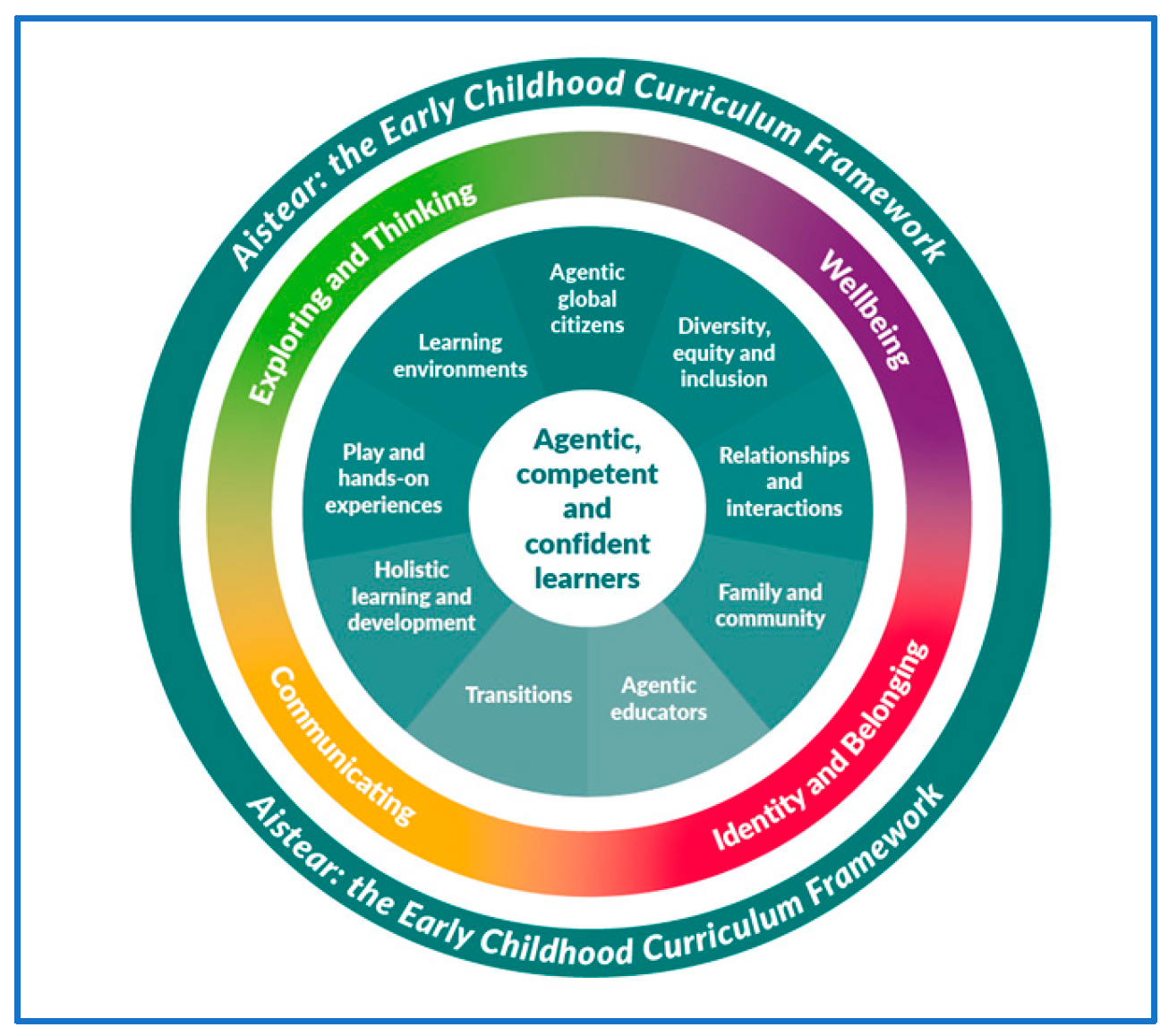
2.1. The Aistear Framework
2.2. The Agentic Early Childhood Educator
2.3. Being and Learning Outdoors
2.4. Challenges to Taking ECEC Practice Outdoors
2.5. Professional Preparation and Practice
3. Methods
3.1. Theoretical Framework
3.2. Research Setting
3.3. Participants and Ethical Considerations
3.4. Data Gathering
3.5. Analysis
3.6. Trustworthiness
4. Findings and Discussion
4.1. Pedagogical Strategies and Inputs
I thought more so, you were there almost as like a floating teacher; because you would tell us what you would like us to do… you would direct us towards what the goal was, and you let us go off [so that] we do it; but you were there still if we didn’t know what to do, or if you saw us doing something that was maybe not the best way to do it,Student Aoife—Group interview #GI3.
4.2. The Learning Disposition of the Students
4.3. New Knowledge for My Practice
4.4. What My Students Gain/Learn/Experience
we’re on to a third [reflection]. But I think, if you get the chance to actually do the reflection yourself and take an experience and put it into the formatted structure, that helps bring it more together. So, I just know from like, the theory, parts of it actually; practically applying them would be good. Even great.Student Ailbhe—Group interview #GI3.
The days that it was kind of drizzling or raining and we kind of went. naah!, whereas now I’m a bit like, we can be outside, you know? Kids don’t get sick. You want them to be outside and to explore and to see things and play with trees and grass and worms and mud. [sic] so I think I have a different approach now to how I would do it in my next placement.—Student Aoife, Group interview #GI2.
4.5. Key Aspects of the Practice
5. Conclusions and Implications for Practice
Author Contributions
Funding
Institutional Review Board Statement
Informed Consent Statement
Data Availability Statement
Acknowledgments
Conflicts of Interest
Appendix A

| Theme | Quotation | Person (Or Pseudonym) | Data Source |
|---|---|---|---|
| Pedagogical strategies and inputs | ‘I think it’s really, really nice to just get hands on and to do the rest yourself’ | Student Áine | 2nd Group interview #GI2 |
| ‘and the lived experience helps you to remember’ | Student Áine | 2nd Group interview #GI2 | |
| ‘I thought more so, you were there almost as like a floating teacher; because you would tell us what you would like us to do… you would direct us towards what the goal was, and you let us go off [so that] we do it; but you were there still if we didn’t know what to do, or if you saw us doing something that was maybe not the best way to do it’ | Student Aoife | 3rd Group interview #GI3 | |
| ‘We had a new element in terms of natural materials with which to create art and to play. The students seemed intrigued; from initially being resistant to doing anything outdoors because the weather was cold, they were now cautiously engaged’ | Author One | Lecturer’s 1st reflection #RJ1 | |
| ‘in our first session outdoors, I encourage the students to explore the environment, and to find elements in nature, with which they can play, and we organised a form of loose parts play in the outdoors’ | Author One | Lecturer’s 1st reflection #RJ1 | |
| The learning disposition of the students | ‘it was interesting to observe the students and to see that some of the students were reticent and holding back; waiting for others to step up’ | Author One | Lecturer’s 4th reflection #RJ4 |
| ‘They were probably used to sitting back and letting things happen, and then at a certain point [they thought] I’m going to have to engage. Whereas I think what we were expecting of them, [sic] is that they would engage from day one. And I think that was probably a big awakening call for many of them’ | Critical friend | 3rd CF Dialogue #CF3 | |
| ‘One of them [the students] talked about the authenticity of the task and the fact that each of the elements that we did, preparing the wood. lighting the fire, [sic] where they had the skills and competence to put it all together. And [for] each of them, this is their own fire’ | Author One | Lecturer’s 2nd reflection #RJ2 | |
| New knowledge for my practice | ‘…somebody’s coming in with the provocative questions or queries and making you think, okay, so you might change the next time. And then we come together, you can have the overall discussion. And I thought, there are lots of different ways of doing this…’ | Author One | 1st CF Dialogue #CF1 |
| What my students gain/learn/experience | ‘We’re on to a third [reflection]. But I think, if you get the chance to actually do the reflection yourself and take an experience and put it into the formatted structure, that helps bring it more together. So, I just know from like, the theory, parts of it actually; practically applying them would be good. Even great.’ | Student Ailbhe | 3rd Group interview #GI3 |
| ‘The days that it was kind of drizzling or raining and we kind of went. naah!, whereas now I’m a bit like, we can be outside, you know? Kids don’t get sick. You want them to be outside and to explore and to see things and play with trees and grass and worms and mud. [sic] so I think I have a different approach now to how I would do it in my next placement.’ | Student Aoife | 2nd Group interview #GI2 | |
| ‘I found myself going outside to read the readings’ | Student Áine | 3rd Group interview #GI3 | |
| ‘…So it was wonderful to hear students, unprompted by me, using words like “building self-efficacy” among the learners; “giving agency to the learners” outdoors’ | Author One | Lecturer’s 4th reflection #RJ4 | |
| Key aspects of the practice | ‘Oh, like, I think I’d say 80% was us, and then 20% was you, like, [sic] you allowed us to learn, you allowed us to explore and give us that agency’ | Student Ailbhe | Group interview #GI3 |
References
- Abbott, K., & Flynn, S. (2022). Outdoor education, interaction and reflection: A study of Irish outdoor ECEC. Irish Educational Studies, 43(3), 371–391. [Google Scholar] [CrossRef]
- Aylward, T. (2022). “Mind the s-step”—A self-study of higher education [Master’s thesis, Munster Technological University]. Available online: https://sword.cit.ie/cgi/viewcontent.cgi?article=1001&context=stemmas (accessed on 22 March 2026).
- Aylward, T., Coulter, M., & Farrelly, T. (2025). Outdoor learning on the edge of Europe: A systematic review of practice from Ireland. Journal of Adventure Education and Outdoor Learning, 1–24. [Google Scholar] [CrossRef]
- Backman, E. (2015). Teaching trainee teachers about outdoor education. In B. Humberstone, H. Prince, & K. A. Henderson (Eds.), Routledge international handbook of outdoor studies (pp. 121–130). Routledge. [Google Scholar]
- Beames, S., & Brown, M. (2016). Adventurous learning, a pedagogy for a changing world. Routledge. [Google Scholar]
- Becker, P. (2008). The European institute for outdoor education and experiential learning: A report about context, foundation, programme and experiences of the first decade of its existence. In P. Becker, & J. Schirp (Eds.), Other ways of learning (pp. 13–56). BSJ Marburg. [Google Scholar]
- Berry, A., & Kitchen, J. (2023). Self-study as expanding our ways of knowing. Studying Teacher Education, 19(2), 125–127. [Google Scholar] [CrossRef]
- Bjørgen, K., & Svendsen, B. (2015). Kindergarten practitioners’ experience of promoting children’s involvement in and enjoyment of physically active play: Does the contagion of physical energy affect physically active play? Contemporary Issues in Early Childhood, 16(3), 257–271. [Google Scholar] [CrossRef]
- Boileau, E., & O’Donoghue, L. (2025). Learning to embrace outdoor pedagogy: Early childhood education student experiences of a nature-focused practicum. Journal of Outdoor and Environmental Education, 28(1), 65–87. [Google Scholar] [CrossRef]
- Braun, V., & Clarke, V. (2019). Reflecting on reflexive thematic analysis. Qualitative Research in Sport, Exercise and Health, 11(4), 589–597. [Google Scholar] [CrossRef]
- Braun, V., & Clarke, V. (2020). One size fits all? What counts as quality practice in (reflexive) thematic analysis? Qualitative Research in Psychology, 18, 328–352. [Google Scholar] [CrossRef]
- Brussoni, M., Ishikawa, T., Brunelle, S., & Herrington, S. (2017). Landscapes for play: Effects of an intervention to promote nature-based risky play in early childhood centres. Journal of Environmental Psychology, 54, 139–150. [Google Scholar] [CrossRef]
- Cetken-Aktas, S., Demirci, G. E., & Sevimli-Celik, S. (2025). Beyond the classroom walls: Outdoor education for pre-service early childhood teachers. Journal of Early Childhood Teacher Education, 1–23. [Google Scholar] [CrossRef]
- Charteris, J., & Smith, J. (2017). Sacred and secret stories in professional knowledge landscapes: Learner agency in teacher professional learning. Reflective Practice, 18(5), 600–612. [Google Scholar] [CrossRef]
- Crimmel, H. (2003). Teaching in the field: Working with students in the outdoor classroom. University of Utah Press. [Google Scholar]
- Cristancho, S., Watling, C. J., & Lingard, L. (2016). Three principles for writing an effective qualitative results section. Perspectives on Medical Education, 5(4), 219–222. [Google Scholar]
- Curtner-Smith, M. D. (2016). Acculturation, recruitment, and the development of orientations. In K. A. R. Richards, & K. Lux Gaudreault (Eds.), Teacher socialization in physical education (pp. 49–62). Routledge. Available online: https://www.taylorfrancis.com/chapters/edit/10.4324/9781315679471-12/acculturation-recruitment-development-orientations-matthew-curtner-smith (accessed on 20 December 2025).
- Daly, M., & Forster, A. (2009). The story of Aistear: The early childhood curriculum framework: Partnership in action. An Leanbh Óg: The OMEP Ireland Journal of Early Childhood Studies, 3(1), 55–72. [Google Scholar]
- Davis-Berman, J., & Berman, D. (2002). Risk and anxiety in adventure programming. Journal of Experiential Education, 25(2), 305–310. [Google Scholar] [CrossRef]
- DCEDIY. (2022). Nurturing skills: The workforce plan for early learning and care and school-age childcare, 2022–2028. The Department of Children, Disability and Equality. Available online: https://assets.gov.ie/static/documents/nurturing-skills-the-workforce-plan-for-early-learning-and-care-and-school-age-childca.pdf (accessed on 15 December 2025).
- DES. (2019). Professional award criteria and guidelines for initial professional education (level 7 and level 8) degree programmes for the Early Learning and Care (ELC) sector in Ireland. Available online: https://assets.gov.ie/30316/784a2158d8094bb7bab40f2064358221.pdf (accessed on 15 December 2025).
- Emirbayer, M., & Mische, A. (1998). What is agency? American Journal of Sociology, 103(4), 962–1023. [Google Scholar] [CrossRef]
- Farrant, K. (2019). Navigating a mirror maze while managing to jump ethics hurdles. In Ethics, self-study research methodology and teacher education (pp. 61–79). Springer. [Google Scholar]
- Ferguson, L. M., Yonge, O., & Myrick, F. (2004). Students’ involvement in faculty research: Ethical and methodological issues. International Journal of Qualitative Methods, 3(4), 56–68. [Google Scholar] [CrossRef]
- Fjørtoft, I., & Sageie, J. (2000). The natural environment as a playground for children: Landscape description and analyses of a natural playscape. Landscape and Urban Planning, 48(1), 83–97. [Google Scholar] [CrossRef]
- Freire, P. (1980). Pedagogy of the oppressed. Bloomsbury Publishing USA. [Google Scholar]
- French, G., & McKenna, G. (2022). Literature review to support the updating of Aistear, the early childhood curriculum framework. Dublin City University. Available online: https://ncca.ie/en/resources/literature-review-to-support-the-updating-of-aistear-the-early-childhood-curriculum-framework/ (accessed on 6 January 2026).
- Frost, G., & Connolly, M. (2015). The road less travelled? Pathways from passivity to agency in student learning. Collected Essays on Learning and Teaching, 8, 47–54. [Google Scholar] [CrossRef]
- Government of Ireland (GoI). (2024). Aistear|Curriculum online. Available online: https://curriculumonline.ie:443/early-childhood/aistear-2024/ (accessed on 6 June 2025).
- Gray, T., & Pigott, F. (2018). Lasting lessons in outdoor learning: A facilitation model emerging from 30 years of reflective practice. Ecopsychology, 10(4), 195–204. [Google Scholar] [CrossRef]
- Hanhikoski, E., & Sevón, E. (2024). Early childhood education and care teachers’ narratives of their professional identity. Journal of Early Childhood Education Research, 13(2), 55–77. [Google Scholar] [CrossRef]
- Harper, N. J., & Obee, P. (2021). Articulating outdoor risky play in early childhood education: Voices of forest and nature school practitioners. Journal of Adventure Education and Outdoor Learning, 21(2), 184–194. [Google Scholar] [CrossRef]
- Hooks, B. (1994). Teaching to transgress: Education as the practice of freedom. Routledge. [Google Scholar] [CrossRef]
- Hug, B., & Möller, K. J. (2005). Collaboration and connectedness in two teacher educators’ shared self-study. Studying Teacher Education, 1(2), 123–140. [Google Scholar] [CrossRef]
- Humberstone, B. (2019). Embodied life-long learning in nature, narratives and older bodies—‘Quit or crash’. Journal of Adventure Education and Outdoor Learning, 19(2), 101–110. [Google Scholar] [CrossRef]
- Hvenegaard, G., & Asfeldt, M. (2007). Embracing friluftsliv’s joys: Teaching the Canadian North through the Canadian wilderness travel experience. In B. Henderson, & N. Vikander (Eds.), Nature first: Outdoor life the friluftsliv way (pp. 168–178). Natural Heritage Books. [Google Scholar]
- Jickling, B., & Blenkinsop, S. (2020). Wilding teacher education: Responding to the cries of nature. Canadian Journal of Environmental Education, 23(1), 121–138. [Google Scholar]
- Kiviranta, L., Lindfors, E., Rönkkö, M.-L., & Luukka, E. (2024). Outdoor learning in early childhood education: Exploring benefits and challenges. Educational Research, 66(1), 102–119. [Google Scholar] [CrossRef]
- Kvalnes, Ø., & Sandseter, E. B. H. (2023). Risky play: An ethical challenge. Springer International Publishing. [Google Scholar] [CrossRef]
- LaBoskey, V. K. (2004). Afterword moving the methodology of self-study research and practice forward: Challenges and opportunities. In J. J. Loughran, M. L. Hamilton, V. K. LaBoskey, & T. Russell (Eds.), International handbook of self-study of teaching and teacher education practices (pp. 1169–1184). Springer. [Google Scholar] [CrossRef]
- Layen, S., & Hattingh, L. (2020). Supporting students’ development through collaborative reflection: Interrogating cultural practices and perceptions of good practice in the context of a field trip. Early Years, 40(3), 306–318. [Google Scholar] [CrossRef]
- Leather, M., Harper, N., & Obee, P. (2021). A pedagogy of play: Reasons to be playful in postsecondary education. Journal of Experiential Education, 44(3), 3. [Google Scholar]
- Lincoln, Y. S., & Guba, E. G. (1985). Naturalistic inquiry. Sage Publications. [Google Scholar]
- Maher, A. J. (2025). Rigour in interpretive qualitative research in education: Ideas to think with. British Educational Research Journal, 51(5), 2099–2115. [Google Scholar] [CrossRef]
- Mann, J., Gray, T., Truong, S., Sahlberg, P., Bentsen, P., Passy, R., Ho, S., Ward, K., & Cowper, R. (2021). A systematic review protocol to identify the key benefits and efficacy of nature-based learning in outdoor educational settings. International Journal of Environmental Research and Public Health, 18(3), 1199. [Google Scholar] [CrossRef] [PubMed]
- Mannion, G., & Lynch, J. (2015). The primacy of place in education in outdoor settings. In B. Humberstone, H. Prince, & K. A. Henderson (Eds.), Routledge international handbook of outdoor studies (1st ed., pp. 85–94). Routledge. [Google Scholar] [CrossRef]
- Martin, A. K., & Russell, T. (2018). Supervising the teacher education practicum: A self-study with a critical friend. Studying Teacher Education, 14(3), 331–342. [Google Scholar] [CrossRef]
- McClintic, S., & Petty, K. (2015). Exploring early childhood teachers’ beliefs and practices about preschool outdoor play: A qualitative study. Journal of Early Childhood Teacher Education, 36(1), 24–43. [Google Scholar] [CrossRef]
- McKenzie, M. (2023). Care in early learning and childcare transitions. International Journal of Educational and Life Transitions, 2(1), 21. [Google Scholar] [CrossRef]
- Mernagh, E. (1987). Outdoor education and the ‘Fringe’ syndrome [Unpublished research paper]. Curriculum Development Unit, Trinity College Dublin.
- Mikuska, E., Fairchild, N., Sabine, A., & Barton, S. (2025). Quality early childhood education and care practices: The importance of skills, knowledge and the early childhood graduate practitioner competences. International Journal of Early Years Education, 33(2), 411–425. [Google Scholar] [CrossRef]
- Moloney, M. (2021). Ireland’s reform agenda: Transforming the early childhood education and care sector into one of the best in the world. In W. Boyd, & S. Garvis (Eds.), International perspectives on early childhood teacher education in the 21st century (pp. 93–109). Springer. [Google Scholar] [CrossRef]
- Murphy, R. (2015). Early childhood education in Ireland: Change and challenge. International Electronic Journal of Elementary Education, 8(2), 287–300. [Google Scholar]
- NCCA. (2024). Consultation report on updating Aistear: Phase 2 (No. 2). National Council for Curriculum and Assessment. Available online: https://ncca.ie/media/nkmbnj0o/phase-2-updating-aistear-consultation-report.pdf (accessed on 6 June 2025).
- North, C. (2020). Interrogating authenticity in outdoor education teacher education: Applications in practice (Vol. 21). Springer. [Google Scholar] [CrossRef]
- North, C., & Dyment, J. (2021). Outdoor education and pedagogical content knowledge: More than class five rapids. In G. Thomas, J. E. Dyment, & H. Prince (Eds.), Outdoor environmental education in higher education (pp. 173–186). Springer. [Google Scholar]
- North, C., Hill, A., Cosgriff, M., Watson, S., Irwin, D., & Boyes, M. (2023). Conceptualisations and implications of ‘newness’ in education outside the classroom. Cambridge Journal of Education, 53(2), 257–274. [Google Scholar] [CrossRef]
- Oke, A., Butler, J. E., & O’Neill, C. (2021). “Who would bother getting a degree when you would be on the exact same pay and conditions…?” Professionalism and the problem with qualifications in early childhood education and care: An Irish perspective. SAGE Open, 11(3), 21582440211031883. [Google Scholar] [CrossRef]
- Oslin, J., Collier, C., & Mitchell, S. (2001). Living the curriculum. Journal of Physical Education, Recreation & Dance, 72(5), 47–51. [Google Scholar] [CrossRef]
- Petrová, Z. (2013). On the relevancy of using Vygotsky’s theoretical framework to legitimize dialogic teaching/learning. Journal of Pedagogy, 4(2), 237–252. [Google Scholar] [CrossRef][Green Version]
- Pinnegar, S., & Hamilton, M. L. (2020). Working in the space between: Conundrums in self-study of practice research. In Exploring self toward expanding teaching, teacher education and practitioner research. Emerald Publishing Limited. [Google Scholar]
- Pithouse-Morgan, K. (2022). Self-study in teaching and teacher education: Characteristics and contributions. Teaching and Teacher Education, 119, 103880. [Google Scholar] [CrossRef]
- Pobal. (2022). Annual early years sector profile report 2020/2021. Pobal. Available online: https://www.pobal.ie/annual-early-years-sector-profile-report-2020-2021/ (accessed on 6 June 2025).
- Rolfe, G., Freshwater, D., & Jasper, M. (2001). Critical reflection for nursing and the helping professions: A user’s guide. Palgrave MacMillan. [Google Scholar]
- Roslund, M. I., Puhakka, R., Grönroos, M., Nurminen, N., Oikarinen, S., Gazali, A. M., Cinek, O., Kramná, L., Siter, N., Vari, H. K., Soininen, L., Parajuli, A., Rajaniemi, J., Kinnunen, T., Laitinen, O. H., Hyöty, H., Sinkkonen, A., & ADELE Research Group. (2020). Biodiversity intervention enhances immune regulation and health-associated commensal microbiota among daycare children. Science Advances, 6(42), eaba2578. [Google Scholar] [CrossRef] [PubMed]
- Sandseter, E. B. H., Cordovil, R., Hagen, T. L., & Lopes, F. (2020). Barriers for outdoor play in Early Childhood Education and Care (ECEC) institutions: Perception of risk in children’s play among European parents and ECEC practitioners. Child Care in Practice, 26(2), 111–129. [Google Scholar] [CrossRef]
- Satina, B., & Hultgren, F. (2001). The absent body of girls made visible: Embodiment as the focus in education. Studies in Philosophy and Education, 20(6), 521–534. [Google Scholar] [CrossRef]
- Siraj, I. (2025). An emergent and inquiry-based curriculum approach in early childhood. NCCA. Available online: https://ncca.ie/media/kcugefoz/an-emergent-and-inquiry-based-curriculum-approach-in-early-childhood.pdf (accessed on 20 December 2025).
- Stevens, S., & Thompson, K. (2022). Contradictions and realisations—A critical friendship in the pursuit of transformative PETE. Curriculum Studies in Health and Physical Education, 13(3), 238–252. [Google Scholar] [CrossRef]
- Storli, R., & Hagen, T. L. (2010). Affordances in outdoor environments and children’s physically active play in pre-school. European Early Childhood Education Research Journal, 18(4), 445–456. [Google Scholar] [CrossRef]
- Storli, R., & Sandseter, E. B. H. (2019). Children’s play, well-being and involvement: How children play indoors and outdoors in Norwegian early childhood education and care institutions. International Journal of Play, 8(1), 65–78. [Google Scholar] [CrossRef]
- Taylor, A., O’Malley, M., O’Callaghan, R., & Goodwin, J. (2025). Exploring the use of sea swimming as an intervention with young people with mental health challenges: A qualitative descriptive study. International Journal of Mental Health Nursing, 34(1), e70000. [Google Scholar] [CrossRef] [PubMed]
- Thomas, G., Dyment, J., & Prince, H. (2021). Outdoor environmental education in higher education: International perspectives. Springer. [Google Scholar]
- Vaisburg, A. V. (2015). The effective occupational socialization of specialists: A model and the reality. Asian Social Science, 11(3), 344. [Google Scholar]
- von Braun, J. (2017). Children as agents of change for sustainable development. In A. M. Battro, P. Léna, M. Sánchez Sorondo, & J. von Braun (Eds.), Children and sustainable development: Ecological education in a globalized world (pp. 17–30). Springer International Publishing. [Google Scholar] [CrossRef]
- Vygotsky, L. (1980). Mind in society. Harvard University Press. [Google Scholar]
- Walshe, P. (2025). Reflecting on the implementation of Aistear in advance of an update to the curriculum framework. Irish Educational Studies, 44(3), 401–420. [Google Scholar] [CrossRef]
- Wattchow, B., Jeanes, R., Alfrey, L., Brown, T., Cutter-Mackenzie, A., & O’Connor, J. (2014). Socioecological educator. Springer. [Google Scholar]
- Wineberg, L. P. (2023). Let’s go outside: Preparing early childhood educators to teach outdoors. International Journal of Early Childhood Environmental Education, 11(1), 63–73. [Google Scholar]
- Wolf, C., Kunz, P., & Robin, N. (2022). Emerging themes of research into outdoor teaching in initial formal teacher training from early childhood to secondary education—A literature review. The Journal of Environmental Education, 53(4), 199–220. [Google Scholar] [CrossRef]

| Data Type | Description | When/How Often | Participant/s |
|---|---|---|---|
| Lecturer’s Reflective Journal | These reflections were informed by field notes and followed a model (Rolfe et al., 2001) to format reflections. This variation on Rolfe’s original model involved 16 subquestions derived from the original What? So What? And Now What? | Completed bi-weekly after week 2, week 4, week 6, week 8, week 10, and week 12 (n = 5) | Author One |
| Critical Friendship Dialogue | The lecturer’s reflective journals were shared in advance with the critical friend (CF). An agreed agenda of standing items for discussion was augmented with issues from the reflective journals (Martin & Russell, 2018). Face-to-face dialogues lasted an average of 31 min. Feedback and further questions were provided by the CF. | Completed after week 4, after week 8, and after week 12 (n = 3) | Critical friend and Author One |
| Group interviews | These semi-structured interviews focused on how students perceived, experienced, and evaluated the teaching and learning structures provided by the lecturer on the ECEC Outdoors module, and their opinions on how the teaching shaped their confidence and future practice needs as educators. Two interviews were held in the woodlands at the outdoor classroom, and one indoors (after the module was completed). The interviews lasted an average of 27 min. | 3 semi-structured interviews pre-module, at the mid-point of the module, and post-module (n = 3) | Students (n = 6) |
Disclaimer/Publisher’s Note: The statements, opinions and data contained in all publications are solely those of the individual author(s) and contributor(s) and not of MDPI and/or the editor(s). MDPI and/or the editor(s) disclaim responsibility for any injury to people or property resulting from any ideas, methods, instructions or products referred to in the content. |
© 2026 by the authors. Licensee MDPI, Basel, Switzerland. This article is an open access article distributed under the terms and conditions of the Creative Commons Attribution (CC BY) license.
Share and Cite
Aylward, T.; Coulter, M.; Farrelly, T. Preparing Innovative ECEC Educators: A Self-Study of Outdoor Pedagogy in Higher Education. Educ. Sci. 2026, 16, 989. https://doi.org/10.3390/educsci16070989
Aylward T, Coulter M, Farrelly T. Preparing Innovative ECEC Educators: A Self-Study of Outdoor Pedagogy in Higher Education. Education Sciences. 2026; 16(7):989. https://doi.org/10.3390/educsci16070989
Chicago/Turabian StyleAylward, Tomás, Maura Coulter, and Tom Farrelly. 2026. "Preparing Innovative ECEC Educators: A Self-Study of Outdoor Pedagogy in Higher Education" Education Sciences 16, no. 7: 989. https://doi.org/10.3390/educsci16070989
APA StyleAylward, T., Coulter, M., & Farrelly, T. (2026). Preparing Innovative ECEC Educators: A Self-Study of Outdoor Pedagogy in Higher Education. Education Sciences, 16(7), 989. https://doi.org/10.3390/educsci16070989