Article

Yearly Trends in Preschoolers’ Cognitive and Affective Outcomes in a Multimedia-Assisted Theme-Based English and Chinese Learning Program


1
Department of Convergence Education, International Convergence Graduate School, Seokyeong University, Seoul 02713, Republic of Korea
2
Laughing Peanut Children’s Foundation, Seongnam-si 13530, Republic of Korea
*
Author to whom correspondence should be addressed.
Educ. Sci. 2026, 16(7), 1085; https://doi.org/10.3390/educsci16071085
Submission received: 21 May 2026 / Revised: 19 June 2026 / Accepted: 2 July 2026 / Published: 7 July 2026
(This article belongs to the Special Issue Pedagogy in Early Years Education)

Abstract

Long-term analyses of year changes in preschoolers’ cognitive and affective development are limited. This field-based study examined yearly trends in a multimedia-assisted, theme-based English and Chinese program in South Korean daycare centers (2022–2024). Participants included 112, 120, and 124 children aged 3–5 annually. Changes were analyzed for cognitive (vocabulary/sentence comprehension and expression) and affective (learning interest, confidence, and motivation) domains. Group differences based on duration of enrollment (three years vs. less than three years) were examined among five-year-old children. Significant cognitive gains occurred for both languages across all three years. Affective development was significant for both languages in 2022 and 2023; however, in 2024, significant positive changes persisted for English across all subdomains, while for Chinese, only confidence improved. Correlation patterns varied by year and language; notably, English motivation was significantly associated with selected cognitive domains in the third year. Furthermore, group comparisons indicated that children enrolled for three years demonstrated better performance in both English and Chinese than those enrolled for less than three years, with statistically significant differences particularly evident in sentence expression. These findings underscore the value of developmentally appropriate and engaging learning contexts that foster both the cognitive and affective dimensions of early learning.

1. Introduction

Early childhood is a sensitive period for language development. Chomsky (1972) proposed the innate Language Acquisition Device (LAD), which suggests heightened learning capacity in early childhood. During this period, children rapidly expand their ability to express thoughts and emotions through interactions. Around the age of four, they often demonstrate accelerated linguistic development, playful language use, and creative word formation (Krashen, 1981).
Support for early foreign language learning is grounded in both theoretical and neurodevelopmental perspectives. Neuroscientific findings indicate that brain plasticity and ongoing lateralization may provide favorable conditions for bilingual and multilingual learning (Mariani et al., 2023; Potdevin et al., 2023). Exposure to multiple languages has been linked to the activation of cognitive processing regions and cognitive flexibility, with potential long-term benefits (García & Wei, 2014; Kroll & Dussias, 2017). However, developmentally inappropriate or overly structured instruction may place undue stress on young children and constrain free thought during the critical period of first-language development (Chen et al., 2020; Tuyet, 2020; Yong & Lee, 2018).
Scholars continue to debate whether educational efforts should prioritize creative expression in the first language or whether foreign language education should begin during this period (Ma, 2018; Thieme et al., 2022). However, beyond the question of when foreign language education should begin, a key question concerns how it should be implemented. Fostering engagement may represent a developmentally appropriate approach to foreign language learning that can produce measurable benefits. In EFL contexts such as Korea, children have limited opportunities for naturalistic foreign language use. Accordingly, approaches that foster interest and provide meaningful exposure and interaction are essential. Multimedia-assisted theme-based integrated learning has been proposed as a practical strategy for connecting play-based experiences with language input and addressing environmental constraints (Jung et al., 2025; E. M. Lim, 2021).

1.1. Educational Context and the Role of Multimedia-Assisted Theme-Based Integrated Learning

Early childhood education in Korea is guided by the 2019 Revised Nuri Curriculum, which emphasizes child-centered, play-based learning and flexible implementation. While children’s interests are positioned at the core of curriculum planning, early foreign language education has often relied on vocabulary- or drill-focused activities, raising concerns about alignment with play-centered principles (E. M. Lim, 2021). Given the limited environmental exposure in an EFL setting, developmentally appropriate pedagogy is crucial (Na & Rhee, 2017).
For young learners, connected language input embedded in meaningful contexts—rather than fragmented phonics-driven instruction—supports more effective learning, particularly through integrated listening and speaking activities (Seo & Lee, 2021). Multimedia resources can strengthen meaning-making by combining visual and auditory cues while reducing instructional burden and increasing engagement (Jung et al., 2025; S.-K. Lee et al., 2019; Mayer, 2009). Furthermore, theme-based integrated learning provides an organizing framework that links language learning to children’s lived experiences and broader developmental domains (Cho & Son, 2009; Choi, 2015).

1.2. Early Childhood Foreign-Language Learning and Affective Development

Given that young children have limited sustained attention to task-oriented activities and may not yet possess stable learning motives, maintaining positive affect—especially interest and confidence—is central to early foreign language education. For preschoolers, language learning is often experienced as “play,” and the affective responses shaped through these experiences can shape later participation and attitudes.
Prior research suggests that exposure to foreign languages can be associated with positive outcomes across cognitive and affective domains (Berk, 2013). Cognitive advantages have been observed in attention and flexibility (Halliwell, 1992), while affective benefits include increased willingness to express oneself, interest, confidence, and more positive attitudes toward learning (Beck et al., 2002; Lipman, 2005). Affective factors are particularly influential among younger learners (Na & Rhee, 2017). Negative emotions (e.g., anxiety and withdrawal) may reduce participation (An, 2022), whereas positive affect (interest, confidence, and motivation) facilitates engagement and persistence (Alzahrani et al., 2019; Graziano et al., 2007; Heo, 2016; Shala, 2013). Together, these findings suggest that early foreign language can foster not only language proficiency, but also affective development that underpins sustained engagement in learning.

1.3. The Present Study

Previous research has often focused on short-term effects, English-only programs, or linguistic achievement, with limited attention to affective development (Nikolov & Mihaljević Djigunović, 2023; Thieme et al., 2022). Long-term analyses integrating cognitive achievement and affective development using accumulated field data remain rare. This study extends existing evidence by examining English and Chinese outcomes over three years and exploring year-by-language variation in cognitive–affective relationships. A multimedia-assisted, theme-based integrated learning approach was designed as a play-centered program using stories, songs, and games with a spiral structure (repetition and extension) and implemented in authentic childcare settings. Multimedia materials were used to present contextualized input and support expressive development. This study addresses the following research questions:
RQ1: What yearly trends were observed from 2022 to 2024 in preschoolers’ cognitive and affective outcomes following participation in the program?
RQ2: How did the relationships between cognitive and affective domains vary across years from 2022 to 2024?
RQ3: Among five-year-old children, were there differences in cognitive and affective outcomes according to cumulative enrollment duration—specifically, three years versus less than three years?

2. Materials and Methods

2.1. Research Design

This study used a repeated cross-sectional trend analysis design to examine yearly changes in preschoolers’ cognitive and affective outcomes over a three-year period (2022–2024). Rather than follow the same children longitudinally, data were collected from comparable groups of preschoolers who participated in the same multimedia-assisted theme-based English and Chinese learning program each year. This design was adopted because it was practically difficult to track the same cohort over time owing to graduation or institutional mobility.
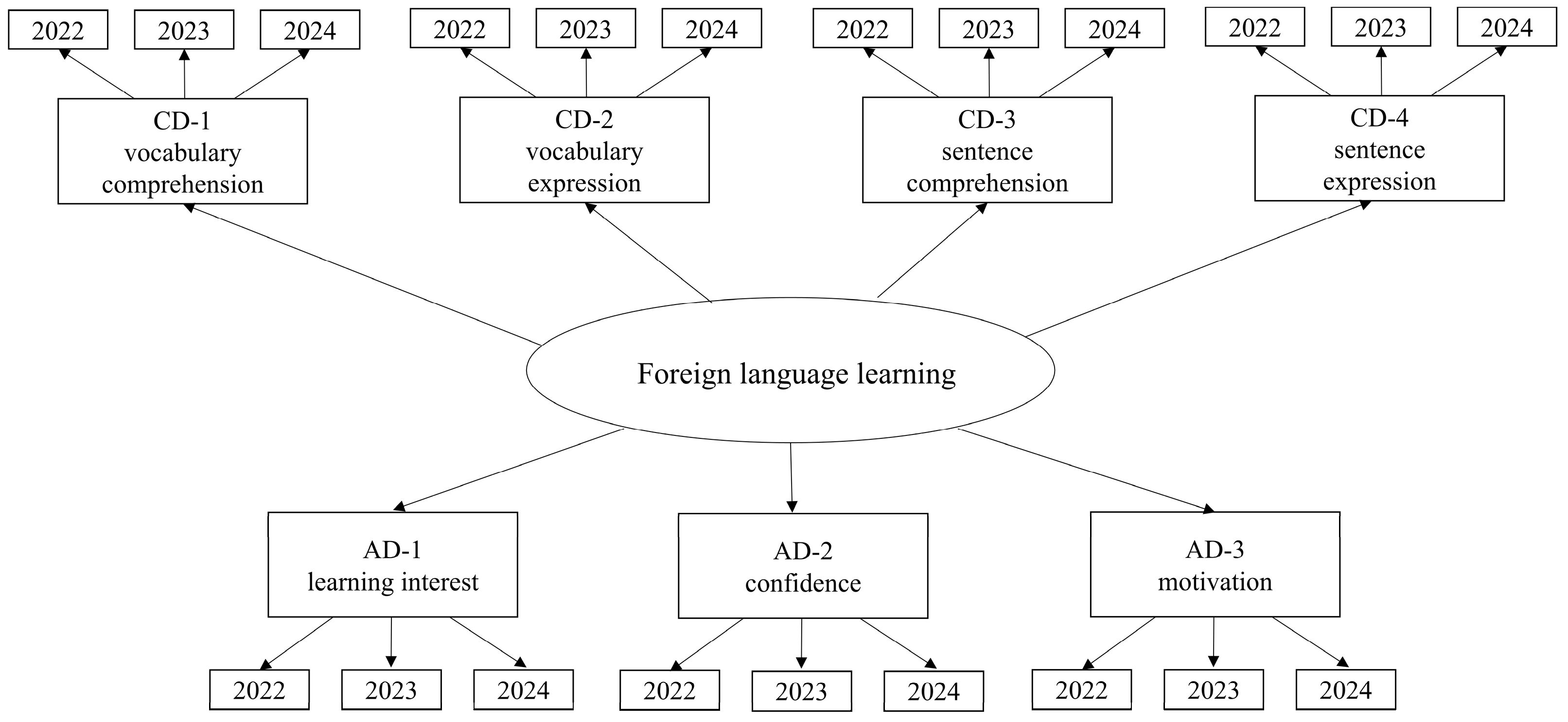
Figure 1 depicts the overall research model. It shows that preschoolers participated in the program during each academic year from 2022 to 2024 and that program-related outcomes were assessed in two domains: the cognitive domain (CD) and the affective domain (AD). The cognitive domain included vocabulary comprehension, vocabulary expression, sentence comprehension, and sentence expression. The affective domain included learning interest, confidence, and motivation. By comparing these outcome indicators across the three years, this study aimed to identify trends in children’s cognitive and affective development within a comparable educational context.
The study period was restricted to 2022–2024 because these years represented a phase of regular curriculum implementation. Data prior to 2022 were not included because the COVID-19 pandemic disrupted the stable implementation of the program in early childhood education settings. Since 2022, the same curriculum and comparable assessment procedures have been implemented over three consecutive years. Accordingly, the present study analyzed data collected from 2022 to 2024 to examine yearly trends in preschoolers’ cognitive and affective outcomes following program participation.

2.2. Ethical Considerations

This study was conducted as an internal research project using anonymized data collected as part of the regular educational program. It did not involve any additional intervention, procedure, or data collection beyond the regular curriculum. Written informed consent regarding program participation and the use of data for research purposes was obtained from parents or legal guardians at the time of enrollment (Supplementary Materials S1). This study was not submitted to or reviewed by a separate institutional ethics committee; therefore, no approval code or date was issued. The study adhered to internal research ethics guidelines and procedures. The collected data were used solely for research purposes and were stored securely. During data analysis and reporting, all personally identifiable information was removed or de-identified to protect participants’ privacy and rights.

2.3. Participants

The participants were preschool children aged three to five years attending two workplace daycare centers in Seongnam City, Gyeonggi Province, South Korea. Seongnam City is an urban municipality located in the Seoul metropolitan area; the participating centers were workplace-based early childhood education and care settings. Thus, the study was conducted in relatively similar institutional and urban educational contexts across the study period.
Participants were recruited from among children enrolled in the regular English and Chinese learning program at the two participating centers between 2022 and 2024. Children were included in the final analysis if their parent or legal guardian gave consent for program participation and data use, they completed the required assessments, and they remained enrolled during the assessment period. Children were excluded if consent was not provided, assessment was not feasible, they had a long-term absence before the pre-test, or they left the institution or moved during the pre- to post-assessment period.
The initial numbers of enrolled children were 138 in 2022, 140 in 2023, and 138 in 2024. After excluding children due to non-consent, assessment difficulty, long-term absence, or attrition between the pre- and post-assessments, the final analytic samples included 112 children in 2022, 120 children in 2023, and 124 children in 2024. Table 1 presents the recruitment process and final sample size by year. Table 2 shows participant characteristics by year, age group, center, and sex.

2.4. Program Content

The multimedia-assisted theme-based foreign language program targeted children aged three to five years and aimed to support foundational communication skills in English and Chinese through developmentally appropriate, play-centered learning. The content was organized around four life themes—me, my family, and neighbors; nature and the environment; objects; and culture—and incorporated digital materials such as stories and songs. Classes were delivered by homeroom teachers five times per week for 30 min and followed a spiral structure emphasizing repetition and extension. Multimedia input, including visual and auditory stimuli, was used to support comprehension and expression and facilitate classroom implementation by the teachers.
The program had been implemented as part of the regular curriculum before the 2022–2024 analysis period. Prior to the study period, the program materials and classroom procedures had been reviewed and refined through regular classroom use and teacher feedback. Therefore, the present study examined the program during a phase of stable curriculum implementation rather than during an initial pilot test.
During the study period, the core curriculum structure, target themes, instructional sequence, weekly schedule, and assessment framework remained consistent across the three years. Minor adaptations were made when necessary to improve classroom implementation, such as refining multimedia materials, teacher guidance, or examples used in class. However, these adaptations did not change the main learning objectives, thematic structure, instructional frequency, or assessment domains. This consistency allowed for examining yearly trends in children’s cognitive and affective outcomes within a comparable program context.

2.5. Instruments

2.5.1. Cognitive Domain Measures

The cognitive domain consisted of four subdomains: vocabulary comprehension, vocabulary expression, sentence comprehension, and sentence expression. The comprehension tasks were divided into vocabulary- and sentence-level items. For these tasks, children listened to a target foreign-language word or sentence through an audio icon embedded in the digital device and selected the picture that best matched its meaning from three options. The vocabulary expression task required children to look at a presented picture and produce the corresponding target foreign-language word. The sentence expression task required children to listen to an audio-recorded question presented through the digital device and produce an appropriate sentence in the target language based on the presented picture.
The cognitive assessments were administered individually using digital devices. Each item was scored on a three-point scale ranging from 1 to 3, with higher scores indicating higher levels of foreign-language comprehension or expression. For comprehension items, correct responses were scored as 3 points and incorrect responses as 1 point. For vocabulary expression items, 3 points were assigned when the child accurately produced the target word, 2 points when the child appeared to recognize the target word but produced a partially accurate response with limited pronunciation or expressive accuracy, and 1 point when the response was unrelated to the target word or when no response was provided. For sentence expression items, 3 points were assigned when the child accurately produced a sentence that matched the meaning of the picture and question, 2 points when the response included part of the target expression but showed limited sentence structure, pronunciation, or expressive accuracy, and 1 point when the response was unrelated to the picture or question or when no response was provided.
To enhance scoring objectivity, children’s oral responses were video- or audio-recorded. A field evaluator who had received the scoring criteria conducted the initial scoring, and a second rater subsequently reviewed the recorded responses and conducted an independent second scoring. Before the main scoring process, preliminary scoring was conducted using a subset of the data, and the scoring criteria were reviewed through consultation with native speakers and a professor specializing in phonetics. When discrepancies occurred between raters, the scores were discussed based on the predefined scoring criteria, and the final score was determined by consensus.
The content validity of the cognitive domain measures was reviewed by four experts in early childhood education, educational assessment, and foreign language education. The experts examined the appropriateness of the assessment content, task format, target age, and developmental suitability. Internal consistency reliability was examined using Cronbach’s alpha. Table 3 presents the item composition and assessment types for each subdomain, and Table 4 presents the age-specific assessment activities and reliability coefficients. Examples of the assessment interface and sample assessment items are provided in Supplementary Materials S2.

2.5.2. Affective Domain Measures

The affective domain measurement tool was developed based on a scale originally proposed by Brown (2000) and later modified and supplemented by Na and Rhee (2017). In the present study, the instrument was restructured to align it with the research objectives and developmental characteristics of young children. The final version comprised three subdomains: interest in foreign language learning, confidence in foreign language expression, and motivation for foreign language learning.
The affective domain assessment was administered using visual stimuli presented on digital devices. Children selected images representing positive, neutral, or negative feelings in response to each item. Responses were scored on a three-point Likert scale, with higher scores indicating more positive affective responses. The content of the affective domain measure was reviewed by four experts in early childhood education, educational assessment, and foreign language education, as well as three master’s-level researchers specializing in early childhood education. Internal consistency reliability was examined using Cronbach’s alpha. Table 5 presents the subdomain structure and reliability coefficients of the affective domain instrument. The full set of items is provided in Supplementary Materials S3.

2.6. Procedure

This study was conducted over three years, from March 2022 to November 2024. The same procedures were applied annually to ensure consistency across the study period. Each year, evaluator training and pre-tests were conducted in March. Evaluator training focused on assessment criteria, administration procedures, and recording methods.
Pre-tests were administered individually to children during free-choice activity time at the daycare centers. Both cognitive and affective assessments were administered using digital devices, and total assessment time was approximately 15 to 20 min per child. The program was implemented from April to August each year as part of regular class time, covering Units 1 through 10. Post-tests were administered from September onward each year under the same conditions and procedures as the pre-tests. All collected data were coded and cleaned prior to statistical analysis.

2.7. Statistical Analysis

To examine the yearly changes in children’s cognitive and affective outcomes following program participation, paired t-tests were conducted on pre- and post-test scores for both the cognitive and affective domains. Pearson’s correlation analysis was performed to examine the relationships between the two domains. Additionally, analysis of covariance (ANCOVA) was conducted to test group differences based on program participation duration (three years vs. less than three years), with pre-test scores entered as covariates. All analyses were performed using IBM SPSS Statistics 30.

3. Results

3.1. Cognitive Domain

Yearly comparisons of cognitive domain scores revealed statistically significant pre–post increases for both English and Chinese across all three years (all p < 0.001). For English, the mean pre–post difference increased over time (Year 1 [2022]: 1.71; Year 2 [2023]: 1.88; Year 3 [2024]: 1.89), suggesting a gradual increase across years. For Chinese, the mean differences were 1.73 (2022), 1.71 (2023), and 1.74 (2024), indicating similar gains in Years 1 and 3, with a slightly smaller difference in Year 2 (Table 6).

3.2. Affective Domain

For English, statistically significant pre–post differences were observed for most affective subdomains across the three years (Table 7). Post-test means reached their highest level in Year 3 (2024; AD overall M post = 4.34), with interest (4.40), confidence (4.39), and motivation (4.25) all reaching their peak levels. Regarding statistical significance, interest and motivation were significant in 2022 (p < 0.001 and p < 0.01, respectively), confidence and motivation were significant in 2023 (p < 0.001 and p < 0.01, respectively), and all affective subdomains showed significant pre–post differences in 2024 (all p < 0.001).
For Chinese, significant pre–post differences were found across all affective subdomains in 2022 and 2023. In 2024, however, only confidence showed a significant increase (M pre = 4.03, M post = 4.18, p < 0.05), whereas changes in interest and motivation were not statistically significant (e.g., interest M pre = 4.36). When affective domain scores in 2024 were compared across languages, English showed higher post-test scores than Chinese across all affective subdomains.

3.3. Trends in Correlations Between Cognitive and Affective Domains by Year

Correlations between affective factors (interest, confidence, and motivation) and cognitive domain scores (vocabulary and sentence comprehension/expression) varied by year and language (Table 8). For English, significant associations were observed only in selected subdomains in 2022 and 2023, with no consistent pattern. In 2024, however, motivation (AD-3) showed relatively more pronounced associations with the overall cognitive domain and selected subdomains. For Chinese, comparatively stronger correlations were observed across the cognitive and affective domains in 2022 and 2023, particularly in 2023, where multiple significant correlations centered on interest and confidence. In contrast, correlations generally diminished in 2024.

3.4. Group Differences Based on Enrollment Duration

Table 9 presents the comparison of cognitive domain scores between the two groups based on enrollment duration, while Table 10 shows the ANCOVA results for the cognitive domain. ANCOVA was conducted to examine group differences by cumulative enrollment duration (3 years vs. <3 years), controlling for pre-test scores. For English, the 3-year group showed a higher adjusted posttest mean for the overall cognitive domain (adjusted M = 4.22) than the <3-year group (adjusted M = 4.06), with the largest difference observed in sentence expression (CD-4; Table 9). For Chinese, the 3-year group also demonstrated a higher adjusted posttest mean (adjusted M = 3.70) than the < 3-year group (adjusted M = 3.36), with relatively larger group differences in speaking-based measures than in listening-based measures (Table 9). The ANCOVA results indicated a statistically significant group difference in sentence expression (CD-4) for both English (F = 4.04, p < 0.05) and Chinese (F = 3.39, p < 0.05) (Table 10). No significant group differences were found for vocabulary comprehension, vocabulary expression, or sentence comprehension.

4. Discussion

This study implemented a multimedia-assisted theme-based language program with young children aged three to five years over three consecutive years (2022–2024) and examined year-to-year trends in cognitive and affective outcomes in early foreign language learning. Additionally, differences by enrollment duration (three years vs. less than three years) were examined among five-year-olds.

4.1. Yearly Changes in the Cognitive Domain

Both English and Chinese showed statistically significant gains in the cognitive domain across all three years. These findings align with theoretical perspectives that view early childhood as a sensitive period for language acquisition and suggest that early exposure contributes to the formation of foundational cognitive mechanisms for language processing (Elliot, 1981; Lado, 1976; Pang, 2022; Thieme et al., 2022). Notably, the magnitude of pre–post gains increased over time, with this pattern being more pronounced in English. This trend may be explained by the EFL context, in which English often offers relatively greater opportunities for exposure and use in children’s everyday environments. These results indicate that cross-linguistic differences in learning outcomes may be shaped not only by language-specific features but also by contextual and environmental factors surrounding learning.

4.2. Yearly Changes in the Affective Domain

In 2022 and 2023, both English and Chinese demonstrated significant overall gains in the affective domain. In 2024, however, only confidence showed a significant improvement for Chinese. This pattern suggests that affective responses may vary over time depending on language-specific learning conditions and the nature of each affective construct. Confidence—unlike interest or motivation—is more directly related to children’s perceived ability to perform a learning task and their willingness to attempt speech (M. Liu & Du, 2024). In the Korean early childhood context, Chinese may be perceived as a relatively new and unfamiliar language experience. When such unfamiliar language experiences are supported through developmentally appropriate task design, repeated exposure, multimedia-based visual and auditory cues, teacher scaffolding, and positive feedback, children may gradually develop a sense of “I can do it.” These small, successful experiences may have contributed to the observed increase in confidence.
By contrast, interest and motivation may require broader, more sustained conditions, such as personal relevance, enjoyment, autonomous engagement, and continued opportunities for meaningful use. Therefore, the finding that confidence increased while interest and motivation did not show significant changes in 2024 may indicate that children became more willing to try Chinese expressions within structured learning situations, even though their broader interest in or motivation toward Chinese learning did not increase to the same extent. In this sense, confidence may function as a task-related emotional resource that supports children’s participation and attempts to use speech, particularly when the target language is relatively unfamiliar. Further research is needed to clarify why confidence, rather than interest or motivation, showed a significant improvement in Chinese in 2024.

4.3. Trends in Correlations Between the Cognitive and Affective Domains

The strength of the relationships between cognitive and affective domains differed by year and by language. For Chinese, correlations generally weakened in the third year, which may be associated with comparatively limited opportunities for exposure and use, as well as structural features of the instructional environment (J. E. Lee et al., 2022). For affective readiness to translate into learning outcomes, children must be provided with sufficient opportunities for interaction, feedback, and learner-initiated production (Long, 1996). When such conditions are not met, interest or confidence may not consistently activate learning behaviors, thereby weakening the link between affective and cognitive development.
Despite these variations, there were significant correlations between the two domains. This finding is consistent with prior research indicating that interest and motivation lower affective filters and facilitate language acquisition (Brown, 2000; Jo & Kim, 2012; Krashen, 1981). Notably, in 2024, motivation in English learning showed a relatively strong association with the overall cognitive domain. This emphasizes that motivation may be a central factor associated with learning gains in EFL contexts (Gardner, 1985; Y. R. Lim, 2017; Pham, 2021; Shaharuddin et al., 2024) and highlights the importance of pedagogical strategies that enhance motivation in early childhood foreign language education.

4.4. Examination of Differences Between Groups Based on Duration

The comparison among five-year-olds revealed that the three-year enrollment group consistently outperformed the group with less than three years of participation. This finding accords with previous research demonstrating a positive association between learning continuity and language acquisition (E. Liu & Wang, 2021). In language learning, time investment increases exposure to input, opportunities for interaction, and occasions for output, thereby promoting automatization and proficiency. The largest between-group difference emerged in sentence expression. Sentence-level production is strengthened through sustained exposure to meaningful input and authentic communicative contexts (Krashen, 1985), and expressive development is further facilitated in environments rich in teacher–child–peer interaction (Long, 1996). These results emphasize that continuous interaction and meaning-focused activities are central to young children’s foreign language development.

4.5. Limitations and Directions for Future Studies

This study has several limitations. First, participants were drawn from workplace childcare centers of a single corporation, limiting generalizability due to relatively homogeneous socio-economic backgrounds. Future studies should include more diverse regions and populations. Second, this study did not include a control group. Therefore, although the observed gains in English and Chinese are meaningful in the context of foreign language learning, they cannot be attributed solely to the multimedia-assisted theme-based program. Other developmental and contextual factors—such as children’s maturation, prior or additional language exposure, classroom environment, teacher support, and home learning experiences—may have also contributed to the observed changes. Future studies should employ experimental or quasi-experimental designs with appropriate comparison groups to more rigorously examine the program-related contribution to children’s foreign language learning outcomes. Third, this study adopted a trend analysis rather than a longitudinal design; thus, individual developmental trajectories could not be examined. Fourth, although the cognitive and affective domain instruments were reviewed by experts, and internal consistency and reliability were examined, exploratory and confirmatory factor analyses were not conducted to verify construct validity. As the present study was not designed as an instrument development or validation study, the findings should be interpreted with this limitation in mind.
Future research should examine instructional strategies that strengthen expressive skills, which tend to lag behind comprehension. In the affective domain, motivation should be differentiated. While prior studies have focused on extrinsic motivation, future work should explore the role of intrinsic motivation—such as the joy of learning and communication—in shaping young children’s engagement and achievement (Dörnyei, 1994; Ellis, 1985; Pham, 2021; Shaharuddin et al., 2024). Distinguishing between intrinsic and extrinsic motivation may help clarify motivational mechanisms in early childhood foreign language education.
In addition, future studies should further examine whether children’s learning outcomes differ according to learning context, age, and sex. Because the present study primarily focused on yearly trends in cognitive and affective outcomes, subgroup analyses by age and sex were not conducted. However, these factors may influence children’s foreign-language learning experiences and outcomes. Therefore, future research with larger, more diverse samples should investigate the potential effects of contextual and demographic factors through subgroup or interaction analyses.

4.6. Implications

By employing a three-year trend analysis, this study extends beyond cross-sectional approaches and elucidates the temporal dynamics between cognitive and affective development in early foreign language learning. The findings suggest that early foreign language education not only enhances language learning but also fosters affective foundations—interest, confidence, and motivation—that may support later academic learning (Hong & Heo, 2013; Kang & Won, 2011; Pham, 2021; Shaharuddin et al., 2024).
These results indicate that foreign language learning in early childhood should be designed as a meaningful, developmentally appropriate experience embedded in play and everyday classroom activities, rather than as isolated or drill-based instruction.
This study contributes to the field by providing multi-year, trend-based evidence from an authentic early childhood education setting and by examining cognitive and affective domains together within a regular early childhood education setting. It also aligns with current educational approaches that emphasize holistic development, play-based learning, learner engagement, and the meaningful use of digital media to support young children’s learning experiences. In this regard, this study has practical implications for early childhood institutions and policymakers seeking to design developmentally appropriate, digitally supported foreign language programs within regular classroom contexts.

5. Conclusions

In EFL contexts, where exposure to the target language is largely limited to the classroom, instructional approaches that stimulate children’s interest and curiosity are particularly critical. The findings of this study suggest that developmentally appropriate and engaging learning contexts may provide meaningful opportunities for interaction and foreign language learning. Specifically, the observed yearly trends indicated that a multimedia-assisted, theme-based integrated approach was associated with gains in young children’s English and Chinese learning outcomes, as well as affective factors, including interest, confidence, and motivation. Trend analysis further showed that learning gains were observed over time, with sustained participation associated with higher levels of achievement. Ultimately, this study highlights the importance of carefully designed and implemented instructional approaches in early foreign language education.

Supplementary Materials

The following supporting information can be downloaded at: https://www.mdpi.com/article/10.3390/educsci16071085/s1. Supplementary Materials S1: Research Participation Consent Form; Supplementary Materials S2: Examples of Cognitive Domain Assessment; Supplementary Materials S3: Examples of Affective Domain Assessment.

Author Contributions

Conceptualization, H.J., J.S. and J.O.G.; methodology, H.J., J.S. and J.O.G.; material preparation, H.J. and J.S.; data collection, H.J. and J.S.; formal analysis, J.O.G.; writing—original draft preparation, J.O.G.; writing—review and editing, H.J.; supervision, J.O.G. All authors have read and agreed to the published version of the manuscript.

Funding

This study was supported by research funding from the Laughing Peanut Children’s Foundation. No specific grant number was assigned.

Institutional Review Board Statement

Ethical review and approval were waived for this study. This study was conducted as part of an institutional educational program at Institution L in South Korea and adhered to the institution’s research ethics guidelines and internal procedures. According to local regulations, formal Institutional Review Board (IRB) approval was not required for this type of study.

Informed Consent Statement

Written informed consent regarding participation and data use was obtained from parents or legal guardians at the time of enrollment (Supplementary Materials S1). The collected data were used solely for research purposes and were stored securely. During data analysis and reporting, all personally identifiable information was removed or anonymized to protect participants’ privacy and rights.

Data Availability Statement

The datasets generated and/or analyzed during the current study are not publicly available because of ethical and privacy restrictions related to identifiable data from young children but are available from the corresponding author upon reasonable request.

Acknowledgments

The authors would like to thank the staff and participating children at affiliated early childhood education centers for their cooperation and support throughout the study.

Conflicts of Interest

Some authors are employees of the Laughing Peanut Children’s Foundation, which provided the data used in this study. The authors affiliated with the foundation were involved in data management and manuscript preparation. However, the funding body and affiliated institutions had no role in the study design, data analysis, interpretation of results, or decision to publish.

Abbreviation

The following abbreviation is used in this manuscript:
LADLanguage acquisition device

References

  1. Alzahrani, M., Alharbi, M., & Alodwani, A. (2019). The effect of social-emotional competence on children academic achievement and behavioral development. International Education Studies, 12(12), 141–149. [Google Scholar] [CrossRef]
  2. An, M. K. (2022). The effect of online English learning on pre-schoolers’ learning attitudes and emotions [Master’s thesis, Hankuk University of Foreign Studies]. [Google Scholar]
  3. Beck, I. L., McKeown, M. G., & Kucan, L. (2002). Bringing words to life: Robust vocabulary instruction. Guilford Press. [Google Scholar]
  4. Berk, L. E. (2013). Child development (9th ed.). Pearson Education. [Google Scholar]
  5. Brown, H. D. (2000). Principles of language learning and teaching (4th ed.). Longman. [Google Scholar]
  6. Chen, S., Zhao, J., de Ruiter, L., Zhou, J., & Huang, J. (2020). A burden or a boost: The impact of early childhood English learning experience on lower elementary English and Chinese achievement. International Journal of Bilingual Education and Bilingualism, 25(4), 1212–1229. [Google Scholar] [CrossRef]
  7. Cho, Y. K., & Son, M. Y. (2009). Effects of theme-based language instruction on secondary EFL learners’ English ability and attitudes. English Language Teaching, 21(2), 375–397. [Google Scholar] [CrossRef]
  8. Choi, J. (2015). Development and implementation of integrated theme oriented early childhood English education program: Based on anti-bias content [Ph.D. thesis, Chung-Ang University]. [Google Scholar]
  9. Chomsky, N. (1972). Language and mind. Harcourt Brace Jovanovich. [Google Scholar]
  10. Dörnyei, Z. (1994). Motivation and motivating in the foreign language classroom. The Modern Language Journal, 78(3), 273–284. [Google Scholar] [CrossRef]
  11. Elliot, A. J. (1981). Child language. Cambridge University Press. [Google Scholar]
  12. Ellis, R. (1985). Understanding second language acquisition. Oxford University Press. [Google Scholar]
  13. García, O., & Wei, L. (2014). Translanguaging. Palgrave Macmillan. [Google Scholar] [CrossRef]
  14. Gardner, R. C. (1985). Social psychology and second language learning: The role of attitude and motivation. Edward Arnold. [Google Scholar]
  15. Graziano, P. A., Reavis, R. D., Keane, S. P., & Calkins, S. D. (2007). The role of emotion regulation and children’s early academic success. Journal of School Psychology, 45(1), 3–19. [Google Scholar] [CrossRef] [PubMed]
  16. Halliwell, S. (1992). Teaching English in the primary classroom. Longman. [Google Scholar]
  17. Heo, K. A. (2016). Case study of children’s anxiety in the storytelling class taught in English [Master’s thesis, Hankuk University of Foreign Studies]. [Google Scholar]
  18. Hong, C. Y., & Heo, K. (2013). The influence of English instruction using five senses on the communicative competence of young children. The Journal of Learner-Centered Curriculum and Instruction, 13(6), 539–567. [Google Scholar]
  19. Jo, M., & Kim, S. (2012). A study on students’ interest and anxiety changes in TEE classes. Studies in English Language & Literature, 38(1), 299–325. [Google Scholar] [CrossRef]
  20. Jung, H., Seok, J., & Lee, S.-K. (2025). A case study on teacher’s experiences and perceptions of implementing a multimedia-based early childhood foreign language education program. Journal of Humanities, Social Sciences and Social Science Education, 27, 113–132. [Google Scholar]
  21. Kang, S.-K., & Won, E. S. (2011). Suggesting a methodology of designing experience-based English learning program for early childhood learners through managing an experience-based program. The Journal of Foreign Studies, 16, 9–33. [Google Scholar] [CrossRef]
  22. Krashen, S. D. (1981). Second language acquisition and second language learning. Pergamon. [Google Scholar]
  23. Krashen, S. D. (1985). The input hypothesis: Issues and implications. Longman. [Google Scholar]
  24. Kroll, J. F., & Dussias, P. E. (2017). The benefits of multilingualism to the personal and professional development of residents of the US. Foreign Language Annals, 50(2), 248–259. [Google Scholar] [CrossRef] [PubMed]
  25. Lado, R. (1976). Early reading as language development. In R. Lado, & T. Andersson (Eds.), Georgetown university papers on languages and linguistics (pp. 8–15). Georgetown University Press. [Google Scholar]
  26. Lee, J. E., Lee, E. H., & Han, Y. J. (2022). Motivational influences on Chinese class participation: Focusing on general high school students. Journal of Chinese Language and Literature, 90, 169–190. [Google Scholar] [CrossRef]
  27. Lee, S.-K., Park, H.-M., & Lee, C. (2019). Effects of a multimedia-assisted early childhood foreign language education program. Studies in Foreign Language Education, 33(2), 55–80. [Google Scholar] [CrossRef]
  28. Lim, E. M. (2021). A study on present status of English education in preschool. Educational Theory and Practice for Infants and Children, 6(3), 55–75. [Google Scholar] [CrossRef]
  29. Lim, Y. R. (2017). Effects of task-based instruction on English learning motivation and spoken language skill for 3rd~4th grade elementary school students [Master’s thesis, Chung-Ang University]. [Google Scholar]
  30. Lipman, M. (2005). Thinking in education (J. H. Park, & H. S. Kim, Trans.; 2nd ed.). Ingansarang. [Google Scholar]
  31. Liu, E., & Wang, J. (2021). Examining the relationship between grit and foreign language performance: Enjoyment and anxiety as mediators. Frontiers in Psychology, 12, 666892. [Google Scholar] [CrossRef] [PubMed]
  32. Liu, M., & Du, N. (2024). A study of Chinese university students’ English learning motivation, anxiety, use of English and English achievement. Sustainability, 16(19), 8707. [Google Scholar] [CrossRef]
  33. Long, M. H. (1996). The role of the linguistic environment in second language acquisition. In W. C. Ritchie, & T. K. Bhatia (Eds.), Handbook of second language acquisition (pp. 413–468). Academic Press. [Google Scholar]
  34. Ma, S. H. (2018). A study on young children’s English acquisition in daycare center English classes. Journal of Early Childhood Education, 38(2), 403–428. [Google Scholar] [CrossRef]
  35. Mariani, B., Nicoletti, G., Barzon, G., Ortiz Barajas, M. C., Shukla, M., Guevara, R., Suweis, S. S., & Gervain, J. (2023). Prenatal experience with language shapes the brain. Science Advances, 9(47), eadj3524. [Google Scholar] [CrossRef] [PubMed]
  36. Mayer, R. E. (2009). Multimedia learning (2nd ed.). Cambridge University Press. [Google Scholar]
  37. Na, I. S., & Rhee, K. J. (2017). The effects of teacher’s types on a learner’s interest, motivation/attitude and confidence in English education for young children. The Journal of Learner-Centered Curriculum and Instruction, 17(15), 1–23. [Google Scholar] [CrossRef]
  38. Nikolov, M., & Mihaljević Djigunović, J. (2023). Studies on pre-primary learners of foreign languages, their teachers, and parents: A critical overview of publications between 2000 and 2022. Language Teaching, 56(4), 451–477. [Google Scholar] [CrossRef]
  39. Pang, D. (2022). The research on critical period hypothesis in pronunciation learning in second language acquisition. The Educational Review, USA, 6(11), 745–750. [Google Scholar] [CrossRef]
  40. Pham, T. (2021). Attitude and motivation in language learning: A review. Journal of English Language Teaching and Applied Linguistics, 3(5), 64–72. [Google Scholar] [CrossRef]
  41. Potdevin, D., Adibpour, P., Garric, C., Somogyi, E., Dehaene-Lambertz, G., Rämä, P., Dubois, J., & Fagard, J. (2023). Brain lateralization for language, vocabulary development and handedness at 18 Months. Symmetry, 15(5), 989. [Google Scholar] [CrossRef]
  42. Seo, J. S., & Lee, H. R. (2021). 5-Year-old children’s meaning-making and understanding of picturebook endings. Educational Theory and Practice for Infants and Children, 6(2), 27–54. [Google Scholar]
  43. Shaharuddin, H. N., Abdul Raup, F. S., Shafri, M. H., & Sanusi, S. S. (2024). Motivational factors for learning foreign language at UiTM. International Journal of Research and Innovation in Social Science, 8(9), 1258–1273. [Google Scholar] [CrossRef]
  44. Shala, M. (2013). The impact of preschool social-emotional development on academic success of elementary school students. Psychology, 4(11), 787–791. [Google Scholar] [CrossRef]
  45. Thieme, A.-M. M. M., Hanekamp, K., Andringa, S., Verhagen, J., & Kuiken, F. (2022). The effects of foreign language programmes in early childhood education and care: A systematic review. Language, Culture and Curriculum, 35(3), 334–351. [Google Scholar] [CrossRef]
  46. Tuyet, T. T. (2020). The myth of “the earlier the better” in foreign language learning or the optimal age to learn a foreign language. VNU Journal of Foreign Studies, 36(1), 22–36. [Google Scholar] [CrossRef]
  47. Yong, S. H., & Lee, S. H. (2018). Mothers’ experiences on early childhood English education for their children. The Journal of the Korea Contents Association, 18(12), 14–24. [Google Scholar] [CrossRef]
Figure 1. Research model. Note. CD: cognitive domain; AD: affective domain; CD-1: vocabulary comprehension; CD-2: vocabulary expression; CD-3: sentence comprehension; CD-4: sentence expression; AD-1: learning interest; AD-2: confidence; AD-3: motivation.
Education 16 01085 g001
Table 1. Participant recruitment and final analytic sample by year.
YearInitially
Enrolled
Non-ConsentAssessment DifficultyLong-Term
Absence Before Pre-Test
Completed Pre-TestAttrition Between Pre- and Post-TestFinal Analytic Sample
202213802181186112
202314027113010120
20241380501339124
Table 2. Participant characteristics by year.
YearAgeTotal nCenter A n (%)Center B n (%)Boys n (%)Girls n (%)
202234123 (56.1)18 (43.9)19 (46.3)22 (53.7)
43525 (71.4)10 (28.6)21 (60.0)14 (40.0)
53631 (86.1)5 (13.9)17 (47.2)19 (52.8)
Total11279 (70.5)33 (29.5)57 (50.9)55 (49.1)
202334324 (55.8)19 (44.2)27 (62.8)16 (37.2)
44430 (68.2)14 (31.8)18 (40.9)26 (59.1)
53327 (81.8)6 (18.2)21 (63.6)12 (36.4)
Total12081 (67.5)39 (32.5)66 (55.0)54 (45.0)
202434125 (61.0)16 (39.0)16 (39.0)25 (61.0)
44932 (65.3)17 (34.7)31 (63.3)18 (36.7)
53424 (70.6)10 (29.4)16 (47.1)18 (52.9)
Total12481 (65.3)43 (34.7)63 (50.8)61 (49.2)
Total 356241 (67.7)115 (32.3)186 (52.2)170 (47.8)
Table 3. Composition of assessment items for the cognitive domain measure.
SubdomainFactorTask DescriptionTarget AgeNo. of Items
Vocabulary Comprehension & ExpressionListeningListening to a word and selecting the corresponding picture3, 4, 56
SpeakingNaming the target language word that matches a given picture3, 4, 56
Sentence Comprehension & ExpressionListeningListening to a sentence and selecting the corresponding picture4, 54
SpeakingListening to a question in the target language and responding in a complete sentence in the target language4, 54
Table 4. Details of assessment activities based on achievement standards.
AgeDomainModalityActivity DescriptionNo. of ItemsCronbach’s α
3Vocabulary
Comprehension
ListeningPointing to the picture corresponding to a target language word presented through an audio recording among multiple pictures120.765
Vocabulary
Expression
SpeakingNaming the target language word corresponding to a presented picture
4Vocabulary
Comprehension
ListeningPointing to the picture corresponding to a target language word presented through an audio recording among multiple pictures200.658
Vocabulary
Expression
SpeakingNaming the target language word corresponding to a presented picture
Sentence
Comprehension
ListeningListening to a sentence in the target language and selecting the corresponding picture
Sentence
Expression
SpeakingResponding to a target language question by producing a complete sentence in the target language
5Vocabulary
Comprehension
ListeningPointing to the picture corresponding to a target language word presented through an audio recording among multiple pictures200.832
Vocabulary
Expression
SpeakingNaming the target language word corresponding to a presented picture
Sentence
Comprehension
ListeningListening to a sentence in the target language and selecting the corresponding picture
Sentence
Expression
SpeakingResponding to a target language question by producing a complete sentence in the target language
Note. Reliability coefficients are reported as Cronbach’s α for each age group.
Table 5. Composition and content of the affective domain measure.
SubdomainDescriptionNo. of ItemsCronbach’s α
Age 3Age 4Age 5
InterestInterest in the foreign language subject30.6120.6160.739
ConfidenceConfidence in foreign language expression30.6810.7810.753
MotivationGoal awareness and strong will to achieve goals in foreign language learning30.8170.6530.716
Note. Reliability coefficients are reported as Cronbach’s α for each age group.
Table 6. Changes in the cognitive domain by year.
LanguageVariable2022 (Year 1)2023 (Year 2)2024 (Year 3)
M PreM PosttM PreM PosttM PreM Postt
EnglishCD-12.294.54−17.32 ***2.954.57−17.71 ***2.934.70−23.08 ***
CD-21.743.58−17.60 ***1.603.74−20.61 ***1.683.79−20.93 ***
CD-32.824.35−10.73 ***2.914.56−13.19 ***2.954.45−11.14 ***
CD-41.062.81−16.42 ***1.143.35−18.57 ***1.193.51−21.91 ***
CD2.354.06−22.95 ***2.174.05−28.10 ***2.204.09−29.87 ***
ChineseCD-12.194.15−18.89 ***2.644.39−18.03 ***2.294.38−20.44 ***
CD-21.102.51−13.74 ***1.032.82−15.87 ***1.052.81−16.89 ***
CD-32.073.97−13.12 ***2.494.21−12.09 ***2.184.19−13.03 ***
CD-41.002.06−8.98 ***1.012.56−13.82 ***1.042.37−12.07 ***
CD1.603.33−20.97 ***1.803.51−21.29 ***1.673.41−18.92 ***
Note. Paired t-tests were conducted to compare pre- and post-test scores. *** p < 0.001. M pre: pre-test mean; M post: post-test mean. CD-1: vocabulary comprehension; CD-2: vocabulary expression; CD-3: sentence comprehension; CD-4: sentence expression; CD: cognitive domain.
Table 7. Changes in the affective domain by year.
LanguageVariable2022 (Year 1) 2023 (Year 2)2024 (Year 3)
M PreM PosttM PreM PosttM PreM Postt
EnglishAD-13.954.34−3.63 ***4.214.32−1.304.064.40−3.40 ***
AD-23.744.12−2.793.934.33−3.61 ***3.964.39−3.67 ***
AD-33.804.21−3.49 **3.874.23−3.03 **3.784.25−3.73 ***
AD3.854.22−4.37 ***4.014.30−3.85 ***3.944.34−4.60 ***
ChineseAD-13.934.32−3.33 **3.864.41−5.60 ***4.364.38−0.19
AD-23.804.11−2.44 *3.844.38−5.47 ***4.034.18−2.44 *
AD-33.563.96−3.28 **3.654.34−5.75 ***3.974.06−0.77
AD3.774.13−3.75 ***3.784.38−7.03 ***4.124.21−1.06
Note. * p < 0.05, ** p < 0.01, *** p < 0.001. M pre: pre-test mean; M post: post-test mean. AD-1: learning interest; AD-2: confidence; AD-3: motivation; AD: affective domain.
Table 8. Yearly trends in correlations between cognitive and affective domains.
EnglishADAD-1AD-2AD-3
202220232024202220232024202220232024202220232024
CD0.241 *0.0340.286 **0.200 *0.0780.300 **0.256 **0.0560.1400.1550.0560.258 **
CD-10.1600.126−0.0820.204 *0.155 *−0.0550.1290.007−0.0500.0800.118−0.090
CD-20.224 *0.0110.1480.1440.0150.1660.261 **0.0200.0420.1560.0280.153
CD-30.1440.0200.1690.1520.0370.1720.1290.0320.0160.0740.0950.214 *
CD-40.1420.1810.273 *0.240 *0.1280.261 *0.1810.297 **0.1960.0480.0110.209 *
ChineseADAD-1AD-2AD-3
202220232024202220232024202220232024202220232024
CD0.248 **0.247 **0.249 **0.266 **0.361 ***0.212 *0.221 *0.1050.1170.1500.1050.116
CD-10.257 **0.218 *0.0270.248 **0.281 **0.0870.211 *0.1720.0140.193 *0.048−0.012
CD-20.1700.221 *0.0680.202 *0.298 **0.0870.1640.099−0.0340.0770.1150.118
CD-30.0870.1380.0930.0330.2130.1620.1440.0040.0490.0320.0950.047
CD-40.1730.1150.0510.1500.254 **0.0600.1220.0130.0450.1600.0170.031
Note. * p < 0.05, ** p < 0.01, *** p < 0.001. CD-1: vocabulary comprehension; CD-2: vocabulary expressions; CD-3: sentence comprehension; CD-4: sentence expressions; CD: cognitive domain; AD-1: learning interest; AD-2: confidence; AD-3: motivation; AD: affective domain.
Table 9. Comparison of cognitive domain between groups based on enrollment duration.
LanguageVariableGroupPre-TestPost-TestAdj. Post-Test
MSDMSDMSD
EnglishCD<3 years2.120.384.040.464.060.13
3 years2.260.424.230.494.220.11
CD-1<3 years2.900.684.520.314.520.10
3 years3.100.694.670.404.670.08
CD-2<3 years1.600.494.070.974.080.23
3 years1.650.544.180.834.170.20
CD-3<3 years2.861.104.500.764.480.19
3 years3.100.974.400.684.420.16
CD-4<3 years1.110.213.070.853.110.24
3 years1.200.473.680.953.650.20
ChineseCD<3 years1.720.313.340.633.360.18
3 years1.530.273.710.653.700.15
CD-1<3 years2.620.734.050.684.050.18
3 years1.970.674.330.574.330.15
CD-2<3 years1.050.183.051.003.030.29
3 years1.100.333.571.153.590.25
CD-3<3 years2.211.054.071.004.070.25
3 years2.050.894.230.904.230.21
CD-4<3 years1.000.002.180.772.180.26
3 years1.000.002.701.082.700.22
Note. CD: cognitive domain; CD-1: vocabulary comprehension; CD-2: vocabulary expression; CD-3: sentence comprehension; CD-4: sentence expression. Adj. Post-test = adjusted post-test mean controlling for pre-test scores.
Table 10. ANCOVA results for the cognitive domain.
VariableSourceSSdfMSF
EnglishChineseEnglishChineseEnglishChineseEnglishChinese
CDCovariate
(pre-test)
0.1800.106110.1800.1060.921.92
Group type0.2100.811110.2100.811
Error7.11413.10231310.2290.423
Total7.58914.3353333
CD-1Covariate
(pre-test)
0.0010.002110.0010.0021.161.31
Group type0.1640.516110.1640.516
Error4.38112.18831310.1410.393
Total4.54912.8633333
CD-2Covariate
(pre-test)
1.3981.064111.3981.0640.092.09
Group type0.0662.501110.0662.501
Error24.08037.14931310.7771.198
Total25.58240.4313333
CD-3Covariate
(pre-test)
1.0040.000111.0040.0000.060.21
Group type0.0270.194110.0270.194
Error15.29628.16631310.4930.909
Total16.38228.3603333
CD-4Covariate
(pre-test)
1.8080.000101.8080.0004.04 *3.39 *
Group type2.4242.239112.4242.239
Error24.75830.00431320.7990.938
Total29.56632.2433333
Note. * p < 0.05. ANCOVA = analysis of covariance. Group type refers to enrollment duration (three years vs. less than three years). Pre-test scores were entered as covariates.
Disclaimer/Publisher’s Note: The statements, opinions and data contained in all publications are solely those of the individual author(s) and contributor(s) and not of MDPI and/or the editor(s). MDPI and/or the editor(s) disclaim responsibility for any injury to people or property resulting from any ideas, methods, instructions or products referred to in the content.