Bridging the Education–Employment Gap: Linking Labour Market Needs with University Programmes Through AI-Assisted Insights and Micro-Credentials

 , ,
, ,
Abstract
1. Introduction
2. Literature Review
2.1. Skills Mismatch and the Education–Employment Gap
2.2. AI-Assisted Labour Market Analytics
2.3. Micro-Credentials as Agile Responses to Labour Market Needs
3. Methodology
3.1. Data Sources and Sample
3.2. AI-Assisted Skill Extraction, ESCO Mapping, and Alignment Metrics
3.3. Validity, Reliability, and Qualitative Validation
4. Results
4.1. Quantitative Findings from ESCO-Based Alignment Analysis
4.1.1. Alignment Between Labour Market Demand and Study Programme Learning Outcomes
4.1.2. Alignment Between Professional Standards and Study Programme Learning Outcomes
4.1.3. Alignment Between Labour Market Demand and Professional Standards
4.1.4. Synthesis of Alignment Across Labour Market Demand, Study Programme Outcomes, and Professional Standards
4.2. Qualitative Findings from Expert Interviews
4.3. Triangulation
5. Discussion
6. Conclusions
Supplementary Materials
Author Contributions
Funding
Institutional Review Board Statement
Informed Consent Statement
Data Availability Statement
Acknowledgments
Conflicts of Interest
References
- Andonovikj, V., Mileva Boshkoska, B., Redek, T., & Boškoski, P. (2024). A data-driven approach to aligning academic offerings with industry needs for business and economy in Slovenia. Journal of Decision Systems, 33(S1), 284–296. [Google Scholar] [CrossRef] [Scilit]
- Asai, Y., Krämer, A., & Schmillen, A. (2020). Education, skills and skill mismatch: A review and some new evidence based on the PIAAC survey (IPP Policy Brief 20/01). Institute for Employment Research. [Google Scholar]
- Biggs, J. (1996). Enhancing teaching through constructive alignment. Higher Education, 32(3), 347–364. [Google Scholar] [CrossRef] [Scilit]
- Braun, V., & Clarke, V. (2006). Using thematic analysis in psychology. Qualitative Research in Psychology, 3(2), 77–101. [Google Scholar] [CrossRef] [Scilit]
- Brown, M., Mhichil, M. N. C., Beirne, E., & Mac Lochlainn, C. (2021). The global micro-credential landscape: Charting a new credential ecology for lifelong learning. Journal of Learning for Development, 8(2), 228–254. [Google Scholar] [CrossRef] [Scilit]
- Bruguera, C., Pagés, C., Peters, M., & Fitó, À. (2025). Micro-credentials and soft skills in online education: The employers’ perspective. Distance Education, 46(1), 56–76. [Google Scholar] [CrossRef] [Scilit]
- Brunello, G., & Wruuck, P. (2021). Skill shortages and skill mismatch: A review of the literature. Journal of Economic Surveys, 35(4), 1145–1167. [Google Scholar] [CrossRef] [Scilit]
- Brun-Schammé, A., & Rey, M. (2021). A new approach to skills mismatch (OECD Productivity Working Paper No. 2021-24). OECD Publishing. [Google Scholar]
- Cammeraat, E., & Squicciarini, M. (2021). Burning Glass Technologies’ data use in policy-relevant analysis: An occupation-level assessment (OECD Science, Technology and Industry Working Papers No. 2021/05). OECD Publishing. [Google Scholar] [CrossRef]
- Cedefop. (2010). The skill matching challenge: Analysing skill mismatch and policy implications. Publications Office of the European Union. [Google Scholar]
- Chiarello, F., Fantoni, G., Hogarth, T., & Mori, J. (2021). Towards ESCO 4.0: Is the European classification of skills in line with Industry 4.0? A text mining approach. Technological Forecasting and Social Change, 173, 121177. [Google Scholar] [CrossRef] [Scilit]
- Colombo, E., Mercorio, F., Mezzanzanica, M., & Primiero, G. (2019). AI meets labor market: Exploring the link between automation and skills. Information Economics and Policy, 47, 27–37. [Google Scholar] [CrossRef] [Scilit]
- Comyn, P. (2019). Skills and jobs mismatches in low- and middle-income countries. International Labour Organization. [Google Scholar]
- Council of the European Union. (2022). Council recommendation of 16 June 2022 on a European approach to micro-credentials for lifelong learning and employability. Council of the European Union. [Google Scholar]
- DeepL. (2025). DeepL translator. DeepL SE. Available online: https://www.deepl.com (accessed on 13 July 2026).
- Di Pietro, G., & Urwin, P. J. (2006). Education and skills mismatch in the Italian graduate labour market. Applied Economics, 38(1), 79–93. [Google Scholar] [CrossRef] [Scilit]
- Epaphras, N., & Wachira, N. (2025). Bridging the skills gap: A case for micro-credentials in academic programs in institutions of higher learning. Creative Education, 16(6), 748–769. [Google Scholar] [CrossRef]
- European Commission. (2020). ESCO model documentation (v2020.10.13). Available online: https://akswnc7.informatik.uni-leipzig.de/dstreitmatter/archivo/data.europa.eu/esco--model/2020.10.13-180035/esco--model_type%3DgeneratedDocu.html (accessed on 6 May 2026).
- European Commission. (2026). ESCO classification: Occupations. Available online: https://esco.ec.europa.eu/en/classification/occupation_main (accessed on 13 July 2026).
- European Training Foundation. (2023). Guide to design, issue and recognise micro-credentials. European Training Foundation. [Google Scholar]
- Eurostat. (n.d.). Skills. Available online: https://ec.europa.eu/eurostat/web/skills (accessed on 6 May 2026).
- Faisal, H., Anwar, M., & Mahmood, N. (2025). Utilizing machine learning-based decision-making to align higher education curriculum with industry requirements. International Journal of Modern Education and Computer Science, 17(4), 1–15. [Google Scholar] [CrossRef] [Scilit]
- Fareri, S., Fantoni, G., Chiarello, F., Coli, E., & Binda, A. (2021). SkillNER: Mining and mapping soft skills from any text. Expert Systems with Applications, 184, 115544. [Google Scholar] [CrossRef] [Scilit]
- Faustino, G. M. A., Gabasa, M. L. G., & De Jesus, L. (2025). Systematic literature review on skill mismatch: Bridging the gap through educational leadership and industry collaboration. International Journal of Research and Innovation in Social Science, 9(5), 5151–5168. [Google Scholar] [CrossRef] [Scilit]
- Gauthier, T. (2020). The value of microcredentials: The employer’s perspective. The Journal of Competency-Based Education, 5(2), e01209. [Google Scholar] [CrossRef] [Scilit]
- Geng, L. (2025). A review of employability skills for graduates in the 21st century labour market. Higher Education, Skills and Work-Based Learning, 15(7), 153–169. [Google Scholar] [CrossRef] [Scilit]
- Goulart, V. G., Liboni, L. B., & Cezarino, L. O. (2022). Balancing skills in the digital transformation era: The future of jobs and the role of higher education. Industry and Higher Education, 36(2), 118–127. [Google Scholar]
- Guznajeva, T., Garcia Gutierrez, J., Oliveira, A., Ploeg, M., & van Nieuwenhuizen, Q. (2023). The case study of Latvia. PILLARS—Pathways to inclusive labour markets, deliverable 7.4. Technopolis. Available online: https://www.h2020-pillars.eu/sites/default/files/toolkit/Latvia%20-%20Case%20Study.pdf (accessed on 4 November 2025).
- Handel, M. J. (2016). The O*NET content model: Strengths and limitations. Journal for Labour Market Research, 49(2), 157–176. [Google Scholar] [CrossRef] [Scilit]
- Hou, A. Y.-C., Tao, C. H.-Y., Zhou, K. Z.-W., Lin, A. F.-Y., Su, E. H.-C., & Chen, Y. (2024). Evolution of quality assurance in higher education from INQAAHE GGP to ISGs—Are quality assurance agencies in Asia ready to the emerging modules? Journal of International Cooperation in Education, 26(1), 85–100. [Google Scholar] [CrossRef] [Scilit]
- Kato, S., Galán-Muros, V., & Weko, T. (2020). The emergence of alternative credentials (OECD Education Working Papers No. 216). OECD Publishing. [Google Scholar]
- Khaouja, I., Mezzour, G., Carley, K. M., & Kassou, I. (2021). A survey on skill identification from online job ads. IEEE Access, 9, 118134–118153. [Google Scholar] [CrossRef] [Scilit]
- Kopackova, H., Simonova, S., & Reimannova, I. (2024). Digital transformation leaders wanted: How to prepare students for the ever-changing demands of the labor market. The International Journal of Management Education, 22(1), 100943. [Google Scholar] [CrossRef] [Scilit]
- Lāma, G., & Lastovska, A. (2025). Exploring public sector workforce attitudes toward AI competence and its impact on AI competence self-assessment. Social Sciences and Humanities Open, 12, 101809. [Google Scholar] [CrossRef] [Scilit]
- Le Vrang, M., Larsen, B., & Andersen, T. (2014). ESCO: Boosting job matching in Europe with semantic interoperability. Computer, 47(10), 57–64. [Google Scholar] [CrossRef] [Scilit]
- Līce, A. (2021). Micro-credentials in Latvia: Possibilities of introducing micro-credentials in the offer of continuing education provided by higher education institutions. Available online: https://aic.lv/wp-content/uploads/2025/09/05_Microcred_Latvia_Gunta_Anita.pdf (accessed on 9 November 2025).
- Mahmud, F., Goffer, M. A., Chakraborty, P., Sultana, S., Rozario, E., Miah, M. A., & Haldar, U. (2024). AI-powered workforce analytics forecasting labor market trends and skill gaps for US economic competitiveness. Journal of Computer Science and Technology Studies, 6(5), 265–277. [Google Scholar] [CrossRef] [Scilit]
- Maina, M. F., Guàrdia Ortiz, L., Mancini, F., & Martinez Melo, M. (2022). A micro-credentialing methodology for improved recognition of HE employability skills. International Journal of Educational Technology in Higher Education, 19(1), 10. [Google Scholar] [CrossRef] [Scilit] [PubMed]
- Manroop, L., Malik, A., & Milner, M. (2024). The ethical implications of big data in human resource management. Human Resource Management Review, 34(2), 101012. [Google Scholar] [CrossRef] [Scilit]
- Matching Skills and Jobs. (2023). Cedefop—Skills intelligence. Available online: https://www.cedefop.europa.eu/en/tools/skills-intelligence/matching-skills-and-jobs#1 (accessed on 9 November 2025).
- McGowan, M. A., & Andrews, D. (2017). Skills mismatch, productivity and policies: Evidence from the second wave of PIAAC (OECD Economics Department Working Paper No. 1403). OECD Publishing. [Google Scholar]
- McGreal, R., Mackintosh, W., Cox, G., & Olcott, D., Jr. (2022). Bridging the gap: Micro-credentials for development: UNESCO chairs policy brief form. The International Review of Research in Open and Distributed Learning, 23(3), 288–302. [Google Scholar] [CrossRef] [Scilit]
- McGuinness, S., Pouliakas, K., & Redmond, P. (2018). Skills mismatch: Concepts, measurement and policy approaches. Journal of Economic Surveys, 32(4), 985–1015. [Google Scholar] [CrossRef] [Scilit]
- Ministry of Education and Science. (2021). Educational development guidelines for 2021–2027 “Future skills for future society”. Ministru kabinets. Available online: https://likumi.lv/ta/id/324332-par-izglitibas-attistibas-pamatnostadnem-2021-2027-gadam (accessed on 4 November 2025).
- National Institute of Standards and Technology. (2020). NIST study evaluates effects of race, age, sex on face recognition software. U.S. Department of Commerce. Available online: https://www.nist.gov/news-events/news/2019/12/nist-study-evaluates-effects-race-age-sex-face-recognition-software (accessed on 9 November 2025).
- Nelson, A., Ivarsson, A., & Lydell, M. (2025). Employability and long-term work life outcomes from studying at a Swedish university college: Problematizing the notion of mismatch. Higher Education, Skills and Work-Based Learning, 15(7), 48–65. [Google Scholar] [CrossRef] [Scilit]
- Nomura, S., Imaizumi, S., Areias, A. C., & Yamauchi, F. (2017). Toward labor market policy 2.0: The potential for using online job-portal big data to inform labor market policies in India (World Bank Policy Research Working Paper No. 7966). World Bank.
- OECD. (2021). Micro-credential innovations in higher education: Who, what and why? (OECD Education Policy Perspectives No. 39). OECD Publishing. Available online: https://www.oecd.org/content/dam/oecd/en/publications/reports/2021/09/micro-credential-innovations-in-higher-education_c323077b/f14ef041-en.pdf (accessed on 9 November 2025).
- OECD. (2023a). Micro-credentials for lifelong learning and employability: Uses and possibilities (OECD Education Policy Perspectives No. 66). OECD Publishing. Available online: https://www.oecd.org/en/publications/micro-credentials-for-lifelong-learning-and-employability_9c4b7b68-en.html (accessed on 9 November 2025).
- OECD. (2023b). OECD skills outlook 2023. OECD Publishing. Available online: https://www.oecd.org/en/publications/oecd-skills-outlook-2023_27452f29-en.html (accessed on 9 November 2025).
- OECD. (2024). Bridging talent shortages in tech: Skills-first hiring, micro-credentials and inclusive outreach. OECD Publishing. Available online: https://www.oecd.org/content/dam/oecd/en/publications/reports/2024/09/bridging-talent-shortages-in-tech_983d7ca6/f35da44f-en.pdf (accessed on 9 November 2025).
- Oliver, B. (2019). Making micro-credentials work for learners, employers and providers. Deakin University. Available online: https://dteach.deakin.edu.au/wp-content/uploads/sites/103/2019/08/Making-micro-credentials-work-Oliver-Deakin-2019-full-report.pdf (accessed on 9 November 2025).
- Panzaru, C., & Grama, A. (2025). Towards explicit soft skills labelling in ESCO through semantic NLP analysis. Journal for Labour Market Research, 59, 18. [Google Scholar] [CrossRef] [Scilit]
- Penesis, I., Barnes, R. K., Kilpatrick, S., Symes, M., & De La Barra, B. L. (2017). Reskilling the manufacturing workforce and developing capabilities for the future. Australasian Journal of Engineering Education, 22(1), 14–22. [Google Scholar] [CrossRef] [Scilit]
- Piróg, D., & Hibszer, A. (2024). Utilising the potential of job postings for auditing learning outcomes and improving graduates’ chances on the labour market. Higher Education Quarterly, 78(1), 164–185. [Google Scholar] [CrossRef] [Scilit]
- Purohit, S., Shuja, M., Walia, S., Kumar, M., Bajaj, K., & Bhardwaj, V. (2024). AI-powered job market analysis: Transforming workforce trends and employment predictions. In 2024 5th IEEE global conference for advancement in technology (GCAT) (pp. 1–5). IEEE. [Google Scholar]
- Ramasubbareddy, S., Walia, A. S., Luhach, A. K., Kannayaram, G., & Evakattu, S. (2021). Big data analysis on job trends using R. Recent Advances in Computer Science and Communications, 14(1), 100–108. [Google Scholar] [CrossRef] [Scilit]
- Sala, G. (2011). Approaches to skills mismatch in the labour market: A literature review. Papers: Revista de Sociologia, 96(4), 1025–1045. [Google Scholar] [CrossRef] [Scilit]
- Salas-Velasco, M. (2021). Mapping the (mis)match of university degrees in the graduate labor market. Journal for Labour Market Research, 55(1), 7. [Google Scholar] [CrossRef] [Scilit]
- Sanguino, R., Uslu, N. Ç., Karahan-Dursun, P., Özdemir, C., Barroso, A., Sánchez-Hernández, M. I., & Gaga, E. O. (2025). Bridging the education–employment gap in Europe: An AI-driven approach to skill matching. World, 6(4), 143. [Google Scholar] [CrossRef] [Scilit]
- Savrina, B., & Martisune, S. (2021). Shortages, skills and older workers in information technology labour market of Latvia. Available online: https://dspace.lu.lv/dspace/handle/7/57095 (accessed on 4 November 2025).
- Schutte, F., & Kyriazi, T. (2025). Micro-credentials and the future of learning. Journal of Ethics in Higher Education, 6(1), 31–69. [Google Scholar] [CrossRef] [Scilit]
- SFIA Foundation. (2021). Skills framework for the information age (SFIA 8). Available online: https://sfia-online.org/en/sfia-8 (accessed on 15 June 2026).
- Shanahan, B. W., & Organ, J. (2022). Harnessing the benefits of micro credentials for Industry 4.0 and 5.0: Skills training and lifelong learning. IFAC-PapersOnLine, 55(39), 82–87. [Google Scholar] [CrossRef] [Scilit]
- Sheerin, C., & Brittain, J. (2023). Irish apprenticeships in financial services: Negotiating gender, skills and employment expectations. Higher Education, Skills and Work-Based Learning, 14(3), 659–674. [Google Scholar] [CrossRef] [Scilit]
- Shron, N. S., Singh, S., Srivastav, K., Kunte, N., Shetty, A., & Dave, H. (2025). AI-driven predictive analytics for identifying emerging trends in quality-oriented employment. International Journal of Electrical, Electronics and Computer Systems, 14(1), 72–80. [Google Scholar] [CrossRef] [Scilit]
- Siafu, S. (2024). Re-defining the future of lifelong learning in bridging skills gaps and skills mismatch through the micro-credential frameworks. Journal of Adult Education in Tanzania, 26(2), 1–33. [Google Scholar]
- Siekmann, G., & Fowler, C. (2017). Identifying work skills: International approaches (Discussion Paper). National Centre for Vocational Education Research. Available online: https://files.eric.ed.gov/fulltext/ED579874.pdf (accessed on 9 November 2025).
- Slišāne, A., Lāma, G., & Bernande, M. (2021). Knowledge valorisation in doctoral studies in Latvia: Entrepreneurship and the development of research competencies in the study process. Acta Paedagogica Vilnensia, 47, 193–210. [Google Scholar] [CrossRef] [Scilit]
- Tamoliune, G., Greenspon, R., Tereseviciene, M., Volungeviciene, A., Trepule, E., & Dauksiene, E. (2023). Exploring the potential of micro-credentials: A systematic literature review. Frontiers in Education, 7, 1006811. [Google Scholar] [CrossRef] [Scilit]
- Tzimas, D., Papadopoulos, S., & Kompatsiaris, I. (2024). From data to insight: Transforming online job postings into labor-market intelligence. Information, 15(8), 496. [Google Scholar] [CrossRef] [Scilit]
- Urkia-Basterra, I., Imaz Agirre, A., & Álvarez-Huerta, P. (2025). Soft skills development in work-based learning: A systematic literature review. Higher Education, Skills and Work-Based Learning, 15(4), 740–755. [Google Scholar] [CrossRef] [Scilit]
- Uzosike, I. O. E., Okatta, C. G., Otokiti, B. O., Ejike, O. G., & Kufile, O. T. (2025). A systematic review of competency-based recruitment frameworks: Integrating micro-credentialing, skill taxonomies, and AI-driven talent matching. Engineering and Technology Journal, 10(7), 5882–5893. [Google Scholar] [CrossRef] [Scilit]
- Varadarajan, S., Koh, J. H. L., & Daniel, B. K. (2023). A systematic review of the opportunities and challenges of micro-credentials for multiple stakeholders: Learners, employers, higher education institutions and government. International Journal of Educational Technology in Higher Education, 20(1), 13. [Google Scholar] [CrossRef] [Scilit] [PubMed]
- Ward, R., Crick, T., Davenport, J. H., Hanna, P., Hayes, A., Irons, A., Miller, K., Moller, F., Prickett, T., & Walters, J. (2023). Using skills profiling to enable badges and micro-credentials to be incorporated into higher education courses. Journal of Interactive Media in Education, 2023(1), 10. [Google Scholar] [CrossRef] [Scilit]
- Wheelahan, L., & Moodie, G. (2021). Analysing micro-credentials in higher education: A Bernsteinian analysis. Journal of Curriculum Studies, 53(2), 212–228. [Google Scholar] [CrossRef] [Scilit]
- Yaya, R., Jalaludin, D., & Widiastuti, H. (2025). Accounting competencies, digital intelligence and work readiness of final-year accounting undergraduates: A comparative analysis between Malaysia and Indonesia. Higher Education, Skills and Work-Based Learning, 15(5), 1004–1023. [Google Scholar] [CrossRef] [Scilit]
- Yılık, M. A. (2025). The rationales and values of micro-credentials in higher education. Thinking Skills and Creativity, 58, 101951. [Google Scholar] [CrossRef] [Scilit]



| Stakeholder | Core Benefits | Key Conditions for Value |
|---|---|---|
| Learners | Flexibility, accessibility, and affordability relative to full degrees; appeal to non-traditional learners and mid-career professionals (OECD, 2021; Yılık, 2025). Stackable credentials allow customised pathways and documentation of non-formal learning (Epaphras & Wachira, 2025; Tamoliune et al., 2023). | Credentials must be portable, stackable toward larger qualifications, and formally recognise competencies from co-curricular or informal contexts (Council of the European Union, 2022; Ward et al., 2023). |
| Employers | Just-in-time upskilling and reskilling channel; verified evidence of actual skills for skills-based hiring in fast-moving technical sectors (Bruguera et al., 2025; Gauthier, 2020; Uzosike et al., 2025). Major technology companies have established non-degree entry routes (OECD, 2023a). | Credentials must be externally benchmarked rather than self-certified; value concentrated in specific technical domains, not generic soft skills (Maina et al., 2022). |
| HEIs | Diversification of learning offer; agile response to fast-changing skill needs; support for modularisation of qualifications and pedagogical innovation through small-scale experimentation (Kato et al., 2020; OECD, 2021; Tamoliune et al., 2023). | Design must be informed by real-time labour market data and co-developed with employers; quality assurance must be transparent and aligned with NQF levels and ESCO taxonomies (ETF, 2023; OECD, 2023b; Uzosike et al., 2025). |
| Phase | Objective | Tools/Techniques Used | Output |
|---|---|---|---|
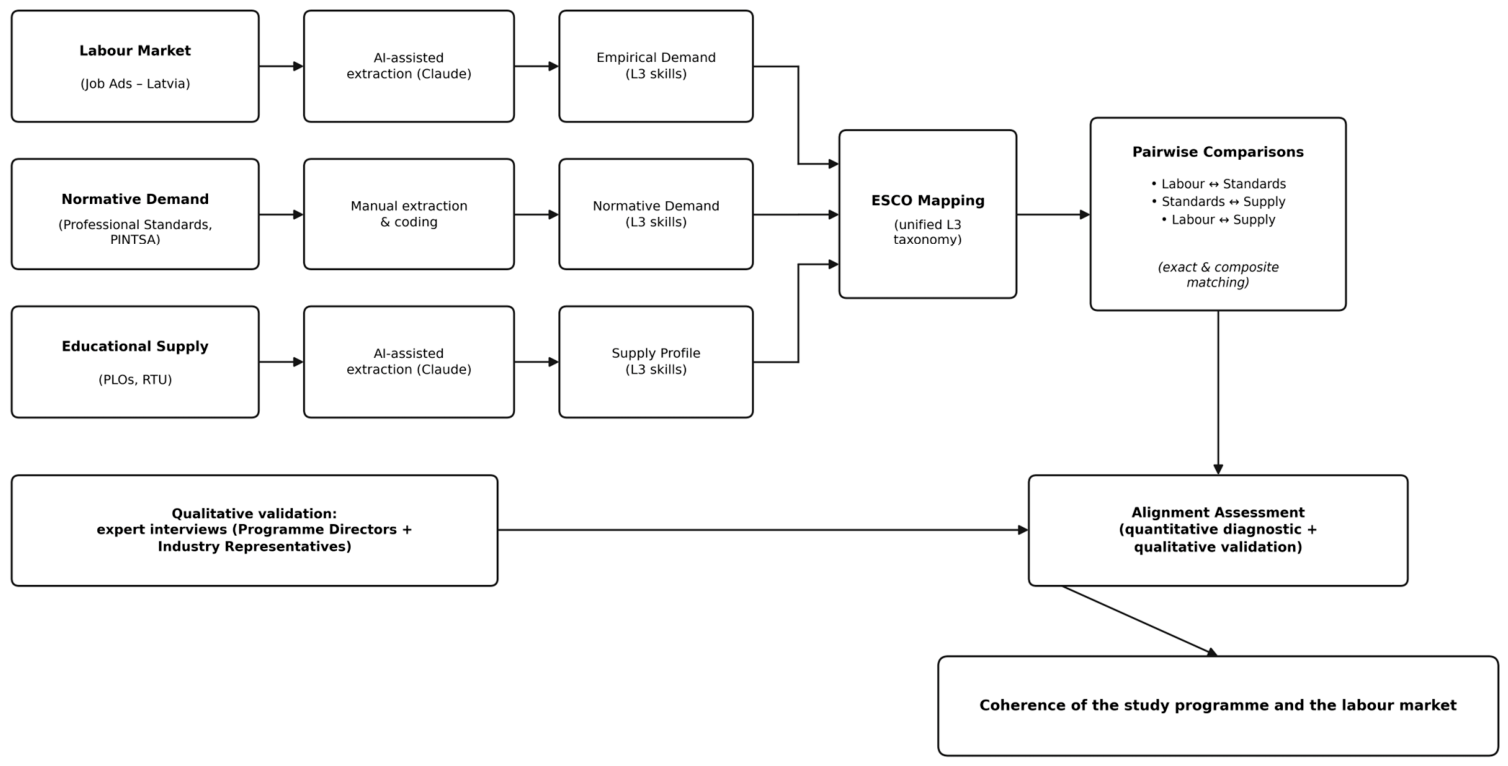
| 1. Data Collection | Build a representative dataset of labour market needs in Latvia | Web scraping from CV Online and NVA using automated scripts | Raw dataset of ~30,000 job ads with job titles, descriptions, and metadata (research period: 1 June 2025–31 December 2025) |
| 2. Preprocessing & Translation | Ensure linguistic consistency for analysis and ESCO mapping | DeepL neural translation, manual review of 5000 samples, segmentation for processing | English-translated, cleaned job ads with verified terminology |
| 3. Occupational Classification (ESCO) | Classify jobs using a structured, auditable taxonomy | Claude (Anthropic LLM), Python 3.12 pipeline, JSON schema, reasoning fields, batch audit | ESCO-coded dataset with role type, seniority, and occupation data |
| 4. Study Programme Learning Outcomes Analysis | Extract and structure educational competencies from programme learning outcomes | Manual review and standardisation of learning outcomes, ESCO L3 mapping | Supply profile (ESCO L3 skills) |
| 5. Professional Standard Analysis | Extract and structure normative competency requirements | Manual analysis of professional standards, ESCO L3 mapping | Normative demand profile (ESCO L3 skills) |
| 6. Skill Extraction & Standardisation | Identify and unify skill references across the dataset | AI-assisted manual classification, fuzzy-matching inheritance, SQLite skill mapping | Standardised list of ESCO Level 3 skills, free of duplication (Empirical demand profile) |
| 7. Three-Layer Curriculum Comparison | Analyse alignment across empirical demand, normative demand, and educational supply | Review of RTU programme learning outcomes by using Claude, exact and composite matching algorithms; Jaccard similarity and coverage calculations | Skill gap analysis (representational vs. substantive) across all three analytical layers |
| 8. Expert Validation | Contextualise and validate findings with stakeholder input | Structured interviews, directed thematic analysis, and triangulation | Qualitative insights from programme directors and employers |
| 9. Framework Refinement | Translate findings into institutional guidance | Synthesis of all data, limitations analysis | Final AI-assisted framework and targeted micro-credential priorities |
| Study Level | Position | ESCO Code | Number of Job Ads | Study Program RTU | Qualification |
|---|---|---|---|---|---|
| Short-cycle professional studies | Human Resources Officer | 2423.3 | 198 | Entrepreneurship and management | Personnel Specialist |
| First-cycle (professional bachelor) studies | Finance Managers | 1211 | 132 | Entrepreneurship and management | Finance Manager |
| Second-cycle (professional master) studies | Managing Directors/Chief Executives | 1120 | 124 | Leadership and management | Organisation Manager |
| Alignment Indicator | Human Resources Officer/Personnel Specialist (ESCO 2423.3) | Finance Manager (ESCO 1211) | Managing Director/Chief Executive/Organisation Manager (ESCO 1120) |
|---|---|---|---|
| Supply (unique L3 from learning outcomes) | 53 | 54 | 37 |
| Demand (unique L3 from job advertisements) | 96 | 78 | 85 |
| Intersection (exact matches) | 48 | 41 | 34 |
| Union | 101 | 91 | 88 |
| Coverage (exact) | 50% | 53% | 40% |
| Jaccard index (exact) | 0.48 | 0.45 | 0.39 |
| Oversupply (supplied but not demanded) | 5 | 13 | 3 |
| Initial gap (demanded but not directly matched) | 48 | 37 | 51 |
| Gaps resolved through composite matching | 22 | 20 | 38 |
| Partial/ambiguous gaps (excluded) | 10 | 7 | 9 |
| True gaps (unmet demand after composite matching) | 16 | 10 | 4 |
| Effective intersection (exact + composite) | 70 | 61 | 72 |
| Effective gap | 26 | 17 | 13 |
| Corrected coverage (composite) | 73% | 78% | 85% |
| Corrected Jaccard index (composite) | 0.69 | 0.67 | 0.82 |
| Alignment Indicator | Short-Cycle SP, Personnel Specialist | First-Cycle SP, Finance Manager | Second-Cycle SP, Organisation Manager |
|---|---|---|---|
| Supply (unique L3) | 53 | 54 | 36 |
| Demand (L3 from PQR) | 43 | 48 | 39 |
| Intersection | 26 | 26 | 27 |
| Union | 70 | 76 | 48 |
| Coverage | 60% | 54% | 69% |
| Jaccard index | 0.37 | 0.34 | 0.56 |
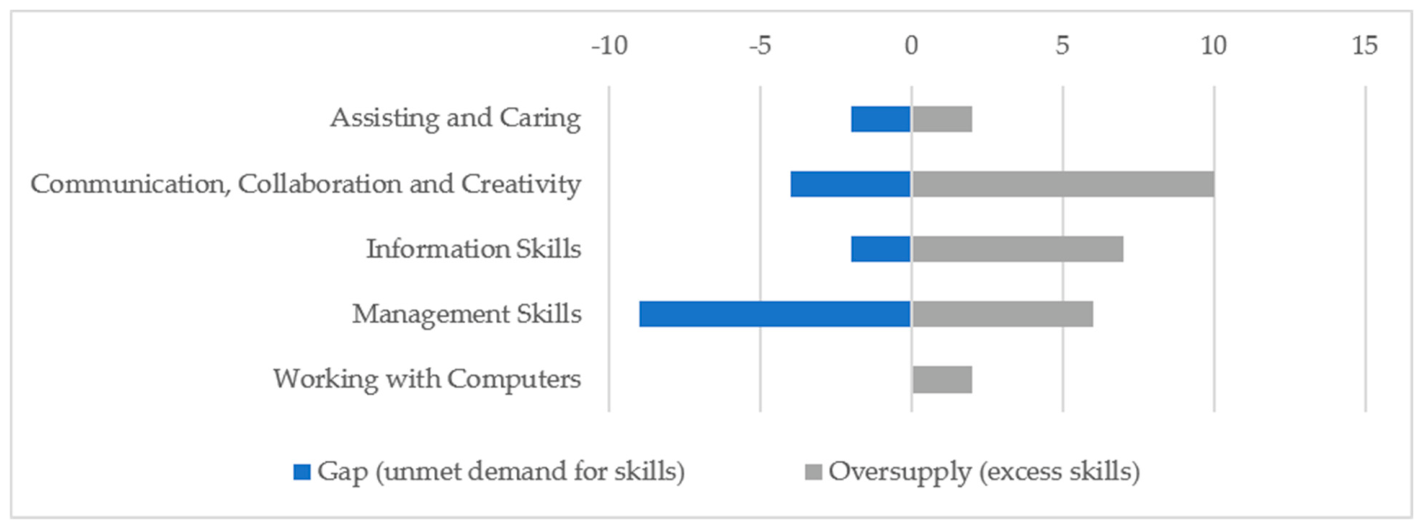
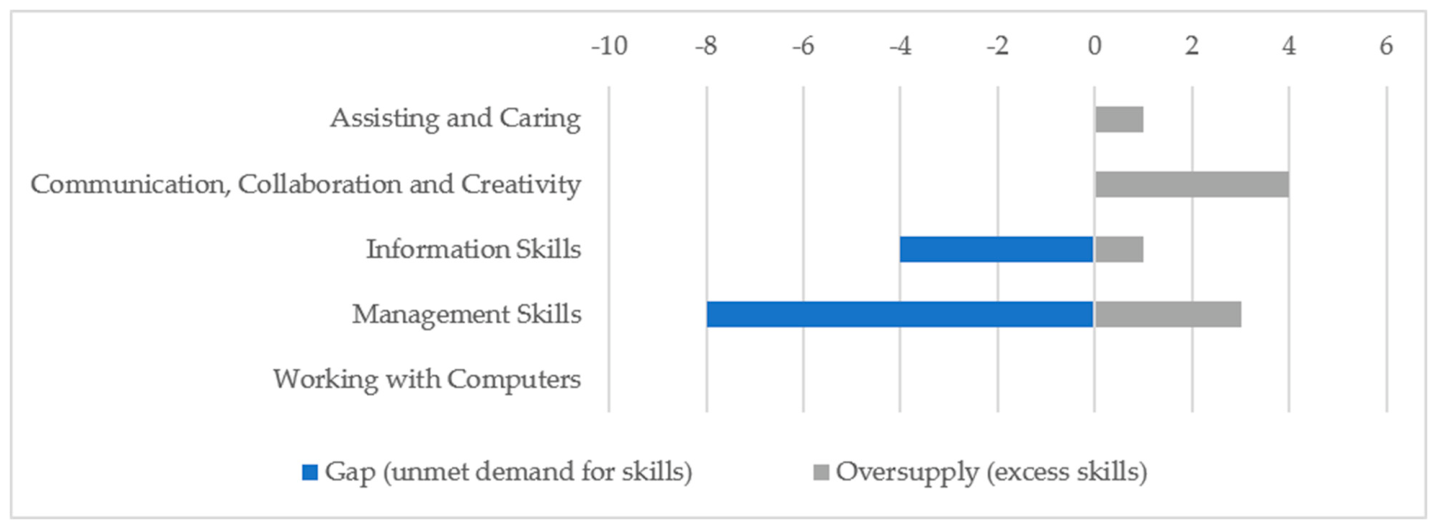
| Gap (unmet demand for skills) | 17 | 22 | 12 |
| Oversupply (excess skills) | 27 | 28 | 9 |
| L1 Area | Short-Cycle SP, Personnel Specialist | First-Cycle SP, Finance Manager | Second-Cycle SP, Organisation Manager |
|---|---|---|---|
| Assisting and caring | 5.66% | 5.56% | 5.56% |
| Communication | 32.08% | 29.63% | 33.33% |
| Information skills | 32.08% | 33.33% | 27.78% |
| Management skills | 24.53% | 25.93% | 30.56% |
| Working with computers | 5.66% | 5.56% | 2.78% |
| Alignment Indicator | 2423.3 (Personnel Specialist) | 1211 (Finance Manager) | 1120 (Organisation Manager) |
|---|---|---|---|
| Unique L3 (Job Ads) | 96 | 78 | 85 |
| Unique L3 (Professional Standard) | 43 | 48 | 39 |
| Exact Intersection | 15 | 24 | 28 |
| Union | 124 | 102 | 96 |
| Standard Coverage (%) | 35% | 50% | 72% |
| Jaccard Index | 0.12 | 0.24 | 0.29 |
| Only in Professional Standard | 28 | 24 | 11 |
| Only in Job Advertisements | 81 | 54 | 57 |
| Alignment Indicator | 2423.3 (Personnel Specialist) | 1211 (Finance Manager) | 1120 (Organisation Manager) |
|---|---|---|---|
| Effective intersection | 38 | 31 | 32 |
| Standard coverage (%) | 88% | 65% | 82% |
| Jaccard index | 0.38 | 0.33 | 0.35 |
| Pairwise Comparison (Exact/Composite Matching) | Personnel Specialist | Finance Manager | Organisation Manager |
|---|---|---|---|
| Labour market ↔ Study programme learning outcomes | 50%/73% | 53%/78% | 40%/85% |
| Labour market ↔ Professional standards | 35%/88% | 50%/65% | 72%/82% |
| Professional standards ↔ Study programme learning outcomes | 60%/— | 54%/— | 69%/— |
| Theme | Key Convergence | Key Divergence |
|---|---|---|
| T1. Current alignment mechanisms | Both groups value industry involvement and recognise the role of existing formal mechanisms such as professional standard development, advisory groups, and state examination commissions. | Programme directors emphasise existing structures as sufficient; industry representatives find current engagement inadequate and call for more structured, regular, and practice-oriented collaboration formats (e.g., hackathons, IR1; greater involvement in programme design, IR2). |
| T2. Perceived skills gaps | Both groups agree that adaptability and willingness to learn matter more than specific technical knowledge at entry level. | Industry perceives significantly larger and more specific gaps—particularly in digital and applied competencies—than programme directors. PD2’s assessment of no significant gaps represents a disconfirming case, potentially explained by the atypical student profile of the OM programme (practising managers). |
| T3. Validity of job advertisement data | Job advertisements capture hard and technical skills better than soft skills, attitudes, or context-specific requirements; both groups treat them as a useful but imperfect signal. | Industry respondents identify specific distortion mechanisms: minimal-information advertisements understate requirements (IR1), while ‘ideal employee’ listings overstate them by combining multiple roles (IR1, IR2). Programme directors rely primarily on other signals (advisory groups, direct employer contact) and are less engaged with this limitation. |
| T4. Institutional agility and barriers | Both groups identify accreditation bureaucracy and methodological commission processes as barriers to timely curriculum updates. | Programme directors regard informal workarounds—adapting course content without formal revision—as adequate compensation. Industry respondents identify a more fundamental structural problem: the study process itself does not always require sufficient student commitment (IR4), pointing to a pedagogical transfer gap beyond curriculum content. |
| T5. Attitudes toward micro-credentials | All respondents agree that micro-credentials require clearly defined quality standards and measurable outcomes to be credible. Micro-credentials for specific, well-defined technical competencies (e.g., labour law, data analysis, AI tools) are viewed as potentially valuable. | PD2 opposes micro-credentials as fragmenting the coherence of study programmes; industry conditionally supports them. Key nuance: industry views micro-credentials as continuing professional development instruments for existing specialists, not as entry-level substitutes for degree-level education (IR3). Generic soft-skill micro-credentials are not valued (IR4). |
Disclaimer/Publisher’s Note: The statements, opinions and data contained in all publications are solely those of the individual author(s) and contributor(s) and not of MDPI and/or the editor(s). MDPI and/or the editor(s) disclaim responsibility for any injury to people or property resulting from any ideas, methods, instructions or products referred to in the content. |
© 2026 by the authors. Licensee MDPI, Basel, Switzerland. This article is an open access article distributed under the terms and conditions of the Creative Commons Attribution (CC BY) license.
Share and Cite
Jēkabsone, I.; Kamola, L.; Līce, A.; Liepa-Hazeleja, E.; Čulkstēna, Z.; Kraupša, K.; Bileskalne, L. Bridging the Education–Employment Gap: Linking Labour Market Needs with University Programmes Through AI-Assisted Insights and Micro-Credentials. Educ. Sci. 2026, 16, 1156. https://doi.org/10.3390/educsci16071156
Jēkabsone I, Kamola L, Līce A, Liepa-Hazeleja E, Čulkstēna Z, Kraupša K, Bileskalne L. Bridging the Education–Employment Gap: Linking Labour Market Needs with University Programmes Through AI-Assisted Insights and Micro-Credentials. Education Sciences. 2026; 16(7):1156. https://doi.org/10.3390/educsci16071156
Chicago/Turabian StyleJēkabsone, Inga, Līga Kamola, Anita Līce, Evija Liepa-Hazeleja, Zane Čulkstēna, Krista Kraupša, and Līva Bileskalne. 2026. "Bridging the Education–Employment Gap: Linking Labour Market Needs with University Programmes Through AI-Assisted Insights and Micro-Credentials" Education Sciences 16, no. 7: 1156. https://doi.org/10.3390/educsci16071156
APA StyleJēkabsone, I., Kamola, L., Līce, A., Liepa-Hazeleja, E., Čulkstēna, Z., Kraupša, K., & Bileskalne, L. (2026). Bridging the Education–Employment Gap: Linking Labour Market Needs with University Programmes Through AI-Assisted Insights and Micro-Credentials. Education Sciences, 16(7), 1156. https://doi.org/10.3390/educsci16071156