


Abstract
This study investigates a paradoxical association between parental beliefs about structured life (PBSL) and children’s play engagement. We conceptualize this association as the structure paradox: although structure is often viewed as potentially constraining free play, parents’ stronger endorsement of structured and organized everyday life may instead be positively related to children’s engagement in play. The sample included 299 parents (94% mothers) of typically developing 6-year-old children. Parent-reported measures included the Parent Play Beliefs Scale and single-item assessments of PBSL, children’s play engagement, and the presence of a dedicated play space at home. Data were analyzed using correlation, multiple regression, and mediation analyses. Results showed that PBSL was positively associated with children’s play engagement: parents who more strongly endorsed the importance of structured and organized everyday life reported higher levels of play engagement in their children. Parental play beliefs were not significantly associated with children’s play engagement. Among the examined family factors, the presence of a dedicated play space at home showed the strongest association with children’s play engagement. A significant positive indirect association was also found between PBSL and children’s play engagement via the presence of a dedicated play space at home. However, the observed direct and indirect associations involving PBSL were small in magnitude. These preliminary findings contribute to the understanding of PBSL and the organization of the home play environment as family factors associated with preschool children’s play engagement. For parents and teachers, the findings suggest that predictable daily routines, clear rules, and the inclusion of play in preschool children’s everyday routines may be associated with more sustained engagement in play.
1. Introduction
Parental beliefs constitute a relatively stable system of ideas about child development and parenting. They include both general knowledge about developmental processes and more specific beliefs about children’s age-related capacities and competencies (Miller, 1988; Bornstein et al., 2020; Ridao et al., 2021). Examining parental beliefs as a family factor is particularly important because parents are key adults who organize children’s everyday lives and create the social and material conditions in which development unfolds (Elkonin, 1978; Smirnova, 2019; Sobkin & Kalashnikova, 2025). Empirical research has shown that parental beliefs, including parental play beliefs, are associated with children’s cognitive, socio-emotional, and self-regulatory development (Bornstein et al., 2017; Rudnova et al., 2024; Metaferia et al., 2020a, 2020b).
However, the role of parental belief about structured life (PBSL) in children’s play engagement remains underexplored. Previous research on structure in children’s everyday lives has focused primarily on observable parenting practices and family routines, rather than on the parental belief that structured and organized everyday life is important for children’s development (Skinner et al., 2005; Selman & Dilworth-Bart, 2023). In studies of family factors related to children’s play, parental beliefs have more often been examined through the more specific construct of parental play beliefs, including play support and academic focus (Fogle & Mendez, 2006). Relatively little attention has been paid to PBSL as a broader parental belief that children’s everyday life should be organized and predictable. This gap is theoretically and empirically important because PBSL may reflect a cognitive basis for how parents organize children’s everyday environments, including the home conditions in which play occurs (Miller, 1988; Bornstein et al., 2017).
Despite growing evidence that family practices (D. Li et al., 2023; W. Zhang et al., 2025; Selman & Dilworth-Bart, 2023; S. Li et al., 2022), parental play beliefs (Fogle & Mendez, 2006; Metaferia et al., 2020a, 2020b), and the organization of the play environment (Tok, 2022; Sagastui et al., 2020; S. Li et al., 2022) are associated with various aspects of child development, these factors have rarely been examined jointly in relation to preschool children’s play engagement at home. This gap is important because play engagement may be considered a meaningful indicator of preschool children’s intrinsic motivation within play, which is regarded as the leading activity of this developmental period (Elkonin, 1978; Smirnova, 2013; King & Howard, 2016). In particular, it remains unclear whether PBSL is associated with children’s play engagement and whether the presence of a dedicated play space at home may partly account for this association.
The present study addresses the following research question: How are PBSL, parental play beliefs, and the presence of a dedicated play space at home related to preschool children’s play engagement? Accordingly, the study aims to examine associations among PBSL, parental play beliefs (play support and academic focus), the presence of a dedicated play space at home, and children’s play engagement.
2. Literature Review
2.1. Parental Belief About Structured Life as a Family Factor and the Structure Paradox
In the present study, PBSL refers to the parental belief that children’s well-being and healthy development are supported by an organized, predictable, and structured everyday life. This belief captures the extent to which parents value stable sequences of daily events, clear temporal boundaries, regular routines, and consistent rules, expectations, and agreements established and maintained in family life. In this sense, structure refers to the organization of children’s everyday conditions rather than to direct adult control over children’s activities. In practical terms, PBSL may be reflected in parents’ recognition of the importance of regular child routines, including bedtime, mealtimes, preschool attendance, and designated time for play at home, as well as rules related to organizing and completing activities, such as putting toys away after play and engaging in simple household chores (Sytsma et al., 2001). Importantly, PBSL may also include the belief that parents should explain the meaning of routines and help children understand why rules and agreements need to be followed (Skinner et al., 2005).
PBSL remains an underexplored family factor (Rudnova et al., 2024). Examining this construct is theoretically important because parental beliefs are considered important predictors of parenting behavior (Miller, 1988). Moreover, parental beliefs may influence child development in ways that are not reducible to observable parenting practices alone (Miller, 1988). In this context, PBSL may capture the extent to which parents consider it important to intentionally establish and maintain predictable patterns in children’s everyday activities. This belief may therefore be considered a potential cognitive antecedent of structure-related parenting practices (Miller, 1988; Skinner et al., 2005; Bornstein et al., 2020; Ridao et al., 2021). As such, PBSL can be theoretically linked to the motivational model of parenting proposed by Skinner et al. (2005). In this model, structure is regarded as one of the key dimensions of parenting style and refers to parents’ provision of clear expectations, consistent rules, age-appropriate limits, and predictable information about pathways to desired outcomes (Skinner et al., 2005). Behavioral constructs associated with parental structure include monitoring, organization, regulation, rule setting, regularity of routines, and organization of the home environment (Skinner et al., 2005). Thus, parental structure as a parenting-style dimension primarily describes the behavioral organization of children’s environments and parent–child interactions, whereas PBSL may be understood as a cognitive component of this process: a parental belief in the importance of predictability, consistency, and organization in children’s everyday life (Miller, 1988; Skinner et al., 2005; Bornstein et al., 2017).
In the context of the present study, the structure paradox refers to the idea that structure in children’s everyday life may be viewed both as a potential constraint on free play and as a condition that supports sustained engagement in play. On the one hand, free play is commonly defined as a spontaneous, intrinsically motivated, flexible, enjoyable, and child-directed activity (King & Howard, 2016; Weisberg et al., 2016). From this perspective, adult-directed organization of play may conflict with children’s autonomy, which is closely related to their motivation to play. Empirical evidence also suggests that adult intervention in free play may be negatively associated with children’s autonomy during play and, consequently, with their motivation to play (King & Howard, 2014). On the other hand, organizing children’s everyday life is not the same as directly structuring play itself. A predictable and organized family environment may provide stable conditions under which children can initiate, sustain, and elaborate play autonomously (King & Howard, 2016).
Direct empirical evidence on the association between PBSL and preschool children’s play engagement remains limited. It is therefore useful to consider research on parenting styles and family routines as closely related behavioral manifestations of structure in children’s everyday lives, as well as their associations with children’s developmental outcomes. Evidence suggests that authoritative parenting, which combines emotional warmth, responsiveness, and clear and consistent expectations, is positively associated with preschool children’s self-control, emotion regulation, and peer interaction (D. Li et al., 2023), and negatively associated with externalizing problem behaviors (W. Zhang et al., 2025). By contrast, authoritarian parenting, characterized by rigid control, directiveness, and limited emotional responsiveness, has been associated with less favorable indicators of children’s self-regulation and socio-emotional functioning (D. Li et al., 2023; W. Zhang et al., 2025). Research on family routines also shows that stable and predictable routines are associated with indicators of children’s mental and physical development and may serve a protective function under conditions of social risk (McLoyd et al., 2008; Martin et al., 2012; Ferretti & Bub, 2014, 2017; Selman & Dilworth-Bart, 2023). Particularly relevant to the present study, parent–child play may also be understood as a regular family routine: Muñiz et al. (2014) showed that regular parent–child play was positively associated with children’s socio-emotional health and school readiness. Taken together, these findings suggest that PBSL may be related to the organization of everyday environments that provide children with stable conditions for autonomous and sustained engagement in play.
2.2. Parental Play Beliefs as Family Factors
Alongside PBSL, parental play beliefs constitute an important family factor in the context of children’s play because they reflect parents’ perceptions of the developmental value of play. Parental play beliefs refer to beliefs about the role of play in children’s learning and development, as well as about parental involvement in supporting children’s play (Fogle & Mendez, 2006). Fogle and Mendez (2006) identified two constructs within parental play beliefs. The first, play support, reflects parents’ recognition of the developmental value of play in children’s lives. The second, academic focus, reflects parents’ prioritization of formal learning and the lower value they place on the contribution of free play to children’s cognitive and social development (Fogle & Mendez, 2006). Examining parental play beliefs is particularly important because these beliefs may be associated with how parents facilitate and support children’s play at home (Metaferia et al., 2020a; Y. Zhang et al., 2021; S. Li et al., 2022).
2.3. Play Engagement in the Context of Family Factors
Play is a key context for psychological development in early childhood (Vygotsky, 1966; Veresov et al., 2025; Gavrilova et al., 2025). Children’s play engagement, reflected in sustained attention to play and involvement in play scenarios, is considered an important indicator of early psychological development and, more specifically, of preschool children’s intrinsic motivation within play (Smirnova, 2013). Given concerns about the decline of children’s play (Bodrova et al., 2013) and increasing screen time (Ngyah-Etchutambe, 2025; Kalabina & Nikolaeva, 2025; Belova & Shumakova, 2024; Pegov, 2024), it is important to examine whether children’s play engagement is related to family factors.
Empirical research has identified several family factors associated with children’s play engagement. First, evidence indicates that play support is positively associated with play engagement (Fogle & Mendez, 2006; LaForett & Mendez, 2016; S. Li et al., 2022; Lin & Li, 2018), whereas academic focus is negatively associated with play engagement (Fogle & Mendez, 2006; LaForett & Mendez, 2016). Second, adult organization of children’s environments may be related to both children’s play engagement and the developmental level of play (Smirnova, 2013; Martin et al., 2012; Sagastui et al., 2020; Rüdisüli et al., 2026; Tok, 2022). Environments characterized by spatial flexibility and transformability, multifunctional materials, and the availability of substitute objects may provide conditions for children to construct play scenarios autonomously and develop play intentions (Smirnova, 2013; Storli et al., 2020). Empirical evidence suggests that children who autonomously construct play environments using substitute objects and available materials demonstrate more advanced levels of play development (Smirnova, 2013; Storli et al., 2020). Third, a psychologically supportive home environment, characterized by emotional cohesion, low family conflict, a supportive parenting style, parental beliefs in the importance of play, and clearly defined family rules, is positively associated with children’s play engagement (S. Li et al., 2022).
2.4. Theoretical Background
The present study is grounded in the cultural-historical and activity approaches (Vygotsky, 1966; Elkonin, 1978), as well as in self-determination theory (Ryan & Deci, 2017). Within the cultural-historical and activity approaches, play is regarded as the leading activity of preschool age, through which children appropriate social relations, roles, and the meanings of human activity. Because play is social in its origin and content, its development is shaped by adults, who organize children’s everyday living conditions and introduce them to the content of the adult world. Children then transform this content into play, reproducing social relations and adult activities in generalized, abbreviated, and symbolic forms (Elkonin, 1978). Thus, parental beliefs and practices may play an important role in children’s play by shaping both the social experiences that children bring into play and the social situation of development in which play unfolds (Vygotsky, 1966; Elkonin, 1978).
From the perspective of self-determination theory, children’s intrinsic motivation is supported when their basic psychological needs for autonomy, competence, and relatedness are met (King & Howard, 2016). During preschool age, play engagement may be considered an indicator of intrinsic motivation within play (Smirnova, 2013; King & Howard, 2016). Accordingly, the supportive role of adults may involve both the organization of a structured and predictable environment and the creation of conditions in which children can choose play actions autonomously, elaborate play scenarios, and sustain engagement in play (Skinner et al., 2005).
2.5. The Present Study
The present study aims to examine associations of family factors, including PBSL, parental play beliefs (play support and academic focus), and the presence of a dedicated play space at home, with preschool children’s play engagement.
Drawing on the cultural-historical and activity approaches, as well as self-determination theory, the present study was guided by the general hypothesis that family factors reflecting parental beliefs and the organization of the home environment are associated with preschool children’s play engagement.
The study tested three specific hypotheses. First, PBSL is positively associated with preschool children’s play engagement after controlling for family sociodemographic characteristics, including parental age, education level, and employment status, family socioeconomic status, number of children in the family, and child gender. Second, play support is positively associated with preschool children’s play engagement, whereas academic focus is negatively associated with preschool children’s play engagement, after controlling for the same sociodemographic characteristics. Third, the presence of a dedicated play space at home partly accounts for the positive association between PBSL and preschool children’s play engagement.
3. Materials and Methods
3.1. Sample
The sample included 299 parents (Mage = 37, SD = 5; 94% mothers) of typically developing children (Mage = 6.03, SD = 0.30; 46% girls). All children attended preparatory groups at state preschool educational institutions. Of the children, 205 had siblings. Most families resided in Moscow (67%), followed by Kazan (23%) and Sochi (10%). Parental education level ranged from 1 (primary school) to 8 (doctoral degree), with a median of 5 (bachelor’s degree). In terms of parental employment status, 54% of parents were employed full-time, 24% were employed part-time, and 22% were not employed. Most parents rated their family socioeconomic status as average (79.4%), followed by above average (17.4%) and below average (3.1%).
3.2. Procedure
The study was conducted from January 2024 to May 2024. Participants were recruited through state-funded preschool educational institutions in Russia that agreed to participate in the study. A non-probability, institution-based convenience sampling procedure was used (Bornstein et al., 2013). Eligible participants were parents or legal guardians of typically developing children attending preparatory groups in these institutions. Parents were invited to participate and were included in the sample if they provided written informed consent and completed a paper-based questionnaire distributed by the researchers. Parents completed the questionnaire at the preschool, either in the morning after bringing their child to preschool or in the afternoon while waiting to pick up their child. If parents were unable to complete the questionnaire at the preschool, they could complete it at home and return it the following day. To reduce participant burden and facilitate participation, the questionnaire was intentionally kept brief.
This study was approved by the Ethics Committee for Scientific Research of the Federal Scientific Center for Psychological and Interdisciplinary Research (approval No. 3, 31 January 2024). Written informed consent was obtained from parents for both their own participation and their children’s participation in the study.
3.3. Measures
3.3.1. Parental Belief About Structured Life
PBSL was assessed with a single item: “In your view, to raise children who are happy and healthy, it is important for everyday life to be structured and organized.” Parents rated their agreement on a 5-point Likert-type response scale: 1 (strongly disagree), 2 (disagree), 3 (neither agree nor disagree), 4 (agree), and 5 (strongly agree).
3.3.2. Parental Play Beliefs
Parental play beliefs were assessed with the Parent Play Beliefs Scale (PPBS) (Fogle & Mendez, 2006). Participants rated 30 items on a 5-point Likert scale: 1 (disagree), 2 (somewhat disagree), 3 (somewhat agree), 4 (agree), and 5 (very much agree). The scale includes two subscales. The first subscale, Play Support (16 items; Cronbach’s α = 0.9), reflects parental beliefs in the developmental value of play for children (e.g., “Play can help my child develop social skills, such as cooperating and making friends”). The second subscale, Academic Focus (8 items; Cronbach’s α = 0.7), reflects parental beliefs in the developmental value of formal learning (e.g., “Play does not help my child learn academic skills like counting or recognizing letters.”).
3.3.3. Play Engagement
Children’s play engagement was assessed with a single item: “The child becomes deeply engaged in play (e.g., it may be difficult to stop the play because the child is highly engaged in the play scenario).” Parents rated their agreement on a 4-point Likert-type response scale: 1 (does not correspond at all), 2 (somewhat does not correspond), 3 (somewhat corresponds), and 4 (fully corresponds).
3.3.4. Dedicated Play Space
The presence of a dedicated play space at home was assessed with a single item: “The child has a designated place for play at home (e.g., children’s constructions, such as a playhouse, are not dismantled every day).” Parents rated their agreement on a 4-point Likert-type response scale: 1 (does not correspond at all), 2 (somewhat does not correspond), 3 (somewhat corresponds), and 4 (fully corresponds).
3.3.5. Family Sociodemographic Characteristics
Family sociodemographic characteristics were assessed with a sociodemographic questionnaire developed for the present study. The questionnaire included items on parental age, child age, child date of birth, child gender, the respondent’s relationship to the child, the number of siblings living with the child, parental education level, parental employment status, and family socioeconomic status.
Parental age and child age at the time of questionnaire completion were assessed with open-ended questions. Parents also reported the child’s date of birth. Child gender was reported in response to the question “Please indicate the child’s gender,” with two response options: “boy” and “girl.”
The respondent’s relationship to the child was assessed with the question “What is your relationship to the child?” Parents selected one of the following response options: “mother,” “father,” or “guardian.” For the “guardian” option, an additional open-ended field was provided to specify the respondent’s relationship to the child. In the present sample, most respondents were mothers (94.4%), followed by fathers (5.6%).
Parents also reported the number of siblings living with the child in response to the question “How many brothers and sisters live with the child?” Response options ranged from 0 to 4, with an additional open-ended field provided when the number of siblings was higher. To create the variable “number of children in the family,” one child was added to the reported number of siblings, corresponding to the preschool child for whom the questionnaire was completed.
Parental education level was assessed with the question “What is your level of education?” Parents selected one of the following response options: 1 (primary general education/primary school), 2 (basic general education/9 years of school), 3 (secondary general education/11 years of school), 4 (secondary vocational education/college or technical school), 5 (higher education, Bachelor’s degree/incomplete higher education), 6 (higher education, Master’s degree), 7 (higher education, Specialist degree), and 8 (two or more higher education degrees, Candidate of Sciences degree, or Doctor of Sciences degree).
Parental employment status was assessed with the question “What is your current employment status?” Parents selected one of the following response options: 1 (not employed), 2 (part-time employment), and 3 (full-time employment).
Family socioeconomic status was assessed with the question “How would you rate your family’s financial situation?” Parents selected one of the following response options: 1 (below average), 2 (average), or 3 (above average).
3.4. Data Analysis
Data were analyzed using descriptive statistics, Spearman’s rank-order correlations, general linear models (GLMs), and mediation analysis. All analyses were conducted in Jamovi (version 2.6.44.0). Because the study variables deviated from normality according to the Shapiro–Wilk test (p < 0.001), robust standard errors (HC3) were applied in all models. The significance of direct and indirect effects was evaluated using bias-corrected and accelerated (BCa) bootstrap confidence intervals based on 5000 resamples. The use of GLMs with robust standard errors for ordinal variables was supported by sensitivity analyses showing that ordinal logistic regression produced the same pattern of results as the GLM analyses reported below. In addition, the GLM framework was chosen because it allowed the mediation model and indirect associations to be estimated within a consistent analytical approach.
4. Results
4.1. Descriptive Statistics
Table 1 presents descriptive statistics for PBSL, parental play beliefs, children’s play engagement, and the presence of a dedicated play space at home.
Table 1.
Descriptive statistics and Spearman correlation coefficients for parental belief about structured life, parental play beliefs, children’s play engagement, and the presence of a dedicated play space at home.
Spearman correlation analysis indicated that stronger endorsement of PBSL was associated with greater children’s play engagement (ρ = 0.19, p = 0.002) (Table 1). Parental play beliefs, including play support and academic focus, were not significantly associated with children’s play engagement (p > 0.05). PBSL was positively associated with play support (ρ = 0.21, p < 0.001).
The presence of a dedicated play space at home was significantly associated with greater children’s play engagement (ρ = 0.32, p < 0.001). It was also positively associated with PBSL (ρ = 0.12, p = 0.035) and was not associated with parental play beliefs (p > 0.05).
4.2. Associations Between Family Factors and Children’s Play Engagement
To test the first specific hypothesis, PBSL was entered as the predictor, with children’s play engagement as the dependent variable. The model explained 2.4% of the variance in the dependent variable (R2 = 0.024, Adj. R2 = 0.021, F(1, 286) = 7.16, p = 0.008, N = 288). PBSL was significantly and positively associated with children’s play engagement (b = 0.151, SE = 0.064, 95% CI [0.034, 0.277], β = 0.16, p = 0.018).
To account for family sociodemographic characteristics, the following variables were entered simultaneously as additional predictors: child gender, parental age, education level, family socioeconomic status, employment status, and number of children in the family. The model explained 4.5% of the variance in the dependent variable (R2 = 0.045, Adj. R2 = 0.016, F(8, 265) = 1.57, p = 0.135, N = 274), although the overall model was not statistically significant. None of the family sociodemographic characteristics were significantly associated with children’s play engagement (p > 0.05). However, PBSL remained significantly and positively associated with children’s play engagement in this adjusted model (b = 0.181, SE = 0.066, 95% CI [0.057, 0.313], β = 0.18, p = 0.007).
The presence of a dedicated play space at home was then added to the model as an additional predictor. The model explained 10.3% of the variance in the dependent variable (R2 = 0.103, Adj. R2 = 0.097, F(2, 285) = 16.40, p < 0.001, N = 288). The presence of a dedicated play space at home was significantly and positively associated with children’s play engagement (b = 0.241, SE = 0.054, 95% CI [0.139, 0.344], β = 0.28, p < 0.001). PBSL remained significantly associated with children’s play engagement in this model; however, the magnitude of its standardized coefficient decreased (b = 0.117, SE = 0.058, 95% CI [0.010, 0.232], β = 0.12, p = 0.045).
When all family sociodemographic characteristics were included in the model together with PBSL and the presence of a dedicated play space at home, the model remained statistically significant and explained 12.2% of the variance in children’s play engagement (R2 = 0.122, Adj. R2 = 0.092, F(9, 264) = 4.06, p < 0.001, N = 274). None of the family sociodemographic characteristics were significantly associated with children’s play engagement (p > 0.05). At the same time, both PBSL (b = 0.152, SE = 0.060, 95% CI [0.040, 0.277], β = 0.15, p = 0.012) and the presence of a dedicated play space at home (b = 0.243, SE = 0.058, 95% CI [0.133, 0.353], β = 0.29, p < 0.001) remained significantly and positively associated with children’s play engagement.
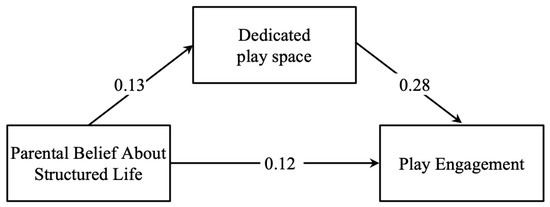
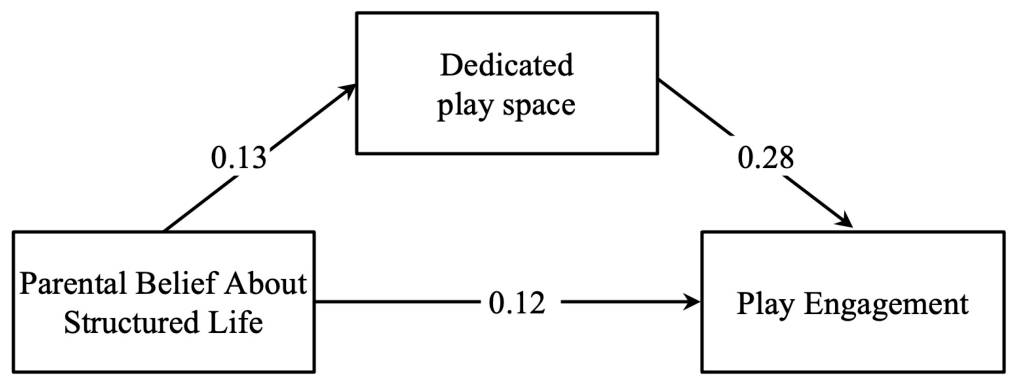
To test the third specific hypothesis, a mediation model was specified with PBSL as the predictor, children’s play engagement as the dependent variable, and the presence of a dedicated play space at home as the mediator (Table 2). Stronger endorsement of PBSL was associated with greater children’s play engagement, and this association was partly accounted for by the presence of a dedicated play space at home (Figure 1). The indirect effect through this mediator was statistically significant (b = 0.035, SE = 0.017, 95% CI [0.002, 0.082], β = 0.04, z = 1.98, p = 0.047, N = 288). The estimated direct effect linking PBSL and children’s play engagement also remained significant (b = 0.117, SE = 0.055, 95% CI [0.010, 0.228], β = 0.12, z = 2.14, p = 0.032).
Table 2.
Effects of parental belief about structured life on children’s play engagement via the presence of a dedicated play space at home.
Figure 1.
Indirect effect of parental belief about structured life on children’s play engagement via the presence of a dedicated play space at home.
5. Discussion
The present study examined associations of family factors, including PBSL, parental play beliefs, and the presence of a dedicated play space at home, with children’s play engagement. The main finding was that PBSL was positively associated with children’s play engagement, whereas parental play beliefs were not significantly associated with children’s play engagement. In addition, a significant positive indirect association between PBSL and children’s play engagement was observed through the presence of a dedicated play space at home. These preliminary findings are discussed below in relation to the study hypotheses and previous research, while taking into account the small magnitude of the observed direct and indirect associations involving PBSL.
5.1. Association Between Parental Belief About Structured Life and Children’s Play Engagement
The first hypothesis, which proposed a positive association between PBSL and children’s play engagement, was empirically supported. The results showed that PBSL was positively associated with children’s play engagement after controlling for family sociodemographic characteristics, including parental age, education level, employment status, family socioeconomic status, number of children in the family, and child gender. More specifically, stronger endorsement of PBSL, understood as a parental belief in the importance of structure, predictability, and organization in children’s everyday life, was associated with higher parental ratings of children’s play engagement, including reports that children became deeply engaged in play and were reluctant to stop ongoing play activity. This finding adds to previous research by suggesting that children’s play engagement at home may be associated not only with observable family routines or structure-related parenting practices, but also with PBSL. At the same time, this association should be interpreted with caution because the effect size was small, the proportion of explained variance was limited, and both key variables were assessed using single items based on parental reports.
Direct empirical evidence on the association between PBSL and preschool children’s play engagement remains limited. Therefore, the present finding should be interpreted in relation to studies that have examined behavioral manifestations of structure in children’s everyday life. In this respect, the present results are consistent with research on family routines and parenting styles showing that regular and predictable elements of everyday life are associated with more favorable indicators of children’s physical, mental, and socio-emotional development (McLoyd et al., 2008; Ferretti & Bub, 2014; Selman & Dilworth-Bart, 2023; Savchenko et al., 2025; D. Li et al., 2023; W. Zhang et al., 2025).
The findings of Martin et al. (2012) are particularly relevant in this context. Their study showed that a lack of routines in preschool children’s lives was negatively associated with receptive vocabulary and self-regulation. Lack of routines was assessed using three mother-reported indicators: the frequency of family meals, the presence of rules for the child, and consistency in enforcing these rules (Martin et al., 2012). These indicators partially correspond to the conceptualization of PBSL in the present study. In addition, Martin et al. (2012) found that a lack of routines was positively associated with having the television constantly on at home. In turn, having the television constantly on was associated with children’s attention problems and aggressive behavior. These findings are important for the present study primarily because they suggest an association between everyday structure and children’s self-regulation. From the perspective of self-determination theory, regulation is involved in the development of intrinsic motivation, and play engagement may require children to sustain attention, maintain a play intention, and continue the activity without constant external prompting (Deci & Ryan, 2000; King & Howard, 2016). Therefore, the association between a lack of routines and lower self-regulation reported by Martin et al. (2012) may be considered in relation to the present findings. PBSL, which includes recognition of the importance of regular routines and clear rules, may be associated with parent-organized home conditions in which children can sustain engagement in play more readily. For example, rules regulating the use of screen devices may be part of a structured everyday environment that limits competing distractions during play. However, this interpretation remains theoretical because self-regulation was not directly measured in the present study.
The study by Muñiz et al. (2014) is particularly important for interpreting the present findings because parent–child play was examined as a type of family routine. The results showed that participation in this routine was positively associated with preschool children’s socio-emotional health, even after accounting for family socioeconomic status, maternal depression, screen time, number of siblings, and other family routines (Muñiz et al., 2014). These findings are consistent with the present results in suggesting that regular play activity at home may be linked to the structured everyday life of the family. However, the present findings further suggest that children’s play engagement may be associated not only with regular adult participation in play, but also with the organization of conditions for children’s autonomous play. In this context, designated time and space for play may be considered components of an organized home environment associated with more sustained children’s play engagement.
Family sociodemographic characteristics were not significantly associated with children’s play engagement in the present analyses. This also applied to family socioeconomic characteristics, including parental education level and family socioeconomic status. This finding partly diverges from studies in which a less structured everyday environment was associated with lower socioeconomic status and less favorable indicators of child development. For example, in Martin et al. (2012), a lack of routines was associated with lower socioeconomic status, as well as with lower receptive vocabulary and self-regulation in preschool children. A similar pattern was reported by S. Li et al. (2022), in which family socioeconomic status was positively associated with persistence, sustained attention, and engagement in play activity. Moreover, this association was partly accounted for by the quality of the home environment: higher socioeconomic status was associated with a more favorable, organized, and supportive family environment, which, in turn, was associated with greater children’s play engagement (S. Li et al., 2022). At the same time, some evidence suggests that specific play routines may be relatively independent of family socioeconomic status. In Muñiz et al. (2014), parent–child play, unlike several other family routines, was not significantly associated with socioeconomic status. This finding suggests that parent–child play may be considered a potentially accessible resource for supporting preschool children’s socio-emotional development in families with different levels of socioeconomic resources. In the present study, the absence of significant associations between family socioeconomic characteristics and children’s play engagement may partly reflect the relative homogeneity of the sample: most parents had higher education and rated their family socioeconomic status as average.
It should be noted that the studies discussed above were conducted in different sociocultural contexts, including China (S. Li et al., 2022; D. Li et al., 2023; W. Zhang et al., 2025) and the United States (Martin et al., 2012; Muñiz et al., 2014). The convergence of findings indicating associations between structured family environments, routines, supportive parenting practices, and indicators of child development may suggest that everyday structure is relevant to understanding child development across cultural contexts. At the same time, research on parental beliefs shows that the content and accessibility of parenting knowledge differ across cultures (Bornstein et al., 2020). This issue should also be considered when interpreting the present findings, as the study was conducted in Russia and the meaning attributed to structure, routines, and organization in children’s everyday life may be culturally specific.
5.2. Association Between Parental Play Beliefs and Children’s Play Engagement
The second hypothesis stated that play support is positively associated with children’s play engagement, whereas academic focus is negatively associated with children’s play engagement, after controlling for family sociodemographic characteristics. This hypothesis was not supported, as the analyses did not show significant associations between parental play beliefs and children’s play engagement.
This finding contrasts with previous studies showing that play support is positively associated with children’s play engagement, whereas academic focus is negatively associated with children’s play engagement (Fogle & Mendez, 2006; LaForett & Mendez, 2016; Lin & Li, 2018; S. Li et al., 2022). This divergence may be related to differences in how play engagement was operationalized and how parental play beliefs were assessed. In some studies, children’s play engagement was examined in the context of peer play rather than solitary play at home (Fogle & Mendez, 2006; LaForett & Mendez, 2016). In other studies, play engagement was operationalized through parent-reported frequency of children’s play activities at home (Lin & Li, 2018). In addition, parental play beliefs have been assessed with different instruments. Fogle and Mendez (2006) and LaForett and Mendez (2016) used the Parent Play Beliefs Scale, whereas Lin and Li (2018) used a modified version of this scale, which limits direct comparisons with studies using the original measure. In S. Li et al. (2022), play beliefs were included as part of a broader assessment of the home environment and were not analyzed as a separate construct. At the same time, the correlation analysis in the present study showed a positive association between PBSL and play support. This pattern may suggest that parental play beliefs are situated within a broader system of parental beliefs concerning the organization of children’s everyday experiences (Miller, 1988; Bornstein et al., 2020). In this context, PBSL, as a general belief about the importance of stability, predictability, and organization in children’s lives, may be more closely related to children’s play engagement at home than to more specific beliefs about the developmental value of play. However, this interpretation requires further examination using more fine-grained measures of play engagement, including observational methods.
The absence of significant associations between parental play beliefs and children’s play engagement may also reflect the complexity of parents’ assessments of children’s play. In a sample of Ethiopian preschool children, Metaferia et al. (2020b) found that children’s engagement in solitary play and pretend play was positively associated with parental play support beliefs, whereas peer play, motor play, fine motor activities, and sports and physical activities were not associated with these beliefs. This pattern suggests that parental reports may not always clearly distinguish among different types of play activities, which may contribute to variation across studies. In the present study, this issue may have been further accentuated by the use of a single parent-reported item to assess children’s play engagement, which could have limited measurement precision. In particular, a single global item may not fully capture the complexity, quality, and variability of children’s engagement across different types of play. At the same time, the findings of Metaferia et al. (2020b) are consistent with the present study in showing the absence of an association between parental academic focus and children’s engagement in various play activities. A similar result was reported in a Hungarian sample (Metaferia et al., 2020a), suggesting that academic focus may not be directly related to children’s play engagement across different cultural contexts.
5.3. Association Between Parental Belief About Structured Life, Children’s Play Engagement, and Dedicated Play Space at Home
The third hypothesis stated that the presence of a dedicated play space at home partly accounts for the positive association between PBSL and children’s play engagement. This hypothesis was empirically supported: the mediation model indicated a significant positive indirect association between PBSL and children’s play engagement through the presence of a dedicated play space at home. At the same time, the direct association between PBSL and children’s play engagement also remained significant. This pattern suggests that the organization of the play environment may represent one aspect of the home context associated with PBSL. This finding is consistent with the theoretical view that parental beliefs may be linked to the organization of children’s everyday experiences (Miller, 1988; Bornstein et al., 2017).
It should be noted that the indirect association was statistically significant but small in magnitude and near the conventional threshold for statistical significance. Because the mediation model was based on cross-sectional data, this indirect association should not be interpreted as evidence of a causal mechanism or developmental sequence. Rather, it suggests that PBSL, the presence of a dedicated play space at home, and children’s play engagement were interrelated in a pattern consistent with the hypothesized theoretical model. This indirect association may be considered alongside studies highlighting adults’ role as observers and organizers of play environments. In studies conducted in preschool educational settings, adults’ active observational and organizational role was associated with children’s motivation in free play, playfulness, and creativity (Sagastui et al., 2020; Tok, 2022; Rüdisüli et al., 2026). In the home context, parents may perform a similar role: adults do not necessarily need to intervene directly in play but may organize the spatial and temporal conditions within which children have opportunities to engage in play autonomously.
Notably, the association between the presence of a dedicated play space at home and children’s play engagement was of moderate magnitude. This finding suggests that a dedicated play space at home may represent an aspect of the home environment related to children’s sustained engagement in play. It is also consistent with S. Li et al. (2022), who found that a favorable home environment was associated with greater children’s play engagement. On the one hand, such a space may provide predictable spatial boundaries and thus function as a manifestation of structure in children’s everyday life (Skinner et al., 2005). On the other hand, within these boundaries, children retain opportunities to choose play actions, toys, and scenarios autonomously, which is consistent with the idea of autonomy support in free play (King & Howard, 2016). Thus, a dedicated play space at home may be viewed as an environmental component in which structure and autonomy are not opposed: parents organize the conditions, whereas children act autonomously within them.
5.4. Practical Implications
The findings of the present study have potential practical implications for parent counseling, teacher preparation, and the organization of preschool educational environments. In parent counseling, psychologists may address the developmental significance of an everyday environment that is predictable and comprehensible to the child. Such educational support may include discussing the importance of regular routines related to sleep, meals, morning and evening activities, shared family practices, and time for play. It may also involve helping parents establish clear and consistent rules that children can understand and that adults can maintain reliably, such as setting a regular time for putting toys away after play or designating predictable periods for free play at home or outdoors.
The findings also point to the potential relevance of the home play environment. In this context, it may be helpful to explain to parents that supporting children’s play does not necessarily require a separate room or expensive play materials. Rather, what may be practically important is the availability of a stable and accessible place where the child regularly has opportunities to develop play scenarios, use substitute objects, construct play settings, and autonomously choose the content of play. For example, parents may support play by allowing children to transform accessible elements of the home environment, such as using a sofa as a “house” or a “ship,” constructing temporary play settings, and leaving these settings in place long enough for children to return to them and further develop their own play scenarios.
Implications for teacher preparation and professional development may include helping preschool teachers distinguish between organizing the conditions for free play and directing the content of play. From this perspective, structured educational environments may support, rather than constrain, children’s free play when teachers maintain predictable spatial and temporal arrangements while adopting an active but non-directive observational stance that preserves children’s autonomy during play.
From a policy and institutional perspective, the findings are consistent with recognizing free play as a meaningful component of the preschool environment and giving it a stable place within the daily schedule. This may involve not only allocating regular time for free play, but also ensuring the availability of spaces in which children can initiate, sustain, and elaborate play activity.
6. Conclusions
The present study examined associations of family factors with children’s play engagement, focusing on parental beliefs about structured life (PBSL), parental play beliefs (play support and academic focus), and the presence of a dedicated play space at home. In the present study, PBSL was positively associated with children’s play engagement, whereas play support and academic focus were not significantly associated with children’s play engagement. In addition, a significant positive indirect association between PBSL and children’s play engagement was observed through the presence of a dedicated play space at home. However, both the direct association between PBSL and children’s play engagement and the indirect association through the presence of a dedicated play space at home were small in magnitude. The indirect association was also close to the conventional threshold for statistical significance.
Taken together, these preliminary findings suggest that PBSL may represent an underexplored family factor associated with children’s play engagement at home and with the organization of the home play environment. They also highlight the importance of considering both parental beliefs about structured life and the spatial organization of the home environment in research on play as the leading activity of preschool age.
7. Limitations and Strengths
The present study contributes to research on family factors associated with preschool children’s play engagement. One strength of the study is its focus on PBSL as an underexplored parental belief and its examination of the association of this belief with children’s play engagement at home. In the present study, PBSL was positively associated with preschool children’s play engagement, whereas parental play beliefs were not significantly associated with children’s play engagement. In addition, a significant but small indirect association between PBSL and children’s play engagement was observed through the presence of a dedicated play space at home.
At the same time, the present study has several limitations that should be considered when interpreting the findings. First, the study used a cross-sectional design, which does not allow conclusions about causality, developmental change, or the direction of the observed associations. Second, the key study variables, including PBSL, children’s play engagement, and the presence of a dedicated play space at home, were assessed using single items. The use of single-item measures was intended to reduce participant burden and provide an initial assessment of specific aspects of the home environment and children’s behavior. However, single-item measures have important psychometric limitations: they do not allow internal consistency to be estimated, may not fully capture complex multidimensional constructs, and limit conclusions about validity. Therefore, the present findings should be interpreted as preliminary. Third, all variables were based on parent reports. This method of data collection may be associated with common method bias and parental social desirability bias. Fourth, the study was conducted using a convenience sample of parents whose children attended preschool educational institutions, and most respondents were highly educated mothers from urban families. This limits the generalizability of the findings to broader groups of parents and families, including fathers, families with fewer socioeconomic resources, families living outside urban contexts, and children who do not attend preschool. In addition, preschool attendance itself may be associated with a regular daily structure, opportunities for free play in a group, and peer interaction. It therefore remains unclear whether similar associations would be observed among children who are not included in an institutional preschool environment. Fifth, because the study was conducted in Russia, the findings should be interpreted with attention to the sociocultural context in which parental beliefs about structured life and play were assessed. The meaning attributed to structured everyday life, routines, adult organization, and free play may vary across cultural contexts. Therefore, whether similar associations would be observed in other sociocultural contexts remains an important question for future research. Sixth, the presence of a dedicated play space at home may be related not only to parental beliefs but also to housing conditions, dwelling size, and the availability of play materials. Although the study controlled for selected family sociodemographic characteristics, these variables do not fully account for all contextual factors that may be associated with the organization of the home play environment.
Taken together, the findings highlight the need for further research on PBSL and the organization of the home play environment in the context of preschool children’s play. Future studies should first use longitudinal designs to examine the directionality of these associations and their change over time. Second, research should be conducted with more diverse samples. Third, future studies should use multi-item measures of PBSL, more differentiated indicators of play engagement, observational assessments of children’s play, and more objective measures of the home play environment. Future research would also benefit from combining parent reports with teacher reports, independent assessments of the home play environment, and, where possible, behavioral and contextual indicators of children’s play. In addition, cross-cultural studies are needed to examine whether the meaning of PBSL and its associations with children’s play engagement and the home play environment are similar across sociocultural contexts or are more specific to the Russian sociocultural context.
Author Contributions
Conceptualization, M.G. and E.D.; methodology, N.V.; formal analysis, E.D.; investigation, M.G. and V.S.; writing—original draft preparation, E.D.; writing—review and editing, M.G., N.V. and V.S.; visualization, E.D.; supervision, M.G., N.V. and V.S. All authors have read and agreed to the published version of the manuscript.
Funding
This research was funded by Russian Science Foundation, grant number 22-78-10097-II.
Institutional Review Board Statement
This study was approved by the Ethics Committee for Scientific Research of the Federal Scientific Center for Psychological and Interdisciplinary Research (approval No. 3, 31 January 2024).
Informed Consent Statement
Written informed consent for participation in this study was obtained.
Data Availability Statement
Dataset available on request from the authors.
Conflicts of Interest
The authors declare no conflicts of interest.
References
- Belova, E. S., & Shumakova, N. B. (2024). Playful interaction of senior preschoolers with parents as a resource of the developing microenvironment in the context of digitalization. Preschool Education Today, 18(4), 24–36. [Google Scholar] [CrossRef]
- Bodrova, E., Germeroth, C., & Leong, D. J. (2013). Play and self-regulation: Lessons from Vygotsky. American Journal of Play, 6(1), 111–123. [Google Scholar]
- Bornstein, M. H., Jager, J., & Putnick, D. L. (2013). Sampling in developmental science: Situations, shortcomings, solutions, and standards. Developmental Review, 33(4), 357–370. [Google Scholar] [CrossRef] [Scilit] [PubMed]
- Bornstein, M. H., Putnick, D. L., & Suwalsky, J. T. D. (2017). Parenting cognitions → parenting practices → child adjustment? The standard model. Development and Psychopathology, 30(2), 399–416. [Google Scholar] [CrossRef] [Scilit] [PubMed]
- Bornstein, M. H., Yu, J., & Putnick, D. L. (2020). Mothers’ parenting knowledge and its sources in five societies: Specificity in and across Argentina, Belgium, Italy, South Korea, and the United States. International Journal of Behavioral Development, 44(2), 135–145. [Google Scholar] [CrossRef] [Scilit] [PubMed]
- Deci, E. L., & Ryan, R. M. (2000). The “what” and “why” of goal pursuits: Human needs and the self-determination of behavior. Psychological Inquiry, 11(4), 227–268. [Google Scholar] [CrossRef] [Scilit]
- Elkonin, D. B. (1978). Psychology of play. Pedagogika. [Google Scholar]
- Ferretti, L. K., & Bub, K. L. (2014). The influence of family routines on the resilience of low-income preschoolers. Journal of Applied Developmental Psychology, 35(3), 168–180. [Google Scholar] [CrossRef] [Scilit]
- Ferretti, L. K., & Bub, K. L. (2017). Family routines and school readiness during the transition to kindergarten. Early Education and Development, 28(1), 59–77. [Google Scholar] [CrossRef] [Scilit]
- Fogle, L. M., & Mendez, J. L. (2006). Assessing the play beliefs of African American mothers with preschool children. Early Childhood Research Quarterly, 21(4), 507–518. [Google Scholar] [CrossRef] [Scilit]
- Gavrilova, M. N., Surilova, I. U., & Sukhikh, V. L. (2025). “Learning is hard even in play”: Do today’s preschoolers want to play school? National Psychological Journal, 20(3), 42–58. [Google Scholar] [CrossRef] [Scilit]
- Kalabina, I. A., & Nikolaeva, E. I. (2025). The role of family factors in preschoolers’ digital practices. Preschool Education Today, 19(5), 68–80. [Google Scholar] [CrossRef]
- King, P., & Howard, J. (2014). Children’s perceptions of choice in relation to their play at home, in the school playground and at the out-of-school club. Children & Society, 28(2), 116–127. [Google Scholar] [CrossRef] [Scilit]
- King, P., & Howard, J. (2016). Free choice or adaptable choice: Self-determination theory and play. American Journal of Play, 9(1), 56–70. [Google Scholar]
- LaForett, D. R., & Mendez, J. L. (2016). Children’s engagement in play at home: A parent’s role in supporting play opportunities during early childhood. Early Child Development and Care, 187(5–6), 910–923. [Google Scholar] [CrossRef] [Scilit]
- Li, D., Li, W., & Zhu, X. (2023). Parenting style and children emotion management skills among Chinese children aged 3–6: The chain mediation effect of self-control and peer interactions. Frontiers in Psychology, 14, 1231920. [Google Scholar] [CrossRef] [Scilit] [PubMed]
- Li, S., Sun, J., & Dong, J. (2022). Family socio-economic status and children’s play behaviors: The mediating role of home environment. Children, 9(9), 1385. [Google Scholar] [CrossRef] [Scilit] [PubMed]
- Lin, X., & Li, H. (2018). Parents’ play beliefs and engagement in young children’s play at home. In Working with parents and families in early childhood education (pp. 5–20). Routledge. [Google Scholar] [CrossRef] [Scilit]
- Martin, A., Razza, R. A., & Brooks-Gunn, J. (2012). Specifying the links between household chaos and preschool children’s development. Early Child Development and Care, 182(10), 1247–1263. [Google Scholar] [CrossRef] [Scilit] [PubMed]
- McLoyd, V. C., Toyokawa, T., & Kaplan, R. (2008). Work demands, work-family conflict, and child adjustment in African American families: The mediating role of family routines. Journal of Family Issues, 29(10), 1247–1267. [Google Scholar] [CrossRef] [Scilit]
- Metaferia, B. K., Futo, J., Drew, R., & Takacs, Z. K. (2020a). Parents’ beliefs about play and the purpose of preschool education, preschoolers’ home activity and executive functions. Frontiers in Psychology, 11, 1104. [Google Scholar] [CrossRef] [Scilit] [PubMed]
- Metaferia, B. K., Takacs, Z. K., & Futo, J. (2020b). The relationship between parental play beliefs, preschoolers’ home experience, and executive functions: An exploratory study in Ethiopia. Frontiers in Psychology, 11, 624. [Google Scholar] [CrossRef] [Scilit] [PubMed]
- Miller, S. A. (1988). Parents’ beliefs about children’s cognitive development. Child Development, 59(2), 259–285. [Google Scholar] [CrossRef] [PubMed]
- Muñiz, E. I., Silver, E. J., & Stein, R. E. (2014). Family routines and social-emotional school readiness among preschool-age children. Journal of Developmental and Behavioral Pediatrics, 35(2), 93–99. [Google Scholar] [CrossRef] [Scilit] [PubMed]
- Ngyah-Etchutambe, I. B. (2025). Children’s engagement in games and the development of 21st century competencies: A comparison of indigenous and digital games in late childhood. New Ideas in Child and Educational Psychology, 1–2(5), 3–21. [Google Scholar] [CrossRef] [Scilit]
- Pegov, V. A. (2024). “The Golden Age of Preschool Childhood”: Historical context, key conditions and characteristics, an attack on childhood in the 21st century. Preschool Education Today, 18(3), 4–14. [Google Scholar] [CrossRef]
- Ridao, P., López-Verdugo, I., & Reina-Flores, C. (2021). Parental beliefs about childhood and adolescence from a longitudinal perspective. International Journal of Environmental Research and Public Health, 18(4), 1760. [Google Scholar] [CrossRef] [Scilit] [PubMed]
- Rudnova, N. A., Kornienko, D. S., Gavrilova, M. N., & Shvedchikova, Y. S. (2024). Parental beliefs as a factor in the cognitive and socio-emotional development of the child. Lomonosov Psychology Journal, 47(2), 134–152. [Google Scholar] [CrossRef] [Scilit]
- Rüdisüli, C., Duss, I., Lannen, P., & Wustmann Seiler, C. (2026). Am I interrupting or supporting? Associations between teachers’ roles in free play and children’s playfulness. Journal of Early Childhood Teacher Education, 47, 1–19. [Google Scholar] [CrossRef] [Scilit]
- Ryan, R. M., & Deci, E. L. (2017). Self-determination theory: Basic psychological needs in motivation, development, and wellness. Guilford Press. [Google Scholar] [CrossRef] [Scilit]
- Sagastui, J., Herrán, E., & Anguera, M. T. (2020). A systematic observation of early childhood educators accompanying young children’s free play at Emmi Pikler Nursery School: Instrumental behaviors and their relational value. Frontiers in Psychology, 11, 1731. [Google Scholar] [CrossRef] [Scilit] [PubMed]
- Savchenko, N. L., Petrakova, A. V., & Siyan, M. V. (2025). On the way from kindergarten: What parents following different parenting styles talk about with their children. Theoretical and Experimental Psychology, 18(4), 159–177. [Google Scholar] [CrossRef] [Scilit]
- Selman, S., & Dilworth-Bart, J. (2023). Routines and child development: A systematic review. Journal of Family Theory and Review, 16(2), 272–328. [Google Scholar] [CrossRef] [Scilit]
- Skinner, E., Johnson, S., & Snyder, T. (2005). Six dimensions of parenting: A motivational model. Parenting: Science and Practice, 5(2), 175–235. [Google Scholar] [CrossRef] [Scilit]
- Smirnova, E. O. (2013). Play in a modern pre-school education. Psychological-Educational Studies, 5(3), 92–98. [Google Scholar]
- Smirnova, E. O. (2019). Specific features of modern preschool childhood. National Psychological Journal, 2(2), 25–32. [Google Scholar]
- Sobkin, V. S., & Kalashnikova, E. A. (2025). On the issue of educational strategies of modern parents of preschoolers: Goals and objectives of upbringing. Kazan Pedagogical Journal, 31(3), 77–99. [Google Scholar] [CrossRef]
- Storli, R., Sandseter, E. B. H., & Sando, O. J. (2020). Children’s involvement in free play and the use of play materials in the outdoor early childhood education and care environment. Children, Youth and Environments, 30(1), 66–82. [Google Scholar] [CrossRef] [Scilit]
- Sytsma, S., Kelley, M., & Wymer, J. (2001). Development and initial validation of the child routines inventory. Journal of Psychopathology and Behavioral Assessment, 23(4), 241–251. [Google Scholar] [CrossRef] [Scilit]
- Tok, E. (2022). Early childhood teachers’ roles in fostering creativity through free play. International Journal of Early Years Education, 30(4), 956–968. [Google Scholar] [CrossRef] [Scilit]
- Veresov, N. N., Veraksa, A. N., & Plotnikova, V. A. (2025). Using PlayWorld to promote narrative development: Evidence from a double-blind control experiment. Psychology in Russia: State of the Art, 18(3), 140–157. [Google Scholar] [CrossRef] [Scilit] [PubMed]
- Vygotsky, L. (1966). Play and its role in the mental development of the child. Voprosy Psikhologii, 12(6), 62–76. [Google Scholar]
- Weisberg, D. S., Hirsh-Pasek, K., Golinkoff, R. M., Kittredge, A. K., & Klahr, D. (2016). Guided play: Principles and practices. Current Directions in Psychological Science, 25(3), 177–182. [Google Scholar] [CrossRef] [Scilit]
- Zhang, W., Xu, T., Li, S., Yu, Q., Zhu, J., & Sun, S. (2025). Parenting styles and externalizing problem behaviors of preschoolers: Mediation through self-control abilities and emotional management skills. Frontiers in Psychology, 16, 1433262. [Google Scholar] [CrossRef] [Scilit] [PubMed]
- Zhang, Y., Leung, S. K. Y., & Li, H. (2021). Parental play beliefs in the developing areas of China: A multiple case study. Education Sciences, 11(10), 625. [Google Scholar] [CrossRef] [Scilit]

Disclaimer/Publisher’s Note: The statements, opinions and data contained in all publications are solely those of the individual author(s) and contributor(s) and not of MDPI and/or the editor(s). MDPI and/or the editor(s) disclaim responsibility for any injury to people or property resulting from any ideas, methods, instructions or products referred to in the content. |
© 2026 by the authors. Licensee MDPI, Basel, Switzerland. This article is an open access article distributed under the terms and conditions of the Creative Commons Attribution (CC BY) license.