1. Introduction
Teachers’ socio-emotional competencies are increasingly recognized as central to effective teaching, professional well-being, and supportive learning environments (
Schonert-Reichl, 2017;
Aldrup et al., 2020;
Chen et al., 2024;
Conceição et al., 2025;
Lu & Jian, 2024). Beyond subject knowledge and pedagogical technique, teachers are expected to regulate emotions, build constructive relationships, respond adaptively to classroom challenges, and sustain engagement under complex professional demands (
Canning et al., 2019;
Ding et al., 2022;
LaTronica-Herb & Noel, 2023). These competencies are especially important in contemporary education systems, where teachers must navigate changing curricula, digital transformation, diverse learner needs, and increasing expectations for evidence-informed professional development.
The growing emphasis on teacher socio-emotional competencies has created a need for valid and culturally appropriate assessment instruments (
Davidson et al., 2017;
Schiepe-Tiska et al., 2021). Research has linked teachers’ emotion regulation, resilience, self-efficacy, and interpersonal skills to work engagement, well-being, burnout reduction, and instructional quality (
S. Li & Akram, 2023;
Ma, 2023a;
Ornaghi et al., 2023;
Pozo-Rico et al., 2023;
Corbí et al., 2024;
Farhi & Rubinsten, 2024;
Ramírez & Álvarez, 2023). However, measurement remains challenging because many existing instruments were developed for students or general adult populations rather than teachers. In addition, self-report measures require careful validation because responses may be shaped by cultural norms, professional expectations, and social desirability (
Lozano-Peña et al., 2021;
Nurumov et al., 2022).
The Behavioral, Emotional, and Social Skills Inventory (BESSI) offers a comprehensive framework for assessing social, emotional, and behavioral skills across five broad domains: Cooperation, Emotional Resilience, Innovation, Self-Management, and Social Engagement (
Soto et al., 2022). Previous adaptation studies suggest that the BESSI framework can be meaningfully applied across cultural and adult samples (
Lechner et al., 2022). Nevertheless, evidence remains limited regarding its use with teacher populations, particularly in multilingual and underrepresented educational contexts.
Kazakhstan provides an important context for such adaptation work. The education system operates in a multilingual environment, with Kazakh and Russian widely used in professional settings. At the same time, teacher professional development is increasingly oriented toward digital learning, data-informed decision-making, and competencies needed for complex educational environments (
Abdigapbarova et al., 2025). These conditions create a practical need for assessment tools that are not only translated but also culturally adapted and psychometrically examined for teachers (
Alrabai & Alamer, 2024;
Zirakashvili et al., 2022).
This focus is also relevant to future-oriented education. Although artificial intelligence and digital technologies are not the primary analytical focus of this study, their successful integration depends partly on teachers’ socio-emotional readiness: their capacity to manage uncertainty, engage with innovation, collaborate with others, regulate stress, and make responsible pedagogical decisions. Future-oriented frameworks emphasize agency, responsibility, collaboration, and adaptability as key capacities for navigating uncertainty and social transformation (
OECD, 2023). Similarly, human-centered approaches to digital and AI-supported education stress that technology integration requires professional judgement, ethical awareness, trust, and human agency, not only technical competence (
Redecker, 2017;
Miao & Holmes, 2023).
Accordingly, this study pursued two aims. First, it examined preliminary psychometric evidence for the Kazakh and Russian adaptation of the BESSI for teachers, including content validity, reliability, and exploratory factor structure. Second, it explored whether model-based clustering could identify interpretable teacher socio-emotional competency profiles. By combining instrument adaptation with exploratory profile analysis, the study contributes to cross-cultural assessment research and offers practical insights for future-oriented teacher professional development in Kazakhstan (
Martín-Antón et al., 2024).
4. Results
Translation and Content Validity. The team-based TRAPD translation yielded finalized Kazakh and Russian versions of the BESSI. The translated items were reviewed iteratively to ensure they accurately conveyed the meaning of the original English items while maintaining clarity and cultural appropriateness in the target languages. Pretesting on native speakers revealed no serious misunderstandings; only minor phrasing changes were required. The detailed documentation of translation steps provides an audit trail supporting the content validity of the adapted instrument.
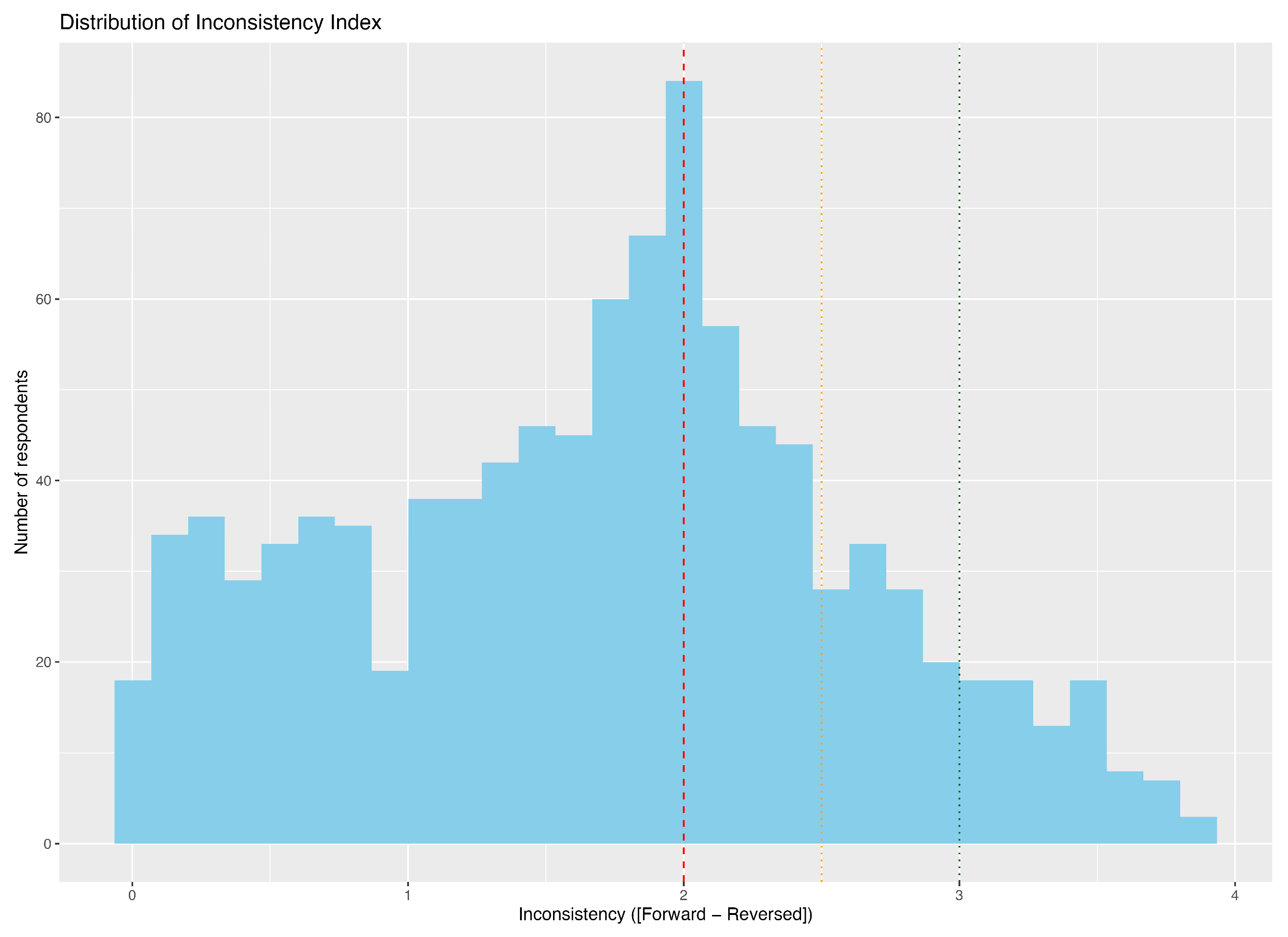
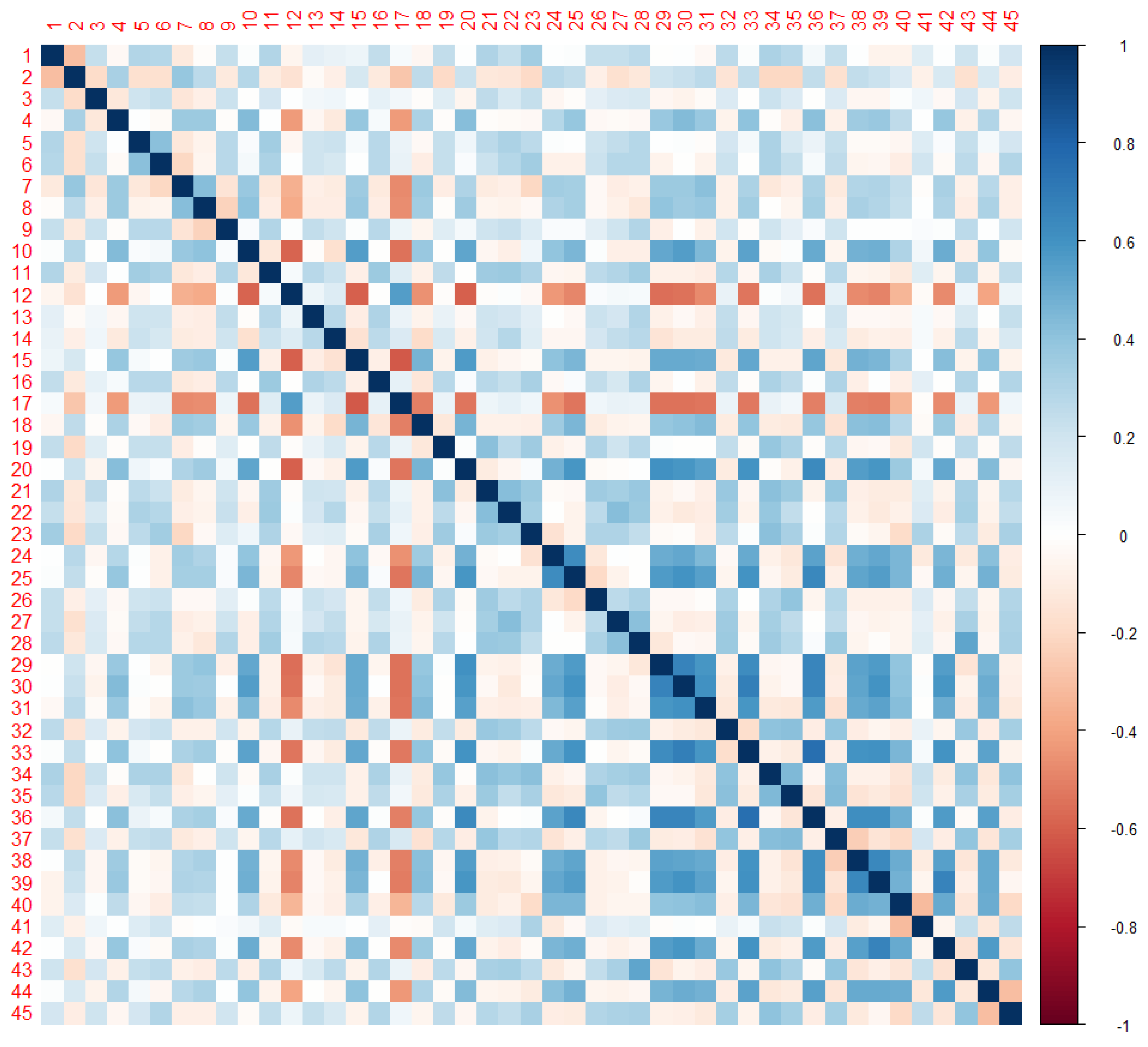
Data Screening. After applying missingness, response-uniformity, inconsistency (
Figure 1), and multivariate outlier filters, the final analytic dataset consisted of 918 valid observations. This represented the dataset used for reliability and exploratory structural analyses. The model-based profile analysis was conducted on the subset of respondents with complete item-level data for clustering.
Internal Consistency. The adapted BESSI demonstrated strong total-scale internal consistency in the combined analytic sample. For the full 45-item instrument, Cronbach’s α was 0.92 and McDonald’s ω was 0.94, indicating excellent total-scale internal consistency in the final analytic sample (
Cronbach, 1951;
McMillan & Schumacher, 2010;
Revelle & Zinbarg, 2009).
Table 2 presents reliability indices for each domain, including Cronbach’s α, McDonald’s ω, average inter-item correlation (
), and split-half reliability ranges. Domain-level reliability was more moderate, with α values ranging from 0.60 to 0.76 and ω values ranging from 0.73 to 0.81 (
Nunnally & Bernstein, 1994). Innovation showed the highest reliability (α = 0.76, ω = 0.81,
= 0.23), followed by Social Engagement (α = 0.71, ω = 0.79,
= 0.21), Emotional Resilience (α = 0.69, ω = 0.76,
= 0.18), Cooperation (α = 0.64, ω = 0.74,
= 0.16), and Self-Management (α = 0.60, ω = 0.73,
= 0.16). Average inter-item correlations across domains fell within the recommended 0.15–0.50 range, indicating that items were related without being redundant (
Clark & Watson, 1995). These results suggest that the adapted BESSI functions most robustly as an overall measure of teacher socio-emotional competencies, while some broad domain scores require cautious interpretation and further refinement.
Split-Half and Item Analyses. Spearman–Brown corrected split-half reliability estimates varied across domains, with stronger results for the total scale than for some individual domains. The total scale showed a broad but generally strong split-half reliability range (0.45–0.93), whereas some domain-level split-half estimates were lower, indicating that certain domains may contain more heterogeneous item content. Average inter-item correlations ranged from 0.16 to 0.23 across domains, aligning with the recommended 0.15–0.50 range for achieving item cohesion without redundancy (
Clark & Watson, 1995). Item-level diagnostics further indicated that most items contributed meaningfully to their respective scales, although several items showed weaker corrected item–total correlations and should be reviewed in future scale refinement. Therefore, no items were removed at this exploratory stage, but low-performing items should be examined through future confirmatory analyses, cognitive interviews, and cross-validation.
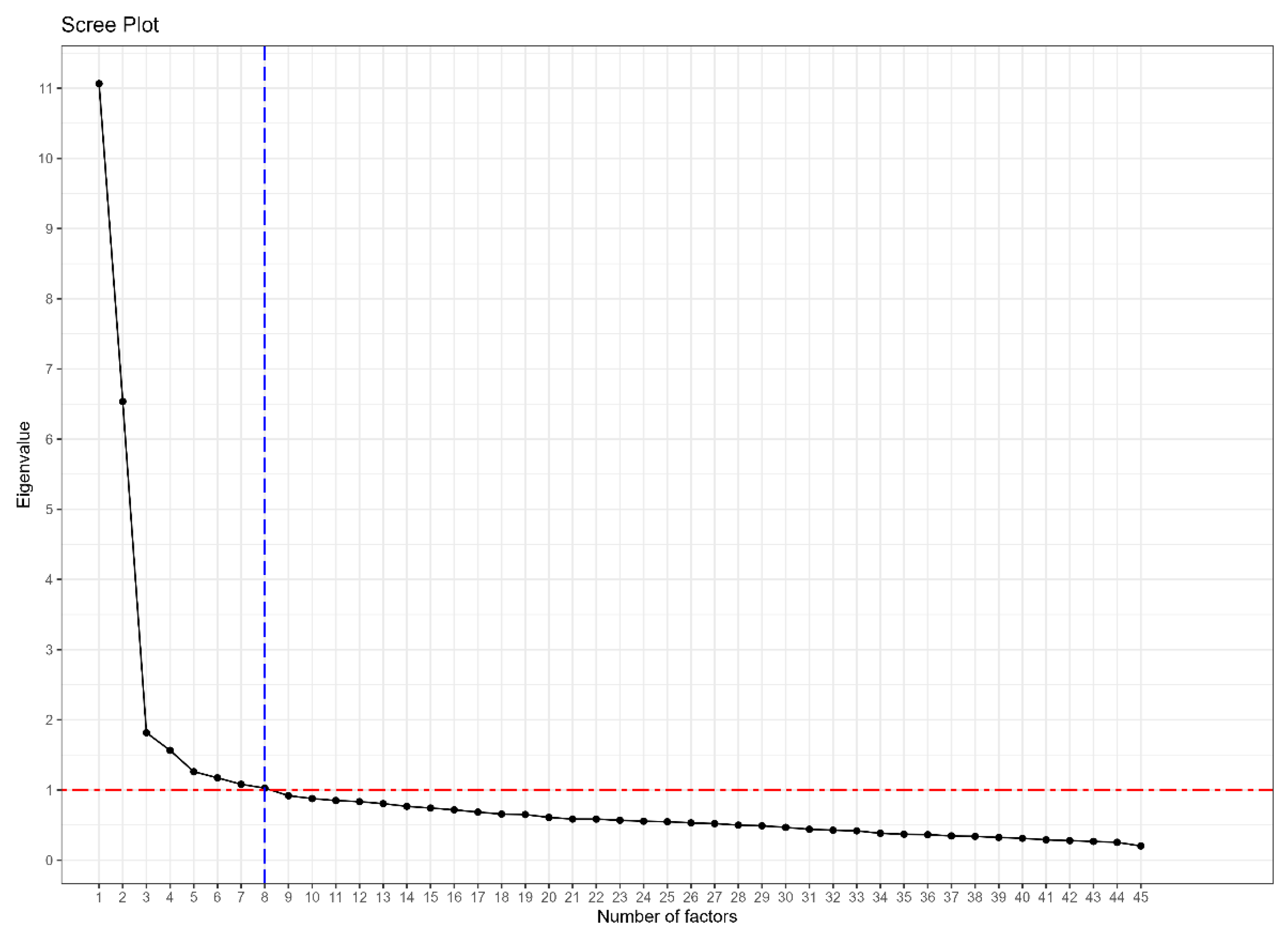
Factor Structure (Construct Validity). EFA were conducted to examine the underlying structure of the adapted BESSI for teachers. The analysis supported the presence of multiple latent dimensions; however, the intended domain–facet structure of the original instrument was not fully replicated. For the full set of 45 items, the eigenvalue pattern indicated that the first component accounted for the largest proportion of variance, while the scree plot suggested an empirical solution of approximately eight factors rather than a structure corresponding directly to the original five broad BESSI domains and associated facets (
Figure 2). This result suggests that the adapted teacher version may capture a more differentiated structure of socio-emotional competencies in this sample.
The variance summary further supported this interpretation. The first component explained 24.5% of the total variance, and the second component explained an additional 14.6%. The remaining six components each explained smaller proportions of variance, ranging from 2.3% to 4.0%. Together, the first eight components explained 56.7% of the total variance (
Table 3). This pattern indicates that the adapted BESSI responses were not purely unidimensional but were also not organized in a way that reproduced the original five-domain structure in a straightforward manner.
A maximum-likelihood factor analysis with eight factors and varimax rotation showed that the eight-factor solution did not fully reproduce the observed covariance structure, χ2(658) = 1461.92, p < 0.001. Given the sensitivity of chi-square tests to sample size, this result was interpreted cautiously. Overall, the findings suggest that the adapted BESSI captures meaningful multidimensional variation among teachers, but that the original theoretical structure may require refinement for adult educator populations. Therefore, subsequent profile analyses were treated as exploratory and interpreted as relative competency patterns rather than fixed teacher types.
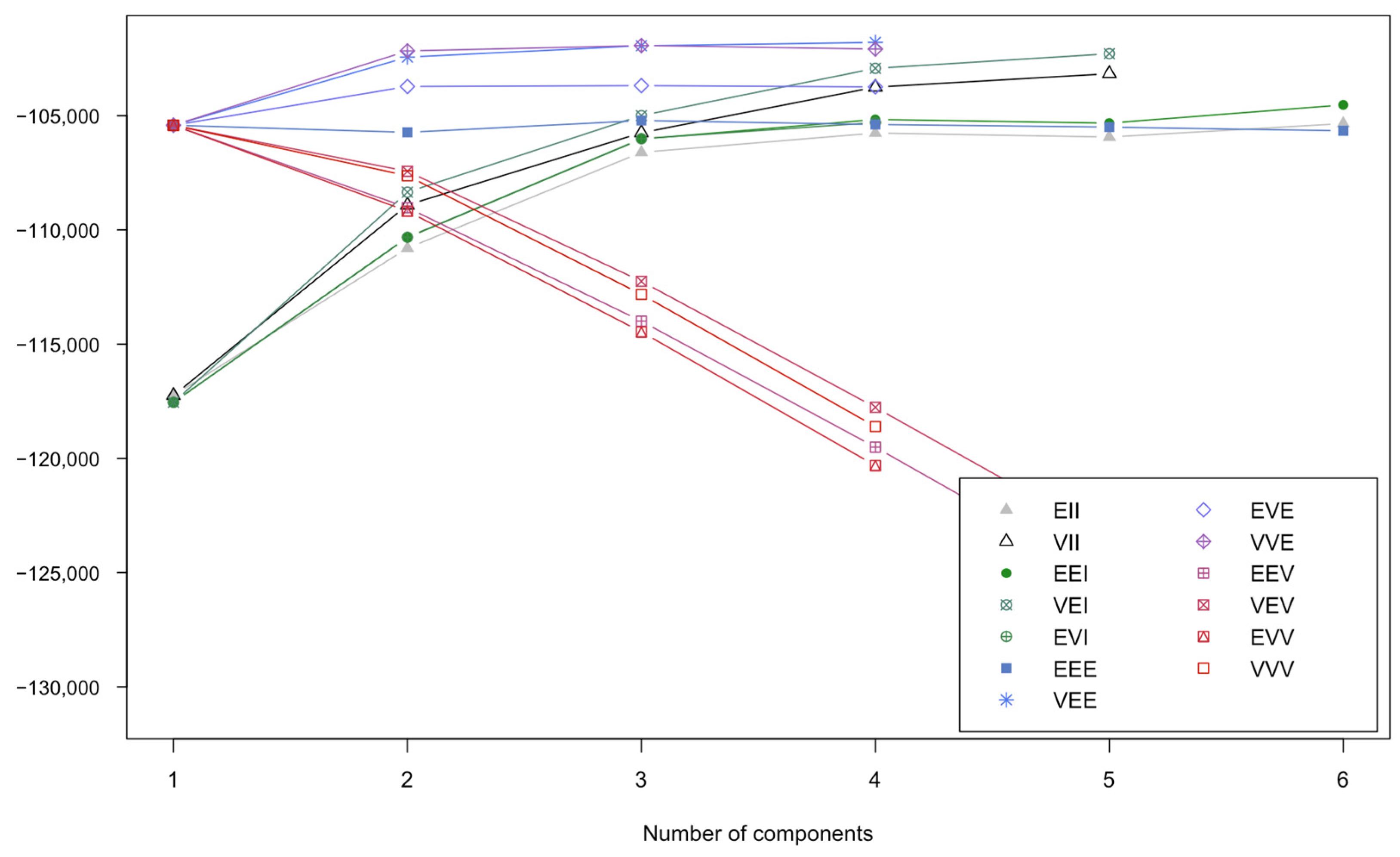
Model-based teacher socio-emotional competency profiles. Model-based clustering was conducted to identify empirically distinct patterns of teacher socio-emotional competencies across the 45 BESSI items. Competing solutions with different numbers of profiles and covariance structures were compared using the Bayesian Information Criterion (BIC). As shown in
Figure 3, the BIC values did not provide unequivocal support for a four-profile solution; more parsimonious two- or three-profile models showed comparable or stronger statistical fit. However, the four-profile solution was retained for further exploratory interpretation because it provided a more substantively meaningful differentiation of teacher competency patterns, avoided an overly broad grouping of respondents, and allowed clearer identification of profile-specific strengths and developmental needs. Thus, the four-profile solution should be interpreted as an exploratory and theoretically informed classification rather than as a definitive statistically optimal model.
The four-profile solution classified teachers into groups of different sizes, indicating that the profiles were not equally distributed in the sample.
Table 4 presents the number and percentage of teachers assigned to each profile.
The selected four-profile solution provided an interpretable representation of the data, differentiating teachers not only by overall competency level but also by the relative balance of self-management, interpersonal, emotional-regulatory, and innovation-related subdomains. Because several profiles showed similar high and low subdomains, the profiles should be interpreted as relative competency patterns rather than fixed teacher types.
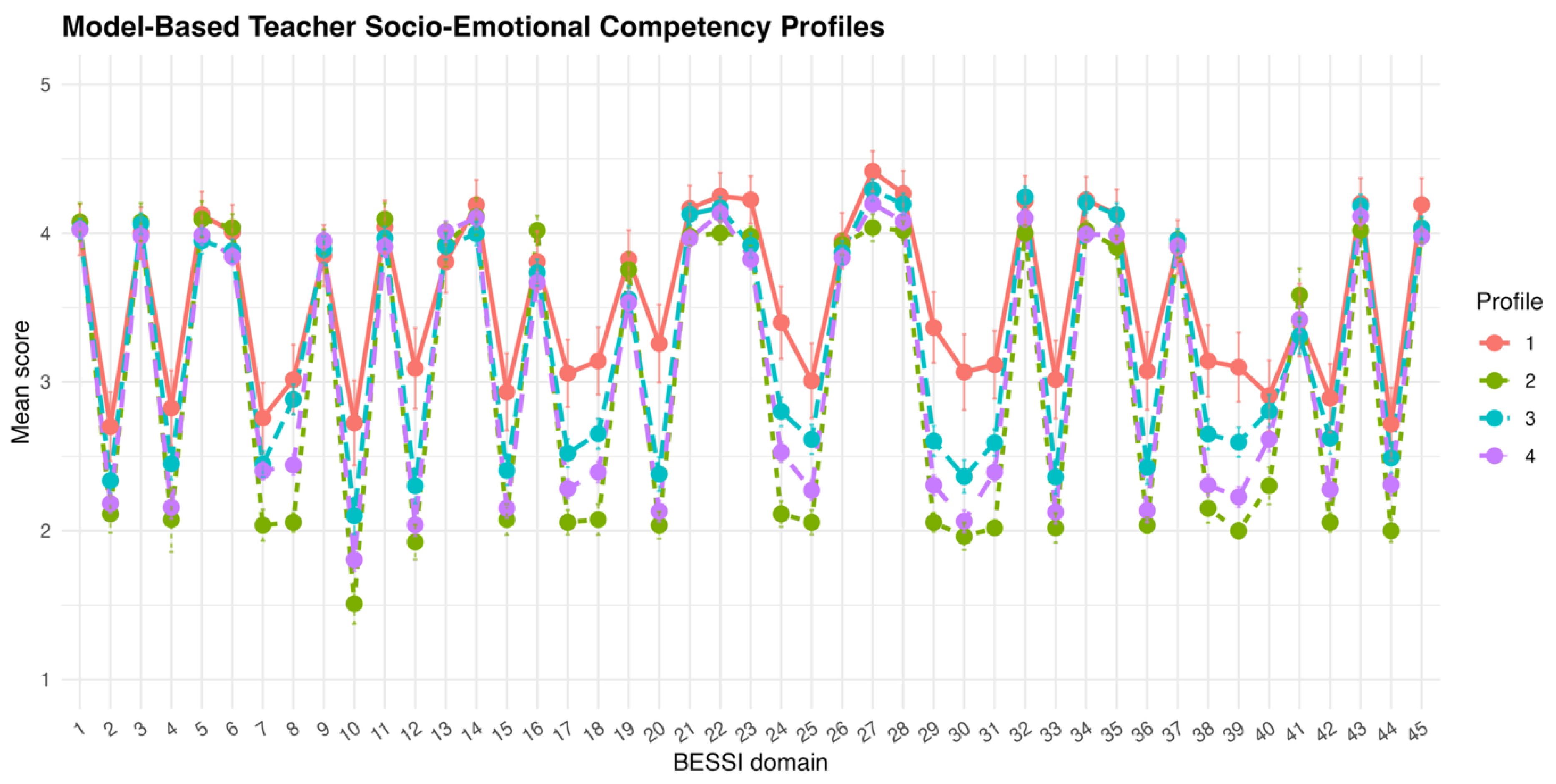
Figure 4 presents the mean profile patterns across the 45 adapted BESSI items. The graph shows that the four profiles share some common peaks and troughs, suggesting partly similar patterns of socio-emotional strengths and challenges across teachers. However, the profiles differ in the magnitude and consistency of these competencies. Profile 1 showed the most balanced and generally elevated pattern, whereas Profiles 2, 3, and 4 showed more uneven configurations with specific vulnerabilities in selected items and facets.
To support substantive interpretation of the profiles, the five highest-scoring and five lowest-scoring subdomains were identified within each profile. These results are presented in
Table 5. This step was used to avoid interpreting the profile graph only visually and to provide a more transparent basis for assigning profile labels.
Profile 1 was labelled the future-ready socio-emotional profile because it combined high energy regulation, ethical competence, organizational skill, perspective-taking, and responsibility management. This pattern suggests a group of teachers with strong adaptive regulation, ethical orientation, professional responsibility, and interpersonal understanding. Profile 2 was labelled the goal-oriented self-management profile with relational vulnerabilities because it showed strong responsibility, time, task, and goal regulation, but lower trust, information processing, persuasion, detail management, and rule-following. Profile 3 was labelled the adaptive interpersonal profile with regulatory pressure points, reflecting strengths in energy regulation, optimism, organization, and perspective-taking, alongside lower stress regulation, rule-following, detail management, and persuasion. Profile 4 was labelled the developing adaptive-regulatory profile, because teachers in this group showed some positive resources in energy regulation, optimism, time management, organization, and perspective-taking, but clearer developmental needs in stress regulation, trust-building, information processing, and persuasive communication.
From the perspective of future-oriented teaching, Profile 1 is especially important because it combines self-regulation, ethical competence, organization, perspective-taking, and responsibility management. These competencies align with broader understandings of future readiness, which emphasize agency, adaptability, collaboration, and responsible action under uncertainty (
OECD, 2023). They are also relevant for teachers’ ability to manage stress, maintain supportive relationships, and exercise professional judgement in digitally changing learning environments (
Lozano-Peña et al., 2021;
Redecker, 2017;
Miao & Holmes, 2023). The remaining profiles indicate that future readiness should not be treated as a single general attribute, but as a multidimensional set of socio-emotional and behavioral competencies requiring differentiated professional support (
Soto et al., 2022).
Because the four profiles shared several similar peaks and troughs, they should be interpreted as relative competency patterns rather than fixed or diagnostic teacher types. In addition, the profiles are based on self-report responses and therefore reflect teachers perceived socio-emotional competencies rather than direct behavioral observations. As with other self-report instruments, responses may be influenced by self-perception, professional identity, or the desire to present oneself in a favorable manner. This limitation does not undermine the usefulness of the profiles, but it indicates that profile labels should be interpreted as descriptive summaries of response patterns rather than as definitive classifications of actual competence.
Summary of Findings. In sum, the Kazakh and Russian adaptations of the BESSI provided promising preliminary evidence of psychometric quality for use with teachers in Kazakhstan. The TRAPD-based translation and review process supported the linguistic and content validity of the adapted items by ensuring semantic equivalence, cultural appropriateness, and consistency across the two language versions. Reliability evidence was strongest at the total-scale level, with excellent internal consistency for the full 45-item instrument. Domain-level reliability was more moderate, suggesting that some broad domain scores should be interpreted cautiously and may require further refinement. Exploratory factor analyses indicated that the original BESSI domain–facet structure was not fully reproduced in the teacher sample, and the empirical results suggested a more differentiated multidimensional structure. The model-based profile analysis further identified four interpretable but exploratory teacher socio-emotional competency profiles. Taken together, the findings support the adapted BESSI as a promising research instrument for examining teacher socio-emotional competencies in Kazakhstan, while also indicating the need for further structural validation, independent replication, and external validity evidence.
5. Discussion
The present study provides preliminary psychometric evidence for the Kazakh and Russian adaptations of the Behavioral, Emotional, and Social Skills Inventory for teachers in Kazakhstan. The findings suggest that the adapted 45-item instrument functions well as an overall measure of teachers’ behavioral, emotional, and social skills, while also indicating that additional refinement is needed at the domain and structural levels. This pattern is important because the BESSI was originally designed as a broad taxonomy of social, emotional, and behavioral skills, and its adaptation to an adult teacher population requires careful consideration of both psychometric quality and professional-context relevance (
Soto et al., 2022;
Lechner et al., 2022).
The translation and adaptation process provides initial evidence of content validity (
Arumi et al., 2024;
Cavioni et al., 2023;
Gálvez-Nieto et al., 2023). The use of the TRAPD approach supported semantic equivalence, cultural appropriateness, and consistency across the Kazakh and Russian versions of the instrument (
Harkness et al., 2003;
Harkness et al., 2004). This is particularly important in the Kazakhstani context, where bilingual implementation requires not only literal translation but also conceptual alignment across linguistic and educational settings. The careful documentation of translation, review, adjudication, pretesting, and revision procedures strengthens the credibility of the adapted instrument and supports its use in further validation studies (
Antoniou & Al-Khadim, 2022).
The reliability results were strongest at the total-scale level. The overall 45-item instrument demonstrated excellent internal consistency, suggesting that the adapted BESSI captures a coherent general construct of teacher socio-emotional competence. However, reliability estimates for the five broad domains were more moderate. This finding should not be interpreted as a failure of the instrument, but rather as evidence that the teacher-adapted version captures a diverse set of skills within each broad domain. The BESSI domains include heterogeneous behavioral, emotional, and interpersonal competencies, and lower alpha values may reflect the breadth of the constructs rather than poor item quality. For this reason, McDonald’s omega and average inter-item correlations are useful complementary indicators, as omega is less restrictive than alpha and average inter-item correlations help evaluate whether items are related without being redundant (
McDonald, 1999;
Revelle & Zinbarg, 2009;
Clark & Watson, 1995).
The exploratory factor analyses showed that the original BESSI domain–facet structure was not fully reproduced in the present teacher sample. The scree plot and component variance results suggested an approximately eight-factor empirical structure, while the maximum-likelihood factor analysis indicated that the eight-factor solution did not fully reproduce the observed covariance structure. This finding suggests that the adapted BESSI captures meaningful multidimensional variation, but that the original theoretical structure may require realignment for adult educator populations. One possible explanation is that teachers interpret socio-emotional skills through professional role expectations, such as classroom management, communication with students, ethical responsibility, emotional regulation, and adaptation to institutional demands. Therefore, competencies that are theoretically distinct in the original BESSI may function differently when applied to teachers.
The model-based profile analysis extends the psychometric findings by showing how socio-emotional competencies are configured among teachers. Although the profile solution should be interpreted as exploratory, the four profiles provide a useful descriptive framework for understanding variation in teachers’ socio-emotional strengths and developmental needs. Profile 1, labelled the future-ready socio-emotional profile, was characterized by high energy regulation, ethical competence, organizational skill, perspective-taking, and responsibility management. This profile reflects a balanced combination of adaptive regulation, professional responsibility, ethical orientation, and interpersonal understanding. Such a configuration is especially relevant in contemporary educational systems, where teachers are expected to manage complex classroom interactions, respond flexibly to changing demands, and support students’ academic and emotional development.
Profiles 2, 3, and 4 showed more differentiated competency patterns. Profile 2, labelled the goal-oriented self-management profile with relational vulnerabilities, demonstrated strengths in responsibility management, time management, task management, goal regulation, and perspective-taking, but lower scores in trust, information processing, persuasion, detail management, and rule-following. This suggests that teachers in this group may be generally organized and goal-directed, but may need support in relational trust, flexible information processing, and communication influence. Profile 3, labelled the adaptive interpersonal profile with regulatory pressure points, showed strengths in energy regulation, perspective-taking, organizational skill, optimism, and time management, but lower scores in stress regulation, detail management, rule-following, persuasion, and artistic skill. Profile 4, labelled the developing adaptive-regulatory profile, showed positive resources in energy regulation, optimism, time management, organization, and perspective-taking, but clearer developmental needs in stress regulation, trust-building, information processing, and persuasive communication.
These profile findings have practical implications for teacher professional development (
Yessingeldinov et al., 2022;
Tuyakova et al., 2021). They suggest that socio-emotional competence should not be treated as a single general trait. Instead, teachers may have different configurations of strengths and support needs. For example, some teachers may require professional development focused on stress regulation and emotional resilience (
Reppa et al., 2023), whereas others may benefit more from support in communication, trust-building, or flexible problem-solving. This aligns with broader research showing that teachers’ socio-emotional competence, emotion regulation, and psychological resources are associated with work engagement, occupational well-being, and reduced burnout (
S. Li & Akram, 2023;
Ma, 2023b;
Ornaghi et al., 2023;
Oliveira et al., 2022b;
Attwood, 2024;
Namaziandost et al., 2024). In this sense, the adapted BESSI may become useful not only as a research instrument but also as a diagnostic tool for designing more targeted and evidence-informed professional development programs (
Koslouski et al., 2024).
The findings are also relevant to teacher development in digitally changing educational systems. Teachers increasingly work in environments that require adaptability, emotional regulation, collaboration, and openness to innovation. Socio-emotional competencies may influence how teachers respond to technological change, hybrid learning models, new assessment systems, and shifting expectations around professional practice (
Kusmaryono, 2025). Therefore, identifying teachers’ socio-emotional profiles can help educational organizations design support systems that address both technical and psycho-emotional dimensions of professional growth. This is consistent with research emphasizing the importance of teacher well-being, resilience, emotional intelligence, and innovation-oriented competencies in contemporary education (
Pozo-Rico et al., 2023;
Derakhshan & Zhang, 2024).
These findings also speak directly to futures thinking in education. Future-ready teaching is not limited to technical proficiency with digital tools or artificial intelligence; it also depends on teachers’ capacity to manage ambiguity, regulate emotions, collaborate ethically, and adapt pedagogical decisions to changing learning environments. The profile analysis suggests that socio-emotional readiness for the digital age may be unevenly distributed across teachers. Some teachers may already combine adaptive regulation, ethical responsibility, and interpersonal understanding, whereas others may need targeted support in trust-building, stress regulation, flexible information processing, or persuasive communication. Therefore, the adapted BESSI may help educational systems identify not only whether teachers possess socio-emotional competencies, but also which combinations of competencies are most relevant for future-oriented professional development.
Future research should also examine the relationship between socio-emotional competencies and the growing use of artificial intelligence (AI) in education. As teachers increasingly integrate AI-powered tools into instructional design, assessment, feedback, and professional learning, socio-emotional competencies may play an important role in shaping how educators adapt to these innovations. Skills such as emotional regulation, ethical decision-making, adaptability, perspective-taking, and collaborative communication may influence teachers’ ability to use AI effectively and responsibly while maintaining meaningful human interactions with students. Investigating the interplay between AI-related practices and socio-emotional competencies may therefore provide valuable insights into the evolving demands of contemporary educational environments.
At the same time, these findings should be interpreted cautiously. The factor structure was exploratory and did not fully reproduce the original BESSI model, and the four-profile solution should be treated as a descriptive classification rather than a confirmed teacher typology. These results therefore provide a basis for further validation rather than final evidence of a stable measurement or profile structure.
Overall, the study contributes to the literature by providing initial evidence for the adaptation and use of the BESSI with teachers in Kazakhstan. It also highlights the importance of moving beyond general reliability estimates toward a more nuanced understanding of how socio-emotional competencies are structured and expressed in professional teaching contexts. The results suggest that the adapted BESSI is a promising instrument for research and professional development, but further validation is needed through confirmatory factor analysis, measurement invariance testing, test–retest reliability, and external validity studies (
Panchenko & Velychko, 2023;
Shirvan et al., 2024).
5.1. Limitations
Several limitations should be acknowledged. First, the study relied on self-report data, which may be influenced by social desirability, self-perception bias, and response style. This issue is particularly relevant in professional samples, where teachers may evaluate their own competencies in relation to socially valued expectations of effective teaching. Although response-quality filters were applied to reduce careless and inconsistent responding, self-report measures cannot fully eliminate the possibility of biased self-assessment.
Second, the internal structure of the adapted BESSI was examined using exploratory procedures, and the original BESSI domain–facet configuration was not fully reproduced in the present teacher sample. This suggests that the adapted instrument captures meaningful multidimensional variation in teachers’ socio-emotional competencies, but further refinement is needed before making strong claims about the stability of the domain structure. In particular, the results should be interpreted as preliminary evidence rather than as final confirmation of the adapted instrument’s factorial validity.
Third, the model-based profile analysis was exploratory. Although the four-profile solution provided substantively interpretable patterns of teacher socio-emotional competencies, it should not be treated as a fixed typology of teachers. The profiles represent relative patterns of strengths and developmental needs within the present sample and should be cross-validated using an independent teacher sample. In addition, one profile was relatively small, comprising 53 teachers, or 5.8% of the clustering sample. Although this group showed a substantively interpretable pattern, its stability should be evaluated carefully in future replications.
Fourth, although the final analytic sample was sufficiently large for preliminary psychometric and profile analyses, the gender distribution was highly imbalanced. This pattern reflects the composition of the teaching workforce, but it limits the possibility of robust gender-based comparisons. Future studies with more balanced subgroup representation would be useful for examining whether the adapted BESSI functions equivalently across demographic groups.
Finally, the current study did not include external validation criteria, such as classroom observation, teacher well-being, burnout, professional development outcomes, student learning indicators, or performance-based measures of socio-emotional competence. As a result, the convergent, predictive, and consequential validity of the adapted BESSI and the identified profiles remains to be examined.
5.2. Future Research
Future research should extend the present findings in several directions. First, the revised structure of the teacher-adapted BESSI should be examined using confirmatory factor analysis in an independent sample. Competing models should be tested, including the original five-domain structure, the empirically suggested eight-factor structure, and potentially bifactor or higher-order models. This would make it possible to determine whether the adapted instrument is best interpreted through broad domains, specific subdomains, or a general socio-emotional competency factor.
Second, measurement invariance should be evaluated across key groups, including language version, region, subject area, teaching experience, school type, and other relevant demographic or professional categories (
Bazán-Ramírez et al., 2021). This is important because the adapted BESSI is intended for use in a multilingual and regionally diverse educational system. Without measurement invariance evidence, comparisons between groups should be interpreted cautiously.
Third, the four-profile solution should be replicated in an independent sample to evaluate its stability and generalizability. Future studies should examine whether the same profile patterns emerge across different teacher groups and whether profile membership remains stable across time. Longitudinal designs would be especially useful for determining whether teachers’ socio-emotional profiles change following targeted professional development interventions.
Fourth, future research should examine convergent, discriminant, and predictive validity by linking BESSI scores and profile membership to external indicators. Relevant outcomes may include teacher well-being, burnout, work engagement, classroom observation results, participation in professional development, instructional quality, and student learning outcomes. These analyses would help determine whether the adapted BESSI is useful not only as a descriptive self-report instrument, but also as a practical tool for identifying professional development needs.
Finally, test–retest reliability should be assessed to evaluate the temporal stability of the adapted scales. Evidence from previous BESSI adaptation studies suggests that temporal stability can be meaningfully examined over short- and medium-term intervals; for example,
Lechner et al. (
2022) reported test–retest correlations ranging from 0.66 to 0.87 across BESSI subdomains. Establishing similar evidence in the Kazakhstani teacher context would strengthen the case for using the adapted BESSI in longitudinal research and professional development evaluation.
Taken together, these limitations and future research directions suggest that the adapted BESSI should be viewed as a promising but still developing instrument. The present findings provide an important foundation for assessing teachers’ socio-emotional competencies in Kazakhstan, but further validation is needed before the instrument is used for high-stakes decisions or formal evaluation. Its strongest immediate value lies in research, diagnostic feedback, and the design of targeted professional development programs.