1. Introduction
Artificial Intelligence (AI) is becoming an integral component of higher education, supporting learners in engaging with academic content. This transformation is particularly evident in English Language Teaching (ELT), especially in the development of academic writing and speaking skills.
AI tools, such as ELSA Speak, ChatGPT 5.5, and Grammarly, support language learning by providing personalized, real-time feedback. These technologies increasingly support individualized language learning through real-time feedback on grammar, vocabulary, pronunciation, and discourse organization. Similarly, in speaking, AI technologies highlight specific pronunciation errors and provide instant feedback on intonation and stress. This expands access to feedback and supports linguistically diverse learners in developing academic proficiency.
Despite its benefits, AI is not without its complexities, including significant ethical and pedagogical concerns. Research highlights the risk of students offloading cognitive effort to AI tools, and issues related to reinforcing dominant language norms at the expense of cultural and translingual diversity. AI should therefore not be conceptualized as a neutral technology, as it presents both pedagogical affordances and challenges related to academic integrity.
Moreover, AI’s impact on higher education is shaped not only by its technological capacity but also by institutional infrastructure, teacher training, curriculum design, and individual learner differences. The pedagogical impact of AI tools varies across contexts, as technologies that support learner autonomy in one environment may contribute to disengagement or dependency in another. For instance, in multilingual classrooms, AI’s fixation on native-like norms could inadvertently signal that a student’s output is inadequate.
While previous literature has primarily examined the effectiveness of AI tools in improving linguistic performance, limited focus has been given to the pedagogical mediation required to ensure meaningful and ethical language learning. This systematic review argues that AI tools should not be considered an autonomous instructional substitute, but rather as a pedagogically mediated resource whose educational value depends on educator guidance, critical AI literacy, and proper implementation. Drawing on 109 peer-reviewed sources across multiple disciplines, this study seeks to:
Evaluate recent empirical findings on the effectiveness of AI tools in supporting ELT.
Analyze how AI tools impact learner progress and engagement, and identify ethical and pedagogical concerns.
Offer implications for research and institutional policy that align with critical pedagogies.
Crucially, this study moves beyond tool-centered evaluations to propose a critical framework: the Educator as the “agent of mediation”. The review argues that AI’s pedagogical value depends on forms of human mediation that balance technological advantages with risks of dependency and linguistic hegemony.
2. Methodology
This study adopts a systematic literature review to analyze the role of AI in enhancing academic writing and speaking in higher education contexts. Unlike traditional reviews that may focus solely on tool effectiveness or positive learning outcomes, this approach examines empirical evidence while questioning the pedagogical and ethical dimensions of AI integration.
The systematic review process involves two main phases. The first phase involved identifying and selecting the relevant studies using the Preferred Reporting Items for Systematic Reviews and Meta-Analyses (PRISMA;
Page et al., 2021). The second phase involved a mixed-methods analysis of those studies, including quantitative synthesis and qualitative coding using deductive and inductive coding techniques within grounded theory (
Strauss & Corbin, 1998). This inductive approach allowed themes to emerge from the data rather than forcing them into pre-determined themes. The primary theoretical output of this systematic review is the “Mediated AI-Pedagogy Cycle”, which redefines the teacher’s role not as a corrector but as a mediator who manages the AI–student interaction.
2.1. Search Strategy
The search focused on peer-reviewed empirical studies published in English. Although theoretical papers and prior reviews informed the conceptual framing of the study, they were excluded from the final database. Furthermore, to ensure the quality of the findings, only peer-reviewed journal articles were included. This review focused on papers published between 2022 and 2025 due to the release of ChatGPT in 2022, which marked a significant shift in AI capabilities.
The data retrieval protocol involved both electronic and manual searches. For the electronic search, Boolean search strategies were used to search for specific words in major scientific platforms such as Web of Science, Science Direct, and ERIC. Electronic searches were conducted across titles, abstracts, and keywords where database functionality permitted. Because database indexing and search syntax vary, the search strings were adapted slightly for each database while preserving the same conceptual search strategy. The Boolean search terms are presented in
Table 1.
In addition to database searches, a manual scan of key journals in applied linguistics and educational technology was performed. These included TESOL Quarterly, System, ReCALL, Computer Assisted Language Learning (CALL), and Language Learning & Technology.
2.2. Inclusion and Exclusion Criteria
To ensure focus and relevance, inclusion and exclusion criteria were rigorously applied, as summarized in
Table 2:
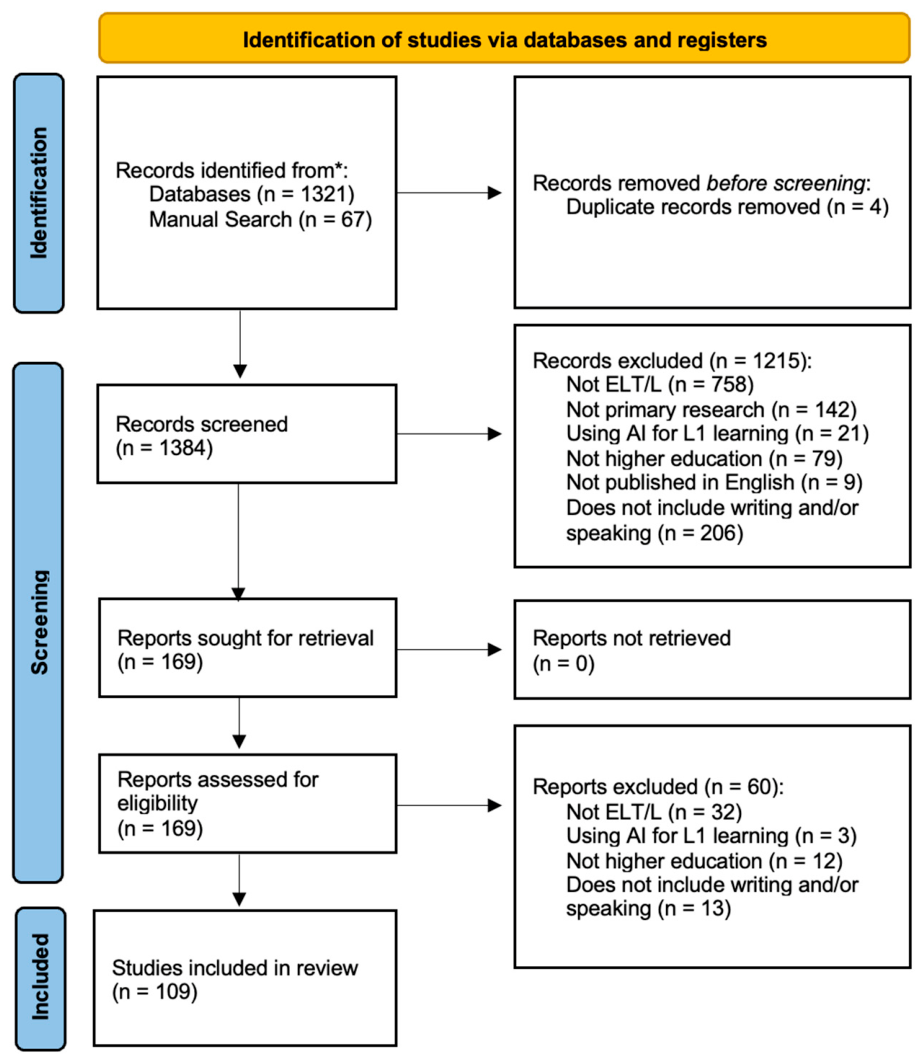
The screening process was conducted in two stages. First, titles and abstracts were screened against the inclusion and exclusion criteria. Studies that did not focus on AI-supported writing or speaking in higher education English language contexts were excluded at this stage. Second, the remaining full texts were reviewed to confirm eligibility. Screening decisions were checked collaboratively by the first two authors, and disagreements were resolved through discussion until consensus was reached. Formal inter-rater agreement statistics were not calculated because all disagreements were resolved through discussion and consensus during the screening process. This process resulted in 169 full-text reports being assessed for eligibility, of which 109 studies were retained for final synthesis.
2.3. Data Selection and Analysis
An initial pool of 1384 articles were identified. After duplicate removal and abstract screening, 169 studies underwent full-text review. Ultimately, 109 articles were retained for final analysis. The data analysis utilized a grounded theory approach (
Strauss & Corbin, 1998) to identify the capabilities and limitations of AI in ELT in higher education. Codes were generated inductively and organized into recurring themes. Coding decisions were reviewed collaboratively by the authors to enhance consistency and trustworthiness throughout the analytical process. The recurring themes identified through this coding process subsequently informed the development of the proposed Mediated AI-Pedagogy Cycle presented in the Discussion. The study selection process is illustrated in
Figure 1:
The analytical coding framework used to categorize the included studies is presented in
Table 3. These coding categories emerged iteratively during the review process and were refined through repeated comparison across studies.
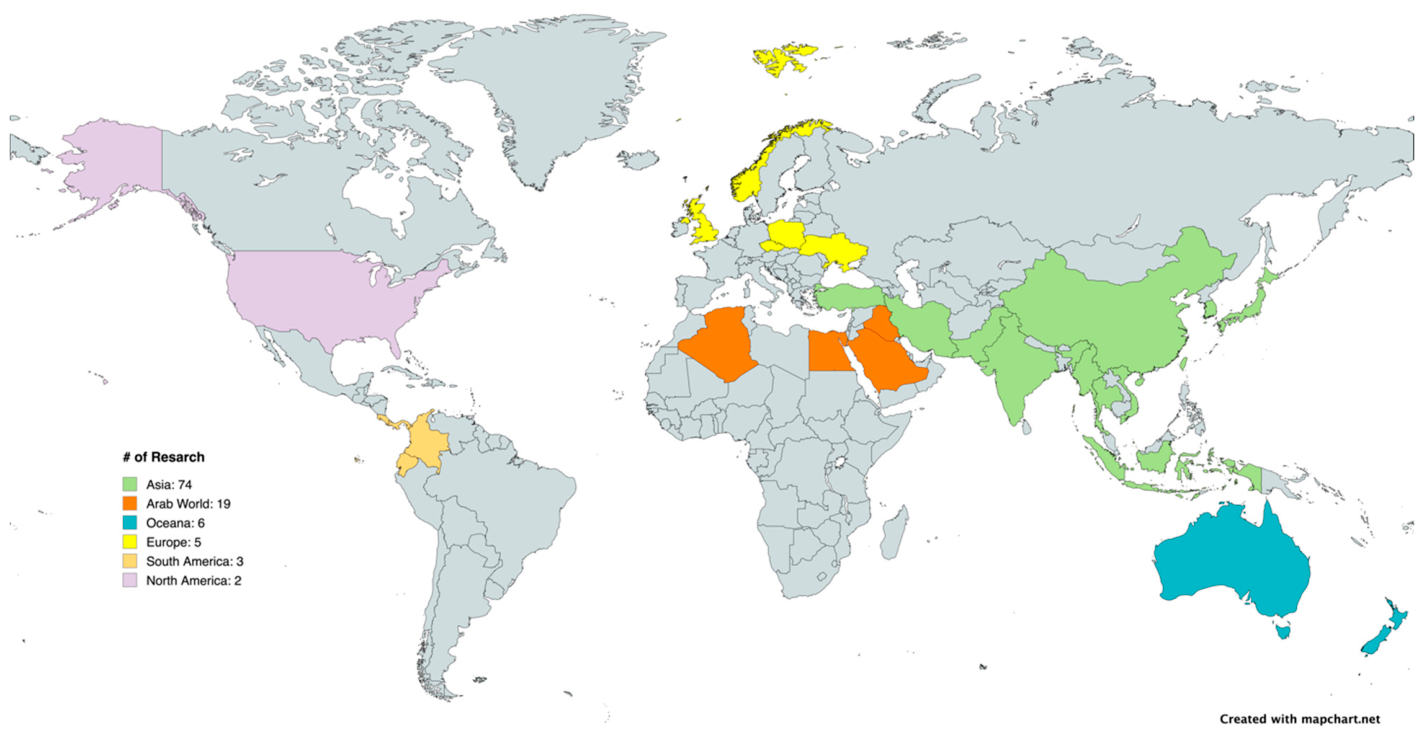
The geographical distribution of studies reveals a strong concentration in Asia (74 studies), followed by the Arab region (19 studies), while other global contexts remain comparatively underrepresented. The geographical distribution of the included studies is presented in
Figure 2.
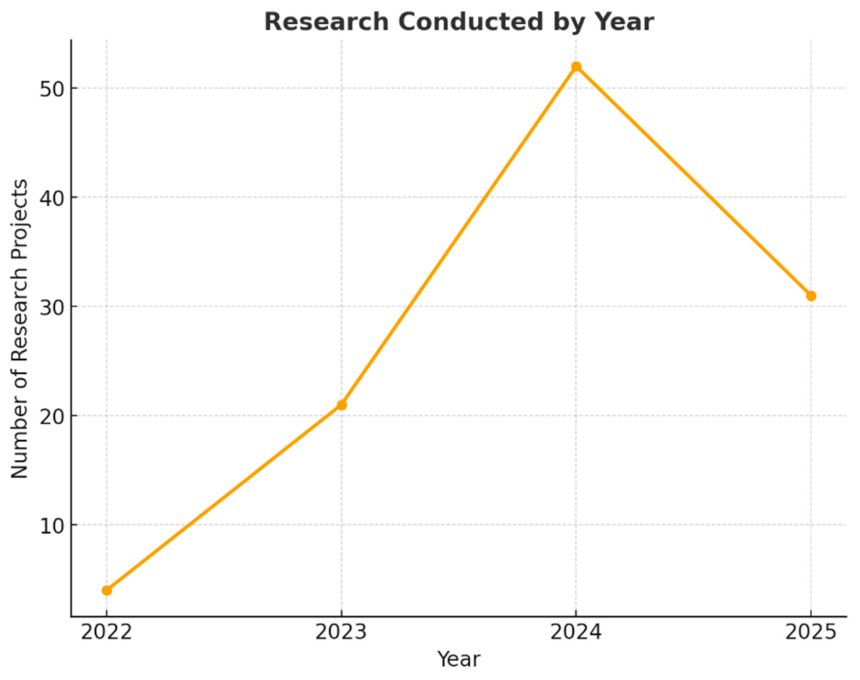
The findings show a substantial increase in ELT research between 2022 and 2024, with publication activity remaining strong in 2025 despite the year still being ongoing. Studies were classified according to the country or region in which the empirical research was conducted. Multi-country studies were categorized based on their primary research context. The distribution of studies by publication year is presented in
Figure 3.
2.4. Quality Appraisal
To address methodological trustworthiness, the included empirical studies were appraised using the Mixed Methods Appraisal Tool (MMAT), which is suitable for reviews containing qualitative, quantitative, and mixed methods studies. Each study was assessed according to the criteria relevant to its research design, including clarity of research questions, appropriateness of methodology, adequacy of data collection, coherence between findings and conclusions, and overall analytical rigor. For summarizing methodological quality, the MMAT findings were synthesized into descriptive categories (high, good, and moderate) based on the overall pattern of criteria satisfied. These categories were used only to support interpretation of the evidence and were not used as formal MMAT scores or exclusion thresholds.
The first two authors independently reviewed the methodological quality of the included studies, and any differences in appraisal were resolved through discussion until consensus was reached. Studies were then categorized as high, good, or moderate quality. The appraisal was used not to exclude studies at this stage, but to qualify the strength of the synthesis and avoid treating all evidence as equally robust. The detailed outcome of the quality appraisal is presented in
Table 4.
The quality appraisal indicated that the evidence base was generally adequate for thematic synthesis. The appraisal informed interpretation of the findings, with evidence from high- and good-quality studies receiving greater interpretive emphasis than evidence from moderate-quality studies. This was particularly important when interpreting broad claims about improvements in accuracy, pronunciation, confidence, engagement, and learner autonomy.
2.5. Limitations of the Review
Several limitations must be acknowledged. First, the field of AI in education has rapidly evolved after the post-COVID era. Therefore, studies from before the year 2020 may already be obsolete or have been significantly updated, rendering some earlier findings less representative of the rapidly evolving AI landscape. Second, while the review attempts global coverage, there is an unavoidable bias toward English-language publications and research from English-medium institutions. This may underrepresent voices from other parts of the globe, such as multilingual pedagogies that fall outside mainstream academic discourse. Consequently, the transferability of the findings to educational contexts outside the predominant study regions should be interpreted with appropriate caution. Evidence suggests that much of the Arabic literature is difficult to find online, as many such publications focus on printed copies, making hard copies difficult to obtain. Furthermore, the authors’ linguistic capabilities limit their search to English-only publications.
Furthermore, not all studies clearly distinguished between AI and non-AI applications (e.g., basic grammar checkers vs. machine-learning-enhanced writing aids), necessitating inferential judgement during coding.
Finally, because the included studies differed substantially in research designs, AI tools, outcome measures, and educational contexts, a quantitative meta-analysis was not considered appropriate.
3. Literature Review
Artificial intelligence (AI) has become increasingly integral to education; however, its pedagogical value remains contested across different instructional contexts. Within the field of ELT, its application has been evident in supporting the development of writing and speaking skills, which traditionally require sustained practice and extensive feedback. Both skills require constant practice and comprehensive feedback, which are often difficult to provide in depth. AI technologies address these challenges by providing immediate, individualized assistance; however, their effectiveness depends on how learners engage with this feedback. Despite these capabilities, incorporating them into educational settings raises persistent concerns about bias, accuracy, and the role of human judgement in the learning process (
Zawacki-Richter et al., 2019).
In teaching and learning speaking, artificial intelligence (AI) has been shown to enhance pronunciation accuracy, learner confidence, and willingness to communicate by providing immediate and individualized feedback in lower-anxiety environments (
J. Du & Daniel, 2024;
Wang et al., 2024;
Wiboolyasarin et al., 2025;
M. Zou & Huang, 2024). These advantages are particularly valuable in contexts where learners have limited exposure to proficient English-speaking environments. However, arguments persist on whether such systems privilege native-speaker norms and standardized pronunciation models.
AI has reshaped writing instruction, evolving from grammar-checking tools capable of supporting idea generation, revision, and metacognitive reflection. AI-assisted writing platforms offer immediate and individualized feedback on grammar, vocabulary, organization, and coherence, enabling iterative revision processes that may strengthen learner confidence and engagement (
Stevenson & Phakiti, 2019). While these tools support iterative revision, their effectiveness depends on whether learners actively process feedback rather than accept automated corrections uncritically. Also, concerns remain regarding the extent to which AI-generated feedback reinforces standardized linguistic norms and reduces opportunities for deeper cognitive engagement with writing.
The emergence of large language models (LLMs) such as ChatGPT has significantly transformed academic writing practices by shifting AI from corrective assistance toward collaborative text generation and idea development. Studies suggest that interaction with AI systems may promote metacognitive reflection on vocabulary, sentence structure, and rhetorical organization (
Kasneci et al., 2023). However, the increasing use of generative AI also raises concerns regarding intellectual ownership, academic integrity, and the extent to which students meaningfully engage with the writing process itself (
Ateeq et al., 2024). The pedagogical challenge therefore lies not in restricting AI entirely, but in designing learning environments that preserve learner agency while encouraging critical engagement with AI-generated content.
Individualized feedback can support learner autonomy while allowing teachers to focus on higher-order guidance. However, it is important that these technologies do not replace teachers’ roles but instead support and redefine their instructional roles. In this regard, educators and policymakers ought to address the ethical dimensions of AI use by guiding students in making informed choices about AI’s feedback and understanding what is appropriate and what is not (
Godwin-Jones, 2022). Achieving this goal requires developing educators’ AI literacy, enabling them to become familiar with the limitations and strengths of these tools, and, consequently, helping learners engage critically with them.
Despite these pedagogical possibilities, AI integration in language learning also introduces significant ethical and sociolinguistic concerns. Automated speech recognition systems may disadvantage learners from diverse linguistic backgrounds, particularly when AI models are trained on datasets that reproduce dominant linguistic norms and cultural hierarchies (
Blodgett et al., 2020). Beyond the technical issues, several ethical issues persist regarding plagiarism, authorship, and the boundaries of acceptable AI use. Academic institutions are facing increasing pressure to address the ongoing advancements in AI, which complicates detection and regulation processes. Furthermore, the broader pedagogical challenge is to ensure that learners use AI tools for growth rather than a shortcut to easy academic gain.
Looking ahead, the trajectory of AI in supporting speaking and writing instruction suggests a need for further expansion. Current developments in AI-assisted learning hold promise for creating immersive and richer communicative experiences. Therefore, future research must move beyond short-term outcomes to examine long-term impact on learner motivation and critical literacy. Scholars (
Holmes & Tuomi, 2022) argue that the success of AI in education depends on how it is successfully embedded in curricula and educational settings that ensure inclusiveness and collaboration among stakeholders. In that sense, the value of AI lies not in replacing humans but in becoming an effective supporting learning tool, one that augments their capabilities whilst maintaining unique human qualities such as judgement and creativity.
4. Findings and Discussion
The findings are synthesized around the major dimensions emerging from the review, including academic writing, academic speaking, and pedagogical mediation. Across these areas, recurring themes such as AI-supported feedback, learner agency, linguistic development, ethical concerns, and teacher mediation are highlighted to provide an integrated interpretation of the evidence.
Consistent with the quality appraisal, the strongest evidence supporting improvements in writing accuracy, speaking confidence, learner engagement, and feedback effectiveness originated primarily from studies appraised as high or good methodological quality, whereas findings from moderate quality studies were interpreted more cautiously.
Therefore, conclusions about improvements in writing accuracy and speaking confidence are supported by stronger evidence. In contrast, conclusions about learner autonomy, long-term learning outcomes, and broader educational impacts should be treated more cautiously because the available evidence is more varied.
4.1. AI in Academic Writing Development
Academic writing presents challenges for multilingual learners, who must simultaneously navigate linguistic development and disciplinary expectations. Within this context, AI-assisted technologies offer substantial support through individualized feedback, revision guidance, and organizational scaffolding. However, these technologies also introduce ethical and pedagogical tensions related to learner dependency, authorship, and reflective engagement.
Recent studies indicate that AI integration in writing instruction has evolved into an area with significant potential to reshape writing instruction. Early work on tools such as Grammarly highlighted both affordances and limitations.
K. M. A. Tran (
2025) and
Bailey et al. (
2025) found that while Grammarly increased students’ awareness of surface-level errors, its contribution to more developed writing skills was limited unless mediated by students’ professors. Moreover, subsequent research with teachers found that Grammarly alone is insufficient to support complex writing (
Saeli et al., 2023).
With the advent of large language models (LLMs), the dialogue shifted from simple corrections toward more advanced feedback and motivational outcomes. For example,
Aljohani (
2025) demonstrated that ChatGPT feedback not only enhanced linguistic accuracy but also boosted students’ confidence in writing. Across diverse educational contexts, studies consistently report that AI-assisted feedback improves grammatical accuracy, textual coherence, and argumentative development, particularly when integrated into iterative drafting processes (
Alnemrat et al., 2025;
Baz & Aksoy, 2025;
Karagoz, 2025;
J. Li et al., 2024). However, the literature also emphasizes that AI feedback is most effective when combined with teacher mediation rather than functioning as a replacement for human guidance.
Recent research increasingly examines not only linguistic improvement but also the ways learners cognitively engage with AI-generated feedback. Findings suggest that AI-assisted revision may support metacognitive awareness, self-regulated learning, and reflective monitoring of the writing process (
Teng, 2024;
Zhan & Yan, 2025;
B. Zou et al., 2024). These findings reinforce the argument that AI systems are most pedagogically effective when learners critically evaluate feedback rather than passively adopting automated suggestions.
However, concerns about academic integrity and student authorship persist, as some researchers have noted that students may become passive learners because of overreliance on AI for content generation (
Zhang, 2025;
Rezai et al., 2024). Similarly,
Chan et al. (
2024) found inconsistent perceptions of trustworthiness amongst their participants, suggesting that institutional policies and cultural attitudes arbitrate AI’s reception. Therefore, while AI emerges as a nuanced tool that provides effective and timely feedback, its integration requires careful pedagogical framing to maintain informative, critical engagement with language and prevent over-dependence on such technologies.
From the breadth of literature, studies have focused on two major insights. First, AI feedback consistently reduces error rates, increases learner motivation and willingness to communicate, and decreases anxiety by creating a low-anxiety learning environment (
H. Tran et al., 2025). Second, the impact of AI is evident when it is considered as an educational partner, one that enriches rather than replaces human feedback (
Hong & Shin, 2025). Despite the growing body of research demonstrating the benefits of AI in writing instruction, there remains limited understanding of how these technologies shape long-term learner development and critical writing abilities. Most studies focus on short-term improvements, leaving a gap in understanding sustained learning outcomes.
4.1.1. The Landscape of AI Writing Tools
Over the past decade, a wide array of AI writing tools has emerged to assist learners at different stages of the writing process, such as generative AI tools, essay feedback platforms, and grammar and style checkers. For instance, some of these technologies provide real-time feedback on grammar, punctuation, and vocabulary, helping students polish their surface-level mechanics, while others offer feedback on structure and coherence.
In a university context, AI technologies are being used not only to revise writing but also increasingly to compose it, suggest ideas, and discuss end products. Students report using ChatGPT to brainstorm thesis statements, draft introductions, generate outlines, or polish conclusions (
Q. Du, 2025). This kind of support, while empowering, shifts the boundaries of what is considered “student work” and what constitutes appropriate assistance. This may also increase students’ reliance on such tools, decreasing their effort and dedication to learning, and potentially leading to excessive reliance.
4.1.2. Impact on Writing Accuracy and Complexity
Empirical studies consistently demonstrate that AI-assisted writing environments improve surface-level linguistic accuracy, including grammar, coherence, lexical sophistication, and organizational clarity (
B. Li et al., 2025;
Mekheimer, 2025). AI-generated feedback additionally appears to support vocabulary expansion and disciplinary language development through repeated exposure to academic collocations and rhetorical structures (
Chen & Gong, 2025;
Deep et al., 2025;
M. Zou et al., 2025). However, these benefits are often dependent on learners’ ability to critically evaluate AI suggestions rather than adopting them uncritically, reinforcing the importance of pedagogical mediation and AI literacy.
4.1.3. Concerns Around Voice and Overreliance
Despite the benefits, many educators and researchers express concern about overreliance and dependence. Thus, learners begin to ‘offload’ their cognitive tasks to AI machines and accept their corrections without any evaluation or consideration (
Gerlich, 2025). Such an issue deprives students of the opportunity to engage in critical and/or deep thinking.
A related issue is the loss of voice and agency. Academic writing is not simply about correctness; it is a form of academic distinctiveness and the attainment of intellectual language skills. When students rely extensively on AI feedback, their writing may become grammatically refined but rhetorically underdeveloped, lacking personal tone. Hence, educators need to engage in open discussions with L2 writers about appropriate and inappropriate borrowing behaviors (
Liu et al., 2024). This concern is particularly acute for learners who are still developing confidence in their academic individuality. While AI can scaffold fluency, it can also obscure the productive cognitive struggle central to language development, all of which are essential components of meaningful language learning. Educators must balance the use of AI as a supportive tool with opportunities for students to experiment, revise, and fail productively.
4.1.4. Shaping the Writing Process
Students have developed elaborate practices with AI tools such as ChatGPT. A consistent finding is that some students use AI to experiment with different rhetorical structures before selecting one to develop independently. Moreover, some students expressed how such tools helped them overcome writer’s block by suggesting paragraph transitions and offering starting points. This suggests that AI can serve as a kind of ‘thinking partner’, especially for those struggling with content organization or coherence, which is a common challenge for many L2 students. Many students, when struggling to think in sentence structures, resort to thinking in their L1 and translating word-for-word into their target language. This difficulty may be alleviated through the effective use of AI tools (
Liu & Zhang, 2025).
However, without proper guidance and training, AI could become a means through which students may avoid cognitively demanding composing practices (
Wang & Wang, 2025). The pedagogical concern is that writing may increasingly shift toward the production of polished outputs rather than functioning as a process through which knowledge and critical understanding are constructed. While AI can effectively scaffold organization and fluency, excessive dependence may reduce opportunities for experimentation, revision, and reflective engagement that are central to academic writing development.
4.1.5. Pedagogical Integration: Opportunities and Challenges
Simply allowing students to use these technologies without guidance and awareness is insufficient, as it could lead to multifaceted educational complications. Pedagogical frameworks are needed to ensure that students understand the appropriate practices for these tools and when, why, and how to use them (
Liu et al., 2024). Some researchers proposed practical strategies. For example,
M. Zou et al. (
2025) suggested using reflective AI journals, whereby students document every interaction with the tools. Furthermore,
Teng (
2024) suggested using layered feedback steps, beginning with AI feedback and followed by peers or teachers’ feedback.
These approaches promote metacognition, a form of awareness of what works and how to regulate it (
Flavell, 1979). Achieving such an understanding promotes more self-regulated learners and allows students to be aware of their limitations and choices as writers (
Ramadhanti & Yanda, 2021). Furthermore, they offer transparency, which is essential for maintaining academic integrity and assessing genuine student growth, thereby helping overcome overreliance and ethical boundaries when using AI.
Notably, teachers themselves need support and guidance, as they are integral to the teaching and learning process. Many instructors are unsure how to address their use ethically or unfamiliar with the inner workings of AI tools. In-service training courses and professional development programs focused on AI literacy are crucial for navigating this terrain and achieving well-informed outcomes.
4.2. AI in Spoken Language Development
While academic writing has long received structured instruction in higher education, academic speaking has often been treated as a secondary skill. Although AI integration in speaking instruction has been slower, it reveals equally promising potential. Empirical evidence across diverse EFL contexts suggests that AI-assisted speaking tools contribute to improvements in pronunciation accuracy, fluency, and communicative confidence through opportunities for repeated low-anxiety practice (
Madhavi et al., 2023). More advanced conversational AI systems additionally support individualized speaking feedback and increased willingness to communicate in classroom and self-directed learning environments.
Sophisticated AI technologies have become increasingly prominent in EFL classrooms, offering learners opportunities for private, immediate, and repeatable oral practice. A consistent finding across multiple contexts is that AI tools influence affective factors, such as confidence (
Núñez-Naranjo et al., 2024). Learners report a greater willingness to communicate and reduced anxiety when practicing with such systems (
B. Zou et al., 2025). The low-anxiety environment created through AI-assisted practice may facilitate willingness to communicate and reduce speaking apprehension.
Empirical studies confirm that regular engagement with AI speaking tools leads to considerable gains in lexical development, fluency, and pronunciation (
López-Minotta et al., 2025). These communicative gains are notable when practice tasks are collaborative and gamified, as they contribute to greater engagement and motivation (
Wiboolyasarin et al., 2025;
Liu et al., 2024). This interactivity appears to improve both learning and psychological competence, suggesting AI may help address persistent challenges in language learning (
J. Du & Daniel, 2024). Studies have also highlighted the AI’s capabilities to provide tailored feedback, as these systems have been found to provide specific feedback that caters to students’ individualized corrections (
Zhu et al., 2025). Notably, Human-AI collaboration is beneficial when structured in a way that enhances rather than automates language instruction.
Despite these promising results, challenges remain. One of the major issues is the longevity of current research findings, since many studies employ short-range mediations, making it unclear whether these gains persist over longer periods. As mentioned above, linguistic bias and correctness in speaking tools are issues that should not be left unattended, as they could exacerbate inequalities rather than reduce them (
Cong-Lem et al., 2025). Furthermore, some parts of the world experience other technical issues such as facing internet connection issues, and others facing mobile phone compatibility issues. Such issues lead to a shift in the educational equilibrium, as students who benefit from AI tools’ capabilities are disproportionately represented according to their social and economic status. Responsible pedagogy is, therefore, reliant on proper implementation and pedagogical integration.
The most compelling evidence comes from studies where AI practice is integrated into broader pedagogical structures. Learners who used AI feedback at home and later brought their AI-enhanced understanding to the classroom for further discussion outperformed their peers who did not use this tactic. This pattern reinforces a recurring finding across the literature, that AI is most effective when used as a scaffolding partner that increases students’ engagement and academic attainment. Thus, teachers take on the role of curators by setting higher curricular goals and integrating AI into specific tasks that produce better learning outcomes and foster a less anxious, less intimidating environment, which would eventually increase willingness to communicate, translating into lasting oral proficiency.
Taken together, the literature on speaking underscores a similar dynamic to that of writing. AI reshapes the reality of teaching speaking by making feedback abundant and immediate and, in some cases, substituting for the social complexity of human encounters. Its true value lies in its ability to prepare learners emotionally and linguistically for those real interactions (
Darmawansah et al., 2025). The true challenge is for institutions and educators alike to design appropriate pedagogies that allow AI practices to complement the richness of classroom dialogue, replicating and enhancing peer and teacher feedback. Thus, this does not eliminate the importance of teachers’ role in setting ethical guidelines and preventing plagiarism and cheating.
Accent Bias and Linguistic Hegemony
A major concern in AI-based speaking instruction is the reinforcement of bias and native-like speaking ideologies, which, in some cases, penalize students’ accents. Bias in human-created content is transferable to AI technologies through several practices, such as use, validation, and model construction (
Kang & Hirschi, 2025). Within the datasets used by these tools, it is likely that some speech discrepancies will affect non-native speakers’ accents and cause confusion.
Jeon et al. (
2024) demonstrated that some of their participants were unsure of their speaking outcomes because they received conflicting feedback from their teacher and the AI chatbot. While their teacher understood their English, the AI chatbot insisted they fix it. Furthermore,
Martin and Wright’s (
2023) comprehensive review elicited that AI speech recognition tools were unable to capture African American language.
Curran et al. (
2025) argued that, despite widespread claims of AI’s objectivity, there is a reproduction of native-speakerism evident in feedback and notions of correctness. The prevalence of non-native speaker norms in these technologies could set a distant goal for learners that may discourage them and reduce confidence (
Jeon & Lee, 2023). This narrow representation of diverse English could lead learners to conceive English not as a ‘language in flux’ (
Rose et al., 2021).
To address this, educators must contextualize AI feedback within broader conversations about World Englishes (
Canagarajah, 2006). Speaking should be assessed by rhetorical appropriateness, purposefulness, and clarity, not by proximity to standard native accents.
Across the preceding findings, a consistent pattern emerged. Although AI tools improved writing and speaking outcomes, these benefits consistently depended on teacher mediation, critical engagement with AI-generated feedback, and appropriate pedagogical design. Rather than emerging from a single study, these themes recurred across the reviewed literature and collectively informed the development of the Mediated AI-Pedagogy Cycle presented below.
4.3. The Mediated AI-Pedagogy Cycle: Educators as Agents of Mediation
The findings of this review suggest that AI’s pedagogical value depends not solely on technological sophistication, but on the quality of mediation guiding learner interaction with AI systems. As the presence of Artificial Intelligence (AI) in English language education grows, higher education institutions and educators face the urgent task of not only adapting but leading with ethical foresight and pedagogical clarity. The findings of this review have explicitly shown that educators are the mediators who strengthen the link between learners and AI technologies. Their role is not to compete with AI, but to frame its use in pedagogically meaningful ways.
To better understand this role, we can view the educator as an agent of mediation. This framework extends
Rea-Dickins’ (
2004) conceptualization on teachers as agents of assessment, in which the instructor navigates the learning process in real time. In the context of AI-enhanced ELT, this mediation serves as the critical bridge preventing technological affordances from leading to learner dependency.
This mediation functions through three primary mechanisms:
The Interpretive Filter: Rea-Dickins argues that assessment is a social practice where teachers interpret data to support learning. Similarly, in an AI-rich environment, the teacher must interpret AI-generated feedback. As noted in the literature (e.g.,
K. M. A. Tran, 2025), tools like Grammarly or ChatGPT often provide feedback that can be linguistically correct but contextually confusing or hollow. The teacher, acting as pedagogical mediator, helps the student navigate these contradictions, ensuring that the student’s cultural and translingual voice is not sacrificed for the sake of an AI-imposed native-like standard.
Scaffolding through Evaluative Dialogue: Rather than accepting AI suggestions at face value, teachers engage students in a dialogue about why a specific phrase was suggested and how it impacts the original meaning. Through this mediation, the teacher transforms a mechanical interaction with a machine into a metacognitive learning event, reinforcing student agency by ensuring the student remains the final arbiter of their work.
Protecting Agency from Offloading: A primary concern identified in the review (e.g.,
Zhang, 2025;
Rezai et al., 2024) is the risk of students “offloading” cognitive effort to the machine. Here, the teacher’s role as an instructional mediator becomes protective. By designing tasks that require students to document their AI-assisted revisions, similar to the reflective AI journal suggested by
M. Zou et al. (
2025), teachers validate the learning process rather than just the product. This ensures that the student’s intellectual growth remains the central objective, successfully mitigating the ethical risks of over-reliance.
By adopting this mediated pedagogical cycle, AI literacy can be more effectively embedded into the curriculum. Therefore, AI literacy should be embedded within language curricula to facilitate understanding of how such systems work and help identify bias and evaluate outputs. It is also recommended that AI serve as a scaffold, not a substitute, and that we clarify which stages of writing and/or speaking can benefit from AI and which require human judgement.
Table 5 illustrates how each component of the proposed Mediated AI-Pedagogy Cycle emerged directly from recurring findings identified across the reviewed empirical studies.
The mediated relationship between Rea-Dickins’ Agent of Assessment and the Teacher as Agent of Mediation is illustrated in
Table 6.
The findings also show that institutional policies are essential for fair and sustainable AI integration. Without the appropriate policies, AI could reinforce confusion and inequality in the classroom. Therefore, inclusive and transparent AI policies must be drafted to provide clear, accessible guidelines for staff members and students on acceptable AI use. Institutions should ensure equitable access to AI tools and training by negotiating campus licenses and providing premium accounts. Institutions should also invest in professional development by offering workshops and resources that enhance educators’ understanding of AI capabilities, which can ultimately support the design of AI-informed syllabi.
AI-integrated ELT remains a rapidly evolving field, and much of the current literature focuses on tool efficacy rather than on pedagogical impact, sociolinguistic diversity, and learner identity. There is a pressing need to broaden the research scope and include underrepresented contexts and voices, for instance, by studying long-term effects on writing/speaking development and examining how prolonged AI use shapes interlanguage development, voice formation, and discourse competence over time. Future scholarship should broaden the scope of AI benefits and challenges, as most research to date is geographically concentrated in East Asia (
Crompton et al., 2024), with little attention to other parts of the world. Furthermore, research should examine AI’s impact on marginalized contexts and shed light on first-generation university students’ experience with AI bias, feedback, and access barriers.
Finally, the research community should promote interdisciplinary collaboration by connecting applied linguistics, educational technology, AI ethics, and critical theory to build a richer, more holistic understanding of AI in ELT.
5. Conclusions
Drawing primarily on evidence from high- and good-quality studies, this review shows that AI is reshaping how academic writing and speaking are taught and practiced in higher education. AI has expanded access to feedback beyond the constraints of exclusively teacher-mediated instruction, which in some cases is slow and insufficient, toward learner-directed interaction. The converging evidence suggests that the pedagogical value of AI is not merely in novelty or efficiency but in its capacity to reshape the concept of practice by positioning learners as more active and persistent participants in their own development.
The review also shows that AI is not a complete pedagogical solution, as its strengths are balanced by its limitations in fostering critical thinking and producing active learners. Without proper mediation, AI feedback may remain limited to surface-level correctness and, in some cases, at the expense of rhetorical depth and originality. These limitations underscore the indispensable role of human educators as core components of proper AI integration in education, as they help learners guide their efforts toward appropriate AI use.
The findings suggest that the future of AI in ELT is inevitable and requires careful integration. There is a symbiotic relationship in which human and machine feedback complement each other when their roles are transparently designed and reconfigured. The most effective interventions in writing are those that integrate AI into structured cycles of drafting and human feedback, while ensuring that learners critically engage with AI suggestions rather than adopting them outright.
Ultimately, the pedagogical value of AI lies not in replacing human instruction, but in reshaping the conditions through which learners engage critically, reflectively, and autonomously with language. The future of AI-assisted language education therefore depends less on technological sophistication than on the quality of pedagogical mediation guiding its use.