Article

Developing Authentic LGBTQ+ Leadership Through Identity-Conscious Programmes to Foster Inclusivity, Innovation, and Social Responsiveness in Education


1
Faculty of Technologies, Education and Social Sciences, University of Bedfordshire, Bedford MK41 9EA, UK
2
Faculty of Arts, Humanities, Education and Social Sciences, Anglia Ruskin University, Cambridge CB1 1PT, UK
3
Faculty of Science and Engineering, Anglia Ruskin University, Cambridge CB1 1PT, UK
*
Author to whom correspondence should be addressed.
Educ. Sci. 2026, 16(7), 1073; https://doi.org/10.3390/educsci16071073 (registering DOI)
Submission received: 20 April 2026 / Revised: 24 June 2026 / Accepted: 2 July 2026 / Published: 4 July 2026
(This article belongs to the Special Issue Educational Leadership Complexity: Theories, Methods, and Practices)

Abstract

This paper explores the development of authentic LGBTQ+ leadership through an identity-conscious leadership development programme for LGBTQ+ staff in UK higher education. Focus group data collected eighteen months after programme completion offered longitudinal perspectives into leadership outcomes and programme design. Reflexive data themes are synthesised into a conceptual framework that illustrates how LGBTQ+ authentic leadership developed. The framework shows that authentic mentoring relationships, supported by trust, hope, and positive emotions, reduced identity and minority stress whilst forming and sustaining leadership identities. Through these processes, participants enhanced their intrapersonal and interpersonal capabilities and constructed collective meaning, thereby enabling authentic LGBTQ+ leadership to flourish within the institution and the wider societal context. The findings underscore that authentic leadership for this minoritised group emerges through the dynamic interplay of individual, relational, organisational, and societal factors. The research emphasises the importance of identity-conscious leadership development programmes in supporting LGBTQ+ leaders, strengthening leadership capacity, and enhancing institutional effectiveness, resilience, and civic responsibility.

1. Introduction

LGBTQ+ individuals offer valuable perspectives that challenge established norms and foster innovative leadership approaches (Lee, 2021; Courtney, 2014; Rumens et al., 2019). Despite this, marginalisation, prejudice, and bias continue to restrict the advancement of LGBTQ+ leaders. These challenges underscore the importance of targeted leadership development programmes (Restubog et al., 2025; Ciphr, 2025; Ebrey & Haworth, 2025; Fletcher et al., 2025). Such programmes can inspire LGBTQ+ talent, alleviate some of the challenges they face, and support them to drive positive change (Baird, 2025; Baird & Lee, 2025; Lee & Burman, 2024).
The need for tailored programmes to nurture LGBTQ+ talent within organisations has long been recognised (Stonewall, 2018; Government Equalities Office, 2018; Business in the Community, 2018). This necessity has become increasingly urgent due to a reversal of LGBTQ+ rights and rising hostility globally. The UK continues to decline in its score on LGBTQ+ inclusion among European countries (ILGA-Europe, 2026). Recent anti-LGBTQ+ legislation includes the UK Supreme Court ruling ‘For Women Scotland v The Scottish Ministers’ and the updated Code of Practice from the Equality and Human Rights Commission (EHRC, 2026). The Code of Practice reinforces the exclusion and segregation of trans people, which business, services, and public bodies across the UK are strongly encouraged to follow (Scottish Trans, 2026).
Legal and policy practices have a significant impact on the careers and personal safety of LGBTQ+ individuals in the workplace. These practices also influence the makeup of leadership and governance within organisations (Trans Actual, 2025; CIPD, 2021; Ebrey & Haworth, 2025; Infantes et al., 2025). Such dynamics affect decision-making processes, shape agendas, and often serve the interests of those who already hold dominant positions of power (Clegg et al., 2016). To restore trust and tackle the root causes of conflict and injustice, strong institutions with inclusive governance and civic responsibility are essential (United Nations [UN], 2025).
Stonewall’s Proud Employers (Stonewall, n.d.), the UK’s leading accreditation tool for LGBTQ+ inclusion in workplaces, highlights the importance of organisations, especially their senior leadership, committing to creating a safe and supportive work environment for LGBTQ+ individuals. To retain LGBTQ+ talent, organisations should offer advancement opportunities and ensure representation in leadership roles. This commitment is significant given the generational shifts in the proportion of individuals identifying as LGBTQ+, with more entering or preparing to enter the workforce (Ipsos, 2021). Generation Z, those born between 1997 and 2012, also have heightened expectations regarding mental health, well-being, and identity expression (Reddy, 2024). Though research indicates it is often younger members of the LGBTQ+ community who feel less safe expressing themselves at work (mygwork, 2024; Just Like Us, 2023).
Barriers that prevent marginalised groups from accessing leadership roles also appear in leadership model theory. Individualistic, hierarchical, fixed, and binary views of leadership reinforce existing power structures and inequalities (Ferry, 2018; Muhr & Sullivan, 2013; Bowring, 2004). This paper explores how authentic LGBTQ+ leadership was fostered through a leadership development programme tailored to the LGBTQ+ community. It draws on longitudinal perspectives from programme attendees regarding the programme’s impact on their leadership. The research highlights the importance of such programmes in advancing inclusivity and innovation, especially given the global socio-political climate for LGBTQ+ individuals. It illustrates the role mentorship played in supporting authentic LGBTQ+ leadership development. It shows how the programme’s contextual framing helped attendees address challenges in UK higher education. It also demonstrates the benefits of nurturing LGBTQ+ leadership for everyone in the workplace. The literature review begins by outlining the complexities and paradoxes authentic LGBTQ+ leaders face. It then highlights opportunities to support their leadership and considers the requirements of authentic leadership to inform programme design for LGBTQ+ leaders.

2. Literature Review

2.1. Navigating the Complexities of Leading in Cisheternormative Working Environments

LGBTQ+ individuals encounter obstacles throughout their leadership journeys, some of which are distinct from those faced by other marginalised groups. Restubog et al.’s (2025) review of research on LGBTQ+ leadership identifies several challenges, including the underrepresentation of LGBTQ+ individuals in senior leadership positions, the risks associated with disclosing their identities, the devaluation of their leadership contributions, and limited access to development opportunities, such as networking and mentoring. These challenges intersect with interpersonal dynamics, influencing the relationships of LGBTQ+ leaders with their followers, peers, and superiors.
The review also highlights that LGBTQ+ individuals’ experiences of living in a cisheternormative society foster attributes that are conducive to effective leadership. Lee (2021) argues that these lived experiences cultivate five essential leadership qualities in LGBTQ+ individuals: sensitivity to inclusivity, the ability to connect with others and build effective teams, emotional intelligence, the capacity to navigate uncertainty and stressful situations, and the courage to take calculated risks. Accordingly, these attributes enable LGBTQ+ leaders to advocate for positive change within organisations by challenging the status quo, particularly by critiquing cisheteronormative assumptions while encouraging others to do the same. deLeon and Brunner (2013) explore the impact of societal discrimination on the experiences of lesbian and gay educational leaders in schools and universities across the US. Their research methods prioritised participant anonymity, enabling access to the lived experiences of educators who identify as LGBTQ+ and remain in the closet at work. The findings are illustrated by the Cycles of Fear model, which depicts a continuous cycle of losses and gains rather than presenting challenges or opportunities in isolation.
One subtle form of bias that LGBTQ+ people encounter in the workplace is heteroprofessionalism. Morgenroth et al. (2024) explain how the high status of cis-heterosexuality shapes professionalism and reinforces the gender/sex binary. The regulatory power of this binary supports the belief that there are two biological, natural, and immutable sexes—male and female—that determine gender. It categorises individuals as either men or women and establishes specific gender roles. These roles are constructed as oppositional, with heterosexuality regarded as the default. As a result, heteroprofessionalism forces LGBTQ+ employees to conceal their identities to conform to prevailing norms (potentially harming their health) or to reveal their LGBTQ+ identity to be perceived as unprofessional.
LGBTQ+ individuals frequently navigate decisions about their visibility at work (Brett, 2022). It is important to note that the LGBTQ+ population is not homogeneous; multiple marginalised identities (race, class, disability) present unique challenges, and there are heightened risks and scrutiny for trans individuals (Brewster et al., 2014; Law et al., 2011). Those who are more open about their queerness often consider this aspect as central to their sense of self (Suppes et al., 2021). Research indicates that when an identity is considered central, individuals become more attuned to threats and stigma related to that identity (Hinton et al., 2022). Creating an identity-safety workplace means fostering an environment where employees feel their identity is valued and respected, and where they can expect fair treatment. This includes acknowledging and addressing the unique experiences and specific needs of LGBTQ+ employees in the workplace. Ensuring equal access to training, networks, and mentorship is also a crucial part of this effort (Groeneveld, 2011).
Organisations that adopt an identity-conscious diversity approach may be more effective at attracting and retaining LGBTQ+ talent due to the relative invisibility of these identities (Mor et al., 2025). Specifically, trans individuals who needed to be more open about their gender identity found identity-conscious organisations to be more appealing. Still, the benefits of diversity consciousness were more pronounced for LGBTQ+ employees with shorter tenures. It was suggested that those with longer tenures may have additional or alternative sources of information. An identity-conscious approach advocates acknowledging and celebrating demographic differences, in contrast to an identity-blind organisational approach that disregards the importance of identity. Without readily visible cues, such as numerical representation or identifiable role models, assessing safety and fairness leaves LGBTQ+ employees more dependent on organisational cues to understand the working environment. Likewise, identity-conscious leadership development programmes can help attract and retain LGBTQ+ talent. These programmes allow LGBTQ+ attendees to network in a supportive environment and share personal and professional narratives, while explicitly connecting those narratives to leadership (Lee, 2021).
LGBTQ+ individuals encounter further challenges in attaining and holding leadership positions, as their leadership may go unrecognised and undervalued. Niesche and Gowlett (2019) argue that the rules of ‘intelligibility’ shape the ‘performative’ aspects of leadership, thereby influencing who is acknowledged as a leader. These dynamics are often reinforced by the specific organisational context. The ‘performative’ university is sustained by traditional top-down educational leadership, which is predominantly associated with traits of white, able-bodied, higher- or middle-class, heterosexual men. Such traits typically include competitiveness, assertiveness, and individuality (Blackmore & Sachs, 2003). Societal expectations further contribute to biases that constrain hiring decisions (Pichler et al., 2010).
Within the UK higher education sector, Black, trans, and non-binary employees frequently encounter particularly challenging work experiences. Bisexual, pansexual and intersex staff often report feeling overlooked. Furthermore, the negative working experiences faced by LGBTQ+ individuals are exacerbated by widespread job insecurity in the sector (Sundberg et al., 2021; Benato et al., 2023; Lock et al., 2025). Financial pressures within UK higher education are resulting in cost-cutting measures, including reductions in EDI initiatives. Such reductions are concerning because EDI is fundamental to cultivating a positive institutional culture and achieving favourable outcomes (Office for Students, 2025; Advance HE, 2023). Establishing a culture of compassion, collaboration, and meaningful action is essential for enabling students and staff to excel, overcome challenges, and sustain academic excellence (Bewick & Hubbard, 2025; UK Universities, 2025; Advance HE, 2024).
Globally, recent backlash against LGBTQ+ rights has included efforts to dismantle EDI initiatives. In the UK, much of the discussion surrounding EDI has focused on the higher education sector, accompanied by increasingly stringent regulatory requirements. The UK Education Secretary has reaffirmed her support for the Higher Education (Freedom of Speech) Bill (Department for Education [DfE], 2023), which seeks to protect free speech rights for students, academics, and invited speakers. However, the Bill appears to prioritise debate over dialogue, raising concerns that dominant voices may challenge the existence and rights of trans individuals.

2.2. Authentic LGBTQ+ Leadership Development and Mentorship

Four overarching domains have been identified in the literature as being essential to the content of effective leadership development programmes: skills building, personal growth, conceptual understanding of leadership, and feedback (Sayers-Brown, 2024). According to Mumford et al. (2007), leadership skill requirements across job roles can be categorised into four areas: cognitive, interpersonal, business, and strategic skills. Effective leadership relies primarily on strong cognitive skills, such as oral and written communication, and advanced interpersonal skills, including negotiation and persuasion. As individuals progress to higher organisational levels, the demand for leadership skills increases. At senior levels, business skills, which involve managing material resources, and strategic skills, which require adopting a systems perspective to influence the organisation, become increasingly important. Their research highlights the need to tailor leadership development programmes to the specific skill requirements of each organisational level. Since leadership skill requirements accumulate at higher levels, there is a need to refine existing skills while also developing new ones.
Effective high-level leadership in dynamic and complex organisational environments depends not only on cognitive capabilities, such as intelligence, reasoning, and creative thinking, but also on metacognitive abilities that help individuals understand their own cognitive processes. To assess and develop these skills, Marshall-Mies et al. (2000) designed a computerised assessment tool to measure general problem-solving, planning and implementation, social construction, social evaluation, social judgement skills, and metacognitive processes. Although the research gathered data from experienced military officers, highlighting the significance of these skills for high-level military leadership, their relevance may extend to leadership in other organisations. However, the study does not consider aspects such as self-awareness, relational dynamics and the moral imperatives of authentic leadership, nor does it address the situational or contextual elements of leadership.
Avolio et al. (2004) offer a broader theoretical framework that highlights the significance of authentic leadership and proposes how it influences followers’ attitudes, behaviours, and performance. Authentic leaders are self-aware; they know their values and act in accordance with them while interacting transparently with others. The framework demonstrates how authentic leaders enhance the key intervening variables of trust, hope, and positive emotions in their followers, underscoring the importance that these positive emotions play in the authentic leadership process. Authentic leaders enhance commitment, job satisfaction, meaningfulness, and engagement, thereby improving followers’ performance outcomes by supporting personal identification with the follower and the follower’s social identification with the organisation. Fine (2017), however, points out that LGBTQ+ individuals may be perceived as inauthentic, even when they are being true to themselves. This perception arises because authenticity is shaped by how others interpret behaviour and may occur when LGBTQ+ individuals do not conform to traditional norms of gender presentation and leadership. Authenticity for LGBTQ+ individuals may involve careful negotiation between risk and belonging, and, at times, compromises to remain employable and accepted (Mellors & Gaspar, 2025).
A self-based model for the development of authentic leaders and followers, and the relationship this has on followers’ performance, is presented by Gardner et al. (2005). Authentic leaders consistently demonstrate self-awareness and self-regulation. The key components of self-awareness include understanding one’s values, identities, emotions, motives and goals. The main features of self-regulation encompass internalised regulation, balanced information processing, authentic and ethical behaviour, and relational transparency. As authentic leaders serve as a positive role model, authentic followers begin to develop similar behaviours, effectively mirroring the process of authentic leadership. Additionally, the model underscores the importance of an inclusive, ethical, caring, and strength-based organisational culture in fostering the development of both authentic leaders and followers. The model, however, does not acknowledge that followers can also influence leaders’ behaviour.
An authentic leadership measure has been proposed, distinguishing this construct by four key components: self-awareness, relational transparency, internalised moral perspective, and balanced processing. This measure initially validates the relationship between authentic leadership and relevant organisational outcomes (Walumbwa et al., 2008). There are evident tensions between job-related demands and leaders’ ability to stay true to their core values. However, Gardner et al. (2021) argue that resolving these tensions can benefit leaders, allowing them to lead more authentically. Fletcher et al.’s (2024) research highlights the significance of LGBTQ+ leadership development programmes that are supported by authentic leadership, given the emphasis placed on harnessing identity for those leaders who have been marginalised.
Authentic leadership theory has often overlooked how those from minoritised groups experience and enact authentic leadership. Fletcher et al. (2025) explore the nuances of authentic leadership for LGBTQ+ leaders, which involves navigating the ongoing expression of their identity in their leadership and the pressures to conform to a heteronormative approach to leadership. They provide a conceptual framework for how LGBTQ+ leaders uniquely experience authentic leadership and how context shapes their behaviour. They offer three theoretical propositions grounded in their data and the literature that explain how authentic leadership among LGBTQ+ individuals is shaped. Firstly, the tension of identity stress and identity verification, the ability to achieve identity verification is strained with the reality that authentic leadership can create minority stress. Secondly, the strain between the need for self-development as an LGBTQ+ person and the need to promote the development of other LGBTQ+/minoritised employees, the optimal being to fulfil both for a shared or mutual benefit. Finally, how both these dimensions are shaped by personal and organisational resources/demands. To be verified as both a leader and an LGBTQ+ person, and to have access to support and networks that enable LGBTQ+ leaders to be visible and make a difference. Their research highlights the need for tailored leadership development and positive, diverse working climates.
Mentoring is a crucial component of career development, as mentors offer both career-related and psychosocial support. This support contributes to both objective and subjective outcomes of career success for mentees (Eby & Robertson, 2020). Seibert et al. (2024) emphasise that the changing nature of careers from vertical advancement in singular organisations to more boundary-less careers has shifted the focus of career success research. As a result, subjective career success (an individual’s cognitive evaluation and affective reaction to personal values and meaning) is becoming a more central construct in career success research than objective measures (occupation status, income, promotions, promotional titles or ranks). Eby et al. (2013) indicate that the strongest and most consistent predictor of the level of career-related and psychosocial support provided to mentees is the perception of deep-level similarity between mentors and mentees.
Mentorship research has often been limited, including only mentees’ perspectives (Ragins et al., 2007). The full value and meaning of mentorship may extend beyond objective measures of career success, particularly for members of minority groups. Mentorship can offer role models. Mann et al. (2024) examined participants’ perceptions of role models’ characteristics. Key attributes included shared identities, confidence in embracing differences, strength coupled with kindness, and a commitment to support and learning. The study also highlighted the significant impact role models had on participants’ self-esteem, personal growth, and their ability to overcome feelings of not belonging.
Even talented leaders, however, require the input and leadership of others. Ancona et al. (2023) emphasise that no leader is flawless; instead, effective leaders must recognise their weaknesses and seek out individuals who can help mitigate those shortcomings through distributed leadership. Syed (2021) further emphasises that a single individual cannot solve complex problems; instead, a diverse group is necessary to enhance decision-making. Day et al. (2014) emphasise the distinction between developing individual leaders and developing leadership in organisations, which involves multiple individuals. Developing individual leaders and effective leadership processes, they argue, requires a shift away from a focus solely on leadership theory toward an understanding and enhancement of human development. Reviewing the literature, they examine intrapersonal and interpersonal issues related to this phenomenon, which involves the development and application of various skills and is shaped by factors such as personality and relationships with others.
This paper extends the review of LGBTQ+ leadership by Restubog et al.’s (2025) and addresses Day et al.’s (2014) call for more focus on collective leadership in leadership development. It responds to the scarcity of research on LGBTQ+ leadership development programmes and on how authentic LGBTQ+ leadership is developed. It acknowledges the importance of monitoring the long-term impact of leadership development programmes on organisations (Gentle & Clifton, 2017). Additionally, the paper supports the development of distributed and collective leadership, as well as enhanced collaboration in UK higher education (Dopson et al., 2019; Bolden et al., 2008; Bryman, 2007). Drawing on relevant literature and empirical data, the findings present a conceptual framework explaining how LGBTQ+ authentic leadership was developed within the programme, emphasising the role of mentoring and community relationships.
This inaugural LGBTQ+ leadership development programme in UK higher education took place at a single university from September 2022 to May 2023. It consisted of three formal programme days grounded in the principles of authentic leadership and offered individual mentorship supported by Whitmore’s (2010) GROW model. Classroom sessions covered themes such as leadership identity and practice, communication skills, influencing cultural change, and building networks. The programme targeted LGBTQ+ individuals in or aspiring to middle management roles. Attendees (eighteen in total) included both professional services and academic staff. Mentorship pairings were organised by the programme co-leaders, ensuring that mentees were not matched with mentors who had a line-management relationship with them within their service function or faculty. Additionally, consideration was given to the comparable roles of mentors and mentees, including professional services, teaching, and research. A further factor in the pairings was the inclusion of known identities, for example, pairing a lesbian mentor with a lesbian mentee.
Previous publications by the paper’s authors underscore the significance of LGBTQ+ leadership development programmes. Mentee feedback during the programme indicated its value in enhancing confidence in leadership abilities, facilitating networking with colleagues, harnessing the power of being different, and encouraging plans to pursue their leadership goals (Lee & Burman, 2024). Together, in the freedom and familiarity of the queer space and drawing on their vantage points, attendees re-examined their queer capital and, importantly, reframed leadership practice as collective, compassionate, creative, and discerning. Attendees reconceptualised authenticity as an ongoing, evolving sense of self within their leadership. Attendees also demonstrated how their leadership navigated oppressive structures and power systems and offered innovative ideas to address the complex challenges facing the UK’s higher education sector (Baird, 2025). Baird and Lee (2025) explain how relationships and collaborations between LGBTQ+ mentors and mentees, within the LGBTQ+ leadership development programme, nurtured and developed LGBTQ+ staff talent. Mentorship enabled intergenerational and reciprocal sharing of queer knowledge. The opportunity to see and hear from mentors had a profound impact on LGBTQ+ mentees as they embraced their identities as LGBTQ+ leaders. Building on the broader outcomes of this initial programme, Baird and Lee (2025) introduce a framework for LGBTQ+ leadership development in UK higher education and provide recommendations for future initiatives.
This paper presents data from a follow-up study conducted eighteen months after the programme concluded, involving online focus groups with programme attendees to gain deeper insight into longitudinal perspectives on leadership and career outcomes, as well as programme design. The research focused on two key questions: (1) In what ways did the programme influence attendees’ leadership practice in working roles? and (2) How did the programme’s structure contribute to authentic LGBTQ+ leadership outcomes?

3. Materials and Methods

Participatory action research methods are well-suited to engaging with minority groups, including the LGBTQ+ community (Cohen et al., 2018; Burgess et al., 2024), as well as in educational settings (James et al., 2008). The researcher focused on the importance of building and, more importantly, maintaining connections with LGBTQ+ programme attendees. This aligns with the long-term commitments of participatory approaches and the need for longitudinal leadership development research. The researcher’s established role as a participating observer within the programme, along with the relationships they had already developed with attendees, supported the data-generation process. The researcher continued to carefully critique their positionality. They were an ‘outsider’ of the host university, yet an ‘insider’ of the LGBTQ+ population and an ‘insider’ on programme days, though not involved in the formal mentorship. They noticed that others’ perceptions of their position changed at different times, requiring both in-the-moment reactions and post-fieldwork reflection and unpacking. They deliberated carefully over their actions, trying to ensure they were perceptive and flexible, offering reciprocal openness while balancing their role and responsibility as researcher.
Appreciative Inquiry is a form of participatory action research that supports reflection and action, by focusing on asking positive, strength-based questions: ‘what works?’. Cooperrider et al. (2008) outlines five stages in the appreciative inquiry cycle: define, discover, dream, design, and destiny. The ‘define’ stage, specifically the need for the LGBTQ+ leadership development programme, was identified by the programme co-leaders (two of the paper’s authors) and the host institution, before the programme began. The final author’s previous research informed the ‘discover’ stage during the programme’s duration: examining how attendees perceived LGBTQ+ leadership as valued in UK higher education, how leadership was understood on the LGBTQ+ leadership programme, and how attendees valued the programme experience. In this follow-up research, attendees were invited to serve as co-constructors during the ‘dream’ and ‘design’ stages of appreciative inquiry through focus group schedules. These schedules explored how the programme influenced attendees’ leadership and how the programme’s structure contributed to these outcomes.
All programme attendees, except the two programme co-leaders, were invited to participate to encourage honest feedback. Although a couple of attendees had left the host university to pursue new career opportunities, ten attendees (seven mentees and three mentors) volunteered to participate. Participants identified with one or more parts of the LGBTQ+ initials, but collectively not all parts, and were to varying degrees ‘out’ or at least comfortable accessing the programme in their work setting. The group of participants represented a diverse range of genders and ages (20 s to 50 s and older). The majority identified as white British (seven), participants from Asian and European backgrounds, as well as cultural heritages beyond the UK, were also included (three). Six participants held professional services roles, and the remaining four were academic staff. A mutually convenient date and time for the focus group were agreed to ensure participants had sufficient time and space to reflect. Mentors were assigned to different focus groups than their assigned mentees to facilitate open discussions about mentorship.
The two focus groups, each lasting sixty minutes, were held online to accommodate participants’ geographic distance and ensure their comfort and safety (Krueger & Casey, 2009). The time allocated for the focus group was appropriate given the group’s familiarity and its online format (Woodyatt et al., 2016); however, questions were shared with participants in advance to encourage deeper discussion. The researcher was responsible for allocating attendees to focus groups, ensuring that mentors and mentees within dyads were placed in different groups. The researcher also outlined the structure and facilitated discussions, including prompts, overseeing dynamics, timekeeping, and focus group recordings. Fellow participants also provided reassurance and support for one another (Murphy, 2025; Ybarra et al., 2014). The focus group arrangement allowed participants to hear from others, ask questions of each other, develop others’ contributions, and present their own views (Finch et al., 2014), thereby building their vision for future LGBTQ+ leadership development programmes rather than the researcher’s agenda predominating (Cohen et al., 2018).
Given the programme’s rarity, it was recognised that anonymity of the programme’s university setting would be difficult, though details could still be obscured. Bearing this in mind, and given the small number of attendees, participants’ identifiable information has been removed. Verbal contributions in focus groups provided multiple perspectives, but the research aimed to ascertain broad outcomes and coalesce on the programme’s next steps rather than to use individual-level data. This, along with the use of thematic rather than narrative analysis, also ensured participants’ anonymity, safety, and care.
The analysis of the data utilised both inductive and deductive approaches. Reflexive thematic analysis (Braun & Clarke, 2021) supported inductive coding and was applied within and across the focus group data. This process entailed the complete coding of everything relevant to the research questions. Codes focused on semantic (overt) and latent (concealed) meanings, as well as critical elements. The researcher then engaged in a recursive process of generating initial themes that drew the data together, reviewing themes and sub-themes, defining and naming themes, and writing the final analysis (using data extracts and analytical commentary). Finally, the researcher drew deductively on existing theories and frameworks, specifically those proposed by Mumford et al. (2007); Marshall-Mies et al. (2000); Fletcher et al. (2025); Gardner et al. (2005); Avolio et al. (2004) and Walumbwa et al. (2008) to develop the conceptual framework of authentic LGBTQ+ leadership development.

4. Findings

Analysis of the focus group transcripts identified four interconnected themes relating to participants’ experiences of the leadership programme: (1) creating a queer leadership space characterised by belonging, visibility and community; (2) authentic mentoring relationships as catalysts for leadership development; (3) developing intrapersonal leadership capacity through confidence, self-awareness and resilience; and (4) translating leadership into action through advocacy, influence and organisational contribution. These themes were identified through iterative coding of participant accounts and reflected patterns that were evident across both mentors and mentees.
Table 1 provides a summary of the themes raised most commonly through the focus groups.

4.1. Creating a Queer Leadership Space: Belonging, Visibility and Community

Participants consistently described the programme as providing a distinct space in which LGBTQ+ identities, experiences and leadership aspirations could be openly discussed. Across the dataset, attendees referred to the importance of engaging with other LGBTQ+ colleagues, developing professional relationships and interacting with visible LGBTQ+ leaders from different career stages:
I feel part of a bigger group.
[Mentee]
I can talk about things [with attendees] that maybe I can’t with other people.
[Mentee]
I think having those higher-up senior leaders who were visible and accessible was really helpful because then you actually put yourself in that place.
[Mentee]
Many participants reported that the programme offered opportunities for conversations that were not routinely available within their everyday working environments. Accounts highlighted the value of shared experiences, peer support and community affiliation. The data also suggested that relationships established during the programme continued beyond its completion, creating enduring professional and social networks:
I think that was the first work environment where that many LGBTQ+ people have surrounded me… from different ages, backgrounds, and occupations.
[Mentee]
It was the acceptance. I was around good people.
[Mentor]
The connections formed have been really valuable in terms of personal life and professional life.
[Mentee]
Overall, this theme captures how participants experienced the programme as a community-centred leadership environment in which belonging, visibility and connection formed a prominent aspect of their experience.

4.2. Authentic Mentoring Relationships as Catalysts for Leadership Development

Mentoring emerged as a prominent feature of participants’ accounts. Both mentors and mentees described relationships characterised by openness, trust and mutual respect. Participants frequently referred to mentors as sources of guidance, support and professional insight, particularly in relation to leadership pathways and organisational navigation:
One of the big parts of the programme was the mentor-mentee element. I do sit and reflect on like what would my mentor say.
[Mentee]
I think you learn something yourself as a mentor. It’s lovely to be able to support people.
[Mentor]
I am being true to those conversations that I had with my mentor about some of the things I was worried about, and I didn’t know how to navigate previously.
[Mentee]
Mentees described learning from mentors’ experiences and drawing upon their advice when making professional decisions. Mentors similarly reported gaining satisfaction from supporting others and reflecting upon their own leadership journeys. Data from both groups suggested that mentoring relationships frequently extended beyond formal programme structures and continued after the programme had concluded:
Mentors on the programme, were kind of giving us the benefit of their expertise of navigating an institution, a sector, a world.
[Mentee]
I think that positive role model element, you know, if you can see it, you can be it.
[Mentee]
I really enjoyed mentoring. I enjoyed developing that relationship with an individual… providing a bird’s-eye view… helping people navigate through… being a bit of a sounding board.
[Mentor]
This theme reflects the centrality of mentoring relationships within participants’ experiences and highlights the significance attached to learning through dialogue, observation and shared experience.

4.3. Developing Intrapersonal Leadership Capacity: Confidence, Self-Awareness and Resilience

Participants reported a range of personal developments associated with programme participation. The most frequently discussed areas included increased confidence, greater self-awareness and enhanced resilience. Attendees often reflected upon previous experiences of uncertainty, self-doubt and imposter syndrome and described changes in how they understood these experiences over time:
The programme gave me the kick, the boost, the confidence… I could grow as a person and that pushed me to do my degree and that’s eventually pushed me into this job with leadership capacity.
[Mentee]
I always put imposter syndrome down to if I knew enough to speak up but really it’s lot deeper than that. It was more emotional than that, and it had more to do with identity. And that’s something I’ve really worked on since the leadership programme that really shows in my work.
[Mentee]
The data indicated that participants became more aware of the relationship between their personal experiences and their approaches to leadership. Discussions frequently referenced reflection on identity, values, motivations and career aspirations. Participants also described recognising skills and strengths that they had not previously associated with leadership:
You kind of almost take for granted what happened to you in your life, but actually it can become like that’s how you’ve got a skill. That’s why you make the decisions you do or how you make the decisions or how you are maybe more aware of the impact that other people have.
[Mentee]
Things are generally earned through a lot of honesty, a lot of hard work in terms of what needs to be done, and you know people want to hear what you have to say.
[Mentor]
And it’s the resilience and various other things that we’ve all experienced coming out growing up and realising our queerness and now realising what that might offer in a leadership capacity.
[Mentee]
Accounts further suggested increased willingness to acknowledge LGBTQ+ identities within professional contexts and greater confidence in expressing perspectives and experiences in workplace settings.

4.4. Translating Leadership into Action: Influence, Advocacy and Organisational Contribution

The final theme captures participants’ descriptions of how programme experiences influenced their professional practice. Across the focus groups, attendees reported becoming more willing to contribute ideas, participate in discussions, advocate for colleagues and engage with institutional initiatives:
I suppose putting yourself a bit more out there and saying, like, that’s great, but now let’s work out a way of, you know, being better, whereas before I might have taken a step back and just have not said anything.
[Mentee]
I think that kind of element of just sticking your hand up and being a voice, even if you feel like, oh, God, I’m going to be, you know, shut down.
[Mentee]
The programme has given me a desire, the impetus. I want to do something to make a change, and you can only do that by being a leader in some way.
[Mentee]
Participants frequently described leadership as extending beyond formal management roles and emphasised the importance of influence, visibility and contribution. Several attendees reported taking on new responsibilities, pursuing promotion opportunities or becoming more involved in LGBTQ+ staff networks and institutional activities:
It gave me confidence in the senior leadership of this institution. They wanted to fund the programme. And it’s got me thinking, what do I want for my career? And I’m seeking out leadership opportunities.
[Mentee]
What messaging do we need to give others? I’m looking out for opportunities and being brave, recognising the positive impact my visibility can have on colleagues.
[Mentee]
The data also reflected participants’ awareness of broader challenges facing both higher education and LGBTQ+ communities. Discussions frequently situated leadership within wider organisational, political and social contexts, highlighting the perceived importance of LGBTQ+ leadership during periods of uncertainty and change:
The programme did a brilliant thing for this organisation… people speaking up and contributing—asking “is there a better way of doing this?”
[Mentor]
There are severe concerns now amongst staff and students and other friends around what is going to happen to us down the line if things start pushing off. Are we going to end up with our rights taken away from us again?
[Mentor]
There’s like a group of people within this institution that, because of their shared experience, have a similar skill set and resilience that could be really beneficial.
[Mentee]
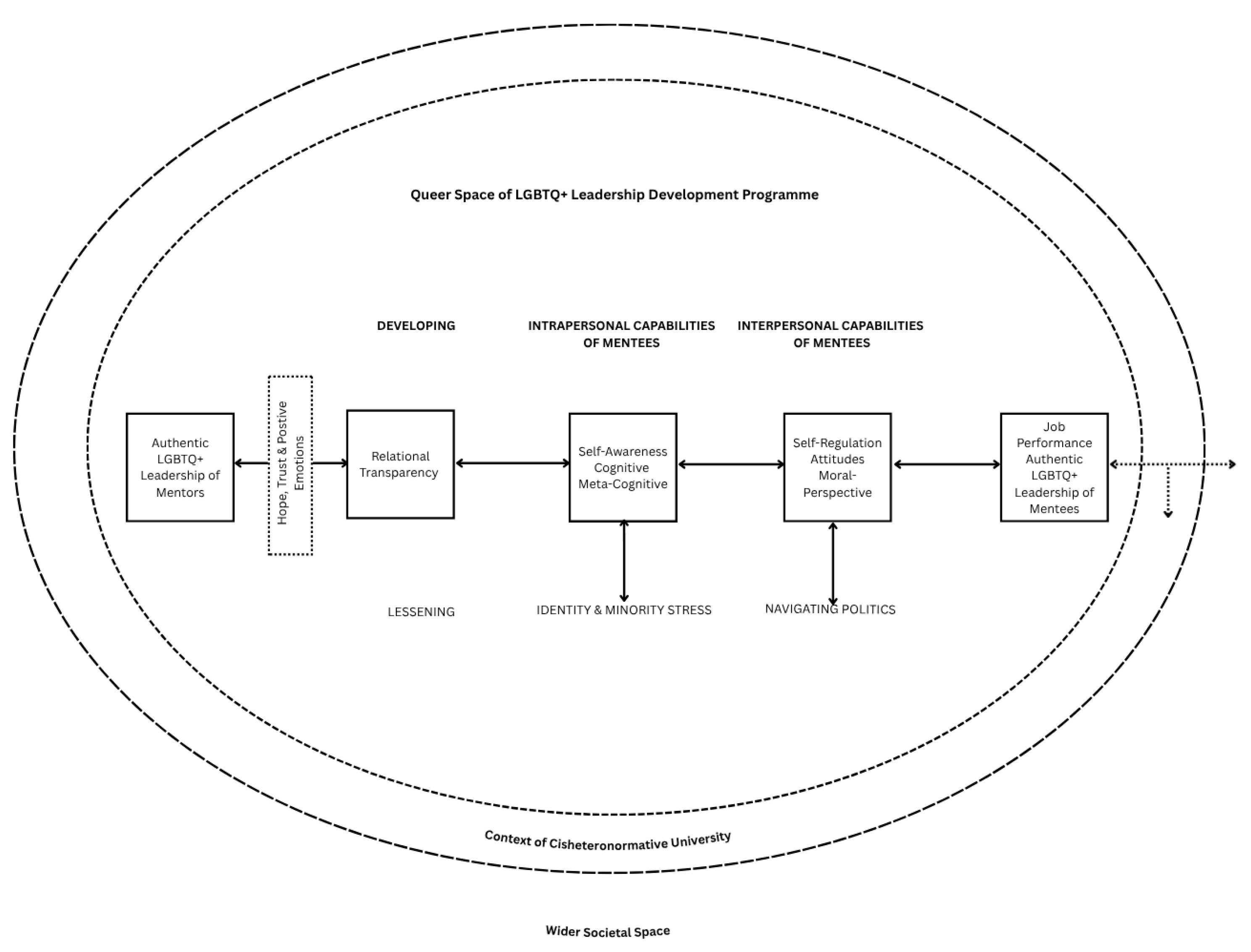
Collectively, the four themes illustrate how participants understood and experienced the programme eighteen months after its completion. These themes are synthesised in Figure 1, which presents a conceptual framework generated through the analysis and shows the relationships between programme structures, mentoring processes and reported leadership outcomes.
The framework demonstrates how authentic mentoring relationships, supported by trust, hope and positive emotions, operated within a queer leadership space to reduce identity and minority stress whilst supporting leadership development. Through these processes, participants developed enhanced intrapersonal and interpersonal leadership capabilities that enabled authentic LGBTQ+ leadership to flourish within both institutional and wider societal contexts.

5. Discussion

Taken together, the findings suggest that leadership development occurred through the interaction of identity-conscious community, mentoring relationships, personal reflection and opportunities for leadership enactment. This process offers an important contribution to authentic leadership scholarship because it demonstrates that authenticity is not solely an individual attribute but is developed relationally and contextually within affirming environments.
The study contributes to an emerging body of literature that challenges universal and decontextualised understandings of leadership. Traditional leadership models have frequently been criticised for privileging individualistic, hierarchical and implicitly heteronormative assumptions regarding who is recognised as a leader and how leadership is enacted (Bowring, 2004; Muhr & Sullivan, 2013; Ferry, 2018). These findings suggest that leadership development for LGBTQ+ individuals cannot be separated from the social conditions within which leadership identities are formed. Rather than simply acquiring leadership competencies, participants appeared to engage in a process of integrating leadership identity, personal identity and professional practice. This study then, extends critiques of dominant leadership paradigms by demonstrating how identity remains central to leadership development for individuals whose experiences have historically been marginalised within organisational settings.
The findings also offer important insight into the role of identity-conscious development interventions. Mor et al. (2025) argue that identity-conscious approaches are particularly significant for individuals whose identities may not be immediately visible within organisational environments. The present study provides support for this position by demonstrating that identity-specific leadership spaces perform functions that extend beyond conventional leadership development. Such spaces facilitate recognition, validation and collective meaning-making, enabling participants to situate their leadership experiences within wider social and organisational contexts. This is particularly significant given that LGBTQ+ individuals continue to navigate professional environments shaped by hetero-professionalism, identity management and concerns regarding visibility (Morgenroth et al., 2024; Brett, 2022).
A central contribution of the study concerns the relationship between mentoring and authentic leadership development. Existing authentic leadership theory places considerable emphasis upon self-awareness, relational transparency and positive leader-follower relationships (Avolio et al., 2004; Gardner et al., 2005). The findings suggest that mentoring provided an important mechanism through which these dimensions could be developed and practised. However, the study also reveals limitations within conventional leader-follower models. Rather than reflecting a linear transfer of knowledge, influence appeared to flow between mentors, mentees and the wider programme community. This supports contemporary understandings of leadership as distributed, relational and socially negotiated rather than residing exclusively within designated leadership positions. This research therefore extends Gardner et al.’s (2005) model of authentic leadership development by highlighting the importance of community as an intervening factor within leadership formation. Whilst authentic leadership theory often focuses upon individual leaders and followers, these findings suggest that authentic leadership development may be strengthened when embedded within collective networks that provide affirmation, challenge and support. Our interpretation aligns with emerging scholarship that views leadership as a relational accomplishment rather than an individual achievement.
Fletcher et al. (2025) argue that authentic leadership for LGBTQ+ individuals involves navigating tensions between self-expression, organisational expectations and social norms. This present study supports this proposition whilst advancing it in two important ways. First, it suggests that authentic leadership is not simply enacted within organisational contexts but actively developed through opportunities to reflect upon and make sense of LGBTQ+ lived experiences. Also it demonstrates that experiences commonly framed as barriers to progression may also constitute important leadership resources. The capacity to navigate uncertainty, negotiate identity, manage complexity and respond to exclusion offer distinctive forms of leadership practice that are particularly valuable within contemporary organisations.
This interpretation also resonates with Lee’s (2021) argument that LGBTQ+ lived experiences can foster leadership qualities including empathy, emotional intelligence, inclusivity and courage. Such qualities should not be understood as automatic consequences of marginalisation. Rather, specific LGBTQ+ leadership development should be read as helping participants recognise, articulate and apply these capabilities within professional contexts. The programme studied functioned not simply as a site of learning but as a mechanism through which participants reinterpreted prior experiences and incorporated them into their emerging leadership identities.
The findings also highlight the importance of considering leadership development within broader socio-political contexts. The literature review outlined increasing hostility towards LGBTQ+ communities internationally, alongside growing challenges to equality, diversity and inclusion initiatives (ILGA-Europe, 2026; Restubog et al., 2025). These developments provide an important backdrop for understanding the significance of the programme. This leadership development work occurred not within politically neutral environments but within contexts characterised by uncertainty, contestation and shifting regulatory landscapes. Consequently, authentic LGBTQ+ leadership emerged not only as an organisational phenomenon but also as a civic and political one.
This contextual dimension is particularly relevant within higher education. Universities occupy a distinctive position as institutions that influence social mobility, knowledge production and civic participation. As pressure on equality and inclusion initiatives faces political backlash, there is a risk that leadership development becomes detached from questions of social justice and representation. Our findings suggest that dedicated LGBTQ+ leadership programmes may help institutions maintain commitments to inclusion whilst simultaneously developing their leadership capacity. Such programmes therefore offer benefits that extend beyond individual participants and have potential implications for institutional culture, governance and organisational effectiveness.
Finally, the conceptual framework developed through this study contributes to authentic leadership scholarship by positioning identity-conscious community, mentoring relationships and leadership practice as interconnected elements of LGBTQ+ leadership development. The framework illustrates how authentic leadership may emerge through iterative interactions between individual, relational, organisational and societal factors. In doing so, it moves beyond static understandings of leadership competence and towards a more dynamic understanding of leadership as an ongoing process of identity construction, negotiation and enactment.

6. Conclusions

This research contributes to the growing literature on LGBTQ+ leadership by examining the long-term influence of a dedicated LGBTQ+ leadership development programme within UK higher education. Drawing on focus group data collected eighteen months after programme completion, the study provides insight into how leadership development continues beyond formal interventions and becomes embedded within professional identities, relationships and organisational practices.
Our findings advance understanding of authentic leadership by demonstrating that authenticity is neither fixed nor solely individual in nature. Instead, authentic leadership appears to develop through interactions between personal identity, social relationships, organisational context and wider political environments. This finding is significant because much of the existing authentic leadership literature continues to prioritise individual characteristics and behaviours. By contrast, this research demonstrates the importance of relational and collective processes in supporting leadership development among minoritised groups.
A key contribution of the research is the identification of identity-conscious leadership development as a potentially important mechanism for supporting LGBTQ+ leaders. Programmes designed specifically for LGBTQ+ participants create opportunities for collective reflection, mentoring, role modelling and leadership identity formation that acknowledge the realities of navigating cis-heteronormative organisational environments.
This research contributes to debates regarding the value of diversity, equity and inclusion initiatives within higher education. At a time when such initiatives are increasingly contested politically and financially, the findings indicate that leadership programmes focused on underrepresented groups may generate benefits extending beyond representation alone. They may support leadership capacity, strengthen institutional networks, foster organisational commitment and contribute to more inclusive cultures. Supporting LGBTQ+ leadership should therefore be understood not simply as an equality objective but as a strategic investment in institutional effectiveness and organisational resilience.
The conceptual framework developed through this research provides a foundation for future scholarship on LGBTQ+ leadership development. By bringing together authentic leadership theory, mentoring literature and emerging work on LGBTQ+ leadership, the framework offers a means of understanding how leadership identities are formed and sustained within complex organisational environments. It also responds to recent calls for leadership theories that better acknowledge the influence of identity, power and context on leadership development (Fletcher et al., 2025; Restubog et al., 2025).
Several limitations of this study are acknowledged. The study focuses on a single programme within one university and draws upon participants’ retrospective accounts of programme impact. Future research could explore similar initiatives across different institutional settings, compare LGBTQ+ and non-LGBTQ+ leadership programmes, and examine leadership outcomes over longer periods of time. Further work may also explore how intersections of sexuality, gender identity, race, disability and class shape experiences of leadership development.
Despite these limitations, the study demonstrates that leadership emerges through relationships, communities and opportunities to make sense of lived experience. For LGBTQ+ leaders in particular, the integration of identity and leadership remains a central aspect of leadership formation. As universities navigate complex political, social and organisational landscapes, programmes that support authentic LGBTQ+ leadership may become increasingly important in developing inclusive, innovative and socially responsive forms of leadership for the future.

Author Contributions

Conceptualization, A.B.; methodology, A.B.; validation, A.B., C.L. and D.B.; formal analysis, A.B.; writing—original draft preparation, A.B.; writing—review and editing, C.L. and D.B. All authors have read and agreed to the published version of the manuscript.

Funding

This research received no external funding.

Institutional Review Board Statement

The study was conducted in accordance with the Declaration of Helsinki and approved by the Institutional Review Board of the University of Bedfordshire (2024ISPAR011, 1 September 2024).

Informed Consent Statement

Informed consent was obtained from all subjects involved in the study.

Data Availability Statement

Data is unavailable due to privacy and ethical restrictions.

Conflicts of Interest

The authors declare no conflict of interest.

References

  1. Advance HE. (2023). Leadership survey for higher education. Available online: https://www.advance-he.ac.uk/leadership/framework-leading-higher-education/leadership-survey-and-framework (accessed on 1 January 2026).
  2. Advance HE. (2024). Framework for leading in higher education. Available online: https://www.advance-he.ac.uk/leadership/framework-leading-higher-education (accessed on 1 January 2026).
  3. Ancona, D., Malone, T. W., Orlikowski, W. J., & Senge, P. M. (2023). In praise of the incomplete leader. Harvard Business Review, 85(2), 43–53. [Google Scholar]
  4. Avolio, B. J., Gardner, W. L., Walumbwa, F. O., Luthans, F., & May, D. R. (2004). Unlocking the mask: A look at the process by which authentic leaders impact follower attitudes and behaviors. The Leadership Quarterly, 15(6), 801–823. [Google Scholar] [CrossRef]
  5. Baird, A. (2025). Que(e)rying leadership on an LGBTQ+ leadership development programme for UK higher education staff. Educational Review. [Google Scholar] [CrossRef]
  6. Baird, A., & Lee, C. (2025). A blueprint for LGBTQ+ leadership development programmes in UK higher education. Management in Education. [Google Scholar] [CrossRef]
  7. Benato, R., Fraser, J., & White, R. J. (2023). Non-binary genders in higher education: Survey findings, report and recommendations. Westminster Research. Available online: https://www.westminster.ac.uk/events/non-binary-in-higher-education-report-launch-and-panel-discussion (accessed on 1 January 2026).
  8. Bewick, B., & Hubbard, S. (2025). HE transformation will only succeed when its people feel safe, supported and connected. WONKHE blog. Available online: https://wonkhe.com/blogs/he-transformation-will-only-succeed-when-its-people-feel-safe-supported-and-connected/ (accessed on 1 January 2026).
  9. Blackmore, J., & Sachs, J. (2003). Managing equity work in the performative university. Australian Feminist Studies, 18(41), 141–162. [Google Scholar]
  10. Bolden, R., Petrov, G., & Gosling, J. (2008). Tensions in higher education leadership: Towards a multi-level model of leadership practice. Higher Education Quarterly, 62(4), 358–376. [Google Scholar] [CrossRef]
  11. Bowring, M. A. (2004). Resistance is not futile: Liberating Captain Janeway from the masculine-feminine dualism of leadership. Gender, Work and Organization, 11(4), 381–405. [Google Scholar] [CrossRef]
  12. Braun, V., & Clarke, V. (2021). One size fits all? What counts as quality practice in (reflexive) thematic analysis? Qualitative Research in Psychology, 18(3), 328–352. [Google Scholar]
  13. Brett, A. (2022). Under the spotlight: Exploring the challenges and opportunities of being a visible LGBT+ teacher. Sex Education, 24(1), 61–75. [Google Scholar] [CrossRef]
  14. Brewster, M. E., Velez, B. L., Mennicke, A., & Tebbe, E. (2014). Voices from beyond: A thematic content analysis of transgender employees’ workplace experiences. Psychology of Sexual Orientation and Gender Diversity, 1(2), 159–169. [Google Scholar] [CrossRef]
  15. Bryman, A. (2007). Effective leadership in higher education: A literature review. Studies in Higher Education, 32(6), 693–710. [Google Scholar] [CrossRef]
  16. Burgess, B., Molnár, G., Vinson, D., & Richardson, E. V. (2024). The realities of utilising participatory research and creative methods to explore the experiences of non-heterosexual coaches. Sports Coaching Review, 13(2), 191–203. [Google Scholar] [CrossRef]
  17. Business in the Community. (2018). Working with pride: Issues affecting LGBT+ people in the workplace. Available online: https://www.bitc.org.uk/wp-content/uploads/2019/10/bitc-wellbeing-report-workingwithpride-feb2019.pdf (accessed on 1 January 2026).
  18. CIPD. (2021). Inclusion at work: Perspectives on LGBT+ working lives. Available online: https://www.cipd.org/globalassets/media/comms/news/as1inclusion-work-perspectives-report_tcm18-90359.pdf (accessed on 1 January 2026).
  19. Ciphr. (2025). Workplace discrimination statistics in 2025: Discrimination at work. Available online: https://www.ciphr.com/infographics/workplace-discrimination-statistics (accessed on 1 January 2026).
  20. Clegg, S. R., Kornberger, M., & Pitsis, T. S. (2016). Managing & organizations: An introduction to theory and practice (4th ed.). Sage. [Google Scholar]
  21. Cohen, L., Manion, L., & Morrison, K. (2018). Research methods in education (8th ed.). Routledge. [Google Scholar]
  22. Cooperrider, D. L., Whitney, D., & Stavros, J. M. (2008). Appreciative inquiry handbook: For leaders of change. Berrett-Koehler. [Google Scholar]
  23. Courtney, S. J. (2014). Inadvertently queer school leadership amongst lesbian, gay and bisexual (LGB) school leaders. Organization, 21(3), 383–399. [Google Scholar] [CrossRef]
  24. Day, D. V., Fleenor, J. W., Atwater, L. E., Sturm, R. E., & McKee, R. A. (2014). Advances in leader and leadership development: A review of 25 years of research and theory. Leadership Quarterly, 25, 63–82. [Google Scholar] [CrossRef]
  25. deLeon, M. J., & Brunner, C. C. (2013). Cycles of fear: A model of lesbian and gay educational leaders’ lived experiences. Educational Administration Quarterly, 49(1), 161–203. [Google Scholar] [CrossRef]
  26. Department for Education [DfE]. (2023). Higher education freedom of speech bill. Available online: https://bills.parliament.uk/bills/2862 (accessed on 1 January 2026).
  27. Dopson, S., Ferlie, E., McGivern, G., Fisher, M. D., Mitra, M., Ledger, J., & Behrens, S. (2019). Leadership development in higher Education: A literature review and implications for programme redesign. Higher Education Quarterly, 73, 218–234. [Google Scholar]
  28. Ebrey, C., & Haworth, M. (2025). Barriers to LGBTQ+ career development in the UK. The Pride in Leadership Report. Available online: https://prideinleadership.co.uk/LGBTQ-career-barriers-report-2025 (accessed on 1 January 2026).
  29. Eby, L. T., Allen, T. D., Hoffman, B. J., Baranik, L. E., Sauer, J. B., Baldwin, S., Morrison, M. A., Kinkade, K. M., Maher, C. P., Curtis, S., & Evans, S. C. (2013). An interdisciplinary meta-analysis of the potential antecedents, correlates, and consequences of protégé perceptions of mentoring. Psychology Bulletin, 139(2), 441–476. [Google Scholar] [CrossRef]
  30. Eby, L. T., & Robertson, M. M. (2020). The psychology of workplace mentoring relationships. Annual Review of Organisational Psychology Organisational Behavior, 7, 75–100. [Google Scholar] [CrossRef]
  31. Equality and Human Rights Commission [EHRC]. (2026). Draft code of practice for services, public functions and associations. GOV.UK. Available online: https://www.gov.uk/government/publications/equality-act-2010-draft-code-of-practice-for-services-public-functions-and-associations-2026 (accessed on 1 January 2026).
  32. Ferry, N. C. (2018). It’s a family business!: Leadership tests as technologies of heteronormativity. Leadership, 14(6), 603–621. [Google Scholar]
  33. Finch, H., Lewis, J., & Turley, C. (2014). Focus groups. In J. Ritchie, J. Lewis, C. McNaughton Nicholls, & R. Ormston (Eds.), Qualitative research practice: A guide for social science students and researchers. Sage. [Google Scholar]
  34. Fine, L. E. (2017). Gender and sexual minorities’ practice and embodiment of authentic leadership: Challenges and opportunities. Advances in Developing Human Resources, 19(4), 378–392. [Google Scholar] [CrossRef]
  35. Fletcher, L., Pichler, S., & Chandrasekaran, L. (2024). Songs of the self: The importance of authentic leadership and core self-evaluations for LGBT managers. Journal of Managerial Psychology, 39(2), 131–145. [Google Scholar] [CrossRef]
  36. Fletcher, L., Pichler, S., & Chandrasekaran, L. (2025). Being LGBT and being an authentic leader: Contextualizing the experience of authentic leadership. Journal of Occupational and Organizational Psychology, 98(1), e70018. [Google Scholar] [CrossRef]
  37. Gardner, W. L., Avolio, B. J., Luthans, F., May, D. R., & Walumbwa, F. (2005). “Can you see the real me?” A self-based model of authentic leader and follower development. The Leadership Quarterly, 16, 343–372. [Google Scholar] [CrossRef]
  38. Gardner, W. L., Karam, E. P., Alvesson, M., & Einola, K. (2021). Authentic leadership theory: The case for and against. The Leadership Quarterly, 32(6), 101495. [Google Scholar] [CrossRef]
  39. Gentle, P., & Clifton, L. (2017). How does leadership development help universities become learning organisations? The Learning Organisation, 24(5), 278–285. [Google Scholar] [CrossRef]
  40. Government Equalities Office. (2018). National LGBT survey. Available online: https://assets.publishing.service.gov.uk/media/5b3cb6b6ed915d39fd5f14df/GEO-LGBT-Survey-Report.pdf (accessed on 1 January 2026).
  41. Groeneveld, S. (2011). Diversity and employee turnover in the Dutch public sector: Does diversity management make a difference? International Journal of Public Sector Management, 24(6), 594–612. [Google Scholar] [CrossRef]
  42. Hinton, J. D. X., de la Piedad Garcia, X., Kaufmann, L. M., Koc, Y., & Anderson, J. R. (2022). A systematic and meta-analytic review of identity centrality among LGBTQ groups: An assessment of psychosocial correlates. Journal of Sex Research, 59(5), 568–586. [Google Scholar] [CrossRef] [PubMed]
  43. ILGA-Europe. (2026). Rainbow map. Available online: https://rainbowmap.ilga-europe.org/ (accessed on 1 January 2026).
  44. Infantes, P. M., Federo, R., & Pascual-Fuster, B. (2025). Follow the leader: The double-edged cascading effect of board gender diversity practices in hierarchical business groups. Journal of Business Ethics. [Google Scholar] [CrossRef]
  45. Ipsos. (2021). LGBT+ pride 2021 global survey. Available online: https://www.ipsos.com/sites/default/files/ct/news/documents/2021-06/LGBT%20Pride%202021%20Global%20Survey%20Report_6.pdf (accessed on 1 January 2026).
  46. James, E. A., Milenkiewicz, M. T., & Bucknam, A. (2008). Participatory action research for educational leadership. Sage. [Google Scholar]
  47. Just Like Us. (2023). Positive futures: How supporting LGBT+ young people enables them to thrive in adulthood. Available online: https://justlikeus.org/wp-content/uploads/2023/05/Positive-Futures-report-by-Just-Like-Us-compressed-for-mobile.pdf (accessed on 1 January 2026).
  48. Krueger, R. A., & Casey, M. A. (2009). Focus groups: A practical guide for applied research (4th ed.). Sage. [Google Scholar]
  49. Law, C. L., Martinez, L. R., Ruggs, E. N., Hebl, M. R., & Akers, E. (2011). Transparency in the workplace: How the experiences of transsexual employees can be improved. Journal of Vocational Behavior, 79, 710–723. [Google Scholar] [CrossRef]
  50. Lee, C. (2021). Promoting diversity in university leadership: The argument for LGBTQ+ specific leadership programmes in higher education. Perspectives: Policy and Practice in Higher Education, 25(3), 91–99. [Google Scholar] [CrossRef]
  51. Lee, C., & Burman, D. (2024). ‘I have gained insight, direction, affirmation, and a network’. Examining the impact of the UK’s first LGBTQ+ specific leadership development programme in higher education. Educational Management Administration & Leadership, 54(2), 602–619. [Google Scholar] [CrossRef]
  52. Lock, S., Jones, E., Hellyer, R. J., & Armstrong, E. (2025). LGBTQ+ staff experiences at UCL: Teaching, research and institutional culture. UCL. LESG. Available online: https://www.ucl.ac.uk/human-resources/sites/human_resources/files/lgbtqstaff_experiences_at_ucl_2025_lesg_0.pdf (accessed on 1 January 2026).
  53. Mann, K., Tesfamichael, S., & Rimes, K. A. (2024). The impact of role models on sexual minority women: A qualitative interview study. Behavioral Sciences, 14, 1119. [Google Scholar] [CrossRef] [PubMed]
  54. Marshall-Mies, J. C., Fleishman, E. A., Martin, J. A., Zaccaro, S. J., Baughman, W. A., & McGee, M. L. (2000). Development and evaluation of cognitive and metacognitive measures for predicting leadership potential. Leadership Quarterly, 11(1), 135–153. [Google Scholar] [CrossRef]
  55. Mellors, J., & Gaspar, T. (2025). Keeping it real? Authenticity and well-being at work. Annals of Tourism Research, 114, 104012. [Google Scholar] [CrossRef]
  56. Mor, K., Gündemir, S., & van der Toorn, J. (2025). Celebrating the “invisible”: The role of organizational diversity approaches on attracting and retaining LGBTQ + talent. Journal of Business and Psychology, 40, 593–617. [Google Scholar] [CrossRef] [PubMed]
  57. Morgenroth, T., Kirby, T. A., & van der Toorn, J. (2024). Heteroprofessionalism: The power of the gender/sex binary in the workplace. Current Opinion in Psychology, 60, 101908. [Google Scholar] [CrossRef] [PubMed]
  58. Muhr, S. L., & Sullivan, K. R. (2013). “None as Queer as Folk”: Gendered expectations and transgressive bodies in leadership. Leadership, 9(3), 416–435. [Google Scholar] [CrossRef]
  59. Mumford, T. V., Campion, M. A., & Morgeson, F. P. (2007). The leadership skills strataplex: Leadership skill requirements across organizational levels. The Leadership Quarterly, 18, 154–166. [Google Scholar] [CrossRef]
  60. Murphy, D. (2025). Conducting focus groups with LGBTQ+ participants. In C. Lee, & A. Brett (Eds.), The guide to LGBT+ research book. Emerald Publishing. [Google Scholar]
  61. mygwork. (2024). LGBTQ+ mental health in the workplace survey. Available online: https://mygwork.com/news/nearly-half-of-lgbtq-professionals-have-experienced-depression-at-some-point-in-their-lives-mygwork-research-finds (accessed on 1 January 2026).
  62. Niesche, R., & Gowlett, C. (2019). Using Judith Butler to queer(y) educational leadership. In R. Niesche, & C. Gowlett (Eds.), Social, critical and political theories for educational leadership. Educational leadership theory. Singer. [Google Scholar]
  63. Office for Students. (2025). Financial sustainability of higher education providers in England: 2025. Available online: https://www.officeforstudents.org.uk/publications/financial-sustainability-of-higher-education-providers-in-england-2025/ (accessed on 1 January 2026).
  64. Pichler, S., Varma, A., & Bruce, T. (2010). Heterosexism in employment decisions: The role of job misfit. Journal of Applied Social Psychology, 40(10), 2527–2555. [Google Scholar] [CrossRef]
  65. Ragins, B. R., Singh, R., & Cornwell, J. M. (2007). Making the invisible visible: Fear and disclosure of sexual orientation at work. Journal of Applied Psychology, 92, 1103–1118. [Google Scholar] [CrossRef] [PubMed]
  66. Reddy, M. S. (2024). Workplace expectations of gen-Z: An empirical study. In P. J. S. Singh Sengupta, S. Kalagnanam, & B. Charumathi (Eds.), Organization, purpose, and values (pp. 508–537). Routledge. [Google Scholar]
  67. Restubog, S. L., Li, Y., Schilpzand, P., He, Y., & Nerona, R. (2025). Leading with pride: An interdisciplinary integrative review on LGBTIQ + leadership and an agenda for future research. The Leadership Quarterly, 36(4), 101883. [Google Scholar] [CrossRef]
  68. Rumens, N., Moulin de Souza, E., & Brewis, J. (2019). Queering queer theory in management and organization studies: Notes toward queering heterosexuality. Organization Studies, 40(4), 593–612. [Google Scholar]
  69. Sayers-Brown, R. M. (2024). Leadership identity: Insights from women-only leadership development programmes and LGBTQ+ leaders [Doctoral thesis, University of London]. Available online: https://eprints.bbk.ac.uk/id/eprint/53189/ (accessed on 1 May 2026).
  70. Scottish Trans. (2026). Our thoughts on the EHRC’s updated code of practice. Available online: https://www.scottishtrans.org/supreme-court-ruling-on-sex-in-the-equality-act/our-thoughts-on-the-ehrcs-updated-code-of-practice-may-2026/ (accessed on 1 April 2026).
  71. Seibert, S., Akkermans, J., & Cheng-Huan, L. (2024). Understanding contemporary career success: A critical review. Annual Review of Organizational Psychology and Organizational Behavior, 11, 509–534. [Google Scholar] [CrossRef]
  72. Stonewall. (n.d.). Proud employers: The leading programme to unlock the power of LGBTQ+ inclusion in the workplace. Available online: https://www.stonewall.org.uk/inclusive-workplaces/proud-employers (accessed on 1 January 2026).
  73. Stonewall. (2018). LGBT in Britain—Work report. Available online: https://www.stonewall.org.uk/resources/lgbt-britain-work-report-2018 (accessed on 1 January 2026).
  74. Sundberg, T., Boyce, P., & Ryan-Flood, R. (2021). Challenging LGBT+ exclusion in UK higher education. Available online: https://www.ucu.org.uk/media/11495/Challenging-LGBT-exclusion-in-UK-highereducation/pdf/LGBT__exclusion_May2021.pdf (accessed on 1 January 2026).
  75. Suppes, A., van der Toorn, J., & Begeny, C. T. (2021). Unhealthy closets, discriminatory dwellings: The mental health benefits and costs of being open about one’s sexual minority status. Social Science & Medicine, 285(9), 114286. [Google Scholar] [CrossRef] [PubMed]
  76. Syed, M. (2021). The power of thinking differently: Rebel ideas. John Murray. [Google Scholar]
  77. Trans Actual. (2025). Trans segregation in practice. Available online: https://transactual.org.uk/wp-content/uploads/Trans-Segregation-in-Practice.pdf (accessed on 1 January 2026).
  78. UK Universities. (2025). Transformation and Efficiency Taskforce: Towards a new era of collaboration. Available online: https://www.universitiesuk.ac.uk/what-we-do/policy-and-research/publications/transformation-and-efficiency-taskforce?__cf_chl_f_tk=xPUhwGiTDoTqkvlZQmStqLthpRUz6hZLhGwDAsJlITA-1783002632-1.0.1.1-4Ihgs5bvnEKaoavPxerkpy9TP3u6utly1MAhjjYdFec (accessed on 1 January 2026).
  79. United Nations [UN]. (2025). Sustainable development goals report (SDG). Available online: https://unstats.un.org/sdgs/report/2025 (accessed on 1 January 2026).
  80. Walumbwa, F. O., Avolio, B. J., Gardner, W. L., Wernsing, T. S., & Peterson, S. J. (2008). Authentic leadership: Development and validation of a theory-based measure. Journal of Management, 34(1), 89–126. [Google Scholar] [CrossRef]
  81. Whitmore, J. (2010). Coaching for performance: The principles and practice of coaching and leadership. Hachette. [Google Scholar]
  82. Woodyatt, C. R., Finneran, C. A., & Stephenson, R. (2016). In-person versus online focus group discussions: A comparative analysis of data quality. Qualitative Health Research, 26(6), 741–749. [Google Scholar] [CrossRef] [PubMed]
  83. Ybarra, M. L., DuBois, Z., Parsons, J. T., Prescott, T. L., & Mustanski, B. (2014). Online focus groups as an HIV prevention program for gay, bisexual and queer adolescent males. AIDS Education and Prevention, 26(6), 554–564. [Google Scholar] [CrossRef] [PubMed]
Figure 1. Conceptual Framework for Advancing an Understanding of LGBTQ+ Authentic Leadership Development in LGBTQ+ Leadership Programmes and drawing on the literature of (Avolio et al., 2004; Walumbwa et al., 2008; Gardner et al., 2005; Fletcher et al., 2025; Mumford et al., 2007; Marshall-Mies et al., 2000).
Education 16 01073 g001
Table 1. Summary of Themes Supporting Authentic LGBTQ+ Leadership Development.
ThemeKey FindingsTheoretical AlignmentLeadership Outcomes
Creating a Queer Leadership Space: Belonging, Visibility and CommunityParticipants valued being part of an LGBTQ+ community where identities, experiences and aspirations could be openly discussed. Visibility of senior LGBTQ+ leaders enabled attendees to imagine themselves in leadership roles. The programme fostered psychological safety, belonging and enduring professional networks.Identity-conscious leadership (Mor et al., 2025); LGBTQ+ leadership (Lee, 2021); critiques of traditional leadership models (Bowring, 2004; Muhr & Sullivan, 2013).Increased belonging, confidence, leadership aspirations, professional networking and community affiliation.
Authentic Mentoring Relationships as Catalysts for Leadership DevelopmentMentors provided practical guidance, emotional support and role modelling. Relationships were characterised by trust, openness and mutual respect. Mentors helped mentees navigate organisational politics and leadership pathways while modelling authentic leadership behaviours.Authentic leadership (Avolio et al., 2004); authentic leader-follower development (Gardner et al., 2005); LGBTQ+ authentic leadership (Fletcher et al., 2025).Enhanced confidence, leadership self-efficacy, career progression, trust and leadership identity formation.
Developing Intrapersonal Leadership Capacity: Confidence, Self-Awareness and ResilienceParticipants developed greater self-awareness, confidence and resilience. Experiences of marginalisation were reframed as sources of leadership strength. The programme reduced identity and minority stress whilst strengthening understanding of personal values and leadership potential.Self-awareness and self-regulation (Gardner et al., 2005); cognitive and metacognitive leadership skills (Marshall-Mies et al., 2000); LGBTQ+ authentic leadership (Fletcher et al., 2025).Increased authenticity, resilience, confidence, self-reflection and leadership readiness.
Translating Leadership into Action: Influence, Advocacy and Organisational ChangeParticipants became more willing to speak up, challenge decisions, advocate for others and contribute to organisational improvement. Leadership was understood as collective influence rather than positional authority. Several participants assumed leadership roles and achieved promotion.Leadership skills framework (Mumford et al., 2007); authentic leadership outcomes (Walumbwa et al., 2008); distributed and relational leadership perspectives.Greater organisational influence, advocacy, leadership visibility, promotions, staff network leadership and institutional contribution.
Disclaimer/Publisher’s Note: The statements, opinions and data contained in all publications are solely those of the individual author(s) and contributor(s) and not of MDPI and/or the editor(s). MDPI and/or the editor(s) disclaim responsibility for any injury to people or property resulting from any ideas, methods, instructions or products referred to in the content.