Article

Textbook Representations of Chemical Bonding: Insights from Czechia, Norway, and Turkey

by
Unni Eikeseth
1,*,
Annette Lykknes
1,
Betül Demirdöğen
2,
Veronika Machková
3,
Martin Bílek
4 and
Gultekin Cakmakci
5
1
Department of Teacher Education, Norwegian University of Science and Technology, 7491 Trondheim, Norway
2
Department of Mathematics and Science Education, Zonguldak Bülent Ecevit University, 67300 Zonguldak, Türkiye
3
Department of Chemistry, University of Hradec Králové, 500 03 Hradec Králové, Czech Republic
4
Department of Chemistry and Chemistry Education, Charles University, 116 39 Prague, Czech Republic
5
Department of Mathematics and Science Education, Hacettepe University, 06800 Ankara, Türkiye
*
Author to whom correspondence should be addressed.
Educ. Sci. 2026, 16(7), 1060; https://doi.org/10.3390/educsci16071060
Submission received: 21 April 2026 / Revised: 22 June 2026 / Accepted: 28 June 2026 / Published: 2 July 2026
(This article belongs to the Section Curriculum and Instruction)

Abstract

Chemical bonding is a fundamental concept in chemistry and is essential for understanding the chemical and physical properties of substances and their interactions. Despite its importance, students often hold alternative conceptions and exhibit poor conceptual understanding. This study examines the extent to which widely used textbooks in Turkey, Norway, and Czechia reflect key recommendations from science education research. We analysed textbook passages covering chemical bonding, assessing whether they: (1) focus on molecules and ions rather than atoms, (2) present bonds as electrical phenomena, (3) avoid anthropomorphic or magical language, and (4) take care with language, avoid mixing the macroscopic and submicroscopic levels. The findings reveal that most textbooks in the three countries do not fully incorporate these recommendations. Explanations frequently focus on individual atoms, combine electrical attraction with other models such as the octet rule, and employ anthropomorphic language. Additionally, linguistic precision regarding the macro–submicro-scale is often lacking. Notably, Turkish and Norwegian textbooks continue to rely heavily on the octet rule, whilst its use is minimal in Czech texts. The observed divergence highlights the persistent gap between science education research and textbook writing practices. We discuss potential reasons for this gap and outline implications for teaching, curriculum development, and future research.

1. Introduction and Background

Chemical bonding is considered to be a key concept in chemistry as it is essential for explaining many of the properties of substances (e.g., boiling point) and chemical phenomena (e.g., dissolving) (Hurst, 2002; Levy Nahum et al., 2010), and because it is foundational for the understanding of structure and function of molecules across subfields of chemistry (Hunter et al., 2022). It is generally recommended that to construct a comprehensive understanding of chemical bonding, students should develop the capacity to model and elucidate bond formation and breaking at the submicroscopic level, utilizing concepts of energy and electrostatic forces (Cooper et al., 2014). Studies, however, suggest that students’ understanding of chemical bonding is very poor and that they develop a wide range of alternative conceptions (Hunter et al., 2022; Taber & Coll, 2002; Ünal et al., 2006). Moreover, empirical research conducted on a global scale has revealed that the pedagogical models employed in educational materials and instructional practices hinder students’ understanding of chemical bonding and foster the development of alternative conceptions (Bergqvist et al., 2013; Taber, 1994, 2001; Taber & Coll, 2002; Tan & Treagust, 1999; Özmen, 2004).
Alternative conceptions may stem from the way in which the conceptions are taught and how topics are presented in textbooks (Bergqvist et al., 2013; Taber, 2001; Yang et al., 2025). It has been found that many teachers continue to teach their subjects without knowledge of alternative conceptions reported in research or advice about how to design teaching to develop learners’ understanding of scientific concepts (Bergqvist et al., 2013; Mikeska et al., 2021; Schneider & Plasman, 2011; Özmen, 2004). This may result in a gap between research and teaching, and students passing from grade to grade without fully grasping concepts (Özmen, 2004).
Textbooks are important sources of knowledge for teachers, who normally have little time to read up on research literature (De Jong, 2000). Indeed, textbooks have been reported to have a considerable influence on the content of lessons in science (Khine & Khine, 2013; Park & Lavonen, 2013; Roth et al., 2006) and chemistry (Bergqvist & Chang Rundgren, 2017; Justi & Gilbert, 2002; Vojíř & Rusek, 2022). Even if textbooks may play different roles in different countries, they “are aligned to the syllabus and represent the way of teaching in the respective country”, as Clément (2008, p. 93) has stated. We support his view that critical analyses of textbooks are interesting, “even without having any information of the way they are used”, as they nevertheless reflect aspects of the actual classroom situation (Clément, 2008, p. 93).
Recognizing the value of teaching resources informed by research, we are interested in examining the extent to which research-based advice has had an impact on the presentation of bonding in recent or currently used textbooks. We have selected textbooks from Turkey, Norway, and Czechia for this study. A comparison of these countries is particularly valuable, as it offers an overview across Europe from the North/West to the South/East. The three countries share several features, including centralized education systems and an emphasis on traditional teaching pedagogies (Blonder & Mamlok-Naaman, 2019). However, notable differences also exist; for example, Czechia scores slightly above the OECD average in science on PISA tests, whereas Norway and Turkey score below average (OECD, 2023). The following research question guides our study:
To what extent (if any) and in what way are the presentations of chemical bonding in textbooks in Czechia, Norway, and Turkey in line with recommendations from research?

1.1. Students’ Understanding of Chemical Bonding

Understanding the concept of chemical bonding has been reported to be challenging for students, and common alternative conceptions and their possible sources have been well documented in the literature (Aakre et al., 2021; Hunter et al., 2022; Taber & Coll, 2002; Tsaparlis et al., 2018; Özmen, 2004; Ünal et al., 2006). Alternative conceptions include those that pertain to specific types of bonding (covalent bonding, ionic bonding, and metallic bonding) and perceptions about bonding concepts in general. For an overview of students’ ideas on chemical bonding, we refer to the extensive reviews on the topic by Hunter et al. (2022), Ünal et al. (2006), and Özmen (2004). In the following, we present but a few selected examples.
One alternative concept related to bonding that is found in the research literature is the atomic ontology—that learners often make the assumption that reactions involve single atoms rather than molecules or ionic or metallic lattices (Taber, 2001). Some students even categorize atoms as living entities (Taber & Coll, 2002) and use anthropomorphic language to explain electrons’ “will” (Hunter et al., 2022; Taber & Adbo, 2013; Taber & Watts, 1996). Taber (2001) sees this misconception as strongly connected to the octet explanatory framework—i.e., an “overgeneralization” of the “rule of thumb” that the electronic structure of stable molecules is usually equal to that of a noble gas atom—often with eight electrons in their valence shell—and that a “full” valence electron shell leads to stability (Tsaparlis et al., 2018).
The octet rule and anthropomorphisms are extensively used in textbooks for explaining chemical processes (Bergqvist & Chang Rundgren, 2017). Indeed, students have been reported to use the “octet rule” to predict whether atoms will form ionic or covalent bonds (Taber & Adbo, 2013; Tsaparlis et al., 2018), and students’ reliance on the octet rule seems to be resilient at the high school level and undergraduate level alike (Hunter et al., 2022). Moreover, in a review of the research literature on bonding between 2006 and 2020, Hunter et al. (2022) found that students’ use of the octet rule to explain the formation of chemical bonds was common across contexts and bonding types—despite the research literature long having reported that the “full outer shell” heuristics is of little help in understanding bonding phenomena and that the strong anthropomorphic thinking often associated with the use of the octet rule could be an “impediment to further learning” (Taber & Watts, 1996, p. 565).
Several of the alternative conceptions held by students have been found to be resistant to change. Indeed, students have difficulty changing their initial perceptions of the concept of chemical bonding (Özmen, 2004). Even when instruction has explicitly contradicted the octet rule framework (Tsaparlis et al., 2018) and focused on an earlier proper understanding of the electrostatic interactions model (Joki & Aksela, 2018), students have tended to treat the octet rule as a simple predictive algorithm. Hunter et al. (2022) ascribe this to the persuasive nature of the octet rule, and state that it is not surprising that students use it widely, when their teachers suggest that “atoms ‘want’ or ‘need’ an octet” (Hunter et al., 2022, p. 2460).
In response to the above-mentioned evidence of misconceptions about chemical bonding and their resistance to change, researchers have proposed recommendations for more effective and scientifically correct teaching of chemical bonding. The following section will elaborate on these recommendations.

1.2. Recommendations for Teaching Chemical Bonding

Based on a review of research on students’ learning difficulties with chemical structures—including atoms, molecules, and lattices—Taber (2001) identified common learning impediments that hinder the development of a sound understanding of these concepts. This work led him to devise five recommendations (Table 1), which curriculum planners, authors, and teachers have had 25 years to implement. The first recommendation refers to the use of physical principles when explaining chemical bonding—explicitly emphasizing the electrical interactions within and between molecular level systems. The second urges chemistry instructors to focus on molecules and ions when explaining bond formation, instead of referring to individual atoms as a starting point for chemical reactions. The third recommendation is to stick to electrical attraction in the explanation of chemical bond formation and avoid magical or social concepts in the teaching of chemical bonding. The fourth is proposed as a response to the findings that students apply a “molecular schema” to all structures, Taber (2001) and Taber & Coll (2002) proposes a new teaching order for chemical bonding—namely, metallic bonding, ionic bonding, giant covalent bonding, and lastly simple covalent bonding. This, in their view, will help students understand the non-molecular nature of non-molecular lattices. The final recommendation urges teachers and textbook writers to be mindful of language when they shift between the macroscopic and submicroscopic levels of descriptions (Johnstone, 1991). For example, expressions such as “… and at the molecular level this is explained in terms of …” can be used to make explicit what level the teacher is referring to.
Key concepts in chemical bonding—and strategies for teaching them effectively—have continued to garner sustained attention from researchers in chemistry education. Kronik et al. (2008) and Levy Nahum et al. (2010) proposed that instruction on chemical bonding should begin with the general properties of atoms and chemical bonds, framing the traditional categories of bonding as extreme cases along various continuum scales. Similarly, Croft and de Berg (2014) highlighted the importance of introducing key concepts at an early stage, with particular emphasis on the central role of the concept of charge in teaching bonding. In line with this perspective, Joki et al. (2015) designed a holistic, novel approach to teaching bonding at the middle school level, which applied principles of Coulombic interactions. Their model presented chemical bonding through the lens of electrical interactions as the foundation for most bonding types. Other researchers have developed reformed curricula that focus on connecting chemical bonding to broader chemical concepts (Cooper et al., 2014; Hunter et al., 2022; Talanquer & Pollard, 2010). A framework for teaching chemical bonding aimed at chemistry teacher educators has also been introduced (van Dulmen et al., 2023). Nevertheless, a consensus on which reformed curriculum best supports the teaching of chemical bonding remains to be established.
One area where consensus remains lacking in the research literature is the optimal sequence in which different types of chemical bonds should be introduced in teaching. Some authors followed Taber’s (2001) suggestion (i.e., metallic bonding, ionic bonding, giant covalent bonding, and simple covalent bonding) (Bergqvist et al., 2013; van Dulmen et al., 2023) whilst Dhindsa and Treagust (2014) proposed a different order: (1) covalent, polar covalent, and ionic bonding, (2) bonding in lattices: metallic bonding and crystals, and (3) intermolecular bonding. They reason that it is best to start with covalent bonding to make the role of electronegativity evident for the learner. Some researchers have deliberately refrained from recommending a specific sequence for teaching bonding types, opting instead to emphasize fundamental principles and core concepts (Joki et al., 2015; Kronik et al., 2008), as previously discussed. They argue that grasping the underlying electrostatic interactions and the distinct electronic structures of the atoms involved is more critical than the order in which bond types are introduced. Their approach involves presenting all bonding types simultaneously and comparing them to highlight their differences. It has been argued that this strategy fosters a more holistic understanding of how bonding influences material properties (Karpin et al., 2014).
In this study, we applied Taber’s recommendations (Taber, 2001; Taber & Coll, 2002) to construct a framework for evaluating how well recent textbooks align with empirical research on effective methods for teaching chemical bonding. There are several reasons for adopting these recommendations for further research. First, they are not only specifically designed to address students’ alternative conceptions about chemical bonding but are also formulated in concrete terms, thereby enhancing their applicability for analysing the instructional materials developed for this topic. Second, a robust body of literature consistently provides empirical evidence highlighting persistent learning difficulties that hinder students’ conceptual understanding of chemical bonding (Aakre et al., 2021; Bergqvist et al., 2013; Hunter et al., 2022; Joki & Aksela, 2018; Kiernan et al., 2024; Taber & Adbo, 2013; Zohar & Levy, 2019). Third, with the exception of the fourth recommendation about teaching sequence, the continued empirical support for Taber’s recommendations affirms their relevance and validity in contemporary chemical bonding instruction. Among the foundational contributions to research on chemical bonding education, Taber (2001) and Taber and Coll (2002) synthesised evidence on common student difficulties and proposed a series of recommendations to improve the teaching and presentation of chemical bonding concepts. Their work has been highly influential in shaping subsequent research and curriculum discussions on chemical bonding.
Although these recommendations were formulated more than two decades ago, many of the challenges identified by Taber and Coll remain evident in contemporary research. A comprehensive review of research on the teaching and learning of chemical bonding by Hunter et al. (2022) highlighted persistent student difficulties in understanding the nature of chemical bonds. Similarly, a meta-analysis by Çalik et al. (2024) demonstrated that instructional interventions specifically designed to address students’ understanding of chemical bonding have a significant positive effect on academic achievement, suggesting that the conceptual challenges associated with chemical bonding continue to warrant educational attention.
The ongoing relevance of these issues makes Taber’s (2001) and Taber and Coll’s (2002) recommendations particularly suitable as an analytical framework for the present study. Rather than treating these recommendations solely as historical contributions, this study uses them as a well-established set of research-informed criteria for examining contemporary textbook presentations of chemical bonding. Given that more than two decades have passed since their publications, textbook authors have had considerable opportunity to incorporate research-based guidance into instructional materials. Consequently, examining the extent to which these recommendations are reflected in current textbooks provides valuable insights into how educational research translates into classroom resources.

2. Method and Context

2.1. Context

In Turkey, chemical bonding is taught in the first year (9th grade) of upper secondary school (grades 9–12, ages 14–18). Chemistry is compulsory up to the 10th grade, and in lower secondary school it is taught as part of an integrated science course (The Ministry of National Education, 2024). The Ministry of National Education (MoNE) issues a nationwide curriculum from kindergarten up to the 12th grade, where topics and their associated learning objectives are stated (see Table 2 for examples). The MoNE is also responsible for the textbook selection in secondary school.
In Norway, chemistry is taught as part of an integrated science course in lower secondary school (grades 8–10, ages 13–16) and the first year of upper secondary school (grade 11, age 16–17). In the second and third year of upper secondary school, chemistry is an elective, separate course (Utdanningsdirektoratet, 2025). The curriculum outlines learning objectives collectively for grades 8–10, whereas for grades 11, 12, and 13, objectives are specified separately for each year. As a result, within lower secondary education, it is left to textbook authors to determine the grade in which each topic is introduced (Table 2) (Utdanningsdirektoratet, 2019, 2021). Chemical bonding is typically taught in grade 9, occasionally in grade 8. For upper secondary school, bonding is a relevant topic for grades 11 and 12.
The first encounter with chemical bonding in the Czech school system traditionally occurs during the first separate chemistry course, which is normally introduced in the 8th grade (age 13–14) of a nine-year compulsory education, although this is sometimes introduced in the 7th grade (Blonder & Mamlok-Naaman, 2019). It is up to each school to allocate the different topics of the “human and nature” educational area, to which chemistry belongs (with physics, biology, and geography). The learning outcomes are indicated in the curricular document Framework Study Programme for Elementary Education (Rámcový vzdělávací program pro základní vzdělávání—RVP ZV) (see Table 2) (Ministerstvo školství, 2025) and should be achieved during lower secondary school but are not assigned to a specific year. Chemical bonding is also taught during the first year of upper secondary school (grades 1–4, ages 15–19).

2.2. Selection of Textbooks

To select textbooks from the three countries, we identified those used at grade levels where chemical bonding is taught within each national curriculum. Consequently, the selection includes books from different school years and varies in quantity and educational stages across countries. In the second step, we looked for textbooks approved by the Ministry of Education in countries where such oversight remains in place—namely Turkey and Czechia. In Norway, however, state-level textbook quality control was discontinued in 2021. Since then, the responsibility for peer review and quality assurance has shifted to the publishing houses themselves (Askeland, 2025). However, for the case of Norway, all relevant textbooks were included in the sample selected for this study.
The textbook sample from Turkey consists of three 9th grade textbooks that were in use in the 2022–2023 school year: (1) the officially approved National Ministry of Education (MoNE) textbook (Güntut et al., 2019), (2) a MoNE-selected textbook designated for schools admitting high-achieving science students based on a statewide secondary school entrance exam (Ertekin et al., 2021), and (3) an alternative, MoNE -selected online textbook (Büyük, 2021) (Table 3).
The Norwegian textbook sample includes all currently used books that covered chemical bonding in grade 8 (Gregers et al., 2020; Steineger & Wahl, 2020), grade 9 (Arntzen et al., 2021; Gregers et al., 2021), grade 11 (Brandt et al., 2020; Heskestad et al., 2020; Svendsen et al., 2020), and grade 12 (Haraldsrud et al., 2021; Knutsen et al., 2021; Steen et al., 2021) (Table 3).
For the case of Czechia, the most frequently used Ministry of Education-approved textbooks (Klečka, 2008; Vojíř & Rusek, 2019) were selected for the present study—five textbooks from lower secondary school (Beneš et al., 2010; Budínská et al., 2019; Los et al., 2014; Mach et al., 2016; Škoda & Doulík, 2022) and four from upper secondary school (Banýr & Beneš, 2010; Flemr & Dušek, 2001; Mareček & Honza, 2005; Šrámek, 2005).
Hence, a total of 21 textbooks are analysed in this study: three from Turkey, nine from Norway, and nine from Czechia.

2.3. Data Analysis

The selected textbooks were initially reviewed by the respective country teams (two authors from each country; Turkey, Norway, and Czechia) to identify the sections to be included in the analysis. A broad approach was adopted, whereby all texts that presented or discussed chemical bonding were considered for inclusion. The five recommendations for teaching about chemical bonds put forward by Taber (2001) and Taber and Coll (2002) comprised the basis for the analysis. These five predefined categories were first tested on a chemistry textbook written in English (Derry et al., 2008) that could be read by all researchers. This allowed each author to try out the categories individually, amend them and collectively calibrate and fine-tune our coding scheme.
Specifically, the coding trial led us to merge recommendation 1 (Build on physical principles) with the first part of recommendation 3 (Teach bonds as electrical concepts), because these two categories turned out to be very difficult to distinguish in practice. As the second part of recommendation 3 (Avoid magical or social concepts) addressed a distinct dimension, we decided to keep it as a separate category. We also decided to omit recommendation 4 (Emphasize the non-molecular nature of non-molecular lattices) from the analysis, as this includes recommendations concerning the instructional sequence from metallic to ionic to covalent bonding. However, as previously noted, research on the effectiveness of teaching sequence remains inconclusive (Bergqvist et al., 2013; Dhindsa & Treagust, 2014; Joki et al., 2015; Kronik et al., 2008).
Through iterative dialogue, we systematically tested all categories and refined the coding scheme such that the country-wise analyses could be carried out in a precise and unambiguous manner. The resulting analytical categories were as follows: (1) Focus on molecules and ions rather than atoms, (2) Teach bonds as electrical concepts, (3) Do not treat chemical bonding as a magical or social concept or use anthropomorphic language, and (4) Take care with language, avoiding mixing the submicroscopic and macroscopic levels.
Each country’s team consisted of two researchers. The analysis of the respective textbooks was first conducted independently by the individual members of the team, and the team then compared, discussed, and eventually reached an agreement about the coding. In the Norwegian team, for instance, discussions on the textbook as a whole led to adjustments from “In accordance with” to “Contradictory mention” for all textbooks in Category 4. Following the initial coding of each textbook, the three country teams convened to review the results, resolve areas of uncertainty, and refine the categorical framework. These discussions culminated in the development of a revised and more robust coding scheme. For example, clearer criteria for coding descriptions of covalent bonding were incorporated into the scheme for Category 2. This ensured a common understanding, as lack of precision had previously led to diverging results in that particular category.
The following scores were given for each category: “In accordance with recommendation”, “Not in accordance with recommendation”, “Contradictory mention”, or “No mention” inspired by Niaz (Niaz, 2001). Scores were given for the relevant passages from each textbook as a whole—either whole chapters or parts of chapters that discuss the points in question. Each statement and the associated scoring system is described and operationalized in the coding scheme below (Table 4).
  • Category 1: Focus on molecules and ions rather than atoms
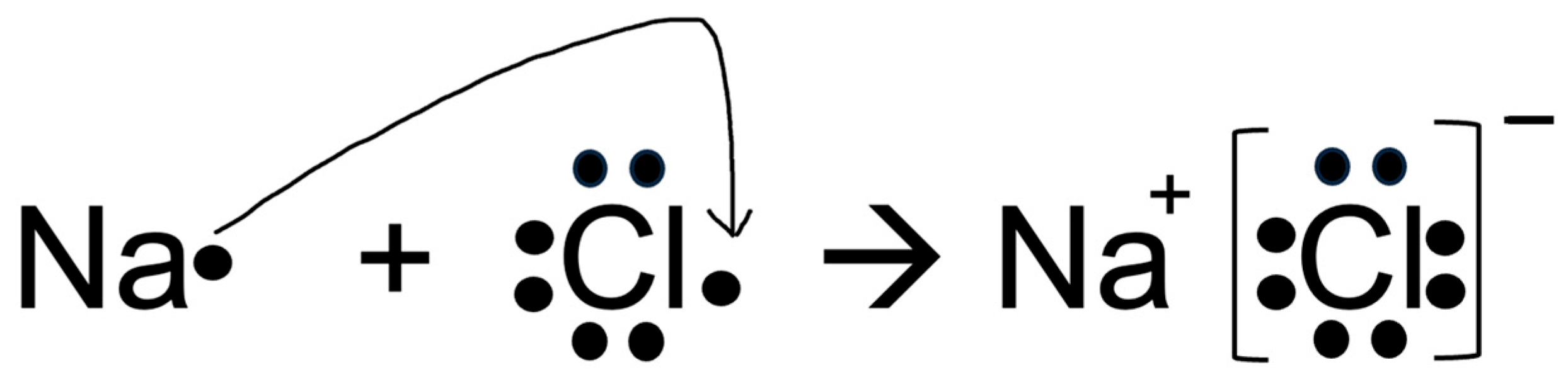
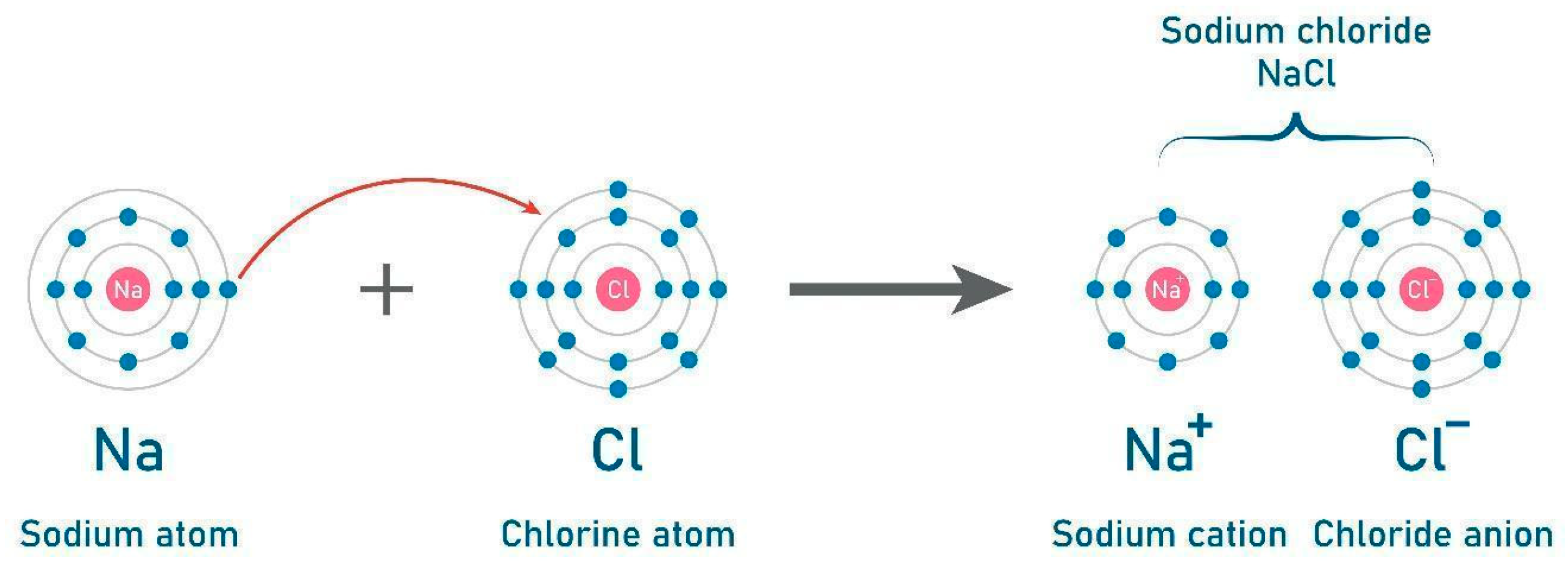
This category is based upon the argument that presenting single atoms in textbooks instead of as part of a chemical arrangement can lead to an “atomic ontology” in learners, which could represent a learning impediment (Taber, 2001; Taber & Coll, 2002; Vladušić et al., 2016). In reality, chemical reactions rarely occur between single atoms, and presenting it in this way is a simplification that may not be readily developed into more sophisticated understanding about molecules, ions, and related phenomena (e.g., intermolecular forces and reactions). Statements and representations in textbooks that explain the formation of ionic bonds by transfer of electrons between two atoms have been scored “Not in accordance with recommendation” (see example in Figure 1).
The recommendation has been assessed as “In accordance” if ionic bonds are explained without considering individual atoms but by considering ions and lattice structures. If the textbook contains both considerations of the individual atom, and ions and lattice structures, the score given was “Contradictory mention”. In our pilot analysis of Derry et al.’s (2008) book, for example, we found both text passages emphasizing the formation of ions from atoms to form sodium and chloride ions, and passages with the reservation that “ionic compounds do not exist in nature as separate units of, for example one sodium ion and one chloride ion”. Thus, this text would be assessed as “Contradictory mention”.
In Taber’s (2001) and Taber and Coll’s (2002) original recommendations, the role of atoms in the formation of covalent bonds is not specifically discussed. However, as more recent research (Erman, 2017) has demonstrated, the idea that covalent bonds are formed between two atoms that use a pair of electrons is still widely held. We therefore expanded the content of this category to include cases where an overemphasis on how atoms share electrons in covalent bonding might give the impression that the electrons belong more to one atom than the other.
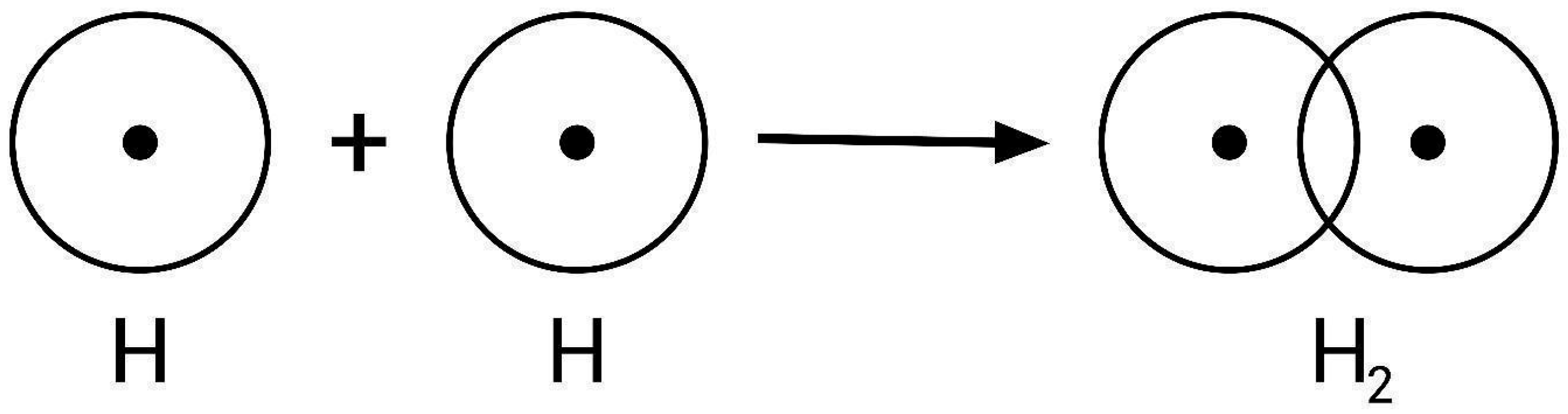
An example of a representation that has been coded as “Not in accordance with recommendation” is shown in Figure 2. In the cases where textbooks present covalent bonds as electron pairs attracted to both positive nuclei (for example, through the use of Lewis structures) and there is no explanation about how the molecule is formed as a result of electron sharing between individual atoms, however, the recommendation was assessed to be “In accordance”. “Contradictory mention” entails considerations both of the individual atom and molecular structures.
  • Category 2: Teach bonds as electrical concepts
If intramolecular bonding is explained in terms of electrical attraction between particles of opposite charge, students will be more inclined to accept that intermolecular bonds are also examples of chemical bonding (Taber, 2001; Taber & Coll, 2002). Therefore, it is not necessary to know from which atoms the electrons that are attracted to the atomic nucleus originated, and therefore, as we discussed above, the forming of ions and molecules should not be used to explain chemical bonding. In many textbooks, ionic bonding is explained as an example of electrical attraction. However, covalent bonding is often explained as a way of fulfilling the octet rule. Hence, our score is “In accordance with recommendation” if and only if covalent bonding is also presented as an electrical phenomenon—for example, as the “mutual attraction between the shared electrons and the nuclei” (Stephenson & Warren, 2014). We use the score “Contradictory mention” if the use of electrostatic explanation is combined with the octet rule, explicitly or implicitly (filling up shells/noble gas configuration/stable structure). Note that we here assess the use of the octet rule to explain chemical bonding, we do not address its practical use as a “rule of thumb” in teaching to visualize how electron shells are filled.
  • Category 3: Do not treat chemical bonding as a magical or social concept or use anthropomorphic language
The idea of chemical bonding as a “magical” or “social” concept refers to explanatory models such as the octet rule where ion formation or bonding is often explained in terms of an atom’s own will or desire to take up or give away or share electrons. In fact, the atomic ontology (Taber, 2001; Taber & Coll, 2002) encourages learners to use such anthropomorphic language. Examples include expressions such as “in need of”, “desire” or “like/wish” to get more electrons, or “prefer to be stable”. Whenever the octet rule or similar anthropomorphic language was mentioned in connection with the formation of bonds, the score was “Not in accordance with recommendation”.
  • Category 4: Take care with language, avoid mixing the submicroscopic and macroscopic levels
This statement refers to the different explanatory levels used in chemistry: the macro level (observable through senses or devices), the submicroscopic level (particle level; using atoms, electrons, ions, molecules, orbitals, etc.), and the symbolic level (symbols, formulas, letters, equations, etc.), which are collectively referred to as the “chemical knowledge triplet” (Johnstone, 1991). Johnstone (1991) suggested that one of the reasons that chemistry is difficult for students is that it involves multilevel understanding and reasoning, with students having to deal with two or more levels at the same time. For example, it might be confusing to students if teachers state that molecules (instead of substances) evaporate (macro level), or that bonds are established between sodium and chlorine, instead of the more precise submicroscopic sodium ion and chloride ion. If the same textbook mixes the macro–submicro levels in one situation and is precise in a similar situation elsewhere, we have given the score “Contradictory mention”. The use of anthropomorphic language is not considered in this category as it is a separate category in itself (see Category 3).

3. Results

In this section, we first present the overall results sorted by country, followed by findings regarding each category. Results by country are presented in Tables S1–S3, see Supplementary Materials, whereas results by categories 1–4 are presented in Tables S4–S7, see Supplementary Materials.

3.1. Overall Results, Sorted by Country

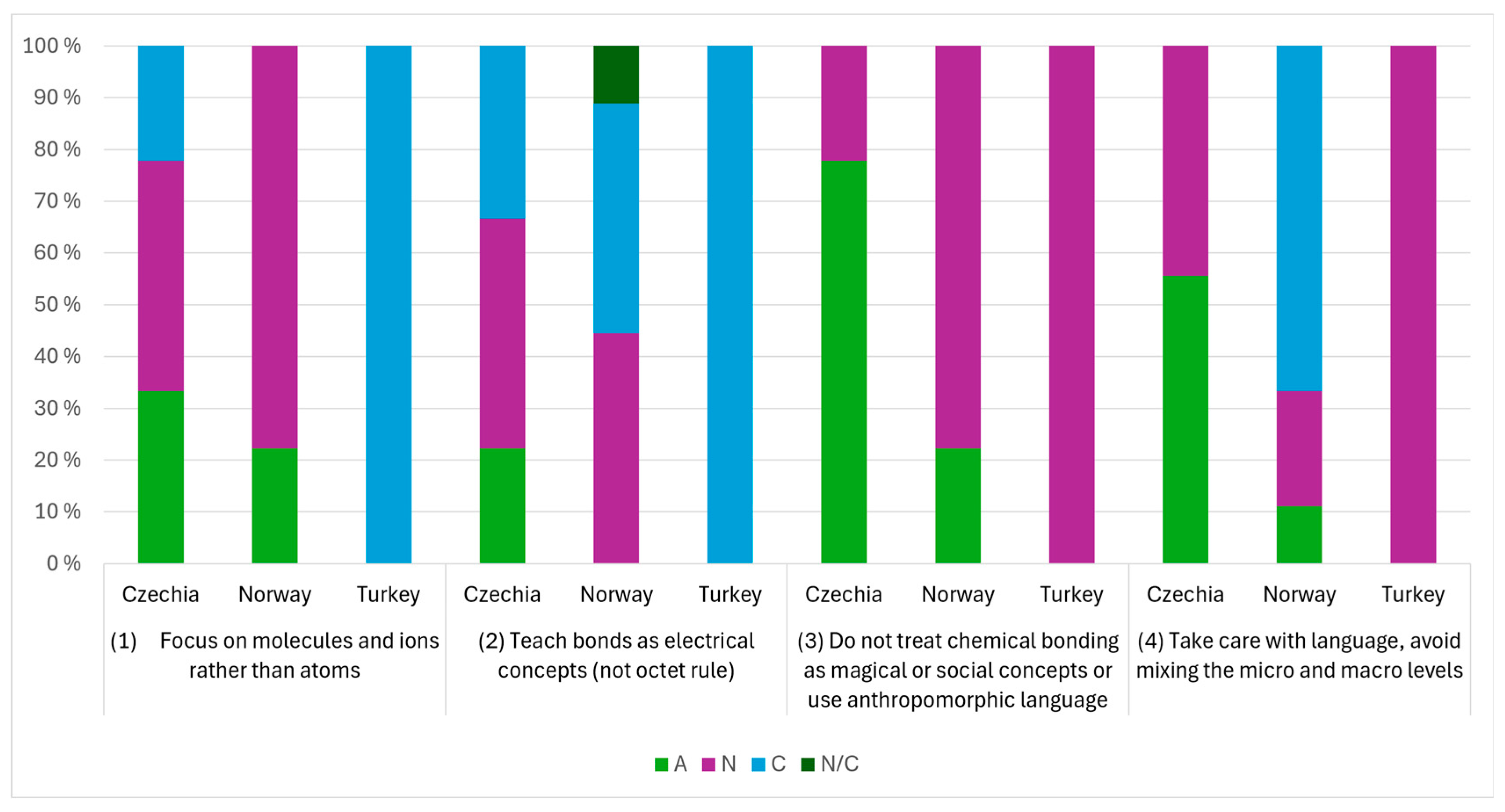
Figure 3 presents a visualization of overall results for Czechia, Norway and Turkey. Tables S1–S3 (Supplementary Materials) present overall results for Turkey, Norway, and Czechia, respectively. Surprisingly, none of the three textbooks from Turkey were in accordance with any of the recommendations; in fact, all three were scored “Contradictory mention” for the first two categories. For Norway and Czechia, there was more variation in the degree to which the recommendations were addressed in school textbooks. In Czechia, two upper secondary textbooks took all recommendations into account. Overall, the largest number of books (7 of 9) were scored “In accordance with recommendation” for category 3 (Do not treat chemical bonding as a magical or social concept). For Norway, the most striking result was the small number of “In accordance” scores—only four of a total of 36 scores (one being “Not covered”). One book, Kjemien stemmer 1 (Knutsen et al., 2021), stood out with three categories in accordance with recommendations, and one contradictory mention (for category 2—Teach bonds as electrical concepts).

3.2. Category 1: Focus on Molecules and Ions Rather than Atoms

Our analyses revealed that a total of five books were in accordance with the recommendation, eleven books were not, and five were scored as contradictory mention (Table S4). In Turkey, “Contradictory mention”—which means that considerations both of the role of single atoms, and of ions and lattices in bond formations were included—was the only score given in this category, while the score “Not in accordance” dominated in Norway.
In all countries, it was common to start the section about ionic bonding with a description of how ions are formed, typically from sodium and chlorine atoms, which bond during chemical reactions to form sodium chloride through the transfer of an electron from a sodium atom to a chlorine atom. For example, one of the Turkish textbooks stated: “When the sodium and chlorine elements interact […], the sodium atom donates electrons to the chlorine atom, thus both atoms turn into ions. Since the ions formed are positively and negatively charged, they attract each other and stay together. The bond formed through the electrostatic attraction of oppositely charged ions is called an ionic bond” (Büyük, 2021, p. 104). The donation of electrons was typically described in illustrations showing both inner and outer electrons in their shells and how electrons “jump” from one elemental atom to the other (as shown in Figure 1). Lewis structures were also used to illustrate the transfer of electrons between atoms (Figure 4). The “electron hopping” from the sodium atom to the chlorine atom is also shown in the Czech lower secondary school textbooks (Beneš et al., 2010, p. 6).
We found that only two of the Norwegian textbooks in science and chemistry were fully in accordance with this recommendation, avoiding the presentation of single atoms where atoms are, in reality, part of a chemical arrangement. Only one of the textbooks for lower secondary school, Element 9 by Arntzen et al. (2021), and one upper secondary textbook, Kjemien stemmer by Knutsen et al. (2021) introduced chemical bonds without any representation of a reaction between single atoms, and ions were shown as part of an ionic lattice. The rest of the Norwegian textbooks depicted discrete atoms instead of showing how the atoms are part of larger structures, and they also used representations of electron transfer when explaining ionic bonds.
As noted above, all Turkish textbooks were scored as “Contradictory mention” for this category. Although the texts were not in accordance with the recommendation to focus on ions rather than atoms where they first elucidated ionic bonding, the authors did focus on ions without mentioning the atoms in the preceding or subsequent texts. Here they explained the nature of lattice structure of ionic compounds and structural units. The following excerpt from a Turkish textbook is indicative of how it is possible to discuss ions without mentioning atoms, which aligns with the recommendation: “In the sodium chloride crystal (compound), sodium and chlorine ions are held together by strong interactions (chemical bond)” (Büyük, 2021, p. 102).
In Czech textbooks, chemical bonding was introduced through the concept of difference in electronegativity, starting with the sharing of electrons in covalent bonding. Ionic bonding was then explained as an extreme form of covalent bonding, where oppositely charged ions are bound together by electrical forces. An example which was coded as “Contradictory mention”, represented ion formation through electron hopping when introducing ionic bonding but also explained ionic bonding as an attraction between opposite charges of cations and anions (Los et al., 2014, pp. 25–26). In another textbook, the formation of a molecule of hydrogen was explained by the sharing of electrons, the representation clearly identified which atom the different electrons had come from (as in Figure 2), and hence followed an atomic ontology (Škoda & Doulík, 2022, p. 22) and was scored “Not in accordance with recommendation”.

3.3. Category 2: Teach Bonds as Electrical Concepts

Data analysis indicated that eight texts were not in accordance with the recommendation to present bonding as electrical attraction, whilst two were, one did not discuss this issue, and ten were scored as “Contradictory mention” (Table S5).
We found that none of the Norwegian textbooks were fully in accordance with this recommendation. Lower secondary school books did not generally go in depth into the topic of chemical bonding, and only one, Solaris naturfag 8, mentioned that atoms are held together by electrical forces (Gregers et al., 2020, p. 82). However, when the authors treated the topic of molecular compounds specifically in Solaris naturfag 9, attraction forces were not mentioned. The three textbooks in chemistry for upper secondary school all explained that chemical bonding is electrical attraction between particles, but they combined it with an octet rule framework, and we have given the score “Contradictory mention” for all of them.
Kjemien stemmer explicitly stated that electrical attraction can take place between atoms, ions, or molecules (Knutsen et al., 2021, p. 63), including in covalent bonding: “In each of the molecules [F2, O2 or N2], one or more common electron pairs are attracted to both atomic nuclei by electrostatic forces and bind them together” (Knutsen et al., 2021, p. 77). Kjemi 1 connected this “electrostatic” attraction to potential energy:
If the atoms get too close to each other, the potential energy becomes very high. If they drift too much apart, the energy also gets higher, until the atoms are no longer attracted to each other. Stable chemical substances have low potential energy, and chemical reactions often happen because the end product gets lower potential energy than the reactants. (Haraldsrud et al., 2021, p. 24) (emphasis in original).
Aqua 1 introduced Coulomb’s law as one way of explaining “many chemical and physical properties of chemical substances—especially how atoms in molecules are bound together” (Steen et al., 2021, p. 57). In the section about covalent bonding, this “electrostatic” attraction was only mentioned in passing, after the authors had explained how two chlorine atoms share electrons and both get surrounded by eight electrons.
As noted, all three books used the octet rule in their explanation. Kjemi 1, for example, explained that each oxygen atom in the oxygen (O2) molecule “lack[s] two electrons to fulfill the octet rule” (Haraldsrud et al., 2021, p. 39), and that the octet is complete after sharing electrons with the other oxygen atom. In an earlier subchapter it was stated that the “orbital model” (based on the Schrödinger equation) can explain how chemical bonding occurs, but no further explanation or examples were provided (Haraldsrud et al., 2021, pp. 15–16). The octet rule is also mentioned in relation to covalent bonding in the textbook Kjemien stemmer, such as in the following sentence: “Each of the atoms in the fluorine molecule has the same distribution of electrons as the atoms in the noble gas neon, and the octet rule is fulfilled” (Knutsen et al., 2021, p. 77). However, the octet rule is not used as an explanatory model in the same way that it is used in the two other textbooks for upper secondary school, so the textbook has therefore been scored as “Contradictory” in this category.
Similarly, the three textbooks from Turkey were inconsistent in explaining bonds as electrical concepts, and they, too, were coded as “Contradictory mention”. All three textbooks focused on the attraction and repulsion forces between electrons and nuclei of chemical species that approach one another during their first introduction of the concept of strong forces, which in the Turkish curriculum refers to ionic and covalent bonding. For example:
As two chemical species come closer, electrostatic attraction and repulsion forces occur between nucleus and electrons of two species. Repulsion forces occur between nucleus–nucleus and electron–electron of two species whereas attraction forces form between nucleus of a species and electrons of the other species (Ertekin et al., 2021, p. 106).
In the subsequent passages of this and the other two books, however, bonding was described by means of how atoms accept, donate, or share electrons during the formation of bonds to achieve noble gas electron configuration, which is an indication that the text is not in accordance with the recommendation throughout:
When atoms form compounds, they accept, donate or share their valence electrons to achieve noble gas electron configuration. IA, IIA, and IIIA group elements in the periodic table (except H) donate their valence electrons to reach noble gas electron configuration. […] Also, nonmetals tend to share their valence electrons when they form compounds (Güntut et al., 2019, p. 108).
The electrostatic attraction between particles was also used as the principle of covalent bonding in two of four Czech upper secondary textbooks, whilst the recommendation is not taken into account or is contradictorily stated for the lower secondary school books. One of the textbooks graphically shows how changes in the potential energy of two isolated hydrogen atoms are dependent on the distance between the atoms (Mareček & Honza, 2005, p. 35). This explanation was accompanied by information on the balance of attractive and repulsive forces between the hydrogen atoms at the distance corresponding to the formation of the chemical bond. Two other books used valence orbital overlap as a principle of covalent bond formation, sharing of bonding electron pair, and the greater stability of the resulting structure (Banýr & Beneš, 2010; Flemr & Dušek, 2001).
To sum up, in our textbook samples from Norway, Turkey, and Czechia, we observed three explanatory models for chemical bonding: the octet rule, an electrical (or, more specifically for some books, electrostatic) attraction model, and the orbital model, which were often used in combination.

3.4. Category 3: Do Not Treat Chemical Bonding as a Magical or Social Concept or Use Anthropomorphic Language

The data provided evidence that a total of nine texts were in accordance with the recommendation to not treat chemical bonding as a magical or social concept or use anthropomorphic language, whilst 12 were not (Table S6). For this category, we saw clear differences between countries. Whilst none of the three Turkish books were in accordance with the recommendation, most of the Czech books were. In Norway, two were coded “In accordance with the recommendation” but seven were not.
Among the Norwegian textbooks, only one of the lower secondary textbooks (Naturfag 8) was scored as “In accordance with the recommendation”. In this textbook (Steineger & Wahl, 2020) we found no mention of the octet rule at all, and no use of anthropomorphic or metaphoric language. The other two books at this level received the score “Not in accordance”, as both books connected the octet rule to the formation of bonds. For example, in Element 9, it was stated that “it is usual for atoms to either donate electrons, accept extra electrons or share electrons with one another to obtain eight electrons in the outer shell. This is called the octet rule” (Arntzen et al., 2021, p. 46). Similarly, in Kjemi 1 at the upper secondary level, we found the following statement: “The octet rule tells us that atoms and ions in many cases will try to achieve eight outer electrons” (Haraldsrud et al., 2021, p. 24), which is in conflict with the recommendations to avoid magical concepts. Kjemien stemmer (Knutsen et al., 2021) was the only book at the upper secondary level where we found no mention of magical concepts in the connection with bond formation, and therefore this book received the score “In accordance with the recommendation”.
As noted, none of the three textbooks from Turkey were in accordance with the recommendation as authors often use anthropomorphic language, either by emphasizing that atoms “wish” to reach noble gas electron configuration, or by presenting the sharing of electrons as a social concept. An example of the “wish” to achieve noble gas configuration can be seen in the following statement:
Atoms wish to reach noble gas electron configuration […]. Therefore, metals, by donating their valence electrons at their outer shells, and nonmetals, by accepting electrons to their outer shells, desire to reach noble gas electron configuration (Ertekin et al., 2021, p. 109). Similarly, we can read in another book that: “shared electrons are more attracted by the more electronegative atom” (Güntut et al., 2019, p. 117).
Interestingly, few of the Czech books explicitly referred to the octet rule to explain chemical bonding. In Scientia’s textbook (Los et al., 2014), the tendency to strive to achieve the magic octet was hinted at to some extent. In the upper secondary school textbooks, the octet rule was only mentioned in SPN1’s book in connection with a historical account of discussions around the formation of chemical bonds but was not used to explain the principles of bond formation. However, there were many other examples of anthropomorphic language in these books, e.g., “Atoms are trying to […] and “atoms are pulling on the bonding electron pair” (Škoda & Doulík, 2022, p. 24).

3.5. Category 4: Take Care with Language, Avoid Mixing the Submicroscopic and Macroscopic Levels

For this category, six textbooks took the recommendation into account, whilst nine did not and six were scored as contradictory (Table S7).
All three textbooks from Turkey included statements that did not pay attention to the different explanatory levels used in chemistry; thus, all were coded as “Not in accordance with the recommendation”. For example, one textbook stated: “When boiling points of compounds of 5A group atoms with hydrogen in the periodic system such as NH3, PH3, AsH3, SbH3 were compared, it was seen that the boiling point of NH3 molecule is high” (Güntut et al., 2019, p. 132).
There were also some imprecise statements in the textbooks from Czechia—for example in the statement “transfer of an electron from sodium to chlorine”, instead of from an atom of sodium to an atom of chlorine (Šrámek, 2005, p. 45). Another example was found in a lower secondary school textbook: “What forces attract sodium and chlorine in a sodium chloride molecule?” (Los et al., 2014, p. 25).
For the textbooks from Norway, we found that only one textbook, Kjemien stemmer, was consistent in its use of language with regard to transitions between the submicroscopic and macroscopic levels. In general, the authors of this textbook restricted themselves to one level at a time and, for example, stated at an early stage that: “Metallic bonds keep atoms together in a metal, ionic bonds keep the ions together in an ionic compound (a salt), and covalent bonds keep the atoms together in molecules and in what we refer to as network solids” (Knutsen et al., 2021, p. 63). Furthermore, when explaining the connection between the element at the macroscopic level and the number of electrons in the atom’s outer electron shell, the authors of Kjemien stemmer used precise language, as we can see in the following statement: “Metals have few outer electrons in their atoms” (Knutsen et al., 2021, p. 67).
The example about metals’ outer electrons was in stark contrast to how many of the other textbooks expressed the connection between the electrons in the atom, and the element’s place in the periodic system. For example, Kjemi 1 (Haraldsrud et al., 2021) repeatedly states that an element or a group of elements (not their atoms) “has/have X outer electrons”. Similarly, some of the books whose score was “Contradictory mention” also used this imprecise expression. In Naturfag 8, the authors explain that “hydrogen only has one electron in its shell” (Steineger & Wahl, 2020, p. 151). In these and similar examples, it seems that the textbook authors skipped the atomic level in their descriptions. In our view, by doing so they took for granted that students would follow the transition from the elements at macro level, to the electrons at submicroscopic level—and that they would realize that the electrons are part of the atoms that again make up the elements.
The “Contradictory mention” score was given when the authors alternated between imprecise descriptions about electrons and elements (such as in the examples shown above) and a more precise use of language. The upper secondary school textbook Kosmos, for example, uses precise and imprecise language on the same page. First, the authors state that: “The atoms of elements that have an equal number of electrons in the outer electron shell are placed in the same group”. They then continue with more sloppy language: “In one period (horizontal row) the elements have the same number of electron shells” (Heskestad et al., 2020, p. 77).

4. Discussion

This study aimed to investigate whether research on the teaching and learning of chemical bonding from the past three decades has influenced the presentation of bonding concepts in recent or currently utilized textbooks from Turkey, Norway, and Czechia. 25 years after Taber’s (Taber, 2001; Taber & Coll, 2002) recommendations for how to teach chemical structures, we observed that the recommendations that are supported by more recent research have not had much impact on how textbooks describe chemical bonding.
An extensive body of literature on the teaching and learning of chemical bonding points in particular to two problematic explanatory models that can give rise to learning difficulties or alternative conceptions: the atomic ontology (category 1 in our analysis) and the octet rule (category 2 in our analysis) (Bergqvist et al., 2013; Hunter et al., 2022; Joki & Aksela, 2018; Kiernan et al., 2024; Taber, 1994, 2001; Taber & Adbo, 2013; Taber & Coll, 2002; Tan & Treagust, 1999; Zohar & Levy, 2019). As Taber (2001) noted: “[…] schemes showing interactions between discrete atoms usually have no chemical validity or relevance, and may support the acquisition of inappropriate ideas” (Taber, 2001, p. 150).
Several of the textbooks we investigated introduced ionic bonding by paying “heed to an irrelevant electron history” (Taber, 1997, p. 13), showing how ions are formed from discrete atoms, when real chemistry involves molecules, ions, or more extensive systems. Also, when describing the formation of covalent bonds, some textbooks depicted single atoms forming bonds through the sharing of electrons (as in Figure 2), thereby highlighting the discrete atom’s role in the bonding process, especially for covalent bonds. As seen in examples from both Turkey and Norway, it is possible to reduce the use of atomic language and the assignment of electrons to specific atoms. Nevertheless, representations depicting ion formation, in particular, remain common despite concerns raised in the research literature.
The use of the octet rule, however, varied across the textbooks that we studied. Two Czech textbooks did not apply the rule at all, and the explanatory framework seemed to be far from as common as it was in Turkey and Norway. Largely, explanations based on electrical attraction between electrons and atomic nuclei were used, but often in combination with other models. In both Turkey and Norway, explanations involving electrical attraction and repulsion were often mixed with the octet framework. Related to the use of the octet framework is the use of anthropomorphic language or social concepts (category 3 in our analysis)—i.e., when particles or other entities are assigned “will” to achieve particular configurations. This was common in all three countries, with a few exceptions; five textbooks in Czechia and two currently in use in Norway actually avoided this.
With regard to the recommendation to take care with language (category 4 in our analysis), the majority of textbooks in the three countries failed to use a precise language that specified the macro or submicroscopic level. None of the Turkish textbooks and only one Norwegian textbook followed this recommendation. The Czech textbooks scored higher, with five out of nine scores being “In accordance with the recommendation”. It was surprising that so few textbook authors specified the macro–submicro level in their texts, considering that the “chemical knowledge triplet” or “Johnstone’s triangle” is widely recognized and highly influential in the field of chemistry education (Taber, 2013), and has led to research indicating that explicit teaching of the macro–submicro–symbolic levels helps students’ conceptual and relational understanding in chemistry (Jaber & BouJaoude, 2012).
Whilst Johnstone (1991) suggested that chemistry should be restricted to the macroscopic level for some students, Taber (2013) argued that teachers instead need to “model the ways in which chemists operate with and between the two domains of conceptual knowledge (macroscopic descriptions and categories; theoretical submicroscopic models)” (Taber, 2013, p. 166). Textbooks are important in this aspect, as students probably read few or no other models on the topic. It is also important that the macro–submicro-symbolic language becomes internalized by teachers (Jaber & BouJaoude, 2012).
So why have some traditional explanatory models such as the octet rule proved to be so resilient in teaching, and why do so many textbook authors use the same examples and ways of introducing ionic bond formation and sharing of electrons? Let us point to a few observations that might explain some of the trends we have observed.
Chemical bonding is an abstract, non-intuitive phenomenon that lacks analogues in everyday experience. Some chemists argue that it cannot be clearly defined due to its intangible nature (Croft & de Berg, 2014). Multiple conceptual models can be employed to define a chemical bond, each emphasizing a distinct aspect of the bond and elucidating different chemical phenomena. These conceptual models range from being excessively advanced for upper secondary school chemistry students to oversimplifications that may impede learning.
On the one hand, scientists describe chemical bonding using quantum-mechanical theories, which exceed the scope of upper secondary school chemistry. Educational research suggests that several aspects of the quantum-mechanical model are too complex for most young students to comprehend, as they are purely mathematical constructs that cannot be determined by experiments (Stevens et al., 2010; Taber & Coll, 2002). On the other hand, quantum theory may give students the erroneous impression that chemistry is a difficult, abstract, mathematical subject that cannot be adequately explained at the introductory level (Gillespie, 1997).
These concerns about students’ ability to learn about more complex ideas about chemical bonding may result in an oversimplification of the topic of chemical bonding by presenting it as based on the octet rule. These oversimplified representations are easily demonstrated and understood; however, they do not provide students with sufficient scientific tools to promote understanding that relies on electrical interactions (Joki & Aksela, 2018; Levy Nahum et al., 2007; Taber & Coll, 2002). Taber and Adbo (2013) suggest that students’ use of the octet rule and associated anthropomorphic language fills an explanatory vacuum in that they are not presented with alternative ways of explaining the phenomenon.
Historical research has demonstrated that it might take a long time for new research to be implemented in textbooks. Lykknes (2015), for example, found that it took almost 100 years before Norwegian textbooks were restructured to use the periodic system rather than an “element-by-element” approach to teaching about the elements. She highlighted several contributing factors: the long-standing dominance of certain authors within the textbook market, a general reluctance to undertake substantial revisions of textbooks that were considered sufficiently effective, and the importance of the authors’ own familiarity with the research field. Such factors may continue to influence textbook development today.
Interestingly, in our study, the Norwegian textbook that aligned most closely with the stated recommendations (Knutsen et al., 2021) was co-authored by a chemistry educator who is familiar with current research in the field. This is consistent with Lykknes’ (2015) findings regarding historical textbooks. Not all textbook authors share a strong scientific or educational background, however, and given that they are typically responsible for content across a broad range of disciplines, it is understandable that they cannot be experts in every area—particularly not educational research.
Although misconceptions continue to surface in science textbooks (Clifford, 2002; King, 2010), and the presentation of content often falls short of incorporating recent advances in science education, the fact that several of the textbooks that we analysed do reflect research-based principles may suggest that the gap between academic knowledge and its translation into classroom materials may be gradually narrowing.

5. Conclusions

Despite the large body of research that has emerged during the past three decades, this study suggests that:
  • Presentations of chemical bonding in textbooks in Turkey, Norway, and Czechia remain largely the same as described by Taber in 2001, which also indicates that
  • There is not sufficient focus on evidence-based content in textbooks. This could be achieved by having more chemistry education researchers be part of the textbook writing process.
  • There are some differences between the three countries with regard to the use of explanatory models. Interestingly, the octet rule is still popular in Turkey and Norway but is not used in Czech textbooks.
Hunter et al. (2022) argue that for students to reduce their use of anthropomorphic language and explanatory models, teachers must first cease modelling this behaviour. Given that textbooks serve as key informational resources for educators, reforming instructional materials is essential. Further research on existing reformed curricula—such as those described by Hunter et al. (2022)—can help to raise awareness of alternative teaching approaches and foster professional development efforts, as well as encourage trial implementation in schools.
Suggestions for practice could be found in new approaches and frameworks for the teaching of chemical bonding, such as cooperative learning and enriched learning environment with different methods (Çalik et al., 2024).
The persistence of outdated instructional practices among teachers may, as Taber and Adbo (2013) have argued, stem from an explanatory vacuum that was created by the absence of more satisfactory models and pedagogical language. To address this gap, further research into the teaching of chemical bonding—particularly in Czech classrooms, where textbooks do not rely on the octet rule—could offer valuable insights. Reforming teacher education using frameworks such as the one developed for preservice educators by van Dulmen et al. (2023) should also be considered.
Based on our own findings and the referred historical study by Lykknes (2015), we encourage chemistry education researchers to be more actively involved in textbook writing in chemistry, to help reduce the research-practice gap and make it easier for teachers to get access to up-to-date knowledge about teaching and learning of chemistry. Studying the effect of such authorship could make a promising avenue for future research.

6. Limitations

All three countries included in this study are members of the Organisation for Economic Co-operation and Development (OECD) and therefore share certain educational policy frameworks. Their geographic and cultural differences, however, provide a compelling basis for comparative analysis. Nonetheless, given the limited scope of this investigation—focusing on textbooks from only three OECD countries—the findings cannot be generalized to represent the global portrayal of chemical bonding in educational materials.
It is important to note that this study has focused solely on the representations of chemical bonding in textbooks. We did not conduct classroom observations and cannot therefore account for how the subject is actually taught in practice across the three countries. Additionally, the textbook samples span multiple educational levels, which complicates efforts to draw firm conclusions regarding cross-national differences in the representation of chemical bonding. Nonetheless, as Clément (Clément, 2008, p. 93) observed, textbooks are “aligned to the syllabus and represent the way of teaching in the respective country”. Accordingly, although the materials examined offer valuable insights into instructional practices across grade levels, they do not provide a comprehensive picture of how chemical bonding is addressed in classrooms in Turkey, Norway, and Czechia.

Supplementary Materials

The following supporting information can be downloaded at: https://www.mdpi.com/article/10.3390/educsci16071060/s1, Table S1. The degree to which Turkish upper secondary school chemistry textbooks address the recommendations; Table S2. The degree to which Norwegian secondary school science and chemistry textbooks address the recommendations; Table S3. The degree to which Czech secondary chemistry textbooks address the recommendations; Table S4. Scores for category 1: Focus on molecules and ions rather than atoms; Table S5. Scores for category 2: Teach bonds as electrical concepts; Table S6. Scores for category 3, Do not treat chemical bonding as a magical or social concept or use anthropomorphic language; Table S7. Scores for Category 4: Take care with language, avoid mixing the submicroscopic and macroscopic levels.

Author Contributions

Conceptualization, U.E., A.L., M.B. and G.C.; methodology, U.E., A.L., and B.D.; formal analysis, U.E., A.L., B.D., V.M., M.B. and G.C.; writing—original draft preparation, U.E., A.L., B.D., V.M., M.B. and G.C.; writing—review and editing, U.E., A.L., B.D., V.M., M.B. and G.C.; visualization, U.E. and B.D. All authors have read and agreed to the published version of the manuscript.

Funding

This work received no funding.

Institutional Review Board Statement

Not applicable.

Informed Consent Statement

Not applicable.

Data Availability Statement

Data are from published textbooks (all referenced in the manuscript).

Conflicts of Interest

The authors declare no competing interests.

References

  1. Aakre, I. G., Persson, J. R., Lein, H. L., & Eggen, P.-O. (2021). First-year university students’ perception of chemical bonding and bond energy. Nordic Journal of STEM Education, 4(2), 12–30. [Google Scholar] [CrossRef]
  2. Arntzen, M., Bækkedal, K. S., & Fossestøl, K. O. (2021). Element 9, grunnbok. Naturfag for ungdomstrinnet. Gyldendal. [Google Scholar]
  3. Askeland, N. (2025). Lærebok. In Store norske leksikon. Available online: https://snl.no/l%C3%A6rebok (accessed on 11 February 2025).
  4. Banýr, J., & Beneš, P. (2010). Chemie pro střední školy. SPN. [Google Scholar]
  5. Beneš, P., Pumpr, V., & Banýr, J. (2010). Základy chemie 1. Fortuna. [Google Scholar]
  6. Bergqvist, A., & Chang Rundgren, S.-N. (2017). The influence of textbooks on teachers’ knowledge of chemical bonding representations relative to students’ difficulties understanding. Research in Science & Technological Education, 35(2), 215–237. [Google Scholar] [CrossRef]
  7. Bergqvist, A., Drechsler, M., De Jong, O., & Rundgren, S.-N. C. (2013). Representations of chemical bonding models in school textbooks—Help or hindrance for understanding? Chemistry Education Research and Practice, 14(4), 589–606. [Google Scholar] [CrossRef]
  8. Blonder, R., & Mamlok-Naaman, R. (2019). Factors affecting the study of chemistry in different countries around the world: Findings from an international survey. Israel Journal of Chemistry, 59(6–7), 625–634. [Google Scholar] [CrossRef]
  9. Brandt, H., Hushovd, O. T., & Tellefsen, C. W. (2020). Naturfag SF. Aschehoug. [Google Scholar]
  10. Budínská, G., Štikovcová, K., Jelínková, L., & Jandová, J. (2019). Hravá chemie 8. Taktik. [Google Scholar]
  11. Büyük, Ş. (2021). Secondary school chemistry textbook. Pacific Publishing. [Google Scholar]
  12. Clément, P. (2008). Introduction to the special issue of SEI relating to critical analysis of school science textbooks. Science Education International, 36(3), 110–112. [Google Scholar]
  13. Clifford, P. (2002). The pressure-flow hypothesisof phloem transport: Misconceptions in the A-level textbooks. Journal of Biological Education, 36(3), 110–112. [Google Scholar] [CrossRef]
  14. Cooper, M. M., Klymkowsky, M. W., Becker, N. M., Chen, R. F., Krajcik, J., Neumann, K., Fortus, D., Scheff, A., Eisenkraft, A., & Nordine, J. (2014). Energy in chemical systems: An integrated approach. In Teaching and learning of energy in K–12 education (pp. 301–316). Springer International Publishing. [Google Scholar] [CrossRef]
  15. Croft, M., & de Berg, K. (2014). From common sense concepts to scientifically conditioned concepts of chemical bonding: An historical and textbook approach designed to address learning and teaching issues at the secondary school level. Science & Education, 23(9), 1733–1761. [Google Scholar] [CrossRef]
  16. Çalik, M., Ültay, N., Bag, H., & Ayas, A. (2024). A meta-analysis of effectiveness of chemical bonding-based intervention studies in improving academic performance. Chemistry Education Research and Practice, 25(1), 506–523. [Google Scholar] [CrossRef]
  17. De Jong, O. (2000). The teacher trainer as researcher: Exploring the initial pedagogical content concerns of prospective science teachers. European Journal of Teacher Education, 23(2), 127–137. [Google Scholar] [CrossRef]
  18. Derry, L., Connor, M., Jordan, C., Jeffery, F., Ellett, B., Ellis, J., & O’Shea, J. (2008). Chemistry. For the use with the IB diploma programme. Standard level. Pearson Education. [Google Scholar]
  19. Dhindsa, H. S., & Treagust, D. F. (2014). Prospective pedagogy for teaching chemical bonding for smart and sustainable learning. Chemistry Education Research and Practice, 15(4), 435–446. [Google Scholar] [CrossRef]
  20. Erman, E. (2017). Factors contributing to students’ misconceptions in learning covalent bonds. Journal of Research in Science Teaching, 54(4), 520–537. [Google Scholar] [CrossRef]
  21. Ertekin, A. B., Kurt, A., Demirbaş, O., & Erkuş, S. (2021). Secondary school science school chemistry textbook. Ministry of National Education Publishing.
  22. Flemr, V., & Dušek, B. (2001). Chemie I pro gymnázia. SPN. [Google Scholar]
  23. Gillespie, R. J. (1997). The great ideas of chemistry. Journal of Chemical Education, 74(7), 862–864. [Google Scholar] [CrossRef]
  24. Gregers, T. F., Kalleson, E., Rosness, S. H., & Skarshaug, S. (2020). Solaris naturfag 8. Aschehoug. [Google Scholar]
  25. Gregers, T. F., Kalleson, E., Rosness, S. H., & Skarshaug, S. (2021). Solaris naturfag 9. Aschehoug.
  26. Güntut, M., Güneş, P., & Çetin, S. (2019). Secondary school chemistry textbook. Ministry of National Education Publishing. [Google Scholar]
  27. Haraldsrud, A. D., Brandt, H., Hushovd, O. T., & Sandtorv, A. H. (2021). Kjemi 1. Aschehoug. [Google Scholar]
  28. Heskestad, P. A., Engan, A., Liebich, H., Mykland, H. C., Nærø, K., & Valvik, S. A. E. (2020). Kosmos SF: Naturfag for studieforberedende utdanningsprogrammer: Lærebok. Cappelen Damm. [Google Scholar]
  29. Hunter, K. H., Rodriguez, J.-M. G., & Becker, N. M. (2022). A review of research on the teaching and learning of chemical bonding. Journal of Chemical Education, 99(7), 2451–2464. [Google Scholar] [CrossRef]
  30. Hurst, M. O. (2002). How we teach molecular structure to freshmen. Journal of Chemical Education, 79(6), 763–764. [Google Scholar] [CrossRef]
  31. Jaber, L. Z., & BouJaoude, S. (2012). A macro-micro-symbolic teaching to promote relational understanding of chemical reactions. International Journal of Science Education, 34(7), 973–998. [Google Scholar] [CrossRef]
  32. Johnstone, A. H. (1991). Why is science difficult to learn? Things are seldom what they seem. Journal of Computer Assisted Learning, 7(2), 75–83. [Google Scholar] [CrossRef]
  33. Joki, J., & Aksela, M. (2018). The challenges of learning and teaching chemical bonding at different school levels using electrostatic interactions instead of the octet rule as a teaching model. Chemistry Education Research and Practice, 19(3), 932–953. [Google Scholar] [CrossRef]
  34. Joki, J., Lavonen, J., Juuti, K., & Aksela, M. (2015). Coulombic interaction in finnish middle school chemistry: A systemic perspective on students’ conceptual structure of chemical bonding. Chemistry Education Research and Practice, 16(4), 901–917. [Google Scholar] [CrossRef]
  35. Justi, R. S., & Gilbert, J. K. (2002). Modelling, teachers’ views on the nature of modelling, and implications for the education of modellers. International Journal of Science Education, 24(4), 369–387. [Google Scholar] [CrossRef]
  36. Karpin, T., Juuti, K., & Lavonen, J. (2014). Learning to apply models of materials while explaining their properties. Research in Science and Technological Education, 32(3), 340–351. [Google Scholar] [CrossRef]
  37. Khine, M. S., & Khine, M. S. (2013). Analysis of science textbooks for instructional effectiveness. In Critical analysis of science textbooks: Evaluating instructional effectiveness (pp. 303–310). Springer. [Google Scholar] [CrossRef]
  38. Kiernan, N. A., Manches, A., & Seery, M. K. (2024). Resources for reasoning of chemistry concepts: Multimodal molecular geometry. Chemistry Education Research and Practice, 25(2), 524–543. [Google Scholar] [CrossRef]
  39. King, C. J. H. (2010). An analysis of misconceptions in science textbooks: Earth science in England and Wales. International Journal of Science Education, 32(5), 565–601. [Google Scholar] [CrossRef]
  40. Klečka, M. (2008). Nejpoužívanější učebnice chemie pro gymnázia a jejich hodnocení učiteli chemie. In Současné problémy v chemickém vzdělávání. Přírodovědecká Fakulta OU. [Google Scholar]
  41. Knutsen, H., Tveit, S., Vestli, K., & Hannisdal, M. (2021). Kjemien stemmer 1: Kjemi 1: Grunnbok. Cappelen Damm. [Google Scholar]
  42. Kronik, L., Levy Nahum, T., Mamlok-Naaman, R., & Hofstein, A. (2008). A new “bottom-up” framework for teaching chemical bonding. Journal of Chemical Education, 85(12), 1680–1685. [Google Scholar] [CrossRef]
  43. Levy Nahum, T., Mamlok-Naaman, R., Hofstein, A., & Krajcik, J. (2007). Developing a new teaching approach for the chemical bonding concept aligned with current scientific and pedagogical knowledge. Science Education, 91(4), 579–603. [Google Scholar] [CrossRef]
  44. Levy Nahum, T., Mamlok-Naaman, R., Hofstein, A., & Taber, K. S. (2010). Teaching and learning the concept of chemical bonding. Studies in Science Education, 46(2), 179–207. [Google Scholar] [CrossRef]
  45. Los, P., Hejsková, J., & Klečková, M. (2014). Nebojte se chemie. Scientia. [Google Scholar]
  46. Lykknes, A. (2015). Ignored, disregarded, discarded? On the introduction of the periodic system in Norwegian periodicals and textbooks, c. 1870–1930s. In H. K. M. Kaji, & G. Palló (Eds.), Early responses to the periodic system. Oxford University Press. [Google Scholar]
  47. Mach, J., Plucková, I., & Šibor, J. (2016). Chemie: Úvod do obecné a anorganické chemie. Nová Škola. [Google Scholar]
  48. Mareček, A., & Honza, J. (2005). Chemie pro čtyřletá gymnázia. Nakladatelství Olomouc. [Google Scholar]
  49. Mikeska, J. N., Brockway, D., Ciofalo, J., Jin, H., & Ritter, S. (2021). Examining variability in elementary science teachers’ pedagogical content knowledge about phase change: Implications for teacher development and assessment. Journal of Science Teacher Education, 32(4), 400–424. [Google Scholar] [CrossRef]
  50. Ministerstvo školství, m. a. t. M. (2025). Rámcový vzdělávací program pro základní vzdělávání—RVP ZV. Available online: https://edu.gov.cz/rvp-ramcove-vzdelavaci-programy/ramcovy-vzdelavacici-program-pro-zakladni-vzdelavani-rvp-zv/ (accessed on 11 February 2025).
  51. Niaz, M. (2001). A rational reconstruction of the origin of the covalent bond and its implications for general chemistry textbooks. International Journal of Science Education, 23(6), 623–641. [Google Scholar] [CrossRef]
  52. OECD. (2023). The state of learning and equity in education in 2022. OECD Publishing. [Google Scholar] [CrossRef]
  53. Özmen, H. (2004). Some student misconceptions in chemistry: A literature review of chemical bonding. Journal of Science Education and Technology, 13(2), 147–159. [Google Scholar] [CrossRef]
  54. Park, D.-Y., & Lavonen, J. (2013). An analysis of standards-based high school physics textbooks of Finland and the United States. In Critical analysis of science textbooks (pp. 219–238). Springer. [Google Scholar] [CrossRef] [PubMed]
  55. Roth, K. J., Druker, S. L., Garnier, H. E., Lemmens, M., Chen, C., Kawanaka, T., Rasmussen, D., Trubacova, S., Warvi, D., Okamoto, Y., Gonzales, P., Stigler, J., & Gallimore, R. (2006). Teaching science in five countries: Results from the TIMSS 1999 video study—Statistical analysis report. United States Department of Education, National Center for Educational Statistics.
  56. Schneider, R. M., & Plasman, K. (2011). Science teacher learning progressions: A review of science teachers’ pedagogical content knowledge development. Review of Educational Research, 81(4), 530–565. [Google Scholar] [CrossRef]
  57. Steen, B.-G., Fimland, N., & Juel, L. A. (2021). Aqua1, grunnbok. Kjemi. Gyldendal. [Google Scholar]
  58. Steineger, E., & Wahl, A. (2020). Naturfag 8. Cappelen Damm. [Google Scholar]
  59. Stephenson, K., & Warren, D. (2014). Chemical bonding: The octet rules… OK? Education in Chemistry, 51, 12–13. [Google Scholar]
  60. Stevens, S. Y., Delgado, C., & Krajcik, J. S. (2010). Developing a hypothetical multi-dimensional learning progression for the nature of matter. Journal of Research in Science Teaching, 47(6), 687–715. [Google Scholar] [CrossRef]
  61. Svendsen, B., Juel, L. A., Stølevik, E., & van Marion, P. (2020). Senit SF: Naturfag SF. Gyldendal. [Google Scholar]
  62. Škoda, J., & Doulík, P. (2022). Chemie 8: Učebnice pro základní školy a víceletá gymnázia. Fraus. [Google Scholar]
  63. Šrámek, V. (2005). Chemie obecná a anorganická. Nakladatelství Olomouc. [Google Scholar]
  64. Taber, K. S. (1994). Misunderstanding the ionic bond. Education in Chemistry, 31(4), 100–103. [Google Scholar]
  65. Taber, K. S. (1997). Student understanding of ionic bonding: Molecular versus electrostatic thinking? School Science Review, 78(285), 123–158. [Google Scholar]
  66. Taber, K. S. (2001). Building the structural concepts of chemistry: Some considerations from educational research. Chemistry Education Research and Practice, 2(2), 123–158. [Google Scholar] [CrossRef]
  67. Taber, K. S. (2013). Revisiting the chemistry triplet: Drawing upon the nature of chemical knowledge and the psychology of learning to inform chemistry education. Chemistry Education Research and Practice, 14, 156–168. [Google Scholar] [CrossRef]
  68. Taber, K. S., & Adbo, K. (2013). Developing chemical understanding in the explanatory vacuum: Swedish high school students’ use of an anthropomorphic conceptual framework to make sense of chemical phenomena. In G. Tsaparlis, & H. Sevian (Eds.), Concepts of matter in science education (pp. 347–370). Springer. [Google Scholar] [CrossRef]
  69. Taber, K. S., & Coll, R. K. (2002). Bonding. In J. K. Gilbert (Ed.), Chemical education: Towards research-based practice (Vol. 17, pp. 213–234). Kluwer Academic Publishers. [Google Scholar]
  70. Taber, K. S., & Watts, M. (1996). The secret life of the chemical bond:students’ anthropomorphic and animistic references to bonding. International Journal of Science Education, 18(5), 557–568. [Google Scholar]
  71. Talanquer, V., & Pollard, J. (2010). Let’s teach how we think instead of what we know. Chemistry Education Research and Practice, 11, 74–83. [Google Scholar] [CrossRef]
  72. Tan, K. C. D., & Treagust, D. F. (1999). Evaluating students’ understanding of chemical bonding. School Science Review, 81(294), 75–84. [Google Scholar]
  73. The Ministry of National Education. (2024). Science curriculum (Grades 3, 4, 5, 6, 7, and 8). Available online: https://mufredat.meb.gov.tr (accessed on 11 February 2025).
  74. Tsaparlis, G., Pappa, E. T., & Byers, B. (2018). Teaching and learning chemical bonding: Research-based evidence for misconceptions and conceptual difficulties experienced by students in upper secondary schools and the effect of an enriched text. Chemistry Education Research and Practice, 19(4), 1253–1269. [Google Scholar] [CrossRef]
  75. Utdanningsdirektoratet. (2019). Læreplan i naturfag. Available online: https://www.udir.no/lk20/nat01-04 (accessed on 11 February 2025).
  76. Utdanningsdirektoratet. (2021). Læreplan i kjemi. Available online: https://www.udir.no/lk20/kje01-02 (accessed on 11 February 2025).
  77. Utdanningsdirektoratet. (2025). Fag- og timefordeling og tilbudsstruktur for Kunnskapsløftet Udir-1-2025. Available online: https://www.udir.no/regelverkstolkninger/opplaring/Innhold-i-opplaringen/udir-1-2025/ (accessed on 11 February 2025).
  78. Ünal, S., Çalık, M., Ayas, A., & Coll, R. K. (2006). A review of chemical bonding studies: Needs, aims, methods of exploring students’ conceptions, general knowledge claims and students’ alternative conceptions. Research in Science & Technological Education, 24(2), 141–172. [Google Scholar] [CrossRef]
  79. van Dulmen, T. H., Visser, T. C., Coenders, F. G., Pepin, B., & McKenney, S. (2023). Learning to teach chemical bonding: A framework for preservice teacher educators. Chemistry Education Research and Practice, 24(3), 896–913. [Google Scholar]
  80. Vladušić, R., Bucat, R. B., & Ožić, M. (2016). Understanding ionic bonding—A scan across the Croatian education system. Chemistry Education Research and Practice, 17, 685–699. [Google Scholar]
  81. Vojíř, K., & Rusek, M. (2019). Používání učebnic chemie na základních školách v České republice: Tvorba a pilotní ověření dotazníku. In M. Rusek, & K. Vojíř (Eds.), Project based education and other activating strategies in science education XVI (pp. 180–193). Charles University, Faculty of Education. [Google Scholar]
  82. Vojíř, K., & Rusek, M. (2022). Of teachers and textbooks: Lower secondary teachers’ perceived importance and use of chemistry textbook components. Chemistry Education Research and Practice, 23(4), 786–798. [Google Scholar] [CrossRef]
  83. Yang, M., Armpriest, B. C., Wright, L. K., & Newman, D. L. (2025). Visual representations of energy and chemical bonding in biology and chemistry textbooks: A case study of ATP hydrolysis. Biochemistry and Molecular Biology Education, 53(3), 274–285. [Google Scholar] [CrossRef] [PubMed]
  84. Zohar, A. R., & Levy, S. T. (2019). Students’ reasoning about chemical bonding: The lacuna of repulsion. Journal of Research in Science Teaching, 56(7), 881–904. [Google Scholar] [CrossRef]
Figure 1. Example of a representation focusing on the formation of sodium and chloride ions through electron transfer from a sodium atom to a chlorine atom, similar to figures we have seen in textbooks. Image: Shutterstock.com.
Education 16 01060 g001
Figure 2. An example of a representation that focuses on the formation of covalent bonding in a hydrogen molecule from discrete hydrogen atoms, similar to images we have seen in textbooks. Image: Shutterstock.com.
Education 16 01060 g002
Figure 3. Overall results. The degree to which Czech, Norwegian, and Turkish lower and upper secondary science and chemistry textbooks address the recommendations given by Taber (2001) and Taber and Coll (2002). A = in accordance, N = not in accordance, C = contradictory, N/C = not covered.
Education 16 01060 g003
Figure 4. An example of a Lewis structure representing the transfer of electrons starting from individual atoms of sodium and chlorine. Image: The authors.
Education 16 01060 g004
Table 1. Recommendations for teaching chemical bonding, based on Taber (2001) and Taber and Coll (2002).
Advice Recommendation
(1) Build on physical principlesExplicitly refer to underlying physical principles. Avoid using “magical” concepts or “octets”
(2) Focus on molecules and ions (not atoms)Avoid pictures of separate atoms when illustrating chemical processes; use complex diagrams instead
(3) Teach bonds as electrical concepts (not magical or social concepts)Emphasize that (all) chemical bonds (covalent, ionic, metallic, hydrogen, van der Waals) form because of electrical forces. Avoid thinking of ion formation when learning about salts and ionic bonding
(4) Emphasize the non-molecular nature of non-molecular latticesAvoid using the “molecular scheme” for all structures. Teach about metallic bonding first, then ionic bonding, and finally covalent bonding
(5) Take care with languageBeware of shifts between the macroscopic and submicroscopic levels. Avoid using anthropomorphic language, and challenge students when they assign will to atoms and molecules
Table 2. Examples of learning outcomes relevant for the concept of chemical bonding in national curricula in Turkey, Norway, and Czechia.
CountryLower Secondary SchoolUpper Secondary School
Turkey(There are no specific learning outcomes related to chemical bonding. Classification of pure substance and nomenclature of common pure substances and usage of those are, however, emphasized)The student:
  • Explains chemical species. Classifies the interactions between chemical species
  • Relates the formation of ionic bond with interactions between ions
  • Makes systematic nomenclature of ionic bonded compounds
  • Explains the formation of a covalent bond on the basis of electron sharing between atoms when classifying covalent bonds
  • Makes systematic nomenclature of covalently bonded compounds
  • Explains the formation of a metallic bond. The electron sea model is used to explain metallic bonding
NorwayThe student:
  • Explores chemical reactions, explains mass conservation, and explains the importance of some combustion reactions
  • Uses atomic models and the periodic table to explain the properties of the elements and chemical compounds
(Natural science integrated course, Vg1 programme for general studies)
The student:
  • Explores and explains the connections between chemical bonds and the properties of different substances
(Chemistry course:)
The student:
  • Accounts for chemical bonding as electrostatic forces that operate between particles, and uses this to explain molecular geometry and the structure, composition, and properties of organic and inorganic substances
CzechiaThe student:
  • Uses the terms atom and molecule, and element and compound in the correct context (with recommended teaching content: chemical compounds and chemical bonding, nomenclature of simple inorganic and organic compounds)
The student:
  • Uses knowledge of the particle structure of substances and chemical bonding to predict some physical-chemical properties of substances and their behaviour in chemical reactions (with recommended teaching content: chemical bonding and properties of substances)
Table 3. List of textbooks included in the study, sorted by country and school level.
CountryLower/UpperTextbook TitleAuthor(s) and Year of PublicationPublisherPages for Chemical Bonding
TurkeyUpperOrtaöğretim Kimya 9 Ders KitabıGüntut et al. (2019)National Ministry of Education 99–124
Ortaöğretim Fen Lisesi Kimya 9 Ders Kitabı (Science school textbook)Ertekin et al. (2021)National Ministry of Education 104–121
Ortaöğretim Kimya 9 Ders KitabıBüyük (2021)Pacific92–120
NorwayLowerElement 9Arntzen et al. (2021)Gyldendal40–73
Naturfag 8Steineger and Wahl (2020)Cappelen Damm138–157 & 178–211
Solaris naturfag 8 + 9 Gregers et al. (2020) (grade 8)/
Gregers et al. (2021) (grade 9)
AschehougGrade 8: 74–96
Grade 9: 36–56
UpperSenit SFSvendsen et al. (2020)Gyldendal38–61
Naturfag SFBrandt et al. (2020)Aschehoug 46–69
Kosmos SFHeskestad et al. (2020)Cappelen Damm73–99
Aqua 1Steen et al. (2021)Gyldendal54–81
Kjemien stemmer 1 Knutsen et al. (2021)Cappelen Damm61–93
Kjemi 1Haraldsrud et al. (2021)Aschehoug6–56
CzechiaLowerChemie 8 pro základní školy a víceletá gymnáziaŠkoda and Doulík (2022)Fraus22–26
Chemie—úvod do obecné a anorganické chemieMach et al. (2016)Nová Škola34–37
Nebojte se chemieLos et al. (2014))Scientia20–27
Základy chemie 1Beneš et al. (2010)Fortuna50 & 66–67
Hravá chemie 8Budínská et al. (2019)Taktik25–29
UpperChemie I pro gymnáziaFlemr and Dušek (2001)SPN (1)25–29
Chemie obecná a anorganickáŠrámek (2005)Nakladatelství Olomouc (1) 36–50
Chemie pro čtyřletá gymnáziaMareček and Honza (2005)Nakladatelství Olomouc (2)35–51
Chemie pro střední školyBanýr and Beneš (2010)SPN (2)21–26
Table 4. Refined coding scheme.
In Accordance with Not in Accordance with Contradictory Mention
Category 1: Focus on molecules and ions rather than atoms
Ionic bondingIonic bonds are explained without considering electron transfer between two atoms but by considering ions and lattice structures Formation of ionic bonds is explained by transfer of electrons between two atomsContains both considerations of atoms, and ions and ionic lattice structures, when ionic bonding is explained
Covalent bondingSharing of electrons is explained by attraction to positive nuclei of all atoms involvedMolecule formation is explained as a result of sharing of electrons between discrete atomsContains both considerations of the individual atom and molecular lattice structures
Category 2: Teach bonds as electrical concepts
Covalent bonding (not just ionic bonding) is presented as an electrical phenomenon (and not explained by the octet rule)The octet rule is used to explain ionic and covalent bondingElectrical explanations are combined with the octet rule, explicitly or implicitly
Category 3: Do not treat chemical bonding as a magical or social concept or use anthropomorphic language
No use of anthropomorphic, “magical” or “social” language to explain bond formationAnthropomorphic, “magical” or “social” language is used to explain bond formation (could also involve the octet rule)N/A
Category 4: Take care with language, avoid mixing the submicroscopic and macroscopic levels
Macro–micro shifts are clear and precise (e.g., not mixed in one sentence)Authors mix the macroscopic and submicroscopic level descriptions in one explanationMacro–micro levels are mixed in one situation and precise in another situation
Disclaimer/Publisher’s Note: The statements, opinions and data contained in all publications are solely those of the individual author(s) and contributor(s) and not of MDPI and/or the editor(s). MDPI and/or the editor(s) disclaim responsibility for any injury to people or property resulting from any ideas, methods, instructions or products referred to in the content.