Article

Reconceptualizing Strategic Vocabulary Learning from the Perspective of Co-Regulation and Socially Shared Regulation

1
Academic Success Center, Kanda University of International Studies, Chiba 261-0014, Japan
2
Graduate School of Foreign Language Education and Research, Kansai University, Osaka 564-8680, Japan
3
Faculty of Foreign Language Studies, Kansai University, Osaka 564-8680, Japan
*
Author to whom correspondence should be addressed.
Educ. Sci. 2026, 16(6), 935; https://doi.org/10.3390/educsci16060935 (registering DOI)
Submission received: 13 April 2026 / Revised: 4 June 2026 / Accepted: 6 June 2026 / Published: 12 June 2026

Abstract

Learning vocabulary is central to learning a second or foreign language (henceforth L2). L2 vocabulary research shows how individual differences (IDs), such as metacognitive elements, motivational factors, and strategy use, contribute to vocabulary learning and acquisition. L2 vocabulary learning that incorporates IDs is often discussed in relation to the internalized vocabulary learning process, including how L2 learners acquire vocabulary by sustaining motivation, using vocabulary learning strategies, and regulating learning processes. The associations between the IDs and vocabulary learning have often been examined within the framework of self-regulated learning (SRL). However, discussions on how SRL processes are reinforced through co-regulated or socially shared learning with others and within social contexts remain scarce. In this article, we introduce a sociocultural perspective on strategic vocabulary learning. Specifically, we discuss how the internalized processes of self-regulated vocabulary learning can be socially constructed through co-regulation and socially shared regulation. The proposed framework has the potential to provide future research agendas and instructional practices in L2 vocabulary learning and teaching. We conclude by proposing directions for future research on the socially constructed nature of strategic vocabulary learning.

1. Introduction

Acquiring a large vocabulary and expanding one’s knowledge of vocabulary are crucial aspects of successful second or foreign language (henceforth L2) learning (e.g., Nation, 2013; Schmitt, 2008). Vocabulary knowledge is, in fact, positively associated with L2 skills or proficiency (e.g., de Jong et al., 2012; Laufer & Aviad-Levitzky, 2017; Milton et al., 2010; Miralpeix & Muñoz, 2018; Qian, 2002; Stæhr, 2008, 2009; Wang & Treffers-Daller, 2017), and empirical evidence suggests that vocabulary learning meaningfully contributes to L2 development.
The crucial role of vocabulary in L2 development is evidenced by extensive L2 vocabulary research (cf. Nation, 2013; Webb, 2020), which examines how vocabulary can be effectively learned and taught in L2 learning and teaching (e.g., Gu & Johnson, 1996; Mizumoto & Takeuchi, 2009; Uchihara et al., 2019; Webb, 2005, 2007; Yanagisawa et al., 2020). Particularly relevant to this discussion are the associations between learners’ individual differences (IDs), such as metacognitive factors (e.g., metacognitive knowledge, metacognitive strategy use, and self-regulation), motivation, and vocabulary learning strategy (VLS) use, and L2 vocabulary learning (e.g., Mizumoto, 2013a; M. F. Teng et al., 2024; Tseng & Schmitt, 2008; Ueno & Takeuchi, 2022). These associations are often discussed within the framework of self-regulated learning (SRL) in L2 learning (e.g., Oxford, 2011, 2017; Ueno et al., 2025). SRL originally began as an educational psychology framework; it assumes a cyclical learning process (e.g., DiBenedetto & Zimmerman, 2013; Zimmerman & Moylan, 2009; see Panadero, 2017 for details of various SRL models) in which learners become “metacognitively, motivationally, and behaviorally active participants” (Zimmerman, 1986, p. 308) to achieve their learning goals. This view has been extended to L2 vocabulary studies, especially in L2 vocabulary learning and teaching contexts (e.g., Choi et al., 2018; Lee et al., 2022; Li & Wang, 2024; Mizumoto, 2012; Y. Zhang et al., 2017), showing how learners’ IDs, such as metacognitive elements, motivational factors, and VLS use, are linked to vocabulary learning processes and their acquisition.
To our knowledge, most existing L2 vocabulary studies have focused primarily on the internalized processes of self-regulated vocabulary learning and especially how learners independently regulate and manage their vocabulary learning through the interplay among self-regulatory skills, motivation, and VLS use (e.g., Li & Wang, 2024; Tseng & Schmitt, 2008; Ueno & Takeuchi, 2022). In contrast, we find limited empirical evidence on the social aspects of self-regulated vocabulary learning, such as how learners strengthen their learning through co-regulation and socially shared regulatory processes supported by others. Since L2 learners are required to acquire a substantial amount of vocabulary (e.g., approximately 8000–9000 word families for 98% coverage of English written texts and 6000–7000 word families for spoken discourse; Nation, 2006), successful vocabulary learning often requires effective SRL. However, many L2 learners, particularly in foreign language contexts, may struggle to develop SRL skills independently. In such cases, the social dimension of L2 vocabulary learning may play a crucial role in promoting both vocabulary acquisition and the development of SRL. Such social support, including regulatory support from instructors and peers, is embedded in the broader context of L2 learning (e.g., Hao & Chen, 2024; Liu et al., 2026; Su et al., 2026; Turner, 2010), shaping how learners engage with others and regulate their learning processes. Thus, it is useful to propose a framework for examining the role of socio-cultural aspects of SRL, such as co-regulation and socially shared regulation (SSR) (Hadwin et al., 2018; Hadwin & Oshige, 2011), in the development of internalized self-regulated vocabulary learning.
In light of the importance of social aspects in self-regulated vocabulary learning and the relative scarcity of research in this area, this article aims to propose a new framework for strategic vocabulary learning from a social perspective on SRL. This framework is grounded in sociocultural perspectives of SRL, including co-regulation and SSR (Hadwin et al., 2018; Hadwin & Oshige, 2011). The framework posits that the social aspects of SRL, including co-regulation and SSR, can explain how regulatory processes are supported and internalized in self-regulated vocabulary learning. By integrating the social aspects of SRL with the internalized processes of self-regulated vocabulary learning, this framework offers a conceptual foundation and suggests new directions for future research on self-regulated vocabulary learning.

2. Literature Review

2.1. Self-Regulated Learning

SRL is a core theory of autonomous learning; it explains how learners engage in a cyclical process of learning that includes forethought, performance, and self-reflection to achieve academic goals (e.g., DiBenedetto & Zimmerman, 2013; Zimmerman & Moylan, 2009). Originally theorized within the socio-cognitive framework, Zimmerman (1986) defined SRL as a process in which learners become “metacognitively, motivationally, and behaviorally active participants in their own learning process” (p. 308). In other words, SRL requires a dynamic interaction of metacognitive (e.g., metacognitive knowledge and regulation), motivational (e.g., self-efficacy and expectancy–value beliefs), and behavioral (e.g., task or cognitive strategies) factors to sustain learning and accomplish learning goals (Pintrich & De Groot, 1990; Zimmerman & Moylan, 2009).
SRL is a major theme in L2 research (e.g., Dörnyei, 2005; Oxford, 2011, 2017; Rose et al., 2018; L. S. Teng & Zhang, 2016; D. Zhang & Zhang, 2019), with extensive empirical evidence demonstrating its important contribution to L2 learning (e.g., Bai & Guo, 2021; Bai et al., 2025; Chen et al., 2023; Guo et al., 2023; Xu et al., 2024; also see Ueno et al., 2025 for a recent review). Oxford’s (2011) Strategic Self-Regulation (S2R) model, an influential framework, conceptualizes L2 learning as a process in which learners strategically regulate their learning through the dynamic interaction of metacognition (e.g., meta-strategies and metacognitive knowledge), emotion regulation, motivation, and sociocultural context. The S2R model emphasizes that learners use strategies and self-regulate their strategy use by planning, monitoring, and evaluating their learning processes. This model is closely associated with sustaining L2 learning and producing successful learning outcomes.
Although Oxford’s S2R model highlights the importance of the social dimension of self-regulation and strategy use, these aspects might not have been sufficiently examined in L2 research, particularly within the context of L2 vocabulary learning, which is usually carried out individually by learners outside of the classroom. Previous L2 vocabulary research in this line has predominantly focused on the internalized processes of self-regulated vocabulary learning (e.g., Mizumoto, 2012; Tseng & Schmitt, 2008; Li & Wang, 2024). Thus, relatively few studies have examined the roles of social dimensions (e.g., Mizumoto, 2013b). While social aspects may not directly correspond to the internalized processes of self-regulation, they may contribute to the development of such processes (Hadwin et al., 2018). This indirect contribution of the social aspect, such as receiving support from more capable others and sharing and constructing a regulatory learning process with peers in a group (Hadwin & Oshige, 2011), seems to be particularly important for fostering strategic L2 vocabulary learning. This is particularly relevant for learners in foreign language environments, where opportunities for natural exposure to an L2 are limited, and SRL is essential. In this regard, we focus on the social aspect of SRL and discuss how it can promote the internalized processes of SRL within the context of L2 vocabulary learning.

2.2. Social Aspects of Self-Regulated Learning

From a historical perspective, models of SRL have generally described it as an individual and cognitive process that brings together learners’ skills and motivation, highlighting personal agency and variations in metacognitive, motivational, behavioral, and achievement-related factors (Hadwin & Oshige, 2011). However, major SRL theorists have also recognized the crucial role of social aspects in the development of regulation (e.g., Schunk & Zimmerman, 1997; Zimmerman, 1989). Zimmerman’s (1989) socio-cognitive model, for instance, acknowledges the reciprocal influence between learners’ regulatory processes and social (or environmental) factors such as teacher feedback and instructional support. Schunk and Zimmerman (1997) further argued that learners’ internalization of SRL develops gradually through four levels, namely, observation, emulation, self-control, and self-regulation, showing the formative role of social interaction in this developmental trajectory. Over the past decade, increasing attention has been paid to the social dimensions of SRL, including the influence of others (e.g., Hadwin et al., 2018; Isohätälä et al., 2017) and emerging resources such as artificial intelligence (AI) (e.g., Järvelä et al., 2023; Molenaar, 2022). Consequently, contemporary conceptualizations of SRL increasingly recognize interindividual functioning alongside individual functioning (Tinajero et al., 2024).
Nevertheless, SRL models would differ considerably in how they conceptualize the social dimension, ranging from viewing it as an external contextual factor to considering it part of a shared or co-constructed regulatory process (Hadwin et al., 2018; Hadwin & Oshige, 2011). In this context, Hadwin and colleagues (e.g., Hadwin et al., 2018; Hadwin & Oshige, 2011) introduced two crucial models of SRL from a sociocultural perspective: (a) co-regulation and (b) SSR. These two models would be particularly useful for understanding how strategic vocabulary learning can be socially constructed through interactions with others, rather than regulated solely within the individual learner.

2.2.1. Co-Regulation

The co-regulation model is a theoretical framework that accounts for the social dimensions of SRL (e.g., Hadwin et al., 2018; Hadwin & Oshige, 2011; McCaslin, 2009). According to Hadwin and Oshige (2011), co-regulation refers to “a transitional process in a learner’s acquisition of SRL, within which learners and others share a common problem-solving plane, and SRL is gradually appropriated by the individual learner through interactions” (p. 247). This framework assumes the crucial role of capable others (e.g., teachers, peers, or more experienced collaborators) who provide guidance, cues, and feedback that help learners move from externally supported regulation toward more independent self-regulation (Hadwin & Oshige, 2011).
In contrast to the socio-cognitive model of SRL, which often views self-regulation as an internal process that is promoted through factors such as observation, emulation, modeling, and feedback from the external environment (e.g., Hadwin & Oshige, 2011; Schunk & Zimmerman, 1997; Zimmerman, 1989), the co-regulation model indicates the socially and culturally mediated nature of regulation, as it develops through interaction, shared activities, and participation within the zone of proximal development (ZPD) (e.g., Hadwin & Oshige, 2011; McCaslin, 2009). Co-regulation involves a transitional process in which learners develop SRL through interactions with more capable others, during which regulatory processes are shared and gradually appropriated by the learner (Hadwin & Oshige, 2011). This process is basically based on Vygotskian sociocultural theory (Vygotsky, 1978), which posits that higher-order psychological functions are first socially constructed and then internalized by the individual (Wertsch & Stone, 1985; see Hadwin & Oshige, 2011; McCaslin, 2009 for details). Through such social engagement, learners begin to appropriate regulatory skills with the support of others (also often referred to as scaffolding in this context) through social interaction (Hadwin & Oshige, 2011). Over time, the locus of regulation gradually shifts from shared to individual control, leading to the development of SRL (Hadwin & Oshige, 2011). Therefore, co-regulation serves as a developmental bridge between socially mediated learning and fully SRL. From this perspective, socially supportive learning environments that provide rich opportunities for interaction and collaboration can play a critical role in fostering learners’ capacity for self-regulation.

2.2.2. Socially Shared Regulation

In the SSR framework, which refers to “the processes by which multiple others regulate their collective activity” (Hadwin & Oshige, 2011, p. 253), goals and standards are co-constructed and socially shared among group members. SSR represents a form of collective regulation in which learners develop shared awareness of goals, progress, and tasks and regulate their activities together through collaborative engagement (Hadwin & Oshige, 2011). Hadwin and Oshige (2011), drawing on Yowell and Smylie’s (1999) ecological perspective of self-regulation based on Bronfenbrenner (1994), further explain that self-regulation is situated within multiple layers of social systems, including the microsystem, mesosystem, and exosystem. Within this framework, self-regulation is understood not merely as an individual internal process but as emerging from interactions among individuals and their social and cultural contexts. In line with Jackson et al. (2000), Hadwin and Oshige also note that personal and social goals are closely connected and achieved through social interaction. In other words, SSR treats regulation as a collective process in which goals, standards, and regulatory processes are co-constructed and shared among group members. Thus, SSR emphasizes that regulation develops through collaborative interaction within broader sociocultural contexts. Recent studies have further incorporated technological tools such as AI, highlighting the potential for SSR through human–AI interaction (e.g., Banihashem et al., 2025; Dang et al., 2024; Järvelä et al., 2023). Thus, this trend reflects the evolving nature of SSR in response to rapid technological advancements.
Importantly, although co-regulation and SSR are often treated as similar concepts, following Hadwin and Oshige (2011), we conceptualize them as different forms of regulation. Co-regulation is understood as a transitional and interactive process in which learners gradually internalize regulatory processes through scaffolding and support from more capable others within the ZPD (Hadwin & Oshige, 2011). For instance, in vocabulary learning activities, instructors or advanced peers may support learners in setting vocabulary learning goals, selecting VLSs to complete tasks, and monitoring learning progress through feedback and scaffolding. Through such socially mediated support within the learner’s ZPD, learners may gradually reinforce the internalized processes of self-regulated vocabulary learning. In contrast, SSR involves collective regulatory processes in which learners collaboratively co-construct and regulate shared goals, tasks, and learning processes, leading to socially shared cognition (Hadwin & Oshige, 2011). For example, in collaborative vocabulary learning tasks, learners may collectively negotiate learning goals, regulate shared tasks, monitor group progress, and evaluate learning outcomes together as a group. Through these collaborative processes, learners jointly regulate shared learning tasks and develop shared awareness of goals, progress, and learning processes, which may contribute to the development of self-regulated vocabulary learning. Therefore, we conceptualize co-regulation as primarily supporting the development of individual SRL, whereas SSR emphasizes the collective regulation of a shared learning activity.

3. Conceptualization of Strategic Self-Regulated Vocabulary Learning

We introduce here a new perspective on SRL that shows how the social aspects of L2 learning (e.g., support from capable others and collaborative assistance) reinforce the internalized processes of self-regulated vocabulary learning through co-regulation and SSR processes. Before presenting the conceptual framework of the social aspect of SRL, we first conceptualize the internalized processes of self-regulated vocabulary learning based on previous empirical research (e.g., Choi et al., 2018; Lee et al., 2022; Li & Wang, 2024; Mizumoto, 2013a; M. F. Teng et al., 2024; Tseng & Schmitt, 2008; Ueno & Takeuchi, 2022; Ziegler, 2015). This model of internalized processes serves as a foundation for understanding how the social aspect of SRL enhances these processes through co-regulation and SSR.

3.1. Conceptualized Internalized Processes of Self-Regulated Vocabulary Learning

L2 vocabulary research has widely investigated the relationship between SRL and L2 vocabulary learning (e.g., Choi et al., 2018; Lee et al., 2022; Li & Wang, 2024; Mizumoto, 2012, 2013a, 2013b; Mizumoto & Takeuchi, 2012; M. F. Teng et al., 2024; Tseng et al., 2006; Tseng & Schmitt, 2008; Ueno & Takeuchi, 2022; Y. Zhang et al., 2017; Ziegler, 2015). Early applications of SRL theory to L2 vocabulary learning were conducted by Dörnyei and his colleagues (Dörnyei, 2005; Tseng et al., 2006), who developed a psychometric instrument to assess learners’ self-regulatory capacity in vocabulary learning. This instrument was built on the control strategy taxonomies proposed by Dörnyei (2001), which were based on Kuhl (1987) and Corno and Kanfer (1993). The resulting measure, the Self-Regulating Capacity in Vocabulary Learning Scale (SRCvoc), conceptualizes five dimensions of self-regulation involved in vocabulary learning: (a) commitment control, (b) metacognitive control, (c) satiation control, (d) emotion control, and (e) environment control (Tseng et al., 2006).
Subsequent research has validated the SRCvoc with various populations of L2 learners worldwide (e.g., Alamer et al., 2025; Mizumoto & Takeuchi, 2012; Tseng & Schmitt, 2008; Ziegler, 2015) and demonstrated its close association with IDs, including various motivational factors (e.g., Tseng & Schmitt, 2008; Ziegler, 2015), intrinsic motivation (Li & Wang, 2024), self-efficacy (e.g., Mizumoto, 2012, 2013a; Ueno & Takeuchi, 2022), mindset (M. F. Teng et al., 2024), VLS use (e.g., Tseng & Schmitt, 2008; Ueno & Takeuchi, 2022), and vocabulary proficiency (e.g., M. F. Teng et al., 2024; Tseng & Schmitt, 2008; Ueno & Takeuchi, 2022). These accumulated findings suggest that SRL in vocabulary learning involves the internalization of regulatory skills that enable learners to sustain motivation and effectively use VLSs. In particular, previous L2 vocabulary studies in this area have provided strong evidence that self-regulation (i.e., SRCvoc), motivational factors (e.g., self-efficacy and intrinsic motivation), and strategy use function as internalized mechanisms that sustain and regulate vocabulary learning. These findings are also largely consistent with the broader SRL literature in educational psychology (Pintrich & De Groot, 1990; Zimmerman & Moylan, 2009) and in L2 research (Oxford, 2011, 2017; Ueno et al., 2025). Accordingly, this article conceptualizes SRCvoc, motivational factors (e.g., self-efficacy and intrinsic motivation/value), and VLS use as key factors that directly or indirectly contribute to internalized, strategic, self-regulated vocabulary learning processes and achievement.
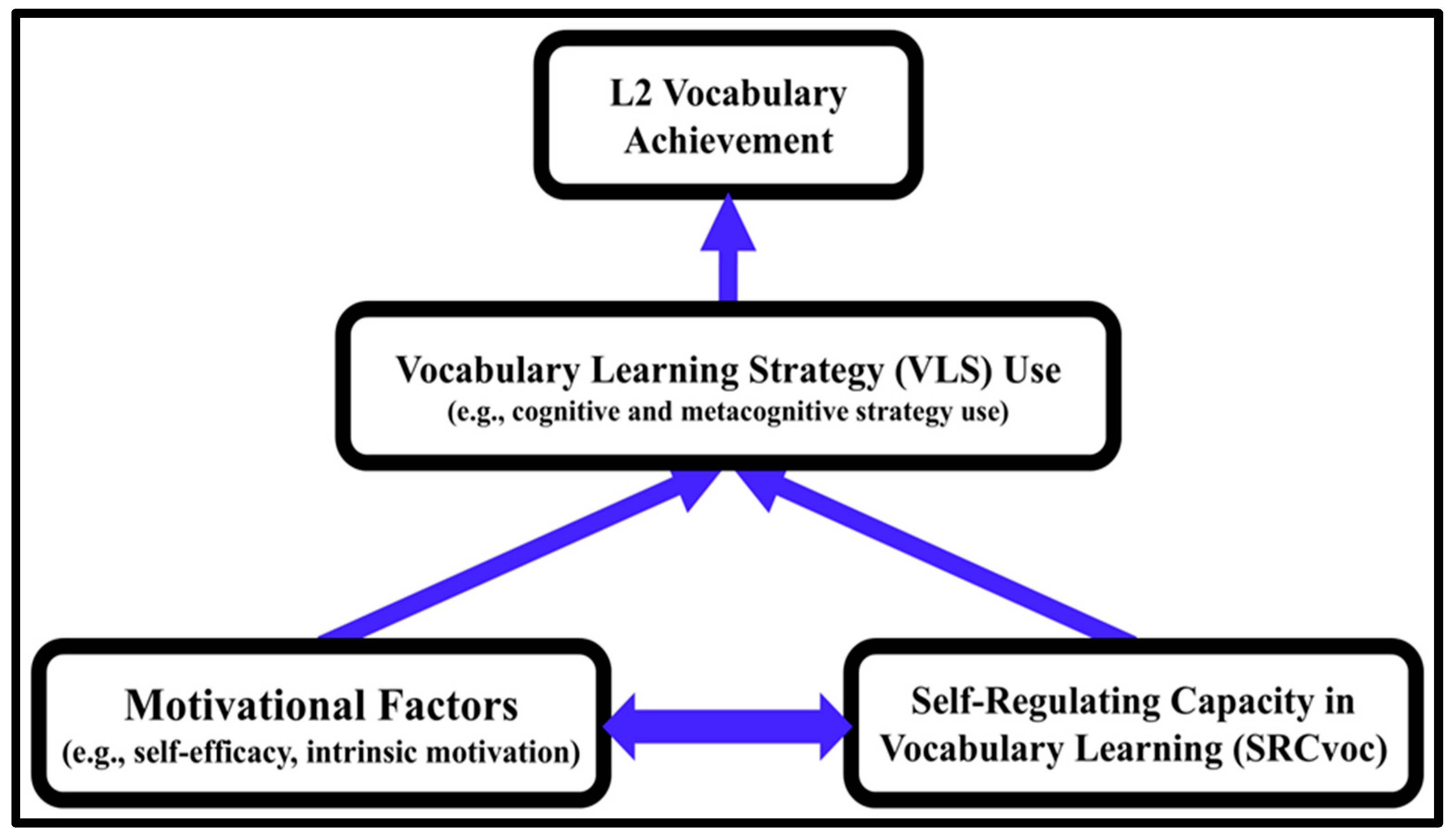
Figure 1 illustrates the internalized processes of self-regulated vocabulary learning, conceptualized through the relationships among SRCvoc, motivational factors (e.g., self-efficacy and intrinsic motivation), and VLS use (e.g., cognitive and metacognitive strategy use), which collectively contribute to L2 vocabulary achievement based on previous studies (e.g., Choi et al., 2018; Lee et al., 2022; Li & Wang, 2024; Mizumoto, 2012, 2013a, 2013b; M. F. Teng et al., 2024; Tseng & Schmitt, 2008; Ueno & Takeuchi, 2022; Y. Zhang et al., 2017; Ziegler, 2015). Building on empirical findings from this line of research, our framework assumes that motivational (or motivational belief) factors, such as self-efficacy, intrinsic motivation, and growth mindset, influence SRCvoc (e.g., M. F. Teng et al., 2024; Tseng & Schmitt, 2008), while reciprocal influences may also exist (e.g., Li & Wang, 2024; Ueno & Takeuchi, 2022). We further conceptualize that motivational factors influence VLS use (e.g., Lee et al., 2022; Mizumoto, 2012; Y. Zhang et al., 2017) and that SRCvoc also affects VLS use (e.g., Tseng & Schmitt, 2008; Ueno & Takeuchi, 2022). In turn, VLS use contributes to L2 vocabulary achievement (e.g., Lee et al., 2022; Tseng & Schmitt, 2008; Ueno & Takeuchi, 2022; Y. Zhang et al., 2017). Thus, in our framework of internalized self-regulated vocabulary learning, motivational factors and SRCvoc serve as central factors that drive VLS use, which subsequently contributes to L2 vocabulary achievement.

3.2. Conceptualizing a Social Perspective on Strategic Self-Regulated Vocabulary Learning

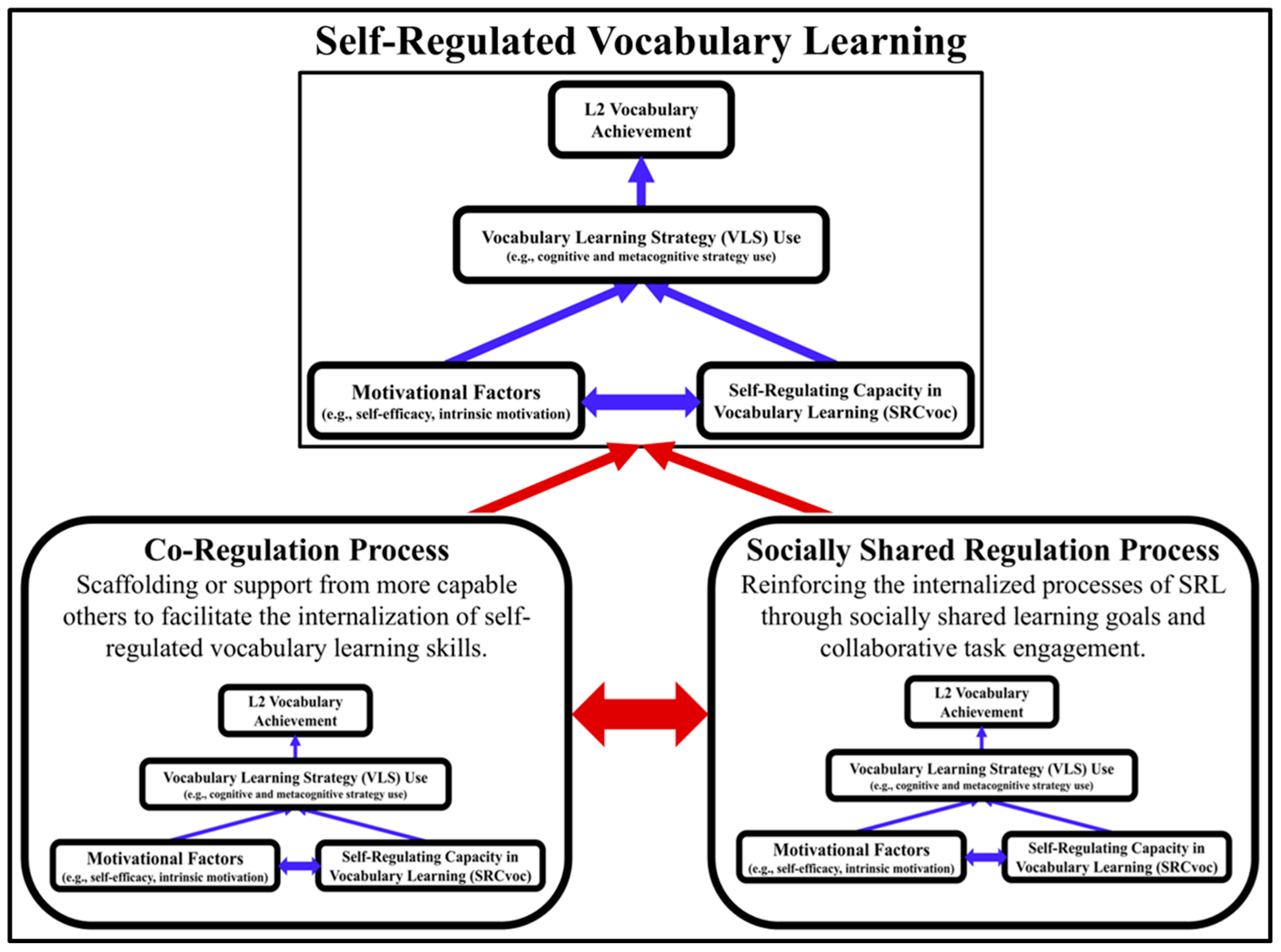
The second framework (see Figure 2) differs from the internalized framework of self-regulated vocabulary learning (see Figure 1) in that it conceptualizes the social aspects of SRL, namely co-regulatory and socially shared regulatory processes, which are assumed to reinforce internalization of self-regulatory processes in vocabulary learning. The roles of the social aspects of SRL, particularly co-regulation, are grounded in sociocultural theory, which posits that learning (or development of internalized self-regulated vocabulary learning in this context) occurs through interaction with more capable others (Hadwin & Oshige, 2011). Within this framework, the concept of the ZPD might emphasize the relationship between learners’ current abilities and their potential development through socially mediated interaction and scaffolding given by others (e.g., peers and instructors) (e.g., De Guerrero & Villamil, 2000; Puntambekar, 2022). Vygotsky (1978) defines ZPD as “the distance between the actual developmental level as determined by independent problem solving and the level of potential development as determined through problem-solving under adult guidance or in collaboration with more capable peers” (p. 86). Scaffolding is, thus, the idea that refers to “given appropriate assistance, a learner can attain a goal or engage in a practice otherwise out of reach” (Davis & Miyake, 2004, p. 266). The relationship between the ZPD and support from more capable others (i.e., scaffolding) is of particular importance in understanding how learners develop and internalize processes of self-regulated vocabulary learning through support from more capable others (Hadwin & Oshige, 2011).
In addition, although SSR is considered one of the social conditions for SRL that may foster the internalization of self-regulated vocabulary learning processes, following Hadwin and Oshige (2011), we posit that SSR, unlike co-regulation, is mainly focused on co-constructed processes in which learners in a group jointly construct, share, and regulate collective goals and activities to achieve desired outcomes through socially shared cognition. Through participation in vocabulary learning tasks or activities, learners in a group may become more aware of regulatory processes, which may in turn facilitate the internalization of self-regulated vocabulary learning. However, in SSR processes, we also assume that, similar to co-regulation, learners may have opportunities to receive scaffolding from more capable others, particularly when learners with different self-regulatory levels are grouped in the same vocabulary task or activity. In this regard, although we conceptualize co-regulation and SSR differently, these processes may also interact with each other (see Figure 2).
Co-regulation and SSR may be more beneficial for some L2 learners, particularly beginners, who may lack the skills necessary for self-regulated vocabulary learning, such as SRCvoc, sufficient self-efficacy, and intrinsic motivation, and the ability to use VLSs that best fit their learning needs. From a co-regulatory perspective, learners at this stage, situated within the ZPD for self-regulated vocabulary learning, require scaffolding from more capable others to develop and promote these self-regulatory skills. Such scaffolding can take multiple forms, including co-regulation, through which instructors or more capable peers provide regulatory support (e.g., Hadwin et al., 2005; Su et al., 2026; Turner, 2010), for example, how to set vocabulary learning goals, plan learning activities, select and use effective VLSs, and regulate and sustain motivation. Similarly, in socially shared regulation (e.g., Hadwin & Oshige, 2011; Panadero & Järvelä, 2015), regulatory processes are jointly negotiated and collectively managed through shared goals and tasks among learners. These interactive and constructive processes enable learners to gradually internalize self-regulated vocabulary learning processes through repeated exposure to scaffolding and typically occur through co-regulatory and socially shared regulatory activities. Taken together, these socially mediated processes may provide important pathways through which learners gradually develop and internalize self-regulated vocabulary learning skills.

4. Conclusions

In this article, we proposed a conceptual framework for understanding the social aspects of self-regulated vocabulary learning and discussed how the social aspects of SRL, including co-regulation and SSR, promote learners’ internalized processes of vocabulary learning. An important implication of this study for future research is that the proposed framework may provide a useful foundation for investigating how learners develop SRL through co-regulation and SSR. In particular, the framework may offer a basis for designing studies that examine the mechanisms through which these social forms of regulation contribute to the internalization of learners’ SRL processes. However, as noted earlier, the framework is still under development. Therefore, future studies are needed to provide empirical evidence regarding its applicability and to refine the framework accordingly. From a pedagogical perspective, although future research is needed to test and verify the empirical validity of the framework, our proposed framework has the potential to serve as a foundation for developing instructional approaches to foster internalized self-regulated vocabulary learning through the mediation of co-regulation and SSR.
Before closing, we suggest several potential directions for future research using this framework. First, based on our proposed framework, future research could examine the effects of social aspects of SRL (e.g., variables relevant to co-regulation and SSR, such as co-regulatory or socially shared regulatory strategies and support from more capable others) on the internalized processes of self-regulated vocabulary learning, including SRCvoc, motivational factors (i.e., self-efficacy and intrinsic motivation), VLS use, and vocabulary achievement. Employing multivariate analyses, such as structural equation modeling, would help investigate how these relationships among social and self-regulatory variables are reflected in empirical learner data, thereby strengthening the theoretical validity of the proposed framework. Second, longitudinal studies would be beneficial for investigating how individual self-regulated vocabulary learning skills and factors (i.e., SRCvoc, motivational factors, and strategic VLS use) are internalized over time through co-regulation and SSR approaches. Such studies would allow researchers to capture in detail how learners’ self-regulated vocabulary learning skills or related factors develop through sustained social interaction across various contexts. Finally, qualitative research could provide further insights into the dynamic and situated nature of self-regulated vocabulary learning. The use of multiple interviews, observations, and reflective journals in co-regulation and SSR contexts would enable researchers to explore and better understand the detailed processes of internalized and socially mediated vocabulary regulation, especially through longitudinal intervention studies.

Author Contributions

Conceptualization, S.U., O.T. and M.I.; methodology, S.U., O.T. and M.I.; investigation, S.U., O.T. and M.I.; writing—original draft preparation, S.U., O.T. and M.I.; writing—review and editing, S.U., O.T. and M.I.; visualization, S.U.; supervision, O.T. and M.I.; project administration, S.U. and O.T.; funding acquisition, S.U., O.T. and M.I. All authors have read and agreed to the published version of the manuscript.

Funding

This research was funded by the Japan Society for the Promotion of Science, grant numbers 25K04295 and 23K00711.

Institutional Review Board Statement

Not applicable.

Informed Consent Statement

Not applicable.

Data Availability Statement

No new data were created or analyzed in this study.

Acknowledgments

During the preparation of this work, the authors used ChatGPT (GPT 5.5 Instant and earlier versions) to improve the accuracy and clarity of the English. After using the tool, the authors reviewed and edited the content as needed and take full responsibility for the content of the publication.

Conflicts of Interest

The authors declare no conflicts of interest.

Abbreviations

The following abbreviations are used in this manuscript:
AIArtificial intelligence
L2Second or foreign language
IDsIndividual differences
VLSVocabulary learning strategy
SRLSelf-regulated learning
SSRSocially shared regulation
SRCvocSelf-Regulating Capacity in Vocabulary Learning Scale
ZPDZone of proximal development

References

  1. Alamer, A., Teng, M. F., & Mizumoto, A. (2025). Revisiting the construct validity of self-regulating capacity in vocabulary learning scale: The confirmatory composite analysis (CCA) approach. Applied Linguistics, 46(2), 230–247. [Google Scholar] [CrossRef]
  2. Bai, B., & Guo, W. (2021). Motivation and self-regulated strategy use: Relationships to primary school students’ English writing in Hong Kong. Language Teaching Research, 25(3), 378–399. [Google Scholar] [CrossRef]
  3. Bai, B., Zhang, J., & Wang, J. (2025). Influences of social expectations and perceived adults’ growth mindsets on school students’ self-regulated learning and English learning achievement. Psychology in the Schools, 62(6), 1678–1690. [Google Scholar] [CrossRef]
  4. Banihashem, S. K., Bond, M., Bergdahl, N., Khosravi, H., & Noroozi, O. (2025). A systematic mapping review at the intersection of artificial intelligence and self-regulated learning. International Journal of Educational Technology in Higher Education, 22, 50. [Google Scholar] [CrossRef]
  5. Bronfenbrenner, U. (1994). Ecological models of human development. In T. Husen, & T. N. Postlethwaite (Eds.), The international encyclopedia of education (2nd ed., pp. 1643–1647). Pergamon. [Google Scholar]
  6. Chen, J., Lin, C.-H., Chen, G., & Fu, H. (2023). Individual differences in self-regulated learning profiles of Chinese EFL readers: A sequential explanatory mixed-methods study. Studies in Second Language Acquisition, 45(4), 955–978. [Google Scholar] [CrossRef]
  7. Choi, Y., Zhang, D., Lin, C. H., & Zhang, Y. (2018). Self-regulated learning of vocabulary in English as a foreign language. Asian EFL Journal, 20(1), 54–82. [Google Scholar]
  8. Corno, L., & Kanfer, R. (1993). The role of volition in learning and performance. Review of Research in Education, 19(1), 301–341. [Google Scholar] [CrossRef]
  9. Dang, B., Nguyen, A., & Järvelä, S. (2024). Deliberative interactions for socially shared regulation in collaborative learning: An AI-driven learning analytics study. Journal of Learning Analytics, 11(3), 192–209. [Google Scholar] [CrossRef]
  10. Davis, E. A., & Miyake, N. (2004). Explorations of scaffolding in complex classroom systems. Journal of the Learning Sciences, 13(3), 265–272. [Google Scholar] [CrossRef]
  11. De Guerrero, M. C. M., & Villamil, O. S. (2000). Activating the ZPD: Mutual scaffolding in L2 peer revision. The Modern Language Journal, 84, 51–68. [Google Scholar] [CrossRef]
  12. de Jong, N. H., Steinel, M. P., Florijn, A. F., Schoonen, R., & Hulstijn, J. H. (2012). Facets of speaking proficiency. Studies in Second Language Acquisition, 34(1), 5–34. [Google Scholar] [CrossRef]
  13. DiBenedetto, M. K., & Zimmerman, B. J. (2013). Construct and predictive validity of microanalytic measures of students’ self-regulation of science learning. Learning and Individual Differences, 26, 30–41. [Google Scholar] [CrossRef]
  14. Dörnyei, Z. (2001). Motivational strategies in the language classroom. Cambridge University Press. [Google Scholar] [CrossRef]
  15. Dörnyei, Z. (2005). The psychology of the language learner: Individual differences in second language acquisition. Routledge. [Google Scholar] [CrossRef]
  16. Gu, P. Y., & Johnson, R. K. (1996). Vocabulary learning strategies and language learning outcomes. Language Learning, 46, 643–679. [Google Scholar] [CrossRef]
  17. Guo, W., Bai, B., Zang, F., Wang, T., & Song, H. (2023). Influences of motivation and grit on students’ self-regulated learning and English learning achievement: A comparison between male and female students. System, 114, 103018. [Google Scholar] [CrossRef]
  18. Hadwin, A. F., Järvelä, S., & Miller, M. (2018). Self-regulation, co-regulation, and shared regulation in collaborative learning environments. In D. H. Schunk, & J. A. Greene (Eds.), Handbook of self-regulation of learning and performance (2nd ed., pp. 83–106). Routledge. [Google Scholar] [CrossRef]
  19. Hadwin, A. F., & Oshige, M. (2011). Self-regulation, coregulation, and socially shared regulation: Exploring perspectives of social in self-regulated learning theory. Teachers College Record: The Voice of Scholarship in Education, 113(2), 240–264. [Google Scholar] [CrossRef]
  20. Hadwin, A. F., Wozney, L., & Pontin, O. (2005). Scaffolding the appropriation of self-regulatory activity: A socio-cultural analysis of changes in teacher–student discourse about a graduate research portfolio. Instructional Science, 33, 413–450. [Google Scholar] [CrossRef]
  21. Hao, X., & Chen, H. (2024). The effect of co-regulation on English public speaking self-efficacy in collaborative oral presentations. Frontiers in Psychology, 15, 1423607. [Google Scholar] [CrossRef]
  22. Isohätälä, J., Järvenoja, H., & Järvelä, S. (2017). Socially shared regulation of learning and participation in social interaction in collaborative learning. International Journal of Educational Research, 81, 11–24. [Google Scholar] [CrossRef]
  23. Jackson, T., Mackenzie, J., & Hobfoll, S. E. (2000). Communal aspects of self-regulation. In M. Boekaerts, P. R. Pintrich, & M. Zeidner (Eds.), Handbook of self-regulation (pp. 275–300). Academic Press. [Google Scholar] [CrossRef]
  24. Järvelä, S., Nguyen, A., & Hadwin, A. (2023). Human and artificial intelligence collaboration for socially shared regulation in learning. British Journal of Educational Technology, 54(5), 1057–1076. [Google Scholar] [CrossRef]
  25. Kuhl, J. (1987). Action control: The maintenance of motivational states. In F. Halisch, & J. Kuhl (Eds.), Motivation, intention, and volition (pp. 279–291). Springer. [Google Scholar] [CrossRef]
  26. Laufer, B., & Aviad-Levitzky, T. (2017). What type of vocabulary knowledge predicts reading comprehension: Word meaning recall or word meaning recognition? The Moden Language Journal, 101(4), 729–741. [Google Scholar] [CrossRef]
  27. Lee, J. H., Ahn, J. J., & Lee, H. (2022). The role of motivation and vocabulary learning strategies in L2 vocabulary knowledge: A structural equation modeling analysis. Studies in Second Language Learning and Teaching, 12(3), 435–458. [Google Scholar] [CrossRef]
  28. Li, J., & Wang, C. (2024). Mediating roles of motivational beliefs and vocabulary learning strategies for the relationship between self-regulation and vocabulary proficiency. European Journal of Education, 59(4), e12706. [Google Scholar] [CrossRef]
  29. Liu, Y., Liu, Z., Wu, H., Yao, J., & Manalo, E. (2026). Exploring the occurrence processes and behavioural patterns of socially shared regulation during online collaborative L2 Learning. Learning and Motivation, 93, 102222. [Google Scholar] [CrossRef]
  30. McCaslin, M. (2009). Co-regulation of student motivation and emergent identity. Educational Psychologist, 44(2), 137–146. [Google Scholar] [CrossRef]
  31. Milton, J., Wade, J., & Hopkins, N. (2010). Aural word recognition and oral competence in English as a foreign language. In R. Chacón-Beltrán, C. Abello-Contesse, & M. M. Torreblanca-López (Eds.), Insights into non-native vocabulary teaching and learning (pp. 83–98). Multilingual Matters. [Google Scholar] [CrossRef]
  32. Miralpeix, I., & Muñoz, C. (2018). Receptive vocabulary size and its relationship to EFL language skills. International Review of Applied Linguistics in Language Teaching, 56(1), 1–24. [Google Scholar] [CrossRef]
  33. Mizumoto, A. (2012). Exploring the effects of self-efficacy on vocabulary learning strategies. Studies in Self-Access Learning Journal, 3(4), 423–437. [Google Scholar] [CrossRef]
  34. Mizumoto, A. (2013a). Effects of self-regulated vocabulary learning process on self-efficacy. Innovation in Language Learning and Teaching, 7(3), 253–265. [Google Scholar] [CrossRef]
  35. Mizumoto, A. (2013b). Enhancing self-efficacy in vocabulary learning: A self-regulated learning approach. Vocabulary Learning and Instruction, 2(1), 15–24. [Google Scholar] [CrossRef]
  36. Mizumoto, A., & Takeuchi, O. (2009). Examining the effectiveness of explicit instruction of vocabulary learning strategies with Japanese EFL university students. Language Teaching Research, 13(4), 425–449. [Google Scholar] [CrossRef]
  37. Mizumoto, A., & Takeuchi, O. (2012). Adaptation and validation of self-regulating capacity in vocabulary learning scale. Applied Linguistics, 33(1), 83–91. [Google Scholar] [CrossRef]
  38. Molenaar, I. (2022). The concept of hybrid human-AI regulation: Exemplifying how to support young learners’ self-regulated learning. Computers and Education: Artificial Intelligence, 3, 100070. [Google Scholar] [CrossRef]
  39. Nation, I. S. P. (2006). How large a vocabulary is needed for reading and listening? The Canadian Modern Language Review, 63(1), 59–82. [Google Scholar] [CrossRef]
  40. Nation, I. S. P. (2013). Learning vocabulary in another language (2nd ed.). Cambridge University Press. [Google Scholar] [CrossRef]
  41. Oxford, R. L. (2011). Teaching and researching: Language learning strategies. Routledge. [Google Scholar] [CrossRef]
  42. Oxford, R. L. (2017). Teaching and researching language learning strategies: Self-regulation in context (2nd ed.). Routledge. [Google Scholar] [CrossRef]
  43. Panadero, E. (2017). A review of self-regulated learning: Six models and four directions for research. Frontiers in Psychology, 8, 422. [Google Scholar] [CrossRef]
  44. Panadero, E., & Järvelä, S. (2015). Socially shared regulation of learning: A review. European Psychologist, 20(3), 190–203. [Google Scholar] [CrossRef]
  45. Pintrich, P. R., & De Groot, E. V. (1990). Motivational and self-regulated learning components of classroom academic performance. Journal of Educational Psychology, 82(1), 33–40. [Google Scholar] [CrossRef]
  46. Puntambekar, S. (2022). Distributed scaffolding: Scaffolding students in classroom environments. Educational Psychology Review, 34, 451–472. [Google Scholar] [CrossRef]
  47. Qian, D. D. (2002). Investigating the relationship between vocabulary knowledge and academic reading performance: An assessment perspective. Language Learning, 52(3), 513–536. [Google Scholar] [CrossRef]
  48. Rose, H., Briggs, J. G., Boggs, J. A., Sergio, L., & Ivanova-Slavianskaia, N. (2018). A systematic review of language learner strategy research in the face of self-regulation. System, 72, 151–163. [Google Scholar] [CrossRef]
  49. Schmitt, N. (2008). Review article: Instructed second language vocabulary learning. Language Teaching Research, 12(3), 329–363. [Google Scholar] [CrossRef]
  50. Schunk, D. H., & Zimmerman, B. J. (1997). Social origins of self-regulatory competence. Educational Psychologist, 32(4), 195–208. [Google Scholar] [CrossRef]
  51. Stæhr, L. S. (2008). Vocabulary size and the skills of listening, reading and writing. The Language Learning Journal, 36(2), 139–152. [Google Scholar] [CrossRef]
  52. Stæhr, L. S. (2009). Vocabulary knowledge and advanced listening comprehension in English as a foreign language. Studies in Second Language Acquisition, 31(4), 577–607. [Google Scholar] [CrossRef]
  53. Su, Y., Yuan, Z., & Liang, J.-C. (2026). Developing and validating a scale for assessing EFL learners’ co-regulation strategies for collaborative writing: A multi-layered perspective. Journal of Second Language Writing, 71, 101280. [Google Scholar] [CrossRef]
  54. Teng, L. S., & Zhang, L. J. (2016). A questionnaire-based validation of multidimensional models of self-regulated learning strategies. The Modern Language Journal, 100(3), 674–701. [Google Scholar] [CrossRef]
  55. Teng, M. F., Mizumoto, A., & Takeuchi, O. (2024). Understanding growth mindset, self-regulated vocabulary learning, and vocabulary knowledge. System, 122, 103255. [Google Scholar] [CrossRef]
  56. Tinajero, C., Mayo, M. E., Villar, E., & Martínez-López, Z. (2024). Classic and modern models of self-regulated learning: Integrative and componential analysis. Frontiers in Psychology, 15, 1307574. [Google Scholar] [CrossRef]
  57. Tseng, W. T., Dörnyei, Z., & Schmitt, N. (2006). A new approach to assessing strategic learning: The case of self-regulation in vocabulary acquisition. Applied Linguistics, 27(1), 78–102. [Google Scholar] [CrossRef]
  58. Tseng, W. T., & Schmitt, N. (2008). Toward a model of motivated vocabulary learning: A structural equation modeling approach. Language Learning, 58(2), 357–400. [Google Scholar] [CrossRef]
  59. Turner, M. (2010). Using student co-regulation to address L2 students’ language and pedagogical needs in university support classes. Language and Education, 24(3), 251–266. [Google Scholar] [CrossRef]
  60. Uchihara, T., Webb, S., & Yanagisawa, A. (2019). The effects of repetition on incidental vocabulary learning: A meta-analysis of correlational studies. Language Learning, 69(3), 559–599. [Google Scholar] [CrossRef]
  61. Ueno, S., & Takeuchi, O. (2022). Self-regulated vocabulary learning in a Japanese high school EFL environment: A structural equation modeling approach. JACET Journal, 66, 97–111. [Google Scholar] [CrossRef]
  62. Ueno, S., Takeuchi, O., & Shinhara, Y. (2025). Exploring the studies of self-regulated learning in second/foreign language learning: A systematic review. International Journal of TESOL Studies, 7(1), 126–147. [Google Scholar] [CrossRef]
  63. Vygotsky, L. S. (1978). Mind in society: The development of higher psychological processes. Harvard University Press. [Google Scholar]
  64. Wang, Y., & Treffers-Daller, J. (2017). Explaining listening comprehension among L2 learners of English: The contribution of general language proficiency, vocabulary knowledge and metacognitive awareness. System, 65, 139–150. [Google Scholar] [CrossRef]
  65. Webb, S. (2005). Receptive and productive vocabulary learning: The effects of reading and writing on word knowledge. Studies in Second Language Acquisition, 27(1), 33–52. [Google Scholar] [CrossRef]
  66. Webb, S. (2007). The effects of repetition on vocabulary knowledge. Applied Linguistics, 28(1), 46–65. [Google Scholar] [CrossRef]
  67. Webb, S. (Ed.). (2020). The Routledge handbook of vocabulary studies. Routledge. [Google Scholar] [CrossRef]
  68. Wertsch, J. V., & Stone, C. A. (1985). The concept of internalization in Vygotsky’s account of the genesis of higher mental functions. In J. Wertsch (Ed.), Culture, communication, and cognition: Vygotskian perspectives (pp. 162–182). Cambridge University Press. [Google Scholar]
  69. Xu, J., Li, J., & Yang, J. (2024). Self-regulated learning strategies, self-efficacy, and learning engagement of EFL students in smart classrooms: A structural equation modeling analysis. System, 125, 103451. [Google Scholar] [CrossRef]
  70. Yanagisawa, A., Webb, S., & Uchihara, T. (2020). How do different forms of glossing contribute to L2 vocabulary learning from reading? A meta-regression analysis. Studies in Second Language Acquisition, 42(2), 411–438. [Google Scholar] [CrossRef]
  71. Yowell, C. M., & Smylie, M. A. (1999). Self-regulation in democratic communities. Elementary School Journal, 99, 469–490. [Google Scholar] [CrossRef] [PubMed]
  72. Zhang, D., & Zhang, L. J. (2019). Metacognition and self-regulated learning (SRL) in second/foreign language teaching. In X. Gao (Ed.), Second handbook of English language teaching (pp. 883–897). Springer. [Google Scholar] [CrossRef]
  73. Zhang, Y., Lin, C. H., Zhang, D., & Choi, Y. (2017). Motivation, strategy, and English as a foreign language vocabulary learning: A structural equation modelling study. British Journal of Educational Psychology, 87(1), 57–74. [Google Scholar] [CrossRef] [PubMed]
  74. Ziegler, N. (2015). The predictive value of the self-regulating capacity in vocabulary learning scale. Applied Linguistics, 36(5), 641–647. [Google Scholar] [CrossRef]
  75. Zimmerman, B. J. (1986). Becoming a self-regulated learner: Which are the key subprocesses? Contemporary Educational Psychology, 11(4), 307–313. [Google Scholar] [CrossRef]
  76. Zimmerman, B. J. (1989). A social cognitive view of self-regulated academic learning. Journal of Educational Psychology, 81(3), 329–339. [Google Scholar] [CrossRef]
  77. Zimmerman, B. J., & Moylan, A. R. (2009). Self-regulation: Where metacognition and motivation intersect. In D. J. Hacker, J. Dunlosky, & A. C. Graesser (Eds.), Handbook of metacognition in education (pp. 299–315). Routledge. [Google Scholar]
Figure 1. A conceptual framework for self-regulated vocabulary learning based on previous research.
Education 16 00935 g001
Figure 2. A conceptual framework for self-regulated, co-regulated, and socially shared vocabulary learning.
Education 16 00935 g002
Disclaimer/Publisher’s Note: The statements, opinions and data contained in all publications are solely those of the individual author(s) and contributor(s) and not of MDPI and/or the editor(s). MDPI and/or the editor(s) disclaim responsibility for any injury to people or property resulting from any ideas, methods, instructions or products referred to in the content.