Learning to Teach Sustainability: Insights from a Transdisciplinary, Local and Authentic Project
 , , , , ,
Abstract
1. Introduction
1.1. Overall Aim and Research Question
1.2. Sustainability Education
1.2.1. Sustainability Education in the Norwegian Curriculum
1.2.2. Sustainability Education in Initial Teacher Education
1.2.3. Authenticity as a Pedagogical Condition for Sustainability Education
1.3. Inter- and Transdisciplinary Teaching
The Potential of Inter- and Transdisciplinary Approaches in Sustainability Education
1.4. Teachers’ Preparedness and Barriers for Sustainability-Oriented Inter- and Transdisciplinary Teaching
1.5. Teacher Professional Development in Sustainability-Oriented Teacher Education
1.5.1. Teacher Self-Efficacy as a Foundation for Professional Development
1.5.2. Emotional and Motivational Dimensions of Sustainability Learning
2. Materials and Methods
2.1. Design and Implementation of the Intervention
2.2. Study Participants and Study Context
2.3. Data Collection
2.4. Data Analysis
3. Results
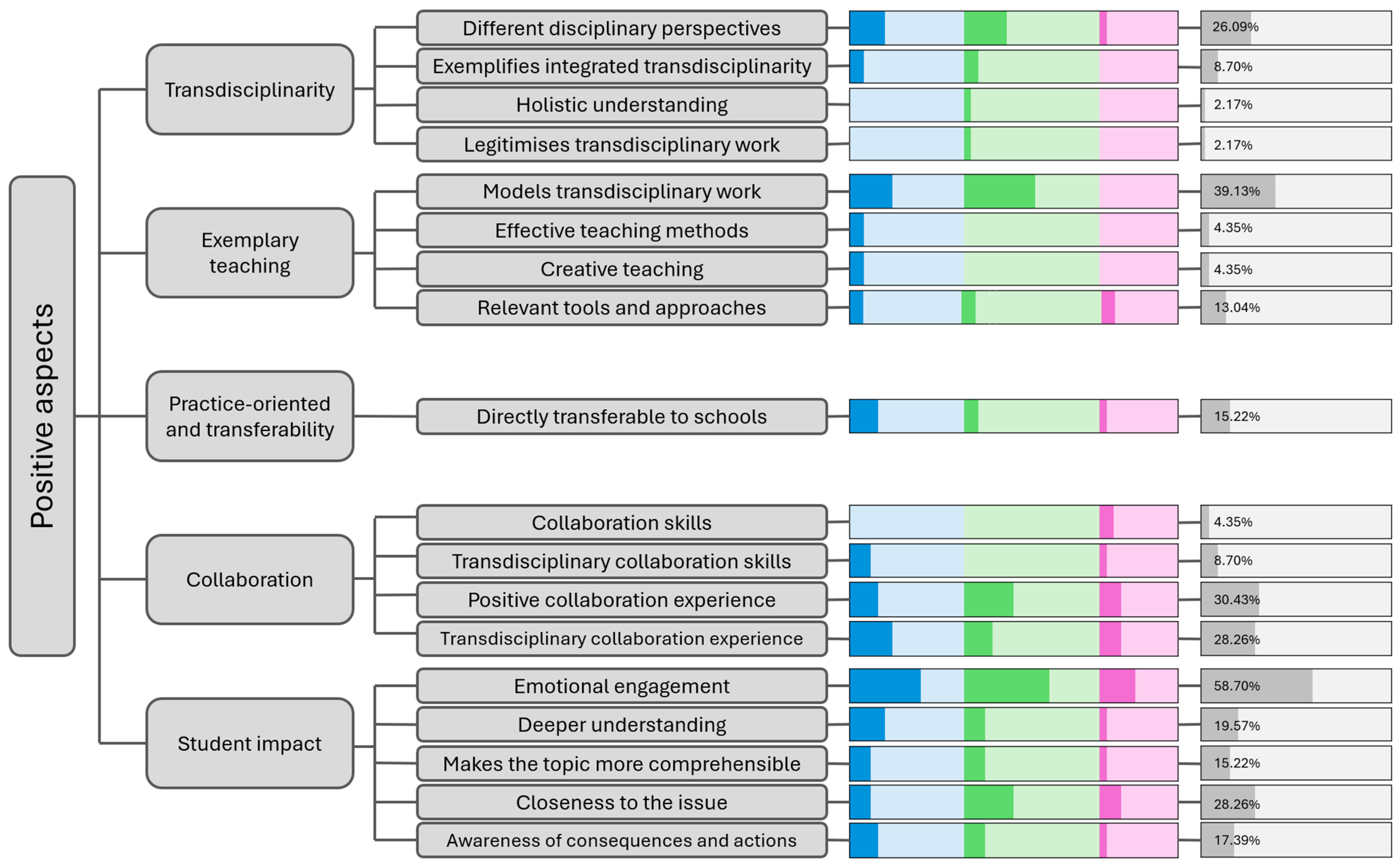
3.1. Positive Aspects
3.1.1. Transdisciplinarity
3.1.2. Exemplary Teaching
3.1.3. Practice-Oriented and Transferability
3.1.4. Collaboration
3.1.5. Student Impact
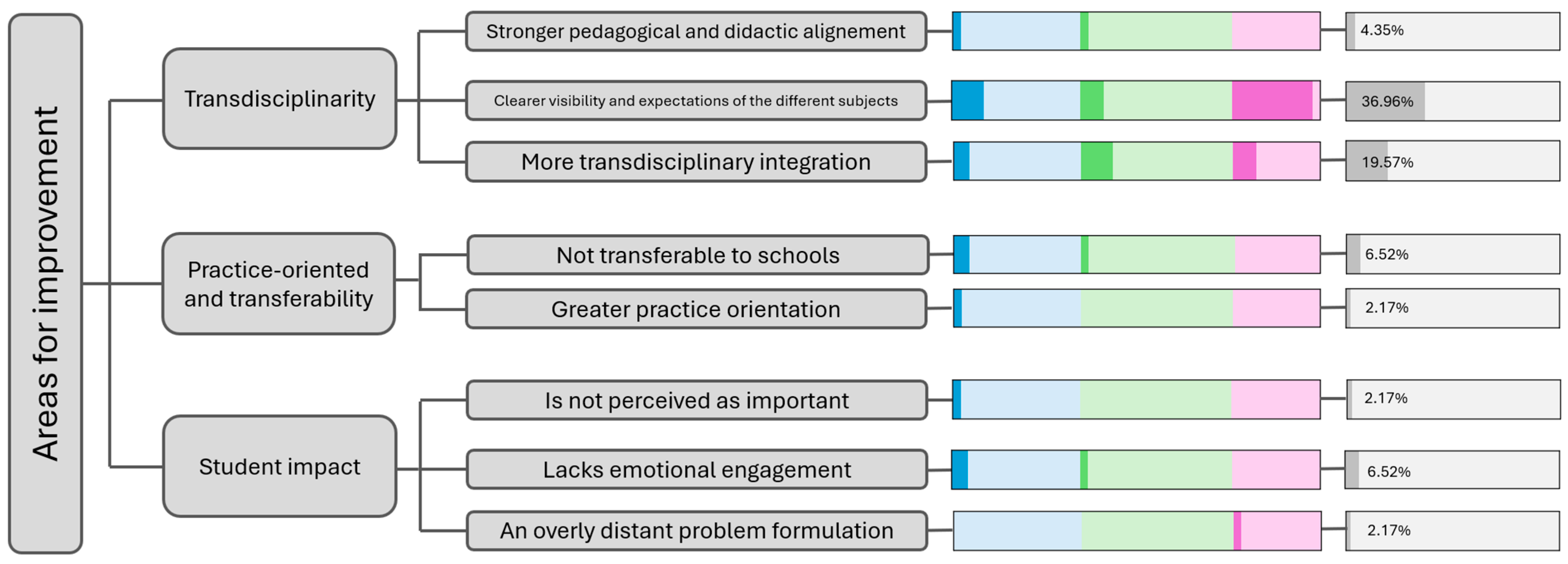
3.2. Areas for Improvement
3.2.1. Transdisciplinarity
3.2.2. Practice-Oriented and Transferability
3.2.3. Student Impact
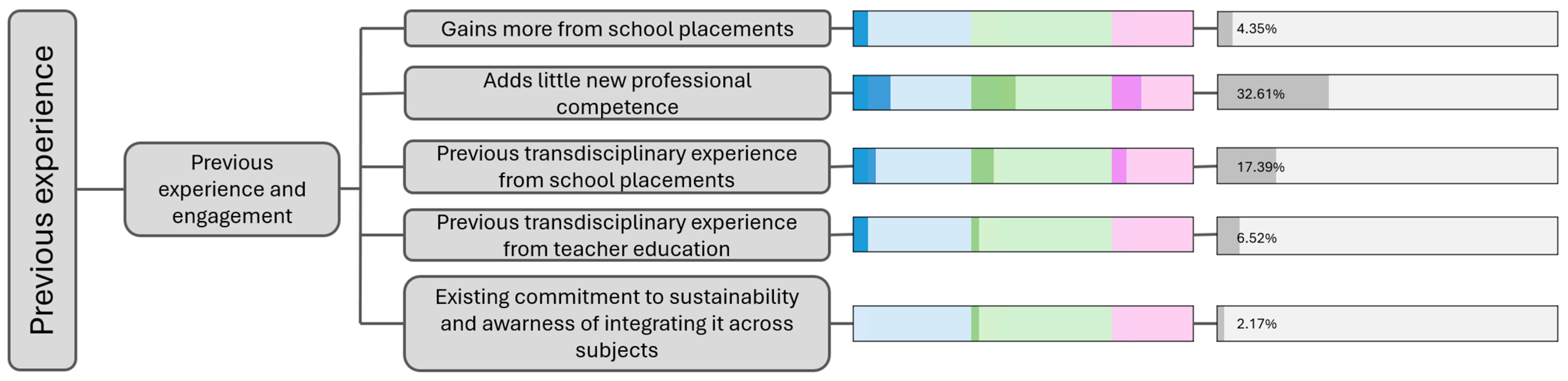
3.3. Previous Experience
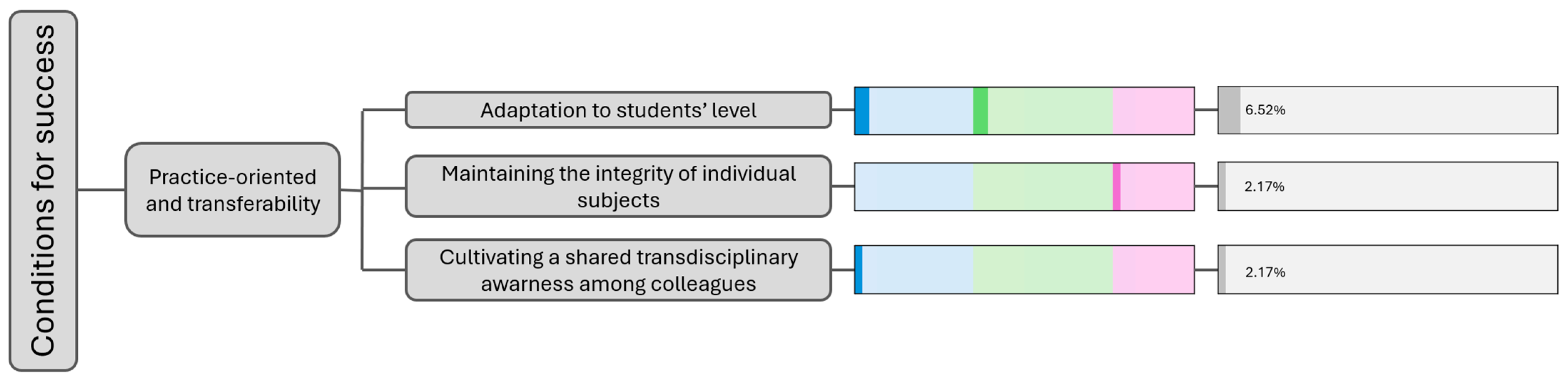
3.4. Conditions for Success
4. Discussion
4.1. Transdisciplinary and Authentic Projects as Catalysts for the Development of Teacher Preparedness
4.2. Disciplinary Identity as a Condition for Transdisciplinary Preparedness
4.3. Emotional Engagement Drives Sustainable Teaching
4.4. Limitations of the Study
5. Conclusions and Implications
Author Contributions
Funding
Institutional Review Board Statement
Informed Consent Statement
Data Availability Statement
Acknowledgments
Conflicts of Interest
Abbreviations
| SE | Sustainability education |
| ITE | Initial teacher education |
| ESD | Education for sustainable development |
| SDG | Sustainable Development Goals |
References
- Arntzen, M., Scheie, E., & Haug, B. (2025). Interdisciplinary ESE: Barriers to implementation and practical ways to overcome them. Environmental Education Research, 1–23. [Google Scholar] [CrossRef]
- Bandura, A. (1977). Self-efficacy: Toward a unifying theory of behavioral change. Psychological Review, 84(2), 191. [Google Scholar] [CrossRef]
- Berg, M. K. S., Storen, I. C., & Straume, I. S. (2026). Frontrunners in sustainability? A scoping review of research on sustainability education in Nordic teacher education. Acta Didactica Norden, 20(1), 12595. [Google Scholar] [CrossRef]
- Bolstad, B. (2020). Dybdelæring og tverrfaglighet. Fagbokforlaget. [Google Scholar]
- Borg, C., Gericke, N., Höglund, H.-O., & Bergman, E. (2012). The Barriers encountered by teachers implementing education for sustainable development: Discipline bound differences and teaching traditions. Research in Science & Technological Education, 30(2), 185–207. [Google Scholar] [CrossRef]
- Braun, V., & Clarke, V. (2022). Thematic analysis: A practical guide. Sage. [Google Scholar]
- Cebrián, G., & Junyent, M. (2015). Competencies in education for sustainable development: Exploring the student teachers’ views. Sustainability, 7(3), 2768–2786. [Google Scholar] [CrossRef]
- Corney, G., & Reid, A. (2007). Student teachers’ learning about subject matter and pedagogy in education for sustainable development. Environmental Education Research, 13(1), 33–54. [Google Scholar] [CrossRef]
- Cruz Lorite, I. M., Nikolaou, M., Nisiforou, E., & Evagorou, M. (2025). Open schooling in science education: A systematic literature review. European Journal of Educational Research, 14(4), 1063–1085. [Google Scholar] [CrossRef]
- Czerniak, C. M., & Johnson, C. C. (2014). Interdisciplinary science teaching. In N. G. Lederman, & S. K. Abell (Eds.), Handbook of research on science education (Vol. 2, pp. 395–411). Routledge. [Google Scholar]
- Dahl, T. (2019). Prepared to teach for sustainable development? Student teachers’ beliefs in their ability to teach for sustainable development. Sustainability, 11(7), 1993. [Google Scholar] [CrossRef]
- del Carmen Pegalajar-Palomino, M., Burgos-García, A., & Martinez-Valdivia, E. (2021). What does education for sustainable development offer in initial teacher training? A systematic review. Journal of Teacher Education for Sustainability, 23(1), 99–114. [Google Scholar] [CrossRef]
- Dewey, J. (1997). Experience and education. Kappa Delta Pi. (Original work published 1938). [Google Scholar]
- Dillon, J., & Herman, B. (2023). Environmental education. In N. G. Lederman, D. L. Zeidler, & J. S. Lederman (Eds.), Handbook of research on science education (Vol. 3, pp. 717–748). Routledge. [Google Scholar]
- Drake, S. M., & Reid, J. L. (2020). 21st century competencies in light of the history of integrated curriculum. Frontiers in Education, 5, 122. [Google Scholar] [CrossRef]
- Echegoyen-Sanz, Y., Morote, Á., & Martín-Ezpeleta, A. (2024). Transdisciplinary education for sustainability. Creativity and awareness in teacher training. Frontiers in Education, 8, 1327641. [Google Scholar] [CrossRef]
- European Commission. (2015). Science education for responsible citizenship: Report to the European Commission of the expert group on science education. P. Office. Available online: https://data.europa.eu/doi/10.2777/12626 (accessed on 19 January 2026).
- Evans, N., Inwood, H., Christie, B., & Ärlemalm-Hagsér, E. (2021). Comparing education for sustainable development in initial teacher education across four countries. International Journal of Sustainability in Higher Education, 22(6), 1351–1372. [Google Scholar] [CrossRef]
- Ferguson, T., Roofe, C., & Cook, L. D. (2021). Teachers’ perspectives on sustainable development: The implications for education for sustainable development. Environmental Education Research, 27(9), 1343–1359. [Google Scholar] [CrossRef]
- Furberg, A., Silseth, K., Rødnes, K. A., Arnseth, H. C., Kvamme, O. A., Rasmussen, I., Sæther, E., Vasbø, K. B., & Lund, A. (2025). Undervisning og læring om tverrfaglige temaer: Skolen som fellesskapsarena for elevers møte med samtidens store utfordringer (Rapport nr. 11, EVA2020). Det Utdanningsvitenskapelige Fakultet, Universitetet i Oslo.
- Gündoğan, A., & Gültekin, M. (2018). The reflection of the attitudes and learning processes to learning environments with authentic tasks in life science class. Pegem Egitim Ve Ogretim Dergisi, 8(4), 771–832. [Google Scholar] [CrossRef]
- Havnes, A. (2009). Talk, planning and decision-making in interdisciplinary teacher teams: A case study. Teachers and Teaching: Theory and Practice, 15(1), 155–176. [Google Scholar] [CrossRef]
- Horn, A., Scheffelaar, A., Urias, E., & Zweekhorst, M. B. (2023). Training students for complex sustainability issues: A literature review on the design of inter-and transdisciplinary higher education. International Journal of Sustainability in Higher Education, 24(1), 1–27. [Google Scholar] [CrossRef]
- Horn, I. S., & Little, J. W. (2010). Attending to practice: Teaching, learning, and professional development. Teachers College Record, 112(1), 1–41. [Google Scholar]
- Jegstad, K. M., & Ryen, E. (2020). Bærekraftig utvikling som tverrfaglig tema i grunnskolens naturfag og samfunnsfag–en læreplananalyse. Norsk Pedagogisk Tidsskrift, 104(3), 297–312. [Google Scholar] [CrossRef]
- Johnson, C. C., & Czerniak, C. M. (2023). Interdisciplinary approaches and integrated STEM in science teaching. In N. G. Lederman, D. L. Zeidler, & J. S. Lederman (Eds.), Handbook of research on science education (Vol. 3, pp. 559–585). Routledge. [Google Scholar]
- Kelsey, E. (2020). Hope matters: Why changing the way we think is critical to solving the environmental crisis. Greystone Books. [Google Scholar]
- Klafki, W. (2016). Dannelsesteori og didaktikk: Nye studier (3rd ed.). Klim. [Google Scholar]
- Klein, J. T. (2017). 3 typologies of interdisciplinarity: The boundary work of definition. In R. Frodeman (Ed.), The oxford handbook of interdisciplinarity (2nd ed., pp. 21–34). Oxford University Press. [Google Scholar]
- Kvamme, O. A. (2025). Skolens verdier og samfunnsmandat: Om verdiløftet og det tverrfaglige temaet bærekraftig utvikling (Rapport nr. 10). Det Utdanningsvitenskapelige Fakultet, Universitetet i Oslo. Available online: https://www.uv.uio.no/forskning/prosjekter/fagfornyelsen-evaluering/publikasjoner/eva_2020_rapport_10.pdf (accessed on 13 April 2026).
- Lenhart, C., & Bouwma-Gearhart, J. (2022). Engaging students around the complex socioscientific issue of sustainability: Affordances and tensions of faculty working across disciplines to develop transdisciplinary curricula. CBE—Life Sciences Education, 21(2), ar21. [Google Scholar] [CrossRef]
- Manasia, L., Ianos, M. G., & Chicioreanu, T. D. (2019). Pre-service teacher preparedness for fostering education for sustainable development: An empirical analysis of central dimensions of teaching readiness. Sustainability, 12(1), 166. [Google Scholar] [CrossRef]
- Margot, K. C., & Kettler, T. (2019). Teachers’ perception of STEM integration and education: A systematic literature review. International Journal of STEM education, 6(1), 2. [Google Scholar] [CrossRef]
- Meeth, L. R. (1978). Interdisciplinary studies: A matter of definition. Change: The Magazine of Higher Learning, 10(7), 10. [Google Scholar] [CrossRef]
- Mellingen, Ø. K., & Tollefsen, I. (2023). Bærekraftig utvikling i norsk skoleforskning. En litteraturgjennomgang. In T. S. Bredal-Tomren (Ed.), Utdanning for bærekraft. Erfaring og forskning fra barnehage og skole (pp. 51–72). Cappelen Damm Akademisk. [Google Scholar] [CrossRef]
- Ministry of Education and Research. (2017). Core curriculum—Values and principles for primary and secondary education. Available online: https://www.udir.no/lk20/overordnet-del/?lang=eng (accessed on 9 April 2026).
- Ministry of Education and Research. (2019a). Curriculum for art and crafts (KHV01-02). Available online: https://www.udir.no/lk20/khv01-02?lang=eng (accessed on 17 March 2026).
- Ministry of Education and Research. (2019b). Curriculum for natural science (NAT01-04). Available online: https://www.udir.no/lk20/nat01-04?lang=eng (accessed on 17 March 2026).
- Ministry of Education and Research. (2019c). Curriculum for social studies (SAF01-04). Available online: https://www.udir.no/lk20/saf01-04?lang=eng (accessed on 17 March 2026).
- Monika, J. (2024). Sustainability education in the 21st century: Incorporating environmental awareness in K-12 curriculum. International Journal of Post Axial: Futuristic Teaching and Learning, 2(3), 120–133. [Google Scholar] [CrossRef]
- Moss, D. M., Osborne, T. A., & Kaufmann, D. (2003). Going beyond the boundaries. In D. Kaufmann, D. M. Moss, & T. A. Osborne (Eds.), Beyond the boundaries: A transdisciplinary approach to learning and teaching (pp. 1–11). Praeger Publishers. [Google Scholar]
- O’Flaherty, J., & Liddy, M. (2018). The impact of development education and education for sustainable development interventions: A synthesis of the research. Environmental Education Research, 24(7), 1031–1049. [Google Scholar] [CrossRef]
- Ojala, M. (2023). Climate-change education and critical emotional awareness (CEA): Implications for teacher education. Educational Philosophy and Theory, 55(10), 1109–1120. [Google Scholar] [CrossRef]
- Olsson, D., Gericke, N., & Boeve-de Pauw, J. (2022). The effectiveness of education for sustainable development revisited: A longitudinal study on secondary students’ action competence for sustainability. Environmental Education Research, 28(3), 405–429. [Google Scholar] [CrossRef]
- Organisation for Economic Co-Operation and Development [OECD]. (2023). PISA 2025 science framework (draft). O. Publishing. Available online: https://pisa-framework.oecd.org/science-2025/assets/docs/PISA_2025_Science_Framework.pdf (accessed on 19 January 2026).
- Ødegaard, M., Knain, E., Kvamme, O. A., & Sæther, E. (2021). Making sense of frustration and complexity when introducing sustainability in teacher education. Acta Didactica Norden, 15(3), 6. [Google Scholar] [CrossRef]
- Öhman, J., & Östman, L. (2019). Different teaching traditions in environmental and sustainability education. In K. Van Poeck, L. Östman, & J. Öhman (Eds.), Sustainable development teaching: Ethical and political challenges (pp. 70–82). Routledge. [Google Scholar]
- Öhman, J., & Sund, L. (2021). A didactic model of sustainability commitment. Sustainability, 13(6), 3083. [Google Scholar] [CrossRef]
- Øyehaug, A. B., Buseth, J. T., & Didham, R. J. (2026). Education for sustainable development (ESD) in teacher education: Pre-service teachers’ perspectives on interdisciplinary learning. In F. Skarstein, & L.-A. Wolff (Eds.), Sustainability and science education: Exploring roles and challenges (pp. 109–135). Springer. [Google Scholar]
- Özdemir-Yılmazer, M. (2025). Towards a holistic understanding of sustainable development in teacher education: Insights from pre-service teachers’ cross-curricular lesson planning. European Journal of Education, 60(4), e70229. [Google Scholar] [CrossRef]
- Parry, S., & Metzger, E. (2023). Barriers to learning for sustainability: A teacher perspective. Sustainable Earth Reviews, 6(1), 2. [Google Scholar] [CrossRef]
- Rittel, H. W., & Webber, M. M. (1973). Dilemmas in a general theory of planning. Policy Sciences, 4(2), 155–169. [Google Scholar] [CrossRef]
- Romano, J. L. (1996). School personnel prevention training: A measure of self-efficacy. The Journal of Educational Research, 90(1), 57–63. [Google Scholar] [CrossRef]
- Sæther, E. (2021). Muligheter og utfordringer i samfunnsfagenes møte med tverrfaglighet og dybdelæring. In S. F. Erdal, L. Granlund, & E. Ryen (Eds.), Samfunnsfagdidaktikk (pp. 28–43). Universitetsforlaget. [Google Scholar]
- Sæther, E., & Kvamme, O. A. (2019). Fagovergripende perspektiver i en bærekraftdidaktikk. In O. A. Kvamme, & E. Sæther (Eds.), Bærekraftdidaktikk (pp. 191–214). Fagbokforlaget. [Google Scholar]
- Sætre, P. J. (2016). Education for sustainable development in Norwegian geography curricula. Nordidactica: Journal of Humanities and Social Science Education, 6(2016:1), 63–78. [Google Scholar]
- Scheie, E., & Korsager, M. (2014). Fler-/tverrfaglig undervisning for bærekraftig utvikling. Naturfag, 2(14), 44–47. [Google Scholar]
- Scheie, E., & Stromholt, S. (2019). The sustainable backpack: Education for sustainable development through a nationwide professional development programme. Acta Didactica Norge, 13(2), 1–22. [Google Scholar] [CrossRef]
- Schuler, S., Fanta, D., Rosenkraenzer, F., & Riess, W. (2018). Systems thinking within the scope of education for sustainable development (ESD): A heuristic competence model as a basis for (science) teacher education. Journal of Geography in Higher Education, 42(2), 192–204. [Google Scholar] [CrossRef]
- Senn, G., McMurtrie, D., & Coleman, B. (2019). Collaboration in the middle: Teachers in interdisciplinary planning. Current Issues in Middle Level Education, 24(1), 6. [Google Scholar] [CrossRef]
- Sidiropoulos, E. (2022). The influence of higher education on student learning and agency for sustainability transition. Sustainability, 14(5), 3098. [Google Scholar] [CrossRef]
- Sinnes, A. T. (2020). Action takk! Hva kan skolen lære av unge menneskers handlinger for bærekraftig utvikling? Gyldendal. [Google Scholar]
- Sund, P., & Gericke, N. (2020). Teaching contributions from secondary school subject areas to education for sustainable development: A comparative study of science, social science and language teachers. Environmental Education Research, 26(6), 772–794. [Google Scholar] [CrossRef]
- Supple, B., Lorenzutti, N., McCullough, K., & Coronel Ortiz, R. M. (2025). Teaching for tomorrow: A qualitative exploration of ESD in initial teacher education across five European universities. International Journal of Sustainability in Higher Education, 26(9), 448–465. [Google Scholar] [CrossRef]
- Swist, T., Markauskaite, L., Mosely, G., Goodyear, P., & Wrigley, C. (2025). Approaches to strengthening teachers’ interdisciplinary expertise: From configurative review to design patterns. Review of Education, 13(3), e70113. [Google Scholar] [CrossRef]
- Timm, J.-M., & Barth, M. (2021). Making education for sustainable development happen in elementary schools: The role of teachers. Environmental Education Research, 27(1), 50–66. [Google Scholar] [CrossRef]
- Tonnetti, B., & Lentillon-Kaestner, V. (2023). Teaching interdisciplinarity in secondary school: A systematic review. Cogent Education, 10(1), 2216038. [Google Scholar] [CrossRef]
- Torsdottir, A. E., Olsson, D., Sinnes, A. T., & Wals, A. (2024). The relationship between student participation and students’ self-perceived action competence for sustainability in a whole school approach. Environmental Education Research, 30(8), 1308–1326. [Google Scholar] [CrossRef]
- Tschannen-Moran, M., Hoy, A. W., & Hoy, W. K. (1998). Teacher efficacy: Its meaning and measure. Review of Educational Research, 68(2), 202–248. [Google Scholar] [CrossRef]
- United Nations [UN]. (2015). Transforming our world: The 2030 agenda for sustainable development (A/Res 70/1). Available online: https://sdgs.un.org/2030agenda (accessed on 9 April 2026).
- United Nations Educational, Scientific and Cultural Organization [UNESCO]. (2006). Framework for the UNDESD international implementation scheme. united nations decade of education for sustainable development (2005–2014). Available online: https://unesdoc.unesco.org/ark:/48223/pf0000148650.locale=en (accessed on 7 April 2026).
- Williams, J., Roth, W.-M., Swanson, D., Doig, B., Groves, S., Omuvwie, M., Borromeo Ferri, R., & Mousoulides, N. (2016). Interdisciplinary mathematics education: A state of the art. In Interdisciplinary mathematics education. ICME-13 topical surveys. Springer Open. [Google Scholar] [CrossRef]
- World Commission on Environment and Development [WCED]. (1987). Our common future. Oxford University Press. [Google Scholar]


Disclaimer/Publisher’s Note: The statements, opinions and data contained in all publications are solely those of the individual author(s) and contributor(s) and not of MDPI and/or the editor(s). MDPI and/or the editor(s) disclaim responsibility for any injury to people or property resulting from any ideas, methods, instructions or products referred to in the content. |
© 2026 by the authors. Licensee MDPI, Basel, Switzerland. This article is an open access article distributed under the terms and conditions of the Creative Commons Attribution (CC BY) license.
Share and Cite
Fredagsvik, M.S.; Pettersen, A.R.; Staberg, R.L.; Febri, M.I.M.; Kamphorst, F.; Sanne, V.G.; Ervik, H. Learning to Teach Sustainability: Insights from a Transdisciplinary, Local and Authentic Project. Educ. Sci. 2026, 16, 934. https://doi.org/10.3390/educsci16060934
Fredagsvik MS, Pettersen AR, Staberg RL, Febri MIM, Kamphorst F, Sanne VG, Ervik H. Learning to Teach Sustainability: Insights from a Transdisciplinary, Local and Authentic Project. Education Sciences. 2026; 16(6):934. https://doi.org/10.3390/educsci16060934
Chicago/Turabian StyleFredagsvik, Maren Skjelstad, Anne Rakstad Pettersen, Ragnhild Lyngved Staberg, Maria I. M. Febri, Floor Kamphorst, Vibeke Gilje Sanne, and Hilde Ervik. 2026. "Learning to Teach Sustainability: Insights from a Transdisciplinary, Local and Authentic Project" Education Sciences 16, no. 6: 934. https://doi.org/10.3390/educsci16060934
APA StyleFredagsvik, M. S., Pettersen, A. R., Staberg, R. L., Febri, M. I. M., Kamphorst, F., Sanne, V. G., & Ervik, H. (2026). Learning to Teach Sustainability: Insights from a Transdisciplinary, Local and Authentic Project. Education Sciences, 16(6), 934. https://doi.org/10.3390/educsci16060934