Article

Learning to Teach Sustainability: Insights from a Transdisciplinary, Local and Authentic Project

by
Maren Skjelstad Fredagsvik
*,
Anne Rakstad Pettersen
,
Ragnhild Lyngved Staberg
,
Maria I. M. Febri
,
Floor Kamphorst
,
Vibeke Gilje Sanne
and
Hilde Ervik
Department of Teacher Education, Norwegian University of Science and Technology, 7491 Trondheim, Norway
*
Author to whom correspondence should be addressed.
Educ. Sci. 2026, 16(6), 934; https://doi.org/10.3390/educsci16060934 (registering DOI)
Submission received: 20 May 2026 / Revised: 5 June 2026 / Accepted: 6 June 2026 / Published: 11 June 2026

Abstract

There is increasing recognition of the need to integrate sustainability education (SE) into school curricula, and assessments such as PISA 2025 emphasise the importance of pupils’ ability to apply sustainability knowledge in authentic contexts. Because sustain-ability issues require social, environmental, and economic perspectives, transdisciplinary real-world approaches are recommended. However, many teachers find SE challenging, and initial teacher education (ITE) students often feel unprepared. This study investigates how a transdisciplinary approach can prepare students for sustainability teaching. Fifty-four fourth-year students participated in a two-week transdisciplinary sustainability project. Working in groups, they explored a self-selected local sustainability issue, engaged with community actors, and proposed solutions. The data consist of individual reflection notes describing how the project supported their understanding of transdisciplinarity, authenticity, subject integration, and teacher preparedness, which were analysed using reflexive thematic analysis. Findings indicate that the project strengthened students’ preparedness for sustainability teaching and, through transdisciplinary approaches, offered a concrete model of best practice for SE. Engagement with authentic, local issues fostered emotional involvement, relevance, and deeper understanding, while collaborative work enhanced insight into distinct disciplinary perspectives on SE. Students further emphasised the need for clear subject expectations and strong pedagogical framing.

1. Introduction

Faced with global challenges such as climate change, the need to rethink how we act and make decisions has become increasingly urgent. Since 1992, UNESCO has promoted education for sustainable development (ESD) (Sætre, 2016), a commitment continued through the Sustainable Development Goals (SDGs) of Agenda 2030 (UN, 2015). Young people are continuously exposed to complex, often controversial sustainability issues, both in school and in everyday life. They therefore require knowledge, skills, values and attitudes that support sustainability in order to address these issues, make informed decisions, and act in ways that contribute to more sustainable societies.
Consequently, there is growing recognition of the importance of integrating SE into curricula (Monika, 2024). This is also reflected in international assessments such as PISA 2025, which emphasise pupils’ ability to apply sustainability and environmental knowledge in new situations and real-life contexts, as well as their capacity for independent decision-making (OECD, 2023). In addition, UNESCO (2006) highlights the importance of interdisciplinarity in SE for fostering a holistic perspective. This emphasis can be traced back to Our Common Future, which identified “an interdisciplinary, integrated approach” as central to addressing sustainability issues (WCED, 1987, p. xii).
In this study, we move beyond interdisciplinarity towards transdisciplinarity and examine how a transdisciplinary teaching project can prepare initial teacher education (ITE) students for sustainability teaching.

1.1. Overall Aim and Research Question

Sustainability education (SE) is increasingly emphasised in curricula and policy; yet research points to a persistent gap between these ambitions and what teachers feel able to implement in practice. Teachers often struggle with the complexity of SE, have limited experience with interdisciplinary and transdisciplinary approaches, and report low self-efficacy when addressing open, real-world sustainability problems. At the same time, teacher education programmes tend to be organised along discipline-based structures, offering few opportunities for ITE students to engage in authentic, collaborative, interdisciplinary sustainability work. Although international research highlights the importance of professional development that includes mastery experiences, peer collaboration, and real-world problem solving, empirical studies examining how transdisciplinary projects in OECD ITE contexts can strengthen students’ readiness for SE remain scarce.
This article builds on these identified challenges and situates them within the broader field of SE. We use the term sustainability education (SE) as an overarching concept that encompasses ESD-related aims and practices. A more detailed review of the literature, as well as a substantiation of the specific research gap addressed in this study, is provided in the following sections.
Against this background, the present study aims to develop knowledge about how teacher education can support students’ readiness for SE. More specifically, it explores the role of a transdisciplinary sustainability project within ITE. The research question guiding the study is: How can a transdisciplinary sustainability project contribute to ITE students’ preparedness for sustainability teaching?
Our long-term goal is to further strengthen both scholarly and practice-based understanding of how to support teachers in implementing SE and to contribute to making SE an integral part of teacher education for all students over time.

1.2. Sustainability Education

Sustainability issues are inherently complex, open-ended, and characterised by multiple perspectives, conflicting values, and high levels of uncertainty. As such, they cannot be addressed through a single-discipline approach (Scheie & Stromholt, 2019). Such issues, which are also context-dependent and difficult to define or solve, are often characterised as wicked problems (Rittel & Webber, 1973). Navigating sustainability issues therefore requires learners to draw on knowledge from diverse subject areas, critically examine alternative viewpoints, and engage with uncertainty and value judgements when making decisions.
Öhman and Östman (2019) describe three traditions within SE, each grounded in different assumptions about knowledge, values, and democracy. The fact-based tradition frames sustainability issues as stemming from deficits in scientific knowledge and emphasises neutral, expert-driven information conveyed through teacher-led instruction. The normative tradition positions sustainability as a moral issue, aiming to cultivate sustainable values and behaviours through education oriented towards predetermined solutions and action. In contrast, the pluralistic tradition treats sustainability issues as inherently political and value-laden, emphasising conflicting interests, perspectives, and uncertainty. Within this tradition, democratic dialogue and critical engagement are central pedagogical principles. Öhman and Östman (2019) thus show that, taken together, these traditions illustrate that SE can be framed in fundamentally different ways, each carrying distinct implications for classroom practice.
In the present study, we foreground a pluralistic approach to SE, as it explicitly acknowledges complexity, uncertainty, and multiple perspectives and thus provides space for engaging with sustainability issues across disciplinary boundaries. This approach supports a pedagogy in which tensions, disagreements, and competing interpretations are not treated as obstacles, but as productive resources for learning. Such features are essential when addressing sustainability issues that cannot be resolved within the epistemic boundaries of a single discipline.

1.2.1. Sustainability Education in the Norwegian Curriculum

Environmental education has been an explicit concern in the Norwegian curriculum since the 1970s, with SE gaining prominence following international policy developments in the 1990s (Sætre, 2016). This has culminated in the current curriculum for primary and secondary education, where sustainable development (SD) is identified as one of three interdisciplinary themes (Ministry of Education and Research, 2017).
The curriculum for Years 1–10 consists of a core curriculum outlining values and principles (Ministry of Education and Research, 2017) and subject-specific curricula defining learning goals and content. SD is addressed in both parts and is well represented in art and crafts, natural science, and social studies (Ministry of Education and Research, 2019a, 2019b, 2019c), which form the context of this study.
At the core curriculum level, SD is described as the interconnection of social, economic, and environmental conditions (Ministry of Education and Research, 2017), reflecting the holistic perspective of Our Common Future (Jegstad & Ryen, 2020; WCED, 1987). It includes values linked to the UN SDGs, such as respect for nature, concern for future generations, democracy and participation, and cultural diversity (UN, 2015), although some values are more emphasised than others (Kvamme, 2025).
Across subjects, SD is operationalised differently. Art and crafts emphasises sustainable lifestyles through practical and creative work, with an emphasis on material use, recycling, and ethical choices; natural science focuses on environmentally informed decision-making grounded in scientific knowledge and inquiry; and social studies highlights the interplay between social, economic, and environmental conditions and associated dilemmas at both individual and societal levels (Ministry of Education and Research, 2019a, 2019b, 2019c).
Despite its broad curricular presence, research suggests that SD’s core values and holistic ambitions are only weakly translated into competence aims. The three dimensions of sustainability (environmental, social, and economic) are mainly articulated in the core curriculum and remain insufficiently integrated into subject-specific objectives, which tend to prioritise selected aspects (Jegstad & Ryen, 2020; Kvamme, 2025). There is also limited coherence between SD and the other interdisciplinary themes, such as democracy and citizenship and health and life skills, despite strong links in frameworks such as the UN SDGs (Jegstad & Ryen, 2020; Kvamme, 2025; UN, 2015). This fragmentation highlights ongoing challenges in enacting SD across subjects and frames how SE is addressed in practice.

1.2.2. Sustainability Education in Initial Teacher Education

Teachers play a central role in translating SDGs into educational practice, acting as key agents in fostering knowledge, skills, and action competence related to SD (Ferguson et al., 2021). Despite increasing policy attention to sustainability, research indicates that SE remains unevenly integrated in ITE. Rather than being embedded systematically across programmes, SE is often addressed implicitly, treated as optional, or driven by individual teacher educators and small-scale initiatives (Dillon & Herman, 2023; Supple et al., 2025). A comparative study across five European ITE university programmes shows that, despite strong international frameworks from the EU and UNESCO, the implementation of SD competencies is fragmented and inconsistent (Supple et al., 2025). Structural constraints, including rigid programme structures, limited institutional support, and insufficient professional development for teacher educators, contribute to this fragmented picture (del Carmen Pegalajar-Palomino et al., 2021; Supple et al., 2025). Across the Nordic region, SE in teacher education faces challenges in implementation (Berg et al., 2026), and in Norway, it has received comparatively limited research attention relative to school settings (Mellingen & Tollefsen, 2023). Recent research from a Norwegian small-scale study of ITE students specialising in natural science and social studies recommends strengthening SE in teacher education, in particular by engaging ITE students in interdisciplinary work on complex situations that involve multiple disciplinary perspectives simultaneously (Øyehaug et al., 2026).
This body of research highlights the importance of embedding SE in ITE, given students’ responsibility for educating future generations (del Carmen Pegalajar-Palomino et al., 2021). Despite this recognition, relatively few studies address how ITE curricula can be designed to support sustainability teaching in systematic and pedagogically robust ways (Cebrián & Junyent, 2015; Corney & Reid, 2007; Schuler et al., 2018). Existing approaches to SE in higher education often result in weak and fragmented learning outcomes, along with sporadic development of students’ agency (Sidiropoulos, 2022).
In response to these challenges, several scholars argue for rethinking how SE is positioned within ITE. Timm and Barth (2021) emphasise the importance of integrating SE not only into subject-specific courses but also across general components of ITE programmes, in order to normalise sustainability teaching rather than present it as an additional responsibility. Similarly, Ferguson et al. (2021) call for a reorientation of ITE towards the development of systems thinking and active citizenship.

1.2.3. Authenticity as a Pedagogical Condition for Sustainability Education

Despite widespread recognition of the importance of active and participatory learning in SE, much research has focused on traditional learning environments characterised by lectures and classroom-based instruction (O’Flaherty & Liddy, 2018). However, fostering competencies such as critical judgement, agency, and engagement with sustainability requires learning environments in which pupils experience that they can meaningfully influence and respond to real-world challenges (Scheie & Korsager, 2014; Øyehaug et al., 2026).
Authentic learning environments provide opportunities for learners to engage with relevant problems and draw on their own experiences, thereby supporting social development and intrinsic motivation (Gündoğan & Gültekin, 2018). Within SE, authentic and participatory approaches have been shown to contribute to a more holistic understanding of SD (Sinnes, 2020) and to enhance students’ action competence, including their willingness to act and confidence in their ability to influence future sustainability outcomes (Torsdottir et al., 2024). Involving real-world stakeholders has been highlighted as particularly important for enabling learners to grapple with sustainability issues (European Commission, 2015).
From a pluralistic SE perspective, authenticity is not merely a pedagogical preference but a necessary condition for engaging with conflicting perspectives, uncertainty, and value-laden decisions. Real-world tasks create an experiential foundation that allows learners to encounter sustainability as a lived and contested phenomenon rather than an abstract concept. In this way, authenticity supports pedagogies that align with transdisciplinary approaches to SE.

1.3. Inter- and Transdisciplinary Teaching

Given its inherently complex, uncertain, and multi-perspectival nature, interdisciplinary teaching emerges as a central pedagogical response within formal SE. Interdisciplinarity can be understood in two complementary ways: as content spanning multiple school subjects and as a pedagogical principle guiding the organisation of teaching (Bolstad, 2020). In practice, this may involve subject-based instruction incorporating sustainability-related content, or thematic teaching organised around complex issues drawing on multiple subjects.
To clarify interdisciplinarity, it is useful to define the concept of discipline. Mannheim (1965, p. 18), cited in Williams et al. (2016, p. 5), describes a discipline as “a speciali[s]ed pursuit of circumscribed scope,” characterised by rules and procedures specific to each discipline (Williams et al., 2016). Some disciplines have a synoptic scope and are thus “inherently interdisciplinary” (Klein, 2017, p. 23). In this article, subject is used as functionally equivalent to discipline, reflecting its school-based application. School subjects derive from academic disciplines and may themselves be integrated (Sæther, 2021), for example natural science and social studies, which can be referred to as intradisciplinary (Drake & Reid, 2020).
Connections across disciplines are described using a wide range of terms, including interdisciplinary, multidisciplinary, and transdisciplinary (Czerniak & Johnson, 2014; Klein, 2017). Czerniak and Johnson (2014) identify as many as 17 terms, often used inconsistently, leading to conceptual ambiguity (Lederman & Niess, 1997, cited in Czerniak & Johnson, 2014). This ambiguity has raised concerns, as it poses challenges for researchers and constrains practitioner understanding (Drake & Reid, 2020).
One way to navigate the conceptual diversity is to view subject integration as a continuum (Drake & Reid, 2020; Meeth, 1978; Williams et al., 2016). At lower levels, cross-disciplinary work involves one subject drawing on others, while multidisciplinary work involves several subjects addressing a shared theme, issue, or problem without subject integration (Meeth, 1978; Moss et al., 2003). Although connections between subjects may be highlighted by the teacher, knowledge remains organised within separate subject lenses (Drake & Reid, 2020). Interdisciplinary approaches represent a higher level of integration, combining subject contributions in ways that make disciplinary boundaries less distinct while maintaining identifiable subject perspectives (Lederman & Niess, 1997, cited in Czerniak & Johnson, 2014; Drake & Reid, 2020; Meeth, 1978; Moss et al., 2003). This conceptualisation aligns with Klein’s (2017) typologies.
At the highest level of integration, transdisciplinary approaches transcend subject boundaries entirely, organising teaching around authentic real-world problems as the primary driver for learning (Drake & Reid, 2020; Meeth, 1978; Moss et al., 2003). Transdisciplinarity has been described as “the only truly integrated” form of subject integration (Beane, 1997, cited in Drake & Reid, 2020, p. 2). Beane (1996), cited in Czerniak and Johnson (2014), identifies four key features of transdisciplinary curriculum design: organising learning around real-world issues of personal and social relevance; drawing on knowledge without adhering to subject boundaries; using knowledge to investigate authentic problems rather than to meet assessment demands; and emphasising active problem solving through projects and applied activities.
Transdisciplinarity is also closely linked to collaboration beyond the education system. Klein (2017) associates it with critical interdisciplinarity, describing it as a transgressive approach advocating change, and with transsectoral integration, where multiple stakeholders contribute diverse expertise. In educational contexts, this entails reducing boundaries between school and society, engaging with local communities and real-world contexts, and using diverse learning environments (Scheie & Korsager, 2014; Sæther, 2021; Sæther & Kvamme, 2019), also referred to as open schooling (European Commission, 2015; Cruz Lorite et al., 2025).
While transdisciplinary approaches aim to transcend subject boundaries, a potential limitation is that students may still perceive disciplinary contributions as distinct, particularly when these are made explicit within the project framework. Alongside transdisciplinary approaches, the term interdisciplinary will be used in the following sections when the literature does not clearly specify the type of integration.

The Potential of Inter- and Transdisciplinary Approaches in Sustainability Education

The world is not organised into school subjects (Drake & Reid, 2020; Sæther, 2021), even though knowledge has historically been divided into specialised disciplinary domains (Klein, 2017). Within the school system, subjects function as organising structures, and in the Norwegian context teachers have increasingly developed subject-specific expertise (Sæther & Kvamme, 2019). While subject specialisation supports depth of knowledge, it may also constrain learners’ ability to address complex, interconnected issues that require perspectives from multiple fields (Özdemir-Yılmazer, 2025), such as sustainability issues. In contemporary, knowledge-intensive societies, learning confined to single subjects is increasingly insufficient (Drake & Reid, 2020).
By connecting knowledge across subjects, interdisciplinarity can, for example, reduce unnecessary overlap and support engagement and affective learning among both pupils and teachers (Drake & Reid, 2020). Interdisciplinary approaches are not intended to replace disciplinary knowledge but to build on strong subject foundations while enabling learners to integrate concepts, methods, and perspectives in meaningful ways (Klein, 2017).
The educational potential of interdisciplinary and transdisciplinary approaches is particularly evident in SE. Addressing sustainability issues requires learners to move beyond single-subject perspectives and engage in problem-solving processes that reflect the interconnected nature of real-world challenges (Drake & Reid, 2020). Different subjects contribute distinct but complementary perspectives (Sæther, 2021). Empirical research supports the value of cross-curricular approaches in SE. Sund and Gericke (2020) show that different subjects emphasise different teaching dimensions (what, how, and why), which together provide a more comprehensive foundation for sustainability learning. Collaborative teaching across subjects can therefore enhance both the quality and coherence of SE.
The Norwegian curriculum evaluation EVA2020 further illustrates both opportunities and challenges associated with interdisciplinary work, including SE. Teachers interpret interdisciplinary topics in different ways, either as collaboration across subjects or as work within individual subjects (Furberg et al., 2025), reflecting the lack of explicit curricular guidance (Kvamme, 2025). Even so, one of the reports highlights that while multidisciplinary approaches tend to strengthen subject-specific perspectives, interdisciplinary work makes real-world issues more visible and meaningful for pupils (Furberg et al., 2025). Furthermore, interdisciplinary and transdisciplinary projects support participation and autonomy and facilitate the integration of pupils’ experiences and interests. Locally grounded issues help to nuance and concretise learning, making it more relevant for pupils. However, this should be balanced with attention to global perspectives on our common future (Furberg et al., 2025).
Despite these benefits, truly integrative interdisciplinary practices remain limited. A systematic review by Tonnetti and Lentillon-Kaestner (2023) shows that while interdisciplinary approaches generally have positive effects on both pupils and teachers, few initiatives achieve deep integration. They identify key conditions for quality interdisciplinary teaching, including strong disciplinary knowledge, shared planning, the use of overarching questions or concepts co-constructed with pupils, and responsiveness to pupils’ needs and interests. Research on teacher collaboration similarly emphasises the importance of structured planning, shared tools, and sustained professional development (Senn et al., 2019).
Both teacher education and professional development programmes can support teachers in exploring how interdisciplinary approaches can be implemented in SE. Such programmes can facilitate collaboration across subject areas to foster holistic understandings of SD and strengthen students’ collaborative competencies (Özdemir-Yılmazer, 2025). Collaborative teaching is particularly important where ITE students struggle to connect disciplinary content to broader sustainability goals (Özdemir-Yılmazer, 2025). Taken together, ITE plays a critical role in building capacity for interdisciplinary and transdisciplinary practice. This is supported by research showing that transdisciplinary training in SE can positively influence ITE students’ motivation, conceptual learning, and perceived professional relevance (Echegoyen-Sanz et al., 2024), further underscoring the importance of integrated pedagogical approaches in ITE.

1.4. Teachers’ Preparedness and Barriers for Sustainability-Oriented Inter- and Transdisciplinary Teaching

Despite increasing interest in incorporating SE in schools, both teachers and students report difficulties in addressing sustainability in meaningful ways (Dahl, 2019; Parry & Metzger, 2023). As a consequence, the inherent complexity of sustainability issues is often lost in teaching (Sund & Gericke, 2020). Although research and policy literature emphasise the importance of understanding what enables teachers to implement SE across contexts (Evans et al., 2021; Timm & Barth, 2021; UNESCO, 2006), substantial barriers persist.
Timm and Barth (2021) distinguish between personal and structural obstacles to sustainability teaching. At the personal level, teachers report uncertainty, limited confidence, and challenges related to their professional background and experience. Integrating SE requires both strong subject knowledge and the ability to combine knowledge across subjects (del Carmen Pegalajar-Palomino et al., 2021; Timm & Barth, 2021). However, sustainability issues are inherently interdisciplinary, and many teachers experience tensions when addressing topics that do not align neatly with subject structures. The lack of opportunities to work across subjects is therefore often perceived as a major barrier (Timm & Barth, 2021).
Structural barriers are closely linked to subject-oriented curricula and school organisation. Hierarchical structures reinforce disciplinary boundaries, unequal subject status, and fragmented responsibility for cross-cutting themes such as sustainability. These conditions prioritise disciplinary depth over collaboration, making it difficult to align content, negotiate shared purposes, and sustain interdisciplinary work (Czerniak & Johnson, 2014; Furberg et al., 2025; Johnson & Czerniak, 2023; Margot & Kettler, 2019). Teachers also report that interdisciplinary projects require substantial coordination, while school structures allow limited room for collaboration (Arntzen et al., 2025; Senn et al., 2019). Drawing on Bourdieu (2000), Williams et al. (2016) show how hierarchical relations between “hard” sciences (e.g., natural sciences) and “soft” sciences (e.g., social sciences) may further hinder collaboration. Similar tensions are identified in transdisciplinary work (Lenhart & Bouwma-Gearhart, 2022), especially when involving multiple knowledge systems. It may also limit opportunities to engage with pluralistic perspectives (Olsson et al., 2022).
Assessment practices represent an additional challenge, as interdisciplinary work often emphasises processes such as collaboration and critical thinking, which are not easily aligned with subject-specific assessment frameworks (Johnson & Czerniak, 2023). As a result, teachers sometimes choose to downplay or omit assessment in interdisciplinary projects in order to prioritise collaboration and pupil engagement (Furberg et al., 2025).
Professional identity and epistemic traditions constitute further barriers. Interdisciplinary teaching may challenge teachers’ sense of expertise and professional authority, which is often rooted in subject-specific knowledge (Greenwood, 2013, cited in Sæther, 2021). This can lead to concerns about loss of depth and tensions around “powerful knowledge” (Drake & Reid, 2020). Differences in epistemological assumptions across subjects may further complicate collaboration, particularly when teachers have limited insights into other subjects, sometimes described as disciplinary “blindness” (Williams et al., 2016). Such challenges are also documented in STEM education, where limited teacher preparation and experience with interdisciplinary pedagogy constrain implementation (Johnson & Czerniak, 2023; Tonnetti & Lentillon-Kaestner, 2023).
From a pedagogical perspective, interdisciplinary teaching also introduces challenges related to pupils’ learning. Pupils often experience subjects as separate, making it difficult to recognise and integrate connections across disciplines (Czerniak & Johnson, 2014; Özdemir-Yılmazer, 2025). While autonomy and collaboration are central aims of interdisciplinary work, excessive task division may reduce depth, enable free-riding, and limit shared meaning-making (Furberg et al., 2025). Balancing pupil autonomy with appropriate teacher guidance is therefore crucial.
Empirical studies from sustainability and environmental education illustrate how these barriers manifest in practice. Arntzen et al. (2025) show that interdisciplinary SE is often characterised by weak coherence, limited progression and a tendency towards fact-oriented, teacher-centred instruction. These patterns reflect both subject traditions and limited organisational support. Similar challenges are reported internationally, particularly related to time, school structure, assessment alignment and teacher preparation (Johnson & Czerniak, 2023; Margot & Kettler, 2019; Swist et al., 2025).
At the same time, research points to possible ways forward. Manasia et al. (2019) conceptualise pre-service teachers’ readiness for SE as emerging professionalism, encompassing knowledge, engagement, practice, and self-management. Their findings indicate that novice teachers often require additional support in translating professional knowledge into effective classroom practice, particularly with respect to self-management competencies. Other studies highlight the importance of concrete and inspiring examples of sustainability teaching (Borg et al., 2012).
Recent research further emphasises interdisciplinary collaboration as a key pedagogical condition for developing teachers’ preparedness for sustainability teaching. Özdemir-Yılmazer (2025) shows that cross-curricular planning in ITE can broaden students’ perspectives and strengthen their ability to integrate sustainability across subjects. However, knowledge remains limited regarding how teachers can develop interdisciplinary and transdisciplinary expertise (Swist et al., 2025). Reviews point to the need for systematic professional development, explicit training in collaboration and co-creation processes, and organisational structures that support sustained teamwork (A. Horn et al., 2023; Swist et al., 2025).
Taken together, this body of research highlights a persistent gap between curricular ambitions and teachers’ preparedness to enact sustainability-oriented interdisciplinary teaching. It underscores the need for teacher education designs that address both personal and structural barriers, provide concrete experiences of interdisciplinary and transdisciplinary work, and support the development of professional confidence in engaging with complex sustainability challenges.

1.5. Teacher Professional Development in Sustainability-Oriented Teacher Education

Developing teachers’ capacity to engage meaningfully with SE and inter- and transdisciplinary teaching requires attention not only to knowledge and skills, but also to how professional learning is organised and experienced within ITE.
I. S. Horn and Little (2010) show that teachers’ professional learning and instructional development primarily occur through practice-grounded conversations, which allow teachers to negotiate meanings, examine dilemmas, and develop shared understandings of practice. Havnes (2009) further demonstrates that such conversations presuppose horizontal relations between participants, shared pedagogical objects, and organisational structures that support the negotiation of goals and practices. These conditions are particularly important in interdisciplinary contexts, where teachers must coordinate perspectives, content, and pedagogical approaches across subject boundaries.
This aligns with Klafki’s (2016) didactic principles, where concrete experiences function as a bridge to broader conceptual knowledge, connecting what is meaningful in students’ lives today with what may become meaningful in the future. In ITE, this can be operationalised by modelling pedagogical approaches that students can later apply in their own practice.
Together, this body of research suggests that professional development for sustainability-oriented interdisciplinary teaching cannot be reduced to individual competence building. Rather, it requires opportunities for students to participate in collaborative processes centred on shared, authentic teaching tasks, enabling collective sense-making and professional learning.

1.5.1. Teacher Self-Efficacy as a Foundation for Professional Development

A key premise for professional development is teacher self-efficacy. Self-efficacy refers to individuals’ beliefs in their capacity to organise and execute actions required to achieve specific outcomes (Bandura, 1977). In teaching contexts, self-efficacy has been shown to be a strong predictor of teachers’ behaviour (Bandura, 1997, cited in Tschannen-Moran et al., 1998) and the choices they make in planning. Self-efficacy comprises both efficacy expectations and outcome expectations. Efficacy expectations refer to an individual’s belief in their ability to successfully perform a specific behaviour to achieve a desired result, whereas outcome expectations concern the belief that this behaviour will lead to the desired outcome (Bandura, 1977; Romano, 1996). Both efficacy and outcome expectations are important predictors of teacher behaviour (Romano, 1996).
Teacher self-efficacy is task- and context-specific (Tschannen-Moran et al., 1998) and can be developed through mastery experiences, vicarious experience, verbal persuasion, and affective states (Bandura, 1977; Tschannen-Moran et al., 1998). Among these, mastery experience has the strongest influence on teachers’ self-efficacy. In the present study, students’ self-efficacy refers to their belief in their ability to plan and implement transdisciplinary sustainability teaching in their future professional practice.

1.5.2. Emotional and Motivational Dimensions of Sustainability Learning

Fostering sustained engagement with SE requires attention to the emotional and motivational dimensions of learning. Drawing on Dewey’s (1938/1997) view of learning as grounded in experience, and Klafki’s (2016) concept of the “double opening” between the learner and the world, learning in SE is understood as involving intellectual, practical, and emotional dimensions. Öhman and Sund’s (2021) model of sustainability engagement builds on this foundation, emphasising the interplay between knowledge, action, and emotion.
Within the intellectual dimension of the model (Öhman & Sund, 2021), students are expected to develop an understanding of sustainability issues, including tensions between economic, social, and ecological concerns. They must understand both problems and conflicts between interests, as well as potential solutions, and be able to critically examine this knowledge, for example through posthumanism or decolonial perspectives, and reflect on its ethical and political implications. The model emphasises transformative action, understood as actions that contribute to change. These may include moral actions at the individual level (e.g., adopting a more sustainable lifestyle), political actions that are often collective in nature (e.g., influencing society through organisations), deliberative actions involving participation in discussions and argumentation, and innovative actions concerned with developing new social, economic, or technological solutions (Öhman & Sund, 2021).
Emotional engagement is equally central, as sustainability education often confronts learners with complex and potentially overwhelming challenges that may lead to feelings of powerlessness or apathy. Rather than opposing reason, emotions are integral to it, as they enable learners to connect with knowledge and make it personally meaningful (Hicks & Bords, 2001, in Öhman & Sund, 2021).
According to Kelsey (2020), two emotions are particularly important for fostering engagement: concern, the recognition that something is problematic, and hope, the belief that it can be addressed. She introduces the concept of evidence-based hope, meaning hope grounded in knowledge. Ojala (2023) similarly refers to constructive hope and emphasises the importance of teachers developing critical emotional competence to respond to students’ emotions in ways that promote hope and agency. Teaching should be anchored in concrete, relatable issues, and teachers must support students in reflecting on moral experiences in relation to broader ethical principles concerning responsibility and rights.

2. Materials and Methods

2.1. Design and Implementation of the Intervention

This study addresses the lack of preparedness among teachers to implement transdisciplinary SE. To this end, we initiated a pilot embedding SE within transdisciplinary days. The pilot had a limited scope, involving the subjects of natural science, social studies, art and crafts, and pedagogy, and targeted students specialising in these areas. SD has a prominent place in the Norwegian curricula for these school subjects, making them particularly relevant for exploring how such a project can contribute to teacher preparedness for SE.
During the transdisciplinary days, students conducted a sustainability project using a transdisciplinary approach, working collaboratively across subjects on shared, local, and authentic sustainability issues. In line with the open schooling approach, students were encouraged to engage with stakeholders from the local community. By allowing considerable freedom within this framework, and by linking their work to local sustainability issues, we created conditions in which students could experience evidence-based hope. This was further supported by asking students to develop a potential solution to their chosen issues, thereby fostering engagement and action competence.
Teacher educators positioned themselves not only as facilitators but also as co-participants, making pedagogical reasoning, decision-making, and interdisciplinary collaboration among teacher educators visible to students. In this way, the transdisciplinary days served as a model for how such approaches can be implemented in practice.
Providing students with this type of concrete experiential learning aims to mitigate barriers to transdisciplinary SE. It may also support students’ self-efficacy through mastery experiences while offering opportunities to observe peers, receive feedback, and experience positive emotional engagement, thereby strengthening self-efficacy through vicarious experience, verbal persuasion, and affective support.
Overall, the pilot aims to contribute to a reorientation towards systems thinking and active citizenship by preparing ITE students, regardless of subject specialisation, for sustainability teaching.
The intervention was implemented over a two-week period at the beginning of the fourth year of ITE. It began with a one-hour digital lecture on transdisciplinarity, including examples of such approaches in school, and sustainability. Students then brainstormed in groups to identify local sustainability issues to address. These issues were further developed during two working sessions (a full day and a half-day). One session overlapped with other courses for art and crafts students, limiting their participation. The intervention concluded with a gallery walk, where groups presented their processes and proposed solutions. In total, the programme comprised 17 h of organised teaching, in addition to independent student work.

2.2. Study Participants and Study Context

The students (n = 54) who participated in the transdisciplinary days were enrolled in two Norwegian five-year ITE programmes: Years 1–7 (primary school, n = 41) and Years 5–10 (upper primary and lower secondary school, n = 13). In these programmes, students specialise in the school subjects mathematics and Norwegian (Years 1–7, 30 ECTS for each subject) or one of these subjects (Years 5–10, 60 ECTS), in addition to a minor (30 ECTS) and a major (60 ECTS in the bachelor phase and 90 ECTS in the master phase). The programmes also include pedagogy (60 ECTS).
The students in this study majored in art and crafts (n = 13), natural science (n = 23), or social studies (n = 18). Among these, 14 students minored in one of the subjects involved in the project. Students were organised into nine interdisciplinary groups of six to seven members, each representing the three subjects, although two groups did not include art and crafts students.
In the Norwegian school system, the three subjects are integrated and draw on multiple disciplines. Art and crafts encompasses areas such as textile work, drawing and painting, ceramics, woodworking, digital tools, and other forms of visual expression, supporting pupils’ development of cultural awareness, craft skills, design processes, and visual communication (Ministry of Education and Research, 2019a). Natural science includes biology, geology, chemistry, physics, and astronomy and involves engagement in scientific practices as well as topics such as technology, energy and matter, Earth and life, and human health (Ministry of Education and Research, 2019b). Social studies comprises geography, history, and social science, including sociology and political science. Pupils engage in enquiry, explore social interconnections, and learn about democracy and citizenship, sustainable development, and identity and belonging (Ministry of Education and Research, 2019c).

2.3. Data Collection

The empirical material consists of 46 individual written reflections (11 art and crafts, 19 natural science, 16 social studies) collected at the end of the project. Students were asked to reflect on how the transdisciplinary days contributed to their understanding of transdisciplinary work, how their subject was represented in the project, how they experienced working with a local and authentic issue, and how the transdisciplinary days contributed to preparing them for future teaching. In addition, students reported their major and the sustainability issue addressed in their project.
To ensure anonymity, the reflections were collected through the digital tool Nettskjema, a web-based survey tool provided by the University of Oslo (www.nettskjema.no/?lang=eng, accessed on 1 September 2024), which complies with GDPR.

2.4. Data Analysis

Data were analysed using inductive reflexive thematic analysis as outlined by Braun and Clarke (2022). In line with this approach, the analysis was conceived as an iterative, organic, and interpretative process in which meaning was generated through sustained engagement with the data and ongoing dialogue within the research team. The analysis was inductive in the sense that codes, categories, subthemes, and themes were developed from the data rather than predefined theoretical frameworks. Categories, subthemes, and themes emerged from codes that shared meaning through common interpretative patterns within the data (Braun & Clarke, 2022).
The analysis began with a phase of collective familiarisation. All authors, together with two additional researchers, divided the questionnaire items between them. Groups of two to three researchers jointly analysed each question. This collaborative configuration supported reflexivity by enabling negotiation of meaning, comparison of interpretations, and questioning of emergent assumptions (Braun & Clarke, 2022). Each group conducted several rounds of analysis, meeting with the wider team to reflect on methodological choices, clarify shared understandings of reflexive thematic analysis, and foster a shared interpretative lens.
Each group documented its developing analysis in a dedicated Excel file, including initial codes, categories, and illustrative data extracts. Following this, each group’s work was reviewed by a second group, who critically examined coding decisions, interpretations, and emerging patterns, adding an additional layer of reflexive scrutiny and enhancing analytical transparency. As meaning-making is an evolving and situated process, knowledge production is understood as inherently subjective. As Braun and Clarke (2022, p. 8) note, “[a]nalysis and interpretation of data cannot be accurate or objective, but they can be weaker […] or stronger […]”. Through identifying patterns of meaning, asking questions along the way, and reflecting on whether our analysis had become too distanced from the data, the collaborative coding provided rich insights into the data and stronger reflexivity (Braun & Clarke, 2022).
Once all cross-group reviews were completed, the first author synthesised the outputs into a single cross-dataset overview of themes, subthemes, categories, codes, and associated data extracts. This process involved identifying convergence and divergence across subgroup analyses. The synthesised structure was then discussed with the full research team, who revisited assumptions, considered alternative interpretations, and refined the thematic map until a shared, data-grounded understanding was reached.
After agreement on the final themes, subthemes and categories, the first author prepared additional overview files mapping the distribution of data extracts across students and subject domains (e.g., number of extracts per student and per student within the different subject disciplines). These descriptive summaries were used to inform the visualisations in the Results section. Consistent with reflexive thematic analysis, these counts were used to illustrate variation and breadth, not to determine the themes themselves.

3. Results

The analysis resulted in two overarching themes: Positive aspects and Areas for improvement, which capture how students experienced the project’s pedagogical design, transdisciplinary structure, and relevance for future teaching. In addition, two supplementary themes, Previous experience and Conditions for success, highlight contextual factors shaping students’ interpretations of the project and its perceived usefulness.
The Results section presents each theme and subtheme in turn, beginning with the positive aspects of the transdisciplinary project. Selective illustrative quotes are included to highlight key patterns and have been translated from Norwegian into English.

3.1. Positive Aspects

The positive aspects are organised into five subthemes: Transdisciplinarity, Exemplary teaching, Practice-oriented and transferability, Collaboration, and Student impact (Figure 1). Together, these subthemes capture how students experienced the project as meaningful, engaging, and professionally relevant.
Consistent with reflexive thematic analysis, the theme is not merely descriptive summaries of the data, but interpretative patterns developed through an iterative, researcher-led analytical process. It represents meaningful constellations of ideas across the dataset rather than frequency-driven categories. To enhance transparency and illustrate the distribution of perspectives, counts for each category are provided.
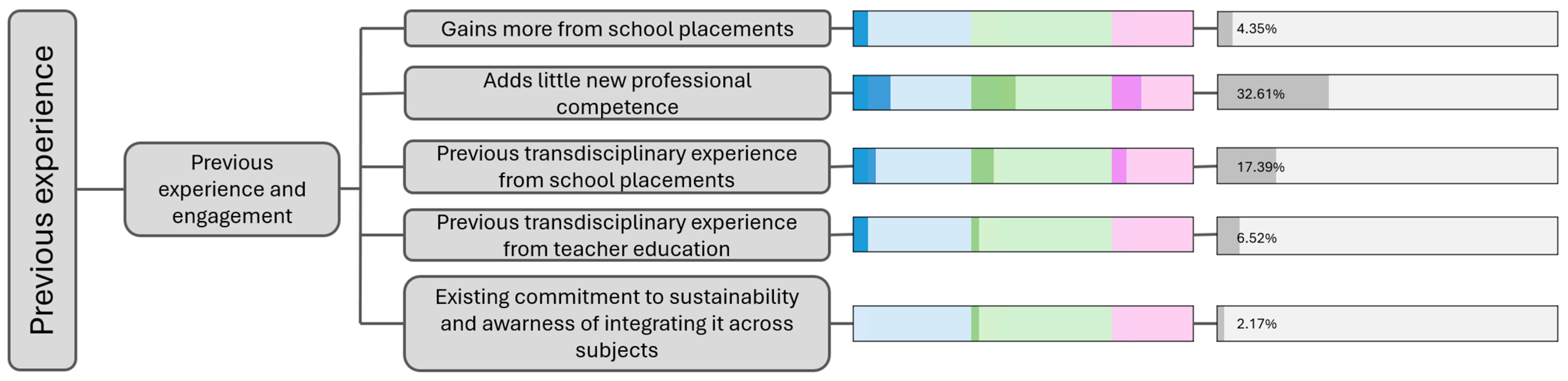
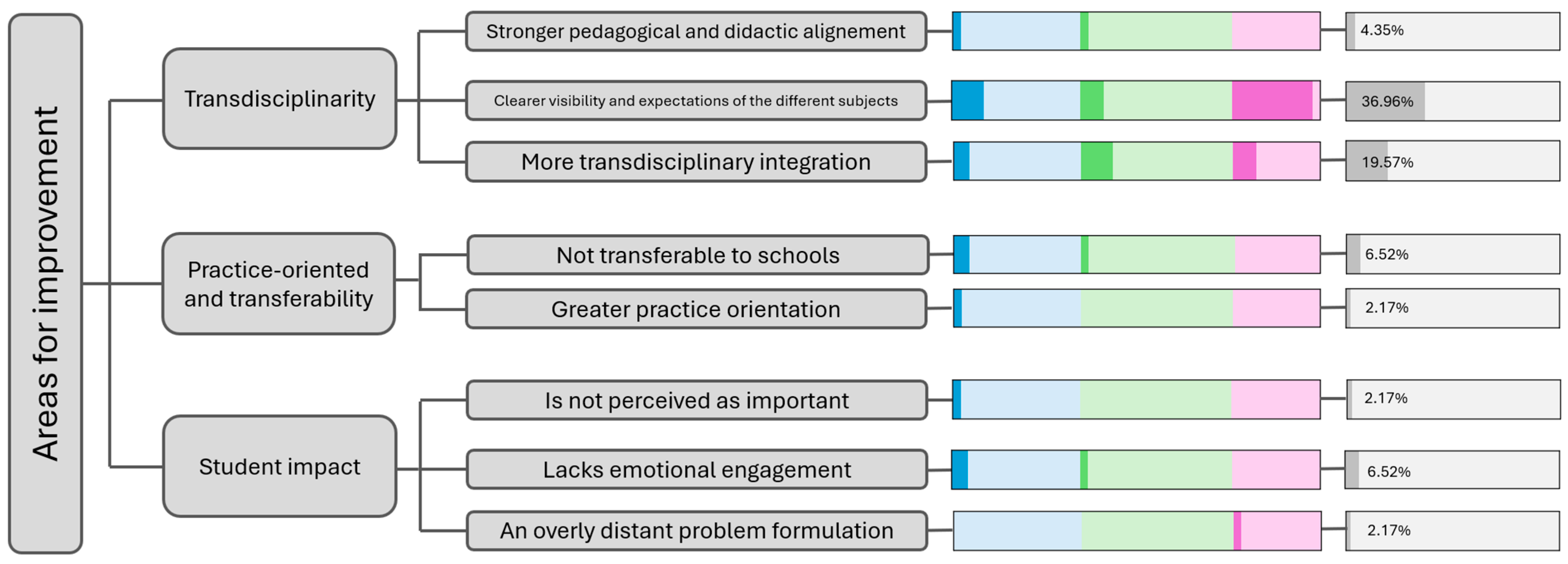
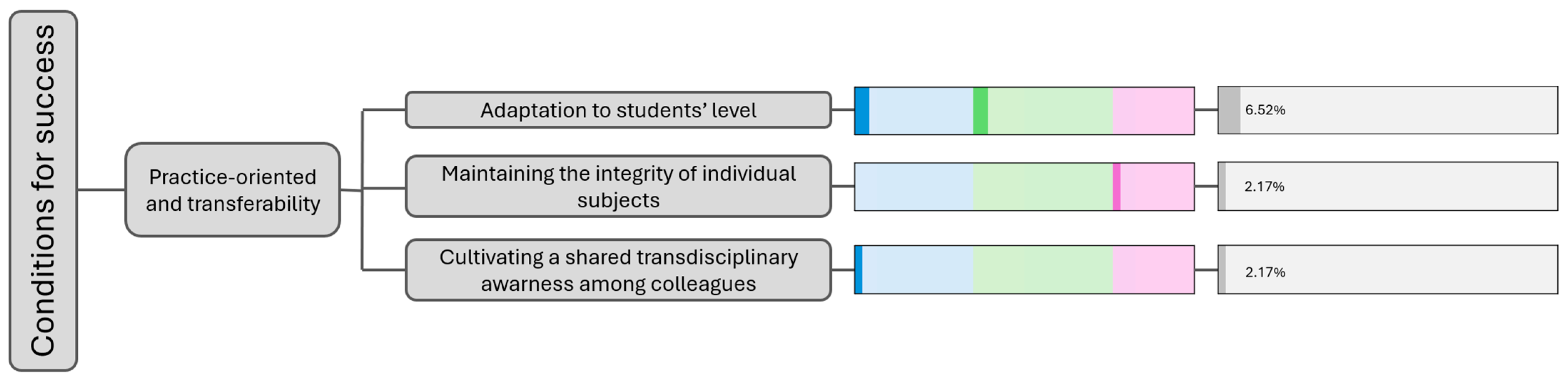
In the figure, the box on the left displays the main theme, followed by subthemes and categories. The distribution of quotes across students’ disciplinary backgrounds is visualised through colour coding (blue for social studies, green for natural science, and pink for art and crafts). The length of each coloured bar represents the total number of students in each discipline, while the darker shades indicate the number of students represented within each category. The percentage distribution across the total sample is shown on the far right, where light grey bars represent the full sample, and darker shades of grey show the proportion of students contributing to each category. These counts are illustrative only and do not determine themes or imply statistical generalisation but provide insight into the breadth and spread of perspectives. This description is also relevant for the figures in Section 3.2, Section 3.3 and Section 3.4.

3.1.1. Transdisciplinarity

Students across all subjects valued how the project brought disciplines together and broadened perspectives. Many highlighted the value of encountering different disciplinary perspectives (Figure 1), often describing how these enriched their own thinking. One social studies student explained: “You get to work with students from other subjects, which gives you their perspective on the theme and the problem, linked to their subject.” A natural science student similarly noted: “It has made me aware of how you can use other subjects to work with complex problems.”
Although only one art and crafts student commented on this category, the point was repeated three times, suggesting that the experience was particularly meaningful.
A natural science student also described gaining a fuller, more integrated understanding of the issue when subjects were combined (Holistic understanding, Figure 1). The student said: “We have seen that many projects can be used for transdisciplinary work, and by illuminating a problem from different viewpoints we gain a deeper understanding and support deeper learning.”
A smaller but noteworthy group explicitly stated that the project both exemplified and legitimised transdisciplinary work in teacher education (Figure 1). One natural science student reflected: “It highlights how the subjects were connected, rather than just ‘this is natural science’ and ‘this is social studies’.” A social studies student described being pushed to design genuinely transdisciplinary work: “We were required to think of a project that combines the subject so that it runs through the entire design.”
Taken together, these findings show that students most frequently emphasised the breadth of perspectives made available through the project. Less frequent but analytically important comments concerned the legitimation of transdisciplinary work, suggesting that observing teacher educators model such collaboration helps students recognise it as a credible and relevant professional practice.

3.1.2. Exemplary Teaching

Students described the teaching design and facilitation as modelling how to carry out transdisciplinary teaching. One of the strongest positive signals in the dataset was that the project models transdisciplinary work (Figure 1), particularly salient among natural science students, several of whom mentioned this repeatedly. As one natural science student explained: “I have seen how a transdisciplinary task can be solved, and what the success factors are for making it work.” Another added: “A practical and creative assignment like this gives a lot of inspiration and motivation to do something similar.” A social studies student also stated: “I have learned how we can approach and handle a transdisciplinary project in school.”
Although fewer students commented on teaching methods directly, several pointed to effective teaching approaches, creativity, and relevant tools (Figure 1). The fact that all three subject domains mentioned relevant tools suggests that students perceived practical takeaways rather than abstract principles. For instance, one natural science student said: “The project is a concrete example of the kind of transdisciplinary tasks you can give in school.” An art and crafts student added: “It gave me useful resources, such as the UN Association of Norway’s webpage.”
Overall, students regarded concrete modelling, more than general discussion, as the clearest teaching strength of the project.

3.1.3. Practice-Oriented and Transferability

Another positive aspect concerned the project’s relevance to school practice. Several students explicitly noted that the ideas and structures presented were directly transferable to their future work (Directly transferable to schools, Figure 1). This was most common among social science students. For example, one social studies student emphasised the professional relevance: “Working in teams across subjects is important in the teaching profession.” A natural science student also commented: “I have understood how this can be part of teaching. How simple it can be to carry out.”
These responses indicate that for many students, the project bridged the gap between teacher education and professional practice.

3.1.4. Collaboration

Collaboration emerged as both a learning mechanism and a positive experience in its own right (Figure 1). Many students described collaboration as productive, enjoyable, and instructive, as it provided them with positive collaboration experiences, both with and without a transdisciplinary focus. Some students also explicitly reported developing transdisciplinary collaboration skills. Students across all three subjects referred to these aspects multiple times, suggesting that the collaboration experiences were meaningful and sustained. Examples include: “It highlights how important collaboration between subject teachers is” (art and crafts student) and “We got to practice collaborating with others across subjects” (social studies student).
The data indicate that collaborative work not only facilitated the project but also helped students envision how to enact transdisciplinary teaching in schools.

3.1.5. Student Impact

Finally, students described strong affective and cognitive engagement with the project. Emotional engagement (Figure 1) was the most pronounced pattern in the entire dataset, reported by more than half the sample and especially prominent among social studies and natural science students. They found sustainability issues in a local authentic context meaningful, urgent, and motivating, as illustrated by these quotes from two social studies students: “It has been fun to work with a sustainability challenge because it is highly relevant and requires action as soon as possible” and “It feels important when it is something you have seen or known about.”
Students also reported becoming closer to the topic (Closeness to the issue), gaining deeper understanding, and finding the topic more comprehensible (Figure 1), as these quotes exemplify: “I understand the extent to which global warming (insect death) affects our daily lived better” (social studies student), “It feels more relevant” (social studies student), and “It feels more meaningful when it is so close to real life” (natural science student).
Some also described increased awareness of consequences and actions (Figure 1), suggesting emerging agency. For example, one art and crafts student said: “It feels more like you can make a difference.” Two natural science students followed with: “I understand how important it is to find a solution” and “It opened my eyes to more environmental problems.”
Collectively, these reflections point to the conditions known to support future pedagogical uptake, emotional resonance, relevance, comprehension, and a sense of meaningful action.

3.2. Areas for Improvement

Students identified several aspects of the project that could be strengthened, particularly related to transdisciplinarity, its perceived practice-orientation and transferability, and the extent to which it supported student impact (Figure 2). These categories reflect where students felt the project could be improved to prepare them for teaching SE.

3.2.1. Transdisciplinarity

Some students across subjects indicated that the pedagogical foundations of the project were not sufficiently explicit (Figure 2). Their reflections suggest that while they valued the idea of transdisciplinary work, they wanted clearer articulation of the didactic reasoning behind the project. A natural science student described this as: “Little pedagogical foundation.” A social studies student commented: “The project is not linked to the subject didactics.” These statements highlight a desire for stronger alignment between the project activities and the specific pedagogical frameworks of each subject.
The category that represents the single most frequent area for improvement is clearer visibility and expectations of the different subjects (Figure 2). It is extraordinarily strong in the art and crafts students. Over 90% of the art and crafts students raised concerns regarding subject visibility, many of them offering multiple comments, indicating a pressing need for clarity about subject roles and expectations within the transdisciplinary frame.
Several art and crafts students felt that their subject’s role was unclear, undervalued, or positioned primarily as a practical support discipline rather than an academic contributor. One student wrote: “The subject was presented as too little integrated, especially art and crafts. Not enough visibility of the subject’s own value.” Another explained: “I missed expectations for how the different subjects could be included.”
Other comments expressed deeper frustration about how art and crafts was represented within the project. One student reflected: “I don’t feel I learned very much about how art and crafts can work with social studies and natural science. It felt like those subjects were in focus, while art and crafts were there to make the exhibition product.” Another described a perceived imbalance in disciplinary contributions: “At the start, the two other subjects contributed academically, while the art and crafts input was only about materials. In a course where we are supposed to argue for strengthening our subject, I find it frustrating to see it used in such a misunderstood way.” These reflections reveal a structural challenge: students appreciated working transdisciplinarily but expressed a need for scaffolding to include their subject in the project.
Alongside the calls for stronger disciplinary visibility, a substantial group of students also requested more subject integration (more transdisciplinary integration, Figure 2). This initially appears contradictory but in fact illuminates a shared concern, that students wanted a balanced transdisciplinarity, one in which subjects maintain their identity while also contributing to a genuinely intertwined approach. One art and crafts student noted that the subjects were “not sufficiently integrated”. These reflections signal that stronger disciplinary grounding and deeper integration are complementary rather than opposing goals, and both are needed to improve the coherence of the project design.

3.2.2. Practice-Oriented and Transferability

Only a small number of students expressed concerns about transferability (Figure 2), but the comments point to important nuances. Some students struggled to see how the project structure would work within existing school timetables or subject divisions. A natural science student remarked: “Difficult, a school class has the same subject [with the same teacher],” suggesting concerns about logistical feasibility. A social studies student added: “There was no focus on how to design teaching linked to our project,” indicating a desire for more explicit modelling of how to adapt the project into concrete teaching sequences.
These concerns contrast with the many students who reported high transferability, implying that such discrepancies may reflect differences in prior experiences, school placement contexts, or variations in how clearly the educators connected the project to classroom practice. This is further supported by the fact that a few other students wished for even stronger practice alignment (Figure 2), indicating that while the project was engaging, more explicit guidance on classroom application could further enhance its relevance.

3.2.3. Student Impact

Very few students found the topic unimportant or reported lacking emotional engagement (Figure 2). A natural science student remarked: “It did not give me very much extra.” In addition, a social studies student commented: “It was not that engaging.” Although marginal, these comments reinforce the importance of anchoring sustainability issues in students’ lived experiences and disciplinary contexts.
One art and crafts student also expressed that the problem formulation felt too removed from their disciplinary or personal context (An overly distant problem formulation, Figure 2): “The issue felt too far removed from our context.” This nuance aligns closely with concerns in other categories, underscoring the importance of constructing transdisciplinary problems that meaningfully include all relevant disciplines.
To sum up, the students sought clearer disciplinary structure, more deliberate integration, and stronger connections to school practice. This is particularly evident for art and crafts students, who expressed the strongest need for disciplinary visibility and recognition.

3.3. Previous Experience

The theme Previous experience captures how students’ existing background with transdisciplinary work and sustainability shapes their perceptions of the project. Across the categories, students compare the project with earlier experiences from school placements, previous coursework, or other learning contexts (Figure 3). This context appears to temper the project’s novelty for some, helping to explain why certain students reported limited new learning despite the positive impact described by others.
Several students indicated that their school placements had provided richer or more meaningful experiences of transdisciplinary work. One social studies student reflected: “I gain more experiences and reflections from practice than from such campus projects.”
A notable portion of students across all subjects expressed that the project added little new professional competence. One natural science student commented: “I don’t feel this project gave me a broader understanding of what it means to work transdisciplinary. I already had an understanding before the project.” Similarly, a social studies student noted: “I already have a lot of information and experience with transdisciplinary work and sustainability from ‘ordinary’ subjects.” This quote also represents a smaller group of students who noted they had already developed considerable transdisciplinary competence through other courses.
Some students also described having strong transdisciplinary experiences from their placements, which served as reference points for evaluating the project. One natural science student explained: “I have had good transdisciplinary projects in practice and as a substitute teacher that I felt I learned more from.”
Finally, a few students already had a strong personal or academic commitment to sustainability. For these students, the project aligned well with their existing knowledge but did not necessarily extend it substantially.
Overall, theme 4 shows that prior experience significantly shapes how students perceive the value and novelty of such projects. For some students, the project added little new learning because they had already engaged with similar work elsewhere.

3.4. Conditions for Success

This theme consists of the subtheme Practice-oriented and transferability, within which students point to three categories that they see as essential for successful transdisciplinary sustainability projects: adaptation to students’ level, maintaining the integrity of individual subjects, and cultivating a shared transdisciplinary awareness among colleagues (Figure 4). Together, these categories highlight the conditions students believe must be in place for such work to function well in school settings.
Some students emphasised that successful implementation requires tasks to be adapted to the developmental stage and capabilities of students/pupils. A natural science student noted: “Pupils in Years 1–7 need closer follow-up when given an open task.”
Students also stressed the importance of maintaining each subject’s integrity within the transdisciplinary framework. This was especially relevant for art and crafts students, who strongly valued disciplinary visibility (as seen in Theme 2). One art and crafts student expressed this clearly: “I see transferability to schools if the subject’s own value is maintained”.
A third condition concerns the broader school environment. Students highlighted the need for a shared awareness and willingness among teachers to engage in transdisciplinary collaboration. As one social studies student put it: “It requires an awareness and desire for transdisciplinary teaching within the staff.”
Together, these categories demonstrate that students view successful transdisciplinary work not merely as a matter of curriculum design, but as an interplay of task adaptation, subject integrity and collegial commitment. These conditions reinforce the improvement needs identified in Theme 2, particularly regarding clarity, visibility, and alignment across subjects.

4. Discussion

4.1. Transdisciplinary and Authentic Projects as Catalysts for the Development of Teacher Preparedness

The findings indicate that the transdisciplinary sustainability project supported students’ preparedness for sustainability teaching. Across subject domains, students emphasised how working on a shared sustainability issue allowed them to encounter it through multiple disciplinary perspectives and to develop a more holistic understanding (Theme 1). Sustainability issues are seen as inherently complex, open-ended, and characterised by uncertainty, conflicting values and multiple perspectives, often described as wicked problems, and therefore cannot be addressed through a single-disciplinary approach (Rittel & Webber, 1973; Scheie & Stromholt, 2019). Within such a perspective, the students’ appreciation of transdisciplinary work can be seen as a recognition of the limitations of single-disciplinary approaches when addressing sustainability issues, and of the need to integrate knowledge and perspectives across subject boundaries, as emphasised in the literature (Drake & Reid, 2020; Klein, 2017).
These findings resonate with research highlighting interdisciplinary collaboration as a key pedagogical condition for developing teachers’ preparedness for sustainability teaching. Özdemir-Yılmazer (2025), for example, shows how cross-curricular lesson planning among ITE students can broaden perspectives on SD and strengthen their capacity to integrate sustainability issues across disciplinary contexts. In the present study, this process was particularly evident in students’ descriptions of gaining a fuller and more integrated understanding when disciplinary perspectives were combined (Theme 1). Such findings align with UNESCO (2006), which stresses the importance of interdisciplinary approaches to SE for fostering a holistic perspective and with broader claims within SE that inter- and transdisciplinary approaches hold educational potential precisely because they mirror the interconnected nature of real-world sustainability issues (Drake & Reid, 2020).
A smaller but analytically important finding that further adds to this is that some students explicitly stated that the project not only engaged them in transdisciplinary work but also exemplified and legitimised such approaches within ITE by highlighting how subjects can be connected when working with sustainability issues (Theme 1). This points to the importance of making coordination across subject perspectives, content, and pedagogical approaches visible in teacher education. From a theoretical perspective, this resonates with research on professional learning that emphasises practice-grounded, collaborative processes centred on shared pedagogical objects, where meanings and approaches to practice can be negotiated collectively (Havnes, 2009; I. S. Horn & Little, 2010).
Findings also suggest that preparedness was developed through the students’ participation in a transdisciplinary process that resembled professional practice. Several students described the project as relevant and transferable to school contexts, while highlighting how it exemplified ways of organising teaching across subjects and working collaboratively with complex issues (Theme 1). In light of Manasia et al.’s (2019) conceptualisation of preparedness to promote SE as emerging professionalism, these findings indicate that the project contributed to dimensions of professional engagement and practice rather than solely to theoretical understanding. Preparedness, in this sense, appears to be linked to students’ experiencing themselves as capable navigators of interdisciplinary collaboration, making pedagogical choices and engaging with sustainability in ways that feel professionally legitimate.
Conversely, students called for a deeper and more balanced integration across subjects (Theme 3). Although a transdisciplinary approach aims to transcend subject boundaries (Drake & Reid, 2020; Meeth, 1978; Moss et al., 2003), deep integration is seldom achieved (Tonnetti & Lentillon-Kaestner, 2023). Moreover, the findings highlight that within a transdisciplinary framework, integration must be balanced with the preservation of disciplinary integrity (Theme 4). Unequal allocation of time and resources among the participating subjects may have produced disparities in students’ sense of ownership and emotional engagement. The way the project was coordinated may thus have led to lower levels of teacher preparedness. A more balanced structure could promote more equitable participation and foster meaningful interdisciplinary engagement while maintaining subject integrity.
At the same time, a smaller number of students expressed reservations regarding the project’s transferability to school contexts (Theme 2). These concerns pointed to important nuances in how preparedness is experienced. Some students struggled to envision how the project structure could be implemented within existing school timetables and subject-organised teaching, while others highlighted the lack of explicit focus on how to translate the project into concrete teaching designs, expressing a need for clearer modelling of how transdisciplinary sustainability projects could be adapted into coherent instructional sequences within school practice. While these concerns were voiced by a minority of students, they contrast with the widespread perception of high transferability and suggest that experiences of preparedness are shaped by variations in prior experience, school placement contexts and the extent to which connections to classroom practice are made explicit by teacher educators. These findings resonate with research identifying both personal and structural barriers to sustainability-oriented interdisciplinary teaching in schools. While students may develop confidence and motivation through participation in transdisciplinary projects, existing school structures such as subject-oriented curricula, fixed timetables and assessment regimes can constrain opportunities for collaboration across subjects (Arntzen et al., 2025; Furberg et al., 2025; Johnson & Czerniak, 2023; Margot & Kettler, 2019; Senn et al., 2019; Timm & Barth, 2021). From this perspective, the reservations expressed by some students do not necessarily indicate a lack of preparedness, but rather an emerging awareness of the tensions between transdisciplinary sustainability ambitions and the organisational realities of school practice. However, such awareness can also be seen as an important component of professional preparedness, as it reflects students’ ability to critically evaluate the conditions under which SE can be enacted in schools.
The students also reported increased confidence in their ability to carry out similar teaching in the future, indicating that the project contributed to the development of self-efficacy for transdisciplinary sustainability teaching. Several students referred to the project as inspiring and to having “seen how a transdisciplinary task can be solved”, suggesting that participation provided concrete mastery experiences, which Bandura (1977) identifies as the strongest source of self-efficacy. The modelling of transdisciplinary collaboration by teacher educators, highlighted in students’ accounts of exemplary teaching (Theme 1), also aligns with the role of vicarious experience in strengthening self-efficacy beliefs (Bandura, 1977; Tschannen-Moran et al., 1998). Taken together, these findings suggest that preparedness for sustainability teaching was fostered through experiencing transdisciplinary work as pedagogically feasible and meaningful, rather than through prescriptive instruction on methods or procedures.
Despite the limited time for interaction with local community stakeholders, students’ external collaborations may have contributed to the development of their self-efficacy for transdisciplinary sustainability teaching. Learning how to establish contact with external actors and experiencing how these actors could contribute to their projects—through access to authentic data, broader perspectives, dialogue around proposed actions, and critical feedback—may be understood as part of providing mastery experiences (see Bandura, 1977). Such collaborations may have supported a tentative transition from theory to practice and could thus have influenced students’ confidence in conducting similar projects in school contexts. They may also have served to highlight the complexity of real-world problems beyond the controlled university environment. Furthermore, engagement with external actors may help students better understand the relationship between theory and practice, thereby potentially supporting the integration of intellectual, practical, and emotional dimensions that are central to sustainability education. Based on these findings, we suggest that future ITE projects could benefit from including such interactions with local community actors, in line with the concept of open schooling (Cruz Lorite et al., 2025).
Furthermore, students’ confidence appears to be linked to the project’s emphasis on concrete and practical examples. Although fewer students commented explicitly on teaching methods, several students across all three subject domains pointed to effective teaching approaches, creativity, and the use of relevant tools (Theme 1). This indicates that students perceived practical takeaways rather than abstract principles alone. Providing concrete and inspiring examples of sustainability teaching has previously been identified as an important condition for supporting teachers’ engagement and competence development in SE (Borg et al., 2012). Seen together, these findings suggest that students’ preparedness for sustainability teaching was fostered not through prescriptive instruction on methods or procedures, but through experiencing, observing and experimenting with transdisciplinary sustainability teaching as a viable and meaningful pedagogical practice.

4.2. Disciplinary Identity as a Condition for Transdisciplinary Preparedness

Results also reveal important tensions that complicate the overall picture of teacher preparedness as described above. The findings show that preparedness was not experienced uniformly across student groups, with art and crafts students expressing the strongest concerns regarding disciplinary visibility, expectations, and perceived legitimacy within the transdisciplinary project. These concerns point to structural and epistemic factors shaping how transdisciplinary SE is experienced and evaluated in ITE.
A central issue raised by art and crafts students was the lack of clear articulation of their subject’s contribution. Many described their subject as weakly integrated or reduced to a practical or supportive role, rather than positioned as an academic and pedagogical contributor alongside natural science and social studies. Over 90% of the art and crafts students explicitly called for greater visibility of their subject. Drawing on Williams et al. (2016), this reflects established disciplinary hierarchies, where natural science often occupies a dominant position while art and crafts are relegated to supportive roles, known as a form of “disciplinary blindness”. The demand for stronger subject grounding should therefore be understood not as resistance to transdisciplinarity, but as a call for designs that make each discipline’s perspectives, methods, and knowledge explicit and meaningfully integrated.
Such reflections echo research on disciplinary hierarchies, which shows how certain subjects are positioned as more legitimate or powerful than others within interdisciplinary contexts (Williams et al., 2016). More recent research suggests that these hierarchies may also generate tensions in transdisciplinary work, particularly when multiple knowledge systems and perspectives are involved (Lenhart & Bouwma-Gearhart, 2022). From this perspective, the frustration expressed by art and crafts students can be understood not simply as dissatisfaction with project design, but as a concern for professional identity and recognition within transdisciplinary teaching practices.
These tensions, experienced especially by art and crafts students, may also point to underlying epistemological challenges in transdisciplinary work. The disciplines of the social sciences, natural sciences, and the arts have different traditions for knowledge construction, which are also reflected in the school subjects grafted on these disciplines. In this context, Sund and Gericke (2020) point out that teaching dimensions are emphasised differently across subjects. Students therefore need to negotiate between these different epistemological traditions and develop a common language and understanding when working transdisciplinarily. These challenges are not unique to the students in this project. Lenhart and Bouwma-Gearhart (2022) describe similar tensions involving the negotiation of disciplinary norms, practices and terminologies in a case where faculties developed transdisciplinary curricula with the aim of challenging students to solve a complex socioscientific issue related to sustainability. These tensions, and the need to navigate them together, should be made explicit to students.
The curriculum, and the way learning goals for SD are specified in it, form an additional obstacle to navigating these tensions in a transdisciplinary team and engaging students in disciplinary negotiation. The school subjects represented in this study all highlight different aspects of SD (Ministry of Education and Research, 2019a, 2019b, 2019c). As a consequence, students may hold different understandings of what SD is, which makes it more challenging for them to understand how their subject contributes to the overall theme of SD. This is further underlined by the fact that the core values of SD are only implemented in the subject-specific curricula to a limited extent (Kvamme, 2025).
Seen in light of a pluralistic sustainability education perspective, which values the coexistence of multiple perspectives and democratic dialogue (Öhman & Östman, 2019), disciplinary negotiation during transdisciplinary work is a strength. However, it may also create challenges and obstacles for collaboration if common ground is not sufficiently established.
Importantly, the students’ responses do not reflect an opposition to transdisciplinarity as such. Rather, they point to a desire for a more balanced form of integration, where disciplinary integrity and subject-specific values are made explicit while still contributing to an integrated whole. This is further illustrated by the seemingly paradoxical finding that some students simultaneously called for clearer subject visibility and deeper transdisciplinary integration (Theme 2). As emphasised in the literature on interdisciplinary and transdisciplinary teaching, such demands are not contradictory but complementary. High-quality interdisciplinary work presupposes strong disciplinary grounding, where the distinctive perspectives, practices and epistemological contributions of each subject are clearly articulated before they can be meaningfully integrated (Lederman & Niess, 1997, cited in Czerniak & Johnson, 2014; Drake & Reid, 2020; Meeth, 1978; Moss et al., 2003). This is an understanding that aligns with transdisciplinarity as problem-oriented integration rather than the dissolving of disciplinary foundations (Klein, 2017). In this sense, the students’ critiques highlight that preparedness for transdisciplinary sustainability teaching depends on knowing not only how to collaborate across subjects, but also what one’s own subject contributes to addressing sustainability issues.
These findings also resonate with research identifying structural barriers to sustainability-oriented interdisciplinary teaching in schools. Subject-oriented curricula, strong disciplinary boundaries and limited opportunities for sustained collaboration are well-documented challenges that can constrain both teachers’ willingness and ability to engage in interdisciplinary work (Arntzen et al., 2025; Furberg et al., 2025; Johnson & Czerniak, 2023; Margot & Kettler, 2019; Senn et al., 2019; Timm & Barth, 2021). The students’ concerns about unclear expectations and limited subject visibility suggest that such structural constraints may already be shaping their understanding of what is feasible and legitimate in school practice.
Further complexity emerges from the transdisciplinary dimension of the project itself. Ødegaard et al. (2021) show that in many programmes, transdisciplinary integration may unintentionally marginalise sustainability when subjects are weighted unequally, with some disciplines dominating the narrative while others contribute only marginally. They argue that projects must explicitly communicate each subject’s role, clarifying whether contributions are methodological or knowledge-based, in order to achieve balanced integration and avoid marginalisation. Making subject roles transparent not only supports equitable participation but also strengthens the authenticity of the problem by ensuring that all relevant perspectives are represented. Seen in light of this, the present findings suggest that disciplinary visibility is not only a matter of representation, but also a condition for meaningful participation. When students perceive their subject as marginalised, this may weaken both their engagement and their sense of professional legitimacy within transdisciplinary work.
A key implication of these findings is the need to reconsider how subjects such as arts and crafts is positioned within such projects in ITE. Students’ experiences of the subject being reduced to a practical or supportive role point to underlying epistemic hierarchies that privilege certain forms of knowledge. Addressing this requires not only increased inclusion, but a shift towards recognising art and crafts as a distinct knowledge contributor. Making these contributions explicit may help challenge hierarchies where scientific knowledge dominates. Transdisciplinary projects should therefore aim for epistemic plurality, where different forms of knowledge are treated as equally relevant. In practice, this involves designing tasks where art and crafts contributes to problem framing, exploration, and meaning-making, rather than primarily to presentation. Conversely, making disciplinary contributions explicit may support both integration and ownership across subject domains.
The importance of disciplinary visibility is further underscored in Theme 3: Conditions for success, where students emphasised maintaining the integrity of individual subjects as a prerequisite for successful transdisciplinary work in schools. For art and crafts students in particular, perceived transferability was closely tied to whether their subject’s core values and competencies were recognised. This finding resonates with research highlighting professional identity and epistemic traditions as central challenges in interdisciplinary and transdisciplinary teaching. Subject-specific expertise often underpins teachers’ professional authority, and working across subjects may bring teachers outside their disciplinary comfort zones (Greenwood, 2013, cited in Sæther, 2021). Such situations can give rise to concerns about loss of subject depth and fears of diluting what is perceived as “powerful knowledge” (Drake & Reid, 2020). Differences in epistemological assumptions and ways of knowing across subjects may further complicate collaboration, particularly when disciplinary perspectives, practices and status are not explicitly articulated (Williams et al., 2016). Concerns about maintaining disciplinary authority within integrated sustainability teaching appear to be a critical condition for preparedness, not because it guarantees smoother collaboration, but because it enables students to engage in transdisciplinary sustainability education without experiencing a loss of professional identity or epistemic legitimacy. Addressing these tensions requires careful attention to how transdisciplinary sustainability projects are designed and communicated within ITE, particularly with regard to making disciplinary roles, expectations and contributions explicit and legitimate.

4.3. Emotional Engagement Drives Sustainable Teaching

A particularly salient finding across the dataset concerns students’ strong emotional engagement with the project (Theme 1). Emotional engagement emerged as the most prominent and consistent pattern, with students emphasising feelings of relevance, importance, and closeness to the sustainability issue. This affective dimension can be understood as closely connected to the project’s authentic design. By working with a locally grounded sustainability issue, students were able to relate abstract global challenges to concrete contexts they recognised and cared about. This aligns with research highlighting authenticity as a key pedagogical condition in sustainability education, enabling learners to experience sustainability as lived and contested rather than detached and theoretical (Gündoğan & Gültekin, 2018; Scheie & Korsager, 2014). From a pluralistic sustainability education perspective, such authentic encounters are not merely motivational but pedagogically necessary, as they provide the experiential basis for engaging with uncertainty, value conflicts and contested knowledge (see Öhman & Östman, 2019).
The centrality of emotional engagement also resonates with theoretical models that emphasise the interplay between knowledge, action and emotion in sustainability education (Hicks & Bords, 2001, cited in Öhman & Sund, 2021). Students’ descriptions of increased awareness, concern and, for some, a sense that “you can make a difference” suggest emerging forms of agency and action competence, thereby increasing the likelihood that they will later adopt sustainability-oriented teaching practices. Within this perspective, emotions are not opposed to reason but enable learners to personalise knowledge and engage meaningfully with complex issues (Hicks & Bords, 2001, cited in Öhman & Sund, 2021).
Students’ reflections confirm the centrality of affect. More than half of the students (59%) reported strong emotional engagement, describing the issue as relevant, urgent, and closely connected to their everyday lives. Statements such as “It feels more meaningful when it is so close to real life” and “It feels more like you can make a difference” illustrate how emotional proximity fosters both deeper understanding and a sense of agency. Only a small minority found the problem distant or unengaging, underscoring the importance of authentic, discipline-relevant problem formulations.
Students’ emotional engagement, sense of closeness to the issue, and sense of agency are consistent with research showing that authentic and participatory approaches can strengthen willingness to act and confidence in influencing sustainability outcomes (Torsdottir et al., 2024). Interaction with local community stakeholders, such as the municipality, environmental organisations, transport providers, reuse businesses, and student welfare services, enabled our students to encounter their chosen issue as a lived and contested phenomenon, while also providing access to authentic data, multiple perspectives, and feedback that often led them to reconsider their proposed actions or solutions. These boundary-crossing collaborations between schools and local communities may have played a role in supporting our students’ integration of knowledge, action, and emotion, as advocated by Öhman and Sund (2021). Our findings are also in line with Cruz Lorite et al.’s (2025) review, which highlights the positive impact of interaction with local community stakeholders on students’ motivation.
This emotional engagement can be further understood through the concept of constructive or evidence-based hope. Kelsey (2020) identifies concern and evidence-based hope as key drivers of engagement, while Ojala (2023) emphasises the importance of teachers developing critical emotional awareness (CEA) to support students in managing emotions such as worry, anxiety, and ambivalence. CEA integrates psychological, social scientific, and philosophical perspectives, enabling teachers to respond to students’ emotional experiences in ways that promote constructive hope and agency. When learners experience both concern and hope grounded in knowledge, they develop the affective and cognitive resources necessary for sustained engagement and future pedagogical action.
The findings of this study therefore suggest that emotional engagement functions as a central driver of preparedness for sustainability teaching. It supports not only motivation, but also the development of agency, professional judgement, and the capacity to engage with ethically and politically complex sustainability issues in future teaching practice.

4.4. Limitations of the Study

Even though our transdisciplinary approach was embedded within the ITE, our organisational design could have been improved. There is potential to include more than the three subjects involved in this study in order to achieve a more holistic approach. Ideally, the entire cohort of students from the fourth-year group in ITE should have participated, thereby modelling collaboration across a whole school collegium. We also recognise that not all subjects had clearly defined and transparent roles, particularly art and crafts. As a consequence, some students experienced their subject domains as being positioned primarily as practical support disciplines rather than as academic contributors.
Additionally, not all subjects allocated the same amount of time to the project, meaning that students from different disciplines did not develop an equal sense of ownership or emotional engagement. The involvement of local community stakeholders could have also been strengthened by allocating more time to the project, thereby providing students with richer experiences of this type of collaboration.
With regard to our research design, this study is based on individual reflection notes, which capture subjective perceptions and self-reported experiences of preparedness. While such data provide valuable insight into how students understand their own learning and development, they do not necessarily reflect enacted competence in practice. Individual interviews could have provided more in-depth insights into students’ perceptions. Group interviews involving students from different subject domains were conducted after the intervention, and these may offer important insights into how meanings, tensions, and perspectives are negotiated across disciplines. However, in the present study, we chose to focus analytically on individual reflections in order to examine perceived preparedness at the individual level. The interview data will be utilised in future work to develop further knowledge related to this type of intervention study. We also found that some of the questions in the reflection notes could be interpreted differently by students, resulting in variations in how they responded. Consequently, some student statements were coded under different codes and categories.
As the study involved only three school subjects and did not include the full cohort of students at our campus, it should be regarded as a small-scale intervention study with the potential to be scaled up.

5. Conclusions and Implications

Our findings indicate that the transdisciplinary sustainability project supported ITE students’ preparedness for sustainability teaching by engaging them in a shared sustainability challenge across subject domains. Working collaboratively on a common problem allowed students to encounter the issue through multiple disciplinary perspectives and to develop a more holistic understanding of sustainability. Preparedness was further strengthened through participation in a transdisciplinary process that resembled professional practice, which many students described as both relevant and transferable to school contexts. In particular, the project illustrated concrete ways of organising teaching across subjects and collaborating around complex societal issues, thereby modelling practices that students could envision applying in their future work as teachers.
Engagement with authentic, local issues fostered emotional involvement, relevance, and deeper understanding, while collaborative work enhanced insight into distinct disciplinary perspectives on SE. A particularly salient finding was the students’ strong emotional engagement with the project. More than half of the cohort reported high levels of affective involvement, describing the sustainability challenge as relevant, urgent, and closely connected to their everyday lives. This emotional engagement appeared closely linked to the project’s authentic design and its grounding in a local context, which translated abstract sustainability concerns into concrete and personally meaningful experiences.
At the same time, the findings highlight the importance of maintaining disciplinary authority within integrated sustainability teaching as a prerequisite for successful transdisciplinary work in schools, as it enables students to engage in such work without experiencing a loss of professional identity or epistemic legitimacy. In this regard, it is important to explicitly communicate each subject’s role in transdisciplinary projects, clarifying whether contributions are primarily methodological or knowledge-based, while also ensuring well-coordinated implementation to avoid structural barriers and working towards a proportionate allocation of time and resources to ensure balanced integration and avoid marginalising any discipline.
For ITE, these results point to the value of designing transdisciplinary sustainability initiatives that intentionally combine authenticity, affective engagement, and transparent subject roles to support meaningful learning and professional relevance.
Future research should further explore how such pedagogical conditions can be sustained and scaled across different ITE contexts, as well as how emotional engagement interacts with the development of students’ sustainability-related competencies over time. Further research is also needed to explore how self-efficacy develops and is sustained in more extended and fully authentic contexts outside the university setting. A recent literature review on SE in Nordic ITE by Berg et al. (2026) concludes that the majority of previous studies are small-scale, involving few participants and often concerned with isolated teaching interventions. Our study contributes to this body of research and, in line with Berg et al. (2026), suggests that future research should place greater emphasis on large-scale studies. Potential avenues for scaling up the present study include developing transdisciplinary SE initiatives that involve all students, as well as contributing to systemic and structural reforms that embed SE as an integral component of teacher education programmes. To advance SE, further research is also needed to critically examine the institutional, political, and structural conditions influencing its development.

Author Contributions

Intervention design, A.R.P., R.L.S. and V.G.S., with contributions from M.I.M.F. and F.K.; data collection, all authors.; data analyses, M.S.F., with contributions from A.R.P., F.K., H.E., M.I.M.F., R.L.S. and V.G.S.; leading the work, M.S.F.; writing—introduction and theoretical background A.R.P., R.L.S., M.I.M.F. and F.K., with contributions from M.S.F., H.E. and V.G.S.; writing—methods, M.S.F., F.K. and A.R.P.; writing—results, M.S.F.; visualisation, M.S.F.; writing—discussion, M.S.F. and H.E., with contributions from A.R.P., R.L.S., M.I.M.F., F.K.; writing conclusion, R.L.S., with contribution from M.I.M.F., A.R.P.; writing—abstract, M.S.F., R.L.S. and V.G.S., with contributions from A.R.P. and F.K.; writing—review and editing, A.R.P., F.K. and M.S.F., with contributions from R.L.S., M.I.M.F., H.E. and V.G.S. All authors have read and agreed to the published version of the manuscript.

Funding

This research received no external funding.

Institutional Review Board Statement

Ethical review and approval were waived for this study because it relied on fully anonymous questionnaire data, and no identifiable personal information was collected.

Informed Consent Statement

Informed consent was obtained from all subjects involved in the study through their voluntary completion of the anonymous questionnaire.

Data Availability Statement

The data presented in this study are not publicly available due to privacy and ethical restrictions, as they consist of anonymous questionnaire responses.

Acknowledgments

The authors would like to thank the students who participated in this study for their time and valuable contributions. We also express our gratitude to Jørund Aasetre and Trine Elisabeth Unander for their contributions to the data collection and, in particular, to the data analysis. During the preparation of this manuscript, the authors used Microsoft M365 Copilot (a GPT-5-based model, version 2.20260526.52.0, accessed in May 2026) for linguistic support, including improvements to grammar, clarity and fluency, as well as for the translation of selected quotes. The authors have reviewed and edited the output and take full responsibility for the content of this publication.

Conflicts of Interest

The authors declare no conflicts of interest.

Abbreviations

The following abbreviations are used in this manuscript:
SESustainability education
ITEInitial teacher education
ESDEducation for sustainable development
SDGSustainable Development Goals

References

  1. Arntzen, M., Scheie, E., & Haug, B. (2025). Interdisciplinary ESE: Barriers to implementation and practical ways to overcome them. Environmental Education Research, 1–23. [Google Scholar] [CrossRef]
  2. Bandura, A. (1977). Self-efficacy: Toward a unifying theory of behavioral change. Psychological Review, 84(2), 191. [Google Scholar] [CrossRef]
  3. Berg, M. K. S., Storen, I. C., & Straume, I. S. (2026). Frontrunners in sustainability? A scoping review of research on sustainability education in Nordic teacher education. Acta Didactica Norden, 20(1), 12595. [Google Scholar] [CrossRef]
  4. Bolstad, B. (2020). Dybdelæring og tverrfaglighet. Fagbokforlaget. [Google Scholar]
  5. Borg, C., Gericke, N., Höglund, H.-O., & Bergman, E. (2012). The Barriers encountered by teachers implementing education for sustainable development: Discipline bound differences and teaching traditions. Research in Science & Technological Education, 30(2), 185–207. [Google Scholar] [CrossRef]
  6. Braun, V., & Clarke, V. (2022). Thematic analysis: A practical guide. Sage. [Google Scholar]
  7. Cebrián, G., & Junyent, M. (2015). Competencies in education for sustainable development: Exploring the student teachers’ views. Sustainability, 7(3), 2768–2786. [Google Scholar] [CrossRef]
  8. Corney, G., & Reid, A. (2007). Student teachers’ learning about subject matter and pedagogy in education for sustainable development. Environmental Education Research, 13(1), 33–54. [Google Scholar] [CrossRef]
  9. Cruz Lorite, I. M., Nikolaou, M., Nisiforou, E., & Evagorou, M. (2025). Open schooling in science education: A systematic literature review. European Journal of Educational Research, 14(4), 1063–1085. [Google Scholar] [CrossRef]
  10. Czerniak, C. M., & Johnson, C. C. (2014). Interdisciplinary science teaching. In N. G. Lederman, & S. K. Abell (Eds.), Handbook of research on science education (Vol. 2, pp. 395–411). Routledge. [Google Scholar]
  11. Dahl, T. (2019). Prepared to teach for sustainable development? Student teachers’ beliefs in their ability to teach for sustainable development. Sustainability, 11(7), 1993. [Google Scholar] [CrossRef]
  12. del Carmen Pegalajar-Palomino, M., Burgos-García, A., & Martinez-Valdivia, E. (2021). What does education for sustainable development offer in initial teacher training? A systematic review. Journal of Teacher Education for Sustainability, 23(1), 99–114. [Google Scholar] [CrossRef]
  13. Dewey, J. (1997). Experience and education. Kappa Delta Pi. (Original work published 1938). [Google Scholar]
  14. Dillon, J., & Herman, B. (2023). Environmental education. In N. G. Lederman, D. L. Zeidler, & J. S. Lederman (Eds.), Handbook of research on science education (Vol. 3, pp. 717–748). Routledge. [Google Scholar]
  15. Drake, S. M., & Reid, J. L. (2020). 21st century competencies in light of the history of integrated curriculum. Frontiers in Education, 5, 122. [Google Scholar] [CrossRef]
  16. Echegoyen-Sanz, Y., Morote, Á., & Martín-Ezpeleta, A. (2024). Transdisciplinary education for sustainability. Creativity and awareness in teacher training. Frontiers in Education, 8, 1327641. [Google Scholar] [CrossRef]
  17. European Commission. (2015). Science education for responsible citizenship: Report to the European Commission of the expert group on science education. P. Office. Available online: https://data.europa.eu/doi/10.2777/12626 (accessed on 19 January 2026).
  18. Evans, N., Inwood, H., Christie, B., & Ärlemalm-Hagsér, E. (2021). Comparing education for sustainable development in initial teacher education across four countries. International Journal of Sustainability in Higher Education, 22(6), 1351–1372. [Google Scholar] [CrossRef]
  19. Ferguson, T., Roofe, C., & Cook, L. D. (2021). Teachers’ perspectives on sustainable development: The implications for education for sustainable development. Environmental Education Research, 27(9), 1343–1359. [Google Scholar] [CrossRef]
  20. Furberg, A., Silseth, K., Rødnes, K. A., Arnseth, H. C., Kvamme, O. A., Rasmussen, I., Sæther, E., Vasbø, K. B., & Lund, A. (2025). Undervisning og læring om tverrfaglige temaer: Skolen som fellesskapsarena for elevers møte med samtidens store utfordringer (Rapport nr. 11, EVA2020). Det Utdanningsvitenskapelige Fakultet, Universitetet i Oslo.
  21. Gündoğan, A., & Gültekin, M. (2018). The reflection of the attitudes and learning processes to learning environments with authentic tasks in life science class. Pegem Egitim Ve Ogretim Dergisi, 8(4), 771–832. [Google Scholar] [CrossRef]
  22. Havnes, A. (2009). Talk, planning and decision-making in interdisciplinary teacher teams: A case study. Teachers and Teaching: Theory and Practice, 15(1), 155–176. [Google Scholar] [CrossRef]
  23. Horn, A., Scheffelaar, A., Urias, E., & Zweekhorst, M. B. (2023). Training students for complex sustainability issues: A literature review on the design of inter-and transdisciplinary higher education. International Journal of Sustainability in Higher Education, 24(1), 1–27. [Google Scholar] [CrossRef]
  24. Horn, I. S., & Little, J. W. (2010). Attending to practice: Teaching, learning, and professional development. Teachers College Record, 112(1), 1–41. [Google Scholar]
  25. Jegstad, K. M., & Ryen, E. (2020). Bærekraftig utvikling som tverrfaglig tema i grunnskolens naturfag og samfunnsfag–en læreplananalyse. Norsk Pedagogisk Tidsskrift, 104(3), 297–312. [Google Scholar] [CrossRef]
  26. Johnson, C. C., & Czerniak, C. M. (2023). Interdisciplinary approaches and integrated STEM in science teaching. In N. G. Lederman, D. L. Zeidler, & J. S. Lederman (Eds.), Handbook of research on science education (Vol. 3, pp. 559–585). Routledge. [Google Scholar]
  27. Kelsey, E. (2020). Hope matters: Why changing the way we think is critical to solving the environmental crisis. Greystone Books. [Google Scholar]
  28. Klafki, W. (2016). Dannelsesteori og didaktikk: Nye studier (3rd ed.). Klim. [Google Scholar]
  29. Klein, J. T. (2017). 3 typologies of interdisciplinarity: The boundary work of definition. In R. Frodeman (Ed.), The oxford handbook of interdisciplinarity (2nd ed., pp. 21–34). Oxford University Press. [Google Scholar]
  30. Kvamme, O. A. (2025). Skolens verdier og samfunnsmandat: Om verdiløftet og det tverrfaglige temaet bærekraftig utvikling (Rapport nr. 10). Det Utdanningsvitenskapelige Fakultet, Universitetet i Oslo. Available online: https://www.uv.uio.no/forskning/prosjekter/fagfornyelsen-evaluering/publikasjoner/eva_2020_rapport_10.pdf (accessed on 13 April 2026).
  31. Lenhart, C., & Bouwma-Gearhart, J. (2022). Engaging students around the complex socioscientific issue of sustainability: Affordances and tensions of faculty working across disciplines to develop transdisciplinary curricula. CBE—Life Sciences Education, 21(2), ar21. [Google Scholar] [CrossRef]
  32. Manasia, L., Ianos, M. G., & Chicioreanu, T. D. (2019). Pre-service teacher preparedness for fostering education for sustainable development: An empirical analysis of central dimensions of teaching readiness. Sustainability, 12(1), 166. [Google Scholar] [CrossRef]
  33. Margot, K. C., & Kettler, T. (2019). Teachers’ perception of STEM integration and education: A systematic literature review. International Journal of STEM education, 6(1), 2. [Google Scholar] [CrossRef]
  34. Meeth, L. R. (1978). Interdisciplinary studies: A matter of definition. Change: The Magazine of Higher Learning, 10(7), 10. [Google Scholar] [CrossRef]
  35. Mellingen, Ø. K., & Tollefsen, I. (2023). Bærekraftig utvikling i norsk skoleforskning. En litteraturgjennomgang. In T. S. Bredal-Tomren (Ed.), Utdanning for bærekraft. Erfaring og forskning fra barnehage og skole (pp. 51–72). Cappelen Damm Akademisk. [Google Scholar] [CrossRef]
  36. Ministry of Education and Research. (2017). Core curriculum—Values and principles for primary and secondary education. Available online: https://www.udir.no/lk20/overordnet-del/?lang=eng (accessed on 9 April 2026).
  37. Ministry of Education and Research. (2019a). Curriculum for art and crafts (KHV01-02). Available online: https://www.udir.no/lk20/khv01-02?lang=eng (accessed on 17 March 2026).
  38. Ministry of Education and Research. (2019b). Curriculum for natural science (NAT01-04). Available online: https://www.udir.no/lk20/nat01-04?lang=eng (accessed on 17 March 2026).
  39. Ministry of Education and Research. (2019c). Curriculum for social studies (SAF01-04). Available online: https://www.udir.no/lk20/saf01-04?lang=eng (accessed on 17 March 2026).
  40. Monika, J. (2024). Sustainability education in the 21st century: Incorporating environmental awareness in K-12 curriculum. International Journal of Post Axial: Futuristic Teaching and Learning, 2(3), 120–133. [Google Scholar] [CrossRef]
  41. Moss, D. M., Osborne, T. A., & Kaufmann, D. (2003). Going beyond the boundaries. In D. Kaufmann, D. M. Moss, & T. A. Osborne (Eds.), Beyond the boundaries: A transdisciplinary approach to learning and teaching (pp. 1–11). Praeger Publishers. [Google Scholar]
  42. O’Flaherty, J., & Liddy, M. (2018). The impact of development education and education for sustainable development interventions: A synthesis of the research. Environmental Education Research, 24(7), 1031–1049. [Google Scholar] [CrossRef]
  43. Ojala, M. (2023). Climate-change education and critical emotional awareness (CEA): Implications for teacher education. Educational Philosophy and Theory, 55(10), 1109–1120. [Google Scholar] [CrossRef]
  44. Olsson, D., Gericke, N., & Boeve-de Pauw, J. (2022). The effectiveness of education for sustainable development revisited: A longitudinal study on secondary students’ action competence for sustainability. Environmental Education Research, 28(3), 405–429. [Google Scholar] [CrossRef]
  45. Organisation for Economic Co-Operation and Development [OECD]. (2023). PISA 2025 science framework (draft). O. Publishing. Available online: https://pisa-framework.oecd.org/science-2025/assets/docs/PISA_2025_Science_Framework.pdf (accessed on 19 January 2026).
  46. Ødegaard, M., Knain, E., Kvamme, O. A., & Sæther, E. (2021). Making sense of frustration and complexity when introducing sustainability in teacher education. Acta Didactica Norden, 15(3), 6. [Google Scholar] [CrossRef]
  47. Öhman, J., & Östman, L. (2019). Different teaching traditions in environmental and sustainability education. In K. Van Poeck, L. Östman, & J. Öhman (Eds.), Sustainable development teaching: Ethical and political challenges (pp. 70–82). Routledge. [Google Scholar]
  48. Öhman, J., & Sund, L. (2021). A didactic model of sustainability commitment. Sustainability, 13(6), 3083. [Google Scholar] [CrossRef]
  49. Øyehaug, A. B., Buseth, J. T., & Didham, R. J. (2026). Education for sustainable development (ESD) in teacher education: Pre-service teachers’ perspectives on interdisciplinary learning. In F. Skarstein, & L.-A. Wolff (Eds.), Sustainability and science education: Exploring roles and challenges (pp. 109–135). Springer. [Google Scholar]
  50. Özdemir-Yılmazer, M. (2025). Towards a holistic understanding of sustainable development in teacher education: Insights from pre-service teachers’ cross-curricular lesson planning. European Journal of Education, 60(4), e70229. [Google Scholar] [CrossRef]
  51. Parry, S., & Metzger, E. (2023). Barriers to learning for sustainability: A teacher perspective. Sustainable Earth Reviews, 6(1), 2. [Google Scholar] [CrossRef]
  52. Rittel, H. W., & Webber, M. M. (1973). Dilemmas in a general theory of planning. Policy Sciences, 4(2), 155–169. [Google Scholar] [CrossRef]
  53. Romano, J. L. (1996). School personnel prevention training: A measure of self-efficacy. The Journal of Educational Research, 90(1), 57–63. [Google Scholar] [CrossRef]
  54. Sæther, E. (2021). Muligheter og utfordringer i samfunnsfagenes møte med tverrfaglighet og dybdelæring. In S. F. Erdal, L. Granlund, & E. Ryen (Eds.), Samfunnsfagdidaktikk (pp. 28–43). Universitetsforlaget. [Google Scholar]
  55. Sæther, E., & Kvamme, O. A. (2019). Fagovergripende perspektiver i en bærekraftdidaktikk. In O. A. Kvamme, & E. Sæther (Eds.), Bærekraftdidaktikk (pp. 191–214). Fagbokforlaget. [Google Scholar]
  56. Sætre, P. J. (2016). Education for sustainable development in Norwegian geography curricula. Nordidactica: Journal of Humanities and Social Science Education, 6(2016:1), 63–78. [Google Scholar]
  57. Scheie, E., & Korsager, M. (2014). Fler-/tverrfaglig undervisning for bærekraftig utvikling. Naturfag, 2(14), 44–47. [Google Scholar]
  58. Scheie, E., & Stromholt, S. (2019). The sustainable backpack: Education for sustainable development through a nationwide professional development programme. Acta Didactica Norge, 13(2), 1–22. [Google Scholar] [CrossRef]
  59. Schuler, S., Fanta, D., Rosenkraenzer, F., & Riess, W. (2018). Systems thinking within the scope of education for sustainable development (ESD): A heuristic competence model as a basis for (science) teacher education. Journal of Geography in Higher Education, 42(2), 192–204. [Google Scholar] [CrossRef]
  60. Senn, G., McMurtrie, D., & Coleman, B. (2019). Collaboration in the middle: Teachers in interdisciplinary planning. Current Issues in Middle Level Education, 24(1), 6. [Google Scholar] [CrossRef]
  61. Sidiropoulos, E. (2022). The influence of higher education on student learning and agency for sustainability transition. Sustainability, 14(5), 3098. [Google Scholar] [CrossRef]
  62. Sinnes, A. T. (2020). Action takk! Hva kan skolen lære av unge menneskers handlinger for bærekraftig utvikling? Gyldendal. [Google Scholar]
  63. Sund, P., & Gericke, N. (2020). Teaching contributions from secondary school subject areas to education for sustainable development: A comparative study of science, social science and language teachers. Environmental Education Research, 26(6), 772–794. [Google Scholar] [CrossRef]
  64. Supple, B., Lorenzutti, N., McCullough, K., & Coronel Ortiz, R. M. (2025). Teaching for tomorrow: A qualitative exploration of ESD in initial teacher education across five European universities. International Journal of Sustainability in Higher Education, 26(9), 448–465. [Google Scholar] [CrossRef]
  65. Swist, T., Markauskaite, L., Mosely, G., Goodyear, P., & Wrigley, C. (2025). Approaches to strengthening teachers’ interdisciplinary expertise: From configurative review to design patterns. Review of Education, 13(3), e70113. [Google Scholar] [CrossRef]
  66. Timm, J.-M., & Barth, M. (2021). Making education for sustainable development happen in elementary schools: The role of teachers. Environmental Education Research, 27(1), 50–66. [Google Scholar] [CrossRef]
  67. Tonnetti, B., & Lentillon-Kaestner, V. (2023). Teaching interdisciplinarity in secondary school: A systematic review. Cogent Education, 10(1), 2216038. [Google Scholar] [CrossRef]
  68. Torsdottir, A. E., Olsson, D., Sinnes, A. T., & Wals, A. (2024). The relationship between student participation and students’ self-perceived action competence for sustainability in a whole school approach. Environmental Education Research, 30(8), 1308–1326. [Google Scholar] [CrossRef]
  69. Tschannen-Moran, M., Hoy, A. W., & Hoy, W. K. (1998). Teacher efficacy: Its meaning and measure. Review of Educational Research, 68(2), 202–248. [Google Scholar] [CrossRef]
  70. United Nations [UN]. (2015). Transforming our world: The 2030 agenda for sustainable development (A/Res 70/1). Available online: https://sdgs.un.org/2030agenda (accessed on 9 April 2026).
  71. United Nations Educational, Scientific and Cultural Organization [UNESCO]. (2006). Framework for the UNDESD international implementation scheme. united nations decade of education for sustainable development (2005–2014). Available online: https://unesdoc.unesco.org/ark:/48223/pf0000148650.locale=en (accessed on 7 April 2026).
  72. Williams, J., Roth, W.-M., Swanson, D., Doig, B., Groves, S., Omuvwie, M., Borromeo Ferri, R., & Mousoulides, N. (2016). Interdisciplinary mathematics education: A state of the art. In Interdisciplinary mathematics education. ICME-13 topical surveys. Springer Open. [Google Scholar] [CrossRef]
  73. World Commission on Environment and Development [WCED]. (1987). Our common future. Oxford University Press. [Google Scholar]
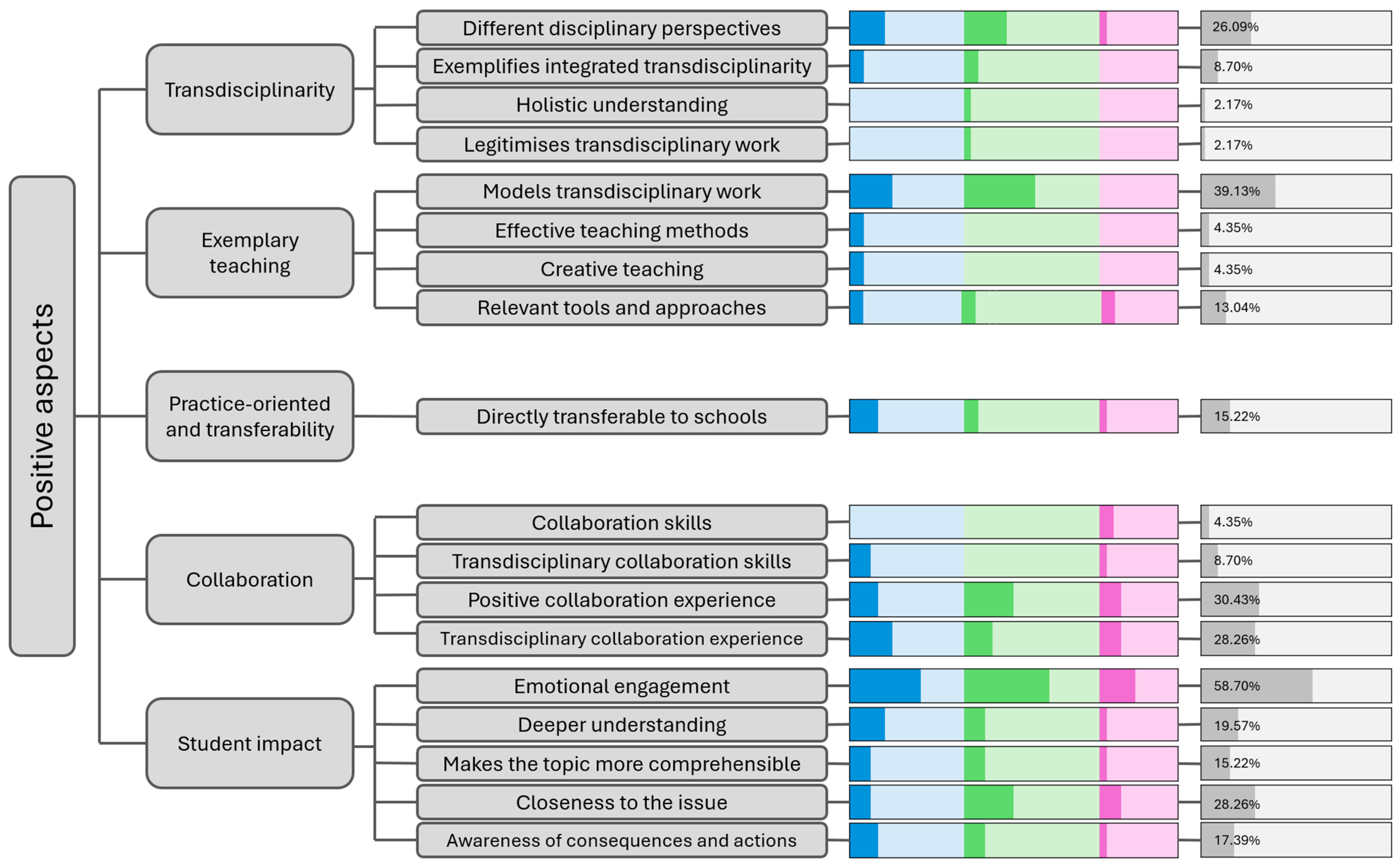
Figure 1. Overview of the five subthemes that together make up the main theme of positive aspects, and the categories under each subtheme. For each category, the frequency is visually represented within the student groups of social studies (blue), natural science (green), and art and crafts (pink). Furthermore, the frequency for all student groups together is reported.
Education 16 00934 g001
Figure 2. Overview of the five subthemes that together make up the main theme of areas for improvement, and the categories under each subtheme. For each category, the frequency is visually represented within the student groups of social studies (blue), natural science (green), and art and crafts (pink). Furthermore, the frequency for all student groups together is reported.
Education 16 00934 g002
Figure 3. Overview of the five subthemes that together make up the main theme of previous experience, and the categories under each subtheme. For each category, the frequency is visually represented within the student groups of social studies (blue), natural science (green), and art and crafts (pink). Furthermore, the frequency for all student groups together is reported.
Education 16 00934 g003
Figure 4. Overview of the five subthemes that together make up the main theme of conditions for success, and the categories under each subtheme. For each category, the frequency is visually represented within the student groups of social studies (blue), natural science (green), and art and crafts (pink). Furthermore, the frequency for all student groups together is reported.
Education 16 00934 g004
Disclaimer/Publisher’s Note: The statements, opinions and data contained in all publications are solely those of the individual author(s) and contributor(s) and not of MDPI and/or the editor(s). MDPI and/or the editor(s) disclaim responsibility for any injury to people or property resulting from any ideas, methods, instructions or products referred to in the content.