Article

A Competency-Based Conceptual Framework and Assessment Method for Computational Thinking: Application to the Abstraction Competency

by
Yuri Mercedes Bermúdez Mazuera
1,2,*,
Maria Patricia Trujillo Uribe
2 and
Juan Francisco Díaz Frias
2
1
Grupo de Investigación GIGAE-3D, Facultad de Ingeniería, Unidad Central del Valle del Cauca (UCEVA), Tuluá 763022, Colombia
2
Escuela de Ingeniería de Sistemas y Computación, Universidad del Valle, Cali 760032, Colombia
*
Author to whom correspondence should be addressed.
Educ. Sci. 2026, 16(6), 871; https://doi.org/10.3390/educsci16060871
Submission received: 26 April 2026 / Revised: 16 May 2026 / Accepted: 18 May 2026 / Published: 31 May 2026
(This article belongs to the Section STEM Education)

Abstract

Computational Thinking (CT) has emerged as a key competency in K–12 education; however, its assessment remains fragmented due to the lack of shared conceptualizations and coherent evaluation frameworks. This study proposes a conceptual framework and an assessment method for CT competencies, and illustrates its application with sixth-grade students in lower secondary education in Colombia. The framework is articulated through competencies, learning outcomes, assessment criteria, and achievement indicators. Methodologically, a conceptual framework for CT was first formulated, organized into three competencies: Abstraction, Decomposition, and Algorithmic Thinking. Subsequently, a rubric-based assessment method was designed to assign achievement levels according to defined thresholds. The method was empirically applied to the Abstraction competency using the Tower of Hanoi problem. Evidence was collected through Moodle questionnaires aligned with each learning outcome and was analyzed at two moments: pre-test and post-test. The results show that the method enables performance to be classified in a structured, traceable, and interpretable manner, preserving the internal differentiation of the Abstraction competency and making visible redistributions, stability, or absence of change in achievement levels. It is concluded that the conceptual framework and the assessment method provide a useful methodological basis for competency-based assessment of CT in educational contexts. However, further studies are required to examine its performance in other samples, grade levels, and CT competencies.

1. Introduction

Computational Thinking (CT) has become an important educational reference point across primary, secondary, and higher education, due to its contribution to the development of problem-solving skills, analytical reasoning, and the transfer of strategies across different contexts (Cakiroglu et al., 2021; Dubinsky, 1991). Several studies highlight the importance of incorporating CT into secondary education to strengthen students’ analytical thinking, broaden their academic and professional opportunities, and improve their performance in different domains (Jacobs, 2009; Kranz et al., 2012; Nesiba et al., 2015; Ribeiro Silva et al., 2018; Tsarava et al., 2019).
Despite this relevance, CT faces two persistent problems. First, there is no fully standardized conceptualization, as the literature differs in the dimensions considered central to CT (Curzon et al., 2019; Duckworth & Fraillon, 2024; Durak & Saritepeci, 2018; Ezeamuzie & Leung, 2022; National Research Council, 2011; Weintrop et al., 2016). Second, CT assessment has developed in a fragmented manner, with instruments often grounded in different definitions, aimed at assessing distinct aspects, and supported by limited evidence of validity and reliability (Anistyasari et al., 2021; Corrales-Álvarez et al., 2024; Gomez et al., 2025; Piatti et al., 2022; Sheridan et al., 2024). This dual limitation affects both research and educational practice, since different instruments may operationalize distinct facets under the same label, making it difficult to compare studies and weakening the alignment between what is taught, assessed, and interpreted.
Recent reviews also point to additional gaps in CT assessment, including the predominance of tools centered on programming-related definitions, the still limited attention given to non-cognitive dimensions, and the need to expand the range of tasks and contexts in order to achieve a more comprehensive representation of CT (Hamed et al., 2025; Jyrwa et al., 2025; Lai & Ellefson, 2023; Zhou et al., 2023). In parallel, several authors emphasize that the lack of a shared conceptualization of CT dimensions constitutes a direct obstacle to the design of coherent assessment frameworks and to the consolidation of a cumulative empirical evidence base (Corrales-Álvarez et al., 2024; Curzon et al., 2019; Ezeamuzie & Leung, 2022; Sheridan et al., 2024).
In this context, proposals are needed that explicitly connect the conceptual definition of CT with an assessment structure that is clear and coherent with that conceptualization. This article addresses this need by presenting a conceptual framework of CT competencies and an associated assessment method that organizes performance through Learning Outcomes (LO), Assessment Criteria (AC), Achievement Indicators (AI), and achievement levels. Formally, the framework encompasses three CT competencies: Abstraction, Decomposition, and Algorithmic Thinking. For each competency, four learning outcomes are specified. The empirical application described in this article is limited to the Abstraction competency and uses the classic Tower of Hanoi problem as the task context. This application was conducted with sixth-grade students in lower secondary education in Colombia, a level at which CT assessment requires attention to students’ developmental stage and prior experience with formal problem-solving tasks.
Although promoting CT is essential for developing students’ twenty-first-century skills, CT instruction in Colombia is not currently included as a compulsory component of the national school curriculum. Nevertheless, in some educational institutions, especially in subjects such as Informatics or Systems, students are introduced to basic notions of programming. In addition, the Colombian Ministry of National Education (MEN) has promoted initiatives aimed at consolidating a National Ecosystem of Educational Innovation for preschool, primary, and secondary education. These initiatives include educational innovation laboratories, programming for children and young people, and active education with a STEM+A approach, understood as the integration of Science, Technology, Engineering, Mathematics, and Arts (Ministerio de Educación Nacional, 2019). This strategy seeks to foster educational innovation and transform learning environments through the use and appropriation of digital technologies.
Similarly, the MEN and the Colombian Federation of the Software and Related Information Technologies Industry (Fedesoft) established an alliance to train students in Computational Thinking. This initiative aims to promote human talent in information technologies (IT) through strategies such as robotics, web application development, video games, and programming, while strengthening the STEM+A approach, digital competencies, programming, and artificial intelligence among teachers and students at all educational levels (Ministerio de Educación Nacional, 2023). More recently, the Ministry of Information and Communication Technologies and the British Council launched Código Verde, a free application designed for children aged 10 and older to develop Computational Thinking and learn basic programming concepts. Through this application, six CT sub-skills are addressed: Algorithmic Thinking, Decomposition, Pattern Recognition, Abstraction, Debugging, and Logical Thinking (Ministerio de las TIC, 2024).
Accordingly, this article aims: (i) to propose a conceptual framework of CT competencies; (ii) to present an assessment method derived from this framework, based on rubrics that articulate LO, AC, AI, and achievement levels; and (iii) to illustrate the applicability of the method through an empirical application case focused on the Abstraction competency in secondary education.
Based on these objectives, the following research questions are proposed:
  • How can a conceptual framework of Computational Thinking competencies be structured to guide their evaluation through learning outcomes, assessment criteria, and achievement indicators?
  • How can an assessment method be defined to determine the achievement level of Computational Thinking competencies based on a rubric?
In summary, the application case showed that the proposed method enabled a differentiated classification of students’ performance in relation to the learning outcomes of the Abstraction competency. The results made it possible to trace how achievement levels are assigned based on achievement indicators and assessment criteria, showing different patterns of redistribution and stability among the learning outcomes. This suggests that the assessment method provides a structured and interpretable basis for competency-based assessment of Computational Thinking.

2. Theoretical Framework

2.1. Why Computational Thinking Matters in K–12 Education

Computational Thinking (CT) has become relevant in K–12 education because it provides students with ways of approaching problems that go beyond the use of programming languages or digital tools. From this perspective, CT supports the formulation of problems, the identification of relevant information, the organization of solution strategies, and the representation of processes that can be carried out by humans or computational systems (Barradas et al., 2024; Wing, 2006, 2008). Therefore, CT is not limited to learning how to code; rather, it involves ways of reasoning that help students analyze situations, structure possible solutions, and transfer strategies across different domains.
In school contexts, CT is meaningful because it contributes to the development of problem-solving skills, analytical reasoning, and the ability to work with different levels of abstraction (Jacobs, 2009; Kranz et al., 2012; Nesiba et al., 2015; Ribeiro Silva et al., 2018; Tsarava et al., 2019). These aspects are especially relevant in secondary education, where students are expected to move from the recognition of concrete procedures toward more structured forms of reasoning. In this sense, CT can support students in understanding problems, decomposing them into manageable parts, identifying relevant patterns or relationships, and designing ordered procedures to address them.
The importance of CT has also been discussed in relation to students’ participation in contemporary academic and professional contexts. Several studies suggest that introducing CT in K–12 education can broaden students’ opportunities to engage with STEM-related fields and strengthen their capacity to solve problems in different disciplinary areas (Angeli & Valanides, 2020; Curzon et al., 2019; Kong, 2016). For this reason, CT has been increasingly incorporated into educational discussions not only as a technical ability, but also as a transversal competency that can contribute to students’ general formation.
However, recognizing the educational relevance of CT also raises an assessment challenge. If CT is expected to support students’ reasoning and problem-solving processes, then its components must be clearly defined and translated into observable evidence of performance. This requires conceptual frameworks that specify what dimensions of CT are being addressed and assessment methods that make it possible to interpret students’ achievement in a structured and transparent way. This article responds to this need by proposing a competency-based conceptual framework and an associated assessment method for CT.

2.2. Computational Thinking

In this study, Computational Thinking (CT) is approached as a set of competencies that can be conceptually delimited and operationalized for assessment in educational contexts. The educational relevance of CT has been widely discussed in relation to K–12 education, problem solving, analytical reasoning, and the transfer of strategies across domains (Jacobs, 2009; Kranz et al., 2012; Nesiba et al., 2015; Ribeiro Silva et al., 2018; Tsarava et al., 2019; Wing, 2006, 2008). However, for the purposes of this article, the central issue is not only the incorporation of CT into the curriculum, but also the way in which its components are defined and translated into assessable evidence.
One of the main difficulties identified in the literature is that CT does not have a single conceptual status. In several studies, it is described as a skill (Ching & Hsu, 2024; Çakiroğlu & Çevik, 2022; de Araujo et al., 2016; Gün-Tosik & Güyer, 2024; Kong, 2016; Nesiba et al., 2015; Palts & Pedaste, 2020); in others, it is understood as a set of practices (Brennan & Resnick, 2012; Kotsopoulos et al., 2017; Weintrop et al., 2016) or as an interdisciplinary characteristic (Ng et al., 2023). This variation affects more than terminology, since each perspective implies different assumptions about what should be observed, taught, and assessed. When CT is understood as a cognitive capacity, the emphasis tends to fall on mental processes; when it is understood as a practice, the focus shifts toward situated actions and participation in computational activities.
This conceptual variation is also reflected in the way CT components are described. Abstraction, for instance, is sometimes associated with reducing complexity or eliminating irrelevant information (Çakiroğlu & Çevik, 2022; Nesiba et al., 2015).
Other approaches relate it to the construction of shared mental models (Zúñiga Muñoz et al., 2019) or to the ability to extract the essence of a complex system (Shute et al., 2017). A similar situation occurs with algorithmic thinking: while some studies define it in terms of organizing sequential steps to solve a problem (Ching & Hsu, 2024; de Araujo et al., 2016), others extend it to the design of more complex logical instructions and control structures (Shute et al., 2017). Automation is also frequently included as part of CT, although empirical studies do not always provide a precise operational definition for it (de Araujo et al., 2016; Palts & Pedaste, 2020).
Other CT dimensions present similar challenges. Components such as problem solving and debugging are often mentioned, but they are not always accompanied by explicit definitions or criteria that allow their assessment (Baratè et al., 2017; Kong, 2016; Kotsopoulos et al., 2017; Palts & Pedaste, 2020; Weintrop et al., 2016). By contrast, components with a stronger technical tradition, such as modularity, tend to be described with greater precision, particularly when they are linked to the encapsulation of system parts and the construction of complex solutions from simpler units (Atmatzidou & Demetriadis, 2016; Brennan & Resnick, 2012). Therefore, the main challenge is not only to identify the components of CT, but also to establish how these components can be related to tasks, contexts, and observable evidence.
Assessment-oriented literature on CT also emphasizes the relevance of debugging and pattern recognition. Weintrop et al. (2021) identify debugging as one of the constituent CT skills, together with abstraction, problem decomposition, and algorithms. Similarly, Bonner et al. (2021), based on the synthesis proposed by Shute et al. (2017), include debugging among the core facets of CT and associate it with testing procedures used to detect and resolve errors. Pattern recognition is also relevant for CT assessment, since it supports the identification of regularities, structural similarities, and recurring elements that can be used to formulate more general or reusable solutions. In Bonner et al. (2021), this aspect is linked to abstraction, understood as the ability to identify structural patterns beneath the surface features of a problem.
Although debugging and pattern recognition are important and necessary dimensions for a broader assessment of CT, the initial scope of the conceptual framework proposed in this article was delimited to three CT competencies: Abstraction, Decomposition, and Algorithmic Thinking. This delimitation does not disregard the relevance of debugging or pattern recognition. On the contrary, both are recognized as relevant dimensions for understanding and assessing students’ computational performance. In the current version of the framework, pattern recognition is addressed in relation to the Abstraction competency, since it supports the identification of common elements, regularities, and structural relationships within a problem. Nevertheless, debugging and pattern recognition will be considered in a future extension of the conceptual framework, either as specific competencies or as cross-cutting components linked to learning outcomes, assessment criteria, achievement indicators, and achievement levels.

2.3. Assessment of Computational Thinking

The diversity of CT definitions has also influenced the way CT is assessed. One line of work uses structured instruments, such as paper-and-pencil tests or questionnaires designed for different educational levels (Rohaeti & Huda, 2025; Santaengracia et al., 2025; Vourletsis & Politis, 2025; Zhang et al., 2025). Examples of this approach include TechCheck-K for early childhood education, the Beginners Computational Thinking Test (BCTt), the Callysto Computational Thinking Test (CCTt), and the Bebras-Based Assessment for Computational Thinking (BBACT) proposal. These instruments contribute to the development of more comparable forms of CT assessment, especially when their design includes evidence of validity and reliability.
At the same time, the application of standardized instruments has revealed important methodological challenges. Reported limitations include ceiling effects at certain educational levels (Vourletsis & Politis, 2025), the need for cultural adaptation (Rohaeti & Huda, 2025), the differential functioning of items according to variables such as age or gender (Rohaeti & Huda, 2025), and the removal of items that do not adequately fit the expected measurement model (Rohaeti & Huda, 2025). These aspects show that CT assessment is influenced by the context of application and that a single instrument does not necessarily operate in the same way across all groups and educational settings (Rohaeti & Huda, 2025; Vourletsis & Politis, 2025).
A second line of work assesses CT through educational interventions based on unplugged activities, programming, robotics, gamification, or robot-based narratives (Alqarni, 2025; Esther-del-Moral-Pérez et al., 2026; Wong, 2024; Zhang et al., 2025). These studies commonly use pre-test and post-test designs to examine students’ performance before and after the implementation of a learning experience. This type of assessment is useful for analyzing the relationship between pedagogical strategies and specific CT skills. However, the interpretation of the results is strongly linked to the activity, the resources used, the duration of the intervention, and the educational context in which the experience takes place.
Another approach focuses on the observation of performance during task resolution. In these cases, rubrics or observation scales are used while students program, solve problems, or execute sequences of actions (Barradas et al., 2024; Esther-del-Moral-Pérez et al., 2026). This perspective has the advantage of incorporating evidence from the process and not only from the final product. Nevertheless, it also introduces variability associated with task design, the assessment context, and the judgments made by evaluators, which may affect comparability across studies.
Automatic assessment tools represent a complementary alternative. Dr. Scratch 2.0, for example, analyzes programmed projects and assigns scores according to code structures, CT dimensions, and detected errors (Robles et al., 2025). These tools are valuable when a large number of programming activities must be evaluated efficiently. However, their interpretation is limited to the evidence that can be extracted from the programmed artifact, and they do not always make it possible to recover the reasoning or decisions involved in constructing the solution.
Across these approaches, the main issue for this article is the alignment between the conceptualization of CT and the evidence used to assess it. The reviewed studies show progress in the development of instruments, intervention-based assessments, performance rubrics, and automatic tools, but they also show that CT assessment remains fragmented. Studies do not always assess the same dimensions, use the same definition of CT, or rely on the same type of evidence (Robles et al., 2025; Rohaeti & Huda, 2025; Santaengracia et al., 2025; Vourletsis & Politis, 2025; Wong, 2024). This makes it difficult to compare findings, identify learning progressions, and establish common criteria for interpreting the level of CT development in educational contexts.
From this perspective, the literature points to the need for assessment frameworks that explicitly connect the conceptual definition of CT, its components, and the observable evidence used to infer performance (Hamed et al., 2025; Jyrwa et al., 2025; Lai & Ellefson, 2023; Zhou et al., 2023). Three limitations are particularly relevant for this study: (i) the conceptual heterogeneity with which CT is defined, (ii) the use of assessment instruments that are not always grounded in an explicit competency framework, and (iii) the limited connection between achievement levels and a clearly delimited conceptualization. The proposal presented in this article responds to these limitations by introducing a conceptual framework of CT competencies and an associated assessment method based on Learning Outcomes, Assessment Criteria, Achievement Indicators, and performance levels. This structure is operationalized through a rubric and applied, in this article, to the Abstraction competency.

3. Materials and Methods

3.1. Study Design

The study was organized to connect three methodological components: the conceptual definition of CT competencies, the design of an assessment method derived from that definition, and an empirical application case focused on the Abstraction competency. First, a conceptual framework was formulated, comprising three CT competencies: Abstraction, Decomposition, and Algorithmic Thinking. For each competency, four learning outcomes were defined. Second, an assessment method was designed to classify student performance through a hierarchical structure composed of learning outcomes, assessment criteria, achievement indicators, and performance levels. Third, the method was applied to the Abstraction competency in lower secondary education, using the Tower of Hanoi problem as the task context.
The empirical component was not intended to provide a full psychometric validation of the instrument or to establish causal effects of the intervention. Instead, it was used to show how the proposed method operates when applied to a specific CT competency and to examine the type of classification information it generates. For this reason, descriptive statistics were used to analyze the distribution of achievement levels and the transitions observed between the pre-test and post-test. This descriptive approach is consistent with the illustrative purpose of the application case, since the main objective was to examine how students’ performance can be classified and interpreted through Learning Outcomes, Assessment Criteria, and Achievement Indicators.
As a complementary inferential procedure, the Wilcoxon signed-rank test was applied to the paired pre-test/post-test data in order to examine whether the observed ordinal changes in achievement levels were statistically significant. This inferential analysis was not used to establish causal effects, but to strengthen the interpretation of the differences observed between both assessment moments.
The collected data were organized in Microsoft Excel (Microsoft Corporation, Redmond, WA, USA), and the Wilcoxon signed-rank test was computed using Python (Python Software Foundation; https://www.python.org/) with the SciPy library (https://scipy.org/).

3.2. Conceptual Framework of Computational Thinking Competencies

The proposed conceptual framework arises from a problem recurrently identified in the literature on computational thinking: the lack of consensus regarding the dimensions or elements that constitute it. Computational thinking has been defined from different perspectives, which makes it difficult to delimit conceptually and to assess consistently in educational contexts (Corrales-Álvarez et al., 2024; Selby & Woollard, 2013; Shute et al., 2017; Tedre & Denning, 2016). This lack of consensus is also reflected in assessment, since the definitions, dimensions, and methods used are not always derived from a common and explicit competency framework (Tang et al., 2020; Zhang et al., 2024). Therefore, proposals are needed that connect the conceptual definition of computational thinking with a clear assessment structure that makes it possible to establish what is assessed, how it is assessed, and how students’ performance is interpreted.
In response to this need, this article proposes a conceptual Framework of Computational Thinking Competencies and an assessment method for CT competencies, organized into a hierarchical structure that articulates competencies, learning outcomes, assessment criteria, achievement indicators, and performance levels. This structure is supported by approaches to learning objectives and assessment, which provide coherence to the conceptual and evaluative elements. In this way, the framework seeks to offer a coherent basis for conceptually organizing computational thinking and guiding its assessment. This framework is defined as follows:
Computational Thinking is the set of Abstraction, Decomposition, and Algorithmic Thinking competencies required to solve problems effectively and efficiently through computation.
Although the term “skill” is frequently used in the literature to refer to the components of CT, this study adopts the concept of competency proposed by the Association for Computing Machinery (ACM), understood as the integration of knowledge, skills, and dispositions that are manifested in the performance of a task with a purpose in a specific context (Clear et al., 2020). In the proposed framework, the literature review was used to delimit the scope of each CT competency and to define the elements that guide its assessment. To make these competencies assessable, each one was expressed through four Learning Outcomes (LO), formulated with Bloom’s Taxonomy as a structuring reference (Anderson & Krathwohl, 2001; Bloom et al., 1956). Each LO was then linked to Assessment Criteria (AC), Achievement Indicators (AI), and three achievement levels: Basic, Intermediate, and Advanced. In this structure, the rubric is not treated only as a scoring instrument, but as the mechanism that connects the conceptual definition of the competency with observable evidence of student performance.
For notation purposes, the set of CT competencies is denoted as
C = { C 1 , C 2 , C 3 } ,
where C 1 corresponds to Abstraction, C 2 to Decomposition, and C 3 to Algorithmic Thinking. For each competency C i , the associated learning outcomes are represented as
L O i = { L O i , 1 , L O i , 2 , L O i , 3 , L O i , 4 } ,
where each L O i , j identifies a specific expected achievement within competency C i . This notation provides the basis for the assessment method presented in the following section.

3.2.1. Abstraction Competency

For the Abstraction competency (C1), the concept of Reflective Abstraction proposed by Dubinsky (Dubinsky, 1991) is adopted as a reference. This approach describes cognitive processes through which students construct mathematical and computational knowledge through operations such as interiorization, coordination, encapsulation, generalization, and reversibility. From this perspective, abstraction is understood as a key CT competency that enables students to restructure their perception of a problem, identify its essential core, and formulate formal representations based on prior experiences (Angeli & Valanides, 2020; Armoni, 2012, 2013).
In this article, the Abstraction competency is structured into four Learning Outcomes: Interiorization, Coordination, Encapsulation, and Generalization. Table 1 presents the description of the competency and of each associated LO.

3.2.2. Decomposition and Algorithmic Thinking Competencies

The Decomposition competency (C2) is grounded in the idea that solving complex problems involves breaking them down into smaller and more manageable parts (Angeli & Valanides, 2020; Atmatzidou & Demetriadis, 2016; Çakiroğlu & Çevik, 2022; Ng et al., 2023; Nicastro et al., 2018; Shute et al., 2017). In the proposed conceptual framework, this competency is organized around different forms and strategies of decomposition, such as structural and functional decomposition, as well as top-down, bottom-up, and comparative approaches (Booch, 1994; Gibson, 1979; Newell & Simon, 1972; Rich et al., 2019; Simon, 1962; Tversky, 1977; Yourdon, 1975). Based on these references, four LO are defined for Decomposition and integrated into the general rubric: Decomposition into Independent Subproblems, Iteration, Simple Recursion, and Multiple Recursion. Table 2 presents the description of the Decomposition competency.
For its part, the Algorithmic Thinking competency (C3) brings together abilities related to the design of algorithmic solutions, including sequencing, the use of control structures, iteration, recursion, branching, efficiency, and solution verification (Angeli & Valanides, 2020; Atmatzidou & Demetriadis, 2016; Ching & Hsu, 2024; de Araujo et al., 2016; Kazimoglu et al., 2012; Nesiba et al., 2015; Palts & Pedaste, 2020; Shute et al., 2017). Based on these components, the Algorithmic Thinking competency is organized into four LO: Specification, Sequential Design, Iterative Design, and Verification. Table 3 presents the description of the Algorithmic Thinking competency.
Consequently, the conceptualization of Computational Thinking competencies and their structure through Learning Outcomes facilitates the design of structured assessment mechanisms.

3.3. Overview of the Assessment Method

To carry out the assessment process for Computational Thinking (CT) competencies, the proposed method determines the achievement level reached by students in each Learning Outcome (LO), while maintaining coherence between the conceptual definition of the competency and the evidence used for its assessment. The method is hierarchically organized into four levels: competency, Learning Outcomes (LO), Assessment Criteria (AC), and Achievement Indicators (AI).
The method requires five input elements: (i) the conceptual framework of the CT competency to be assessed; (ii) the general rubric, in which the LO and AC are defined; (iii) the specific rubric, aligned with the general rubric, in which the AC are disaggregated into AI adapted to the assessment problem or task; (iv) the relationship between the assessment activities and the AI evaluated by each activity; and (v) the scores obtained by students in those activities.
Based on these elements, the assessment is organized from the most specific level to the most general one. Each CT competency is expressed through a set of learning outcomes. Each LO is disaggregated into assessment criteria, and each AC is operationalized through achievement indicators linked to specific assessment activities. These activities provide the observable evidence used to classify student performance.
Once the inputs have been defined, the method proceeds with the assessment process in three progressive stages. First, the achievement level of each AI is determined from the scores obtained in the activities associated with that indicator. Second, the achievement levels assigned to the AI are used to determine the achievement level of each AC. Third, the achievement levels assigned to the AC are used to determine the achievement level of the corresponding LO. Therefore, the result of the method is not a single global score for the competency, but a differentiated classification by learning outcome.
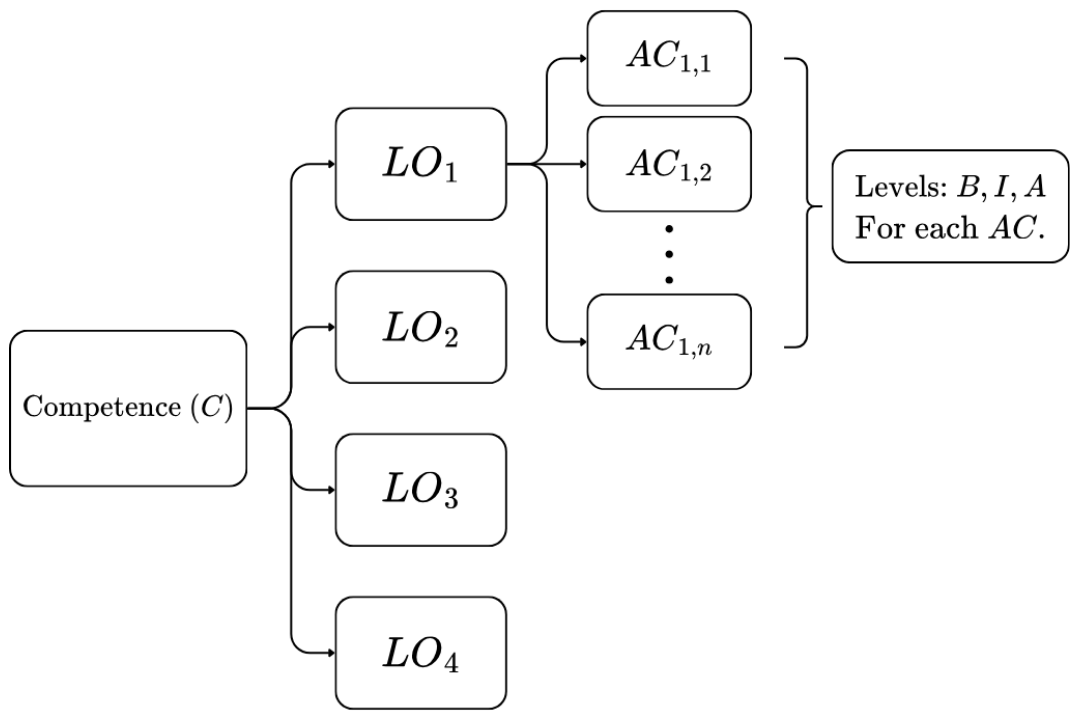
Within this process, the general rubric and the specific rubric fulfill complementary functions. The general rubric defines the assessment structure at the level of LO and AC, including the weight assigned to each criterion within the learning outcome. The specific rubric translates this structure into AI and links them to observable evidence associated with a specific problem. In this way, the method provides a procedure that connects the conceptualization of the competency with the interpretation of the evidence obtained in the assessment activities. Figure 1 presents the structure of the general rubric.
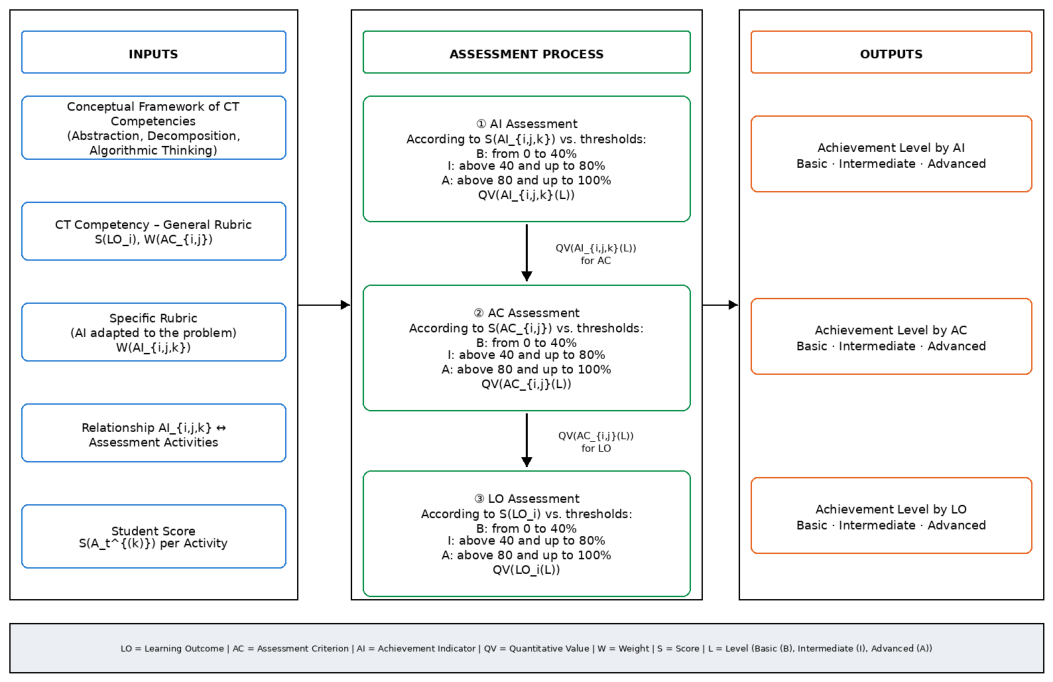
As shown in Figure 1, the general rubric establishes the assessment structure from the learning outcome to its assessment criteria and achievement levels. This structure is subsequently adapted in the specific rubric by defining the AI associated with each AC and linking them to the activities or questions used to collect evidence. Thus, the assessment method does not start with the final classification of the LO, but with the evidence obtained in the activities associated with each AI. Figure 2 presents the assessment method for Computational Thinking competencies.
To clarify the calculation and classification procedure, the method distinguishes four numerical elements. First, S ( L O i ) represents the score assigned to learning outcome L O i , which is taken as a reference for its assessment. This value is distributed among the assessment criteria that compose the LO; therefore, each A C i , j is assigned a weight W ( A C i , j ) . Second, each assessment criterion is disaggregated into achievement indicators, and each A I i , j , k is assigned a weight W ( A I i , j , k ) . Third, S ( A t ( k ) ) corresponds to the score obtained by the student in each activity or question associated with an achievement indicator. These activity scores are added to obtain S ( A I i , j , k ) , which corresponds to the score used to classify the achievement level of the indicator. Finally, Q V corresponds to the quantitative value assigned by the rubric once the achievement level has been classified.
This distinction is important because the score used at each level has a different origin. At the AI level, S ( A I i , j , k ) is obtained directly from the scores achieved by the student in the assessment activities. At the AC level, the classification score is obtained by aggregating the Q V values assigned to the AI associated with that criterion. At the LO level, the classification score is obtained by aggregating the Q V values assigned to the AC associated with that learning outcome. Therefore, W defines the maximum value or weight of a rubric component, S is the value compared with the achievement-level ranges, and Q V is the value assigned after the achievement level has been determined.
The thresholds used to classify performance into Basic, Intermediate, and Advanced levels were defined a priori as criterion-referenced percentage ranges. These ranges were established by the authors during the rubric design process, based on expert judgment and on the need to translate qualitative achievement levels into explicit quantitative decision rules. They were not statistically estimated from the sample; rather, they were used to ensure that the same proportional classification logic could be applied consistently across achievement indicators, assessment criteria, and learning outcomes.
In this sense, the Basic range, from 0% to 40% of the component weight, represents initial or limited evidence of the expected performance. The Intermediate range, above 40% and up to 80%, represents partial but sufficient evidence of achievement. The Advanced range, above 80% and up to 100%, represents consistent or consolidated evidence of achievement in relation to the expected learning outcome.
Therefore, the values 0.40, 0.80, and 1.00 are decimal expressions of percentage thresholds applied to the weight W of each component. This means that the thresholds are directly aligned with the weights assigned in the rubric: they are not fixed scores, but proportional ranges calculated from the weight of each AI, AC, or LO. Table 4 illustrates this alignment using the weights assigned to the achievement indicators of L O 1 : Interiorization.
After the achievement level of an AI has been determined, the corresponding Q V defined in the specific rubric is assigned. These Q V values are then aggregated to determine the achievement level of the corresponding AC. Subsequently, the Q V values assigned to the AC are aggregated to determine the achievement level of the LO. In this way, the method preserves traceability between the evidence obtained in the assessment activities and the final classification of the learning outcome.
The complete formal specification of this process, including notation, equations, constraints, threshold rules, and calculation procedure, is presented in Appendix A. A step-by-step illustrative example of the assessment process for L O 1 , corresponding to Interiorization, is provided in the Supplementary Materials.

4. Application of the Assessment Method to the Abstraction Competency

4.1. Context and Participants

The empirical application of the assessment method was conducted with sixth-grade students in lower secondary education at a Colombian public educational institution. In the Colombian school system, sixth grade generally corresponds to the beginning of lower secondary education, with students approximately 11 to 12 years old. The participating group consisted of 60 students, who were enrolled in the Informatics course at the time of data collection. It should be clarified that, although the participating group consisted of 60 students, 47 participations were obtained in the pre-test and 48 participations in the post-test. This was due to circumstances inherent to the classroom context, such as irregular attendance, the late incorporation of some students, incomplete questionnaires, and alternation between individual and pair-based completion, owing to the limited availability of computer equipment for individual work.
The selection of this educational level is grounded in the literature, where several studies consider the relevance of addressing computational thinking in secondary education, both to strengthen problem-solving skills and to support future educational trajectories in STEM fields (Jacobs, 2009; Kranz et al., 2012; Nesiba et al., 2015; Ribeiro Silva et al., 2018). This study focuses specifically on the Abstraction competency, considered a key dimension of CT at these ages (Angeli & Valanides, 2020; Armoni, 2012, 2013).

4.2. Structure of the Abstraction Rubrics

To carry out the assessment process for the Abstraction competency, a general rubric was constructed according to the conceptual framework presented in Table 1.
To illustrate both a general and a specific rubric, the LO of Interiorization is used as a reference. Table 5 shows an example of the general rubric and the description of the achievement levels for each assessment criterion. The rubrics for the remaining LO can be consulted in the Supplementary Materials.
As observed for the Interiorization L O , two A C were defined, each with its corresponding weight, achievement level, and description. The weight assigned to each assessment criterion follows the proportional structure defined in the assessment method. The formal specification of this weighting procedure is presented in Appendix A.
Subsequently, a specific rubric was designed using the Tower of Hanoi problem (THP) as a reference. This problem consists of three vertical towers and a set of n disks stacked on the source tower, ordered from largest to smallest, so that the largest disk is located at the base. The objective is to move the set of n disks from the source tower to the destination tower using the minimum possible number of moves, while respecting the following rules: (i) only one disk may be moved at a time and (ii) at no point may a larger disk be placed on top of a smaller one. In this regard, the relevance of using this problem to work on the Abstraction competency lies in the fact that it makes it possible to identify fundamental characteristics, model a solution strategy, and generalize the problem through the definition of different values of n disks.
Based on the above, in the specific rubric, each criterion A C i , j is decomposed into a set of achievement indicators A I i , j , k , each with an assigned weight. The formal notation used to represent this relationship is presented in Appendix A. By way of illustration, Table 6 shows an example of the specific rubric for the Interiorization LO. In this case, A C _ 1 _ 1 is decomposed into two achievement indicators A I , whereas A C _ 1 _ 2 is decomposed into three achievement indicators A I , each with its respective achievement levels and weights. Further details of this rubric and of the remaining learning outcomes of the Abstraction competency can be consulted in the Supplementary Materials.
On the other hand, to assess the Abstraction competency, four questionnaires were designed and implemented in the Moodle platform version 3.5: one questionnaire for each learning outcome, aligned with the achievement indicators A I i , j , k associated with each assessment criterion. The questionnaires are included in the Supplementary Materials.

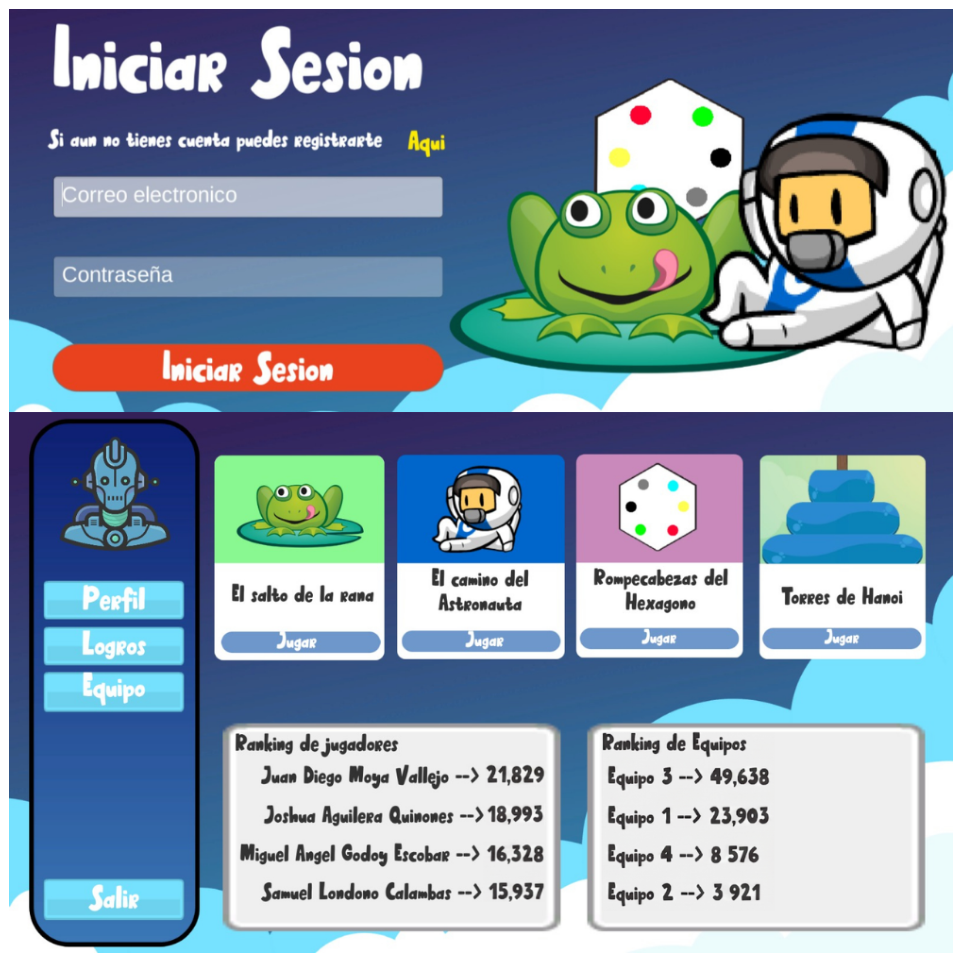
Additionally, in this process, a complementary tool was used to promote students’ interaction with a visual and interactive representation of the THP: the gamified application GamifyPlay, developed within the framework of an undergraduate thesis supervision process (Ospina Peláez & Chávez Murillo, 2022). This application contains four problems presented in game format, among which the THP is included. The application is available online: https://pcgamify.org/gamifyplay/ (accessed on 25 April 2026). It should be noted that the remaining problems can be used to assess the CT competencies defined in the proposed conceptual framework.
In the specific case of the THP, GamifyPlay incorporates graphical elements that represent the towers and disks, with the purpose of visually simulating the dynamics of the problem. Figure 3 presents some functionalities of the GamifyPlay platform.

4.3. Assessment Process for the Abstraction Competency

The application of the proposed assessment method to the Abstraction competency was carried out at two moments, referred to as the pre-test and post-test, with the aim of illustrating its application at different points in time. At each of these moments, students completed the questionnaires designed to assess the learning outcomes of the Abstraction competency. As a result, one matrix was obtained for the pre-test and another for the post-test, in which the achievement levels of the achievement indicators, assessment criteria, and learning outcomes of the Abstraction competency were recorded for each student.
Consequently, a review and data-cleaning process was conducted on the data collected in the pre-test and post-test, with the aim of ensuring comparability between the two assessment moments. To this end, the following selection criteria were defined: (i) participation in both the pre-test and the post-test; (ii) complete responses to the four questionnaires at both moments; and (iii) matching authorship between the pre-test and post-test evidence.
In this study, paired units of analysis refer to the valid response records that could be matched across the pre-test and post-test for the same participant or response unit. Therefore, a unit was considered paired only when it satisfied the three criteria described above, ensuring that the paired analysis was based on comparable repeated observations across the two assessment moments. Based on these criteria, a final sample of 30 paired units of analysis was consolidated.
Accordingly, considering the purpose of the study, the mode of completion, whether individual or in pairs, was not considered a comparison factor, but rather a condition inherent to the implementation process and context. In this sense, the unit of analysis does not strictly correspond to the individual student, but to the paired pre–post case, which makes it possible to maintain methodological consistency between the data-cleaning process, the analysis conducted, and the objective of the article, focused on illustrating the applicability of the proposed assessment method.

5. Results

This section presents the results obtained from the application of the assessment method to the Abstraction competency. Consistent with the aim of the study, the results are not interpreted in terms of intervention effectiveness or learning gains, but rather in relation to the classification of students’ performance across the learning outcomes, assessment criteria, and achievement indicators of this competency. Accordingly, the pre-test and post-test distributions by achievement level are first presented for the four learning outcomes. Next, the transition matrices between both moments are shown, followed by the comparative tables disaggregated by learning outcome.

5.1. Distribution of Achievement Levels by Learning Outcome

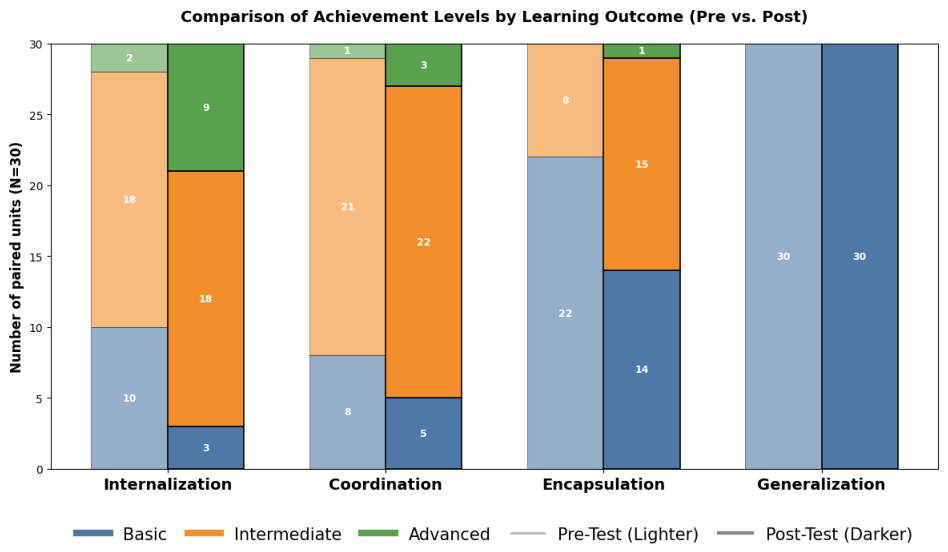
To describe how students’ performance was distributed across each learning outcome of the Abstraction competency, a comparison was conducted between the two measurement moments considered in the study: pre-test and post-test. This analysis makes it possible to observe the composition of achievement levels reached in Interiorization, Coordination, Encapsulation, and Generalization, and to identify possible changes in the distribution of the group between both moments. Figure 4 shows this comparison through stacked bars, representing, for each learning outcome, the number of students classified at the Basic, Intermediate, and Advanced levels.
The figure shows that the distribution of achievement levels differs among the four learning outcomes assessed and that this configuration varies between the pre-test and the post-test. In this sense, performance classification does not show a uniform pattern, but rather adopts different configurations depending on the learning outcome considered.
In Interiorization, the comparison between the two measurements reveals a redistribution of students across achievement levels. Overall, this variation is expressed in a lower presence of the Basic level and a greater representation of the Advanced level, while the Intermediate level maintains a similar share.
In Coordination, the distribution is concentrated mainly at the Intermediate level in both measurement moments. Although some variations are observed across levels, the general configuration of this learning outcome remains relatively stable between the pre-test and the post-test.
In Encapsulation, the comparison between the two moments shows a modification in the initial distribution of achievement levels. Whereas the Basic level predominates in the pre-test, the post-test distribution shifts toward the Intermediate level and shows the presence of the Advanced level.
In Generalization, the classification remains unchanged between both measurements, as students remain located at the same achievement level. No redistributions across levels are observed for this learning outcome.
Overall, the distributions show different configurations across the four learning outcomes. While Interiorization and Encapsulation present visible redistributions across achievement levels, Coordination maintains a more concentrated distribution at the Intermediate level, and Generalization remains unchanged between the two measurement moments.
On the other hand, to complement this analysis, transition matrices were structured for each learning outcome in order to identify the trajectories followed by students between the pre-test and the post-test. Based on this analysis, it is possible to recognize, for each learning outcome, movements, permanence, or absence of change in the achievement levels of the Abstraction competency. This is shown in Table 7.
With respect to the Interiorization learning outcome, the matrix shows that, of the 30 paired units of analysis, 15 (50.0%) moved to a higher achievement level, 13 (43.3%) remained at the same level, and 2 (6.7%) moved to a lower level. Among the 10 paired units initially located at the Basic level, 7 moved to Intermediate, 1 moved to Advanced, and 2 remained at Basic. At the Intermediate level, 10 paired units remained at that level and 7 moved to Advanced.
In the Coordination learning outcome, 9 paired units of analysis (30.0%) moved to a higher achievement level, 16 (53.3%) remained at the same level, and 5 (16.7%) moved to a lower level. Among the paired units initially located at the Basic level, 6 moved to Intermediate and 1 moved to Advanced. Among those initially classified at the Intermediate level, 15 remained at that level, 2 moved to Advanced, and 4 moved to Basic. The only paired unit initially located at the Advanced level moved to Intermediate in the post-test.
In the Encapsulation learning outcome, 12 paired units of analysis (40.0%) moved to a higher achievement level, 15 (50.0%) remained at the same level, and 3 (10.0%) moved to a lower level. Among the 22 paired units initially located at the Basic level, 11 moved to Intermediate and 11 remained at Basic. At the Intermediate level, 4 paired units remained at that level, 1 moved to Advanced, and 3 moved to Basic.
In the Generalization learning outcome, no changes were observed between the pre-test and the post-test. The 30 paired units of analysis remained at the Basic level in both measurement moments.
Taken together, the transition matrices show that the patterns of movement between achievement levels differed across learning outcomes. Interiorization presented the highest number of upward transitions, Encapsulation showed movement mainly from Basic to Intermediate, Coordination presented a greater concentration of unchanged classifications, and Generalization showed no transitions between levels.

5.2. Inferential Comparison of Pre-Test and Post-Test Achievement Levels

The Wilcoxon signed-rank test showed statistically significant differences between the pre-test and post-test for Interiorization ( W = 17.00 , p = 0.0017 , r = 0.759 ) and Encapsulation ( W = 24.00 , p = 0.0201 , r = 0.600 ). In both learning outcomes, the number of positive changes was greater than the number of negative changes, which is consistent with the descriptive redistributions observed in the transition matrices. This is shown in Table 8.
By contrast, Coordination did not show a statistically significant difference between the two assessment moments ( W = 35.00 , p = 0.2253 , r = 0.324 ), despite the presence of some positive transitions. Generalization also showed no statistically significant difference ( p = 1.0000 ), since all paired units of analysis remained at the same achievement level. These results indicate that the changes observed in the Abstraction competency were not homogeneous across all learning outcomes. Rather, statistically significant differences were concentrated in Interiorization and Encapsulation, while Coordination and Generalization remained comparatively stable at the learning outcome level.
Although the Wilcoxon test provides a complementary inferential comparison at the learning outcome level, it does not explain how the assessment criteria and achievement indicators contribute to those classifications. Therefore, the following subsection presents the results disaggregated by AC and AI. This hierarchical reading makes it possible to identify whether the statistically significant changes observed at the LO level are also reflected in the internal structure of the competency, and whether some changes remain visible only at the AC or AI.

5.3. Results Disaggregated by Assessment Criteria and Achievement Indicators

The following tables present the results disaggregated by assessment criteria. Due to the number of variables considered, the column headers are presented in abbreviated form.
Regarding the Interiorization LO, the final classification shows a reduction in the Basic level and an increase in the Advanced level, while the Intermediate level remains unchanged. At the LO level, the main variation is therefore located between Basic and Advanced. This is shown in Table 9.
At the AC level, AC_1 presents small changes: Basic decreases, Intermediate increases, and Advanced appears with a low percentage in the post-test. AC_2 shows a stronger change, with a larger decrease in Basic and a higher increase in Advanced. This indicates that the final redistribution observed in Interiorization is more strongly associated with AC_2 than with AC_1.
At the AI level, the indicators linked to AC_1 show moderate variations. AI_1_1 decreases slightly in Basic and increases in Intermediate, but it no longer presents cases at the Advanced level in the post-test. AI_1_2 decreases in Basic and increases in both Intermediate and Advanced. In AC_2, the three indicators show clearer changes. AI_2_1 decreases in Basic and Intermediate and increases in Advanced. AI_2_2 shows a marked decrease in Basic, with increases in Intermediate and Advanced. AI_2_3 decreases in Basic and Intermediate and presents the largest increase in Advanced within this LO. These AI-level results help explain why AC_2 has greater weight in the final change observed for Interiorization.
In the case of the Coordination LO, the distribution remains concentrated at the Intermediate level in both measurement moments. The Basic level decreases, while Intermediate and Advanced increase. Thus, the LO shows a moderate redistribution, but its main concentration continues to be located at the Intermediate level. This is shown in Table 10.
At the AC level, AC_1 decreases in Basic and increases in both Intermediate and Advanced. This shows movement from Basic toward the two upper levels. AC_2 also decreases in Basic, but its main increase occurs in Advanced, while Intermediate decreases.
At the AI level, the two indicators associated with AC_1 show different behaviors. AI_1_1 decreases in Basic and increases in Intermediate and Advanced. AI_1_2 also decreases in Basic, but its change is concentrated mainly in Advanced, with a slight decrease in Intermediate. In AC_2, the criterion is represented by a single indicator, AI_2_1. Therefore, the behavior of AC_2 directly follows this indicator: Basic and Intermediate decrease, while Advanced increases. These results show that the Coordination LO remains mainly at the Intermediate level, although the indicators reveal internal changes toward Advanced.
Continuing with the Encapsulation LO, the classification changes from a predominance of Basic in the pre-test to a higher presence of Intermediate in the post-test. Basic decreases, Intermediate increases, and Advanced appears with a low percentage. This is shown in Table 11.
At the AC level, both AC_1 and AC_2 show decreases in Basic and increases in Intermediate and Advanced. In AC_1, the largest change is the increase in Intermediate, followed by a smaller increase in Advanced. AC_2 follows a similar pattern, although Advanced remains limited.
At the AI level, the indicators associated with AC_1 show different internal movements. AI_1_1 changes little in Basic, decreases in Intermediate, and increases in Advanced. AI_1_2 shows a stronger decrease in Basic, with increases in Intermediate and Advanced. In AC_2, the criterion is represented by AI_2_1. This indicator decreases in Basic and increases in Intermediate and Advanced. These results indicate that the change observed in the Encapsulation LO is supported mainly by the reduction of Basic classifications in AI_1_2 and AI_2_1.
On the other hand, for the Generalization LO, the final classification remains unchanged between the pre-test and the post-test. All paired units of analysis remain at the Basic level, with no cases classified as Intermediate or Advanced. This is shown in Table 12.
At the AC level, AC_1 and AC_2 follow the same pattern as the LO. Both criteria remain fully concentrated at the Basic level in the two measurement moments. Therefore, no change is observed at the criterion level.
At the AI level, the table shows a distinction that is not visible in the aggregated classification. AI_1_1 remains practically unchanged, with almost all cases at Basic and a small percentage at Intermediate in both moments. In contrast, AI_2_1 decreases in Basic and increases in Intermediate, although Advanced remains absent. This change at the indicator level is not sufficient to modify the classification of AC_2 or the final classification of the Generalization LO.
Overall, the comparative tables allow the results to be read at three levels of detail. The LO level provides the final classification for each component of the Abstraction competency. The AC level shows how each criterion contributes to that classification. The AI level identifies specific changes that may remain hidden when only the aggregated LO result is considered. This hierarchical reading is especially clear in Generalization, where AI_2_1 changes between the pre-test and the post-test, but AC_2 and the LO remain classified at the Basic level.

6. Discussion

The application case provides evidence of the methodological applicability of the proposed competency-based assessment method specifically for the Abstraction competency. Therefore, the results should not be interpreted as evidence of the applicability of the full conceptual framework to all Computational Thinking competencies. Rather, they show how the proposed assessment structure can be operationalized in one competency through Learning Outcomes (LO), Assessment Criteria (AC), Achievement Indicators (AI), and achievement levels. In this sense, the main contribution of the application case lies in showing how the Abstraction competency can be translated into observable and classifiable evidence of student performance. This operationalization responds to a recurrent limitation in the literature: the difficulty of articulating broad conceptual definitions of CT with concrete assessment procedures (Jyrwa et al., 2025; Sheridan et al., 2024; Zhou et al., 2023).
The complementary Wilcoxon analysis supports this differentiated interpretation. The statistically significant differences observed in Interiorization and Encapsulation indicate that, for these learning outcomes, the redistributions between pre-test and post-test were not limited to descriptive variation. However, the absence of statistically significant differences in Coordination and Generalization shows that the application of the method does not imply uniform change across all components of the competency. This result reinforces the value of the proposed hierarchical assessment structure, since it allows both change and stability to be identified at the level of each learning outcome.
A relevant implication of the application case is that the method avoids reducing the Abstraction competency to a single global score. Instead, it preserves the internal structure of the competency and allows each LO to be interpreted according to the criteria and indicators that compose it. This is consistent with studies that use performance rubrics to assess CT components (Barradas et al., 2024; Songkram et al., 2024); however, the present proposal extends this approach by incorporating a formal hierarchical structure (competency → LO → AC → AI). This structure strengthens the traceability of each classification decision, an element that studies based exclusively on analytical rubrics do not always make explicit.
This proposal also differs from standardized instruments such as the BCTt (Vourletsis & Politis, 2025) or the CCTt adapted by (Rohaeti & Huda, 2025). While these instruments are oriented toward comparability and psychometric generalization, the method proposed here prioritizes coherence between the conceptual framework, the assessment task, and the interpretation of performance. This distinction is relevant because standardized instruments may face ceiling effects, gender bias, or items that do not fit the psychometric model. By contrast, the proposed method uses rubrics contextualized to the problem being assessed. Similarly, unlike Dr. Scratch 2.0 (Robles et al., 2025), whose scope is restricted to observable features of code, this method incorporates evidence obtained through activities aligned with achievement indicators.
The absence of variation in one of the learning outcomes is also methodologically informative. Rather than forcing differences across all components, the method preserves the classification produced by the evidence collected. This behavior is relevant because an assessment procedure should be able to represent both change and stability without assuming that all components of a competency evolve in the same way. This interpretation is consistent with studies that report differentiated results across CT components when using observation scales (Esther-del-Moral-Pérez et al., 2026).
The contribution of this study can be understood at two levels. At the theoretical level, the proposed framework organizes CT into three competencies—Abstraction, Decomposition, and Algorithmic Thinking—and defines each one through LO that can be linked to assessment criteria and achievement indicators. This offers an operationalizable conceptualization that addresses the predominance of broad qualitative descriptions in the literature (Curzon et al., 2019; Sheridan et al., 2024). At the practical level, the method provides a procedure for assigning achievement levels through rubrics aligned with a specific problem, which may support teachers and curriculum designers in structuring CT assessment without requiring automated assessment infrastructure.
In this sense, the distinctive contribution of the proposed method lies in its capacity to connect a competency-based conceptual framework with an assessment procedure that is hierarchical, traceable, and adaptable to specific tasks. Unlike approaches that mainly provide a global score or a general performance level, this method preserves the relationship between observable evidence, Achievement Indicators, Assessment Criteria, and Learning Outcomes. Therefore, it offers a more detailed interpretation of student performance and provides information that can be used not only to classify achievement, but also to support formative feedback and instructional decision-making.
Although the empirical application was conducted using the Tower of Hanoi problem, the assessment method is not conceptually restricted to this task. In the proposed framework, the specific problem functions as the context through which achievement indicators are operationalized. Therefore, the method could be adapted to other problems, provided that the task allows observable evidence to be aligned with the learning outcomes, assessment criteria, and achievement indicators of the competency being assessed. In the case of Decomposition, for example, future applications could use problems that require students to divide a complex situation into smaller subproblems or to recognize recursive structures. For Algorithmic Thinking, the method could be applied to tasks involving the specification of data, the organization of sequential steps, the use of iterative structures, or the verification of solutions. However, these possibilities require further empirical studies, since the present article only illustrates the application of the method to Abstraction through the Tower of Hanoi problem. Future research should therefore examine the transferability of the framework to other CT competencies, task contexts, educational levels, and types of problems.

6.1. Limitations and Future Research Directions

This study has four limitations that should be considered. First, the empirical application was limited to the Abstraction competency and to a single educational context: sixth-grade students in a Colombian institution. Therefore, the findings cannot be automatically extrapolated to other CT competencies or populations. Accordingly, the results should be interpreted as evidence of the methodological applicability of the proposed assessment method for the Abstraction competency in this specific application context, rather than as evidence of general applicability to the full CT framework.
Second, the final sample consisted of 30 paired units of analysis, which limits the statistical power of the inferential analysis and requires a cautious interpretation of the Wilcoxon results. Thus, the statistically significant changes observed in some learning outcomes should be understood as preliminary evidence within this sample, not as broadly generalizable effects.
Third, the assessment process was not conducted by multiple independent human raters. Students’ responses were collected through Moodle questionnaires aligned with the achievement indicators, and the achievement levels were assigned according to the predefined rubric structure and threshold rules of the proposed method. For this reason, inter-rater agreement was not calculated. Although this procedure reduced the dependence on subjective evaluator judgment in this application, future studies involving open-ended tasks or direct evaluator-based scoring should examine inter-rater reliability to strengthen the consistency and replicability of the assessment process.
Fourth, although the study illustrates the applicability of the proposed assessment method, it does not constitute a full validation of its psychometric properties, such as construct validity, criterion validity, internal consistency, or test–retest reliability. Therefore, the results should be interpreted as evidence of methodological applicability for the Abstraction competency, rather than as evidence of a complete validation of the assessment framework.
Based on these limitations, future research should extend the application of the method to the Decomposition and Algorithmic Thinking competencies, examine its use in different educational contexts and grade levels, include demographic variables to explore possible equity-related patterns, apply the rubric with multiple evaluators to estimate inter-rater reliability, and conduct validation studies to strengthen the theoretical and empirical robustness of the proposal.

6.2. Implications for Educational Practice and Policy

The proposed method has implications for teachers, curriculum designers, and educational policy makers interested in incorporating Computational Thinking (CT) into K–12 education. Its hierarchical structure can support the identification of specific components of a CT competency in which students may require additional guidance. In classroom practice, this information may contribute to formative feedback, instructional adjustment, and the design of reinforcement activities aligned with the assessed learning outcomes.
For teachers, the method offers a way to move from general statements about CT to more specific evidence of student performance. Instead of assigning only a global score, the assessment process makes it possible to identify how students perform in relation to Learning Outcomes, Assessment Criteria, and Achievement Indicators. This may support instructional decisions, such as revisiting a specific concept, redesigning an activity, or providing targeted feedback. In this sense, the method is consistent with assessment-oriented approaches that emphasize the need to connect CT components with observable evidence of performance (Shute et al., 2017; Tang et al., 2020; Weintrop et al., 2021).
For curriculum designers, the conceptual framework offers a structured basis for aligning CT learning outcomes, assessment criteria, achievement indicators, and assessment activities across educational trajectories. This alignment is relevant in contexts where CT is incorporated either as part of computer science education or as a transversal competency across different subject areas. International recommendations, such as the K–12 Computer Science Framework and the CSTA K–12 Computer Science Standards, emphasize the need to organize computer science education through concepts, practices, and measurable learning expectations (Computer Science Teachers Association, 2017; K–12 Computer Science Framework Steering Committee, 2016). From this perspective, the proposed framework may contribute to curriculum design by making explicit what is expected from each CT competency and how that expectation can be assessed.
The international relevance of this proposal is also connected with broader discussions on digital education, early computing education, and artificial intelligence literacy. The OECD has documented the growing interest in introducing CT from early educational stages and has emphasized the need for developmentally appropriate pedagogical approaches, teacher support, and assessment tools that are coherent with students’ age and learning context (OECD, 2022). Similarly, UNESCO has mapped government-endorsed K–12 artificial intelligence curricula and has identified CT as one of the foundational competencies commonly associated with AI education, together with data literacy, programming, and algorithmic thinking (UNESCO, 2021). These international references reinforce the need for assessment structures that do not depend exclusively on a single task, curriculum, or national context, but that can be adapted to different educational systems.
Although the empirical application of this study was conducted with sixth-grade students in Colombia and focused on the Abstraction competency, the assessment logic is not restricted to this specific context. The method can be adapted to other K–12 settings, provided that the competency, learning outcomes, assessment criteria, achievement indicators, and tasks are coherently aligned. This is particularly relevant for educational systems in which CT is incorporated through different routes, such as computer science courses, STEM initiatives, programming activities, robotics, digital education strategies, or emerging AI-related curricula. In this sense, the method does not prescribe a single curriculum; rather, it provides a structure for translating CT competencies into observable and assessable evidence.
The proposal also has implications for educational policy makers at different levels. At the local level, schools may use the framework to design institutional CT assessment plans that are coherent across grades, activities, and learning outcomes. This can support teachers and school leaders in identifying areas of strength and difficulty in students’ CT performance and in planning targeted instructional actions. At the regional or state level, educational authorities may use this type of structure to guide teacher professional development, promote common criteria for CT assessment, and support the design of curricular materials that can be adapted to different school contexts. At the national level, the framework may inform policy discussions about how CT competencies can be incorporated into curriculum standards, assessment guidelines, digital education strategies, and AI-related educational initiatives (OECD, 2022; UNESCO, 2021).
Finally, the framework may support more transparent decision-making in CT education. By linking each classification decision to explicit criteria and indicators, the method can help teachers, curriculum designers, and policy makers interpret student performance beyond isolated test scores. At the policy level, this structure may contribute to the definition of common assessment criteria, the alignment of curricular decisions, and the design of teacher professional development actions related to CT. Therefore, the main practical and policy value of the proposal lies in offering a structured and adaptable basis for designing, applying, and interpreting competency-based CT assessment across different educational contexts.

7. Conclusions

This study contributes a competency-based conceptual framework and an associated assessment method for Computational Thinking. Its main contribution lies in providing a structured way to connect the conceptual definition of CT competencies with observable evidence of student performance through Learning Outcomes (LO), Assessment Criteria (AC), Achievement Indicators (AI), and achievement levels.
The application case focused on the Abstraction competency showed that the proposed method can operationalize this hierarchical structure in an educational context. Rather than producing only a global score, the method supports a differentiated interpretation of performance by learning outcome, while preserving the relationship between indicators, criteria, and the final classification assigned to each LO.
The complementary Wilcoxon signed-rank test provided additional support for this interpretation. The statistically significant differences found in Interiorization and Encapsulation indicate that the redistributions observed in these learning outcomes were not only descriptive changes. In contrast, the absence of significant differences in Coordination and Generalization shows that the method also preserves cases of stability or absence of change. Thus, the inferential analysis reinforces the usefulness of the proposed method for identifying differentiated patterns of performance within the Abstraction competency.
From a methodological perspective, the study shows that competency-based assessment of CT can be organized through a traceable process in which each classification decision is linked to explicit criteria and indicators. This contribution is relevant for educational contexts in which CT assessment requires more than the application of isolated tests or general performance scores.
The findings also indicate that the proposed method can be applied at successive measurement moments under the same evaluative logic. This allows performance classifications to be compared without assuming that the analysis is intended to demonstrate intervention effects or infer learning gains. In this sense, the method provides a basis for monitoring CT competencies while maintaining coherence between the conceptual framework, the rubric, and the evidence collected.
Overall, the study shows that the proposed method can support a structured and traceable assessment of CT competencies by combining rubric-based classification with complementary inferential analysis when paired data are available. However, these conclusions should be interpreted within the scope of this application case. The empirical analysis was limited to the Abstraction competency, the Tower of Hanoi problem, and 30 paired units of analysis; therefore, the results should be understood as evidence of methodological applicability in this specific context, rather than as broadly generalizable evidence for the full CT framework.
Future work should extend the application of the method to the Decomposition and Algorithmic Thinking competencies, examine its behavior in other educational contexts and grade levels, and conduct validation studies to strengthen evidence regarding consistency, stability, and construct validity of the proposed assessment process.

Supplementary Materials

The following supporting information is available online at: https://drive.google.com/drive/folders/1kS9myaUHrJ5tsjd2lrDD4c9vR1xdX06T?usp=drive_link (accessed on 17 May 2026). Tables S1–S4: general and specific rubrics for the learning outcomes of the Abstraction competency; Tables S5–S8: Moodle questionnaires aligned with the learning outcomes; Table S9: step-by-step illustrative example of the assessment process for L O 1 (Interiorization); Table S10: summary of the achievement levels assigned in the illustrative example for Interiorization L O 1 .

Author Contributions

Conceptualization, Y.M.B.M. and J.F.D.F.; Methodology, Y.M.B.M., M.P.T.U. and J.F.D.F.; Validation, Y.M.B.M. and J.F.D.F.; Formal analysis, Y.M.B.M. and J.F.D.F.; Investigation, Y.M.B.M., M.P.T.U. and J.F.D.F.; Resources, Y.M.B.M.; Data curation, Y.M.B.M. and J.F.D.F.; Writing—original draft, Y.M.B.M. and M.P.T.U.; Writing—review & editing, Y.M.B.M. and M.P.T.U.; Visualization, M.P.T.U. and J.F.D.F.; Supervision, M.P.T.U. and J.F.D.F.; Project administration, M.P.T.U. and J.F.D.F.; Funding acquisition, Y.M.B.M. All authors have read and agreed to the published version of the manuscript.

Funding

This research was funded by Vice-Rector for Research of Unidad Central del Valle del Cauca under project No. PI-1300-50.2-2026-27.

Institutional Review Board Statement

Ethical review and approval were not required for this study because the empirical component was conducted as a minimal-risk educational activity within the regular context of the Informatics course and involved only anonymized academic responses. According to Article 11(a) of Resolution 8430 of 1993 of the Colombian Ministry of Health, studies involving questionnaires or similar procedures in which participants are not identified and sensitive aspects of their conduct are not addressed are classified as research without risk. No personally identifiable data were collected from the students. The implementation was authorized by the school principal and was carried out at all times under the supervision of the teacher responsible for the course.

Informed Consent Statement

Informed consent from legal guardians was not required, as participation took place within the framework of the regular academic activities of the Informatics course and had been authorized by the school principal. The activity was carried out under the supervision of the teacher responsible for the course. No personally identifiable data were collected from the students.

Data Availability Statement

The data supporting the findings of this study are included in the article and Supplementary Materials. Further inquiries can be directed to the corresponding author.

Conflicts of Interest

The authors declare no conflict of interest.

Abbreviations

The following abbreviations are used in this manuscript:
ACAssessment Criterion
ACMAssociation for Computing Machinery
AIAchievement Indicator
CTComputational Thinking
K–12Kindergarten through 12th Grade
LLevel
LOLearning Outcome
QVQuantitative Value
STEMScience, Technology, Engineering, and Mathematics
THPTower of Hanoi Problem

Appendix A. Formal Specification of the Assessment Method

Appendix A.1. Inputs of the Assessment Method

To carry out the assessment process for computational thinking competencies, a method was proposed that makes it possible to determine the achievement level attained by students in each Learning Outcome (LO) of the CT competency, while maintaining coherence between the conceptualization of the competency and its assessment. Its main contribution consists of articulating, within a single structure, the conceptual framework of the competency, a general rubric, a specific rubric, and a progressive process that begins with achievement indicators and proceeds toward learning outcomes.
Accordingly, for each computational thinking competency ( C ) to be assessed, the method requires three main inputs. In this formal specification, W ( · ) denotes the weight assigned to a rubric component, S ( · ) denotes the score used to classify the component, and Q V ( · ) denotes the quantitative value assigned by the rubric to an achievement level. For achievement indicators, S corresponds to the sum of the scores obtained by the student in the associated assessment activities. For assessment criteria and learning outcomes, S corresponds to the aggregated value obtained from the Q V values assigned at the immediately preceding level.
First, the method requires the conceptual framework, which contains the formal definition of the competency ( C ) and the set of associated Learning Outcomes,
L O i , i { 1 , 2 , 3 , 4 } .
Each L O i describes an expected student achievement regarding the competency being assessed and constitutes the highest classification unit of the method.
Second, the method requires a general rubric for the competency. This rubric is constructed by disaggregating each learning outcome L O i into a finite set of Assessment Criteria
A C i , j , j { 1 , , n i } ,
to which weights W ( A C i , j ) and quantitative values for the achievement levels Basic, Intermediate, and Advanced are assigned. The distribution of weights must satisfy the following constraint:
j = 1 n i W ( A C i , j ) = W ( L O i ) , i { 1 , 2 , 3 , 4 } .
With respect to the quantitative values associated with the achievement levels of each criterion, these are expressed as percentage proportions of its weight:
Q V ( A C i , j ( B ) ) = α W ( A C i , j ) , 0 α 0.40 ,
Q V ( A C i , j ( I ) ) = β W ( A C i , j ) , 0.40 < β 0.80 ,
Q V ( A C i , j ( A ) ) = γ W ( A C i , j ) , 0.80 < γ 1 .
Third, the method requires a specific rubric for the competency. This is constructed from the general rubric by disaggregating each criterion A C i , j into a set of Achievement Indicators
A I i , j , k , k { 1 , , m i , j } ,
to which weights W ( A I i , j , k ) and quantitative values for the Basic, Intermediate, and Advanced levels are assigned. Coherence between the general rubric and the specific rubric is ensured through the following formulation:
W ( L O i ) = j = 1 n i W ( A C i , j ) = j = 1 n i k = 1 m i , j W ( A I i , j , k ) , i { 1 , 2 , 3 , 4 } .
It is important to note that the achievement indicators are formulated according to the specific problem used to assess the CT competency.
With respect to the quantitative values of the achievement levels of each achievement indicator, they are defined as percentage proportions of its weight:
Q V ( A I i , j , k ( B ) ) = δ W ( A I i , j , k ) , 0 δ 0.40 ,
Q V ( A I i , j , k ( I ) ) = λ W ( A I i , j , k ) , 0.40 < λ 0.80 ,
Q V ( A I i , j , k ( A ) ) = σ W ( A I i , j , k ) , 0.80 < σ 1 .
Finally, for each achievement indicator A I i , j , k , there is a set of assessment activities, denoted by A t ( k ) , which corresponds to the t-th activity that assesses achievement indicator k. The score obtained by the student in each activity is denoted by S ( A t ( k ) ) . These scores must satisfy the following constraint:
0 t = 1 r i , j , k S ( A t ( k ) ) W ( A I i , j , k ) .
In summary, the general rubric and the specific rubric fulfill complementary functions within the method. The general rubric makes it possible to define the assessment at the level of learning outcomes and assessment criteria, specifying the weight of each assessment criterion for an L O i , according to Equation (A1).
For its part, the specific rubric makes it possible to move from the structure of the general rubric to the level of achievement indicators, allowing each criterion to be translated into observable evidence linked to a specific problem, according to Equation (A5).
With respect to the above, the general rubric makes it possible to demonstrate conceptual and evaluative coherence at the level of learning outcomes, while the specific rubric facilitates the operationalization of the general rubric in terms of activities and observable performances. Therefore, the method is not limited to classifying responses; rather, it explicitly provides a procedure for associating the conceptualization of the competency with the interpretation of empirical evidence.

Appendix A.2. Operation of the Assessment Method

Once the inputs have been defined, the method operates upward in three stages: achievement indicators, assessment criteria, and learning outcomes. This procedure preserves the traceability of the assessment, since each classification decision at a higher level depends on the results obtained at the immediately preceding level.
It is important to distinguish the role of S ( · ) and W ( · ) in the classification procedure. The score S ( · ) is the value that is compared with the achievement-level ranges to determine the level reached by the student. In contrast, the weight W ( · ) is not the value being classified; it represents the maximum value assigned to the rubric component and is used only as the reference for calculating the percentage thresholds. Therefore, the conditions in the following equations compare S ( · ) against ranges derived from W ( · ) . For example, if an achievement indicator has a weight W ( A I i , j , k ) = 20 , the Basic range is 0 S ( A I i , j , k ) 8 , the Intermediate range is 8 < S ( A I i , j , k ) 16 , and the Advanced range is 16 < S ( A I i , j , k ) 20 .

Appendix A.2.1. Step 1: Assessment of Achievement Indicators

For each indicator A I i , j , k , the total score obtained by the student in the activities t that assess it is calculated:
S ( A I i , j , k ) = t = 1 r i , j , k S ( A t ( k ) ) .
The score obtained by the student, S ( A I i , j , k ) , is compared with the percentage ranges defined according to the weight W ( A I i , j , k ) of the indicator in the specific rubric to determine the achievement level reached in that indicator. Formally,
Q V ( A I i , j , k ( N ) ) = Q V ( A I i , j , k ( B ) ) , if 0 S ( A I i , j , k ) 0.40 W ( A I i , j , k ) , Q V ( A I i , j , k ( I ) ) , if 0.40 W ( A I i , j , k ) < S ( A I i , j , k ) 0.80 W ( A I i , j , k ) , Q V ( A I i , j , k ( A ) ) , if 0.80 W ( A I i , j , k ) < S ( A I i , j , k ) W ( A I i , j , k ) .
This first step produces, for each indicator, an achievement level and an associated quantitative value.

Appendix A.2.2. Step 2: Assessment of Assessment Criteria

Once the performance level has been assigned to the achievement indicators associated with an assessment criterion, the score used to determine the achievement level of each A C i , j is calculated by adding the Q V values assigned to its achievement indicators:
S ( A C i , j ) = k = 1 m i , j Q V ( A I i , j , k ( L ) ) .
The resulting score S ( A C i , j ) , obtained by aggregating the Q V values of the associated indicators, is compared with the percentage ranges derived from the weight W ( A C i , j ) of the assessment criterion. Formally,
Q V ( A C i , j ( L ) ) = Q V ( A C i , j ( B ) ) , if 0 S ( A C i , j ) 0.40 W ( A C i , j ) , Q V ( A C i , j ( I ) ) , if 0.40 W ( A C i , j ) < S ( A C i , j ) 0.80 W ( A C i , j ) , Q V ( A C i , j ( A ) ) , if 0.80 W ( A C i , j ) < S ( A C i , j ) W ( A C i , j ) .
This second step produces, for each criterion, an achievement level and its associated quantitative value.

Appendix A.2.3. Step 3: Assessment of the Learning Outcome

To determine the score used to calculate the achievement level of L O i , the Q V values obtained for the criteria associated with the learning outcome are added:
S ( L O i ) = j = 1 n i Q V ( A C i , j ( L ) ) .
The achievement level attained by the student in the learning outcome L O i is obtained by comparing the aggregated score S ( L O i ) with the percentage ranges derived from the weight W ( L O i ) of the learning outcome. Formally,
Q V ( L O i ( L ) ) = Q V ( L O i ( B ) ) , if 0 S ( L O i ) 0.40 W ( L O i ) , Q V ( L O i ( I ) ) , if 0.40 W ( L O i ) < S ( L O i ) 0.80 W ( L O i ) , Q V ( L O i ( A ) ) , if 0.80 W ( L O i ) < S ( L O i ) W ( L O i ) .
The assessment method is applied independently to each L O i of the competency being assessed. Consequently, its result is not a single global level for the competency, but rather a differentiated classification by learning outcomes, which enables a more specific interpretation of student performance. As a result of this process, the assessment method generates, for each CT competency assessed:
  • The achievement level corresponding to each achievement indicator A I i , j , k ;
  • The achievement level for each assessment criterion A C i , j ;
  • The achievement level for each learning outcome L O i .
Finally, this structure facilitates the assessment process for CT competencies, as it explicitly connects the conceptualization of each CT competency in the proposed framework, the construction of the rubrics, and the procedure for classifying achievement levels.

References

  1. Alqarni, A. (2025). Network dynamics and the impact of gamification on computational thinking and visual programming in primary education. Journal of Educational Computing Research, 63(5), 1186–1218. [Google Scholar] [CrossRef] [Scilit]
  2. Anderson, L. W., & Krathwohl, D. R. (Eds.). (2001). A taxonomy for learning, teaching, and assessing: A revision of bloom’s taxonomy of educational objectives. Longman. ISBN 978-0-8013-1903-7. [Google Scholar]
  3. Angeli, C., & Valanides, N. (2020). Developing young children’s computational thinking with educational robotics: An interaction effect between gender and scaffolding strategy. Computers in Human Behavior, 105, 105954. [Google Scholar] [CrossRef] [Scilit]
  4. Anistyasari, Y., Ekohariadi, E., Asto Buditjahjanto, I. G. P., & Hidayati, S. C. (2021, June 22–23). Exploring the psychometric properties of computational thinking assessment in introductory programming. 2021 International e-Engineering Education Services Conference (e-Engineering) (pp. 88–93), Petra, Jordan. [Google Scholar] [CrossRef] [Scilit]
  5. Armoni, M. (2012). Teaching computer science in kindergarten: How early can the pipeline begin? ACM Inroads, 3(4), 18–19. [Google Scholar] [CrossRef] [Scilit]
  6. Armoni, M. (2013). On teaching abstraction in computer science to novices. Journal of Computers in Mathematics and Science Teaching, 32(3), 265–284. [Google Scholar]
  7. Atmatzidou, S., & Demetriadis, S. (2016). Advancing students computational thinking skills through educational robotics: A study on age and gender relevant differences. Robotics and Autonomous Systems, 75, 661–670. [Google Scholar] [CrossRef] [Scilit]
  8. Baratè, A., Ludovico, L. A., & Malchiodi, D. (2017). Fostering computational thinking in primary school through a LEGO®-based music notation. Procedia Computer Science, 112, 1334–1344. [Google Scholar] [CrossRef] [Scilit]
  9. Barradas, R., Lencastre, J. A., Soares, S. P., & Valente, A. (2024). Arduino-based mobile robotics for fostering computational thinking development: An empirical study with elementary school students using problem-based learning across europe. Robotics, 13(11), 159. [Google Scholar] [CrossRef] [Scilit]
  10. Bloom, B. S., Engelhart, M. D., Furst, E. J., Hill, W. H., & Krathwohl, D. R. (1956). Taxonomy of educational objectives: The classification of educational goals. Handbook I: Cognitive domain. David McKay Company. [Google Scholar]
  11. Bonner, S., Chen, P., Jones, K., & Milonovich, B. (2021). Formative assessment of computational thinking: Cognitive and metacognitive processes. Applied Measurement in Education, 34(1), 27–45. [Google Scholar] [CrossRef] [Scilit]
  12. Booch, G. (1994). Object-oriented analysis and design with applications (2nd ed.). Addison-Wesley. [Google Scholar]
  13. Brennan, K., & Resnick, M. (2012). New frameworks for studying and assessing the development of computational thinking. In Proceedings of the 2012 annual meeting of the American educational research association (AERA), Vancouver, BC, Canada (pp. 1–25). AERA. Available online: https://scratched.gse.harvard.edu/ct/files/AERA2012.pdf (accessed on 13 January 2025).
  14. Cakiroglu, U., Cevik, I., Koseli, E., & Aydin, M. (2021). Understanding students abstractions in block-based programming environments: A performance based evaluation. Thinking Skills and Creativity, 41, 100888. [Google Scholar] [CrossRef] [Scilit]
  15. Ching, Y. H., & Hsu, Y. C. (2024). Educational robotics for developing computational thinking in young learners: A systematic review. TechTrends, 68(3), 423–434. [Google Scholar] [CrossRef] [Scilit]
  16. Clear, A., Parrish, A., Impagliazzo, J., Wang, P., Ciancarini, P., Cuadros-Vargas, E., Frezza, S., Gal-Ezer, J., Takada, S., Pears, A., & Topi, H. (2020). Computing curricula 2020 (CC2020): Paradigms for future computing curricula. ACM/IEEE Computer Society. [Google Scholar] [CrossRef] [Scilit]
  17. Computer Science Teachers Association. (2017). CSTA K–12 computer science standards, revised 2017. Computer Science Teachers Association. Available online: https://csteachers.org/k12standards/ (accessed on 23 January 2026).
  18. Corrales-Álvarez, M., Ocampo, L. M., & Cardona-Torres, S. A. (2024). Definiciones del pensamiento computacional: Una revisión de la literatura. Revista EIA, 21(42), 1–24. [Google Scholar] [CrossRef] [Scilit]
  19. Curzon, P., Bell, T., Waite, J., & Dorling, M. (2019). Computational thinking. In The Cambridge handbook of computing education research (pp. 513–546). Cambridge University Press. [Google Scholar] [CrossRef] [Scilit]
  20. Çakiroğlu, Ü., & Çevik, İ. (2022). A framework for measuring abstraction as a sub-skill of computational thinking in block-based programming environments. Education and Information Technologies, 27(7), 9455–9484. [Google Scholar] [CrossRef] [Scilit]
  21. de Araujo, A. L. S. O., Andrade, W. L., & Guerrero, D. D. S. (2016). A systematic mapping study on assessing computational thinking abilities. In 2016 IEEE frontiers in education conference (FIE) (pp. 1–9). IEEE. [Google Scholar] [CrossRef] [Scilit]
  22. Dubinsky, E. (1991). Reflective abstraction in advanced mathematical thinking. In D. Tall (Ed.), Advanced mathematical thinking (pp. 95–126). Springer. [Google Scholar] [CrossRef] [Scilit]
  23. Duckworth, D., & Fraillon, J. (2024). Computational thinking framework. In IEA international computer and information literacy study 2023: Assessment framework (pp. 35–43). Springer Nature Switzerland. [Google Scholar] [CrossRef] [Scilit]
  24. Durak, H. Y., & Saritepeci, M. (2018). Analysis of the relation between computational thinking skills and various variables with the structural equation model. Computers and Education, 116, 191–202. [Google Scholar] [CrossRef] [Scilit]
  25. Esther-del-Moral-Pérez, M., López-Bouzas, N., & Castañeda-Fernández, J. (2026). Game-based storytelling with a robot character: Activating computational thinking in young children. Early Childhood Education Journal, 54, 1293–1312. [Google Scholar] [CrossRef] [Scilit]
  26. Ezeamuzie, N. O., & Leung, J. S. C. (2022). Computational thinking through an empirical lens: A systematic review of literature. Journal of Educational Computing Research, 60(2), 481–511. [Google Scholar] [CrossRef] [Scilit]
  27. Gibson, J. J. (1979). The ecological approach to visual perception. Houghton Mifflin. [Google Scholar] [CrossRef] [Scilit]
  28. Gomez, A., Guzman-Jimenez, R., & Cardenas-Garro, J. (2025). Designing a high school computational thinking test using evidence-centered design. IET Conference Proceedings, 2025(4), 17–24. [Google Scholar] [CrossRef] [Scilit]
  29. Gün-Tosik, E., & Güyer, T. (2024). The effect of computer science unplugged on abstraction as a sub-component of computational thinking. Thinking Skills and Creativity, 53, 101552. [Google Scholar] [CrossRef] [Scilit]
  30. Hamed, A. S. A., Wong, S. L., Khambari, M. N. M., Abd Rahim, N. A., Khalid, F., & Moses, P. (2025). A bibliometric analysis of computational thinking skills: Definition, components and assessment tools. Research and Practice in Technology Enhanced Learning, 20, 35. [Google Scholar] [CrossRef] [Scilit]
  31. Jacobs, P. (2009). Building excitement, experience and expertise in computational science among middle and high school students. In Computational science—ICCS 2009 (pp. 15–24). Springer. [Google Scholar] [CrossRef] [Scilit]
  32. Jyrwa, J. J. R., Jayaraman, C., & Joseph, A. (2025). A comprehensive analysis on computational thinking in education: Open issues and challenges. Engineering Proceedings, 107, 6. [Google Scholar] [CrossRef] [Scilit]
  33. K–12 Computer Science Framework Steering Committee. (2016). K–12 computer science framework. Association for Computing Machinery, Code.org, Computer Science Teachers Association, Cyber Innovation Center, and National Math and Science Initiative. [Google Scholar] [CrossRef]
  34. Kazimoglu, C., Kiernan, M., Bacon, L., & MacKinnon, L. (2012). Learning programming at the computational thinking level via digital game-play. Procedia Computer Science, 9, 522–531. [Google Scholar] [CrossRef] [Scilit]
  35. Kong, S.-C. (2016). A framework of curriculum design for computational thinking development in K-12 education. Journal of Computers in Education, 3(4), 377–394. [Google Scholar] [CrossRef] [Scilit]
  36. Kotsopoulos, D., Floyd, L., Khan, S., Namukasa, I. K., Somanath, S., Weber, J., & Yiu, C. (2017). A pedagogical framework for computational thinking. Digital Experiences in Mathematics Education, 3(2), 154–171. [Google Scholar] [CrossRef] [Scilit]
  37. Kranz, S., Tabor, C., Duval, A., Lim, K. H., Elizabethwagler, A., & Freudenthal, E. A. (2012). Impact-math: Games & activities that motivate exploration of foundational algebra concepts while inadvertently scaffolding computational thinking and engineered design. In 2012 ASEE annual conference & exposition. ASEE Conferences. [Google Scholar]
  38. Lai, R. P. Y., & Ellefson, M. R. (2023). How multidimensional is computational thinking competency? A bi-factor model of the computational thinking challenge. Journal of Educational Computing Research, 61(2), 259–282. [Google Scholar] [CrossRef] [Scilit]
  39. Ministerio de Educación Nacional. (2019). Hacia la consolidación del ecosistema nacional de innovación educativa. Available online: https://www.mineducacion.gov.co/1780/articles-363488_recurso_32.pdf (accessed on 10 April 2026).
  40. Ministerio de Educación Nacional. (2023). Memorando de entendimiento entre el ministerio de educación y fedesoft. Available online: https://www.mineducacion.gov.co/portal/salaprensa/Comunicados/415822:Ministerio-de-Educacion-y-Fedesoft-firman-alianza-para-formacion-de-8-000-estudiantes-en-pensamiento-computacional (accessed on 26 April 2026).
  41. Ministerio de las TIC. (2024). Estrategia código verde. Available online: https://mintic.gov.co/colombiaprograma/ (accessed on 26 April 2026).
  42. National Research Council. (2011). Report of a workshop on the pedagogical aspects of computational thinking. National Academies Press. [Google Scholar] [CrossRef] [Scilit]
  43. Nesiba, N., Pontelli, E., & Staley, T. (2015). DISSECT: Exploring the relationship between computational thinking and English literature in K-12 curricula. In 2015 IEEE frontiers in education conference (FIE) (pp. 1–8). IEEE. [Google Scholar] [CrossRef] [Scilit]
  44. Newell, A., & Simon, H. A. (1972). Human problem solving. Prentice Hall. [Google Scholar]
  45. Ng, O. L., Leung, A., & Ye, H. (2023). Exploring computational thinking as a boundary object between mathematics and computer programming for STEM teaching and learning. ZDM—Mathematics Education, 55(7), 1315–1329. [Google Scholar] [CrossRef] [Scilit]
  46. Nicastro, F., Baranauskas, M. C. C., & da Silva Torres, R. (2018). A methodology to conduct computational thinking activities in children’s educational context. In Proceedings of the 10th international conference on computer supported education (CSEDU 2018) (Vol. 2, pp. 309–316). SCITEPRESS. [Google Scholar] [CrossRef] [Scilit]
  47. OECD. (2022). The state of the field of computational thinking in early childhood education. OECD Publishing. [Google Scholar] [CrossRef]
  48. Ospina Peláez, C. A., & Chávez Murillo, J. S. (2022). Aplicación gamificada para el apoyo del proceso de enseñanza en competencias del pensamiento computacional [Unpublished undergraduate thesis]. Universidad del Valle.
  49. Palts, T., & Pedaste, M. (2020). A model for developing computational thinking skills. Informatics in Education, 19(1), 113–128. [Google Scholar] [CrossRef] [Scilit]
  50. Piatti, A., Adorni, G., El-Hamamsy, L., Negrini, L., Assaf, D., Gambardella, L., & Mondada, F. (2022). The CT-cube: A framework for the design and the assessment of computational thinking activities. Computers in Human Behavior Reports, 5, 100166. [Google Scholar] [CrossRef] [Scilit]
  51. Ribeiro Silva, L., Pedro Da Silva, A., Toda, A., & Isotani, S. (2018). Impact of teaching approaches to computational thinking on high school students: A systematic mapping. In Proceedings of the 2018 IEEE 18th international conference on advanced learning technologies (ICALT) (pp. 285–289). IEEE. [Google Scholar] [CrossRef] [Scilit]
  52. Rich, P. J., Egan, G., & Ellsworth, J. (2019). A framework for decomposition in computational thinking. In Proceedings of the 2019 ACM conference on innovation and technology in computer science education (pp. 416–421). ACM. [Google Scholar] [CrossRef] [Scilit]
  53. Robles, G., Pons, G., Escobar-Morales, D., Harteveld, C., & Troiano, G. M. (2025). Dr. Scratch 2.0 (CT4ALL): Advanced modes and rubrics for assessing computational thinking in Scratch projects. SoftwareX, 32, 102359. [Google Scholar] [CrossRef] [Scilit]
  54. Rohaeti, E., & Huda, N. (2025). Assessing computational thinking skills of science and mathematics upper-secondary school students. European Journal of Science and Mathematics Education, 13(4), 289–303. [Google Scholar] [CrossRef] [Scilit]
  55. Santaengracia, J. J., Palop, B., García, T., Rodríguez Pérez, C., & Rodríguez-Muñiz, L. J. (2025). Bebras-based assessment for computational thinking: Performance and gender analysis. Education Sciences, 15(7), 899. [Google Scholar] [CrossRef] [Scilit]
  56. Selby, C., & Woollard, J. (2013). Computational thinking: The developing definition. University of Southampton. [Google Scholar]
  57. Sheridan, F., Stynes, P., Pathak, P., & Quille, K. (2024). Computational thinking assessment tools: A systematic review of the literature (initial findings). In Proceedings of the United Kingdom and Ireland computing education research conference (UKICER 2024). ACM. [Google Scholar] [CrossRef] [Scilit]
  58. Shute, V. J., Sun, C., & Asbell-Clarke, J. (2017). Demystifying computational thinking. Educational Research Review, 22, 142–158. [Google Scholar] [CrossRef] [Scilit]
  59. Simon, H. A. (1962). The architecture of complexity. Proceedings of the American Philosophical Society, 106(6), 467–482. Available online: https://www.jstor.org/stable/985254 (accessed on 10 April 2026).
  60. Songkram, N., Upapong, S., Ku, H.-Y., Aulpaijidkul, N., Chattunyakit, S., & Songkram, N. (2024). Unlocking the power of robots: Enhancing computational thinking through innovative teaching methods. Interactive Learning Environments, 32(10), 7604–7621. [Google Scholar] [CrossRef] [Scilit]
  61. Tang, X., Yin, Y., Lin, Q., Hadad, R., & Zhai, X. (2020). Assessing computational thinking: A systematic review of empirical studies. Computers & Education, 148, 103798. [Google Scholar] [CrossRef] [Scilit]
  62. Tedre, M., & Denning, P. J. (2016). The long quest for computational thinking. In Proceedings of the 16th koli calling international conference on computing education research (pp. 120–129). ACM. [Google Scholar] [CrossRef] [Scilit]
  63. Tsarava, K., Moeller, K., & Ninaus, M. (2019). Board games for training computational thinking. In International conference on games and learning alliance (pp. 90–100). Springer. [Google Scholar] [CrossRef] [Scilit]
  64. Tversky, A. (1977). Features of similarity. Psychological Review, 84(4), 327–352. [Google Scholar] [CrossRef]
  65. UNESCO. (2021). K–12 AI curricula: A mapping of government-endorsed AI curricula. UNESCO. Available online: https://unesdoc.unesco.org/ark:/48223/pf0000380602 (accessed on 17 May 2026).
  66. Vourletsis, I., & Politis, P. (2025). Greek translation, cultural adaptation, and psychometric validation of beginners computational thinking test (BCTt). Education and Information Technologies, 30, 2211–2235. [Google Scholar] [CrossRef] [Scilit]
  67. Weintrop, D., Beheshti, E., Horn, M., Orton, K., Jona, K., Trouille, L., & Wilensky, U. (2016). Defining computational thinking for mathematics and science classrooms. Journal of Science Education and Technology, 25(1), 127–147. [Google Scholar] [CrossRef] [Scilit]
  68. Weintrop, D., Rutstein, D., Bienkowski, M., & McGee, S. (2021). Assessment of computational thinking. In Computational thinking in education (pp. 90–111). Routledge. [Google Scholar] [CrossRef] [Scilit]
  69. Wing, J. M. (2006). Computational thinking. Communications of the ACM, 49(3), 33–35. [Google Scholar] [CrossRef] [Scilit]
  70. Wing, J. M. (2008). Computational thinking and thinking about computing. Philosophical Transactions of the Royal Society A: Mathematical, Physical and Engineering Sciences, 366(1881), 3717–3725. [Google Scholar] [CrossRef] [Scilit]
  71. Wong, G. K. W. (2024). Amplifying children’s computational problem-solving skills: A hybrid-based design for programming education. Education and Information Technologies, 29, 1761–1793. [Google Scholar] [CrossRef] [Scilit]
  72. Yourdon, E. (1975). Structured design. Yourdon Press. [Google Scholar]
  73. Zhang, X., Aivaloglou, F., & Specht, M. (2024). A systematic umbrella review on computational thinking assessment in higher education. European Journal of STEM Education, 9(1), 2. [Google Scholar] [CrossRef] [Scilit]
  74. Zhang, X., Chen, Y., Hu, L., Hwang, G.-J., & Tu, Y.-F. (2025). Developing preschool children’s computational thinking and executive functions: Unplugged vs. robot programming activities. International Journal of STEM Education, 12, 10. [Google Scholar] [CrossRef] [Scilit]
  75. Zhou, X., Zhang, W., Wang, S., & Chen, H. (2023). Construction and application of a computational thinking assessment framework from the perspective of the iceberg model. In 2023 5th international workshop on artificial intelligence and education (WAIE) (pp. 96–100). IEEE. [Google Scholar] [CrossRef] [Scilit]
  76. Zúñiga Muñoz, R. F., Hurtado Alegría, J. A., Collazos, C. A., & Fardoun, H. (2019). ChildProgramming Evolution, A method to increase the computational thinking skills in school. In Human-computer interaction: 4th iberoamerican workshop, HCI-collab 2018 (pp. 57–69). Springer. [Google Scholar] [CrossRef] [Scilit]
Figure 1. Structure of the general rubric for each CT competency.
Education 16 00871 g001
Figure 2. Inputs, process, and outputs of the assessment method for Computational Thinking competencies.
Education 16 00871 g002
Figure 3. GamifyPlay (Ospina Peláez & Chávez Murillo, 2022).
Education 16 00871 g003
Figure 4. Distribution of achievement levels by learning outcome in the pre-test and post-test.
Education 16 00871 g004
Table 1. Learning Outcomes—Abstraction.
Competency C1: Abstraction
Models a problem by identifying its core and enabling movement between different levels of detail in order to solve it using computation.
LODescription of the LO
LO_1 (Interiorization)Formally expresses a model of a problem by identifying its fundamental characteristics and using symbolic or formal language for this purpose.
LO_2 (Coordination)Formally expresses a model of a problem by constructing composite abstractions through the coordination of existing abstractions.
LO_3 (Encapsulation)Formally expresses a model of a problem by constructing new abstractions through the conversion of a dynamic process or processes into a static object.
LO_4 (Generalization)Formally expresses a model of a collection of problems by applying a representation schema from a specific problem to produce a general model.
Table 2. Learning Outcomes—Decomposition.
Competency C2: Decomposition
Models the solution to a problem as the composition of solutions to simpler or less complex problems in order to solve it using computation.
LODescription of the LO
LO_1 (Subproblems)Models the solution to a problem as the sequential composition of solutions to a finite number of simpler independent problems (subproblems).
LO_2 (Iteration)Models the solution to a problem as the sequential composition of solutions to simpler problems, ending with a problem of the same type but smaller in size.
LO_3 (Simple recursion)Models the solution to a problem as a sequential composition in which one of the steps (not the last one) is the solution to a problem of the same type but smaller in size.
LO_4 (Multiple recursion)Models the solution to a problem as the composition of solutions in which at least two correspond to problems of the same type but smaller in size than the original.
Table 3. Learning Outcomes—Algorithmic Thinking.
Competency C3: Algorithmic Thinking
Designs algorithmic solutions to a problem based on models derived from the application of decomposition and/or abstraction competencies.
LODescription of the LO
LO_1 (Specification)Designs algorithmic solutions by specifying data types according to the model proposed through the abstraction and/or decomposition competency.
LO_2 (Sequential design)Designs algorithmic solutions by defining the sequence of steps organized according to an algorithmic approach for a particular problem.
LO_3 (Iterative design)Designs algorithmic solutions with an iterative approach using nested conditionals and repetition structures.
LO_4 (Verification)Designs algorithmic solutions by verifying the correctness of the algorithm based on the solution approach and the supported input data types.
Table 4. Threshold ranges for the achievement indicators of L O 1 : Interiorization.
Assessment CriterionAchievement IndicatorWeight
W (AI)
BasicIntermediateAdvanced
A C 1 , 1 A I 1 , 1 , 1 10 0 S ( A t ( k ) ) 4 4 < S ( A t ( k ) ) 8 8 < S ( A t ( k ) ) 10
A C 1 , 1 A I 1 , 1 , 2 20 0 S ( A t ( k ) ) 8 8 < S ( A t ( k ) ) 16 16 < S ( A t ( k ) ) 20
A C 1 , 2 A I 1 , 2 , 1 15 0 S ( A t ( k ) ) 6 6 < S ( A t ( k ) ) 12 12 < S ( A t ( k ) ) 15
A C 1 , 2 A I 1 , 2 , 2 15 0 S ( A t ( k ) ) 6 6 < S ( A t ( k ) ) 12 12 < S ( A t ( k ) ) 15
A C 1 , 2 A I 1 , 2 , 3 40 0 S ( A t ( k ) ) 16 16 < S ( A t ( k ) ) 32 32 < S ( A t ( k ) ) 40
Note: S ( A t ( k ) ) represents the score obtained by the student in the activities associated with the corresponding achievement indicator. The table does not report a student’s results; it only illustrates how the thresholds allow the assignment of the quantitative value Q V that represents each achievement level of the AI.
Table 5. General rubric for L O 1 : Interiorization.
ACWAssessment CriterionBasicIntermediateAdvanced
L O 1 : Interiorization. Formally expresses a model of a problem by identifying its fundamental characteristics and using symbolic or formal language. Assigned score: 100.
A C 1 , 1 30Identifies the fundamental characteristics of a problem and justifies why they are essential. Q V = 8 . Identifies some characteristics, but has difficulty justifying why they are fundamental. Q V = 15 . Identifies most characteristics, but still has difficulty justifying some of them. Q V = 30 . Identifies the fundamental characteristics and clearly justifies their relevance.
A C 1 , 2 70Uses symbolic language to represent fundamental characteristics and define valid solution states. Q V = 25 . Has difficulty using symbolic language and representing valid solution states. Q V = 40 . Represents some characteristics symbolically, but has difficulty with some valid solution states. Q V = 70 . Correctly represents the characteristics and valid solution states using symbolic language.
Note: W denotes the weight assigned to each assessment criterion, and Q V denotes the quantitative value assigned to each achievement level.
Table 6. Specific rubric for LO_1: Interiorization.
LO_1Assessment CriterionAchievement IndicatorBasicIntermediateAdvanced
InteriorizationAC_1_1 ( W = 30 ).AI_1_1_1 ( W = 10 ).B ( Q V = 3 ).I ( Q V = 5 ).A ( Q V = 10 ).
AI_1_1_2 ( W = 20 ).B ( Q V = 5 ).I ( Q V = 10 ).A ( Q V = 20 ).
AC_1_2 ( W = 70 ).AI_1_2_1 ( W = 15 ).B ( Q V = 5 ).I ( Q V = 8 ).A ( Q V = 15 ).
AI_1_2_2 ( W = 15 ).B ( Q V = 5 ).I ( Q V = 8 ).A ( Q V = 15 ).
AI_1_2_3 ( W = 40 ).B ( Q V = 15 ).I ( Q V = 24 ).A ( Q V = 40 ).
Table 7. Transition matrix by learning outcome.
Learning OutcomePrePost BPost IPost A
InteriorizationB271
I1107
A011
CoordinationB161
I4152
A010
EncapsulationB11110
I341
A000
GeneralizationB3000
I000
A000
Table 8. Wilcoxon signed-rank test for paired pre-test and post-test comparisons by learning outcome.
Learning OutcomenPos.Neg.TiesWzpr
Interiorization301521317.003.1300.00170.759
Coordination30951635.001.2130.22530.324
Encapsulation301231524.002.3240.02010.600
Generalization3000300.000.0001.00000.000
Note: Achievement levels were ordinally coded as Basic = 1, Intermediate = 2, and Advanced = 3. Pos. indicates positive changes from pre-test to post-test, Neg. indicates negative changes, and Ties indicates paired cases with no change. The Wilcoxon signed-rank test was applied as a two-tailed test with α = 0.05 . The reported p values were obtained using the normal approximation associated with the z statistic. The effect size was calculated as r = | z | / N , where N corresponds to the number of non-zero paired differences. For Generalization, all paired differences were zero; therefore, the row is reported descriptively as absence of change.
Table 9. Comparative table—Interiorization.
GroupComp.%B Pre%I Pre%A Pre%B Post%I Post%A PostΔ pp BΔ pp IΔ pp A
AI_AC_1Level_AI_1_173.3%20.0%6.7%70.0%30.0%0.0%−3.3%10.0%−6.7%
Level_AI_1_250.0%50.0%0.0%40.0%56.7%3.3%−10.0%6.7%3.3%
AC_1Level_AC_150.0%50.0%0.0%43.3%53.3%3.3%−6.7%3.3%3.3%
AI_AC_2Level_AI_2_156.7%40.0%3.3%46.7%33.3%20.0%−10.0%−6.7%16.7%
Level_AI_2_246.7%43.3%10.0%20.0%46.7%33.3%−26.7%3.3%23.3%
Level_AI_2_336.7%43.3%20.0%16.7%36.7%46.7%−20.0%−6.7%26.7%
AC_2Level_AC_233.3%60.0%6.7%10.0%56.7%33.3%−23.3%−3.3%26.7%
LOInteriorization33.3%60.0%6.7%10.0%60.0%30.0%−23.3%0.0%23.3%
Note: In this table, Group refers to the grouping category, and Comp. stands for the specific component evaluated. Additionally, % represents the percentage obtained, while Δ pp indicates the variation in percentage points between the pre- and post-assessments.
Table 10. Comparative table—Coordination.
GroupComp.%B Pre%I Pre%A Pre%B Post%I Post%A PostΔ pp BΔ pp IΔ pp A
AI_AC_1Level_AI_1_150.0%46.7%3.3%33.3%50.0%16.7%−16.7%3.3%13.3%
Level_AI_1_260.0%16.7%23.3%43.3%13.3%43.3%−16.7%−3.3%20.0%
AC_1Level_AC_166.7%30.0%3.3%50.0%36.7%13.3%−16.7%6.7%10.0%
AI_AC_2Level_AI_2_123.3%56.7%20.0%16.7%50.0%33.3%−6.7%−6.7%13.3%
AC_2Level_AC_223.3%56.7%20.0%16.7%50.0%33.3%−6.7%−6.7%13.3%
LOCoordination26.7%70.0%3.3%16.7%73.3%10.0%−10.0%3.3%6.7%
Note: In this table, Group refers to the grouping category, and Comp. stands for the specific component evaluated. Additionally, % represents the percentage obtained, while Δ pp indicates the variation in percentage points between the pre- and post-assessments.
Table 11. Comparative table—Encapsulation.
GroupComp.%B Pre%I Pre%A Pre%B Post%I Post%A PostΔ pp BΔ pp IΔ pp A
AI_AC_1Level_AI_1_130.0%63.3%6.7%26.7%50.0%23.3%−3.3%−13.3%16.7%
Level_AI_1_260.0%23.3%16.7%36.7%40.0%23.3%−23.3%16.7%6.7%
AC_1Level_AC_160.0%36.7%3.3%40.0%50.0%10.0%−20.0%13.3%6.7%
AI_AC_2Level_AI_2_173.3%26.7%0.0%53.3%40.0%6.7%−20.0%13.3%6.7%
AC_2Level_AC_273.3%26.7%0.0%53.3%40.0%6.7%−20.0%13.3%6.7%
LOEncapsulation73.3%26.7%0.0%46.7%50.0%3.3%−26.7%23.3%3.3%
Note: In this table, Group refers to the grouping category, and Comp. stands for the specific component evaluated. Additionally, % represents the percentage obtained, while Δ pp indicates the variation in percentage points between the pre- and post-assessments.
Table 12. Comparative table—Generalization.
GroupComp.%B Pre%I Pre%A Pre%B Post%I Post%A PostΔ pp BΔ pp IΔ pp A
AI_AC_1Level_AI_1_196.7%3.3%0.0%96.7%3.3%0.0%0.0%0.0%0.0%
AC_1Level_AC_1100.0%0.0%0.0%100.0%0.0%0.0%0.0%0.0%0.0%
AI_AC_2Level_AI_2_173.3%26.7%0.0%63.3%36.7%0.0%−10.0%10.0%0.0%
AC_2Level_AC_2100.0%0.0%0.0%100.0%0.0%0.0%0.0%0.0%0.0%
LOGeneralization100.0%0.0%0.0%100.0%0.0%0.0%0.0%0.0%0.0%
Note: In this table, Group refers to the grouping category, and Comp. stands for the specific component evaluated. Additionally, % represents the percentage obtained, while Δ pp indicates the variation in percentage points between the pre- and post-assessments.
Disclaimer/Publisher’s Note: The statements, opinions and data contained in all publications are solely those of the individual author(s) and contributor(s) and not of MDPI and/or the editor(s). MDPI and/or the editor(s) disclaim responsibility for any injury to people or property resulting from any ideas, methods, instructions or products referred to in the content.