Exploring Curriculum Implementation for Learners with Intellectual Disability in South Africa



Abstract
1. Introduction
2. Curriculum Policy Background
Current Curricula for Learners with ID in South Africa
- (a)
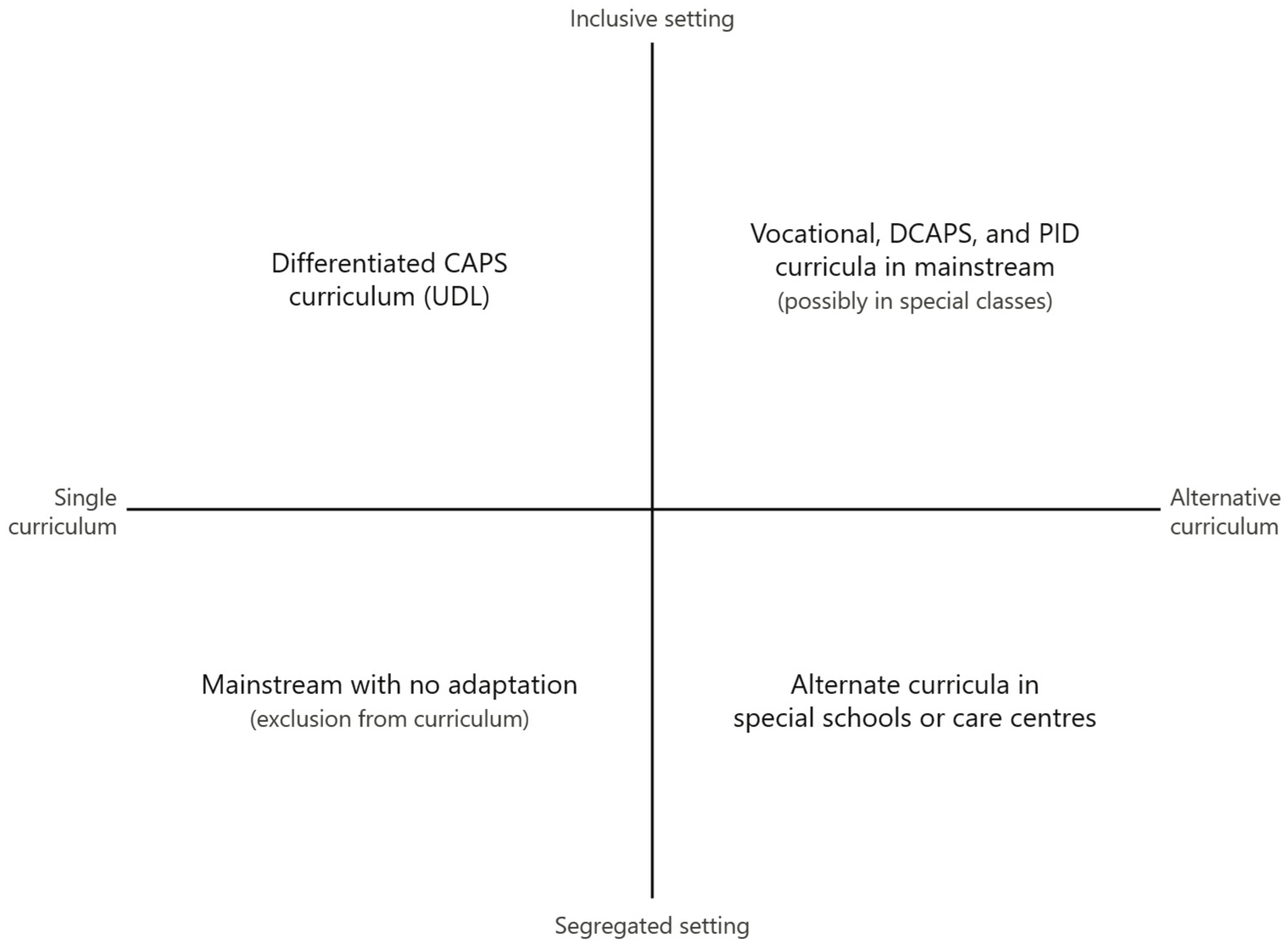
- Learners with severe and profound ID are offered the learning programme for learners with profound intellectual disability, which is largely delivered at special care centres.
- (b)
- The Curriculum and Assessment Policy Statement for Learners with Severe Intellectual Disabilities is being piloted in special schools for learners with severe intellectual disability.
- (c)
- The needs of learners with mild to moderate ID are intended to be addressed through the Occupational Stream for Learners with Mild to Moderate Intellectual disability, which is also being developed as a third stream of education within the national curriculum.
3. Materials and Methods
3.1. Recruitment, Enrolment, and Informed Consent Procedures
3.2. Data Collection and Analysis
4. Results
4.1. Separate Curriculum Goals and Learner Placement
‘I went to (name of school with-held) Primary School, it is classified under normal schools and then from there I was sent here (School of Skills).’(Learner 2)
‘It was not the same as (name of a mainstream school). In (name of a mainstream school), we did the normal high school subjects and those were difficult, and in (name of a school of skills), they focused on subjects that have to do with our hands [skills subjects]. They were not focused on grades, you understand right? It was not the same as normal schools [mainstream school] …… When I moved to the Western Cape, I was used to the fast-paced system from East London where what they taught us was difficult.’(Learner 4)
‘They do the subjects, home language, English and mathematics and these are the academic subjects and take optional skills subjects. We got a variety of skills subjects they have to choose in year one. It can be welding, woodwork, ICT which is computer, sewing, arts and crafts, hospitality. Those are the skills subject options.’(Teacher 2)
‘We look at how the child is disabled, and we put the child into a probation of about three months, so that you can see what his or her passion is all about. So, where he or she has the interest and where they got the capability or ability of that particular subject in the skills subject.’(Teacher 2)
‘When we started with school, we went around all the workshops [skills classes]. So we had a taste of all the workshops, and then we could decide what workshop we want to join. So I chose motor mechanics and then afterwards, like in the second year I felt like it wasn’t working out and then I was like, no, I change my workshop and then actually started doing working on the overlocker [sewing]’.(Learner 3)
‘So that is the academic and skills program that we are offering as a special school in grade 6 and going upwards. So, in grade 6 there is year one, year two, year three, year four. When the child exits, they will exit with NQF level one, which means that nobody will employ them.’(Teacher 1)
‘We are working with a department with Umalusi that accredits these courses, to try and get that level one NQF, I think it’s level one NQF qualification recognised as soon as possible, there’s also moves to an intermediate high school qualification after the phase of compulsory schooling, which is grade nine, that we have a general education certificate for all learners. So, it’s not only the National Senior certificate that’s grade 12. And the idea is that there will be the GC technical occupation one, which is just occupational, and these learners will be eligible for. So, that will also help if they want to go on to further studies and so on.’(Official 1)
‘We were given a year in which to respond to the court order, the court order was in November of 2010 and by November of 2011, we had to put measures in place. One of the problems that we realised was that there were no education programmes at special care centres and so we set about putting together a draft curriculum, which subsequently, when national, started responding to the court order, a national task team for development of a learning programme for children with severe to profound intellectual disabilities was formed.’(Official 1)
4.1.1. Experiences of Implementation
‘For example, if I teach agriculture, I integrated with maths, I integrated with science, I integrated with life skills, you know, so there’s that cross pollination or integration, the way there’s a deliberate attempt to do that and this is effective for our learners.’(Teacher 1)
‘I can say that the one for learners with profound ID, I see improvement and progress of those learners since they came to the school, they are developing, and they are so happy, and they enjoy the program. Coming to this one with SID, we do the programme for three years, and they are benefiting these learners. It’s not the same as in the mainstream because they are slow learners. So, their speed of learning is not so normal. So, they take it slowly, and the curriculum is designed in such a way that it can take two years for those who are in grade one up to grade four, they are also benefiting in that way. When going to grade four and grade five, there is academic and there are skills subjects where they also benefit these learners. Those skills are not so big. They are the skills that when they go to the society or to the community, they are able to use those skills. Like I may put it, they can be able to make tea, they can be able to do gardening, something like that, or do something like nails, small skills that they can enjoy when they are out of school.’(Teacher 2)
4.1.2. Supporting Teachers to Implement Curricula
‘As a teacher, you need to adapt, you need to differentiate, and we have got to put it easy. We have got to have a methodology on how you are gonna teach these learners this high-level syllabus and we have got to design an individual learning program for a child. Bring it low because this syllabus is at a higher level, and we got a child maybe he’s 15 years, but the child is thinking like a 3–5 year old according to chronological age, you’ll put a child maybe in grade 4, and it can work in a great wonder for that child…. It’s a big challenge, we have about 10 to 15 learners. Each and every learner has got to have his or her own individual support program, we call it the ISP. It means that a teacher, when he’s making a lesson plan, has got to make a lesson plan for about 15 people, which is a big challenge, and we do not have enough teachers and support. In the classroom, we need to have about five to six learners, not more, because it becomes heavy for a teacher to teach the individual support program for each and every learner.’(Teacher 2)
‘It’s still like a pilot curriculum. So, you get it from the department and as a teacher, you are the one who has to adapt it further to fit the needs of your children in your classroom…. There are guidelines to what activities and stuff we can do, you know, but that’s not really helpful. It’s really not helpful.’(Teacher 3)
‘I mean, running a pilot for six years. So, in other words, the pilot was planned, but they’ve never piloted it, they’ve just gone straight from development to implementation. This is a total violation of these learners’ rights to have an unfinished curriculum.’(Official 4)
I think it was the latter part of 2018, where we had to write down our concerns about the pilot curriculum and send them to the Education Department, which we did. We had lots of staff meetings, speaking about the whole thing. And we don’t even know whether those things were implemented, you know, there were suggestion of the irregularities or the problems that we are experiencing. You know, we are not curriculum writers, teachers aren’t curriculum writers.(Teacher 1)
4.2. Common Curriculum with Adjusted Access, Pace, and Support
‘There’s very little guidance given from the department side, as to how you implement… the only guidelines relate to activities we can do, you know, but that’s not really helpful. These don’t really help us when it comes to differentiation, it’s basically you have to create, or research different ways to teach a certain concept.’(Teacher 3)
Reasonable Accommodations
‘I won’t say that the teaching methods should be changed but there should be extra classes where teachers take struggling students and help them…. they should take their time in explaining the subject until you understand it and you can sit next to them as you process the lesson and be able to see that you are on the right track.’(Learner 2)
4.3. Supportive Efforts
4.3.1. Support for Learners
‘I won’t say that the teaching methods should be changed but there should be extra classes where teachers take struggling students and help them, for example, there was a teacher who paid attention to all the struggling students and take them to a separate class and teach them the subject until they understood. I did not feel right at first, because sometimes the teacher would repeat things that you can see that are easy. I would notice that after the teacher has explained it, I would notice that what I am being taught is simple by looking at it’.(Learner 2)
‘I know they’re doing that at school, and they have more room and more patience to do things like that versus what I can do at home…. I am very happy with what he is learning at school at the moment because if there’re challenges at school that they can’t deal with, his teacher will phone me and we will address it together and we will see where we can close the gap, I’m quite happy with the level of education he’s receiving currently.’(Parent 2)
4.3.2. Support for Teachers
‘A lot of our training happens on a Saturday, or we’ve gotten a lot to blended learning and have been doing a lot of online, short webinars and just short micro learning opportunities as we would we’d have series of things, building up to something bigger and building up to a Saturday workshop. Anybody can attend the online courses and then register for the face-to-face workshop, CTLI actually pays for accommodation, the travelling costs are seen to and food is provided.’(Official 2)
4.3.3. Government Support
4.3.4. Collaborative Efforts
4.3.5. Advocacy and Awareness
5. Discussion
Limitations
6. Conclusions
Author Contributions
Funding
Institutional Review Board Statement
Informed Consent Statement
Data Availability Statement
Acknowledgments
Conflicts of Interest
Abbreviations
| ID | Intellectual Disability |
| MMID | Mild and Moderate Intellectual Disability |
| SID | Severe Intellectual Disability |
| PID | Profound Intellectual Disability |
| CAPS | Curriculum and Assessment Policy Statement |
| DCAPS | Differentiated Curriculum and Assessment Policy Statement |
| DBE | Department of Basic Education |
| NCS | National Curriculum Statement |
| EWP6 | Education White Paper 6 |
| WCFID | Western Cape Forum for Intellectual Disability |
References
- Adeniyi, Y. C., & Omigbodun, O. O. (2016). Effect of a classroom-based intervention on the social skills of pupils with intellectual disability in southwest Nigeria. Child and Adolescent Psychiatry and Mental Health, 10(1), 29. [Google Scholar] [CrossRef]
- Al Hazmi, A. N., & Ahmad, A. C. (2018). Universal design for learning to support access to the general education curriculum for students with intellectual disabilities. World Journal of Education, 8(2), 13331. [Google Scholar] [CrossRef]
- Brown, A. M. B. (2016). Has the policy window closed? A critical analysis of South Africa’s inclusive education policy. African Journal of Teacher Education, 4(2), 1–23. [Google Scholar] [CrossRef]
- Capri, C., Abrahams, L., McKenzie, J., Coetzee, O., Mkabile, S., Saptouw, M., Hooper, A., Smith, P., Adnams, C., & Swartz, L. (2018). Intellectual disability rights and inclusive citizenship in South Africa: What can a scoping review tell us? African Journal of Disability, 7, 396. [Google Scholar] [CrossRef] [PubMed]
- Connor, D. (2005). Studying disability and disability studies: Shifting paradigms of LD: A synthesis of responses to Reid and Valle. Journal of Learning Disabilities, 38, 159–174. [Google Scholar] [CrossRef]
- Department of Basic Education. (2014). Draft policy on screening, identification, assessment and support. Government Gazette. Available online: https://www.education.gov.za/LinkClick.aspx?fileticket=2bB7EaySbcw%3D&tabid=617&portalid=0&mid=2371 (accessed on 15 October 2024).
- Department of Basic Education. (2016a). Draft learning programme for children with severe to profound intellectual disability. Government Gazette. Available online: https://www.education.gov.za/Portals/0/Documents/Legislation/Call%20for%20Comments/DraftCSPIDPolicyOct2016.pdf?ver=2016-11-07-092618-000 (accessed on 15 October 2024).
- Department of Basic Education. (2016b). Report on the implementation of education white paper 6 on inclusive education: Overview for the period 2013–2015. Government Gazette. Available online: https://static.pmg.org.za/160308overview.pdf (accessed on 15 October 2024).
- Department of Basic Education. (2018). Differentiated curriculum and assessment policy statement. (for public comment). Government Gazette. Available online: https://www.education.gov.za/Portals/0/Documents/Publications/SID%20DOCS/CAPS%20SID%20Section%201%20%204%20curriculum%20%20(2).pdf?ver=2018-06-15-094922-750 (accessed on 15 October 2024).
- Department of Basic Education. (2023). Presentation to the portfolio committee: Progress on the implementation of inclusive education. Government Gazette. Available online: https://pmg.org.za/committee-meeting/37416/ (accessed on 15 October 2024).
- Department of Education. (1996). South African schools act. Government Gazette. Available online: https://www.gov.za/sites/default/files/gcis_document/201409/act84of1996.pdf (accessed on 15 October 2024).
- Department of Education. (2001). Education White Paper 6. Special needs education: Building an inclusive education and training system. Government Gazette. Available online: https://www.gov.za/sites/default/files/gcis_document/201409/educ61.pdf (accessed on 15 October 2024).
- Diale, G. V. (2022). Careworkers’ lived experiences and their perception of the program for learners with severe to proffound intellectual disabilities. University of the Witwatersrand. [Google Scholar]
- Ellman, E., Sonday, A., & Buchanan, H. (2020). Transition from special school to post-school life in youths with severe intellectual disability: Parents’ experiences. South African Journal of Education, 40, s1–s9. [Google Scholar] [CrossRef]
- Erasmus, Z. (2001). Coloured by history, shaped by place: New perspectives on coloured identities in Cape Town. Social identities South Africa series. Kwela Books. [Google Scholar]
- Gale, N. K., Heath, G., Cameron, E., Rashid, S., & Redwood, S. (2013). Using the framework method for the analysis of qualitative data in multi-disciplinary health research. BMC Medical Research Methodology, 13, 117. [Google Scholar] [CrossRef]
- Genovesi, E., Gaches, A., McKenzie, J., Hanlon, C., & Hoekstra, R. A. (2025). Inclusive strategies for children with developmental disabilities in mainstream classrooms in African countries: A systematic review of stakeholder experiences, attitudes, and perspectives. Review of Educational Research, 95(6), 1183. [Google Scholar] [CrossRef] [PubMed]
- Govender, S. (2024). Inclusive educational practices: Psychological challenges in South Africa. Environment and Social Psychology, 9(7), 6185. [Google Scholar] [CrossRef]
- Gow, M. A., Mostert, Y., & Dreyer, L. (2020). The promise of equal education not kept: Specific learning disabilities—The invisible disability. African Journal of Disability, 9, a647. [Google Scholar] [CrossRef]
- Gwalla-Ogisi, N., Nkabinde, Z., & Rodriguez, L. (1998). The social context of the special education debate in South Africa. European Journal of Special Needs Education, 13(1), 72–85. [Google Scholar] [CrossRef]
- Hanreddy, A., & Östlund, D. (2020). Alternate curricula as a barrier to inclusive education for students with intellectual disabilities. lnternational Electronic Journal of Elementary Education, 12(3), 235–247. [Google Scholar] [CrossRef]
- Horner-Johnson, W., & Bailey, D. (2013). Assessing understanding and obtaining consent from adults with intellectual disabilities for a health promotion study. Journal of Policy and Practice in Intellectual Disabilities, 10(3), 1–10. [Google Scholar] [CrossRef]
- Human Rights Watch. (2015). Complicit in exclusion: South Africa’s failure to guarantee an inclusive education for children with disabilities. Available online: https://www.hrw.org/sites/default/files/report_pdf/southafricaaccessible.pdf (accessed on 31 October 2024).
- Isaacs, D., Tirivanhu, P., Ramoroka, T. M., Makoae, M., & Maphosho, N. (2025). A theory of change for the inclusive education for learners with intellectual disabilities in South Africa. African Journal of Disability, 14, 1516. [Google Scholar] [CrossRef]
- Kleintjes, S., Flisher, A. J., Fick, M., Railoun, A., Lund, C., Molteno, C., & Robertson, B. A. (2006). The prevalence of mental disorders among children, adolescents and adults in the Western Cape, South Africa. African Journal of Psychiatry, 9, 157–160. [Google Scholar] [CrossRef]
- Kurth, J. A., Miller, A. L., & Toews, S. G. (2020). Preparing for and Implementing effective inclusive education with participation plans. TEACHING Exceptional Children, 53(2), 140–149. [Google Scholar] [CrossRef]
- Mahlaule, A. P., McCrindle, C. M. E., & Napoles, L. (2024). Inclusive education and related policies in special needs schools in South Africa. African Journal of Disability, 13, a1358. [Google Scholar] [CrossRef]
- Malahlela, M. K., & Johnson, E. (2024). South African teachers’ application of inclusive education policies and their impact on learners with learning disabilities: Implications for teacher education. Education Sciences, 14(7), 743. [Google Scholar] [CrossRef]
- McKenzie, J. (2021). Intellectual disability in inclusive education in South Africa: Curriculum challenges. Journal of Policy & Practice in Intellectual Disabilities, 18(1), 53–57. [Google Scholar] [CrossRef]
- McKenzie, J., Aston, D., Buchner, T., Camedda, D., Corby, D., McConkey, R., & Shevlin, M. (2026). A conceptual framework for developing an inclusive curriculum for all learners with Intellectual and developmental disability. International Journal of Disability and Development in Education, 1–21. [Google Scholar] [CrossRef]
- McKenzie, J., Kelly, J., & Shanda, N. (2018). Starting where we are: Situational analysis of the educational needs of learners with severe to profound sensory or intellectual impairments in South Africa. Available online: https://health.uct.ac.za/sites/default/files/content_migration/health_uct_ac_za/2024/files/2.%2520Starting%2520Where%2520We%2520Are.pdf (accessed on 10 October 2024).
- McKenzie, J. A., & Dalton, E. M. (2020). Universal design for learning in inclusive education policy in South Africa. African Journal of Disability, 9, a776. [Google Scholar] [CrossRef] [PubMed]
- Moljord, G. (2020). Aiming for (what) capabilities? An inquiry into school policy for pupils with intellectual disabilities. Scandinavian Journal of Educational Research, 65(6), 1141–1155. [Google Scholar] [CrossRef]
- Morrissey, B., King, F., & Keating, S. (2024). Conceptualising inclusive curricula for learners with complex special educational needs: Narrowing the design gap between commonality and difference. International Journal of Inclusive Education, 29, 2529–2548. [Google Scholar] [CrossRef]
- Mudali, M. C., & Munongi, L. (2025). Experiences of South African learners with severe intellectual disabilities from low socioeconomic backgrounds on their educational challenges during the COVID-19 pandemic. British Journal of Learning Disabilities, 53(3), 382. [Google Scholar] [CrossRef]
- Naicker, S. (2019). History of special education in South Africa and the challenges of inclusive education. In K. Hytten (Ed.), Oxford research encyclopedia of education. Oxford Academic. [Google Scholar] [CrossRef]
- Nkabinde, Z. P. (1993). The role of special education in a changing South Africa. The Journal of Special Education, 27(1), 107–114. [Google Scholar] [CrossRef]
- Pillay, J., & Di Terlizzi, M. (2009). A case study of a learner’s transition from mainstream schooling to a school for learners with special educational needs (LSEN): Lessons for mainstream education. Available online: https://ujcontent.uj.ac.za/esploro/outputs/journalArticle/A-case-study-of-a-learners/9913322407691#file-0 (accessed on 12 October 2024).
- Raley, S., Mumbardó-Adam, C., Shogren, K., SimóPinatella, D., & Giné, C. (2018). Curricula to teach skills associated with self-determination. Education and Training in Autism and Developmental Disabilities, 53, 353–362. [Google Scholar] [CrossRef]
- Rens, J., & Louw, H. (2021). Teachers’ experiences in the implementation of the life skills CAPS for learners with severe intellectual disability. Per Linguam, 37(2), 105–123. [Google Scholar] [CrossRef]
- Ritchie, J., & Spencer, L. (1994). Qualitative data analysis for applied policy research. In A. Bryman, & R. Burgess (Eds.), The qualitative researcher’s companion (pp. 173–194). Routledge. [Google Scholar] [CrossRef]
- Sepadi, M. D. (2025). Teachers’ Understanding of implementing inclusion in mainstream classrooms in rural areas. Education Sciences, 15(7), 889. [Google Scholar] [CrossRef]
- Solomon, E. T., Luger, R., & Ned, L. (2024). Experiences of teachers in vocational programmes in special needs schools, City of Cape Town. African Journal of Disability, 13, a1333. [Google Scholar] [CrossRef]
- Tyabashe-Phume, B. (2023). Development of a conceptual framework to inform self-advocacy for social and health-related policy priorities of adults with intellectual disability. University of Cape Town. [Google Scholar]
- UNESCO. (2020). Global education monitoring report 2020: Inclusion and education: All means all. Available online: https://unesdoc.unesco.org/ark:/48223/pf0000373718 (accessed on 15 October 2024).
- United Nations Committee on the Rights of Persons with Disabilities. (2016). General comment No. 4 (2016), Article 24: Right to inclusive education. United Nations Committee on the Rights of Persons with Disabilities. [Google Scholar]
- Vergunst, R., McKenzie, J., & Hansen, A. (2021). Capacity building for quality care and education for children with severe to profound intellectual disabilities in South Africa. Journal of Intellectual Disabilities, 26(3), 561–574. [Google Scholar] [CrossRef]
- Walton, E. (2018). Decolonising (through) inclusive education? Educational Research for Social Change, 7, 31–45. [Google Scholar] [CrossRef]
- Walton, E., & Engelbrecht, P. (2024). Inclusive education in South Africa: Path dependencies and emergences. International Journal of Inclusive Education, 28(10), 2138–2156. [Google Scholar] [CrossRef]
- Wehmeyer, M. L., Shogren, K. A., & Kurth, J. (2020). The state of inclusion with students with intellectual and developmental disabilities in the United States. Journal of Policy and Practice in Intellectual Disabilities, 18(1), 36–43. [Google Scholar] [CrossRef]
- Western Cape Education Department. (2013). Adapted Curriculum and assessment policy statement for schools of skills and schools with skills units. Available online: https://wcedonline.westerncape.gov.za/Specialised/SpecialSchools/SchoolofSkills/SoS-Curr/Curr-Maintenance.pdf (accessed on 15 October 2024).
- Western Cape High Court. (2011). Western Cape forum for ID v government of the Republic of South Africa and government of the province of the Western Cape. Available online: https://www.saflii.org/za/cases/ZAWCHC/2010/544.html (accessed on 15 October 2024).
- Wood, T., Essop, F., Watermeyer, B., & McKenzie, J. (2019). Access to education for children with severe to profound intellectual disability in South Africa: The potential and limits of social action. In The palgrave handbook of disability and citizenship in the global south (pp. 135–145). Palgrave Macmillan. [Google Scholar]
- Zhao, Y., Rose, R., & Shevlin, M. (2021). Paraprofessional support in Irish schools: From special needs assistants to inclusion support assistants. European Journal of Special Needs Education, 36(2), 183–197. [Google Scholar] [CrossRef]


| Participant Category | Age | Gender | Race | Province |
|---|---|---|---|---|
| Learner 1 | 26 | Male | Coloured | Western Cape |
| Learner 2 | 22 | Female | African/Black | Western Cape |
| Learner 3 | 24 | Male | Coloured | Western Cape |
| Learner 4 | 21 | Female | African | Western Cape |
| Learner 5 | 21 | Male | African/Black | Western Cape |
| Parent 1 | 37 | Female | Coloured | Western Cape |
| Parent 2 | 48 | Female | Coloured | Western Cape |
| Parent 3 | 50 | Male | White | Gauteng |
| Parent 4 | 32 | Female | African/Black | Mpumalanga |
| Parent 5 | 39 | Female | African/Black | Gauteng |
| Teacher 1 | 64 | Male | Coloured | Western Cape |
| Teacher 2 | 59 | Male | African/Black | KwaZulu-Natal |
| Teacher 3 | 29 | Female | Coloured | Western Cape |
| Teacher 4 | 59 | Female | Coloured | Western Cape |
| Teacher 5 | 65 | Female | Indian | Western Cape |
| Government Official 1 | 65 | Female | Coloured | Western Cape |
| Government Official 2 | 53 | Female | Coloured | Western Cape |
| Government Official 3 | 58 | Male | Indian | Western Cape |
| Government Official 4 | 59 | Female | White | Gauteng |
| Government Official 5 | 61 | Female | Coloured | Western Cape |
Disclaimer/Publisher’s Note: The statements, opinions and data contained in all publications are solely those of the individual author(s) and contributor(s) and not of MDPI and/or the editor(s). MDPI and/or the editor(s) disclaim responsibility for any injury to people or property resulting from any ideas, methods, instructions or products referred to in the content. |
© 2026 by the authors. Licensee MDPI, Basel, Switzerland. This article is an open access article distributed under the terms and conditions of the Creative Commons Attribution (CC BY) license.
Share and Cite
Tyabashe-Phume, B.; McKenzie, J. Exploring Curriculum Implementation for Learners with Intellectual Disability in South Africa. Educ. Sci. 2026, 16, 872. https://doi.org/10.3390/educsci16060872
Tyabashe-Phume B, McKenzie J. Exploring Curriculum Implementation for Learners with Intellectual Disability in South Africa. Education Sciences. 2026; 16(6):872. https://doi.org/10.3390/educsci16060872
Chicago/Turabian StyleTyabashe-Phume, Babalwa, and Judith McKenzie. 2026. "Exploring Curriculum Implementation for Learners with Intellectual Disability in South Africa" Education Sciences 16, no. 6: 872. https://doi.org/10.3390/educsci16060872
APA StyleTyabashe-Phume, B., & McKenzie, J. (2026). Exploring Curriculum Implementation for Learners with Intellectual Disability in South Africa. Education Sciences, 16(6), 872. https://doi.org/10.3390/educsci16060872