3.1. Study Design
The study was organized to connect three methodological components: the conceptual definition of CT competencies, the design of an assessment method derived from that definition, and an empirical application case focused on the Abstraction competency. First, a conceptual framework was formulated, comprising three CT competencies: Abstraction, Decomposition, and Algorithmic Thinking. For each competency, four learning outcomes were defined. Second, an assessment method was designed to classify student performance through a hierarchical structure composed of learning outcomes, assessment criteria, achievement indicators, and performance levels. Third, the method was applied to the Abstraction competency in lower secondary education, using the Tower of Hanoi problem as the task context.
The empirical component was not intended to provide a full psychometric validation of the instrument or to establish causal effects of the intervention. Instead, it was used to show how the proposed method operates when applied to a specific CT competency and to examine the type of classification information it generates. For this reason, descriptive statistics were used to analyze the distribution of achievement levels and the transitions observed between the pre-test and post-test. This descriptive approach is consistent with the illustrative purpose of the application case, since the main objective was to examine how students’ performance can be classified and interpreted through Learning Outcomes, Assessment Criteria, and Achievement Indicators.
As a complementary inferential procedure, the Wilcoxon signed-rank test was applied to the paired pre-test/post-test data in order to examine whether the observed ordinal changes in achievement levels were statistically significant. This inferential analysis was not used to establish causal effects, but to strengthen the interpretation of the differences observed between both assessment moments.
The collected data were organized in Microsoft Excel (Microsoft Corporation, Redmond, WA, USA), and the Wilcoxon signed-rank test was computed using Python (Python Software Foundation;
https://www.python.org/) with the SciPy library (
https://scipy.org/).
3.2. Conceptual Framework of Computational Thinking Competencies
The proposed conceptual framework arises from a problem recurrently identified in the literature on computational thinking: the lack of consensus regarding the dimensions or elements that constitute it. Computational thinking has been defined from different perspectives, which makes it difficult to delimit conceptually and to assess consistently in educational contexts (
Corrales-Álvarez et al., 2024;
Selby & Woollard, 2013;
Shute et al., 2017;
Tedre & Denning, 2016). This lack of consensus is also reflected in assessment, since the definitions, dimensions, and methods used are not always derived from a common and explicit competency framework (
Tang et al., 2020;
Zhang et al., 2024). Therefore, proposals are needed that connect the conceptual definition of computational thinking with a clear assessment structure that makes it possible to establish what is assessed, how it is assessed, and how students’ performance is interpreted.
In response to this need, this article proposes a conceptual Framework of Computational Thinking Competencies and an assessment method for CT competencies, organized into a hierarchical structure that articulates competencies, learning outcomes, assessment criteria, achievement indicators, and performance levels. This structure is supported by approaches to learning objectives and assessment, which provide coherence to the conceptual and evaluative elements. In this way, the framework seeks to offer a coherent basis for conceptually organizing computational thinking and guiding its assessment. This framework is defined as follows:
Computational Thinking is the set of Abstraction, Decomposition, and Algorithmic Thinking competencies required to solve problems effectively and efficiently through computation.
Although the term “skill” is frequently used in the literature to refer to the components of CT, this study adopts the concept of competency proposed by the Association for Computing Machinery (ACM), understood as the integration of knowledge, skills, and dispositions that are manifested in the performance of a task with a purpose in a specific context (
Clear et al., 2020). In the proposed framework, the literature review was used to delimit the scope of each CT competency and to define the elements that guide its assessment. To make these competencies assessable, each one was expressed through four Learning Outcomes (LO), formulated with Bloom’s Taxonomy as a structuring reference (
Anderson & Krathwohl, 2001;
Bloom et al., 1956). Each LO was then linked to Assessment Criteria (AC), Achievement Indicators (AI), and three achievement levels: Basic, Intermediate, and Advanced. In this structure, the rubric is not treated only as a scoring instrument, but as the mechanism that connects the conceptual definition of the competency with observable evidence of student performance.
For notation purposes, the set of CT competencies is denoted as
where
corresponds to Abstraction,
to Decomposition, and
to Algorithmic Thinking. For each competency
, the associated learning outcomes are represented as
where each
identifies a specific expected achievement within competency
. This notation provides the basis for the assessment method presented in the following section.
3.2.1. Abstraction Competency
For the Abstraction competency (C
1), the concept of Reflective Abstraction proposed by Dubinsky (
Dubinsky, 1991) is adopted as a reference. This approach describes cognitive processes through which students construct mathematical and computational knowledge through operations such as interiorization, coordination, encapsulation, generalization, and reversibility. From this perspective, abstraction is understood as a key CT competency that enables students to restructure their perception of a problem, identify its essential core, and formulate formal representations based on prior experiences (
Angeli & Valanides, 2020;
Armoni, 2012,
2013).
In this article, the Abstraction competency is structured into four Learning Outcomes: Interiorization, Coordination, Encapsulation, and Generalization.
Table 1 presents the description of the competency and of each associated LO.
3.2.2. Decomposition and Algorithmic Thinking Competencies
The Decomposition competency (C
2) is grounded in the idea that solving complex problems involves breaking them down into smaller and more manageable parts (
Angeli & Valanides, 2020;
Atmatzidou & Demetriadis, 2016;
Çakiroğlu & Çevik, 2022;
Ng et al., 2023;
Nicastro et al., 2018;
Shute et al., 2017). In the proposed conceptual framework, this competency is organized around different forms and strategies of decomposition, such as structural and functional decomposition, as well as top-down, bottom-up, and comparative approaches (
Booch, 1994;
Gibson, 1979;
Newell & Simon, 1972;
Rich et al., 2019;
Simon, 1962;
Tversky, 1977;
Yourdon, 1975). Based on these references, four LO are defined for Decomposition and integrated into the general rubric: Decomposition into Independent Subproblems, Iteration, Simple Recursion, and Multiple Recursion.
Table 2 presents the description of the Decomposition competency.
For its part, the Algorithmic Thinking competency (C
3) brings together abilities related to the design of algorithmic solutions, including sequencing, the use of control structures, iteration, recursion, branching, efficiency, and solution verification (
Angeli & Valanides, 2020;
Atmatzidou & Demetriadis, 2016;
Ching & Hsu, 2024;
de Araujo et al., 2016;
Kazimoglu et al., 2012;
Nesiba et al., 2015;
Palts & Pedaste, 2020;
Shute et al., 2017). Based on these components, the Algorithmic Thinking competency is organized into four LO: Specification, Sequential Design, Iterative Design, and Verification.
Table 3 presents the description of the Algorithmic Thinking competency.
Consequently, the conceptualization of Computational Thinking competencies and their structure through Learning Outcomes facilitates the design of structured assessment mechanisms.
3.3. Overview of the Assessment Method
To carry out the assessment process for Computational Thinking (CT) competencies, the proposed method determines the achievement level reached by students in each Learning Outcome (LO), while maintaining coherence between the conceptual definition of the competency and the evidence used for its assessment. The method is hierarchically organized into four levels: competency, Learning Outcomes (LO), Assessment Criteria (AC), and Achievement Indicators (AI).
The method requires five input elements: (i) the conceptual framework of the CT competency to be assessed; (ii) the general rubric, in which the LO and AC are defined; (iii) the specific rubric, aligned with the general rubric, in which the AC are disaggregated into AI adapted to the assessment problem or task; (iv) the relationship between the assessment activities and the AI evaluated by each activity; and (v) the scores obtained by students in those activities.
Based on these elements, the assessment is organized from the most specific level to the most general one. Each CT competency is expressed through a set of learning outcomes. Each LO is disaggregated into assessment criteria, and each AC is operationalized through achievement indicators linked to specific assessment activities. These activities provide the observable evidence used to classify student performance.
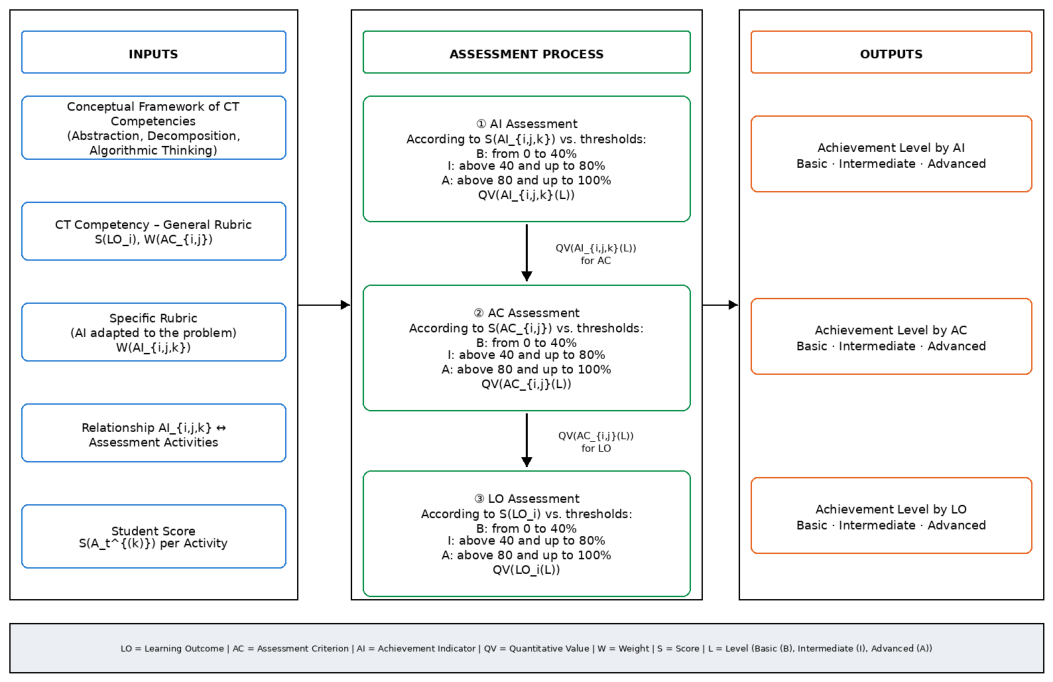
Once the inputs have been defined, the method proceeds with the assessment process in three progressive stages. First, the achievement level of each AI is determined from the scores obtained in the activities associated with that indicator. Second, the achievement levels assigned to the AI are used to determine the achievement level of each AC. Third, the achievement levels assigned to the AC are used to determine the achievement level of the corresponding LO. Therefore, the result of the method is not a single global score for the competency, but a differentiated classification by learning outcome.
Within this process, the general rubric and the specific rubric fulfill complementary functions. The general rubric defines the assessment structure at the level of LO and AC, including the weight assigned to each criterion within the learning outcome. The specific rubric translates this structure into AI and links them to observable evidence associated with a specific problem. In this way, the method provides a procedure that connects the conceptualization of the competency with the interpretation of the evidence obtained in the assessment activities.
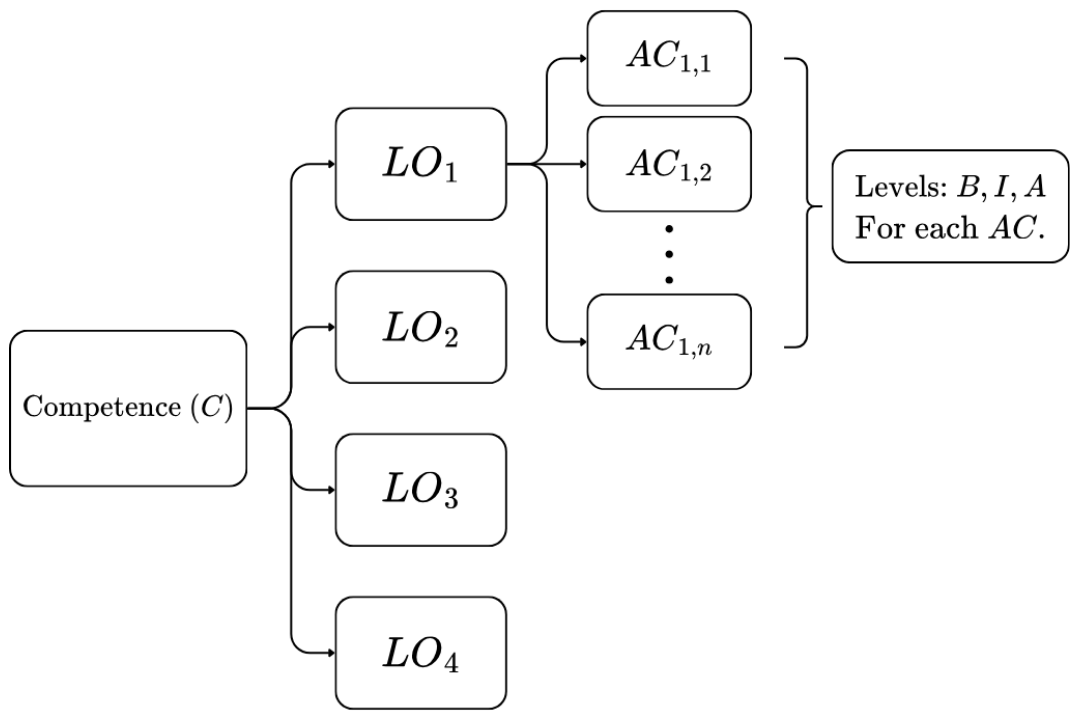
Figure 1 presents the structure of the general rubric.
As shown in
Figure 1, the general rubric establishes the assessment structure from the learning outcome to its assessment criteria and achievement levels. This structure is subsequently adapted in the specific rubric by defining the AI associated with each AC and linking them to the activities or questions used to collect evidence. Thus, the assessment method does not start with the final classification of the LO, but with the evidence obtained in the activities associated with each AI.
Figure 2 presents the assessment method for Computational Thinking competencies.
To clarify the calculation and classification procedure, the method distinguishes four numerical elements. First, represents the score assigned to learning outcome , which is taken as a reference for its assessment. This value is distributed among the assessment criteria that compose the LO; therefore, each is assigned a weight . Second, each assessment criterion is disaggregated into achievement indicators, and each is assigned a weight . Third, corresponds to the score obtained by the student in each activity or question associated with an achievement indicator. These activity scores are added to obtain , which corresponds to the score used to classify the achievement level of the indicator. Finally, corresponds to the quantitative value assigned by the rubric once the achievement level has been classified.
This distinction is important because the score used at each level has a different origin. At the AI level, is obtained directly from the scores achieved by the student in the assessment activities. At the AC level, the classification score is obtained by aggregating the values assigned to the AI associated with that criterion. At the LO level, the classification score is obtained by aggregating the values assigned to the AC associated with that learning outcome. Therefore, W defines the maximum value or weight of a rubric component, S is the value compared with the achievement-level ranges, and is the value assigned after the achievement level has been determined.
The thresholds used to classify performance into Basic, Intermediate, and Advanced levels were defined a priori as criterion-referenced percentage ranges. These ranges were established by the authors during the rubric design process, based on expert judgment and on the need to translate qualitative achievement levels into explicit quantitative decision rules. They were not statistically estimated from the sample; rather, they were used to ensure that the same proportional classification logic could be applied consistently across achievement indicators, assessment criteria, and learning outcomes.
In this sense, the Basic range, from 0% to 40% of the component weight, represents initial or limited evidence of the expected performance. The Intermediate range, above 40% and up to 80%, represents partial but sufficient evidence of achievement. The Advanced range, above 80% and up to 100%, represents consistent or consolidated evidence of achievement in relation to the expected learning outcome.
Therefore, the values 0.40, 0.80, and 1.00 are decimal expressions of percentage thresholds applied to the weight
W of each component. This means that the thresholds are directly aligned with the weights assigned in the rubric: they are not fixed scores, but proportional ranges calculated from the weight of each AI, AC, or LO.
Table 4 illustrates this alignment using the weights assigned to the achievement indicators of
: Interiorization.
After the achievement level of an AI has been determined, the corresponding defined in the specific rubric is assigned. These values are then aggregated to determine the achievement level of the corresponding AC. Subsequently, the values assigned to the AC are aggregated to determine the achievement level of the LO. In this way, the method preserves traceability between the evidence obtained in the assessment activities and the final classification of the learning outcome.
The complete formal specification of this process, including notation, equations, constraints, threshold rules, and calculation procedure, is presented in
Appendix A. A step-by-step illustrative example of the assessment process for
, corresponding to Interiorization, is provided in the
Supplementary Materials.




 ,
,