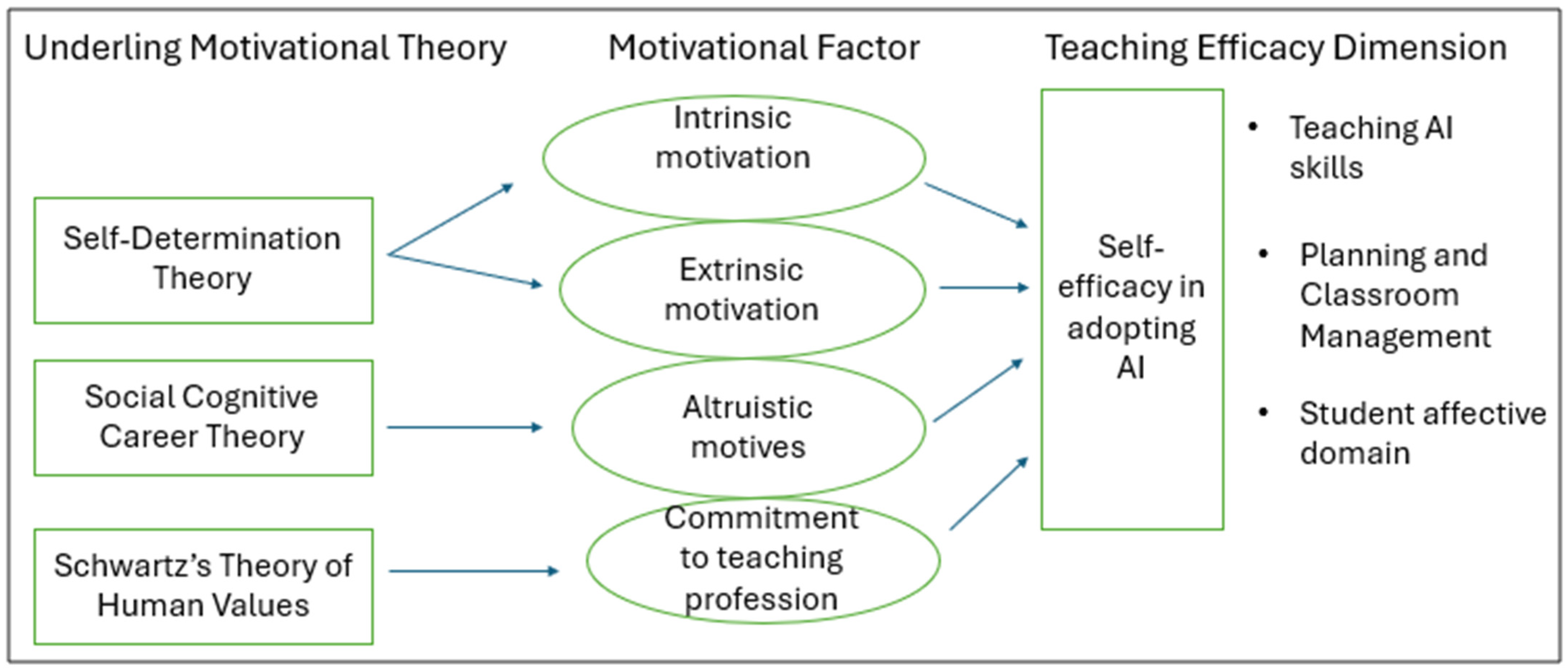
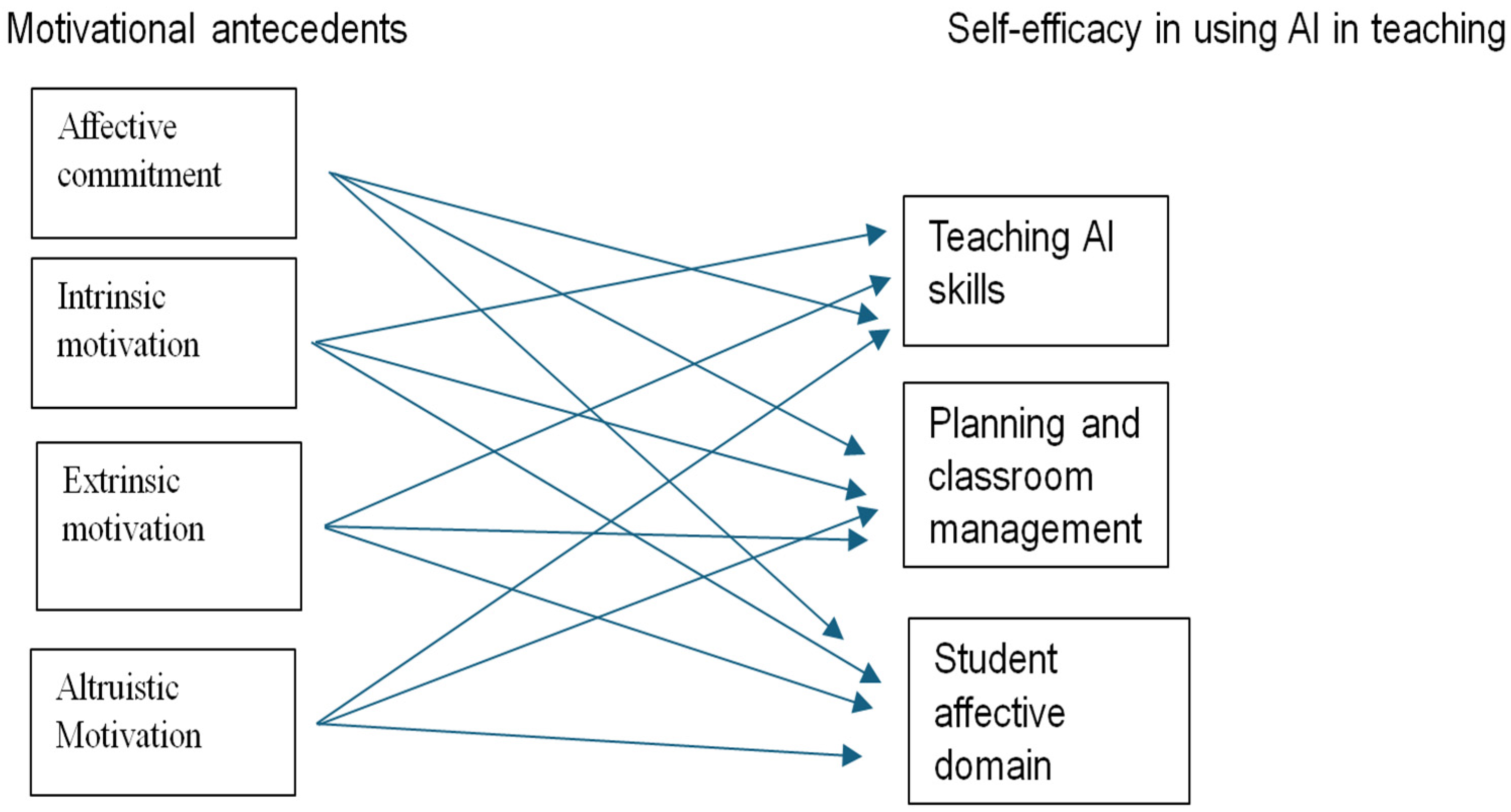
Motivational Factors Influencing Ethiopian Student Teachers’ Self-Efficacy in Adopting AI in Education

 ,
,
Abstract
1. Introduction
1.1. The Context
1.2. Theoretical Framework
1.3. Conceptual Framework and Hypothesis Development
2. Research Methods and Design

| Construct | Source |
|---|---|
| Self-efficacy-related construct | |
| Teaching AI skills | Carolus et al. (2023) |
| Planning and Classroom Management | Carolus et al. (2023) |
| The student affective domain | Carolus et al. (2023) |
| Motivation-related constructs | |
| Intrinsic motivation | Archer (1994) |
| Extrinsic motivation | Deci and Ryan (1980) |
| Altruistic motivation | Roness (2011) |
| Affective commitment | Meyer et al. (1993) |
| Indicator | Source |
|---|---|
| Self-efficacy in using AI in teaching: Teaching AI Skills (TAIS) 1. I know how to teach students to use AI. 2. I can teach students to understand AI. 3. I can prepare students to keep up with the latest innovations in AI applications. 4. I can prepare students to detect AI. 5. I know how to discuss ethical aspects of AI with students. 6. I can teach students how to solve problems using AI. 7. I am able to teach students how to use AI in decision-making processes. | Inspired by Carolus et al. (2023) |
| Self-efficacy in using AI in teaching: Planning and classroom management (PCM) 8. I can use AI to create lesson plans. 9. I know how to prevent students from being distracted when using AI. 10. I can prevent students from cheating using AI. 11. I can identify the knowledge students need when interacting with AI. 12. I know how to use AI to create multiple choice questions. 13. I can use AI to create learning material adapted to the actual student group. 14. I know how to use AI in student assessment. | Inspired by Carolus et al. (2023) |
| Self-efficacy in using AI in teaching: Student affective domain (SAD) 15. I know how to strengthen students’ confidence in using AI. 16. I know how to engage students to use AI for learning purposes. 17. I can make students excited about using AI for learning purposes. 18. I can prepare students to control their possible frustrations while using AI. 19. I can make the students control the euphoria that may arise when using AI. | Inspired by Carolus et al. (2023) |
| Affective commitment to the teaching profession (AC) 20. I feel attracted to the teaching profession. 21. It feels good to think that one day I will be a teacher. 22. I am looking forward to working as a teacher. | Inspired by Meyer et al. (1993) |
| Intrinsic motivation (IM) 23. I want to be a teacher because it is exciting to teach. 24. For me, it is a pleasure to interest students in my subject. 25. I want to be a teacher because I want others to be interested in learning. | Inspired by Archer (1994) |
| Extrinsic motivation (EM) 26. It is important to me to be looked up to by other student teachers. 27. It is important to me to be described as the best in the study group. | Inspired by Deci and Ryan (1980) |
| Altruistic motivation (AM) 28. It is important to me to work with people. 29. It is important to me to help people who need help. 30. For me, it is a pleasure to interest students in my subject. 31. For me, it is a pleasure to help others. | Inspired by Roness (2011) |
3. Results
Descriptive Statistics
4. Discussion
5. Conclusions
6. Limitations
Author Contributions
Funding
Institutional Review Board Statement
Data Availability Statement
Acknowledgments
Conflicts of Interest
Abbreviations
| AI | Artificial Intelligence |
| SEM | Structural equation modeling |
| TAIS | Teaching AI skills |
| PCM | Planning and classroom management |
| SAD | Student affective domain |
| AC | Affective commitment to teaching profession |
| IM | Intrinsic Motivation |
| EM | Extrinsic Motivation |
| AM | Altruistic Motivation |
References
- Abie, A., & Serpa, S. (2019). Post graduate diploma in teaching (PGDT) Pre-service teacher development policy reform initiative: Its Practices, outcomes and challenges in bahr dar university (BDU). Cogent Education, 6(1), 1696503. [Google Scholar] [CrossRef]
- Ahmadi, A., Noetel, M., Parker, P., Ryan, R. M., Ntoumanis, N., Reeve, J., Beauchamp, M., Dicke, T., Yeung, A., Ahmadi, M., Bartholomew, K., Chiu, T. K. F., Curran, T., Erturan, G., Flunger, B., Frederick, C., Froiland, J. M., González-Cutre, D., Haerens, L., … Lonsdale, C. (2023). A classification system for teachers’ motivational behaviors recommended in self-determination theory interventions. Journal of Educational Psychology, 115(8), 1158–1176. [Google Scholar] [CrossRef]
- Archer, J. (1994). Achievement goals as a measure of motivation in university students. Contemporary Educational Psychology, 19(4), 430–446. [Google Scholar] [CrossRef]
- Bandura, A. (1977). Self-efficacy: Toward a unifying theory of behavioral change. Psychological Review, 84(2), 191–215. [Google Scholar] [CrossRef]
- Barbieri, W., & Nguyen, N. (2025). Generative AI as a “placement buddy”: Supporting pre-service teachers in work-integrated learning, self-management and crisis resolution. Australasian Journal of Educational Technology, 41(2), 34–49. [Google Scholar] [CrossRef]
- Barni, D., Danioni, F., & Benevene, P. (2019). Teachers’ self-efficacy: The role of personal values and motivations for teaching. Frontiers in Psychology, 10, 1645. [Google Scholar] [CrossRef]
- Bentler, P. M., & Bonett, D. G. (1980). Significance tests and goodness of fit in the analysis of covariance structures. Psychological Bulletin, 88(3), 588–606. [Google Scholar] [CrossRef]
- Bergmark, U., Lundström, S., Manderstedt, L., & Palo, A. (2018). Why become a teacher? Student teachers’ perceptions of the teaching profession and motives for career choice. European Journal of Teacher Education, 41(3), 266–281. [Google Scholar] [CrossRef]
- Bower, M., Torrington, J., Lai, J. W. M., Petocz, P., & Alfano, M. (2024). How should we change teaching and assessment in response to increasingly powerful generative artificial intelligence? Outcomes of the ChatGPT teacher survey. Education and Information Technologies, 29, 15403–15439. [Google Scholar] [CrossRef]
- Brandão, A., Pedro, L., & Zagalo, N. (2024). Teacher professional development for a future with generative artificial intelligence—An integrative literature review. Digital Education Review, (45), 151–157. [Google Scholar] [CrossRef]
- Burić, I., Jakšić, K., & Balaž, B. (2024). Teacher self-efficacy and teaching quality: A three-wave longitudinal investigation. International Journal of Psychology, 59(6), 1317–1325. [Google Scholar] [CrossRef]
- Calkins, L., Wiens, P., Parker, J., & Tschinkel, R. (2024). Teacher motivation and self-efficacy: How do specific motivations for entering teaching relate to teacher self-efficacy? Journal of Education, 204(2), 427–438. [Google Scholar] [CrossRef]
- Carolus, A., Koch, M. J., Straka, S., Latoschik, M. E., & Wienrich, C. (2023). MAILS—Meta AI literacy scale: Development and testing of an AI literacy questionnaire based on well-founded competency models and psychological change- and meta-competencies. Computers in Human Behavior: Artificial Humans, 1(2), 100014. [Google Scholar] [CrossRef]
- Chan, C. (2024). Holistic competencies and AI in education: A synergistic pathway. Australasian Journal of Educational Technology, 40(5), 1–12. [Google Scholar] [CrossRef]
- Chan, S., Maneewan, S., & Koul, R. (2023). Teacher educators’ teaching styles: Relation with learning motivation and academic engagement in pre-service teachers. Teaching in Higher Education, 28(8), 2044–2065. [Google Scholar] [CrossRef]
- Chang, T.-J., & Sung, Y.-T. (2024). Does teacher motivation really matter? Exploring the mediating role of teachers’ self-efficacy in the relationship between motivation and job satisfaction. The Asia-Pacific Education Researcher, 33(6), 1315–1325. [Google Scholar] [CrossRef]
- Chiu, T. K. F., Bali, S., Tondeur, J., Howard, S., & Chan, K. K. H. (2026). Teacher education for artificial intelligence literacy through a self-determination theory perspective. European Journal of Teacher Education, 1–21. [Google Scholar] [CrossRef]
- Cohen, L., Manion, L., & Morrison, K. (2017). Research methods in education (8th ed.). Routledge. [Google Scholar] [CrossRef]
- Darling-Hammond, L., Hyler, M. E., & Wojcikiewicz, S. (2025). Design principles for teacher preparation: Enacting the science of learning and development. Learning Policy Institute. [Google Scholar] [CrossRef]
- Deci, E. L. (1971). Effects of externally mediated rewards on instrinsic motivation. Journal of Personality and Social Pschology, 18(1), 105–115. [Google Scholar] [CrossRef]
- Deci, E. L., & Ryan, R. M. (1980). Self-determination theory: When mind mediates behavior. The Journal of Mind and Behavior, 1(1), 33–43. Available online: https://www.jstor.org/stable/43852807 (accessed on 10 March 2025).
- Deng, R., Jiang, M., Yu, X., Lu, Y., & Liu, S. (2025). Does ChatGPT enhance student learning? A systematic review and meta-analysis of experimental studies. Computers & Education, 227, 105224. [Google Scholar] [CrossRef]
- Ding, L.-J., Li, J.-M., & Hui, B.-H. (2025). Will teacher-AI collaboration enhance teaching engagement? Behavioral Sciences, 15(7), 866. [Google Scholar] [CrossRef] [PubMed]
- Du, Y., & Gao, H. (2022). Determinants affecting teachers’ adoption of AI-based applications in EFL context: An analysis of analytic hierarchy process. Education and Information Technologies, 27(7), 9357–9384. [Google Scholar] [CrossRef]
- Eriksen, A., Leming, T., & Skrøvset, S. (2024). Shaping professional identity in the early days of teacher education. In Transforming university-based teacher education through innovation: A Norwegian response to research literacy, integration and technology (1st ed., pp. 197–204). Routledge. [Google Scholar] [CrossRef]
- Friedman, I. A., & Kass, E. (2002). Teacher self-efficacy: A classroom-organization conceptualization. Teaching and Teacher Education, 18(6), 675–686. [Google Scholar] [CrossRef]
- Garvis, S., & Pendergast, D. (2011). An investigation of early childhood teacher self-efficacy beliefs in the teaching of arts education. International Journal of Education & the Arts, 12(9). Available online: http://www.ijea.org/v12n9/ (accessed on 20 March 2025).
- Hair, J., Black, W., Babin, B., & Anderson, R. (2010). Cluster analysis. In J. Hair, W. Black, & B. Babin (Eds.), Multivariate data analysis: A global perspective (7th ed., pp. 477–536). Pearson Prentice Hall. [Google Scholar]
- Han, J., & Yin, H. (2016). Teacher motivation: Definition, research development and implications for teachers. Cogent Education, 3(1), 1217819. [Google Scholar] [CrossRef]
- Hazzan-Bishara, A., Kol, O., & Levy, S. (2025). The factors affecting teachers’ adoption of AI technologies: A unified model of external and internal determinants. Education and Information Technologies, 30(11), 15043–15069. [Google Scholar] [CrossRef]
- Hußner, I., Lazarides, R., & Symes, W. (2024). The relation between self-efficacy and teaching behaviour: A video-based analysis of student teachers. Learning and Instruction, 91, 101880. [Google Scholar] [CrossRef]
- IBM. (2023). IBM global AI adoption index report dec. 2023. IBM Morning Consult. [Google Scholar]
- Johnakin-Putnam, S. (2020). The impact of teacher intrinsic and extrinsic motivation on teacher self-efficacy [Ph.D. Thesis, Liberty University]. Available online: https://digitalcommons.liberty.edu/cgi/viewcontent.cgi?article=3677&context=doctoral (accessed on 10 December 2025).
- Klaeijsen, A., Vermeulen, M., & Martens, R. (2018). Teachers’ innovative behaviour: The importance of basic psychological need satisfaction, intrinsic motivation, and occupational self-efficacy. Scandinavian Journal of Educational Research, 62(5), 769–782. [Google Scholar] [CrossRef]
- Klassen, R., Wilson, E., Siu, A. F. Y., Hannok, W., Wong, M. W., Wongsri, N., Sonthisap, P., Pibulchol, C., Buranachaitavee, Y., & Jansem, A. (2013). Preservice teachers’ work stress, self-efficacy, and occupational commitment in four countries. European Journal of Psychology of Education, 28(4), 1289–1309. [Google Scholar] [CrossRef]
- Kline, R. B. (2023). Structural equation modeling in neuropsychology research. In G. G. Brown, B. Crosson, K. Y. Haaland, & T. Z. King (Eds.), APA handbook of neuropsychology, Volume 2: Neuroscience and neuromethods (Vol. 2, pp. 681–698). American Psychological Association. [Google Scholar] [CrossRef]
- Lent, R. W., Brown, S. D., & Hackett, G. (1994). Toward a unifying social cognitive theory of career and academic interest, choice, and performance. Journal of Vocational Behavior, 45(1), 79–122. [Google Scholar] [CrossRef]
- Li, B., Lowell, V. L., Wang, C., & Li, X. (2024). A systematic review of the first year of publications on ChatGPT and language education: Examining research on ChatGPT’s use in language learning and teaching. Computers and Education: Artificial Intelligence, 7, 100266. [Google Scholar] [CrossRef]
- MacCallum, R. C., Browne, M. W., & Sugawara, H. M. (1996). Power analysis and determination of sample size for covariance structure modeling. Psychological Methods, 1(2), 130–149. [Google Scholar] [CrossRef]
- Margaryan, A. (2023). Artificial intelligence and skills in the workplace: An integrative research agenda. Big Data & Society, 10(2). [Google Scholar] [CrossRef]
- Martínez-Moreno, J., & Petko, D. (2024). What motivates future teachers? The influence of artificial intelligence on student teachers’ career choice. Computers and Education: Artificial Intelligence, 7, 100296. [Google Scholar] [CrossRef]
- Mekonnen, D. M. (2008). Reflections on the teacher education system overhaul (TESO) program in Ethiopia: Promises, pitfalls, and propositions. Journal of Educational Change, 9(3), 281–304. [Google Scholar] [CrossRef]
- Menon, D., Wieselmann, J. R., Haines, S., & Asim, S. (2024). A meta-synthesis of the literature on science & engineering teaching self-efficacy: Current gaps and future research directions. Journal of Science Teacher Education, 35(5), 480–503. [Google Scholar] [CrossRef]
- Meyer, J. P., Allen, N. J., & Smith, C. A. (1993). Commitment to organizations and occupations: Extension and test of a three-component conceptualization. Journal of Applied Psychology, 78(4), 538–551. [Google Scholar] [CrossRef]
- Michael, K. (2025). Teacher education curriculum framework of Ethiopia: Technology integration issues and reflection for improvement. Ethiopian Journal of Education and Sciences, 20(2), 20–36. Available online: https://journals.ju.edu.et/index.php/ejes/article/view/6331 (accessed on 10 December 2025).
- Ministry of Education. (2021). Ethiopian education sector development program 6 (ESDP VI). Ministry of Education. [Google Scholar]
- Miseliunaite, B., Kliziene, I., & Cibulskas, G. (2022). Can holistic education solve the world’s problems: A systematic literature review. Sustainability, 14(15), 9737. [Google Scholar] [CrossRef]
- Moses, I., Admiraal, W., Berry, A., & Saab, N. (2021). Teacher education and student teachers’ commitment to teaching: A thematic literature review. Africa Education Review, 18(3–4), 75–92. [Google Scholar] [CrossRef]
- Na, C., & Isa, Z. M. (2024). Exploring the influence of teacher self-efficacy on teaching quality in higher vocational education. Journal of Digitainability, Realism & Mastery (DREAM), 3(7), 16–27. [Google Scholar] [CrossRef]
- Nesje, K., Brandmo, C., & Berger, J.-L. (2018). Motivation to become a teacher: A Norwegian validation of the factors influencing teaching choice scale. Scandinavian Journal of Educational Research, 62(6), 813–831. [Google Scholar] [CrossRef]
- Ng, D. T. K., Lee, M., Tan, R. J. Y., Hu, X., Downie, J. S., & Chu, S. K. W. (2023). A review of AI teaching and learning from 2000 to 2020. Education and Information Technologies, 28(7), 8445–8501. [Google Scholar] [CrossRef]
- Octoria, D., Harahap, D. H., & Sari, P. R. (2024). The effect of teachers’ self-efficacy and teaching commitment on pre-service teachers’ performance. Multidisciplinary Science Journal, 7(4), 2025181. [Google Scholar] [CrossRef]
- Opoku, M. P., Belbase, S., Nketsia, W., Side, A. S., Were, D., & Gemeda, F. T. (2025). Comparative study of teachers’ attitudes, self-efficacy and job satisfaction when teaching gifted students in Ethiopia and Kenya. Compare: A Journal of Comparative and International Education, 1–18. [Google Scholar] [CrossRef]
- Perera, H. N., & John, J. E. (2020). Teachers’ self-efficacy beliefs for teaching math: Relations with teacher and student outcomes. Contemporary Educational Psychology, 61, 101842. [Google Scholar] [CrossRef]
- Richter, E., Lazarides, R., & Richter, D. (2021). Four reasons for becoming a teacher educator: A large-scale study on teacher educators’ motives and well-being. Teaching and Teacher Education, 102, 103322. [Google Scholar] [CrossRef]
- Roness, D. (2011). Still motivated? The motivation for teaching during the second year in the profession. Teaching and Teacher Education, 27(3), 628–638. [Google Scholar] [CrossRef]
- Roness, D., & Smith, K. (2009). Postgraduate Certificate in Education (PGCE) and student motivation. European Journal of Teacher Education, 32(2), 111–134. [Google Scholar] [CrossRef]
- Ryan, R. M., & Deci, E. L. (2000). Self-determination theory and the facilitation of intrinsic motivation, social development, and well-being. American Psychologist, 55(1), 68–78. [Google Scholar] [CrossRef] [PubMed]
- Sankar, V. (2025). Holistic development in education: Nurturing well—Rounded individuals for a complex world. Shanlax International Journal of Arts, Science and Humanities, 12(S2-Jan), 103–106. [Google Scholar] [CrossRef]
- Schuberth, F., Schamberger, T., Kemény, I., & Henseler, J. (2025). The sum score model: Specifying and testing equally weighted composites using structural equation modeling. Psychometrika, 90(1), 358–383. [Google Scholar] [CrossRef]
- Schwartz, S. H. (2012). An overview of the Schwartz theory of basic values. Online Readings in Psychology and Culture, 2(1). [Google Scholar] [CrossRef]
- Semela, T. (2014). Teacher preparation in Ethiopia: A critical analysis of reforms. Cambridge Journal of Education, 44(1), 113–145. [Google Scholar] [CrossRef]
- Simonsz, H., Leeman, Y., & Veugelers, W. (2023). On the threshold of being a teacher: Motivations and ideals of 116 Dutch student teachers. Asia-Pacific Journal of Teacher Education, 51(4), 328–343. [Google Scholar] [CrossRef]
- Subaveerapandiyan, A., Radhakrishnan, S., Tiwary, N., & Guangul, S. M. (2025). Student satisfaction with artificial intelligence chatbots in Ethiopian academia. IFLA Journal, 51(3), 600–614. [Google Scholar] [CrossRef]
- Şimşek, A. S., Cengiz, G. Ş. T., & Bal, M. (2025). Extending the TAM framework: Exploring learning motivation and agility in educational adoption of generative AI. Education and Information Technologies, 30(15), 20913–20942. [Google Scholar] [CrossRef]
- Tabernero, C., & Hernández, B. (2011). Self-efficacy and intrinsic motivation guiding environmental behavior. Environment and Behavior, 43(5), 658–675. [Google Scholar] [CrossRef]
- Tuli, F., Tekle, E., Hunde, A. B., Baye, G., Waktole, Y., Yifru, M., Abate, E., Bogal, B., Abate, S., Fentahun, T., & Beyene, F. (2025). Reimagining initial teacher education for the 21st Century in Ethiopia. Kotebe Journal of Education, 3(1), 89–118. [Google Scholar] [CrossRef] [PubMed]
- UNESCO. (2015). Rethinking education: Towards a global common good? UNESCO. [Google Scholar] [CrossRef]
- Woldemariam, M. T., Ergado, A. A., & Jimma, W. (2025). Factors influencing effective integration of educational technology in the colleges of teacher education in Ethiopia: A constructivist grounded theory. Australasian Journal of Educational Technology, 41(2), 50–70. [Google Scholar] [CrossRef]
- Yang, Y.-F., Tseng, C. C., & Lai, S.-C. (2024). Enhancing teachers’ self-efficacy beliefs in AI-based technology integration into English speaking teaching through a professional development program. Teaching and Teacher Education, 144, 104582. [Google Scholar] [CrossRef]
- Zhao, J., Li, S., & Zhang, J. (2025). Understanding teachers’ adoption of ai technologies: An empirical study from Chinese middle schools. Systems, 13(4), 302. [Google Scholar] [CrossRef]

| Min | Max | Mean | SD | Skew | Kurt | |
|---|---|---|---|---|---|---|
| AC | 1 | 7 | 4.44 | 1.77 | −0.37 | −0.94 |
| IM | 1 | 7 | 4.57 | 1.75 | −0.40 | −0.83 |
| EM | 1 | 7 | 4.68 | 1.77 | −0.48 | −0.65 |
| AM | 1 | 7 | 4.80 | 1.85 | −0.57 | −0.72 |
| TAIS | 1 | 7 | 4.39 | 1.62 | −0.43 | −0.77 |
| PCM | 1 | 7 | 4.22 | 1.58 | −0.39 | −0.65 |
| SAD | 1 | 7 | 4.25 | 1.67 | −0.32 | −0.73 |
| N = 278 | AC | IM | EM | AM | TAIS | PCM |
|---|---|---|---|---|---|---|
| IM | 0.68 | -- | ||||
| EM | 0.60 | 0.76 | -- | |||
| AM | 0.54 | 0.64 | 0.77 | -- | ||
| TAIS | 0.56 | 0.50 | 0.48 | 0.37 | -- | |
| PCM | 0.68 | 0.54 | 0.52 | 0.46 | 0.76 | -- |
| SAD | 0.64 | 0.52 | 0.51 | 0.42 | 0.72 | 0.85 |
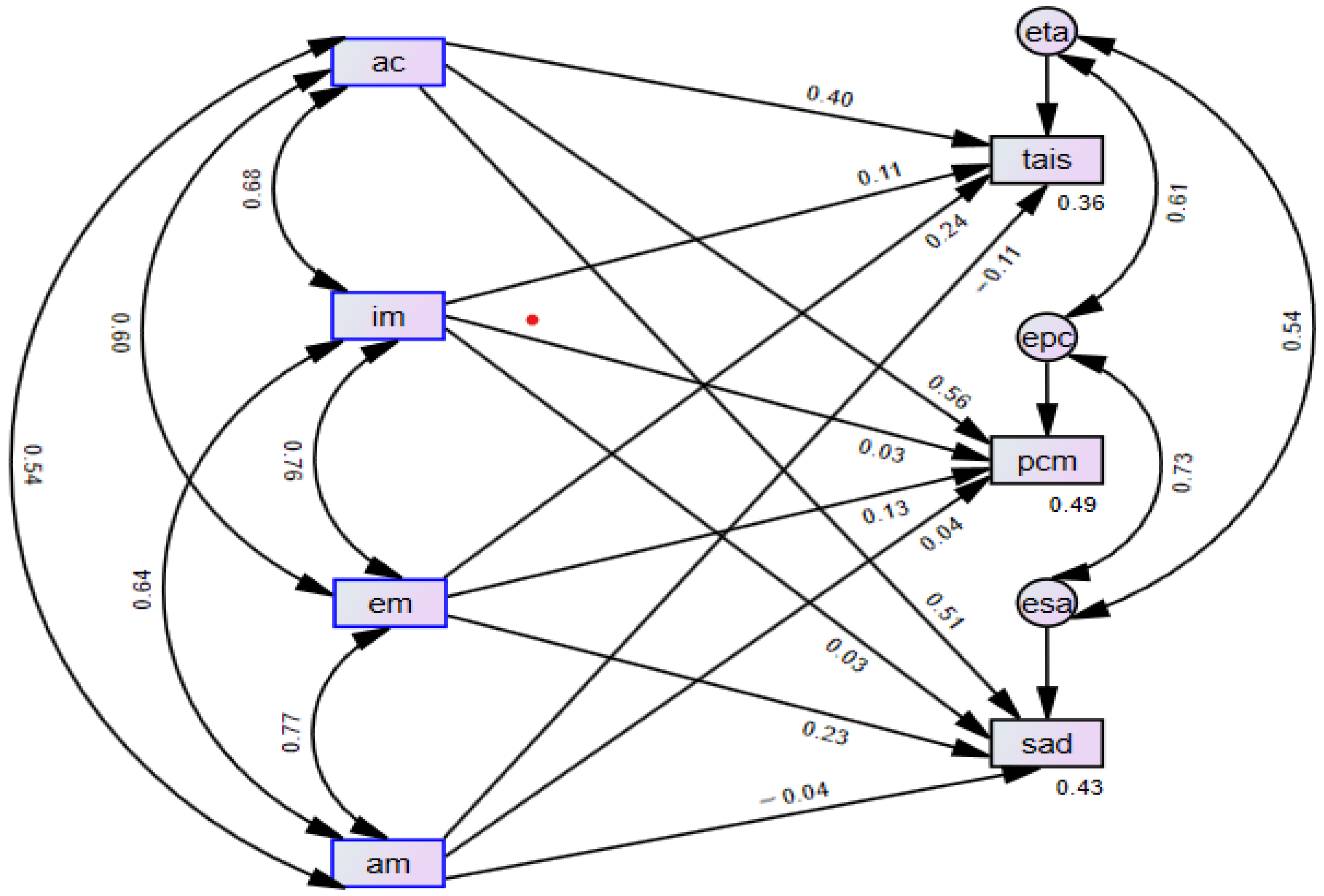
| H. No | Direct Paths | Estimate | S.E | C.R. | p | Remark |
|---|---|---|---|---|---|---|
| H1 | IM > TAIS | 0.103 | 0.076 | 1.351 | 0.177 | Not supported |
| H2 | IM > PCM | 0.027 | 0.067 | 0.402 | 0.688 | Not supported |
| H3 | IM > SAD | 0.027 | 0.074 | 0.360 | 0.719 | Not supported |
| H4 | EM > TAIS | 0.223 | 0.083 | 2.670 | ** | Supported |
| H5 | EM > PCM | 0.120 | 0.073 | 1.646 | 0.100 | Not supported |
| H6 | EM > SAD | 0.212 | 0.081 | 2.617 | ** | Supported |
| H7 | AM > TAIS | −0.096 | 0.067 | −1.435 | 0.151 | Not supported |
| H8 | AM > PCM | 0.035 | 0.059 | 0.590 | 0.555 | Not supported |
| H9 | AM > SAD | 0.035 | 0.059 | 0.590 | 0.555 | Not supported |
| H10 | AC > TAIS | 0.366 | 0.061 | 5.998 | *** | Supported |
| H11 | AC > PCM | 0.498 | 0.053 | 9.324 | *** | Supported |
| H12 | AC > SAD | 0.475 | 0.059 | 8.018 | *** | Supported |
Disclaimer/Publisher’s Note: The statements, opinions and data contained in all publications are solely those of the individual author(s) and contributor(s) and not of MDPI and/or the editor(s). MDPI and/or the editor(s) disclaim responsibility for any injury to people or property resulting from any ideas, methods, instructions or products referred to in the content. |
© 2026 by the authors. Licensee MDPI, Basel, Switzerland. This article is an open access article distributed under the terms and conditions of the Creative Commons Attribution (CC BY) license.
Share and Cite
Hunde, A.B.; Elstad, E.; Christophersen, K.-A.A.; Turmo, A.; Gemeda, F.T.; Demissie, E.A. Motivational Factors Influencing Ethiopian Student Teachers’ Self-Efficacy in Adopting AI in Education. Educ. Sci. 2026, 16, 800. https://doi.org/10.3390/educsci16050800
Hunde AB, Elstad E, Christophersen K-AA, Turmo A, Gemeda FT, Demissie EA. Motivational Factors Influencing Ethiopian Student Teachers’ Self-Efficacy in Adopting AI in Education. Education Sciences. 2026; 16(5):800. https://doi.org/10.3390/educsci16050800
Chicago/Turabian StyleHunde, Adula Bekele, Eyvind Elstad, Knut-Andreas Abben Christophersen, Are Turmo, Fekede Tuli Gemeda, and Eyueil Abate Demissie. 2026. "Motivational Factors Influencing Ethiopian Student Teachers’ Self-Efficacy in Adopting AI in Education" Education Sciences 16, no. 5: 800. https://doi.org/10.3390/educsci16050800
APA StyleHunde, A. B., Elstad, E., Christophersen, K.-A. A., Turmo, A., Gemeda, F. T., & Demissie, E. A. (2026). Motivational Factors Influencing Ethiopian Student Teachers’ Self-Efficacy in Adopting AI in Education. Education Sciences, 16(5), 800. https://doi.org/10.3390/educsci16050800