


Abstract
Student well-being, encompassing mental, social, cognitive, and behavioral domains, is increasingly compromised by academic stress, social isolation, and sedentary lifestyles. Horticulture-based interventions (HBIs), involving plant-based activities, have shown potential in promoting holistic health across populations. Nevertheless, no systematic review has synthesized global evidence for its effects on students. This systematic review aimed to evaluate HBI’s impact on students’ well-being, synthesizing global evidence to inform educational and therapeutic practices. This systematic review was registered in PROSPERO (CRD420251250712). Following PRISMA guidelines, we searched PubMed, Web of Science, MEDLINE, EMBASE, and APA PsycInfo from inception to 30 June 2025. Keywords were used to search for related articles. Fifteen studies (n > 2000 students, aged 5–18 years) from South Korea (n = 8), Taiwan (n = 3), Chinese Mainland (n = 1), Hong Kong, China (n = 1), Italy (n = 1), and the United States (n = 1) were included for analysis. Results showed that HBI has the potential to enhance emotional/psychological well-being (e.g., stress reduction, mood improvement), social well-being (e.g., peer relations, social skills), cognitive and education benefits (e.g., attention, academic attitudes), and physical and overall health benefits (e.g., physical activity, quality of life). HBI may contribute to multifaceted student well-being, particularly emotional and social domains. This systematic review provides a reference for educators to integrate horticultural programs into the curriculum. Government and school policies may consider funding school gardens. Future randomized controlled trials with diverse populations are needed to address limitations like small samples and geographic bias.
1. Introduction
In recent years, student well-being has garnered increasing attention from educators, policymakers, and researchers, involving different aspects of development, including mental, social, cognitive, and behavioral domains. Attention is primarily driven by escalating concerns over mental health challenges in educational settings worldwide (World Health Organization, 2022). For instance, it was shown that in more than half of all cases of adult mental disorder, the onset occurs before the age of 18 years (Kessler et al., 2007). According to a meta-analysis, the global point prevalence rate of elevated self-reported depressive symptoms from 2001 to 2020 was 34% among adolescents whilst point prevalence for major depressive disorder and dysthymia was 8% (Shorey et al., 2022). Another meta-analysis revealed that the prevalence of common mental health disorders assessed by the General Health Questionnaire was 31.0% among children and adolescents (Silva et al., 2020). Outcomes from longitudinal research further showed that adolescents with persistent depressive disorder utilized significantly more healthcare resources in mid-adulthood (Ssegonja et al., 2019). The association was not limited to psychiatric care, and remained after adjustment for individual and parental characteristics (Ssegonja et al., 2019). Additionally, studies indicate that chronic stress affected up to 40% of adolescents, contributing to anxiety and depression that undermine overall psychological well-being (American Psychological Association, 2018).
Student social well-being is also at risk, with isolation and poor interpersonal relationships exacerbating feelings of disconnection, particularly in the digital age where social media amplifies peer pressures (Orben & Przybylski, 2019). Cognitive issues, such as deficits in attention and concentration, further compound these problems, often linked to overstimulation and sedentary lifestyles that hinder focus and learning (Hattie, 2009). A review study showed that the global prevalence of attention-deficit/hyperactivity disorder was 7.6% for children aged 3 to 12 years and 5.6% for adolescents aged 12 to 18 years (Salari et al., 2023). Additionally, it was revealed that children and adolescents spent approximately 41–57% of the after-school period in sedentary time (Arundell et al., 2016). Furthermore, academic attitudes and motivation have declined, with many students experiencing burnout and disengagement, leading to lower achievement and risk of dropout (Fredricks et al., 2004). Behavioral issues, including aggression or withdrawal, are on the rise, correlating with disrupted school environments and external stressors (Centers for Disease Control and Prevention, 2023).
In the last two decades, one non-pharmacological intervention, horticulture-based interventions (HBIs), has been shown to be effective to improve individuals’ well-being, including emotional, social, cognitive, and physical aspects across different populations (Cipriani et al., 2017; Detweiler et al., 2015; Gonzalez et al., 2010; Nevil & Beela, 2023; Oh et al., 2020). This approach is grounded in theories like attention restoration theory and biophilia, emphasizing humans’ innate connection with nature for stress reduction and healing (R. Kaplan & Kaplan, 1989).
A meta-analysis in adult populations found that HBI exerted a significant and positive effect on mental health, with a moderate effect size (Hedges’ g = 0.55) (Tu, 2022). The outcomes encompassed a broad array of variables, including depression, anxiety, stress, life satisfaction, loneliness, cognitive functioning, mental fatigue, and self-identity (Tu, 2022). Several meta-analyses focused on older adults similarly indicated that HBI was effective in alleviating depression and anxiety symptoms, reducing stress and cortisol levels, enhancing physical flexibility and social interaction, and boosting daily vegetable and fruit consumption, along with other benefits (Lin et al., 2022; Wang et al., 2022; Yun et al., 2024). Additionally, one meta-analysis targeting cognitive functioning in adult populations revealed that HBI had a significant and positive impact on cognitive function, with a moderate effect size (Tu & Chiu, 2020). The outcomes included diverse variables such as global cognitive screening, attention, executive function, memory, orientation, visuospatial skills, task behavior, and cognitive factors in psychiatric conditions (Tu & Chiu, 2020).
Specific to students, studies have suggested possible benefits of HBI for their well-being. For instance, one study in Taiwan showed that school gardening enhanced children’s life skills, environmental awareness, and overall well-being (Chang et al., 2016). Similarly, another study demonstrated that horticultural activities lowered stress levels and salivary cortisol in maladjusted South Korean elementary students, promoting emotional regulation (M. J. Lee et al., 2018). Complementing this, another study showed that school gardens improved children’s interpersonal relationships, self-understanding, and attitudes toward school through cooperative gardening tasks in the United States (Waliczek et al., 2001). These examples underscore HBI’s potential role in promoting students’ well-being across different domains.
Despite these preliminary findings, a significant knowledge gap remains in synthesizing the evidence on HBI’s effects on students’ well-being. To date, only one systematic review has addressed a related topic, conducted exclusively within the Korean literature and focusing on Korean student participants (S. Y. Lee et al., 2023). In particular, this Korean review primarily examined the characteristics of HBIs rather than providing a comprehensive synthesis of their effects. This review, while insightful, is constrained by its cultural and linguistic scope, limiting generalizability to diverse global contexts. Notably, no systematic review has been undertaken using global evidence, which encompasses a wider array of international studies, methodologies, and student populations.
To bridge this gap, the present systematic review synthesizes global evidence on the effects of HBI on students’ well-being, aiming to inform evidence-based practices for educators and health professionals worldwide.
2. Methods
2.1. Study Design
This systematic review was registered in PROSPERO (CRD420251250712) and conducted according to The Preferred Reporting Items for Systematic Reviews and Meta-Analyses (PRIMSA) guideline (Moher et al., 2015). We included studies reporting on the effects of using HBI to promote students’ well-being. Studies were sourced from the following platforms: PubMed, Web of Science, MEDLINE, EMBASE, and APA PsycInfo databases.
2.2. Search Strategy
The most recent date for the literature search was 30 June 2025. In order to identify studies reporting on the effects of using HBI to promote students’ well-being, we conducted a comprehensive search using several appropriate keywords. To match the aim of this systematic review, three sets of keywords were selected to search articles, classified as follows: (1) horticultural activities, (2) students/children/adolescents, and (3) well-being. Our research team convened to reach consensus on a strategy to identify the appropriate terms to be included in each set of terms. Each term was appended with an asterisk to search for variations of these terms. Furthermore, the Boolean operator “OR” was used to link each term in each set, and “AND” was used to link each set of terms. Detailed information about the search strategy is provided in Table 1.
Table 1.
Search strategy.
2.3. Inclusion and Exclusion Criteria
This systematic review included original studies that were peer-reviewed and published in English-language journals. Eligible studies had to examine the effects of using HBI on students’ well-being. Students include children and adolescents aged 18 years or below. There was no restriction on the country or region where the studies were conducted or published. Articles were excluded if: (1) horticultural activities were not involved in the intervention; (2) it did not report the outcomes on students’ well-being; (3) the study was a protocol, review article, a perspective, a commentary, an editorial, a correspondence, or a conference abstract.
2.4. Data Extraction and Analysis
Two independent reviewers (PSFC and JK) conducted data extraction simultaneously. As an Assistant Professor in the Department of Psychology at The Education University of Hong Kong, Hong Kong, China, PSFC has been active in the research field for eight years. PSFC is a registered horticultural therapist. His research areas include mental health, behavioral health, and health promotion. JK is the second author and serves as a postdoctoral researcher at Stony Brook University in New York, United States, with nine years of experience in the research field. His research areas include child health, community health, and global health.
To begin, they each extracted data from three randomly selected studies to pilot the process. They then compared their findings and resolved any differences through discussion and mutual agreement. After aligning on the procedure, they continued with the extraction for the remaining studies. Once all data had been collected, they held a discussion to consolidate their results and reach a consensus on how to organize the extracted information. Consensus was reached using predefined criteria: prioritizing alignment with the study’s research questions on well-being domains (e.g., emotional, social, cognitive); resolving discrepancies by cross-referencing original study texts and discussing until 100% agreement; and organizing data thematically by outcome categories (e.g., stress reduction, peer relations) to facilitate narrative synthesis. Inter-rater reliability was assessed qualitatively during piloting. A standardized data extraction form was utilized to capture details such as first author, publication year, study period, title, country, research design, participant demographics, sample size, and key findings.
2.5. Assessment for Publication Quality and Risk of Bias
We evaluated the risk of bias in the studies using the Risk of Bias 2 (RoB 2) tool for randomized controlled trials (RCTs) (Sterne et al., 2019), the Risk of Bias in Non-randomized Studies of Interventions (ROBINS-I) tool for non-randomized studies (Sterne et al., 2016), and the Mixed-Method Appraisal Tool (MMAT) version 2011 for qualitative studies (Pace et al., 2012). Bias levels were classified as low risk, some concerns, or high risk. Two authors (PSFC and JK) independently performed the assessments for each evaluation item. Inter-rater agreement was examined by comparing the evaluations, with discrepancies resolved via consensus discussions between the two reviewers.
3. Results
3.1. Identification of Studies
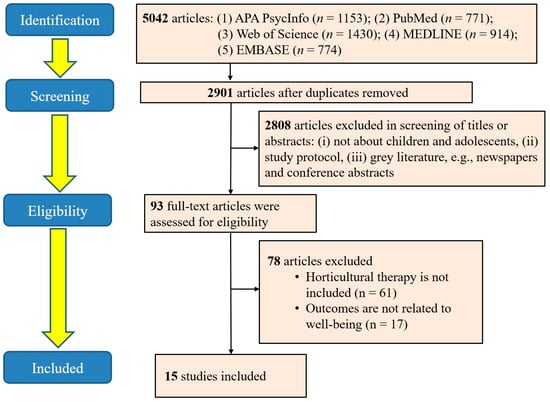
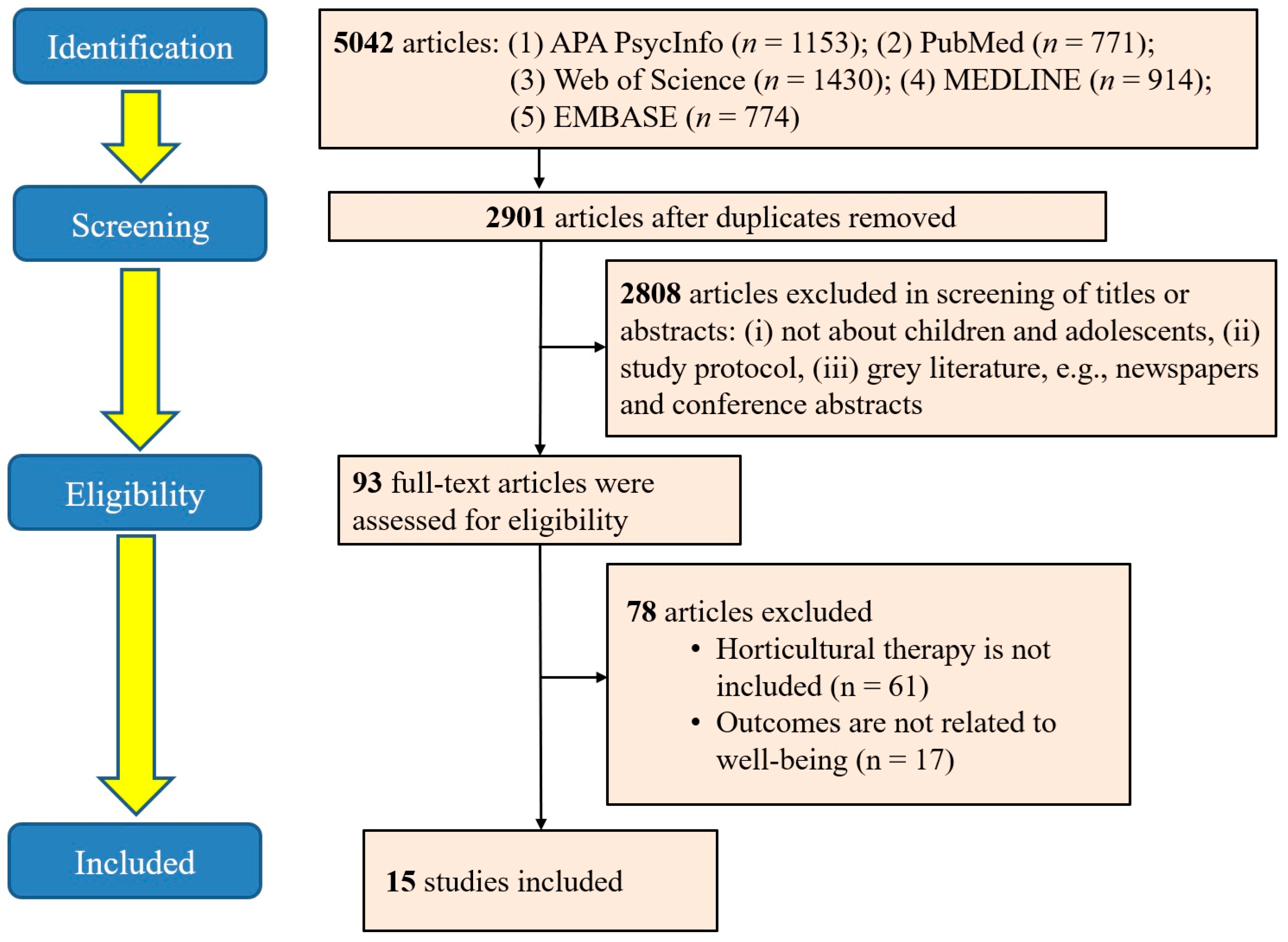
The initial database search yielded 5042 records, with 2141 removed due to duplication. Title and abstract screening led to the exclusion of an additional 2808 articles. Subsequently, 93 full-text articles were assessed for eligibility, of which 78 were excluded for not meeting the inclusion criteria. The study selection process is illustrated in the PRISMA flow diagram (Figure 1).
Figure 1.
PRISMA flowchart of selection of the included studies.
3.2. Overview of Included Studies
A total of 15 studies published from 2001 to 2024 were finally analyzed and summarized (Table 2) (Chang et al., 2016; Chen et al., 2014; Curzio et al., 2022; B. Y. Kim et al., 2012; S. S. Kim et al., 2014; S. O. Kim et al., 2021; M. J. Lee et al., 2018; S. M. Lee & Park, 2024; Ma & Shek, 2018; Oh et al., 2020; S. A. Park et al., 2016; K. H. Park et al., 2022; Shao et al., 2020; Tseng et al., 2023; Waliczek et al., 2001). Most of the studies were performed in South Korea (n = 8, 53%), followed by Taiwan (n = 3, 20%), Chinese Mainland (n = 1, 7%), Hong Kong, China (n = 1, 7%), Italy (n = 1, 7%), and the United States (n = 1, 7%). These studies consisted of 12 quantitative studies (primarily quasi-experimental pre-post designs with scales and physiological measures), 2 mixed-methods study (combining quantitative scales with qualitative interviews/feedback), and 1 qualitative study (interviews and inductive analysis).
Table 2.
Characteristics of included studies (n = 15).
Among these studies, 10 included elementary/primary school students (total sample size: 1604, around ages 5–13 years), 4 included adolescents/teenage students (total sample size: 140, around ages 11–18 years), and 1 included children in kindergarten/day care centres (total sample size: 336, around ages 5–7 years). Regarding publication years, 1 study was published before 2010, 7 were between 2010 and 2019, and 7 were after 2019. The above information is presented in Table 2. The overall quality of the included studies was generally good, meaning that the studies satisfied most of the assessment criteria (Tables S1 and S2).
3.3. Information on the HBIs of the 15 Included Studies
Table 3 provides an overview of the interventions across 15 studies, focusing on objectives, who designed the interventions, dosage, and participant grouping. The primary objectives varied but commonly emphasized psychological, social, and educational benefits. These included enhancing attention, sociality, and emotional intelligence (e.g., B. Y. Kim et al., 2012; Oh et al., 2020), improving peer relations and social behavior (e.g., S. S. Kim et al., 2014; K. H. Park et al., 2022), promoting positive youth development and relaxation (e.g., Ma & Shek, 2018; Shao et al., 2020), and evaluating impacts on specific conditions like anorexia (e.g., Curzio et al., 2022). Several interventions integrated theoretical frameworks, such as Skinner’s behavior modification, Strong Kids, or school curricula, to foster attention, creativity, resilience, and sociality (e.g., Chang et al., 2016; B. Y. Kim et al., 2012; Oh et al., 2020).
Table 3.
Information on the HBIs of the 15 included studies.
Interventions were typically designed by horticultural therapists, experts in related fields (e.g., education, agriculture), or the study authors themselves. Dosage shows some variations: most programs ran weekly sessions (e.g., 6–24 sessions over 6–24 weeks), lasting 40–120 min each (e.g., Curzio et al., 2022; S. S. Kim et al., 2014), though some were single sessions (e.g., S. O. Kim et al., 2021; S. M. Lee & Park, 2024). Grouping was inconsistent. Several studies divided participants into small groups of 2–6 for cooperative activities (e.g., Curzio et al., 2022; S. S. Kim et al., 2014), while others provided no details or use individual formats (e.g., S. M. Lee & Park, 2024; Shao et al., 2020).
3.4. Effects of HBIs
Significant results reported in the included studies and results from qualitative studies were presented below. In Table 2, both significant and non-significant results were presented.
3.4.1. Emotional and Psychological Well-Being
Across 10 studies, HBIs demonstrated some potential for improving emotional and psychological outcomes. Preliminary patterns may reveal that HBIs promoted holistic psychosocial development by reducing stress and fostering emotional intelligence, resilience, and self-efficacy. Evidence across RCTs and non-RCTs suggested that engagement with plants enhanced physiological relaxation, emotional regulation, and self-perception, contributing to improved mental health and adaptive functioning in children and adolescents.
Stress Reduction and Relaxation
Results showed that HBI was likely to reduce both physiological and perceived stress, particularly among maladjusted or at-risk youth. Findings across RCTs and non-RCTs indicated improved autonomic regulation, emotional well-being, and health outcomes, highlighting HBI’s potential to enhance relaxation and overall quality of life.
- Results from RCTs
HBI significantly lowered physiological stress markers (e.g., salivary cortisol) and perceived stress, particularly in maladjusted or at-risk youth (M. J. Lee et al., 2018). A pilot RCT study with maladjusted elementary school children (aged 10–11 years), implemented nine 40-min sessions of flower arranging, planting, and pressing (M. J. Lee et al., 2018). Pre- and post-program cortisol measurements showed a significant reduction (≥37% decrease) in cortisol levels, alongside lower self-reported stress in school (M. J. Lee et al., 2018). Another study piloted 24 sessions for adolescents (aged 11–18 years) with anorexia nervosa, demonstrating significant reduction in body uneasiness and affective problems, as well as improvements in olfactory stress response (Curzio et al., 2022). This study also showed significant changes in resting low- to high-frequency component ratio of the ECG signal and thermal imaging (Curzio et al., 2022).
- Results from non-RCTs
A within-subject experimental study with 26 elementary school students (mean age 8.12 years) was conducted to compare gardening (e.g., a 5-min plant-cutting and potting task) with a smartphone game (Shao et al., 2020). Gardening significantly enhanced parasympathetic activity and stress recovery, measured via heart rate variability and skin conductance, indicating physiological relaxation (Shao et al., 2020). Furthermore, one study observed 93 elementary students (grade 1–6) in a green activity program (Tseng et al., 2023). The intervention group showed significantly higher physical activity levels, nature connectedness, and overall health/quality of life compared to the control group (Tseng et al., 2023).
Emotional Intelligence and Mood Enhancement
Results demonstrated that HBI enhanced emotional awareness, regulation, and cognitive engagement in children. Across studies, potential improvements in emotional intelligence, concentration, and mood suggested that plant-based activities may foster both emotional and neurophysiological benefits in early developmental contexts.
- Results from non-RCTs
The HBI programs may help support emotional awareness, expression, and regulation. One study evaluated a 24-session program (e.g., planting, harvesting) in 336 children aged 5–7 years in kindergartens or day care centres (S. A. Park et al., 2016). Gains in emotional intelligence (e.g., emotion utilization, recognition) via teacher-rated scales were found (S. A. Park et al., 2016). Another study replicated this in 582 elementary students (aged 11–13 years) over seven sessions, with significant pre-post improvements in emotional intelligence in both genders and resilience for males (Oh et al., 2020). One study used electroencephalogram (EEG) in 30 children (aged 10–13 years) during activities like harvesting and planting (S. O. Kim et al., 2021). Results showed significant increase in concentration (e.g., reduced theta waves) and positive moods (e.g., feeling “natural” via semantic differential method) (S. O. Kim et al., 2021).
Resilience, Self-Efficacy, and Self-Concept
Results revealed that HBI may strengthen coping abilities, self-concept, and resilience among children. Findings indicated enhanced self-perception across domains such as moral identity, school engagement, control, achievement, and self-efficacy, particularly benefiting male participants.
- Results from non-RCTs
HBI enhanced coping skills and self-perception. One study investigated 46 primary students in seven sessions, reporting significant improvements in self-concept (Chen et al., 2014). It included moral self and school, sense of control, and sense of achievement (Chen et al., 2014). Another study revealed significant resilience and self-efficacy gains in males (Oh et al., 2020).
3.4.2. Social Well-Being
Preliminary patterns may reveal that HBI was associated with social outcomes in 9 relevant studies. Preliminary patterns may reveal that HBI enhanced social functioning by fostering empathy, cooperation, and prosocial interactions while reducing behavioral issues. Evidence across studies demonstrated improved peer relations, adaptability, and social competence, suggesting that horticultural activities nurtured harmonious relationships and emotional growth in both typical and at-risk youth.
Peer Relations and Social Skills
Results showed that HBI promoted positive peer interactions, social competence, and prosocial behaviors among children. Across diverse groups, improvements in cooperation, adaptability, and self-control suggested that group-based horticultural activities had the potential to strengthen social relationships and reduce interpersonal conflicts.
- Results from non-RCTs
Group activities improved interactions and reduced conflicts. One study involved 246 elementary students (aged 10–12 years) in 10 gardening sessions, and found significant enhancements in peer relations (e.g., persistence, adaptability) and sociality (S. S. Kim et al., 2014). One study showed that interpersonal relationships varied significantly by grade level, and attitudes were more positive in females and schools offering intensive individualized gardening (Waliczek et al., 2001). One study noted significant improvements in sociality, e.g., assertion, self-control, and cooperation in 24 children with intellectual disabilities (grade 1–3) after 24 sessions, using teacher ratings (B. Y. Kim et al., 2012). One study found significant increase in prosocial gains (e.g., helping, sharing) in kindergarteners via observations (S. A. Park et al., 2016).
Reduction in Behavioral Issues
- Results from non-RCTs
HBI promoted positive interactions. One study found significant improvements in peer attachment and social skills in detained youth (K. H. Park et al., 2022).
3.4.3. Cognitive and Educational Benefits
Cognitive and educational gains appeared in 6 studies, with positive effects in some outcomes. Preliminary patterns may reveal that HBI supported cognitive and academic development by enhancing attention, inquiry skills, and positive learning attitudes. Findings indicated improved concentration, curiosity, and school engagement, suggesting that plant-based activities stimulate both cognitive processing and motivation for learning in children and adolescents.
Concentration and Attention
Results revealed that plant-based activities enhanced focus and cognitive engagement, as evidenced by increased beta activity and beta/theta ratios indicating improved attention and alertness in children and adolescents.
- Results from non-RCTs
Plant activities enhanced focus. One study used EEG in 30 children found significantly improved concentration specifically during the harvesting activity, as measured by an increased beta/theta wave ratio in the right prefrontal lobe (S. O. Kim et al., 2021). One study found better EEG indicators of attention in 34 teenagers (aged 11–16 years) during plant-based coding, with increased beta waves signaling alertness (S. M. Lee & Park, 2024).
Scientific Investigation and Attitudes
- Results from non-RCT
Gardening fostered inquiry skills. One study reported significant improvements in scientific abilities (e.g., prediction, observation, classification) and attitudes (e.g., curiosity, objectivity, criticism) in kindergarteners via teacher ratings (S. A. Park et al., 2016).
Academic Attitudes and Learning Motivation
- Results from non-RCT
HBI improved school engagement. One study found female students had significantly more positive attitudes toward school than males after a gardening program (Waliczek et al., 2001).
Problem-Solving Skills
- Results from non-RCT
In one study, the quantitative survey found that the program enhanced problem-solving skills in more than 90% students (S. A. Park et al., 2016).
3.4.4. Physical and Overall Health Benefits
- Results from non-RCT
Gardening promoted fitness and healthy behaviors. One study reported potential increase in performing physical exercises and overall health (Tseng et al., 2023).
4. Discussion
To the best of our knowledge, this is the first systematic review to investigate the effects of HBI on different domains of well-being among children and adolescents using global evidence. Our results indicated that horticultural activity has the potential to enhance children’s and adolescents’ well-being by addressing interconnected domains. Such domains include emotional/psychological (e.g., stress reduction, mood improvement), social (e.g., social skills and peer relations), cognitive and education benefits (e.g., attention, academic attitudes), and physical and overall health benefits (e.g., physical activity, quality of life). This review points to HBI’s possible value as a low-cost, scalable, and easy-to-use option for enhancing children’s and adolescents’ well-being, with benefits noted despite various study methods.
HBI’s benefits stem from multifaceted mechanisms, including attention restoration theory and the biophilia hypothesis, which underpin HBI’s restorative effects (R. Kaplan & Kaplan, 1989; Kellert & Wilson, 1993). Attention restoration theory posits that natural environments replenish directed attention (R. Kaplan & Kaplan, 1989). This explains observed improvements in concentration and cognitive clarity among students engaged in gardening tasks, such as reduced theta waves in EEG measurements (S. O. Kim et al., 2021; S. M. Lee & Park, 2024). This aligns with stress reduction outcomes, where HBI facilitates “soft fascination” to alleviate mental fatigue from academic pressures (Cipriani et al., 2017). Soft fascination, as defined in attention restoration theory, refers to effortless, involuntary attention captured by mildly stimulating natural elements (S. Kaplan, 1995). It allows recovery from mental fatigue without cognitive strain (S. Kaplan, 1995). In HBI, activities like gardening engage soft fascination, promoting stress reduction and emotional restoration by immersing participants in calming plant interactions (R. Kaplan & Kaplan, 1989; S. A. Park et al., 2016). Complementarily, the biophilia hypothesis suggests an evolutionary affinity for nature (Kellert & Wilson, 1993). This fosters emotional resilience and positive mood states, as evidenced by enhanced emotional intelligence and lowered cortisol in maladjusted youth (M. J. Lee et al., 2018).
Socially, these theories intersect with social learning theory, where group HBI activities promote prosocial behaviors through modeled cooperation and empathy (S. S. Kim et al., 2014; S. A. Park et al., 2016). Physiologically, exposure to natural elements like phytoncides supports immune modulation and affective restoration, contextualizing physical health gains (Antonelli et al., 2019; Tseng et al., 2023; Van den Berg & Custers, 2011). Activities like planting activate the parasympathetic nervous system, lowering cortisol as evidenced by heart rate variability improvements (M. J. Lee et al., 2018; Shao et al., 2020). These mechanisms are amplified in students due to developmental plasticity, where HBI supports neuroplasticity for emotional regulation. Collectively, these frameworks suggest HBI’s potential holistic impact, possibly bridging psychological, social, and physiological domains to enhance student well-being, though empirical validation in diverse contexts remains essential.
This systematic review’s findings align with the broader literature on HBI beyond student populations, where HBI has shown efficacy in reducing stress and enhancing well-being in adults with mental health conditions, such as depression and anxiety (Annerstedt & Währborg, 2011; Detweiler et al., 2015; Gonzalez et al., 2010; Kamioka et al., 2014). For instance, a study on older adults in community gardens reported similar reductions in cortisol and improved mood, echoing our results on stress alleviation in maladjusted children (M. J. Lee et al., 2018; Tse, 2010). Similarly, a U.S.-based trial with veterans found HBI improved posttraumatic stress disorder symptoms through social bonding, similar to our social well-being outcomes (S. O. Kim et al., 2021; Poulsen et al., 2016). European studies, such as those in the UK, integrate HBI into urban green spaces for individuals’ mental health (Barton & Pretty, 2010). It revealed benefits in resilience that parallel our findings but with greater focus on biodiversity exposure. These comparisons suggest HBI’s universal appeal, yet cultural contexts influence implementation, e.g., Asian programs prioritize family involvement (Chen et al., 2014). This underscores the need for culturally adapted HBI frameworks to enhance global applicability.
The heterogeneity in HBI dosages represents a potential limitation. Dosages range from brief single sessions to extended multi-week programs. This complicates comparisons and the generalizability of effects. For instance, some studies suggested possible benefits like improved concentration and emotional states from minimal exposure (S. O. Kim et al., 2021; S. M. Lee & Park, 2024). Examples include 3 min for each activity with 4 activities in total in a single session with randomized horticultural tasks (S. O. Kim et al., 2021). Others involved longer durations, potentially influencing outcomes variably (Curzio et al., 2022; S. S. Kim et al., 2014). This variability makes it challenging to determine a minimum duration or intensity likely required for measurable well-being improvements. It may hinder practical application for educators. Future research could explore optimal dosages to better guide implementation in school settings.
Educators may consider integrating horticultural activities into curricula to address student well-being holistically, leveraging its low-cost, accessible nature. For instance, incorporating weekly gardening sessions could mitigate academic stress, as seen in our reviewed studies, by providing hands-on activities that foster emotional regulation and social skills (Blair, 2009; M. J. Lee et al., 2018; Shao et al., 2020). Schools in resource-limited areas might start with simple interventions like classroom plant care, which have been shown to boost concentration and self-esteem in primary students (Chen et al., 2014; S. O. Kim et al., 2021; Williams & Dixon, 2013). Training teachers via workshops on HBI principles, such as those aligned with attention restoration theory, could ensure effective delivery. For at-risk groups, like those with behavioral issues, tailored horticultural activity programs combining planting with reflective discussions could reduce aggression and enhance peer relations, as supported by interventions in inclusive education settings (B. Y. Kim et al., 2012; M. J. Lee et al., 2018). Overall, these practices could transform educational environments into therapeutic spaces, promoting preventive mental health strategies.
Future studies should employ rigorous RCTs with larger, diverse samples to address the quasi-experimental bias in our review. They should incorporate longitudinal designs to assess long-term effects. Extending the intervention to underrepresented regions, such as Africa or Latin America, could provide cross-cultural data. Research on mechanisms, including neuroimaging, could elucidate brain changes during HBI. Finally, comparative studies with other therapies (e.g., art therapy) would clarify HBI’s unique contributions.
Despite the suggestive results of the systematic review, it has several limitations. First, the predominance of East Asian studies (e.g., South Korea) may limit generalizability to other cultural contexts, as HBI’s effects could vary due to differing educational systems, environmental factors, or societal values. Second, small sample sizes in many included studies (e.g., n < 50) may introduce selection bias. Third, our conclusions are primarily driven by non-RCT studies in the existing literature which reduce causal inference reliability. Fourth, heterogeneity in HBI and outcome measures potentially overlooks nuanced effects. Fifth, HBI dosages ranged from brief single sessions to multi-week programs. It hinders identifying minimum durations or intensities for measurable well-being effects. Sixth, most studies featured short-term follow-ups, leaving long-term sustainability unclear. Finally, the prevalent use of self-reported instruments in many included studies may introduce biases like social desirability or recall inaccuracies.
Nevertheless, this systematic review represents the first synthesis of HBI’s effects on children and adolescent well-being using global evidence. It consolidates research findings from 15 studies and over 2000 participants to inform educational practices and policy. By highlighting potential benefits and research gaps, it provides a foundational reference for advancing HBI as a low-cost and scalable nature-based intervention, while calling for more robust, diverse studies to build on these insights.
5. Conclusions
This systematic review of 15 studies suggests potential benefits for student well-being. Grounded in theories such as attention restoration and biophilia, HBI’s hands-on nature fosters students’ holistic development. Our findings reveal HBI’s potential practical meaning as an evidence-based intervention that consistently reduces stress and enhances social skills across diverse student groups. This provides high information value by synthesizing global evidence for the first time and addressing gaps in non-pharmacological approaches to youth mental health.
Educators could integrate horticultural programs into curricula via school gardens to combat mental health challenges. Policymakers may support funding for horticultural programs in schools to combat rising student mental health crises. Schools could integrate them into national curricula as evidence-based interventions. For example, policies may support the integration of green spaces, such as school gardens, into educational facilities to promote student well-being. On a broader scale, horticultural programs’ societal impact includes fostering environmental stewardship. This potentially reduces urban mental health burdens by encouraging community gardening initiatives that extend beyond schools. Economically, investing in horticultural programs could yield cost savings through decreased healthcare needs for stress-related disorders among students. Globally, international guidelines, such as those from the United Nations Educational, Scientific and Cultural Organization (UNESCO) on sustainable education, could incorporate HBI to address inequities in well-being.
Supplementary Materials
The following supporting information can be downloaded at: https://www.mdpi.com/article/10.3390/educsci16050723/s1, Table S1: Quality assessment of RCTs and non-experimental studies; Table S2: Quality assessment of the qualitative study (assessed by the subcomponent evaluating qualitative studies of the Mixed Methods Appraisal Tool (MMAT)—Version 2011).
Author Contributions
Conceptualization: P.S.-f.C.; methodology and analysis: P.S.-f.C. and J.K.; formal analysis: P.S.-f.C., and J.K.; writing—original draft preparation: P.S.-f.C., J.K., M.S., and E.B.; writing—review and editing: P.S.-f.C., J.K., M.S., E.B., E.Y.Y.L., K.F.H.L. All authors have read and agreed to the published version of the manuscript.
Funding
This study was supported by the International Collaborative Research Fellowships Programme from the Faculty of Education and Human Development, The Education University of Hong Kong, Hong Kong, China.
Institutional Review Board Statement
Not applicable.
Informed Consent Statement
Not applicable.
Data Availability Statement
The data presented in this study are available from the corresponding author upon request.
Conflicts of Interest
The authors declare no conflicts of interest.
References
- American Psychological Association. (2018). Stress in America: Generation Z. Available online: https://www.apa.org/news/press/releases/stress/2018/stress-gen-z.pdf (accessed on 12 November 2025).
- Annerstedt, M., & Währborg, P. (2011). Nature-assisted therapy: Systematic review of controlled and observational studies. Scandinavian Journal of Public Health, 39(4), 371–388. [Google Scholar] [CrossRef] [Scilit] [PubMed]
- Antonelli, M., Barbieri, G., & Donelli, D. (2019). Effects of forest bathing (shinrin-yoku) on levels of cortisol as a stress biomarker: A systematic review and meta-analysis. International Journal of Biometeorology, 63(8), 1117–1134. [Google Scholar] [CrossRef] [Scilit]
- Arundell, L., Fletcher, E., Salmon, J., Veitch, J., & Hinkley, T. (2016). A systematic review of the prevalence of sedentary behavior during the after-school period among children aged 5–18 years. International Journal of Behavioral Nutrition and Physical Activity, 13(1), 93. [Google Scholar] [CrossRef] [Scilit]
- Barton, J., & Pretty, J. (2010). What is the best dose of nature and green exercise for improving mental health? A multi-study analysis. Environmental Science & Technology, 44(10), 3947–3955. [Google Scholar] [CrossRef] [Scilit]
- Blair, D. (2009). The child in the garden: An evaluative review of the benefits of school gardening. Journal of Environmental Education, 40(2), 15–38. [Google Scholar] [CrossRef] [Scilit]
- Centers for Disease Control and Prevention. (2023). Youth risk behavior survey data summary & trends report: 2011–2021. Available online: https://www.cdc.gov/yrbs/?CDC_AAref_Val=https://www.cdc.gov/healthyyouth/data/yrbs/pdf/YRBS_Data-Summary-Trends_Report2023_508.pdf (accessed on 3 October 2025).
- Chang, Y. Y., Su, W. C., Tang, I. C., & Chang, C. Y. (2016). Exploring the benefits of school gardening for children in Taiwan and identifying the factors influencing these benefits. HortTechnology, 26(6), 783–792. [Google Scholar] [CrossRef] [Scilit]
- Chen, M. L., Lou, S. J., Tsai, W. F., & Tsai, C. C. (2014). A study of the impact of horticultural activities on primary school children’s self-concept, well-being and happiness. Journal of Baltic Science Education, 13(5), 637–649. [Google Scholar] [CrossRef] [Scilit]
- Cipriani, J., Benz, A., Holmgren, A., Kinter, D., McGarry, J., & Rufino, G. (2017). A systematic review of the effects of horti-cultural therapy on persons with mental health conditions. Occupational Therapy in Mental Health, 33(1), 47–69. [Google Scholar] [CrossRef] [Scilit]
- Curzio, O., Billeci, L., Belmonti, V., Colantonio, S., Cotrozzi, L., De Pasquale, C. F., Morales, M. A., Nali, C., Pelosi, G., & To-Nacci, A. (2022). Horticultural therapy may reduce psychological and physiological stress in adolescents with anorexia nervosa: A pilot study. Nutrients, 14(24), 5198. [Google Scholar] [CrossRef] [Scilit] [PubMed]
- Detweiler, M. B., Self, J. A., Lane, S., Spencer, L., Lutgens, B., Kim, D. Y., Halling, M. H., Rudder, T. C., & Lehmann, L. (2015). Horticultural therapy: A pilot study on modulating cortisol levels and indices of substance craving, posttraumatic stress dis-order, depression, and quality of life in veterans. Alternative Therapies in Health and Medicine, 21(4), 36–41. [Google Scholar]
- Fredricks, J. A., Blumenfeld, P. C., & Paris, A. H. (2004). School engagement: Potential of the concept, state of the evidence. Review of Educational Research, 74(1), 59–109. [Google Scholar] [CrossRef] [Scilit]
- Gonzalez, M. T., Hartig, T., Patil, G. G., Martinsen, E. W., & Kirkevold, M. (2010). Therapeutic horticulture in clinical depression: A prospective study of active components. Journal of Advanced Nursing, 66(9), 2002–2013. [Google Scholar] [CrossRef] [Scilit] [PubMed]
- Hattie, J. (2009). Visible learning: A synthesis of over 800 meta-analyses relating to achievement. Routledge. [Google Scholar]
- Kamioka, H., Tsutani, K., Yamada, M., Park, H., Okuizumi, H., Honda, T., Okada, S., Park, S. J., Kitayuguchi, J., Abe, T., Handa, S., Oshio, T., & Mutoh, Y. (2014). Effectiveness of horticultural therapy: A systematic review of randomized controlled trials. Complementary Therapies in Medicine, 22(5), 930–943. [Google Scholar] [CrossRef] [Scilit] [PubMed]
- Kaplan, R., & Kaplan, S. (1989). The experience of nature: A psychological perspective. Cambridge University Press. [Google Scholar]
- Kaplan, S. (1995). The restorative benefits of nature: Toward an integrative framework. Journal of Environmental Psychology, 15(3), 169–182. [Google Scholar] [CrossRef] [Scilit]
- Kellert, S. R., & Wilson, E. O. (Eds.). (1993). The biophilia hypothesis. Island Press. [Google Scholar]
- Kessler, R. C., Angermeyer, M., Anthony, J. C., De Girolamo, G., Demyttenaere, K., Gasquet, I., De Graaf, R., Gureje, O., Haro, J. M., Kawakami, N., Karam, A., Levinson, D., Medina Mora, M. E., Oakley Browne, M. A., Posada-Villa, J., Stein, D. J., Adley Tsang, C. H., Aguilar-Gaxiola, S., Alonso, J., … Üstün, T. B. (2007). Lifetime prevalence and age-of-onset distributions of mental disorders in the World Health Organization’s world mental health survey initiative. World Psychiatry, 6(3), 168–176. [Google Scholar]
- Kim, B. Y., Park, S. A., Song, J. E., & Son, K. C. (2012). Horticultural therapy program for the improvement of attention and sociality in children with intellectual disabilities. HortTechnology, 22(3), 320–324. [Google Scholar] [CrossRef] [Scilit]
- Kim, S. O., Jeong, J. E., Oh, Y. A., Kim, H. R., & Park, S. A. (2021). Comparing concentration levels and emotional states of children using electroencephalography during horticultural and nonhorticultural activities. HortScience, 56(3), 324–329. [Google Scholar] [CrossRef] [Scilit]
- Kim, S. S., Park, S. A., & Son, K. C. (2014). Improving peer relations of elementary school students through a school gardening program. HortTechnology, 24(2), 181–187. [Google Scholar] [CrossRef] [Scilit]
- Lee, M. J., Oh, W., Jang, J. S., & Lee, J. Y. (2018). A pilot study: Horticulture-related activities significantly reduce stress levels and salivary cortisol concentration of maladjusted elementary school children. Complementary Therapies in Medicine, 37, 172–177. [Google Scholar] [CrossRef] [Scilit]
- Lee, S. M., & Park, S. A. (2024). Psychophysiological and psychological responses of teenage students conducting computer programming activities combined with horticultural activities. HortTechnology, 34(3), 353–360. [Google Scholar] [CrossRef] [Scilit]
- Lee, S. Y., Jang, E. J., & Kim, J. (2023). Analysis of horticultural activity programs in research articles on horticultural therapy for children in Korean journals. Journal of People, Plants, and Environment, 26(3), 233–245. [Google Scholar] [CrossRef] [Scilit]
- Lin, Y., Lin, R., Liu, W., & Wu, W. (2022). Effectiveness of horticultural therapy on physical functioning and psychological health outcomes for older adults: A systematic review and meta-analysis. Journal of Clinical Nursing, 31(15–16), 2087–2099. [Google Scholar] [CrossRef] [Scilit]
- Ma, C. M. S., & Shek, D. T. L. (2018). Promotion of positive youth development through a horticultural therapy program among Chinese adolescents. International Journal on Disability and Human Development, 17(3), 329–337. [Google Scholar]
- Moher, D., Shamseer, L., Clarke, M., Ghersi, D., Liberati, A., Petticrew, M., Shekelle, P., & Stewart, L. A. (2015). Preferred reporting items for systematic review and meta-analysis protocols (PRISMA-P) 2015 statement. Systematic Reviews, 4(1), 1. [Google Scholar] [CrossRef] [PubMed]
- Nevil, W. S., & Beela, G. K. (2023). Impact of horticultural therapy in social intelligence of people with autism spectrum disorder. International Journal of Autism, 3(1), 6–13. [Google Scholar]
- Oh, Y. A., Lee, A. Y., An, K. J., & Park, S. A. (2020). Horticultural therapy program for improving emotional well-being of elementary school students: An observational study. Integrative Medicine Research, 9(1), 37–41. [Google Scholar] [CrossRef] [Scilit]
- Orben, A., & Przybylski, A. K. (2019). The association between adolescent well-being and digital technology use. Nature Human Behaviour, 3(2), 173–182. [Google Scholar] [CrossRef] [Scilit]
- Pace, R., Pluye, P., Bartlett, G., Macaulay, A. C., Salsberg, J., Jagosh, J., & Seller, R. (2012). Testing the reliability and efficiency of the pilot Mixed Methods Appraisal Tool (MMAT) for systematic mixed studies review. International Journal of Nursing Studies, 49(1), 47–53. [Google Scholar] [CrossRef] [Scilit]
- Park, K. H., Kim, S. Y., & Park, S. A. (2022). Efficacy of a horticultural therapy program designed for emotional stability and career exploration among adolescents in juvenile detention centers. International Journal of Environmental Research and Public Health, 19(14), 8812. [Google Scholar] [CrossRef] [Scilit]
- Park, S. A., Cho, M. K., Yoo, M. H., Kim, S. Y., Im, E. A., Song, J. E., Lee, J. C., & Jun, I. G. (2016). Horticultural activity program for improving emotional intelligence, prosocial behavior, and scientific investigation abilities and attitudes in kindergarteners. HortTechnology, 26(6), 754–761. [Google Scholar] [CrossRef] [Scilit]
- Poulsen, D. V., Stigsdotter, U. K., Djernis, D., & Sidenius, U. (2016). ‘Everything just seems much more right in nature’: How veterans with post-traumatic stress disorder experience nature-based activities in a forest therapy garden. Health Psychology Open, 3(1), 2055102916637090. [Google Scholar] [CrossRef] [Scilit]
- Salari, N., Ghasemi, H., Abdoli, N., Rahmani, A., Shiri, M. H., Hashemian, A. H., Akbari, H., & Mohammadi, M. (2023). The global prevalence of ADHD in children and adolescents: A systematic review and meta-analysis. Italian Journal of Pediatrics, 49(1), 48. [Google Scholar] [CrossRef] [Scilit] [PubMed]
- Shao, Y. H., Elsadek, M., & Liu, B. Y. (2020). Horticultural activity: Its contribution to stress recovery and wellbeing for children. International Journal of Environmental Research and Public Health, 17(4), 1229. [Google Scholar] [CrossRef] [Scilit] [PubMed]
- Shorey, S., Ng, E. D., & Wong, C. H. (2022). Global prevalence of depression and elevated depressive symptoms among adolescents: A systematic review and meta-analysis. British Journal of Clinical Psychology, 61(2), 287–305. [Google Scholar] [CrossRef] [Scilit]
- Silva, S. A., Silva, S. U., Ronca, D. B., Gonçalves, V. S. S., Dutra, E. S., & Carvalho, K. M. B. (2020). Common mental disorders prevalence in adolescents: A systematic review and meta-analyses. PLoS ONE, 15(4), e0232007. [Google Scholar] [CrossRef] [Scilit] [PubMed]
- Ssegonja, R., Alaie, I., Philipson, A., Hagberg, L., Sampaio, F., Möller, M., von Knorring, L., Sarkadi, A., Langenskiöld, S., von Knorring, A., Bohman, H., Jonsson, U., & Feldman, I. (2019). Depressive disorders in adolescence, recurrence in early adulthood, and healthcare usage in mid-adulthood: A longitudinal cost-of-illness study. Journal of Affective Disorders, 258, 33–41. [Google Scholar] [CrossRef] [Scilit]
- Sterne, J. A. C., Hernán, M. A., Reeves, B. C., Savović, J., Berkman, N. D., Viswanathan, M., Henry, D., Altman, D. G., Ansari, M. T., Boutron, I., Carpenter, J. R., Chan, A. W., Churchill, R., Deeks, J. J., Hróbjartsson, A., Kirkham, J., Jüni, P., Loke, Y. K., Pigott, T. D., … Higgins, J. P. T. (2016). ROBINS-I: A tool for assessing risk of bias in non-randomised studies of interventions. BMJ, 355, i4919. [Google Scholar] [CrossRef] [Scilit]
- Sterne, J. A. C., Savović, J., Page, M. J., Elbers, R. G., Blencowe, N. S., Boutron, I., Cates, C. J., Cheng, H. Y., Corbett, M. S., Eldridge, S. M., Emberson, J. R., Hernán, M. A., Hopewell, S., Hróbjartsson, A., Junqueira, D. R., Jüni, P., Kirkham, J. J., Lasserson, T., Li, T., … Higgins, J. P. T. (2019). RoB 2: A revised tool for assessing risk of bias in randomised trials. BMJ, 366, l4898. [Google Scholar] [CrossRef] [Scilit]
- Tse, M. M. Y. (2010). Therapeutic effects of an indoor gardening programme for older people living in nursing homes. Journal of Clinical Nursing, 19(7–8), 949–958. [Google Scholar] [CrossRef] [Scilit]
- Tseng, T. A., Chang, J. J., & Chang, Y. C. (2023). Green experience: The effect of horticultural activities on children’s physical and mental health and dietary behavior. HortScience, 58(11), 1439. [Google Scholar] [CrossRef] [Scilit]
- Tu, H. M. (2022). Effect of horticultural therapy on mental health: A meta-analysis of randomized controlled trials. Journal of Psychiatric and Mental Health Nursing, 29(4), 603–615. [Google Scholar] [CrossRef] [Scilit]
- Tu, H. M., & Chiu, P. Y. (2020). Meta-analysis of controlled trials testing horticultural therapy for the improvement of cognitive function. Scientific Reports, 10(1), 14637. [Google Scholar] [CrossRef] [Scilit]
- Van den Berg, A. E., & Custers, M. H. G. (2011). Gardening promotes neuroendocrine and affective restoration from stress. Journal of Health Psychology, 16(1), 3–11. [Google Scholar] [CrossRef] [Scilit] [PubMed]
- Waliczek, T. M., Bradley, J. C., & Zajicek, J. M. (2001). The effect of school gardens on children’s interpersonal relationships and attitudes toward school. HortTechnology, 11(3), 466–468. [Google Scholar] [CrossRef] [Scilit]
- Wang, Z., Zhang, Y., Lu, S., Tan, L., Guo, W., Lown, M., Hu, X., & Liu, J. (2022). Horticultural therapy for general health in the older adults: A systematic review and meta-analysis. PLoS ONE, 17(2), e0263598. [Google Scholar] [CrossRef] [Scilit]
- Williams, D. R., & Dixon, P. S. (2013). Impact of garden-based learning on academic outcomes in schools: Synthesis of research between 1990 and 2010. Review of Educational Research, 83(2), 211–235. [Google Scholar] [CrossRef] [Scilit]
- World Health Organization. (2022). World mental health report: Transforming mental health for all. Available online: https://www.who.int/publications/i/item/9789240049338 (accessed on 2 November 2025).
- Yun, J., Yao, W., Meng, T., & Mu, Z. (2024). Effects of horticultural therapy on health in the elderly: A review and me-ta-analysis. Journal of Public Health, 32(10), 1905–1931. [Google Scholar] [CrossRef] [Scilit] [PubMed]

Disclaimer/Publisher’s Note: The statements, opinions and data contained in all publications are solely those of the individual author(s) and contributor(s) and not of MDPI and/or the editor(s). MDPI and/or the editor(s) disclaim responsibility for any injury to people or property resulting from any ideas, methods, instructions or products referred to in the content. |
© 2026 by the authors. Licensee MDPI, Basel, Switzerland. This article is an open access article distributed under the terms and conditions of the Creative Commons Attribution (CC BY) license.