Article

Shaping the Classroom: How Job Crafting and LMX Can Drive Teacher Performance and Well-Being
Department of Marketing, Innovation and Organization, Faculty of Economics and Business Administration, Ghent University, 9000 Ghent, Belgium
*
Author to whom correspondence should be addressed.
Educ. Sci. 2026, 16(3), 370; https://doi.org/10.3390/educsci16030370
Submission received: 12 January 2026 / Revised: 13 February 2026 / Accepted: 26 February 2026 / Published: 27 February 2026

Abstract

The teaching profession plays a central role in shaping educational quality and student development, yet it is increasingly characterized by high job demands and increasing pressures. Against this backdrop, this study examines how individual proactive behaviors (i.e., structural and social job crafting) interact with relational resources (i.e., LMX), to foster teachers’ emotional well-being and professional functioning, drawing on the Job Demands–Resources (JD-R) model and LMX theory. Using cross-sectional survey data from 374 Flemish public secondary school teachers, we investigated the relationships between job crafting, well-being, and performance outcomes, as well as the mediating role of LMX. The results indicate that both forms of job crafting are significantly associated with lower emotional exhaustion and higher teacher enthusiasm and creative performance. Moreover, LMX emerged as a key, yet underexplored, mediating mechanism linking job crafting to teacher well-being and enthusiasm. These findings advance theoretical understanding of how proactive work behaviors translate into positive outcomes in educational contexts and highlight the importance of high-quality leader–teacher relationships. From a practical perspective, the results suggest that encouraging teachers’ job crafting behaviors alongside supportive school leadership may be crucial for fostering sustainable well-being and performance in education.

1. Introduction

In the educational system, teachers play an essential role not only as transmitters of knowledge but also as key figures in fostering students’ social and emotional development (Evers et al., 2004; Madigan & Kim, 2021). This dual function places considerable demands on educators, who are expected to facilitate academic achievement while simultaneously attending to the well-being and growth of their pupils. The link between teacher effectiveness and student outcomes such as academic performance (Darling-Hammond, 2000; Gerritsen et al., 2017; Lillelien & Jensen, 2025; Rivkin et al., 2005) is well established, underscoring the importance of sustaining high levels of teacher performance and motivation. However, this imperative is increasingly undermined by rising job demands (e.g., administrative burden, higher expectations, and communication with parents) and limited flexibility in their roles, which can contribute to enhanced levels of stress and burnout (Hakanen et al., 2006; McConnell, 2025; Oh & Wolf, 2023). Recent research indicates that teachers’ poor well-being and elevated stress can not only undermine students’ academic performance (Elliott et al., 2024; Jõgi et al., 2023) but also impair students’ executive functioning (Oh & Wolf, 2023) and compromise their well-being (Tikkanen et al., 2021), highlighting the far-reaching consequences of teacher stress on student development.
Identifying and leveraging strategies that promote both well-being and performance of teachers is not merely desirable but also crucial to the optimal performance of school systems (Fan & Wang, 2022) and society (Zhang et al., 2024). The Job Demands–Resources (JD-R) model offers a useful framework to understand employee well-being and performance. It proposes that both are a result of the interplay between job demands and job resources. Job demands comprise physical, cognitive, and emotional aspects of work that require sustained effort and are associated with psychological or physiological costs. Examples from the teaching profession are high workload, time pressure, and emotionally demanding interactions with students. Although these demands are inherent to teaching, they may deplete teachers’ energy and lead to strain. Job resources, in contrast, refer to structural, social, and psychological characteristics of the work context, such as autonomy, supportive leadership, collegial relationships, and opportunities for professional development, that can buffer the impact of job demands, facilitate goal attainment, and foster motivation and work engagement (Bakker & Demerouti, 2007; Skaalvik & Skaalvik, 2018).
One promising path in this regard is job crafting: proactive, self-initiated behavior in which employees adapt their work tasks, relationships, and perceptions to better fit their personal strengths and preferences (Wrzesniewski & Dutton, 2001). Within the framework of the JD-R model, job crafting can be understood as a mechanism through which employees actively manage job demands and mobilize resources, thereby shaping outcomes such as stress and engagement (Bakker & Demerouti, 2007). Furthermore, job crafting is recognized not only as a mechanism for enhancing well-being but also as a pathway to improved professional functioning (Tims et al., 2015). However, the manifestation of these outcomes may be mediated by contextual variables, such as the quality of the relationship between teachers and their school leaders.
Leader–member exchange (LMX) theory could act as a guiding framework for understanding how relational dynamics shape the outcomes of job crafting. LMX refers to the degree of mutual trust, support, and respect between a leader and a subordinate (Graen & Uhl-Bien, 1995), and has been linked to a wide array of positive outcomes, including engagement, creativity, reduced emotional exhaustion, and enhanced innovative work behaviors (Dulebohn et al., 2012; Martin et al., 2016; Widiastuti & Kusmaryani, 2023). In educational settings, where hierarchical structures and interpersonal interdependence are prominent, LMX—the quality of the relationship between teachers and principals—may serve as a critical mediating mechanism that explains how and why job crafting translates into improved well-being and classroom performance (Adams et al., 2025). Despite its theoretical relevance, empirical studies examining LMX as a mediating mechanism in the relationship between job crafting and teacher outcomes are still scarce.
This study aims to integrate insights from the Job Demands–Resources model and LMX theory to investigate the relation between job crafting and teacher well-being and performance, and the possible role of LMX. In this study, we explore how individual strategies and relationships with leaders work together to promote positive outcomes in demanding educational settings.

2. Conceptual Framework

Over the last decades, the teaching profession has undergone significant transformation, driven by technological change (Dhanpat, 2022). These developments have increased the cognitive, emotional, and administrative demands placed on educators and created a work environment that is both complex and resource-intensive. Moreover, teachers are now expected to not only transmit knowledge but also foster inclusion, emotional intelligence, and adaptability—competencies that extend beyond traditional pedagogical tasks (Salmerón Aroca et al., 2023). In the Flemish context, indicators of job feasibility, such as perceived meaningfulness, developmental opportunities, and work–life balance, have steadily declined for teachers (SERV, 2024). This mirrors a broader European and American trend, where secondary education systems face growing teacher shortages, affecting the learning environment of students (Admiraal & Kittelsen Røberg, 2023; Nguyen et al., 2022). Numerous studies (Collie, 2023; Mijakoski et al., 2022; Sandmeier et al., 2022) have highlighted the persistently high job demands faced by teachers. Declining well-being among teachers has been linked to adverse effects on the quality and stability of the teaching profession but also on students’ academic development (Carver-Thomas & Darling-Hammond, 2019; Fernet et al., 2012). The performance of teachers plays an important role in influencing students’ learning experiences, serving as both an instructional and motivational driver of academic achievement. Evidence suggests that supporting teacher creativity and innovative behavior (Ellis et al., 2019; Wen et al., 2022) and enthusiasm (Kunter et al., 2013; Long & Hoy, 2006) two components of teaching performance, plays a relevant role in enhancing students’ motivation, learning, and academic achievement. Given its wide-reaching implications across multiple layers of the educational system, safeguarding teacher well-being and performance constitutes a pressing concern. Individual-level strategies such as job crafting may offer a means for teachers to have control over their work and protect their well-being and performance.

2.1. Job Crafting

Conceptualized by Wrzesniewski and Dutton (2001), job crafting refers to the proactive modifications that individuals make to their jobs to enhance person–job fit. It encompasses changes in task boundaries, relational interactions, and cognitive framing. Within the Job Demands–Resources model (Demerouti et al., 2001), job demands are defined as aspects of the job that require sustained effort, while job resources are aspects that help employees cope with demands and promote growth (Bakker & Demerouti, 2007). Research shows that challenging demands may enhance engagement when adequate resources are available (Crawford et al., 2010). In contrast, hindering demands are associated with strain and burnout (Tims et al., 2015). Job crafting can serve as a mechanism by which employees manage job demands and resources, thereby possibly having an impact on outcomes such as stress, engagement, and performance (Bakker & Demerouti, 2007). Tims et al. (2012) conceptualized job crafting as a multidimensional construct, comprising four key dimensions: increasing structural job resources, increasing social job resources, increasing challenging job demands, and decreasing hindering demands. Together, these dimensions capture the proactive behaviors employees engage in to optimize their work environment and can enhance person–job fit. In the present study, we focus on two key dimensions of job crafting: increasing structural job resources and increasing social job resources. The former entails proactive behaviors aimed at enhancing one’s work environment through opportunities for learning, development, and autonomy. The latter refers to self-initiated efforts to strengthen social aspects of the job, such as actively seeking feedback, support, and collaboration from colleagues. These dimensions are particularly pertinent in the teaching profession, where ongoing professional growth and collegial relationships are essential for maintaining engagement and effectiveness.
In the educational sector, job crafting may manifest in various ways. Teachers might shape their tasks and responsibilities in ways that enhance instructional effectiveness and support their psychological well-being (Qi et al., 2016). They may seek to increase structural resources (e.g., autonomy) and social resources (e.g., peer support), while reducing job demands that hinder their functioning. Such adjustments are particularly relevant as teachers navigate increasingly complex and dynamic educational settings (Huang et al., 2023). Educators can actively adjust their pedagogical strategies, curricular content, and classroom management practices to align more closely with their individual instructional preferences and strengths (Peral & Geldenhuys, 2016; Tims et al., 2012). They can proactively engage in collaborative initiatives, pursue ongoing professional learning, or cultivate mentoring relationships, all of which can foster greater job satisfaction, emotional well-being, and a sense of connectedness within the school environment (Alonso et al., 2019). These behaviors are shaped not only by institutional factors (e.g., school policies, team climate) but also by psychological dispositions such as self-efficacy and intrinsic motivation (Huang et al., 2023; Kunnari et al., 2021).

2.2. Job Crafting and Work Outcomes in Education

Job crafting can play a pivotal role in fostering positive work outcomes. Job crafting strategies have been shown to improve person–job fit, thereby promoting well-being and a sense of control over one’s work (Kristof-Brown et al., 2005). Teacher well-being plays a critical role in shaping educators’ mental and physical health, their level of job engagement, and their intentions to remain in their current school or within the profession (Claeys, 2011; O’Reilly, 2014). It has a direct impact on key student outcomes, such as academic motivation, well-being of students, achievement, and overall performance (Collie et al., 2012; Fouché et al., 2017). There is even evidence that teacher well-being contributes to the broader effectiveness of the school as an organization (Bajorek et al., 2014). Tims et al. (2013) found that job crafting significantly reduced burnout symptoms. Burnout has been defined in various ways, yet the most widely accepted and frequently cited definition remains that of Maslach et al. (1997), who describe it as “a psychological syndrome of emotional exhaustion, depersonalization, and reduced personal accomplishment that can occur among individuals who work with other people in some capacity”. Maslach and Leiter (1997) conceptualize burnout as a psychological and physical response to work-related stress, characterized by three core components: emotional exhaustion, depersonalization, and reduced personal accomplishment. The first dimension of burnout, emotional exhaustion, refers to a state in which individuals no longer possess the emotional, mental, or physical resources required to meet the demands of their work. This manifests as feelings of being overwhelmed, fatigued, and depleted, leaving individuals with insufficient energy to engage with their tasks, let alone support colleagues (Maslach et al., 1997; Maslach & Leiter, 2007). Burnout is a widespread issue among teachers, primarily driven by prolonged exposure to high job demands combined with insufficient resources (Kyriacou, 2001; Schaufeli et al., 2009). A meta-analysis by Dağtaş et al. (2024) confirmed that job crafting not only may enhance teachers’ psychological health but also fosters greater engagement and commitment within the educational workforce. The meta-analysis suggests that a supportive organizational context is essential to maintain educators’ mental and emotional health and to enable the effective implementation of job crafting practices.
Evidence from the COVID-19 pandemic further illustrates the protective role of job crafting. Wardani et al. (2021) showed that when teachers are granted autonomy to adjust their pedagogical methods and working conditions, they are better equipped to handle professional challenges, such as shifting curricula or student performance concerns, ultimately increasing their resilience. In line with this, Leana et al. (2009) found that teachers who actively engage in job crafting report higher levels of job satisfaction, stronger organizational commitment, and a lower intention to leave the profession.
Teachers operate in emotionally demanding environments. Burnout, particularly emotional exhaustion, is a pervasive issue within the profession, with detrimental effects on individual functioning, student academic achievement, student motivation, and organizational performance (Madigan & Kim, 2021; Maslach et al., 2001). Given these challenges, it is essential to identify behaviors that buffer the negative consequences of high job demands. In educational contexts, job crafting enables teachers to mitigate emotional demands, balance workload, and derive renewed purpose from their roles (Alonso et al., 2019; Huang et al., 2023). In this study, teacher well-being is assessed by examining levels of emotional exhaustion and stress-related complaints. Thus, consistent with the theoretical framework and prior empirical findings, we hypothesize the following:
H1a. 
Job crafting is negatively related to emotional exhaustion in teachers.
H1b. 
Job crafting is negatively related to teachers’ stress-related complaints.
The benefits of job crafting extend beyond psychological well-being to include improvements in professional functioning (Alonso et al., 2019; Lyons, 2008; Tims et al., 2015). By enabling employees to align their tasks with their strengths and interests, job crafting can foster both enhanced task performance and creativity (Kanya et al., 2021; Shang, 2022). Creativity in the workplace refers to the ability to produce ideas or solutions that are both novel and useful (Zhou & George, 2003). In the context of education, teacher creativity can be defined as the capacity to generate original yet practical responses to instructional challenges, with the goal of enhancing student learning and academic achievement (Adams et al., 2025). Creative teachers are those who frequently propose innovative approaches to improve instructional quality and meet educational objectives (Zhou & George, 2001). Fostering creativity and innovation in teaching has become increasingly vital for improving student outcomes and maintaining the adaptability of students (Wen et al., 2022). It can enhance teachers’ ability to innovate, adapt to diverse student needs, and sustain their professional development (Massie et al., 2022). In this vein, Huang et al. (2022) underscore the role of teacher job crafting in encouraging innovative teaching practices, highlighting how educators can purposefully redefine their roles to create more dynamic and creative learning environments. Teacher enthusiasm is defined by Keller et al. (2016) as a construct combining positive affect, specifically, enjoyment related to teaching, and its behavioral expression. Kunter et al. (2011) provide a definition distinguishing between two dimensions of enthusiasm: subject enthusiasm, which relates to interest in the content, and teaching enthusiasm, referring to the enjoyment of teaching activities. Teacher enthusiasm thus reflects teachers’ enjoyment of their profession, observable through dynamic instructional methods (H. Patrick et al., 2003). It is widely regarded as a crucial factor in effective teaching and student motivation (Long & Hoy, 2006; Witcher et al., 2001). Research further suggests that teacher enthusiasm is associated with student learning outcomes and academic performance (Kunter et al., 2013; B. C. Patrick et al., 2000). Enthusiastic teachers even appear to be happier and healthier (Kunter et al., 2013). Although the benefits of teacher enthusiasm are well-documented, the mechanisms underlying its effects remain underexplored. Notably, the relationship between teacher enthusiasm and job crafting has yet to be investigated (Keller et al., 2016).
Teachers who engage in job crafting may optimize their roles by aligning teaching strategies with personal strengths, thereby enhancing instructional effectiveness (Leana et al., 2009; Shang, 2022). In line with the JD-R model, job crafting supports a gain cycle in which enhanced resources may lead to higher motivation and better performance (Bakker & Demerouti, 2007). Therefore, we propose the following:
H2a. 
Job crafting is positively related to teachers’ creative performance.
H2b. 
Job crafting is positively related to teachers’ teaching enthusiasm.

2.3. The Mediating Role of Leader–Member Exchange (LMX)

LMX theory posits that leaders form differentiated relationships with subordinates, ranging from low to high quality. High-quality LMX is characterized by mutual trust, respect, and support, while low-quality exchanges are more transactional and marked by limited collaboration and loyalty (Graen & Uhl-Bien, 1995). Rooted in social exchange theory, Leader–Member Exchange emphasizes the reciprocal nature of leader–follower relationships, where the follower’s behavior is shaped by the leader’s treatment (Cropanzano et al., 2017; Graen & Uhl-Bien, 1995). High-quality LMX relationships have been associated with individual work outcomes such as increased performance, job satisfaction, engagement, and creativity (Brower et al., 2000; Dulebohn et al., 2012; Gerstner & Day, 1997; Martin et al., 2016). Such relationships can promote psychological safety, enabling employees to provide and receive feedback more openly (Scandura & Schriesheim, 1994). Conversely, low-quality LMX has been linked to elevated stress, reduced affective well-being, and diminished performance (Decramer et al., 2015; Dulebohn et al., 2012; Van Horn et al., 2004).
In educational settings, LMX refers primarily to the relationship between school leaders—typically principals—and their teaching staff (Zheng et al., 2024). Here, strong LMX relationships between teachers and school leaders are associated with better teacher well-being and classroom performance (Gu et al., 2015). High-quality LMX relationships between principals and teachers have also been linked with positive outcomes, including increased teacher commitment (Rahmy, 2018) and enhanced innovative work behaviors (Widiastuti & Kusmaryani, 2023). Importantly, we conceptualize LMX as a distinct relational resource that captures the quality of the dyadic teacher–leader relationship and reflects access to resources that are not inherent to broader collegial support.
Recent research positions LMX as a mediating mechanism between job crafting and its outcomes (Dağtaş et al., 2024). Radstaak and Hennes (2017) argue that job crafting behaviors are facilitated by trust in leadership. Furthermore, LMX provides access to resources like autonomy, which are essential for job crafting behaviors (Sekiguchi et al., 2017). In educational settings, LMX plays a pivotal role in shaping teachers’ professional behavior and classroom practices. Specific leadership strategies are needed to support and encourage innovative behavior among teachers (Adams & Periasamy, 2023; Feng & Adams, 2023). One key factor in this regard is the quality of the relationship between school leaders and teachers, as described by Leader–Member Exchange theory (Adams et al., 2025). When teachers feel supported and trusted by their leaders, they may be more likely to take initiative and experiment with new ideas in their classrooms. However, the implementation of creative practices in the classroom is not without obstacles. Teachers often face external constraints—such as accountability pressures, standardized curricula, and limited autonomy—that hinder their ability to act creatively (Adams et al., 2025). These challenges are particularly pronounced in educational systems characterized by hierarchical structures and high power distance, where rigid organizational norms may suppress individual initiative (Bellibaş & Kılınç, 2023). In such contexts, the role of leadership becomes critical. Empirical studies have shown that high-quality LMX relationships can foster greater creativity and innovative behavior among teachers (Adams et al., 2025). Nevertheless, findings in the literature are not entirely consistent. Some studies report weaker or non-significant effects of LMX on creativity (Sanders et al., 2010; Schermuly et al., 2013).
As mentioned above, high-quality LMX relationships can play a central role in enabling proactive behaviors such as job crafting. They can either facilitate or constrain the enactment of job crafting behaviors and their impact on outcomes. High-LMX leaders are more likely to grant resources, encourage autonomy, and provide meaningful recognition—factors that strengthen the link between proactive behavior, such as job crafting, and both well-being and performance (Dulebohn et al., 2012). Recent studies confirm the possibility that LMX mediates the relationship between proactive behaviors and key work outcomes (Adams et al., 2025; Widiastuti & Kusmaryani, 2023), suggesting that relational quality is not merely a moderator but a key explanatory mechanism.
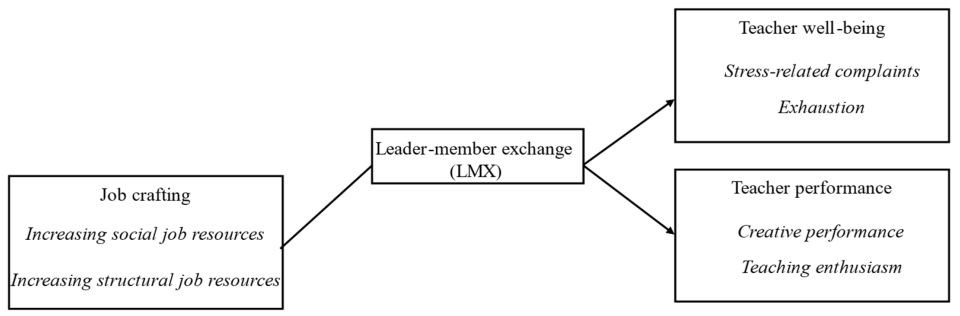
Thus, we hypothesize the following, as seen in Figure 1:
H3. 
Leader–member exchange (LMX) mediates the relationship between job crafting and teacher well-being ((a) teacher emotional exhaustion and (b) teachers’ stress-related complaints).
H4. 
Leader–member exchange (LMX) mediates the relationship between job crafting and teacher performance ((a) teacher creative performance and (b) teacher teaching enthusiasm).

3. Materials and Methods

3.1. Participants and Procedure

A quantitative cross-sectional survey design was adopted, as this approach aligns well with the research questions and mirrors methodological choices in recent studies on similar topics (e.g., Adams et al., 2025; Alonso et al., 2019; Collie, 2023; Huang et al., 2022). Data were collected through an online survey instrument. Initially, school administrations were contacted with the request to distribute the questionnaire internally among their teaching staff. In addition, the sampling strategy was modified to include convenience and snowball sampling techniques, primarily drawing on professional networks and relevant social media platforms. Given the nature of this recruitment procedure, it is not possible to determine an exact response rate. Teachers from different types of Flemish public secondary schools participated in the study, capturing the variety of educational tracks and finalities within the Flemish secondary education system.
Data collection took place between 21 January and 8 October 2024. Data from the 374 complete questionnaires show that 87 participants (23%) were men and 286 were women (77%). Participant age ranged from 22 to 68 years, with an average age of 42.13 years (SD = 10.54), and had an average tenure of 15.15 years (SD = 10.87, range 0–49).

3.2. Measures

In the online survey, all study variables were measured using five-point Likert-type scales, anchored from 1 (strongly disagree) to 5 (strongly agree). All variables were measured using subscales from validated questionnaires. In order to limit respondent burden and reduce survey fatigue, we deliberately relied on validated subscales rather than full instruments. To ensure linguistic equivalence for the Flemish educational context, all measures were administered in Dutch, with items translated and back-translated according to standard translation procedures.
Job crafting—increasing structural job resources was measured using a subscale consisting of five items from Tims et al. (2012). We deleted one item due to low internal consistency. The four remaining items from the scale are sufficiently internally consistent (Cronbach’s alpha = 0.609).
Job crafting—increasing social job resources was measured using a subscale consisting of five items from Tims et al. (2012). The items from the scale are sufficiently internally consistent (Cronbach’s alpha = 0.748).
LMX was measured using five items from Graen and Uhl-Bien (1995). Specifically, respondents were asked to indicate to what extent they had a good relationship with their principal. An example item is ‘I usually know where I stand with my principal’. The items from the scale are sufficiently internally consistent (Cronbach’s alpha = 0.916).
Creative performance was measured using seven items from G. Wang and Netemeyer (2004). The items from the scale are sufficiently internally consistent (Cronbach’s alpha = 0.861).
Exhaustion was measured using a subscale consisting of eight items from Schaufeli et al. (2020). The items from the scale are sufficiently internally consistent (Cronbach’s alpha = 0.915).
Stress-related complaints were measured using a subscale consisting of five items from Schaufeli et al. (2020). The items from the scale are sufficiently internally consistent (Cronbach’s alpha = 0.793).
Teacher enthusiasm was measured using one of the two subscales of the Teacher Enthusiasm Scale from Kunter et al. (2011). Teaching enthusiasm was assessed using a five-item subscale. Respondents were asked to indicate to which extent they experience enthusiasm in their teaching role. An example item is “I teach with a lot of enthusiasm”. The items from the scale are sufficiently internally consistent (Cronbach’s alpha = 0.891).
Gender and age were possibilities of control variables. The variable gender had two categories, namely, man (M) and woman (W). These were respectively coded as 0 and 1.

3.3. Data-Analysis

Statistical Package for the Social Sciences (SPSS) Version 26, including the PROCESS macro 3.5 (Hayes, 2012), was used to conduct all statistical analyses. First, descriptive statistics, reliability coefficients, and Pearson correlation analyses were calculated to examine the associations among the study variables. Next, mediation analyses were performed using ordinary least squares regression within the PROCESS macro. For each mediation model, indirect effects were estimated using 5000 bootstrap resamples, and 95% confidence intervals were generated. Indirect effects were considered statistically significant when the confidence interval did not include zero. Prior to analysis, the dataset was screened for missing values.

4. Results

4.1. Results

Means, standard deviations, and intercorrelations among all study variables are presented in Table 1. As shown, none of the control variables were significantly correlated with the primary study variables, nor did they show significant associations with the dependent variables.
A significant negative correlation was found between structural job crafting and emotional exhaustion (p < 0.01), as well as between social job crafting and emotional exhaustion (p = 0.033). Thus, Hypothesis 1a was supported. In contrast, no significant correlations were found between either structural job crafting or social job crafting and stress-related complaints. Therefore, Hypothesis 1b was not supported. Regarding performance outcomes, structural job crafting was positively correlated with creative performance (p < 0.01), and social job crafting also showed a significant positive association (p < 0.01). Thus, Hypothesis 2a was supported. Finally, both structural job crafting (p < 0.01) and social job crafting (p < 0.01) were positively correlated with teacher enthusiasm. Therefore, Hypothesis 2b was supported. Visual inspection of regression plots indicated no violations of model assumptions.

4.2. Well-Being as an Outcome

We investigated the potential mediating role of LMX in the relationship between job crafting—structure and well-being. A significant negative relationship was identified between LMX and exhaustion (β = −0.22, p < 0.001). Mediation analysis using 5000 bootstrapped samples (Preacher & Hayes, 2004) revealed a significant indirect effect (β = −0.09; 95% CI [−0.17, −0.03]), along with a significant direct effect (β = −0.39; 95% CI [−0.57, −0.20]). These results indicate partial mediation, suggesting that LMX partially mediates the relationship between job crafting—structure and exhaustion. LMX was also significantly negatively associated with stress-related complaints (β = −0.22, p < 0.001). The mediation analysis, based on 5000 bootstrapped samples, revealed a significant indirect effect (β = −0.09; 95% CI [−0.17, −0.03]), while the direct effect was not significant. These findings indicate full mediation, suggesting that LMX might fully mediate the relationship between job crafting—structure and stress-related complaints.
We investigated the potential mediating role of LMX in the relationship between job crafting—social and exhaustion. A significant negative association was found between LMX and exhaustion (β = −0.26, p < 0.001). Mediation analysis using 5000 bootstrapped samples (Preacher & Hayes, 2004) revealed a significant indirect effect (β = −0.12; 95% CI [−0.19, −0.06]), while the direct effect was not significant. These results indicate full mediation, suggesting that LMX might fully explain the relationship between job crafting—social and exhaustion. Similarly, LMX was significantly negatively associated with stress-related complaints (β = −0.26, p < 0.001). Bootstrapped mediation analysis (5000 samples) showed a significant indirect effect (β = −0.12; 95% CI [−0.18, −0.05]), with no significant direct effect. These results indicate full mediation.
Taken together, these findings provide support for Hypothesis 3 about the mediating role of leader–member exchange (LMX) in the relationship between job crafting and the well-being of teachers.

4.3. Performance as an Outcome

A significant positive relationship was observed between LMX and teacher enthusiasm (β = 0.11, p < 0.001). To examine the potential mediating role of LMX in the relationship between job crafting—structure and teacher enthusiasm, unstandardized indirect effects and their 95% confidence intervals were estimated using 5000 bootstrapped samples (Preacher & Hayes, 2004). The analysis revealed a significant indirect effect (β = 0.05; 95% CI [0.01, 0.10]), alongside a significant direct effect (β = 0.35; 95% CI [0.23, 0.47]). These findings suggest that LMX partially mediates the relationship between job crafting—structure and teacher enthusiasm. We examined whether LMX mediates the relationship between job crafting—structure and creative performance. The analysis revealed no significant association between LMX and creative performance. Consequently, the conditions for mediation were not met, and no indirect effect was observed. These findings provide no support for the hypothesized mediating role of LMX in the relationship between job crafting—social and creative performance.
We also investigated the mediating role of LMX in the relationship between job crafting—social and performance. A significant positive relationship was observed between LMX and teacher enthusiasm (β = 0.12, p < 0.001). The mediation analysis, based on 5000 bootstrapped samples, revealed a significant indirect effect (β = 0.06; 95% CI [0.01, 0.11]), while the direct effect was not significant. These results suggest that LMX fully mediates the relationship between job crafting—social and teacher enthusiasm. We examined whether LMX mediates the relationship between job crafting—social and creative performance. The analysis revealed no significant association between LMX and creative performance. Consequently, the conditions for mediation were not met, and no indirect effect was observed. These findings provide no support for the hypothesized mediating role of LMX in the relationship between job crafting—social and creative performance.
In sum, the results provide partial support for Hypothesis 4. LMX significantly mediated the relationship between both structural and social job crafting and teacher enthusiasm—fully in the case of social job crafting and partially for structural job crafting. However, no evidence was found for mediation with regard to creative classroom performance.

5. Discussion

This study advances the scholarly discourse on job crafting for teachers by examining its potential consequences, thereby contributing to a more nuanced understanding of how proactive work behaviors influence teachers’ well-being and performance. Specifically, this study provides theoretical insight into the mechanisms underlying these relationships by investigating the mediating role of leader–member exchange (LMX). Moreover, by examining both well-being and performance outcomes, this research offers a more comprehensive perspective than studies focusing on either domain in isolation. By situating job crafting within the educational context, this study extends the applicability of job crafting theory to teachers. Building on the Job Demands–Resources model (Bakker & Demerouti, 2007) and leader–member exchange theory (Graen & Uhl-Bien, 1995), this study examined whether job crafting is linked to teachers’ well-being and performance, and whether this link is contingent upon the quality of the leader–teacher relationship. By conceptualizing LMX as a key relational mechanism, this study advances theoretical integration by demonstrating how individual-level proactive strategies operate alongside relational processes, particularly in high-pressure educational environments where relational resources are critical. In doing so, the research responds to recent calls (Adams et al., 2025) to better understand the social/contextual conditions under which job crafting is most effective. Both structural and social job crafting were associated with lower emotional exhaustion and higher performance outcomes, although no significant associations emerged with stress-related complaints. Importantly, LMX fully or partially mediated the relationship between job crafting and emotional outcomes, underscoring its role in supporting teacher well-being. For performance, LMX mediated the link with teacher enthusiasm but not with creative performance, suggesting that the mechanisms underlying enthusiasm and creativity differ in meaningful ways.

5.1. Theoretical Implications

Our findings contribute to the growing body of research on job crafting for teachers (e.g., Alonso et al., 2019; Dağtaş et al., 2024; Huang et al., 2022, 2023; Qi et al., 2016; Shang, 2022; Wu et al., 2023) by emphasizing its dual role in fostering teacher well-being and performance. Importantly, the results underscore the inherently interpersonal nature of job crafting in educational contexts, where high-quality relationships with school leadership, conceptualized as leader–member exchange, emerge as a critical mechanism in supporting individual crafting efforts. This is particularly evident in relation to emotional resilience and teaching enthusiasm.
Previous studies have established associations between job crafting and indicators of psychological health (Alonso et al., 2019; Dağtaş et al., 2024; Tims et al., 2013), as well as with key markers of professional functioning, including work engagement, job satisfaction, organizational commitment, and reduced turnover intentions among teachers (Dağtaş et al., 2024; Leana et al., 2009). Our study adds to this research by showing that both structural and social dimensions of job crafting are positively linked with teacher enthusiasm and creative performance—two crucial outcomes for instructional quality and innovation. Notably, while emotional exhaustion was reduced, stress-related complaints did not show a significant association with either form of job crafting, suggesting that different facets of psychological strain may respond differently to proactive work behaviors. Prior research has yielded mixed evidence regarding the relationship between job crafting and stress-related complaints. While some studies have reported a negative association between job crafting and stress symptoms (Singh & Singh, 2018; Tims et al., 2013), others have failed to establish such a link (Sakuraya et al., 2017; Voss et al., 2025). One possible explanation is that job crafting primarily aims to align one’s work with personal strengths, values, and preferences (Wrzesniewski & Dutton, 2001), rather than directly targeting stress reduction or alleviation of psychological strain. Another plausible explanation relates to the operationalization of job crafting in the present study, which focused specifically on increasing structural and social job resources (Tims et al., 2012). It is possible that crafting efforts aimed at decreasing hindering demands—rather than augmenting resources—may be more directly associated with lower stress-related complaints. Future research could benefit from examining the distinct effects of demand-decreasing forms of job crafting on stress and related outcomes.
Within this context, LMX has been identified as a valuable social resource linked to increased teacher commitment (Rahmy, 2018) and greater innovative work behavior (Widiastuti & Kusmaryani, 2023). Recent research has begun to conceptualize LMX as a mediating variable in the relationship between job crafting and employee outcomes (Dağtaş et al., 2024), a proposition further analyzed and supported by our results. In line with theoretical expectations (Adams et al., 2025), our findings demonstrate that LMX partially or fully mediates the relationship between job crafting and emotional outcomes, as well as teacher enthusiasm. Despite the theoretical relevance of this pathway, empirical studies exploring LMX as a mediator in the education sector have been limited to date. This study addresses this gap by offering empirical support for LMX as a relational mechanism that enables job crafting to yield beneficial effects.
At the same time, the present findings indicate that not all hypothesized pathways were supported. The absence of a significant mediating effect of LMX in the relationship between job crafting and creative performance suggests that the mechanisms underlying classroom creativity may differ from those driving teacher well-being and enthusiasm. Whereas LMX primarily constitutes a relational and socio-emotional resource, creative performance in the classroom may depend more strongly on task-related and structural conditions, such as pedagogical autonomy, curricular flexibility, and available time to experiment. This interpretation aligns with prior research showing mixed associations between LMX and individual creativity in highly regulated contexts (Sanders et al., 2010; Schermuly et al., 2013). In educational systems characterized by hierarchical structures and accountability, such as Flemish secondary education, creative teaching may be more directly shaped by teachers’ proactive job redesign efforts than by relational leadership resources alone. Future research could therefore examine alternative mediating mechanisms, such as perceived autonomy, professional learning opportunities, or psychological empowerment, to further clarify how job crafting contributes to creative performance in educational settings. Taken together, these findings point to “different shades of meaning” within the hypotheses. Although job crafting is generally beneficial for teachers, and LMX represents a meaningful relational mechanism, the pathways are not universal.

5.2. Practical Implications for Education

The results of this research may carry important implications for policy and practice within educational institutions. Promoting teacher well-being and performance is not merely a desirable objective but a necessity for the sustainable functioning of educational systems (Fan & Wang, 2022) and for broader societal development (Zhang et al., 2024). Against the backdrop of persistently high job demands in secondary education (Collie, 2023; Mijakoski et al., 2022; Sandmeier et al., 2022), the present findings offer important implications for how schools can move beyond reactive support strategies toward a more proactive and relationally embedded approach to sustaining teachers’ enthusiasm.
Our findings highlight job crafting as a possible individual-level strategy through which teachers can actively regulate and optimize their work environment. By proactively seeking resources, adjusting task boundaries, and shaping interpersonal interactions, teachers may better align their work with their professional strengths, values, and developmental goals. These findings reaffirm the importance of investing in and supporting both social and structural job resources for schools. Schools may consider incorporating job crafting principles into teacher development initiatives. Concretely, schools can stimulate social resources by ensuring that teachers have access to regular coaching by supervisors, by creating opportunities to ask for and receive feedback from supervisors and colleagues, and by encouraging peer consultation and advice-sharing among colleagues. Structural resources can be strengthened by facilitating continuous professional development, supporting teachers in developing new skills, and granting sufficient autonomy in how they plan and deliver instruction. By making such practices explicit and accessible, schools may create conditions in which teachers are better able to craft their jobs, thereby possibly sustaining both well-being and performance.
In addition, the results underscore the pivotal role of high-quality relationships with school leadership. The observed mediating function of leader–member exchange (LMX) suggests that relational resources are important in transforming proactive efforts into positive outcomes, particularly emotional well-being and enthusiasm. High-quality relationships between teachers and school leaders appear to function as an important social resource that can translate proactive behaviors into enhanced emotional well-being and teaching enthusiasm. This finding suggests that initiatives aimed at promoting teacher agency should preferably not be implemented in isolation from leadership practices. Investing in leadership training that emphasizes trust, support, and two-way communication may help create the interpersonal climate needed for job crafting to be most effective. Schools could also adopt a more comprehensive approach by developing institution-wide initiatives that actively encourage and facilitate teachers’ engagement in job crafting. Given that many teachers remain unfamiliar with the concept and that existing practices often occur implicitly, raising awareness and providing structured guidance may foster more intentional and widespread adoption, thereby enhancing the positive relations observed in this study.
Taken together, these recommendations reinforce the central conclusion of this study: sustainable teacher well-being and enthusiasm might be most effectively achieved when individual proactive behavior is embedded alongside supportive relational context.

5.3. Limitations and Directions for Future Research

While this study provides novel insights into the associations between job crafting, leader–member exchange, and both well-being and performance outcomes among secondary school teachers, limitations should be acknowledged.
First, the cross-sectional research design limits the ability to draw causal conclusions. Although the hypothesized relationships are theoretically grounded in the JD-R model (Bakker & Demerouti, 2018), the temporal ordering of the constructs cannot be empirically established. In addition, previous methodological work has shown that cross-sectional mediation models may not always fully reflect the temporal processes underlying indirect effects. For example, Maxwell and Cole (2007) illustrated that estimates of mediation based on single-wave data can diverge from those obtained in longitudinal models, particularly when constructs influence one another over time. Longitudinal research is therefore warranted to gain deeper insight into the dynamic and reciprocal interplay of the constructs.
Furthermore, the study relied exclusively on self-reported data from a single source, which raises the risk of bias (Costa & Hauck Filho, 2019). Although validated scales were used and anonymity was ensured, the single-respondent design limits the objectivity of the findings. Data were collected at the beginning of each semester, in both the first and second semester. While we do not expect this timing to have substantially affected the results, future studies might consider collecting data simultaneously to further minimize potential temporal influences. Additionally, future research would benefit from employing multi-method and multi-informant approaches, such as incorporating evaluations from peers, supervisors, or students, to enhance the robustness and generalizability of the findings. A further limitation stems from our use of validated subscales rather than full instruments. Although this approach was intended to reduce respondent burden, minimize survey fatigue among in-service teachers, and safeguard response quality, abbreviated measures may restrict construct coverage. As a result, certain nuances or peripheral dimensions might not have been fully assessed. Future studies may benefit from including full-length measures to evaluate the robustness of the present findings.
A further limitation concerns the use of convenience and snowball sampling, which may restrict the external validity of the findings. Although the sample included teachers from multiple secondary schools across Flanders, participation was voluntary, potentially introducing selection bias.
Fourth, the research was conducted within the specific educational and cultural context of Belgian secondary education. While this provides valuable insights into a region facing acute teacher shortages and declining job feasibility (SERV, 2024), the extent to which these findings can be generalized to other countries or school systems remains unclear. To further contextualize this situation, the demand for new teachers across all educational levels was projected to be approximately 10% higher in 2025 compared to a decade earlier, with the most significant increases expected in secondary education. At the outset of the 2024–2025 school year, nearly 3000 teaching positions—both full-time and part-time—remained vacant across primary and secondary education. The shortage is particularly pronounced in urban settings and is exacerbated by broader labor market pressures. Structural causes include both a limited inflow of new entrants and high attrition rates. Teaching is frequently perceived in this national context as a rigid profession, characterized by elevated burnout levels and limited flexibility (Frederix & De Wilde, 2025). Compared to other sectors, teachers in Belgium report higher workloads, increased stress, and greater difficulty maintaining work–life balance (SERV, 2024). These contextual specificities underscore the importance of situating the findings within the characteristics of the Belgian educational landscape, and caution should be exercised when attempting to extrapolate the results to other national or systemic contexts that may differ (Pietsch et al., 2025). Regarding the generalizability of our findings within Belgium, it is important to note that our sample consisted of teachers from public secondary schools. Teachers from a diverse mix of secondary school types, encompassing different educational tracks and finalities, were asked to participate in the study. This heterogeneous sample was deliberately chosen to enhance the generalizability of the findings across the Flemish secondary education context. Secondary schools in Flanders combine substantial organizational autonomy with a centrally regulated policy framework defined by the Flemish government. Public and private schools operate under largely comparable governance structures, and leadership in schools increasingly reflects elements of distributed leadership (OECD, 2016). In larger schools, middle leaders (e.g., grade-level coordinators or deputy principals) often act as teachers’ direct supervisors. As respondents in this study evaluated LMX in relation to their immediate supervisor, perceptions likely reflect relationships with either principals or middle leaders. The relatively high degree of teacher autonomy and the presence of distributed leadership structures in Flanders may have an impact on opportunities for job crafting and supervisory support (Huang et al., 2023). Therefore, caution is warranted when generalizing these findings to educational systems with more centralized governance, lower teacher autonomy, or different leadership configurations. Although the present study focuses on the Belgian context, it is important to note that teacher burnout does represent a broader international phenomenon. A substantial body of research has documented the high prevalence of burnout among teachers (Omondi et al., 2023). For example, Agyapong et al. (2023) reported that approximately 60.9% of teachers worldwide experienced occupational burnout. Country-specific investigations further corroborate this trend: studies conducted in Finland (Holmström et al., 2023), Spain (Méndez et al., 2020), and Italy (Pellerone et al., 2020) revealed that between 13% and 33% of teachers exhibited symptoms of burnout. While prevalence rates vary across national contexts, the accumulated evidence highlights teacher burnout as a widespread challenge. Beyond its consequences for teachers’ psychological well-being and job satisfaction, burnout also poses significant risks for the educational systems (Yao & Abdullah, 2025). Consequently, future research would benefit from extending this line of inquiry to other national contexts, where similar challenges may be observed and comparable research could be beneficial.
Future research could also explore potential moderators, including self-efficacy or the personality characteristics of the teacher, to clarify when job crafting can enhance teacher well-being and performance, while qualitative studies may offer deeper insight into its contextual enactment. Additional variables, including teachers’ emotion regulation strategies (Y. Wang et al., 2025) and the adoption of motivational teaching styles (J. Wang et al., 2024) to support students’ well-being, could be integrated in future studies to provide a more comprehensive understanding of the processes at play.
We chose to employ mediation analyses in the current study, as this approach provides a focused examination of the indirect effects of job crafting on teachers’ well-being and performance via LMX. However, path analysis could also be a valuable approach in future research, as it allows for the estimation of multiple direct and indirect effects simultaneously and the modeling of complex relationships among variables, offering a more holistic understanding of the underlying processes.
Finally, the relationship between job crafting and creative performance warrants further empirical exploration, particularly with regard to potential mediating mechanisms that may explain how and why job crafting fosters (or fails to foster) creativity in the classroom.

6. Conclusions

In sum, this study reinforces the importance of proactive work behaviors like job crafting in promoting teacher well-being and enthusiasm. It also highlights the pivotal role of supportive leadership relationships in maximizing the benefits of job crafting, especially for emotional outcomes. While not all effects were mediated by LMX, the findings underscore the value of considering both individual agency and social context in understanding and supporting teacher performance and well-being.

Author Contributions

Conceptualization, E.S.; methodology, E.S.; software, M.R.; validation, E.S., C.M. and M.R.; formal analysis, M.R.; investigation, C.M.; resources, E.S. and C.M.; data curation, M.R. and E.S.; writing—original draft preparation, C.M.; writing—review and editing, E.S.; visualization, C.M.; supervision, E.S.; project administration, E.S. and C.M. All authors have read and agreed to the published version of the manuscript.

Funding

This research received no external funding.

Institutional Review Board Statement

In accordance with the Ethical Code for Scientific Research in Belgium and the regulations of the Faculty of Economics and Business (FEB), Ghent University, ethical approval is required only when a study presents potential ethical implications or when prior review is explicitly mandated by an external authority. The present study was conducted in full compliance with all applicable ethical norms and institutional requirements, and it did not involve any procedures that would trigger the obligation to obtain prospective ethics approval. Consequently, no prior approval was sought before data collection. The FEB Ethics Committee subsequently granted retroactive approval, formally confirming that the data collection was carried out in accordance with the relevant ethical standards.

Informed Consent Statement

Informed consent was obtained from all subjects involved in the study.

Data Availability Statement

The data presented in this study are available on request from the corresponding author.

Conflicts of Interest

The authors declare no conflicts of interest.

References

  1. Adams, D., Bellibaş, M. Ş., Muniandy, V., & Pietsch, M. (2025). The role of openness to experience in innovating teaching and instruction through leader-member exchange and teacher creativity. Thinking Skills and Creativity, 57, 101834. [Google Scholar] [CrossRef]
  2. Adams, D., & Periasamy, R. (2023). Instructional leadership practices in primary schools: A malaysian indian culture perspective. In Educational leadership and asian culture. Routledge. [Google Scholar] [CrossRef]
  3. Admiraal, W., & Kittelsen Røberg, K.-I. (2023). Teachers’ job demands, resources and their job satisfaction: Satisfaction with school, career choice and teaching profession of teachers in different career stages. Teaching and Teacher Education, 125, 104063. [Google Scholar] [CrossRef]
  4. Agyapong, B., Brett-MacLean, P., Burback, L., Agyapong, V. I. O., & Wei, Y. (2023). Interventions to reduce stress and burnout among teachers: A scoping review. International Journal of Environmental Research and Public Health, 20(9), 5625. [Google Scholar] [CrossRef]
  5. Alonso, C., Fernández-Salinero, S., & Topa, G. (2019). The impact of both individual and collaborative job crafting on Spanish teachers’ well-being. Education Sciences, 9(2), 74. [Google Scholar] [CrossRef]
  6. Bajorek, Z., Gulliford, J., & Taskila, T. (2014). Healthy teachers, higher marks? T. W. Foundation. [Google Scholar]
  7. Bakker, A. B., & Demerouti, E. (2007). The job demands-resources model: State of the art. Journal of Managerial Psychology, 22(3), 309–328. [Google Scholar] [CrossRef]
  8. Bakker, A. B., & Demerouti, E. (2018). Multiple levels in job demands-resources theory: Implications for employee well-being and performance. Noba Scholar. [Google Scholar]
  9. Bellibaş, M. Ş., & Kılınç, A. Ç. (2023). Contextualizing leadership: How does national societal culture shape the practices of school leadership in Türkiye? Bulletin of Educational Studies, 2(1), 37–49. [Google Scholar] [CrossRef]
  10. Brower, H. H., Schoorman, F. D., & Tan, H. H. (2000). A model of relational leadership: The integration of trust and leader–member exchange. The Leadership Quarterly, 11(2), 227–250. [Google Scholar] [CrossRef]
  11. Carver-Thomas, D., & Darling-Hammond, L. (2019). The trouble with teacher turnover: How teacher attrition affects students and schools. Education Policy Analysis Archives, 27, 36. [Google Scholar] [CrossRef]
  12. Claeys, L. (2011). Teacher motivation to teach and to remain teaching culturally and linguistically diverse students [Ph.D. thesis, The University of Texas at San Antonio]. [Google Scholar]
  13. Collie, R. J. (2023). Teacher well-being and turnover intentions: Investigating the roles of job resources and job demands. British Journal of Educational Psychology, 93(3), 712–726. [Google Scholar] [CrossRef]
  14. Collie, R. J., Shapka, J. D., & Perry, N. E. (2012). School climate and social–emotional learning: Predicting teacher stress, job satisfaction, and teaching efficacy. Journal of Educational Psychology, 104(4), 1189–1204. [Google Scholar] [CrossRef]
  15. Costa, A. R. L., & Hauck Filho, N. (2019). Methods for the control of extreme response styles in self-report instruments: A review. Trends in Psychology, 27(2), 309–323. [Google Scholar] [CrossRef]
  16. Crawford, E. R., Lepine, J. A., & Rich, B. L. (2010). Linking job demands and resources to employee engagement and burnout: A theoretical extension and meta-analytic test. The Journal of Applied Psychology, 95(5), 834–848. [Google Scholar] [CrossRef]
  17. Cropanzano, R., Anthony, E., & Daniels, S. (2017). Social exchange theory: A critical review with theoretical remedies. The Academy of Management Annals, 11, 1–38. [Google Scholar] [CrossRef]
  18. Dağtaş, A., Zaimoğlu, S., & Toköz, F. (2024). Exploring the landscape of job crafting in teacher education: A systematic review. Advanced Education, 12(25), 179–199. [Google Scholar] [CrossRef]
  19. Darling-Hammond, L. (2000). Teacher quality and student achievement: A review of state policy evidence. Education Policy Analysis Archives, 8, 1. [Google Scholar] [CrossRef]
  20. Decramer, A., Audenaert, M., Van Waeyenberg, T., Claeys, T., Claes, C., Vandevelde, S., van Loon, J., & Crucke, S. (2015). Does performance management affect nurses’ well-being? Evaluation and Program Planning, 49, 98–105. [Google Scholar] [CrossRef]
  21. Demerouti, E., Nachreiner, F., & Schaufeli, W. (2001). The job demands–resources model of burnout. Journal of Applied Psychology, 86, 499–512. [Google Scholar] [CrossRef]
  22. Dhanpat, N. (2022). A systematic review of job crafting in the South African context. Journal of Contemporary Management, 19(1), 242–259. [Google Scholar] [CrossRef]
  23. Dulebohn, J. H., Bommer, W. H., Liden, R. C., Brouer, R. L., & Ferris, G. R. (2012). A meta-analysis of antecedents and consequences of leader-member exchange: Integrating the past with an eye toward the future. Journal of Management, 38(6), 1715–1759. [Google Scholar] [CrossRef]
  24. Elliott, A., Reddy, L. A., Lekwa, A. J., & Fingerhut, J. (2024). Teacher stress and supports, classroom practices and student outcomes in high poverty urban elementary schools. Psychology in the Schools, 61(1), 29–42. [Google Scholar] [CrossRef]
  25. Ellis, V., Souto-Manning, M., & Turvey, K. (2019). Innovation in teacher education: Towards a critical re-examination. Journal of Education for Teaching, 45(1), 2–14. [Google Scholar] [CrossRef]
  26. Evers, W. J. G., Tomic, W., & Brouwers, A. (2004). Burnout among teachers: Students’ and teachers’ perceptions compared. School Psychology International, 25(2), 131–148. [Google Scholar] [CrossRef]
  27. Fan, J., & Wang, Y. (2022). English as a foreign language teachers’ professional success in the Chinese context: The effects of well-being and emotion regulation. Frontiers in Psychology, 13, 952503. [Google Scholar] [CrossRef]
  28. Feng, X., & Adams, D. (2023). Can leaders enhance followers’ psychological capital? A framework to support leader–member exchange for sustainable organizations. International Journal of Educational Management, 37(6/7), 1323–1334. [Google Scholar] [CrossRef]
  29. Fernet, C., Guay, F., Senécal, C., & Austin, S. (2012). Predicting intraindividual changes in teacher burnout: The role of perceived school environment and motivational factors. Teaching and Teacher Education, 28(4), 514–525. [Google Scholar] [CrossRef]
  30. Fouché, E., Rothmann, S., & van der Vyver, C. (2017). Antecedents and outcomes of meaningful work among school teachers. SA Journal of Industrial Psychology, 43(1), a1398. [Google Scholar] [CrossRef]
  31. Frederix, S., & De Wilde, B. (2025). Hoe lossen we lerarentekort op? Available online: https://www.klasse.be/180314/hoe-lossen-we-het-lerarentekort-op/ (accessed on 4 June 2025).
  32. Gerritsen, S., Plug, E., & Webbink, D. (2017). Teacher quality and student achievement: Evidence from a sample of dutch twins. Journal of Applied Econometrics, 32(3), 643–660. [Google Scholar] [CrossRef]
  33. Gerstner, C. R., & Day, D. V. (1997). Meta-Analytic review of leader–member exchange theory: Correlates and construct issues. Journal of Applied Psychology, 82(6), 827–844. [Google Scholar] [CrossRef]
  34. Graen, G. B., & Uhl-Bien, M. (1995). Relationship-based approach to leadership: Development of leader-member exchange (LMX) theory of leadership over 25 years: Applying a multi-level multi-domain perspective. The Leadership Quarterly, 6(2), 219–247. [Google Scholar] [CrossRef]
  35. Gu, Q., Tang, T. L.-P., & Jiang, W. (2015). Does moral leadership enhance employee creativity? Employee identification with leader and leader–member exchange (LMX) in the Chinese context. Journal of Business Ethics, 126(3), 513–529. [Google Scholar] [CrossRef]
  36. Hakanen, J. J., Bakker, A. B., & Schaufeli, W. B. (2006). Burnout and work engagement among teachers. Journal of School Psychology, 43(6), 495–513. [Google Scholar] [CrossRef]
  37. Holmström, A., Tuominen, H., Laasanen, M., & Veermans, M. (2023). Teachers’ work engagement and burnout profiles: Associations with sense of efficacy and interprofessional collaboration in school. Teaching and Teacher Education, 132, 104251. [Google Scholar] [CrossRef]
  38. Huang, X., Sun, M., & Wang, D. (2022). Work harder and smarter: The critical role of teachers’ job crafting in promoting teaching for creativity. Teaching and Teacher Education, 116, 103758. [Google Scholar] [CrossRef]
  39. Huang, X., Wang, C., Lam, S. M., & Xu, P. (2023). Teachers’ job crafting: The complicated relationship with teacher self-efficacy and teacher engagement. Professional Development in Education, 51(4), 625–642. [Google Scholar] [CrossRef]
  40. Jõgi, A. L., Pakarinen, E., & Lerkkanen, M. K. (2023). Teachers’ physiological and self-reported stress, teaching practices and students’ learning outcomes in Grade 1. The British Journal of Educational Psychology, 93, 211–226. [Google Scholar] [CrossRef]
  41. Kanya, N., Fathoni, A. B., & Ramdani, Z. (2021). Factors affecting teacher performance. International Journal of Evaluation and Research in Education, 10(4), 1462–1468. [Google Scholar] [CrossRef]
  42. Keller, M. M., Hoy, A. W., Goetz, T., & Frenzel, A. C. (2016). Teacher enthusiasm: Reviewing and redefining a complex construct. Educational Psychology Review, 28(4), 743–769. [Google Scholar] [CrossRef]
  43. Kristof-Brown, A. L., Zimmerman, R. D., & Johnson, E. C. (2005). Consequences of individuals’ fit at work: A meta-analysis of person–job, person–organization, person–group, and person–supervisor fit. Personnel Psychology, 58(2), 281–342. [Google Scholar] [CrossRef]
  44. Kunnari, I., Tuomela, V., & Jussila, J. (2021). Teacher-facilitators’ job-crafting: Making meaning and relevance in authentic learning environments. International Journal of Management, Knowledge and Learning, 10, 115–126. [Google Scholar] [CrossRef]
  45. Kunter, M., Frenzel, A., Nagy, G., Baumert, J., & Pekrun, R. (2011). Teacher enthusiasm: Dimensionality and context specificity. Contemporary Educational Psychology, 36(4), 289–301. [Google Scholar] [CrossRef]
  46. Kunter, M., Klusmann, U., Baumert, J., Richter, D., Voss, T., & Hachfeld, A. (2013). Professional competence of teachers: Effects on instructional quality and student development. Journal of Educational Psychology, 105(3), 805–820. [Google Scholar] [CrossRef]
  47. Kyriacou, C. (2001). Teacher stress: Directions for future research. Educational Review, 53(1), 27–35. [Google Scholar] [CrossRef]
  48. Leana, C., Appelbaum, E., & Shevchuk, I. (2009). Work process and quality of care in early childhood education: The role of job crafting. Academy of Management Journal, 52(6), 1169–1192. [Google Scholar] [CrossRef]
  49. Lillelien, K., & Jensen, M. T. (2025). Digital and digitized interventions for teachers’ professional well-being: A systematic review of work engagement and burnout using the job demands–resources theory. Education Sciences, 15(7), 799. [Google Scholar] [CrossRef]
  50. Long, J. F., & Hoy, A. W. (2006). Interested instructors: A composite portrait of individual differences and effectiveness. Teaching and Teacher Education, 22(3), 303–314. [Google Scholar] [CrossRef]
  51. Lyons, P. (2008). The crafting of jobs and individual differences. Journal of Business and Psychology, 23(1), 25–36. [Google Scholar] [CrossRef]
  52. Madigan, D. J., & Kim, L. E. (2021). Does teacher burnout affect students? A systematic review of its association with academic achievement and student-reported outcomes. International Journal of Educational Research, 105, 101714. [Google Scholar] [CrossRef]
  53. Martin, R., Guillaume, Y., Thomas, G., Lee, A., & Epitropaki, O. (2016). Leader–member exchange (LMX) and performance: A meta-analytic review. Personnel Psychology, 69(1), 67–121. [Google Scholar] [CrossRef]
  54. Maslach, C., Jackson, S., & Leiter, M. (1997). The maslach burnout inventory manual (Vol. 3). The Scarecrow Press. [Google Scholar]
  55. Maslach, C., & Leiter, M. (2007). Burnout. In Stress: Concepts, cognition, emotion, and behavior (pp. 358–362). Academic Press. [Google Scholar] [CrossRef]
  56. Maslach, C., & Leiter, M. P. (1997). The truth about burnout: How organizations cause personal stress and what to do about it. Jossey-Bass/Wiley. [Google Scholar]
  57. Maslach, C., Schaufeli, W., & Leiter, M. (2001). Job burnout. Annual Review of Psychology, 52, 397–422. [Google Scholar] [CrossRef]
  58. Massie, M.-H., Capron Puozzo, I., & Boutet, M. (2022). Teacher creativity: When professional coherence supports beautiful risks. Journal of Intelligence, 10(3), 62. [Google Scholar] [CrossRef]
  59. Maxwell, S. E., & Cole, D. A. (2007). Bias in cross-sectional analyses of longitudinal mediation. Psychological Methods, 12(1), 23–44. [Google Scholar] [CrossRef]
  60. McConnell, J. W. (2025). Who will burn out, and who will leave? Demographic predictors of burnout and intent to quit in world language teachers. Language Teaching Research, 13621688251320584. [Google Scholar] [CrossRef]
  61. Méndez, I., Martínez-Ramón, J. P., Ruiz-Esteban, C., & García-Fernández, J. M. (2020). Latent profiles of burnout, self-esteem and depressive symptomatology among teachers. International Journal of Environmental Research and Public Health, 17(18), 6760. [Google Scholar] [CrossRef]
  62. Mijakoski, D., Cheptea, D., Marca, S. C., Shoman, Y., Caglayan, C., Bugge, M. D., Gnesi, M., Godderis, L., Kiran, S., McElvenny, D. M., Mediouni, Z., Mesot, O., Minov, J., Nena, E., Otelea, M., Pranjic, N., Mehlum, I. S., van der Molen, H. F., & Canu, I. G. (2022). Determinants of burnout among teachers: A systematic review of longitudinal studies. International Journal of Environmental Research and Public Health, 19(9), 5776. [Google Scholar] [CrossRef]
  63. Nguyen, T. D., Lam, C. B., & Bruno, P. (2022). Is there a national teacher shortage? A systematic examination of reports of teacher shortages in the United States. EdWorkingPaper: 22-631. Annenberg Institute at Brown University. [Google Scholar] [CrossRef]
  64. OECD. (2016). School leadership for learning: Insights from TALIS 2013. TALIS. OECD Publishing. [Google Scholar] [CrossRef]
  65. Oh, J., & Wolf, S. (2023). Negative effects of teacher burnout on student executive function and social-emotional outcomes. Educational Psychology, 43(4), 304–325. [Google Scholar] [CrossRef]
  66. Omondi, D., Luhumbo, K. K., & Aswani, D. R. (2023). Effective internal communication and teacher burnout: A review of relevant literature. Kabarak Journal of Research & Innovation, 13(2), 38–47. [Google Scholar] [CrossRef]
  67. O’Reilly, P. E. (2014). Teachers at work: Factors influencing satisfaction, retention and the professional well-being of elementary and secondary educators [Ph.D. thesis, City University of New York]. [Google Scholar]
  68. Patrick, B. C., Jennifer, H., & Kempler, T. (2000). “What’s everybody so excited about?”: The effects of teacher enthusiasm on student intrinsic motivation and vitality. The Journal of Experimental Education, 68(3), 217–236. [Google Scholar] [CrossRef]
  69. Patrick, H., Turner, J. C., Meyer, D. K., & Midgley, C. (2003). How teachers establish psychological environments during the first days of school: Associations with avoidance in mathematics. Teachers College Record, 105(8), 1521–1558. [Google Scholar] [CrossRef]
  70. Pellerone, M., Rapisarda, V., Trischitta, M. C. A., Vitale, E., & Ramaci, T. (2020). Burnout and self-perceived instructional competence: An exploratory study of a group of Italian female elementary school teachers. International Journal of Environmental Research and Public Health, 17(4), 1356. [Google Scholar] [CrossRef] [PubMed]
  71. Peral, S., & Geldenhuys, M. (2016). The effects of job crafting on subjective well-being amongst South African high school teachers. SA Journal of Industrial Psychology, 42(1), 1–13. [Google Scholar] [CrossRef]
  72. Pietsch, M., Aydin, B., & Gümüş, S. (2025). Putting the instructional leadership–student achievement relation in context: A meta-analytical big data study across cultures and time. Educational Evaluation and Policy Analysis, 47(1), 29–64. [Google Scholar] [CrossRef]
  73. Preacher, K. J., & Hayes, A. F. (2004). SPSS and SAS procedures for estimating indirect effects in simple mediation models. Behavior Research Methods, Instruments, & Computers, 36(4), 717–731. [Google Scholar] [CrossRef] [PubMed]
  74. Qi, Y.-J., Wu, X.-C., & Wang, X.-L. (2016). Job crafting and work engagement in primary and secondary school teachers: A cross-lagged analysis. Chinese Journal of Clinical Psychology, 24(5), 935–938. [Google Scholar]
  75. Radstaak, M., & Hennes, A. (2017). Leader-member exchange fosters work engagement: The mediating role of job crafting. SA Journal of Industrial Psychology, 43, a1458. [Google Scholar] [CrossRef]
  76. Rahmy, H. M. (2018). Pengaruh leader member exchange (LMX) dan keadilan prosedural terhadap komitmen organisasi guru SMK negeri di jakarta utara. Jurnal Manajemen Pendidikan, 9(2), 161–173. [Google Scholar] [CrossRef]
  77. Rivkin, S. G., Hanushek, E. A., & Kain, J. F. (2005). Teachers, schools, and academic achievement. Econometrica, 73(2), 417–458. [Google Scholar] [CrossRef]
  78. Sakuraya, A., Shimazu, A., Eguchi, H., Kamiyama, K., Hara, Y., Namba, K., & Kawakami, N. (2017). Job crafting, work engagement, and psychological distress among Japanese employees: A cross-sectional study. BioPsychoSocial Medicine, 11(1), 6. [Google Scholar] [CrossRef] [PubMed]
  79. Salmerón Aroca, J. A., Moreno Abellán, P., & Martínez de Miguel López, S. (2023). Teachers’ professional development and intelligent ways of coping with it: A systematic review in elementary and middle school education. Journal of Intelligence, 11(1), 1. [Google Scholar] [CrossRef]
  80. Sanders, K., Moorkamp, M., Torka, N., Groeneveld, S., & Groeneveld, C. (2010). How to support innovative behaviour? The role of LMX and satisfaction with HR practices. Technology and Investment, 1(1), 59–68. [Google Scholar] [CrossRef]
  81. Sandmeier, A., Baeriswyl, S., Krause, A., & Muehlhausen, J. (2022). Work until you drop: Effects of work overload, prolonging working hours, and autonomy need satisfaction on exhaustion in teachers. Teaching and Teacher Education, 118, 103843. [Google Scholar] [CrossRef]
  82. Scandura, T. A., & Schriesheim, C. A. (1994). Leader-member exchange and supervisor career mentoring as complementary constructs in leadership research. Academy of Management Journal, 37(6), 1588–1602. [Google Scholar] [CrossRef]
  83. Schaufeli, W. B., Bakker, A. B., & Van Rhenen, W. (2009). How changes in job demands and resources predict burnout, work engagement and sickness absenteeism. Journal of Organizational Behavior, 30(7), 893–917. [Google Scholar] [CrossRef]
  84. Schaufeli, W. B., Desart, S., & De Witte, H. (2020). Burnout assessment tool (BAT)-development, validity, and reliability. International Journal of Environmental Research and Public Health, 17(24), 9495. [Google Scholar] [CrossRef]
  85. Schermuly, C. C., Meyer, B., & Dämmer, L. (2013). Leader-member exchange and innovative behavior. Journal of Personnel Psychology, 12(3), 132–142. [Google Scholar] [CrossRef]
  86. Sekiguchi, T., Li, J., & Hosomi, M. (2017). Predicting job crafting from the socially embedded perspective: The interactive effect of job autonomy, social skill, and employee status. The Journal of Applied Behavioral Science, 53(4), 470–497. [Google Scholar] [CrossRef]
  87. SERV. (2024). Werkbaar werk in het onderwijs 2023. Stichting Innovatie & Arbeid. [Google Scholar]
  88. Shang, W. (2022). The effects of job crafting on job performance among ideological and political education teachers: The mediating role of work meaning and work engagement. Sustainability, 14(14), 8820. [Google Scholar] [CrossRef]
  89. Singh, V., & Singh, M. (2018). A burnout model of job crafting: Multiple mediator effects on job performance. IIMB Management Review, 30(4), 305–315. [Google Scholar] [CrossRef]
  90. Skaalvik, E. M., & Skaalvik, S. (2018). Job demands and job resources as predictors of teacher motivation and well-being. Social Psychology of Education, 21, 1251–1275. [Google Scholar] [CrossRef]
  91. Tikkanen, L., Pyhältö, K., Soini, T., & Pietarinen, J. (2021). Crossover of burnout in the classroom—Is teacher exhaustion transmitted to students? International Journal of School & Educational Psychology, 9(4), 326–339. [Google Scholar] [CrossRef]
  92. Tims, M., Bakker, A. B., & Derks, D. (2012). Development and validation of the job crafting scale. Journal of Vocational Behavior, 80(1), 173–186. [Google Scholar] [CrossRef]
  93. Tims, M., Bakker, A. B., & Derks, D. (2013). The impact of job crafting on job demands, job resources, and well-being. Journal of Occupational Health Psychology, 18(2), 230–240. [Google Scholar] [CrossRef]
  94. Tims, M., Bakker, A. B., & Derks, D. (2015). Job crafting and job performance: A longitudinal study. European Journal of Work and Organizational Psychology, 24(6), 914–928. [Google Scholar] [CrossRef]
  95. Van Horn, J. E., Taris, T. W., Schaufeli, W. B., & Schreurs, P. J. G. (2004). The structure of occupational well-being: A study among Dutch teachers. Journal of Occupational and Organizational Psychology, 77(3), 365–375. [Google Scholar] [CrossRef]
  96. Voss, A. S., Soucek, R., Moser, K., & Drexler, H. (2025). The differentiated roles of resilient behavior and job crafting in interaction with work intensity and their impact on employee health and performance. International Journal of Environmental Research and Public Health, 22(3), 429. [Google Scholar] [CrossRef] [PubMed]
  97. Wang, G., & Netemeyer, R. G. (2004). Salesperson creative performance: Conceptualization, measurement, and nomological validity. Journal of Business Research, 57(8), 805–812. [Google Scholar] [CrossRef]
  98. Wang, J., Meng, W., Xing, Q., & Moè, A. (2024). Motivating and demotivating teaching styles: A comparison among planned, adopted, and perceived. Social Psychology of Education, 27, 2993–3017. [Google Scholar] [CrossRef]
  99. Wang, Y., Zai, F., & Zhou, X. (2025). The impact of emotion regulation strategies on teachers’ well-being and positive emotions: A meta-analysis. Behavioral Sciences, 15(3), 342. [Google Scholar] [CrossRef]
  100. Wardani, L. M. I., Sekarini, D. A., Syaputra, R. D., Kartikawati, M. S., Dawanti, R., Mulia, D. D. A., & Malek, M. D. A. (2021). Career of horizontal education mismatch workers: Career competency, job crafting, and work engagement. Journal of Education and Learning (EduLearn), 15(3), 414–424. [Google Scholar] [CrossRef]
  101. Wen, F., Hu, Y., & Gu, X. (2022, July 1–4). Does the perceived organizational support and Al literacy affect teachers’ Al instructional creative performance? 2022 International Conference on Advanced Learning Technologies (ICALT), Bucharest, Romania. [Google Scholar]
  102. Widiastuti, W., & Kusmaryani, R. E. (2023). The influence of leader member exchange on innovative work behavior (a study of high school teachers). International Journal of Multicultural and Multireligious Understanding, 10(10), 414–423. [Google Scholar] [CrossRef]
  103. Witcher, A. E., Onwuegbuzie, A. J., & Minor, L. C. (2001). Characteristics of effective teachers: Perceptions of preservice teachers. Research in the Schools, 8(2), 45–57. [Google Scholar]
  104. Wrzesniewski, A., & Dutton, J. E. (2001). Crafting a job: Revisioning employees as active crafters of their work. Academy of Management Review 26, 179–201. [Google Scholar] [CrossRef]
  105. Wu, G., Zhang, L., Liu, X., & Liang, Y. (2023). How school principals’ motivating style stimulates teachers’ job crafting: A self-determination theory approach. Current Psychology, 42, 20833–20848. [Google Scholar] [CrossRef]
  106. Yao, J., & Abdullah, M. N. L. Y. (2025). Five decades of teacher burnout research (1970–2024): A comprehensive bibliometric analysis. Acta Psychologica, 259, 105318. [Google Scholar] [CrossRef]
  107. Zhang, L., Chen, J., Li, X., & Zhan, Y. (2024). A scope review of the teacher well-being research between 1968 and 2021. The Asia-Pacific Education Researcher, 33(1), 171–186. [Google Scholar] [CrossRef]
  108. Zheng, X., Huang, H., & Yu, Q. (2024). The associations among gratitude, job crafting, teacher-student relationships, and teacher psychological well-being. Frontiers in Psychology, 15, 1329782. [Google Scholar] [CrossRef]
  109. Zhou, J., & George, J. M. (2001). When job dissatisfaction leads to creativity: Encouraging the expression of voice. Academy of Management Journal, 44(4), 682–696. [Google Scholar] [CrossRef]
  110. Zhou, J., & George, J. M. (2003). Awakening employee creativity: The role of leader emotional intelligence. The Leadership Quarterly, 14(4), 545–568. [Google Scholar] [CrossRef]
Figure 1. Conceptual model of the hypothesized relationships between job crafting, leader–member exchange (LMX), and teacher outcomes.
Education 16 00370 g001
Table 1. Means, standard deviants, and correlations among study variables.
VariableMSD12345678
1. Gender1.770.42
2. Age42.1310.54−0.01
3. Job crafting—structure4.150.430.11 *0.08
4. Job crafting—social3.140.69−0.02−0.15 **0.33 **
5. LMX3.450.79−0.08−0.040.21 **0.39 **
Well-being
6. Stress-related complaints2.410.860.24 **−0.05−0.08−0.06−0.24 **
7. Emotional exhaustion2.510.800.11 *−0.02−0.24 **−0.11 *−0.27 **0.54 **
Performance
8. Creative performance3.345.34−0.030.040.40 **0.29 **0.090.03−0.02
9. Teacher enthusiasm4.330.54−0.010.040.30 **0.18 **0.22 **−0.21 **−0.34 **0.29 **
Note: Gender is coded so that man equals 0 and woman equals 1. N = 374. * p < 0.01; ** p < 0.001, two-tailed.
Disclaimer/Publisher’s Note: The statements, opinions and data contained in all publications are solely those of the individual author(s) and contributor(s) and not of MDPI and/or the editor(s). MDPI and/or the editor(s) disclaim responsibility for any injury to people or property resulting from any ideas, methods, instructions or products referred to in the content.