Article

Lecturer Agency in the Enactment of CEFR-Based Curriculum Internationalisation: Lessons Learned from Indonesian Higher Education

English Department, School of Education, Faculty of Teacher Training and Education, University of Mataram, Mataram 83125, Indonesia
*
Author to whom correspondence should be addressed.
Educ. Sci. 2026, 16(3), 369; https://doi.org/10.3390/educsci16030369

Submission received: 4 February 2026 / Revised: 22 February 2026 / Accepted: 23 February 2026 / Published: 27 February 2026

Abstract

Generally portrayed as a neutral framework, the Common European Framework of Reference for Languages (CEFR) is implemented in various contexts through unequal policy transfers that favour Global North perspectives. The CEFR has become a key policy tool for curriculum internationalisation worldwide, particularly in higher education institutions in the Global South that seek international recognition. This qualitative study uses a critical policy transfer and policy enactment approach to examine how lecturer agency influences CEFR-based curriculum internationalisation in Indonesian postgraduate English programs, especially those aiming for the C1/C2 level. Informed by Priestley, Biesta, and Robinson’s ecological model of agency, the analysis reveals that lecturers employ interpretive, adaptive, and transformative agency to counter deficit narratives, integrate global standards with local pedagogical principles, and redefine CEFR C1/C2 as a construct of contextual significance. Rather than implementing the CEFR as a fixed benchmark, lecturers act as epistemic and cultural brokers who reclaim curriculum internationalisation as a locally grounded pedagogical project. The study advances debates on the CEFR, policy transfer, and Global South internationalisation by foregrounding lecturer agency as a critical site where global language policies are negotiated, contested, and reworked.

1. Introduction

Curriculum internationalisation has become a strategic policy priority in higher education worldwide (de Wit, 2019; de Wit & Altbach, 2021), frequently framed as an essential response to three agendas: institutional globalisation, international rankings, and graduate employability (Lingard, 2018, 2020) These agendas have been exacerbated in Asia, particularly within ASEAN, where universities strive to achieve international legitimacy by adhering to globally recognised standards (Du & Curdt-Christiansen, 2026; Kanjananiyot & Chaitiamwong, 2018; Yusra et al., 2020, 2023; Zhang, 2025). In the field of English language education, the Common European Framework of Reference for Languages (CEFR) has become a highly influential reference point for curriculum design, learning outcomes, and assessment (Ahmad Afip et al., 2019; Nguyen & Hamid, 2021). Nevertheless, its pervasive adoption is indicative of the unequal circulation of policy ideas and pedagogical aspirations from the Global North to the Global South (M. O. Hamid, 2016).
In policy and institutional discourse, the CEFR is frequently claimed to be a technical framework that is neutral and appliable to a variety of sociocultural contexts with minimal modification. Critical language policy scholarship, however, has questioned such an assumption, arguing that the global circulation of the CEFR is inseparable from relations of power, knowledge production, and policy transfer between the Global North and the Global South (Byram, 2022) and to be locally and effectively implementable it requires local adaptation and modification with local needs (Kentmen et al., 2023; Rehner & Lasan, 2023) and sociocultural conditions (Li et al., 2024). From these perspectives, the CEFR can be understood as a travelling policy whose meanings are reinterpreted and reshaped, rather than implemented intact, as it encounters new sociocultural, institutional, and pedagogical contexts. Empirical studies from Asia and other Global South settings have demonstrated that CEFR adoption is frequently characterised by selective alignment, partial appropriation, and local re-articulation, as scholars have shown (Ahmad Afip et al., 2019; Foley, 2022; Uri, 2021; Jehdo et al., 2024), challenging the so-called linear model of policy diffusion above.
Within English education departments at higher education institutions in ASEAN countries, CEFR alignment has been motivated by the need for international recognition, comparable learning outcomes, graduate competitiveness (Mohamad Uri & Abd Aziz, 2018; Pereira & Kobayashi, 2021), international accreditation (Ali et al., 2018; H. A. Hamid et al., 2025), and global student mobility (Archanjo, 2017; Sanoh & Ambele, 2024). Indonesian universities have progressively been urged to incorporate the CEFR in curriculum documentation and assessment methodologies as a component of wider internationalisation plans (Hoinbala, 2025; Yusra et al., 2021). Current empirical studies in Indonesia (Maryo, 2021; Dwinalida & Maulia, 2024; Yusra et al., 2023) and the surrounding regions (Singapore (Savski, 2023), Malaysia (Savski, 2020), Brunei (M. Hamid & Ali, 2022), Myanmar (Lee et al., 2024), Thailand (Franz & Teo, 2018; Savski, 2020), the Philippines (Soe et al., 2023), Vietnam (Nguyen & Hamid, 2021), Laos (Savski, 2025), Australia (Normand-Marconnet & Lo Bianco, 2015)) indicate significant discrepancies in the interpretation and implementation of the CEFR among various programs, institutions, and contexts. This variance underscores the significance of contextualisation, the process by which global frameworks are tailored, negotiated, and reinterpreted to align with local educational, institutional, and sociocultural contexts.
Those studies, nonetheless, have predominantly concentrated on teacher perspectives and curriculum alignment with the CEFR for undergraduate levels, aiming at B1/B2 level of proficiency, and they provide limited understanding, if any, of CEFR implementation in postgraduate programs with higher levels of expectancy. At the postgraduate level, the target is CEFR C1/C2 proficiency, and this offers unique problems and opportunities, but the existing literature has not adequately addressed this issue. At this level, language learning is closely intertwined with disciplinary communication, professional identity formation, and critical engagement with specialised knowledge, skills and attitudes (Council of Europe, 2001). Treating CEFR C1/C2 descriptors as uniform and transferable benchmarks risks obscuring how advanced proficiency is negotiated with the specific demands of the academic and professional worlds. Recent critical scholarship (Canagarajah, 2005; Higgins & Brady, 2018; Johnson & Freeman, 2010; Trudell & Piper, 2014) has, therefore, called for more situated analyses of how global frameworks acquire new meanings through implementation in local pedagogical practices rather than solely through generalised policy claims.
To account for such variations in CEFR alignment and enactment in higher education, scholars have increasingly drawn on theories of policy enactment and lecturer agency. These perspectives reject the assumption that educational policies are implemented as intended, emphasising instead how policies are reinterpreted, negotiated, and transformed by local policy actors according to local institutional and sociocultural conditions (Baldauf, 2006; Baldauf & Hamid, 2018; M. O. Hamid, 2016). Within this tradition, lecturers are conceptualised not as passive recipients of global or national policy but, rather, as proactive mediators who translate the policy texts into local pedagogical practices (Ellis & Spendlove, 2020; Guarda, 2025; Phantharakphong & Liyanage, 2026; Tsagari & Armostis, 2025; Yusra et al., 2021). In the ecological model of agency (Priestley et al., 2015), the local actors exercise the iterational dimension of agency (i.e., by relying on previous emergent and relational achievements from past professional experiences), practical and evaluative aspects of agency (i.e., by presenting rational, objective and contextual judgements of local sociocultural contexts), and projective characteristics of agency (i.e., by orienting the actions towards future aspirations of the stakeholders). While this framework has been widely applied to curriculum reform and accountability-driven change (Wang, 2022; Wang & Li, 2025; Priestley & Drew, 2019; Namgung et al., 2023; Kang, 2025), its application to CEFR-based curriculum internationalisation, particularly in Global South postgraduate contexts, remains limited. This is the void that the current study intends to seal.
Additionally, most of the literature on CEFR-oriented curriculum internationalisation in higher education remains policy-centric, focusing merely on the documents, the standards, and the intended outcomes (Bakar, 2020; Demirel & Fakazlı, 2021; Muliastuti, 2024; Umaya, 2023; Yusra et al., 2023). Less attention has been paid to the actions taken by the lecturers as the main local policy actors who mediate between the global frameworks and the local pedagogical practices. Drawing on policy enactment scholarship, this study argues that lecturers are not passive implementers of the CEFR but, rather, active agents who interpret, adopt, translate, modify, and even resist it according to context-specific local situations.
In summary, the existing studies have hinted at several gaps for the current study to fill. In the first place, amidst the abundance of empirically grounded studies on the CEFR as European policy travelling to other Global North or Outer Circle English-speaking countries where English is a second language, little is known about what happens when it is enacted by local agents in the Global South and Extended Circle countries where English is a foreign language. Integrating the ecological model of agency with the perspectives on policy transmission and enactment, this study takes the critical standpoint that the CEFR, as a travelling policy, is reconstituted as it traverses from context to context. Lecturers as agents of the Global South operate within the iterational dimension by using past professional experiences (e.g., educational background, English proficiency, personal skills), the practical–evaluative dimension by reflecting on local conditions (e.g., institutional capacity, student characteristics, and resource constraints) and the projective dimension by taking into consideration future orientation of the stakeholders (i.e., the lecturers themselves, the students, the institution and the nation). In the Indonesian context, these dimensions should take these factors into account: the student’s A2/B1 English proficiency upon entry, the limited four-semester time spent in the program, the C1/C2 English proficiency upon exit, and, in the long run, the required international recognition of the alumni.
Secondly, CEFR alignment has been dominantly concerned with the B1/B2 standard in undergraduate programs, and CEFR C1/C2 proficiency alignment in postgraduate programs has not received sufficient scholarly attention. In view of the challenging situation above, this study examines the manner in which lecturers at an Indonesian postgraduate English education department exercise their agency in the implementation of a curriculum that they have oriented towards the CEFR. In this way, the study provides a theoretical contribution towards the discussions on how a local postgraduate English curriculum gets internationalised, how global language policy and standards are interpreted, reinterpreted, aligned and enacted by postgraduate institutions, and how lecturers and students of the Global South with limited access to English exercise agency in obtaining Global North high standards.
Finally, lecturer agency has been extensively theorised; however, its function in mediating global curriculum internationalisation frameworks with local conditions has not been sufficiently investigated. Positioning CEFR-oriented curriculum internationalisation as a contested pedagogical process (Biesta & Tedder, 2006; Priestley et al., 2011, 2015), the study looks at the role of lecturers in making professional judgements in the re-orientation of the already established department curriculum, the preparation of resources, the implementation of the curriculum and the evaluation of the implementation. Thus, the question “How do lecturers exercise their agency in the local creation, negotiation and implementation of CEFR-based curriculum?” remains a focal point and the research question of the study. This question hypothesises that lecturers as the local agents play significant roles in the reinterpretation of the global standards into a local policy, its implementation and evaluation in terms of actions, and its transformation for future actions, and the current study is aimed at explicating those roles. The methods of investigating them need to be carefully scrutinised.

2. Materials and Methods

To investigate the role of lecturer agency in the internationalisation of CEFR-based curricula in Indonesian postgraduate English education, the study employs a qualitative methodology.

2.1. Research Design

The study utilised a qualitative design where ethnography was selected as the research methodology, enabling the researchers to ethnographically observe what happens at the research site and, following Hornberger (2015), to carefully and critically examine all the intricate and comprehensive layers of social and policy processes like curriculum internationalisation, policy alignment and enactment, and lecturer agency in actual contexts. This framework also enables us to dissever all dimensions of lecturer agency in the research question.

2.2. Research Context and Materials

One of the universities in the Global South was selected as the research site and a postgraduate English education department in that university was appointed as the object of the study. The university is known as the only secular government-owned tertiary education institution and the only hope for the local people on the island of Lombok, Indonesia, to be internationally recognised amidst the island’s fame as one of the world’s most popular tourist destinations. The department is also targeted by the university as one of the models for its upcoming internationalisation project where a European-based institution has been opted as the accreditation agency. The curriculum and the units of the program, as well as those of others, have been explicitly aligned with the CEFR, and CEFR C1/C2 proficiency has been targeted as the measure of linguistic competence of its graduates.
Three course units were intentionally chosen as focal cases: Contemporary English Language Teaching (CELT), ELT-Based Entrepreneurship (EBE), and Critical Discourse in Workplaces (CDW). CELT concentrates on pedagogical theory, reflective practice, and intercultural awareness required for CEFR-related pedagogic competencies. CDW aims to develop students’ competence and critical analytical skills in professional and organisational discourse. EBE integrates CELT and CDW for business purposes, enabling students to establish globally oriented English courses as entrepreneurial enterprises. These units were purposively selected as samples due to their global outward-looking nature, the lecturers, and the learning outcomes. Aiming at C1/C2 CEFR descriptors, all documents from the units (i.e., the syllabi, the lesson plans, the materials, the activities, the tasks and the assessment) were collected as primary research materials.
All these materials were anonymised, archived, and subjected to institutional ethical approval and removal of all identifying information, and they can be made available to readers upon reasonable request.

2.3. Participants

Key participants consisted of six convenors of the sampled units under study, three of whom served as participant researchers in the three sampled units. All of them were directly involved in the design, implementation, and assessment of the units and had a wealth of experience in teaching the English language. Additional research informants included the head of the department, the key persons on the department’s quality assurance team and the students randomly sampled from each unit under study. In order to safeguard confidentiality, no personal identifiers have been disclosed. Informed consent was obtained prior to data collection, and participation was voluntary.

2.4. Data Collection Procedures

In order to facilitate methodological triangulation, data were collected over the course of one academic semester using three complementary methodologies: document collection, classroom observation and interviews with key informants.
Initially, instructional materials, learning outcomes, assessment rubrics, and course syllabi were subjected to document collection and analysis. The examination focused on how CEFR C1/C2 descriptors were represented, reformulated, or omitted, and how curriculum documents established connections among the CEFR, learning objectives, and assessment practices.
Secondly, classroom observations were conducted in both participant and non-participant modes. When the convenors of the units being observed were members of the research team, they used participant modes while others observed the classes in non-participant modes. Similarly, when the student member of the research team was enrolled in the observed classes, she used the participant modes and, otherwise, the non-participant ones. Note that the student involvement in the study was regulated by the university, but this involvement has enabled us to examine agency exercises through a critical research lens not only from the eyes of the lecturers but also from those of the researching students.
To document a diverse array of instructional activities, each unit was observed across multiple sessions. Language use, pedagogical practices, task design, lecturer–student interaction, and instances in which CEFR-oriented expectations were explicitly or implicitly enacted were the primary focus of the observations. Field notes were meticulously recorded during and immediately following each observation.
In the third step, semi-structured interviews were conducted with each lecturer. The interviews investigated lecturers’ CEFR comprehension, their experiences with curriculum internationalisation, their pedagogical decision-making processes, and their perceptions of institutional expectations. Additionally, the interviews were also administered to the head of the department, the quality assurance team and the students. Participants’ assent was obtained before the interviews were audio-recorded and transcribed verbatim for analysis.
Supplementary materials include interview protocols, observation guidelines, and document analysis frameworks. Access to these research instruments is not restricted.

2.5. Data Analysis

Data analysis was conducted using a thematic approach that was informed by Priestley et al.’s (2015) ecological model of agency and Hornberger’s (2015) ethnography of policy enactment. The analysis was conducted in a series of stages. Initially, all data sources were read iteratively to familiarise oneself with them and to identify preliminary patterns. Secondly, the initial classification process was implemented across documents, observation notes, and interview transcripts to identify instances of interpretive, adaptive, and transformative agency.
Codes were refined and organised in accordance with the iterational, practical–evaluative, and projective dimensions of agency during the third stage. A cross-case analysis was subsequently conducted to compare the manner in which agency was enacted across the three courses. Analytic memos were preserved to facilitate reflexivity and to document interpretive decisions during the analytic process.

2.6. Trustworthiness and Ethical Considerations

Trustworthiness of the data and credibility in the analysis were maintained by using triangulated sources of data (i.e., learning documents, departmental management, a quality assurance unit, lecturers, and students), methods of data collection (i.e., document collection, interviews and observations), modes of data collection (i.e., participant and non-participant), points of view (i.e., unit convenors, unit students, researchers and student researcher) and methods of data analysis (i.e., mixed-method and integrated ethnography of policy enactment). Ethical approval was obtained at the institutional level prior to data collection, and all data were handled in accordance with ethical guidelines for qualitative research.

2.7. Data Availability

In line with open research principles, anonymised excerpts of interview transcripts, observation notes, and documentary data can be shared with readers upon reasonable request. Full datasets are not publicly deposited due to ethical and confidentiality considerations. No large quantitative datasets or computer code were generated in this study.

3. Results

This section presents the findings from triangulated data sources: curriculum documents, classroom observations, and semi-structured lecturer interviews. As the department’s internationalisation targets, the general descriptors of C1 and C2 of the CEFR for languages are presented in Table 1.
It is clear that these descriptors are related to language proficiency, and to be able to work as English lecturers responsible for teaching undergraduate students (with a target of B2 CEFR), the alumni of the department need to obtain at least C1 level. While the majority (almost 85%) of the students’ own proficiency falls into B1/B2 levels, the attainment of C1 and C2 levels requires language practice, but the time limit for the program (i.e., maximum 2 years or 4 semesters) does not allow the students to attain them. As a result, as the head of the department explains, English proficiency is integrated with pedagogic competencies in all units of the course.
The global trend at the moment is that our alumni expect to work as English lecturers at universities in Indonesia or around the world. … We have no choices but to let them go with at least 500 TOEFL scores or C1 or C2 levels of CEFR. … this proficiency is integrated in all units in the curriculum.
(AM, 56 y.o., head of department)
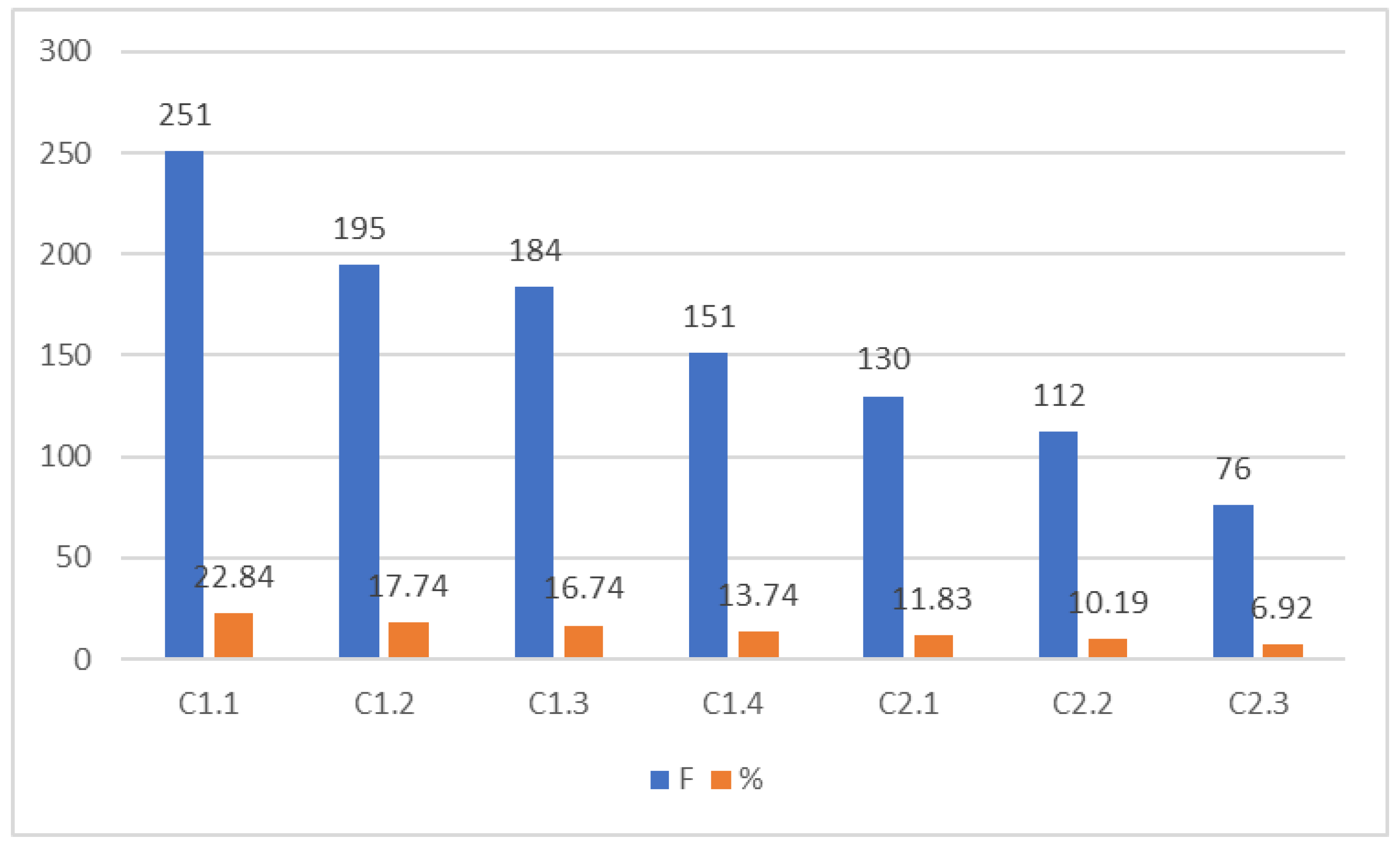
The development of the students’ language proficiency and pedagogic competencies has been the goal of all the course units, and, in this study, we have observed such integration. Observing the classes, we were able to identify 1099 pedagogic practices, 781 and 318 of which are respectively associated with C1 and C2 CEFR descriptors (see Figure 1). This indicates that the majority of the class activities (i.e., around 70%) were attributable to C1 proficiency and only around 30% to C2 CEFR descriptors.
Guided by the temporal model of policy enactment and lecturer agency perspectives, our data showed these dimensions of agency exercises: iterational, 180; practical–evaluative, 446; and projective, 89. With a total of 1099 instances in the corpus, this indicates that 384 instances have not been accounted for with this model, and this covers almost 35 percent of the data. Because not all actions were framed within the perfect senses of the temporal dimensions (i.e., past, present and future), the agency exercises should be complementarily re-organised as well in three analytically distinct yet interrelated action-based models of agency exercises (i.e., interpretive, adaptive, and transformative), and this integrated model could comprehensively accommodate our data and address how lecturers implement, negotiate, and localise CEFR-based curricula (see Table 2).
As shown in Table 2, the dominant dimension of agency exercises, in answer to the research question, is practical and evaluative adaptation (i.e., 50% of all exercises), followed by iterational interpretation at around 30% and projective transformation at around 20%. More information about these integrated enactments will be illustrated below.

3.1. Iterational–Interpretive Agency: Reframing CEFR C1/C2 in Curriculum Documents

In the creation of the curriculum and curriculum-in-action, iterational and interpretive dimensions of agency, around 20 to 28% of the data, have been exercised in a number of ways: reinterpreting the policy, using the status and identities of stakeholders, and using past experiences of failure and success.
The most frequent strategy (i.e., 59.5%) is re-reading the policy texts, that is, reinterpreting C1 or C2 not from the point of view of language proficiency but from language production in the forms of student oral presentations and written publication of papers as outcomes of the course units, which are related to those expected in the C1.4 and C2.3 levels of the CEFR. As re-interpreters of the global standards, lecturers have been involved in various training workshops (e.g., workshops on outcome-based education syllabi, material development, project-based learning and outcome-based assessment) and the students in paper presentation and publication workshops. These re-readings have enabled the lecturers to merge the global targets (i.e., the CEFR) with the national standard (i.e., level 8 of the Indonesian qualification framework) and the local standard (i.e., the department’s curriculum), where publication in nationally accredited journals have become the minimum. One of the lecturers in the units we observed represented this re-reading when he said
…. To teach at ASEAN levels, you need to have C1 level of competency. We do not have the capacity to assess you. The only thing we could do is publishing an article in accredited journals. We can do it, right?
(KM, 60 y.o., EBE lecturer)
Secondly, 10 out of iterational-interpretive dimensions of agency exercise are related to status and identities. The lecturers have also made use of the statuses of the department and the identities of the lecturers and the students. Being in the Global South, the department’s curriculum has promoted local sociocultural contexts of Lombok, Nusatenggara and Indonesia as parts of its core contents while at the same time integrating them with those of the global world. The lecturers being professionally trained at doctorate levels at internationally recognised institutions have established professional experiences in the target standards and they, thus, have the capacity to assist students attaining the target goals. The students being EFL learners in the Extended Circle with limited access to English and low English proficiency (i.e., average TOEFL score of 435 out of 667) are in need of access to English and extra language trainings and the department’s curriculum accommodate these needs with courses related to language skills such as Grammar for Language Teachers and Writing for Publication in addition to oral and written paper presentation as student’s outcomes in all units of the study. One of the lecturers narrated in interview her successful experience of helping student’s publication amidst the limitation,
At the beginning, we were doubtful if students could attain the [global] standards. Attainable. After hard work, all our alumni could publish at international journals. No reasons for our current students to abandon it.
(YN, 50 y.o., CDW lecturer, emphasis added)
Finally, around 13.51% of iterational–interpretive exercises of agency in the department’s curriculum design come from past successes and failures. The greatest success of all is the department’s latest accreditation of learning and management by the national accreditation body, as its excellence has motivated it to aim for international accreditation, requiring its curriculum to accommodate the international standards. Theoretical and academic orientation in the past has burdened students with readings of modules and end-of-semester tests; few students could graduate in time and, consequently, the accreditation level was low. Refocusing the curriculum based on the CEFR as outcomes has enabled lecturers and students to focus on publishable products and, as a result, more students could graduate in time and the accreditation improves. These curricular products, according to the leader of the department’s quality assurance team, are the curricular assets for future international accreditation.
…. [S]tudents producing oral and written papers in all courses have been the cur-rent standards. In the past, we focused on examinations. Now, we change. The lecturers and the students collaborate for the standards.
(GKM team leader, 54 y.o. our translation)
We have seen agency exercises at the level of curriculum design and we will now show them at the level of its implementation.

3.2. Practical–Evaluative–Adaptive Agency: Enacting CEFR C1/C2 Through Classroom Practices

In the implementation of the aligned curriculum, we found 50 to 52% of the instances of agency exercises were classifiable into three categories: evaluative agency (27.03%), practical agency (32.43%) and adaptive agency (40.54%). As shown above, the practical dimensions based on evaluation of conditions have been the basis for taking adaptive actions throughout the curriculum implementation.
Evaluative agency is the action taken by the lecturer to assess the current condition of the students, the department and the institution in obtaining the C1 and C2 CEFR targets in the aligned curriculum. A number of aspects have been reported as the bases of evaluation: for example, evaluating the present English proficiency and competencies of the students, identifying what works with students given their linguistic conditions, ascertaining the attainment of the department’s goal, measuring resources available, and continuously assessing student progress and potential attainment of the global standards. One of the professors enacted this evaluative agency in his class when he reminded his students of the readings he had assigned:
I know you don’t like reading that much. You have to do it. Like it or not, reading is the key [to success]. With the assignment [that] you have submitted to me I am not really happy with them. At least you need to sign of analysis, synthesis and evaluation in it as you are at postgraduate level.
(YD, 63 y.o. CELT lecturer, emphasis added)
Practical agency deals with actions taken by the lecturers given the condition of the students and the learning resources. A number of practical actions have been observed during the implementation. Given students’ low proficiency in English, the lecturers have been observed to take these practical actions: speaking slowly in class discourses, using the national language for rewording complex theoretical concepts, printing handouts and PowerPoints for class discussions, assisting classes or individual students with class projects, sharing materials through class WhatsApp groups, assisting individual students in planning and working on class projects, providing digital, written or oral feedback on individual assignments, and reviewing and revising students’ works according to the expected descriptors of the global standard. Such actions might be practical, but demanding, as one of the convenors of the EBE course shared his struggle of helping students with the expected global standard:
My class deal with ELT business proposal and report. [The students] need to have ELT-related businesses, which they don’t always have. I invited a former student and a [successful] entrepreneur to work with them. She helped a lot.
(BH, 60 y.o. EBE lecturer, emphasis added)
Nonetheless, the majority of actions in the curriculum implementation are in the form of adaptive agency. Given the evaluation of the conditions and the success or failure of the practical actions taken, the lecturers always adapt their actions to those situations. Numerous adaptive activities have been recorded: re-assessing the target outcomes, re-adjusting the curriculum standards to local potentials, redefining, re-adjusting or modifying actions to obtain the curricular standards, giving extra service time for overcoming constraints (e.g., tutoring for low-proficiency students, office hours for student consultation, collaborative work for class products, or student peer review), modifying course syllabi following students’ expectations and conditions, re-aligning C1/C2 descriptors according to the students’ competencies, and re-designing assessments. While it is a hard struggle to obtain the global standards, adaptation of the targets, the strategies and the assessment is a constant negotiation among lecturers. The convenor of CDW shared this challenge when she said
In CDW, [the students] critically engage with workplace discourses. Emails, meeting transcripts, [and] office documents are analysed, power dynamics [are] discussed. [it is difficult] [but] I am not seeking flawless English. I desire for students to comprehend the manner in which language functions in actual professional settings. That is a more advanced level for me.
(MQ, 65 y.o. CDW lecturer, emphasis added)
In this instance, adaptive agency reconciles CEFR-oriented expectations with the analytical requirements of the course units.
These adaptive actions are expected to be projected and transformed into future actions in the courses, in the department and in the lives of the students. They are elaborated below.

3.3. Projective–Transformative Agency: Re-Envisioning CEFR and Curriculum Internationalisation

In the implementation of the aligned curriculum, we found 19 to 20% of the instances of agency exercises were attributable to projective agency (36.67%) and transformative agency (63.33%).
Projective dimensions of agency exercises are linked with the use of current actions for the later bigger challenges in the program. A number of projective actions have been noted: for example, linking content and activities with bigger assignments (e.g., proposal, thesis and article writing), with challenges in future professions (e.g., being lecturers, teachers, headmasters) and with other challenges (e.g., international accreditations). Projective agency also comes in the form of integrating the aspirations of the students, the lecturers, the department and the institution with respect to the attainment of C1 and C2 CEFR and other standards.
Transformative dimensions of agency exercises refer to the acts of converting experiences and lessons learned from the current alignment and enactment of the curriculum to future performance in the educational services. Note that the experiences and the lessons are transferable mostly to micro levels of policy enactment but also to macro and meso levels. At micro levels, the lecturers have reported lessons being transformable to future actions. For future curriculum reforms, the experiences have taught the lecturers how to identify essential contents for future curricula for future types of students. In terms of lecturer requirements and qualities, the experiences in implementing the aligned curriculum have informed the department of qualities needed in lecturers for future course units. In terms of course content, the lessons have enabled the course convenors to restructure and reform the content of future course units based on the current one. In terms of learning experiences, the implementation has supplied the lecturers with effective ways of organising and delivering course contents, activities, norms and course assignments. In relation to attainment of C1/C2 CEFR as a global target goal, the enactment has enriched the lecturers with experiences in publishing quality products of the taught units in the forms of oral paper presentations and published articles as evidence of attainment of both C1 and C2 levels of the CEFR. At the macro level, the enactment experiences have taught the lecturers lessons about the challenges and the prospects for the university in producing future quality alumni based on the conditions, attitudes and performance of the current students and their proficiency in English. At the meso level, the enactment experiences have helped lecturers in reforming English language teaching policy for better future types of English education services.
In general, we can conclude from the study that lecturer agency in the enactment of the aligned curriculum is constituted through iterational, practical, evaluative and projective dimensions which respectively enable interpretative, adaptive and transformative forms of agency. These dimensions interact dynamically across past experiences, present contexts, and future-oriented professional aspirations. This is a brief generalisation of the research findings, and they are in need of corroboration with the findings of others in this field of study.

4. Discussion

This study has examined how lecturer agency mediates CEFR-aligned curriculum internationalisation in Indonesian postgraduate English education. By foregrounding lecturers’ iterational–interpretive, practical–evaluative–adaptive, and projective–transformative practices, the findings challenge linear and compliance-oriented accounts of CEFR implementation and instead position curriculum internationalisation as a negotiated, power-laden, and contextually situated process.
The results of this study demonstrate that lecturer agency in CEFR-based curriculum internationalisation is most effectively understood as an ecological and relational accomplishment, rather than as individual autonomy or isolated acts of resistance, by utilising Priestley et al.’s (2015) ecological model of agency. In line with this theoretical framework, agency emerged through the dynamic interplay of lecturers’ past professional experiences (iterational), their situated judgements under present institutional and pedagogical conditions (practical–evaluative), and their future-oriented aspirations for postgraduate graduates and curriculum development (projective). Importantly, these findings do not merely apply the ecological model; they extend it by situating lecturer agency within the specific policy terrain of global benchmarking and internationalisation.
At the iterational–interpretive level, lecturers’ prior experiences with curriculum reform, language policy initiatives, and postgraduate teaching shaped how they engaged with the CEFR. This resonates with earlier empirical studies on teacher agency, which show that educators’ responses to policy are deeply informed by accumulated professional histories rather than by policy texts alone (Ellis & Spendlove, 2020; Guarda, 2025; Tsagari & Armostis, 2025; Yusra et al., 2021). Consistent with this literature, lecturers in the present study drew on memories of earlier standardisation and accountability-driven reforms to critically evaluate CEFR C1/C2 descriptors. However, this study extends previous research by showing that such historical sense-making is particularly salient when global frameworks such as the CEFR are introduced as part of internationalisation agendas in Global South contexts, where past experiences often involve negotiating externally imposed standards.
At the practical–evaluative–adaptive level, the findings align with policy enactment research demonstrating that educators exercise agency through everyday pedagogical judgement rather than through overt opposition to policy (Yusra et al., 2020, 2023; Baldauf & Hamid, 2018). Similar to studies of teacher agency under curriculum reform (Wang & Li, 2025; Wang, 2022; Namgung et al., 2023; Priestley & Drew, 2019), lecturers balanced competing demands by aligning formally with institutional expectations while adapting pedagogical practices to multilingual classrooms, diverse student trajectories, and postgraduate epistemic goals. However, unlike much of the existing CEFR literature, which often focuses on curriculum alignment or assessment design (Mohamad Uri & Abd Aziz, 2018; Pereira & Kobayashi, 2021, Ahmad Afip et al., 2019; Foley, 2022; Yusra et al., 2020, 2023), the present study foregrounds how such judgements occur in real-time teaching and assessment practices. This empirical focus highlights lecturer agency as a situated practice shaped simultaneously by institutional accountability and pedagogical responsibility.
The projective–transformative dimension of agency further distinguishes the present findings from earlier work. While previous studies have noted that teachers orient policy enactment towards preferred futures (Demirel & Fakazlı, 2021; Yusra et al., 2023, 2021), this study demonstrates how lecturers explicitly reframed CEFR C1/C2 in relation to graduates’ anticipated roles as professionals, educators, and communicators in multilingual and intercultural environments. This future-oriented perspective challenges the prevailing CEFR research, which regards higher proficiency levels as fixed endpoints of linguistic mastery. Rather, the results bolster the emergence of critical scholarship that views proficiency frameworks as resources for professional development, rather than as terminal standards.
The results are particularly significant in that they complicate the conventional depictions of agency as either compliance or resistance. In this study, lecturers substantively reshaped pedagogical meanings while aligning curriculum documents with CEFR expectations, reflecting and extending prior empirical research on strategic compliance (Steiner-Khamsi, 2016; Tan & Reyes, 2016). This supports previous research that regards agency as relational and negotiated (M. O. Hamid & Nguyen, 2016; Ellis & Spendlove, 2020; Yusra et al., 2023). However, it provides new insight by situating this negotiation within the context of curriculum internationalisation and global benchmarking pressures. In this context, strategic compliance is not a deficit response, but rather a sophisticated form of professional agency that enables lecturers to preserve epistemic authority while operating within globalised higher education regimes.
This study contributes to a more nuanced understanding of lecturer agency in Global South higher education by explicitly coupling ecological agency theory with empirical research on policy enactment and CEFR implementation. It shows that agency is not simply constrained by global policy frameworks, nor exercised independently of them. Instead, it is produced through ongoing negotiation across temporal, institutional, and discursive contexts. In CEFR-based curriculum internationalisation, lecturer agency thus functions as the key mechanism through which global standards are interpreted, reshaped, and rendered pedagogically legitimate in locally grounded postgraduate education.

5. Conclusions

This study has contended that lecturer agency is not a peripheral aspect of CEFR-based curriculum internationalisation in Indonesian higher education; rather, it is central. In a Global South context characterised by unequal policy flows and external benchmarking pressures, lecturers serve as cultural and epistemic translators, negotiating the implications of global standards within local educational initiatives.
The results indicate that policy alignment alone is insufficient to accomplish sustainable and meaningful internationalisation. Rather, it requires institutional conditions that acknowledge lecturers’ agency, facilitate critical engagement with global frameworks, and provide opportunities for contextual reinterpretation. This necessitates a transition from managerialist and audit-driven internationalisation models to approaches that prioritise professional judgement and locally rooted expertise for university leaders and policymakers.
The results reinforce the importance of ecological and enactment-based approaches to comprehending educational policy, thereby contributing to the theory. This study demonstrates the operation of agency at the intersection of structure and practice in Global South higher education by incorporating lecturer agency theory with policy enactment and policy transfer perspectives. This contribution conceptually situates lecturer agency at the meso level between macro-level CEFR policy discourses and micro-level pedagogical practices, as introduced in the findings. By explicitly connecting agency to internationalisation processes in the curriculum and by demonstrating how global policies are re-authored through local professional practice, this model extends the body of extant theoretical work.
Overall, the discourse emphasises that CEFR-based curriculum internationalisation cannot be comprehended exclusively through policy texts or alignment claims. Rather, it is necessary to analyse the situated actions of lecturers who interpret, adapt, and transform global frameworks in context. Consequently, it is imperative to acknowledge the agency of lecturers in order to develop more equitable and context-sensitive approaches to internationalisation in higher education, in addition to conducting empirical analysis.
Future research could further investigate student perspectives on CEFR-based internationalisation or analyse comparative cases across institutions and regions to enhance understanding of how global language policies are reworked in various Global South settings.

Author Contributions

Conceptualization, Y.B.L. and K.Y.; methodology, Y.B.L.; software, B.J.O.W.; validation, Y.B.L., N.N. (Nuriadi Nuriadi) and N.N. (Nawawi Nawawi); formal analysis, Y.B.L. and L.M.; investigation, Y.B.L., K.Y. and L.M.; resources, N.N. (Nuriadi Nuriadi) and N.N. (Nawawi Nawawi) and B.J.O.W.; data curation, Y.B.L., N.N. (Nuriadi Nuriadi), N.N. (Nawawi Nawawi) and L.M.; writing—original draft preparation, Y.B.L.; writing—review and editing, Y.B.L. and K.Y.; visualization, B.J.O.W.; supervision, Y.B.L.; project administration, K.Y.; funding acquisition, Y.B.L. All authors have read and agreed to the published version of the manuscript.

Funding

This research was funded by The University of Mataram grant number 2992/UN18.L1/PP/2025, and the APC was funded by University of Mataram.

Institutional Review Board Statement

The study was conducted in accordance with the Declaration of Helsinki and was approved by the Institutional Review Board of The University of Mataram (protocol code 2992/UN18.L1/PP/2025; date of approval: 24 September 2025).

Informed Consent Statement

Informed consent was obtained from all subjects involved in the study.

Data Availability Statement

The original contributions presented in this study are included in the article. Further inquiries can be directed to the corresponding author.

Conflicts of Interest

The authors declare no conflict of interest.

Abbreviations

The following abbreviations are used in this manuscript:
CEFRCommon European Framework of Reference for Languages
CDWCritical Discourse in Workplaces
CELTContemporary English Language Teaching
EBEELT-Based Entrepreneurship

References

  1. Ahmad Afip, L., Hamid, M. O., & Renshaw, P. (2019). Common European framework of reference for languages (CEFR): Insights into global policy borrowing in Malaysian higher education. Globalisation, Societies and Education, 17(3), 378–393. [Google Scholar] [CrossRef]
  2. Ali, Z. M., Razzaly, W., Muhamad, I. I., Razak, M. A., Ali, Z., Abidin, I., Abdullah, S., & Akmal, S. (2018). Towards strategic internationalisation and global prominence: Modelling continuous quality improvement for sustainable internationalisation of the Malaysian technical universities. In ICERI2018 Proceedings (pp. 6898–6908). IATED. [Google Scholar]
  3. Archanjo, R. (2017). Moving globally to transform locally? Academic mobility and language policy in Brazil. Language Policy, 16(3), 291–312. [Google Scholar] [CrossRef]
  4. Bakar, E. W. (2020). Can-do descriptors—Realigning English language curriculum at higher education institution to CEFR. International Journal of Modern Languages and Applied Linguistics (IJMAL), 4(2), 84–97. [Google Scholar] [CrossRef]
  5. Baldauf, R. B. (2006). Rearticulating the case for micro language planning in a language ecology context. Current Issue in Language Planning, 7(2–3), 147–170. [Google Scholar] [CrossRef]
  6. Baldauf, R. B., & Hamid, M. O. (2018). Language planning “schools” and their approaches and methodologies. In F. Lisa, N. Jiri, & S. Marian (Eds.), The language management approach: A focus on research methodology (pp. 43–66). P I E—Peter Lang. [Google Scholar]
  7. Biesta, G., & Tedder, M. (2006). How is agency possible? Towards an ecological understanding of agency-as-achievement. Learning Lives Work Papers, 5, 1–40. Available online: http://hdl.handle.net/10993/13718 (accessed on 21 January 2026).
  8. Byram, M. (2022). Politics, origins and futures of the CEFR. The Language Learning Journal, 50(5), 586–599. [Google Scholar] [CrossRef]
  9. Canagarajah, A. S. (2005). Reclaiming the local in language policy and practice. Routledge. [Google Scholar]
  10. Council of Europe. (2001). Common European framework of reference for languages: Learning, teaching, assessment. Cambridge University Press. Available online: https://www.coe.int/t/dg4/linguistic/Source/Framework_EN.pdf (accessed on 18 March 2025).
  11. Demirel, İ. F., & Fakazlı, Ö. (2021). A CEFR-based comparison of English and Turkish language teaching course books in terms of speaking and writing skills. Journal of Theoretical Educational Science, 14(2), 167–185. [Google Scholar] [CrossRef]
  12. de Wit, H. (2019). Internationalization in higher education, a critical review. SFU Educational Review, 12(3), 9–17. [Google Scholar] [CrossRef]
  13. de Wit, H., & Altbach, P. G. (2021). Internationalization in higher education: Global trends and recommendations for its future. Policy Reviews in Higher Education, 5(1), 28–46. [Google Scholar] [CrossRef]
  14. Du, X., & Curdt-Christiansen, X. L. (2026). Teacher agency in practiced language policy in higher education in East and Southeast Asia (2010–2025): A systematic review. Teaching and Teacher Education, 171, 105345. [Google Scholar] [CrossRef]
  15. Dwinalida, K., & Maulia, B. P. (2024). Does CEFR (Common European Framework of Reference) fit the expectation: Voices from the classroom. INSANIA: Jurnal Pemikiran Alternatif Kependidikan, 29(2), 168. [Google Scholar] [CrossRef]
  16. Ellis, V., & Spendlove, D. (2020). Mediating ‘School Direct’: The enactment of a reform policy by university-based teacher educators in England. British Educational Research Journal, 46(5), 949–966. [Google Scholar] [CrossRef]
  17. Foley, J. (2022). CLT using CEFR and EIL in Southeast Asia and East Asia in the English language classroom. RELC Journal, 53(1), 240–252. [Google Scholar] [CrossRef]
  18. Franz, J., & Teo, A. (2018). ‘A2 is normal’—Thai secondary school English teachers’ encounters with the CEFR. RELC Journal, 49(3), 322–338. [Google Scholar] [CrossRef]
  19. Guarda, M. (2025). Fostering educational change at the intersection of macro-level institutional narratives and micro-level classroom experiences. Education Sciences, 15, 472. [Google Scholar] [CrossRef]
  20. Hamid, H. A., Fakhruddin, W. F. W. W., Afip, L. A., & Hamid, M. O. (2025). Navigating global standards in local contexts: A systematic review of CEFR-aligned English language curriculum in the ASEAN region. Journal of Nusantara Studies (JONUS), 10(1), 324–352. [Google Scholar] [CrossRef]
  21. Hamid, M., & Ali, M. (2022, November 22). Language planning and education in Asia. Oxford Research Encyclopedia of Education. Available online: https://oxfordre.com/education/view/10.1093/acrefore/9780190264093.001.0001/acrefore-9780190264093-e-1804 (accessed on 29 January 2026).
  22. Hamid, M. O. (2016). The politics of language in education in a global polity. In K. Mundy, A. Green, B. Lingard, & A. Verger (Eds.), The handbook of global education policy (pp. 259–274). Wiley Blackwell. [Google Scholar]
  23. Hamid, M. O., & Nguyen, H. T. M. (2016). Globalization, English language policy, and teacher agency: Focus on Asia. The International Education Journal: Comparative Perspectives, 15(1), 26–44. [Google Scholar]
  24. Higgins, R. M., & Brady, A. (2018). Language policy, planning, and enactment: The necessity and empowering potential at the local level. In Language policy and planning in universities (pp. 12–29). Routledge. [Google Scholar]
  25. Hoinbala, F. R. (2025). The need for a standardized framework for language assessment in Indonesia: Could the CEFR be a solution? In N. N. Benu, & P. M. Jonathans (Eds.), Innovations in language learning: Pedagogical strategies and linguistic insights (pp. 112–131). Artha Wacana Press. [Google Scholar]
  26. Hornberger, N. H. (2015). Selecting appropriate research methods in LPP research. In F. M. Hult, & D. C. Johnson (Eds.), Research methods in language policy and planning (pp. 9–20). Wiley Blackwell. [Google Scholar]
  27. Jehdo, K., Yossiri, V., Hayeesani, M., Vongsvivut, S., & Paramal, N. (2024). Challenges and benefits of developing CEFR for languages-aligned writing assessments for Thai EFL learners: A case study on Yala Rajabhat University Test of English Proficiency. Arab World English Journal, 15(1), 352–367. [Google Scholar] [CrossRef]
  28. Johnson, D. C., & Freeman, R. (2010). Appropriating language policy on the local level: Working the spaces for bilingual education. In Negotiating language policies in schools (pp. 27–45). Routledge. [Google Scholar]
  29. Kang, H. S. (2025). Language teacher agency and identity in internationalized higher education: An ecological perspective. International Journal of Applied Linguistics, 35(2), 555–565. [Google Scholar] [CrossRef]
  30. Kanjananiyot, P., & Chaitiamwong, C. (2018). The internationalization of Thai higher education over the decades: Formidable challenges remain! In Education in Thailand: An old elephant in search of a new mahout (pp. 271–321). Springer. [Google Scholar]
  31. Kentmen, H., Debreli, E., & Yavuz, M. A. (2023). Assessing tertiary Turkish EFL learners’ pragmatic competence regarding speech acts and conversational implicatures. Sustainability, 15(4), 3800. [Google Scholar] [CrossRef]
  32. Lee, H. Y., Hamid, M. O., & Hardy, I. (2024). Language policy at the supranational level: English and the ASEAN (Vol. 37). Springer Nature. [Google Scholar]
  33. Li, Z., Li, J. Z., Zhang, X., & Reynolds, B. L. (2024). Mastery of listening and reading vocabulary levels in relation to CEFR: Insights into student admissions and English as a medium of instruction. Languages, 9(7), 239. [Google Scholar] [CrossRef]
  34. Lingard, B. (2018). Reforming education: The spaces and places of education policy and learning. In E. Hultqvist, S. Lindblad, & T. Popkewitz (Eds.), Critical analyses of educational reforms in an era of transnational governance (Vol. 7, pp. 37–49). Springer. [Google Scholar] [CrossRef]
  35. Lingard, B. (2020). Globalisation and education: Theorising and researching changing imbrications in education policy. In Globalisation and education (pp. 1–27). Routledge. [Google Scholar]
  36. Maryo, F. A. A. (2021). The issues of the implementation of CEFR in Indonesia. Aplinesia (Journal of Applied Linguistics Indonesia), 5(1), 18–22. [Google Scholar]
  37. Mohamad Uri, N. F., & Abd Aziz, M. S. (2018). Neoliberalism and its impact on English as a medium of instruction in Malaysia, Thailand and Vietnam. Journal of Creative Practices in Language Learning and Teaching (CPLT), 6(1), 17–29. [Google Scholar]
  38. Muliastuti, L. (2024). CEFR-based model of Indonesian grammar teaching materials for foreign students. KnE Social Sciences. [Google Scholar]
  39. Namgung, W., Moate, J., & Ruohotie-Lyhty, M. (2023). An ecological approach to teacher agency in English curriculum design at Korean secondary schools. Curriculum and Teaching, 38(1), 67–84. [Google Scholar] [CrossRef]
  40. Nguyen, V. H., & Hamid, M. O. (2021). The CEFR as a national language policy in Vietnam: Insights from a sociogenetic analysis. Journal of Multilingual and Multicultural Development, 42(7), 650–662. [Google Scholar] [CrossRef]
  41. Normand-Marconnet, N., & Lo Bianco, J. (2015). The Common European Framework of Reference down under: A survey of its use and non-use in Australian universities. Language Learning in Higher Education, 5(2), 281–307. [Google Scholar] [CrossRef]
  42. Pereira, A., & Kobayashi, E. (2021). Internationalization and English language in a public institution. Independent Journal of Management & Production, 12(9), s794–s811. [Google Scholar] [CrossRef]
  43. Phantharakphong, P., & Liyanage, I. (2026). The professional development (PD) paradox: How policy shapes English teacher identity and constrains authentic learning in Thailand. Education Sciences, 16(1), 117. [Google Scholar] [CrossRef]
  44. Priestley, M., Biesta, G., & Robinson, S. (2015). Teacher agency: An ecological approach. Bloomsbury. [Google Scholar]
  45. Priestley, M., & Drew, V. (2019). Professional enquiry: An ecological approach to developing teacher agency. In An ecosystem for research-engaged schools (pp. 154–169). Routledge. [Google Scholar]
  46. Priestley, M., Robinson, S., & Biesta, G. (2011, 20 September). Mapping teacher agency: An ecological approach to understanding teachers’ work. Paper presented at the Oxford Ethnography and Education Conference, Oxford, UK. [Google Scholar]
  47. Rehner, K., & Lasan, I. (2023). Developing second language learners’ sociolinguistic competence: How teachers’ CEFR-related professional learning aligns with learner-identified needs. Education Sciences, 13(3), 282. [Google Scholar] [CrossRef]
  48. Sanoh, M., & Ambele, E. A. (2024). Internationalization and Englishes in Thai higher education: Surveying insights from international mobile students in Thailand [Doctoral dissertation, Mahasarakham University]. [Google Scholar]
  49. Savski, K. (2020). Local problems and a global solution: Examining the recontextualization of CEFR in Thai and Malaysian language policies. Language Policy, 19(4), 527–547. [Google Scholar] [CrossRef]
  50. Savski, K. (2023). CEFR and the ELT practitioner: Empowerment or enforcement? ELT Journal, 77(1), 62–71. [Google Scholar] [CrossRef]
  51. Savski, K. (2025). Ideological (dis)entanglements of English in higher education: Comparing an Asian and a European ecology. In Critical intercultural and English language issues in the internationalisation of higher education (pp. 24–37). Routledge. [Google Scholar]
  52. Soe, N. W., Mangulabnan, P., & Arrecis, A. L. (2023). Reading through English curricula of Cambodia, Guatemala, Japan, Myanmar, and the Philippines: A case study of teacher reflections. In Global perspectives on education research (Vol. II, pp. 169–195). Routledge. [Google Scholar]
  53. Steiner-Khamsi, G. (2016). New directions in policy borrowing research. Asia Pacific Education Review, 17(3), 381–390. [Google Scholar] [CrossRef]
  54. Tan, C., & Reyes, V. (2016). Curriculum reform and education policy borrowing in China: Towards a hybrid model of teaching. In C. Chou, & J. Spangler (Eds.), Chinese education models in a global age, education in the Asia-Pacific region (Vol. 31, pp. 37–49). Springer. [Google Scholar]
  55. Trudell, B., & Piper, B. (2014). Whatever the law says: Language policy implementation and early-grade literacy achievement in Kenya. Current Issues in Language Planning, 15(1), 4–21. [Google Scholar] [CrossRef]
  56. Tsagari, D., & Armostis, S. (2025). Contextualizing language assessment literacy: A comparative study of teacher beliefs, practices, and training needs in Norway and Cyprus. Educational Sciences, 15(7), 927. [Google Scholar] [CrossRef]
  57. Umaya, S. (2023). Internationalization of the French language curriculum through the application of the common European framework of reference. Inovasi Kurikulum, 20(1), 61–72. [Google Scholar] [CrossRef]
  58. Uri, N. F. M. (2021). CEFR in Malaysia: The appropriacy of English syllabus and assessment, stakeholders’ perspectives and challenges [Unpublished doctoral dissertation, Universiti Kebangsaan Malaysia]. [Google Scholar]
  59. Wang, L. (2022). English language teacher agency in response to curriculum reform in China: An ecological approach. Frontiers in Psychology, 13, 935038. [Google Scholar] [CrossRef] [PubMed]
  60. Wang, L., & Li, D. (2025). An ecological perspective on language teacher agency in educational reform. Journal of Educational Change, 26(4), 579–598. [Google Scholar] [CrossRef]
  61. Yusra, K., Hanafi, N., & Lestari, Y. B. (2020). The implementation of common ASEAN tourism curriculum (CATC) in Indonesia. The Asian ESP Journal, 16(2), 90–115. [Google Scholar]
  62. Yusra, K., Lestari, Y. B., & Hamid, M. O. (2021). Teacher agency and the implementation of CEFR-like policies for English for tourism and hospitality: Insights from local vocational contexts. Current Issues in Language Planning, 23(3), 233–253. [Google Scholar] [CrossRef]
  63. Yusra, K., Lestari, Y. B., & Susanti, N. W. M. (2023). Integrating supranational and national frameworks into local tourism-related English courses. World Journal of English Language, 13(5), 331–346. [Google Scholar] [CrossRef]
  64. Zhang, Y. (2025). Higher education regionalization in East and Southeast Asia: Between decolonization, recolonization, and self-colonization. Higher Education, 89(6), 1603–1618. [Google Scholar] [CrossRef]
Figure 1. Learning activities and C1/C2 descriptors.
Education 16 00369 g001
Table 1. C1/C2 CEFR as internationalisation targets.
LevelDescriptors
C11Can understand a wide range of demanding, longer texts and recognise implicit meaning.
2Can express ideas fluently and spontaneously without much obvious searching for expressions.
3Can use language flexibly and effectively for social, academic, and professional purposes.
4Can produce clear, well-structured, detailed texts on complex subjects, showing controlled use of organisational patterns, connectors, and cohesive devices.
C21Can understand with ease virtually everything heard or read.
2Can summarise information from different spoken and written sources, reconstructing arguments and accounts in a coherent presentation.
3Can express themselves spontaneously, very fluently, and precisely, differentiating finer shades of meaning even in complex situations.
Table 2. CEFR descriptors and dimensions of agency exercises.
CEFRDimensions of Agency Exercises
Iterational–InterpretativePractical–Evaluative–AdaptiveProjective–TransformativeTotal
F%F%F%F%
C1.17630.2812127.135463.5325122.84
C1.26023.909020.184552.9419517.74
C1.35120.3210824.222529.4118416.74
C1.44015.948118.163035.2915113.74
C2.13313.157316.372428.2413011.83
C2.22811.166213.902225.8811210.19
C2.3207.97408.971618.82766.92
Total30828.0357552.3221619.651099
Disclaimer/Publisher’s Note: The statements, opinions and data contained in all publications are solely those of the individual author(s) and contributor(s) and not of MDPI and/or the editor(s). MDPI and/or the editor(s) disclaim responsibility for any injury to people or property resulting from any ideas, methods, instructions or products referred to in the content.