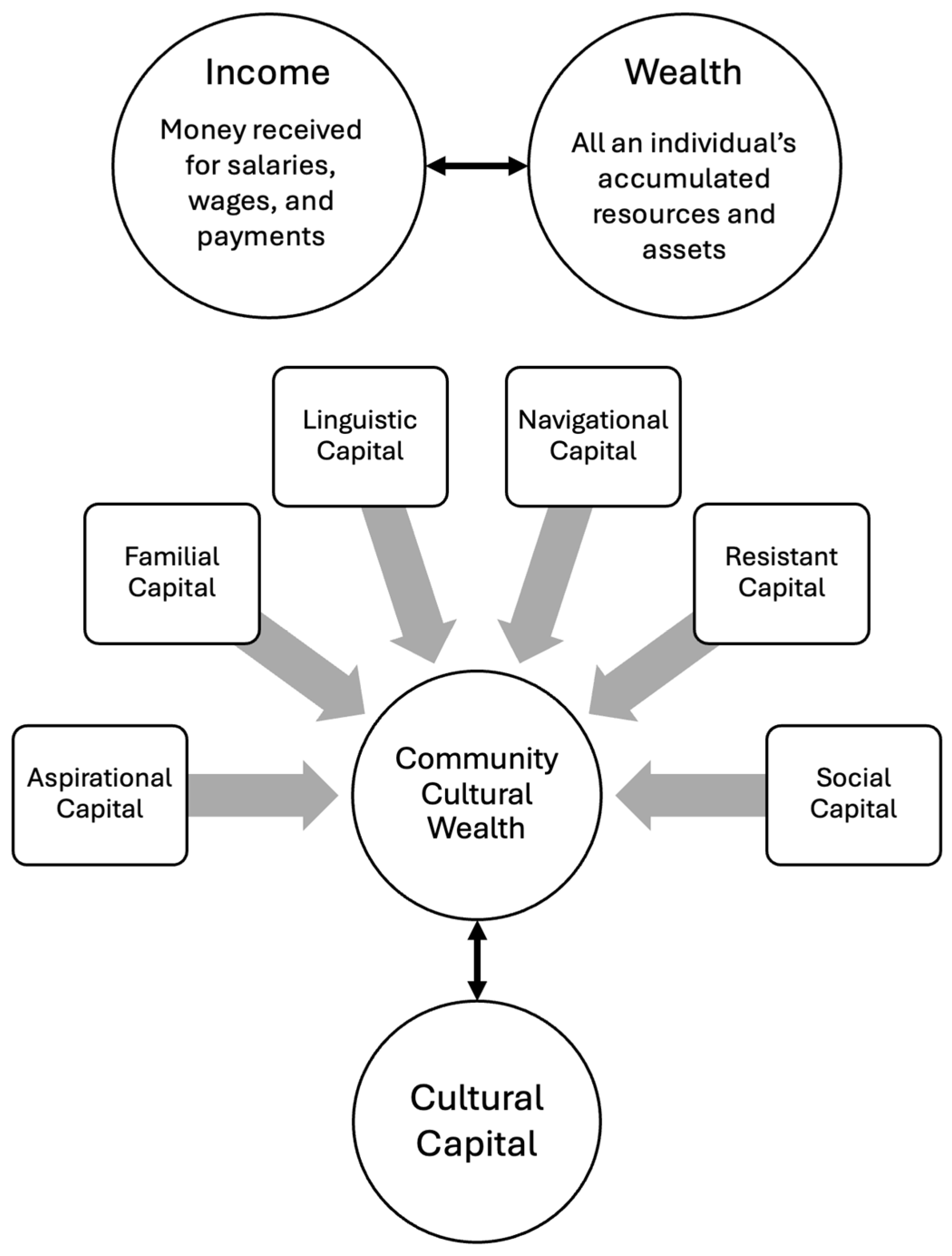
Exploring the Community Cultural Wealth and Science Capital of Parents in a Family STEM Program


Abstract
1. Introduction
1.1. Community Cultural Wealth
1.2. Study Context
1.3. Research Question
2. Methods
2.1. Participants
2.2. Analyses
3. Results
I didn’t have that much exposure to science… I grew up in a rural part of the state. There weren’t a lot of resources at my school. There was only one high school, everyone knew each other, and you weren’t exposed to a lot. And so, I was really pushed into business because that was my strength (final interview).
[The program has] definitely given me a ‘like’ relationship with science and I’m actually open to learning new things about science instead of saying ‘I don’t like this subject, so I’m not going to like any of it.’ I don’t have that attitude anymore about science… It definitely opened our world to science. I actually developed a “like” relationship with science. Not quite with the “love” thing yet. But the exposure has really… I mean, we have conversations about space. At night, we’re looking at the moon to see if we know if it’s a full or half moon, stuff like that. To see if we can find the big dipper, the north star. With every activity that we’ve had, it’s really opened our world up to the world around us (final interview).
Oh yes, in general, I am [more interested]. I would like to learn more and do some of the STEM activities that we have. And the coding is really cool… I signed up [to teach] a coding elective [in my job] because we’re starting now in kindergarten, and they needed some volunteers and I signed up for the gardening. So, I’ll be teaching both of those electives. But I’ll be actually learning myself as I teach the kids. So, it’ll be a really cool experience… Now I see the importance of doing [science] every day and the impact just from having it every few Saturdays a month, every couple of months, how it changes the way that my daughter thinks, when I know she didn’t think of it before, as well as myself. So really, kids starting young and getting them to think about science (final interview).
I will say yes, but as far as knowing what they did, no I didn’t know what they did, no one [I was] familiar [with] or had an experience with. My mom was a nurse, but you don’t really know what’s related to science (final interview).

| Pre-Test | Post-Test | |||||||
|---|---|---|---|---|---|---|---|---|
| n | Yes | No | n | Yes | No | z | p | |
| Do you know anyone now who works in STEM | 44 | 77.3 | 22.7 | 44 | 93.2 | 6.8 | −2.65 | 0.008 * |
| Do you know anyone now with STEM hobbies? | 44 | 68.2 | 31.8 | 43 | 76.7 | 23.3 | −1.00 | 0.315 |
| Does anyone in your family work in STEM? | 42 | 76.2 | 23.8 | 43 | 86.0 | 14.0 | −1.41 | 0.157 |
This was a great opportunity for my child to grow in the knowledge of science and the many possibilities available. It helped me to have more information to guide my daughter in her interest in animal science as she wants to be a veterinarian (final survey).
Olivia also talked about how she changed their family’s engagement with STEM:My children now can tell what science is all about and the different types of science. They are more interested in becoming [a scientist]. They want to explore the world, they look for rocks, plants, animals and tried to find more about it. We go to explore at museums, parks, zoos, beach, etc. They ask to buy tools to use that are science related like binoculars, bug catching, etc. (final survey).
This was similar to the change Claire had when thinking about her sons.I have increased the priority to involve my son in STEM activities as much as we can. He is such an athlete but we have shifted our priorities to have a balance between STEM and sports because he loves both (final survey).
Our other son also loved coming to these events. It was actually really good for him/us because we often think of our other son as being the real science/math kid and him into reading and sports. But he is absolutely just as interested in science. Thanks for helping us see that (final survey).
The program has helped me to bring up things in everyday life that are impacted by science. I now let them measure and mix things to cook so they can see the outcome. I can appreciate the program exposing kids to different aspects of science (final survey).
Yes. I told them for [her] birthday- and we’ve never done this but I know it’s because of the influence that the program has had- I went online to look at these science experiments that she could do with her friends. We tried them out. We did the lava lamp, that is really cool. I love doing that. And we made snot. I was hoping the girls would get a kick out of that since most of them have brothers. It was more like slime (final interview).
We took the bird feeder home and hung it. I did bird watching before now, but now I’m really interested in it, now that we did the whole process of bird banding. I’ve really enjoyed that. To see the birds up close, how beautiful they are (final interview).
3.1. Community Cultural Wealth
I like this because it’s a different setting, a different environment. So, we met different people. And it was people who were kind of like minded and seemed inquisitive and wanted to learn more, had something to contribute so that was fun (final interview).
There might be other activities that we don’t know about through other places. The university offers [a STEM program] we didn’t know about until we were a part of the science club. It was someone at the [program] who told us about it (final interview).
It’s made it easier to see if I can try again to go back to school… Seeing the people that were doing the instruction and the people that helped it and giving some background about what they were doing. Listening to them talk about what they do and the types of jobs that they may do, and what they do when they do their job and, main thing, knowing it was all local. Different parts of the state but it’s all still local (final interview).
My family has a deeper appreciation for science related experiences and understand the impact these experiences will have on our son’s future. We are increasing dialogue about science related careers and I feel strongly that he will pursue a career in STEM (final survey).
This program has exposed us to the world of science in ways we would not have explored ourselves. We talk about earth, how to make the world a better place and have plans to visit zoos, aquariums, and museums more often (final survey).
3.2. Limitations
4. Discussion
4.1. Community Cultural Wealth
4.2. Future Areas for Research
5. Conclusions
I can speak to the importance of being inclusive the people who haven’t historically- who haven’t chosen science or math or stem as an option for various reasons whether lack of confidence, or not being targeted, or not feeling comfortable, but I think this is a great opportunity to kind of bridge that gap and do it in a fun way. It’s powerful. It’s meaningful. It has really changed us and our lives. It is all about exposure. Exposure is big. So as much as we can expose children, especially those who are not represented in this field to it, I think that’s great. The earlier the better (Deja, final interview).
Author Contributions
Funding
Institutional Review Board Statement
Informed Consent Statement
Data Availability Statement
Acknowledgments
Conflicts of Interest
References
- Aish, N., Asare, P., & Miskioğlu, E. E. (2018, March 10). People like me: Providing relatable and realistic role models for underrepresented minorities in STEM to increase their motivation and likelihood of success. 2018 IEEE integrated STEM education conference (ISEC) (pp. 83–89), Princeton, NJ, USA. Available online: https://ieeexplore.ieee.org/abstract/document/8340510 (accessed on 1 December 2025).
- Amarnani, R. K., Garcia, P. R. J. M., Restubog, S. L. D., Bordia, P., & Bordia, S. (2018). Do you think I’m worth it? The self-verifying role of parental engagement in career adaptability and career persistence among STEM students. Journal of Career Assessment, 26(1), 77–94. [Google Scholar] [CrossRef] [Scilit]
- Archer, L., Dawson, E., DeWitt, J., Seakins, A., & Wong, B. (2015). “Science capital”: A conceptual, methodological, and empirical argument for extending bourdieusian notions of capital beyond the arts. Journal of Research in Science Teaching, 52(7), 922–948. [Google Scholar] [CrossRef] [Scilit]
- Archer, L., & DeWitt, J. (2016). Understanding young people’s science aspirations: How students form ideas about ‘becoming a scientist’. Routledge. [Google Scholar]
- Archer, L., DeWitt, J., Osborne, J., Dillon, J., Willis, B., & Wong, B. (2012). Science aspirations, capital, and family habitus: How families shape children’s engagement and identification with science. American Educational Research Journal, 49(5), 881–908. [Google Scholar] [CrossRef] [Scilit]
- Archer, L., Moote, J., Macleod, E., Francis, B., & DeWitt, J. (2020). ASPIRES 2: Young people’s science and career aspirations, age 10–19. Report. Available online: https://discovery.ucl.ac.uk/id/eprint/10092041/ (accessed on 1 December 2025).
- Bourdieu, P. (1986). The forms of capital. In J. Richardson (Ed.), Handbook of theory and research for the sociology of education (pp. 241–258). Greenwood Press. [Google Scholar]
- Campbell, J. L., Quincy, C., Osserman, J., & Pedersen, O. K. (2013). Coding in-depth semistructured interviews: Problems of unitization and intercoder reliability and agreement. Sociological Methods & Research, 42(3), 294–320. [Google Scholar] [CrossRef] [Scilit]
- Ceglie, R. J., & Settlage, J. (2016). College student persistence in scientific disciplines: Cultural and social capital as contributing factors. International Journal of Science and Mathematics Education, 14(1), 169–186. [Google Scholar] [CrossRef] [Scilit]
- Chen, X. (2013). STEM attrition: College students’ paths into and out of STEM fields (Statistical Analysis Report NCES 2014-001). National Center for Education Statistics. Available online: http://ies.ed.gov/pubsearch/pubsinfo.asp?pubid=2014001rev (accessed on 8 February 2019).
- Chiu, T. K. (2024). Using self-determination theory (SDT) to explain student STEM interest and identity development. Instructional Science, 52(1), 89–107. [Google Scholar] [CrossRef] [Scilit]
- Cian, H., Dou, R., Castro, S., Palma-D’souza, E., & Martinez, A. (2022). Facilitating marginalized youths’ identification with STEM through everyday science talk: The critical role of parental caregivers. Science Education, 106(1), 57–87. [Google Scholar] [CrossRef] [Scilit]
- Claridge, T. (2022). Exploring the limits of social capital. Institute for Social Capital. Available online: https://www.socialcapitalresearch.com/wp-content/uploads/2022/06/Exploring-the-limits-of-social-capital.pdf (accessed on 1 December 2025).
- Clark Blickenstaff, J. (2005). Women and science careers: Leaky pipeline or gender filter? Gender and Education, 17(4), 369–386. [Google Scholar] [CrossRef] [Scilit]
- Claussen, S., & Osborne, J. (2013). Bourdieu’s notion of cultural capital and its implications for the science curriculum. Science Education, 97(1), 58–79. [Google Scholar] [CrossRef] [Scilit]
- Crowley, K., Callanan, M. A., Tenenbaum, H. R., & Allen, E. (2001). Parents explain more often to boys than to girls during shared scientific thinking. Psychological Science, 12, 258–261. [Google Scholar] [CrossRef] [Scilit] [PubMed]
- Dabney, K. P., Chakraverty, D., & Tai, R. H. (2013). The association of family influence and initial interest in science. Science Education, 97(3), 395–409. [Google Scholar] [CrossRef] [Scilit]
- Dabney, K. P., Tai, R. H., Almarode, J. T., Miller-Friedmann, J. L., Sonnert, G., Sadler, P. M., & Hazari, Z. (2012). Out-of-school time science activities and their association with career interest in STEM. International Journal of Science Education, Part B, 2(1), 63–79. [Google Scholar] [CrossRef] [Scilit]
- Dabney, K. P., Tai, R. H., & Scott, M. R. (2016). Informal science: Family education, experiences, and initial interest in science. International Journal of Science Education, Part B, 6(3), 263–282. [Google Scholar] [CrossRef] [Scilit]
- Davis-Kean, P. E. (2005). The influence of parent education and family income on child achievement: The indirect role of parental expectations and the home environment. Journal of Family Psychology, 19(2), 294. [Google Scholar] [CrossRef] [Scilit]
- Deci, E. L., & Ryan, R. M. (2012). Self-determination theory. In Handbook of theories of social psychology (Volume 1, pp. 416–436). SAGE Publications Ltd. [Google Scholar]
- DeVellis, R. F., & Thorpe, C. T. (2021). Scale development: Theory and applications. Sage Publications. [Google Scholar]
- Dorrance-Hall, E., Zhang, Y., Edwards, A. L., Wolfe, B. H., Watson, O., Morales, N., & Valdes, P. (2025). STEM career interest development and persistence: What parents do, say, and should say. Annals of the International Communication Association, 49(4), 323–335. [Google Scholar] [CrossRef] [Scilit]
- Dotterer, A. M. (2022). Parent involvement, expectancy values, and STEM outcomes among underrepresented adolescents. Social Psychology of Education, 25(1), 113–127. [Google Scholar] [CrossRef] [Scilit]
- Dou, R., Hazari, Z., Dabney, K., Sonnert, G., & Sadler, P. (2019). Early informal STEM experiences and STEM identity: The importance of talking science. Science Education, 103(3), 623–637. [Google Scholar] [CrossRef] [Scilit]
- Dou, R., Villa, N., Cian, H., Sunbury, S., Sadler, P. M., & Sonnert, G. (2025). Unlocking STEM identities through family conversations about topics in and beyond STEM: The contributions of family communication patterns. Behavioral Sciences, 15(2), 106. [Google Scholar] [CrossRef] [Scilit]
- Ennes, M., Jones, M. G., Chesnutt, K., Cayton, E., & Childers, G. M. (2023a). Family science experiences’ influence on youths’ achievement value, perceived family value, and future value of science. Research in Science Education, 53(5), 977–992. [Google Scholar] [CrossRef] [Scilit]
- Ennes, M., Jones, M. G., Childers, G., Cayton, E., & Chesnutt, K. (2023b). Children and parents’ perceptions of access to science tools at home and their role in science self-efficacy. Research in Science Education, 53(4), 671–687. [Google Scholar] [CrossRef] [Scilit]
- Ennes, M., Jones, M. G., Cian, H., Dou, R., Abramowitz, B., Bordewieck, K., & Ideus, K. (2023c). Family influence and STEM career aspirations. In R. Tierney, F. Rizvi, & K. Ercikan (Eds.), International Encyclopedia of Education (4th ed., pp. 370–381). Elsevier. [Google Scholar] [CrossRef] [Scilit]
- Falk, J. H., & Needham, M. (2011). Measuring the impact of a science center on its community. Journal of Research in Science Teaching, 48(1), 1–12. [Google Scholar] [CrossRef] [Scilit]
- Funk, C., & Parker, K. (2018, January). Women and men in STEM often at odds over workplace equity. Pew Research Center. Available online: https://www.pewresearch.org/social-trends/2018/01/09/women-and-men-in-stem-often-at-odds-over-workplace-equity/ (accessed on 1 December 2025).
- Gibson, D. E. (2004). Role models in career development: New directions for theory and research. Journal of Vocational Behavior, 65(1), 134–156. [Google Scholar] [CrossRef] [Scilit]
- Gladstone, J. R., & Cimpian, A. (2021). Which role models are effective for which students? A systematic review and four recommendations for maximizing the effectiveness of role models in STEM. International Journal of STEM Education, 8(1), 59. [Google Scholar] [CrossRef] [Scilit]
- Gülhan, F. (2023). Parental involvement in STEM education: A systematic literature review. European Journal of STEM Education, 8(1), 05. [Google Scholar] [CrossRef] [Scilit] [PubMed]
- Harlow, D. B. (2012). The excitement and wonder of teaching science: What pre-service teachers learn from facilitating family science night centers. Journal of Science Teacher Education, 23(2), 199–220. [Google Scholar] [CrossRef] [Scilit]
- Hecht, M. L. (1993). 2002-A research odyssey: Toward the development of a communication theory of identity. Communication Monographs, 60(1), 76–82. [Google Scholar] [CrossRef] [Scilit]
- Hernandez, D., Rana, S., Alemdar, M., Rao, A., & Usselman, M. (2016). Latino parents’ educational values and STEM beliefs. Journal for Multicultural Education, 10(3), 354–367. [Google Scholar] [CrossRef] [Scilit]
- Jackson, K. M., & Suizzo, M.-A. (2015). Sparking an interest: A qualitative study of Latina science identity development. Journal of Latina/o Psychology, 3(2), 103–120. [Google Scholar] [CrossRef] [Scilit]
- Jones, M. G., Chesnutt, K., Ennes, M., Cayton, E., & Mulvey, K. L. (2021a). Understanding science career aspirations: Factors predicting future science task value. Journal of Research in Science Teaching, 58(7), 937–955. [Google Scholar] [CrossRef] [Scilit]
- Jones, M. G., Chesnutt, K., Ennes, M., Macher, D., & Paechter, M. (2022). Measuring science capital, science attitudes, and science experiences in elementary and middle school students. Studies in Educational Evaluation, 74, 101180. [Google Scholar] [CrossRef] [Scilit]
- Jones, M. G., Chesnutt, K., Ennes, M., Macher, D., & Paechter, M. (2023). Science-related beliefs and attitudes of parents: Building students’ interests and career aspirations. In M. M. Thomson, & R. Wood (Eds.), Motivation and Engagement in Various Learning Environments: Interdisciplinary Perspectives (pp. 19–28). Brown Walker Press. [Google Scholar]
- Jones, M. G., Corin, E. N., Andre, T., Childers, G. M., & Stevens, V. (2016). Factors contributing to lifelong science learning: Amateur astronomers and birders. Journal of Research in Science Teaching, 54(3), 412–433. [Google Scholar] [CrossRef] [Scilit]
- Jones, M. G., Ennes, M., Weedfall, D., Chesnutt, K., & Cayton, E. (2021b). The development and validation of a measure of science capital, habitus, and future science interests. Research in Science Education, 51, 1549–1565. [Google Scholar] [CrossRef] [Scilit]
- Kaushal, N. (2014). Intergenerational payoffs of education. The Future of Children, 24(1), 61–78. Available online: https://www.jstor.org/stable/23723383 (accessed on 3 December 2025). [CrossRef] [Scilit] [PubMed]
- Keller, B. K., & Whiston, S. C. (2008). The role of parental influences on young adolescents’ career development. Journal of Career Assessment, 16(2), 198–217. [Google Scholar] [CrossRef] [Scilit]
- Kiyama, J. M., Harper, C. E., Ramos, D., Aguayo, D., Page, L. A., & Riester, K. A. (2015). Parent and family engagement in higher education. ASHE Higher Education Report, 41(6), 1–94. [Google Scholar] [CrossRef] [Scilit]
- Lee, O., & Luykx, A. (2006). Science education and student diversity: Synthesis and research agenda. Cambridge University Press. [Google Scholar]
- Lent, R. W., Brown, S. D., & Hackett, G. (2002). Social cognitive career theory. Career Choice and Development, 4(1), 255–311. [Google Scholar]
- Levine, K. A., & Sutherland, D. (2013). History repeats itself: Parental involvement in children’s career exploration. Canadian Journal of Counselling and Psychotherapy, 47(2), 239–255. Available online: https://cjc-rcc.ucalgary.ca/article/view/60935 (accessed on 3 December 2025).
- Locke, K., Feldman, M., & Golden-Biddle, K. (2022). Coding practices and iterativity: Beyond templates for analyzing qualitative data. Organizational Research Methods, 25(2), 262–284. [Google Scholar] [CrossRef] [Scilit]
- MacPhee, D., Farro, S., & Canetto, S. S. (2013). Academic self-efficacy and performance of underrepresented STEM majors: Gender, ethnic, and social class patterns. Analyses of Social Issues and Public Policy, 13(1), 347–369. [Google Scholar] [CrossRef] [Scilit]
- Maltese, A. V., & Tai, R. H. (2010). Eyeballs in the fridge: Sources of early interest in science. International Journal of Science Education, 32, 669–685. [Google Scholar] [CrossRef] [Scilit]
- McHugh, M. L. (2012). Interrater reliability: The kappa statistic. Biochemia Medica, 22(3), 276–282. [Google Scholar] [CrossRef] [Scilit]
- Moore, J. L. (2006). A qualitative investigation of African American males’ career trajectory in engineering: Implications for teachers, school counselors, and parents. Teachers College Record, 108(2), 246. [Google Scholar] [CrossRef] [Scilit]
- Morgan, H. (2010). Improving schooling for cultural minorities: The right teaching styles can make a big difference. Educational Horizons, 88(2), 114–120. Available online: https://www.jstor.org/stable/42923797 (accessed on 4 December 2025).
- Murray, K. W., Finigan-Carr, N., Jones, V., Copeland-Linder, N., Haynie, D. L., & Cheng, T. L. (2014). Barriers and facilitators to school-based parent involvement for parents of urban public middle school students. SAGE Open, 4(4), 1–12. [Google Scholar] [CrossRef] [Scilit] [PubMed]
- Musu-Gillette, L., de Brey, C., McFarland, J., Hussar, W., Sonnenberg, W., & Wilkinson-Flicker, S. (2017). Status and trends in the education of racial and ethnic groups 2017 (Report no. NCES 2017-051). U.S. Department of Education, National Center for Education Statistics. Available online: https://nces.ed.gov/pubs2017/2017051.pdf (accessed on 8 February 2019).
- National Science Board. (2015). Revisiting the STEM workforce: A companion to science and engineering indicators 2014. Available online: https://www.nsf.gov/pubs/2015/nsb201510/nsb201510.pdf (accessed on 8 February 2019).
- Nugent, G., Barker, B., Welch, G., Grandgenett, N., Wu, C., & Nelson, C. (2015). A model of factors contributing to STEM learning and career orientation. International Journal of Science Education, 37(7), 1–22. [Google Scholar] [CrossRef] [Scilit]
- Ogens, E. M., & Padilla, C. (2012). It’s tradition! Science and Children, 49(6), 47. [Google Scholar]
- Oh, S., Shillingford-Butler, A., & Plocha, A. (2022). Challenges for parents of color in children’s STEM career aspiration. The Career Development Quarterly, 70(2), 110–124. [Google Scholar] [CrossRef] [Scilit]
- Perera, L. D. H. (2014). Parents’ attitudes towards science and their children’s science achievement. International Journal of Science Education, 36(18), 3021–3041. [Google Scholar] [CrossRef] [Scilit]
- Sedawi, W., Barton, A. C., & Tan, E. (2025, June 10–13). Fostering familial presence in STEM education through an identities-in-practice perspective. 19th International Conference of the Learning Sciences-ICLS 2025 (pp. 1359–1363), Helsinki, Finland. [Google Scholar] [CrossRef] [Scilit]
- Shin, J. E. L., Levy, S. R., & London, B. (2016). Effects of role model exposure on STEM and non-STEM student engagement. Journal of Applied Social Psychology, 46(7), 410–427. [Google Scholar] [CrossRef] [Scilit]
- Simpson, A., & Bouhafa, Y. (2020). Youths’ and adults’ identity in STEM: A systematic literature review. Journal for STEM Education Research, 3(2), 167–194. [Google Scholar] [CrossRef] [Scilit]
- Snyder, T. D., & Dillow, S. A. (2010). Digest of education statistics, 2009 (Report no. NCES 2010-013). National Center for Education Statistics. Available online: https://nces.ed.gov/pubs2010/2010013_0.pdf (accessed on 8 February 2019).
- Sonnert, G. (2009). Parents who influence their children to become scientists: Effects of gender and parental education. Social Studies of Science, 39(6), 927–941. [Google Scholar] [CrossRef] [Scilit]
- Sorby, S. A., & Schumaker-Chadde, J. (2007). Partnering to bring engineering concepts to elementary students. International Journal of Engineering Education, 23(1), 65–72. Available online: https://www.ijee.ie/articles/Vol23-1/10_ijee1884.pdf (accessed on 6 December 2025).
- Staus, N. L., Falk, J. H., Price, A., Tai, R. H., & Dierking, L. D. (2021). Measuring the long-term effects of informal science education experiences: Challenges and potential solutions. Disciplinary and Interdisciplinary Science Education Research, 3(1), 3. [Google Scholar] [CrossRef] [Scilit] [PubMed]
- Stewart, C. O. (2022). STEM identities: A communication theory of identity approach. Journal of Language and Social Psychology, 41(2), 148–170. [Google Scholar] [CrossRef] [Scilit]
- Sullivan, J., & Hatton, M. (2011). Math and science night. Science and Children, 48(5), 58–63. [Google Scholar]
- Šimunović, M., & Babarović, T. (2021). The role of parental socializing behaviors in two domains of student STEM career interest. Research in Science Education, 51(4), 1055–1071. [Google Scholar] [CrossRef] [Scilit]
- Tezcan-Akmehmet, K., & Luke, J. J. (2013). Museums and parent involvement: A landscape review. Museum Management and Curatorship, 28(5), 491–507. [Google Scholar] [CrossRef] [Scilit]
- Thomas, J., Utley, J., Hong, S. Y., Korkmaz, H., & Nugent, G. (2020). Parent involvement and its influence on children’s STEM learning: A review of the research. In Handbook of research on STEM education (pp. 323–333). Routledge. [Google Scholar] [CrossRef] [Scilit]
- Wang, M. T., & Degol, J. (2013). Motivational pathways to STEM career choices: Using expectancy–value perspective to understand individual and gender differences in STEM fields. Developmental Review, 33(4), 304–340. [Google Scholar] [CrossRef] [Scilit]
- Wigfield, A., & Eccles, J. S. (2000). Expectancy–value theory of achievement motivation. Contemporary Educational Psychology, 25(1), 68–81. [Google Scholar] [CrossRef] [Scilit]
- Williams, S., & Dawson, B. A. (2011). The effects of familial capital on the academic achievement of elementary Latino/a students. Families in Society: The Journal of Contemporary Social Services, 92(1), 91–98. [Google Scholar] [CrossRef] [Scilit]
- Workman, J. L. (2015). Parental influence on exploratory students’ college choice, major, and career decision making. College Student Journal, 49(1), 23–30. Available online: https://eric.ed.gov/?id=EJ1095481 (accessed on 7 December 2025).
- Yosso, T. J. (2005). Whose culture has capital? A critical race theory discussion of community cultural wealth. Race Ethnicity and Education, 8(1), 69–91. [Google Scholar] [CrossRef] [Scilit]
- Yosso, T. J., & Solórzano, D. G. (2005). Conceptualizing a critical race theory in sociology. In M. Romero, & E. Margolis (Eds.), The Blackwell companion to social inequalities (pp. 117–146). Blackwell Publishing Ltd. [Google Scholar] [CrossRef] [Scilit]

| Capital | Description | Example |
|---|---|---|
| Aspirational | Having goals for the future in spite of real or perceived barriers | Wanting to become a chemist |
| Familial | Historical and cultural knowledge shared between family or kin | Having a parent who can help a student learn how to pursue a career in chemistry |
| Linguistic | The ability to speak in more than one language, which can include music, art or forms of code switching | Being able to explain scientific research to one’s family |
| Navigational | The ability to navigate systems that are complex, such as higher education or medical care | Knowing how to search for college scholarships |
| Resistant | The knowledge, skills, and strategies developed through challenging inequity, discrimination, or oppressive social structures | Pursuing a degree in chemistry despite feeling like the only student of color in one’s classes |
| Social | The individuals and networks one has access to | An after-school science club |
| Science | The resources, economic, cultural and social, one has related to science | Having a parent with a science career |
| Frequency | Percent | |
|---|---|---|
| Gender | ||
| Female | 41 | 93.2 |
| Male | 3 | 6.8 |
| Race | ||
| African American | 24 | 54.5 |
| Latinx | 7 | 15.9 |
| White | 9 | 20.5 |
| Other | 4 | 9.1 |
| Language | ||
| English | 36 | 83.7 |
| Spanish | 5 | 11.6 |
| Other | 2 | 4.7 |
| Home Location | ||
| Urban | 18 | 40.9 |
| Suburban | 18 | 40.9 |
| Rural | 8 | 18.2 |
| Education | ||
| Some high school | 3 | 6.8 |
| Graduated high school | 4 | 9.1 |
| Some college | 10 | 22.7 |
| Two years college | 6 | 13.6 |
| Four or more years college | 21 | 47.7 |
| Code | Example |
|---|---|
| Science capital | “This was a great opportunity for my child to grow in the knowledge of science and the many possibilities available” |
| Social capital | “My son has enjoyed meeting other children that have an interest in science” |
| Familial capital | “I’ve learned my child is very knowledgeable on things I never knew” |
| Aspirational capital | “We are increasing dialogue about science related careers and I feel strongly that he will pursue a career in STEM” |
| Linguistic capital | “She uses more science vocabulary too” |
| Navigational capital | “It has made me explore other opportunities to integrate science into my children’s routines” |
| When You Were a Child… | n | Yes (%) | No (%) |
|---|---|---|---|
| Did you have access to science toys and tools | 43 | 76.7 | 23.3 |
| Did you know anyone who worked in STEM | 41 | 53.5 | 46.5 |
| Were you in a science fair or science club? | 44 | 61.4 | 38.6 |
| Were you ever in Scouts or 4H? | 44 | 31.4 | 65.9 |
| n | STEM Career (%) | Non-STEM Career (%) | |
|---|---|---|---|
| What did you want to be when you grew up? | 42 | 57.1 | 42.9 |
| What is your current job? | 42 | 35.7 | 64.3 |
Disclaimer/Publisher’s Note: The statements, opinions and data contained in all publications are solely those of the individual author(s) and contributor(s) and not of MDPI and/or the editor(s). MDPI and/or the editor(s) disclaim responsibility for any injury to people or property resulting from any ideas, methods, instructions or products referred to in the content. |
© 2026 by the authors. Licensee MDPI, Basel, Switzerland. This article is an open access article distributed under the terms and conditions of the Creative Commons Attribution (CC BY) license.
Share and Cite
Ennes, M.; Jones, M.G.; Cayton, E.; Chesnutt, K. Exploring the Community Cultural Wealth and Science Capital of Parents in a Family STEM Program. Educ. Sci. 2026, 16, 331. https://doi.org/10.3390/educsci16020331
Ennes M, Jones MG, Cayton E, Chesnutt K. Exploring the Community Cultural Wealth and Science Capital of Parents in a Family STEM Program. Education Sciences. 2026; 16(2):331. https://doi.org/10.3390/educsci16020331
Chicago/Turabian StyleEnnes, Megan, M. Gail Jones, Emily Cayton, and Katherine Chesnutt. 2026. "Exploring the Community Cultural Wealth and Science Capital of Parents in a Family STEM Program" Education Sciences 16, no. 2: 331. https://doi.org/10.3390/educsci16020331
APA StyleEnnes, M., Jones, M. G., Cayton, E., & Chesnutt, K. (2026). Exploring the Community Cultural Wealth and Science Capital of Parents in a Family STEM Program. Education Sciences, 16(2), 331. https://doi.org/10.3390/educsci16020331