Methodological Choices When Assessing Summer Bridge Programs in STEM Majors: A Scoping Review


Abstract
1. Introduction
1.1. Methodological Considerations When Evaluating Summer Bridge Programs
1.1.1. Differences in Implementation
1.1.2. Differences in Program Participation
1.1.3. Differences in Academic Content
1.2. Prior Research and Existing Knowledge
2. Materials and Methods
2.1. Search
2.2. Inclusion/Exclusion Criteria
2.3. Study Selection/Screening
2.4. Data Extraction
2.5. Data Synthesis
3. Results
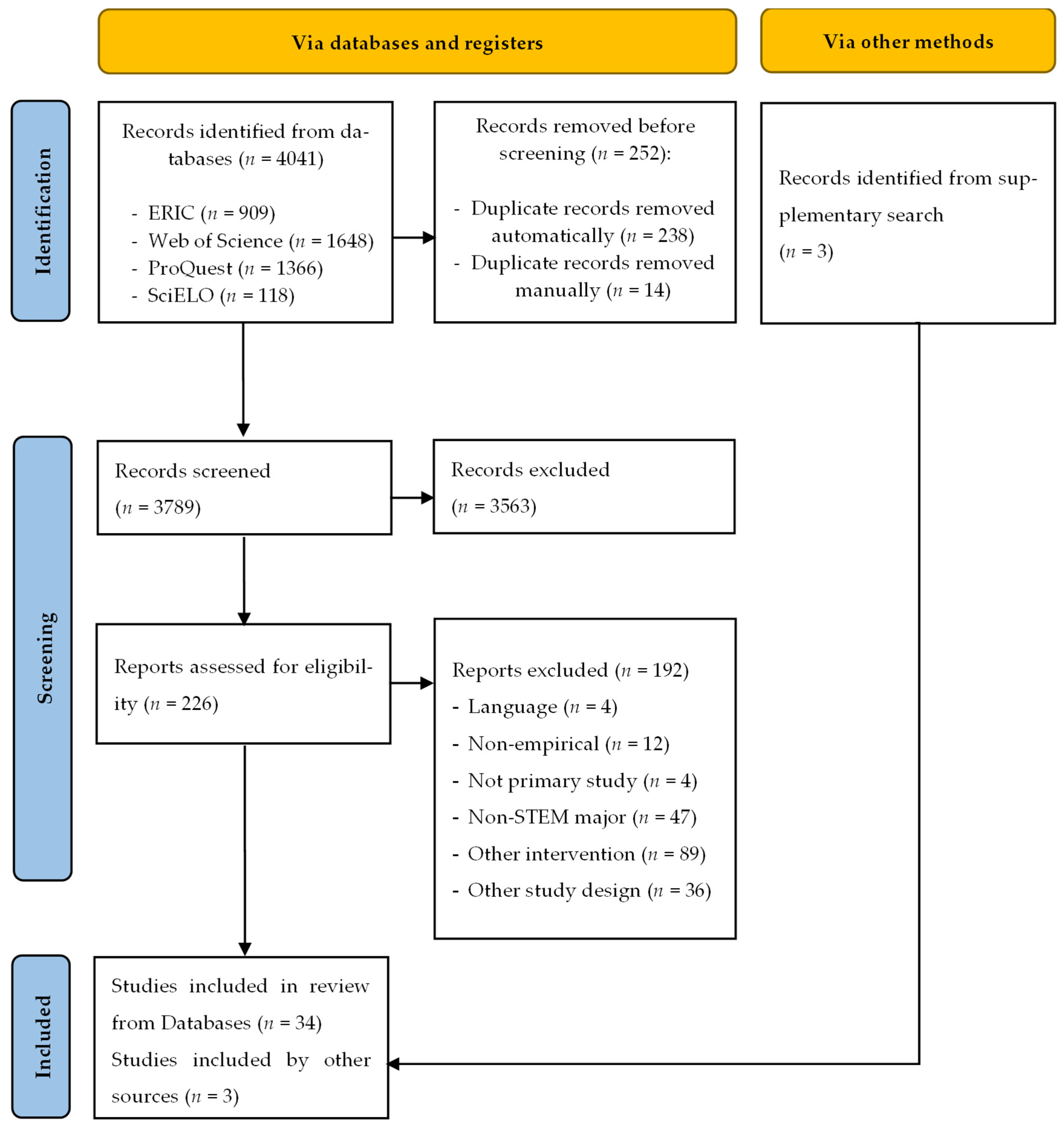
3.1. Search Results
3.2. Description of the Included SBP
3.3. Methodological Considerations When Assessing SBP
3.3.1. Outcomes
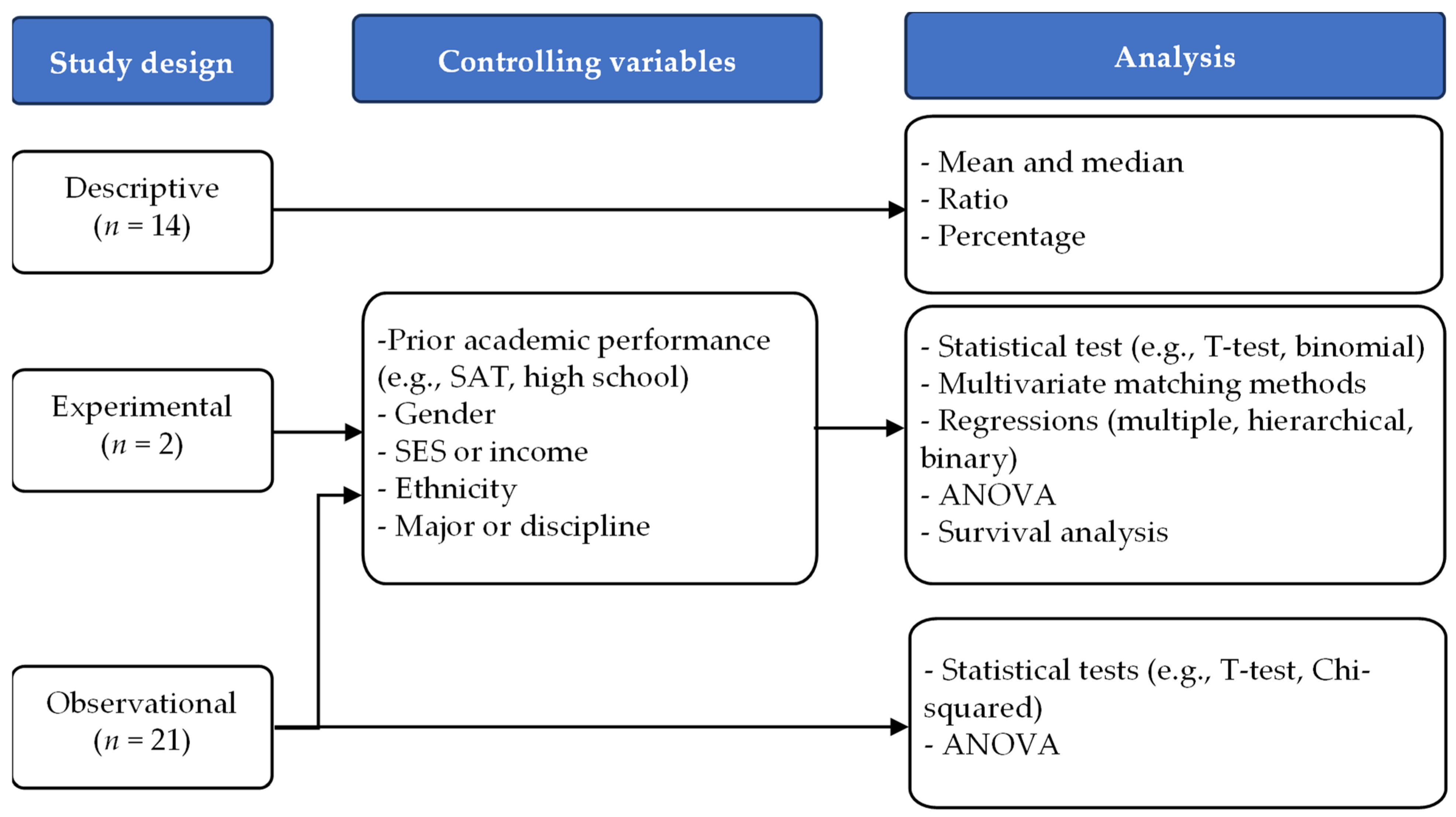
3.3.2. Study Design and Analytical Approach
3.3.3. Study Participants and Cohorts of Students
4. Discussion
Implications and Next Steps
Author Contributions
Funding
Institutional Review Board Statement
Informed Consent Statement
Data Availability Statement
Acknowledgments
Conflicts of Interest
Abbreviations
| SBP | Summer Bridge Program |
| STEM | Science, Technology, Engineering and Math |
| HEI | Higher Education Institution |
| SAT | Scholastic Aptitude Test |
| ACT | American College Testing |
| GPA | Grade Point Average |
| SES | Socio-Economic Status |
| PSM | Propensity Score Matching |
| RCT | Randomized Control Trial |
References
- Adelson, J. L. (2013). Educational research with real-world data: Reducing selection bias with propensity score analysis. Practical Assessment, Research, and Evaluation, 18(1), 15. [Google Scholar] [CrossRef]
- Arendale, D. R. (2011). Then and now: The early years of developmental education. Research and Teaching in Developmental Education, 27(2), 58–76. [Google Scholar]
- Ashley, M., Cooper, K. M., Cala, J. M., & Brownell, S. E. (2017). Building better bridges into STEM: A synthesis of 25 years of literature on STEM summer bridge programs. CBE—Life Sciences Education, 16(4), es3. [Google Scholar] [CrossRef]
- Barnett, E. A., Bork, R. H., Mayer, A. K., Pretlow, J., Wathington, H. D., & Weiss, M. J. (2012). Bridging the gap: An impact study of eight developmental summer bridge programs in Texas (pp. 1–90). National Center for Postsecondary Research. [Google Scholar]
- Baron, J. (2004). Identifying and implementing education practices supported by rigorous evidence: A user friendly guide. Journal for Vocational Special Needs Education, 26, 40–54. [Google Scholar]
- Barth, J., Dunlap, S., Bolland, A., McCallum, D., & Acoff, V. (2021). Variability in STEM summer bridge programs: Associations with belonging and STEM self-efficacy. Frontiers in Education, 6, 667589. [Google Scholar] [CrossRef]
- Berliner, D. C. (2002). Comment: Educational research: The hardest science of all. Educational Researcher, 31(8), 18–20. [Google Scholar] [CrossRef]
- Bettinger, E. P., & Long, B. T. (2005). Addressing the needs of under-prepared students in higher education: Does college remediation work? (NBER Working Paper No. 11325). National Bureau of Economic Research. [Google Scholar]
- Blackburn, H. (2017). The status of women in STEM in higher education: A review of the literature 2007–2017. Science & Technology Libraries, 36(3), 235–273. [Google Scholar] [CrossRef]
- Boatman, A., & Long, B. T. (2018). Does remediation work for all students? How the effects of postsecondary remedial and developmental courses vary by level of academic preparation. Educational Evaluation and Policy Analysis, 40(1), 29–58. [Google Scholar] [CrossRef]
- Botella, C., Rueda, S., López-Iñesta, E., & Marzal, P. (2019). Gender Diversity in STEM Disciplines: A multiple factor problem. Entropy, 21(1), 30. [Google Scholar] [CrossRef]
- Boyce, A. S. (2017). Lessons learned using a values-engaged approach to attend to culture, diversity, and equity in a STEM program evaluation. Evaluation and Program Planning, 64, 33–43. [Google Scholar] [CrossRef]
- Bozzi, M., Balossi, B., Di Sieno, L., Ganzer, L., Gondoni, P., Genco, I., Minnai, C., Pini, A., Rezoagli, F., Zanoletti, M., & Zani, M. (2019, November 11–13). Securing freshmen’s learning through a physics refresher course: A breakthrough experience at Politecnico Di Milano. 12th Annual International Conference of Education, Research and Innovation (WOS:000530109202048) (pp. 2237–2243), Seville, Spain. [Google Scholar] [CrossRef]
- Bradford, B. C., Beier, M. E., & Oswald, F. L. (2021). A meta-analysis of university STEM summer bridge program effectiveness. CBE—Life Sciences Education, 20(2), ar21. [Google Scholar] [CrossRef] [PubMed]
- Brandon, P. R., & Singh, J. M. (2009). The strength of the methodological warrants for the findings of research on program evaluation use. American Journal of Evaluation, 30(2), 123–157. [Google Scholar] [CrossRef]
- Burt, B. A., Stone, B. D., Motshubi, R., & Baber, L. D. (2023). STEM validation among underrepresented students: Leveraging insights from a STEM diversity program to broaden participation. Journal of Diversity in Higher Education, 16(1), 53–65. [Google Scholar] [CrossRef]
- Büchele, S., Berndt, S., & Felix, A. (2024). Voluntary math remediation for STEM and economics disciplines—Who is attending at all? Evidence from Germany. European Journal of Higher Education, 14(1), 60–79. [Google Scholar] [CrossRef]
- Calcagno, J. C., & Long, B. T. (2009). Evaluating the impact of remedial education in Florida community colleges: A quasi-experimental regression discontinuity design. NCPR brief (pp. 1–5). National Center for Postsecondary Research. [Google Scholar]
- Cançado, L., Reisel, J. R., & Walker, C. M. (2018). Impacts of a summer bridge program in engineering on student retention and graduation. Journal of STEM Education: Innovations and Research, 19(2), 26–31. [Google Scholar]
- Chamberlin, K., Yasué, M., & Chiang, I.-C. A. (2023). The impact of grades on student motivation. Active Learning in Higher Education, 24(2), 109–124. [Google Scholar] [CrossRef]
- Chariker, J., Ralston, P., Hieb, J., & Wilkins, C. (2013, June 23–26). An analysis of two interventions designed to improve student performance in engineering calculus. 2013 ASEE Annual Conference (WOS:000367454806005) (pp. 23.148.1–23.148.12), Atlanta, GA, USA. [Google Scholar] [CrossRef]
- Chingos, M. M., Griffiths, R. J., & Mulhern, C. (2017). Can low-cost online summer math programs improve student preparation for college-level math? Evidence from randomized experiments at three universities. Journal of Research on Educational Effectiveness, 10(4), 794–816. [Google Scholar] [CrossRef]
- Chouinard, J. A., & Cousins, J. B. (2009). A review and synthesis of current research on cross-cultural evaluation. American Journal of Evaluation, 30(4), 457–494. [Google Scholar] [CrossRef]
- Cohen, L., Manion, L., & Morrison, K. (2008). Research methods in education (6th ed). Routledge. [Google Scholar]
- Conley, D. T. (2008). Rethinking college readiness. New Directions for Higher Education, 2008(144), 3–13. [Google Scholar] [CrossRef]
- Creswell, J. W., & Creswell, J. D. (2023). Research design: Qualitative, quantitative, and mixed methods approaches (6th ed.). SAGE. [Google Scholar]
- Demszky, D., Wang, R., Geraghty, S., & Yu, C. (2024, March 18–22). Does feedback on talk time increase student engagement? Evidence from a randomized controlled trial on a math tutoring platform. 14th Learning Analytics and Knowledge Conference (pp. 632–644), Kyoto, Japan. [Google Scholar] [CrossRef]
- Dockter, D., Uvarov, C., Guzman-Alvarez, A., & Molinaro, M. (2017). Improving preparation and persistence in undergraduate STEM: Why an online summer preparatory chemistry course makes sense. In Online approaches to chemical education (WOS:000418983800002) (Vol. 1261, pp. 7–33). American Chemical Society. [Google Scholar] [CrossRef]
- Doerr, H. M., Ärlebäck, J. B., & Costello Staniec, A. (2014). Design and effectiveness of modeling-based mathematics in a summer bridge program. Journal of Engineering Education, 103(1), 92–114. [Google Scholar] [CrossRef]
- Dones, J., Martin, F., Lu, J., & Mir, F. (2022, October 8–11). Design and impact of a near peer-led computer science summer bridge program. 2022 IEEE Frontiers in Education Conference (FIE) (pp. 1–9), Uppsala, Sweden. [Google Scholar] [CrossRef]
- Eitemüller, C., & Habig, S. (2020). Enhancing the transition?—Effects of a tertiary bridging course in chemistry. Chemistry Education Research and Practice, 21(2), 561–569. [Google Scholar] [CrossRef]
- Enriquez, A. (2011, June 26–29). Strengthening the STEM pipeline through an intensive review program for math placement testing. 2011 ASEE Annual Conference & Exposition (WOS:000378522700009) (pp. 22.1328.1–22.1328.18), Vancouver, BC, Canada. [Google Scholar] [CrossRef]
- Erickson-Ludwig, A., & Clyne, A. (2014, June 15–18). Summer diversity program enhances female and underrepresented minority student academic performance and retention in the Drexel University College of Engineering. 2014 ASEE Annual Conference (WOS:000383780002027) (pp. 24.1140.1–24.1140.11), Indianapolis, IN, USA. [Google Scholar] [CrossRef]
- Evans, B. D. (2014). Factors that affect academic performance and retention status: A study of a summer bridge program [Ph.D. thesis, Auburn University]. Available online: https://www.proquest.com/dissertations-theses/factors-that-affect-academic-performance/docview/2778651375/se-2 (accessed on 19 August 2024).
- Fan, X., & Nowell, D. L. (2011). Using propensity score matching in educational research. Gifted Child Quarterly, 55(1), 74–79. [Google Scholar] [CrossRef]
- Fletcher, S. L., Newell, D. C., Newton, L. D., & Anderson-Rowland, M. R. (2001, June 24–27). The WISE summer bridge program: Assessing student attrition, retention, and program effectiveness. 2001 ASEE Annual Conference (pp. 6.1053.1–6.1053.7), Albuquerque, NM, USA. [Google Scholar] [CrossRef]
- GEM Report UNESCO. (2024). Global education monitoring report 2024, gender report: Technology on her terms. GEM Report UNESCO. [Google Scholar] [CrossRef]
- Gibson, S., Brinkley, K., Griggs, L., James, B., Smith, M., Schwitzerlett, M., Waller, L., & Hargraves, R. (2021). Implementing a hybrid summer transition program. Frontiers in Education, 6, 674337. [Google Scholar] [CrossRef]
- Gilbert, M. B. (1982, November 1). An enrichment program for migrant students: MENTE/UOP. Council for Exceptional Children Conference on the Bilingual Exceptional Child (pp. 1–59), Phoenix, AZ, USA. [Google Scholar]
- Gleason, J., Boykin, K., Johnson, P., Bowen, L., Whitaker, K. W., Micu, C., Raju, D., & Slappey, C. (2010). Integrated engineering math-based summer bridge program for student retention. Advances in Engineering Education, 2(2), n2. [Google Scholar]
- Gleghorn, V., & Stwalley, C. (2011, June 26–29). Impact of transition programs on the retention of underrepresented students. 2011 ASEE Annual Conference & Exposition (WOS:000378523002042) (pp. 22.1267.1–22.1267.8), Vancouver, BC, Canada. [Google Scholar] [CrossRef]
- Gopalan, M., Rosinger, K., & Ahn, J. B. (2020). Use of quasi-experimental research designs in education research: Growth, promise, and challenges. Review of Research in Education, 44(1), 218–243. [Google Scholar] [CrossRef]
- Graham, S. E., & Kurlaender, M. (2011). Using propensity scores in educational research: General principles and practical applications. The Journal of Educational Research, 104(5), 340–353. [Google Scholar] [CrossRef]
- Hagler, M. A., Christensen, K. M., & Rhodes, J. E. (2024). A longitudinal investigation of first-generation college students’ mentoring relationships during their transition to higher education. Journal of College Student Retention: Research, Theory & Practice, 25(4), 791–819. [Google Scholar] [CrossRef]
- Hanlon, E. H., & Schneider, Y. (1999, April 19–23). Improving math proficiency through self efficacy training. 1999 Annual Meeting of the American Educational Research Association (pp. 1–12), Montreal, QB, Canada. [Google Scholar]
- Harackiewicz, J. M., & Priniski, S. J. (2018). Improving student outcomes in higher education: The science of targeted intervention. Annual Review of Psychology, 69(1), 409–435. [Google Scholar] [CrossRef]
- Harrington, M. A., Lloyd, A., Smolinski, T., & Shahin, M. (2016). Closing the gap: First year success in college mathematics at an HBCU. Journal of the Scholarship of Teaching and Learning, 16(5), 92–106. [Google Scholar] [CrossRef][Green Version]
- Henry, D. L., Baltes, B., & Nistor, N. (2014). Examining the relationship between math scores and English language proficiency. Journal of Educational Research and Practice, 4(1), 11–29. [Google Scholar]
- Herrmann, S. D., Adelman, R. M., Bodford, J. E., Graudejus, O., Okun, M. A., & Kwan, V. S. Y. (2016). The effects of a female role model on academic performance and persistence of women in STEM courses. Basic and Applied Social Psychology, 38(5), 258–268. [Google Scholar] [CrossRef]
- Hieb, J. L., Lyle, K. B., Ralston, P. A. S., & Chariker, J. (2015). Predicting performance in a first engineering calculus course: Implications for interventions. International Journal of Mathematical Education in Science and Technology, 46(1), 40–55. [Google Scholar] [CrossRef]
- Hood, S., Hopson, R. K., & Frierson, H. T. (Eds.). (2015). Continuing the journey to reposition culture and cultural context in evaluation theory and practice. Information Age Publishing, Inc. [Google Scholar]
- Hornsby, D. J., & Osman, R. (2014). Massification in higher education: Large classes and student learning. Higher Education, 67(6), 711–719. [Google Scholar] [CrossRef]
- Hsu, T. (2005). Research methods and data analysis procedures used by educational researchers. International Journal of Research & Method in Education, 28(2), 109–133. [Google Scholar] [CrossRef]
- Ikuma, L. H., Steele, A., Dann, S., Adio, O., & Waggenspack, W. N. (2019). Large-scale student programs increase persistence in STEM fields in a public university setting. Journal of Engineering Education, 108(1), 57–81. [Google Scholar] [CrossRef]
- Jackson, C. R., Whittington, D., & Bradley, T. (2024). Pre-college summer program in entrepreneurial and design thinking influences STEM success for African American students. Journal of STEM Outreach, 7(2), n2. [Google Scholar] [CrossRef]
- James, K. A., & James, C. E. (2025). Routes to STEM: Toward making science education more accessible and inclusive. Race Ethnicity and Education, 1–22. [Google Scholar] [CrossRef]
- Jefferson, G., Steadman, S., Thomas, T., & Hsiao, K. (2013, June 23–26). Novel program for engineering student retention. 2013 ASEE Annual Conference (WOS:000367454804003) (pp. 23.932.1–23.932.10), Atlanta, GA, USA. [Google Scholar] [CrossRef]
- Johnson, J. M. (2016). Managing transitions, building bridges: An evaluation of a summer bridge program for African American scientists and engineers. Journal for Multicultural Education, 10(2), 206–216. [Google Scholar] [CrossRef]
- Johnson, M., Sprowles, A., Overeem, K., & Rich, A. (2013). A place-based learning community: Klamath connection at Humboldt State University. Learning Communities: Research & Practice, 5(2), 1–19. [Google Scholar]
- Johnston, C., Tang, J., Arvand, A., & Lee, P. (2021). Attracting and retaining latina women in an undergraduate biology program: Benefits of NSF S-STEM support. Journal of STEM Education: Innovations and Research, 22(4), 39–46. [Google Scholar]
- Jordan, W. J. (2010). Defining equity: Multiple perspectives to analyzing the performance of diverse learners. Review of Research in Education, 34(1), 142–178. [Google Scholar] [CrossRef]
- Jura, M., & Gerhardt, I. (2022). Examining the effectiveness of an online summer bridge course to prepare students for calculus. PRIMUS: Problems, Resources, and Issues in Mathematics Undergraduate Studies, 32(7), 755–763. [Google Scholar] [CrossRef]
- Kassaee, A. M., & Rowell, G. H. (2016). Motivationally-informed interventions for at-risk STEM students. Journal of STEM Education: Innovations and Research, 17(3), 77–84. [Google Scholar]
- Kearns, L. R. (2012). Student assessment in online learning: Challenges and effective practices. Journal of Online Learning and Teaching, 8(3), 198–208. [Google Scholar]
- Kilian, N. G. (2010). Self-efficacy and remediation of higher education mathematics students. Dissertation Abstracts International Section A: Humanities and Social Sciences, 70(12-A), 4615. [Google Scholar]
- Kitchen, J. A., Sadler, P., & Sonnert, G. (2018). The impact of summer bridge programs on college students’ STEM career aspirations. Journal of College Student Development, 59(6), 698–715. [Google Scholar] [CrossRef]
- Knight, D., Sullivan, J., Kotys-Schwartz, D., Myers, B., Louie, B., Luftig, J., Zarske, M., & Hornback, J. (2013, June 23–26). The impact of inclusive excellence programs on the development of engineering identity among first-year underrepresented students. 2013 ASEE Annual Conference (WOS:000375256301070) (pp. 23.1207.1–23.1207.17), Atlanta, GA, USA. [Google Scholar] [CrossRef]
- Kornreich-Leshem, H., Brewe, E., Hazari, Z., Milani, M., Potvin, G., & Kramer, L. (2015). Evaluation of a summer bridge program using multivariate matching (WOS:000375147300041) (pp. 175–178). American Association of Physics Teachers. [Google Scholar] [CrossRef][Green Version]
- Kroshus, E., Hawrilenko, M., & Browning, A. (2021). Stress, self-compassion, and well-being during the transition to college. Social Science & Medicine, 269, 113514. [Google Scholar] [CrossRef]
- Lecocke, M., Shaw, J., Martines, I., Wolff, N., Cano, P., & Tobares, V. (2019). Jump start: Lessons learned from a mathematics bridge program for STEM undergraduates. Journal of STEM Education: Innovations and Research, 19(5), 40–45. [Google Scholar]
- Lisberg, A., & Woods, B. (2018). Mentorship, mindset and learning strategies: An integrative approach to increasing underrepresented minority student retention in a STEM undergraduate program. Journal of STEM Education: Innovations and Research, 19(3), 14–19. [Google Scholar]
- Liu, Z., & Kringos, N. (2025). What prevents STEM universities from widening participation? A systematic literature review on global experiences. International Journal of STEM Education, 12(1), 63. [Google Scholar] [CrossRef]
- Loeb, S., Dynarski, S., McFarland, D., Morris, P., Reardon, S., & Reber, S. (2017). Descriptive analysis in education: A guide for researchers (NCEE 2017-4023). National Center for Education Evaluation and Regional Assistance. [Google Scholar]
- Macheridis, N., & Paulsson, A. (2021). Tracing accountability in higher education. Research in Education, 110(1), 78–97. [Google Scholar] [CrossRef]
- Maringe, F., & Sing, N. (2014). Teaching large classes in an increasingly internationalising higher education environment: Pedagogical, quality and equity issues. Higher Education, 67(6), 761–782. [Google Scholar] [CrossRef]
- Masjutina, S., Stearns, E., & Bottia, M. C. (2025). An analysis of students who represent missed opportunity for diversifying STEM fields. Science Education, 109(5), 1287–1312. [Google Scholar] [CrossRef]
- McGee, B. S., Williams, J. L., Armstrong, S. L., & Holschuh, J. P. (2021). Gateways, not gatekeepers: Reclaiming the narrative for developmental education. Journal of Developmental Education, 44(2), 2–10. [Google Scholar]
- Mfengu, A., & Raju, J. (2024). Challenges with measures used for assessing research impact in higher education institutions. South African Journal of Science, 120(7/8), 1–6. [Google Scholar] [CrossRef]
- Morris, R., Perry, T., & Wardle, L. (2021). Formative assessment and feedback for learning in higher education: A systematic review. Review of Education, 9(3), e3292. [Google Scholar] [CrossRef]
- Murphy, T. E., Gaughan, M., Hume, R., & Moore, S. G., Jr. (2010). College graduation rates for minority students in a selective technical university: Will participation in a summer bridge program contribute to success? Educational Evaluation and Policy Analysis, 32(1), 70–83. [Google Scholar] [CrossRef] [PubMed]
- Nachbauer, M., & Kyriakides, L. (2020). A review and evaluation of approaches to measure equity in educational outcomes. School Effectiveness and School Improvement, 31(2), 306–331. [Google Scholar] [CrossRef]
- National Institute for Health and Care Excellence [NICE]. (2014). Developing NICE guidelines: The manual NICE process and methods. Available online: www.nice.org.uk/process/pmg20 (accessed on 2 December 2025).
- Noordzij, M., Dekker, F. W., Zoccali, C., & Jager, K. J. (2009). Study designs in clinical research. Nephron Clinical Practice, 113(3), c218–c221. [Google Scholar] [CrossRef]
- Odeleye, B.-G., & Santiago, J. (2019). A review of some diverse models of summer-bridge programs for first-generation and at-risk college students. Administrative Issues Journal Education Practice and Research, 9(1), 35–47. [Google Scholar] [CrossRef]
- OECD. (2018). How is the tertiary-educated population evolving? (Vol. 61). Education Indicators in Focus. [Google Scholar] [CrossRef]
- OECD. (2021). Why do more young women than men go on to tertiary education? (Vol. 79). Education Indicators in Focus. [Google Scholar] [CrossRef]
- Oppenheimer, S., Mills, J., Zakeri, A., Payte, T., Lidgi, A., & Zavala, M. (2020). An approach to improving student success in science, technology, engineering, and mathematics (STEM) career pathways. Ethnicity & Disease, 30(1), 33–40. [Google Scholar] [CrossRef]
- Owen, J. M. (2020). Program evaluation: Forms and approaches (3rd ed.). Routledge, Taylor & Francis Group. [Google Scholar]
- Pain, K. D. (2016). Voluntary remediation in Florida: Will it blaze a new trail or stop student pathways? Community College Journal of Research and Practice, 40(11), 927–941. [Google Scholar] [CrossRef]
- Pellegrini, M., & Vivanet, G. (2021). Evidence-based policies in education: Initiatives and challenges in Europe. ECNU Review of Education, 4(1), 25–45. [Google Scholar] [CrossRef]
- Peters, D. L. (2023, March 24–25). Engineering strong bridges: Review of college bridge programs. 2023 ASEE North Central Section Conference, Morgantown, WV, USA. [Google Scholar] [CrossRef]
- Pong, W., Enriquez, A., Shahnasser, H., Chen, C., Ozer, N., Cheng, A., Jiang, H., & Mahmoodi, H. (2011, June 26–29). Enhancing the interest, participation, and retention of underrepresented students in engineering through a summer engineering institute. 2011 ASEE Annual Conference & Exposition (WOS:000378522702045) (pp. 22.624.1–22.624.16), Vancouver, BC, Canada. [Google Scholar]
- Pritchard, T. J., Perazzo, J. D., Holt, J. A., Fishback, B. P., McLaughlin, M., Bankston, K. D., & Glazer, G. (2016). Evaluation of a summer bridge: Critical component of the leadership 2.0 program. Journal of Nursing Education, 55(4), 196–202. [Google Scholar] [CrossRef]
- Ranganathan, P., & Aggarwal, R. (2018). Study designs: Part 1—An overview and classification. Perspectives in Clinical Research, 9(4), 184. [Google Scholar] [CrossRef]
- Ranganathan, P., & Aggarwal, R. (2019). Study designs: Part 3—Analytical observational studies. Perspectives in Clinical Research, 10(2), 91. [Google Scholar] [CrossRef] [PubMed]
- Reed, M. J. (2016). University massification and teaching non-traditional university students. In J. Arvanitakis, & D. J. Hornsby (Eds.), Universities, the citizen scholar and the future of higher education (pp. 137–154). Palgrave Macmillan UK. [Google Scholar] [CrossRef]
- Reisel, J., Jablonski, M., Kialashaki, A., & Hosseini, H. (2014, June 15–18). Analysis of the impact of participation in a summer bridge program on mathematics course performance by first-semester engineering students. 2014 ASEE Annual Conference (WOS:000383779701024) (pp. 24.183.1–24.183.14), Indianapolis, IN, USA. [Google Scholar] [CrossRef]
- Reisel, J., Jablonski, M., Rineck, L., Munson, E., & Hosseini, H. (2012, June 10–13). Analysis of math course placement improvement and sustainability achieved through summer bridge program. 2012 ASEE Annual Conference (WOS:000380250100007) (pp. 25.186.1–25.86.16), San Antonio, TX, USA. [Google Scholar] [CrossRef]
- Reisel, J., Rineck, L., Jablonski, M., Munson, E., & Hosseini, H. (2011, June 26–29). Evaluation of the Impacts of Math Course Placement Improvement Achieved through a Summer Bridge Program. 2011 ASEE Annual Conference & Exposition (WOS:000378520700021) (pp. 22.654.1–22.654.13), Vancouver, BC, Canada. [Google Scholar] [CrossRef]
- Reisel, J. R., Jablonski, M., Hosseini, H., & Munson, E. (2012). Assessment of factors impacting success for incoming college engineering students in a summer bridge program. International Journal of Mathematical Education in Science and Technology, 43(4), 421–433. [Google Scholar] [CrossRef]
- Rodríguez Rincón, Y., Munárriz, A., & Magreñán Ruiz, A. (2024). A new approach to continuous assessment: Moving from a stressful sum of grades to meaningful learning through self-reflection. The International Journal of Management Education, 22(3), 101072. [Google Scholar] [CrossRef]
- Rosenbaum, P. R., & Rubin, D. B. (1983). The central role of the propensity score in observational studies for causal effects. Biometrika, 70(1), 41–55. [Google Scholar] [CrossRef]
- Rosenthal, L., Levy, S. R., London, B., Lobel, M., & Bazile, C. (2013). In pursuit of the MD: The impact of role models, identity compatibility, and belonging among undergraduate women. Sex Roles, 68(7–8), 464–473. [Google Scholar] [CrossRef]
- Rovai, A. P. (2003). A practical framework for evaluating online distance education programs. The Internet and Higher Education, 6(2), 109–124. [Google Scholar] [CrossRef]
- Sablan, J. R. (2014). The challenge of summer bridge programs. American Behavioral Scientist, 58(8), 1035–1050. [Google Scholar] [CrossRef]
- Schmid, S., Youl, D. J., George, A. V., & Read, J. R. (2012). Effectiveness of a short, intense bridging course for scaffolding students commencing university-level study of chemistry. International Journal of Science Education, 34(8), 1211–1234. [Google Scholar] [CrossRef]
- Scott, A., & Martin, A. (2014). Perceived barriers to higher education in science, technology, engineering and mathematics. Journal of Women and Minorities in Science and Engineering, 20(3), 235–256. [Google Scholar] [CrossRef]
- Sheffield, A., Morgan, H. G., & Blackmore, C. (2018). Lessons learned from the STEM entrepreneurship academy. Journal of Higher Education Outreach and Engagement, 22(3), 185–200. [Google Scholar]
- Slavin, R. E. (2002). Evidence-based education policies: Transforming educational practice and research. Educational Researcher, 31(7), 15–21. [Google Scholar] [CrossRef]
- Slavin, R. E. (2020). How evidence-based reform will transform research and practice in education. Educational Psychologist, 55(1), 21–31. [Google Scholar] [CrossRef]
- Steadman, S., Jefferson, G., Thomas, T., & Hsiao, K. (2014, June 15–18). Impacting first year engineering retention. 2014 ASEE Annual Conference (WOS:000383779806064) (pp. 24.702.1–24.702.7), Indianapolis, IN, USA. [Google Scholar] [CrossRef]
- Steiner, P. M., Cook, T. D., & Shadish, W. R. (2011). On the importance of reliable covariate measurement in selection bias adjustments using propensity scores. Journal of Educational and Behavioral Statistics, 36(2), 213–236. [Google Scholar] [CrossRef]
- Stout, W. L., Jr. (2013). School level factors associated with Pennsylvania high schools that exceed PVAAS growth projections in reading (pp. 1–129). ProQuest LLC. [Google Scholar]
- Strayhorn, T. L. (2011). Bridging the pipeline: Increasing underrepresented students’ preparation for college through a summer bridge program. American Behavioral Scientist, 55(2), 142–159. [Google Scholar] [CrossRef]
- Tempelaar, D., Rienties, B., Kaper, W., Giesbers, B., van Gastel, L., van de Vrie, E., van der Kooij, H., & Cuypers, H. (2011). Effectiveness of a voluntary postsecondary remediation program in mathematics. Pedagogische Studien, 88(4), 231–248. [Google Scholar]
- Thompson, B. (2006). Foundations of behavioral statistics: An insight-based approach. Foundations of Behavioral Statistics: An Insight-Based Approach, xii, 457. [Google Scholar]
- Tomasko, D. L., Ridgway, J. S., Waller, R. J., & Olesik, S. V. (2016). Research and teaching: Association of summer bridge program outcomes with STEM retention of targeted demographic groups. Journal of College Science Teaching, 45(4), 90–99. [Google Scholar] [CrossRef]
- Trautwein, C., & Bosse, E. (2017). The first year in higher education—Critical requirements from the student perspective. Higher Education, 73(3), 371–387. [Google Scholar] [CrossRef]
- Tricco, A. C., Lillie, E., Zarin, W., O’Brien, K. K., Colquhoun, H., Levac, D., Moher, D., Peters, M. D. J., Horsley, T., Weeks, L., Hempel, S., Akl, E. A., Chang, C., McGowan, J., Stewart, L., Hartling, L., Aldcroft, A., Wilson, M. G., Garritty, C., … Straus, S. E. (2018). PRISMA extension for scoping reviews (PRISMA-ScR): Checklist and explanation. Annals of Internal Medicine, 169(7), 467–473. [Google Scholar] [CrossRef]
- UNESCO. (2017). Cracking the code girls’ and women’s education in science, technology, engineering and mathematics (STEM). UNESCO. [Google Scholar] [CrossRef]
- U.S. Department of Education. (2023). Non-regulatory guidance: Using evidence to strengthen education investments. Available online: https://www.ed.gov/sites/ed/files/fund/grant/about/discretionary/2023-non-regulatory-guidance-evidence.pdf (accessed on 2 December 2025).
- U.S. Department of Education, Institute of Education Sciences, What Works Clearinghouse. (2016). Supporting postsecondary success intervention report: Summer bridge programs. What Works Clearinghouse. Available online: https://ies.ed.gov/ncee/wwc/Docs/InterventionReports/wwc_summerbridge_071916.pdf (accessed on 2 December 2025).
- Venezia, A., & Jaeger, L. (2013). Transitions from high school to college. The Future of Children, 23(1), 117–136. [Google Scholar] [CrossRef]
- Verdone, M., Joshi, M., Bodenstine, T., Green, J., Lynch, S., Gettig, J., & Fjortoft, N. (2020). An online, self-directed pharmacy bridging course for incoming first-year students. American Journal of Pharmaceutical Education, 84(7), 892–896. [Google Scholar] [CrossRef]
- Walter, H., & Wade, E. (2024). STEM persistence among women, non-binary, and students of color: A longitudinal study of the impact of a residential science-oriented summer bridge program. Journal of STEM Education: Innovations and Research, 25(2), 15–20. [Google Scholar] [CrossRef]
- Wathington, H. D., Barnett, E. A., Weissman, E., Teres, J., Pretlow, J., & Nakanishi, A. (2011). Getting ready for college: An implementation and early impacts study of eight Texas developmental summer bridge programs. Executive summary (pp. 1–16). National Center for Postsecondary Research. [Google Scholar]
- Weatherton, Y., Kruzic, A., Isbell, B., Peterson, L., Tiernan, J., & Pham, V. (2011, June 26–29). Mathematics performance and first year retention of students in engineering learning communities. 2011 ASEE Annual Conference & Exposition (WOS:000378523007021) (pp. 22.1047.1–22.1047.16), Vancouver, BC, Canada. [Google Scholar] [CrossRef]
- Whalin, R., & Pang, Q. (2014, June 15–18). Emerging impact on graduation rates/times from a summer engineering enrichment program. 2014 ASEE Annual Conference (WOS:000383779705045) (pp. 24.475.1–24.475.11), Indianapolis, IN, USA. [Google Scholar] [CrossRef]
- Wheatland, J. (2002, June 16–19). Factors that affect grade point average and retention status of first time science, engineering, and mathematics students at Morgan State University, an historically black university. 2002 Annual Conference Proceedings (pp. 7.554.1–7.554.23), Montreal, QB, Canada. [Google Scholar] [CrossRef]
- Wischusen, S. M., & Wischusen, E. W. (2007). Biology Intensive Orientation for Students (BIOS): A biology “boot camp”. CBE—Life Sciences Education, 6(2), 172–178. [Google Scholar] [CrossRef]
- Wischusen, S. M., Wischusen, E. W., & Pomarico, S. M. (2010). Impact of a short pre-freshman program on retention. Journal of College Student Retention: Research, Theory and Practice, 12(4), 429–441. [Google Scholar] [CrossRef]
- Zorn, E., Jeschke, S., Kato, A., & Pfeiffer, O. (2011). Pre-freshmen students gearing up with early bird. In Automation, communication and cybernetics in science and engineering 2009/2010 (WOS:000285168000034) (p. 379). Springer. [Google Scholar] [CrossRef]



| Databases | Search String |
|---|---|
| ERIC, ProQuest, SciELO (Web of Science) | (bridg* OR summer OR prefreshm* OR freshm* OR remediation) AND (program* OR class OR course) AND (engineer* OR STEM OR scien* OR chem* OR tech* OR math* OR biolog* OR physic*) AND (college OR university OR undergraduate) |
| Web of Science | ((bridg* OR summer OR prefreshm* OR freshm* OR remediation) NEAR/3 (program* OR class OR course)) AND (engineer* OR STEM OR scien* OR chem* OR tech* OR math* OR biolog* OR physic*) AND (college OR university OR undergraduate) |
| PICO Framework | Description |
|---|---|
| Population | All incoming first-year undergraduate students in any discipline within the field of Science, Technology, Engineering and Mathematics area. |
| Intervention | A Summer Bridge Program conducted during the summer prior to the first fall semester. The duration may vary but must occur exclusively during the summer. Program format (online or in-person), voluntariness, and participation criteria are not restricted. |
| Comparison | Other incoming first-year undergraduate STEM students who did not participate in any SBP activities. |
| Outcome | Any academic achievement measurement. |
| Reason | Description |
|---|---|
| Language | The paper is not written in English. |
| Non-empirical study | The paper describes one or more programs without an appropriate study design to measure academic outcomes. It focuses on program design, implementation, or cost analysis rather than evaluation. |
| Not a primary study | The paper synthesizes existing primary studies, is a systematic or meta-review, or analyses multiple programs. |
| Not for STEM majors | The paper examines a program not intended for STEM-major students; it does not mention any targeted major or is an institution-wide program offered to all students. |
| Other intervention | The paper addresses a different type of intervention, such as a program that does not occur immediately after high school, a yearlong program, a research initiative, or a broader intervention that extends beyond the summer. |
| Other study design | The study design does not align with the aim of this review. For example, it uses a purely qualitative approach, measures non-academic outcomes (e.g., belonging, confidence), or lacks a control group. |
| Program | Institution (Country) | Duration [Weeks] | Format | Eligibility Criteria/Target Students 1 | Selection to the Program Criteria | Participants’ Major—Subject Taught 2 | Reference | |
|---|---|---|---|---|---|---|---|---|
| 1 | WISE Summer Bridge Program | Arizona State University (USA) | 1 | In-person | Incoming female students | Not mentioned | Eng—Math, Phys, Chem, Computer-programming | Fletcher et al. (2001) |
| 2 | Early Bird Program | Berlin Institute of Technology (Germany) | 9 | In-person | Incoming students required to take Calculus I and Linear Algebra for Engineers in their first semesters | Not mentioned | Eng—Math | Zorn et al. (2011) |
| 3 | Summer Math and Language Arts Enrichment Program | California State University (USA) | 5 | In-person | Incoming students, URS, with a high school GPA of 3.0 or above; underrepresented and economically disadvantaged students | High school science and math preparation, the strength of the recommendation and interest in research careers | Basic biomed science—Math, English | Oppenheimer et al. (2020) |
| 4 | SMILE | Cañada College (USA) | 2 | In-person | Students who have expressed interest in pursuing engineering and STEM but performed low in the placement test | Not mentioned | Eng and other STEM—Math | Enriquez (2011) |
| 5 | Summer Diversity Program | Delaware State University (USA) | 8 | Online and in-person | Incoming students placed into Introduction to Algebra or College Algebra | Not mentioned | STEM—Math | Harrington et al. (2016) |
| 6 | Not mentioned | Drexel University College of Engineering (USA) | 2 | In-person | All incoming female and URS in engineering | All students who applied were accepted | Eng—Math, Chem, Phys and Computer Labs | Erickson-Ludwig and Clyne (2014) |
| 7 | Challenge Program | Florida International University (USA) | NA | In-person | Enrolled incoming students | Not mentioned | Eng—Eng design | Kornreich-Leshem et al. (2015) |
| 8 | Summer Math Jam | Georgia Tech (USA) | 5 | In-person | All first-time incoming students, but actively promotion of incoming minority students (based on ethnicity) | Not mentioned | Eng—Math, Chem, CS, English | Murphy et al. (2010) |
| 9 | SEEP | Jackson State University (USA) | 10 | In-person (residential) | First time incoming students with ACT scores from 17 to 25 | Not mentioned | Eng—Math | Whalin and Pang (2014) |
| 10 | BIOS | Louisiana State University (USA) | 5 days | In-person | All first-time incoming students and pre-enrolled in the Introductory Biology Science Majors I | FCFS until maximum of 60 students is reached | Bio—Bio | Wischusen et al. (2010); Wischusen and Wischusen (2007) |
| 11 | Online Bridge Course for Science/Engineering | Manhattan College (USA) | 7 | Online | Students in border case based on TRAM scores | Not mentioned | SEM—Math | Jura and Gerhardt (2022) |
| 12 | AMP Summer Math Bridge Program | Morgan State University (USA) | 4 | In-person (residential) | Admitted MSU students with math SAT score between 470 and 570 | All applicants were accepted when pools were small. Otherwise, a 20% cap was applied | SEM—Math, English, Chem and Introduction to computers | Wheatland (2002) |
| 13 | NASA Morgan Engineering Enrichment Program | Morgan State University (USA) | 5 | In-person (residential) | Admitted MSU students with SAT score of 1000 or more and high school GPA of 3 or more | Not mentioned | Eng—Math, English, Chem, Phys, introduction to computers | Wheatland (2002) |
| 14 | Not mentioned | (USA) | 6 | In-person (residential) | Incoming engineering students | Not mentioned | Eng—Math | Doerr et al. (2014) |
| 15 | OSTEP | Ohio State University (USA) | 6 | In-person | First-generation students and URM | Not mentioned | STEM—NA | Tomasko et al. (2016) |
| 16 | Not mentioned | Politecnico di Milano (Italy) | 2 | Blended (online and in-person) | All incoming students | Not mentioned | Eng—Phys | Bozzi et al. (2019) |
| 17 | ABC | Purdue University (USA) | 5 | In-person | All incoming students | First come, first served | Eng—Chem, Math, MATLAB and English | Gleghorn and Stwalley (2011) |
| 18 | Jump Start program | St. Mary’s University (USA) | 12 days | In-person (residential) | Incoming students placed into precalculus (based on readiness placement test or SAT/ACT score) | Not mentioned | STEM—Math | Lecocke et al. (2019) |
| 19 | E-MAP | University of Alabama (USA) | 5 | In-person | All incoming students, targeting 60% of incoming students (placement scores to pre-calculus course) | Not mentioned | Eng—Math | Gleason et al. (2010) |
| 20 | SP-Chem | University of California—UC Davis (USA) | NA | Online | All incoming students | Randomly | STEM—Chem | Dockter et al. (2017) |
| 21 | Summer Bridge Residential Program | University of Cincinnati (USA) | 6 | In-person (residential) | URS (race, ethnicity, and gender) and disadvantaged (socioeconomically and educationally) groups | Not mentioned | Nursing—Anatomy, Physiology, Chem, Math | Pritchard et al. (2016) |
| 22 | Summer Algebra Intervention course | University of Louisville (USA) | 5 | Onsite and online (self-guided) | Low Performing Students (below 80% based on readiness exam) | Not mentioned | Eng—Math | Chariker et al. (2013); Hieb et al. (2015) |
| 23 | Not mentioned | University of Maryland Baltimore County (USA) | 6 | Online | Incoming students with low placement scores | Randomly | STEM—Math | Chingos et al. (2017) |
| 24 | Exploring Engineering—E2 | University of South Alabama (USA) | 2 | In-person | High-achieving incoming students (based on ACT) | Based on academic achievement and interest (demonstrated through an essay) | Eng—Interdisciplinary Eng topics | Steadman et al. (2014) |
| 25 | Not mentioned | University of Sydney (Australia) | 7 days | Hybrid | All students enrolled in Fundamentals of Chemistry 1A who do not have university entry-level chemistry knowledge | Not mentioned | Any major that has the course—Chem | Schmid et al. (2012) |
| 26 | JSM | University of Texas (USA) | 8 | NA | Underrepresented groups | Not mentioned | Eng—Math | Weatherton et al. (2011) |
| 27 | Not mentioned | University of Wisconsin-Milwaukee (USA) | 4 | In-person (residential) | Low-performing students (low placement score) | Not mentioned | Eng—Math | Cançado et al. (2018); J. Reisel et al. (2011, 2012, 2014) |
| 28 | Not mentioned | University of Duisburg-Essen (Germany) | 2 | In-person | All students with courses with an affinity to chemistry (except for engineering sciences) | Not mentioned | Med, Bio, Chem, Phys, Water Science, Energy Science—Chem | Eitemüller and Habig (2020) |
| 29 | FREE | University of Alabama (USA) | 2 | In-person | High achieving students (ACT ≥ 28) and URS with high math scores or high school coursework in Calculus | Not mentioned | Eng—Electrical, computer engineering and mechanical and materials eng | Jefferson et al. (2013) |
| 30 | SoarCS | University of Massachusetts Lowell (USA) | 1 or 4 | In-person | All first-year undergraduate students with special encouragement of minority students | The program was non-selective | CS—CS | Dones et al. (2022) |
| 31 | RDI Summer Institute | North Carolina Central University (USA) | 5 | In-person (residential) | All pre-college students who have been accepted for admission with minimum high school GPA of 2.5 | All who complete the application process are accepted | STEM—Eng design, entrepreneurial thinking and knowledge skills supporting engineering design | Jackson et al. (2024) |
| 32 | HSSM | Mills College (USA) | 2 or 4 | In-person (residential) | Based on their interest in STEM and math SAT score of 550-650 | Not mentioned | STEM—Bio, Chem, Calculus | Walter and Wade (2024) |
| 33 | Not mentioned | Auburn University (USA) | 4 | NA | Traditionally URS in STEM, ACT score of 18-28 | Based on an application, essay, transcripts, and two letters of recommendation | Science—Math, Chem | Evans (2014) |
| Study Design | Controlling Variables? | Subsequent Course Evaluation | Retention and/or Graduation Rates | GPA | Total (Row) |
|---|---|---|---|---|---|
| Descriptive | No | 9 | 7 | 3 | 19 |
| Analytical | |||||
| Observational | No | 4 | 7 | 3 | 14 |
| Yes | 6 | 6 | 5 | 17 | |
| Experimental | Yes | 2 | 0 | 1 | 3 |
| Total (column) | 21 | 20 | 12 | 54 |
Disclaimer/Publisher’s Note: The statements, opinions and data contained in all publications are solely those of the individual author(s) and contributor(s) and not of MDPI and/or the editor(s). MDPI and/or the editor(s) disclaim responsibility for any injury to people or property resulting from any ideas, methods, instructions or products referred to in the content. |
© 2026 by the authors. Licensee MDPI, Basel, Switzerland. This article is an open access article distributed under the terms and conditions of the Creative Commons Attribution (CC BY) license.
Share and Cite
Caballero Díaz, D.; Amin, A.; Musa, P.; Leung, V. Methodological Choices When Assessing Summer Bridge Programs in STEM Majors: A Scoping Review. Educ. Sci. 2026, 16, 220. https://doi.org/10.3390/educsci16020220
Caballero Díaz D, Amin A, Musa P, Leung V. Methodological Choices When Assessing Summer Bridge Programs in STEM Majors: A Scoping Review. Education Sciences. 2026; 16(2):220. https://doi.org/10.3390/educsci16020220
Chicago/Turabian StyleCaballero Díaz, Daniela, Avani Amin, Pako Musa, and Vincent Leung. 2026. "Methodological Choices When Assessing Summer Bridge Programs in STEM Majors: A Scoping Review" Education Sciences 16, no. 2: 220. https://doi.org/10.3390/educsci16020220
APA StyleCaballero Díaz, D., Amin, A., Musa, P., & Leung, V. (2026). Methodological Choices When Assessing Summer Bridge Programs in STEM Majors: A Scoping Review. Education Sciences, 16(2), 220. https://doi.org/10.3390/educsci16020220