1. Introduction
Traffic accidents are the leading cause of unintentional and fatal injuries among young people aged 15 to 29 years (
Riaz et al., 2019). This high incidence has been associated with multiple factors, including limited road safety awareness, non-compliance with traffic laws, and an underestimation of risk (
Luchidio, 2015). Young people often display overconfidence in their driving abilities, which increases the likelihood of engaging in risky behaviors such as driving while fatigued or under the influence of alcohol or drugs. These behaviors are particularly prevalent within university contexts and nightlife settings (
Albarracín & Muñoz, 2008). Decision-making in traffic situations is strongly influenced by individuals’ perception of risk (
Becoña, 2000). In this regard, most people tend to avoid behaviors they perceive as having negative consequences; however,
Ruiz-Olivares et al. (
2010) state that young people frequently engage in high-risk behaviors because they perceive death or illness as distant and unlikely outcomes, often dissociated from alcohol or drug use (
Jiménez-Muro et al., 2009). This distorted perception contributes to the normalization of dangerous practices such as mobile phone use while driving, even when individuals acknowledge the potential for serious consequences, including accidents and injuries (
Harrison, 2011). Moreover, research shows that young people do not demonstrate greater awareness of accidents, even when they have experienced a serious accident first-hand or know someone who has had a life-threatening accident (
Fernández et al., 2006).
Given the social impact of traffic accidents, road safety education has been identified as a key preventive strategy. Educational interventions aimed at promoting safe behaviors, responsible decision-making and civic responsibility in traffic environments are particularly relevant during early stages of development. In this regard, teachers play a fundamental role in fostering road safety knowledge, as well as civic attitudes and values among children and adolescents, thus contributing to long-term accident prevention. Understanding future teachers’ behavior in traffic situations and their knowledge of road safety education is essential, given their role as role models and educators in the development of responsible citizenship. However, to what extent do valid tools currently exist to systematically assess pre-service teachers’ preparedness to address road safety education from both a civic and preventive perspective?
2. Literature Review
Previous research on road safety has largely focused on the analysis of high-risk behaviors in traffic situations, particularly among young people and university students, using self-report questionnaires as the primary methodological tool. These instruments have been designed to assess attitudes, perceptions and behavioral patterns related to compliance with traffic regulations, risk perception and decision-making while driving.
Some studies have examined risk perception and speeding behavior among novice drivers.
Jariot and Montané (
2009) developed an intervention program to determine whether the risk level associated with speed among young people obtaining their driving license could be reduced. To measure this, they used two questionnaires: The QAR–Precon (Risk Assessment Questionnaire for Pre-Drivers) and the ‘Specific Questionnaire for Evaluating Risk Level Related to Speed’. Both tools demonstrated high reliability, as measured by satisfactory Cronbach’s alpha coefficients. Similarly,
Baptista and Reyes (
2014) created a questionnaire to evaluate behavioral patterns and attitudes towards road safety rules and measures among university students in Mexican cities. This instrument included 50 items distributed across four areas: participants’ attitudes; opinions on the causes of accidents; types of prevention messages; and sociodemographic data. The instrument’s description provided in their research, however, does not include reliability and validity data.
Driver personality and impulsiveness have also been analyzed through validated questionnaires.
Pearson et al. (
2013) assessed impulsivity traits in university students using a 59-item questionnaire measured on a four-point Likert scale ranging from “strongly disagree” to “strongly agree”. Cronbach’s alpha values were above 0.79 across all dimensions. The study also used an adaptation of the Driving Behavior Questionnaire (DBQ), consisting of 24 items distributed across three dimensions (errors, lapses and violations), which were measured using a six-point Likert scale ranging from ‘never’ to ‘almost all the time’. This tool was also used in another study in which the number of items was reduced to nine (
Martinussen et al., 2013). Although the adapted version maintained acceptable psychometric properties, its reliability coefficients were lower than those reported for the original instrument.
Mobile phone use while driving has been another area of interest in road safety research.
Harrison (
2011) investigated the risks associated with texting while driving among university students using a short questionnaire with five-point Likert scale items. The study highlighted the dangers this behavior poses not only to drivers but also to other road users, although no psychometric data regarding the reliability and validity of the instrument were provided.
The relationship between substance use and high-risk driving has also been widely explored.
Jiménez-Mejías et al. (
2015) examined drug use unsafe driving practices among 559 young people aged 18–30 who were in their first year of university, using a 373-item questionnaire. This questionnaire covered drug consumption frequency over the past year, types of drugs consumed, exposure to hazardous driving situations, and involvement in 18 potentially risk-prone driving behaviors during the month before the survey, among other aspects. It was created using items from the EDADES survey and the MATCA questionnaire (Mobility, Traffic Accidentality, and Associated Circumstances). The latter underwent a validity study that identified weaknesses. Similarly,
Wechsler et al. (
2003) created a brief questionnaire on alcohol consumption and driving practices among university students. The questionnaire description does not include reliability and validity data for the instrument. The results of this study show that students living in states with stricter laws against reckless behavior consume less alcohol. This ties in with the findings of similar research in different contexts. For instance, strengthening safety measures was one of the conclusions drawn from a study conducted with Indian university students by
Kulkarni et al. (
2013), who analyzed the road safety knowledge and practices of 260 university students using a questionnaire. They found that the students had low levels of awareness regarding the dangers of drinking and driving, not wearing a seatbelt, and using a mobile phone without a hands-free device. However, participants demonstrated broad knowledge of traffic signs.
In addition to motor vehicle drivers, some studies have focused on traffic behavior among non-motorized road users.
Hezaveh et al. (
2018) created the BRBQ (Bicycle Rider Behavior Questionnaire). This consisted of 34 items distributed across five dimensions: stunts and distractions; traffic violations; ignoring warnings; control errors; and signaling violations. All of these had a Cronbach’s Alpha value between 0.70 and 0.84. Similarly,
Wang et al. (
2019) developed a 24-item questionnaire, completed by 547 participants, which assessed unusual behavior and self-reported accidents among bicycle users in China. The CCBQ (Chinese Cycling Behavior Questionnaire) included five dimensions that distinguished between three concepts: rule violations, errors and distractions. Rule violations are deliberate deviations from practices that are necessary to maintain safety and can be either aggressive or ordinary. Errors complement violations and arise due to failure, while distractions are unintentional deviations. This study found that the gender and age of cyclists predicted aberrant behaviors, which were more prevalent among young men.
Although these instruments have contributed substantially to understanding unsafe traffic behaviors in different populations, they primarily assess individuals as road users rather than as educators. Research specifically addressing road safety education and teacher-related competencies remains scarce. One notable exception is the ACOM–Form (Trainer Competence Assessment Questionnaire), developed by
Jariot and Rodríguez (
2007) to evaluate the competencies and predisposition of road safety instructors, which demonstrated high reliability. However, this instrument was designed for professional driving instructors and does not address the broader educational role of future teachers in promoting civic competencies and preventive road safety education in early and compulsory schooling. Overall, the literature reveals a limited availability of validated instruments designed to assess future teachers’ knowledge, attitudes and behaviors related to road safety education.
3. Aims and Research Questions
Despite the recognized importance of education in promoting road safety, research on road safety has primarily focused on risky traffic behaviors among general populations, particularly young drivers and university students. While these instruments have provided valuable in-sights into traffic-related behaviors and risk factors, considerably less attention has been paid to the assessment of future teachers’ preparedness to address road safety education from a civic and preventive perspective. Addressing this gap is of socio-educational relevance and contributes to strengthening preventive strategies through formal education.
The aim of this study is to design and validate a tool for evaluating future teachers’ behavior in traffic situations and their knowledge of road safety education. This will be achieved by ensuring scientific rigor through content validity and internal consistency analysis. To guide this process, the study addresses the following research questions:
RQ1: What are the underlying dimensions and structure of the RSQ-PST as a tool for evaluating pre-service teachers’ behavior and knowledge in traffic situations?
RQ2: Does the RSQ-PST demonstrate adequate internal consistency and reliability for assessing these dimensions?
RQ3: Does the factor structure of the RSQ-PST adequately represent the intended theoretical dimensions, confirming its suitability as an evaluation tool?
4. Materials and Methods
4.1. Participants
This study involved 388 students (85 men and 303 women) enrolled in the Early Childhood Education and Primary Education degree programs at the University of Extremadura (Spain).
Table 1 presents the final distribution of the sample.
4.2. Instrument and Procedure
Phase 1: Construction and validation of the instrument. The Road Safety Questionnaire for Pre-Service Teachers (RSQ-PST) was designed based on theoretical frameworks of pedestrian (
Mcllroy et al., 2019) and driver (
Hezaveh et al., 2018) behaviors. The dimensions were defined according to specific indicators, as shown in
Table 2.
After defining the dimensions that generated the various indicators, 49 items were drafted. Out of these, only 32 were included in the final version of the questionnaire (see
Appendix A).
Table 3 shows the dimensions and the number and type of items in the final version.
Although sociodemographic items are presented in
Table 3 for descriptive completeness, they do not constitute a theoretical dimension of the RSQ-PST. These items were included solely to characterize the sample and provide contextual information and were therefore excluded from all reliability and factor analyses.
Phase II: Content validity through expert judgment. To validate the content and structure of the questionnaire, a new form was designed using a five-point Likert scale consisting of the initial 49 items across five dimensions. Twenty-five experts in education and psychology at the University of Extremadura and the National Police Force were invited via email to participate in the content validation. The expert panel included university lecturers in teacher education and educational psychology, as well as professionals with experience in road safety training and prevention. All experts had prior experience in curriculum design, assessment, or road safety education. Eight responses were received and analyzed to calculate the mean and standard deviation for each item and dimension of the questionnaire. Experts were asked to rate each item in terms of adequacy and relevance for assessing pre-service teachers’ competence in road safety education. Adequacy referred to the clarity, wording, and suitability of the item for the target population (future teachers), while relevance referred to the extent to which the item was considered essential and representative of the construct of road safety education competence, understood as the integration of knowledge, attitudes, behavioral tendencies, and pedagogical preparedness. Ratings were provided using a five-point Likert scale (1 = very low, 5 = very high).
Phase III: Analysis of the instrument’s internal consistency with a pilot sample. The questionnaire’s reliability was examined using Cronbach’s alpha coefficient. The questionnaire was administered to 388 students (85 men and 303 women) enrolled in Early Childhood Education and Primary Education degree programs at the University of Extremadura. Additionally, a confirmatory factor analysis was conducted based on the responses of the pilot sample to assess the reliability and validity of each item. This analysis confirmed that the questionnaire consisted of four dimensions (excluding the sociodemographic dimension, which were not considered part of the theoretical construct and were therefore removed from the analysis). Some items were regrouped based on the results. During the pilot study, issues regarding the clarity and comprehension of some of the items were identified and addressed to ensure that the questionnaire was suitable for the target population. Scoring was based on a 1–5 Likert scale, with higher scores indicating greater knowledge of safe behaviors or stronger competencies in road safety education. All procedures were conducted in accordance with ethical guidelines, and informed consent was obtained from all participants.
4.3. Data Analysis
Descriptive statistics were calculated for each item and dimension of the RSQ-PST to analyze the collected data. These statistics included means, standard deviations, skewness, and kurtosis. Cronbach’s alpha coefficients were computed to assess the instrument’s internal consistency, and an “if item deleted” analysis was performed to examine each item’s contribution to overall reliability. A confirmatory factor analysis was conducted to evaluate the questionnaire’s factor structure. Model fit was assessed using the Kaiser–Meyer–Olkin (KMO) measure of sampling adequacy, Bartlett’s test of sphericity, and fit indices such as the Comparative Fit Index (CFI), Tucker–Lewis Index (TLI), and Root Mean Square Error of Approximation (RMSEA). Then, factor loadings were examined to determine the adequacy of each item within its designated dimension and verify the underlying factor structure of the questionnaire.
5. Results
This section presents the results obtained from administering and analyzing the Road Safety Questionnaire for Pre-Service Teachers (RSQ-PST). The results are organized into three complementary subsections, each corresponding to one of the research questions. First, it provides a detailed description of the dimensions and structure of the RSQ-PST. Next, the internal consistency of the instrument is examined, and reliability statistics and item performance are reported. Lastly, the results of the confirmatory factor analysis are presented, including descriptive statistics, skewness, kurtosis, and factor loadings to evaluate the adequacy of the questionnaire’s underlying factor structure.
5.1. Dimensions and Structure of the RSQ-PST
This subsection presents a detailed description of the content validity assessment conducted to explore the dimensions and structure of the questionnaire. Eight expert judges evaluated the instrument, and the quantitative assessment produced positive results.
Table 4 shows that the lowest mean scores for adequacy and relevance were obtained for Dimension 2 (adequacy: Mean = 4.63, SD = 0.75; relevance: Mean = 4.75, SD = 0.67). In short, sociodemographic items were evaluated by experts in terms of adequacy and relevance as background variables, but they were not treated as a substantive dimension of the construct nor included in subsequent psychometric analyses.
Table 5 shows that item 11 received the lowest mean scores for adequacy and relevance (adequacy: Mean = 4.25, SD = 1.04; relevance: Mean = 4.50, SD = 1.07). Some of the initially proposed items were removed based on the experts’ observations and their low scores for adequacy and relevance in the analysis. Additionally, some questions were merged based on these observations. Consequently, the original 49-item scale was reduced to 32 items.
5.2. Internal Consistency and Reliability of the RSQ-PST
A pilot administration using a Google Drive form indicate that the questionnaire is sufficiently reliable. A Cronbach’s alpha of 0.80 was obtained for the 28 road safety education items, excluding the four sociodemographic information items from the analysis.
Table 6 shows that removing the items ultimately included in the final version would not positively affect the questionnaire’s overall reliability, confirming that the questionnaire items adequately measure the intended construct. As a result, the questionnaire demonstrates good internal consistency and reliability.
5.3. Confirmatory Factor Analysis of the RSQ-PST
A confirmatory factor analysis (CFA) was conducted to examine the factor structure of the RSQ-PST, including 28 items measuring road safety education across four dimensions; sociodemographic items were excluded. After calculating the mean sample adequacy, two tests were applied before conducting a factor analysis: the Kaiser–Meyer–Olkin (KMO) measure of sampling adequacy (KMO = 0.84) and Bartlett’s test of sphericity (Chi-square = 7.76; p > 0.01).
The CFA was estimated using a diagonally weighted least squares (DWLS) estimator, treating all items as ordinal. The model demonstrated an acceptable fit, with a chi-square of 1905.75 (df = 344; p < 0.001), a Comparative Fit Index (CFI) of 0.94, a Tucker–Lewis Index (TLI) of 0.93, and a Root Mean Square Error of Approximation (RMSEA) of 0.11 (90% CI [0.104, 0.113]). Although the chi-square test was significant, as expected with a large sample, the CFI and TLI indicate good relative fit, while the RMSEA suggests a modest degree of misfit.
Table 7 presents the descriptive statistics, as well as the skewness and kurtosis, of the questionnaire items. Items 22, 23, and 24 had the highest standard deviations, each greater than 2, while items 6, 18, and 31 had the highest mean scores, all above 4.5. Items 6 and 13 showed the greatest deviations from normality in terms of skewness and kurtosis.
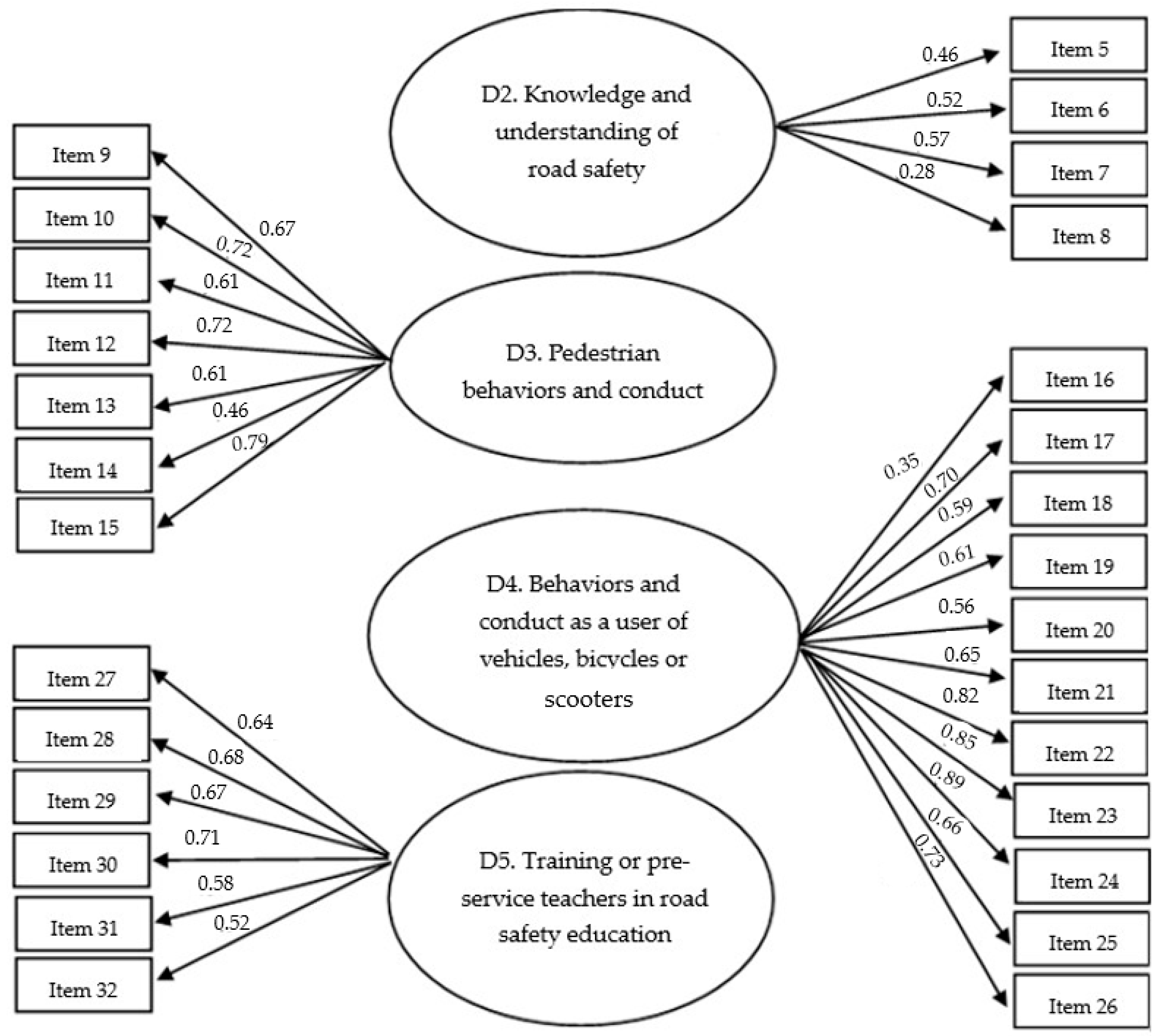
The factor loading estimates can be seen in
Figure 1. Two loadings in the second dimension of the questionnaire are inadequate (items 5 and 8) because they are below 0.50. In the factor corresponding to the dimension of pedestrian behavior and conduct, all loadings are adequate except for item 14, which is below 0.50. Regarding the fourth dimension, all items have adequate loadings except item 16, which has a loading of 0.35. All loadings are adequate for the fifth dimension. Although some items in the questionnaire have weak loadings, removing them would not affect the instrument’s reliability.
6. Discussion
Despite its importance, as mentioned above, a vast amount of research has highlighted the scarcity of instruments designed to evaluate road safety education, particularly tools that assess the preparedness of future teachers to promote safe behaviors among children (
Akhyar, 2023;
Jariot & Rodríguez, 2007). Questionnaires have proven to be a useful tool for exploring knowledge, attitude, and behavior in traffic situations. However, most do not report reliability and validity information (e.g.,
Baptista & Reyes, 2014), and some show weaknesses in this regard (
Jiménez-Mejías et al., 2015). To address this gap, the present study designed and validated the Road Safety Questionnaire for Future Teachers (RSQ-PST), a Likert-type scale developed ad hoc to assess future teachers’ knowledge and behaviors in road safety contexts. To structure this discussion, the following paragraphs present the main findings in relation to each research question, highlighting their theoretical and practical significance.
Regarding the first research question, which aimed to identify the underlying dimensions and structure of the RSQ-PST, confirmatory factor analysis supported a five-factor structure distinguishing between traffic-related content and sociodemographic information. Most items demonstrated adequate loadings, although a few items (6, 13, 16) exhibited suboptimal values. This variability may reflect differences in participants’ interpretation, levels of exposure to certain traffic situations, or the multidimensional nature of traffic behaviors, which combine cognitive, social, and decision-making components (
von Beesten & Bresges, 2025;
Wnuk, 2018). These lower loadings provide insight into potential areas where pre-service teacher training may need to be strengthened, suggesting that the RSQ-PST can highlight specific competencies requiring targeted interventions. Although these items show loadings below 0.50, their conceptual relevance outweighs the statistical weakness. These items capture critical aspects of teacher preparedness (such as decision-making in complex traffic situations, integration of cognitive and social factors, and safety-related judgment) that are essential for a comprehensive evaluation of future educators. Retaining them ensures that the RSQ-PST assesses practically meaningful competencies, even if the numerical loading is suboptimal. Expert judgment confirmed that these items were theoretically relevant and practically meaningful, justifying their retention while highlighting opportunities for future refinement in item formulation or instructional scaffolding (
Papadakaki et al., 2020). This finding reflects international evidence that teacher preparedness in road safety requires structured, iterative support and practical engagement, and suggests that assessment tools must capture complex, multidimensional competencies.
It is important to clarify that the RSQ-PST was designed to assess comprehensive competence in road safety education, rather than knowledge alone. While a subset of items (e.g., 16, 27–30) explicitly measures knowledge or teaching ability, other items capture attitudes, behavioral tendencies, personal interest, normative beliefs, and emotional assessments. These dimensions are integral to teacher preparedness; a future teacher must not only know traffic rules but also model safe behavior, convey knowledge effectively, and foster positive attitudes toward road safety among children. Consequently, the combination of items provides a multidimensional measure of competence, reflecting both cognitive and affective aspects necessary for effective education in road safety, rather than merely assessing knowledge or isolated behaviors.
The confirmed structure captures both cognitive and behavioral dimensions of road safety education, reflecting the integration of knowledge, practical skills, and safety-related decision-making that is essential in teacher training programs (
Akhyar, 2023). By encompassing knowledge, pedestrian conduct, vehicular behavior, and teacher training, the RSQ-PST provides a comprehensive assessment of future teachers’ preparedness to promote road safety in educational contexts. From a practical standpoint, this allows teacher education programs to design targeted interventions (such as workshops, simulations, and field-based exercises) addressing specific areas of weakness identified by the RSQ-PST without overburdening the curriculum. Moreover, the multidimensional insights from the RSQ-PST can guide curriculum adjustments, inform supervision during practicums, and support continuous professional development, ensuring alignment between assessment and training goals.
Building on these structural findings, the second research question examined whether the RSQ-PST demonstrates adequate internal consistency and reliability. Results indicated strong reliability, with a Cronbach’s alpha of 0.80 for the road safety education items. This level of internal consistency aligns with psychometric standards for similar instruments, such as the Driving Behavior Questionnaire (
Martinussen et al., 2013) and the ACOM–Form (
Jariot & Rodríguez, 2007), confirming that the items function cohesively as a scale. The RSQ-PST’s reliability ensures that teacher education programs can confidently use the tool to monitor student progress over time and evaluate the impact of interventions, providing empirical feedback for curriculum improvement.
The third research question addressed the factor structure’s adequacy and overall suitability as an evaluation tool. The RSQ-PST structure generally aligned with theoretical expectations, capturing both knowledge and behavior components essential to road safety education. The suboptimal loadings observed in certain items highlight opportunities for improvement, such as rewording or further piloting to increase clarity and discrimination. Importantly, the overall factor structure emphasizes the need for holistic teacher training approaches that integrate theory with practical learning experiences. International evidence demonstrates that combining classroom instruction, simulations, field exercises, and reflective activities enhances not only knowledge but also risk perception, empathy, and safety-related decision-making among teachers (
Akhyar, 2023;
Papadakaki et al., 2020;
von Beesten & Bresges, 2025). Our results extend these findings by showing that a validated, multidimensional assessment tool can provide actionable insights to strengthen both cognitive and practical components of teacher preparation and identify areas where future teachers may need additional support. This perspective situates the RSQ-PST as a practical link between assessment and pedagogical interventions, contributing to international discussions on teacher training in safety education. By encompassing these cognitive, emotional, and behavioral dimensions, the RSQ-PST contributes to preparing educators who can effectively promote safe behaviors in children, bridging the gap between knowledge acquisition and practical application, and offering a framework for integrating assessment within teacher training programs internationally.
7. Conclusions and Recommendations
Road safety education promotes knowledge of traffic rules and the estimation of speed and space in context involving traffic contexts. It also improves attitudes toward road risk (
García Ramírez et al., 2018). The latter aspect is particularly relevant because achieving safer driving requires modifying choices and habits that lead to risk-prone behaviors while driving (
Lonero, 2008). For this reason, road safety sensitization should begin at an early age in educational settings (
Ben-Bassat & Avnieli, 2016) and be reinforced through campaigns aimed at adults, including university students (
Baptista & Reyes, 2014).
The present study has shown that the Road Safety Questionnaire for Future Teachers (RSQ-PST) is a valid, reliable, and user-friendly tool for assessing pre-service teachers’ knowledge, behavior, and preparedness in road safety education. The instrument demonstrated adequate content validity, supported by expert input, satisfactory internal consistency comparable to international instruments, and a coherent factor structure, even though a few items exhibited lower loadings. These psychometric properties confirm that the RSQ-PST can effectively evaluate the competencies of future teachers, addressing an important gap in instruments tailored to this population.
The practical implications of these findings are substantial for teacher education programs. By identifying specific strengths and gaps in knowledge and behavior, the RSQ-PST can guide curriculum design, inform targeted workshops, and support continuous professional development in road safety education. For instance, items assessing knowledge of traffic rules and safe pedestrian behavior could be used to tailor classroom modules or simulation exercises, while items related to practical teacher training could inform supervised practicum activities. These applications align with international evidence highlighting the effectiveness of structured, multi-phase teacher training programs that integrate theory, practice, and technology (
Akhyar, 2023;
Papadakaki et al., 2020;
von Beesten & Bresges, 2025). The RSQ-PST provides a mechanism to systematically evaluate whether such programs are enhancing the cognitive, emotional, and behavioral competencies that are necessary for future educators to promote safe traffic practices among children and adolescents. In this sense, the instrument not only supports pre-service teacher preparation but also contributes to broader public health goals by fostering early adoption of safe traffic behaviors.
Nevertheless, certain limitations must be acknowledged. The exclusion of second-year Early Childhood and Primary Education students limits the generalizability of the findings, and responses may have been influenced by social desirability bias. To mitigate these issues in future research, triangulation with observational methods, simulations, peer assessments, or longitudinal designs could be employed. Expanding the sample to include external or multi-university participants would enhance generalizability. In the same way, further refinement of items with lower factor loadings, combined with international benchmarking, could strengthen cross-cultural validity. Although the RSQ-PST demonstrated satisfactory reliability and an adequate factor structure, some items showed suboptimal loadings, highlighting minor areas for refinement in future versions. Looking forward, the RSQ-PST opens several avenues for future research and practical development. Future studies could examine the longitudinal impact of road safety training on pre-service teachers’ knowledge, attitudes, and behaviors, compare cohorts across different countries to explore cultural influences, and investigate the effectiveness of integrated training programs that combine classroom instruction, experiential learning, and technological tools. Additionally, RSQ-PST-informed interventions could be evaluated in terms of their impact on student behavior, linking teacher training directly to measurable improvements in road safety outcomes.
Author Contributions
Conceptualization, A.P., M.-J.F.-S. and S.S.-H.; Methodology, A.P. and M.-J.F.-S.; Validation, S.S.-H.; Formal analysis, A.P. and M.-J.F.-S.; Investigation, A.P.; Data curation, A.P. and M.-J.F.-S.; Writing—original draft, A.P.; Writing—review and editing, M.-J.F.-S. and S.S.-H.; Supervision, M.-J.F.-S. and S.S.-H.; Funding acquisition, M.-J.F.-S. and S.S.-H. All authors have read and agreed to the published version of the manuscript.
Funding
This activity has been 85% co-financed by the European Union (European Regional Development Fund) and the Regional Government of Extremadura (GR24141 and GR24073). Managing Authority: Ministry of Finance.
Institutional Review Board Statement
The study was approved by the Bioethics and Biosafety Committee of the University of Extremadura, protocol code 336/2025, on 16 May 2025.
Informed Consent Statement
Informed consent was obtained from all subjects involved in the study.
Data Availability Statement
Data sharing is not applicable to this article due to confidentiality restrictions and the lack of informed consent for third-party data sharing.
Conflicts of Interest
The authors declare no conflicts of interest.
Abbreviations
The following abbreviations are used in this manuscript:
| RSQ-PST | Road Safety Questionnaire for Pre-Service Teachers |
| KMO | Kaiser–Meyer–Olkin measure of sampling adequacy |
| SD | Standard deviation |
Appendix A
Degree Currently Being Pursued: Early Childhood Education and Primary Education.
Year of study: First, second, third, or fourth.
Age:
Gender: Male, Female, or Prefer not to answer.
Please rate each statement from 1 to 5: 1. Strongly disagree, 2. Disagree, 3. Neutral, 4. Agree, 5. Strongly agree.
- 5.
Road safety education interests me and captures my attention.
- 6.
It is necessary for citizens to function in society and contributes to the promotion of desirable habits and attitudes.
- 7.
Road safety education should be developed as cross-curricular content and incorporated into everyday school activities.
- 8.
I believe that road safety education in schools is limited to teaching traffic rules without addressing road situations from a values-based educational perspective.
- 9.
I walk on the right side of the sidewalk to avoid disturbing pedestrians coming from the opposite direction.
- 10.
However, if I am in a hurry, I cross the road without regard for safety.
- 11.
I cross between stationary vehicles during traffic jams or when the traffic light is red.
- 12.
If the crosswalk is far away, I cross the road directly instead of walking to it.
- 13.
I cross the road without looking when I’m on my phone.
- 14.
I walk in the bike lane instead of on the sidewalk.
- 15.
I feel safe driving or walking on the university campus.
- 16.
I know traffic signs and road markings.
If you do not drive a car, bicycle, scooter, or motorcycle, please skip questions 17–26.
- 17.
When I travel by car, I properly fasten my seatbelt.
- 18.
When riding a bicycle, scooter, or motorcycle, I wear an approved protective helmet that is properly fastened.
- 19.
Other occupants in my car wear their seat belts and/or child restraint systems.
- 20.
I have had arguments with other road users over traffic-related issues.
- 21.
I use the horn to express anger towards other users, whether they are pedestrians or drivers.
- 22.
I drive above the legally established speed limit.
- 23.
I use my mobile phone while driving a car or riding a bicycle, scooter, or motorcycle.
- 24.
I drive after drinking alcohol.
- 25.
I get nervous when another driver passes me going faster than the speed limit.
- 26.
I also get nervous around slow drivers.
- 27.
I can work with my colleagues to improve road safety education.
- 28.
I can promote safe driving habits, develop relevant skills, and convey the emotions and values associated with road safety and risk behaviors.
- 29.
I am familiar with tools and resources for road safety education that can be used in the classroom.
- 30.
I can design teaching materials and activities that promote road safety education.
- 31.
Programs, strategies, courses, and awareness-raising talks on road safety should be developed.
- 32.
Road safety education should be given greater importance in my degree program.
References
- Akhyar, Y. (2023). Teachers’ pre-service programs curriculum to prepare professional teachers at education faculties. Indonesian Journal of Islamic Educational Management, 6(2), 72–84. [Google Scholar] [CrossRef]
- Albarracín, M., & Muñoz, L. (2008). Factores asociados al consumo de alcohol en estudiantes de los dos primeros años de carrera universitaria. Liberabit, 14(14), 49–61. [Google Scholar]
- Baptista, P., & Reyes, J. (2014). Los jóvenes y la educación para la cultura de la seguridad vial. Revista Panamericana de Pedagogía: Saberes y Quehaceres del Pedagogo, 21, 101–119. [Google Scholar] [CrossRef]
- Becoña, E. (2000). Los adolescentes y el consumo de drogas. Papeles del Psicólogo, 77, 1–5. [Google Scholar]
- Ben-Bassat, T., & Avnieli, S. (2016). The effect of a road safety educational program for kindergarten children on their parents’ behavior and knowledge. Accident Analysis & Prevention, 95, 78–85. [Google Scholar] [CrossRef] [PubMed]
- Fernández, M. R., Callejo, S., Ibáñez, S., & Vidal, J. V. (2006). Análisis de la sensibilización de los jóvenes ante la seguridad vial. Bases para la elaboración de un programa. RELIEVE, 12(2), 307–324. [Google Scholar] [CrossRef]
- García Ramírez, Y., Ramírez, R., Rojas, H., & Duque, E. (2018). Estudiantes universitarios en la enseñanza de la seguridad vial en la educación primaria. INNOVA Research Journal, 3(8), 83–94. [Google Scholar] [CrossRef]
- Harrison, M. A. (2011). College students’ prevalence and perceptions of text messaging while driving. Accident Analysis & Prevention, 43(4), 1516–1520. [Google Scholar] [CrossRef]
- Hernández-Ramos, J. P., & Martínez-Abad, F. (2021). La importancia de la actitud del docente universitario: Validación de una escala para su consideración. Revista Electrónica Interuniversitaria de Formación del Profesorado, 24(1), 59–71. [Google Scholar] [CrossRef]
- Hezaveh, A. M., Zavareh, M. F., Cherry, C. R., & Nordfjærn, T. (2018). Errors and violations in relation to bicyclists’ crash risks: Development of the Bicycle Rider Behavior Questionnaire (BRBQ). Journal of Transport and Health, 8, 289–298. [Google Scholar] [CrossRef]
- Hurtado, A. K. H., & Madueño, M. L. (2017). Propiedades psicométricas del instrumento prácticas derivadas del aprendizaje social del profesorado. Revista Electrónica Interuniversitaria de Formación del Profesorado, 20(3), 93–106. [Google Scholar] [CrossRef]
- Jariot, M., & Montané, J. (2009). Actitudes y velocidad en jóvenes. Aplicación de un programa de educación vial. RELIEVE, 15(1), 1–28. [Google Scholar] [CrossRef]
- Jariot, M., & Rodríguez, M. (2007). La formación por competencias profesionales: Evaluación y mejora de las competencias del profesor de formación vial desde un modelo de cambio de actitudes. Educación XX1: Revista de la Facultad de Educación, 10, 107–136. [Google Scholar] [CrossRef]
- Jiménez-Mejías, E., Medina-García, M. A., Martínez-Ruiz, V., Pulido-Manzanero, J., & Fernández-Villa, T. (2015). Drug use and involvement in risky driving styles in a simple of university students. The uniHcos Project. Gaceta Sanitaria, 29, 4–9. [Google Scholar] [CrossRef] [PubMed]
- Jiménez-Muro, A., Belmonte, A., Marqueta, A., Gargallo, P., & Nerín de la Puerta, I. (2009). Consumo de drogas en estudiantes universitarios de primer curso. Adicciones, 21(1), 21–28. [Google Scholar] [CrossRef]
- Kulkarni, V., Kanchan, T., Palanivel, C., Papanna, M. K., Kumar, N., & UnniKrishnan, B. (2013). Awareness and practice of road safety measures among undergraduate medical students in a South Indian state. Journal of Forensic and Legal Medicine, 20(4), 226–229. [Google Scholar] [CrossRef]
- Lonero, L. P. (2008). Trends in driver education and training. American Journal of Preventive Medicine, 35(3), S316–S323. [Google Scholar] [CrossRef]
- Luchidio, T. M. (2015). Assessing the training and safety status of motorcycle transportation in Kakamega County in Kenya [Doctoral thesis, Jomo Kenyatta University of Agriculture and Technology]. [Google Scholar]
- Martinussen, L. M., Lajunen, T., Møller, M., & Özkan, T. (2013). Short and user-friendly: The development and validation of the Mini-DBQ. Accident Analysis & Prevention, 50, 1259–1265. [Google Scholar] [CrossRef]
- Mcllroy, R. C., Plant, K. L., Jikyong, U., Nam, V. H., Bunyasi, B., Kokwaro, G. O., Wu, J., Hoque, S., Preston, J. M., & Stanton, N. A. (2019). Vulnerable road users in low-, middle-, and high-income countries: Validation of a pedestrian behaviour questionnaire. Accident Analysis & Prevention, 131, 80–94. [Google Scholar] [CrossRef] [PubMed]
- Papadakaki, M., Kounali, V., Lioliou, S., Christoforidi, E., Chatzidrosou, D., Vasilakis, E., Tamoutsidou, A., Vagionaki, K., Vasilaki, I., & Chliaoutakis, J. (2020). Pilot test of a train the trainer programmes on road safety education. European Journal of Public Health, 30(5), ckaa166-466. [Google Scholar] [CrossRef]
- Pearson, M. R., Murphy, E. M., & Doane, A. N. (2013). Impulsivity-like traits and risky driving behaviors among college students. Accident Analysis & Prevention, 53, 142–148. [Google Scholar] [CrossRef]
- Riaz, M. S., Cuenen, A., Dhondt, S., Craps, H., Janssens, D., Wets, G., Brijs, T., & Brijs, K. (2019). Evaluation of a road safety education program based on driving under influence and traffic risks for higher secondary school students in Belgium. Safety, 5(2), 34. [Google Scholar] [CrossRef]
- Ruiz-Olivares, M., Lucena, V., Pino, M., Raya, A., & Herruzo, J. (2010). El consumo de cannabis y la percepción del riesgo en jóvenes universitarios. Behavioral Psychology, 18, 579–590. [Google Scholar]
- von Beesten, S., & Bresges, A. (2025). The effectiveness of teaching methods for preparing teacher education students to teach road safety-related content. Frontiers in Education, 9, 1471022. [Google Scholar] [CrossRef]
- Wang, C., Zhang, W., Feng, Z., Sze, N. N., Xu, J., Zhang, X., Wang, K., Huang, W., & Luo, Y. (2019). Aberrant behaviours in relation to the self-reported crashes of bicyclists in China: Development of the Chinese Cycling Behaviour Questionnaire. Transportation Research Part F: Traffic Psychology and Behaviour, 66, 63–75. [Google Scholar] [CrossRef]
- Wechsler, H., Lee, J. E., Nelson, T. F., & Lee, H. (2003). Drinking and driving among college students: The influence of alcohol-control policies. American Journal of Preventive Medicine, 25(3), 212–218. [Google Scholar] [CrossRef]
- Wnuk, A. (2018). PW 2382 Current challenges for road safety education teachers in Poland. Injury Prevention, 24, 86–87. [Google Scholar] [CrossRef]
| Disclaimer/Publisher’s Note: The statements, opinions and data contained in all publications are solely those of the individual author(s) and contributor(s) and not of MDPI and/or the editor(s). MDPI and/or the editor(s) disclaim responsibility for any injury to people or property resulting from any ideas, methods, instructions or products referred to in the content. |