Implementing and Evaluating a Teaching Learning Sequence to Enhance Energy Understanding and Science Self-Efficacy in Primary School
 , ,
, ,  and
and 
Abstract
1. Introduction
2. Literature Review
2.1. Energy Concept
2.2. Energy in Primary School
2.3. Science Self Efficacy
3. Theoretical Framework
The Teaching Learning Sequence
4. The Research
4.1. Methodology
- RQ1.
- What common-sense conceptions do primary school students highlight about energy?
- RQ2.
- To what extent is the planned TLS effective in familiarizing primary school pupils with the key concept of energy?
- RQ3.
- To what extent can the planned TLS promote an improvement in male and female pupil’s science self-efficacy?
4.2. Contents
4.3. Data Collection and Analysis
4.3.1. Questionnaire on Energy Concept
- Q1.
- What do you know about energy?
- Q2.
- As far as you know, are there things that make energy?
- Q3.
- As far as you know, are there things that have/possess energy?
- Q4.
- Is energy conserved? In your answer, explain what is meant by “conserved”.
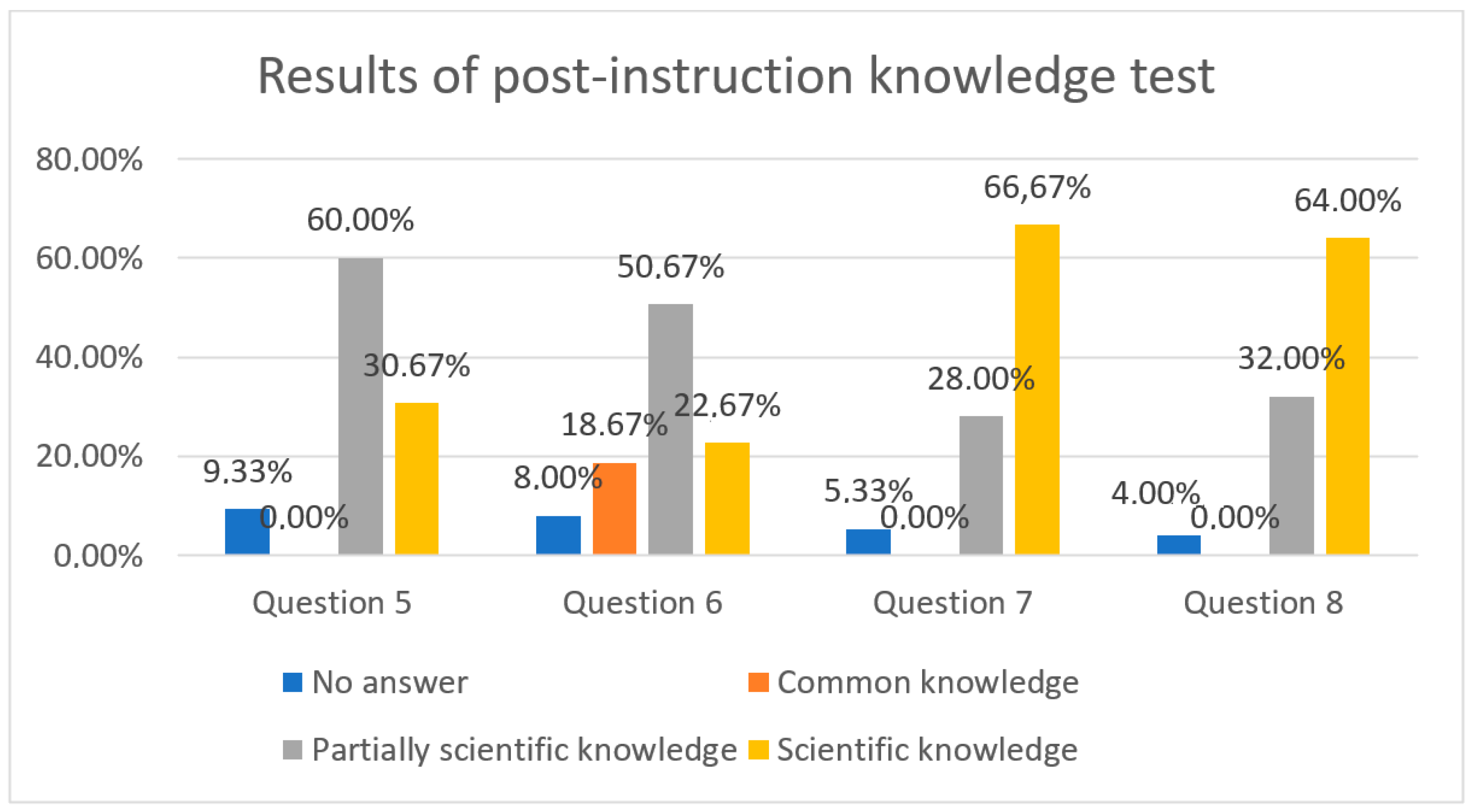
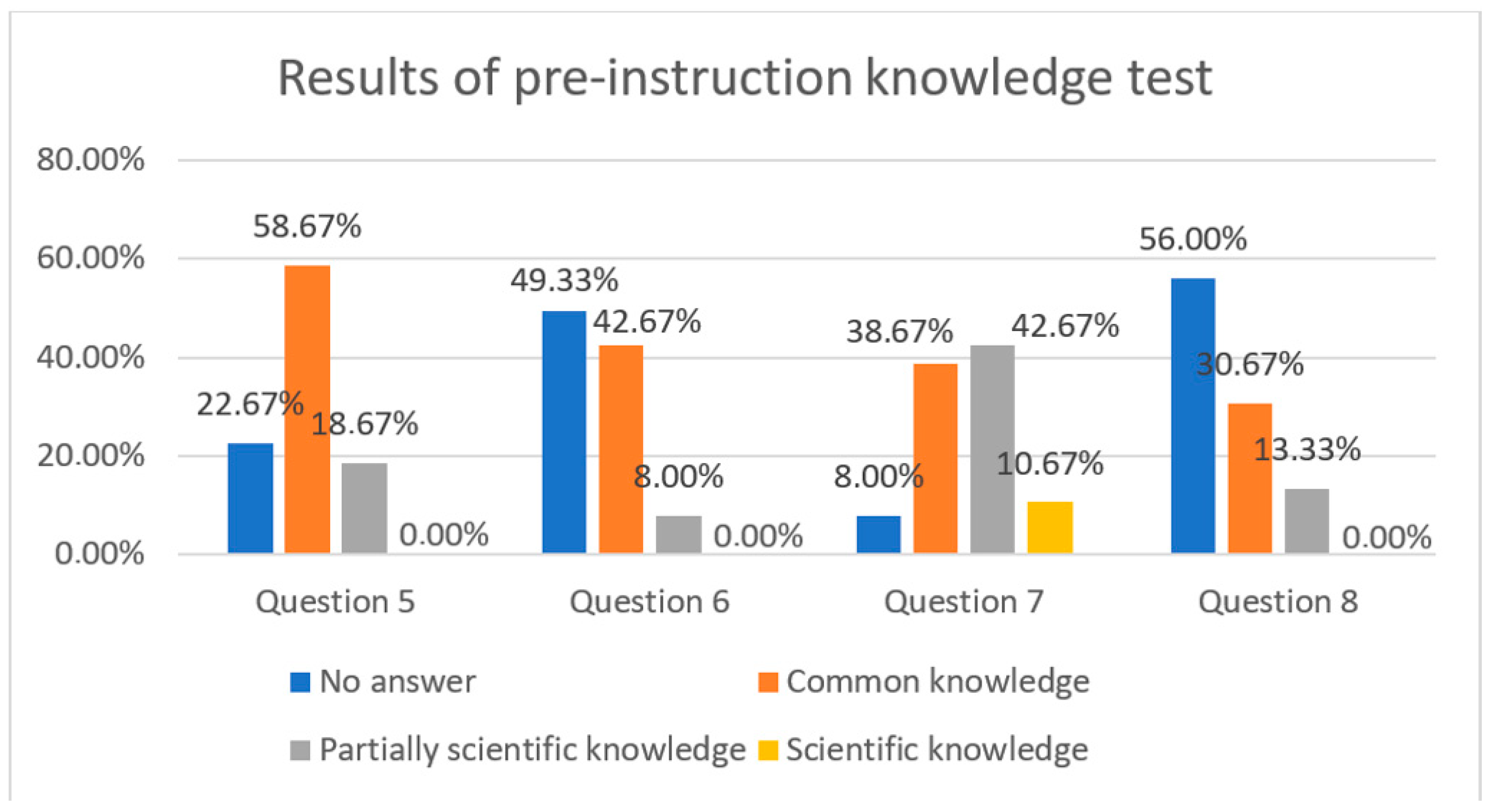
- Q5.
- Can energy be converted? Explain, giving two examples.
- Q6.
- Can energy be lost? Explain, giving two examples.
- Q7.
- What types of energy do you know about?
- Q8.
- What is the difference between renewable and non-renewable energy sources?
4.3.2. Questionnaire on Science Self-Efficacy
4.4. The Teaching Learning Sequence
4.4.1. First Session
4.4.2. Second Session
4.4.3. Third Session
4.4.4. Fourth Session
4.4.5. Fifth Session
5. Results
5.1. Observation During the TLS
5.2. Results from Energy Concept Questionnaire
5.3. Results on Self-Efficacy In Science (SE-IS) Questionnaire
6. Discussion
7. Conclusions
7.1. Key Contributions of the Study
7.2. Limitations of the Study
Author Contributions
Funding
Institutional Review Board Statement
Informed Consent Statement
Data Availability Statement
Conflicts of Interest
Appendix A
Self-Efficacy In Science Questionnaire (SE-IS)
| Info | |||||||||||||
| Age Gender School Classroom | |||||||||||||
| Var. | Section A How much do you agree with these statements? | Not at all | A little | Somewhat | A lot | Completely | |||||||
| I am a very curious | |||||||||||||
| 1 | I like learning new things | ||||||||||||
| I think learning new things is boring | |||||||||||||
| I am very creative. | |||||||||||||
| Not at all | A little | Somewhat | A lot | Completely | |||||||||
| There are people who do poorly in science, no matter how much they study | |||||||||||||
| 2 | When tasks become difficult, I give up | ||||||||||||
| I can think quickly | |||||||||||||
| Section B How well could you do the following… | Terribly | Poorly | Neither well nor poorly | Well | Perfectly | ||||||||
| Italian | |||||||||||||
| 3 | Math | ||||||||||||
| Science | |||||||||||||
| English | |||||||||||||
| Section C How well could you answer questions on the following science topics? | Terribly | Poorly | Neither well nor poorly | Well | Perfectly | ||||||||
| Plants | |||||||||||||
| 4 | Animals | ||||||||||||
| Human body | |||||||||||||
| Water cycle | |||||||||||||
| Terribly | Poorly | Neither well nor poorly | Well | Perfectly | |||||||||
| States of matter | |||||||||||||
| Liquids | |||||||||||||
| Solutions and mixtures | |||||||||||||
| Energy | |||||||||||||
| 5 | Heat and temperature | ||||||||||||
| Forces | |||||||||||||
| The Universe and the Solar System | |||||||||||||
| Electricity | |||||||||||||
| Magnets | |||||||||||||
| Section D How well do you agree with the following? | Strongly disagree | Disagree | Neither agree nor disagree | Agree | Strongly agree | ||||||||
| Science is one of my favorite subjects | |||||||||||||
| I like science assignments | |||||||||||||
| Science is easy for me | |||||||||||||
| 6 | I enjoy learning new science topics. | ||||||||||||
| I can’t wait to do science | |||||||||||||
| I lose interest during science lessons. | |||||||||||||
| I am interested in learning topics related to science. | |||||||||||||
| Strongly disagree | Disagree | Neither agree nor disagree | Agree | Strongly agree | |||||||||
| I received excellent grades in science tests. | |||||||||||||
| Even when I study very hard, I do poorly in science | |||||||||||||
| When science topics are explained to me, I understand the concepts very well | |||||||||||||
| 7 | I can usually answer questions or science tasks well. | ||||||||||||
| I have always been successful with science. | |||||||||||||
| I do well even on the more difficult science assignments. | |||||||||||||
| I learn science quickly. | |||||||||||||
| Strongly disagree | Disagree | Neither agree nor disagree | Agree | Strongly agree | |||||||||
| When I see my teacher doing science experiments, I imagine doing them myself | |||||||||||||
| 8 | When I see how another student does a science experiment, I would like to do it too | ||||||||||||
| Strongly disagree | Disagree | Neither agree nor disagree | Agree | Strongly agree | |||||||||
| 9 | My classmates like to work with me in science because they think I’m good at it | ||||||||||||
| My teacher tells me that I am good at science. | |||||||||||||
| Strongly disagree | Disagree | Neither agree nor disagree | Agree | Strongly agree | |||||||||
| 10 | I am unable to think clearly when doing science work. | ||||||||||||
| I feel anxious when I have to do science | |||||||||||||
| Section E How capable do you think you are of performing these activities? | 0 | 1 | 2 | 3 | 4 | 5 | 6 | 7 | 8 | 9 | 10 | ||
| Connecting science topics with each other | |||||||||||||
| Explaining science topics to my classmates if they haven’t understood something | |||||||||||||
| Working together with my classmates to better understand science topics | |||||||||||||
| 11 | Write a good report about an experiment | ||||||||||||
| Correctly use instruments during an experiment | |||||||||||||
| Encouraging my classmates to participate in discussions. | |||||||||||||
| Conducting science experiments using practical materials | |||||||||||||
References
- Ballen, C. J., Wieman, C., Salehi, S., Searle, J. B., & Zamudio, K. R. (2017). Enhancing diversity in undergraduate science: Self-efficacy drives performance gains with active learning. CBE—Life Sciences Education, 16(4). [Google Scholar] [CrossRef]
- Bandura, A. (1977). Self-efficacy: Toward a unifying theory of behavioral change. Psychological Review, 84(2), 191–215. [Google Scholar] [CrossRef]
- Bezen, S., Bayrak, C., & Aykutlu, I. (2016). Physics teachers’ views on teaching the concept of energy. Eurasian Journal of Educational Research, 2016(64), 109–124. [Google Scholar] [CrossRef][Green Version]
- Bian, L., Leslie, S.-J., & Cimpian, A. (2017). Gender stereotypes about intellectual ability emerge early and influence children’s interests. Science, 355(6323), 389–391. [Google Scholar] [CrossRef]
- Biggs, A., Daniel, L., & Feather, R. M. (2008). Glencoe science. Glencoe/McGraw-Hill. [Google Scholar]
- Boyes, E., & Stanisstreet, M. (1990). Pupils’ ideas concerning energy sources. International Journal of Science Education, 12(5), 513–529. [Google Scholar] [CrossRef]
- Britner, S. L., & Pajares, F. (2006). Sources of science self-efficacy among middle school students. Journal of Research in Science Teaching, 43(5), 485–499. [Google Scholar] [CrossRef]
- Brook, A. J., & Wells, P. (1988). Conserving the circus? An alternative approach to teaching and learning about energy. Physics Education, 23(2), 80–85. [Google Scholar] [CrossRef]
- Brousseau, G. (1997). Theory of didactical situations in mathematics. Mathematics Education Research Journal, 19, 86–87. [Google Scholar]
- Bybee, R. W. (2015). The BSCS 5E instructional model: Creating teachable moments. NSTA Press. [Google Scholar]
- Caprara, G. V., Fida, R., Vecchione, M., Del Bove, G., Vecchio, G. M., Barbaranelli, C., & Bandura, A. (2008). Longitudinal analysis of perceived self-efficacy for self-regulated learning. Journal of Educational Psychology, 100(3), 525–534. [Google Scholar] [CrossRef]
- Carr, M., & Kirkwood, V. (1988). Teaching and learning about energy in New Zealand secondary school junior science classrooms. Physics Education, 23(2), 86–91. [Google Scholar] [CrossRef]
- Carroll, S., McCauley, V., & Grenon, M. (2024). Science self-efficacy beliefs of upper primary students in Ireland. International Journal of Science Education, 46(6), 503–523. [Google Scholar] [CrossRef]
- Chen, R. F., Eisenkraft, A., Fortus, D., Krajcik, J., Neumann, K., Nordine, J., & Scheff, A. (2014). Teaching and learning of energy in K–12 education. Springer. [Google Scholar] [CrossRef]
- Chrzanowski, M. M., Grajkowski, W., Żuchowski, S., Spalik, K., & Ostrowska, E. B. (2018). Vernacular Misconceptions in Teaching Science—Types and Causes. Journal of Turkish Science Education, 15(4), 29–54. [Google Scholar]
- Colonnese, D., Heron, P., Michelini, M., Santi, L., & Stefanel, A. (2012). A vertical pathway for teaching and learning the concept of energy. Review of Science, Mathematics and ICT Education, 6(1), 21–50. [Google Scholar] [CrossRef]
- Constantinou, C. P., & Papadouris, N. (2012). Teaching and learning about energy in middle school: An argument for an epistemic approach. Studies in Science Education, 48(2), 161–186. [Google Scholar] [CrossRef]
- Corbett, C., & Hill, C. (2015). Solving the equation: The variables for women’s success in engineering and computing. AAUW. [Google Scholar]
- Delegkos, N., & Koliopoulos, D. (2020). Constructing the “energy” concept and its social use by students of primary education in Greece. Research in Science Education, 50(2), 393–418. [Google Scholar] [CrossRef]
- Driver, R., Rushworth, P., & Wood-Robinson, V. (2004). Making sense of secondary science: Support material for teachers. Taylor & Francis. [Google Scholar]
- Duit, R., & Treagust, D. F. (1998). Learning in science: From behaviorism towards social constructivism and beyond. In B. J. Fraser, & K. G. Tobin (Eds.), International handbook of science education (pp. 3–25). Springer. [Google Scholar]
- Duit, R., & Treagust, D. F. (2003). Conceptual change: A powerful framework for improving science teaching and learning. International Journal of Science Education, 25(6), 671–688. [Google Scholar] [CrossRef]
- Etkina, E., Brookes, D. T., & Planinsic, G. (2019). Investigative science learning environment. Morgan & Claypool. [Google Scholar] [CrossRef]
- Evans, G. W., Brauchle, G., Haq, A., Stecker, R., Wong, K., & Shapiro, E. (2007). Young children’s environmental attitudes and behaviors. Environment and Behavior, 39(5), 635–658. [Google Scholar] [CrossRef]
- Fabrigar, L. R., & Wegener, D. T. (2019). Exploratory factor analysis. Oxford University Press. [Google Scholar]
- Fauth, B., Decristan, J., Rieser, S., Klieme, E., & Büttner, G. (2014). Student ratings of teaching quality in primary school: Dimensions and prediction of student outcomes. Learning and Instruction, 29, 1–9. [Google Scholar] [CrossRef]
- Ganajová, M., Orosová, R., Sotáková, I., & Letošníková, P. (2025). The effect of inquiry-based teaching on students’ attitudes toward science as an academic subject as well as science and technology in general. Frontiers in Education, 10, 1708139. [Google Scholar] [CrossRef]
- Giarratano, G., Battaglia, O. R., Termini, G., & Fazio, C. (2024, August 26–30). A didactic pathway on the concept of energy in primary school: Cognitive well-being and self-efficacy based on gender [Conference session]. IV World Conference on Physics Education, Kraków, Poland. [Google Scholar]
- Gorard, S., & See, B. H. (2009). The impact of socioeconomic status on participation and attainment in science. Studies in Science Education, 45(1), 93–129. [Google Scholar] [CrossRef]
- Hand, S., Rice, L., & Greenlee, E. (2017). Exploring teachers’ and students’ gender role bias and confidence in STEM. Social Psychology of Education, 20(4), 929–945. [Google Scholar] [CrossRef]
- Harackiewicz, J. M., Smith, J. L., & Priniski, S. J. (2016). Interest matters. Policy Insights from the Behavioral and Brain Sciences, 3(2), 220–227. [Google Scholar] [CrossRef]
- Hendrickson, P. (2021). Effect of active learning techniques on student excitement, interest, and self-efficacy. Journal of Political Science Education, 17(2), 311–325. [Google Scholar] [CrossRef]
- Jensen, M. P. (2003). Questionnaire validation: A brief guide for readers of the research literature. Clinical Journal of Pain, 19, 345–352. [Google Scholar] [CrossRef]
- Jin, H., & Anderson, C. W. (2012). A learning progression for energy in socio-ecological systems. Journal of Research in Science Teaching, 49(9), 1149–1180. [Google Scholar] [CrossRef]
- King, T. L., Scovelle, A. J., Meehl, A., Milner, A. J., & Priest, N. (2021). Gender stereotypes and biases in early childhood: A systematic review. Australasian Journal of Early Childhood, 46(2), 112–125. [Google Scholar] [CrossRef]
- Krippendorff, K. (2019). Content analysis: An introduction to its methodology. SAGE. [Google Scholar]
- Lent, R. W., & Brown, S. D. (2006). On conceptualizing and assessing social cognitive constructs in career research: A measurement guide. Journal of Career Assessment, 14(1), 12. [Google Scholar] [CrossRef]
- Lijnse, P. (2004). Didactical structures as an outcome of research on teaching–learning sequences? International Journal of Science Education, 26(5), 537–554. [Google Scholar] [CrossRef]
- Linn, M. C., & Eylon, B. (2006). Science education: Integrating views of learning and instruction. In W. M. Reynolds, & G. E. Miller (Eds.), Handbook of educational psychology (2nd ed.). Erlbaum. [Google Scholar]
- Liou, P. Y., Lin, Y. M., Huang, S. C., & Chen, S. (2023). Gender differences in science motivational beliefs and their relations with achievement over Grades 4 and 8: A multinational perspective. International Journal of Science and Mathematics Education, 21(1), 233–249. [Google Scholar] [CrossRef]
- Liu, X., & Ruiz, M. E. (2008). Using data mining to predict K–12 students’ performance on assessment items related to energy. Journal of Research in Science Teaching, 45(5), 554–573. [Google Scholar] [CrossRef]
- Liu, Y., & Wang, J. (2022). The mediating–moderating model of inquiry-based learning and science self-efficacy: Evidence from PISA 2015. International Journal of Science Education, 44(7), 1096–1119. [Google Scholar] [CrossRef]
- Lown, J. (2002). Circle time: The perceptions of teachers and pupils. Educational Psychology in Practice, 18(2), 93–102. [Google Scholar] [CrossRef]
- Mackay, J., & Parkinson, J. (2010). Gender, self-efficacy and achievement among South African technology teacher trainees. Gender and Education, 22(1), 87–103. [Google Scholar] [CrossRef]
- Mariani, C., Laurenti, E., & Corni, F. (2012). Hands-on, minds-on activities to construct the concept of energy in primary school: Experiments, games and group discussions. Latin American Journal of Physics Education, 6(Suppl. 1), 105–111. [Google Scholar]
- Master, A. (2021). Gender stereotypes influence children’s STEM motivation. Child Development Perspectives, 15(3), 203–210. [Google Scholar] [CrossRef]
- Méheut, M., & Psillos, D. (2004). Teaching–learning sequences: Aims and tools for science education research. International Journal of Science Education, 26(5), 515–535. [Google Scholar] [CrossRef]
- Millar, R. (2005). Teaching about energy. University of York. [Google Scholar]
- MIUR. (2018). Indicazioni nazionali e nuovi scenari. Ministry of Education, Italy. [Google Scholar]
- Mohtar, L. E., Halim, L., Abd Rahman, N., Maat, S. M., Iksan, Z. H., & Osman, K. (2019). A model of interest in STEM careers among secondary school students. Journal of Baltic Science Education, 18(3), 404–416. [Google Scholar] [CrossRef]
- National Research Council. (2010). A framework for K–12 science education: Practices, crosscutting concepts, and core ideas. National Academies Press. [Google Scholar]
- Niedderer, H., Goldberg, F., & Duit, R. (1992). Towards learning process studies. In R. Duit, F. Goldberg, & H. Niedderer (Eds.), Research in physics learning: Theoretical issues and empirical studies (pp. 10–28). IPN—Institute for Science Education. [Google Scholar]
- Nordine, J., Krajcik, J., & Fortus, D. (2011). Transforming energy instruction in middle school to support integrated understanding and future learning. Science Education, 95(4), 670–699. [Google Scholar] [CrossRef]
- Nugent, G., Barker, B., Welch, G., Grandgenett, N., Wu, C., & Nelson, C. (2015). A model of factors contributing to STEM learning and career orientation. International Journal of Science Education, 37(7), 1067–1088. [Google Scholar] [CrossRef]
- OECD. (2019). PISA 2018 results (Volume II): Where all students can succeed. OECD. [Google Scholar] [CrossRef]
- Opitz, S. T., Harms, U., Neumann, K., Kowalzik, K., & Frank, A. (2015). Students’ energy concepts at the transition between primary and secondary school. Research in Science Education, 45(5), 691–715. [Google Scholar] [CrossRef]
- Ölçer, S. (2025). Inquiry-based science teaching in primary school. Journal of Child Development and Education, 1, 55–66. [Google Scholar]
- Pajares, F., & Schunk, D. H. (2002). Self and self-belief in psychology and education. In S. Graham, & H. Harris (Eds.), Improving academic achievement (pp. 3–21). Elsevier. [Google Scholar] [CrossRef]
- Persano Adorno, D., Pizzolato, N., & Fazio, C. (2018). Long term stability of learning outcomes in undergraduates after an open-inquiry instruction on thermal science. Physical Review Physics Education Research, 14, 010108. [Google Scholar] [CrossRef]
- Psillos, D., & Kariotoglou, P. (2016). Iterative design of teaching–learning sequences: Introducing the science of materials in European schools. Springer. [Google Scholar]
- Salkind, N. (2010). Encyclopedia of research design. SAGE. [Google Scholar] [CrossRef]
- Scott, P. H. (1992). Pathways in learning science: A case study of the development of one student’s ideas relating to the structure of matter. In R. Duit, F. Goldberg, & H. Niedderer (Eds.), Research in physics learning: Theoretical issues and empirical studies (pp. 203–224). IPN. [Google Scholar]
- Shepardson, D. P., Niyogi, D., Choi, S., & Charusombat, U. (2011). Students’ conceptions about the greenhouse effect. Climatic Change, 104(3–4), 481–507. [Google Scholar] [CrossRef]
- Sherman, R. R., & Webb, R. B. (2001). Qualitative research in education: Focus and methods. Routledge Falmer. [Google Scholar]
- Sissamperi, N., & Koliopoulos, D. (2021). How students of primary school understand large scale energy systems: The case of thermal power plant. Journal of Technology and Science Education, 11(1), 129–145. [Google Scholar] [CrossRef]
- Solomon, J. (1983). Learning about energy: How pupils think in two domains. European Journal of Science Education, 5(1), 49–59. [Google Scholar] [CrossRef]
- Tiberghien, A. (1997). Learning and teaching: Differentiation and relation. Research in Science Education, 27, 359–382. [Google Scholar] [CrossRef]
- Toma, R. B., Greca, I. M., & Orozco Gómez, M. L. (2019). Attitudes towards science and views of nature of science among elementary school students in terms of gender, cultural background and grade level variables. Research in Science & Technological Education, 37(4), 492–515. [Google Scholar] [CrossRef]
- Trumper, R. (1990). Being constructive: An alternative approach to teaching the energy concept—Part one. International Journal of Science Education, 12(4), 343–354. [Google Scholar] [CrossRef]
- Usher, E. L., & Pajares, F. (2006). Sources of academic and self-regulatory efficacy beliefs of entering middle school students. Contemporary Educational Psychology, 31(2), 125–141. [Google Scholar] [CrossRef]
- Webb-Williams, J. (2018). Science self-efficacy in the primary classroom. Research in Science Education, 48(5), 939–961. [Google Scholar] [CrossRef]
- Whitcomb, K. M., & Singh, C. (2020). Gender inequities throughout STEM: Women with higher grades drop STEM majors while men persist. arXiv, arXiv:2004.00560. [Google Scholar]
- Yeh, S.-C., Huang, J.-Y., & Yu, H.-C. (2017). Analysis of energy literacy and misconceptions of junior high students in Taiwan. Sustainability, 9(3), 423. [Google Scholar] [CrossRef]
- Zhang, L., & Ma, Y. (2023). A study of the impact of project-based learning on student learning effects: A meta-analysis study. Frontiers in Psychology, 14, 1202728. [Google Scholar] [CrossRef] [PubMed]
- Zyadin, A., Puhakka, A., Ahponen, P., Cronberg, T., & Pelkonen, P. (2012). School students’ knowledge and attitudes toward renewable energy in Jordan. Renewable Energy, 45, 78–85. [Google Scholar] [CrossRef]






| Level | Criteria | Examples |
|---|---|---|
| Common-sense knowledge | References to everyday experiences; intuitive explanations; conceptual errors | “Energy is used for moving.” “Energy is stored in the electric wires.” |
| Partially scientific knowledge | Presence of scientific terms without correct or complete connections; partially scientific language; declarative responses that report notions without contextualization; examples explored during the learning sequence but reported in an incomplete and/or partially correct way. | “Wind turbines have energy.” “Energy cannot be created or destroyed.” “The bicycle transferred some of its energy to the bulb, and it became light energy.” |
| Scientific knowledge | Correct and consistent use of scientific language; examples explored during the learning sequence, contextualized and clearly explained; identification of cause–effect relationships. | “If we take a whisk and a bowl full of water and start stirring the whisk inside the bowl, the water will warm up because the kinetic energy of the whisk has been transformed into thermal energy.” |
| V | Variables |
|---|---|
| V1 | Desire to learn and extend |
| V2 | Growth Mindset |
| V3 | General academic SE |
| V4 | SE in specific knowledge—life science |
| V5 | SE in specific knowledge—physics/chemistry |
| V6 | Attitude towards science |
| V7 | Mastery Experience |
| V8 | Vicarious Experience |
| V9 | Verbal Persuasion |
| V10 | Emotional State |
| V11 | Specific skills in Science |
| Mean PRE ma | Dev. st. PRE ma | Mean PRE fe | Dev. st. PRE fe | Student’s t | p-Value | Cohen’s d | |
|---|---|---|---|---|---|---|---|
| V1 | 3.940 | 0.447 | 4.006 | 0.480 | −0.613 | 0.544 | 0.142 |
| V2 | 3.825 | 0.510 | 3.410 | 0.671 | 3.020 | 0.003 | 0.697 |
| V3 | 3.913 | 0.447 | 3.650 | 0.648 | 2.006 | 0.049 | 0.471 |
| V4 | 4.169 | 0.469 | 4.043 | 0.583 | 1.021 | 0.311 | 0.238 |
| V5 | 3.731 | 0.458 | 3.295 | 0.632 | 3.438 | 0.001 | 0.788 |
| V6 | 4.061 | 0.548 | 3.861 | 0.678 | 1.410 | 0.163 | 0.324 |
| V7 | 3.771 | 0.608 | 3.457 | 0.671 | 2.123 | 0.037 | 0.491 |
| V8 | 4.200 | 0.806 | 4.200 | 0.714 | 0.000 | 1.000 | 0.000 |
| V9 | 3.738 | 0.608 | 3.386 | 0.686 | 2.350 | 0.021 | 0.543 |
| V10 | 2.150 | 0.900 | 3.200 | 0.566 | −5.932 | 0.000 | 1.397 |
| V11 | 7.425 | 1.180 | 7.544 | 1.050 | −0.483 | 0.646 | 0.106 |
| Mean PRE ma | Dev. st. PRE ma | Mean POST ma | Dev. st. POST ma | Student’s t | p-Value | Cohen’s d | |
|---|---|---|---|---|---|---|---|
| V1 | 3.940 | 0.447 | 3.920 | 0.480 | 0.181 | 0.857 | 0.043 |
| V2 | 3.825 | 0.510 | 3.800 | 0.600 | 0.189 | 0.851 | 0.045 |
| V3 | 3.913 | 0.447 | 3.850 | 0.500 | 0.574 | 0.568 | 0.132 |
| V4 | 4.169 | 0.469 | 4.113 | 0.520 | 0.534 | 0.600 | 0.114 |
| V5 | 3.731 | 0.458 | 3.889 | 0.316 | −1.856 | 0.071 | 0.402 |
| V6 | 4.061 | 0.548 | 4.189 | 0.387 | −1.256 | 0.177 | 0.271 |
| V7 | 3.771 | 0.608 | 3.886 | 0.316 | −1.043 | 0.303 | 0.236 |
| V8 | 4.200 | 0.806 | 4.300 | 0.648 | −0.726 | 0.472 | 0.137 |
| V9 | 3.738 | 0.608 | 3.650 | 0.608 | 0.714 | 0.480 | 0.144 |
| V10 | 2.150 | 0.900 | 2.100 | 0.714 | 0.257 | 0.790 | 0.062 |
| V11 | 7.425 | 1.180 | 7.861 | 0.687 | −2.819 | 0.007 | 0.451 |
| Mean PRE fe | Dev. st. PRE fe | Mean POST fe | Dev. st. POST fe | Student’s t | p-Value | Cohen’s d | |
|---|---|---|---|---|---|---|---|
| V1 | 4.006 | 0.480 | 4.200 | 0.480 | −1.704 | 0.097 | 0. 405 |
| V2 | 3.410 | 0.671 | 3.562 | 0.748 | −1.113 | 0.274 | 0.214 |
| V3 | 3.650 | 0.648 | 3.843 | 0.520 | −1.344 | 0.187 | 0.328 |
| V4 | 4.043 | 0.583 | 4.107 | 0.548 | −0.447 | 0.658 | 0.114 |
| V5 | 3.295 | 0.632 | 3.756 | 0.469 | −3.535 | 0.001 | 0.827 |
| V6 | 3.861 | 0.678 | 4.188 | 0.566 | −2.715 | 0.010 | 0.523 |
| V7 | 3.457 | 0.671 | 3.792 | 0.616 | −2.782 | 0.008 | 0.520 |
| V8 | 4.200 | 0.714 | 4.429 | 0.600 | −1.604 | 0.118 | 0.347 |
| V9 | 3.386 | 0.686 | 3.586 | 0.781 | −1.268 | 0.213 | 0.272 |
| V10 | 3.200 | 0.566 | 2.586 | 0.894 | 3.370 | 0.001 | 0.821 |
| V11 | 7.544 | 1.050 | 7.857 | 1.182 | −1.281 | 0.208 | 0.280 |
| Mean POST ma | Dev. St. POST ma | Mean POST fe | Dev. St. POST fe | Student’s t | p-Value | Cohen’s d | |
|---|---|---|---|---|---|---|---|
| V1 | 3.920 | 0.480 | 4.200 | 0.480 | −2.523 | 0.014 | 0.584 |
| V2 | 3.800 | 0.600 | 3.562 | 0.748 | 1.525 | 0.132 | 0.351 |
| V3 | 3.850 | 0.500 | 3.843 | 0.520 | 0.061 | 0.952 | 0.014 |
| V4 | 4.113 | 0.520 | 4.107 | 0.548 | 0.044 | 0.965 | 0.010 |
| V5 | 3.889 | 0.316 | 3.756 | 0.469 | 1.439 | 0.154 | 0.333 |
| V6 | 4.189 | 0.387 | 4.188 | 0.566 | 0.014 | 0.989 | 0.003 |
| V7 | 3.886 | 0.316 | 3.792 | 0.616 | 0.833 | 0.407 | 0.192 |
| V8 | 4.300 | 0.648 | 4.429 | 0.600 | −0.882 | 0.381 | 0.206 |
| V9 | 3.650 | 0.608 | 3.586 | 0.781 | 0.399 | 0.691 | 0.092 |
| V10 | 2.100 | 0.714 | 2.586 | 0.894 | −2.606 | 0.011 | 0.600 |
| V11 | 7.861 | 0.687 | 7.857 | 1.182 | 0.016 | 0.929 | 0.020 |
Disclaimer/Publisher’s Note: The statements, opinions and data contained in all publications are solely those of the individual author(s) and contributor(s) and not of MDPI and/or the editor(s). MDPI and/or the editor(s) disclaim responsibility for any injury to people or property resulting from any ideas, methods, instructions or products referred to in the content. |
© 2026 by the authors. Licensee MDPI, Basel, Switzerland. This article is an open access article distributed under the terms and conditions of the Creative Commons Attribution (CC BY) license.
Share and Cite
Giarratano, G.; Agliolo Gallitto, A.; Fazio, C.; Battaglia, O.R. Implementing and Evaluating a Teaching Learning Sequence to Enhance Energy Understanding and Science Self-Efficacy in Primary School. Educ. Sci. 2026, 16, 209. https://doi.org/10.3390/educsci16020209
Giarratano G, Agliolo Gallitto A, Fazio C, Battaglia OR. Implementing and Evaluating a Teaching Learning Sequence to Enhance Energy Understanding and Science Self-Efficacy in Primary School. Education Sciences. 2026; 16(2):209. https://doi.org/10.3390/educsci16020209
Chicago/Turabian StyleGiarratano, Giusy, Aurelio Agliolo Gallitto, Claudio Fazio, and Onofrio Rosario Battaglia. 2026. "Implementing and Evaluating a Teaching Learning Sequence to Enhance Energy Understanding and Science Self-Efficacy in Primary School" Education Sciences 16, no. 2: 209. https://doi.org/10.3390/educsci16020209
APA StyleGiarratano, G., Agliolo Gallitto, A., Fazio, C., & Battaglia, O. R. (2026). Implementing and Evaluating a Teaching Learning Sequence to Enhance Energy Understanding and Science Self-Efficacy in Primary School. Education Sciences, 16(2), 209. https://doi.org/10.3390/educsci16020209