Article

Digital Learning and Usage Practices of German Students in a Continuum of Formal and Informal Contexts—Results of a Diary Study

Continuing Education and Lifelong Learning, Helmut-Schmidt-University/University of the Federal Armed Forces Hamburg, Stoltenstraße 13, 22043 Hamburg, Germany
Educ. Sci. 2026, 16(2), 208; https://doi.org/10.3390/educsci16020208
Submission received: 14 December 2025 / Revised: 15 January 2026 / Accepted: 22 January 2026 / Published: 29 January 2026
(This article belongs to the Special Issue Investigating Informal Learning in the Age of Technology)

Abstract

In the “culture of digitality”, new (digital) spaces of opportunity in the contested field of formal and informal learning contexts are constantly emerging, forcing students to orient themselves and take responsibility for selecting information. To deal with the associated challenges (e.g., cognitive overload) this brings, digital skills are required, which can be acquired through various learning and usage practices. The aim of this study is to examine the interplay between students’ individual (digital) learning environments and their (digital) learning and usage practices, which are shaped by the culture of digitality, to derive actionable recommendations for the promotion of digital competencies. Thus, the multivariate results of a quantitative 10-day diary study with 70 students from a German University demonstrate that merely owning digital media is not sufficient to stimulate processes for developing digital competencies. Instead, students need to be encouraged to use these media in a way that actively promotes learning and reflection. Against the backdrop of these findings, there is a discussion about how learning environments can be designed to support and accompany students’ individual digital learning practices.

1. Introduction

Throughout the “culture of digitality” (Stalder, 2021), new (digital) spaces of possibility are constantly being created, which simultaneously expand and restrict the digital possibilities of students. Stalder (2021) distinguished three dimensions of digitality: referentiality, communality, and algorithmicity. In the first dimension individuals search for orientation within these new (digital) spaces and must take responsibility for selecting and passing on references. New forms of social interaction are indispensable in the second dimension, whereby the individual increasingly defines themselves by way of personal social networks that possess a stable yet delicate quality. In the third dimension, machine and automated processes already contribute to a pre-selection of information that controls and guides the cultural practices of students (Stalder, 2021, pp. 144–166). In order to be able to deal with the resulting uncertainties and challenges, students need to become familiar with digital competencies that can be acquired by taking advantage of three types of learning opportunities in the university context: In (1) formal teaching and learning contexts, for example, teaching and learning content is worked on together with the students in didactically structured university seminars. These formal teaching and learning contexts are “institutionalized, intentional and planned through public organizations” (UNESCO, 2012, p. 11). In addition, depending on the financial, personnel and infrastructural resources of the university, students can choose from a variety of (2) nonformal learning contexts, for example, by participating in interdisciplinary workshops to further develop their digital competencies (Breitschwerdt et al., 2025, p. 109). Students also can engage in a wide range of informal learning activities (3), which are not defined by a specific learning outcome, do not lead to any certification (Werquin, 2009), and are less organized and structured than both formal and nonformal education. Informal learning encompasses activities that take place within the family, the workplace, the local community, or in everyday life, and may occur in self-directed, family-directed, or socially directed ways (UNESCO, 2012).
Current theoretical approaches point to the increasing blending of formal, nonformal and informal contexts, suggesting a mutual conditionality of these learning formats that renders a clear distinction impossible (Rosemann, 2025a). In this context, various authors emphasize the importance of analyzing the interplay between formal and informal learning contexts within organizational settings (e.g., Tannenbaum et al., 2024; Boerma et al., 2025) and highlight the growing interconnectedness of learning and educational spaces as well as the dimension of time and space (Kraus, 2022). Learners continuously move between different learning contexts and times, which can dynamize and situationally influence the development of digital competencies. It is evident that students’ digital learning and usage practices vary depending on the context (Rosemann, 2025b) and time (Schwarz et al., 2021). This is particularly evident in university contexts, where formal and nonformal structures, as well as informal learning activities, interact in a unique way, simultaneously supporting and challenging learning processes. Recent studies highlight that these variations are not only due to individual preferences but also shaped by broader structural conditions, including socio-economic factors and access to digital resources (Tang et al., 2025).
Students have access to numerous, partly non-transparent learning opportunities, which can be situated along a continuum of formality and digitality and may initiate digital competence development processes to varying degrees (Rosemann, 2025a). It is well known that students display varying levels of digital competence (Biehl & Besa, 2021; Zinn et al., 2022), use different numbers of digital technologies (Schmidt-Lauff et al., 2022), and use them mainly for entertainment (Bond et al., 2018, p. 1ff.). However, these forms of use do not necessarily translate into competence development. Accordingly, students primarily develop digital competencies in study-related formal teaching and learning contexts, for example, when working on self-study assignments or module completion tasks (Rosemann, 2025b). This indicates that these differences not only result from individual preferences but are also shaped by broader structural conditions. Research suggests that these structural conditions, including differential access to technology and support, can have substantial consequences for student outcomes, even contributing to dropout rates in higher education (Barragán Moreno & Guzmán Rincón, 2025). In academic and public discourse, various socio-demographic and economic factors that influence the use of digital media and reproduce social inequalities are subsumed under the concept of the “digital divide” (Norris, 2001). Against this background, J. van Dijk (2020) identifies four factors that guide the acquisition of digital skills. The first factor is an individual’s attitude toward operating a digital device, considered a fundamental prerequisite for the use of digital media. The second factor addresses physical access, and this means “the opportunity to use digital media by obtaining them privately in homes or publicly in collective settings” (J. van Dijk, 2020, p. 48). Against this background, he distinguishes between material access and conditional access. The former is broader than physical access and includes subscriptions, peripheral equipment, electricity, software, and printed materials. The latter is a more limited concept and refers to provisional access to particular applications, programs, or content on computers. The third factor consists of media- and content-related digital skills that “focus on what users can actually do with and in digital media” (J. van Dijk, 2020, p. 66). The last factor refers to the actual usage of digital media, which guides the development of digital competence through a corresponding regularity. Of central importance are the intensity of use, the diversity of use, and the type of activities involved (J. van Dijk, 2020, pp. 34–96).
This culture of digitality thus gives rise to various practices of situational, learning-relevant engagement with digital media, which vary according to contextual conditions such as the availability of devices, formal and informal learning structures, and temporal constraints. Via subject-theoretical learning theory, which originates from the tradition of German Critical Psychology, these practices can become recognizable when students encounter experiences of discrepancy (Holzkamp, 1995) within the continuum of learning contexts (Rosemann, 2025a), which are perceived as learning occasions and can trigger digital competence development processes. This theoretical perspective underlines the rationale for focusing on both students’ physical access to digital media and the actual learning and usage practices of students.
The multidimensional model of J. van Dijk (2020) provides the basis for this study to analyze the specific learning and usage practices of students dealing with digital media in varying situations. Accordingly, it is essential to consider learning activities not in isolation, but always in interaction with contextual factors. In view of the relevance of informal digital learning practices for the development of digital competencies (Rosemann, 2025b), this article focuses on the interrelationship between two factors of the multidimensional model of J. van Dijk (2020): physical access to digital media (factor 2) and the digital learning and usage practices of students (factor 4). The aim is to determine how much each of the reciprocal factors contributes to explaining the perception of learning-relevant situations using regression analyses. The entry point of this digital learning and usage diary study is a multi-method research project (DigiTaKS*). Here, 70 students from three student cohorts (2021, 2022, 2023) in the Humanities and Social Sciences at the Helmut-Schmidt-University, Hamburg1, participated in a 10-day learning and usage diary study. On the one hand, quantitative surveys are used to identify students’ study-, leisure- and media-related activities, while on the other, documentation is used to locate learning-relevant situations in everyday student life that can be used as impulses for the promotion of digital skills. The investigation is centered around the questions of what the relative contributions of the factors (physical access to digital media and practices related to the use of digital media for learning) to explaining the perception of learning-relevant moments in everyday academic life are, and what conclusions can be drawn from this for the learning-supportive design of study programs and (individual) learning environments. The results of our diary study show that it is not merely the possession of digital devices, but above all their flexible, reflective, and critical use across the continuum of learning contexts that is crucial for perceiving learning-relevant situations. These findings highlight the need to design university programs and learning environments in ways that promote active learning practices and reflection to strengthen the development of digital competencies.
Firstly, the article examines the digital learning and usage practices of students from a practical and subject-theoretical perspective, before the next section—following the logic of the continuum model of learning forms (Rosemann, 2025a)—presents the state of research on formal, nonformal, and informal digital learning practices in higher education (Section 2). Subsequently, the learning and usage diary study is presented in detail with regard to its objectives, methodology, implementation, and analysis (Section 3). As part of the analysis, descriptive results regarding students’ physical access to digital media are first examined. Subsequently, the longitudinal diary data are analyzed to identify activities, and based on these, to consolidate them into practice-oriented patterns of learning-related digital media use via factor analysis (Section 4). The presentation of the results concludes with the reporting of the multivariate regression analyses (Section 5). Finally, a discussion of the results and a critical reflection on the research design is conducted (Section 6).

2. Theoretical and Empirical Background of Students’ Digital Learning and Usage Practices

This section provides the theoretical and empirical foundation for understanding how students engage with digital media in different learning contexts. In this article, practice-theoretical and subject-theoretical approaches are interwoven to systematically analyze the interactions between the contextual conditions of individual learning environments and students’ specific digital learning and usage practices. To examine students’ digital learning and usage practices, it is first necessary to clarify the central theoretical concepts. This introductory section begins by describing social orders as contextual frameworks within which practices take place. Building on this, practices are explained as recurring, structured activities that are both shaped by these orders and actively transform them. Subsequently, the concept of activities in introduced, which describes the concrete, temporal–spatial enactment of practice. The next section, presenting the state of research, follows the logic of the continuum model of learning forms (Rosemann, 2025a), beginning with a description of practices in formal, nonformal, and informal higher education learning contexts before focusing on typologies of study-related practices. By integrating theoretical frameworks with empirical findings, this section sets the stage for the subsequent multivariate analysis and interpretation of students’ digital learning and usage practices.

2.1. Theoretical Background of Students’ Digital Learning and Usage Practices

Moments of disruption in everyday digital study life may challenge established routines and thereby act as catalysts for the development of digital competencies, for example, by actively shaping or modifying the digital learning environment. In these situations, students search for orientation within newly created or spontaneously arising digital spaces of possibility. As a result, they develop new practices of information acquisition, content creation, and critical selection when engaging with digital media (Stalder, 2021, pp. 144–166). The term media generally encompasses a wide range of materials and technical devices used for storing and transmitting information (Weidenmann, 2011, p. 75). However, an object or device becomes a medium only through its communication-related use (Tulodziecki et al., 2021, p. 33). A common classification distinguishes between analog and digital media. The former includes traditional print formats such as specialist books, academic journals, seminar-related materials, paper-based instructions for action, notebooks (Rosemann, 2022, p. 116), and daily newspapers. They are available to support and structure learning and competence-development processes, even in digital contexts. In addition, conversation itself can already be considered a medium, as it serves the exchange of information (Kirchhöfer, 2001, p. 120). According to Breitschwerdt et al. (2022), digital media can be divided into digital media types (hardware), digital tools (e.g., standard software), and didactically structured media types (e.g., didactically structured instructional programs). Understanding these categories is essential, as the learning-related use of these different media forms is not isolated but embedded in complex social practices.
To understand how digital learning processes unfold, practice theory provides valuable insights into the social dynamics of learning, showing how social orders emerge through the complex “practical interplay of bodies, things and artefacts” (Alkemeyer & Buschmann, 2016, p. 116). In this theory, “things” are understood as material objects that are part of social practices, while “artefacts” are objects intentionally created or designed by humans that fulfill specific functions within practices (Reckwitz, 2003; T. R. Schatzki, 2001; Alkemeyer & Buschmann, 2016). In this process, practices not only shape and transform those who practice them but also affect everyone involved, while simultaneously changing the world in which they occur (T. Schatzki, 2014, p. 25). Social orders form the framework within which practices take place. Practices can thus be understood as “the site of the social” (T. R. Schatzki, 2002, pp. 146–147) and are in turn characterized by specific contextual conditions that are shaped by a network of orders and practices. To summarize, orders are “arrangements of elements (e.g., people, artefacts, things)” (T. R. Schatzki, 2001, p. 15), while practices are organized activities (T. R. Schatzki, 2001). According to the practical theorist T. R. Schatzki (2010), an activity is to be understood as a “temporal-spatial event” (2010, p. 171), and it is precisely this, in combination with other activities, that reveals the concrete enactment of practices. The temporal component of activities is characterized by the fact that these are carried out in the present, whilst being oriented towards the future. The physical component is defined by the fact that activities take place in specific locations. The respective contextual conditions of these locations lead to the subject orientating themselves according to rules, while the execution of the practices is guided by the motivations, attitudes, and goals of the acting subject (T. R. Schatzki, 2010, p. 171). In other words, “practices are not carried out according to predetermined scripts; the way in which a practice unfolds or happens is always characterized by the conditions that prevail in a particular place and at a particular time” (T. Schatzki, 2014, p. 33). Students’ learning-related practices become visible when subjects encounter discrepancies within the network of formal, nonformal, and informal learning contexts and perceive these as learning opportunities to acquire specific digital skills (Rosemann, 2025a).
Here, subject-theoretical learning theory comes into play: from this perspective, irritations can lead to instances of discrepancy (Holzkamp, 1995), which are perceived as an occasion for learning and, as a result, can be “experienced” (Holzkamp, 1995, p. 212). Occasions (including learning occasions) arise whenever problematic experiences occur during which the subject’s previous world and self-relationships have proven to be inadequate. However, the mere instance of an occasion is not enough; the individual must be sufficiently flexible and active (Marotzki, 2006) in order to interpret, respond to, and make meaningful use of the opportunities presented. These experiences of discrepancy lead the subject to perceive learning opportunities, making their learning-related practices with digital media visible as they work to acquire specific competencies. The resulting (learning) activities unfold within learning complexes (Rosemann, 2025a) shaped by process-accompanying shifts in perspective, uncertainties, surprises, and subsequent “learning loops.” (Holzkamp, 1995). In doing so, the subject draws on specific ways of using various artefacts to carry out learning activities that take place within a learning context but can also extend beyond it (Rosemann, 2025a). It becomes apparent that subjects behave differently in formal, nonformal, and informal learning contexts: in more formal contexts, they align more closely with established structures, rules, and requirements, whereas in nonformal contexts, they develop greater self-regulation and flexibility. Informal contexts provide subjects with the opportunity to act exploratively and to respond spontaneously to situational challenges (Rosemann, 2025b). However, it should be noted that the boundaries between formal, nonformal, and informal learning contexts are increasingly dissolving. Learners move ever more flexibly between these contexts, which also changes the relationships of subjects to the respective learning environments. As a result, it becomes more difficult—and at times opaque—for a subject to clearly assign individual experiences or practices to a specific context. This leads to the subject being decreasingly able to clearly locate their learning processes and experiences, which brings with it new challenges, but also opportunities for the development of digital competencies.

2.2. Empirical Perspectives on Students’ Digital Learning and Usage Practices

International research on digital learning and usage practices in higher education has grown significantly in recent years; nevertheless, a research gap remains regarding informal digital learning practices, the sustainable integration of digital technologies, and the impact of digital transformations on equal opportunities (Otto et al., 2024; Rahmadi, 2024). Various studies (e.g., Kelder et al., 2025; Biehl & Besa, 2021) emphasize that, from a formal perspective, university management and teaching staff are particularly important for developing digital competencies of students and enabling appropriate learning-relevant situations when dealing with digital media. Breitschwerdt et al. (2025) point out that structural changes within higher education institutions—such as the integration of digital competence objectives into curricula and more strongly interconnected infrastructures (e.g., networks, provision of digital media)—are necessary in order to stimulate a more intensive discussion within universities about the relevance and necessity of fostering digital competencies, and to ensure broader support for students. Even earlier findings by J. A. van Dijk and van Deursen (2014) indicate that impulses for students’ digital competence development processes primarily arise within formal teaching and learning contexts, such as when completing self-study tasks. These tasks are preferably completed by students at their private workspace (Vogel, 2020, p. 150) and mostly involve productive activities that include the use of digital media. Students invest roughly 4 to 4.3 h per week in preparation for and follow-up of seminars (Schwarz et al., 2021, p. 99), whereby digital media and tools tend to be used by students in a results-orientated manner. In doing so, learning materials that accompany the seminars are primarily used, applied in the specific context of formal teaching and learning settings (Schmidt-Lauff et al., 2022). In this context, findings from the research and development project DigiTaKS* indicate that, within teaching settings, lecturers primarily use MS Office applications (87%), reference management software such as Citavi 6 (40%), and statistical software like SPSS Version 28 (40%) (Rathmann et al., 2022). It can therefore be assumed that students are predominantly exposed to these tools on their courses, which are likely to shape their digital learning and usage practices in these directions.
These findings from different studies emphasize the relevance of the specific design of formal teaching and learning contexts in order to initiate valuable impulses for promoting the development of digital competencies. Such digital competencies should include technological awareness, which emphasizes the cultural and societal implications and applications of technology, extending beyond mere technical knowledge (Sneltvedt et al., 2025). Transformative digital competencies are of central importance in this context, as they enable individuals not only to critically reflect on digital technologies but also to use them actively, responsibly, and in a co-creative manner (Schmidt-Lauff, 2025).
Moreover, a variety of nonformal training opportunities in institutions (e.g., university) which are freely accessible and support the development of digital competencies in higher education (Breitschwerdt et al., 2025) is necessary. Furthermore, recent findings from Köstler and Wolff (2025) show that the effectiveness of digitally supported courses at promoting digital competencies largely depends on the frequency and intensity of participation in nonformal learning opportunities. Accordingly, isolated individual measures are not sufficient; rather, practice-oriented concepts are needed to continuously (further) develop students’ digital competencies (Köstler & Wolff, 2025).
In addition, students can also make use of a wide range of informal learning opportunities—such as peer exchange and the use of search engines or AI applications (Rosemann, 2025a). According to Rosemann (2025a), these various learning opportunities in higher education contexts can be positioned along a continuum model of formality and digitality in order to subsequently identify students’ digital learning and usage practices while taking into account the interdependence of different forms of learning. The continuum model describes learning contexts as fluid transitions in which varying degrees of formality (formal–nonformal–informal) and digitality (analog–digital) are intertwined. Learning spaces and learning activities are understood as situational, subject-dependent, and dynamic. The model can be conceived analogously to a coordinate system with four quadrants: along the axes of formality and digitality, four fields emerge (formal–digital, formal–analog, informal–digital, informal–analog). The diverse learning and activity practices of students can be located within these quadrants. Building on the continuum-model, findings from a situational analysis of 31 episodic interviews with students show that informal–digital learning contexts, such as independent research processes using search engines or AI, guide the development of digital competencies (Rosemann, 2025b) since the students’ digital learning and activity complexes primarily extend across this quadrant.
Previous research has focused more on the digital learning and usage practices of teachers (Al Khateeb, 2017), as students have often been mistakenly labeled as “digital natives” (Prensky, 2001) due to their relative youth, resulting in students playing a more passive role in inquiries. The few quantitative studies on students’ media usage practices in Germany tend to be limited to examining the extent to which digital media and tools are used (Janschitz et al., 2021; Bond et al., 2018; Zawacki-Richter et al., 2020), although research in recent years has increasingly focused on the digital divide in higher education, shifting the focus to the subject at hand (Janschitz & Penker, 2022; Buzzetto-Hollywood et al., 2018). The associated study results shows that students differ significantly from one another in terms of their physical access to digital media and their use of online services (Janschitz & Penker, 2022; Zinn et al., 2022). In addition, current findings show that there are indications of situation-varying practices of students in dealing with digital media that need to be further specified, but which have hardly been worked out in detail so far. More research into the emergence of digital work practices (Harteis, 2017) is needed to overcome the challenges that arise for learning in the course of advancing digitalization (Vallo Hult & Byström, 2022). Only through the most recent research, which particularly takes subjective aspects into account, has it become evident that students engage in differentiated practices that vary with respect to their individual scope of action and the degree of rule-guidedness (Rosemann, 2025b, p. 92).
Based on group discussions with pre-service teachers, Schiefner-Rohs and Krein (2023) were able to identify the following three student practices: organizing everyday study life, collaborative work, and didactically induced practices. The first aspect primarily guides the organization of everyday study life, whereby digital media are used as tools to connect different study-related contexts, complete self-study tasks, and obtain information. The practices of collaborative work are “community-orientated practices” (Schiefner-Rohs & Krein, 2023, p. 632) that are made possible through digital media by sharing materials, working together or communicating using digital media. These student practices are usually initiated by the students. Didactically induced practices, in contrast, are influenced in particular by infrastructural conditions that are evoked by the pedagogical–didactic planning of lecturers. The latter are a decisive conditioning factor for students’ media-related practices (Schiefner-Rohs & Krein, 2023). Furthermore, Rosemann (2025b), through content- and situation-analytical analyses of episodic interviews with students, demonstrates differentiated practices, and a dynamic engagement of students with digital media becomes apparent. This oscillates between routinized actions and flexible adaptation to learning-related challenges. When students encounter experiences of discrepancy in dealing with digital media and perceive these as learning occasions to develop specific competencies in digital learning practices (Rosemann, 2025a), complex and often opaque networks of (learning) activities emerge. In this context, the laptop functions as a central digital all-purpose medium for daily study routines, whereas smartphones and tablets serve a complementary role, for example, for taking notes or as alternative media.
The classifications of practices show that students use digital media in different ways, depending on the specific situational conditions and the resources available within their individual learning environments. While the differentiation by Schiefner-Rohs and Krein (2023) primarily distinguishes between externally guided and self-initiated impulses, Rosemann’s (2025b) categorization is task-specific and differentiates practices according to the extent to which they are structured by formal rules or expectations versus relying on students’ autonomous decision-making.

3. Materials and Methods

This section begins with the study main objective, followed by an overview of the study design and participants. The instruments used to collect the data and the procedures for gathering information over time are then presented. Finally, the section outlines the strategy for analyzing the collected data.

3.1. Objective of the Learning and Usage Diary Study

The aim of this quantitative study was to identify the learning-related social practices of students, whereby a descriptive and multivariate analysis of the longitudinal data of the diary study is guided by the continuum model proposed by Rosemann (2025a). Due to the high relevance of informal–digital contexts for students’ development of digital competencies (Rosemann, 2025b), the focus of the analysis is on these learning contexts, with particular attention paid to the temporal and spatial interconnection of practices (digital learning and usage practices) within individual learning environments (physical access to digital media).

3.2. Study Design

The study applied a quantitative longitudinal diary design consisting of two complementary components: the entrance survey at the beginning of the study program aimed to identify relatively time-stable characteristics (traits) of the students, while the priority of the subsequent longitudinal diary study was geared toward recording the students’ digital usage and learning activities (states), differentiated according to media-, study- and leisure-related activities. The design of the subsequent study followed an interval-contingent diary approach (Bolger et al., 2003), in which students complete one short questionnaire per day. This approach allows for a fine-grained examination of students’ digital learning and usage practices in their everyday study contexts, with particular attention to temporal and spatial patterns of activities.
The quantitative learning and usage diary study was conducted using an online questionnaire hosted on the survey platform SoSci Survey and spanned ten consecutive days. A pilot study with students in higher trimesters was conducted in August of 2022 to test the feasibility of the interval-contingent diary design, the comprehensibility of the items, and the time burden for participants. The pilot sample consisted of six students comparable to the target population of the main study. Following the pilot study, several modifications were made to the learning diary instrument to increase its context-specific relevance for the student group and to ensure that the short questionnaire could be completed as quickly as possible. The resulting changes primarily involved the addition of further study- and leisure-related activities, which emerged from the open responses in the learning and usage diary. A question was also included to identify the specific tools used in each situation, together with an open-ended question for a detailed description of the respective contexts of challenging situations.

3.3. Participants

A total of 70 students from two cohorts (2022 and 2023) from the German Helmut-Schmidt-University took part in the study. The participants were enrolled in degree programs within the Humanities and Social Sciences. At the end of the survey, a total of 100 data sets (individual level) had been collected, each with up to a maximum of 10 measurement points (situational level). Dropout analysis showed that most participants who dropped out did so at the beginning of the study. Notably, the dropout rate after the first short questionnaire was particularly high, at 30%, so these incomplete data sets were excluded from further analysis. The final adjusted data set therefore consisted of 70 complete data sets.

3.4. Instruments

The learning and usage diary study was further divided into two parts, the first2 (entrance survey) asking students to provide general information about their study life and the second (learning and usage diary study) concerning the media-, study- and leisure-related activities of the last study day, as well as the amount of time spent on these activities. The entrance survey focused on characteristics that are crucial for understanding the participants’ everyday study routines and for capturing the patterns of their digital media usage. In addition, the diary study aimed to identify challenging situations that students encountered in their use of digital media. Table 1 provides an overview of the identified characteristics of the two sub-studies.
In developing the entrance survey, mostly existing questionnaire scales were used and slightly modified in order to capture students’ personal characteristics and characteristics of media use (e.g., Janschitz et al., 2021; Schmid et al., 2017). In contrast, the design of the learning and usage diary study was based on the findings of the research project DigiTaKS* (e.g., Schmidt-Lauff et al., 2022). The first part of the learning and usage diary study aimed to gather specific characteristics of students’ everyday study routines (including the number of classes attended). Moreover, the study explored the students’ media-related activities in the context of their studies to carry out study-related tasks. Regarding this item, students could choose from six different options, for example, smartphone, laptop from the DigiTaKS* research and development project3, second screen, etc. In terms of study-related activities, students could choose from eight possible options, such as self-study/reading, preparation of a written module paper, preparation of a presentation, etc. They were also asked about leisure-related activities. Here, students could choose between the following activities: regeneration, meeting other students, sport, and other activities. The second part of the short questionnaire dealt with the students’ learning-related practices that arose when using digital media. To this end, they were asked to report on challenging situations in as much detail as possible for ten consecutive days. (Question: When you think back on today, was there a specific event in your use of digital media that you would describe as challenging?) The students were presented with follow-up questions about the situations to determine the contextual characteristics of these situations (Table 1). These included the following variables: study-related context of the event, digital media, software/digital tool, location and time, degree of success, learning activity, and solution.

3.5. Data Collection Process

The data collection was a process-oriented method in which participants documented specific outcomes through introspection over a defined period of time. Since several assumptions regarding students’ digital learning and usage behavior were already available from the project’s context, a combination of closed and open questionnaire items was chosen. While the former allowed for quick completion of the short questionnaire and provide high context sensitivity (Rausch, 2013, p. 72), the latter ensured that additional characteristics of interest of students’ everyday study routines could be captured. A data collection period of ten days was selected in order to increase participants’ compliance (Rausch et al., 2010) and to prevent early dropouts.
The data collection process began with a 20 min initial questionnaire that recorded the students’ relatively time-stable traits. This initial questionnaire contained general information about the diary study and a consent form. This was followed by the 10-day learning and usage diary study, which aimed to highlight the activities involved in dealing with digital media (stats). The latter was conducted using an interval-based approach, whereby the students were invited by email once a day at fixed times in the evening to complete a short digital questionnaire about their previous day of study. To minimize the dropout rate, the start of the diary study was announced to the respective student population via the university’s internal communication platform (MS Teams) shortly before the survey began.

3.6. Analysis Strategy

Students’ practices of dealing with digital media were worked out by way of a five-step analysis. As a first feature, the orders of social practice (see Section 2) were identified by analyzing the spatial framework and media conditions of study life (material arrangement of digital media in the students’ individual learning environments). In a further step, the temporal scope of the students’ activities was identified, whereby a differentiation was made between students’ study-, leisure-, and media-related activities. Expanding on this, digital learning and usage practices were identified in a third step using an explorative factor analysis that described the students’ practices in dealing with digital media, which emerge in the interplay between their individual learning environments and their specific activities. The fourth step of the analysis addressed the learning-relevant situations that arose for students when using digital media, and digital competence development processes were brought to the fore. The final regression-analytical approach serves to link the results of the first two analyses to work out the interrelationship that becomes clear in the interaction between subjects, artefacts, and things. As a result, the explanatory value of the orders of social practice and the practices of dealing with digital media for determining the frequency of the perception of practices of dealing with digital media are elaborated.

4. Descriptive and Analytical Results of Students’ Digital Learning Practices

The descriptive results are presented here to offer an insight into the characteristics of the student population. The conditions of everyday study life are then outlined based on the entrance survey, prior to describing the media-, study- and leisure-related activities of the students during of the diary study. Building on this, the practices of learning-related use of digital media identified through factor analysis are outlined. Subsequently, challenging learning situations reported during the two-week data collection period are described as triggers for learning-related use of digital media, as they can provide impulses for the further development of digital competencies. Finally, the results of the multivariate linear regression analyses are presented to determine the relative contribution of the two central factors (physical access to digital media and practices of learning-related use) to the frequency of perceiving learning-relevant situations.

4.1. Characteristics of the Sample

The majority of students in the sample are male (58%). The relatively high proportion of men in this sample, comparable to other surveys in the higher education sector (Destatis, 2026), could be related to the students’ institutional affiliation with the Helmut-Schmidt-University, Hamburg. On average, the students are 23 years old, and 30% have a migration background. With regard to the age- and migration-specific composition of the sample, it can be stated—drawing on the findings of the Author Group for the Education Report (2024) and the German Student Survey (Kroher et al., 2023)—that the distribution within the sample aligns comparatively well with the demographic composition of young adults in Germany.
In addition, 96% of students have a general higher education entrance qualification and 4% have a comparable qualification. The descriptive results also demonstrate that 25% of students had already started vocational training before beginning their bachelor’s degree program, and 38% had previous study experience. This indicates heterogeneous and non-linear educational pathways within the present sample, which may be associated with differences in learning experiences. The students come from three different subject areas of the Humanities and Social Sciences: the majority (44%) study education and educational science, followed by 29% from history and 28% from psychology. In addition to their studies, an above-average number of students are involved in voluntary work in clubs and projects. Accordingly, 35% of those surveyed reported voluntary work, with the majority being active in the social sector, followed by students who are involved in religious organizations. This finding also indicates an approximately feature-specific representativeness of students who engage in volunteer activities. In 2024, 40% of 14- to 29-year-olds were involved in voluntary work, according to the representative Volunteer Survey (Federal Ministry for Family Affairs, Senior Citizens, Women and Youth, 2024). Furthermore, only an extremely small proportion of students (1%) reported caring for relatives or children.
The students’ affiliation with the Humanities and Social Sciences is associated with specific disciplinary cultures (e.g., text-oriented work, analytic tasks), which are largely comparable across the fields represented in this study. At the same time, the present sample exhibits a heterogeneous composition with regard to prior educational and study experiences. It can therefore be assumed that students may differ in their previously acquired digital learning and usage practices as well as in their temporal usage profiles—differences that should be considered when interpreting the results. Moreover, a notable proportion of students engage in voluntary activities, which may be associated with more structured daily routines.

4.2. Spatial Framework Conditions

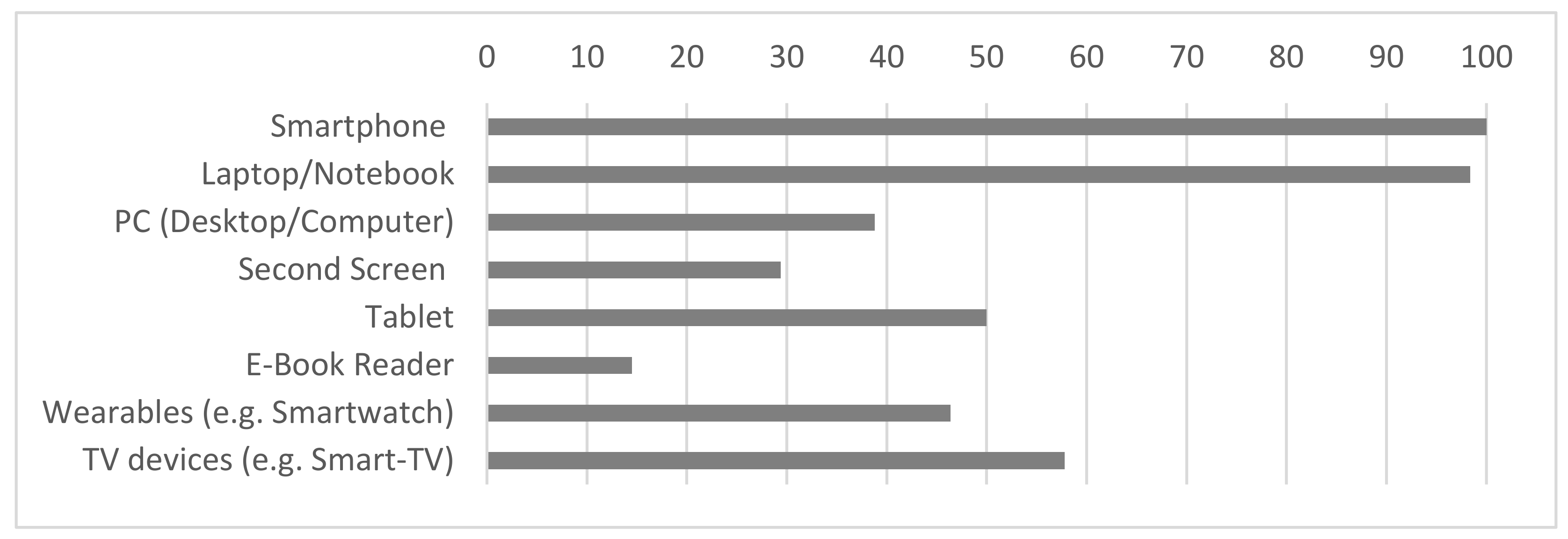
Students’ social practices are primarily guided by smartphones (100%), laptops (98%), and tablets (50%) (Figure 1). The findings of the initial survey reveal that students own these mobile devices most frequently. In contrast, PCs (39%), TV devices (46%), and wearables (46%) are owned by a portion of students but are used overall significantly less frequently than smartphones and laptops. Strikingly, students have a wide range of devices in their individual learning environments. Accordingly, students report owning an average of 4.1 total digital media, although there are differences in the frequency of use and the respective reasons for use depending on the context.
The descriptive results provide the first cautious indications of some specifics in the individual equipment of students with digital media. Accordingly, mobile devices such as smartphones, laptops, and tablets appear to be central components of everyday study life. These offer sufficient flexibility to manage both intensive individual work phases in a private setting and to accompany active participation in formal courses. In contrast, static digital media such as the desktop computer and a second screen offer limited flexibility in terms of location and tend to play a subordinate role in students’ social–learning practices. The latter appear to be favored only by a specific group of users within the student population—namely those who rely on a fixed desktop computer and an additional external monitor. This subgroup tends to work in more technically equipped, stationary study environments, which makes the use of such tools particularly convenient and integral to their study routines.

4.3. Temporal Scope of the Students’ Activities

The findings regarding the organization of social practice provide initial indications of some person-specific preferences in the usage of digital media, which could be due to individual preferences and interests, yet no conclusions should be drawn from this cross-sectional data about the daily intensity of use digital media. Hence, the subjective assessments of the amount of time spent on activities, which originate from the diary study, are used in the following analysis step.
The daily use of digital media (Table 2) shows that students spend the most time using their DigiTaKS* laptops, averaging 143 min a day, followed by their private laptops at 116 min. Tablets are also used quite frequently during studies, averaging 94 min, to take notes, complete study-related tasks, or to study for exams. Smartphones are primarily used for communication with others in a time- and location-flexible manner, in addition to checking and replying to emails and short-term research activities. In this context, students report spending an average of 45 min a day on study-related smartphone use. Here, the standard deviations of the amount of time spent using a second screen and private laptops indicate considerable variance. This reaffirms the assumption that among the study population, different user groups can be identified, characterized by significant variances in the design of their individual learning environments. In contrast, slightly lower standard deviations are evident for the use of tablets and smartphones. Accordingly, these digital media appear to have a similar extent of use across the entire student population.
To gain a more detailed insight into study-related activities (Table 3), students were asked to estimate the amount of time they spent on activities that arose in the context of their studies. The results show that by far the most time is spent on attending courses (M = 158 min), followed by exam preparation (M = 100 min). This is followed by self-study or reading texts, with an average of 84 min per day. In contrast, students invest less time in completing module work and preparation of term papers (in each case 79 min a day on average). These are not necessarily graded, but they are mandatory requirements that may be prerequisites for admission to an examination or for successful completion of a module.
A look at the standard deviations reveals that the amount of time spent attending events differs considerably between days. These strong variances can possibly be attributed to the fact that both study days and days off were included in the learning and usage diary study. In contrast, the standard deviations are low for self-study/reading and exam preparation. These appear to be of roughly constant importance over the study population.
For leisure-related activities (Table 4), the results indicate that students need the most daily time for meetings with other students (M = 157.9 min) and recovery activities such as regeneration (M = 145.5 min). This is followed by voluntary activities, with an average of 123.7 min per day, and sporting activities, with an average of 102.4 min per day.
The largest standard deviation is located in the daily amount of time spent meeting with other students and in voluntary activities. This could indicate considerable intra- and inter-individual variance within the student population for these activities. Intra-individual differences refer to variations in a single student’s behavior across different days or situations, while inter-individual differences refer to variations between different students. It can be assumed that the intensity of the subjectively estimated time spent on each activity differs not only between students but also varies from day to day for the same activity. In contrast, less variation occurs within the student group for sporting activities.

4.4. Practices of Learning-Related Use of Digital Media

Considering the results of the learning and usage diary study, it was possible to gain initial insights into the daily intensity of use and the specific occasions for using differentiated digital media. Exploratory factor analyses were used to work out practices for dealing with digital media. The decision was deliberately made to include digital media available to students in their individual learning environments (possessions of digital media) and the study-, media-, and leisure-related activities (average frequency of activities over a 10-day survey period) in the analysis. This was performed to interlink the two levels and thus elaborate on the latent structures of the observational variable. Specifically, the data from the second (2022) and third (2023) survey waves, which were based on the modifications to the short questionnaire after the first survey wave, were considered. The prerequisites for the factor analysis were checked using the following tests: the KMO criterion and the Bartlett test for sphericity (Bühner, 2011, p. 346). In addition, individual activities were excluded from the analysis considering the anti-image matrices (Kaiser, 1976). Thus, a total of nine activities were included in the factor analysis.
The use of principal component analysis resulted in a three-factor solution, which was subsumed into the following practices based on an interpretation of the content: mobile usage practices in the formal teaching and learning context (Factor 1), regular study- and leisure-related practices (Factor 2), and module completion practices (Factor 3).
Overall, the factor loading matrix has a simple structure; in other words, the variables only ever load onto one factor (Backhaus et al., 2018, p. 399), with the proportion of explained variance being 52%. Therefore, the following specifics can be identified for the digital media use practices:
  • Mobile usage practices in the formal teaching and learning context (Factor 1) are directly related to preparation and follow-up work as well as active participation in study-related courses. In this context, students predominantly use mobile devices such as laptops and tablets to prepare for and follow up on study-related courses at their private desks, in addition to taking notes in the immediate course context. These mobile devices offer strong spatial flexibility, allowing users to use them almost anywhere, not requiring a fixed location or workplace.
  • Regular study- and leisure-related practices (Factor 2) include reading texts, carrying out research activities, and completing module assignments. These can be carried out as individual or group work and are usually accompanied by intensive work phases, e.g., to produce excerpts or summaries. These practices are characterized—unlike the mobile usage practices in the formal teaching and learning context—by activities that are rather location-bound, for which students consciously take time.
  • Module completion practices (Factor 3) are characterized by a high degree of standardization and a strong institutional connection. These include time-intensive activities that serve the preparation of term papers, such as the writing and formatting of texts, but also conceptual activities aimed at preparing presentations. These require a high level of concentration and regular dialogue with other students in order to overcome challenges that arise during content-related and conceptual work (Table 5).
Taking the continuum model (Rosemann, 2025a) into account, the practices identified through factor analysis exhibit certain variations in their positioning within the model. While mobile usage practices are primarily situated across the formal contexts, regular study- and leisure-related practices span all contexts of the model. This indicates a high degree of flexibility in these practices, with considerable variation in their adoption depending on the individual. In contrast, practices related to module completion primarily emerge in informal–digital contexts, even though they are subject to particularly strong formal requirements.

4.5. Characteristics of Challenging Situations in Dealing with Digital Media

Over the 10-day survey period of the learning and usage diary study, 21 students reported a total of 27 challenging situations that occurred when using digital media. Based on practice- and subject-oriented theories (Section 2), challenging situations arise when experiences of discrepancies or disruptions—where a subject’s previous understanding of the world and of themselves in a specific learning context is perceived as insufficient—are recognized as opportunities for learning. In such situations, existing patterns of learning and media use are no longer sufficient, resulting in alternative learning and usage activities involving digital media (Rosemann, 2025a).
In this context, the situational results indicate that laptops play a key role in guiding students’ social practice in dealing with challenges, whereas other (mobile) devices are not applied in these situations. Although smartphones and tablets are certainly used to fulfil study-related tasks, their use is rarely accompanied by challenging moments that require additional digital skill acquisition. This suggests routinised usage practices on the part of students that characterize the use of such devices. Students most frequently experience challenging moments during the design and creation of (innovative) digital content (N = 9). The second-most-common challenges reported by students are those that arise while solving technical problems (N = 7), yet they only rarely report such moments when exchanging information using digital technologies or analyzing data, information, and digital content. From the results of the in-depth follow-up questions on the characteristics of the situations, it can also be concluded that the students are predominantly at their private desks at the time of these challenging situations. By far the largest proportion of challenging situations occur while working with standard software such as MS Office, e.g., when digital material is created during the preparation and follow-up of seminars or for the completion of module work. More specifically, the reported difficulties are primarily of a technical–procedural nature and relate to formatting issues, such as setting up page numbering starting from a specific page (e.g., from page three). These challenges are therefore less associated with cognitive overload, organizational problems, or pedagogical demands, but rather with the practical implementation of document formatting requirements within standard software environments. Moreover, a few challenging situations arise during the acquisition of specific software for data analysis (e.g., SPSS) or video editing.

4.6. Interrelationship Between Spatial Framework Conditions and Practices

Multiple linear regression analyses were carried out in order to obtain information on the direction and effect size of the individual independent variables of the social order of practices (possession of digital media) and the identified digital media use practices. These serve to determine the explanatory value of the independent variables for the frequency of the perception of learning-relevant situations (dependent variable) in study life. The analyses were preceded by an examination of the conditions of multicollinearity and autocorrelation using the Durbin–Watson statistic (Janssen & Laatz, 2013, p. 413). In the multiple linear regression analysis, the independent variables were gradually included in the regression model. The initial model thematizes physical access to digital media. This is gradually expanded to include the three practices of dealing with digital media. The coefficient of determination R2 is used to determine the quality of the model, and the significance is determined using the F-test.
The variance explanation of the first model is 13.1% (Table 6). In Model 1, marginally significant negative effects are found for laptop ownership (B = −1.988, ß = −0.508, p < 0.1), indicating that mere possession of such a comprehensive medium does not necessarily lead to a higher frequency of perceiving learning-relevant situations. By adding the accompanying practices in the formal teaching and learning context (model 2), this increases significantly to 29.4%. Against this background, positive standardized coefficients are apparent, suggesting that intensive use of digital media in formal learning contexts (ß = 0.459, p > 0.1) is associated with a higher frequency of perceiving learning-relevant situations. Model 3 also includes the regular study- and leisure-related practices, which increases the variance explanation by a further 9% to 38.4%. The goodness of fit of the model is significant here (p < 0.024). Furthermore, the highly significant positive effects at this point indicate that more intensive study- and leisure-related practices dealing with digital media are associated with a higher likelihood of encountering learning-relevant situations. Furthermore, the negative effect of laptop ownership (ß = −0.488 *, p > 0.1) suggests that merely owning a laptop tends to reduce the perception of learning-relevant situations when other usage practices are taken into account. Finally, in Model 4, the practices of module completion are integrated, which again significantly increases the variance explanation to 52.1%—with a significant goodness of fit of the model (p < 0.006). Thus, the results of the multiple linear regression analysis indicate that the availability of digital media in the individual learning environment can increase the probability of perceiving learning-relevant situations in everyday study life that arise when using digital media. Positive effects, however, are only evident for the ownership of tablets and e-book readers, as well as mobile usage practices in formal learning contexts. In other words, these digital media and usage practices offer a wide range of opportunities that can initiate digital skills development processes for students by testing software applications. The significant negative coefficient for laptop ownership, which increases from ß = −0.448 * in Model 3 to ß = −0.649 in Model 4 (p > 0.05), suggests a substitution effect: students who primarily rely on mobile devices for flexible, location-independent work tend to use stationary setups with a PC and second monitor less frequently.
The results indicate that mere possession of a laptop does not automatically increase the likelihood of encountering learning-relevant situations; rather, specific usage practices are necessary to have an impact. Students appear to rely either on mobile devices for flexible, location-independent work or on stationary setups for more intensive tasks In particular, intensive mobile usage phases in formal teaching and learning contexts, as well as regular study- and leisure-related practices, are positively associated with a higher frequency of learning-relevant situation perception. The results underscore the significance of digital media for learning behavior and suggest that different practices in handling digital media can influence how students experience and process learning-relevant situations.

5. Discussion

The results of the digital learning and usage diary study underscore the importance of flexibility and mobility in the digital equipment of students and provide valuable insights into the social practices that emerge in the use of digital media in everyday study life. The social (learning-)practice of students is characterized by a specific interplay of digital media, which are arranged by the subject in a certain way in their individual learning environment. The results show that students use a wide variety of digital media equipment, the possible uses of which vary in terms of time and space. Smartphones, tablets, and laptops are poignant in their high degree of spatial flexibility, meaning that they are used in both the private sphere and in formal courses. Compared to other studies (e.g., Janschitz et al., 2021; Dolch et al., 2021), which have so far focused primarily on the ownership and usage of digital media, the presented diary study enables a differentiated analysis of the temporal and spatial conditions under which digital media are used and how they are embedded in the social practices of students. Except for smartphones, mobile devices like laptops and tablets are used particularly intensively by students in terms of time when study-related tasks are completed individually or notes are taken during seminar participation. Smartphones are used selectively during everyday study when short-term coordination processes with others are necessary, information and data are shared with others, or information can be researched flexibility in terms of time and space. Mobile devices function as an interface between analog and digital contexts and represent bridging practices that create multiple opportunities for the development of digital competencies. This flexibility in the use of digital media offers numerous chances to develop digital competencies in various contexts, which can help counteract the digital divide. However, without reflection, the learning process remains superficial, and the digital divide may persist or even widen if students are not supported in applying, evaluating, and adapting their digital practices across different contexts. At this point, it becomes important to differentiate between technological familiarity and technological awareness (Sneltvedt et al., 2025). While students may display a high level of confidence and routine in using digital tools across different contexts, this does not necessarily imply a reflective or strategic understanding of their use. Without explicit opportunities to develop such awareness—i.e., to critically reflect on the purposes, implication, and transferability of their digital practices—the development of digital competence remains limited to functional use.
From an educational perspective, learning environments need to be deliberately designed to make digital practices visible, discussable, and transferable across contexts. In this framework, instructors are expected to serve as learning mentors who not only evaluate learning outcomes (e.g., term papers), typically produced through independent work, but also guide students throughout the entire learning and creation process. Implementing this approach requires the adoption of innovative assessment formats (e.g., digital learning portfolios) that foster ongoing reflective practice.
From the study-, leisure-, and media-related complexes of student activities and physical access to digital media, three different practices of digital media use in social practice could be factor-analyzed. These practices are operationalized through the allocation of temporal resources, that is, how much subjective time students spend on specific activities. With reference to the current state of research on students’ practices of using digital media, the factor analysis made it possible to identify rather broad, abstract categories of practices. In this analysis, the identified practices served primarily to examine explanatory contributions in order to determine how strongly they influence the perception of learning situations. In contrast, qualitative approaches (e.g., Schiefner-Rohs & Krein, 2023; Rosemann, 2025b), which focus on more interpretative evaluation procedures, allow for finer and more detailed classification. This explains why different data collection methods yield differentiated classifications, but only the combination of both qualitative and quantitative methods allows for a comprehensive view of students’ digital learning and usage practices.
The availability of digital media, particularly the use of laptops, creates many opportunities for students to try out new functions and independently design digital materials; however, these opportunities have to be actively utilized by students, as mere possession of a laptop is not sufficient to trigger digital competence development processes and thus reduce the digital divide. Thus, the results of the multivariate regression analysis—which draws on the previously identified practices—show that flexible, reflective, and critical use of digital media within the continuum of learning contexts is particularly decisive for the perception of learning-relevant situations. These findings suggest that teaching formats which explicitly require students to reflect on their digital practices—such as comparing tools, justifying media choices, or transferring practices between study-related and non-study contexts—are more likely to be perceived as learning-relevant and supportive of digital competence development. In this context, regular study- and leisure-related practices, which include research activities and the completion of module tasks, offer a wide range of learning opportunities and highlight the importance of instructors’ roles in shaping these practices. The relevance of these findings becomes particularly apparent when compared with international studies. At this point, the study can be situated, on the one hand, within the international research context, which shows that the digital competencies and didactic expertise of instructors are crucial for fostering specific student learning practices. These practices should actively engage students, promote critical reflection, and enable collaborative learning processes (Dong Dang et al., 2024). On the other hand, it cannot be ruled out that, in international comparison, there are cultural, societal, and infrastructural differences in students’ digital learning and usage practices. These differences are particularly evident in the temporal and spatial patterns of specific digital media use. Recent international studies indicate, for example, that students in developing countries rely primarily on smartphones as their central mobile devices, while laptops are used less frequently (Patrick Saidi et al., 2025; Imtinan et al., 2025). By contrast, European studies suggest that differences in digital learning and usage practices of German students compared to those of students in other European countries are less pronounced. Findings from Greece (Nikolopoulou, 2022) and Spain (López-Noguero & Gallardo-López, 2022) indicate that students primarily use smartphones for flexible, time- and location-independent information searching, accessing course materials, and communication. At this point, cross-country comparisons could be conducted to identify how cultural, infrastructural, and educational factors shape students’ digital practices and to determine which conditions support more effective and equitable digital learning. At the same time, these practices appear to be strongly dependent on higher education institutions, suggesting that differences may also exist within countries depending on institutional policies, available resources, and teaching approaches.
In summary, three central areas of action for higher education institutions can be identified based on the findings: Curricula should be designed to integrate structured opportunities for students to reflect on their digital practices, enabling the development of technological awareness alongside subject-specific knowledge. Further, universities need learning and support offerings that are accessible to all instructors and students in order to promote active engagement with a variety of digital applications (e.g., software, AI tools). Higher education institutions should provide low-threshold support structures, such as easily accessible guidance, workshops, and advisory services, to help teachers and students develop reflective and transferable digital competencies. Furthermore, the indirect promotion of digital competencies through structured integration of digital tools into formal learning and teaching contexts is particularly important, as it allows students to develop skills organically while engaging with their regular coursework. Moreover, the probability of perceiving learning-relevant situations increases when students carry out digital practices that begin in the context of formal teaching and learning settings at university. These include self-study tasks requiring students to design digital materials actively and autonomously (e.g., podcasts, videos). Similarly, lecturers can initiate learning-relevant situations that can initiate digital skill development processes with digital media in courses, especially in group work sessions. Mobile devices should be regarded not as a disruptive factor, but as a didactic resource that can meaningfully support and complement learning processes. Against this background, regular reflection phases during the execution of individual and group work promote a reflective, critical approach to digital media and materials. These reflection phases can contribute to generating a change in perspective on the part of the subject, thereby stimulating sensitivities in the use of digital information that accompany the learning process and thus initiate processes of digital competence development.

6. Conclusions and Limitations

This learning and usage diary study provides a deeper insight into the interplay between student’s individual (digital) learning environments and their (digital) learning and usage practices, which are shaped by the culture of digitality, to derive actionable recommendations for promoting digital competencies. The study had the advantage that memory-related issues—which frequently occur in cross-sectional surveys—were reduced due to the shorter reference period of the items. Using this method, it was possible to not only capture subjective assessments of the time spent on study-relevant activities but also to identify particularly challenging moments that students encounter when dealing with digital media. However, it cannot be ruled out that, due to memory issues, some research-relevant situations may remain unaccounted for. Even the relatively low-frequency of use of specific programs and software (e.g., SPSS, video editing tools) within formal teaching and learning contexts in higher education may explain why students have rarely encountered challenging situations when working with these applications.
Even so, memory distortions in retrospective subjective assessments of the time spent on activities cannot be ruled out (see, among others Schmidt-Lauff, 2025), although the short reference period of the survey instrument used contributed to reducing them. Supplementing these subjective assessments of time durations with digitally generated time logs could provide interesting insights and reduce memory issues. This could be implemented, for example, through the use of time tracking software, although its incorporation into the research process involves some methodological challenges in data collection and interpretation that can only be mitigated through triangulation of different methodologies. Thus, (digital) ethnographic observations—combined with in-depth (episodic) interviews—could provide valuable insights into identifying situational variations that arise in the (learning-related) use of digital media. An alternative approach would be to combine subjective self-assessments, such as those collected in the present study, with learning analytics, allowing digital learning and usage practices to be examined from multiple perspectives and thus linking subjective and objective approaches in a meaningful way. This method could provide a deeper understanding of students’ perception of time in the context of digitalization, supporting a triangulated perspective on time perception (Schmidt-Lauff et al., 2025).
In this regard, future studies should place greater emphasis on contextual factors of the (individual and social) learning environment (Vallo Hult & Byström, 2022) to better understand the interplay between the orders of social practices and specific (learning) activities. In the study presented here, the focus was on the design of students’ individual (digital) learning environments and less on their social and cultural conditions. Considering these factors could provide valuable insights into how collective practices, institutional frameworks, and cultural norms influence the use of digital media and, in turn, promote or inhibit the development of digital competencies. Furthermore, for a comprehensive explanation of the “digital divide,” alongside physical access and specific practices, future studies could also consider subjective motives and specific competencies in handling digital media and their content, drawing from J. van Dijk (2020).
In summary, while this learning and usage diary study provides valuable insights into the practices that emerge from the interrelationship between individual digital learning environments and students’ study-, leisure-, and media-related activities, this study goes beyond mere usage and time studies and offers valuable recommendations for designing higher education environments that foster active learning practices and reflection, which can initiate and support processes of digital competency development.


Funding

This research was funded by the project “Digital Key Competencies for Study and Work–Development of a Model for the Transformative Digital Competence Development of Students (DigiTaKS*)” (2021–2026). The project is funded by the Center for Digitalization and Technology Research of the German Armed Forces (dtec.bw) and financed by the European Union in the context of “NextGenerationEU.”

Institutional Review Board Statement

The study was conducted in accordance with the Declaration of Helsiniki. The survey instruments (quantitative questionnaires) used in the research presented in this paper were approved on 05.07.2022 by the General Data Protection Officer of the institution where all research was undertaken (Helmut-Schmidt-University/University of the Federal Armed Forces). Further ethical approval was not necessary for the presented study results, as guidelines from the Institution where the study was held do not see them necessary for quantitative surveys within the institution itself. Survey participation was anonymous and voluntary. All participants signed a comprehensive declaration of consent that can be revoked at all times.

Informed Consent Statement

Informed consent was obtained from all subjects involved in the study.

Data Availability Statement

The data presented in this study are available on request from the corresponding author, as they are still needed for ongoing analyses until the completion of the project at the end of 2026. The data underlying this study will be made available in a suitable repository after the end of the project.

Conflicts of Interest

The funders had no role in the design of the study; in the collection, analyses, or interpretation of data; in the writing of the manuscript; or in the decision to publish the results.

Notes

1
University of the Federal Armed Forces, Hamburg.
2
The entrance survey was conducted within the context of the DigiTaKS* project with all students from the cohorts of 2021, 2022, and 2023. In this context, a total of 240 students were surveyed at the beginning of their studies. In the present article, only the data from the entrance surveys of those students who also participated in the learning and usage diary study are included.
3
As part of the DigiTaKS* research and development project, all students were provided with laptops.

References

  1. Alkemeyer, T., & Buschmann, N. (2016). Praktiken der subjektivierung—Subjektivierung als praxis. In Praxistheorie (pp. 115–136). De Gruyter Brill. [Google Scholar] [CrossRef]
  2. Al Khateeb, A. A. M. (2017). Measuring digital competence and ICT literacy: An exploratory study of in-service English language teachers in the context of Saudi Arabia. International Education Studies, 10(12), 38–51. [Google Scholar] [CrossRef]
  3. Author Group for the Education Report. (2024). Education in Germany 2024: An indicator-based report with an analysis on vocational education. wbv Publikation. [Google Scholar]
  4. Backhaus, K., Erichson, B., Plinke, W., & Weiber, R. (2018). Multivariate analysemethoden: Eine anwendungsorientierte einführung. Springer. [Google Scholar] [CrossRef]
  5. Barragán Moreno, S. P., & Guzmán Rincón, A. (2025). Digital divide as an explanatory variable for dropout in higher education. International Journal of Educational Technology in Higher Education, 22(1), 60. [Google Scholar] [CrossRef]
  6. Biehl, A., & Besa, K. S. (2021). Zusammenhänge zwischen der mediennutzung studierender und ihrer dozierenden an Deutschen hochschulen: Eine explorative studie. MedienPädagogik: Zeitschrift für Theorie und Praxis der Medienbildung, 40, 77–96. [Google Scholar] [CrossRef]
  7. Boerma, S., de Laat, M., & Vermeulen, M. (2025). The relationship between organisational agility and informal learning. Management Review Quarterly, 75, 3327–3356. [Google Scholar] [CrossRef]
  8. Bolger, N., Davis, A., & Rafaeli, E. (2003). Diary methods: Capturing life as it is lived. Annual Review of Psychology, 54(1), 579–616. [Google Scholar] [CrossRef]
  9. Bond, M., Marín, V. I., Dolch, C., Bedenlier, S., & Zawacki-Richter, O. (2018). Digital transformation in German higher education: Student and teacher perceptions and usage of digital media. International Journal of Educational Technology in Higher Education, 15(1), 1–20. [Google Scholar] [CrossRef]
  10. Breitschwerdt, L., Rosemann, T., & Schiller, J. (2025). Digitalization and higher education in Germany: Promotion of transformative digital competences. In L. A. Cordie (Ed.), Transition from pedagogy to andragogy: An international perspective. Emerald. [Google Scholar]
  11. Breitschwerdt, L., Thees, A., & Egetenmeyer, R. (2022). Digitale medien in der erwachsenenbildung/weiterbildung. Magazin Erwachsenenbildung.at, 44, 1–11. [Google Scholar]
  12. Buzzetto-Hollywood, N. A., Elobeid, M., & Elobaid, M. E. (2018). Addressing information literacy and the digital divide in higher education. Interdisciplinary Journal of e-Skills and Lifelong Learning, 14, 77–93. [Google Scholar] [CrossRef]
  13. Bühner, M. (2011). Einführung in die test- und fragebogenkonstruktion (3rd ed.). Pearson. [Google Scholar]
  14. Destatis. (2026). Studierende an hochschulen. statistisches bundesamt. Available online: https://www.destatis.de/DE/Themen/Gesellschaft-Umwelt/Bildung-Forschung-Kultur/Hochschulen/Tabellen/lrbil01.html#242472 (accessed on 17 January 2026).
  15. Dolch, C., Zawacki-Richter, O., Bond, M., & Marín, V. I. (2021). Higher education students’ media usage: A longitudinal analysis. Asian Journal of Distance Education, 16(1), 31–53. [Google Scholar] [CrossRef]
  16. Dong Dang, T., Tú Phan, T., Nhu Quynh Vu, T., Dung La, T., & Kiem Pham, V. (2024). Digital competence of lecturers and its impact on student learning value in higher education. Heliyon, 10(17), e37318. [Google Scholar] [CrossRef]
  17. Federal Ministry for Family Affairs, Senior Citizens, Women and Youth. (2024). Voluntary engagement in Germany: Key results of the 2024 volunteer survey. Federal Ministry for Family Affairs, Senior Citizens, Women and Youth.
  18. Harteis, C. (2017). Machines, change and work: An educational view on the digitalization of work. In The impact of digitalization in the workplace: An educational view (pp. 1–10). Springer International Publishing. [Google Scholar]
  19. Holzkamp, K. (1995). Lernen. Subjektwissenschaftliche grundlegung. Campus. [Google Scholar]
  20. Imtinan, U., Issa, T., Mwagwabi, F., Hamadi, M., Shamsi, U. R., Issa, T., Maketo, L., Balapumi, R., & Siwale, M. (2025). Switching mobile learning on in Pakistan: Students’ experiences and perceptions of mobile learning activities and applications. International Review of Education, 71, 1–27. [Google Scholar] [CrossRef]
  21. Janschitz, G., Monitzer, S., Archan, D., Dreisiebner, G., Ebner, M., Hye, F., Kopp, M., Mossböck, C., Nagler, W., Orthaber, M., Rechberger, M., Rehatschek, H., Slepcevic-Zach, P., Stock, M., Swoboda, B., & Teufel, M. (2021). Alle(s) digital im Studium?!: Projektbericht der Steirischen hochschulkonferenz zur analyse digitaler kompetenzen von studienanfängerinnen. Graz University Library Publishing. [Google Scholar] [CrossRef]
  22. Janschitz, G., & Penker, M. (2022). How digital are ‘digital natives’ actually? Developing an instrument to measure the degree of digitalisation of university students—The DDS-Index. Bulletin of Sociological Methodology/Bulletin de Méthodologie Sociologique, 153(1), 127–159. [Google Scholar] [CrossRef]
  23. Janssen, J., & Laatz, W. (2013). Statistische datenanalyse mit SPSS: Eine anwendungsorientierte einführung in das basissystem und das modul exakte tests. Springer. [Google Scholar]
  24. Kaiser, H. F. (1976). Image and anti-image covariance matrices from a correlation matrix that may be singular. Psychometrika, 41(3), 295–300. [Google Scholar] [CrossRef]
  25. Kelder, J. A., Crawford, J., Al Naabi, I., & To, L. (2025). Enhancing digital productivity and capability in higher education through authentic leader behaviors: A cross-cultural structural equation model. Education and Information Technologies, 30, 17751–17767. [Google Scholar] [CrossRef]
  26. Kirchhöfer, D. (2001). Perspektiven des lernens im sozialen umfeld. In A. B. Weiterbildungsforschung (Ed.), Kompetenzentwicklung 2001 (pp. 95–142). Waxmann. [Google Scholar]
  27. Köstler, V., & Wolff, M.-S. (2025). Promoting digital competencies in pre-service teachers: The impact of integrative learning opportunities. Education Sciences, 15(3), 337. [Google Scholar] [CrossRef]
  28. Kraus, K. (2022). Die entwicklung von beruflichkeit über iterative lern- und bildungsprozesse. Zeitschrift für Weiterbildungsforschung, 45(1), 51–67. [Google Scholar] [CrossRef]
  29. Kroher, M., Beuße, M., Isleib, S., Becker, K., Ehrhardt, M. C., Gerdes, F., Koopmann, J., Schommer, T., Schwabe, U., Steinkühler, J., Völk, D., Peter, F., & Buchholz, S. (2023). The student survey in Germany: 22nd social survey—The economic and social situation of students in Germany 2021. German Centre for Higher Education Research and Science Studies (DZHW). [Google Scholar]
  30. López-Noguero, F., & Gallardo-López, J. A. (2022). The educational use of the smartphone by university students of social education and social work. Revista Fuentes, 24(1), 39–53. [Google Scholar] [CrossRef]
  31. Marotzki, W. (2006). Forschungsmethoden und -methodologie der erziehungswissenschaftlichen biografieforschung. In H. H. Krüger, & W. Marotzki (Eds.), Handbuch erziehungswissenschaftliche biografieforschung. Springer VS. [Google Scholar]
  32. Nikolopoulou, K. (2022). Students’ mobile phone practices for academic purposes: Strengthening post-pandemic university digitalization. Sustainability, 14(22), 14958. [Google Scholar] [CrossRef]
  33. Norris, P. (2001). Digital divide: Civic engagement, information poverty, and the internet worldwide. Cambridge University Press. [Google Scholar]
  34. Otto, S., Bertel, L. B., Lyngdorf, N. E. R., Markman, A. O., Andersen, T., & Ryberg, T. (2024). Emerging digital practices supporting student-centered learning environments in higher education: A review of literature and lessons learned from the COVID-19 pandemic. Education and Information Technologies, 29(2), 1673–1696. [Google Scholar] [CrossRef]
  35. Patrick Saidi, K., Athuman Jumanne, J., Mark Makwinya, N., & Nicodemus Lyimo, N. (2025). Determinants of mobile devices adoption amongst students: A case of Sokoine university of agriculture, Tanzania. East African Journal of Education and Social Sciences, 6(1), 65–77. [Google Scholar] [CrossRef]
  36. Prensky, M. (2001). Digital natives, digital immigrants part 2: Do they really think differently? On the Horizon, 9(6), 1–6. [Google Scholar] [CrossRef]
  37. Rahmadi, I. F. (2024). Research on digital transformation in higher education: Present concerns and future endeavours. TechTrends, 68, 647–660. [Google Scholar] [CrossRef]
  38. Rathmann, M., Rosemann, T., Schiller, J., Schmidt-Lauff, S., & Schwarz, J. (2022). Digitalität als herausforderung und chance. Eine multiperspektivische analyse zu bedarfslagen. openHSU. [Google Scholar]
  39. Rausch, A. (2013). Task characteristics and learning potentials—Empirical results of three diary studies on workplace learning. Vocations and Learning, 6(1), 55–79. [Google Scholar] [CrossRef]
  40. Rausch, A., Scheja, S., Dreyer, K., Warwas, J., & Egloffstein, M. (2010). Emotionale befindlichkeit in lehr-lern-prozessen—Konstruktverständnis und empirische zugänge. Lehr-Lern-Forschung in der kaufmännischen Berufsbildung–Ergebnisse und Gestaltungsaufgaben, 23, 193–215. [Google Scholar] [CrossRef]
  41. Reckwitz, A. (2003). Grundelemente einer theorie sozialer praktiken/Basic elements of a theory of social practices. Zeitschrift für Soziologie, 32(4), 282–301. [Google Scholar] [CrossRef]
  42. Rosemann, T. (2022). Informelle und non-formale lernaktivitäten im arbeitsalltag: Analyse betrieblicher lernkontexte von beschäftigten in pflegeberufen. wbv Media. [Google Scholar] [CrossRef]
  43. Rosemann, T. (2025a). Lernkomplexe studierender auf einem kontinuum der formalität und digitalität. Bildungsforschung, 31(01), 1–18. [Google Scholar] [CrossRef]
  44. Rosemann, T. (2025b). Lern- und aktivitätskomplexe studierender auf einem kontinuum der formalität und digitalität: Ergebnisse einer inhalts- und situationsanalyse. In S. Schmidt-Lauff (Ed.), Transformative digitale kompetenzen. Entwicklungen für hochschule, studium und gesellschaft (1st ed., pp. 35–66). wbv. [Google Scholar]
  45. Schatzki, T. (2014). Practices, governance and sustainability. In Social practices, intervention and sustainability (pp. 15–30). Routledge. [Google Scholar]
  46. Schatzki, T. R. (2001). Introduction. Practice theory. In T. R. Schatzki, K. Knorr Cetina, & E. von Savigny (Eds.), The practice turn in contemporary theory (pp. 1–23). Routledge. [Google Scholar]
  47. Schatzki, T. R. (2002). The site of the social: A philosophical account of the constitution of social life and change. Penn State Press. [Google Scholar]
  48. Schatzki, T. R. (2010). The timespace of human activity: On performance, society, and history as indeterminate teleological events. Lexington Books. [Google Scholar]
  49. Schiefner-Rohs, M., & Krein, U. (2023). Medienbezogene praktiken von lehramtsstudierenden. Erkenntnisse aus sicht von studierenden. Unterrichtswissenschaft, 51, 623–642. [Google Scholar] [CrossRef]
  50. Schmid, U., Goertz, L., Radomski, S., Thom, S., & Behrens, J. (2017). Monitor digitale bildung: Die hochschulen im digitalen zeitalter. Bertelsmann Stiftung. [Google Scholar] [CrossRef]
  51. Schmidt-Lauff, S. (Ed.). (2025). Transformative digitale kompetenzen. Entwicklungen für hochschule, studium und gesellschaft. In Innovative hochschule: Digital—international—transformative (Vol. 6). wbv. [Google Scholar] [CrossRef]
  52. Schmidt-Lauff, S., Breitschwerdt, L., Egetenmeyer, R., Hassinger, H., Hümmer, C., Miller, M., Rathmann, M., Rosemann, T., Schasse de Araujo, B., Schiller, J., & Schubert, J. (2025). Gedankensplitter zu temporalen, digitalen, virtuellen und hybriden phänomenen von lehren und Lernen. In S. Schmidt-Lauff (Ed.), Transformative digitale kompetenzen. Entwicklungen für hochschule, studium und gesellschaft (Vol. 1, pp. 35–66). wbv. [Google Scholar]
  53. Schmidt-Lauff, S., Schwarz, J., Rosemann, T., Rathmann, M., & Schiller, J. (2022). DigiTaKS–Digitale schlüsselkompetenzen für studium und beruf. openHSU. [Google Scholar] [CrossRef]
  54. Schwarz, J., Rosemann, T., & Rathmann, M. (2021). Educated for the digital transformation?! Students’ acquisition of competencies for digital learning and teaching during and past pandemic times. EPALE Journal on Adult Learning and Continuing Education, 10, 91–101. [Google Scholar]
  55. Sneltvedt, O., Geirbo, H. C., & Haagensen, T. K. (2025). Teaching technology awareness: Capabilities and thresholds to think about technology. In Frontiers in education. Frontiers Media SA. [Google Scholar] [CrossRef]
  56. Stalder, F. (2021). Kultur der digitalität. Suhrkamp Verlag. [Google Scholar] [CrossRef]
  57. Tang, Q., Kamarudin, S., Abdul Rahman, S. N., & Zhang, X. (2025). Bridging gaps in online learning: A systematic literature review on the digital divide. Journal of Technology and Online Learning, 15(1), 1–25. [Google Scholar] [CrossRef]
  58. Tannenbaum, S. I., Mathieu, J., & Luciano, M. (2024). Exploring the interplay between formal and informal learning: A quasi-experimental investigation. Academy of Management Discoveries, 11(4), 500–520. [Google Scholar] [CrossRef]
  59. Tulodziecki, G., Herzig, B., & Grafe, S. (2021). Medienbildung in schule und unterricht: Grundlagen und beispiele. Utb. [Google Scholar]
  60. UNESCO. (2012). International standard classification of education: ISCED 2011. UNESCO Institute for Statistics. Available online: https://unesdoc.unesco.org/ark:/48223/pf0000219109 (accessed on 15 September 2025).
  61. Vallo Hult, H., & Byström, K. (2022). Challenges to learning and leading the digital for statistics. Workplace. Studies in Continuing Education, 44(3), 460–474. [Google Scholar] [CrossRef]
  62. van Dijk, J. (2020). The digital divide. John Wiley & Sons. [Google Scholar]
  63. van Dijk, J. A., & van Deursen, A. J. (2014). Solutions: Learning digital skills. In Digital skills: Unlocking the information society (pp. 113–138). Palgrave Macmillan US. [Google Scholar]
  64. Vogel, B. (2020). Das Selbststudium der Studierenden. Ergebnisse einer Befragung zur zeitlichen und räumlichen Organisation des Lernens. In R. Stang, & A. Becker (Eds.), Zukunft lernwelt hochschule: Perspektiven und optionen für eine neuausrichtung (pp. 149–164). de Gruyter. [Google Scholar] [CrossRef]
  65. Weidenmann, B. (2011). Multimedia, multicodierung und multimodalität beim online-lernen. In P. Klimsa, & L. J. Issing (Eds.), Online-lernen: Handbuch für wissenschaft und praxis (pp. 73–86). Oldenbourg Wissenschaftsverlag Verlag. [Google Scholar]
  66. Werquin, P. (2009). Recognition of non-formal and informal learning in OECD countries: An overview of some key issues. REPORT–Zeitschrift für Weiterbildungsforschung, 32(3), 11–23. [Google Scholar] [CrossRef]
  67. Zawacki-Richter, O., Kerres, M., Bedenlier, S., Bond, M., & Buntins, K. (2020). Systematic reviews in educational research: Methodology, perspectives and application (p. 161). Springer Nature. [Google Scholar]
  68. Zinn, B., Brändle, M., Pletz, C., & Schaal, S. (2022). Wie schätzen Lehramtsstudierende ihre digitalisierungsbezogenen Kompetenzen ein? Eine hochschul- und fächerübergreifende Studie. In Die hochschullehre (pp. 156–171). wbv. [Google Scholar] [CrossRef]
Figure 1. Possession of digital media (percentage frequency).
Education 16 00208 g001
Table 1. Characteristics of digital usage and learning diary study.
Entrance SurveyDiary Study
Personal characteristicsCharacteristics of Day
Socio-cultural characteristics
  • Gender
  • Migration background
Educational and occupational characteristics
  • School-leaving qualification
  • Pre-study and work-related experience
Study-related characteristics
  • Department
  • Recreational commitment
  • Details of daily program
  • Study- and leisure-related practices of day, and time range
  • Media-related practices in context of degree program, and time range 1
  • Number of courses (in-person and digital)
Characteristics of media useEvents in Dealing with Digital Media
  • Use of digital media for study and leisure
  • Use of digital tools for study and leisure
  • Learning with didactically structured media
Challenging event
  • Study-related context of events
  • Digital media
  • Software/digital tool
  • Location and time
  • Degree of success
  • Learning activities
  • Solution
1 This category was only surveyed in the second and third years of study (2022 and 2023).
Table 2. Temporal intensity of digital media activities (in minutes).
Digital Media ActivitiesMeanMinMaxSD
Smartphone45139070.1
DigiTaKS* Laptop1432735364.9
Private Laptop116131099.1
Second Screen64132098.7
Tablet94125063.4
Other Devices1.011.170.3
Remarks: Means (Mean; average minutes per day) ± standard deviation (SD; standard deviation in minutes), as well as minimum (Min; minimum minutes per day) and maximum (Max; maximum minutes per day) values of the measured data. N = 70.
Table 3. Temporal intensity of study-related activities (in minutes).
Study-Related ActivitiesMeanMinMaxSD
Self-study reading83.918.3240.050.8
Module services79.25.0240.079.2
Presentation preparation81.51.0240.065.6
Exam preparation100.21.0300.070.6
Preparation of term paper79.15.0240.057.8
Participation in events158.21.0330.0158.1
Other study-related activities1.11.02.00.2
Remarks: Means (Mean; average minutes per day) ± standard deviation (SD; standard deviation in minutes), as well as minimum (Min; minimum minutes per day) and maximum (Max; maximum minutes per day) values of the measured data. N = 70.
Table 4. Temporal intensity of leisure-related activities (in minutes).
Leisure-Related ActivitiesMeanMinMaxSD
Regeneration145.510.0360.090.4
Volunteering123.71.0310.098.7
Meetings with others157.91.0450.0108.8
Sport102.420.0250.049.1
Other leisure activities1.11.12.00.2
Remarks: Means (Mean; average minutes per day) ± standard deviation (SD; standard deviation in minutes), as well as minimum (Min; minimum minutes per day) and maximum (Max; maximum minutes per day) values of the measured data. N = 70.
Table 5. Highest factor loadings of the individual variables.
ActivitiesFactor 1Factor 2Factor 3
DigiTaKS* laptop0.825
Tablet0.710
Participation in events0.491
Self-study reading 0.572
Module services 0.669
Other leisure activities 0.760
Preparation of term papers 0.819
Presentation preparation 0.594
Smartphone use 0.483
Remarks: Factor loadings of variables on extracted factors. The table presents the rotated factor solution. Factor loadings represent the correlation between variables and factors.
Table 6. Multiple linear regression.
FactorsModel 1Model 2Model 3Model 4
BβBβBβBβ
Laptop−1.988−0.508 *−1.475−0.377−1.754−0.448 *−2.540−0.649 **
PC0.0490.064−0.066−0.085−0.181−0.235−0.076−0.098
Second screen−0.148−0.191−0.109−0.141−0.005−0.006−0.118−0.153
Tablet−0.031−0.0380.0180.0220.1850.2270.2780.342
E-book reader0.0680.072−0.190−0.201−0.140−0.1480.0110.011
Wearables−0.232−0.289−0.264−0.329−0.237−0.296−0.111−0.139
Mobile usage practices in formal learning context 0.6480.495 *0.4720.3600.1220.093
Regular study- and leisure-related practices 0.7690.4371.4160.804 **
Module completion practices −0.636−0.491 *
R233.2%48.4%57.4%68.7%
Korr.13.1%29.4%38.4%52.1%
Remarks: Results of a hierarchical multiple linear regression. The table shows unstandardized regression coefficients (B) and standardized coefficients (β) for each predictor across four models. R2 represents the proportion of variance explained by each model, and adjusted R2 (Korr.) accounts for model complexity. Significance level: ** p < 0.05, * p < 0.1.
Disclaimer/Publisher’s Note: The statements, opinions and data contained in all publications are solely those of the individual author(s) and contributor(s) and not of MDPI and/or the editor(s). MDPI and/or the editor(s) disclaim responsibility for any injury to people or property resulting from any ideas, methods, instructions or products referred to in the content.