Redefining Agency: A Capability-Driven Research Agenda for Generative AI in Education


Abstract
1. Introduction
- Research Question: From the perspective of educational research centred on digital empowerment, what aspects of the impact of generative AI on education should be focused on, and how should research questions be identified to ensure the expansion of human capabilities?
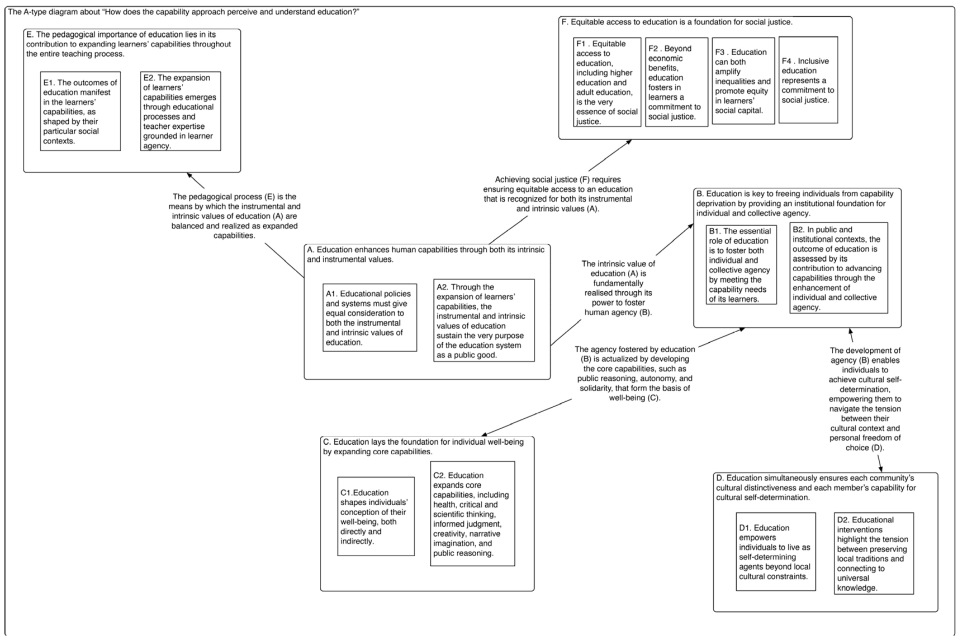
2. Analytical Framework: The Reconstructed CDDEF
- A.
- Education enhances human capabilities through both its intrinsic and instrumental values.
- B.
- Education is key to freeing individuals from capability deprivation by providing an institutional foundation for individual and collective agency.
- C.
- Education lays the foundation for individual well-being by expanding core capabilities.
- D.
- Education simultaneously ensures each community’s cultural distinctiveness and each member’s capability for cultural self-determination.
- E.
- The pedagogical importance of education lies in its contribution to expanding learners’ capabilities throughout the entire teaching process.
- F.
- Equitable access to education is a foundation for social justice.
3. Methodology
3.1. Data Collection and Search Protocol
3.2. Methodological Rationale
3.3. Data Analysis
3.4. Limitations
3.5. Use of Generative AI in This Paper
4. Results
4.1. Thesis A: Education Enhances Human Capabilities Through Both Its Intrinsic and Instrumental Values
4.1.1. Deeper Considerations: The Trade-Off and Measurement of Values
4.1.2. New Perspectives for Expansion: The Capabilities of Educators
4.2. Thesis B: Education as an Institutional Foundation for Agency
4.2.1. Deeper Considerations: Distinguishing “Authentic” from “Simulated” Agency
4.2.2. New Perspectives for Expansion: From Individual to Collective Agency
4.3. Thesis C: Education as the Foundation for Well-Being Through Core Capabilities
4.3.1. Deeper Considerations: The Ambiguous Impact of Generative AI on Core Capabilities
4.3.2. New Perspectives for Expansion: The Impact on Social and Emotional Capabilities
4.4. Thesis D: Education for Cultural Distinctiveness and Self-Determination
4.4.1. Deeper Considerations: The Pedagogy of “Integration” Between Universal and Local Knowledge
4.4.2. New Perspectives for Expansion: The Decolonisation of Educational AI and Epistemological Diversity
4.5. Thesis E: The Pedagogical Importance of Education Lies in Its Contribution to Expanding Learners’ Capabilities Throughout the Entire Teaching Process
4.5.1. Deeper Considerations: The New Professionalism of Teachers in the AI Era
4.5.2. New Perspectives for Expansion: Redesigning Collaborative Learning Enabled by AI
4.6. Thesis F: Equitable Access to Education Is a Foundation for Social Justice
4.6.1. Deeper Considerations: From “Access Gaps” to “Quality of Use Gaps”
4.6.2. New Perspectives for Expansion: Global Justice in the Educational AI Supply Chain
5. Discussion
5.1. Synthesising the Research Agenda: Cross-Cutting Themes in the Age of Generative AI
5.1.1. The Double-Edged Sword: Navigating the Ambiguous Impact of AI on Human Capabilities
5.1.2. From “Access” to “Quality” and “Justice”: The Evolving Landscape of Educational Inequality
5.1.3. The Human in the Loop: Redefining the Roles of Educators and Learners
5.2. Implications of the Study
5.2.1. Implications for Researchers: A Roadmap for Future Inquiry
5.2.2. Implications for Practitioners
- Recommendation 1 (Pedagogy): Implement “AI-Fading” strategies in curriculum design. Rather than constant AI assistance, educators should design sequences where AI support is gradually withdrawn to ensure skill internalisation and autonomy.
- Recommendation 2 (Assessment): Shift assessment focus from summative grading to formative feedback. As AI can easily generate final outputs, the pedagogical value must shift to the process of “dialogue” with AI (e.g., critiquing AI outputs, iterative prompting).
- Recommendation 3 (Collaboration): Foster “Collective Agency” by designing group projects where learners use AI to address local community challenges, thereby connecting technical skills with social purpose.
5.2.3. Implications for Policymakers
- Recommendation 1 (Equity): Position education as a bulwark against the “quality of use gap.” This requires public investment not just in access, but in equitable infrastructure (high-quality models and hardware) for under-resourced schools to prevent a “capability caste system.”
- Recommendation 2 (Protection): Protect “Educational Time” from market pressures. Regulations should ensure that AI integration is not aimed solely at “productivity gains” or cost-cutting, but guarantees temporal space for reflective inquiry and human mentorship.
- Recommendation 3 (Literacy): Mandate “Algorithmic Literacy” education. To ensure democratic participation, curricula must include a critical understanding of AI’s mechanisms and biases, empowering learners to govern the technology rather than be governed by it.
5.3. Theoretical Contribution and Limitations
5.3.1. Advancing the CDDEF as an Analytical Tool
5.3.2. Limitations and Future Directions
- Selection Bias: As an exploratory review with a small, purposive sample (N = 21), this study does not capture the entire landscape of AI education research. A broader systematic review, including grey literature or non-English sources, might reveal different themes or contradict our findings regarding the “quality of use” gap.
- Framework Dependence: Our results are heavily contingent on the specific theoretical lens of the CDDEF. If this framework fails to capture certain dimensions—such as the political economy of EdTech or cognitive science perspectives on learning transfer—the proposed research agenda may be incomplete or skewed.
- Lack of Triangulation: The present analysis relies on a deductive thematic analysis of text. Without empirical triangulation (e.g., comparing our theoretical themes with actual classroom data), the “cross-cutting themes” remain interpretative hypotheses rather than proven phenomena.
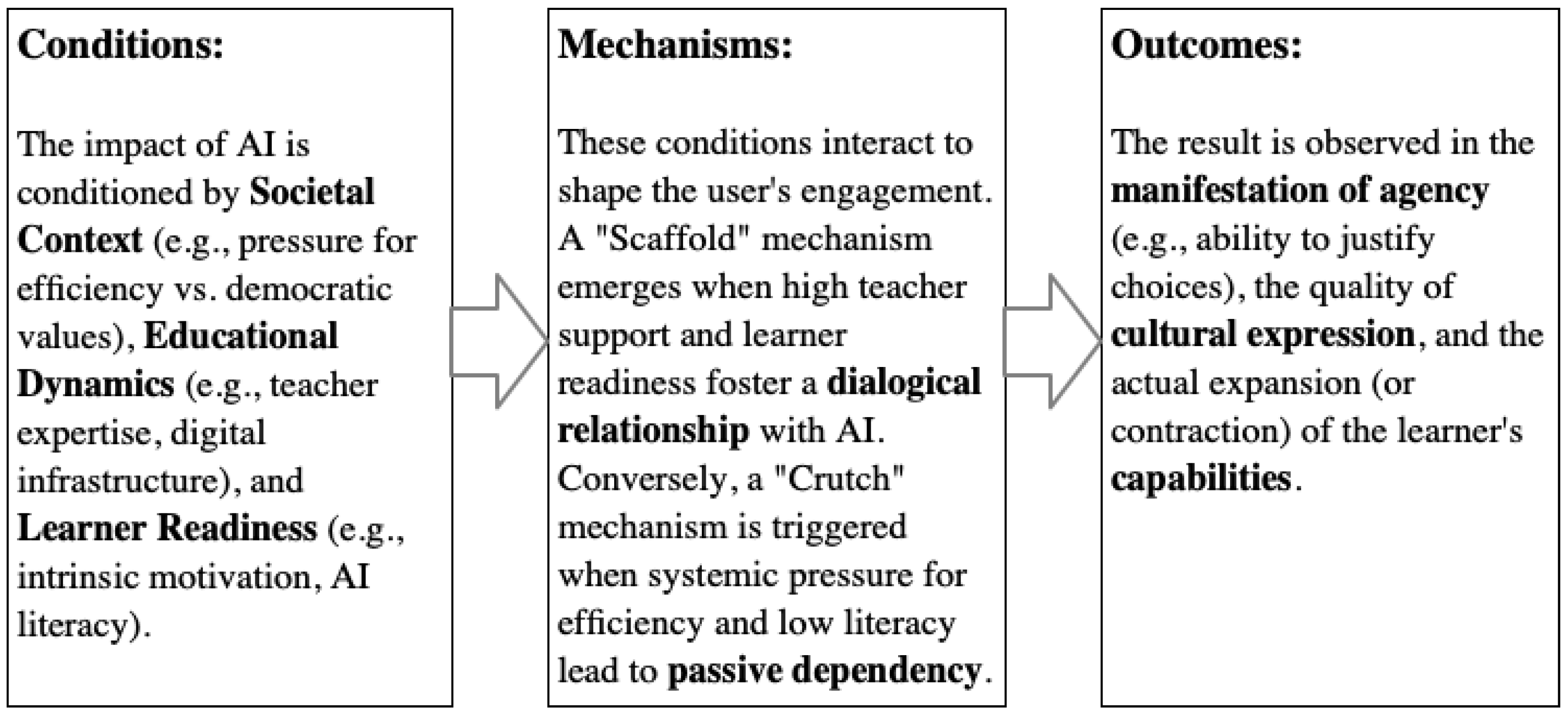
- Design-Based Research (DBR): Researchers should engage in DBR to iteratively design and test educational interventions that serve as “scaffolds.” By cycling through design, enactment, analysis, and redesign in real-world settings, researchers can identify the specific pedagogical conditions that prevent AI from becoming a “crutch.”
- Mixed Methods Approaches: Future studies should combine the quantitative indicators proposed in Table 2 (e.g., anxiety levels, time allocation) with qualitative methods (e.g., interviews, ethnography). This triangulation is necessary to understand why certain usage patterns lead to capability expansion while others do not.
- Longitudinal Studies: Cross-sectional data cannot capture the long-term impact of AI on human development. Longitudinal tracking is essential to determine whether early reliance on AI leads to a long-term atrophy of core capabilities or, conversely, frees up cognitive resources for higher-order skill acquisition.
6. Conclusions
Funding
Institutional Review Board Statement
Informed Consent Statement
Data Availability Statement
Conflicts of Interest
References
- Abma, F. I., Brouwer, S., de Vries, H. J., Arends, I., Robroek, S. J. W., Cuijpers, M. P. J., & van der Klink, J. J. L. (2016). The capability set for work: Development and validation of a new questionnaire. Scandinavian Journal of Work, Environment & Health, 42(1), 34–42. [Google Scholar] [CrossRef]
- Addabbo, T., Di Tommaso, M. L., & Maccagnan, A. (2016). Education capability: A focus on gender and science. Social Indicators Research, 128(2), 793–812. [Google Scholar] [CrossRef]
- Agboli, A., Botbol, M., O’Neill, S., Richard, F., & Aujoulat, I. (2020). Transforming vulnerability into power: Exploring empowerment among women with Female Genital Mutilation/Cutting (FGM/C) in the context of migration in Belgium. Journal of Human Development and Capabilities, 21(1), 49–62. [Google Scholar] [CrossRef]
- Akala, B., & Divala, J. (2016). Gender equity tensions in South Africas post-apartheid higher education: In defence of differentiation. South African Journal of Higher Education, 30(1), 1–16. [Google Scholar] [CrossRef][Green Version]
- Akpınar, B., Barut, M., Akpınar, E. N., & Balıkçı, H. C. (2025). Lifelong learning supported by artificial intelligence and technology for sustainable development goals: An OECD perspective. Sustainable Development, 33(5), 7826–7843. [Google Scholar] [CrossRef]
- Algraini, S. (2019). Education for human development: A capability perspective in Saudi public education. Compare: A Journal of Comparative and International Education, 51(5), 716–732. [Google Scholar] [CrossRef]
- Al-Janabi, H. (2018). Do capability and functioning differ? A study of U.K. survey responses. Health Economics, 27(2), e119–e124. [Google Scholar] [CrossRef]
- Alkire, S. (2005). Why the capability approach? Journal of Human Development, 6(1), 115–135. [Google Scholar] [CrossRef]
- Bakhshi, P., Babulal, G. M., & Trani, J. F. (2017). Education of children with disabilities in New Delhi: When does exclusion occur? PLoS ONE, 12(9), e0183885. [Google Scholar] [CrossRef]
- Baldassarre, M. T., Caivano, D., Fernández Nieto, B., Gigante, D., & Ragone, A. (2023, September 6–8). The social impact of generative AI: An analysis on ChatGPT. ACM International Conference on Information Technology for Social Good (GoodIT ’23) (pp. 1–6), Lisbon, Portugal. [Google Scholar]
- Biggeri, M., & Santi, M. (2012). The missing dimensions of children’s well-being and well-becoming in education systems: Capabilities and philosophy for children. Journal of Human Development and Capabilities, 13(3), 373–395. [Google Scholar] [CrossRef]
- Blackie, M., le Roux, K., & McKenna, S. (2016). Possible futures for science and engineering education. Higher Education, 71(6), 755–766. [Google Scholar] [CrossRef]
- Boni, A., & Calabuig, C. (2017). Education for global citizenship at universities: Potentialities of formal and informal learning spaces to foster cosmopolitanism. Journal of Studies in International Education, 21(1), 22–38. [Google Scholar] [CrossRef]
- Boots, B. C., Matlack, A. K., & Richardson-Gool, T. (n.d.). A call for promoting algorithmic literacy. SSRN. Available online: https://ssrn.com/abstract=4912427 (accessed on 10 July 2025).
- Bower, M., Torrington, J., Alfano, M., Lai, J. W. M., & Petocz, P. (2024). How should we change teaching and assessment in response to increasingly powerful generative Artificial Intelligence? Outcomes of the ChatGPT teacher survey. Education and Information Technologies, 29, 15403–15439. [Google Scholar] [CrossRef]
- Boyadjieva, P., & Ilieva-Trichkova, P. (2016). Rethinking missions and values of higher education: Insights from the capability approach and the institutional perspective. In J. Huisman, & M. Pausits (Eds.), Positioning higher education institutions: From here to there (pp. 41–62). Sense Publishers. [Google Scholar] [CrossRef]
- Boyadjieva, P., & Ilieva-Trichkova, P. (2017). Between inclusion and fairness: Social justice perspective to participation in adult education. Adult Education Quarterly, 67(2), 97–117. [Google Scholar] [CrossRef]
- Broderick, A. (2018). Equality of what? The capability approach and the right to education for persons with disabilities. Social Inclusion, 6(1), 29–39. [Google Scholar] [CrossRef]
- Buckler, A. (2016). Teachers’ professional capabilities and the pursuit of quality in sub-saharan African education systems: Demonstrating and debating a method of capability selection and analysis. Journal of Human Development and Capabilities, 17(2), 161–177. [Google Scholar] [CrossRef]
- Calitz, T. M. L., Walker, M., & Wilson-Strydom, M. (2016). Theorising a capability approach to equal participation for undergraduate students at a South African university. Perspectives in Education, 34(2), 57–69. [Google Scholar] [CrossRef]
- Capraro, V., Lentsch, A., Acemoglu, D., Akgun, S., Akhmedova, A., Bilancini, E., Bonnefon, J. F., Brañas-Garza, P., Butera, L., Douglas, K. M., Everett, J. A., Gigerenzer, G., Greenhow, C., Hashimoto, D. A., Holt-Lunstad, J., Jetten, J., Johnson, S., Kunz, W. H., Longoni, C., … Viale, R. (2024). The impact of generative artificial intelligence on socioeconomic inequalities and policy making. PNAS Nexus, 3(6), pgae191. [Google Scholar] [CrossRef]
- Chiappero-Martinetti, E., & Sabadash, A. (2014). Integrating human capital and human capabilities in understanding the value of education. In S. Ibrahim, & M. Tiwari (Eds.), The capability approach: From theory to practice (pp. 206–230). Palgrave Macmillan. [Google Scholar] [CrossRef]
- Cin, F. M., & Walker, M. (2016). Reconsidering girls’ education in Turkey from a capabilities and feminist perspective. International Journal of Educational Development, 49, 134–143. [Google Scholar] [CrossRef]
- Clarke, V., & Braun, V. (2013). Teaching thematic analysis: Overcoming challenges and developing strategies for effective learning. The Psychologist, 26(2), 120–123. [Google Scholar]
- Daepp, M. I. G., & Counts, S. (2025, June 23–26). The emerging generative artificial intelligence divide in the United States. Nineteenth International AAAI Conference on Web and Social Media (ICWSM 2025), Copenhagen, Denmark. [Google Scholar]
- Dalkilic, M., & Vadeboncoeur, J. A. (2016). Re-framing inclusive education through the capability approach: An elaboration of the model of relational inclusion. Global Education Review, 3(3), 122–137. [Google Scholar]
- de Fine Licht, K. (2025). Resolving value conflicts in public Al governance: A procedural justice framework. Government Information Quarterly, 42(2), 102033. [Google Scholar] [CrossRef]
- Dua, M., Singh, J. P., & Shehu, A. (2025). The ethics of national artificial intelligence plans: An empirical lens. AI and Ethics, 5, 3803–3831. [Google Scholar] [CrossRef]
- Federico, P., Heimerl, F., Koch, S., & Miksch, S. (2017). A survey on visual approaches for analyzing scientific literature and patents. IEEE Transactions on Visualization and Computer Graphics, 23(9), 2179–2198. [Google Scholar] [CrossRef]
- Gabriel, S. (2024, December 5–6). Generative Al and educational (in)equity. International Conference on Al Research, Lisbon, Portugal. [Google Scholar]
- Gale, T., & Molla, T. (2015). Social justice intents in policy: An analysis of capability for and through education. Journal of Education Policy, 30(6), 810–830. [Google Scholar] [CrossRef]
- Girija, S., Banerji, B., Batra, N., Paruchuru, M., & Yeediballi, T. (2024). Making frugal innovations inclusive: A gendered approach. Journal of Cleaner Production, 434, 140182. [Google Scholar] [CrossRef]
- Gupta, A., Singh, N. C., & Duraiappah, A. K. (2019). Education for humanity: Freire and Sen re-examined. In C. A. Torres (Ed.), The Wiley handbook of Paulo Freire (pp. 321–334). John Wiley & Sons. [Google Scholar] [CrossRef]
- Hart, C. S. (2019). Education, inequality and social justice: A critical analysis applying the Sen-Bourdieu analytical framework. Policy Futures in Education, 17(5), 582–598. [Google Scholar] [CrossRef]
- Hart, C. S., & Brando, N. (2018). A capability approach to children’s well-being, agency and participatory rights in education. European Journal of Education, 53(3), 293–309. [Google Scholar] [CrossRef]
- Hendawy, M. (2024, June 14). The intensified digital divide: Comprehending GenAI. Internet Policy Review. Available online: https://policyreview.info/articles/news/intensified-digital-divide-comprehending-genai/1772 (accessed on 30 September 2025).
- Hick, R., & Burchardt, T. (2016). Capability Deprivation. In D. Brady, & L. M. Burton (Eds.), The Oxford handbook of the social science of poverty (pp. 1–22). Oxford University Press. [Google Scholar] [CrossRef]
- IEA. (2025). ICILS 2023 international report: An international perspective on digital literacy. International Association for the Evaluation of Educational Achievement. Available online: https://www.iea.nl/ (accessed on 21 November 2025).
- Ikebuaku, K., & Dinbabo, M. (2018). Beyond entrepreneurship education: Business incubation and entrepreneurial capabilities. Journal of Entrepreneurship in Emerging Economies, 10(1), 154–174. [Google Scholar] [CrossRef]
- Imperiale, M. G. (2017). A capability approach to language education in the Gaza Strip: “To plant hope in a land of despair”. Critical Multilingualism Studies, 5(1), 37–58. [Google Scholar]
- James, D. (2023, July). Human-centric lifelong learning for an era of digital transformation (Working Paper 10). Digital Futures of Work Research Programme. [Google Scholar]
- Johansson, P. E., Bruch, J., Chirumalla, K., Osterman, C., & Stålberg, L. (2024). Integrating advanced digital technologies in existing lean-based production systems: Analysis of paradoxes, imbalances and management strategies. International Journal of Operations & Production Management, 44(6), 1158–1191. [Google Scholar] [CrossRef]
- Khullar, A., Nalin, N., Prasad, A., Mampilli, A. J., & Kumar, N. (2025, April 26–May 1). Nurturing capabilities: Unpacking the gap in human-centered evaluations of Al-based systems. CHI Conference on Human Factors in Computing Systems (CHI ’25), Yokohama, Japan. [Google Scholar] [CrossRef]
- Kim, R., Maurya, Y., & Mukku, G. (n.d.). Designing a benefit assessment protocol for Al systems. Carnegie Mellon University. [Google Scholar]
- Kluge Corrêa, N., & Mönig, J. M. (2024). Catalog of general ethical requirements for AI certification. Center for Science and Thought, University of Bonn. [Google Scholar]
- Kouam, A. W. F., & Muchowe, R. M. (2025). Assessing the role of Al technology in mitigating the equity gap in educational access in Zimbabwe: Barriers and implications. Journal of Applied Learning & Teaching, 8(1), 1–10. [Google Scholar] [CrossRef]
- Kromydas, T. (2017). Rethinking higher education and its relationship with social inequalities: Past knowledge, present state and future potential. Palgrave Communications, 3(1), 1. [Google Scholar] [CrossRef]
- Lanzi, D. (2007). Capabilities, human capital and education. Journal of Socio-Economics, 36(3), 424–435. [Google Scholar] [CrossRef]
- Leonelli, S., & Mussgnug, A. M. (n.d.). Convenience Al. PhilSci-Archive. [Google Scholar]
- London, A. J., & Heidari, H. (2024). Beneficent intelligence: A capability approach to modeling benefit, assistance, and associated moral failures through Al systems. Minds and Machines, 34, 41. [Google Scholar] [CrossRef]
- Loots, S., & Walker, M. (2016). A capabilities-based gender equality policy for higher education: Conceptual and methodological considerations. Journal of Human Development and Capabilities, 17(2), 260–277. [Google Scholar] [CrossRef]
- Lopez-Fogues, A. (2016). A social justice alternative for framing post-compulsory education: A human development perspective of VET in times of economic dominance. Journal of Vocational Education and Training, 68(2), 161–177. [Google Scholar] [CrossRef]
- Matengu, M., Korkeamäki, R. L., & Cleghorn, A. (2019). Conceptualizing meaningful education: The voices of indigenous parents of young children. Learning, Culture and Social Interaction, 22, 100242. [Google Scholar] [CrossRef]
- Mateos Cortés, L. S. (2017). Indigenous youth graduating from intercultural universities: Capability building through intercultural higher education in Veracruz, Mexico. Journal of Intercultural Studies, 38(2), 155–169. [Google Scholar] [CrossRef]
- Mendoza Cazarez, D. C. (2019). Factors affecting school dropout and completion in Mexico: Does agency matter? Journal of Human Development and Capabilities, 20(3), 311–328. [Google Scholar] [CrossRef]
- Mick, M. M. A. P., Kovaleski, J. L., & Chiroli, D. M. D. G. (2024). Sustainable digital transformation roadmaps for SMEs: A systematic literature review. Sustainability, 16(19), 8551. [Google Scholar] [CrossRef]
- Mohanty, A. (2017). Multilingualism, education, English and development: Whose development? In C. H. Williams, & J. E. P. L. T. Williams (Eds.), Multilingualism and development (pp. 261–280). Cambridge University Press. [Google Scholar]
- Molla, T., & Pham, L. (2019). Editorial: Capital, capability and educational justice. Policy Futures in Education, 17(5), 575–581. [Google Scholar] [CrossRef]
- Moodie, G., & Wheelahan, L. (2018). Implications of the human capability approach for relations between Australian vocational and higher education. Monash commission’s designing the future seminar. Monash University. Available online: https://www.monash.edu/__data/assets/pdf_file/0009/1476144/Moodie_Wheelahan1.pdf (accessed on 30 September 2025).
- Morselli, D. (2017). Boundary crossing workshops for enterprise education: A capability approach. In V. Ramadani, L. P. Dana, S. Gërguri-Rashiti, & V. Ratten (Eds.), Contemporary issues in entrepreneurship research (Vol. 7, pp. 283–306). Emerald Group Publishing Limited. [Google Scholar] [CrossRef]
- Muthukrishna, M., Dai, J., Panizo Madrid, D., Sabherwal, R., Vanoppen, K., & Yao, H. (2025). Al can revolutionise education but technology is not enough: Human development meets cultural evolution. Journal of Human Development and Capabilities, 26, 482–492. [Google Scholar] [CrossRef]
- Ndubuka, N. N., & Rey-Marmonier, E. (2019). Capability approach for realising the sustainable development goals through responsible management education: The case of UK business school academics. The International Journal of Management Education, 17(3), 100319. [Google Scholar] [CrossRef]
- Norwich, B. (2014). How does the capability approach address current issues in special educational needs, disability and inclusive education field? Journal of Research in Special Educational Needs, 14(1), 16–21. [Google Scholar] [CrossRef]
- Norwich, B., & Koutsouris, G. G. (2017). Addressing dilemmas and tensions in inclusive education. In G. W. Noblit (Ed.), Oxford research encyclopedia of education. Oxford University Press. [Google Scholar] [CrossRef]
- Nussbaum, M. C. (2006). Education and democratic citizenship: Capabilities and quality education. Journal of Human Development, 7(3), 385–395. [Google Scholar] [CrossRef]
- OECD. (2025). The impact of digital technologies on students’ learning. OECD Publishing. [Google Scholar]
- Ohiwa, H., Kawai, K., & Koyama, M. (1990). Idea processor and the KJ method. Journal of Information Processing, 13, 44–48. [Google Scholar]
- Osmani, S. (2000). Human rights to food, health, and education. Journal of Human Development, 1(2), 273–298. [Google Scholar] [CrossRef]
- Otto, H., & Ziegler, H. (2006). Capabilities and education. Social Work & Society, 4(2), 269–287. [Google Scholar]
- Ó Murchú, N. (2019). Education and agency freedom in Du Bois and Sen. Journal of Human Development and Capabilities, 20(4), 452–467. [Google Scholar] [CrossRef]
- Pang, M.-S., Tafti, A., & Tanriverdi, H. (2024). Digital technologies and the advancement of social justice. MIS Quarterly, 48(4), 1591–1616. [Google Scholar] [CrossRef]
- Peppin Vaughan, R. (2016). Education, social justice and school diversity: Insights from the capability approach. Journal of Human Development and Capabilities, 17(2), 206–224. [Google Scholar] [CrossRef]
- Polat, F. (2011). Inclusion in education: A step towards social justice. International Journal of Educational Development, 31(1), 50–58. [Google Scholar] [CrossRef]
- Rajapakse, N. (2016). Amartya Sen’s capability approach and education: Enhancing social justice. Revue LISA/LISA e-Journal, 14. [Google Scholar] [CrossRef]
- Reiss, M. J., & Mujtaba, T. (2017). Should we embed careers education in STEM lessons? The Curriculum Journal, 28(1), 137–150. [Google Scholar] [CrossRef]
- Robeyns, I. (2003). Sen’s capability approach and gender inequality: Selecting relevant capabilities. Feminist Economics, 9(2–3), 61–92. [Google Scholar] [CrossRef]
- Robeyns, I. (2006). Three models of education: Rights, capabilities and human capital. Theory and Research in Education, 4(1), 69–84. [Google Scholar] [CrossRef]
- Roy, P. (2019). Development as improved life chances: Education for improved life chances. Kardan Journal of Social Sciences and Humanities, 2(2), 1–12. [Google Scholar] [CrossRef]
- Sahebi, S., & Formosa, P. (2025). Artificial intelligence (AI) and global justice. Minds and Machines, 35(1), 4. [Google Scholar] [CrossRef]
- Saito, M. (2003). Amartya Sen’s capability approach to education: A critical exploration. Journal of Philosophy of Education, 37(1), 17–33. [Google Scholar] [CrossRef]
- Saito, T. (2025). Empowering marginalized communities through digital education: Building a research framework based on the capability approach. In M. Leahy, & C. Reffay (Eds.), Digitally transformed education: Are we there yet? Springer. [Google Scholar] [CrossRef]
- Sandri, O., Holdsworth, S., & Thomas, I. (2018). Assessing graduate sustainability capability post-degree completion: Why is it important and what are the challenges? International Journal of Sustainability in Higher Education, 19(1), 2–14. [Google Scholar] [CrossRef]
- Scupin, R. (1997). The KJ method: A technique for analyzing data derived from Japanese ethnology. Human Organization, 56(2), 233–237. [Google Scholar] [CrossRef]
- Semela, T., & Cochrane, L. (2019). Education—Migration nexus: Understanding youth migration in Southern Ethiopia. Education Sciences, 9(2), 77. [Google Scholar] [CrossRef]
- Sharma, B., & Acharya, B. B. (2025). Leveraging remittances for STEM education: A capability approach to development in the Global South. American Journal of STEM Education: Issues and Perspectives, 13, 1–20. [Google Scholar] [CrossRef]
- Skovhus, R. B. (2016). A focus on educational choice has social justice consequences—An empirical study informed by Sen’s capability approach. Journal of the National Institute for Career Education and Counselling, 36, 54–60. [Google Scholar] [CrossRef]
- Slabbert, I. (2018). Applying the capability approach in social work education. Social Work Education, 37(7), 867–880. [Google Scholar] [CrossRef]
- Stella, J., & Corry, M. (2017). A capability approach for online primary and secondary students with disabilities. British Journal of Special Education, 44(4), 448–464. [Google Scholar] [CrossRef]
- Stephens, S. (2025). The development and evaluation of a legal chatbot for women in Tanzania. SSRN. Available online: https://ssrn.com/abstract=5251610 (accessed on 29 September 2025).
- Teubner, J. D., & Ivey, R. M. (2025, May). Social Al and human connections: Benefits, risks and social impact. Human Flourishing Program, Institute for Quantitative Social Science, Harvard University. [Google Scholar]
- Tumuheki, P. B., Zeelen, J., & Openjuru, G. L. (2016). Towards a conceptual framework for developing capabilities of “new” types of students participating in higher education in Sub-Saharan Africa. International Journal of Educational Development, 47, 54–62. [Google Scholar] [CrossRef]
- Unterhalter, E. (2009). What is equity in education? Reflections from the capability approach. Studies in Philosophy and Education, 28(5), 415–424. [Google Scholar] [CrossRef]
- Unterhalter, E. (2017). Negative capability? Measuring the unmeasurable in education. Comparative Education, 53(1), 1–16. [Google Scholar] [CrossRef]
- Vaismoradi, M., Turunen, H., & Bondas, T. (2013). Content analysis and thematic analysis: Implications for conducting a qualitative descriptive study. Nursing & Health Sciences, 15(3), 398–405. [Google Scholar] [CrossRef]
- Van Slyke, C., Sarabadani, J., & Mosafer, H. (2025, August 14–16). Epistemic injustice in generative Al. AMCIS 2025 Proceedings (Paper 6), Montréal, QC, Canada. [Google Scholar]
- Vaughan, R. P., & Walker, M. (2012). Capabilities, Values and Education Policy. Journal of Human Development and Capabilities, 13(3), 495–512. [Google Scholar] [CrossRef]
- Walker, M. (2003). Framing social justice in education: What does the “capabilities” approach offer? British Journal of Educational Studies, 51(2), 168–187. [Google Scholar] [CrossRef]
- Walker, M. (2018). Dimensions of higher education and the public good in South Africa. Higher Education, 76(3), 555–569. [Google Scholar] [CrossRef]
- Walker, M. (2019). Defending the need for a foundational epistemic capability in education. Journal of Human Development and Capabilities, 20(2), 218–232. [Google Scholar] [CrossRef]
- Walkington, H., Dyer, S., Solem, M., Haigh, M., & Waddington, S. (2018). A capabilities approach to higher education: Geocapabilities and implications for geography curricula. Journal of Geography in Higher Education, 42(1), 7–24. [Google Scholar] [CrossRef]
- Wood, L. (2016). Community development in higher education: How do academics ensure their community-based research makes a difference? Community Development Journal, 52(4), 685–701. [Google Scholar] [CrossRef]
- Xiao, Y., & Sun, X. (2025). Integration of Soft and Hard Laws: Profiling Legal Protection for “Al for All”. International Journal of Digital Law and Governance. Advance online publication. [Google Scholar] [CrossRef]


| No. | Reference (Author/Year) | Type | Focus/Key Theme | Methodology |
|---|---|---|---|---|
| 1 | Akpınar et al. (2025) | Journal Article | Lifelong learning and AI for Sustainable Development Goals (SDGs) in OECD countries. | Quantitative (MMQREG, KRLS); Analysis of OECD data (2005–2019) |
| 2 | Boots et al. (n.d.) | Working Paper | The need for “Algorithmic Literacy” as a prerequisite for agency and informed citizenship. | Conceptual analysis; Literature review |
| 3 | Bower et al. (2024) | Journal Article | Educators’ views on how teaching and assessment should change due to GenAI. | Mixed methods; Survey (n = 318) and thematic analysis |
| 4 | de Fine Licht (2025) | Journal Article | Resolving value conflicts (e.g., efficiency vs. legality) in public AI governance. | Conceptual framework; Case study (Swedish Public Employment Service) |
| 5 | Dua et al. (2025) | Journal Article | Ethical priorities in national AI strategies and their alignment with human capabilities. | Content analysis (LDA topic modelling) of 54 national AI plans |
| 6 | Girija et al. (2024) | Journal Article | “Frugal innovation” in AI to empower marginalised women and reduce inequality. | Qualitative; Interviews with marginalised women in India (n = 25) |
| 7 | James (2023) | Working Paper | Human-centric lifelong learning in the digital age, emphasising agency over skills. | Policy analysis; Qualitative insights from expert interviews |
| 8 | Khullar et al. (2025) | Conference Paper | Gap between worker aspirations and AI evaluation metrics in healthcare. | Mixed methods; Design-Based Implementation Research (DBIR) |
| 9 | Kim et al. (n.d.) | Working Paper | Protocol for assessing AI “benefits” using Capability Approach indicators. | Protocol design; Expert interviews (n = 5) |
| 10 | Kluge Corrêa and Mönig (2024) | White Paper | Ethical requirements for AI certification (e.g., fairness, sustainability). | Normative framework development |
| 11 | Kouam and Muchowe (2025) | Journal Article | AI’s role in mitigating educational equity gaps and access barriers in Zimbabwe. | Qualitative; Interviews with lecturers and students (n = 12) |
| 12 | Leonelli and Mussgnug (n.d.) | Preprint | “Convenience AI” in research and its impact on epistemic integrity and labour. | Conceptual analysis; Philosophy of science |
| 13 | London and Heidari (2024) | Journal Article | Formalising “benefit” and “assistance” in AI ethics to avoid paternalism/exploitation. | Theoretical modelling; Capability Approach integration |
| 14 | Muthukrishna et al. (2025) | Journal Article | Cultural evolution of AI in education; critique of “techno-fix” approaches (e.g., OLPC). | Comparative policy analysis; Case studies (Estonia, Uruguay) |
| 15 | Pang et al. (2024) | Journal Article | Framework for the interplay between digital technologies and social justice. | Theoretical framework development |
| 16 | Sahebi and Formosa (2025) | Journal Article | Global justice implications of AI, focusing on supply chain harms (labour/extraction). | Philosophical analysis; Capability Approach application |
| 17 | Sharma and Acharya (2025) | Journal Article | Leveraging remittances to fund STEM education and build capabilities in the Global South. | Theoretical model proposal (Remittance-Induced Development) |
| 18 | Stephens (2025) | Working Paper | Developing a legal chatbot for women’s inheritance rights in Tanzania. | Design science; User evaluation (n = 5) |
| 19 | Teubner and Ivey (2025) | White Paper | Impact of “Social AI” on human connection and social capabilities. | Conceptual framework; Expert panel discussions |
| 20 | Van Slyke et al. (2025) | Conference Paper | “Epistemic injustice” in GenAI and its impact on marginalised knowledge systems. | Conceptual analysis |
| 21 | Xiao and Sun (2025) | Journal Article | Legal protection for “AI for All”; integrating soft and hard laws to address inequality. | Legal and policy analysis; Theoretical framework (World-Systems Theory) |
| Thesis (Core Value) | Candidate Indicators for Empirical Verification |
|---|---|
| A. Intrinsic & Instrumental Value |
|
| B. Agency |
|
| C. Core Capabilities |
|
| D. Cultural Identity |
|
| E. Pedagogical Process |
|
| F. Social Justice (Equity) |
|
Disclaimer/Publisher’s Note: The statements, opinions and data contained in all publications are solely those of the individual author(s) and contributor(s) and not of MDPI and/or the editor(s). MDPI and/or the editor(s) disclaim responsibility for any injury to people or property resulting from any ideas, methods, instructions or products referred to in the content. |
© 2026 by the author. Licensee MDPI, Basel, Switzerland. This article is an open access article distributed under the terms and conditions of the Creative Commons Attribution (CC BY) license.
Share and Cite
Saito, T. Redefining Agency: A Capability-Driven Research Agenda for Generative AI in Education. Educ. Sci. 2026, 16, 155. https://doi.org/10.3390/educsci16010155
Saito T. Redefining Agency: A Capability-Driven Research Agenda for Generative AI in Education. Education Sciences. 2026; 16(1):155. https://doi.org/10.3390/educsci16010155
Chicago/Turabian StyleSaito, Toshinori. 2026. "Redefining Agency: A Capability-Driven Research Agenda for Generative AI in Education" Education Sciences 16, no. 1: 155. https://doi.org/10.3390/educsci16010155
APA StyleSaito, T. (2026). Redefining Agency: A Capability-Driven Research Agenda for Generative AI in Education. Education Sciences, 16(1), 155. https://doi.org/10.3390/educsci16010155