


Abstract
This study explores the integration of technology and artificial intelligence (AI) as catalysts for professional teacher development within the context of Mexico’s educational challenges. Adopting a qualitative and exploratory approach, a four-phase workshop was conducted with 40 high school and university-level teachers from the National Polytechnic Institute (IPN). The methodology included scientific modeling activities using traditional methods, software (Tracker, ver. 6.2.0), and AI tools (ChatGPT-3.5), while analyzing participants’ perceptions and experiences. The findings reveal a clear disconnect between teachers’ theoretical competencies and their practical skills, with persistent gaps in scientific literacy at both educational levels. However, this study documents that the workshop functioned as a genuine professional learning community, where inter-academic collaboration and peer-learning proved to be an effective strategy for addressing these deficiencies. Technology, specifically the Tracker software, served as a catalyst for conceptual understanding. Despite AI’s potential for research, its limitations in the precision of responses reinforced this study’s central conclusion: technology does not replace the teacher’s work but transforms the teacher’s role into a critical mediator, responsible for guiding students to develop analytical and critical thinking in a complex digital environment.
1. Introduction
The recent and rapid transition from remote to in-person education has underscored the urgent need for teacher training that strengthens pedagogical competencies and the integration of digital tools. In this context, Shezad et al. (2025) and Mandal (2024) argue that educational technology and, more recently, artificial intelligence (AI), have emerged as essential tools that catalyze this professional development, which in turn translates into a transformation of teaching and student interaction. Our research directly responds to this imperative by providing an empirical model for this essential pedagogical shift.
The imperative for innovative classroom strategies is particularly evident in the Mexican educational landscape. International assessments, such as those published by the OCDE (2022), consistently reveal a persistent lag in key areas such as mathematics and science. Cedeño et al. (2020) emphasize that these results underscore how targeted teacher training and specialized workshops are essential to address these national deficiencies. Therefore, this research focuses on providing support and implementing actions for the development of student learning in physical–mathematical sciences, targeting the fundamental competency gaps identified at the institutional level.
The literature on AI in education has explored its benefits but has also pointed out its limitations. For instance, Coban and Coban (2023) analyzed how tools like ChatGPT can be used in physics teaching, stressing the critical importance of teacher judgment to evaluate results and guide students. This view frames the use of AI as an opportunity for teachers to improve their instructional methods (Avila et al., 2024; Küchemann et al., 2025). However, its integration faces challenges such as limited access to technology, insufficient teacher training, and ethical considerations (Kotsis, 2025; Alshorman, 2024)—all of which justify our decision to integrate a critical reflection phase on AI use into our workshop design.
In addition, Azumah and Najah (2024) have pointed out that while technology plays a vital role in all sectors, their findings reveal that some science teachers lack knowledge about available educational technologies. The successful integration of technology in the classroom implies a profound transformation that requires teachers to develop competencies across technology, pedagogy, and content knowledge, the core tenets of the TPACK framework that guides our study (Dinçer, 2021, 2024; Dinçer & Çengel-Schoville, 2022).
In response to this multi-layered need, this study documents the experience of a training workshop designed for High School (HS) and University Level (UL) teachers from the National Polytechnic Institute (IPN). The particularity of this workshop lies in its focus on inter-academic linkage, creating space for collaboration and reflection on the observed gains of technology and AI. The sequence of activities, which progressed from traditional modeling to the use of analysis software (Tracker) and AI tools, was designed to generate critical and comparative analysis.
The objective of this research is to explore how participation in a training workshop, focused on the use of technology and AI, affects the perceptions and practices of science and mathematics teachers. Through this analysis, we seek to answer the following research question: How does teacher training, within the framework of collaboration between high school and university, influence the integration of technology and AI for learning in science and mathematics?
2. Theoretical Framework
International assessments, such as PISA (OCDE, 2022), consistently demonstrate a persistent decline in student performance in key areas like Scientific and Mathematical Literacy. This macro-level educational lag, which is demonstrably linked to infrastructural and teacher competency issues (IMCO, 2024), underscores the urgent need for targeted professional development that directly addresses these basic skills—which is the fundamental premise of our investigative approach. In this context, effective teacher training emerges as the primary means of equipping educators with the skills necessary to engage students and facilitate effective learning (Darling-Hammond et al., 2020).
2.1. Conceptual Definitions
To ensure the transparency required by qualitative research, we provide clear conceptual definitions:
- Scientific Literacy: In the context of this study, it is defined as the teacher’s ability to critically apply and model scientific concepts (specifically the mechanics of motion) to procedural problem-solving scenarios. This capacity, which focuses on the didactic nature of teaching and learning processes (Pérez-Rodríguez & Baquero-Mendieta, 2025, pp. 210102–210104), is fundamental for scientific inquiry.
- Practical Skills: These refer to the procedural competence required to effectively use technological tools (such as Tracker) and traditional methods (paper and pencil) to represent, analyze, and interpret physical phenomena, revealing the skills gap necessary for effective technological integration (Richter et al., 2011).
2.2. Technology and Collaboration: The Foundation for Competency Development
The Technological Pedagogical Content Knowledge (TPACK) framework (Ning et al., 2024) is foundational to our approach, emphasizing the complex transformation of content knowledge into accessible learning experiences. This demands a specific set of competencies, particularly as digital tools and AI become transformative forces. Vičič Krabonja et al. (2024) highlights that the potential of AI is realized only when the educator acts as a critical mediator who guides data interpretation, a crucial role that forms the basis of our third theme of analysis.
Building on the foundational Community of Practice (CoP) model (Lave & Wenger, 1991), our workshop design employs a critical inter-academic linkage. Hord (1997) suggests that this model is a potent strategy for promoting mutual engagement and knowledge sharing. This collaborative approach, which unites High School and University Level teachers, is central to the design and findings of this study, as it specifically targets the competency continuity gap in student preparation. This collaborative approach is central to the design and results of this study, as it addresses the need for peer-learning and competence enhancement (Huijboom et al., 2023).
2.3. Teacher Competencies in High School and University Levels
Within this changing landscape, a teacher’s effectiveness depends not only on their content knowledge but also on their ability to transform it into accessible and effective learning experiences (Kind, 2009; Van Driel et al., 2012), which is a key component of Pedagogical Content Knowledge (PCK). This demands a specific set of competencies. According to the OCDE (2018), competencies are a combination of knowledge, skills, and attitudes that enable individuals to perform tasks appropriately. At a national level, Mexico’s Secretariat of Public Education (SEP, 2008) has established eight key competencies for high school (HS) teachers. Similarly, for university-level (UL) educators, the focus is on fostering active and participatory learning with the use of technology for knowledge construction (Rico-Gómez & Ponce Gea, 2022).
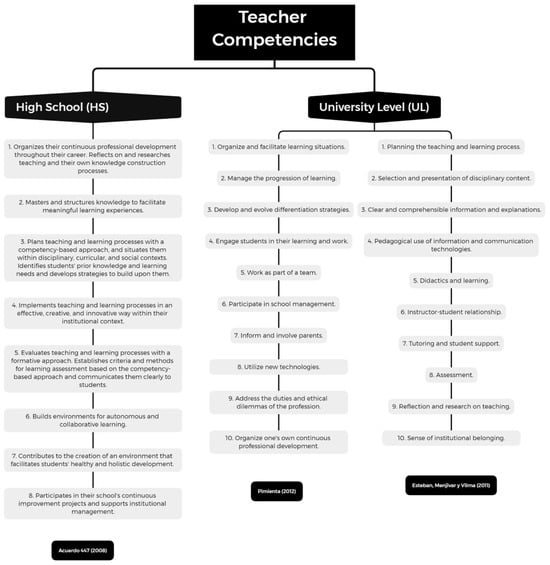
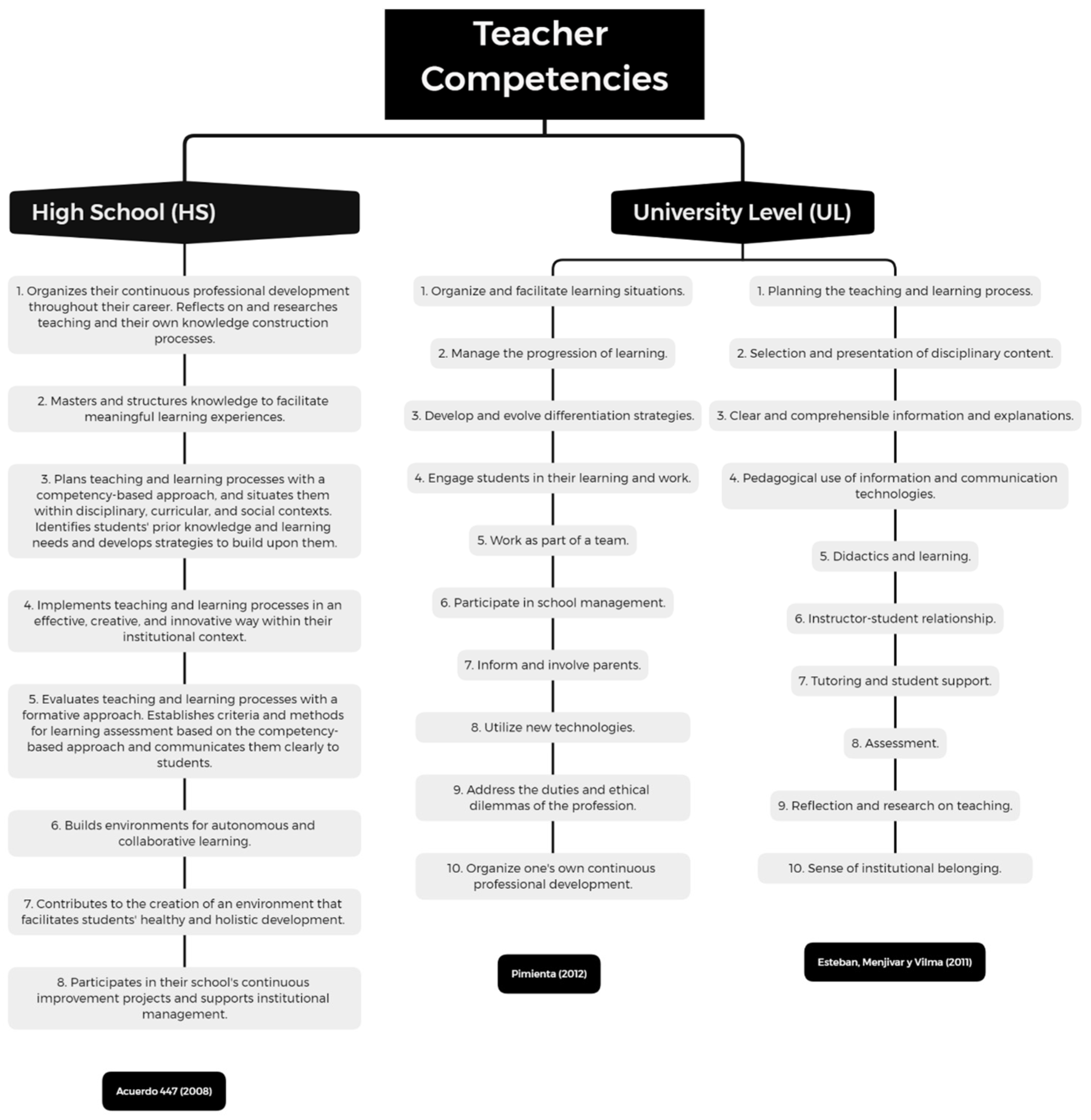
Figure 1 is included to structurally justify the need for inter-academic collaboration (CoP). It specifically illustrates the alignment criteria between the established competency frameworks for both levels (HS and UL). The key message is that the expected teacher roles are not hierarchically distinct but synergistically interconnected, forming a continuous learning trajectory that directly supports the design of the inter-level workshop.
Figure 1.
Comparison of Competencies of High School (HS) and University Level (UL) Teachers. Source: Adapted from Pimienta (2012) and Esteban Moreno and Menjívar de Barbón (2011). Teacher competencies according to Agreement 447 (SEP, 2008).
Figure 1 illustrates the alignment between these two educational levels, showing a clear connection in the skills teachers are expected to develop.
The relevance of these competencies is reinforced by the need for digital literacy, a crucial aspect of professional development. Frameworks like DigCompEdu (Ponce-López et al., 2022) offer a solid structure for professional and pedagogical competencies. The IPN’s graduate profiles for both levels emphasize the development of these skills, such as critical thinking, logical reasoning, and the application of scientific knowledge to solve problems (IPN, 2023a, 2023b). Table 1 presents a comparative view of these skills, demonstrating a shared institutional vision. The need for this collaborative approach is supported by the literature, which shows the effectiveness of professional development programs that foster peer learning and active, inquiry-based experiences (Sánchez-Aguilar & Ochoa-Villanueva, 2023). A recent study by Huijboom et al. (2023) underscores that participation in professional learning communities is a proven strategy for improving teaching quality and the development of teacher competencies.
Table 1.
Skills to be developed by High School and University Level students at the IPN.
Table 1 is critical to the discussion as it further details the Phenomena Modeling and Technology Proficiency skills that IPN students are expected to acquire at both levels. This comparison explicitly defines the baseline skills gap addressed by the paper-and-pencil modeling activity. The implication is that the development of these core skills requires a unified pedagogical approach across both educational stages, reinforcing the rationale for the cross-level CoP.
2.4. Technology, Scientific Models, and AI as Pedagogical Tools
Ilomäki and Lakkala (2018) assert that the integration of technology in the classroom must be viewed not merely as a complement but as a catalyst for genuine pedagogical transformation. At the core of this transformation is the teacher’s role as a facilitator of knowledge construction (Scardamalia & Bereiter, 2021). This shift is especially crucial in the STEM fields, where scientific modeling is a fundamental skill. Scientific models serve to analyze, describe, and simulate reality (De Torres, 2015), and their effective use requires a structured approach. In this sense, Bounou et al. (2025) demonstrate that software like Tracker effectively supports abstract thinking by organizing information and offering flexible representations of phenomena, a capacity we specifically leverage in the workshop to address the procedural competency gaps identified by León (2020).
The emerging role of Artificial Intelligence (AI) represents the next frontier. Academics, including Bertochi et al. (2021) and Zucchetti et al. (2020), argue that AI is a transformative force that should be integrated into the educational system to foster active learning (Williams et al., 2019) and inquiry-based practices (Ng et al., 2021; Sintov et al., 2017). Kelley and Wenzel (2025) recognize the vital need to address AI’s role in practice and in teacher training programs. Furthermore, AI tools also enhance the adaptability of educational technology (Cardona et al., 2023) and assist in research (Marino et al., 2023). However, its abstract nature demands a pedagogical approach focused on social interaction and collaborative activities (Sperling & Lickerman, 2012; Vartiainen et al., 2020).
This reinforces the principle that the teacher must mediate learning to ensure students develop the critical thinking necessary to use AI effectively. Yuan et al. (2024) affirm this by developing a scale to measure AI literacy, highlighting that this competency extends beyond technical skills to crucial social and ethical aspects. This competency-based mediation is precisely the gap our workshop seeks to address through the TPACK framework.
2.5. Pedagogical Transition and Technological Adaptation
The COVID-19 pandemic introduced major challenges in education, with Chans et al. (2023) documenting significant obstacles for Mexican universities. These challenges included a lack of infrastructure and teacher training for virtual education (Vicentini, 2020; Sánchez Mendiola et al., 2020). The subsequent transitions between in-person and online learning highlighted acute concerns about connectivity, digitalization, and the effects on the emotional stability of the educational community (Camacho-Zuñiga et al., 2021; Contreras-Vizcaino & Zamora-Echegollen, 2023). These persistent issues form the experiential backdrop against which our workshop designed its technological intervention.
Despite these challenges, the sustained adoption and acceptance of technology fostered digital transformation. García-Peñalvo (2022), Treve (2021), and Lytras et al. (2022) have shown that this experience has demonstrated long-term positive outcomes in educational and curricular design, enabling a more adaptable, digital, and responsible approach. It is this recognized positive potential that our study seeks to leverage and formalize through targeted training strategies within a professional learning community.
3. Materials and Methods
The present study is framed within a qualitative exploratory approach, which is ideal for answering the “how” and “why” of participants’ experiences. This methodology is the most suitable for delving into the complexity of educational phenomena and human interactions (Creswell & Creswell, 2022; Denzin et al., 2017), allowing for a deep analysis of teachers’ perceptions, attitudes, and motivations.
3.1. Research Context
The study was conducted at two key institutions of the National Polytechnic Institute (IPN) in Mexico: The Interdisciplinary Professional Engineering Unit, Guanajuato Campus (UPIIG), and the Center for Scientific and Technological Studies (CECyT 17). The IPN is a public institution with a mission to contribute to social transformation through the training of professionals and researchers in various fields of science and technology (Ley Orgánica del IPN, 1982).
The research team comprised a workshop facilitator (the first author, with teaching experience in physics and mathematics at the high school and university levels), an expert in educational mathematics, and an expert in educational physics. The workshop’s instructional sequence was designed by the facilitator and the educational mathematics expert, while the theoretical framework was developed in collaboration with the educational physics expert. All three authors participated in the analysis of the workshop’s results.
3.2. Participants
The workshop included 40 teachers, comprising a non-probabilistic convenience sample from UPIIG and CECyT 17. This methodological choice is deliberate and justified primarily by the qualitative-exploratory paradigm of this study (Creswell & Creswell, 2022). Since the objective is to thoroughly understand the process and complexity of teacher perception within a specific institutional context, rather than to estimate population parameters, probabilistic sampling methods were unnecessary. Our goal is not statistical generalization, but rather to achieve transferability; therefore, the focus is on a detailed analysis of the experiences of this specific, context-rich group (Patton, 2015).
3.3. Ethical Considerations
Institutional Review Board Statement: Formal institutional review board (IRB) approval was not required for this study. The investigation was officially conducted as an Internal Program Evaluation/Quality Improvement activity aimed at assessing professional development needs within the National Polytechnic Institute (IPN), which qualifies for an exemption under local institutional guidelines. The activity was internally registered under the DFIE (Dirección de Formación e Innovación Educativa) with the official code: CUR: DFIE/23/E2/080EA/4/Co/P/62/120723-130723 (Registered Date: 12 July 2023).
Informed consent was considered implicit by the voluntary participation of the teachers in the professional development workshop. All participants were informed of the study’s educational scope and were assured that all data collected (observations, written responses, and thematic discussions) would be processed and stored with the highest degree of confidentiality and used exclusively for program improvement and research dissemination. All procedures were conducted in full adherence to the principles outlined in the Declaration of Helsinki. Any qualitative data (quotes) used in this publication has been de-identified and presented only in aggregated form to ensure absolute anonymity.
3.4. Workshop Design and Data Collection
The design of the inter-academic collaboration is fundamentally justified by the students’ educational pipeline. Specifically, students from the CECYT high school level are the primary ingress candidates for the UPIIG university campus, particularly in the Physics and Mathematics Sciences area. This inherent, institutional link makes the understanding of curricular and pedagogical needs across both educational stages crucial to ensure a seamless educational transition and to directly address the Scientific Literacy Gap before university entry.
The workshop was designed with a four-phase sequential approach, which was conducted within the framework of the second Inter-Academy Colloquium. The entire sequence comprised a total of 5 h (300 min), distributed over two sessions of 150 min each. This design aligns with professional development models that promote reflection and progressive practice (Richter et al., 2011). For data collection, the evidence generated by the teachers was analyzed, and a thematic analysis was used to identify recurrent patterns in their perceptions and experiences (Braun & Clarke, 2006).
- Diagnostic Phase: The workshop began with a discussion on the educational transition before, during, and after the pandemic. The objective was to identify teachers’ initial challenges and perceptions, as they had expressed concern about a lack of competency and skills in using digital platforms (Yasir et al., 2022; Chans et al., 2023). These findings served as a starting point for reflection and learning.
- Pencil-and-paper modeling activity: Teachers were presented with a motion problem to solve using only pencil and paper (details of this problem, “Epiphany” (Suárez et al., 2005, p. 323) are described in Appendix A), based on the principle that modeling is fundamental in the experimental sciences (Bahri et al., 2021; Danusso et al., 2010). This approach aligns with research that highlights the importance of student exploration through modeling phenomena (Jafari Ghalehkohneh et al., 2025).
The paper-and-pencil modeling activity was specifically designed as a diagnostic tool to assess participants’ scientific literacy and practical skills prior to the technological intervention. This methodology allowed us to accurately identify the theoretical-practical discrepancy of the central problem addressed in this study by requiring participants to rely solely on their fundamental conceptual and procedural understanding. Inter-academic collaboration was systematically facilitated through mixed-group tasks, in which high school and university teachers were intentionally paired to solve modeling exercises. The facilitator’s role was strictly non-directive, focusing on promoting reflective dialogue and the shared construction of knowledge, thus creating the peer-learning environment necessary for the emergence of a community of practice (CoP).
- Use of Technology (Tracker): Next, the same problem was addressed using Tracker video analysis software, a tool that effectively supports abstract thinking and information organization (Bounou et al., 2025). This phase sought for teachers to explore how technology can enrich the modeling process and foster inquiry-based learning.
- Use of Artificial Intelligence: Finally, teachers were asked to interact with AI tools (such as ChatGPT) to discuss and reflect on the problem-solving process and information search. This activity is justified by the fact that AI is redefining teaching and learning in teacher preparation programs (Marino et al., 2023).
The workshop activities used portable digital devices for interaction with teachers. Likewise, the growing influence of AI in teaching and learning suggests that technology can increase educational opportunities and effectively connect students with viable sources of information (Wang, 2023; Zhou & Zhang, 2022; Suarez-Fernandez de Miranda et al., 2021). Teachers’ productions were compiled on digital platforms such as Classroom, Padlet, and menti.com. The corresponding permissions from participants were obtained to make audio and video recordings.
3.5. Data Analysis Trustworthiness
In accordance with the exploratory nature of this study, which sought to understand teachers’ perceptions and experiences, a qualitative analysis methodology was selected, specifically focused on thematic analysis (Braun & Clarke, 2006). This choice was fundamental, as it allowed for the systematic and inductive identification of patterns of meaning (themes) throughout the data corpus (written texts, observation notes, and transcripts), ensuring that the observed achievements and challenges emerged directly from the teachers’ perspectives. This approach forms the basis for establishing the qualitative reliability of the findings.
The qualitative data collected were analyzed using Thematic Analysis following the six-phase guide by Braun and Clarke. Data processing and coding were managed manually by the lead researcher to ensure direct immersion in the data. The analysis proceeded through the following stages:
- Familiarization with the data;
- Generating initial codes (descriptive labels for features of the data);
- Searching for themes (grouping codes into potential themes);
- Reviewing and refining themes;
- Defining and naming the themes;
- Producing the report (linking themes back to the research questions).
To ensure the trustworthiness of the findings a critical criterion for qualitative research we employed two specific strategies:
- Researcher Triangulation: The coding and theme definition process was independently conducted by two members of the research team, followed by joint discussions to resolve discrepancies and ensure a shared understanding of the emerging data interpretations. This collaborative and reflexive process ensured a shared understanding of the emerging data interpretations, thus validating the internal consistency and credibility of the theme generation before proceeding to the final analysis phases. (An illustrative example of the coding consensus process, demonstrating the independent coding and final agreement between the two researchers, is included in Appendix B).
- Thick Description: The results section incorporates detailed, contextualized quotations and narrative descriptions (thick description) to allow readers to evaluate the applicability (transferability) of the findings to their own educational contexts, thereby replacing the need for statistical generalization.
4. Results
The thematic analysis process described in the previous section allowed for the systematic identification of three central thematic categories that encompass the observed achievements and persistent challenges in teacher professional development. The following table (Table 2) summarizes these categories, their strategic implications, and the direct evidence that supports them, serving as a guide for the detailed analysis of the results.
Table 2.
Central Thematic Categories in Teacher Professional Development: Definitions, Strategic Implications, and Evidence.
4.1. Perceptions of Educational Lag and Teaching Challenges
This section addresses the teachers’ initial opinions on the academic challenges pre- and post-pandemic. Participants from both levels (High School and University Level) agreed that educational lag, apathy, and a lack of commitment are persistent challenges that were exacerbated by the pandemic.
Based on the initial reflections of the teachers, two main themes were identified that contextualize the need for this study: (1) pre-existing academic challenges exacerbated by the pandemic, and (2) the need for continuous technological and pedagogical adaptation.
High school teachers, for example, mentioned the persistence of problems such as “lack of commitment, lag in reading comprehension, and problem-solving.” At the university level, concerns were focused on “apathy, educational lag, and dropout rates.” These perceptions are directly related to the recent results of international assessments like PISA (OCDE, 2022), which highlight the lag in basic skills within the Mexican educational context.
In response to the pandemic, teachers at both levels were forced to implement new strategies, such as the “use of educational platforms and online work.” However, this change created new challenges, such as the need for” professional preparation for the new challenges after the pandemic,” which includes the use of “ad hoc technologies for engineering” and AI.
Thus, the analysis of the participants’ initial perceptions reveals that, beyond pre-existing problems, the transition to online education and the return to the classroom created a new field of challenges that demand the continuous development of teacher competencies.
4.2. Modeling in Physics: From Paper-and-Pencil Solutions to Technology
This section presents the results of the modeling activity sequence, which was designed to explore the progression of understanding among high school and university-level teachers, from the use of traditional methods to the integration of technological and artificial intelligence tools. Through this analysis, three main themes were identified that reveal the multifaceted nature of professional teacher development in the context of inter-academic collaboration: the persistence of gaps in scientific literacy, the role of interdisciplinary collaboration in problem-solving, and technology as a catalyst for conceptual understanding and the development of critical thinking skills.
4.3. The Challenge of Paper-and-Pencil Modeling: Persistence of Gaps in Scientific Literacy
The first phase of the workshop, focused on paper-and-pencil modeling, revealed that high school and university-level teachers face a common challenge in scientific literacy and graphical interpretation. Although the activity did not require the use of technology, the responses showed notable differences in familiarity with graphical analysis. In this sense, University-Level teachers obtained a higher percentage of correct answers (37.5%) in the graph identification activity compared to their High School colleagues (22.5%). However, the persistence of a percentage of incorrect responses and the initial difficulty in approaching the problem underscored that these skills are not universally consolidated among the teaching staff.
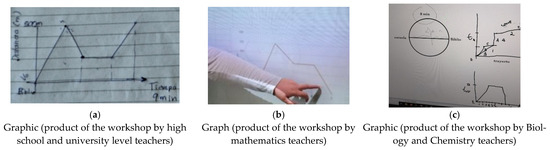
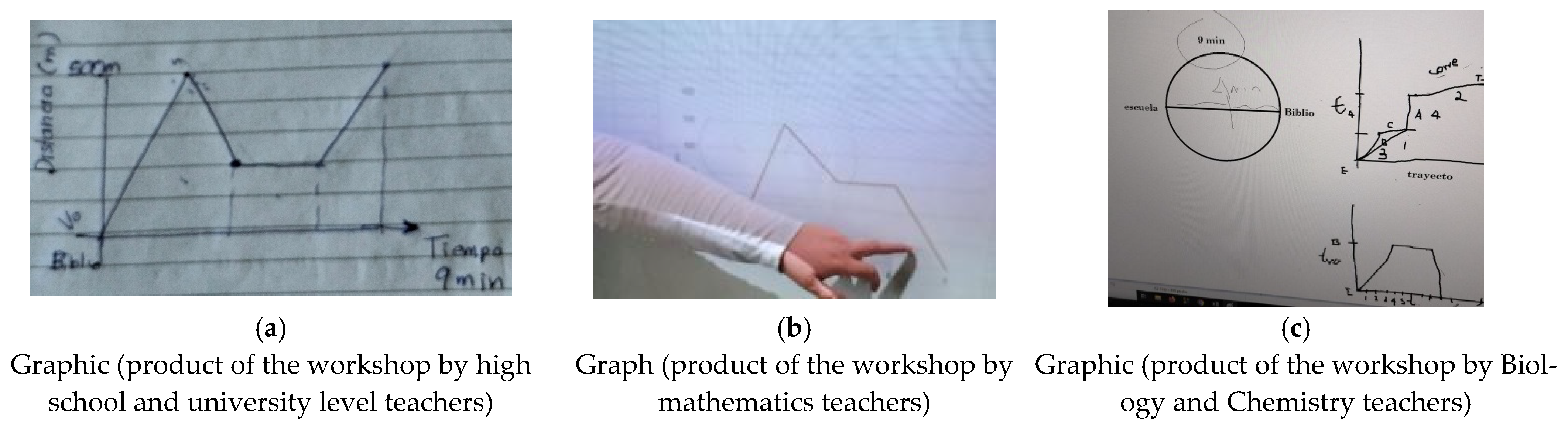
This gap was particularly evident in the reflections of participants from non-scientific areas, one of whom noted that the exercise was “challenging, but valuable,” which demonstrates the complexity of graphical interpretation outside the fields of physics and mathematics. This difficulty in the process became tangible in the workshop’s products. Although some teams achieved a precise solution (see Figure 2a,b), others, such as the team of high school teachers shown in Figure 2c, obtained a correct answer only after considerable effort and a complex reflective process.
Figure 2.
Solutions from High School (HS) and University Level (UL) teachers in the workshop. Source: Products derived from the workshop.
4.4. Technology (Tracker) as a Catalyst for Understanding and Reflection
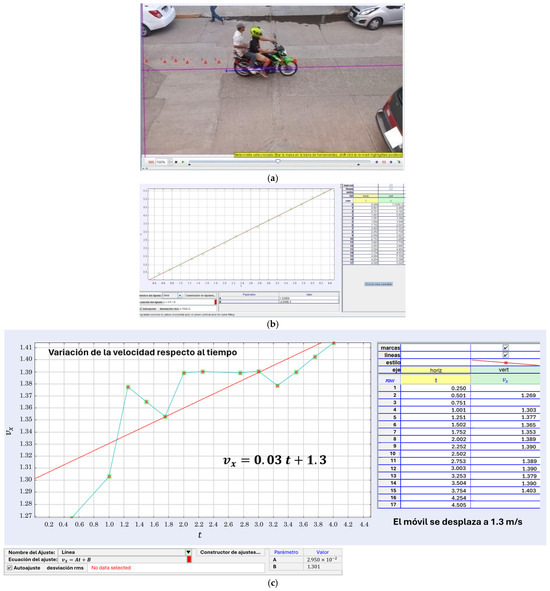
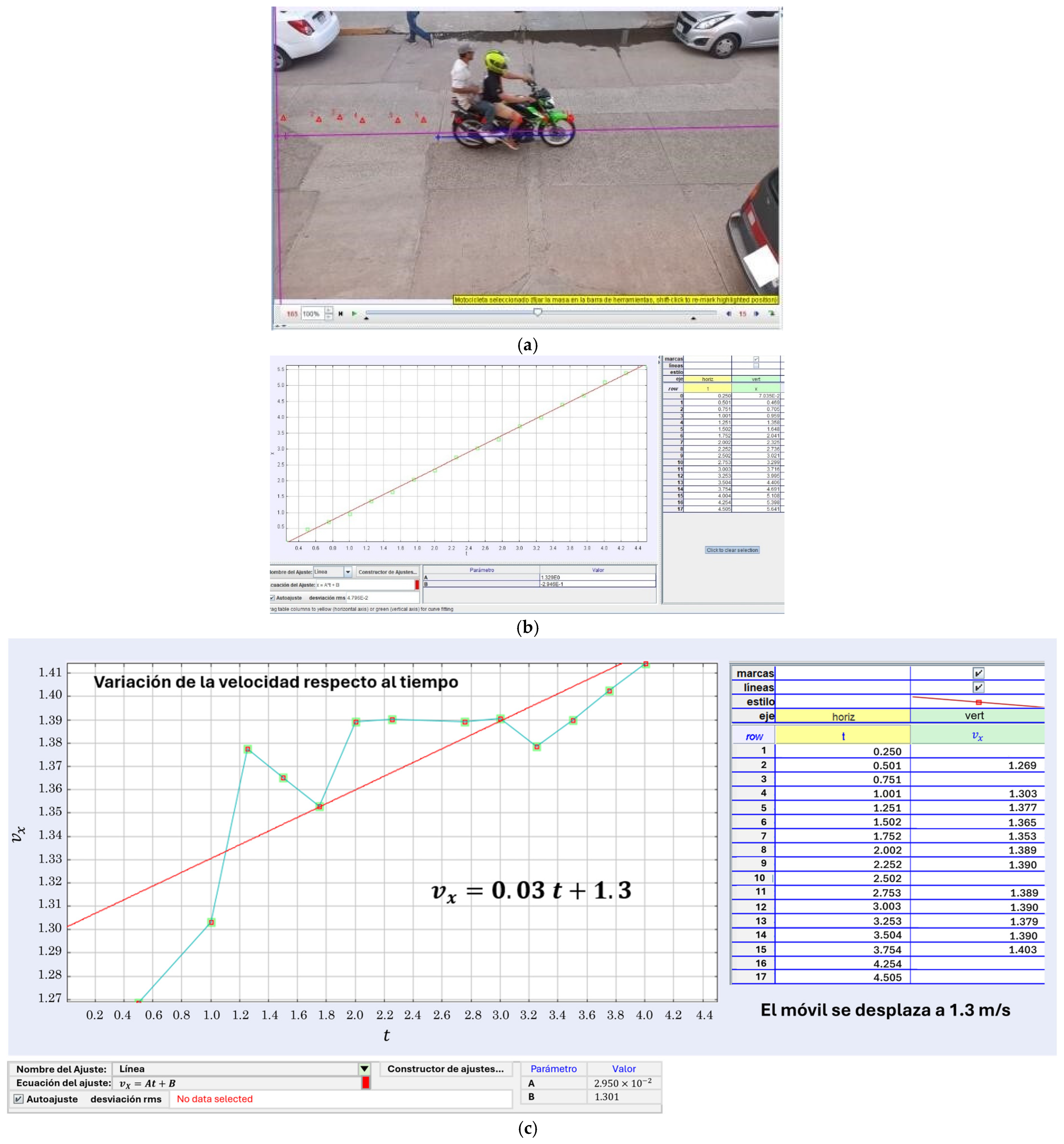
The second phase of the workshop demonstrated how technological tools can act as a catalyst for conceptual understanding and the development of critical thinking skills. Unlike the abstraction of paper-and-pencil modeling, the use of Tracker video analysis software allowed teachers to intuitively visualize physical phenomena. An example of this process is shown in Figure 3, where a team of teachers analyzed Uniformly Accelerated Rectilinear Motion (UARM). Using the software, the participants were able to generate precise graphical models and algebraic expressions, highlighting the synergy between theoretical knowledge and the use of technology.
Figure 3.
This figure illustrates the Uniformly Accelerated Rectilinear Motion (UARM) analysis process carried out by a team of teachers using the Tracker video analysis software. (a) Shows the video analysis interface, where participants marked the object’s trajectory. (b) Presents the position and velocity versus time graphs generated by the software, demonstrating how the tool converts video data into precise graphical representations. (c) Shows the least squares fit, evidencing the use of mathematical models to describe the phenomenon. These visual products served as evidence of technology’s ability to facilitate the conceptual understanding of abstract phenomena, which was difficult to achieve with traditional paper-and-pencil methods. Source: Teacher product, derived from the workshop.
The teachers’ reflections, particularly from those in non-scientific areas, underscored the value of this experience. They considered the tool “very visual” and “practical,” allowing students to “analyze more issues that are not so visible in class.” This visualization transformed the perception of learning, as one biology and chemistry teacher noted that the use of these types of activities could be adapted to their learning units, demonstrating the possibility of transdisciplinary adaptation.
The results also revealed a shift in perception toward educational technology. One participant emphasized that, while technological use is practical, it is crucial to “guide the student” in interpreting the data, warning about the risk of creating “technological illiterates.” On the other hand, a team of teachers, in their final reflection, pointed out that using the software allowed them to develop their argumentation and concluded that “collaborative work is everything.” This interaction demonstrated that the teacher’s presence is fundamental for mediating learning, disproving the idea that technology can replace the teacher’s work.
4.5. The Role of Artificial Intelligence: From Exploration to Critical Reflection
The final workshop activity focused on exploring artificial intelligence (AI), revealing a set of advantages and limitations that generated a significant debate among teachers about its ethical and effective use in the classroom. The most used tools by participants from both levels were ChatGPT and Wolframalpha (ver. 13.3). At the university level, the exploration of AI was more varied, with participants using tools like Perplexity and Scispace, which is evidence of a broader interest in its potential for research.
When asked to solve “The Epiphany” problem, participants observed that while the AI-generated responses offered ideas for the solution, they lacked rigor. The AIs failed to generate precise graphs or consider all the variables of the problem, which resulted in incomplete or erroneous answers. This finding reinforced the conclusion that AI tools, in their current state, lack the necessary graphical and analytical elements for the interpretation of physical phenomena.
The teachers highlighted that this lack of rigor in the responses could lead to two main scenarios for students: (a) increasing their curiosity and motivating them to investigate further, or (b) causing confusion due to irrelevant information, leading them to incorrect conclusions. In this sense, a university-level teacher pointed out that “it is necessary to propose problems that do not have an easy solution through AI, perhaps ideas for a solution.” This point underscores that the teacher’s role is fundamental for guiding students in critical thinking, preventing them from accepting AI information without deep analysis.
Despite these limitations, teachers also identified the potential of AI in the field of research. Three university-level teachers, with the guidance of the workshop facilitator, used a tool like Scispace and concluded that AI is very useful for retrieving recent information efficiently. This allows them to “save time and dedicate themselves to a deeper analysis of the information obtained,” which they value for their continuous professional development.
5. Discussion
5.1. The Theoretical-Practical Discrepancy as a Manifestation of the Scientific Literacy Gap (PCK)
The purpose of this section is to interpret the findings of the teacher training workshop and connect them to the theoretical framework and existing literature. The discussion is organized around three main axes that emerged from the results, addressing teacher perceptions, the value of inter-academic collaboration, and the critical mediation of technology and AI.
The initial results of the workshop reveal a clear disconnect between the competencies that teachers are expected to possess, according to frameworks such as DigCompEdu (Ponce-López et al., 2022) and the IPN’s Graduate Profile (IPN, 2023a, 2023b), and the reality of classroom challenges.
The finding that teachers exhibited this Persistent Theoretical-Practical Discrepancy is crucial. This finding serves to substantiate at the local, qualitative level what international assessments (OCDE, 2022) and national reports (IMCO, 2024) identify as a Scientific Literacy Gap. The inability of some high school and non-scientific teachers to solve the paper-and-pencil modeling activity, as reflected in participant statements like “The activity is very complex, honestly we are English teachers,” illustrates in a compelling way the need for teacher training programs that reinforce these basic competencies, an issue directly related to the limits of their Pedagogical Content Knowledge (PCK). This finding underscores that it cannot be assumed that all teachers, regardless of their area of specialization, have a homogeneous mastery of the skills required for the 21st century.
5.2. Inter-Level Collaboration: Validating the Emergence of a Community of Practice (CoP)
The second key finding of this study is the value of inter-academic collaboration, which manifested in the workshop as a genuine Community of Practice (CoP). This finding directly validates the theoretical premises of Lave and Wenger (1991) and Hord (1997), who define a CoP through mutual commitment and joint initiative, as observed in the multi-level group dynamics. The interaction between secondary and university teachers not only allowed them to solve complex problems but also generated profound reflections on students’ learning trajectories. For example, the comments from English and reading comprehension teachers demonstrate that the collaboration facilitated the understanding that mathematical and graphical interpretation skills are not exclusive to the sciences. This result is directly supported by the research of Huijboom et al. (2023), which argues that learning communities improve the quality of teaching and the development of teaching competencies. By breaking down disciplinary barriers, the workshop demonstrated that teacher training is more effective when based on peer learning and the co-construction of pedagogical solutions.
5.3. The Teacher as a Critical Mediator of Technology and Artificial Intelligence (TPACK)
The results demonstrate that technology, in its pedagogical use, cannot be a simple substitute for traditional methodologies; on the contrary, it requires active mediation by the teacher. The use of Tracker (Figure 3a–c) allowed teachers to visualize and model physical phenomena, improving their understanding and that of their students. This process is entirely consistent with the Technological, Pedagogical, and Content Knowledge (TPACK) framework. However, this process was enriched thanks to the collaboration and guidance provided by the workshop.
On the other hand, the exploration of AI revealed a dual nature: while AI tools can be useful for generating initial ideas and saving research time, their inability to produce accurate graphical models or contextualize responses highlights their current limitations. This finding reinforces the thesis that the teacher’s role is not replaced by technology but rather transformed. The teacher becomes a crucial mediator, responsible for guiding students so they do not passively accept information from AI. This idea aligns with the concept of AI literacy, which, as Yuan et al. (2024) point out, is not limited to technical competence, but also involves critical thinking and an understanding of the tool’s limitations.
5.4. Study Limitations and Future Research
This exploratory study provided valuable information about teachers’ perceptions, it has limitations inherent to qualitative design. The main limitation lies in the non-probabilistic nature of the sample (convenience sampling) and the short duration of the workshop. This deliberate decision, necessary for the in-depth qualitative approach, means that the findings cannot be statistically generalized to the teaching population. However, this is methodologically offset by the rigor applied to ensure the transferability and credibility of the results. This was achieved through in-depth descriptions that provide rich context and direct quotes from participants (Table 2) and through researcher triangulation (documented in Appendix B), which allows readers in similar educational contexts to critically evaluate the applicability of these contextualized findings to their own practice.
A crucial next step, as the reviewer suggests, would be a longitudinal follow-up study in which participating teachers implement the cross-level community of practice models, focusing on the distinction between pencil and paper and the use of technology, in their own high school and university classrooms. This would allow for an assessment of the long-term impact of skills acquisition on student learning outcomes.
6. Conclusions
The present study explored the critical connection among teaching practices, interdisciplinary collaboration, and the integration of technologies and artificial intelligence (AI), providing a detailed insight into the challenges and opportunities in professional teacher development. The findings from the training workshop offer three main contributions that enrich literature in this field.
First, the results evidence a clear disconnect between theoretical competencies and practical classroom challenges, such as educational lag and a lack of problem-solving skills, which is consistent with the Scientific Literacy Gap. The difficulty of some teachers, regardless of their specialization, in solving paper-and-pencil modeling problems underscores the critical need for teacher training programs to reinforce these basic competencies. This conclusion has direct implications for educational institutions, which cannot assume a homogeneous mastery of these skills and must invest in continuous and contextualized professional development.
Second, this study demonstrates that Professional Learning Communities (CoPs) are an effective strategy for closing the competency gap. The interaction and collaborative work among teachers from different levels and disciplines not only enriched the understanding of scientific concepts but also fostered critical reflection on students’ learning trajectories. This collaborative approach, which aligns with the literature that promotes peer learning, is presented as a powerful alternative to traditional and hierarchical training models.
Finally, this study underscores the need to position the teacher as a critical mediator of technology, rather than a mere consumer. While tools like Tracker and AI can be powerful allies in teaching, their potential is only fully leveraged with the teacher’s guidance, confirming the necessity of a solid TPACK foundation. AI showed critical limitations in graphical representation and in contextualizing responses, which demands that teachers develop critical thinking in their students and the ability to question and verify the information they obtain. This finding confirms that technology does not replace the teacher but transforms their role into a learning facilitator who guides students in an increasingly complex and information-saturated digital environment.
Author Contributions
For research Conceptualization, G.Á.G.; Methodology, G.Á.G.; Software, G.Á.G.; Validation, G.Á.G., L.S.T., M.H.R.D. and F.A.H.R.; Formal Analysis, G.Á.G.; Investigation, G.Á.G.; Resources, G.Á.G., L.S.T., M.H.R.D. and F.A.H.R.; Data Curation, G.Á.G.; Writing—Original Draft Preparation, G.Á.G., L.S.T.; Writing—Review and Editing, G.Á.G.; Visualization, G.Á.G.; Supervision, G.Á.G., L.S.T., M.H.R.D. and F.A.H.R.; Project Administration, G.Á.G.; Funding Acquisition, G.Á.G., L.S.T., M.H.R.D. and F.A.H.R. All authors have read and agreed to the published version of the manuscript.
Funding
This research was funded by the Secretaría de Investigación y Posgrado (SIP) del Instituto Politécnico Nacional (IPN). The Article Processing Charge was funded by the same institution, subject to the manuscript’s acceptance for publication.
Institutional Review Board Statement
Formal external REC approval was not required, as the study was officially conducted as an Internal Program Evaluation/Quality Improvement activity aimed at assessing teacher training needs at the National Polytechnic Institute (IPN). This qualifies for an exemption under local institutional guidelines for this type of pedagogical activity. As proof of its institutional nature, the activity was registered internally with the DFIE (Directorate of Training and Educational Innovation) with the official code: CUR: DFIE/23/E2/080EA/4/Co/P/62/120723-130723.
Informed Consent Statement
Informed consent was obtained from all subjects involved in the study.
Data Availability Statement
The data presented in this study is available on request from the corresponding author. The data is not publicly available due to privacy and ethical restrictions related to the personal information of the participants.
Acknowledgments
The authors gratefully acknowledge the support of the Secretaría de Investigación y Posgrado (SIP) del Instituto Politécnico Nacional (SIP). The authors have reviewed and edited the output and take full responsibility for the content of this publication.
Conflicts of Interest
The authors declare no conflicts of interest. The funders had no role in the design of the study; in the collection, analyses, or interpretation of data; in the writing of the manuscript; or in the decision to publish the results.
Appendix A. Didactic Sequence and Activities of the Teacher Professional Development Workshop
This appendix contains the detailed didactic sequence of the teacher workshop, including the specific activities, learning goals, and the didactic materials used. This information is provided to ensure full transparency and to allow for the potential replication of the study.
- Day 1
Purpose of the activity: To recognize the challenges and issues faced in the educational field
| Learning Content | Implemented Activities | Evidence of Learning | Didactic Materials/Resources |
| Opening: Analysis of academic situations (pre-pandemic, pandemic, and post-pandemic). Recognition of graphs using the mathematical model and their relationship to the physical model. | 1. Brief overview of the PISA 2018 and 2022 results. (30 min) | Participation was collected via the menti.com platform | Computer, projector, menti.com |
| Development: Teachers respond to questions about academic challenges before and after the pandemic. Discussion and reflections. (30 min) | The teacher presents a proposal of graphs; the team selects the one that corresponds to a statement. (30 min) | Team presentations on their answers and arguments. | White paper, pencil, and eraser. |
| Closing: The correct answers are shown, and a new round of discussion and reflection is generated. (30 min) | Participation was collected via the menti.com platform. | ||
| Assessment: Formative. | Reflections. | Graphs with correct answers. |
- Day 2
Purpose of the activity: To solve a problem that involves the relationship between physics and mathematics using paper and pencil, technology, and artificial intelligence.
| Learning Content | Implemented Activities | Evidence of Learning | Didactic Materials/Resources |
| Opening: Problem “The Epiphany” (graphs, functions, and motion). Use of technology (Tracker) and artificial intelligence (AI). | The importance of functions (mathematics) and their relationship to the phenomenon of motion (physics). The statement of “The Epiphany” problem. Questions about the use of AI in education and research. (30 min) | Participations through the padlet.com platform. | Computer, paper, and pencil, padlet.com |
| Development: Teachers solve the problem and present their work. (30 min) | The teams model the problem using the Tracker software and present their results. (30 min) | Screenshots of the AI results. | Tracker software, internet access, ChatGPT. |
| Closing: Teachers interact with AI to use it in their learning unit or research. (30 min) | Reflections on the use of paper and pencil, and technology. Discussion on how to use AI to support student learning. | Phones with internet access. | |
| Assessment: Formative. | Reflections. | Graphs with correct answers. |
Section: “Excerpt from Graphics in the context of science”
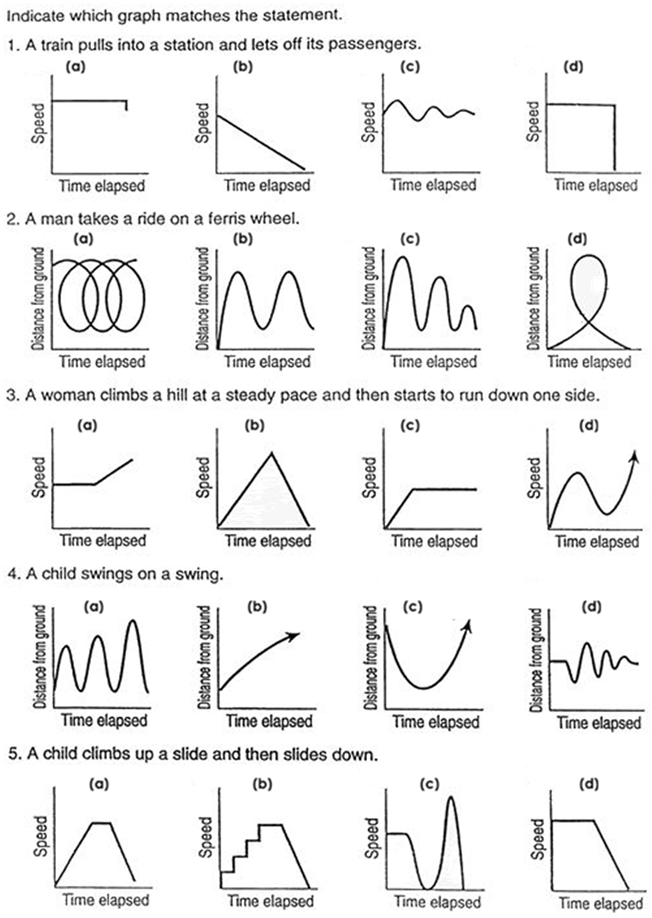
(Hunter College Quantitative Reasoning, n.d.)
Section: Statement of the problem of “The Epiphany”
Valentina arrived early to her music class. She was about to sit down when she realized, dismayed, that she had forgotten her notebook in her favorite refuge: the always comfortable and welcoming library. She couldn’t miss the start of class, so she went to the library, grabbed her notebook, and returned to her seat, in time to begin her probably enjoyable music lesson. But on the way, she ran into her beloved Juan and stopped to exchange a few tokens of their very genuine affection, which took her four minutes, but a long one at that, and forced her to make up for those four minutes so well spent, because when she left the room, she hadn’t anticipated the Epiphany. The library is diametrically opposite the music room in the school’s circular courtyard, which is 500 m in diameter. It took Valentina a total of nine minutes. Construct a graph that describes Valentina’s changes in position on her round trip with respect to time. We’ve all heard or spoken of descriptions of moving objects, which include expressions like “stopped,” “fast,” “slow,” “faster,” “slowed down,” “farther away,” “sped up more,” and many others that have surely plagued your memory. Identify some parts of the graph with these expressions and describe the graph characteristics that correspond to them.(Suárez et al., 2005).
Appendix B. Example of a Consensus Record for Triangulation and Coding of Researchers
This table offers crucial evidence of the methodological rigor applied to the thematic analysis. This consensus record provides explicit proof of the credibility and inter-rater reliability of the findings, directly addressing the need for transparency in qualitative research. It illustrates the iterative process of researcher triangulation, where initial independent codes were systematically discussed, refined, and reconciled into the final, theoretically grounded codes and themes. The reflective notes show how the interpretation of the data was linked to the theoretical framework (such as the Community of Practice [CoP] model), thus ensuring the greatest possible methodological transparency in the final thematic categories.
| Participant Quote (Raw Data) | Initial Code (Investigator 1) | Initial Code (Investigator 2) | Disagreement/Consensus (Reflective Note) | Final Agreed Code |
| “If they can’t resolve it on paper, do you think they’re going to use technology?” | Challenge: Fundamental Skills | Gap: Practical Competence | Consensus (refinement): Both codes point to a deficiency in prior skills. The broader term is chosen to highlight the gap between theory and application. | Theoretical-Practical Discrepancy |
| “The activity is very complex; honestly, we are English teachers.” | Disciplinary Barrier | Identity Conflict | Discrepancy (resolution): The quote reflects an emotional barrier related to identity. The focus is on the impact in the area of Applied Scientific Literacy, which is the objective of the workshop. | Low Applied Scientific Literacy |
| “The support from the math teachers is good because they explained what to do.” | The Value of Collaboration | peer-to-peer | Consensus (Theoretical Linkage): Both codes are valid. The concept is specifically linked to the most powerful theory introduced in the Theoretical Framework. | Inter-Level Community of Practice (CoP) |
| “It is important to highlight the most important aspect, which is the interpretation that is generated.” | Cognitive Mediation | Ethical/Analytical Filter | Consensus (expansion): Interpretation is the key cognitive function. The code is expanded to reflect the new role of the teacher as a guide in the digital environment. | Transformation of the Role to Critical Mediator |
References
- Alshorman, S. (2024). The readiness to use AI in teaching science: Science teachers’ perspective. Journal of Baltic Science Education, 23(3), 432–448. [Google Scholar] [CrossRef] [Scilit]
- Avila, K. E., Steinert, S., Ruzika, S., Kuhn, J., & Küchemann, S. (2024). Using ChatGPT for teaching physics. The Physics Teacher, 62(6), 536–537. [Google Scholar] [CrossRef] [Scilit]
- Azumah, E. A., & Najah, A. N. (2024). Science teachers’ knowledge of technology, its usage and challenges faced during integration. Science, 3(3), 218–234. [Google Scholar] [CrossRef]
- Bahri, A., Jamaluddin, A. B., Muharni, A., Fikri, M. J., & Arifuddin, M. (2021). The need of science learning to empower high order thinking skills in 21st century. Journal of Physics: Conference Series, 1899(1), 012144. [Google Scholar] [CrossRef] [Scilit]
- Bertochi, S., Navarro, J., Rodríguez, J., & Cecchi, L. (2021, June 10–11). Enfoque didáctico para la enseñanza transdisciplinar de la inteligencia artificial. XVI Congreso de Tecnología en Educación & Educación en Tecnología-TE & ET, La Plata, Argentina. Available online: https://sedici.unlp.edu.ar/handle/10915/122747 (accessed on 25 January 2025).
- Bounou, A., Tselios, N., Kaliampos, G., Lavidas, K., & Papadakis, S. (2025). Criteria for evaluating digital technology used to support computational thinking via inquiry learning—The case of two educational software applications for mathematics and physics. Computers, 14(3), 90. [Google Scholar] [CrossRef] [Scilit]
- Braun, V., & Clarke, V. (2006). Using thematic analysis in psychology. Qualitative Research in Psychology, 3(2), 77–101. [Google Scholar] [CrossRef] [Scilit]
- Camacho-Zuñiga, C., Pego, L., Escamilla, J., & Hosseini, S. (2021). The impact of the COVID-19 pandemic on students’ feelings at high school, undergraduate, and postgraduate levels. Heliyon, 7(3), e06465. [Google Scholar] [CrossRef] [Scilit]
- Cardona, M. A., Rodríguez, R. J., & Ishmael, K. (2023). Artificial intelligence and the future of teaching and learning: Insights and recommendations. U.S. Department of Education, Office of Educational Technology. Available online: https://www.ed.gov/sites/ed/files/documents/ai-report/ai-report.pdf (accessed on 10 February 2025).
- Cedeño, F. M., Jarre, G. A., Zambrano, R. O., & Jarre, G. R. (2020). Impacto del taller de matemática en los resultados de la prueba “Ser bachiller”. Revista Científica Sinapsis, 3(18). [Google Scholar] [CrossRef] [Scilit]
- Chans, G. M., Orona-Navar, A., Orona-Navar, C., & Sánchez-Rodríguez, E. P. (2023). Higher education in Mexico: The effects and consequences of the COVID-19 pandemic. Sustainability, 15(12), 9476. [Google Scholar] [CrossRef] [Scilit]
- Coban, A., & Coban, N. (2023). Use of ChatGPT in physics education. Yeditepe University. [Google Scholar]
- Contreras-Vizcaino, J. J., & Zamora-Echegollen, M. A. (2023). Afectos y efectos de la pandemia en la educación superior en México. Revista Latinoamericana de Tecnología Educativa-RELATEC, 22(1), 73–88. [Google Scholar] [CrossRef] [Scilit]
- Creswell, J. W., & Creswell, J. D. (2022). Research design: Qualitative, quantitative, and mixed methods approaches (6th ed.). SAGE Publications. [Google Scholar]
- Danusso, L., Testa, I., & Vicentini, M. (2010). Improving prospective teachers’ knowledge about scientific models and modelling: Design and evaluation of a teacher education intervention. International Journal of Science Education, 32(7), 871–905. [Google Scholar] [CrossRef] [Scilit]
- Darling-Hammond, L., Flook, L., Cook-Harvey, C., Barron, B., & Osher, D. (2020). Implications for educational practice of the science of learning and development. Applied Developmental Science, 24(2), 97–140. [Google Scholar] [CrossRef] [Scilit]
- Denzin, N. K., Lincoln, Y. S., MacLure, M., Otterstad, A. M., Torrance, H., Cannella, G. S., Koro, M., & McTier, T. (2017). Critical qualitative methodologies: Reconceptualizations and emergent construction. International Review of Qualitative Research, 10(4), 482–498. [Google Scholar] [CrossRef] [Scilit]
- De Torres, M. (2015). Los reyes de la pasarela, modelos matemáticos en las ciencias. Fundación de Historia Natural Félix de Azara. Available online: https://catalogo.unpaz.edu.ar/opac_css/index.php?lvl=notice_display&id=8365 (accessed on 15 January 2025).
- Dinçer, S. (2021). Bilgi ve iletişim teknolojileri okur-yazarlığı ve eğitimde teknoloji entegrasyonu. In Ü. Ormancı, & S. Çepni (Eds.), Kuramdan uygulamaya 21. yüzyıl becerileri ve öğretimi (pp. 111–120). Nobel Akademik Yayıncılık. [Google Scholar]
- Dinçer, S. (2024). Bridging the Gap in Technology Integration in Education: An Examination of Science Teachers’ Competencies and Needs. Journal of Turkish Science Education, 21(4), 620–634. [Google Scholar] [CrossRef] [Scilit]
- Dinçer, S., & Çengel-Schoville, M. (2022). Curriculum content proposal for integration of technology in education. International Journal of Curriculum and Instructional Studies, 12(2), 399–412. [Google Scholar] [CrossRef] [Scilit]
- Esteban Moreno, R. M., & Menjívar de Barbón, S. V. (2011). Una mirada internacional a las competencias docentes universitarias: Investigación en primera persona: Profesores y estudiantes. Ediciones Octaedro. [Google Scholar]
- García-Peñalvo, F. J. (2022). El sistema universitario ante la COVID-19: Retrospectiva y prospectiva de la transformación digital. In F. Llorens Largo, & R. López-Meseguer (Eds.), Transformación digital de las Universidades. Hacia un futuro postpandemia (pp. 142–148). Universidad Internacional de La Rioja (UNIR). Available online: https://bit.ly/3v569zk (accessed on 17 May 2025).
- Hord, S. M. (1997). Professional learning communities: Communities of continuous inquiry and improvement. Southwest Educational Development Laboratory. [Google Scholar]
- Huijboom, F., van Meeuwen, P., Rusman, E., & Vermeulen, M. (2023). Differences and similarities in the development of Professional Learning Communities: A cross-case longitudinal study. Learning, Culture and Social Interaction, 42, 100740. [Google Scholar] [CrossRef] [Scilit]
- Hunter College Quantitative Reasoning. (n.d.). Activity: Qualitative line graphs. Available online: https://huntercollegeqr.wordpress.com/activity-qualitative-line-graphs/ (accessed on 21 December 2025).
- Ilomäki, L., & Lakkala, M. (2018). Digital technology and practices for school improvement: Innovative digital school model. Research and Practice in Technology Enhanced Learning, 13, 1–32. [Google Scholar] [CrossRef] [Scilit]
- IMCO. (2024, January 22). Desigualdades educativas en México. Instituto Mexicano para la Competitividad (IMCO). Available online: https://imco.org.mx/desigualdades-educativa-en-mexico/ (accessed on 15 April 2025).
- Instituto Politécnico Nacional [IPN]. (2023a). Plan académico/Técnico en aeronáutica. Unidad Profesional Interdisciplinaria de Ingeniería, Campus Guanajuato. Available online: https://www.upiig.ipn.mx/oferta-educativa/sistemas.html (accessed on 25 January 2025).
- Instituto Politécnico Nacional [IPN]. (2023b). Plan de estudios ingeniería en sistemas. Centro de Estudios Científicos y Tecnológicos No. 17. Available online: https://www.cecyt17.ipn.mx/oferta-educativa/ver-carrera.html?lg=es&id=2&nombre=T%C3%A9cnico-en-Aeron%C3%A1utica (accessed on 25 January 2025).
- Jafari Ghalehkohneh, S., Arnell, J., Hart, K., Swanson, H., Edwards, B., & Edwards, J. (2025). Upper-division physics simulations with equation manipulation. Physical Review Physics Education Research, 21(1), 010151. [Google Scholar] [CrossRef] [Scilit]
- Kelley, M., & Wenzel, T. (2025). Advancing artificial intelligence literacy in teacher education through professional partnership inquiry. Education Sciences, 15(6), 659. [Google Scholar] [CrossRef] [Scilit]
- Kind, V. (2009). Pedagogical content knowledge in science education: Perspectives and potential for progress. Studies in Science Education, 45(2), 169–204. [Google Scholar] [CrossRef] [Scilit]
- Kotsis, K. T. (2025). Integrating artificial intelligence for science teaching in high school. LatIA, (3), 89. [Google Scholar] [CrossRef] [Scilit]
- Küchemann, S., Avila, K. E., Dinc, Y., Hortmann, C., Revenga, N., Ruf, V., Stausberg, N., Steinert, S., Fischer, F., Fischer, M., Kasneci, E., Kasneci, G., Kuhr, T., Kutyniok, G., Malone, S., Sailer, M., Schmidt, A., Stadler, M., Weller, J., & Kuhn, J. (2025). Are large multimodal foundation models all we need? On opportunities and challenges of these models in education. NPJ Science of Learning, 10(1), 11. [Google Scholar] [CrossRef] [Scilit]
- Lave, J., & Wenger, E. (1991). Situated learning: Legitimate peripheral participation. Cambridge University Press. [Google Scholar]
- León, P. A. (2020). Construcción de modelos matemáticos para la ciencia física. Universidad de la Guajira. Available online: https://repositoryinst.uniguajira.edu.co/bitstream/handle/uniguajira/427/45.%20Modelos%20matem%C3%A1ticos%20para%20la%20f%C3%ADsica%20%E2%80%93web-.pdf?sequence=1&isAllowed=y (accessed on 22 January 2025).
- Ley Orgánica del IPN, DOF 29-12-1981, de 28 de mayo de 1982. (1982). Available online: https://www.diputados.gob.mx/LeyesBiblio/pdf/171.pdf (accessed on 22 January 2025).
- Lytras, M. D., Serban, A. C., Ruiz, M. J. T., Ntanos, S., & Sarirete, A. (2022). Translating knowledge into innovation capability: An exploratory study investigating the perceptions on distance learning in higher education during the COVID-19 pandemic-the case of Mexico. Journal of Innovation & Knowledge, 7(4). [Google Scholar] [CrossRef] [Scilit]
- Mandal, J. (2024). AI integration in lifelong learning: Transformative approaches to teaching and learning. In Artificial intelligence in education (p. 250). Red Unicorn Publishing. [Google Scholar] [CrossRef] [Scilit]
- Marino, M. T., Vasquez, E., Dieker, L., Basham, J., & Blackorby, J. (2023). The future of artificial intelligence in special education technology. Journal of Special Education Technology, 38(3), 404–416. [Google Scholar] [CrossRef] [Scilit]
- Ng, D. T. K., Leung, J. K. L., Chu, S. K. W., & Qiao, M. S. (2021). Conceptualizing AI literacy: An exploratory review. Computers and Education: Artificial Intelligence, 2, 100041. [Google Scholar] [CrossRef] [Scilit]
- Ning, Y., Zhang, C., Xu, B., Zhou, Y., & Wijaya, T. T. (2024). Teachers’ AI-TPACK: Exploring the relationship between knowledge elements. Sustainability, 16(3), 978. [Google Scholar] [CrossRef] [Scilit]
- Organización para la Cooperación y el Desarrollo Económico [OCDE]. (2018). Teachers and school leaders as lifelong learners. Talis 2013 (Vol. 1). Available online: https://www.oecd.org/education/talis-2018-results-volume-i-1d0bc92a-en.htm (accessed on 22 January 2025).
- Organización para la Cooperación y el Desarrollo Económico [OCDE]. (2022). PISA 2022 results (volume I): The state of learning and equity in education. OECD Publishing. [Google Scholar] [CrossRef] [Scilit]
- Patton, M. Q. (2015). Evaluación cualitativa y métodos de investigación. Sage. [Google Scholar]
- Pérez-Rodríguez, F., & Baquero-Mendieta, G. (2025). Alfabetización científica en la educación científica y la didáctica de las ciencias: Tendencias y brechas en la producción intelectual de los últimos 40 años. Revista Eureka sobre Enseñanza y Divulgación de las Ciencias, 22(2), 210101–210118. [Google Scholar] [CrossRef] [Scilit]
- Pimienta, P. J. (2012). Las competencias en la docencia universitaria. Editorial Pearson. [Google Scholar]
- Ponce-López, J. L., Vicario, C. M., & López, F. C. (Coords.). (2022). Competencias digitales profesores MetaRed México, estudio 2021: Resultados de la herramienta de autoevaluación Check-in DigCompEd. Asociación Nacional de Universidades e Instituciones de Educación Superior (ANUIES). [Google Scholar]
- Richter, D., Kunter, M., Klusmann, U., Lüdtke, O., & Baumert, J. (2011). Professional development across the teaching career: Teachers’ uptake of formal and informal learning opportunities. Teaching and Teacher Education, 27(1), 116–126. [Google Scholar] [CrossRef] [Scilit]
- Rico-Gómez, M. L., & Ponce Gea, A. I. (2022). El profesor del siglo XXI: Perspectivas según el rol formativo y profesional. Revista Mexicana de Investigación Educativa, 27(92), 77–101. [Google Scholar]
- Sánchez-Aguilar, A., & Ochoa-Villanueva, E. M. (2023). Talleres de formación profesor, una alternativa para la alfabetización académica. In Centros y programas de escritura en América Latina: Opciones teóricas y pedagógicas para la enseñanza de la escritura disciplinar (pp. 161–187). The WAC Clearinghouse. Available online: https://wac.colostate.edu/docs/books/centros/chapter6.pd (accessed on 12 February 2025).
- Sánchez Mendiola, M., Martínez Hernández, A. M., Torres Carrasco, R., de Agüero Servín, M., Hernández Romo, A. K., Benavides Lara, M. A., Rendón Cazales, V. J., & Jaimes Vergara, C. A. (2020). Educational challenges during the COVID-19 pandemic: A teachers’ survey at UNAM. Revista Digital Universitaria, 21(3), 1–24. [Google Scholar] [CrossRef] [Scilit]
- Scardamalia, M., & Bereiter, C. (2021). Knowledge building: Advancing the state of community knowledge. In U. Cress, C. Rosé, A. F. Wise, & J. Oshima (Eds.), International handbook of computer-supported collaborative learning. Computer-supported collaborative learning series, 19. Springer. [Google Scholar] [CrossRef] [Scilit]
- Secretaría de Educación Pública [SEP]. (2008, August 14). Acuerdo número 447 por el que se establecen las competencias profesores para quienes impartan educación media Universitario en la modalidad escolarizada. Diario Oficial de la Federación. [Google Scholar]
- Shezad, F., Goswami, R., Shaheen, A., & Khan, I. (2025). AI in teacher training and professional development: A tool for continuous learning and skill enhancement. Review of Education, Administration & Law, 8(1), 179–191. [Google Scholar] [CrossRef] [Scilit]
- Sintov, N., Kar, D., Nguyen, T., Fang, F., Hofman, K., Lyet, A., & Tambe, M. (2017). Keeping it real: Using real-world problems to teach AI to diverse audiences. AI Magazine, 38(2), 35–47. [Google Scholar] [CrossRef] [Scilit]
- Sperling, A., & Lickerman, D. (2012, July 3–5). Integrating AI and machine learning in software engineering course for high school students. 17th ACM Annual Conference on Innovation and Technology in Computer Science Education, Haifa, Israel. [Google Scholar] [CrossRef] [Scilit]
- Suarez-Fernandez de Miranda, S., Aguayo-González, F., Ávila-Gutiérrez, M. J., & Córdoba-Roldán, A. (2021). Neuro-competence approach for sustainable engineering. Sustainability, 13(8), 4389. [Google Scholar] [CrossRef] [Scilit]
- Suárez, L., Cordero, F., Daowz, P., Ortega, P., Ramírez, A., & Torres, J. L. (2005). De los paquetes didácticos hacia un repositorio de objetos de aprendizaje: Un reto educativo en Matemáticas: Uso de las gráficas, un ejemplo. RIED. Revista Iberoamericana de Educación a Distancia, 8, 307–334. [Google Scholar] [CrossRef] [Scilit]
- Treve, M. (2021). What COVID-19 has introduced into education: Challenges facing higher education institutions (HEIs). Higher Education Pedagogies, 6(1), 212–227. [Google Scholar] [CrossRef] [Scilit]
- Van Driel, J. H., Meirink, J., van Veen, K., & Zwart, R. (2012). Current trends and missing links in studies on teacher professional development in science education: A review of design features and quality of research. Studies in Science Education, 48(2), 129–160. [Google Scholar] [CrossRef] [Scilit]
- Vartiainen, H., Tedre, M., & Valtonen, T. (2020). Learning machine learning with very young children: Who is teaching whom? International Journal of ChildComputer Interaction, 25, 100182. [Google Scholar] [CrossRef] [Scilit]
- Vicentini, I. C. (2020). La educación superior en tiempos de COVID-19: Segunda reunión del diálogo virtual con rectores de universidades líderes de América Latina. Banco Interamericano de Desarrollo. [Google Scholar] [CrossRef] [Scilit]
- Vičič Krabonja, M., Kustec, S., Skrbinjek, V., Aberšek, B., & Flogie, A. (2024). Innovative professional learning communities and sustainable education practices through digital transformation. Sustainability, 16(14), 6250. [Google Scholar] [CrossRef] [Scilit]
- Wang, L. (2023). Adoption of the PICRAT model to guide the integration of innovative technologies in the teaching of a linguistics course. Sustainability, 15(5), 3886. [Google Scholar] [CrossRef] [Scilit]
- Williams, R., Park, H. W., Oh, L., & Breazeal, C. (2019). Popbots: Designing an artifcial intelligence curriculum for early childhood education. Proceedings of the AAAI Conference on artifiCIAL Intelligence, 33(1), 9729–9736. [Google Scholar] [CrossRef] [Scilit]
- Yasir, M., Ullah, A., Siddique, M., Hamid, Z., & Khan, N. (2022). The capabilities, challenges, and resilience of digital learning as a tool for education during the COVID-19. Journal of Technology, 16(13), 30909. [Google Scholar] [CrossRef] [Scilit]
- Yuan, C. W., Tsai, H. Y. S., & Chen, Y. T. (2024). Charting competence: A holistic scale for measuring proficiency in artificial intelligence literacy. Journal of Educational Computing Research, 62(7), 1455–1484. [Google Scholar] [CrossRef] [Scilit]
- Zhou, T., & Zhang, W. (2022). Effectiveness study on online or blended language learning based on student achievement: A systematic review of empirical studies. Sustainability, 14(12), 7303. [Google Scholar] [CrossRef] [Scilit]
- Zucchetti, A., Cobo, C., & Montaldo, M. (2020). Uruguay: Integrar las tecnologías de la información y las comunicaciones en la educación. In M. Mateo, & C. Lee (Eds.), Lo que puede y no puede hacer por la educación: Una comparación de cinco historias de éxito. Banco Interamericano de Desarrollo. Available online: https://redi.anii.org.uy/jspui/handle/20.500.12381/310 (accessed on 21 December 2025).

Disclaimer/Publisher’s Note: The statements, opinions and data contained in all publications are solely those of the individual author(s) and contributor(s) and not of MDPI and/or the editor(s). MDPI and/or the editor(s) disclaim responsibility for any injury to people or property resulting from any ideas, methods, instructions or products referred to in the content. |
© 2026 by the authors. Licensee MDPI, Basel, Switzerland. This article is an open access article distributed under the terms and conditions of the Creative Commons Attribution (CC BY) license.