Optimizing Assessment Thresholds of a Computer Gaming Intervention for Students with or at Risk for Mathematics Learning Disabilities: Accuracy and Response Time Trade-Offs


Abstract
1. Introduction
1.1. Study Purpose and Research Questions
- What is the relationship between accuracy, speed, and speed–accuracy trade-offs in whole-number concepts and skills of first-grade students with or at risk for MLD? What is the optimal assessment threshold (i.e., sweet spot) of the mathematics technology gaming intervention designed for first-grade students with or at risk for MLD?
- What are the overall patterns of student performance in early mathematical fluency? To what extent do student background characteristics predict different patterns of student performance?
1.2. Mathematical Fluency
1.3. Accuracy and Timing Elements
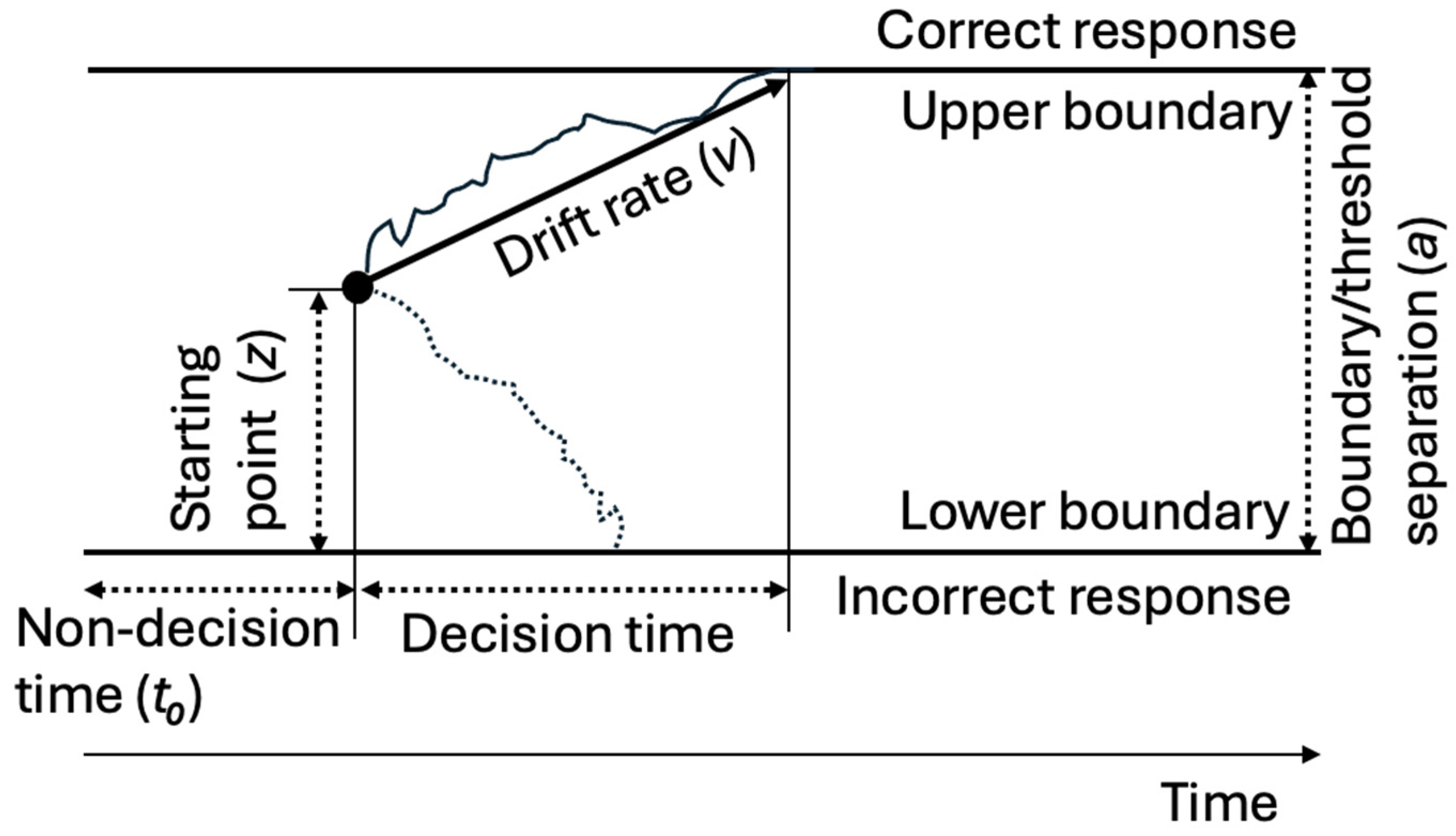
1.4. Drift-Diffusion Model
2. Materials and Methods
2.1. NumberShire Gaming Intervention
2.1.1. Differentiated Learning Pathway
2.1.2. Embedded Assessment
2.2. Settings and Participants
2.3. Dataset
2.4. Data Analysis
2.4.1. Simulating DDM
2.4.2. Calculating Trade-Offs
2.4.3. Subgroup Comparison
3. Results
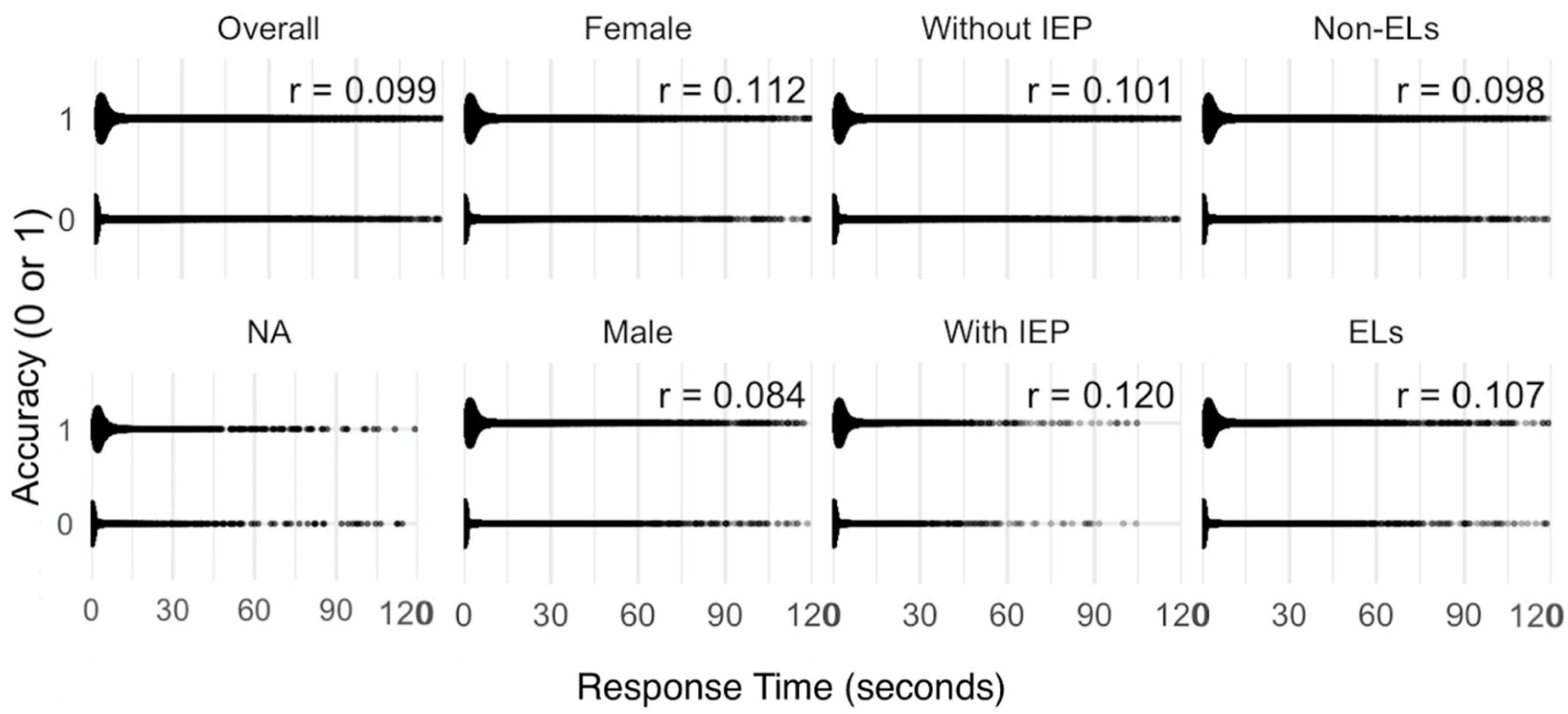
3.1. Descriptive Statistics
3.2. Model Fit
3.3. Parameter Estimations
3.4. Simulation Results
3.5. Trade-Offs and Subgroup Comparison
4. Discussion
4.1. Summary of Research Findings
4.1.1. Overall Performance
4.1.2. Subgroup Performance
4.2. Conceptualizing the Thresholds in Technology-Based Mathematics Assessments
4.3. Study Limitations, Practical Implications, and Future Work
5. Conclusions
Author Contributions
Funding
Institutional Review Board Statement
Informed Consent Statement
Data Availability Statement
Conflicts of Interest
Abbreviations
| ANOVA | Analysis of Variance |
| CBM | Curriculum-Based Measures |
| CCSS-M | Common Core State Standards for Mathematics |
| DCPM | Digits Correct Per Minute |
| DDM | Drift-diffusion model |
| DLP | Differentiated Learning Pathway |
| EL | English language |
| IEP | Individualized Education Program |
| MLD | Mathematics Learning Disabilities |
| OR | Odd Ratio |
| RT | Response time |
Appendix A


Appendix B

References
- Allen, K., Giofrè, D., Higgins, S., & Adams, J. (2021). Using working memory performance to predict mathematics performance 2 years on. Psychological Research, 85(5), 1986–1996. [Google Scholar] [CrossRef]
- Alonzo, J., Tindal, G., Ulmer, K., & Glasgow, A. (2006). easyCBM online progress monitoring assessment system. Center for Educational Assessment Accountability. Available online: http://easycbm.com (accessed on 21 November 2025).
- Baek, J., & Park, H. J. (2024). Bayesian adaptive method for estimating speed–accuracy tradeoff functions of multiple task conditions. Behavior Research, 56, 4403–4420. [Google Scholar] [CrossRef]
- Baroody, A. J. (2011). Learning: A framework. In F. Fennell (Ed.), Achieving fluency: Special education and mathematics (pp. 15–58). National Council of Teachers of Mathematics. [Google Scholar]
- Black, P., & Wiliam, D. (1998). Assessment and classroom learning. Assessment in Education: Principles, Policy & Practice, 5(1), 7–74. [Google Scholar] [CrossRef]
- Bogacz, R., Brown, E., Moehlis, J., Holmes, P., & Cohen, J. D. (2006). The physics of optimal decision making: A formal analysis of models of performance in two-alternative forced-choice tasks. Psychological Review, 113(4), 700–765. [Google Scholar] [CrossRef]
- Clark, A. K., & Karvonen, M. (2021). Instructionally embedded assessment: Theory of action for an innovative system. Frontiers in Education, 6, 724938. [Google Scholar] [CrossRef]
- Clarke, B., Nelson, N., & Shanley, L. (2016). Mathematics fluency—More than the weekly timed test. In K. D. Cummings, & Y. Petscher (Eds.), The fluency construct: Curriculum-based measurement concepts and applications (pp. 67–89). Springer Science + Business Media. [Google Scholar] [CrossRef]
- Common Core State Standard-Mathematics. (2010). Common core state standards for mathematics. Available online: http://www.corestandards.org/Math/ (accessed on 21 November 2025).
- Deno, S. L. (1985). Curriculum-based measurement: The emerging alternative. Exceptional Children, 52(3), 219–232. [Google Scholar] [CrossRef]
- Domingue, B. W., Kanopka, K., Stenhaug, B., Sulik, M. J., Beverly, T., Brinkhuis, M., Circi, R., Faul, J., Liao, D., McCandliss, B., & Yeatman, J. (2022). Speed–accuracy trade-off? Not so fast: Marginal changes in speed have inconsistent relationships with accuracy in real-world settings. Journal of Educational and Behavioral Statistics, 47(5), 576–602. [Google Scholar] [CrossRef]
- Evans, W. S., Hula, W. D., & Starns, J. J. (2019). Speed–accuracy trade-offs and adaptation deficits in aphasia: Finding the “Sweet Spot” between overly cautious and incautious responding. American Journal of Speech-Language Pathology, 28(1S), 259–277. [Google Scholar] [CrossRef] [PubMed]
- Evans, W. S., & Quique, Y. M. (2021). Understanding speed–accuracy processing dynamics in aphasia using response time modeling. Seminars in Speech and Language, 42(3), 240–255. [Google Scholar] [CrossRef] [PubMed]
- Fien, H., Doabler, C. T., Nelson, N. J., Kosty, D. B., Clarke, B., & Baker, S. K. (2016). An examination of the promise of the NumberShire level 1 gaming intervention for improving student mathematics outcomes. Journal of Research on Educational Effectiveness, 9(4), 635–661. [Google Scholar] [CrossRef]
- Fitts, P. M. (1954). The information capacity of the human motor system in controlling the amplitude of movement. Journal of Experimental Psychology, 47(6), 381–391. [Google Scholar] [CrossRef]
- Foegen, A., Jiban, C., & Deno, S. (2007). Progress monitoring measures in mathematics: A review of the literature. The Journal of Special Education, 41(2), 121–139. [Google Scholar] [CrossRef]
- Fritz, C. O., Morris, P. E., & Richler, J. J. (2012). Effect size estimates: Current use, calculations, and interpretation. Journal of Experimental Psychology: General, 141(1), 2–18. [Google Scholar] [CrossRef]
- Fuchs, L. S. (2017). Curriculum–based measurement as the emerging alternative: Three decades later. Learning Disabilities Research & Practice, 32(1), 5–7. [Google Scholar] [CrossRef]
- Fuchs, L. S., Fuchs, D., Stuebing, K., Fletcher, J. M., Hamlett, C. L., & Lambert, W. (2008). Problem solving and computational skill: Are they shared or distinct aspects of mathematical cognition? Journal of Educational Psychology, 100(1), 30–47. [Google Scholar] [CrossRef]
- Geary, D. C. (1993). Mathematical disabilities: Cognitive, neuropsychological, and genetic components. Psychological Bulletin, 114(2), 345–362. [Google Scholar] [CrossRef] [PubMed]
- Geary, D. C., Hoard, M. K., Byrd-Craven, J., Nugent, L., & Numtee, C. (2007). Cognitive mechanisms underlying achievement deficits in children with mathematical learning disability. Child Development, 78(4), 1343–1359. [Google Scholar] [CrossRef] [PubMed]
- Gersten, R., Beckmann, S., Clarke, B., Foegen, A., Marsh, L., Star, J. R., & Witzel, B. (2009). Assisting students struggling with mathematics: Response to Intervention (RtI) for elementary and middle schools (NCEE 2009-4060). National Center for Education Evaluation and Regional Assistance, Institute of Education Sciences, U.S. Department of Education. Available online: http://ies.ed.gov/ncee/WWC/PracticeGuide/2 (accessed on 21 November 2025).
- Heitz, R. P. (2014). The speed–accuracy tradeoff: History, physiology, methodology, and behavior. Frontiers in Neuroscience, 8, 150. [Google Scholar] [CrossRef]
- Institute of Education Sciences. (2016). A multi-site randomized controlled trial to assess the efficacy of the NumberShire level 1 gaming intervention for improving math outcomes for students with or at risk for math learning disabilities (Award No. R324A160125). The National Center for Special Education Research (NCSER), Institute of Education Sciences, U.S. Department of Education. Available online: https://ies.ed.gov/use-work/awards/multi-site-randomized-controlled-trial-assess-efficacy-numbershire-level-1-gaming-intervention (accessed on 21 November 2025).
- International Organization for Standardization. (2023). Accuracy (trueness and precision) of measurement methods and results—Part 1: General principles and definitions (ISO 5725-1:2023). International Organization for Standardization (ISO).
- Jordan, N. C., & Hanich, L. B. (2000). Mathematical thinking in second-grade children with different forms of LD. Journal of Learning Disabilities, 33(6), 567–578. [Google Scholar] [CrossRef] [PubMed]
- Kyllonen, P. C., & Zu, J. (2016). Use of response time for measuring cognitive ability. Journal of Intelligence, 4(4), 14. [Google Scholar] [CrossRef]
- Lembke, E., & Stecker, P. (2007). Curriculum-based measurement in mathematics: An evidence-based formative assessment procedure. RMC Research Corporation, Center on Instruction. Available online: https://files.eric.ed.gov/fulltext/ED521574.pdf (accessed on 21 November 2025).
- MacKenzie, I. S., & Mackenzie, S. (1992). Fitts’ law as a research and design tool in human-computer interaction. Human Computer. Interaction, 7(1), 91–139. [Google Scholar] [CrossRef]
- Mayer, R. E. (2009). Multimedia learning (2nd ed.). Cambridge University Press. [Google Scholar] [CrossRef]
- McCarthy, M. A., Niederjohn, D. M., & Bosack, T. N. (2011). Embedded assessment: A measure of student learning and teaching effectiveness. Teaching of Psychology, 38(2), 78–82. [Google Scholar] [CrossRef]
- McNeil, N. M., Jordan, N. C., Viegut, A. A., & Ansari, D. (2025). What the science of learning teaches us about arithmetic fluency. Psychological Science in the Public Interest, 26(1), 10–57. [Google Scholar] [CrossRef]
- Medrano, J., & Miller-Cotto, D. (2025). Understanding working memory as a facilitator of math problem-solving: Offloading as a potential strategy. British Journal of Educational Psychology, 95(3). [Google Scholar] [CrossRef]
- Miwa, K. (2023). How quickly do investors react to analyst reports? Evidence from reports released outside trading hours. Global Finance Journal, 57, 100856. [Google Scholar] [CrossRef]
- Myers, J. A., Witzel, B. S., Powell, S. R., Li, H., Pigott, T. D., Xin, Y. P., & Hughes, E. M. (2022). A meta-analysis of mathematics word-problem solving interventions for elementary students who evidence mathematics difficulties. Review of Educational Research, 92(5), 695–742. [Google Scholar] [CrossRef]
- National Council of Teachers of Mathematics. (2014). Principles to actions: Ensuring mathematical success for all. NCTM. [Google Scholar]
- National Governors Association Center for Best Practices & Council of Chief State School Officers. (2010). Common core state standards. Council of Chief State School Officers, National Governors Association Center for Best Practices. [Google Scholar]
- National Mathematics Advisory Panel (NMAP). (2008). Foundations for success: The final report of the national mathematics advisory panel. U.S. Department of Education.
- National Research Council (NRC). (2001). Adding it up: Helping children learn mathematics. National Academies Press. [Google Scholar]
- National Research Council (NRC). (2005). How students learn: History, mathematics, and science in the classroom. The National Academies Press. [Google Scholar] [CrossRef]
- Paganelli, A. I., Mondejar, A. G., da Silva, A. C., Silva-Calpa, G., Teixeira, M. F., Carvalho, F., Raposo, A., & Endler, M. (2022). Real-time data analysis in health monitoring systems: A comprehensive systematic literature review. Journal of Biomedical Informatics, 127, 104009. [Google Scholar] [CrossRef]
- Partchev, I., De Boeck, P., & Steyer, R. (2013). How much power and speed is measured in this test? Assessment, 20(2), 242–252. [Google Scholar] [CrossRef]
- Petscher, Y., Mitchell, A. M., & Foorman, B. R. (2015). Improving the reliability of student scores from speeded assessments: An illustration of conditional item response theory using a computer-administered measure of vocabulary. Reading and Writing, 28(1), 31–56. [Google Scholar] [CrossRef]
- Raghubar, K. P., Barnes, M. A., & Hecht, S. A. (2010). Working memory and mathematics: A review of developmental, individual difference, and cognitive approaches. Learning and Individual Differences, 20(2), 110–122. [Google Scholar] [CrossRef]
- Ratcliff, R. (1978). A theory of memory retrieval. Psychological Review, 85(2), 59–108. [Google Scholar] [CrossRef]
- Ratcliff, R., & McKoon, G. (2008). The diffusion decision model: Theory and data for two-choice decision tasks. Neural Computation, 20(4), 873–922. [Google Scholar] [CrossRef]
- Ratcliff, R., Smith, P. L., Brown, S. D., & McKoon, G. (2016). Diffusion decision model: Current issues and history. Trends in Cognitive Sciences, 20(4), 260–281. [Google Scholar] [CrossRef]
- Rittle-Johnson, B., Schneider, M., & Star, J. R. (2015). Not a one-way street: Bidirectional relations between procedural and conceptual knowledge of mathematics. Educational Psychology Review, 27(4), 587–597. [Google Scholar] [CrossRef]
- Schneider, M., Rittle-Johnson, B., & Star, J. R. (2011). Relations among conceptual knowledge, procedural knowledge, and procedural flexibility in two samples differing in prior knowledge. Developmental Psychology, 47(6), 1525–1538. [Google Scholar] [CrossRef] [PubMed]
- Shute, V. J., Lu, X., & Rahimi, S. (2021). Stealth assessment. In J. M. Spector (Ed.), The routledge encyclopedia of education (pp. 1–9). Taylor & Francis group. [Google Scholar]
- Sideridis, G., & Alahmadi, M. T. S. (2022). The role of response times on the measurement of mental ability. Frontiers in Psychology, 13, 892317. [Google Scholar] [CrossRef] [PubMed]
- Star, J. R. (2005). Reconceptualizing procedural knowledge. Journal for Research in Mathematics Education, 36(5), 404–411. [Google Scholar]
- Stickney, E. M., Sharp, L. B., & Kenyon, A. S. (2012). Technology-enhanced assessment of math fact automaticity: Patterns of performance for low- and typically achieving students: Patterns of performance for low- and typically achieving students. Assessment for Effective Intervention, 37(2), 84–94. [Google Scholar] [CrossRef]
- Stocker, J. D., Schwartz, R., Kubina, R. M., Kostewicz, D., & Kozloff, M. (2019). Behavioral fluency and mathematics intervention research: A review of the last 20 years. Behavioral Interventions, 34, 102–117. [Google Scholar] [CrossRef]
- Tan, S. Y., Sumner, J., Wang, Y., & Wenjun Yip, A. (2024). A systematic review of the impacts of remote patient monitoring (RPM) interventions on safety, adherence, quality-of-life and costrelated outcomes. npj Digital Medicine, 7(1), 192. [Google Scholar] [CrossRef]
- U.S. Department of Education. (2024). Report on the condition of education 2024 (NCES 2024-144). National Center for Education Statistics. [Google Scholar]
- U.S. Department of Education. (2025). The nation’s report card: Results from the 2024 national assessment of educational progress (NAEP). Institute of Education Sciences, National Center for Education Statistics. Available online: https://nces.ed.gov/nationsreportcard/ (accessed on 21 November 2025).
- VanDerHeyden, A. M., & Burns, M. K. (2009). Performance indicators in math: Implications for brief experimental analysis of academic performance. Journal of Behavioral Education, 18(1), 71–91. [Google Scholar] [CrossRef]
- Van der Linden, W. J. (2009). Conceptual issues in response-time modeling. Journal of Educational Measurement, 46(3), 247–272. [Google Scholar] [CrossRef]
- Vandierendonck, A. (2021). On the utility of integrated speed–accuracy measures when speed–accuracy trade-off is present. Journal of Cognition, 4(1), 22. [Google Scholar] [CrossRef] [PubMed]
- Voss, A., Rothermund, K., Gast, A., & Wentura, D. (2013). Cognitive processes in associative and categorical priming: A diffusion model analysis. Journal of Experimental Psychology: General, 142(2), 536. [Google Scholar] [CrossRef] [PubMed]
- Voss, A., Rothermund, K., & Voss, J. (2004). Interpreting the parameters of the diffusion model: An empirical validation. Memory & Cognition, 32(7), 1206–1220. [Google Scholar] [CrossRef]
- Voss, A., Voss, J., & Lerche, V. (2015). Assessing cognitive processes with diffusion model analyses: A tutorial based on fast-dm-30. Frontiers in Psychology, 6, 336. [Google Scholar] [CrossRef]
- Voss, A., Voss, J., & Lerche, V. (2025). rtdists: Response time distributions (Version 0.11-5) [R package]. Available online: https://github.com/rtdists/rtdists (accessed on 21 November 2025).
- Wilson, M., & Sloane, K. (2000). From principles to practice: An embedded assessment system. Applied Measurement in Education, 13(2), 181–208. [Google Scholar] [CrossRef]
- Woodward, J. (2006). Developing automaticity in multiplication facts: Integrating strategy instruction with timed practice drills. Learning Disability Quarterly, 29(4), 269–289. [Google Scholar] [CrossRef]
- Young, M. F., Slota, S., Cutter, A. B., Jalette, G., Mullin, G., Lai, B., Simeoni, Z., Tran, M., & Yukhymenko, M. (2012). Our princess is in another castle: A review of trends in serious gaming for education. Review of Educational Research, 82(1), 61–89. [Google Scholar] [CrossRef]



| Group | Demographic (N = 801 Students) | Accuracy and Response Time (N = 631,521 Items) | ||
|---|---|---|---|---|
| Overall | N = 801 | Accuracy | n | % |
| 404,421 | 64.0 | |||
| Response Time (seconds) | M | SD | ||
| Total | 3.69 | 6.13 | ||
| Correct response | 4.55 | 6.22 | ||
| Incorrect response | 2.17 | 5.64 | ||
| Gender | Female | Accuracy | n | % |
| (n = 367, 45.8%) | 180,694 | 68.5 | ||
| Response Time (seconds) | M | SD | ||
| Total | 4.20 | 6.71 | ||
| Correct response | 4.91 | 6.67 | ||
| Incorrect response | 2.66 | 6.54 | ||
| Male | Accuracy | n | % | |
| (n = 407, 50.9%) | 211,605 | 60.8 | ||
| Response Time (seconds) | M | SD | ||
| Total | 3.29 | 5.54 | ||
| Correct response | 4.22 | 5.74 | ||
| Incorrect response | 1.85 | 4.87 | ||
| IEP status | Without IEP | Accuracy | n | % |
| (n = 717, 89.5%) | 360,873 | 64.0 | ||
| Response Time (seconds) | M | SD | ||
| Total | 3.72 | 6.16 | ||
| Correct response | 4.58 | 6.28 | ||
| Incorrect response | 2.17 | 5.62 | ||
| With IEP | Accuracy | n | % | |
| (n = 58, 7.2%) | 31,426 | 64.8 | ||
| Response Time (seconds) | M | SD | ||
| Total | 3.29 | 5.12 | ||
| Correct response | 4.02 | 5.51 | ||
| Incorrect response | 1.93 | 4.96 | ||
| EL status | Non-EL | Accuracy | n | % |
| (n = 551, 68.9%) | 284,440 | 65.5 | ||
| Response Time (seconds) | M | SD | ||
| Total | 3.76 | 6.18 | ||
| Correct response | 4.57 | 6.27 | ||
| Incorrect response | 2.22 | 5.69 | ||
| EL | Accuracy | n | % | |
| (n = 223, 27.8%) | 107,859 | 60.6 | ||
| Response Time (Seconds) | M | SD | ||
| Total | 3.48 | 5.85 | ||
| Correct response | 4.44 | 5.98 | ||
| Incorrect response | 2.01 | 5.31 | ||
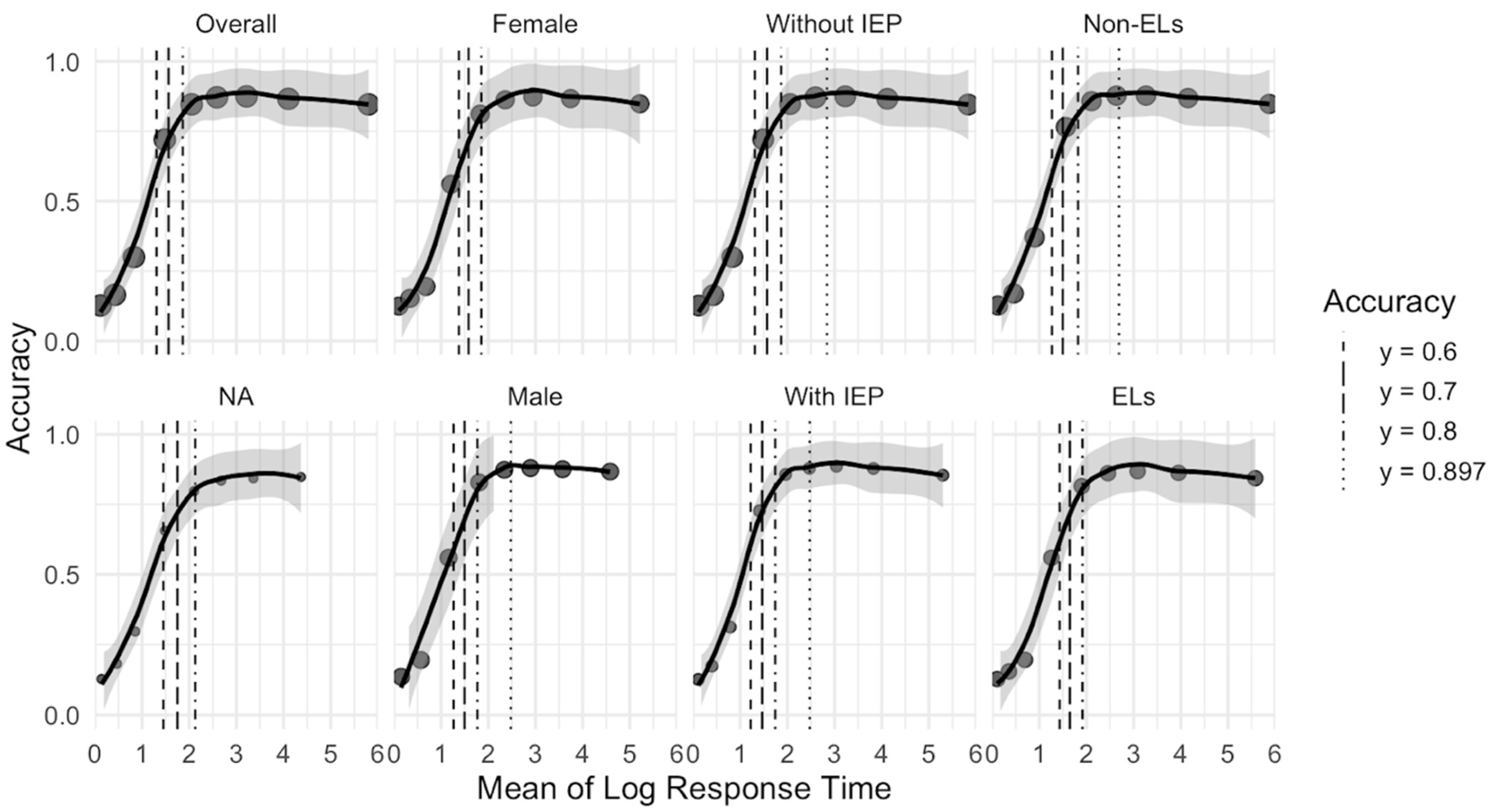
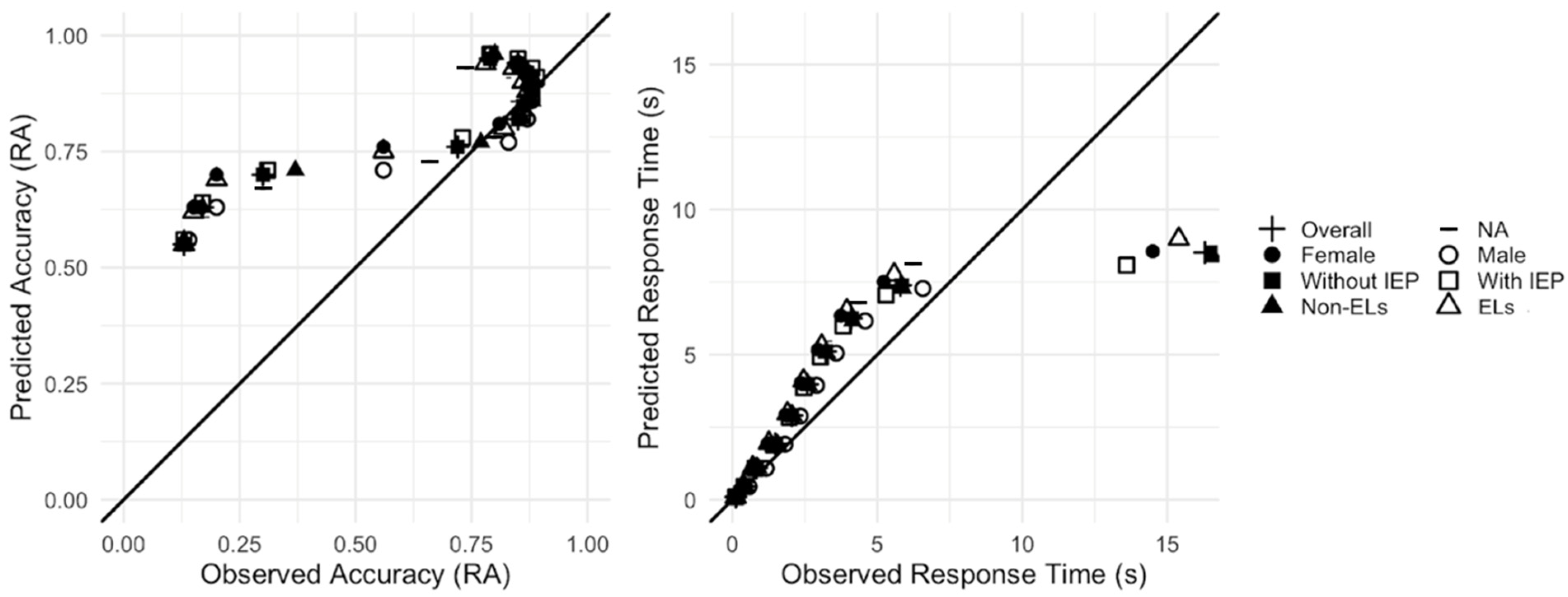
| Overall | Female | Male | Without IEP | With IEP | Non-ELs | ELs | NA | |
|---|---|---|---|---|---|---|---|---|
| Bin 1 | 0.13 | 0.13 | 0.14 | 0.13 | 0.13 | 0.13 | 0.13 | 0.13 |
| Bin 2 | 0.17 | 0.15 | 0.20 | 0.16 | 0.17 | 0.17 | 0.15 | 0.18 |
| Bin 3 | 0.30 | 0.20 | 0.56 | 0.30 | 0.31 | 0.37 | 0.20 | 0.30 |
| Bin 4 | 0.72 | 0.56 | 0.83 | 0.72 | 0.73 | 0.77 | 0.56 | 0.66 |
| Bin 5 | 0.85 | 0.81 | 0.87 | 0.85 | 0.86 | 0.86 | 0.82 | 0.80 |
| Bin 6 | 0.87 | 0.86 | 0.88 | 0.87 | 0.88 | 0.88 | 0.86 | 0.84 |
| Bin 7 | 0.88 | 0.87 | 0.88 | 0.88 | 0.89 | 0.88 | 0.87 | 0.84 |
| Bin 8 | 0.87 | 0.87 | 0.87 | 0.87 | 0.88 | 0.87 | 0.86 | 0.85 |
| Bin 9 | 0.85 | 0.85 | 0.85 | 0.85 | 0.85 | 0.85 | 0.84 | 0.83 |
| Bin 10 | 0.79 | 0.79 | 0.79 | 0.79 | 0.79 | 0.80 | 0.78 | 0.74 |
| Bin 1 | 0.12 s | 0.10 s | 0.15 s | 0.12 s | 0.11 s | 0.12 s | 0.11 s | 0.14 s |
| Bin 2 | 0.43 s | 0.34 s | 0.57 s | 0.43 s | 0.40 s | 0.46 s | 0.36 s | 0.47 s |
| Bin 3 | 0.83 s | 0.68 s | 10.16 s | 0.83 s | 0.79 s | 0.90 s | 0.70 s | 0.85 s |
| Bin 4 | 1.48 s | 1.21 s | 1.81 s | 1.49 s | 1.41 s | 1.56 s | 1.26 s | 1.49 s |
| Bin 5 | 2.05 s | 1.83 s | 2.34 s | 2.06 s | 1.96 s | 2.11 s | 1.90 s | 2.10 s |
| Bin 6 | 2.59 s | 2.36 s | 2.90 s | 2.60 s | 2.47 s | 2.64 s | 2.45 s | 2.68 s |
| Bin 7 | 3.22 s | 2.95 s | 3.58 s | 3.23 s | 3.04 s | 3.26 s | 3.08 s | 3.36 s |
| Bin 8 | 4.10 s | 3.74 s | 4.58 s | 4.12 s | 3.82 s | 4.15 s | 3.95 s | 4.37 s |
| Bin 9 | 5.80 s | 5.22 s | 6.57 s | 5.84 s | 5.30 s | 5.88 s | 5.58 s | 6.20 s |
| Bin 10 | 16.30 s | 14.50 s | 18.30 s | 16.50 s | 13.6 s | 16.6 s | 15.4 s | 18.7 s |
| n | a | v | t0 | zr | |
|---|---|---|---|---|---|
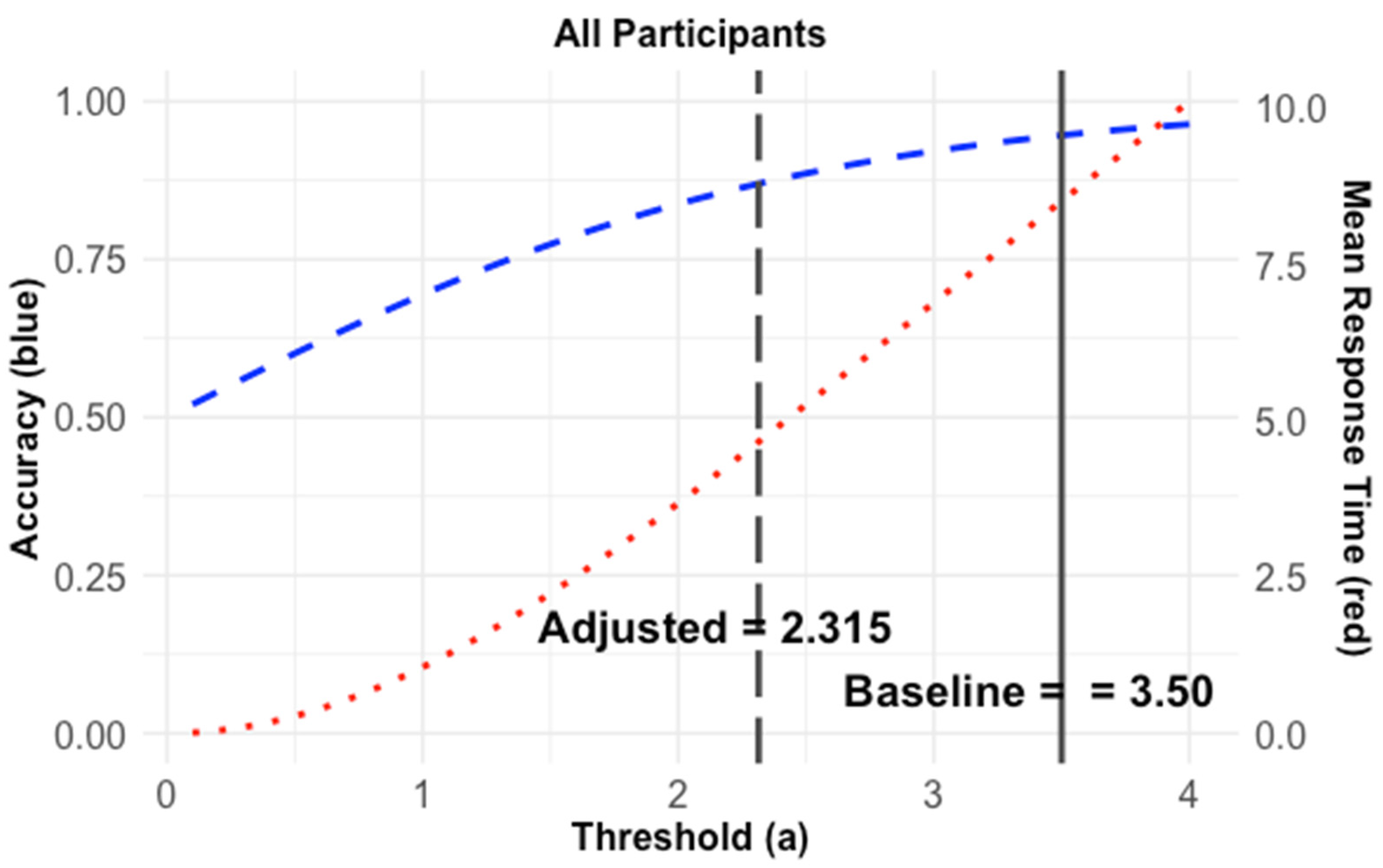
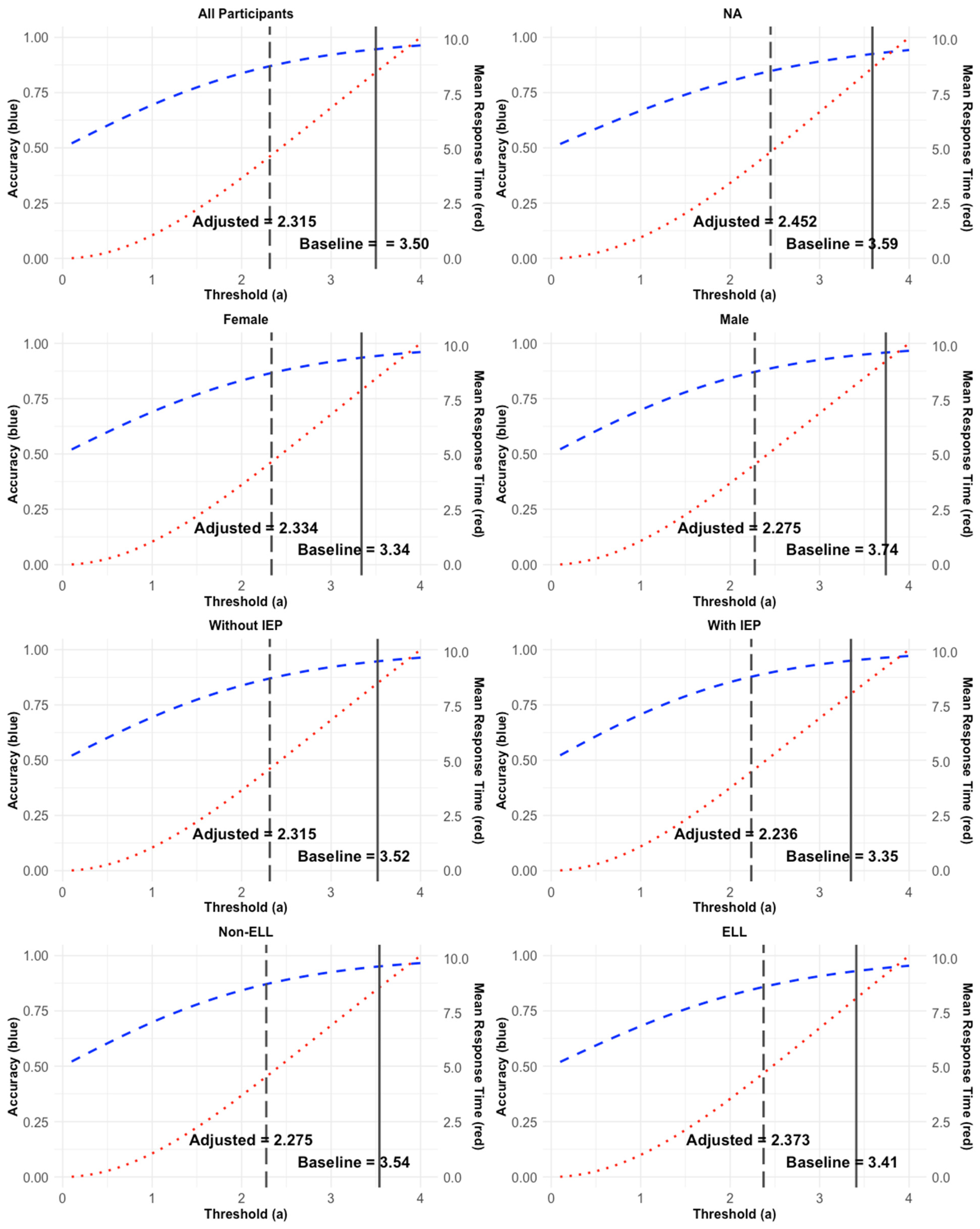
| All | 631,521 | 3.50 | 0.41 | 0.00 | 0.20 |
| Female | 263,817 | 3.34 | 0.40 | 0.00 | 0.25 |
| Male | 347,982 | 3.74 | 0.42 | 0.00 | 0.22 |
| Without IEP | 563,335 | 3.52 | 0.41 | 0.00 | 0.21 |
| With IEP | 48,464 | 3.35 | 0.44 | 0.00 | 0.21 |
| Non-EL | 433,884 | 3.54 | 0.42 | 0.00 | 0.21 |
| EL | 177,915 | 3.41 | 0.38 | 0.00 | 0.21 |
| NA | 19,722 | 3.59 | 0.35 | 0.00 | 0.06 |
| Group (* Adjusted Threshold) | Performance at (Baseline) Threshold | Performance at “Adjusted” Threshold | Estimated Speed–Accuracy Trade-Off | |||
|---|---|---|---|---|---|---|
| Accuracy | RT | Accuracy | RT | %ΔAccuracy | %ΔRT | |
| All (2.31) | 0.95 | 7.50 s | 0.87 | 4.13 s | −8.42 | −44.93 |
| Female (2.33) | 0.94 | 7.04 s | 0.87 | 4.19 s | −7.45 | −40.48 |
| Male (2.27) | 0.95 | 8.17 s | 0.87 | 4.02 s | −8.42 | −50.80 |
| Without IEP (2.31) | 0.95 | 7.55 s | 0.87 | 4.13 s | −8.42 | −45.30 |
| With IEP (2.23) | 0.94 | 7.07 s | 0.86 | 3.91 s | −8.51 | −44.70 |
| Non-EL (2.28) | 0.95 | 7.61 s | 0.87 | 4.02 s | −8.42 | −47.17 |
| EL (2.37) | 0.94 | 7.24 s | 0.88 | 4.30 s | −6.38 | −40.61 |
| NA (2.45) | 0.95 | 7.75 s | 0.88 | 4.52 s | −7.37 | −41.68 |
| Outcome | Predictor | F(df1, df2) | p | Partial η2 |
| RT | Gender | 1661.95 (1, 611,791) | <0.001 | 0.005 |
| EL | 246.76 (1, 611,791) | <0.001 | 0.000 | |
| IEP | 41.72 (1, 611,791) | <0.001 | 0.000 | |
| Gender × EL | 138.51 (1, 611,791) | <0.001 | 0.000 | |
| Gender × IEP | 30.41 (1, 611,791) | <0.001 | 0.000 | |
| EL × IEP | 14.52 (1, 611,791) | <0.001 | 0.000 | |
| Gender × EL × IEP | 242.26 (1, 611,791) | <0.001 | 0.000 | |
| Outcome | Predictor | B (SE) | p | OR [95% CI] |
| Accuracy | Gender | 0.31 (0.01) | <0.001 | 1.36 [1.34, 1.38] |
| EL | −0.22 (0.01) | <0.001 | 0.80 [0.79, 0.81] | |
| IEP | 0.28 (0.01) | <0.001 | 1.33 [1.29, 1.36] | |
| Gender × EL | 0.20 (0.01) | <0.001 | 1.23 [1.20, 1.26] | |
| Gender × IEP | −0.22 (0.03) | <0.001 | 0.80 [0.75, 0.85] | |
| EL × IEP | −0.28 (0.03) | <0.001 | 0.75 [0.71, 0.79] | |
| Gender × EL × IEP | −0.60 (0.05) | <0.001 | 0.55 [0.50, 0.61] |
| EL Status | IEP Status | Contrast (Male vs. Female) | Odds Ratio | SE | z | p |
|---|---|---|---|---|---|---|
| Non-EL | Without IEP | Male vs. Female | 0.735 | 0.004 | −45.92 | <0.001 |
| EL | Without IEP | Male vs. Female | 0.600 | 0.006 | −48.19 | <0.001 |
| Non-EL | With IEP | Male vs. Female | 0.918 | 0.026 | −2.94 | 0.003 |
| EL | With IEP | Male vs. Female | 1.359 | 0.050 | 8.27 | <0.001 |
| Female | Without IEP | Non-EL vs. EL | 1.25 | 0.009 | 28.93 | <0.001 |
| Male | Without IEP | Non-EL vs. EL | 1.02 | 0.011 | 2.16 | 0.031 |
| Female | With IEP | Non-EL vs. EL | 1.66 | 0.047 | 19.41 | <0.001 |
| Male | With IEP | Non-EL vs. EL | 2.46 | 0.096 | 23.02 | <0.001 |
| Female | Non-EL | Without vs. With IEP | 0.754 | 0.010 | −21.08 | <0.001 |
| Male | Non-EL | Without vs. With IEP | 0.942 | 0.025 | −2.23 | 0.026 |
| Female | EL | Without vs. With IEP | 1.003 | 0.023 | 0.11 | 0.912 |
| Male | EL | Without vs. With IEP | 2.272 | 0.068 | 27.09 | <0.001 |
Disclaimer/Publisher’s Note: The statements, opinions and data contained in all publications are solely those of the individual author(s) and contributor(s) and not of MDPI and/or the editor(s). MDPI and/or the editor(s) disclaim responsibility for any injury to people or property resulting from any ideas, methods, instructions or products referred to in the content. |
© 2025 by the authors. Licensee MDPI, Basel, Switzerland. This article is an open access article distributed under the terms and conditions of the Creative Commons Attribution (CC BY) license (https://creativecommons.org/licenses/by/4.0/).
Share and Cite
Choo, S.; An, J.; Nelson, N.; Kosty, D. Optimizing Assessment Thresholds of a Computer Gaming Intervention for Students with or at Risk for Mathematics Learning Disabilities: Accuracy and Response Time Trade-Offs. Educ. Sci. 2025, 15, 1660. https://doi.org/10.3390/educsci15121660
Choo S, An J, Nelson N, Kosty D. Optimizing Assessment Thresholds of a Computer Gaming Intervention for Students with or at Risk for Mathematics Learning Disabilities: Accuracy and Response Time Trade-Offs. Education Sciences. 2025; 15(12):1660. https://doi.org/10.3390/educsci15121660
Chicago/Turabian StyleChoo, Sam, Jechun An, Nancy Nelson, and Derek Kosty. 2025. "Optimizing Assessment Thresholds of a Computer Gaming Intervention for Students with or at Risk for Mathematics Learning Disabilities: Accuracy and Response Time Trade-Offs" Education Sciences 15, no. 12: 1660. https://doi.org/10.3390/educsci15121660
APA StyleChoo, S., An, J., Nelson, N., & Kosty, D. (2025). Optimizing Assessment Thresholds of a Computer Gaming Intervention for Students with or at Risk for Mathematics Learning Disabilities: Accuracy and Response Time Trade-Offs. Education Sciences, 15(12), 1660. https://doi.org/10.3390/educsci15121660