Correction

Correction: Ma et al. (2025). Knowledge Mapping of Geography Examinations in Chinese National Entrance Examination to Universities: Insights from Four Decades of Research. Education Sciences, 15(11), 1423


1
Key Laboratory for Climate Risk and Urban-Rural Smart Governance, School of Geography, Jiangsu Second Normal University, Nanjing 210013, China
2
Department of Geography and Environmental Science, University of Reading, Reading RG6 6AB, UK
3
Dainan Middle School, Taizhou 225721, China
4
School of Business, Jiangsu Second Normal University, Nanjing 210013, China
5
School of Geography and Ocean Science, Nanjing University, Nanjing 210023, China
*
Authors to whom correspondence should be addressed.
Educ. Sci. 2025, 15(12), 1654; https://doi.org/10.3390/educsci15121654

Submission received: 14 November 2025 / Accepted: 19 November 2025 / Published: 8 December 2025
(This article belongs to the Section Curriculum and Instruction)

Figure Correction

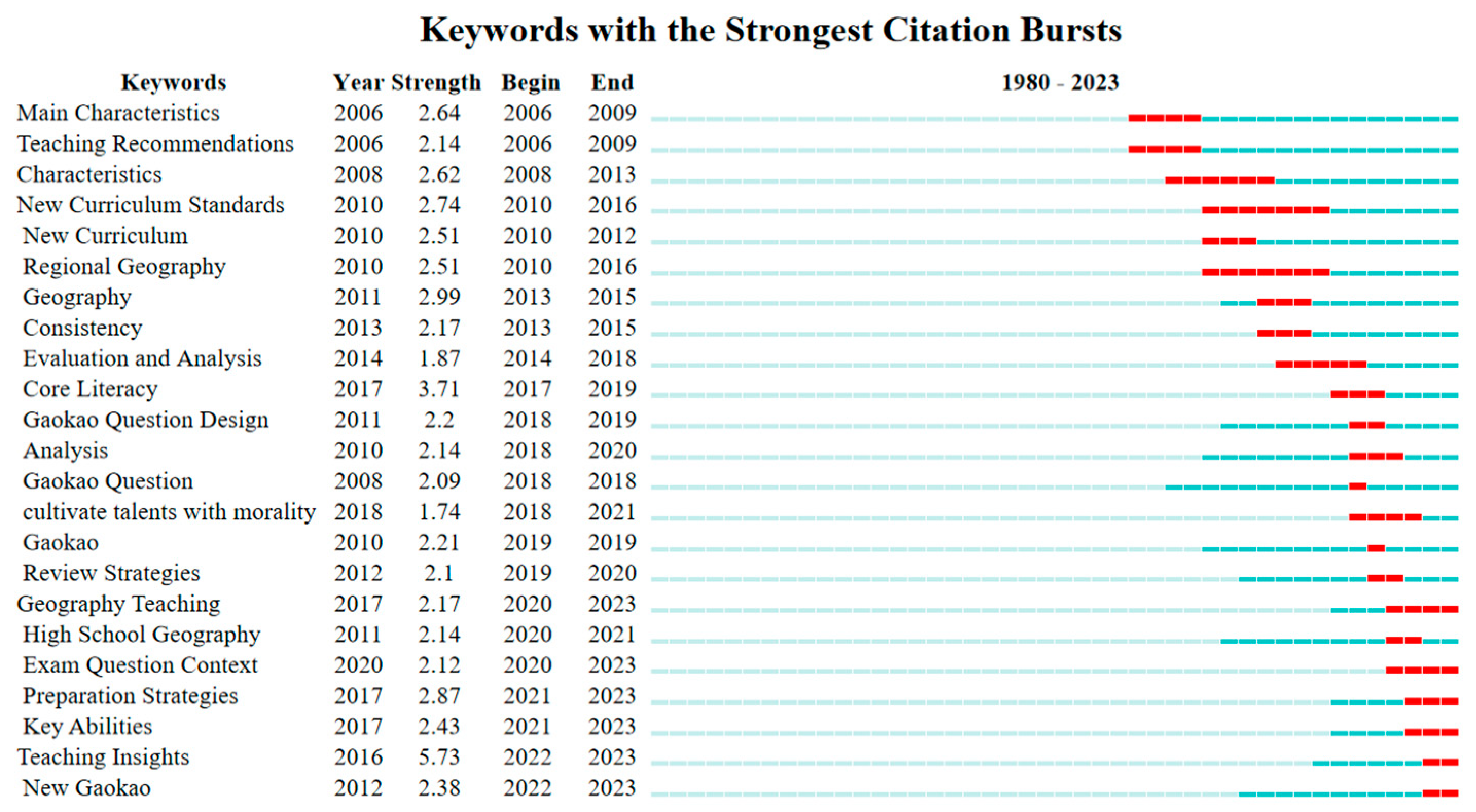
In the original publication (Ma et al., 2025), there was a mistake in the legend for “Figure 5. Keywords with the strongest citation bursts (Gaokao = National Entrance Exam to Universities; Gaokao Geography = Geography for the National Entrance Exam to Universities)”. The image included in the proof was not updated to reflect the most recent results. The correct Figure 5 legend appears below. The authors confirm that the scientific conclusions are unaffected. This correction was approved by the Academic Editor. The original publication has also been updated.
Figure 5. Keywords with the strongest citation bursts (Gaokao = National Entrance Exam to Universities; Gaokao Geography = Geography for the National Entrance Exam to Universities).
Education 15 01654 g005

Text Correction

There was an repetitive error in the original publication. Delete “‘research,’ ‘geography ability,’ ‘curriculum standards’”.
A correction has been made to “3.4. Emergent Words”, Paragraph 3:
“Fluctuating Growth Period (2000–2014): Influenced by the new curriculum reform, this period saw the emergence of multiple notable keywords, primarily centered on the new curriculum standards. Prior to 2010, research mainly focused on the characteristics of geography questions in the college entrance examination and case analyses of specific questions. In 2013, the Ministry of Education issued the “General High School Curriculum Standards (Experimental),” which introduced comprehensive reforms of subject syllabi and textbooks, emphasizing the development of subject-specific competencies. In 2014, the pilot reform of the new college entrance examination was launched. This period is characterized by increased research on the analysis of geography exam questions, which became more diverse in focus. Key areas of attention included: (1) exam questions, such as “exam questions,” “question analysis,” “analysis,” and “regional geography”; (2) the alignment between geography curriculum standards and exam content, with keywords such as “new curriculum standards,” “new curriculum,” and “consistency”; and (3) problem-solving strategies for geography exam questions.”
There is a formatting error. A correction has been made to “4.1. Policy Impact on CNEEU Examination Proposition”:
“Based on our synthesis of the literature and policy documents, the new CNEEU and the reform of the geography curriculum standards have significantly influenced the scope, focus, and format of geography exam questions.
Regarding scope, the content of the new CNEEU strictly adheres to the high school curriculum standards, shifting from the previous model of “exam based on outline” to a model that “integrates exam with teaching” (Yu, 2019). This alignment encouraged secondary schools to structure their teaching in accordance with the established curriculum standards, underscoring the prescriptive and guiding role of policy in shaping instructional content.
In terms of focus, the new CNEEU evaluation system places greater emphasis on assessing students’ key ability and core literacy, transitioning from a traditional emphasis on “knowledge orientation” to an “ability orientation” and “ literacy orientation” approach. For example, physical geography can be applied to illustrate the question-setting trends of the new CNEEU geography examination (Figure 7). This shift is part of a broader curriculum reform aimed at instilling moral values and cultivating talents in alignment with contemporary societal needs. The examination content closely reflects current social issues and real-life societal engagement, thereby enhancing the educational function of the college entrance examination by prioritizing ideological education and value-orientated guidance.
Regarding question format, real-life contexts and exploratory learning scenarios serve as the mediums for task design, facilitating the application of fundamental knowledge and skills. This mode of exam design not only assesses students’ mastery of fundamental knowledge and their ability to transfer and apply it, but also strengthens their capacity to tackle complex real-world problems.
Through a combination of policy text analysis and co-occurrence analysis of the studies, this study reveals that the evolution of geography exam questions—in terms of scope, literacy orientation, and contextual design—closely aligns with the core literacy orientation emphasized in policy documents. By integrating both quantitative and qualitative methods, this study systematically uncovers the transmission mechanism linking policy orientation to exam practices, offering a more comprehensive explanation of how the new CNEEU influences geography exam design.”
The authors state that the scientific conclusions are unaffected. This correction was approved by the Academic Editor. The original publication has also been updated.

Reference

  1. Ma, X., Yang, H., Yang, F., Shang, L., Xie, M., & Ma, L. (2025). Knowledge mapping of geography examinations in Chinese national entrance examination to universities: Insights from four decades of research. Education Sciences, 15(11), 1423. [Google Scholar] [CrossRef]
Disclaimer/Publisher’s Note: The statements, opinions and data contained in all publications are solely those of the individual author(s) and contributor(s) and not of MDPI and/or the editor(s). MDPI and/or the editor(s) disclaim responsibility for any injury to people or property resulting from any ideas, methods, instructions or products referred to in the content.