Profiles of Classroom Management Across Five Countries: A Person-Centered Analysis of TALIS 2018 Data


Abstract
1. Introduction
1.1. Literature Review
1.1.1. Classroom Management
1.1.2. Teachers’ Classroom Behavior Across Countries
- (1)
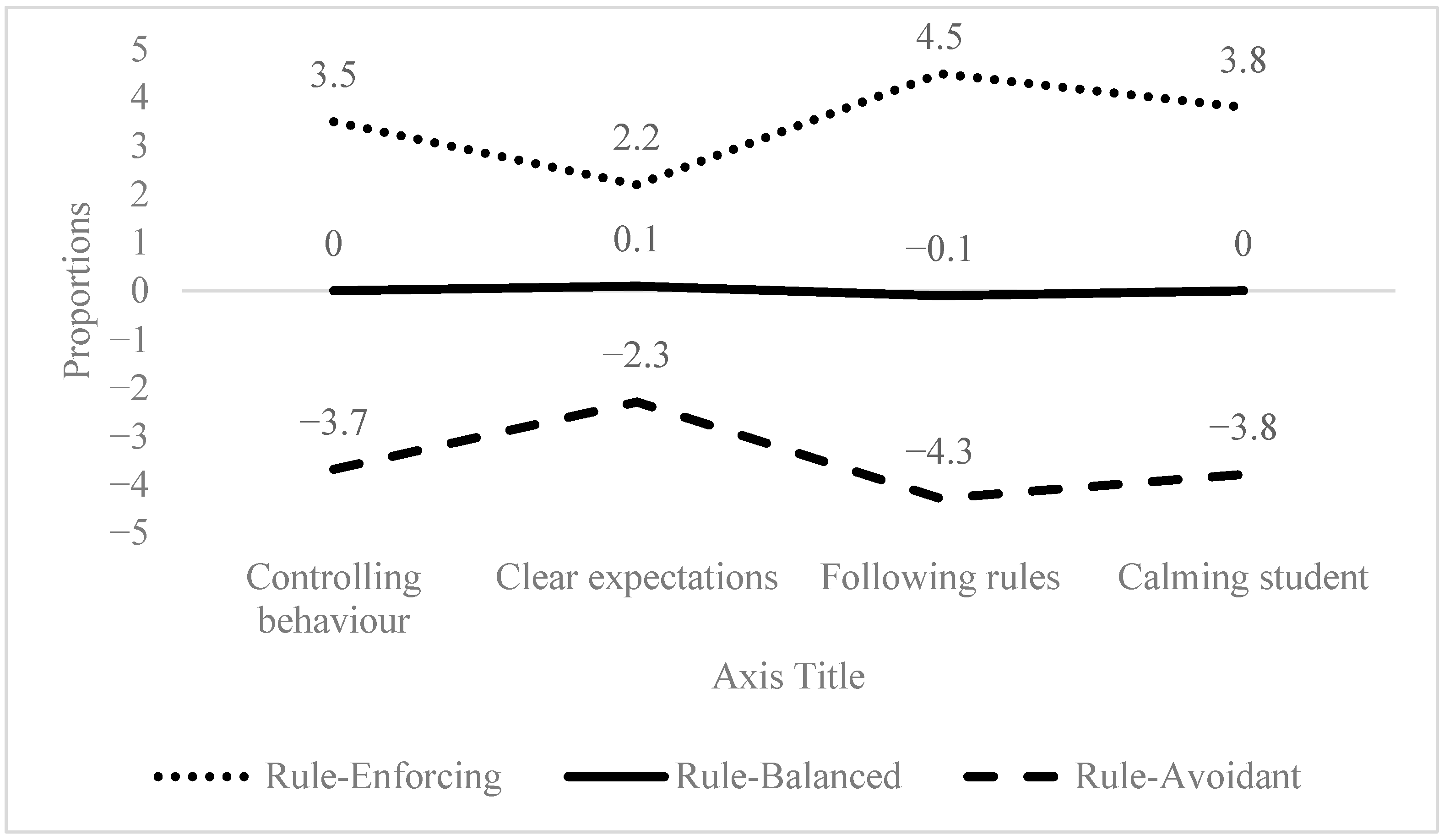
- To identify latent profiles of teachers’ classroom management practices across five participating countries in TALIS 2018: Brazil, Canada (Alberta), Japan, Portugal, and South Africa. Four TALIS 2018 indicators are considered: controlling disruptive behavior, clarifying expectations, getting students to follow rules, and calming disruptive students.
- (2)
- Using covariates, examine whether profiles differ as a function of the teacher’s country of origin and teaching experience.
- (3)
- To explore whether latent profiles are associated with teacher-reported outcomes, such as self-efficacy, job satisfaction, and well-being.
- (4)
- To test the invariance of the latent class structure across five countries, from five different continents, with distinct educational traditions.
- (5)
- To explore descriptively whether national scores on Hofstede’s cultural dimensions are associated with the relative prevalence of classroom management profiles across countries.
2. Materials and Methods
2.1. Participants
2.2. Variables and Measures
2.3. Analytic Procedure
3. Results
3.1. Latent Class Identification
3.2. Covariate Effects on Class Membership
3.3. Differences in Distal Outcomes
3.4. Multiple-Group Latent Class Analysis by Country
3.5. Cultural Dimensions and Profile Prevalence
4. Discussion
4.1. Objective 1: Identification of Management Profiles
4.2. Objective 2: Variations by Country and Experience
4.3. Objective 3: Associations with Teacher-Reported Outcomes
4.4. Objective 4: Structural Invariance Across Countries
4.5. Objective 5: Associations with National Cultural Dimensions
4.6. Broader Educational Implications
5. Conclusions and Contributions
6. Limitations
Author Contributions
Funding
Institutional Review Board Statement
Informed Consent Statement
Data Availability Statement
Conflicts of Interest
References
- Admiraal, W., & Kittelsen Røberg, K. I. (2023). Teachers’ job demands, resources and their job satisfaction: Satisfaction with school, career choice and teaching profession of teachers in different career stages. Teaching and Teacher Education, 125, 104063. [Google Scholar] [CrossRef]
- Bakker, A. B., & Demerouti, E. (2007). The job demands-resources model: State of the art. Journal of Managerial Psychology, 22, 309–328. [Google Scholar] [CrossRef]
- Bandura, A. (1991). Social cognitive theory of self-regulation. Organizational Behavior and Human Decision Processes, 50(2), 248–287. [Google Scholar] [CrossRef]
- Bandura, A. (2006). Toward a psychology of human agency. Perspectives on Psychological Science, 1(2), 164–180. [Google Scholar] [CrossRef] [PubMed]
- Baumrind, D. (1971). Current patterns of parental authority. Developmental Psychology, 4(1), 1–103. [Google Scholar] [CrossRef]
- Biggs, J. B. (1998). Learning from the Confucian heritage: So size doesn’t matter? International Journal of Educational Research, 29, 723–738. [Google Scholar] [CrossRef]
- Boström, L. (2023). What is the problem and how can we solve it? School authorities’ perceptions of the shortage of teachers in Sweden. Educational Research for Policy and Practice, 22(3), 479–497. [Google Scholar] [CrossRef]
- Chen, R. J. C., Lin, H. C., Hsueh, Y. L., & Hsieh, C. C. (2020). Which is more influential on teaching practice, classroom management efficacy or instruction efficacy? Evidence from TALIS 2018. Asia Pacific Education Review, 21(4), 589–599. [Google Scholar] [CrossRef]
- Chiu, M. M., & Chow, B. W. Y. (2011). Classroom discipline across forty-one countries: School, economic, and cultural differences. Journal of Cross-Cultural Psychology, 42(3), 516–533. [Google Scholar] [CrossRef]
- Chiu, M. M., & Klassen, R. M. (2010). Relations of mathematics self-concept and its calibration with mathematics achievement: Cultural differences among fifteen-year-olds in 34 countries. Learning and Instruction, 20(1), 2–17. [Google Scholar] [CrossRef]
- De Carlo, A., Girardi, D., Falco, A., Dal Corso, L., & Di Sipio, A. (2019). When does work interfere with teachers’ private life? An application of the job demands-resources model. Frontiers in Psychology, 10(MAY), 1121. [Google Scholar] [CrossRef]
- Deci, E. L., & Ryan, R. M. (2000). The “what” and “why” of goal pursuits: Human needs and the self-determination of behavior. Psychological Inquiry, 11(4), 227–268. [Google Scholar] [CrossRef]
- Deci, E. L., & Ryan, R. M. (2008). Self-determination theory: A macrotheory of human motivation, development, and health. Canadian Psychology, 49(3), 182–185. [Google Scholar] [CrossRef]
- Doyle, W. (1986). Classroom organization and management. In M. C. Wittrock (Ed.), Handbook of research on teaching (3rd ed., pp. 392–431). Mcmillan. [Google Scholar]
- Duan, S., Bissaker, K., & Xu, Z. (2024). Correlates of teachers’ classroom management self-efficacy: A systematic review and meta-analysis. Educational Psychology Review, 36(2), 43. [Google Scholar] [CrossRef]
- Emmer, E. T., & Evertson, C. M. (1981). Synthesis of research on classroom management. Educational Leadership, 38(4), 342–343, 345–347. [Google Scholar]
- Evertson, C. M., Emmer, E. T., Clements, B. S., & Worsham, M. E. (1997). Classroom management for elementary teachers (4th ed.). Allyn & Bacon. [Google Scholar]
- Evertson, C. M., & Weinstein, C. S. (2006). Classroom management as a field of inquiry. In C. M. Evertson, & C. S. Weinstein (Eds.), Handbook of classroom management. Research, practice, and contemporary issues (pp. 3–16). Lawrence Erlbaum Associates. [Google Scholar]
- Fischer, J., He, J., & Klieme, E. (2020). The structure of teaching practices across countries: A combination of factor analysis and network analysis. Studies in Educational Evaluation, 65, 100861. [Google Scholar] [CrossRef]
- Granger, K. L., Chow, J. C., Montesion, A., Stouffer, J. M., Sutherland, K. S., & Conroy, M. A. (2025). Teacher’s classroom management self-efficacy and teacher–child conflict as a function of child ordinal behavior ranking. School Mental Health, 17, 90–105. [Google Scholar] [CrossRef]
- Hofstede, G., Hofstede, G. J., & Minkov, M. (2010). Cultures and organizations: Software of the mind—Intercultural cooperation and its importance for survival (3rd ed.). McGraw-Hill. [Google Scholar]
- House, R. J., Hanges, P. J., Javidan, M., Dorfman, P. W., & Gupta, V. (Eds.). (2004). Culture, leadership, and organizations: The GLOBE study of 62 societies. SAGE Publications. [Google Scholar]
- Hu, Y. (2024). How do Confucian schools and Anglo schools differ? A latent profile analysis based on PISA 2015. Large-Scale Assessments in Education, 12(1), 39. [Google Scholar] [CrossRef]
- Huang, D., Reeve, J., Jang, H.-R., Marsh, H. W., Dicke, T., & Cheon, S. H. (2025). Teaching with confidence: How a skill-based intervention develops teacher self-efficacy and improves educational outcomes. Teaching and Teacher Education, 167, 105202. [Google Scholar] [CrossRef]
- Huberman, M. (1989). The professional life cycle of teachers. Teachers College Record, 91(1), 31–57. [Google Scholar] [CrossRef]
- Klassen, R. M., Perry, N. E., & Frenzel, A. C. (2012). Teachers’ relatedness with students: An underemphasized component of teachers’ basic psychological needs. Journal of Educational Psychology, 104, 150–165. [Google Scholar] [CrossRef]
- Korpershoek, H., Mouw, J. M., & de Boer, H. (2022). International research on the foci and effectiveness of classroom management programs and strategies. In E. J. Sabornie, & D. L. Espelage (Eds.), Handbook of classroom management (pp. 350–372). Taylor and Francis. [Google Scholar]
- Kounin, J. (1970). Discipline and group management in classrooms. Holt, Rinehart & Winston. [Google Scholar]
- Kwok, A. (2023). Facilitating classroom management development in teacher education. Educational Forum, 87(1), 105–121. [Google Scholar] [CrossRef]
- Lazarides, R., Watt, H. M. G., & Richardson, P. W. (2020). Teachers’ classroom management self-efficacy, perceived classroom management and teaching contexts from beginning until mid-career. Learning and Instruction, 69, 101346. [Google Scholar] [CrossRef]
- Liu, S. N., & Feng, D. M. (2015). How culture matters in educational borrowing? Chinese teachers’ dilemmas in a global era. Cogent Education, 2(1), 1046410. [Google Scholar] [CrossRef]
- McSweeney, B. (2002). Hofstede’s model of national cultural differences and their consequences: A triumph of faith—A failure of analysis. Human Relations, 55(1), 89–118. [Google Scholar] [CrossRef]
- OECD. (2019). TALIS 2018 technical report. OECD Publishing. [Google Scholar]
- Perera, H. N., Calkins, C., & Part, R. (2019). Teacher self-efficacy profiles: Determinants, outcomes, and generalizability across teaching level. Contemporary Educational Psychology, 58, 186–203. [Google Scholar] [CrossRef]
- Perera, H. N., Maghsoudlou, A., Miller, C. J., McIlveen, P., Barber, D., Part, R., & Reyes, A. L. (2022). Relations of science teaching self-efficacy with instructional practices, student achievement and support, and teacher job satisfaction. Contemporary Educational Psychology, 69, 102041. [Google Scholar] [CrossRef]
- Pressley, T., Croyle, H., & Edgar, M. (2020). Different approaches to classroom environments based on teacher experience and effectiveness. Psychology in the Schools, 57(4), 606–626. [Google Scholar] [CrossRef]
- Reddy, L. A., Fabiano, G. A., Dudek, C. M., & Hsu, L. (2013). Instructional and behavior management practices implemented by elementary general education teachers. Journal of School Psychology, 51(6), 683–700. [Google Scholar] [CrossRef] [PubMed]
- Schwartz, S. H. (1992). Universals in the content and structure of values: Theoretical advances and empirical tests in 20 countries. In M. Zanna (Ed.), Advances in experimental social psychology (Vol. 25, pp. 1–65). Academic Press. [Google Scholar]
- Schwartz, S. H. (2010). Basic values: How they motivate and inhibit prosocial behavior. In M. Mikulincer, & P. R. Shaver (Eds.), Prosocial motives, emotions, and behavior: The better angels of our nature (pp. 221–241). American Psychological Association. [Google Scholar] [CrossRef]
- Scott, T. M. (2021). Implicit bias, disproportionate discipline, and teacher responsibility for instruction as prevention. Preventing School Failure, 65(4), 291–300. [Google Scholar] [CrossRef]
- Shimahara, N. K. (2014). Politics of classroom life: Classroom management in international perspective. Taylor and Francis. [Google Scholar] [CrossRef]
- Skaalvik, E. M., & Skaalvik, S. (2015). Job satisfaction, stress and coping strategies in the teaching profession-what do teachers say? International Education Studies, 8(3), 181–192. [Google Scholar] [CrossRef]
- Skaalvik, E. M., & Skaalvik, S. (2017). Still motivated to teach? A study of school context variables, stress and job satisfaction among teachers in senior high school. Social Psychology of Education, 20(1), 15–37. [Google Scholar] [CrossRef]
- Spurk, D., Hirschi, A., Wang, M., Valero, D., & Kauffeld, S. (2020). Latent profile analysis: A review and “how to” guide of its application within vocational behavior research. Journal of Vocational Behavior, 120, 103445. [Google Scholar] [CrossRef]
- Taras, V., Kirkman, B. L., & Steel, P. (2010). Examining the impact of culture’s consequences: A ThreeDecade, multi-level, meta-analytic review of Hofstede’s cultural value dimensions. Journal of Applied Psychology, 95(3), 405–439. [Google Scholar] [CrossRef]
- Tschannen-Moran, M., & Woolfolk Hoy, A. (2001). Teacher efficacy: Capturing an elusive construct. Teaching and Teacher Education, 17(7), 783–805. [Google Scholar] [CrossRef]
- Wang, L., Gulish, K. D., & Pollastri, A. R. (2024). Understanding teachers’ attributions and responses to student misbehavior: The roles of explanatory rationale and personal beliefs. School Mental Health, 16(4), 1094–1106. [Google Scholar] [CrossRef]
- Wartenberg, G., Aldrup, K., Grund, S., & Klusmann, U. (2023). Satisfied and high performing? A meta-analysis and systematic review of the correlates of teachers’ job satisfaction. Educational Psychology Review, 35(4), 114. [Google Scholar] [CrossRef]
- Wei, Y. (2025). A study on the influence of physical education teachers’ teaching beliefs and attributions of teaching success and failure on their effective teaching behaviors. PLoS ONE, 20(4), e0321137. [Google Scholar] [CrossRef]
- Weiner, B. (1985). An attributional theory of achievement motivation and emotion. Psychological Review, 92(4), 548–573. [Google Scholar] [CrossRef]
- Weiner, B. (1993). On sin versus sickness: A theory of perceived responsibility and social motivation. American Psychologist, 48(9), 957–965. [Google Scholar] [CrossRef] [PubMed]
- Weitkämper, F. (2024). Un/Doing authority and social inequality: Understanding mutual vulnerability in pupil-teacher relations and challenging situations. Educational Review, 76(1), 199–215. [Google Scholar] [CrossRef]
- Wubbels, T. (2011). An international perspective on classroom management: What should prospective teachers learn? Teaching Education, 22(2), 113–131. [Google Scholar] [CrossRef]
- Žerak, U., Juriševič, M., & Pečjak, S. (2024). Parenting and teaching styles in relation to student characteristics and self-regulated learning. European Journal of Psychology of Education, 39(2), 1327–1351. [Google Scholar] [CrossRef]



| Dimension | Portugal | Brazil | South Africa | Alberta (Canada) | Japan |
|---|---|---|---|---|---|
| Power Distance | 63 | 69 | 49 | 39 | 54 |
| Individualism | 27 | 38 | 65 | 80 | 46 |
| Masculinity | 31 | 49 | 63 | 52 | 95 |
| Uncertainty Avoidance | 99 | 76 | 49 | 48 | 92 |
| Long-Term Orientation | 28 | 44 | 34 | 36 | 88 |
| Indulgence | 33 | 59 | 63 | 68 | 42 |
| Female | Male | Total | Average Teaching Experience | |
|---|---|---|---|---|
| Brazil | 1621 | 826 | 2447 | 15.78 |
| Canada (Alberta) | 680 | 397 | 1077 | 12.89 |
| Japan | 1510 | 2045 | 3555 | 17.25 |
| Portugal | 2681 | 995 | 3676 | 22.73 |
| South Africa | 1226 | 820 | 2046 | 14.41 |
| Country | Self Efficacy | Job. Sat. | Dis. Clim. | Util. Val. | Pol. Infl. | T-S. Rel. | Wel. Be. | ||
|---|---|---|---|---|---|---|---|---|---|
| Inst. | Eng. | Class. Manag. | |||||||
| Alberta (CAB) | 10.68 | 9.62 | 10.49 | 11.19 | 9.77 | 10.8 | 7.96 | 11.75 | 10.02 |
| Brazil (BRA) | 11.07 | 10.28 | 11.17 | 11.59 | 10.42 | 11.46 | 8.79 | 11.76 | 9.56 |
| Japan (JPN) | 10.53 | 9.49 | 10.65 | 10.8 | 9.47 | 11.02 | 7.78 | 11.48 | 8.8 |
| Portugal (PRT) | 11.36 | 10.54 | 11.14 | 11.12 | 10.18 | 10.98 | 8.22 | 11.61 | 10.26 |
| South Africa (ZAF) | 10.66 | 10.13 | 10.75 | 10.78 | 9.94 | 10.88 | 8.17 | 11.57 | 9.83 |
| Covariate | Rule Enforcing | Rule Balanced | Rule Avoidant | |
|---|---|---|---|---|
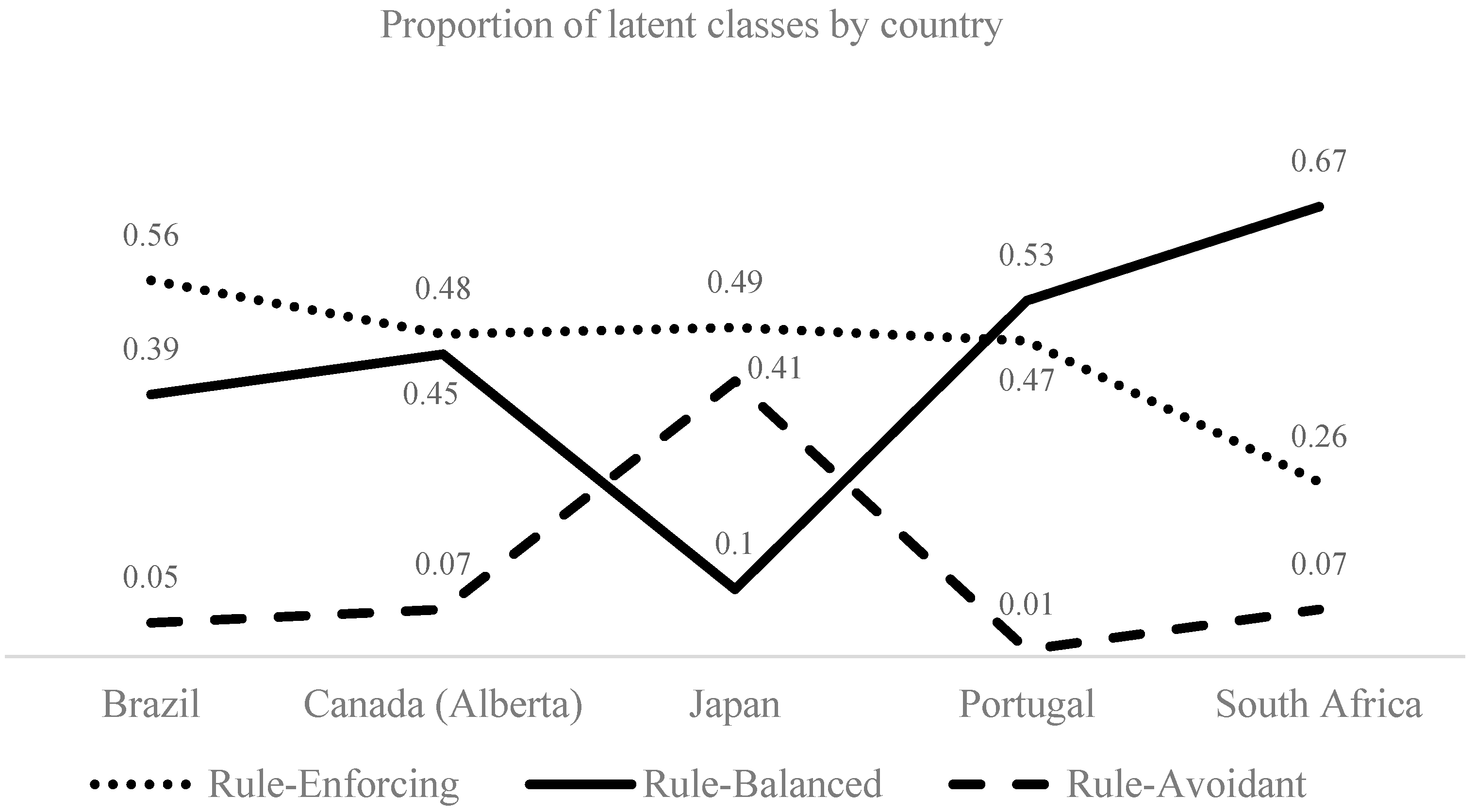
| Country | Brazil | 55.6% | 39.0% | 5.4% |
| Canada (CAB) | 47.5% | 45.0% | 7.5% | |
| Japan | 48.1% | 9.1% | 42.7% | |
| Portugal | 46.0% | 52.8% | 1.2% | |
| South Africa | 26.2% | 66.3% | 7.6% | |
| Teaching experience | 0–6 yrs | 41.2% | 30.7% | 28.1% |
| 7–14 yrs | 46.0% | 36.5% | 17.6% | |
| 15–20 yrs | 47.5% | 43.4% | 9.1% | |
| 21–27 yrs | 44.6% | 46.6% | 8.8% | |
| 28–55 yrs | 47.2% | 39.9% | 12.9% |
| Distal Variable | R2 |
|---|---|
| Self-efficacy: classroom management | 0.675 |
| Self-efficacy: student engagement | 0.214 |
| Self-efficacy: instruction | 0.180 |
| Job satisfaction with the profession | 0.010 |
| Perceived disciplinary climate | 0.044 |
| Personal utility value | 0.001 |
| Value and policy influence | 0.001 |
| Teacher–student relations | 0.020 |
| Well-being and stress | 0.007 |
| Profile | Cultural Dimension | ρ (Spearman) |
|---|---|---|
| Rule-Enforcing | Long-Term Orientation | 0.80 |
| Rule-Balanced | Power Distance | −0.90 |
| Rule-Balanced | Long-Term Orientation | −0.90 |
| Rule-Avoidant | Masculinity | 0.98 |
| Rule-Avoidant | Indulgence | −1.00 |
Disclaimer/Publisher’s Note: The statements, opinions and data contained in all publications are solely those of the individual author(s) and contributor(s) and not of MDPI and/or the editor(s). MDPI and/or the editor(s) disclaim responsibility for any injury to people or property resulting from any ideas, methods, instructions or products referred to in the content. |
© 2025 by the authors. Licensee MDPI, Basel, Switzerland. This article is an open access article distributed under the terms and conditions of the Creative Commons Attribution (CC BY) license (https://creativecommons.org/licenses/by/4.0/).
Share and Cite
Oliveira, C.; Lopes, J. Profiles of Classroom Management Across Five Countries: A Person-Centered Analysis of TALIS 2018 Data. Educ. Sci. 2025, 15, 1653. https://doi.org/10.3390/educsci15121653
Oliveira C, Lopes J. Profiles of Classroom Management Across Five Countries: A Person-Centered Analysis of TALIS 2018 Data. Education Sciences. 2025; 15(12):1653. https://doi.org/10.3390/educsci15121653
Chicago/Turabian StyleOliveira, Célia, and João Lopes. 2025. "Profiles of Classroom Management Across Five Countries: A Person-Centered Analysis of TALIS 2018 Data" Education Sciences 15, no. 12: 1653. https://doi.org/10.3390/educsci15121653
APA StyleOliveira, C., & Lopes, J. (2025). Profiles of Classroom Management Across Five Countries: A Person-Centered Analysis of TALIS 2018 Data. Education Sciences, 15(12), 1653. https://doi.org/10.3390/educsci15121653