1. Introduction
“Educating is a political and poetic act: a daily choice for transformation. […] an act of care. A focus on a pedagogy that places experience, relationships, and the interconnection between knowledge and people back at the centre. Service-learning […] is not just a methodology or a teaching technique: it is an educational horizon, an invitation to inhabit education as an ethical, civic, and transformative space.”
(Irene Culcasi)
Numerous field experiences, authors, and studies have confirmed the importance of Service-Learning (SL) as an innovative teaching-learning approach that combines academic learning with community service, in the face of the new challenges that today’s increasingly complex, interconnected, and dynamic society poses to various educational agencies (
Culcasi & Paz Fontana Venegas, 2023;
Aramburuzabala et al., 2020;
Fiorin, 2016a,
2016b;
Dumont et al., 2010;
Tapia, 2012,
2006;
Furco, 1996).
These challenges offer the opportunity to jointly reinvent the present and future of education, as indicated by
UNESCO (
2021), in the ongoing search for an education that allows us to be citizens of this world, living and operating in a “local” dimension but continuously connected and in dialogue with the other dimensions that characterize the “global”. As
Culcasi (
2025) indicates, inhabiting education as an ethical, civic, and transformative space, putting field experience, relationships, and the interconnection between people and knowledge back at the center.
In this process of deconstruction and co-construction of new educational paradigms, teacher education is recognized as one of the main factors determining the quality of both schools and the teaching-learning processes themselves (
CUNSF, 2019;
European Commission/EACEA/Eurydice, 2018;
Ellerani, 2016;
Agenzia Europea per lo Sviluppo dell’Istruzione degli Alunni Disabili, 2011). “The role of the teacher is becoming increasingly important as Europe faces its educational, social, and economic challenges. Rising expectations for student achievement and the increased pressures of an increasingly diverse student population, coupled with rapid technological innovation, are simultaneously having a profound impact on the teaching profession” (
Baggiani, 2018).
In this regard, numerous scientific studies have highlighted the importance and innovation of SL in teacher education (
Barnes, 2016;
Mazzoni & Ubbiali, 2015;
McKenna et al., 2004). Back in the now distant 2000, according to Anderson, new teachers “[…] must be educated to take a leadership role in the improvement and restructuring of P-12 education to meet students’ and society’s needs more fully. Service-learning appears to have considerable potential as a method to achieve both these goals” (
Anderson, 2000, p. 1).
Some authors focus on specific aspects of pre-service teacher education.
Mazzoni and Ubbiali (
2015) analyze SL as a method for training future teachers in research. According to them, “A competent teacher is not a technician who applies curricula designed by others but is a researcher who questions experience starting from learned theories and seeks to create the best possible ‘learning environment’ for each situation” (p. 243).
For
Ellerani (
2016), however, “context” is interdependent with teachers’ professional development, thus influencing their development and improvement. This reflection recalls the perspective that SL could be understood as a “third space” (
Bhabha, 1990;
Soja, 1996) in teacher education. “[…] the metaphor of the third space evokes a hybrid, intermediate, and disruptive space that can work to disrupt normative or deficient perceptions and disrupt the subjectivities of in-service teachers. The ‘third space’ also draws attention to the centrality of space and place as embodied in pedagogical encounters […]” (
Gannon, 2009, p. 21).
When it comes to “context,” the landscape becomes even more complex and colorful when the horizon opens up to International Service-Learning (ISL) projects (
Andrian, 2024;
Meuers, 2024;
Mansvelt, 2022;
Kiely, 2004,
2005). During ISL, the students immerse themselves in a culture different from their own and participate in projects that address the real needs of the host community. For Beckford and Lekule, “International community engagement experiences are a growing element of service-learning as institutions attempt to enrich beginning teachers’ experiences and develop more rounded professionals capable of operating in an increasingly globalized educational system built around equity, diversity, inclusion, and decolonization” (
Beckford & Lekule, 2022, p. 126).
The ISL experience with the GloCal approach, developed by a student of the University of Padua (UNIPD) in the Northeast Region of Brazil, differs from SL in pre-service training; in addition to making us reflect on another option for in-service training, it also highlights a crucial aspect of the teaching profession: the aspect of “taking care,” caring for those who care, in education, be they teachers, educators, or parents.
This article analyzes the planning and implementation of educational meetings for in-service teachers and parents of children at risk and in conditions of high social vulnerability in the city of Juazeiro, Bahia, through an ISL with a GloCal approach. Specifically, the research presented in this article aims to analyze both the impact of the training sessions, specifically for the teachers involved, and the learning of the UNIPD student, the protagonist of the international mobility experience.
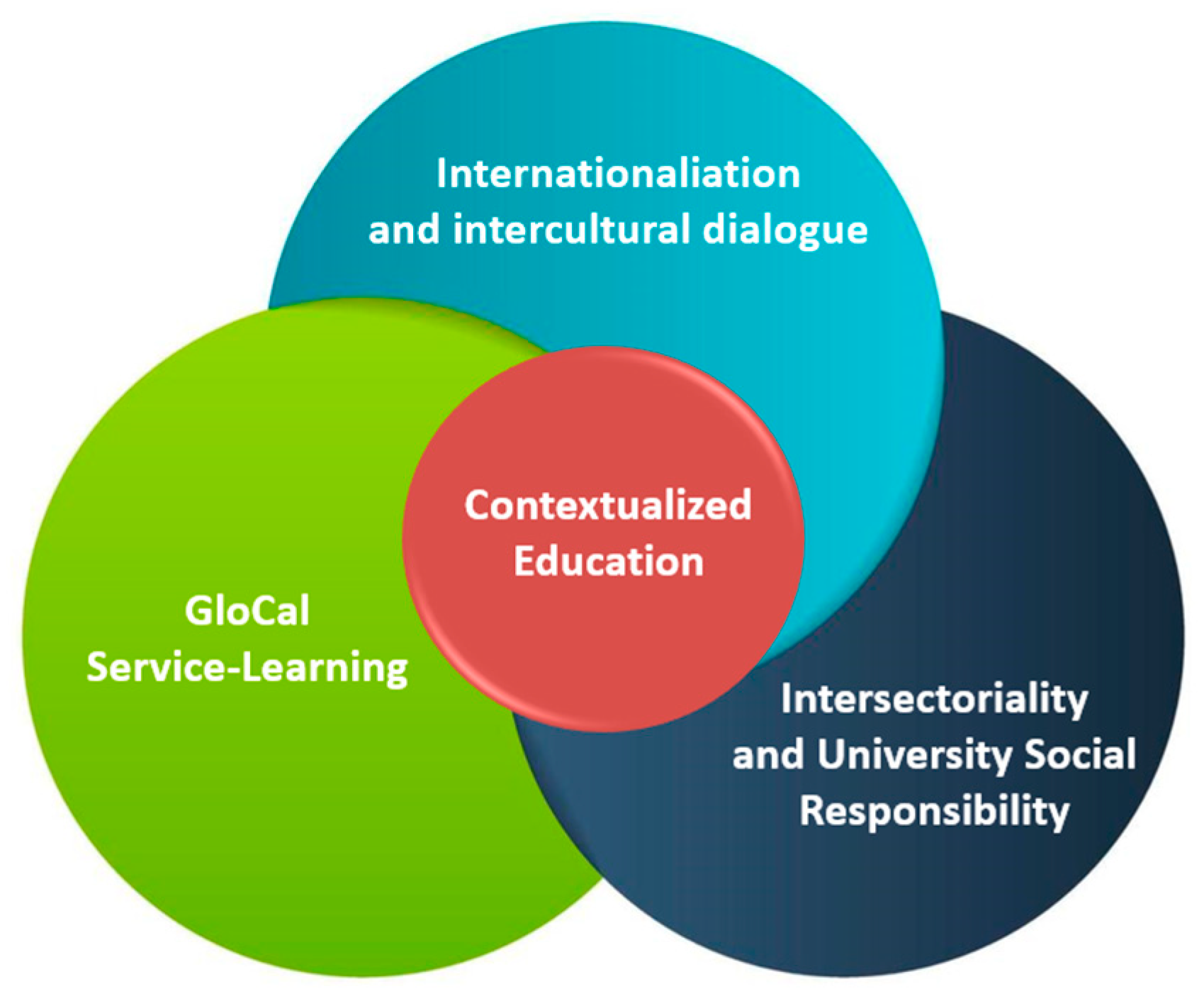
Without claiming to be exhaustive, the analysis of this experience leads us to reflect on the different facets of integrating dimensions such as intercultural dialogue and internationalization, intersectoral dialogue and the third mission, and between learning and SL, all through the lens of contextualized education, as shown in
Figure 1.
The research may also stimulate the following questions: What were the strengths, weaknesses, and challenges that this experience allows us to share? How can they serve as discussion material for further experiences, even in different contexts and for different thematic areas?
2. GloCal Service-Learning
The GloCal SL experience was shared by a UNIPD student in Brazil as part of the Intereurisland research and exchange program that provides mixed student mobility, including study and internships abroad, through ISL projects.
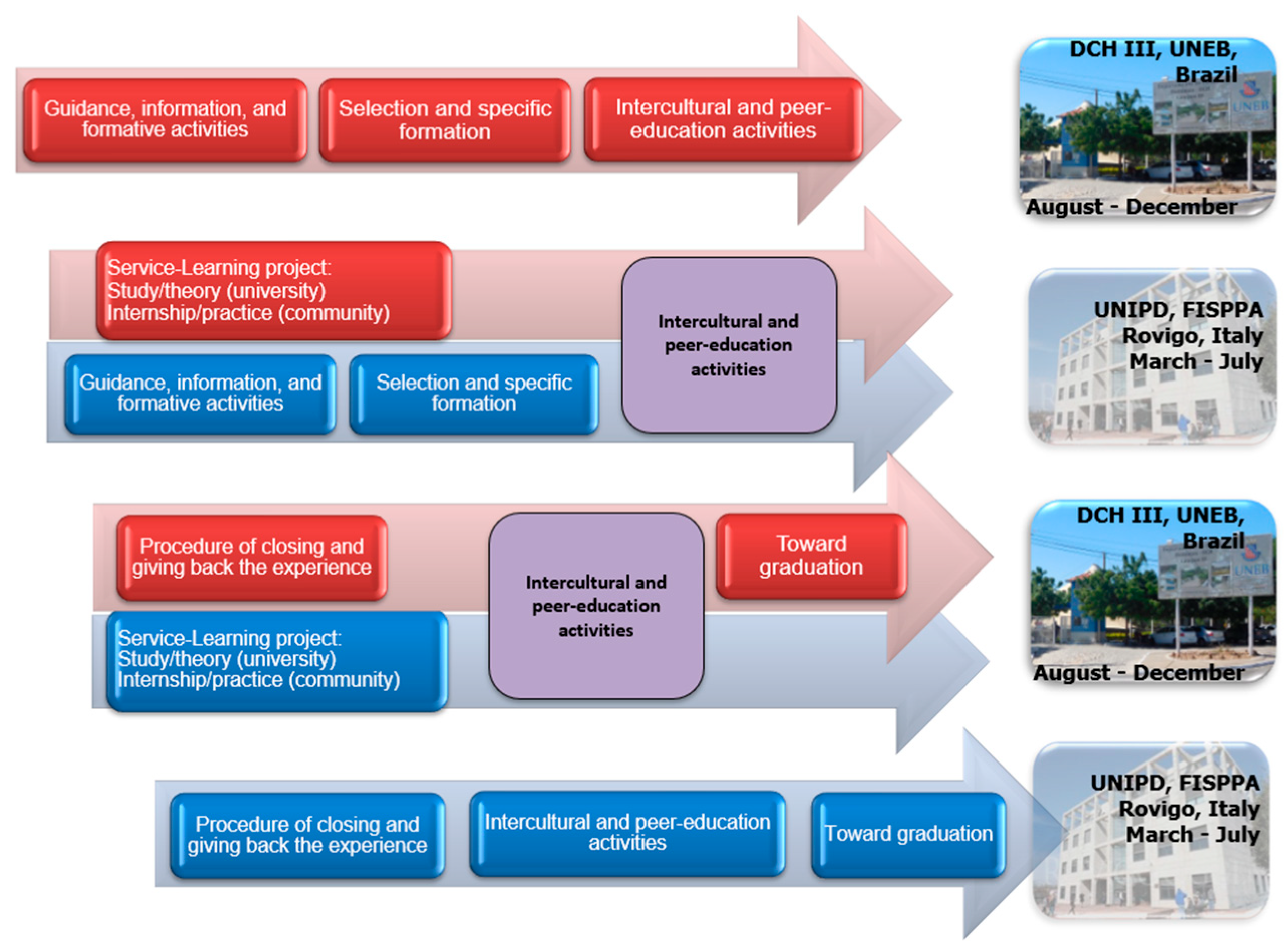
The program was born in 2016 from a joint doctorate between UNIPD and the University of the State of Bahia (UNEB), Brazil, and is developed within the framework of a bilateral agreement between the two universities, with the collaboration of other Brazilian universities and EnARS Association, in Italy. The cyclicality of Intereurisland in its smart format (I-Smart-C) proposes four protocols and twenty-five activities, covering internationalization, third mission, and SL. The activities are repeated cyclically with three different sequential phases, as shown in
Figure 2 below.
The research carried out and the many years of experience in the field stimulated the interest in tracing “[…] a new path of research, action, and formation through which to deepen, from the theoretical and practical point of view, the GloCal value of ISL projects, through the special lens of contextualized education” (ibidem, p. 107). Edmerson dos Santos Reis, one of the leading exponents of contextualized education for survival in semi-arid areas from the Northeast Region of Brazil, when asked about the possible relationship between contextualized education and a GloCal education, proposed the construction of an educational process for current generations that contributes to “[…] feeling belonging to their world, to their life context, without losing sight of the globalization in which we live and the need for an education that awakens in this individual the feeling and action for planetary citizenship” (
Reis, 2020, p. 57).
This approach, in addition to integrating academic learning with solidarity service in an international context, as in ISL (
Nurbatra, 2018;
Coryell et al., 2016;
Nickols et al., 2013), seeks to: (a) understand how local challenges and problems connect to global issues and vice versa; (b) recognize the value of the context where the student lives and/or studies (the local) in the dialogical relationship between the local and global dimensions.
Specifically, several critical perspectives were highlighted that are considered crucial in outlining and designing this GloCal approach: (a) immersion in the host context; (b) language; (c) contextualized education; (d) dialogue between local and global dimensions; (e) carbon footprint; (f) e-Service-Learning. It is not possible to specifically address each of the perspectives listed here, but the experience presented below will allow us to draw some reflections and prepare possible lines of future research.
In the context of the UNIPD student’s field experience, when undertaking specific research on the early development of joint attention (JA) in children from socioeconomically disadvantaged backgrounds in Brazil (
Zucchi, 2025), cultural differences (non-WEIRD populations) and community needs (requests for parent and teacher training) were key aspects the student had to confront as she immersed herself in the context of interest. A decisive factor in this process was the time devoted during the first months in Brazil to familiarizing with the new context and integrating it into the existing cultural background. This initial phase proved fundamental in proposing training that was truly meaningful for the intended recipients: training rooted in the context, made possible only by shifting away from the presumed protagonism of those who dispense knowledge towards a repositioning in a space of listening and observation. Through this process, the experience highlighted the importance of linguistic competence and intercultural dialogue for establishing trust and building collaborative pathways with teachers, parents, and the community.
At the same time, attention to care emerged in the micro-educational practices observed, confirming the centrality of the affective and relational dimension for sustainable educational interventions. Taken together, these elements illustrate the potential of integrating participatory evaluation and moments of feedback, creating a more responsive and contextually grounded approach. In summary, this experience underscores the urgency of interweaving care, contextualization, and global responsibility, so that ISL with a GloCal approach does not remain merely a theoretical formula but evolves into a shared ethical praxis capable of sustaining transformative and genuinely intercultural educational processes.
3. The Research
Research on the Intereurisland program analyzes the implementation and impact of new internationalization and university social responsibility strategies, particularly through blended student mobility (study and internship) and ISL projects with a GloCal approach. Considering that the phenomenon being studied is contemporary and embedded in a real-world context, an integrated and descriptive case study was chosen as the most appropriate research methodology (
Yin, 2005;
Damiano, 2007;
Trinchero, 2004).
Given the complexity of the research topic, the case study was approached through the following three subunits of analysis: 1. the implementation of the Intereurisland program activities, in its smart format (I-Smart-C); 2. the social impact of ISL projects; 3. the learning of mobile students involved in ISL projects.
Based on
Yin’s (
2005) indications, for data collection, the research refers to the following sources of evidence: documents (including research diaries, internship projects, final reports, theses, etc.), questionnaires, interviews, focus groups, and participant observation.
For this article, we specifically focus on subunits 2, relating to teachers’ and parents’ evaluation of the training sessions, and 3, regarding the students’ learning. The research context is the Fundação Lar Feliz (Happy Home Foundation), a nonprofit organization whose mission is to provide comprehensive care for children aged 0 to 11 living in conditions of social vulnerability, as well as for their families (
Fundação Lar Feliz, n.d.), located in the city of Juazeiro, Bahia, in the Northeast Region of Brazil. The data collection period runs from October 2024 to January 2025.
Specifically, regarding student learning, data collection was conducted by means of: (a) a semi-structured questionnaire (completed every two weeks), a final evaluation questionnaire (at the end of the mobility period in Brazil), a final report on the experience and a master’s thesis, all written by the student; (b) a final interview with the pedagogical coordinator of the Fundação Lar Feliz; (c) two closed-ended questionnaires with Likert scales, entitled “Evaluation of the professional skills acquired by the intern” and “Evaluation of the organizational/relational skills of the intern”, completed by the tutor of the internship organization in Brazil and the program coordinator, also based on the evaluation expressed by the pedagogical coordinator of the Fundação Lar Feliz; (d) participant observation and research diary, completed by the program coordinator.
Regarding the training sessions, 40 parents and 6 teachers from the Fundação Lar Feliz participated in the activities proposed by the student in question. Specifically, with regard to the teachers (the focus of this article), data collection was conducted through interviews and a semi-structured questionnaire, administered at the end of the training sessions. The qualitative data were analyzed using descriptive coding.
In the interest of adhering to the ethical principles and values of social research, the Intereurisland research project was approved by the Ethics Committee of the University of the State of Bahia on 6 March 2017, under protocol number 1,950,708. The specific study presented in this article received approval from the Ethics Committee of the University of Padua (protocol number: 3686) as a secure means of data collection and storage. The video recordings were promptly transferred to a secure server for storage in a private directory, in compliance with EU Regulation GDPR 679/2016.
One of the procedures followed to legitimize the involvement of each individual in the research phases was the use of informed consent.
4. The Experience
“I think it’s difficult to summarize everything this mobility experience has meant to me. I find its meaning every day in seeing the person I’ve become after these six months in Brazil. The reason I embarked on this journey lies in the awareness that contact with humanity in all its forms and manifestations is essential for those like me who hope to work in it in the not-too-distant future. Breaking the mental patterns we’ve always grown up with, deconstructing ourselves, and questioning ourselves are all motivations that have driven me to challenge myself and break down my limits.”
(AZ’s final evaluation questionnaire, January 2025)
What is shared through this and the next chapters refers to the experience in the field and to the master’s thesis, discussed in Padua on 15 July 2025, by the student involved. A student enrolled in the second year of the Master’s Degree in Neuroscience and Neuropsychological Rehabilitation at the UNIPD traveled to Brazil thanks to a five-month scholarship (ULISSE program, UNIPD), part of the bilateral agreement between UNIPD and UNEB.
The learning agreement submitted before departure stipulated, theoretically, attendance of the following subjects: (a) Fundamentals of education for coexistence with the Brazilian semi-arid region (60 h, 4 UNEB CFU); (b) Interpersonal Relationship and group dynamics (40 h, 3 UNEB CFU), (c) Research Group EDUCERE (30 h, 2 UNEB CFU); and (d) Thesis work (30 h, 2 UNEB CFU). As for the practical part, the student was required to complete 575 h (23 UNIPD CFU) of a mandatory practical training TPV (tirocinio pratico valutativo pre laurea). In accordance with the GloCal SL proposal, the mobility experience of the student was developed between 17 August 2024 and 16 January 2025, in the continuous alternation between theory and practice, university and community, learning and solidarity service.
At the beginning of the mobility phase in Brazil, one of the main activities carried out to immerse the students in the context of interest (the first critical perspective of the GloCal approach) is the entire student team’s visit to all the partner organizations in the local network. These are the community organizations that are available to host the students for the training internship.
Following the founding characteristics of the pedagogical-methodological proposal of SL (
UNISERVITATE, 2021;
Tapia, 2006), the student in question, from the very beginning, put her protagonism into practice by asking the program coordinator to create a link with a new local organization. Her interest, in fact, was to explore “[…] the early development of Joint Attention (JA), with a focus on its responsive form (RJA), in infants from socioeconomically disadvantaged Brazilian contexts.”(…) In agreement with her internship and thesis supervisor from UNIPD and based on a neuroconstructivist framework, the study examines how early-life experiences and environmental influences shape developmental trajectories, with particular attention to non-WEIRD populations.
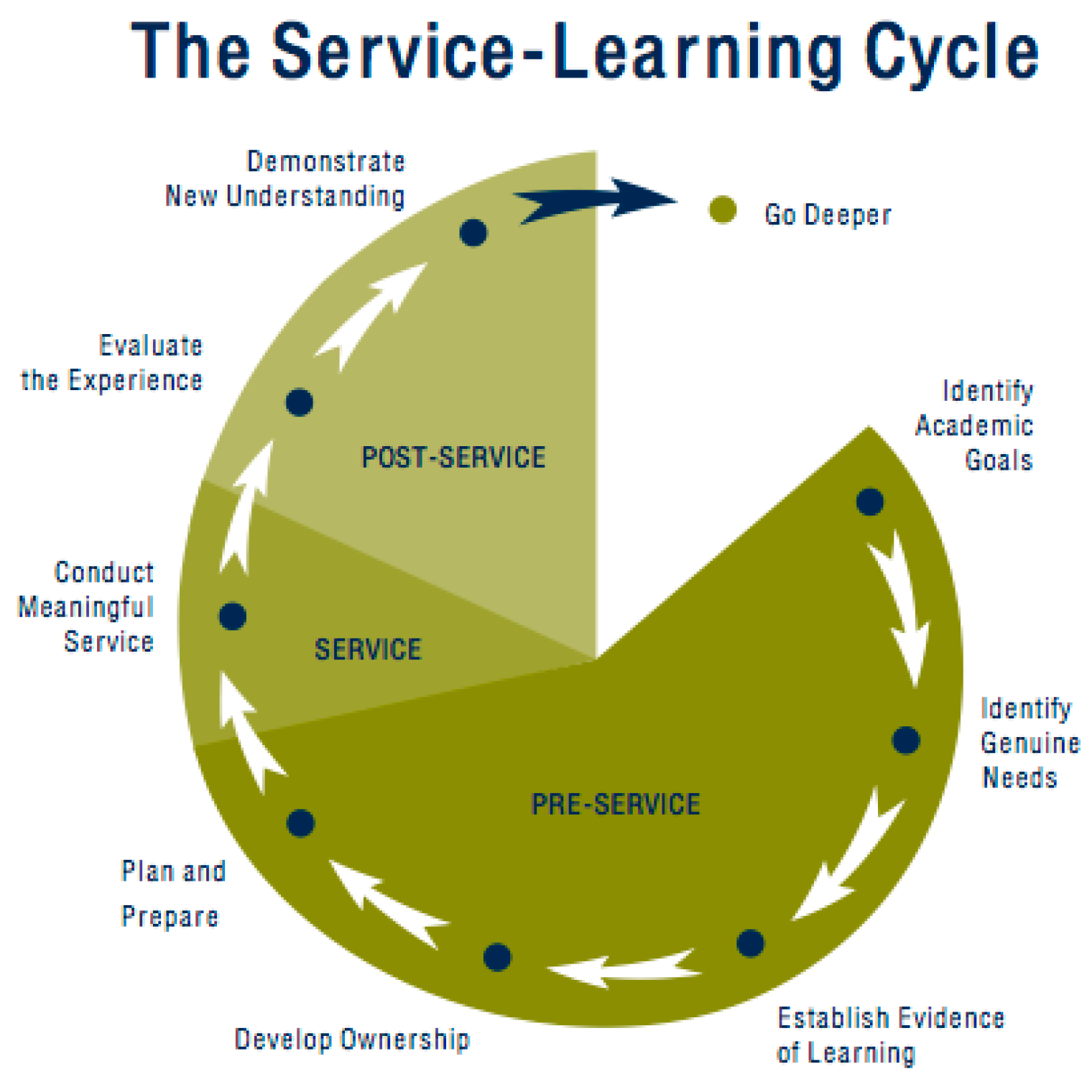
The challenge was accepted by the coordination of the Intereurisland program, and a new partnership was established with Fundação Lar Feliz. Following the visits and selection of internship providers, a weekly schedule was developed for the team’s students, alternating between university (theory) and community (practice). Within this framework, through the extension (third mission) course Interpersonal Relations and Group Dynamics, each student was asked to develop their own SL project, as part of the social engagement project Educational and Helping Relationships in Extracurricular Contexts. The course had 28 participants, including undergraduate and postgraduate students, technicians, and professors from DCH III, UNEB, exchange students from UNIPD, Italy, and people from the communities of Juazeiro, Bahia, and Petrolina, Pernambuco. The students involved were invited to plan their own SL project, following the SL cycle proposed by the
NYLC (
2005), presented in
Figure 3.
During the pre-service phase, which involves planning the project to be implemented during the in-service phase, students were invited to co-construct the project with the internship organization representatives. Specifically, the professionals who make up the multidisciplinary teams.
In this process, one of the most delicate and important moments is, undoubtedly, the sharing of academic objectives (by students) and the needs of the host institution (by the teams). For the student in question, this was the moment when she negotiated with the educational coordinator at Fundação Lar Feliz about her interest in conducting her specific research, taking into account the institution’s real needs.
Based on the needs expressed by the teachers during a monthly school evaluation session, the student was asked to schedule informational and educational meetings with the school’s teachers and the children’s parents. These meetings were aimed at increasing awareness and sensitivity around the importance of fostering healthy and psychologically stimulating environments during the early stages of development. Thinking of the baby as endowed with a mind, capable of mental processes from the earliest stages of development, has profound practical implications, as it gives value to their actions, emotions, modes of expression, and the environment surrounding them. This implies that caregivers and educators have the responsibility to engage themselves in seeking attunement, exchange, and relationship with the child. Thanks to this awareness, it is possible to lay the foundations for promoting a culture of caring rather than a culture of curing. The quote by Frederick Douglass, “It is easier to build strong children than to repair broken men,” clearly highlights that it is much simpler and more effective to invest in the positive development of children rather than trying to mend the damage and scars inflicted upon them when they are adults. Therefore, early childhood education, nurturing, and support in shaping individuals can contribute positively to society.
Meetings also emphasize the importance of integrating community engagement with psychological and pedagogical research, recognizing that the construction of new knowledge must go hand in hand with the social responsibility we bear in generating it.
The goal was to share knowledge on the importance of early developmental stages, with a particular focus on JA, the human ability to share interests and attention to adopt a common point of reference with a social partner (
Mundy, 2018). JA plays a crucial role in human development, as coordinating attention with another person facilitates participation in social learning opportunities, development of social skills, mentalizing (
Tomasello & Carpenter, 2007), and language acquisition (
Senju & Csibra, 2008).
The biological foundations and significant evolutionary function of JA indicate that it represents a socio-cognitive skill common to all human populations and manifests comparably in children worldwide (
Tomasello et al., 2005). However, research in developmental psychology has identified several factors that potentially modulate JA expression, such as socioeconomic status (
Abels & Hutman, 2015) and culture. For example, the style of triadic interaction typically observed in Western contexts between caregiver, child, and external object is not representative of other non-Western communities (
Bard et al., 2021;
Little et al., 2016). To sum up, meetings were planned with a psychoeducational approach, offering scientifically grounded information to promote a better understanding among parents and educators of this fundamental socio-cognitive ability.
Meetings were offered to 6 early childhood education teachers and 40 parents. The initiative “[…] aimed not only to actively involve them in the process, but also to raise their awareness on topics related to child development that could be practically useful in their relationship with their children.”
The design and preparation of the training sessions were guided by a clear awareness of the target audience for whom they were conceived. All the contents resulted from an in-depth bibliographic review of both international literature and local studies, with the aim of providing knowledge that genuinely reflected the context in which they were proposed. To achieve this aim, immersion in the local culture meant not only seeking to understand a different way of life but also acquiring the local language, which proved to be key to developing authentic relationships. Language acted as the connecting thread that enabled the creation of relationships based on trust and credibility. Taking care also means making the information conveyed accessible, avoiding inappropriate vocabulary or incomprehensible technical jargon. In this sense, it was necessary to adapt the terminology during the sessions to meet the needs of different recipients: on one side, the parents, and on the other, the educators.
This process of preparing and adapting the training sessions was made possible by giving prominence to the cultural and social context in which they were embedded. By bridging academic knowledge with local realities, the initiative fostered a space of mutual learning in which parents and educators could feel both recognized and empowered. In this way, the mere transfer of technical information and theoretical knowledge was accompanied by dialogue and responsibility, cultivated through an awareness of the place and context in which the activities took place.
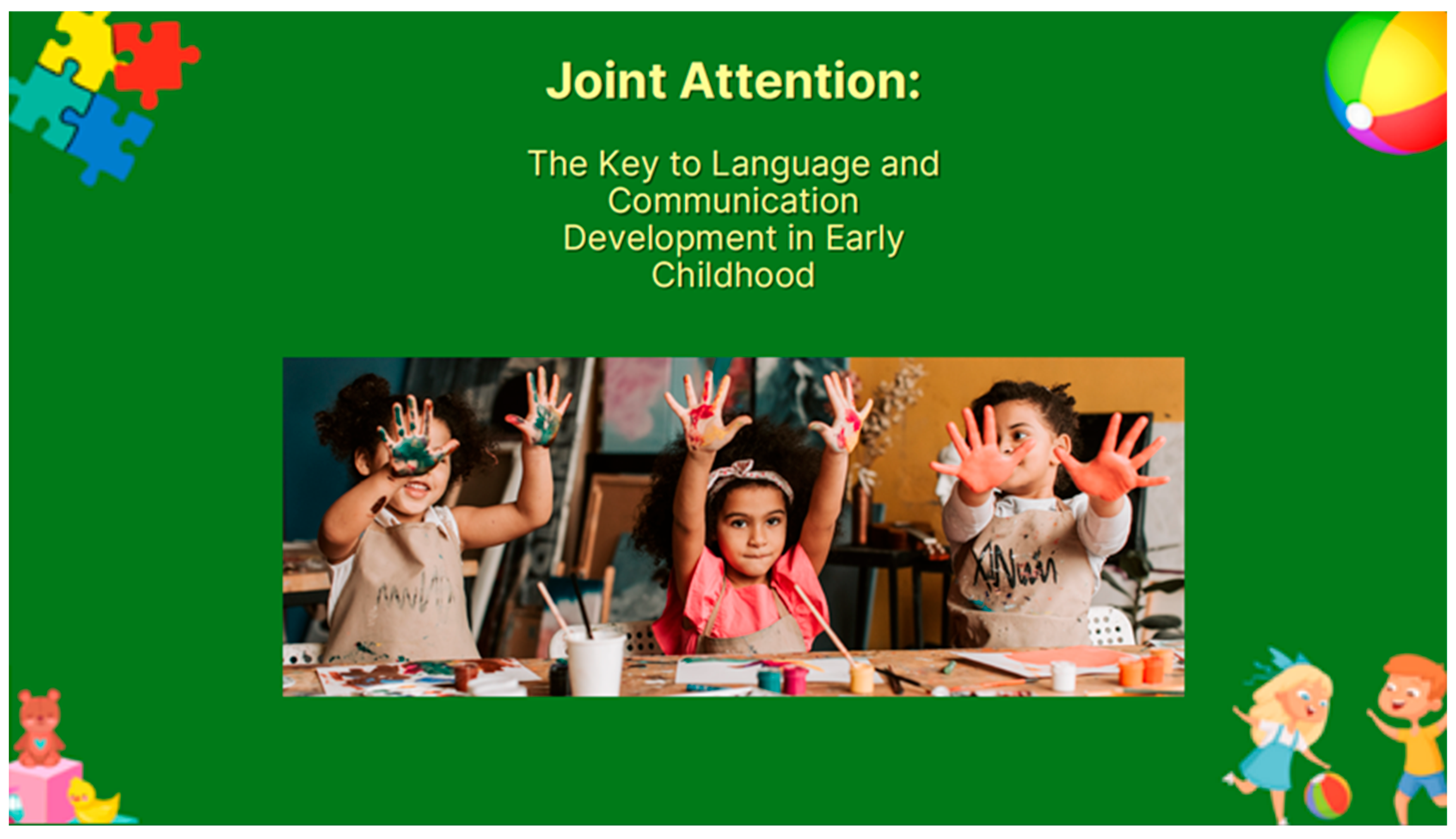
The following
Figure 4 and
Figure 5 show the opening slides of the meetings with parents and teachers.
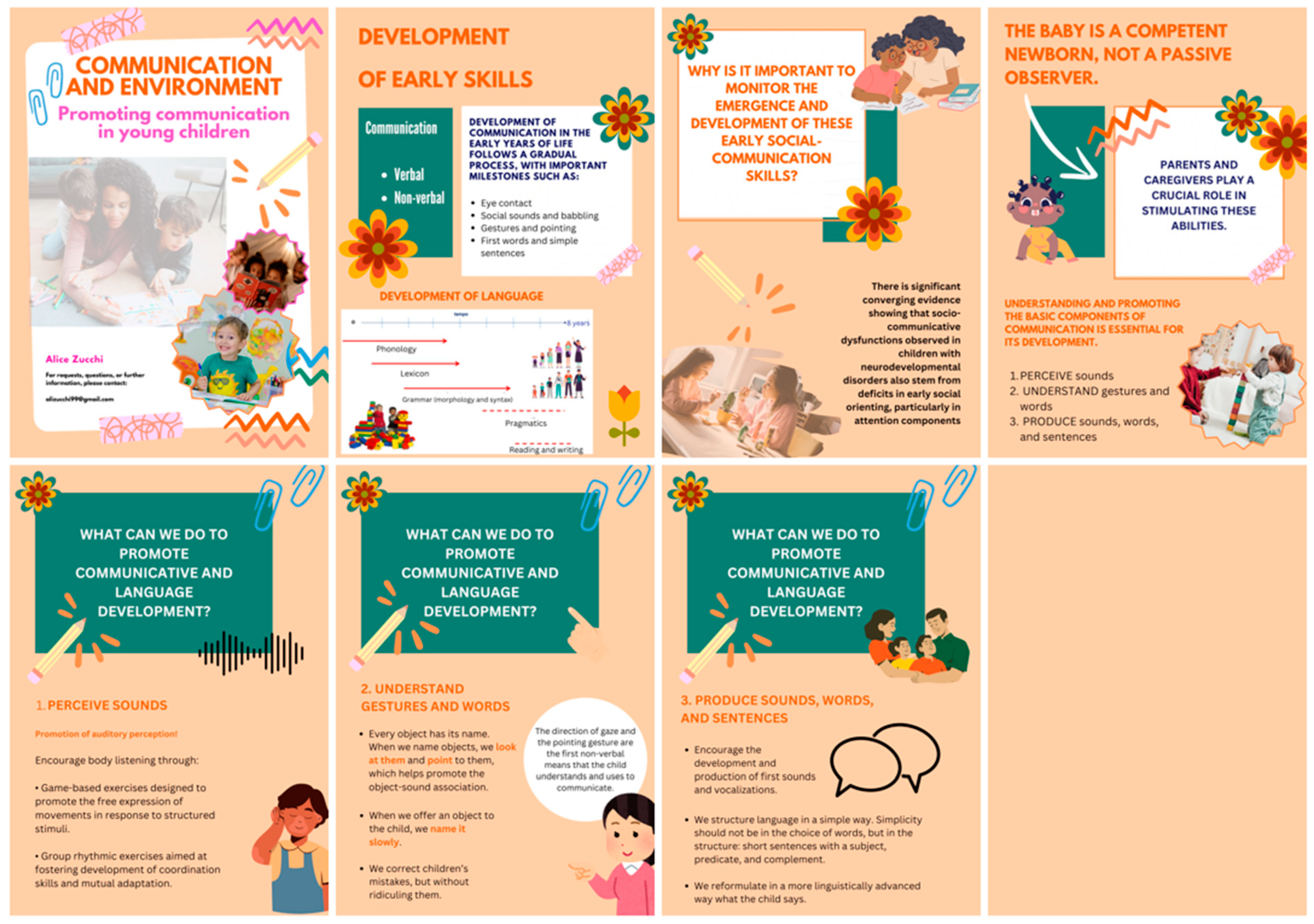
In the context of the experience delineated in this article, a structured feedback protocol was implemented for the families and educational professionals engaged in the project. The primary objective of this protocol was to address the outstanding issue of providing empirical and practical recommendations for fostering and enhancing the development of JA. In collaboration with the educators and under the guidance of the internship supervisor, AZ developed an informational brochure designed to augment the participants’ perceived self-efficacy and competence.
This brochure encompasses evidence-based strategies for stimulating auditory perception and rhythmic awareness, promoting gestural and verbal expression, and encouraging the production of concise utterances that facilitate early communicative development in young children. The brochure was disseminated in print format (as shown in
Figure 6, following) to both educators and parents on the final day of the academic term, serving as a token of appreciation for their cooperation and collaborative efforts throughout the study.
5. Results
“I carry with me the daily practice of questioning how I’m occupying my space and time, constantly questioning myself in relating to an Other different from myself. I ask myself if I ‘know how to be,’ what I can do to improve my being. It’s a constant exercise that I’ve acquired and that I’m unlikely to abandon because it has become an integral part of my living with others.”
(Final evaluation questionnaire, January 2025)
This chapter provides a brief description of the data collected and their interpretation. With reference to subunit of analysis 2, the evaluation of the educational meetings by teachers and parents was analyzed based on data collected from the final evaluation of the preschool pedagogical coordination team and the six teachers who participated in the meetings. The semi-structured questionnaire consisted of a closed-ended question (with a Likert scale), a semi-structured question, and a multiple-choice question, as follows: (1) How do you generally evaluate the educational meeting led by Italian intern AZ? (1. Excellent, 2. Good, 3. Fair, 4. Sufficient, 5. Insufficient); (2) Based on your previous answer, can you explain your choice? Why did you rate the training this way? (3) Are you interested in participating in other similar training sessions? (1. Yes, 2. No, 3. I don’t know).
When asked for an overall evaluation of the experience on a five-point Likert scale, all teachers responded: A = excellent.
The qualitative data, collected through interviews and a questionnaire with the pedagogical coordinator and teachers, were analyzed using descriptive coding, with the aim of highlighting the most frequently cited words and concepts (codes) that can be traced back to general themes. The following codes—(Mastery of) scientific knowledge in practice, commitment, punctuality, and Ethics—are believed to be included in Topic 1: Professional Practice. The following codes—kindness in relationships, love and affection for children—can be included in Topic 2: Care.
“She mastered very sensitive topics to discuss with parents and teachers, preparing meetings that were appreciated by everyone”.
(Final evaluation, pedagogical coordinator)
The educational meeting was rated very positively for: (a) addressing a specific need expressed by the teachers; (b) the importance of the topic discussed in relation to “caring for those who care,” in the educational field, and to the well-being of teachers; and (c) the skills and competences demonstrated by the student involved.
“… is a wonderful and excellent professional for several reasons: she carries out her work with great care, is deeply interested and sensitive in her interactions with people, and is very affectionate when caring for children. She is punctual, focused, and always seeks understanding and care in interpersonal relationships, helping each person with sensitivity and warmth, and is very loving toward everyone. She also demonstrates ethics and integrity. [AZ] has an innate charisma toward others, especially children. Her scientific knowledge and expertise have contributed significantly to the development of the children she has cared for. She was carefully observed, we exchanged notes, and received excellent feedback on the proposed activities”.
(Final evaluation, Teacher 01)
“… is an exemplary professional; her work demonstrates the importance of science in social interaction and children’s psychomotor development. She has the gift of interacting sensitively with people, especially children, and is highly competent and dedicated. My analysis was based on several examples of values: dedication, respect, responsibility, affection, friendship, etc. In addition to the activities we carried out, which had excellent results, we also had very meaningful moments of exchange”.
(Final evaluation, Teacher 02)
To the question: “Are you interested in participating in other similar training sessions?”, all the teachers and the pedagogical coordinator confirmed their interest, reiterating the importance of meetings like these for their educational work and well-being.
In addition to the data collected from the questionnaires completed by teachers, qualitative feedback was also spontaneously provided by some parents who attended the psychoeducational meetings. These informal remarks offer further insight into the perceived usefulness and emotional resonance of the initiative. One mother shared, “My studies have led me to take an interest in infancy and early development; this meeting was informative and proved to be genuinely useful” (Parent 1). Another added, “Thank you for your time and the dedication you put into preparing these meetings; they will certainly be useful in my daily life” (Parent 2). Such spontaneous comments complement the formal evaluations, adding depth to the understanding of participants’ experiences and highlighting the meaningful impact of the encounters.
Overall, the qualitative analysis of the data collected from the final evaluation of AZ’s experience at Fundação Lar Feliz highlights a key aspect, considered by all to be of great importance: the perception of a strong relationship between scientific knowledge and attitudes of affection and love towards children.
Still with regard to subunit of analysis 2, the evaluation of the experience by the Intereurisland program coordinator highlights two aspects considered relevant. The first refers to the importance of the voice of community individuals and organizations in evaluating the impact of SL projects. This aspect is acknowledged to have been neglected in previous years, in favor of a much more in-depth assessment of the learning perceptions of the students involved. The second concerns the question of the replicability of the experience in other contexts (not just in Brazil) or in the same context, with the involvement of other students (Intereurisland Research Diary, 2025).
With reference to subunit of analysis 3, AZ’s learning was monitored through specific focus groups and a questionnaire with a fortnightly frequency, weekly tutoring meetings, a final evaluation with the pedagogical coordination of Fundação Lar Feliz, and a final evaluation questionnaire completed by the student herself.
With regard to the personal evaluation of the experience, the student states: “I left those meetings with positive impressions, pleasantly surprised by their interest in what I had to share. I also received a few kind and appreciative comments, which I greatly valued, feeling encouraged to continue this mutual exchange: on my part offering information on relevant and necessary topics, and on their part, offering their time, which greatly enriched my experiential learning process. […] These meetings proved valuable not only as an opportunity to clarify my role within the Fundação Lar Feliz but, more importantly, for the meaningful exchange that occurred, fully aligned with the principles of Service Learning (SL) that guided my journey, allowing a fusion between my research experience and educational practice.” (
Zucchi, 2025, pp. 41–43).
Table 1 and
Table 2 display the final evaluation tables of the Booklet—Practical—Valutative internship diary pre lauream (ID no. 564/2022)—UNIPD, filled out by the internship tutor, of the host institution in Brazil, and the program coordinator, also in relation to the final evaluation by the pedagogical coordinator of the Fundação Lar Feliz.
During the analysis of all the collected data, an important issue arose regarding the choice of “excellent” rating (Likert scale) by all those involved in the evaluation, both for the training sessions and for the students’ learning. In this case, the risk of confirmation bias was assessed. To mitigate this risk, we considered the fact that the responses were provided by individuals within the university and community, and at different times, without prior sharing. The value of qualitative data in supporting the stated excellence in every aspect of the experience is recognized.
6. Conclusions
“As for the future, the ‘for what?’ I’d say this experience will prove invaluable not only professionally but also in my everyday life, in every way, from a perspective of living in the world as a citizen of the world, aware of the privilege I carry with me and intent, especially after this period, to use it to give a voice to those who don’t have the privilege of being heard.”
(AZ’s final evaluation questionnaire, January 2025)
This study explores in depth an ISL experience with a GloCal approach, undertaken by a student from the University of Padua in Juazeiro, Bahia, Brazil, as part of the Intereurisland Program. A research and exchange program that was developed within a bilateral agreement between UNIPD and UNEB.
This approach, through the lens of different dimensions, innovatively integrated academic study with community service through a series of formative encounters with teachers and parents of children living in socially vulnerable conditions.
Rooted in the philosophy of SL, the experience viewed education as an ethical and civic practice that promotes care, dialogue, and transformation across cultures. This vision allows for a bridge between academic theory and field practice, offering mutual benefits both to the exchange students, who enrich their academic education with intercultural competence, empathy, and social awareness, and to the local community, which has significantly benefited.
Furthermore, considering the implications and limitations (presented below), this proposal can serve as a model for future ISL experiences, demonstrating how international academic cooperation with a GloCal approach can be leveraged to create a positive social impact. By combining rigorous academic study with hands-on community service, the initiative prepares students to become globally minded citizens capable of addressing complex challenges in diverse cultural contexts. This collaboration exemplifies a growing trend in international academic partnerships that aim to create meaningful cross-cultural learning experiences.
Set within the Fundação Lar Feliz, a nonprofit organization that supports children and families in vulnerable social contexts, the program combines global perspectives with local action, allowing participants to think both globally and locally, addressing the specific needs of the community. By immersing students in the daily challenges of the Lar Feliz Foundation (considering the delicate aspect of foreign language learning) and from the perspective of contextualized education, the program offered a unique opportunity to apply theoretical knowledge of developmental psychology to real-world situations.
The research aimed to analyze teacher and parent evaluations of training sessions focused on improving and supporting early social and communication skills in early childhood. These sessions were designed to address specific local educational challenges, while integrating psychological knowledge and creating a unique blend of contextually relevant scientific content. At the same time, the study placed particular emphasis on analyzing the learning experience of the UNIPD student involved in the mobility project. This aspect of the research aimed to shed light on the transformative potential of ISL experiences, exploring how immersion in a diverse cultural and social context could enhance a student’s academic, personal, and professional development.
More broadly, by focusing on intercultural dialogue, contextualized education, and caring pedagogy, the study aimed to contribute to the evolving field of global citizenship education. It sought to understand how future educators could be better prepared to address the complexities of an increasingly interconnected world, while remaining sensitive to local needs and cultural nuances.
Furthermore, the research aimed to provide insights into the potential long-term impacts of such GloCal SL experiences on both participating communities and the students involved, exploring how these experiences could shape more inclusive, culturally responsive, and globally aware educational practices.
Ultimately, this comprehensive research approach sought to demonstrate the transformative power of combining academic rigor with community engagement, intercultural exchange, and a GloCal perspective in teacher education programs.
A qualitative case study model was used, based on
Yin’s (
2005) methodological framework, which is particularly suited to exploring contemporary phenomena in real-life contexts. Data were collected through interviews, questionnaires, focus groups, and participant observation, complemented by research diaries. Significant insights emerged from participant reflections, final reports, and dissertation materials provided further depth. The analysis of this diverse dataset followed a descriptive coding process, adhering to established qualitative research practices. This comprehensive analytical approach facilitated an in-depth analysis of the impact of the GloCal SL experience on various stakeholders, from the personal growth of the participating students to the broader effects on the local community and educational practices.
The findings revealed that both teachers and parents viewed the training sessions very positively, often describing them as excellent. This high level of satisfaction may be attributed to several key factors. Firstly, the UNIPD student demonstrated exceptional communication skills, presenting complex psychological concepts in a clear, accessible manner. This clarity facilitated better understanding and engagement among the local participants. Effective communication, both in terms of linguistic proficiency and cultural nuances, played a vital role in bridging cultural gaps and facilitating knowledge exchange. Moreover, the student’s approach was characterized by a high degree of cultural sensitivity and professional conduct. This created a comfortable and respectful learning environment, encouraging open dialogue and active participation. This “care” approach established a foundation of trust and mutual respect. “Care” is a topic that is still relatively unrepresented in pedagogical debate, but is increasingly considered of fundamental importance (
Machado et al., 2025;
Pate et al., 2023;
Colette, 2008;
Boffo, n.d.). Finally, the ability to comprehend and adapt to the local socio-cultural realities proved crucial. This understanding allowed for the effective translation of global educational principles into locally relevant practices.
In brief, the study highlighted how care, contextual understanding, and language emerged as interwoven dimensions essential for meaningful and sustainable educational engagement. The initiative fostered a sense of reciprocity, where both the student and the community benefited from mutual learning and shared reflection. The student reported developing a stronger awareness of her professional identity, as well as a deeper understanding of intercultural communication and ethical responsibility in education. These findings underscore the transformative potential of GloCal SL initiatives in teacher education. By combining academic rigor with real-world application in diverse cultural settings, such programs can cultivate educators who are not only knowledgeable and skilled but also culturally sensitive, ethically grounded, and globally minded. The study thus provides compelling evidence for the value of integrating such experiences into teacher education curricula, potentially reshaping how future educators are prepared for the challenges of an increasingly interconnected and diverse world.
The experience demonstrated the potential of GloCal SL to connect academic knowledge with community realities, enriching teacher education by promoting empathy, inclusiveness, and a culture of care. It also underscored the value of immersing oneself in the local context, engaging directly with community needs, and recognizing the importance of language as a bridge between cultures. The project reaffirmed that meaningful learning occurs when education is experienced as a collaborative and humane process, not merely an academic exercise. By reframing education as a collaborative, humane, and context-sensitive process, this approach has the potential to transform not only individual educators but also the broader landscape of global education.
While the study provides valuable insights into the value of GloCal SL experiences, it is important to acknowledge its limitations to ensure a balanced interpretation of the findings and to guide future research efforts.
Firstly, it represents a single case and therefore cannot be generalized to other contexts. The unique cultural, social, and educational characteristics of Juazeiro may have influenced the outcomes in ways that might not be replicable in other settings. Also, the participating student may have played a significant role in the success of the experience, making it difficult to predict similar outcomes for all students.
Secondly, the absence of quantitative measures restricts the scope for evaluating long-term outcomes. Without quantitative baseline and follow-up data, it is challenging to objectively evaluate the long-term outcomes of the intervention on both the student and the community.
Thirdly, the voices of community members were not fully included in assessing the impact of the intervention. This gap has been noted by several authors, both in practice and research (
Hollenbeck, 2024;
Mansvelt, 2022;
Chika-James et al., 2022;
Lau & Snell, 2020;
Matthews, 2019;
Goertzen et al., 2016). Without a comprehensive follow-up with community members over time, the lasting effects of the intervention on local educational practices remain unclear. Future research should aim to address these aspects through broader, mixed-method approaches and by giving greater prominence to community perspectives.
Despite these limitations, this experience offers valuable insights into how SL can evolve into a truly intercultural and ethical practice, one that brings care, context, and global responsibility to the heart of education.
In essence, this GloCal SL experience provides a blueprint for how education can evolve to meet the challenges of our interconnected world. It suggests a path forward where education is not just about the transfer of knowledge, but about fostering global understanding, ethical responsibility, and a deep commitment to care and context-sensitive practice.
While acknowledging the need for further research and broader application, this experience nonetheless stands as a powerful testament to the potential of SL to reshape educational paradigms. It points towards a future where education is inherently global in outlook yet deeply rooted in local realities, ethically grounded, and fundamentally committed to fostering care and understanding across cultural boundaries.