Advancing Sustainable Design Education: University-Led Initiatives in Engaging Primary School Students and Empowering Communities

 ,
,  ,
,  ,
,  , , and
Abstract
1. Introduction
2. Literature Review
2.1. Sustainable Design Education
2.2. Children’s Participation
2.3. University Design Students Partnering with Primary School Students
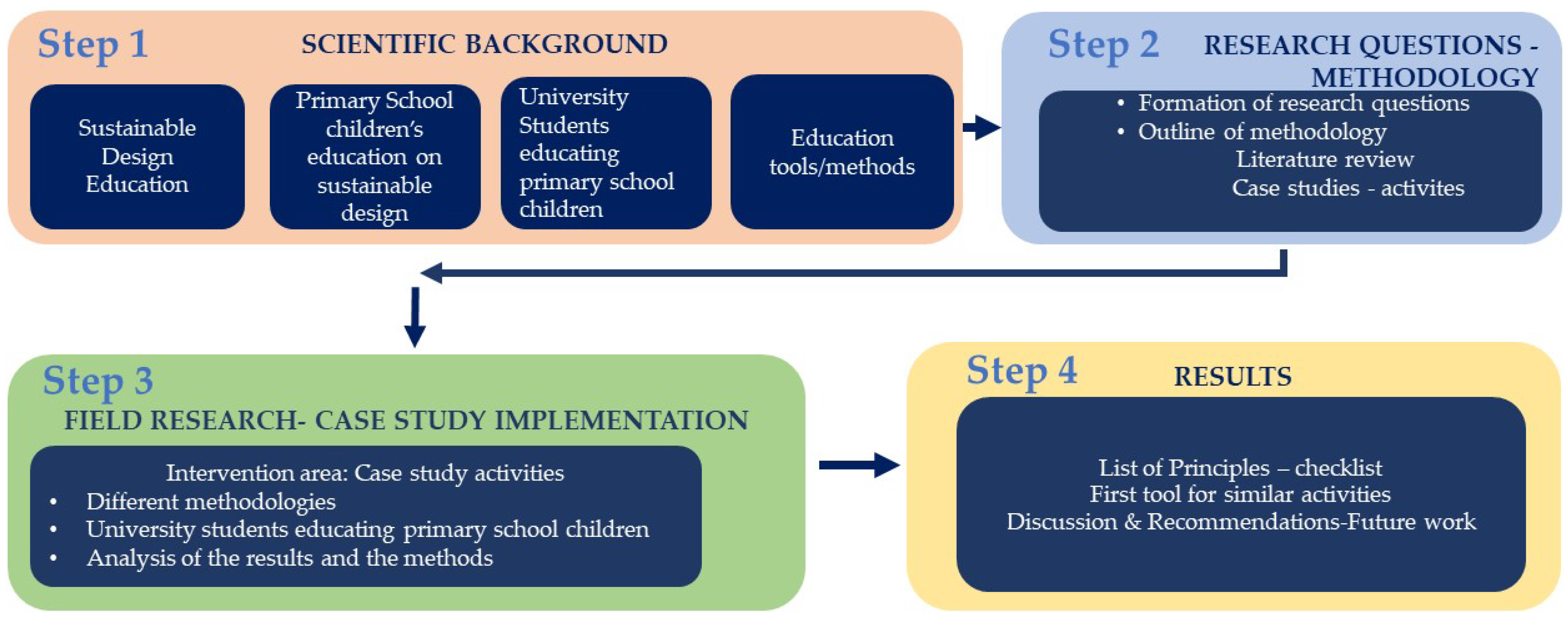
3. Materials and Methods
3.1. Methodological Outline
- RQ1: How can university-led initiatives effectively introduce sustainable design principles to primary school students?
- RQ2: What are the strengths and weaknesses of different educational methodologies (STEAM, storytelling and crafts, artistic installations) in teaching sustainable design?
- RQ3: How does participation in sustainable design activities impact children’s understanding of environmental responsibility and urban planning?
- RQ4: What role do university students play in facilitating sustainability education, and what are the mutual learning benefits?
3.2. Case Studies
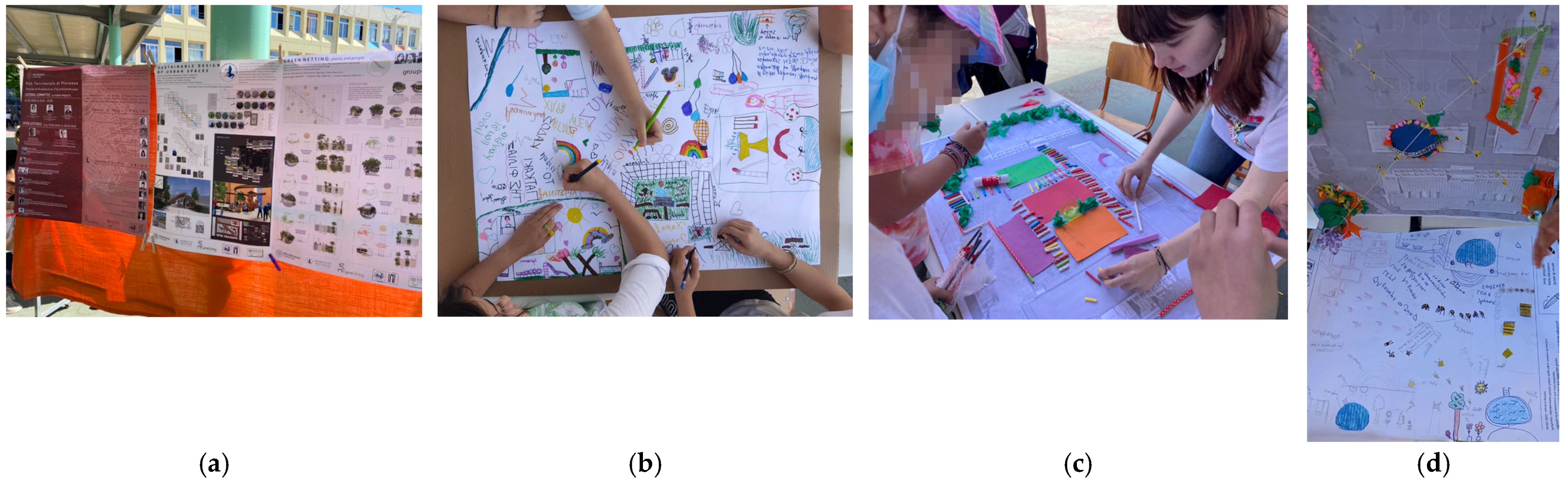
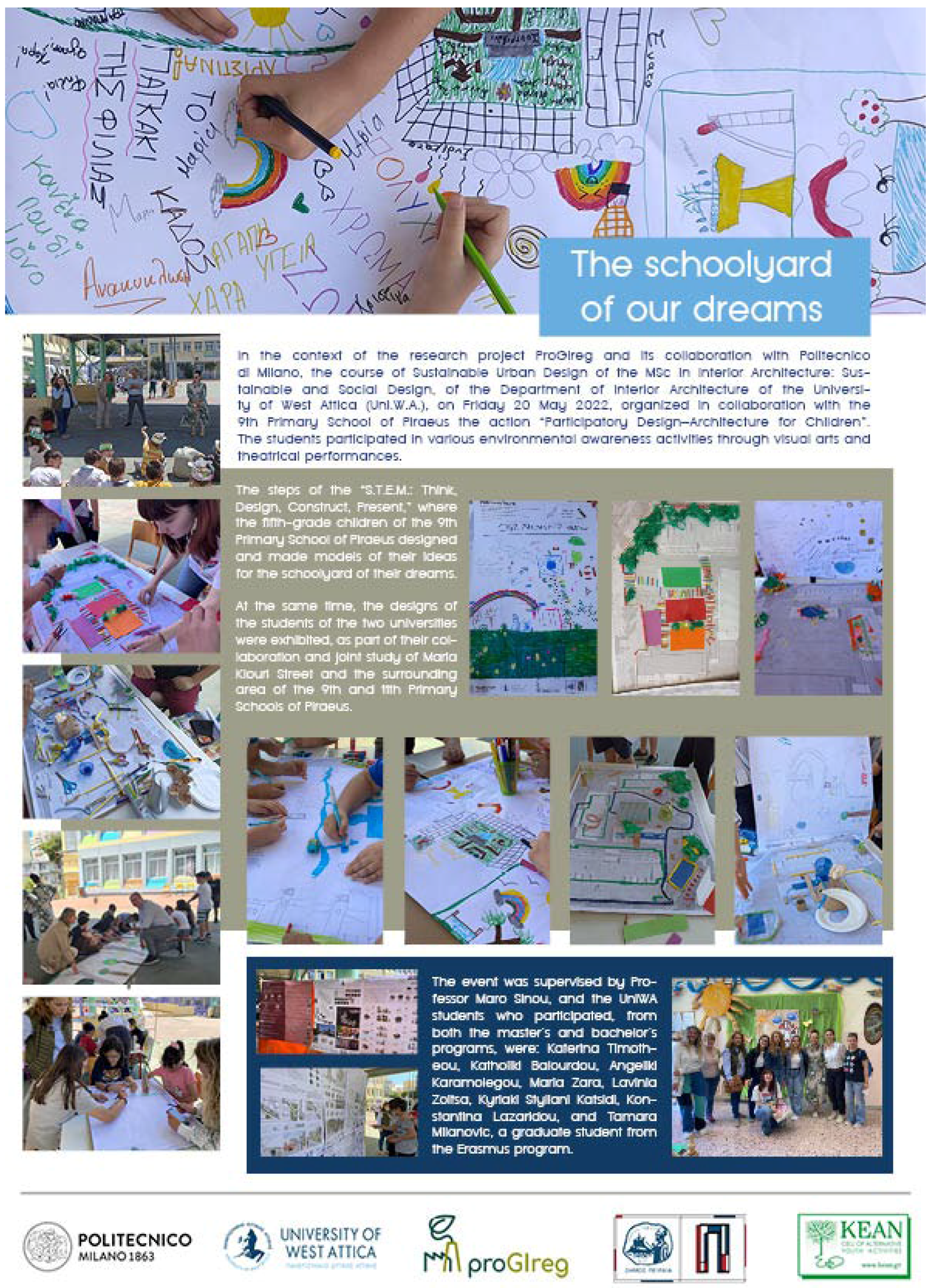
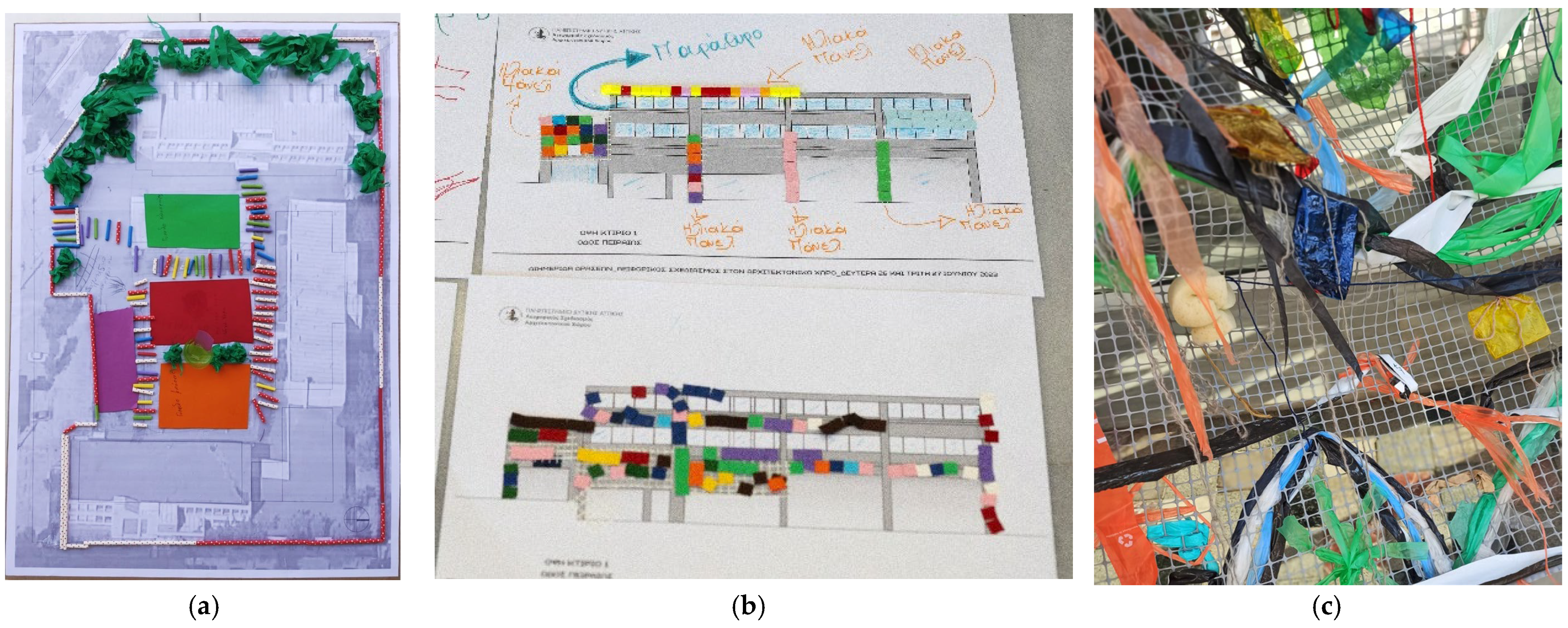
3.2.1. Case Study 1: STEM Education Methodology: Designing the Schoolyard of Our Dreams Activity” (Case Study in Piraeus)
Step 1: Think and Propose
Step 2: Design
Step 3: Construct
Step 4: Present
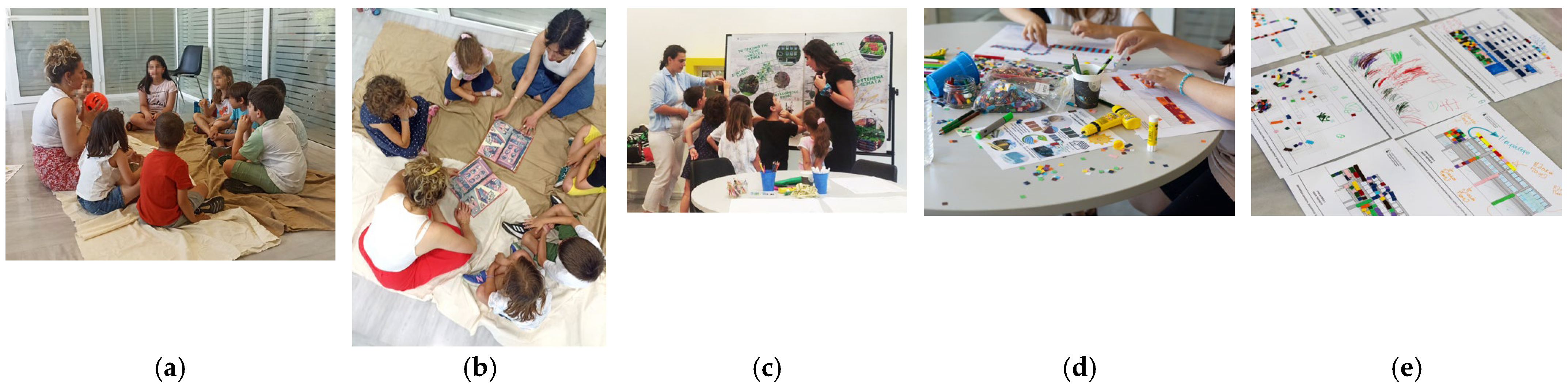
3.2.2. Case Study 2: Storytelling and Crafts Methodology. Greening the City by Planting the Buildings in Our Neighborhood—Green Infrastructure
- Step 1: Introduction and team-building activities: Introduction and team-building activities, followed by a brief discussion about our city’s strengths and weaknesses. Particular attention was placed on the city’s scarcity of green spaces. At that stage, a seamless transition was made into the interactive storytelling session.
- Step 2: Storytelling session: For the purposes of the interactive storytelling session, educators have chosen the “Balcony,” a wordless picture book by (Castrillón, 2019). The book exemplifies the power of visual storytelling. Through intricate illustrations, the narrative follows a young girl who transforms a barren balcony into a vibrant garden. The book effectively employs color, texture, and composition to convey themes of adaptation, connection to nature, and personal growth without text. This silent format invites readers to actively interpret the imagery, fostering deeper engagement with the story and encouraging multiple interpretations.
- Step 3: In-depth Exploration: How can urban greenery be integrated into building structures? This investigation utilizes explanatory posters measuring 70 × 100 cm to illustrate various strategies and design concepts for incorporating green elements, such as vertical gardens, green roofs, and plant walls, into urban architecture. The aim is to highlight the ecological, aesthetic, and social benefits of integrating greenery into the urban landscape, thereby enhancing biodiversity, improving air quality, and fostering community engagement.
- Step 4: Creative Construction: This concept encompasses the innovative design and building of structures that merge artistic expression with functionality. It involves utilizing diverse materials and techniques to create unique, practical solutions to architectural challenges, while also promoting sustainability and ecological principles in the design process.
- Step 5: Photographic Documentation and Evaluation of the Activity: Photographic documentation of the creative constructions is conducted to visually capture the outcomes of the project. This process aims to showcase the various designs and techniques employed by participants, providing a visual record that can be used for analysis and presentation. Following the documentation, a comprehensive evaluation of the activity took place. This evaluation assessed the effectiveness of the creative process, the participant engagement, and the overall impact of the constructions on the intended objectives. The goal is to gain insights into the successes and challenges encountered during the project, which will contribute to future improvements and developments.
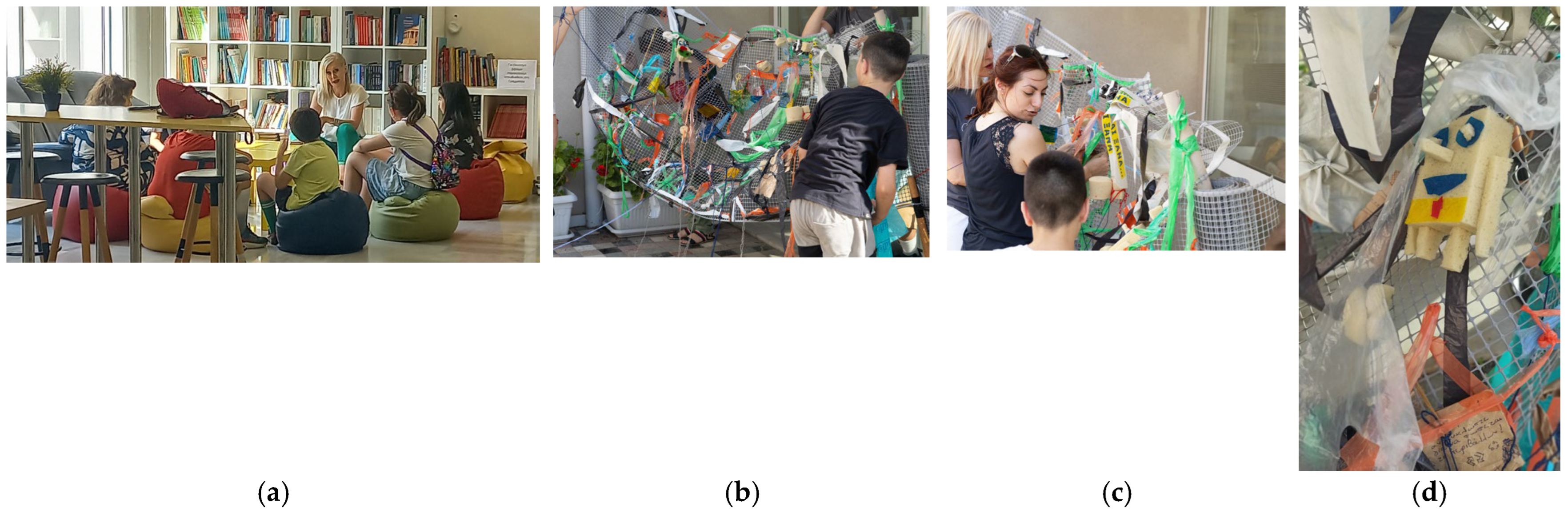
3.2.3. Case Study 3: Artistic Inspiration for an Installation. “Where to Find Energy and How to Use It” Urban Art Installation with Reused Materials
- Step 1: Team-building activities and inspiration on the first day of the workshop; the children participated in a number of activities designed to help them get to know each other and introduce them to the project’s fundamental ideas. Children were given the chance to introduce themselves and discuss their opinions on public space and the value of community during the first meeting. The conversation then turned to the city’s contemporary rhythms, which frequently cause estrangement. Participants were urged to consider ways to design gathering places that would foster conversation and engagement. In addition, the work of an artist was selected as inspiration.
- Step 2: Discuss and design the clothing for the city
- Step 3: Construct an installation created by the children
- Step 4: Present and evaluate a presentation of the installation and evaluation of its broader impact
- Being cognizant of their place in the social and ecological totality (ecological consciousness);
- Being eager to engage in society (active citizens);
- To rethink how they interact with common place items (reuse, recycling, and zero waste);
- The application of imagination, creativity, and inventiveness in real-world situations (innovation).
- Glasses (containers) and sponges are examples of environmental water collection equipment.
- The gathering of solar thermal energy is referred to by the knitted surfaces of bags and gels.
- The threads on the construction represented the movement of energy from the site of collecting to other points, the interaction of the work with its surroundings, and changes in the materials, such as the intense temperature (melting).
- The kids also independently wrote messages about the environment and pinned them to the grid.
4. Results
4.1. Results of the Different Methods
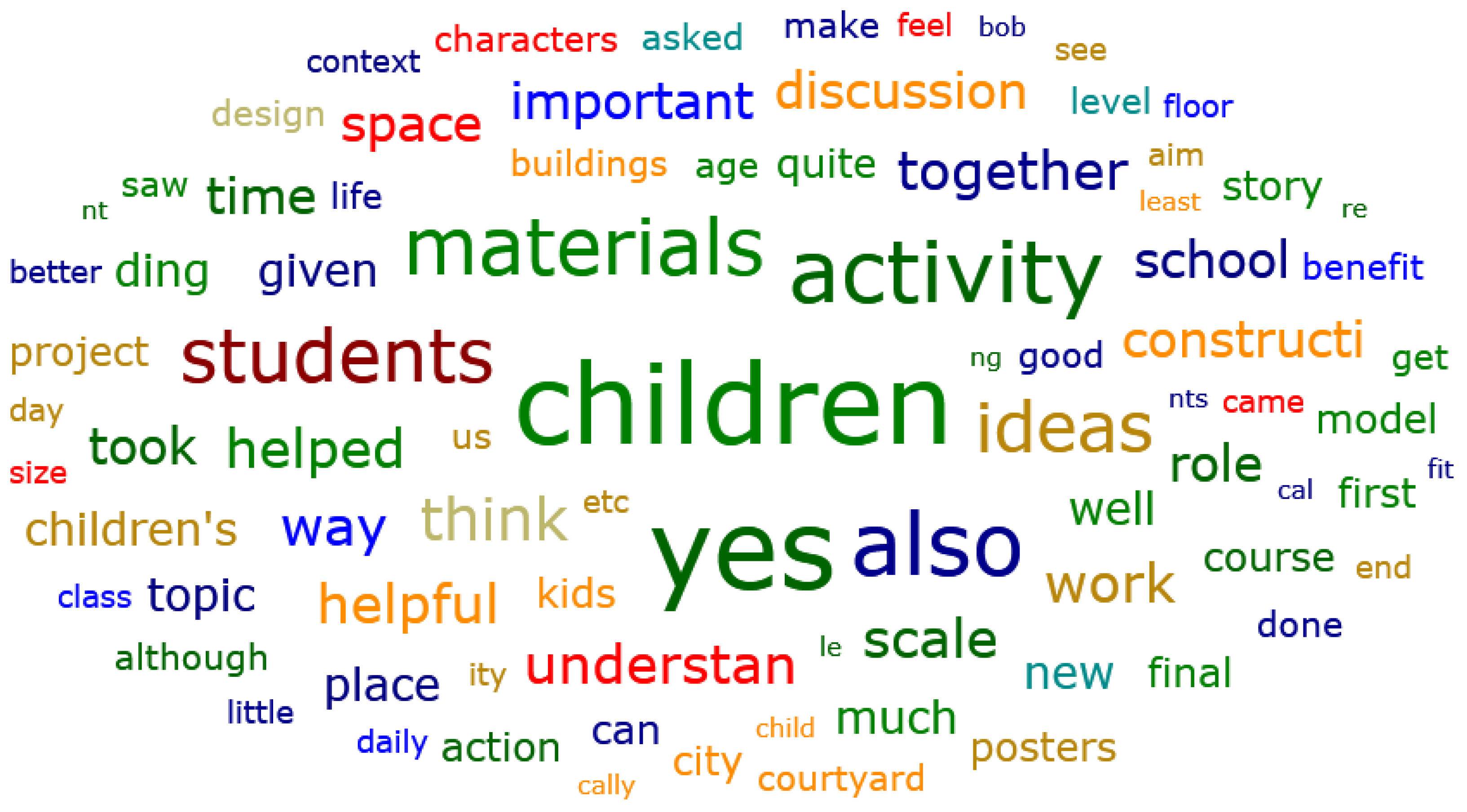
4.2. Feedback: Impact from the Educators on Students
5. Discussion
6. Conclusions
Author Contributions
Funding
Institutional Review Board Statement
Informed Consent Statement
Data Availability Statement
Acknowledgments
Conflicts of Interest
References
- Alali, R., & Yousef, W. (2024). Enhancing student motivation and achievement in science classrooms through STEM education. STEM Education, 4, 82–105. [Google Scholar] [CrossRef]
- Avsec, S., & Jagiełło-Kowalczyk, M. (2021). Investigating possibilities of developing self-directed learning in architecture students using design thinking. Sustainability, 13(8), 4369. [Google Scholar] [CrossRef]
- Bertrand, M. G., & Namukasa, I. K. (2022). A pedagogical model for STEAM education. Journal of Research in Innovative Teaching & Learning, 16(2), 169–191. [Google Scholar] [CrossRef]
- Bosevska, J., & Kriewaldt, J. (2019). Fostering a whole-school approach to sustainability: Learning from one school’s journey towards sustainable education. International Research in Geographical and Environmental Education, 29(1), 55–73. [Google Scholar] [CrossRef]
- Bower, M., Stevenson, M., Forbes, A., Falloon, G., & Hatzigianni, M. (2020). Makerspaces pedagogy–supports and constraints during 3D design and 3D printing activities in primary schools. Educational Media International, 57(1), 1–28. [Google Scholar] [CrossRef]
- Brundiers, K., Barth, M., Cebrián, G., Cohen, M., Diaz, L., Doucette-Remington, S., Dripps, W., Habron, G., Harré, N., Jarchow, M., Losch, K., Michel, J., Mochizuki, Y., Rieckmann, M., Parnell, R., Walker, P., & Zint, M. (2021). Key competencies in sustainability in higher education—Toward an agreed-upon reference framework. Sustainability Science, 16(1), 13–29. [Google Scholar] [CrossRef]
- Castrillón, M. (2019). The balcony (1st ed.). Simon & Schuster Books for Young Readers. [Google Scholar]
- Chawla, L., & Cushing, D. (2007). Education for strategic environmental behaviour. Environmental Education Research, 13(4), 437–452. [Google Scholar] [CrossRef]
- Culén, A. L., & Gasparini, A. A. (2019). STEAM education: Why learn design thinking? In Z. Babaci-Wilhite (Ed.), Promoting language and STEAM as human rights in education: Science, technology, engineering, arts and mathematics (pp. 91–108). Springer. [Google Scholar] [CrossRef]
- Doran, P., Tsourlidaki, E., Mentxaka, I., Vicente, T., Gomes, M., & Doran, R. (2021). Thinking in STEAM education: A legacy from the islands diversity for science education project. Ellinogermaniki Agogi. [Google Scholar]
- Ernst, J., & Burcak, F. (2019). Young children’s contributions to sustainability: The influence of nature play on curiosity, executive function skills, creative thinking, and resilience. Sustainability, 11(15), 4212. [Google Scholar] [CrossRef]
- European Commission. (2022). GreenComp: The European sustainability competence framework. Available online: https://joint-research-centre.ec.europa.eu/greencomp-european-sustainability-competence-framework_en (accessed on 17 September 2025).
- Francis, M., & Lorenzo, R. (2002). Seven realms of children’s participation. Journal of Environmental Psychology, 22(1), 157–169. [Google Scholar] [CrossRef]
- Geitz, G., & de Geus, J. (2019). Design-based education, sustainable teaching, and learning. Cogent Education, 6(1), 1647919. [Google Scholar] [CrossRef]
- Green, M., & Somerville, M. (2015). Sustainability education: Researching practice in primary schools. Environmental Education Research, 21(6), 832–845. [Google Scholar] [CrossRef]
- Hart, R. A. (2013). Children’s participation: The theory and practice of involving young citizens in community development and environmental care. Routledge. [Google Scholar] [CrossRef]
- Hofman-Bergholm, M. (2022). Storytelling as an educational tool in sustainable education. Sustainability, 14(5), 2946. [Google Scholar] [CrossRef]
- Hurley, M., & Roche, J. (2023). RISING strong: Sustainability through art, science, and collective community action. Sustainability, 15(20), 14800. [Google Scholar] [CrossRef]
- Izadpanahi, P., Xu, L., Elkadi, H., & Ang, S. (2012, September 8–20). ‘Kids in Design’: Designing creative schools with children. The 2nd International Conference on Design Creativity (ICDC2012), Glasgow, UK. [Google Scholar]
- Katsenou, C., Flogaitis, E., & Liarakou, G. (2013). Exploring pupil participation within a sustainable school. Cambridge Journal of Education, 43(2), 243–258. [Google Scholar] [CrossRef]
- Kokkinaki, K., & Georgiadou, Z. (2024). Children as the designers of their everyday life. Integrating design thinking in primary education. European Journal of Education Studies, 11. [Google Scholar] [CrossRef]
- Koskela, I.-M., & Paloniemi, R. (2023). Learning and agency for sustainability transformations: Building on Bandura’s theory of human agency. Environmental Education Research, 29(1), 164–178. [Google Scholar] [CrossRef]
- Lefkeli, S., Manolas, E., Ioannou, K., & Tsantopoulos, G. (2018). Socio-cultural impact of energy saving: Studying the behaviour of elementary school students in Greece. Sustainability, 10(3), 737. [Google Scholar] [CrossRef]
- Lozanovska, M., & Xu, L. (2013). Children and university architecture students working together: A pedagogical model of children’s participation in architectural design. CoDesign, 9(4), 209–229. [Google Scholar] [CrossRef]
- Lundy, L. (2007). ‘Voice’ is not enough: Conceptualising article 12 of the United Nations convention on the rights of the child. British Educational Research Journal, 33(6), 927–942. [Google Scholar] [CrossRef]
- Manna, V., Rombach, M., Dean, D., & Rennie, H. G. (2022). A design thinking approach to teaching sustainability. Journal of Marketing Education, 44(3), 362–374. [Google Scholar] [CrossRef]
- Mercer, N. (2010). The analysis of classroom talk: Methods and methodologies. The British Journal of Educational Psychology, 80, 1–14. [Google Scholar] [CrossRef]
- Million, A., Parnell, R., & Coelen, T. (2018). Editorial: Policy, practice and research in built environment education. Proceedings of the Institution of Civil Engineers—Urban Design and Planning, 171(1), 1–4. [Google Scholar] [CrossRef]
- Morlacci, J. L. (2020). The role of built environment education programs in environmental education [Master’s thesis, Royal Roads University (Canada)]. [Google Scholar] [CrossRef]
- Opoku, A., Ekung, S., Kugblenu, G., & Mushtaha, E. S. N. (2024). Chapter 10: Education for sustainable development, the built environment, and the sustainable development goals. In The Elgar companion to the built environment and the sustainable development goals. Edward Elgar Publishing. Available online: https://www.elgaronline.com/edcollchap/book/9781035300037/book-part-9781035300037-19.xml (accessed on 15 September 2025).
- Perales, F. J., & Aróstegui, J. L. (2024). The STEAM approach: Implementation and educational, social and economic consequences. Arts Education Policy Review, 125(2), 59–67. [Google Scholar] [CrossRef]
- Pierandrei, F., & Marengoni, E. (2017). Design culture in school. Experiences of design workshops with children. The Design Journal, 20(Suppl. S1), S915–S926. [Google Scholar] [CrossRef]
- Poje, M., Marinić, I., Stanisavljević, A., & Dika, I. R. (2024). Environmental education on sustainable principles in kindergartens—A foundation or an option? Sustainability, 16(7), 2707. [Google Scholar] [CrossRef]
- Pöllänen, S. H. (2011). Beyond craft and art: A pedagogical model for craft as self-expression. International Journal of Education Through Art, 7(2), 111–125. [Google Scholar] [CrossRef] [PubMed]
- Punzalan, C. H., & Balanac, L. M. (2020). Students’ participation in tree planting activity: Promoting the 21st century environmental education. Journal of Sustainability Education, 24. Available online: https://www.susted.com/wordpress/content/students-participation-in-tree-planting-activity-promoting-the-21st-century-environmental-education_2020_12/ (accessed on 28 October 2025).
- Ramani, G. B., & Brownell, C. A. (2014). Preschoolers’ cooperative problem solving: Integrating play and problem solving. Journal of Early Childhood Research, 12(1), 92–108. [Google Scholar] [CrossRef]
- Rigolon, A. (2012). A greener future: The active role of place in enhancing ecoliteracy in children. Journal of Architectural and Planning Research, 29(3), 181–203. [Google Scholar]
- Sass, W., Pauw, J. B., Olsson, D., Gericke, N., De Maeyer, S., & Van Petegem, P. (2020). Redefining action competence: The case of sustainable development. The Journal of Environmental Education, 51(4), 292–305. [Google Scholar] [CrossRef]
- Stavridi, S. (2015). The role of interactive visual art learning in development of young children’s creativity. Creative Education, 6(21), 2274–2282. [Google Scholar] [CrossRef]
- Thakur, A., & Kumar, A. (2024). Community engagement and education for eco-conscious health. In P. K. Prabhakar, & W. Leal Filho (Eds.), Preserving health, preserving earth: The path to sustainable healthcare (pp. 81–102). Springer Nature. [Google Scholar] [CrossRef]
- Torsdottir, A. E., Olsson, D., Sinnes, A. T., & Wals, A. (2024). The relationship between student participation and students’ self-perceived action competence for sustainability in a whole school approach. Environmental Education Research, 30(8), 1308–1326. [Google Scholar] [CrossRef]
- UNESCO. (n.d.). Education for sustainable development. Available online: https://www.unesco.org/en/sustainable-development/education (accessed on 17 September 2025).
- UNESCO. (2020). Education for sustainable development: A roadmap. UNESCO Bibliothèque Numérique. Available online: https://unesdoc.unesco.org/ark:/48223/pf0000374802.locale=fr (accessed on 29 May 2025).
- UNESCO & MECCE. (2024). Education and climate change: Learning to act for people and planet. UNESCO & Monitoring and Sustainability Education Research Institute. Available online: https://unesdoc.unesco.org/ark:/48223/pf0000389801 (accessed on 29 May 2025).
- UNESCO Digital Library. (2016). Education 2030: Incheon declaration and framework for action for the implementation of sustainable development goal 4: Ensure inclusive and equitable quality education and promote lifelong learning opportunities for all. Available online: https://unesdoc.unesco.org/ark:/48223/pf0000245656 (accessed on 17 September 2025).
- Vesterinen, M., & Ratinen, I. (2024). Sustainability competences in primary school education—A systematic literature review. Environmental Education Research, 30(1), 56–67. [Google Scholar] [CrossRef]
- Wake, S. J. (2011, November 17–19). Using principles of education to drive practice in sustainable architectural co-design with children. ANZAScA. 45th Annual Conference of the Architectural Science Association, Sydney, Australia. Available online: https://archscience.org/paper/using-principles-of-education-to-drive-practice-in-sustainable-architectural-co-design-with-children/ (accessed on 29 May 2025).
- Wake, S. J., & Eames, C. (2013). Developing an ‘ecology of learning’ within a school sustainability co-design project with children in New Zealand. Local Environment, 18(3), 305–322. [Google Scholar] [CrossRef]
- Wiek, A., Withycombe, L., & Redman, C. L. (2011). Key competencies in sustainability: A reference framework for academic program development. Sustainability Science, 6(2), 203–218. [Google Scholar] [CrossRef]
- Xu, L., & Izadpanahi, P. (2016). Creative architectural design with children: A collaborative design project informed by Rhodes’s theory. International Journal of Design Creativity and Innovation, 4(3–4), 234–256. [Google Scholar] [CrossRef]
- Zachariou, A., & Symeou, L. (2009). The local community as a means for promoting education for sustainable development. Applied Environmental Education & Communication, 7(4), 129–143. [Google Scholar] [CrossRef]




| Strengths | Weaknesses | |
|---|---|---|
| Case Study 1 STEAM and Design Thinking |
|
|
| Case Study 2 Storytelling and Crafts |
|
|
| Case Study 3 Artistic Installation |
|
|
| Relation of the Participants | Introduction Tools | Inspiration Tools | Representation Methods | People—Participants | Project Assigned | Expected Design Results | General Results | |
|---|---|---|---|---|---|---|---|---|
| Case Study 1: STEAM and Design Thinking | Classmates | STEAM introduction | Brainstorming from paradigms | 2D concept diagram; 3D modeling of a schoolyard | Small groups of children with one educator | Redesign their own schoolyard | Space suggestions | Understanding space Growth of children’s spatial, emotional, and interpersonal intelligence. Comprehension of human society’s impact on natural and urban surroundings. Exposure to the idea of both individual and group accountability. Project creation and completion. Interaction between kids and guests in the activity area |
| Case Study 2: Storytelling and Crafts | Non-acquaintant group | Team building | Storytelling—heroes | 2D creations on building façade elevations | a. Central educator; b. small groups of children with one educator | Design the streetscape of their neighborhood | Street design suggestions | |
| Case Study 3: Artistic Installation | Non-acquaintant group | Team building | Inspiration from the work of an artist | Art installation—urban clothing | a. Central educator; b. small groups of children with one educator | Design a street artifact that could be integrated into any surrounding | Artifact |
| Criteria | Case Study 1: STEAM and Design Thinking | Case Study 2: Storytelling and Crafts | Case Study 3: Artistic Installation |
|---|---|---|---|
| Introduction Tools | STEAM framework, brainstorming | Storytelling, visual narratives | Artistic inspiration, team discussion |
| Inspiration Sources | Real-world sustainability examples | Children’s books and illustrations | Contemporary eco-art installations |
| Representation Methods | 2D diagrams, 3D models | Façade redesign, paper crafts | Public space installation |
| Participants | Small groups with one educator | Mixed-age groups with structured guidance | Rotating groups with collective input |
| Expected Outcomes | Improved spatial awareness, creative problem solving | Awareness of urban greenery, hands-on design experience | Understanding of urban energy use, teamwork skills |
| General Impact | Increased accountability and environmental awareness | Fostered creativity and community engagement | Strengthened ecological consciousness and artistic expression |
| Key Takeaway | Description |
|---|---|
| 1. Tailored Pedagogical Approaches | Educators should select teaching methods suited to specific learning goals—using STEAM for analytical thinking, storytelling for conceptual understanding, and artistic installations for experiential learning. |
| 2. Multidisciplinary Collaboration | Collaboration between university and primary students promotes reciprocal learning, enhances teaching and communication skills, and deepens understanding of sustainability concepts. |
| 3. Community Engagement | Linking classroom activities to local sustainability challenges helps students apply knowledge in real contexts, strengthening civic responsibility and awareness of environmental issues. |
| 4. Scalability and Adaptation | Incorporating digital and hybrid approaches expands the reach and accessibility of sustainable design education, ensuring broader community impact. |
Disclaimer/Publisher’s Note: The statements, opinions and data contained in all publications are solely those of the individual author(s) and contributor(s) and not of MDPI and/or the editor(s). MDPI and/or the editor(s) disclaim responsibility for any injury to people or property resulting from any ideas, methods, instructions or products referred to in the content. |
© 2025 by the authors. Licensee MDPI, Basel, Switzerland. This article is an open access article distributed under the terms and conditions of the Creative Commons Attribution (CC BY) license (https://creativecommons.org/licenses/by/4.0/).
Share and Cite
Sinou, M.; Tousi, E.; Kanetaki, Z.; Kourniatis, N.; Kalessopoulou, D.; Timotheou, K.; Martha, L. Advancing Sustainable Design Education: University-Led Initiatives in Engaging Primary School Students and Empowering Communities. Educ. Sci. 2025, 15, 1609. https://doi.org/10.3390/educsci15121609
Sinou M, Tousi E, Kanetaki Z, Kourniatis N, Kalessopoulou D, Timotheou K, Martha L. Advancing Sustainable Design Education: University-Led Initiatives in Engaging Primary School Students and Empowering Communities. Education Sciences. 2025; 15(12):1609. https://doi.org/10.3390/educsci15121609
Chicago/Turabian StyleSinou, Maria, Evgenia Tousi, Zoe Kanetaki, Nikos Kourniatis, Despina Kalessopoulou, Katerina Timotheou, and Loukia Martha. 2025. "Advancing Sustainable Design Education: University-Led Initiatives in Engaging Primary School Students and Empowering Communities" Education Sciences 15, no. 12: 1609. https://doi.org/10.3390/educsci15121609
APA StyleSinou, M., Tousi, E., Kanetaki, Z., Kourniatis, N., Kalessopoulou, D., Timotheou, K., & Martha, L. (2025). Advancing Sustainable Design Education: University-Led Initiatives in Engaging Primary School Students and Empowering Communities. Education Sciences, 15(12), 1609. https://doi.org/10.3390/educsci15121609