Changing Structures of Attention When Learning About Decimal Fractions with Digital Tools


Abstract
1. Introduction
1.1. Conceptual Understanding of Decimal Fractions
1.2. Mathematics Representations
2. Theoretical Frameworks
2.1. Constructivist Theory
2.2. Representation Theory
2.3. Shifts of Attention Theory
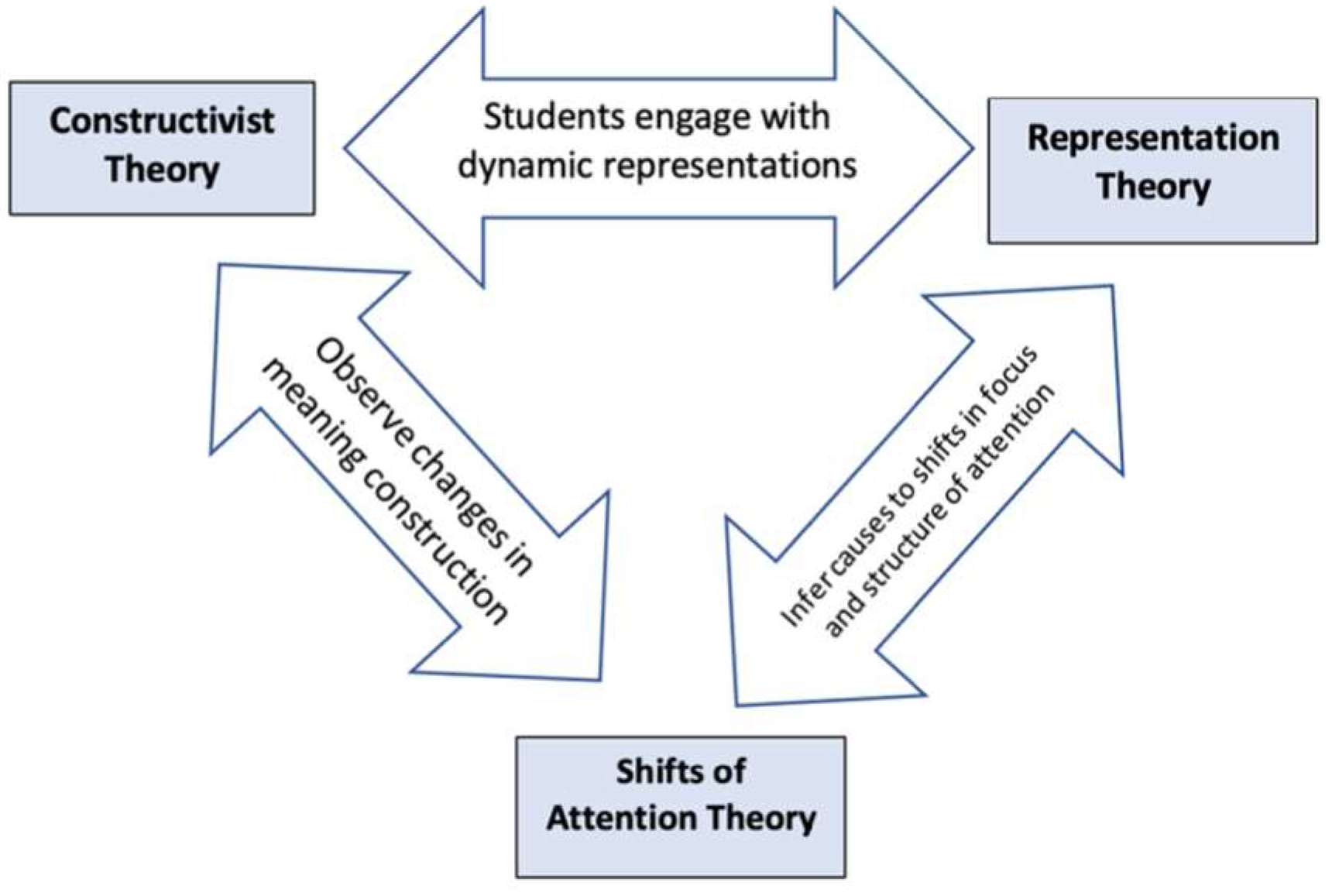
2.4. The Relationship Between the Theories
3. Materials and Methods
3.1. Task-Based Interviews Overview
3.2. Task Design
3.3. Participants and Interview Procedure
3.4. Procedure and Data Collection
- An initial decimal comparison pre-test;
- Four individual task-based interviews each focussing on a different dynamic digital representation.
3.4.1. Pre-Test
3.4.2. Task-Based Interviews
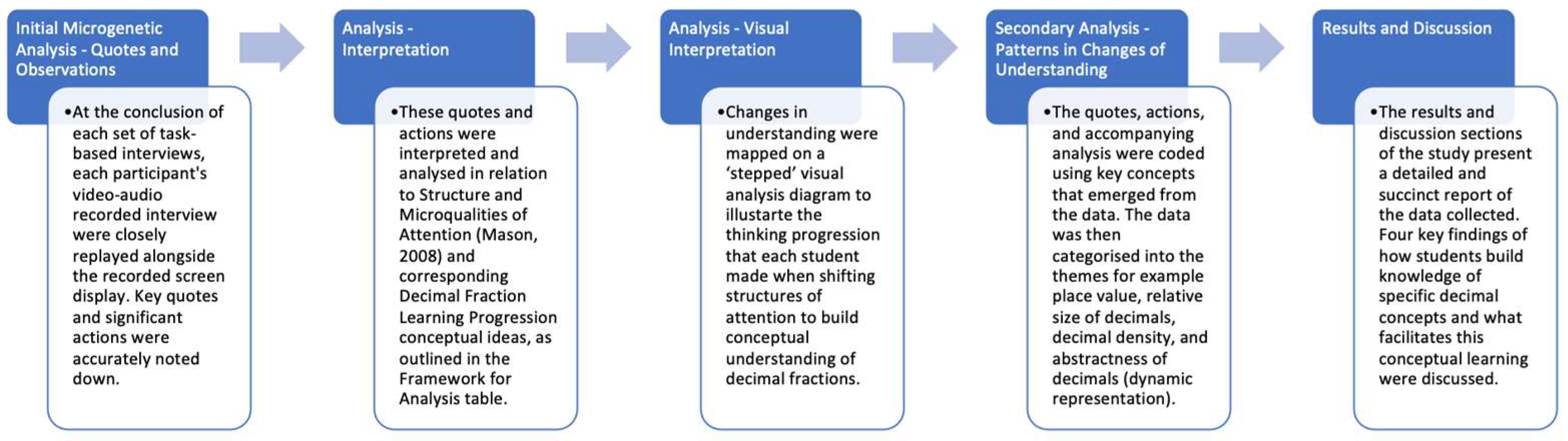
3.5. Microgenetic Analysis
4. Results
4.1. Finding One: Students Demonstrated a Change in Understanding Related to Decimal Density Through Noticing the Dynamic Display of Continuous Decimal Place Values on the Zoomable Number Line
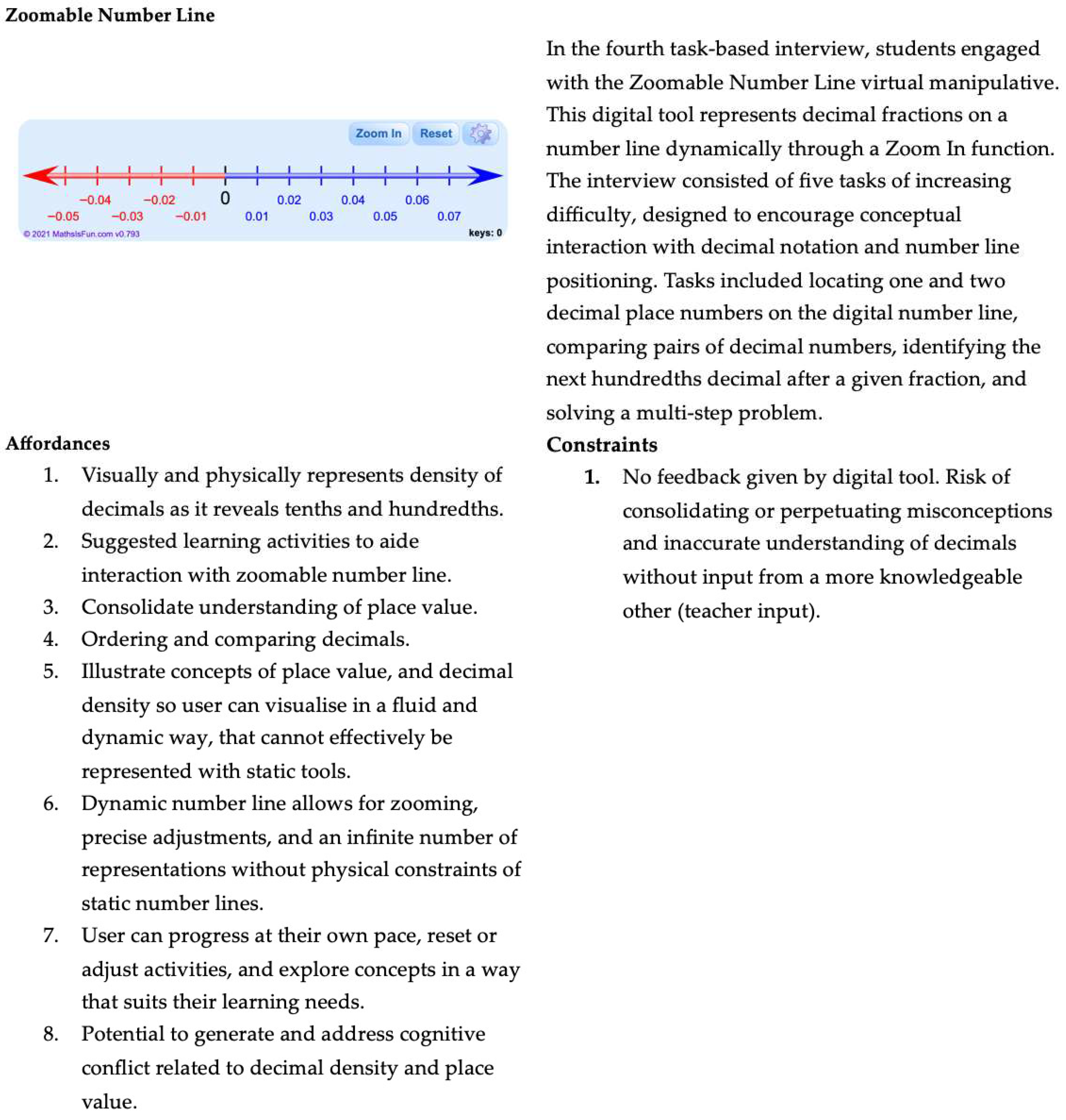
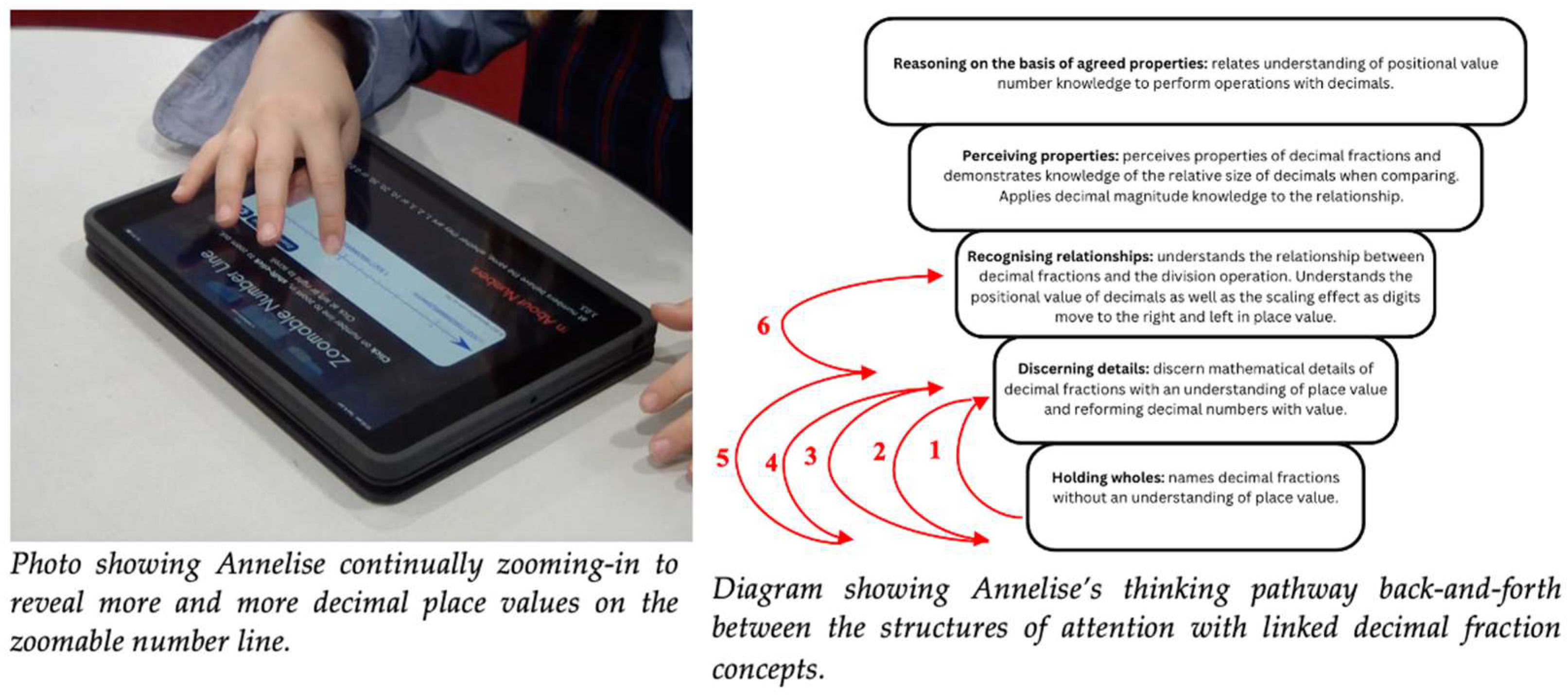
Annelise: [Held down zoom-in function to continually reveal more and more decimal place values] Oh wow… there are so many numbers.Interviewer: How many numbers are after the decimal point?Annelise: Six.Interviewer: What do you think is the maximum number of decimals there are after a decimal point?Annelise: Maybe 10 [held down zoom-in function to continually reveal more and more decimal place values] I just counted 12 numbers after…maybe it stops at 20” [held down zoom-in function to continually reveal more and more decimal place values] “I don’t think it will stop.Interviewer: Why don’t you think it will stop.Annelise: Because there are infinite numbers.
4.2. Finding Two: Students’ Knowledge of Decimal Magnitude and Decimal Place Value Determined Their Success with Decimal Comparison Tasks and How They Used Decimal Strips
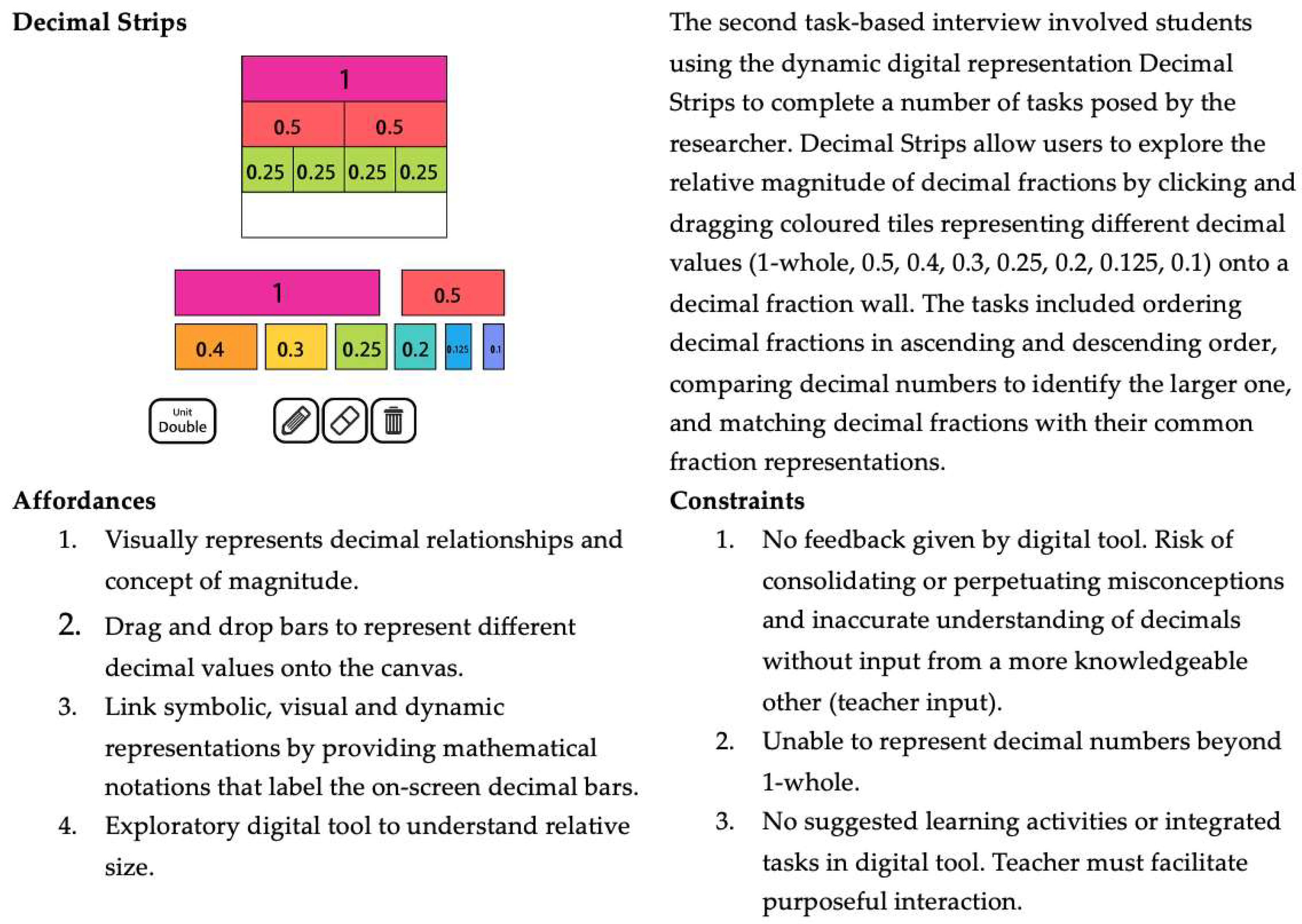
Interviewer: “Which decimal in this pair is larger?” [Presented card with 0.2 and 0.25 decimals].Annelise: “This is what I was looking at before. I’m not sure I’ll have to check.” [Dragged aqua 0.2 strip, and green 0.25 strip onto two blank fraction wall rows]. “They are very close but this one [pointed to green 0.25 strip] is the biggest.”Interviewer: “Why do you think they are so close in value?”Annelise: “Maybe the zero-point-two has something else on it you just can’t see it.”Interviewer: “What would be on the end?”Annelise: “It could be twenty-something and then this one [pointed to yellow 0.3 strip at bottom of screen display] could be thirty-something.”
4.3. Finding Three: Relating Decimal Fractions with the Division Operation Was Prompted by Student Interaction with Zooming in on Place Value as Well as the Zoomable Number Line, and Positioned Students to Understand the Relative Magnitudes of Rational Numbers
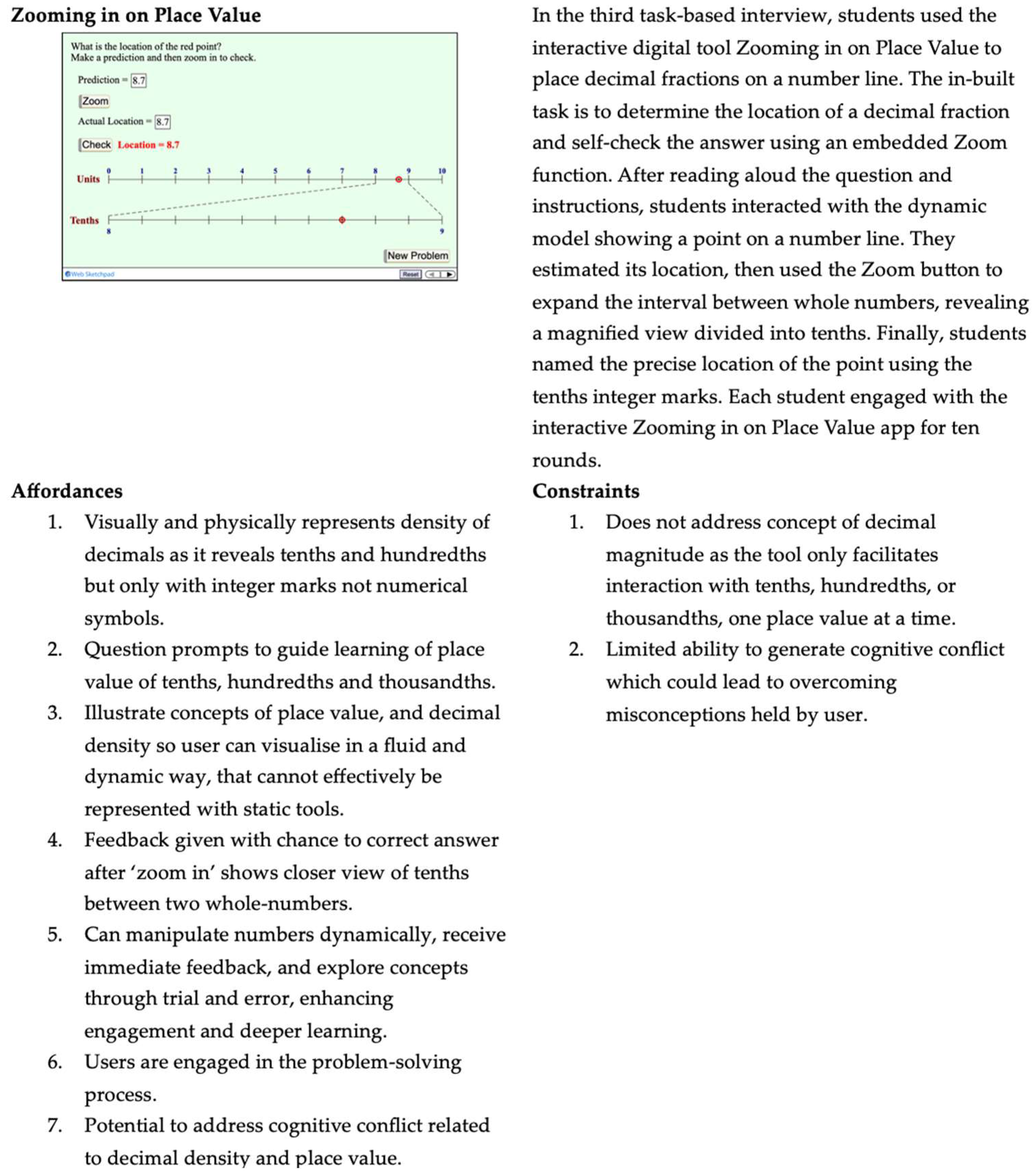
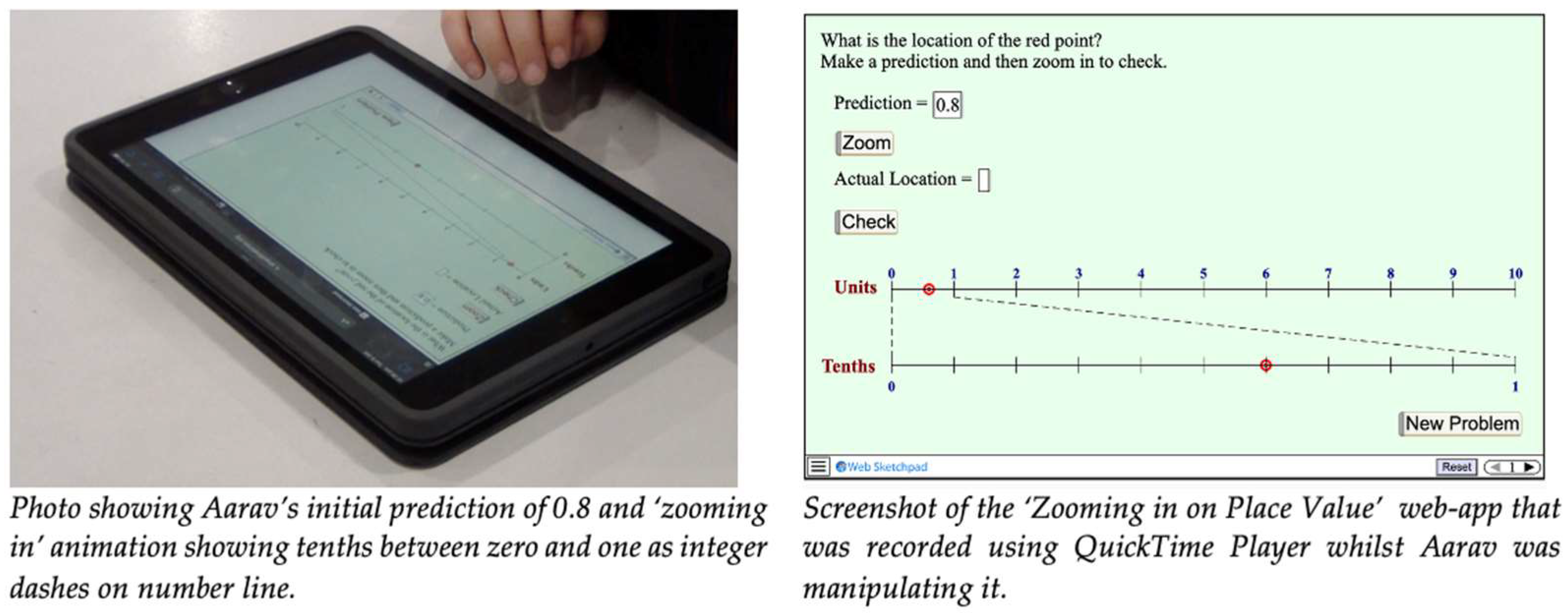
Aarav: I think the dot is three away from one… so zero point eight. [Typed the predicted location in and watched the ‘zooming in’ animation reveal the location between zero and one with tenths integers marked as dashes on the number line].Aarav: It’s actually zero point six.Interviewer: How do you know that is the answer?Aarav: Because I counted along zero point one, zero point two, zero point three, zero point four, zero point five, and zero point six.Interviewer: What is the second number line showing?Aarav: Oh, I understand it’s showing the number after the decimal point, the tenths.Interviewer: Did the zoomed-in number line help you answer the question?Aarav: Yes, seeing the closer numbers on the number line helped me, I could see exactly where the decimal was with it zoomed in and it was easier.
4.4. Finding Four: Discovering Decimal Magnitude with Tenths and Hundredths Required an Understanding of Reforming Decimal Numbers with Value, as Dynamically Displayed in Wishball-Hundredths
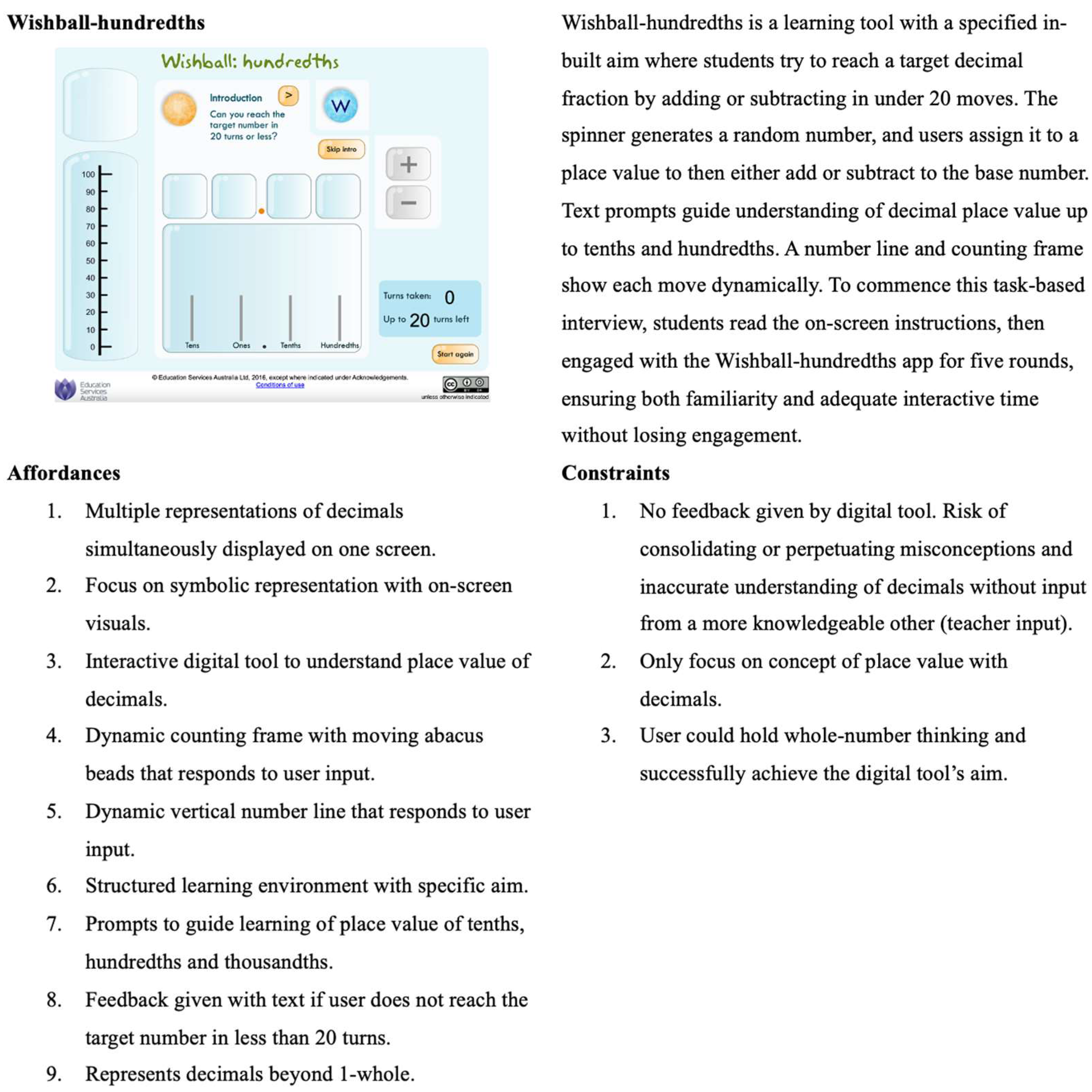
Aarav: I don’t know what to do with this number because if I minus for any of them [place value digits] it will automatically be zero but if I plus then it is going to be too high… okay I am going to risk it and add it to one to make it ten and then I’ll subtract on the next spin.[Screen displayed 60.45 as the new starting number whilst the dynamic counting frame simultaneously carried over 10-ones to the tens place value].Aarav: I understand it now… because I added nine-ones to make ten-ones in total so it had to jump over to the tens place value.[Screen displayed next spinner number was 8 alongside the current starting number 60.45].Aarav: I could add it here [gestured to the 4-tenths place value] which would give one to this number [gestured to ones place value] and then it would be closer to two [the target ones digit].Interviewer: Is the counting frame helping you?Aarav: Yes, I can see how many I need to add or minus to each number.
5. Discussion
5.1. Structures of Attention and Changing Conceptual Understanding
5.2. Provoking Productive Cognitive Confusion
5.3. Abstractness of Decimal Fractions
5.4. Practical Implications for Classroom Practice
5.5. Limitations and Implications for Further Research
6. Conclusions
Author Contributions
Funding
Institutional Review Board Statement
Informed Consent Statement
Data Availability Statement
Conflicts of Interest
References
- Assad, D. A. (2015). Task-based interviews in mathematics: Understanding student strategies and representations through problem solving. International Journal of Education and Social Science, 2(1), 17–26. [Google Scholar]
- Attard, C., Ingram, N., Forgasz, H., Leder, G., & Grootenboer, P. (2016). Mathematics education and the affective domain. In K. Makar, S. Dole, J. Visnovska, M. Goos, A. Bennison, & K. Fry (Eds.), Research in mathematics education in Australasia 2012–2015 (pp. 73–96). Springer. [Google Scholar]
- Australian Curriculum, Assessment and Reporting Authority (ACARA). (2020). National numeracy learning progression. Available online: https://v8.australiancurriculum.edu.au/resources/national-literacy-and-numeracy-learning-progressions/national-numeracy-learning-progression/ (accessed on 6 May 2023).
- Bobis, J. (2011). Fractions: Best evidence and its implications for practice. In J. Way, & J. Bobis (Eds.), Fractions: Teaching for understanding (pp. 11–20). Australian Association of Mathematics Teachers. [Google Scholar]
- Bruner, J. (1986). Play, thought and language. Prospects: Quarterly Review of Education, 16(1), 77–83. [Google Scholar] [CrossRef]
- Caldwell, J. (2020). Developing conceptual understanding: The case of place value. Savvas Learning Company. [Google Scholar]
- Chinn, C. A. (2006). The microgenetic method: Current work and extensions to classroom research. In J. L. Green, G. Camilli, & P. B. Elmore (Eds.), Handbook of complementary methods in education research (pp. 439–456). Lawrence Erlbaum Associates. [Google Scholar]
- Chinn, C. A., & Sherin, B. L. (2014). Microgenetic methods. In R. K. Sawyer (Ed.), The Cambridge handbook of the learning sciences (pp. 171–190). Cambridge University Press. [Google Scholar]
- Clements, D. H., & Sarama, J. (2004). Learning trajectories in mathematics education. Mathematical Thinking and Learning, 6(2), 81–89. [Google Scholar] [CrossRef]
- Cobb, P., Yackel, E., & Wood, T. (1992). A constructivist alternative to the representational view of mind in mathematics education. Journal for Research in Mathematics Education, 23(1), 2–33. [Google Scholar] [CrossRef]
- DeWolf, M., Bassok, M., & Holyoak, K. J. (2016). A set for relational reasoning: Facilitation of algebraic modeling by a fraction task. Journal of Experimental Child Psychology, 152, 351–366. [Google Scholar] [CrossRef] [PubMed]
- diSessa, A. A. (2017). Conceptual change in a microcosm: Comparative analysis of a learning event. Human Development, 60(1), 1–37. [Google Scholar] [CrossRef]
- Duval, R. (2006). A cognitive analysis of problems of comprehension in a learning of mathematics. Educational Studies in Mathematics, 61(1–2), 103–131. [Google Scholar] [CrossRef]
- Ginsburg, H. (1997). Entering the child’s mind: The clinical interview in psychological research and practice. Cambridge University Press. [Google Scholar]
- Ginsburg, H. P. (2009). The challenge of formative assessment in mathematics education: Children’s minds, teachers’ minds. Human Development, 52, 109–128. [Google Scholar] [CrossRef]
- Goldin, G. (1993). Observing mathematical problem solving: Perspectives on structured, task-based interviews. In B. Atweh, C. Kanes, M. Carss, & G. Booker (Eds.), Proceedings of sixteenth annual conference of the mathematics education research group of Australasia (pp. 303–309). MERGA. [Google Scholar]
- Goldin, G., & Shteingold, N. (2001). Systems of representations and the development of mathematical concepts. In A. A. Cuoco, & F. R. Curcio (Eds.), The roles of representation in school mathematics (Vol. 2001 Yearbook, pp. 1–23). National Council of Teachers of Mathematics. [Google Scholar]
- Goldin, G. A. (2000). A scientific perspective on structures, task-based interviews in mathematics education research. In R. Lesh, & A. E. Kelly (Eds.), Research design in mathematics and science education (pp. 517–545). Erlbaum Hillsdale. [Google Scholar]
- Goldin, G. A. (2003). Representation in school mathematics: A unifying research perspective. In J. Kilpatrick, W. G. Martin, & D. Schifter (Eds.), A research companion to principles and standards for school mathematics (pp. 275–285). The National Council of Teachers of Mathematics. [Google Scholar]
- Gorman, A., & Way, J. (2018). Zooming in on decimals. In J. Hunter, P. Perger, & L. Darragh (Eds.), Making waves, opening spaces (Proceedings of the 41st annual conference of the mathematics education research group of Australasia) (pp. 337–344). MERGA. [Google Scholar]
- Hiebert, J., & Carpenter, T. P. (1992). Learning and teaching with understanding. In D. A. Grouws (Ed.), Handbook of research on mathematics teaching and learning (pp. 65–97). Mcmillan. [Google Scholar]
- Hiebert, J., & Wearne, D. (1985). A model of students’ decimal computation procedures. Cognition and Instruction, 2(4), 175–205. [Google Scholar] [CrossRef]
- Hoyles, C., & Noss, R. (2003). What can digital technologies take from and bring to research in mathematics education? In A. J. Bishop, M. A. Clements, C. Keitel, J. Kilpatrick, & F. K. S. Leullg (Eds.), Second international handbook of mathematics education (pp. 23–349). Kluwer Academic Publishers. [Google Scholar]
- Hunting, R. (1997). Clinical interview methods in mathematics education research and practice. The Journal of Mathematical Behavior, 16(2), 145–165. [Google Scholar] [CrossRef]
- Kame’enui, E., & Simmons, D. (1990). Designing instructional strategies: The prevention of academic learning problems. Merrill. [Google Scholar]
- Katic, E., Hmelo-Silver, C. E., & Weber, K. (2009). Material mediation: Tools and representations supporting collaborative problem-solving discourse. International Journal of Teaching and Learning in Higher Education, 21(1), 13–24. [Google Scholar]
- Kennedy, M. L. (1986). A rationale. Arithmetic Teacher, 33, 6–7. [Google Scholar] [CrossRef]
- Laborde, C., & Laborde, J. M. (2014). Dynamic and tangible representations in mathematics education. In S. Rezat, M. Hattermann, & A. Peter-Koop (Eds.), Transformation—A fundamental idea of mathematics education (pp. 187–202). Springer. [Google Scholar]
- Lesh, R., Behr, M., & Post, T. (1987). Rational number relations and proportions. In C. Janvier (Ed.), Problems of representation in the teaching and learning of mathematics (pp. 41–58). Lawrence Erlbaum. [Google Scholar]
- Martinie, S. L. (2014). Decimal fractions: An important point. Mathematics Teaching in the Middle School, 19(7), 420–429. [Google Scholar] [CrossRef]
- Marton, F. (1986). Phenomenography—A research approach to investigating different understandings of reality. Journal of Thought, 21(3), 28–49. [Google Scholar]
- Mason, J. (2002). Researching your own practice: The discipline of noticing. Routledge Falmer. [Google Scholar]
- Mason, J. (2008). Being mathematical with and in front of learners. In B. Jaworski, & T. Wood (Eds.), The mathematics teacher educator as a developing professional (pp. 31–55). Sense Publishers. [Google Scholar]
- Mason, J. (2010). Attention and intention in learning about teaching through teaching. In R. Leikin, & R. Zazkis (Eds.), Learning through teaching mathematics. Mathematics teacher education (Vol. 5, pp. 23–47). Springer. [Google Scholar]
- Mason, J., & Johnston-Wilder, S. (2004). Fundamental constructs in mathematics education. Routledge Falmer. [Google Scholar]
- Mishra, P., & Koehler, M. J. (2006). Technological pedagogical content knowledge: A framework for teacher knowledge. Teachers College Record, 108(6), 1017–1054. [Google Scholar] [CrossRef]
- Moloney, K., & Stacey, K. (1997). Changes with age in students’ conceptions of decimal notation. Mathematics Education Research Journal, 9(1), 25–38. [Google Scholar] [CrossRef]
- Moyer, P. S., Bolyard, J. J., & Spikell, M. A. (2002). What are virtual manipulatives? Teaching Children Mathematics, 8(6), 372–377. [Google Scholar] [CrossRef]
- Moyer-Packenham, P. S., & Westenskow, A. (2016). Revisiting the effects and affordances of virtual manipulatives for mathematics learning. Educational Technology & Society, 19(3), 14–26. [Google Scholar]
- National Research Council. (2001). Adding it up: Helping children learn mathematics. National Academies Press.
- NSW Education Standards Authority (NESA). (2012). Mathematics K-10 syllabus. Available online: https://syllabus.nesa.nsw.edu.au/download/ (accessed on 6 May 2023).
- Orrill, C. H., & Polly, D. (2013). Supporting mathematical communication through technology. In D. Polly (Ed.), Common core mathematics standards and implementing digital technologies (pp. 22–36). IGI Global. [Google Scholar]
- Pape, S., & Tchoshanov, M. (2001). The role of representation(s) in developing mathematical understanding. Theory Into Practice, 40(2), 118–127. [Google Scholar] [CrossRef]
- Piaget, J. (1970). Science of education and the psychology of the child. Viking. [Google Scholar]
- Pirie, S., & Kieren, T. E. (1991). Folding back: Dynamics in the growth of mathematical understanding. In F. Furinghetti (Ed.), Proceedings of the 15th annual meeting of the international group for the psychology of mathematics education (Vol. 3, pp. 169–176). Istituto di Matematica, Università di Genova. [Google Scholar]
- Pirie, S., & Kieren, T. E. (1994). Growth in mathematical understanding: How can we characterize it and how can we represent it? Educational Studies in Mathematics, 26(2–3), 165–190. [Google Scholar] [CrossRef]
- Resnick, I., Rinne, L., Barbieri, C., & Jordan, N. C. (2019). Children’s reasoning about decimals and its relation to fraction learning and mathematics achievement. Journal of Educational Psychology, 111(4), 604–618. [Google Scholar] [CrossRef]
- Roschelle, J., Pea, R. D., Hoadley, C. M., Gordin, D. N., & Means, B. (2000). Changing how and what children learn in school with computer-based technologies. The Future of Children, 10(2), 76–101. [Google Scholar] [CrossRef]
- Ruthven, K. (2022). Ergonomic, epistemological and existential challenges of integrating digital tools into school mathematics. Asian Journal for Mathematics Education, 1(1), 7–18. [Google Scholar] [CrossRef]
- Santos-Trigo, M. (2006). On the use of computational tools to promote students’ mathematical thinking. International Journal of Computers for Mathematical Learning, 11(3), 361–376. [Google Scholar] [CrossRef]
- Shahmohammadi, S. (2019). Opportunities and challenges in using dynamic software in mathematics education. International Journal for Infonomics, 12(1), 1834–1840. [Google Scholar] [CrossRef]
- Siegler, R. S. (2006). Microgenetic analyses of learning. In W. Damon, R. M. Lerner, D. Kuhn, & R. S. Siegler (Eds.), Handbook of child psychology: Volume 2: Cognition, perception, and language (6th ed., pp. 464–510). Wiley. [Google Scholar]
- Siegler, R. S., Thompson, C., & Schneider, M. (2011). An integrated theory of whole number and fractions development. Cognitive Psychology, 62(4), 273–296. [Google Scholar] [CrossRef]
- Siemon, D., Beswick, K., Brady, K., Clark, J., Faragher, R., & Warren, E. (2011). Teaching mathematics: Foundations to middle years. Oxford University Press. [Google Scholar]
- Simon, M. (1995). Reconstructing mathematics pedagogy from a constructivist perspective. Journal for Research in Mathematics Education, 26(2), 114–145. [Google Scholar] [CrossRef]
- Skemp, R. (1987). The psychology of learning mathematics. Lawrence Erlbaum Associates. [Google Scholar]
- Stacey, K., & Steinle, V. (2003). Exploring the right, probing questions to uncover decimal misconceptions. In L. Bragg, C. Campbell, G. Herbert, & J. Mousley (Eds.), MERINO—Mathematics education research: Innovation, networking, opportunity, Proceedings of the 26th annual conference of the mathematics education research group of Australasia, Geelong, Australia, 6–10 July 2003 (Vol. 2, pp. 634–641). MERGA. [Google Scholar]
- Steinle, V., & Stacey, K. (2004). A longitudinal study of students’ understanding of decimal notation: An overview and refined results. In I. Putt, R. Faragher, & M. Mclean (Eds.), Mathematics education for the third millennium, towards 2010, Proceedings of the 27th annual conference of the mathematics education research group of Australasia, Townsville, Australia, 27–30 June 2004 (Vol. 2, pp. 541–548). MERGA. [Google Scholar]
- Swan, M. (1983). Teaching decimal place value: A comparative study of “conflict” and “positive only” approaches. Shell Centre for Mathematical Education, Nottingham University. [Google Scholar]
- Teppo, A., & van den Heuvel-Panhuizen, M. (2014). Visual representations as objects of analysis: The number line as an example. ZDM—The International Journal on Mathematics Education, 46(1), 45–58. [Google Scholar] [CrossRef]
- Tian, J., & Siegler, R. S. (2018). Which type of rational numbers should students learn first? Educational Psychology Review, 30, 351–372. [Google Scholar] [CrossRef]
- Tucker, S. I., & Moyer-Packenham, P. S. (2014). Virtual manipulatives’ affordances influence student learning. In S. Oesterle, C. Nicol, P. Liljedahl, & D. Allan (Eds.), Proceedings of the joint meeting of PME 38 and PME-NA 36 (Vol. 6, p. 251). PME. [Google Scholar]
- Tucker, S. I., Moyer-Packenham, P. S., Westenskow, A., & Jordan, K. E. (2016). The complexity of the affordance–ability relationship when second-grade children interact with mathematics virtual manipulative apps. Technology, Knowledge and Learning, 21(3), 341–360. [Google Scholar] [CrossRef]
- von Glasersfeld, E. (1995). Radical constructivism in mathematics education. Kluwer. [Google Scholar]
- Voutsina, C., George, L., & Jones, K. (2019). Microgenetic analysis of young children’s shifts of attention in arithmetic tasks: Underlying dynamics of change in phases of seemingly stable task performance. Educational Studies in Mathematics, 102(1), 47–74. [Google Scholar] [CrossRef]
- Way, J. (2011). Developing fraction sense using digital learning objects. In J. Way, & J. Bobis (Eds.), Fractions: Teaching for understanding (pp. 153–166). Australian Association of Mathematics Teachers. [Google Scholar]
- Wei, S., Lei, Q., Chen, Y., & Xin, Y. P. (2023). The effects of visual cueing on students with and without math learning difficulties in online problem solving: Evidence from eye movement. Behavioral Sciences, 13(11), 927. [Google Scholar] [CrossRef] [PubMed]
- Widjaja, W., Stacey, K., & Steinle, V. (2008). Misconceptions about density of decimals: Insights from Indonesian pre-service teachers’ work. Journal for Science and Mathematics Education in Southeast Asia, 31(2), 117–131. [Google Scholar]



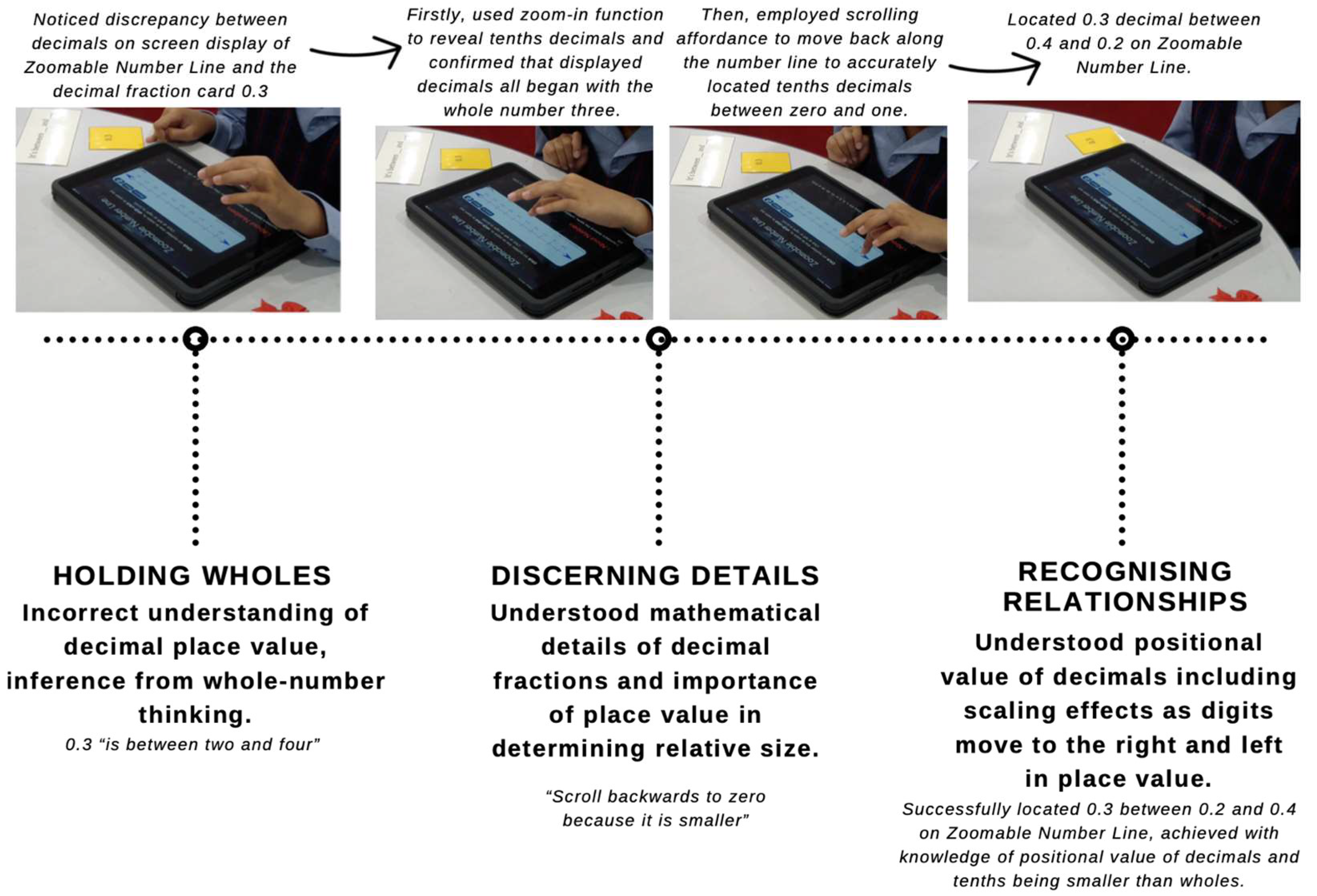
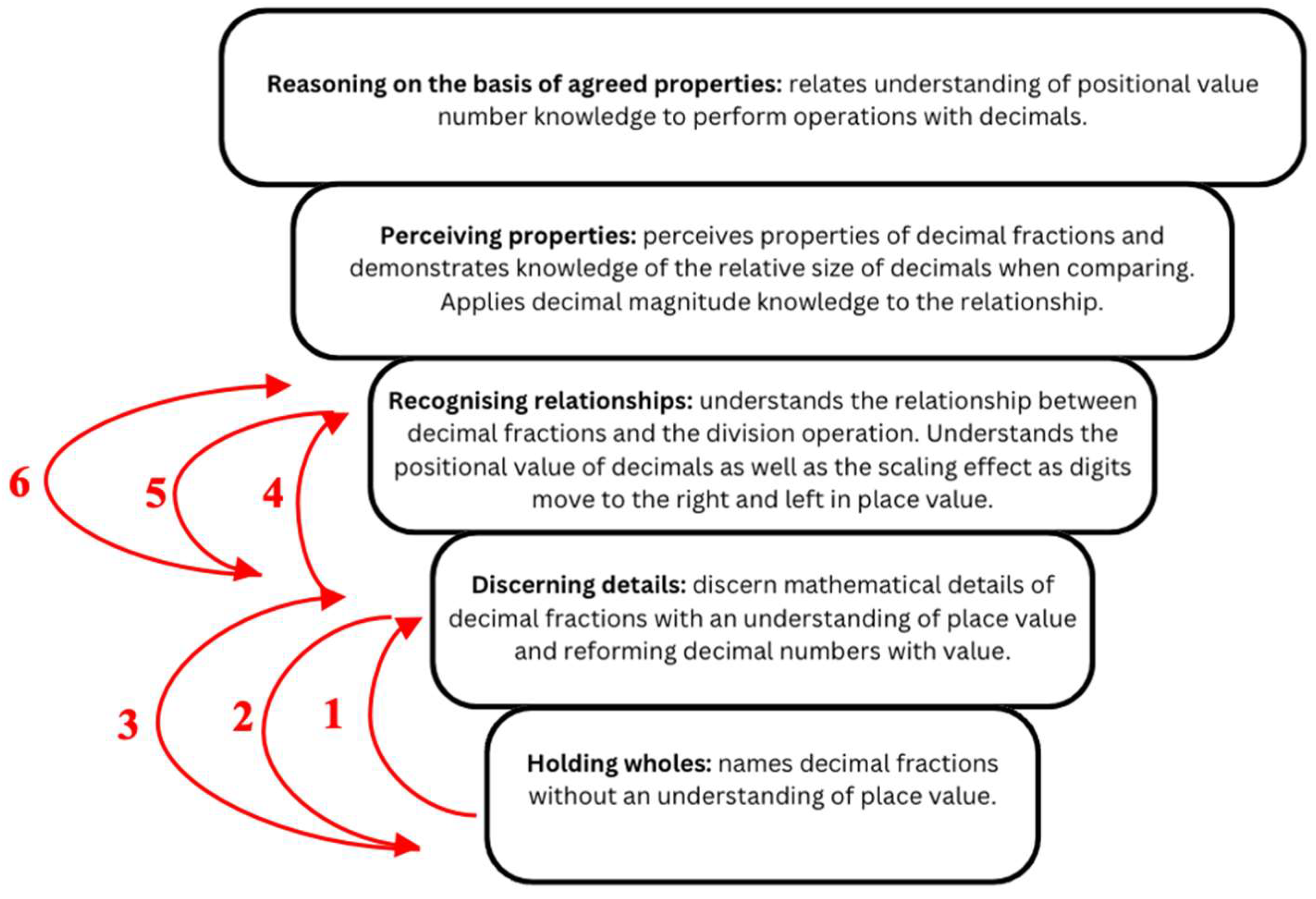
| Structure and Microqualities of Attention (Mason, 2008) | Decimal Fraction Learning Progression (ACARA, 2020) | Connection of Theory of Structures of Attention and Decimal Fraction Learning Progression Points (Researcher’s Own Reasoning) | Key Concept(s) of Decimal Fractions in which Conceptual Change Has Occurred (Researcher’s Own Reasoning) |
|---|---|---|---|
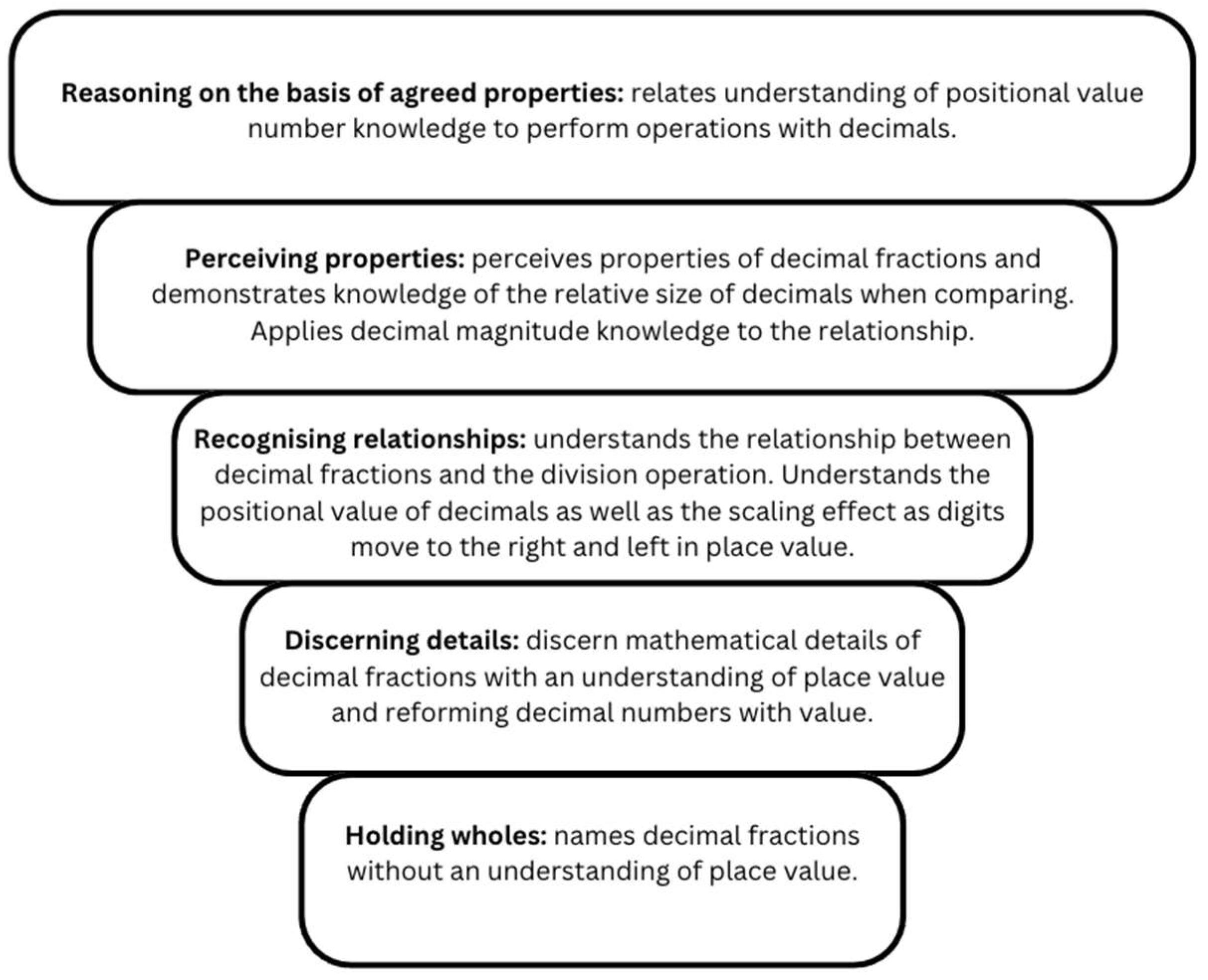
| Holding wholes | Naming decimal fractions. | The student verbally names decimal fractions without an understanding of place value. | Place value |
| Discerning details | State the place value of digits in decimal numbers of up to two decimal places. Use place value to partition decimals of up to two decimal places. | The student can discern mathematical details of decimal fractions with an understanding of place value and reforming decimal numbers with value. | Place value Decimal magnitude |
| Recognising relationships | Understand what a decimal fraction is and recognise that they arise out of division. Model, compare and represent decimals of up to two decimal places. Understanding and estimating relative size of decimals. | The student understands the relationship between decimal fractions and the division operation, as the decimal is parts of a unit resulting from dividing the whole into equal parts. Furthermore, the student understands the positional value of decimals as well as the scaling effect as digits move to the right and left in place value, for example, 3.509 has 35.09 tenths, 350.9 hundredths, 3509 thousandths. | Place value Decimal density |
| Perceiving properties | Place decimals of up to two decimal places on a number line. Apply knowledge of decimals to record measurements, for example, 123 cm = 1.23 m. | The student perceives properties of decimal fractions as they demonstrate knowledge of the relative size of decimals when comparing and applies this knowledge to the relationship with measurement and position when plotting values on a number line. | Decimal magnitude |
| Reasoning on the basis of agreed properties | Flexible strategies for addition, subtraction, multiplication and division of decimals. | The student relates their understanding of positional value number knowledge to perform operations with decimals. | Place value Decimal density |
| Dynamic Digital Representation | Affordances Utilised | Key Changes in Decimal Conceptual Understanding |
|---|---|---|
| Wishball-hundredths | Dynamic counting frame with moving abacus beads that responded to student input. Dynamic vertical number line that reflected student input. Multiple representations of decimals simultaneously displayed on one screen. Symbolic representation of tenths and hundredths decimal place value. On-screen prompts to guide learning of place value of tenths, and hundredths. Feedback given with text if student did not reach the target number in less than 20 turns. | The fluid movement between decimal place values on the dynamic counting frame modelled the reforming of decimal fractions which all students tuned into when they acknowledged that value could be shifted across place values to perform operations and reform the decimal number. The students utilised the vertical number line representation to assist with gauging the relative size of decimals, particularly the scaling effects as digits move to the right and left in place value. Students discerned how the dynamic counting frame featured a visible display of this addition operation principle, in-built constraint on column overflow. |
| Decimal Strips | Drag and drop feature helped dynamically represent decimal relationships and concept of magnitude. Links symbolic, visual and dynamic representations by providing mathematical notations with labelled on-screen decimal strips. | Exploratory digital tool assisted students with understanding relative size of decimals through interactive feature of combining and separating decimal place value strips on a multi-row decimal fraction wall. |
| Zooming in on Place Value | Visually and physically represents density of decimals as the number line zooms-in to reveals tenths and hundredths but only with integer marks not numerical symbols. Feedback given with chance to correct answer after ‘zoom in’ shows closer view of tenths between two whole-numbers. Manipulated numbers dynamically, received immediate feedback, and explored concepts through trial and error, enhancing engagement and deeper learning. | The virtual manipulative illustrates concepts of decimal place value and decimal density. The students came to understand these concepts in a fluid and dynamic way as the tool’s affordances helped them visualise decimal fractions, that cannot effectively be represented with static tools. Potential to address students’ cognitive conflict related to decimal density and place value. |
| Zoomable Number Line | Visually and physically represented density of decimals as it revealed tenths, hundredths, thousandths and beyond. Dynamic number line allowed for zooming, precise adjustments, and an infinite number of representations without physical constraints of static number lines. Scrolling back and forth along the dynamic number line assisted with comparing decimal place values. | Supports students in extending their understanding of decimal place value to tenths, hundredths, thousandths, and beyond. By utilising the zoom-in and zoom-out functions, all students visually explored how the decimal number system is structured around powers of ten. Unlike physical manipulatives, which may be limited to representing only a few decimal places, this digital number line provides a dynamic way for students to see that decimals can always be divided further. Additionally, continuous zooming reinforces the concept of decimal density which resulted in some students making connections to the idea of infinity by recognising that numbers can always be divided into smaller parts without limit, just as they can extend infinitely in the other direction. Potential to generate and address cognitive conflict related to decimal density and place value. |
Disclaimer/Publisher’s Note: The statements, opinions and data contained in all publications are solely those of the individual author(s) and contributor(s) and not of MDPI and/or the editor(s). MDPI and/or the editor(s) disclaim responsibility for any injury to people or property resulting from any ideas, methods, instructions or products referred to in the content. |
© 2025 by the authors. Licensee MDPI, Basel, Switzerland. This article is an open access article distributed under the terms and conditions of the Creative Commons Attribution (CC BY) license (https://creativecommons.org/licenses/by/4.0/).
Share and Cite
Gorman, A.; Way, J.; Bobis, J. Changing Structures of Attention When Learning About Decimal Fractions with Digital Tools. Educ. Sci. 2025, 15, 1453. https://doi.org/10.3390/educsci15111453
Gorman A, Way J, Bobis J. Changing Structures of Attention When Learning About Decimal Fractions with Digital Tools. Education Sciences. 2025; 15(11):1453. https://doi.org/10.3390/educsci15111453
Chicago/Turabian StyleGorman, Amelia, Jennifer Way, and Janette Bobis. 2025. "Changing Structures of Attention When Learning About Decimal Fractions with Digital Tools" Education Sciences 15, no. 11: 1453. https://doi.org/10.3390/educsci15111453
APA StyleGorman, A., Way, J., & Bobis, J. (2025). Changing Structures of Attention When Learning About Decimal Fractions with Digital Tools. Education Sciences, 15(11), 1453. https://doi.org/10.3390/educsci15111453