
Too Loud to Ignore: Knowledge, Attitudes, and Practices Regarding Hearing Protection in Student Musicians and Ensemble Directors


Abstract
1. Introduction
2. Materials and Methods
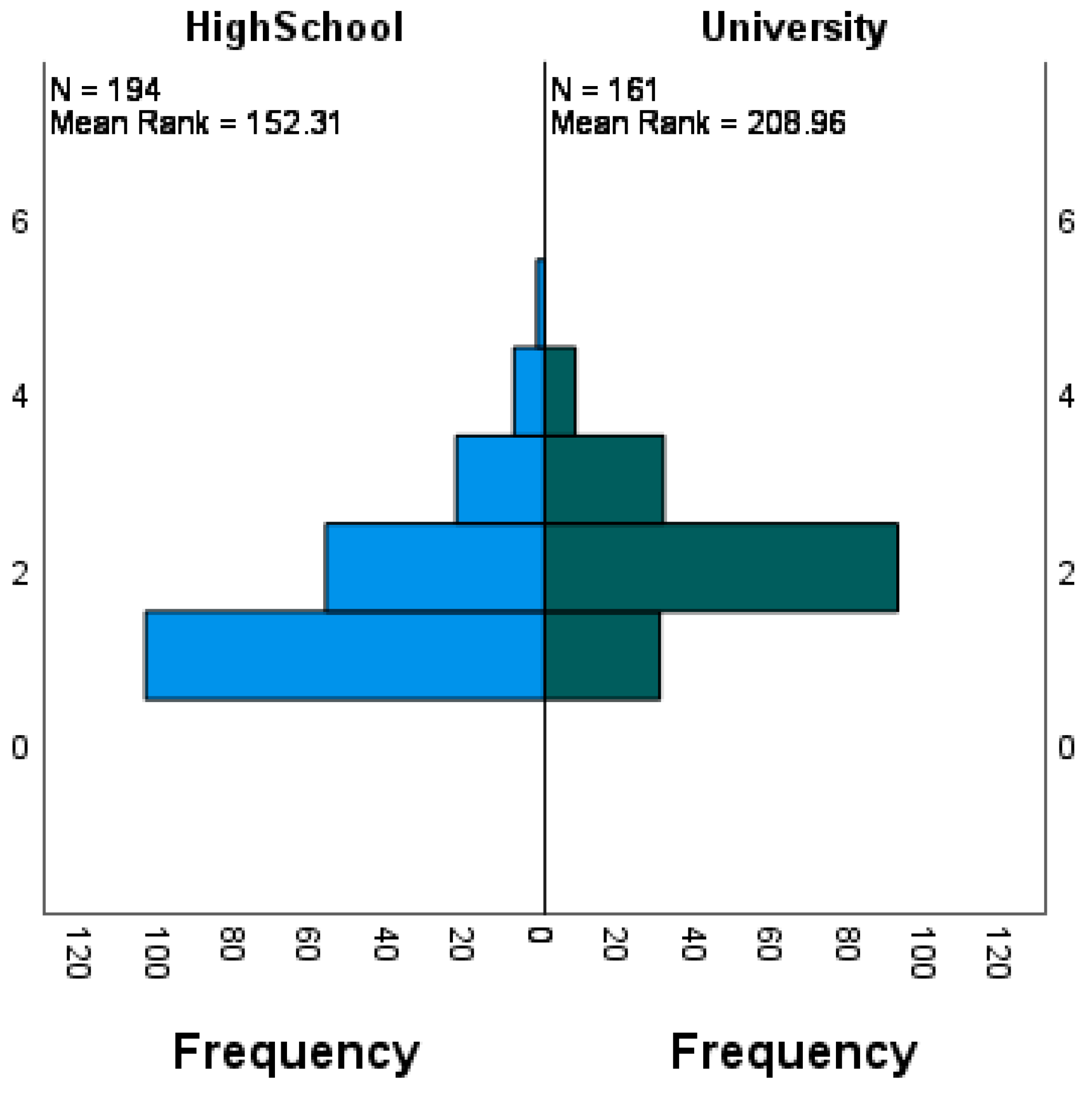
- Is there a significant difference in knowledge of MIHL between high school and university musicians?
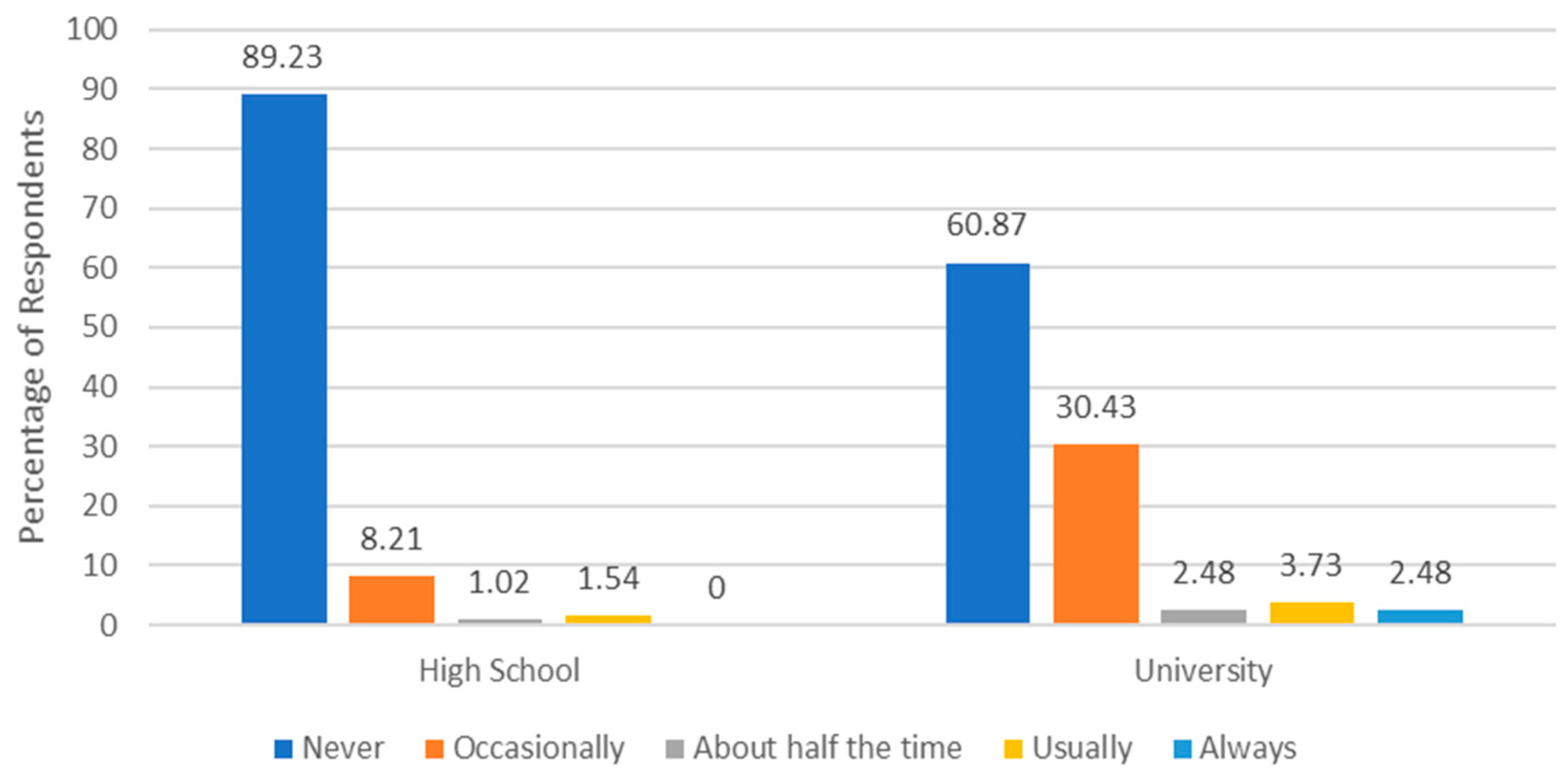
- Is there a significant difference in frequency of hearing protection use between high school and university musicians?
- Does knowledge of MIHL significantly predict use of hearing protection in student musicians?
- Is there a significant difference in use of hearing protection among different instruments?
- Is there a relationship between the number of years of active musical involvement and use of hearing protection?
- What percentage of musicians experiencing auditory symptoms resulting from noise exposure, and what specific symptoms are reported?
- How often do ensemble directors wear HPDs?
- How often do ensemble directors share information about hearing healthcare, and what types of information are shared with students?
3. Results
3.1. Student Musicians
3.2. Ensemble Directors
4. Discussion
- (1)
- It never occurred to me/I never thought of it.
- (2)
- I don’t need it.
- (3)
- I don’t want to.
- (4)
- I can’t afford it.
5. Conclusions
Author Contributions
Funding
Institutional Review Board Statement
Informed Consent Statement
Data Availability Statement
Conflicts of Interest
Appendix A
- High School Student Survey
- What instrument do you play?
- How old are you?
- What different ensembles have you been involved in? (Concert Band, Drum Corps, Orchestra, Marching Band, etc.)? Please List:
- How many years have you been involved with ensemble programs?
- Do you have any hearing loss or disorders? Circle all that apply.
- Hearing Loss
- Tinnitus (Ringing in the ears)
- Hyperacusis (Hearing Sensitivity)
- Loss of clarity
- Diplacusis (Same pitch sounds like two different tones in each ear)
- Ear Pain
- How much do you know about music-induced hearing loss on a scale of 1–5? (1 = nothing at all and 5 = I consider myself well-versed).1 2 3 4 5
- How often has hearing protection been brought up in ensemble rehearsals?NeverOnce or TwicePeriodically/SometimesOftenAlmost every rehearsal
- Are there posters or flyers about hearing protection hung up in your rehearsal space?YesNoI don’t know
- Do you wear hearing protection while you’re rehearsing?NeverOccasionallyAbout half the timeUsuallyAlways
- Do you know where to get hearing protection?YesNo
Appendix B
- College Student Survey
- What is your primary instrument?
- Flute or Piccolo
- Clarinet
- Double Reeds
- Saxophone
- Trumpet
- Trombone
- French Horn
- Tuba or Baritone
- Percussion
- Other
- Are you a current University Student?YesNo
- In what ensembles have you been involved?Concert BandMarching BandOrchestraChamber EnsembleDrum CorpsJazz Band
- Approximately how many years have you been involved in music programs?
- Do you currently experience any of the following symptoms? Choose all that apply.
- Hearing Loss
- Tinnitus (ringing or buzzing in the ear)
- Difficulty understanding speech
- Diplacusis (one tone sounds like two different tones in each ear)
- Ear Pain
- Aural Fullness (Ears feeling full or stopped up)
- None
- What does music-induced hearing loss mean to you?
- How much do you know about music-induced hearing loss on a scale of 1–5(1 = nothing at all and 5 = I consider myself well-versed).1 2 3 4 5
- How often has hearing protection been addressed in your curriculum?NeverIt’s been addressed before, but not regularlyOnce a semesterAt least once a weekEvery rehearsal
- Are there posters, flyers, or other resources about hearing protection in your rehearsal space?YesNoI don’t know
- Do you wear hearing protection during rehearsals?NeverOccasionallyAbout half the timeMost of the timeAlways
- Do you wear hearing protection during performances?NeverOccasionallyAbout half the timeMost of the timeAlways
- If you wear hearing protection, what kind do you wear?Foam EarplugsSilicone Earplugs with filters (Ex. Etymotic or Vibes)Custom EarplugsOtherI don’t wear hearing protection
- Why do you not use hearing protection? (If your answer is “Never” to #11)
- Have you ever had your hearing tested?YesNo
Appendix C
- Director Survey
- How long have you been a music director (in any ensemble)?
- What types of ensembles have you taught in (concert band, marching band, drum corps, orchestra, etc.)? Please list:
- What age of students have you taught? Mark all that apply.Elementary SchoolMiddle SchoolHigh SchoolCollegeAdults
- Were you ever taught about hearing loss in your education?YesNoI don’t remember
- How often do you talk about hearing protection in your program?NeverOnce or TwicePeriodically/SometimesOftenAlmost every rehearsal
- Do you have posters of flyers on hearing protection in your rehearsal space?YesNo
- Do you provide ear plugs for your musicians?YesNo
- Do you share where your musicians can obtain hearing plugs?YesNo
- How important is hearing protection to you?Extremely importantModerately importantMinimally importantNot at all important
- Do you use your own hearing protection in your own rehearsals?NeverOccasionallyAbout half the timeUsually
- Do you have your students use hearing protection in rehearsals?It is requiredIt is recommendedI don’t mind if they wear themI don’t want them to wear them
- What type of information about hearing protection do you make available for your students?Posters/flyersWebsite linksGuest speakers
- How much do you know about music-induced hearing loss on a scale of 1–5 (1 = nothing at all and 5 = I consider myself well-versed)?1 2 3 4 5
References
- Auchter, M., & Le Prell, C. G. (2014). Hearing loss prevention education using adopt-a-band: Changes in self-reported earplug use in two high school marching bands. American Journal of Audiology, 23(2), 211–226. [Google Scholar] [CrossRef] [PubMed]
- Blasco-Magraner, J. S., Marin-Liebana, P., Hurtado-Soler, A., & Botella-Nicolas, A. M. (2025). The impact of the soundscape on university life: Critical music education as a tool for awareness and transformation. Education Sciences, 15(5), 600. [Google Scholar] [CrossRef]
- Callahan, A. J., Lass, N. J., Foster, L. B., Poe, J. R., Steinberg, E. L., & Duffle, K. A. (2011). Collegiate musicians’ noise exposure and attitudes on hearing protection. Hearing Review, 18(6), 36–44. [Google Scholar]
- Camp, J. E., & Horstman, S. W. (1992). Musician sound exposure during performance of Wagner’s ring cycle. Medical Problems of Performing Artists, 7(2), 37–39. [Google Scholar]
- Centers for Disease Control and Prevention (CDC). (2019). Preventing noise-induced hearing loss. Centers for Disease Control and Prevention. Available online: https://www.cdc.gov/ncbddd/hearingloss/noise.html (accessed on 27 June 2022).
- Chasin, M. (2006). How loud is that musical instrument? Hearing Review, 13(3), 26. [Google Scholar]
- Chasin, M. (2009). Hearing loss in musicians: Prevention & management. Plural Publishing, Inc. [Google Scholar]
- Chasin, M. (2014). Hear the music: Hearing loss prevention for musicians. Musicians Clinics of Canada. [Google Scholar]
- Eichwald, J., & Scinicariello, F. (2020). Survey of teen noise exposure and efforts to protect hearing at school-united states. Morbidity and Mortality Weekly Report, 69(48), 1822–1826. [Google Scholar] [CrossRef] [PubMed]
- Fitzlaff, M., Jecker, R., Muller, A., Riegert, M., Riemenschnitter, C., Wenhart, T., Bucher, K., Kleinjung, T., Veraguth, D., Hildebrandt, H., & Bachinger, D. (2025). Awareness and attitudes towards ear health in classical music students-advancing education and care for professional ear users. Frontiers in Psychology, 16, 1497674. [Google Scholar] [CrossRef] [PubMed]
- Henderson, E., Testa, M., & Hartnick, C. (2011). Prevalence of noise-induced hearing-threshold shifts and hearing loss among US youths. Pediatrics, 127(1), e39–e46. [Google Scholar] [CrossRef] [PubMed]
- Killion, M. C. (2012). Factors influencing use of hearing protection by trumpet players. Trends in Amplification, 16(3), 173–178. [Google Scholar] [CrossRef] [PubMed]
- Kornisch, M., Barton, A., Park, H., Lowe, R., & Ikuta, T. (2024). Prevalence of hearing loss in college students: A meta-analysis. Frontiers in Neuroscience, 5(17), 1282929. [Google Scholar] [CrossRef] [PubMed]
- Laitinen, H. (2005). Factors affecting the use of hearing protectors among classical music players. Noise & Health, 7(26), 21–29. [Google Scholar] [CrossRef]
- Laitinen, H., & Poulsen, T. (2008). Questionnaire investigation of musicians’ use of hearing protectors, self reported hearing disorders, and their experience of their working environment. International Journal of Audiology, 47(4), 160–168. [Google Scholar] [CrossRef] [PubMed]
- Matei, R., Broad, S., Goldbart, J., & Ginsborg, J. (2018). Health education for musicians. Frontiers in Psychology, 9, 1137. [Google Scholar] [CrossRef] [PubMed]
- Mendes, M. H., Morata, T. C., & Marques, J. M. (2007). Acceptance of hearing protection aids in members of an instrumental and voice music band. Brazilian Journal of Otorhinolaryngology, 73(6), 785–792. [Google Scholar] [CrossRef] [PubMed]
- Miller, V. L., Stewart, M., & Lehman, M. (2007). Noise exposure levels for student musicians. Medical Problems of Performing Artists, 22(4), 160–165. [Google Scholar] [CrossRef]
- Natarajan, N., Batts, S., & Stankovic, K. M. (2023). Noise-induced hearing loss. Journal of Clinical Medicine, 12(6), 2347. [Google Scholar] [CrossRef] [PubMed]
- National Association of Music Education. (2007). Health in music education (Position statement). Available online: https://nafme.org/resource/health-in-music-education/ (accessed on 29 June 2022).
- National Association of Schools of Music (NAMA) & Performing Arts Medicine Association (PAMA). (2011). Basic information on hearing health. Information and recommendations for administrators and faculty in schools of music. Available online: https://nasm.arts-accredit.org/wp-content/uploads/sites/2/2016/02/1_NASM_PAMA-Admin_and_Faculty_2011Nov.pdf (accessed on 29 June 2022).
- National Institute for Occupational Safety and Health (NIOSH). (1996). Criteria for a recommended standard occupational noise exposure, revised criteria. Available online: www.nonoise.org/library/niosh/criteria.htm (accessed on 28 August 2025).
- National Institute for Occupational Safety and Health (NIOSH). (1998). Criteria for a recommended standard: Occupational noise exposure—Revised criteria 1998 (Publication No. 98-126). U.S. Department of Health and Human Services (NIOSH).
- Neerja, M. (2021). Noise-induced hearing loss clinical presentation: History, physical, causes. disease & conditions. Otolaryngology and Facial Plastic Surgery. Available online: http://emedicine.medscape.com/article/857813-clinical (accessed on 1 July 2022).
- Occupational Safety and Health Act of 1970. Public law No. 91-596, 84 Stat. 1590. (1970). Available online: https://www.osha.gov/laws-regs/oshact/toc (accessed on 28 June 2022).
- Occupational Safety and Health Administration (OSHA). (1998). Regulations (Standards—29 CFR) Occupational noise exposure—1910.95. Available online: https://www.osha.gov/pls/oshaweb/owadisp.show_document?p_table=standards&p_id=9735 (accessed on 29 June 2022).
- Peters, C., Thom, J., McIntyre, E., Winters, M., Teschke, K., & Davies, H. (2005). Noise and hearing loss in musicians. Safety and Health in Arts Production and Entertainment. [Google Scholar]
- Phillips, S. L., Shoemaker, J., Mace, S. T., & Hodges, D. A. (2008). Environmental factors in susceptibility to noise-induced hearing loss in student musicians. (Report). Medical Problems of Performing Artists, 23(1), 20–28. [Google Scholar] [CrossRef]
- Rodrigues, M. A., Goncalves, S., Neves, P., & Silva, M. V. (2019). Sound exposure of secondary school music students during individual study. Medical Problems of Performing Artists, 34(2), 98–101. [Google Scholar] [CrossRef] [PubMed]
- Washnik, N. J., Phillips, S. L., & Teglas, S. (2016). Student’s music exposure: Full-day personal dose measurements. Noise & Health, 18(81), 98–103. [Google Scholar] [CrossRef]
- WHO Programme for the Prevention of Deafness and Hearing Impairment. (1998). Prevention of noise-induced hearing loss: Report of an informal consultation held at the World Health Organization, Geneva, 28–30 October 1997. World Health Organization. Available online: https://apps.who.int/iris/handle/10665/65390 (accessed on 29 June 2022).


| Type | Number of Respondents | Percentage of Respondents |
|---|---|---|
| Silicone non-custom | 51 | 78.5 |
| Foam | 8 | 12.3 |
| Custom-fit | 2 | 3.1 |
| Other | 4 | 6.1 |
| Instrument | Number of Respondents | Percentage of Respondents |
|---|---|---|
| Flute | 45 | 12.6 |
| Clarinet | 52 | 14.6 |
| Double Reeds | 6 | 1.7 |
| Saxophone | 38 | 10.7 |
| Trumpet | 59 | 16.6 |
| Trombone | 31 | 8.7 |
| French Horn | 22 | 6.2 |
| Baritone/Tuba | 39 | 11.0 |
| Percussion | 46 | 12.9 |
| Other | 18 | 5.1 |
| Symptom Reported | Number (Percentage) of High School Respondents | Number (Percentage) of University Respondents |
|---|---|---|
| Hearing Loss | 31 (15.9%) | 31 (19.2%) |
| Tinnitus | 54 (27.7%) | 53 (32.9%) |
| Loss of Clarity (HS)/ Difficulty Understanding Speech (University) | 7 (3.6%) | 29(18.0%) |
| Ear Pain/Otalgia | 23 (11.8%) | 22 (13.7%) |
| Aural Fullness/ Ear stopped up * | Not a response option | 28(17.4%) |
| Diplacusis | 2 (1.0%) | 2 (1.2%) |
| Hyperacusis ** | 10 (5.12%) | Not a response option |
| Number of Years Teaching Music | What Age of Students Have You Taught? | Do You Use Your Own Hearing Protection in Rehearsals? | Were You Taught About Hearing Loss in Your Education? | How Often Do You Talk About Hearing Protection in Your Program? |
|---|---|---|---|---|
| 6 | MS, HS, Adults | Usually | Yes | Often |
| 7 | HS | Never | No | Periodically |
| 10 | MS, HS, College | Never | Yes | Periodically |
| 1 | ES, MS, HS | Never | No | Never |
| 1 | ES, MS, HS, College | Never | Yes | Once or Twice |
| 2 | ES, MS, HS | Never | Yes | Once or Twice |
| 28 | ES, MS, HS, Adults | Occasionally | Yes | Once or Twice |
| 1 | ES | Occasionally | No | Once or Twice |
| 4 | MS | Occasionally | Yes | Once or Twice |
| 15 | ES, MS, HS, College | Occasionally | No | Periodically |
| 6 | MS, HS | Occasionally | Yes | Once or Twice |
| 2 | ES, MS, HS | Occasionally | No | Never |
| 4 | MS, HS | Occasionally | Yes | Once or Twice |
| 16 | MS, HS | Occasionally | No | Once or Twice |
| 22 | ES, MS, HS, Adults | Never | No | Never |
Disclaimer/Publisher’s Note: The statements, opinions and data contained in all publications are solely those of the individual author(s) and contributor(s) and not of MDPI and/or the editor(s). MDPI and/or the editor(s) disclaim responsibility for any injury to people or property resulting from any ideas, methods, instructions or products referred to in the content. |
© 2025 by the authors. Licensee MDPI, Basel, Switzerland. This article is an open access article distributed under the terms and conditions of the Creative Commons Attribution (CC BY) license (https://creativecommons.org/licenses/by/4.0/).
Share and Cite
Donald, L.; Flagge, A.G. Too Loud to Ignore: Knowledge, Attitudes, and Practices Regarding Hearing Protection in Student Musicians and Ensemble Directors. Educ. Sci. 2025, 15, 1454. https://doi.org/10.3390/educsci15111454
Donald L, Flagge AG. Too Loud to Ignore: Knowledge, Attitudes, and Practices Regarding Hearing Protection in Student Musicians and Ensemble Directors. Education Sciences. 2025; 15(11):1454. https://doi.org/10.3390/educsci15111454
Chicago/Turabian StyleDonald, Lucile, and Ashley G. Flagge. 2025. "Too Loud to Ignore: Knowledge, Attitudes, and Practices Regarding Hearing Protection in Student Musicians and Ensemble Directors" Education Sciences 15, no. 11: 1454. https://doi.org/10.3390/educsci15111454
APA StyleDonald, L., & Flagge, A. G. (2025). Too Loud to Ignore: Knowledge, Attitudes, and Practices Regarding Hearing Protection in Student Musicians and Ensemble Directors. Education Sciences, 15(11), 1454. https://doi.org/10.3390/educsci15111454