1. Introduction
The Latvian educational system, like many in Europe, faces a persistent gap between the ambitious objectives set by national education policy—largely aligned with global trends—and the everyday practices observed in classrooms (
Greitans & Namsone, 2024) Since the introduction of the national reform Skola2030, emphasis has been placed on competency-based learning, integration of Science, Technology, Engineering, and Mathematics (STEM), and the cultivation of transversal skills. Teacher preparation follows a traditional higher education route, complemented by in-service professional development. However, systemic and contextual barriers—such as limited resources and fragmented support structures—continue to hinder effective implementation of innovations in classroom practice (
Greitāns & Namsone, 2022). This makes the Latvian case both unique, due to its reform-driven agenda, and representative of challenges encountered internationally when translating education policy into teaching practice.
Teacher professional development and learning (TPDL) is widely recognized as a critical factor in successful educational innovation. However, prior research has shown that in-service TPD initiatives often struggle to produce sustained changes in practice because of these systemic obstacles (
Greitāns & Namsone, 2022). Against this backdrop, the present study investigates continuous professional development and learning (CPDL) pathways in the context of implementing a specific innovation: instructional practices that foster students’ spatial ability. Spatial ability is a foundational cognitive skill strongly associated with achievement in STEM, especially in the early years (
Newcombe, 2010;
Uttal et al., 2013). Students with well-developed spatial skills demonstrate enhanced mathematical reasoning, scientific modeling, and engineering design competence (
Wai et al., 2009). Despite this, spatial ability has received relatively little attention in curriculum design and teacher development programs, creating a clear knowledge and practice gap.
This study is guided by the following three research questions:
RQ1: To what extent does the LS-based CPDL path help participating primary teachers progress toward the desired classroom practices that promote student spatial ability?
RQ2: To what extent does students’ spatial ability improve following the implementation of instructional strategies developed through the LS-based CPDL, as measured by pre- and post-intervention assessments?
RQ3: Which components of spatial ability—spatial visualization, mental transformation, and spatial orientation—show the greatest and least gains in student performance following the LS-based CPDL?
Background and Rationale
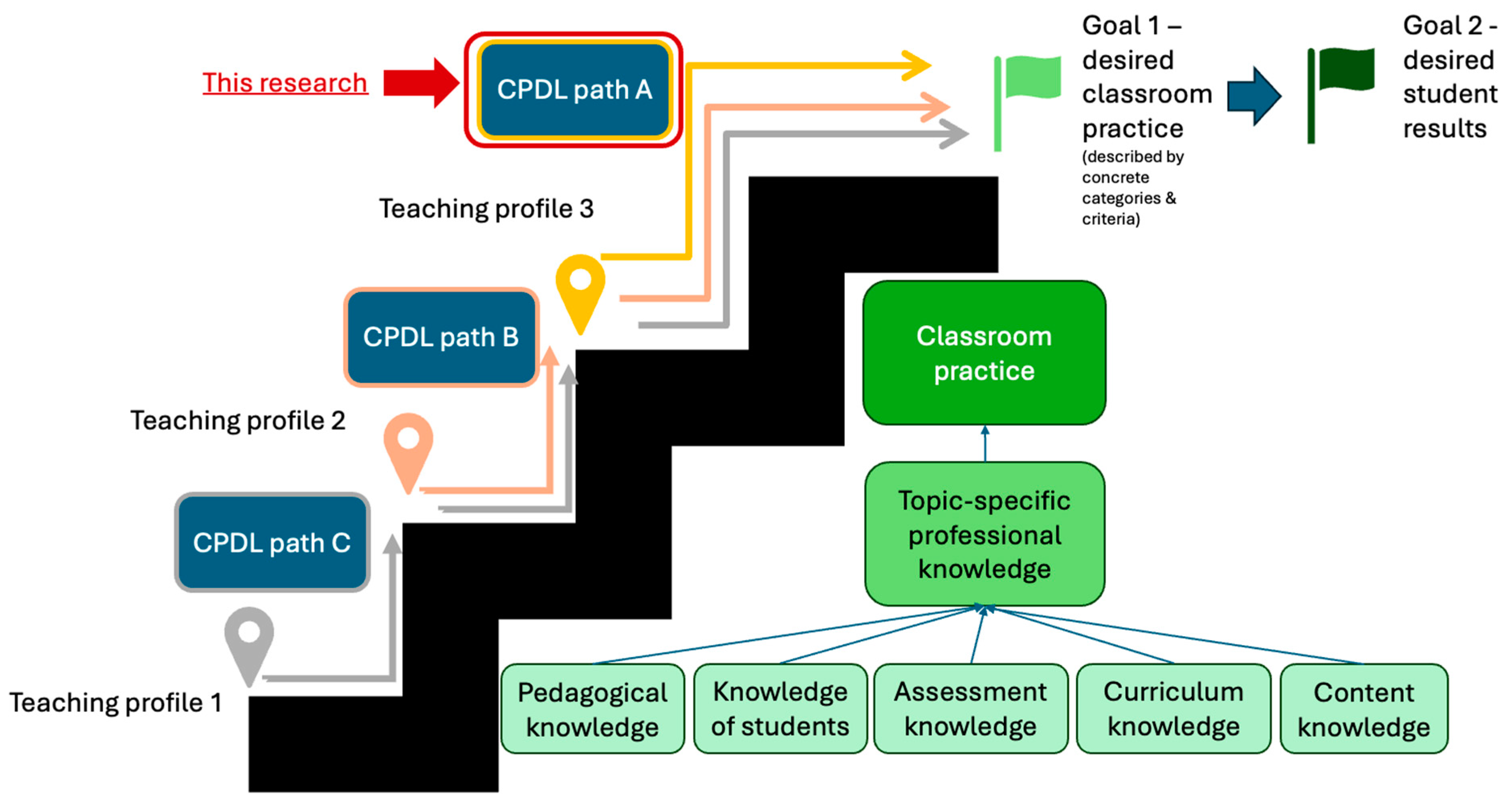
This study is part of a larger research project aimed at developing a system that links observed teaching profiles with appropriate CPDL solutions. The present research represents an early phase of this project—a small-scale study conducted to explore how, within the Latvian educational context, teacher professional development (TPD) programs can be designed based on observations of teaching practice to promote changes in both classroom instruction and student learning outcomes. The central premise is that achieving specific instructional goals—particularly improvements in teaching practice—requires differentiated CPDL paths for different teachers (see
Figure 1).
This premise is supported by two widely accepted assumptions in educational research. First, it is possible to group teachers into smaller profiles based on shared attributes and teaching characteristics (
Bae et al., 2020). Second, different TPD solutions vary in their effectiveness and impact (
Ventista & Brown, 2023). As illustrated in
Figure 1, the first sub-premise is operationalized through teaching Profiles 1, 2, and 3, categorized into two dimensions: foundational teaching practices and teaching for conceptual understanding (
Greitans & Namsone, 2024). Profile 1 demonstrates strength in basic instructional strategies but has gaps in promoting conceptual understanding. Profile 2 shows weaknesses in both areas, while Profile 3 displays significant shortcomings in both foundational and conceptual practices. Prior findings suggest that evaluations of current teaching practices are highly valuable for teacher educators when planning CPDL pathways (
Namsone & Čakāne, 2017). These practice-based profiles provide key insights into teachers’ PD needs.
The second sub-premise is reflected in CPDL paths A, B, and C. Earlier research indicates that, within the Latvian context, the implementation of meaningful educational innovations is often hindered. However, carefully designed combinations of focused TPD strategies—including the development of teacher reflection and learning skills—can lead to successful outcomes (
Bufasi et al., 2024b). Collaborative and reflective PD models, such as LS, have shown promising results globally (
Dudley, 2013;
Lewis et al., 2006), and in Latvia as well (
Bufasi et al., 2024a,
2024b), in enhancing instructional quality and improving student achievement. Therefore, this approach is a valuable consideration when designing TPD programs aimed at transforming classroom practice.
By addressing research questions, this study contributes to the growing literature on effective STEM teacher CPDL and offers practical insights for educators, curriculum designers, and policymakers. Specifically, it fills three gaps: (1) the underexplored link between LS-based CPDL and spatial ability instruction; (2) the lack of evidence on how teacher profiles can guide differentiated CPDL design; and (3) empirical insights into how teacher learning translates into student gains in spatial ability. Although this is a small-scale study, its findings highlight the potential of combining LS with spatial ability instruction as a meaningful innovation and provide a foundation for larger-scale research in Latvia and beyond.
2. Literature Review
To address the research questions, this literature review outlines the key concepts that underpin this study. Specifically, it examines the following: (1) TPD models that are responsive to teachers’ instructional needs; (2) CPDL approaches that effectively lead to changes in classroom practice, focusing in particular on LS, which forms the foundation of this research; and (3) instructional strategies for fostering spatial ability in primary education settings.
2.1. Needs-Based In-Service Teacher Continuous Professional Development and Learning
For decades, researchers and policymakers have consistently underscored the importance of grounding in-service teacher PD in the real and evolving needs of practicing educators (
Darling-Hammond et al., 2017;
Desimone, 2009;
Opfer & Pedder, 2011). This perspective acknowledges that generic, one-size-fits-all PD often fails to enhance teaching quality and student learning outcomes. In contrast, needs-based PD begins with what teachers themselves identify as essential for their professional growth, ensuring greater relevance and applicability.
Researchers have employed various approaches to assess in-service teachers’ PD needs, including teacher self-assessment (
Richards & Farrell, 2005), classroom observations (
van den Bergh et al., 2015), and large-scale surveys (
Darling-Hammond et al., 2017). Each method yields unique insights into teacher competencies and areas requiring support. Evidence suggests that PD is most effective when both its content and format are tailored to these identified needs (
Guskey, 2002). Several studies highlight how PD models have been aligned with teacher-identified needs through mechanisms such as systematic needs assessments (
Hirsch et al., 2018;
Shernoff et al., 2017), collaborative goal setting (
Bufasi et al., 2024c;
Ross et al., 2012), and iterative feedback loops that empower teachers as active agents in their own development (
van den Bergh et al., 2015;
Zinger et al., 2017).
Such models prioritize contextual relevance, responsiveness to local challenges, and sustained engagement, ensuring that PD is both pedagogically robust and practically applicable to teachers’ instructional environments (
Avalos, 2011;
Borko, 2004;
Desimone, 2009). Aligning PD content and delivery with teachers’ perceived priorities—such as strengthening subject knowledge, enhancing classroom management, or refining assessment practices—can foster greater teacher ownership, motivation, and long-term instructional improvement. For example,
Owston et al. (
2020) describe a blended PD program designed in response to secondary teachers’ expressed needs for collegial dialog and autonomous learning. The face-to-face component supported peer collaboration and problem-solving among subject-area colleagues, while the online portion enabled self-paced, independent learning. This integration of collaborative and self-directed modalities illustrates how PD formats can be customized to accommodate diverse professional learning preferences and objectives, ultimately enhancing both effectiveness and sustainability.
Another needs-responsive model that has gained increasing traction in recent years is LS, a collaborative, inquiry-based PD approach originating in Japan. LS aligns closely with the principles of needs-based PD, as it centers teachers’ own classroom practices and professional concerns as the starting point for instructional improvement (
Dudley, 2013;
Lewis, 2002). In this model, teachers work in small groups to identify specific learning challenges or content areas, jointly design a “research lesson,” observe its implementation, and engage in structured reflection and refinement. This cyclical process supports teachers in addressing their self-identified instructional needs through peer-supported experimentation and evidence-based analysis (
Lewis et al., 2006).
2.2. The Role of Lesson Study in Teacher CPDL
LS has increasingly been recognized as a powerful model of embedded PD, emphasizing the collaborative enhancement of instructional practices (
Lewis & Hurd, 2011;
Qin, 2024). Rooted in the Japanese education system, LS provides a structured yet flexible framework through which teachers systematically investigate teaching and learning in their own classrooms (
Fernandez, 2002;
Lewis, 2002). This model closely aligns with the principles of needs-based PD, as it emerges from teachers’ self-identified challenges and promotes learning through collective reflection and continuous inquiry (
Chokshi & Fernandez, 2004;
Xu & Pedder, 2014).
Early research situated LS within social constructivist paradigms, viewing it as a form of situated professional learning in which knowledge is co-constructed through collaborative engagement in authentic instructional practices (
Chokshi & Fernandez, 2004;
Fernandez, 2002;
Lewis, 2002). Within this framework, teacher learning is context-bound and socially mediated, occurring through shared dialog, observation, and analysis of classroom teaching (
Borko, 2004;
Vescio et al., 2008). Rather than relying on external prescriptions, LS encourages teachers to generate solutions based on localized classroom evidence and shared professional judgment (
Dudley, 2013;
Lewis & Perry, 2017).
Recent studies confirm that LS fosters meaningful, application-oriented learning among teachers, particularly by enhancing their capacity to identify and address student misconceptions and instructional challenges. For example,
Vermunt et al. (
2019) found that teachers engaging in LS improved their ability to uncover and interpret student errors through structured collaborative reflection. Similarly,
Vrikki et al. (
2017) demonstrated that dialogic teacher interactions—such as “building on other ideas and drawing on knowledge to challenge statements”—during LS discussions led to enhanced pedagogical reasoning and problem-diagnostic skills.
In addition to promoting teacher learning, LS contributes positively to student learning by fostering the design of lessons that are inclusive, engaging, and responsive to diverse learner needs (
Ayra & Kösterelioglu, 2021;
Huang & Shimizu, 2016). The focus on student thinking during post-lesson analysis provides critical insight into how students interpret and engage with content, informing pedagogical decisions in subsequent cycles (
Dudley, 2013;
Lewis & Perry, 2017). Moreover, the collaborative structure of LS helps build professional communities of practice that reduce isolation and support sustained teacher development (
Schipper et al., 2017;
Vescio et al., 2008).
Furthermore, LS also offers significant value in teacher education settings by creating a supportive environment for pre-service teachers to engage in practice-based learning and professional dialog (
Cajkler et al., 2013;
Schipper et al., 2017). It enables teacher educators to scaffold instructional knowledge while modeling reflective, inquiry-oriented approaches to teaching (
Xu & Pedder, 2014). The adaptability of LS across diverse educational contexts further demonstrates its capacity to support long-term instructional improvement through collaborative, situated, and student-centered professional learning (
Lewis, 2002;
Qin, 2024).
While prior research has established the foundational role of spatial ability in STEM learning, as well as the effectiveness of collaborative PD models such as LS, few studies have directly examined how teacher learning translates into measurable gains in students’ spatial skills. Moreover, limited evidence exists on how specific components of spatial ability respond to such interventions. Addressing this gap, the present study explores the impact of LS-based PD on students’ spatial performance in primary education, offering insights into the instructional mechanisms that most effectively support the development of spatial ability.
2.3. Supporting Spatial Ability in the Primary Classroom
Spatial ability comprises a set of cognitive processes that allow individuals to mentally generate, manipulate, and transform visual–spatial information (
McGee, 1979). It is typically conceptualized through three core components: spatial visualization, the ability to interpret and manipulate complex spatial relationships (
Linn & Petersen, 1985); mental transformation, the capacity to mentally rotate objects or shift one’s own perspective (
Tinella et al., 2020); and spatial orientation, which involves understanding the spatial positioning of objects in relation to oneself and to other objects (
Carroll, 1993). These dimensions play a foundational role in both academic learning and real-world problem-solving. For example, spatial visualization is crucial for interpreting diagrams, solving multi-step mathematical problems, and mentally simulating quantitative relationships (
Hawes et al., 2022;
Mix, 2019). Mental transformation is central to geometry, engineering, and design thinking, where manipulating and imagining objects in three-dimensional space is essential (
Buckley et al., 2019;
Weckbacher & Okamoto, 2014). Meanwhile, spatial orientation supports tasks such as navigation, data visualization, and spatial layout interpretation—skills that are widely used in fields such as computer science and geography (
Kulawiak et al., 2023;
Salac et al., 2023;
Swink & Speier, 1999). A meta-analysis by
Wai et al. (
2009) found spatial ability to be a robust and independent predictor of STEM success, even when controlling for verbal and mathematical skills. Longitudinal studies further show that spatial skills reliably predict mathematics achievement from early childhood through adolescence (
Geer et al., 2019;
Gilligan et al., 2019) and are linked to performance in other domains such as reading (
Cui et al., 2019).
Crucially, spatial ability is not fixed. A wealth of evidence shows that these skills are malleable and responsive to instruction, especially in early childhood (
Uttal et al., 2013). During this developmental period, brain regions tied to spatial processing—such as the parietal lobes and prefrontal cortex—undergo rapid growth, making early interventions particularly impactful (
Gogtay et al., 2004). Effective instructional strategies include hands-on activities (e.g., block play, puzzles, and construction tasks), spatial language use, and integration of visual representations such as diagrams, manipulatives, and number lines (
Casasola et al., 2020;
Levine et al., 2012;
Verdine et al., 2017). Recent innovations also highlight the promise of digital tools—like dynamic geometry software and interactive 3D apps—in supporting students’ exploration of spatial transformations in STEM contexts (
Gilligan et al., 2019;
Sutherland et al., 2024).
Despite its clear importance, spatial ability remains underrepresented in primary education practice. National curricula often lack explicit references to spatial reasoning, and teachers report limited guidance or support for incorporating spatial instruction into their lessons (
Bufasi et al., 2024a). This curricular ambiguity contributes to teacher uncertainty about the relevance of spatial thinking in STEM learning. Furthermore, few PD opportunities exist that focus specifically on spatial pedagogy, leaving educators underprepared to translate research insights into classroom practice.
Taken together, these findings point to a critical need to strengthen teacher capacity in supporting spatial learning from the early years. Spatial ability offers a gateway to success in STEM fields and broader academic achievement. For this reason, the present study focuses not only on the development of students’ spatial performance but also on how TPD in spatial pedagogy can be transferred into measurable student learning outcomes.
3. Methodology
The goal of this study is to examine how teacher CPDL paths unfold from current teaching practice toward enhanced instructional practice, with particular attention to how these processes relate to changes in student outcomes in a foundational cognitive domain. The present study is explicitly framed as exploratory and descriptive, documenting the implementation of a TPD solution that was tailored to participating teachers’ identified needs. It does not make causal claims regarding the effectiveness of the intervention. Instead, this study focuses on tracing teacher learning pathways and associated student outcomes as indicative trends. Given its small scale, absence of comparison groups, and context-specific nature, the findings should be interpreted as formative evidence that informs future development rather than as generalizable conclusions. In the following sections, we describe the study sample (including previously obtained evidence of teaching practice), the CPDL design, and the data collection and analysis procedures. Attention is also given to the validation of instruments and to clarifying the limitations inherent in this design.
3.1. Participants
This study was conducted across two public primary schools in an urban district, selected based on their engagement in STEM-focused initiatives and willingness to participate in design-based research (DBR)-informed professional learning. A total of 24 female teachers, teaching Grades 1 through 3 and with between 4 and 47 years of teaching experience, participated in this study. All of the teachers teach mathematics, and a large part also primary science and other subjects; therefore, the expression “STEM teachers” is used throughout this paper. The classrooms of these teachers included 345 students: 104 in Grade 1, 115 in Grade 2, and 126 in Grade 3. Throughout the research also two school leaders (15+ years of experience in teaching; 10+ years of experience in school leadership) participated. According to the research rationale presented in
Figure 1, the next subsections describe the study sample’s teaching profile and its determination and the development of a CPDL path and intervention according to the profile.
3.2. Study Samples Teaching Profile
The researchers and participating teachers had collaborated in a prior research project, in which the teachers gradually became acquainted with the concept of spatial ability and LS as a teacher professional learning approach.
1 According to author assumptions (
Figure 1), the first step for the development of a CDPL path is the determination of current teaching profiles of study sample teachers. To do that, lesson transcripts and associated ratings were obtained from a database containing 677 recorded lessons (both the study sample teacher and other teachers). This database is maintained by the authors’ institution and is accessible upon request. The lessons were evaluated using a previously developed and validated category–criteria framework designed to assess teaching and learning practices that support students’ 21st-century skills (
Bertule et al., 2019). The framework includes 17 criteria, each described across five performance levels. A score of 0 indicates that the criterion was not observed, while a score of 4 reflects exemplary practice according to the most current evidence: level 1—some fragmented elements of practice; level 3—practice that aligns to the most current evidence.
The analysis was performed in two parts that are important for supporting primary student spatial ability—“foundational teaching practices” (characterized by four criteria: clarity of learning objectives, lesson design, classroom management, and feedback to students) and “student cognitive activation” (characterized by four criteria: tasks for deep learning, representation of learning contents, classroom discourse, and opportunities for metacognition). We believe that four chosen criteria in the category “student cognitive activation” closely align with the up-to-date ideas about supporting student spatial ability in primary classrooms, as the available evidence indicates that such instruction should include hands-on activities and integration of visual representations such as diagrams, manipulatives, and number lines (manifested in the criteria representation of learning contents) and spatial language use (manifested in the criteria of classroom discourse and opportunities for metacognition).
The analysis and profiling (according to the previously developed methodology by Greitans & Namsone, 2024) revealed that participating teachers demonstrated relatively high proficiency in criteria corresponding to the category “foundational teaching practices”; however, they had comparatively lower performance levels in criteria corresponding to the category “student cognitive activation” and formed a single teaching profile. According to the employed methodology, the expression “form a single teaching profile” means that in each of the eight chosen criteria, the observed teaching practice of the study sample teachers differs by no more than one level. For example, in the criterion “feedback to students”, the study sample teachers observed performance was either in level 1 or level 2; in the criterion “opportunities for metacognition”, it was either in level 0 or level 1. Detailed information about the determined teaching profile of study sample teachers is presented in
Table 1.
As shown in
Table 1, while the teachers demonstrate proficiency in foundational categories, notable gaps exist in the curriculum-specific teaching, leading to a hypothesis that the study sample teachers lack topic-specific professional knowledge or there are barriers for implementation of this specific knowledge into classroom practice.
This hypothesis was supported by interviews conducted with school leaders, who noted: “Teachers generally lack a methodology for teaching specific content elements; this is a national problem because we have nowhere to find such information in the national language.” Furthermore, in preliminary discussions prior to the LS-based CPDL, teachers themselves acknowledged gaps in their PCK, stating: “I have some idea what spatial ability means and what an effective STEM lesson looks like, but I have no idea how to develop an effective STEM lesson that promotes spatial ability.”
3.3. The Teacher CPDL Path
In previous research projects (see Note 1), the authors and study sample teachers and school leaders have collaborated to obtain teachers’ initial insights about student spatial ability and classroom practices (
Bufasi et al., 2022) and to design a PD intervention that helps teachers to progress with their respective classroom practices. From a methodological perspective, the previous research articles describe several cycles of DBR in which a PD model has been developed through three cycles of analysis, design, implementation, and evaluation. As spatial ability and classroom instruction that supports it are quite an innovation for Latvian teachers, the previous DBR cycles have carefully addressed and built on teachers’ existing knowledge and learning skills. For example, as teachers had no previous knowledge about spatial visualization and mental transformation, almost a year of learning was dedicated to fostering such teacher knowledge (first two cycles of DBR). In the fourth DBR cycle (this research), we examine how the instructional changes resulting from CPDL affect students’ spatial learning outcomes. In comparison with previous DBR cycles, the PD contents for teachers now include both more advanced ideas about student spatial ability (spatial visualization, mental transformation, and spatial orientation) and also more advanced ideas about classroom practices that enhance student spatial ability (tasks for deep learning, representation of learning contents, classroom discourse, and opportunities for metacognition). The CPDL implemented in this cycle is grounded in the LS approach, which was developed and described in a prior publication (
Bufasi et al., 2024b). The CPDL was designed with the intentions to foster both teacher insights for classroom practices that support student spatial ability and to guide teachers through a structured, collaborative inquiry process in which they plan, teach, observe, and revise spatially enriched STEM lessons.
The development of the CPDL through all DBR cycles followed the following concrete design principles:
In comparison with previous iterations, CPDL in this DBR cycle differed by the complexity of the CPDL contents (teachers learned complex and advanced ideas both about components of spatial ability and classroom practices and how to enhance them), not by the CPDL opportunities available for teachers. The next paragraph describes the details about CPDL available for teachers.
The CPDL was implemented over a six-month period and comprises six thematic workshops. Each workshop addressed a distinct component of spatial ability—visualization, mental rotation, construction/deconstruction, and orientation—and the place of the component in the STEM curriculum and classroom practices to enhance each component. Sessions were spaced approximately one month apart, allowing participants time to experiment with strategies in their classrooms and reflect on implementation.
The workshops were facilitated by a teacher educator (the third author of this study), who served as both a subject-matter expert and pedagogical mentor. The educator provided conceptual input, modeled exemplar lessons, and supported teachers in adapting these strategies to their specific teaching contexts. During the modeling workshop, the educator enacted lessons while participants assumed the role of learners, enabling teachers to experience instructional strategies from the student perspective. In addition to the teacher educator, two school leaders also participated in the PD framework. Their role was to support the facilitation of the LS process at the school level, helping coordinate group activities, encourage reflective practice, and ensure alignment with broader school priorities. Their involvement contributed to the organizational coherence and sustainability of PD efforts.
Following each workshop, teachers engaged in LS cycles within their schools. Depending on school size, these were carried out in triads or groups of five. Each LS cycle included collaborative goal setting, co-planning of lessons, live classroom enactment with peer observation, and post-lesson reflection. This cyclical structure ensured that the theoretical knowledge and pedagogical strategies introduced during the workshops were applied, tested, and refined in authentic classroom settings—supporting both teacher professional growth and the development of student-centered instruction.
3.4. Data Collection and Analysis
To evaluate the impact of the teacher CPDL on students’ spatial ability, a pre-test/post-test design was employed. Assessments targeted three key components of spatial cognition: mental transformation (e.g., rotation and flipping of 2D shapes), spatial visualization (e.g., folding/unfolding tasks and embedded figure identification), and spatial orientation (e.g., perspective-taking and map-following tasks). These tasks were adapted from the RIF 3.0 platform (
https://rif4you.eu, accessed on 10 January 2025), a validated resource for spatial skill development. To ensure developmental appropriateness and reliability for primary-aged learners, the tasks were first piloted with a small group of students and reviewed by the research team. Assessments were administered in classroom settings during regular lesson periods by the researchers in collaboration with teachers. Each administration lasted approximately 30 min and was conducted in a whole-class format to maintain consistency.
In parallel, semi-structured interviews were conducted with all participating teachers following the conclusion of the LS-based CPDL. The interviews, lasting between 30 and 45 min each, were conducted face-to-face, audio-recorded with informed consent, and transcribed verbatim. The interview protocol was aligned with Guskey’s five levels of PD evaluation (see
Table 2), covering participant reactions, knowledge and skill acquisition, organizational support, and use of new knowledge and skills.
Quantitative data from student assessments were analyzed using paired-sample t-tests to examine statistically significant differences between pre-test and post-test scores. Assumptions of normality were checked, and Cohen’s d was calculated to report effect sizes. Additional analyses explored learning gains by spatial skill type and across grade levels, allowing for identification of age-related or skill-specific patterns of improvement. Qualitative data from teacher interviews were analyzed using a deductive content analysis approach. Coding was guided by Guskey’s five impact levels, with transcripts segmented and coded by two researchers independently. The analysis sought to identify both evidence supporting Guskey’s framework and examples that challenged or extended it, with attention to concrete cases of teacher learning, classroom behavioral change, and contextual factors such as school-level support. Illustrative quotations were used to ground the interpretation of findings. By combining quantitative evidence of student learning gains with qualitative insights into teacher professional growth, the analysis aimed to provide a comprehensive picture of how CPDL participation influenced both instructional practices and student outcomes.
4. Results
This section presents findings related to the three research questions guiding this study, drawing on both qualitative and quantitative data sources. First, we examine the CPDL path of participating STEM teachers, with a focus on support of student spatial skills. Second, we report the impact of LS-informed instruction on students’ spatial performance, based on pre- and post-intervention assessments across three grade levels. Finally, we analyze differential gains across specific spatial ability components—spatial visualization, mental transformation, and spatial orientation—to determine which subskills showed the most improvement because of the intervention.
4.1. Teacher CPDL Path
The impact of the LS-TPD on participating teachers was assessed through post-intervention semi-structured interviews. Responses were categorized according to their alignment with the intended outcomes of the PD program—particularly in relation to support for student spatial skills. A summary of the qualitative findings is presented in
Table 3.
Overall, the findings reflect a strong positive reception of the LS-based CPDL path. Most teachers (29 of 36) reported satisfaction with the PD experience, citing the relevance of the content, the clarity of instructional examples, and the opportunity for peer collaboration as key benefits. Comments such as “The workshop was very helpful.” and “Thank you for the ideas.” underscore the perceived value of the experience. While a minority (7 comments) expressed reservations—often tied to uncertainty about next steps or sustained application—these concerns were largely attributed to limitations in available curriculum materials rather than the CPDL path design itself. Teachers also demonstrated a solid grasp of how to foster spatial visualization, mental transformation, and spatial orientation, with 31 of 36 responses aligned with research-based SA instructional principles. Examples included using manipulatives, color cues, and visual–spatial prompts to enhance student engagement and understanding.
Importantly, all 25 respondents identified aspects of the PD they found supportive, including hands-on activities, access to concrete teaching resources, opportunities for collaboration, and the psychological safety of the learning environment. These aspects appeared to play a crucial role in deepening teacher engagement and motivation. Moreover, most participants (28 of 32) expressed intentions to apply what they learned in their future teaching practice, describing specific ways they planned to integrate SA strategies into STEM instruction. For instance, one teacher reflected, “Organizing conversations with students, guiding their thinking, and exploring different task types—I’m excited to keep discovering new ones!” However, a few remained uncertain, noting that continued use would depend on alignment with mandated curricula and the availability of supporting materials.
Collectively, the interview data suggest that the LS-based CPDL path not only addressed immediate instructional needs but also fostered a professional learning environment conducive to sustained teacher growth. The alignment between the PD structure and the teachers’ day-to-day classroom realities—along with the emphasis on collaborative inquiry and practical application—appears to have supported both teacher confidence and instructional readiness. At the same time, the findings point to a need for continued curricular integration and administrative support to fully embed PD-informed practices into routine classroom instruction.
4.2. Student Gains in Spatial Performance Following LS-Based CPDL Path
To address the second research question, paired-sample
t-tests were conducted for each grade level to compare students’ pre- and post-test scores on spatial ability assessments. Results are summarized in
Table 4.
Across all three grade levels, students demonstrated statistically significant gains in spatial performance between pre- and post-tests. The mean differences ranged from 2.21 to 3.31 points, corresponding to moderate-to-large effect sizes (d = 0.57–0.67). These gains indicate consistent improvement across grades on the spatial ability assessments.
4.3. Observed Differential Gains Across Spatial Ability Components
To address research question three, paired-sample
t-tests were conducted separately for three spatial ability components—spatial visualization, mental transformation, and spatial orientation—in Grades 1 and 2 (see
Table 5). Grade 3 was excluded due to test design differences that precluded direct comparison.
Across both grades, statistically significant gains were observed for all three components. The size of these gains varied by component and grade.
5. Discussion
This was a small-scale, exploratory study conducted with a limited number of Latvian primary teachers. It employed an uncontrolled, single-group pre–post design and therefore cannot make causal claims about the effectiveness of the LS-based CPDL path. Instead, this study offers descriptive insights into how participating teachers experienced the process, how contextual factors shaped its implementation, and what kinds of changes in student spatial performance were observed in this specific context. All interpretations presented here should be understood as preliminary, illustrative, and contingent upon the unique features of the sample and setting, including teachers’ extensive prior training and the strong involvement of school leadership.
5.1. Teacher Learning and Contextual Factors
Teacher interviews suggested that the LS-based CPDL path was perceived as relevant and useful for addressing classroom practice related to spatial ability. Participants described gaining new strategies and expressed motivation to continue applying them, echoing earlier findings that collaborative and reflective models of professional learning can support changes in teacher knowledge and classroom practice (
Desimone, 2009;
Lewis et al., 2006). Within
Guskey’s (
2002) framework, reported outcomes spanned multiple levels, including satisfaction, perceived learning, and intentions for application. At the same time, this study highlights the importance of contextual enablers. School leadership emerged as a central factor: in cases where leaders allocated time, encouraged collaboration, and integrated the LS cycles into broader school development, engagement appeared more consistent. This observation aligns with research emphasizing the role of leadership in shaping professional development conditions (
Hallinger & Heck, 2010;
McChesney & Aldridge, 2021). However, these are context-specific findings and cannot be generalized; they illustrate how leadership support coincided with implementation in this sample. The CPDL path also showed correspondence with models of effective PD design (
Sims et al., 2025), which emphasize alignment with teacher context, opportunities for reflection, and ongoing support. Nevertheless, it is important to stress that such alignment was observed, not proven, and that this study’s uncontrolled design prevents drawing firm conclusions about effectiveness. This also aligns with research by Hallinger and Heck (
Hallinger & Heck, 2010), emphasizing the importance of leadership in shaping PD outcomes. These findings suggest that LS-TPD, when well-supported, is a promising approach for addressing complex and underrepresented areas of teacher professional learning, such as spatial cognition within STEM.
5.2. Student Outcomes in Spatial Ability
Pre–post assessments indicated that students across three grade levels improved their scores on spatial ability tasks. While the mean differences were consistent and of moderate to large magnitude, these results must be interpreted with caution. Without a comparison group, alternative explanations such as maturation, test familiarity, or expectancy effects cannot be ruled out. This limitation is well documented in research on single-group pre–post designs (
Dudley, 2013;
Perry & Lewis, 2009). Nevertheless, the pattern of observed gains aligns with the broader literature showing that spatial skills are malleable and can be supported through instruction (
Newcombe, 2010;
Wai et al., 2009). In this sense, the present study contributes tentative evidence that instructional practices emphasizing spatial thinking may be promising in early STEM education, though definitive claims about impact require more rigorous research designs.
5.3. Implications of Differential Gains Across Spatial Ability Components
Analyses of subskills in Grades 1 and 2 revealed significant pre–post gains in spatial visualization, mental transformation, and spatial orientation. The largest mean differences were observed in spatial visualization, while orientation showed smaller relative gains. Several hypotheses may explain this pattern: strategies emphasizing visual modeling and manipulatives may have supported visualization (
Sorby, 2009); dynamic tasks may explain growth in mental transformation (
Tzuriel & Egozi, 2010); and orientation may have been constrained either by ceiling effects (
Newcombe, 2010) or by limited emphasis in the LS content. These explanations remain tentative and highlight areas for refinement in future iterations of PD design.
5.4. Limitations
Several limitations frame the interpretation of these findings. First, the uncontrolled pre–post design precludes causal inference; improvements cannot be attributed with certainty to the LS-based CPDL path.
Second, teachers in this study had prior exposure to Lesson Study and related training, which may have influenced both implementation and perceptions.
Third, the RIF 3.0 platform provided a structured set of spatial tasks but was not originally intended as a formal assessment instrument, limiting its sensitivity to developmental nuances across subskills.
Fourth, qualitative data relied on self-reports, which may be subject to social desirability bias.
Fifth, this study involved a relatively small number of schools and triads, reducing generalizability.
Finally, the short duration of the CPDL cycle did not allow for long-term follow-up of either teacher practice or student outcomes.
These limitations correspond to well-documented validity threats in educational research, including maturation, history, and testing effects. As such, the present study should be seen as formative research that documents implementation processes and explores potential areas for refinement.
5.5. Contributions and Future Directions
Within these boundaries, this study contributes in two modest but important ways. First, it illustrates how an LS-based CPDL path can be implemented in the Latvian context and how teachers perceived its alignment with their instructional needs.
Second, it provides preliminary observations on student spatial performance that may inform the design of future, more rigorous studies.
Future research should employ controlled or quasi-experimental designs, larger and more diverse samples, and longer follow-up periods to assess the sustainability of teacher and student outcomes. Moreover, refining assessment tools to capture nuanced growth across spatial subskills and designing PD that balances attention across all dimensions of spatial ability would strengthen the evidence base.
In sum, this exploratory study demonstrates the feasibility of integrating LS-based CPDL with spatial ability instruction in early STEM education. While no causal claims can be made, the findings underscore the importance of contextual supports—particularly leadership involvement—and point toward promising directions for further investigation.
6. Conclusions
This exploratory study examined how an LS-based CPDL path unfolded for a small group of Latvian primary teachers with prior training in collaborative professional development. The findings provide descriptive insights into teachers’ experiences and observed changes in student outcomes, but given the uncontrolled, single-group design, no causal claims can be made.
RQ1 (teacher CPDL path): Teacher interviews indicated that participants perceived the LS-based CPDL as aligned with their needs and reported gaining strategies for fostering spatial ability. These insights illustrate how teachers in this specific context experienced professional growth, though this study cannot determine the extent to which these perceptions would translate into sustained changes in classroom practice more broadly.
RQ2 (student outcomes): Pre–post assessments showed observed improvements in student spatial performance across three grade levels. These findings suggest possible associations between teacher participation in LS-based CPDL and student outcomes, but without a comparison group, alternative explanations such as maturation, testing familiarity, or contextual factors cannot be ruled out.
RQ3 (differential gains across components): Analysis of subskills indicated observed gains in visualization, mental transformation, and orientation, with relatively larger improvements in visualization. These patterns provide tentative hypotheses for further investigation but do not constitute evidence of causal effects.
Taken together, this study highlights the importance of school leadership, prior training, and supportive contexts in shaping how CPDL is implemented and experienced. However, the results are specific to a small group of pre-trained teachers in selected schools and cannot be generalized to typical educational settings.
Future research should employ controlled designs, larger and more diverse samples, and longer follow-up periods to examine whether and how LS-based CPDL can influence teacher practice and student spatial learning in broader contexts. This preliminary study thus contributes formative evidence about implementation processes and teacher perceptions, offering a starting point for refining CPDL approaches to support spatial ability in STEM education.
While limited in scope and design, this study provides preliminary insights into how an LS-based CPDL path was experienced by teachers and students in one specific context. By documenting these processes, the research contributes to ongoing conversations about how professional learning structures might support complex cognitive skills such as spatial ability. These observations can inform the design of future, more rigorous investigations into the role of CPDL in STEM education.
Author Contributions
Conceptualisation, E.B., I.C., K.G., I.D. and D.N.; methodology, E.B., K.G. and I.C.; formal analysis, E.B. and K.G.; investigation, I.C. and K.G.; data curation, I.C. and K.G.; writing—original draft, E.B. and K.G.; writing—review and editing, E.B. and K.G.; supervision, I.D. and D.N. All authors have read and agreed to the published version of the manuscript.
Funding
This research received funding from Latvian national council of science, project “Functional Model for Personalized and Automated Teacher Professional Development Solutions” (nr. lzp-2023/1-0122).
Institutional Review Board Statement
This study was conducted in accordance with the Decla-ration of Helsinki, and approved by the Ethics Committee for Research in Humanities and Social Sciences at the University of Latvia (protocol nr. 71-43/57; date of approval: 10 April 2024).
Informed Consent Statement
Informed consent was obtained from all subjects involved in this study.
Data Availability Statement
Due to legal restrictions, data are available upon request from the corresponding author.
Conflicts of Interest
The authors declare no conflicts of interest.
Abbreviations
The following abbreviations are used in this manuscript:
| CPDL | continuous professional development and learning |
| DBR | design-based research |
| LS | Lesson Study |
| LS-TPD | Lesson Study—Based Teacher Professional Development |
| PCK | Pedagogical Content Knowledge |
| PD | professional development |
| SA | spatial ability |
| STEM | Science, Technology, Engineering, and Mathematics |
| TPD | teacher professional development |
Note
| 1 | European Union’s Horizon 2020 research and innovation programme under the Marie Skłodowska-Curie grant agreement, No 956124, “Spatially Enhanced Learning Linked to STEM (SellSTEM)”, project ( https://sellstem.eu, accessed on 30 July 2025). |
References
- Avalos, B. (2011). Teacher professional development in teaching and teacher education over ten years. Teaching and Teacher Education, 27(1), 10–20. [Google Scholar] [CrossRef] [Scilit]
- Ayra, M., & Kösterelioglu, I. (2021). Effect of the lesson study practice on students’ academic achievements in life sciences course. Educational Policy Analysis and Strategic Research, 16(1), 249–270. [Google Scholar] [CrossRef] [Scilit]
- Bae, C. L., Hayes, K. N., & DeBusk-Lane, M. (2020). Profiles of middle school science teachers: Accounting for cognitive and motivational characteristics. Journal of Research in Science Teaching, 57(6), 911–942. [Google Scholar] [CrossRef] [Scilit]
- Bertule, D., Dudareva, I., Namsone, D., Cakane, L., & Butkevica, A. (2019, March 11–13). Framework of teacher performance assessment to support teaching 21st century skills. 13th International Technology, Education and Development Conference (pp. 5742–5752), Valencia, Spain. [Google Scholar] [CrossRef] [Scilit]
- Borko, H. (2004). Professional development and teacher learning: Mapping the terrain. Educational Researcher, 33(8), 3–15. [Google Scholar] [CrossRef] [Scilit]
- Buckley, J., Seery, N., & Canty, D. (2019). Spatial cognition in engineering education: Developing a spatial ability framework to support the translation of theory into practice. European Journal of Engineering Education, 44(1–2), 164–178. [Google Scholar] [CrossRef] [Scilit]
- Bufasi, E., Cakane, I., Dudareva, I., & Namsone, D. (2022, July 4–6). A preliminary study on spatial ability for primary school teachers’ professional development. 14th International Conference on Education and New Learning Technologies (pp. 3230–3239), Palma, Spain. [Google Scholar] [CrossRef] [Scilit]
- Bufasi, E., Cakane, I., Dudareva, I., & Namsone, D. (2024a). Professional development for primary school teachers intended to promote students’ spatial ability. International Journal of Engineering Pedagogy, 14(2), 130–144. [Google Scholar] [CrossRef] [Scilit]
- Bufasi, E., Čakāne, I., Greitans, K., Dudareva, I., & Namsone, D. (2024b). Lesson study as a professional development model for teaching spatial ability in primary STEM. Education Sciences, 14(5), 512. [Google Scholar] [CrossRef] [Scilit]
- Bufasi, E., Lin, T. J., Benedicic, U., Westerhof, M., Mishra, R., Namsone, D., Dudareva, I., Sorby, S., Gumaelius, L., Klapwijk, R. M., Spandaw, J., Bowe, B., O’KAne, C., Duffy, G., Pagkratidou, M., & Buckley, J. (2024c). Addressing the complexity of spatial teaching: A narrative review of barriers and enablers. Frontiers in Education, 9, 1306189. [Google Scholar] [CrossRef] [Scilit]
- Cajkler, W., Wood, P., Norton, J., & Pedder, D. (2013). Lesson study: Towards a collaborative approach to learning in initial teacher education? Cambridge Journal of Education, 43(4), 537–554. [Google Scholar] [CrossRef] [Scilit]
- Carlson, J., Daehler, K. R., Alonzo, A. C., Barendsen, E., Berry, A., Borowski, A., Carpendale, J., Chan, K. K. H., Cooper, R., Friedrichsen, P., Gess-Newsome, J., Henze-Rietveld, I., Hume, A., Kirschner, S., Liepertz, S., Loughran, J., Mavhunga, E., Neumann, K., Nilsson, P., … Wilson, C. D. (2019). The refined consensus model of pedagogical content knowledge in science education. In A. Hume, R. Cooper, & A. Borowski (Eds.), Repositioning pedagogical content knowledge in teachers’ knowledge for teaching science (pp. 77–94). Springer Nature. [Google Scholar] [CrossRef] [Scilit]
- Carroll, J. B. (1993). Human cognitive abilities: A survey of factor-analytic studies (No. 1). Cambridge University Press. [Google Scholar] [CrossRef] [Scilit]
- Casasola, M., Wei, W. S., Suh, D. D., Donskoy, P., & Ransom, A. (2020). Children’s exposure to spatial language promotes their spatial thinking. Journal of Experimental Psychology: General, 149(6), 1116. [Google Scholar] [CrossRef] [Scilit] [PubMed]
- Chokshi, S., & Fernandez, C. (2004). Challenges to importing Japanese lesson study: Concerns, misconceptions, and nuances. Phi Delta Kappan, 85(7), 520–525. [Google Scholar] [CrossRef] [Scilit]
- Cui, J., Zhang, Y., Wan, S., Chen, C., Zeng, J., & Zhou, X. (2019). Visual form perception is fundamental for both reading comprehension and arithmetic computation. Cognition, 189, 141–154. [Google Scholar] [CrossRef] [Scilit]
- Darling-Hammond, L., Hyler, M. E., & Gardner, M. (2017). Effective teacher professional development. Learning Policy Institute. [Google Scholar] [CrossRef] [Scilit]
- Desimone, L. M. (2009). Improving impact studies of teachers’ professional development: Toward better conceptualizations and measures. Educational Researcher, 38(3), 181–199. [Google Scholar] [CrossRef] [Scilit]
- Dudley, P. (2013). Teacher learning in lesson study: What interaction-level discourse analysis revealed about how teachers utilized imagination, tacit knowledge of teaching and fresh evidence of pupils’ learning, to develop practice knowledge and so enhance their pupils’ learning. Teaching and Teacher Education, 34, 107–121. [Google Scholar] [CrossRef] [Scilit]
- Fernandez, C. (2002). Learning from Japanese approaches to professional development: The case of lesson study. Journal of Teacher Education, 53(5), 393–405. [Google Scholar] [CrossRef] [Scilit]
- Geer, E. A., Quinn, J. M., & Ganley, C. M. (2019). Relations between spatial skills and math performance in elementary school children: A longitudinal investigation. Developmental Psychology, 55(3), 637. [Google Scholar] [CrossRef] [Scilit] [PubMed]
- Gilligan, K. A., Thomas, M. S., & Farran, E. K. (2019). First demonstration of effective spatial training for near transfer to spatial performance and far transfer to a range of mathematics skills at 8 years. Developmental Science, 23(4), e12909. [Google Scholar] [CrossRef] [Scilit] [PubMed]
- Gogtay, N., Giedd, J. N., Lusk, L., Hayashi, K. M., Greenstein, D., Vaituzis, A. C., Nugent, T. F., Herman, D. H., Clasen, L. S., Toga, A. W., Rapoport, J. L., & Thompson, P. M. (2004). Dynamic mapping of human cortical development during childhood through early adulthood. Proceedings of the National Academy of Sciences USA, 101(21), 8174–8179. [Google Scholar] [CrossRef] [Scilit] [PubMed]
- Greitans, K., & Namsone, D. (2024). Identification of science teacher profiles based on lesson observation data. Science Education International, 35(2), 102–108. [Google Scholar] [CrossRef] [Scilit]
- Greitāns, K., & Namsone, D. (2022, March 7–8). Role of school leadership team in the implementation of school-based teacher professional development model. 16th International Technology, Education and Development Conference (pp. 4004–4012), Online Conference. [Google Scholar] [CrossRef] [Scilit]
- Guskey, T. R. (2002). Professional development and teacher change. Teachers and Teaching, 8(3), 381–391. [Google Scholar] [CrossRef] [Scilit]
- Hallinger, P., & Heck, R. H. (2010). Collaborative leadership and school improvement: Understanding the impact on school capac-ity and student learning. School Leadership & Management, 30(2), 95–110. [Google Scholar] [CrossRef] [Scilit]
- Hawes, Z. C., Gilligan-Lee, K. A., & Mix, K. S. (2022). Effects of spatial training on mathematics performance: A meta-analysis. Developmental Psychology, 58(1), 112. [Google Scholar] [CrossRef] [Scilit]
- Hirsch, S. E., Ely, E., Lloyd, J. W., & Isley, D. (2018). Targeted professional development: A data-driven approach to identifying educators’ needs. School-University Partnerships, 11(2), 84–91. [Google Scholar]
- Huang, R., & Shimizu, Y. (2016). Improving teaching, developing teachers and teacher educators, and linking theory and practice through lesson study in mathematics: An international perspective. ZDM Mathematics Education, 48(4), 393–409. [Google Scholar] [CrossRef] [Scilit]
- Kulawiak, M., Krajnik, D., Czaplicka, M., & Dawidowicz, A. (2023). A Web-GIS tool for diagnosing spatial orientation of young adults: Design and evaluation of Geo-Survey. Scientific Reports, 13(1), 18621. [Google Scholar] [CrossRef] [Scilit]
- Levine, S. C., Ratliff, K. R., Huttenlocher, J., & Cannon, J. (2012). Early puzzle play: A predictor of preschoolers’ spatial transformation skill. Developmental Psychology, 48(2), 530. [Google Scholar] [CrossRef] [Scilit]
- Lewis, C. (2002). Lesson study: A handbook of teacher led instructional change (p. ix, 134). Research for Better Schools, Inc. [Google Scholar]
- Lewis, C., & Hurd, J. (2011). Lesson study step by step: How teacher learning communities improve instruction. Heinemann. [Google Scholar]
- Lewis, C., Perry, R., & Murata, A. (2006). How should research contribute to instructional improvement? The case of lesson study. Educational Researcher, 35(3), 3–14. [Google Scholar] [CrossRef] [Scilit]
- Lewis, C., & Perry, R. R. (2017). Lesson study to scale up research-based knowledge: A randomized, controlled trial of fractions learning. Journal for Research in Mathematics Education, 48(3), 261–299. [Google Scholar] [CrossRef] [Scilit]
- Linn, M. C., & Petersen, A. C. (1985). Emergence and characterization of sex differences in spatial ability: A meta-analysis. Child Development, 56(6), 1479–1498. [Google Scholar] [CrossRef]
- McChesney, K., & Aldridge, J. M. (2021). What gets in the way? A new conceptual model for the trajectory from teacher professional development to impact. Professional Development in Education, 47(5), 834–852. [Google Scholar] [CrossRef] [Scilit]
- McGee, M. G. (1979). Human spatial abilities: Psychometric studies and environmental, genetic, hormonal, and neurological influences. Psychological Bulletin, 86(5), 889. [Google Scholar] [CrossRef] [PubMed]
- Mix, K. S. (2019). Why are spatial skill and mathematics related? Child Development Perspectives, 13(2), 121–126. [Google Scholar] [CrossRef] [Scilit]
- Namsone, D., & Čakāne, L. (2017). A Collaborative classroom-based teacher professional learning model. In Science education research and practice in Asia-pacific and beyond (pp. 177–195). Springer. [Google Scholar] [CrossRef] [Scilit]
- Newcombe, N. S. (2010). Picture this: Increasing math and science learning by improving spatial thinking. American Educator, 34(2), 29. [Google Scholar]
- Opfer, V. D., & Pedder, D. (2011). Conceptualizing teacher professional learning. Review of Educational Research, 81(3), 376–407. [Google Scholar] [CrossRef] [Scilit]
- Owston, R., York, D. N., Malhotra, T., & Sitthiworachart, J. (2020). Blended learning in STEM and non-STEM courses: How do student performance and perceptions compare? Online Learning, 24(3), 203–221. [Google Scholar] [CrossRef] [Scilit]
- Perry, R. R., & Lewis, C. C. (2009). What is successful adaptation of lesson study in the US? Journal of Educational Change, 10, 365–391. [Google Scholar] [CrossRef] [Scilit]
- Qin, X. (2024). Collaborative inquiry in action: A case study of lesson study for intercultural education. Asian-Pacific Journal of Second and Foreign Language Education, 9(1), 66. [Google Scholar] [CrossRef] [Scilit]
- Richards, J. C., & Farrell, T. S. (2005). Professional development for language teachers: Strategies for teacher learning. Cambridge University Press. [Google Scholar] [CrossRef] [Scilit]
- Ross, M., Van Dusen, B., Sherman, S., & Otero, V. (2012,Teacher-driven professional development and the pursuit of a sophisticated understanding of inquiry. AIP Conference Proceedings, 1413(1), 327–330. [Google Scholar] [CrossRef] [Scilit]
- Salac, J., Eatinger, D., & Franklin, D. (2023, March 15–18). The role of spatial orientation in diagram design for computational thinking development in K-8 teachers. 54th ACM Technical Symposium on Computer Science Education V. 1 (pp. 917–923), New York, NY, USA. [Google Scholar] [CrossRef] [Scilit]
- Schipper, T., Goei, S. L., de Vries, S., & van Veen, K. (2017). Professional growth in adaptive teaching competence as a result of Lesson Study. Teaching and Teacher Education, 68, 289–303. [Google Scholar] [CrossRef] [Scilit]
- Shernoff, D. J., Sinha, S., Bressler, D. M., & Ginsburg, L. (2017). Assessing teacher education and professional development needs for the implementation of integrated approaches to STEM education. International Journal of STEM Education, 4, 13. [Google Scholar] [CrossRef] [Scilit] [PubMed]
- Sims, S., Fletcher-Wood, H., O’Mara-Eves, A., Cottingham, S., Stansfield, C., Goodrich, J., Van Herwegen, J., & Anders, J. (2025). Effective teacher professional development: New theory and a meta-analytic test. Review of Educational Research, 95(2), 213–254. [Google Scholar] [CrossRef] [Scilit]
- Sorby, S. A. (2009). Educational research in developing 3-D spatial skills for engineering students. International Journal of Science Education, 31(3), 459–480. [Google Scholar] [CrossRef] [Scilit]
- Sutherland, M., Furjanic, D., Hermida, J., & Clarke, B. (2024). Using the number line to develop understanding of whole number magnitude and operations. Intervention in School and Clinic, 59(3), 158–164. [Google Scholar] [CrossRef] [Scilit]
- Swink, M., & Speier, C. (1999). Presenting geographic information: Effects of data aggregation, dispersion, and users’ spatial orientation. Decision Sciences, 30(1), 169–195. [Google Scholar] [CrossRef] [Scilit]
- Tinella, L., Lopez, A., Caffò, A. O., Grattagliano, I., & Bosco, A. (2020). Spatial mental transformation skills discriminate fitness to drive in young and old adults. Frontiers in Psychology, 11, 604762. [Google Scholar] [CrossRef] [Scilit] [PubMed]
- Tzuriel, D., & Egozi, G. (2010). Gender differences in spatial ability of young children: The effects of training and processing strategies. Child Development, 81(5), 1417–1430. [Google Scholar] [CrossRef] [Scilit]
- Uttal, D. H., Meadow, N. G., Tipton, E., Hand, L. L., Alden, A. R., Warren, C., & Newcombe, N. S. (2013). The malleability of spatial skills: A meta-analysis of training studies. Psychological Bulletin, 139(2), 352–402. [Google Scholar] [CrossRef] [Scilit]
- van den Bergh, L., Ros, A., & Beijaard, D. (2015). Teacher learning in the context of a continuing professional development programme: A case study. Teaching and Teacher Education, 47, 142–150. [Google Scholar] [CrossRef] [Scilit]
- Ventista, O. M., & Brown, C. (2023). Teachers’ professional learning and its impact on students’ learning outcomes: Findings from a systematic review. Social Sciences & Humanities Open, 8(1), 100565. [Google Scholar] [CrossRef] [Scilit]
- Verdine, B. N., Golinkoff, R. M., Hirsh-Pasek, K., & Newcombe, N. S. (2017). Vi. discussion and implications: How early spatial skills predict later spatial and mathematical skills. Monographs of the Society for Research in Child Development, 82(1), 89–109. [Google Scholar] [CrossRef] [Scilit]
- Vermunt, J. D., Vrikki, M., van Halem, N., Warwick, P., & Mercer, N. (2019). The impact of Lesson Study professional development on the quality of teacher learning. Teaching and Teacher Education, 81, 61–73. [Google Scholar] [CrossRef] [Scilit]
- Vescio, V., Ross, D., & Adams, A. (2008). A review of research on the impact of professional learning communities on teaching practice and student learning. Teaching and Teacher Education, 24(1), 80–91. [Google Scholar] [CrossRef] [Scilit]
- Vrikki, M., Warwick, P., Vermunt, J. D., Mercer, N., & Van Halem, N. (2017). Teacher learning in the context of Lesson Study: A video-based analysis of teacher discussions. Teaching and Teacher Education, 61, 211–224. [Google Scholar] [CrossRef] [Scilit]
- Wai, J., Lubinski, D., & Benbow, C. P. (2009). Spatial ability for STEM domains: Aligning over 50 years of cumulative psychological knowledge solidifies its importance. Journal of Educational Psychology, 101(4), 817. [Google Scholar] [CrossRef] [Scilit]
- Weckbacher, L. M., & Okamoto, Y. (2014). Mental rotation ability in relation to self-perceptions of high school geometry. Learning and Individual Differences, 30, 58–63. [Google Scholar] [CrossRef] [Scilit]
- Xu, H., & Pedder, D. (2014). Lesson study: An international review of the research. In Lesson study (pp. 29–58). Routledge. [Google Scholar] [CrossRef] [Scilit]
- Zinger, D., Naranjo, A., Amador, I., Gilbertson, N., & Warschauer, M. (2017). A design-based research approach to improving professional development and teacher knowledge: The case of the Smithsonian Learning Lab. Contemporary Issues in Technology and Teacher Education, 17(3), 388–410. [Google Scholar]
| Disclaimer/Publisher’s Note: The statements, opinions and data contained in all publications are solely those of the individual author(s) and contributor(s) and not of MDPI and/or the editor(s). MDPI and/or the editor(s) disclaim responsibility for any injury to people or property resulting from any ideas, methods, instructions or products referred to in the content. |
© 2025 by the authors. Licensee MDPI, Basel, Switzerland. This article is an open access article distributed under the terms and conditions of the Creative Commons Attribution (CC BY) license (https://creativecommons.org/licenses/by/4.0/).