Article

AI-Generated Context for Teaching Robotics to Improve Computational Thinking in Early Childhood Education


by
Raquel Hijón-Neira
1,*,
Celeste Pizarro
2,
Oriol Borrás-Gené
1 and
Sergio Cavero
1
1
Computer Science Department, Universidad Rey Juan Carlos, 28032 Madrid, Spain
2
Applied Mathematics Department, Universidad Rey Juan Carlos, 28032 Madrid, Spain
*
Author to whom correspondence should be addressed.
Educ. Sci. 2024, 14(12), 1401; https://doi.org/10.3390/educsci14121401

Submission received: 23 October 2024 / Revised: 18 November 2024 / Accepted: 17 December 2024 / Published: 20 December 2024

Abstract

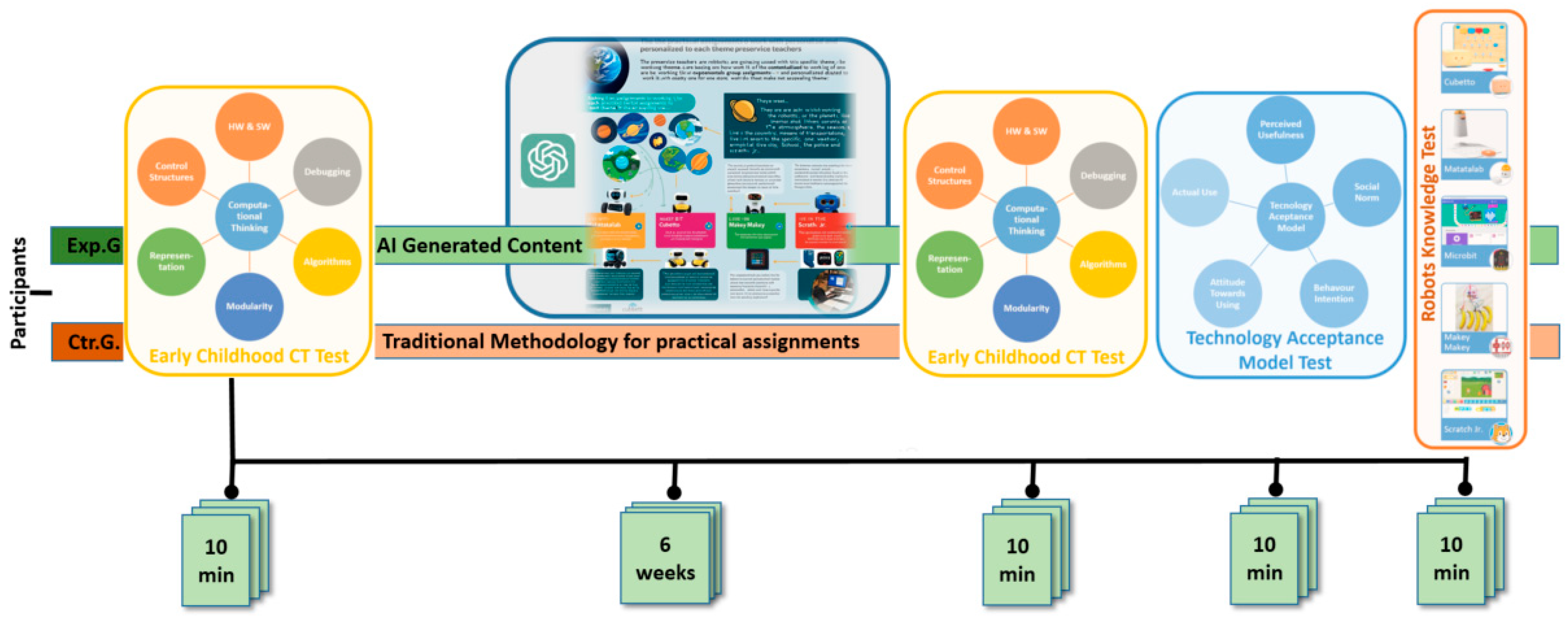
This study investigates the impact of AI-generated contexts on preservice teachers’ computational thinking (CT) skills and their acceptance of educational robotics. This article presents a methodology for teaching robotics based on AI-generated contexts aimed at enhancing CT. An experiment was conducted with 122 undergraduate students enrolled in an Early Childhood Education program, aged 18–19 years, who were training in the Computer Science and Digital Competence course. The experimental group utilized a methodology involving AI-generated practical assignments designed by their lecturers to learn educational robotics, while the control group engaged with traditional teaching methods. The research addressed five key factors: the effectiveness of AI-generated contexts in improving CT skills, the specific domains of CT that showed significant improvement, the perception of student teachers regarding their ability to teach with educational robots, the enhancement in perceived knowledge about educational robots, and the overall impact of these methodologies on teaching practices. Findings revealed that the experimental group exhibited higher engagement and understanding of CT concepts, with notable improvements in problem-solving and algorithmic thinking. Participants in the AI-generated context group reported increased confidence in their ability to teach with educational robots and a more positive attitude toward technology integration in education. The findings highlight the importance of providing appropriate context and support when encouraging future educators to build confidence and embrace educational technologies. This study adds to the expanding research connecting AI, robotics, and education, emphasizing the need to incorporate these tools into teacher training programs. Further studies should investigate the lasting impact of such approaches on computational thinking skills and teaching methods in a variety of educational environments.
Keywords: early childhood education; robotics; computational thinking; generative AIs; preservice teachers early childhood education; robotics; computational thinking; generative AIs; preservice teachers