Motivational Profiles of High Achievers in Mathematics: Relations with Metacognitive Processes and Achievement Emotions


Abstract
1. Introduction
1.1. High Achievers in Mathematics: Motivational Beliefs, Metacognitive Processes, and Achievement Emotions
1.1.1. Motivational Beliefs
1.1.2. Metacognitive Processes
1.1.3. Achievement Emotions
1.1.4. Studying High Achievers with Person-Centered Approaches
1.2. The Present Study
2. Materials and Methods
2.1. Participants
2.2. Measures
2.2.1. Achievement in Mathematics
2.2.2. Motivational Beliefs
2.2.3. Metacognitive Processes
2.2.4. Achievement Emotions
2.3. Procedure
3. Results
3.1. Psychometric Properties of the Scales
3.2. Identification of High Achievers
3.3. Performance Calibration
3.4. Motivational Profiles of High Achievers
4. Discussion
5. Limitations and Future Research
6. Conclusions and Implications for Educational Practice
Author Contributions
Funding
Institutional Review Board Statement
Informed Consent Statement
Data Availability Statement
Acknowledgments
Conflicts of Interest
References
- Sowell, E.J.; Zeigler, A.J.; Bergwall, L.; Cartwright, R.M. Identification and Description of Mathematically Gifted Students: A Review of Empirical Research. Gift. Child Q. 1990, 34, 147–154. [Google Scholar] [CrossRef] [Scilit]
- Floyd, R.G.; Evans, J.J.; McGrew, K.S. Relations between Measures of Cattell-Horn-Carroll (CHC) Cognitive Abilities and Mathematics Achievement across the School-Age Years. Psychol. Sch. 2003, 40, 155–171. [Google Scholar] [CrossRef] [Scilit]
- Lipnevich, A.A.; Preckel, F.; Krumm, S. Mathematics Attitudes and Their Unique Contribution to Achievement: Going over and above Cognitive Ability and Personality. Learn. Individ. Differ. 2016, 47, 70–79. [Google Scholar] [CrossRef] [Scilit]
- Semeraro, C.; Giofrè, D.; Coppola, G.; Lucangeli, D.; Cassibba, R. The Role of Cognitive and Non-Cognitive Factors in Mathematics Achievement: The Importance of the Quality of the Student-Teacher Relationship in Middle School. PLoS ONE 2020, 15, 1–22. [Google Scholar] [CrossRef] [Scilit]
- Eccles, J.S.; Wigfield, A. From Expectancy-Value Theory to Situated Expectancy-Value Theory: A Developmental, Social Cognitive, and Sociocultural Perspective on Motivation. Contemp. Educ. Psychol. 2020, 61, 101859. [Google Scholar] [CrossRef] [Scilit]
- Schukajlow, S.; Rakoczy, K.; Pekrun, R. Emotions and Motivation in Mathematics Education. Theoretical Considerations and Empirical Contributions. ZDM Int. J. Math. Educ. 2017, 49, 307–322. [Google Scholar] [CrossRef] [Scilit]
- Tian, Y.; Fang, Y.; Li, J. The Effect of Metacognitive Knowledge on Mathematics Performance in Self-Regulated Learning Framework: Μultiple Mediation of Self-Efficacy and Motivation. Front. Psychol. 2018, 9, 2518. [Google Scholar] [CrossRef] [Scilit]
- Tzohar-Rozen, M.; Kramarski, B. Metacognition, Motivation and Emotions: Contribution of Self-Regulated Learning to Solving Mathematical Problems. Glob. Educ. Rev. 2014, 1, 76–95. [Google Scholar]
- Freeman, B.; Marginson, S.; Tytler, R. (Eds.) The Age of STEM: Educational Policy and Practice across the World in Science, Technology, Engineering and Mathematics; Routledge: London, UK, 2014. [Google Scholar]
- Gaspard, H.; Dicke, A.L.; Flunger, B.; Brisson, B.M.; Häfner, I.; Nagengast, B.; Trautwein, U. Fostering Adolescents’ Value Beliefs for Mathematics with a Relevance Intervention in the Classroom. Dev. Psychol. 2015, 51, 1226–1240. [Google Scholar] [CrossRef] [Scilit]
- Harackiewicz, J.M.; Rozek, C.S.; Hulleman, C.S.; Hyde, J.S. Helping Parents to Motivate Adolescents in Mathematics and Science: An Experimental Test of a Utility-Value Intervention. Psychol. Sci. 2012, 23, 899–906. [Google Scholar] [CrossRef] [Scilit]
- Raza, A.; Kazi, H.; Ali, M. Metacognitive Mathematics Tutor: Mathematics Tutoring System with Metacognitive Strategies. Int. J. Comput. Appl. 2016, 153, 21–31. [Google Scholar] [CrossRef] [Scilit]
- Rubie-Davies, C.M.; Peterson, E.R.; Sibley, C.G.; Rosenthal, R. A Teacher Expectation Intervention: Modelling the Practices of High Expectation Teachers. Contemp. Educ. Psychol. 2014, 40, 72–85. [Google Scholar] [CrossRef] [Scilit]
- Flake, J.K.; Barron, K.E.; Hulleman, C.S.; McCoach, D.B.; Welsh, M.E. Measuring Cost: The Forgotten Component of Expectancy-Value Theory. Contemp. Educ. Psychol. 2015, 41, 232–244. [Google Scholar] [CrossRef] [Scilit]
- Balaž, B.; Hanzec Marković, I.; Brajša-Žganec, A. The Exploration of the Relationship between Positive Achievement Emotions and Academic Success: Testing the Assumptions of the Control-Value Theory of Achievement Emotions. Educ. Dev. Psychol. 2021, 38, 77–87. [Google Scholar] [CrossRef] [Scilit]
- Camacho-Morles, J.; Slemp, G.R.; Pekrun, R.; Loderer, K.; Hou, H.; Oades, L.G. Activity Achievement Emotions and Academic Performance: A Meta-Analysis. Educ. Psychol. Rev. 2021, 33, 1051–1095. [Google Scholar] [CrossRef] [Scilit]
- Moon, S.M. Myth 15: High-Ability Students Don’t Face Problems and Challenges. Gift. Child Q. 2009, 53, 274–276. [Google Scholar] [CrossRef] [Scilit]
- Reis, S.M.; Renzulli, J.S. Myth 1: The Gifted and Talented Constitute One Single Homogeneous Group and Giftedness Is a Way of Being That Stays in the Person over Time and Experiences. Gift. Child Q. 2009, 53, 233–235. [Google Scholar] [CrossRef] [Scilit]
- Peterson, J.S. Myth 17: Gifted and Talented Individuals Do Not Have Unique Social and Emotional Needs. Gift. Child Q. 2009, 53, 280–282. [Google Scholar] [CrossRef] [Scilit]
- Gonida, E.N.; Karabenick, S.A.; Stamovlasis, D.; Metallidou, P. CTY Greece Help Seeking as a Self-Regulated Learning Strategy and Achievement Goals: The Case of Academically Talented Adolescents. High Abil. Stud. 2019, 30, 147–166. [Google Scholar] [CrossRef] [Scilit]
- Watt, H.M.G.; Bucich, M.; Dacosta, L. Adolescents’ Motivational Profiles in Mathematics and Science: Associations with Achievement Striving, Career Aspirations and Psychological Wellbeing. Front. Psychol. 2019, 10, 990. [Google Scholar] [CrossRef] [Scilit]
- Ng, B.L.L.; Liu, W.C.; Wang, J.C.K. Student Motivation and Learning in Mathematics and Science: A Cluster Analysis. Int. J. Sci. Math. Educ. 2016, 14, 1359–1376. [Google Scholar] [CrossRef] [Scilit]
- Habók, A.; Magyar, A.; Németh, M.B.; Csapó, B. Motivation and Self-Related Beliefs as Predictors of Academic Achievement in Reading and Mathematics: Structural Equation Models of Longitudinal Data. Int. J. Educ. Res. 2020, 103, 101634. [Google Scholar] [CrossRef] [Scilit]
- Guo, J.; Nagengast, B.; Marsh, H.W.; Kelava, A.; Gaspard, H.; Brandt, H.; Cambria, J.; Flunger, B.; Dicke, A.-L.; Häfner, I.; et al. Probing the Unique Contributions of Self-Concept, Task Values, and Their Interactions Using Multiple Value Facets and Multiple Academic Outcomes. AERA Open 2016, 2, 1–20. [Google Scholar] [CrossRef] [Scilit]
- Brisson, B.M.; Dicke, A.L.; Gaspard, H.; Häfner, I.; Flunger, B.; Nagengast, B.; Trautwein, U. Short Intervention, Sustained Effects: Promoting Students’ Math Competence Beliefs, Effort, and Achievement. Am. Educ. Res. J. 2017, 54, 1048–1078. [Google Scholar] [CrossRef] [Scilit]
- Cleary, T.J.; Kitsantas, A. Motivation and Self-Regulated Learning Influences on Middle School Mathematics Achievement. Sch. Psych. Rev. 2017, 46, 88–107. [Google Scholar] [CrossRef] [Scilit]
- Eccles, J.S. Expectancies, Values and Academic Behaviors. In Achievement and Achievement Motives: Psychological and Sociological Approaches; Spence, J.T., Ed.; Freeman and Company: San Francisco, CA, USA, 1983; pp. 75–146. [Google Scholar]
- Bandura, A. Self-Efficacy. In Encyclopedia of Human Behavior; Ramachaudran, V.S., Ed.; Academic Press: New York, NY, USA, 1994; Volume 4, pp. 71–81. ISBN 9780470479216. [Google Scholar]
- Schunk, D.H.; DiBenedetto, M.K. Self-Efficacy and Human Motivation. Adv. Motiv. Sci. 2021, 8, 153–179. [Google Scholar] [CrossRef] [Scilit]
- Hidi, S.; Renninger, K.A. The Four Phase Model of Interest Development. Educ. Psychol. 2006, 41, 111–127. [Google Scholar] [CrossRef] [Scilit]
- Deci, E.L.; Ryan, R.M. Intrinsic Motivation and Self-Determination in Human Behavior; Plenum Press: New York, NY, USA, 1985; ISBN 9781489922731. [Google Scholar]
- Ryan, R.M.; Deci, E.L. Intrinsic and Extrinsic Motivation from a Self-Determination Theory Perspective: Definitions, Theory, Practices, and Future Directions. Contemp. Educ. Psychol. 2020, 61, 101860. [Google Scholar] [CrossRef] [Scilit]
- Barron, K.E.; Hulleman, C.S. Expectancy-Value-Cost Model of Motivation. In International Encyclopedia of the Social & Behavioral Sciences; Eccles, J., Salmelo-Aro, K., Eds.; Elsevier: Amsterdam, The Netherlands, 2015; pp. 503–509. ISBN 9780080970875. [Google Scholar]
- Kosovich, J.J.; Hulleman, C.S.; Barron, K.E.; Getty, S. A Practical Measure of Student Motivation: Establishing Validity Evidence for the Expectancy-Value-Cost Scale in Middle School. J. Early Adolesc. 2015, 35, 790–816. [Google Scholar] [CrossRef] [Scilit]
- Jiang, Y.; Rosenzweig, E.Q.; Gaspard, H. An Expectancy-Value-Cost Approach in Predicting Adolescent Students’ Academic Motivation and Achievement. Contemp. Educ. Psychol. 2018, 54, 139–152. [Google Scholar] [CrossRef] [Scilit]
- Berweger, B.; Born, S.; Dietrich, J. Expectancy-Value Appraisals and Achievement Emotions in an Online Learning Environment: Within- and between-Person Relationships. Learn. Instr. 2022, 77, 101546. [Google Scholar] [CrossRef] [Scilit]
- McCoach, D.B.; Siegle, D. A Comparison of High Achievers’ and Low Achievers’ Attitudes, Perceptions, and Motivations. Acad. Exch. 2001, 2, 71–76. [Google Scholar]
- Gaspard, H.; Wigfield, A.; Jiang, Y.; Nagengast, B.; Trautwein, U.; Marsh, H.W. Dimensional Comparisons: How Academic Track Students’ Achievements Are Related to Their Expectancy and Value Beliefs across Multiple Domains. Contemp. Educ. Psychol. 2018, 52, 1–14. [Google Scholar] [CrossRef] [Scilit]
- Eccles, J.S. Gender Roles and Women’s Achievement-Related Decisions. Psychol. Women Q. 1987, 11, 135–172. [Google Scholar] [CrossRef] [Scilit]
- Guo, J.; Marsh, H.W.; Parker, P.D.; Morin, A.J.S.; Yeung, A.S. Expectancy-Value in Mathematics, Gender and Socioeconomic Background as Predictors of Achievement and Aspirations: A Multi-Cohort Study. Learn. Individ. Differ. 2015, 37, 161–168. [Google Scholar] [CrossRef] [Scilit]
- Marsh, H.W.; Yeung, A.S. Longitudinal Structural Equation Models of Academic Self-Concept and Achievement: Gender Differences in the Development of Math and English Constructs. Am. Educ. Res. J. 1998, 35, 705–738. [Google Scholar] [CrossRef]
- Steinmayr, R.; Spinath, B. Sex Differences in School Achievement: What Are the Roles of Personality and Achievement Motivation? Eur. J. Pers. 2008, 22, 185–209. [Google Scholar] [CrossRef] [Scilit]
- Vermeer, H.J.; Boekaerts, M.; Seegers, G. Motivational and Gender Differences. J. Educ. Psychol. 2000, 92, 308–315. [Google Scholar] [CrossRef]
- Watt, H.M.G.; Shapka, J.D.; Morris, Z.A.; Durik, A.M.; Keating, D.P.; Eccles, J.S. Gendered Motivational Processes Affecting High School Mathematics Participation, Educational Aspirations, and Career Plans: A Comparison of Samples from Australia, Canada, and the United States. Dev. Psychol. 2012, 48, 1594–1611. [Google Scholar] [CrossRef] [Scilit]
- Brown, C.; Putwain, D.W. Socio-Economic Status, Gender and Achievement: The Mediating Role of Expectancy and Subjective Task Value. Educ. Psychol. 2022, 42, 730–748. [Google Scholar] [CrossRef] [Scilit]
- Preckel, F.; Goetz, T.; Pekrun, R.; Kleine, M. Gender Differences in Gifted and Average-Ability Students. Gift. Child Q. 2008, 52, 146–159. [Google Scholar] [CrossRef] [Scilit]
- Reis, S.M.; Park, S. Gender Differences in High-Achieving Students in Math and Science. J. Educ. Gift. 2001, 25, 52–73. [Google Scholar] [CrossRef] [Scilit]
- Flavell, J.H. Metacognition and Cognitive Monitoring: A New Area of Cognitive-Developmental Inquiry. Am. Psychol. 1979, 34, 906–911. [Google Scholar] [CrossRef]
- Veenman, M.V.J.; van Hout-Wolters, B.H.A.M.; Afflerbach, P. Metacognition and Learning: Conceptual and Methodological Considerations. Metacognition Learn. 2006, 1, 3–14. [Google Scholar] [CrossRef] [Scilit]
- Efklides, A.; Metallidou, P. Applying Metacognition and Self-Regulated Learning in the Classroom. In Oxford Research Encyclopedia of Education; Zhang, L., Ed.; Oxford University Press: New York, NY, USA, 2020. [Google Scholar]
- Efklides, A. How Does Metacognition Contribute to the Regulation of Learning? An Integrative Approach. Psychol. Top. 2014, 23, 1–30. [Google Scholar]
- Tay, L.Y.; Chan, M.; Chong, S.K.; Tan, J.Y.; Aiyoob, T.B. Learning of Mathematics: A Metacognitive Experiences Perspective. Int. J. Sci. Math. Educ. 2023. [Google Scholar] [CrossRef]
- Efklides, A.; Volet, S. Emotional Experiences during Learning: Multiple, Situated and Dynamic. Learn. Instr. 2005, 15, 377–380. [Google Scholar] [CrossRef] [Scilit]
- Nerantzaki, K.; Efklides, A.; Metallidou, P. Epistemic Emotions: Cognitive Underpinnings and Relations with Metacognitive Feelings. New Ideas Psychol. 2021, 63, 100904. [Google Scholar] [CrossRef] [Scilit]
- Schneider, W.; Artelt, C. Metacognition and Mathematics Education. ZDM Int. J. Math. Educ. 2010, 42, 149–161. [Google Scholar] [CrossRef] [Scilit]
- Desoete, A.; De Craene, B. Metacognition and Mathematics Education: An Overview. ZDM Math. Educ. 2019, 51, 565–575. [Google Scholar] [CrossRef] [Scilit]
- Efklides, A. The Role of Metacognitive Experiences in the Learning Process. Psicothema 2009, 21, 76–82. [Google Scholar] [PubMed]
- Benito, Y. Metacognitive Ability and Cognitive Strategies to Solve Maths and Transformation Problems. Gift. Educ. Int. 2000, 14, 151–159. [Google Scholar] [CrossRef] [Scilit]
- Shore, B.M. Metacognition and Flexibility: Qualitative Differences in How Gifted Children Think. In Talents unfolding: Cognition and Development; Friedman, R.C., Shore, B.M., Eds.; American Psychological Association: Washington, DC, USA, 2000; pp. 167–187. [Google Scholar]
- Kaizer, C.; Shore, B.M. Strategy Flexibility in More and Less Competent Students on Mathematical Word Problems. Creat. Res. J. 1995, 8, 77–82. [Google Scholar] [CrossRef] [Scilit]
- Efklides, A. Gifted Students and Self-Regulated Learning: The MASRL Model and Its Implications for SRL. High Abil. Stud. 2019, 30, 79–102. [Google Scholar] [CrossRef] [Scilit]
- Hacker, D.J.; Bol, L.; Keener, M.C. Metacognition in Education: A Focus on Calibration. In Handbook of Metamemory and Memory; Dunlosky, J., Bjork, R.A., Eds.; Psychology Press: London, UK, 2008. [Google Scholar]
- Pajares, F.; Graham, L. Self-Efficacy, Motivation Constructs, and Mathematics Performance of Entering Middle School Students. Contemp. Educ. Psychol. 1999, 24, 124–139. [Google Scholar] [CrossRef] [Scilit]
- Kruger, J.; Dunning, D. Unskilled and Unaware of It: How Difficulties in Recognizing One’ s Own Incompetence Lead to Inflated Self-Assessments. J. Pers. Soc. Psychol. 1999, 77, 1121–1134. [Google Scholar] [CrossRef]
- Chen, P.P. Exploring the Accuracy and Predictability of the Self-Efficacy Beliefs of Seventh-Grade Mathematics Students. Learn. Individ. Differ. 2003, 14, 79–92. [Google Scholar] [CrossRef] [Scilit]
- García, T.; Rodríguez, C.; González-Castro, P.; González-Pienda, J.A.; Torrance, M. Elementary Students’ Metacognitive Processes and Post-Performance Calibration on Mathematical Problem-Solving Tasks. Metacognition Learn. 2016, 11, 139–170. [Google Scholar] [CrossRef] [Scilit]
- Erickson, S.; Heit, E. Metacognition and Confidence: Comparing Math to Other Academic Subjects. Front. Psychol. 2015, 6, 742. [Google Scholar] [CrossRef] [Scilit]
- Lingel, K.; Lenhart, J.; Schneider, W. Metacognition in Mathematics: Do Different Metacognitive Monitoring Measures Make a Difference? ZDM Int. J. Math. Educ. 2019, 51, 587–600. [Google Scholar] [CrossRef] [Scilit]
- Wigfield, A.; Meece, J.L. Math Anxiety in Elementary and Secondary School Students. J. Educ. Psychol. 1988, 80, 210–216. [Google Scholar] [CrossRef]
- Ma, X. A Meta-Analysis of the Relationship between Anxiety toward Mathematics and Achievement in Mathematics. J. Res. Math. Educ. 1999, 30, 520–540. [Google Scholar] [CrossRef] [Scilit]
- Ashcraft, M.H. Math Anxiety: Personal, Educational, and Cognitive Consequences. Curr. Dir. Psychol. Sci. 2002, 11, 181–185. [Google Scholar] [CrossRef] [Scilit]
- Ramirez, G.; Shaw, S.T.; Maloney, E.A. Math Anxiety: Past Research, Promising Interventions, and a New Interpretation Framework. Educ. Psychol. 2018, 53, 145–164. [Google Scholar] [CrossRef] [Scilit]
- Chang, H.; Beilock, S.L. The Math Anxiety-Math Performance Link and Its Relation to Individual and Environmental Factors: A Review of Current Behavioral and Psychophysiological Research. Curr. Opin. Behav. Sci. 2016, 10, 33–38. [Google Scholar] [CrossRef] [Scilit]
- Bieleke, M.; Goetz, T.; Yanagida, T.; Botes, E.; Frenzel, A.C.; Pekrun, R. Measuring Emotions in Mathematics: The Achievement Emotions Questionnaire—Mathematics (AEQ-M). ZDM Math. Educ. 2022, 55, 269–284. [Google Scholar] [CrossRef] [Scilit]
- Mouratidis, A.; Vansteenkiste, M.; Lens, W.; Vanden Auweele, Y. Beyond Positive and Negative Affect: Achievement Goals and Discrete Emotions in the Elementary Physical Education Classroom. Psychol. Sport Exerc. 2009, 10, 336–343. [Google Scholar] [CrossRef] [Scilit]
- Pekrun, R.; Lichtenfeld, S.; Marsh, H.W.; Murayama, K.; Goetz, T. Achievement Emotions and Academic Performance: Longitudinal Models of Reciprocal Effects. Child Dev. 2017, 88, 1653–1670. [Google Scholar] [CrossRef] [Scilit]
- Pekrun, R. Emotion and Achievement during Adolescence. Child Dev. Perspect. 2017, 11, 215–221. [Google Scholar] [CrossRef] [Scilit]
- Pekrun, R. The Control-Value Theory of Achievement Emotions: Assumptions, Corollaries, and Implications for Educational Research and Practice. Educ. Psychol. Rev. 2006, 18, 315–341. [Google Scholar] [CrossRef] [Scilit]
- Goetz, T.; Hall, N.C. Emotion and Achievement in the Classroom; Hattie, J., Anderman, E.M., Eds.; Routledge: London, UK, 2013; Volume 251, pp. 192–195. ISBN 9780415879019. [Google Scholar]
- Hembree, R. Correlates, Causes, Effects, and Treatment of Test Anxiety. Rev. Educ. Res. 1988, 58, 47–77. [Google Scholar] [CrossRef]
- Seipp, B. Anxiety and Academic Performance: A Meta-Analysis of Findings. Anxiety Res. 1991, 4, 27–41. [Google Scholar] [CrossRef] [Scilit]
- Roos, A.-L.; Bieg, M.; Goetz, T.; Frenzel, A.C.; Taxer, J.; Zeidner, M. Experiencing More Mathematics Anxiety than Expected? Contrasting Trait and State Anxiety in High Achieving Students. High Abil. Stud. 2015, 26, 245–258. [Google Scholar] [CrossRef] [Scilit]
- van der Beek, J.P.J.; van der Ven, S.H.G.; Kroesbergen, E.H.; Leseman, P.P.M. Self-Concept Mediates the Relation between Achievement and Emotions in Mathematics. Br. J. Educ. Psychol. 2017, 87, 478–495. [Google Scholar] [CrossRef] [Scilit] [PubMed]
- Goetz, T.; Preckel, F.; Pekrun, R.; Hall, N.C. Emotional Experiences during Test Taking: Does Cognitive Ability Make a Difference? Learn. Individ. Differ. 2007, 17, 3–16. [Google Scholar] [CrossRef] [Scilit]
- Goetz, T.; Nett, U.E.; Martiny, S.E.; Hall, N.C.; Pekrun, R.; Dettmers, S.; Trautwein, U. Students’ Emotions during Homework: Structures, Self-Concept Antecedents, and Achievement Outcomes. Learn. Individ. Differ. 2012, 22, 225–234. [Google Scholar] [CrossRef] [Scilit]
- Schwartze, M.M.; Frenzel, A.C.; Goetz, T.; Marx, A.K.G.; Reck, C.; Pekrun, R.; Fiedler, D. Excessive Boredom among Adolescents: A Comparison between Low and High Achievers. PLoS ONE 2020, 15, e0241671. [Google Scholar] [CrossRef] [Scilit]
- Larson, R.W.; Richards, M.H. Boredom in the Middle School Years: Blaming Schools versus Blaming Students. Am. J. Educ. 1991, 99, 418–443. [Google Scholar] [CrossRef] [Scilit]
- Preckel, F.; Goetz, T.; Frenzel, A.C. Ability Grouping of Gifted Students: Effects on Academic Self-Concept and Boredom. Br. J. Educ. Psychol. 2010, 80, 451–472. [Google Scholar] [CrossRef] [Scilit]
- Peixoto, F.; Sanches, C.; Mata, L.; Monteiro, V. “How Do You Feel about Math?”: Relationships between Competence and Value Appraisals, Achievement Emotions and Academic Achievement. Eur. J. Psychol. Educ. 2017, 32, 385–405. [Google Scholar] [CrossRef] [Scilit]
- Goetz, T.; Cronjaeger, H.; Frenzel, A.C.; Lüdtke, O.; Hall, N.C. Academic Self-Concept and Emotion Relations: Domain Specificity and Age Effects. Contemp. Educ. Psychol. 2010, 35, 44–58. [Google Scholar] [CrossRef] [Scilit]
- Conley, A.M. Patterns of Motivation Beliefs: Combining Achievement Goal and Expectancy-Value Perspectives. J. Educ. Psychol. 2012, 104, 32–47. [Google Scholar] [CrossRef] [Scilit]
- Andersen, L.; Cross, T.L. Are Students with High Ability in Math More Motivated in Math and Science than Other Students? Roeper Rev. 2014, 36, 221–234. [Google Scholar] [CrossRef] [Scilit]
- Ziernwald, L.; Hillmayr, D.; Holzberger, D. Promoting High-Achieving Students Through Differentiated Instruction in Mixed-Ability Classrooms—A Systematic Review. J. Adv. Acad. 2022, 33, 540–573. [Google Scholar] [CrossRef] [Scilit]
- Abu, K.; Akkanat, Ç.; Gökdere, M. Teachers’ Views about the Education of Gifted Students in Regular Classrooms. Turkish J. Gift. Educ. 2017, 7, 87–109. [Google Scholar]
- Keller, L.; Preckel, F.; Eccles, J.S.; Brunner, M. Top-Performing Math Students in 82 Countries: An Integrative Data Analysis of Gender Differences in Achievement, Achievement Profiles, and Achievement Motivation. J. Educ. Psychol. 2021, 11, 966–991. [Google Scholar] [CrossRef] [Scilit]
- Sperling, R.A.; Howard, B.C.; Miller, L.A.; Murphy, C. Measures of Children’s Knowledge and Regulation of Cognition. Contemp. Educ. Psychol. 2002, 27, 51–79. [Google Scholar] [CrossRef] [Scilit]
- Pekrun, R.; Goetz, T.; Perry, R.P. Achievement Emotions Questionnaire (AEQ)—User’s Manual; Department of Psychology, University of Munich: Munich, Germany, 2005. [Google Scholar]
- World Medical Association. World Medical Association Declaration of Helsinki World Medical Association Declaration of Helsinki: Ethical Principles for Medical Research Involving Human Subjects. JAMA 2013, 310, 2191. [Google Scholar] [CrossRef] [Scilit]
- Cattell, R.B. The Scree Test for the Number of Factors. Multivariate Behav. Res. 1966, 1, 245–276. [Google Scholar] [CrossRef] [Scilit]
- Field, A. Discovering Statistics Using IBM SPSS Statistics, 5th ed.; SAGE: London, UK, 2018; ISBN 978-1-5264-1951-4. [Google Scholar]
- Boone, W.J.; Staver, J.R.; Yale, M.S. Rasch Analysis in the Human Sciences; Springer: Berlin/Heidelberg, Germany, 2014; ISBN 9789400768567. [Google Scholar]
- Rasch, G. Probabilistic Models for Some Intelligence and Achievement Tests; Danish Institute for Educational Research: Copenhagen, Denmark, 1960; ISBN -0-941938-05-0. [Google Scholar]
- Meyer, J.P. JMetrik, 2018 Version 4.1.1 2018, Mac OS. Available online: https://itemanalysis.com/ (accessed on 30 July 2023).
- JASP Team. JASP, 2020 Version 0.14, Mac OS. Available online: https://jasp-stats.org/previous-versions/ (accessed on 30 July 2023).
- Schraw, G. A Conceptual Analysis of Five Measures of Metacognitive Monitoring. Metacognition Learn. 2009, 4, 33–45. [Google Scholar] [CrossRef] [Scilit]
- Vansteenkiste, M.; Sierens, E.; Soenens, B.; Luyckx, K.; Lens, W. Motivational Profiles from a Self-Determination Perspective: The Quality of Motivation Matters. J. Educ. Psychol. 2009, 101, 671–688. [Google Scholar] [CrossRef] [Scilit]
- Scholte, R.H.J.; van Lieshout, C.F.M.; de Wit, C.A.M.; van Aken, M.G. Adolescent Personality Types and Subtypes and Their Psychosocial Adjustment. Merrill. Palmer. Q. 2005, 51, 258–286. [Google Scholar] [CrossRef] [Scilit]
- Cohen, J. Statistical Power Analysis for the Behavioral Sciences, 2nd ed.; Lawrence Erlbaum Associates: Mahwah, NJ, USA, 1988; ISBN 0805802835. [Google Scholar]
- Pekrun, R.; Elliot, A.J.; Maier, M.A. Achievement Goals and Discrete Achievement Emotions: A Theoretical Model and Prospective Test. J. Educ. Psychol. 2006, 98, 583–597. [Google Scholar] [CrossRef] [Scilit]
- Pekrun, R.; Elliot, A.J.; Maier, M.A. Achievement Goals and Achievement Emotions: Testing a Model of Their Joint Relations with Academic Performance. J. Educ. Psychol. 2009, 101, 115–135. [Google Scholar] [CrossRef] [Scilit]
- Tuominen-Soini, H.; Salmela-Aro, K. Schoolwork Engagement and Burnout among Finnish High School Students and Young Adults: Profiles, Progressions, and Educational Outcomes. Dev. Psychol. 2014, 50, 649–662. [Google Scholar] [CrossRef] [Scilit]
- Marsh, H.W.; Trautwein, U.; Lüdtke, O.; Köller, O.; Baumert, J. Academic Self-Concept, Interest, Grades, and Standarized Test Scores: Reciprocal Effects Models of Causal Ordering. Child Dev. 2005, 76, 397–416. [Google Scholar] [CrossRef] [Scilit]
- Castejón, J.L.; Gilar, R.; Miñano, P.; González, M. Latent Class Cluster Analysis in Exploring Different Profiles of Gifted and Talented Students. Learn. Individ. Differ. 2016, 50, 166–174. [Google Scholar] [CrossRef] [Scilit]
- Dixon, F.A.; Cross, T.L.; Adams, C.M. Psychological Characteristics of Academically Gifted Students in a Residential Setting: A Cluster Analysis. Psychol. Sch. 2001, 38, 433–445. [Google Scholar] [CrossRef] [Scilit]
- Rinn, A.N.; Mendaglio, S.; Rudasill, K.M.; McQueen, K.S. Examining the Relationship between the Overexcitabilities and Self-Concepts of Gifted Adolescents via Multivariate Cluster Analysis. Gift. Child Q. 2010, 54, 3–17. [Google Scholar] [CrossRef] [Scilit]
- Jang, L.Y.; Liu, W.C. 2×2 Achievement Goals and Achievement Emotions: A Cluster Analysis of Students’ Motivation. Eur. J. Psychol. Educ. 2012, 27, 59–76. [Google Scholar] [CrossRef] [Scilit]
- Ding, L.; Pepin, B.; Jones, K. Students’ Attitudes towards Mathematics across Lower Secondary Schools in Shanghai. In From Beliefs to Dynamic Affect Systems in Mathematics Education; Pepin, B., Roesken-Winter, B., Eds.; Springer: Cham, Switzerland, 2015; pp. 157–178. ISBN 978-3-319-06808-4. [Google Scholar]
- Jacobs, J.E.; Lanza, S.; Osgood, W.D.; Eccles, J.S.; Wigfield, A. Changes in Childrens Self-Competence and Values: Gender and Domain Differences Accross Grades One through Twelve. Child Dev. 2002, 73, 509–527. [Google Scholar] [CrossRef] [Scilit] [PubMed]
- Rogers, K.; Robinson, D. Measuring Affect and Emotions. In Handbook of the Sociology of Emotions; Springer: Cham, Switzerland, 2014; Volume II, pp. 283–303. ISBN 9780387307138. [Google Scholar]
- Frenzel, A.C.; Pekrun, R.; Goetz, T. Girls and Mathematics—A “Hopeless” Issue? A Control-Value Approach to Gender Differences in Emotions towards Mathematics. Eur. J. Psychol. Educ. 2007, 22, 497–514. [Google Scholar] [CrossRef] [Scilit]
- Frenzel, A.C.; Thrash, T.M.; Pekrun, R.; Goetz, T. Achievement Emotions in Germany and China: A Cross-Cultural Validation of the Academic Emotions Questionnaire-Mathematics. J. Cross. Cult. Psychol. 2007, 38, 302–309. [Google Scholar] [CrossRef] [Scilit]
- Grossman, M.; Wood, W. Sex Differences in Emotional Intensity: A Social Role Interpretation. J. Pers. Soc. Psychol. 1993, 65, 1010–1022. [Google Scholar] [CrossRef] [PubMed]
- Winne, P.H.; Jamieson-Noel, D. Exploring Students’ Calibration of Self Reports about Study Tactics and Achievement. Contemp. Educ. Psychol. 2002, 27, 551–572. [Google Scholar] [CrossRef] [Scilit]
- Gaspard, H.; Häfner, I.; Parrisius, C.; Trautwein, U.; Nagengast, B. Assessing Task Values in Five Subjects during Secondary School: Measurement Structure and Mean Level Differences across Grade Level, Gender, and Academic Subject. Contemp. Educ. Psychol. 2017, 48, 67–84. [Google Scholar] [CrossRef] [Scilit]
- Gonida, E.N.; Kiosseoglou, G.; Leondari, A. Implicit Theories of Intelligence, Perceived Academic Competence and School Achievement: Developmental Differences and Educational Implications. Am. J. Psychol. 2006, 119, 223–238. [Google Scholar] [CrossRef] [Scilit]
- Midgley, C.; Feldlaufer, H.; Eccles, J.S. Change in Teacher Efficacy and Student Self- and Task-Related Beliefs in Mathematics During the Transition to Junior High School. J. Educ. Psychol. 1989, 81, 247–258. [Google Scholar] [CrossRef]
- Johnston, O.; Wildy, H.; Shand, J. A Decade of Teacher Expectations Research 2008–2018: Historical Foundations, New Developments, and Future Pathways. Aust. J. Educ. 2019, 63, 44–73. [Google Scholar] [CrossRef] [Scilit]
- Parker, P.D.; Schoon, I.; Tsai, Y.-M.; Nagy, G.; Trautwein, U.; Eccles, J.S. Achievement, Agency, Gender, and Socioeconomic Background as Predictors of Postschool Choices: A Multicontext Study. Dev. Psychol. 2012, 48, 1629–1642. [Google Scholar] [CrossRef] [Scilit] [PubMed]
- Schukajlow, S.; Rakoczy, K. The Power of Emotions: Can Enjoyment and Boredom Explain the Impact of Individual Preconditions and Teaching Methods on Interest and Performance in Mathematics? Learn. Instr. 2016, 44, 117–127. [Google Scholar] [CrossRef] [Scilit]
- Hulleman, C.S.; Barron, K.E.; Kosovich, J.J.; Lazowski, R.A. Student Motivation: Current Theories, Constructs, and Interventions within an Expectancy-Value Framework. In Psychosocial Skills and School Systems in the 21st Century: Theory, Research, and Applications; Lipnevich, A., Preckel, F., Roberts, R., Eds.; Springer: Cham, Switzerland, 2015; pp. 241–278. ISBN 978-3-319-28604-4. [Google Scholar]
- Wigfield, A.; Rosenzweig, E.Q.; Eccles, J.S. Achievement Values. In Handbook of Competence and Motivation; Elliot, A.J., Dweck, C.S., Yeager, D.S., Eds.; The Guilford Press: New York, NY, USA, 2017; pp. 116–134. [Google Scholar]
- Rozek, C.S.; Hyde, J.S.; Svoboda, R.C.; Hulleman, C.S.; Harackiewicz, J.M. Gender Differences in the Effects of a Utility-Value Intervention to Help Parents Motivate Adolescents in Mathematics and Science. J. Educ. Psychol. 2015, 107, 195–206. [Google Scholar] [CrossRef] [Scilit]
- Hulleman, C.S.; Godes, O.; Hendricks, B.L.; Harackiewicz, J.M. Enhancing Interest and Performance With a Utility Value Intervention. J. Educ. Psychol. 2010, 102, 880–895. [Google Scholar] [CrossRef] [Scilit]
- Rosenzweig, E.Q.; Wigfield, A.; Eccles, J.S. Beyond Utility Value Interventions: The Why, When, and How for next Steps in Expectancy-Value Intervention Research. Educ. Psychol. 2022, 57, 11–30. [Google Scholar] [CrossRef] [Scilit]
- Johnson, M.L.; Sinatra, G.M. Use of Task-Value Instructional Inductions for Facilitating Engagement and Conceptual Change. Contemp. Educ. Psychol. 2013, 38, 51–63. [Google Scholar] [CrossRef] [Scilit]
- Rosenzweig, E.Q.; Wigfield, A.; Hulleman, C.S. More Useful or Not so Bad? Examining the Effects of Utility Value and Cost Reduction Interventions in College Physics. J. Educ. Psychol. 2020, 112, 166–182. [Google Scholar] [CrossRef] [Scilit]
- Goetz, T.; Frenzel, A.C.; Hall, N.C.; Pekrun, R. Antecedents of Academic Emotions: Testing the Internal/External Frame of Reference Model for Academic Enjoyment. Contemp. Educ. Psychol. 2008, 33, 9–33. [Google Scholar] [CrossRef] [Scilit]
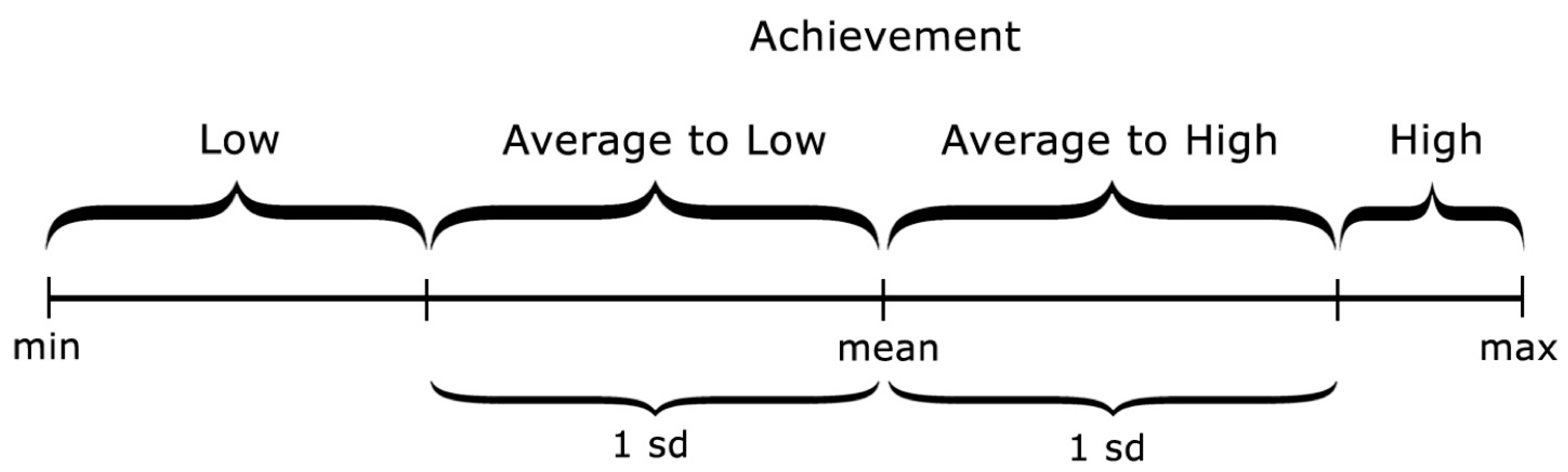


| Category | Achievement | Ν | % |
|---|---|---|---|
| 1 | High | 31 | 10.4 |
| 2 | Average to High | 104 | 35.0 |
| 3 | Average to Low | 124 | 41.8 |
| 4 | Low | 38 | 12.8 |
| Total | 297 | 100.0 |
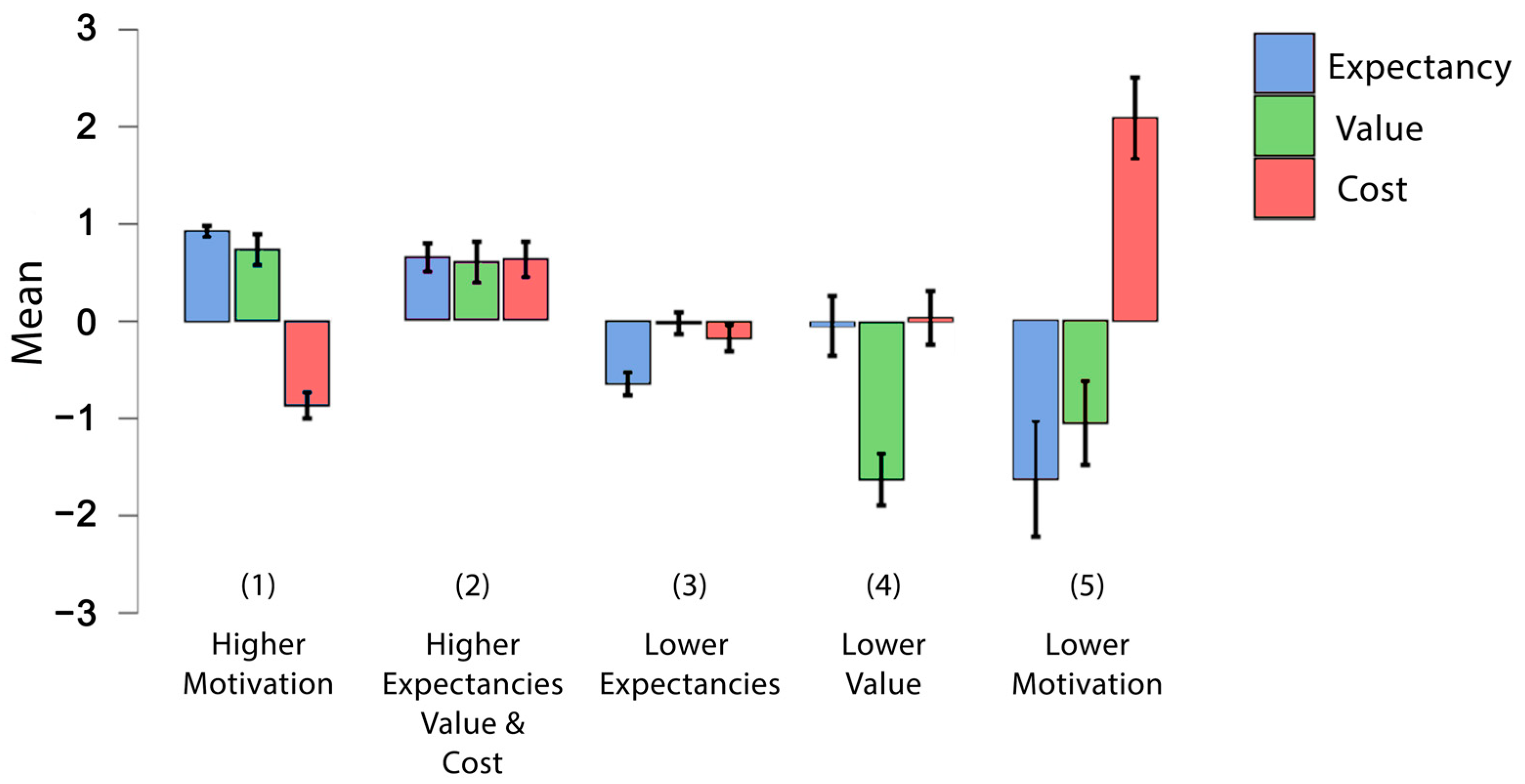
| Cluster | 1 | 2 | 3 | 4 | 5 |
|---|---|---|---|---|---|
| Relative Size | 27% | 17.7% | 34% | 12.8% | 8.5% |
| Expectancy | 4.95 (0.93) | 4.75 (0.64) | 3.85 (−0.64) | 4.28 (−0.04) | 3.17 (−1.63) |
| Value | 4.52 (0.73) | 4.41 (0.59) | 3.97 (−0.02) | 2.78 (−1.62) | 3.19 (−1.05) |
| Cost | 1.54 (−0.87) | 2.62 (0.62) | 2.05 (−0.17) | 2.19 (0.03) | 3.69 (2.08) |
| Cluster | (1) | Higher Motivation | (2) | Higher Expectancies, Value & Cost | (3) | Lower Expectancies | (4) | LowerValue | (5) | Lower Motivation | ||
|---|---|---|---|---|---|---|---|---|---|---|---|---|
| Mean (z) | sd | Mean (z) | sd | Mean (z) | sd | Mean (z) | sd | Mean (z) | sd | F | ηp2 | |
| Metacognitive Awareness | 3.93 (0.59) a | 0.37 | 3.84 (0.39) a,b | 0.44 | 3.49 (−0.40) c | 0.30 | 3.48 (−0.43) c | 0.58 | 3.49 (−0.43) b,c | 0.42 | 9.102 *** | 0.212 |
| Perceived Difficulty | 1.38 (−0.44) | 0.36 | 1.63 (0.16) | 0.41 | 1.66 (0.23) | 0.45 | 1.57 (0.02) | 0.32 | 1.64 (0.18) | 0.48 | 2.852 * | 0.078 |
| Perceived Certainty | 4.83 (0.54) a | 0.28 | 4.55 (−0.06) a,b | 0.43 | 4.48 (−0.21) b | 0.57 | 4.51 (−0.15) a,b | 0.37 | 4.37 (−0.45) b | 0.47 | 4.332 ** | 0.114 |
| Metacognitive Accuracy | 0.34 (−0.31) | 0.53 | 0.66 (0.09) | 0.75 | 0.70 (0.14) | 1.06 | 0.66 (0.08) | 0.74 | 0.70 (0.13) | 0.66 | 1.263 | 0.036 |
| Enjoyment | 4.06 (0.77) a | 0.54 | 3.40 (−0.10) c,b | 0.78 | 3.45 (−0.04) b | 0.51 | 2.88 (−0.79) c | 0.66 | 2.81 (−0.89) c | 0.93 | 15.545 *** | 0.314 |
| Pride | 4.09 (0.76) a | 0.53 | 3.69 (0.23) a,b | 0.62 | 3.34 (−0.23) c,b | 0.46 | 2.98 (−0.71) c | 1.01 | 2.85 (−0.88) c | 0.83 | 15.834 *** | 0.318 |
| Boredom | 1.73 (−0.47) c | 0.89 | 2.27 (0.11) b,c | 1.07 | 1.95 (−0.23) c | 0.59 | 2.88 (0.76) a,b | 0.80 | 3.15 (1.04) a | 0.91 | 11.161 *** | 0.247 |
| Anxiety | 1.42 (−0.73) c | 0.36 | 2.04 (0.14) b | 0.77 | 2.11 (0.24) b | 0.59 | 1.80 (−0.19) b,c | 0.54 | 2.85 (1.29) a | 0.82 | 15.770 *** | 0.317 |
| Shame | 1.51 (−0.52) c | 0.56 | 1.96 (0.05) b,c | 0.84 | 2.06 (0.17) b | 0.71 | 1.74 (−0.23) b,c | 0.58 | 2.89 (1.21) a | 1.04 | 9.228 *** | 0.213 |
Disclaimer/Publisher’s Note: The statements, opinions and data contained in all publications are solely those of the individual author(s) and contributor(s) and not of MDPI and/or the editor(s). MDPI and/or the editor(s) disclaim responsibility for any injury to people or property resulting from any ideas, methods, instructions or products referred to in the content. |
© 2023 by the authors. Licensee MDPI, Basel, Switzerland. This article is an open access article distributed under the terms and conditions of the Creative Commons Attribution (CC BY) license (https://creativecommons.org/licenses/by/4.0/).
Share and Cite
Moustakas, D.; Gonida, E.Ν. Motivational Profiles of High Achievers in Mathematics: Relations with Metacognitive Processes and Achievement Emotions. Educ. Sci. 2023, 13, 970. https://doi.org/10.3390/educsci13100970
Moustakas D, Gonida EΝ. Motivational Profiles of High Achievers in Mathematics: Relations with Metacognitive Processes and Achievement Emotions. Education Sciences. 2023; 13(10):970. https://doi.org/10.3390/educsci13100970
Chicago/Turabian StyleMoustakas, Dimitrios, and Eleftheria Ν. Gonida. 2023. "Motivational Profiles of High Achievers in Mathematics: Relations with Metacognitive Processes and Achievement Emotions" Education Sciences 13, no. 10: 970. https://doi.org/10.3390/educsci13100970
APA StyleMoustakas, D., & Gonida, E. Ν. (2023). Motivational Profiles of High Achievers in Mathematics: Relations with Metacognitive Processes and Achievement Emotions. Education Sciences, 13(10), 970. https://doi.org/10.3390/educsci13100970