1. Introduction
In an era of deepening financial globalisation, investors and asset managers are increasingly adopting cross-border strategies to enhance portfolio efficiency and optimise performance. A central element of these strategies lies in understanding the extent to which stock markets across different economies move in tandem. Of particular importance is the relationship between the United States—the world’s largest and most influential financial market—and major emerging markets, which has become a focal point for both scholars and practitioners. The degree of correlation between U.S. and emerging-market stock returns carries substantial implications for risk management, portfolio diversification, and international capital allocation. A growing body of empirical evidence suggests that incorporating both developed and emerging market assets into investment portfolios yields significant diversification benefits, particularly in mitigating risk. These benefits stem from the generally low correlations between the two market groups, enabling investors to reduce portfolio volatility, enhance Sharpe ratios, and improve overall risk-adjusted returns (
Mensi et al., 2017;
Patel, 2021).
When correlations are low or negative, investors can capitalise on cross-market diversification opportunities to reduce overall portfolio risk and strengthen resilience against shocks. In contrast, high or persistent correlations erode the benefits of diversification and heighten exposure to systemic risks, particularly during periods of global financial stress when markets tend to move in tandem. These dynamics are especially salient for emerging markets, given their increasing integration into global capital markets and heightened vulnerability to external shocks from the United States. Accordingly, understanding the degree and underlying drivers of these correlations offers critical insights into the scope for diversification, hedging, and safe-haven strategies in an interconnected financial system. Moreover, these structural drivers can function as early warning indicators, enabling investors to anticipate shifts in co-movement or decoupling and to make timely portfolio adjustments (
Morema & Bonga-Bonga, 2020).
Although a substantial body of research has examined stock market correlations, much of the existing literature has concentrated on the temporal dynamics of integration (
Song et al., 2021;
Wan et al., 2021;
Bonga-Bonga & Mabe, 2020;
Endri et al., 2024;
Malladi et al., 2025) or on specific regional linkages (
Corbet et al., 2021;
Gopane, 2023;
Shi, 2022;
Heinlein et al., 2021;
Khan, 2024). By contrast, relatively limited scholarly attention has been devoted to the structural determinants that shape the co-movements between U.S. stock markets and major emerging economies. Unpacking these determinants is critical, as they can reveal whether shocks are propagated through real economic channels, financial linkages, or broader structural asymmetries. Such insights carry significant implications for investors, offering valuable signals to inform hedging decisions, portfolio diversification strategies, and asset liquidation policies.
Only a limited number of studies have directly investigated these structural determinants (
Aggarwal et al., 2024;
McMillan et al., 2021). For instance,
McMillan et al. (
2021) identify oil as a key factor influencing correlations between the United States and major oil-exporting economies, showing that oil returns and oil price volatility account for a substantial portion of the observed co-movement. Fewer studies, however, have examined spatial dimensions—particularly the role of distance in shaping financial linkages. Early contributions (
Grinblatt & Keloharju, 2001;
Flavin et al., 2002;
Chong et al., 2011;
Xiong et al., 2025) prove that geographical distance weakens stock market correlations. Notably,
Chong et al. (
2011) demonstrate a negative relationship between bilateral stock market correlations and Great Circle Distance across 23 countries.
Xiong et al. (
2025) examine how the geographical distance between mutual funds and firms affects stock price synchronisation in China. Using data from the Shanghai and Shenzhen Stock Exchanges, their findings show that greater distance increases price synchronisation due to heightened information asymmetry. Firms in regions with stronger governance benefit more from reduced information gaps than those in weaker regulatory environments.
This paper addresses these gaps by broadening the analysis of the determinants of stock market correlations between developed (the U.S.) and emerging markets. Specifically, it incorporates multiple forms of distance—geographical distance, economic distance, and remoteness—together with trade intensity, to explain the conditional correlations between the United States and key emerging equity markets. Whereas previous studies have primarily relied on the gravity model to examine the effects of geographical distance on selected economic and financial variables, this study advances the literature by extending the scope to include multidimensional distance measures and assessing their influence on stock market co-movements. In doing so, it provides novel insights into how spatial and structural asymmetries shape market integration in economies that are particularly relevant for international portfolio diversification.
The contributions of this paper are threefold. First, it comprehensively analyses the structural and spatial determinants of stock market co-movements between the United States and key emerging economies. In doing so, it applies the Poisson Pseudo Maximum Likelihood (PPML) estimator within a gravity model framework, which offers a robust approach to addressing heteroscedasticity and zero-value issues that often arise in bilateral financial linkages. Second, it models the conditional correlations between the U.S. and major emerging stock markets to uncover their structure and dynamic trends, using the DCC-GARCH model. Third, the paper evaluates the role of trade intensity as a conditioning factor in shaping stock market interconnectedness between the U.S. and emerging economies. By examining how trade flows influence the strength and direction of financial linkages, this contribution highlights an important channel of financial integration with direct implications for international portfolio diversification. In particular, it demonstrates that trade intensity has a non-trivial effect on the dynamic correlations of stock markets, influencing whether markets serve as substitutes or complements in global investment portfolios. Finally, it evaluates the role of trade intensity in shaping stock market linkages between the U.S. and emerging markets, thereby highlighting an important channel of financial integration with direct implications for portfolio diversification strategies. Specifically, this contribution reveals how trade intensity influences the dynamic correlations of stock markets in countries whose equities are commonly used for portfolio diversification.
The remainder of the paper is organised as follows.
Section 2 reviews the relevant literature.
Section 3 presents the methodology.
Section 4 discusses the data and results.
Section 5 concludes with key findings and implications.
2. Literature Review
The literature examining how distance shapes financial market co-movements has expanded significantly, reflecting a broader recognition that bilateral relations between countries influence stock market correlations through multiple channels. Distance in financial markets transcends physical geography; it encompasses cultural, institutional, informational, and behavioural dimensions that structure how investors interpret signals, transmit information, and synchronise asset prices. Within this context, stock market integration is understood as the degree to which markets share common information sets, respond to similar macroeconomic fundamentals, and transmit shocks across borders. This interplay between distance and market integration forms a conceptual foundation for understanding both fundamental-based contagion—where shocks propagate due to shared economic linkages—and pure contagion, which arises from shifts in sentiment, herding behaviour, or informational frictions unrelated to fundamentals.
Empirical studies within the gravity-model tradition provide early insights into how spatial factors influence financial correlations. Research on geographic distance has consistently shown that physical separation weakens information transmission and limits arbitrage, thereby reducing market co-movement.
Chong et al. (
2011), using data from 23 countries, document a negative association between bilateral market correlations and great-circle distance, suggesting that physical closeness enhances informational efficiency and price discovery. Similar conclusions are drawn from
Bonga-Bonga and Manguzvane (
2023), who combine the DCC-GARCH and PPML methods to model correlations between stock markets. Their results confirm that correlations decline as geographical distance increases, reinforcing the idea that physical separation elevates informational frictions and reduces synchronous pricing.
Xiong et al. (
2025) assess how the geographical distance between mutual funds and firms affects stock price synchronisation in China. The authors find that greater distance increases price synchronisation due to heightened information asymmetry.
Beyond geographical distance, recent studies emphasise the role of social and cultural distance in shaping financial linkages.
Y. Liu (
2020) introduces “trust distance”—a measure capturing beliefs about counterpart honesty—as a behavioural dimension of financial distance. Using a panel of 22 countries, the study finds that greater trust distance lowers stock market correlations, especially when trade ties are strong. This finding bridges behavioural finance and structural gravity models by suggesting that cultural affinity and trust reduce frictions, enhancing the transmission of fundamental information across markets.
The moderating role of cultural proximity has also been explored.
Lucey and Zhang (
2010) show that country pairs with smaller cultural distance exhibit stronger financial integration, even after controlling for alternative measures of cultural traits. Their findings are particularly pronounced among countries with active bilateral financial and trade relations, indicating that cultural similarity enhances both fundamental-based linkages and behavioural channels of co-movement. This conclusion aligns with the extended analysis by
Zhou et al. (
2019), who demonstrate that cultural dimensions and cultural distance have a significant influence on volatility co-movement and cross-border investment flows. Smaller cultural distance is associated with more similar volatility dynamics and higher levels of securities investment, illustrating how cultural proximity shapes both fundamental and pure contagion processes.
Spatial econometric approaches further extend this literature by disentangling economic fundamentals from spatial dependence.
Asgharian et al. (
2013) find that bilateral trade, as a proxy for real economic integration, is the dominant channel explaining return co-variations across international markets. Their results show that shocks originating in dominant economies such as the U.S., the U.K., and Japan propagate widely through trade linkages, demonstrating fundamentals-based contagion. Importantly, they also document that the influence of geographic proximity has diminished over time, especially during recessions, when behavioural contagion and global risk aversion intensify.
The literature has also incorporated institutional distance to explain variations in stock market synchronisation.
Guo and Tu (
2021) explore the “liability of foreignness” hypothesis, which posits that foreign investors face greater disadvantages in unfamiliar institutional environments. Their findings reveal that institutional distance affects synchronisation in complex ways: economic distance increases co-movement, while political, financial, demographic, and global connectedness distances reduce it. This mixed result suggests that different forms of institutional distance may mediate either fundamental-based or pure contagion mechanisms.
Despite these contributions, a notable gap remains in the literature regarding the effect of distance measures on stock market linkages between the United States and key emerging economies. No existing study systematically analyses various distance dimensions—geographic, cultural, economic, and institutional—while simultaneously considering trade intensity and using a PPML specification suited to gravity models. Traditional log-linear regressions used in earlier studies struggle with the high prevalence of zero trade flows and heteroscedasticity. The PPML estimator offers a more robust alternative by accommodating zero flows and producing consistent estimates under heteroscedasticity, making it theoretically and empirically appropriate for modelling bilateral financial relationships.
By integrating multiple forms of distance with economic fundamentals and market integration measures, this study advances the literature in an important direction. It provides new empirical evidence on how different dimensions of distance shape stock market correlations between the U.S. and emerging economies, capturing both fundamental-based contagion through trade linkages and pure contagion driven by informational frictions and behavioural responses.
3. Methodology
This section elaborates on the methodology employed to analyse the effect of various measures of economic distance on the dynamic conditional correlations between equity markets in the USA and the top emerging countries. It is essential to note that the DCC-GARCH model is first estimated, and its resulting dynamic correlations are then utilised in the gravity model, which is specified and estimated using PPML. To validate the results obtained using the PPML method, nonlinear least squares (NLS) estimation was employed for robustness.
The DCC-GARCH model applied to estimate the dynamic correlation between stock markets follows these steps:
The mean and variance equations are modelled as:
where
is the return of the stock market
i at time
t.
is the mean return.
is the shock conditional on a set of news available at
t − 1, which is represented by
. Equation (2) assumes GARCH (1,1).
The conditional variance–covariance matrix,
obtained from Equation (2) can be specified as:
where
is the conditional correlation estimator and
is the diagonal matrix of the time-varying conditional standard deviations of returns expressed as
, where
is the dynamic conditional volatility for each equity market’s return following Equation (2).
is the dynamic conditional correlation matrix, which is obtained from the standardised residuals from the GARCH (1,1) as follows:
where
is the unconditional covariance of standardised residuals.
. The conditional correlation between any two variables that is time-varying is then written as
The dynamic conditional correlation can also be computed as:
where
is the dynamic conditional correlation between equity markets in the USA and the top emerging countries. If
is positive, both stock market returns in the two countries move together in the same direction. In contrast, a negative
indicates that the co-movement of returns is in different directions.
The paper employs the Poisson Pseudo Maximum Likelihood (PPML) estimator as proposed by
Silva and Tenreyro (
2006). The PPML framework estimates the model in levels rather than logs, thereby accommodating zero observations and avoiding the bias associated with heteroskedasticity. The estimator relies on the conditional mean assumption
, and the coefficients are obtained by maximising the pseudo log-likelihood function. The first-order conditions imply that the PPML estimates are consistent if the mean specification is correct, even if the data are not truly Poisson distributed. Robust standard errors are used to ensure valid inference in the presence of heteroskedasticity.
The specification of our model is as follows:
where
includes
Thus,
where
is the conditional pairwise correlation between the United States (U.S.) equity market and country
j at period
t obtained via the DCC GARCH model.
and
are the inflation differential and currency exchange rates between nations
i and
j.
is the economic mass between nation i and nation j. Economic mass is the product of the two countries’ GDPs, which was obtained as follows:
where
is the economic mass between nation
i and
j.
are the real GDP of the USA and emerging countries, respectively.
is the economic distance between the two countries, which is specified as:
Remoteness captures the concept of multilateral resistance (
Anderson & van Wincoop, 2003), which posits that trade between two countries depends on both their bilateral distance and the overall ease of trading with all other partners.
The standard remoteness index for country
is:
where
remoteness index of country
distance between country and partner country
of partner
A higher remoteness value means a country is less remote (with more partners close to it). A lower remoteness value means a country is more remote (its partners are either small or far away).
Trade intensity between nation
i and nation
j is specified as follows:
where
is the trade intensity.
is the total exports from nation
i to nation
j, whereas
is the total imports of nation
i from nation
j.
4. Data, Empirical Results and Discussion
4.1. Data
To examine how various distance specifications impact the dynamic correlation between the USA and emerging equity markets, quarterly data from 1998 to 2023 were used. Data availability was the primary determinant of the time interval used in this analysis, particularly for data related to different distances. Moreover, the sample period encompasses both stable and turbulent phases, enabling the analysis to capture the diverse economic regimes within these countries. The seven emerging countries used in this study were selected based on their stock market capitalisation among emerging economies
Equity market index data were obtained from Yahoo Finance. The GDP data were sourced from the World Bank database to construct economic mass and economic distance. The inflation rate and currency exchange rate data were sourced from Refinitiv. Inflation-rate differentials and exchange rates were used as control variables, following
Paramati et al. (
2018). Trade intensity was built from export and import data from the World Integrated Trade Solutions. The geographical distance data used to construct remoteness were obtained from the CEPII database.
Table 1 presents the descriptive statistics of the variables used. The statistics in the Table show that the mean returns approximate the stationary level of zero, which theoretically supports the principle of economic profit (
Mundt et al., 2020). The mean returns of emerging markets are higher than those of the U.S., supporting the principle that emerging economies tend to offer higher returns. However, their standard deviations are higher than those of the U.S. due to the higher risk associated with emerging economies. Other key descriptive statistics are presented in the
Appendix A.
4.2. Empirical Results
The first step of the paper aimed to construct the conditional correlation of the U.S. and each of the merging market equity markets using the DCC GARCH model. Given that the model necessitates high-frequency data, we used weekly data for the abovementioned analysis. Subsequently, we employed temporal aggregation to convert weekly data into quarterly data.
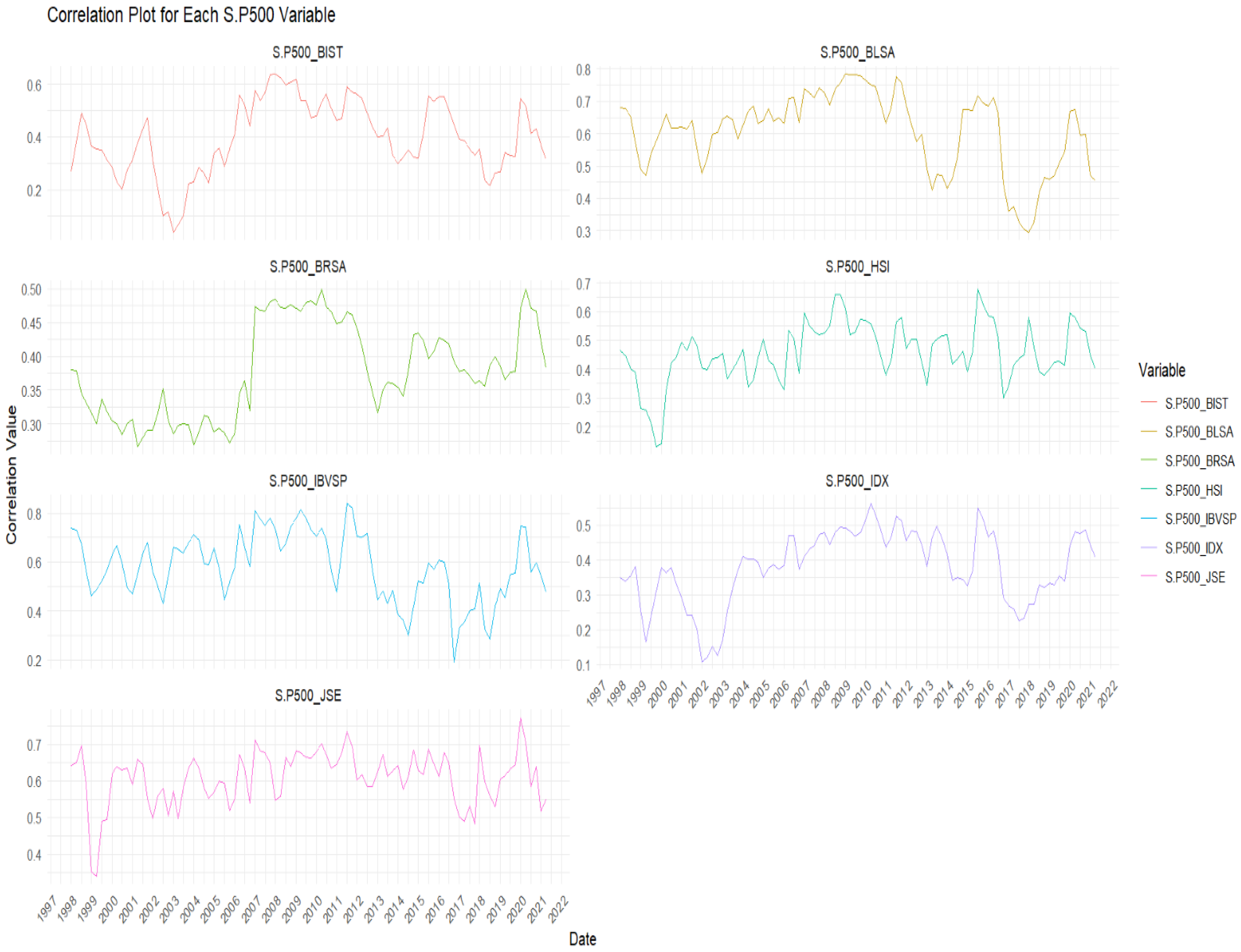
Figure 1 shows the conditional correlation display obtained for the DCC-GARCH model. The standard features of these graphs are that periods of crisis are evidenced by the increase in the dynamic conditional correlation between the U.S. and emerging markets, showing possible contagion during global crises, such as the Latin America crisis of 2002, the global financial crisis of 2008, the European debt crisis of 2009, the 2016 emerging market crisis and the COVID-19 crisis.
The descriptive statistics of the dynamic conditional correlation are presented in
Table 2. The results reveal a strictly positive correlation between equity returns in the USA and emerging markets from 1998 to 2023. South Africa has the strongest mean correlation with the U.S., at 0.609, followed by Mexico and Brazil, with correlations of 0.606 and 0.583, respectively.
Focusing on the core of this paper, which assesses the effects of different distances on the dynamic conditional correlation between the U.S. and equity markets,
Table 3 presents the gravity model results based on the PPML methodology.
Subsequently, to examine the dynamic correlations between the USA and the equity markets of developing countries, the study analysed the impact of various distance measures on correlations using the PPML gravity model, as expressed in Equation (8). The estimation results for Equation (8) are presented in
Table 3.
The results reported in
Table 3 indicate that most coefficients are statistically significant, except for the exchange rates. Moreover, different distances have different signs regarding their effect on the conditional correlation of the equity returns. For example, a one-unit increase in economic distance reduced the correlation in the equity market by 0.32 percentage points. A 1% increase in economic mass results in 0.11 percentage point changes in equity market correlation between the U.S. and the selected equity markets. On the other hand, geographical distance has a detrimental effect on the correlation of the equity market. Remoteness, which reflects a country’s isolation from major global markets, is positively correlated with its equity market’s correlation with the U.S. The more remote an emerging country is, the higher the co-movement of its equity market with the USA market.
Trade Intensity between the U.S. and emerging markets has a negative impact on their equity market correlation. A widening gap in inflation between the USA and emerging countries reduced stock market correlations.
5. Discussion of Results
Table 3 presents intriguing results that warrant careful interpretation. The observed negative relationship between stock return correlations and economic distance is consistent with findings in the literature (
Wu et al., 2025;
Omoshoro-Jones & Bonga-Bonga, 2020;
Kinfack & Bonga-Bonga, 2020). These studies suggest that reducing economic distance fosters greater synchronisation of business and financial cycles across countries. As economies become more alike in their structures, levels of development, and financial integration, their markets tend to react more uniformly to global and domestic shocks. This increasing alignment translates into higher conditional correlations of equity markets, reflecting the growing interconnectedness of economic fundamentals and investor behaviour across borders. On the other hand, the negative relationship between stock return correlations and economic distance can also stem from differences in economic structures, policy frameworks, investor bases, and asynchronous business cycles, which explain greater economic distance or a higher difference in GDP. These factors reduce the co-movement of equity returns, explaining why economic distance results in a decline in stock market correlation.
The positive effect of economic mass on stock market correlations aligns with findings in the broader literature. For instance,
Esposito (
2017) shows that larger combined economic mass enhances trade flows between countries. Since economic mass captures the aggregate GDP of trading partners, an increase reflects stronger financial and commercial linkages, facilitating deeper cross-border integration. Larger economies not only trade more intensively but are also more likely to experience synchronised business cycles, encourage cross-listings of firms, and attract international investors. These mechanisms promote greater financial market integration, ultimately resulting in stronger positive correlations between their equity markets.
The negative effect of geographical distance on stock market correlation is well-documented (
Guo & Tu, 2021;
Bonga-Bonga & Manguzvane, 2023;
Grinblatt & Keloharju, 2001;
Zaheer, 1995).
Grinblatt and Keloharju (
2001) contend that information frictions are the key reason distance matters, as geographical distance is often used as a proxy for information costs in financial markets. Building on their argument, one may infer that reducing geographical distance—or, more broadly, information costs—facilitates stronger financial and economic linkages between countries, thereby raising the correlation of their stock markets. Similarly, in the field of international business,
Zaheer (
1995) introduced the concept of the ‘liability of foreignness’ (LOF) to describe the additional costs faced by firms when entering and operating in foreign markets. According to this view, the liability of foreignness increases with geographical distance, as distance amplifies the challenges of acquiring information, adapting to regulatory frameworks, and understanding local institutional environments. When this liability is reduced—whether through geographical proximity, institutional convergence, or improved information channels—countries become more synchronised, fostering greater integration and higher correlations across their equity markets.
Remoteness, another measure of distance, has a positive effect on stock market correlation. This finding needs to be nuanced. Given that a higher remoteness value indicates a country is less remote (it has larger partners close to it), the positive relationship between remoteness value and stock market correlation suggests that emerging markets with larger economic and financial partners nearby will exhibit a positive stock market correlation with the U.S. The rationale is this finding that the U.S. is integrated with most of the larger economies. These larger economies are mostly exposed to U.S. economic and financial shocks, leading to the synchronisation of their business and financial cycles. Thus, an emerging market with close ties to these larger economies will have a synchronised cycle with the U.S., thus a positive stock market correlation.
Regarding trade intensity, the paper’s results indicate that more vigorous trade intensity between the U.S. and emerging markets is associated with negative stock market correlation. At first glance, this may appear counterintuitive, since greater trade linkages are expected to foster stronger co-movement in economic and financial variables, thereby leading to a positive correlation in stock markets. However, the evidence points to a different mechanism. The dominant channel here is the portfolio allocation motive: investors in both the U.S. and emerging markets view each other’s markets as diversification opportunities. As highlighted in
Pan and Mishra (
2022),
Smolo et al. (
2024),
Morema and Bonga-Bonga (
2020), and
Bonga-Bonga (
2018), portfolio diversification naturally implies that when one market strengthens, investors rebalance by shifting funds into the other, creating an offsetting dynamic and thus reducing correlation. This effect is further amplified by higher trade intensity and openness levels, which facilitate cross-border capital flows. Importantly, these flows are often asymmetric—capital may leave emerging markets for the U.S. during periods of heightened uncertainty, and conversely, move into emerging markets when returns become more attractive. Such asymmetric movements reinforce the negative correlation, suggesting that trade intensity does not necessarily synchronise markets but enhances their role as diversification counterparts in the global financial system.
The results presented in
Table 3 indicate that an increase in the inflation differential between emerging economies and the U.S. is associated with a negative correlation between their stock markets. This outcome is consistent with expectations, as higher inflation in emerging economies relative to the U.S. reduces the attractiveness of their equity markets to foreign investors. Consequently, capital outflows from emerging markets benefit U.S. portfolio investments. This reallocation of funds increases returns in the U.S. market while depressing those in emerging markets, reinforcing the negative correlation between the two.
The finding that exchange rate movements do not significantly affect stock market correlations can be attributed to the long-term stabilising behaviour of exchange rates (
Fanelli & Straub, 2021;
T. Y. Liu & Lee, 2022). In many economies, exchange rates exhibit mean-reverting tendencies as monetary policy responses, market arbitrage, and trade adjustments gradually correct short-term misalignments. As a result, exchange rate shocks tend to dissipate rather than persist, limiting their ability to generate sustained divergence or convergence in equity returns across countries. This automatic stabilisation reduces the influence of currency fluctuations on the co-movement of stock markets, thereby explaining why exchange rate variations do not materially alter stock market correlations in the long run.
To confirm the validity of our results in
Table 3 and assess the robustness of our baseline findings, we conducted an additional check by estimating a gravity model using the nonlinear least squares (NLS) approach. Gravity models often involve nonlinear interactions between explanatory and dependent variables (
Siliverstovs & Schumacher, 2009), and the NLS technique is well-suited for capturing such complexities. By estimating parameters that best align with the observed data, NLS provides a more flexible framework for modelling nonlinear functional forms (
Teunissen, 1990;
Xu et al., 2024). Moreover, this approach accommodates various nonlinear specifications, yielding a more accurate representation of the underlying relationships. Additionally, NLS can address heteroscedasticity by incorporating robust standard errors or employing weighted least squares.
The results for NLS are presented in
Table 4 above. The results are similar to those in
Table 3, confirming their robustness.
6. Conclusions
This paper examined the determinants of equity market correlations between the United States and major emerging economies, with a particular focus on the role of various distance measures, bilateral linkages, and macroeconomic fundamentals. Using the Poisson Pseudo Maximum Likelihood (PPML) estimator within a gravity-model framework, the study produced robust estimates that address heteroskedasticity and the presence of zero flows—an important methodological advantage over traditional log-linear specifications.
The empirical findings reveal several important dynamics. Greater economic distance significantly weakens equity market correlations, indicating that structural and developmental disparities hinder deeper financial integration between the U.S. and emerging economies. At the same time, a larger combined economic mass strengthens correlations, consistent with the idea that bigger economies possess deeper financial networks and attract more synchronised investor attention. Notably, trade intensity between the U.S. and emerging markets generates negative, rather than positive, correlations. This reflects a portfolio substitution mechanism: global investors rebalance their portfolios in opposite directions, allocating capital toward the U.S. during high uncertainty and toward emerging markets when relative returns improve. Trade openness amplifies this behaviour by enabling more fluid capital reallocation across borders. Additionally, widening inflation differentials between the U.S. and emerging economies lower stock market correlations by triggering capital outflows from high-inflation environments and reinforcing return divergence.
These results have clear implications for global investors. Since trade intensity between the U.S. and emerging markets generates negative, rather than positive, correlations, global portfolio managers can therefore enhance risk-adjusted returns by combining U.S. equities with carefully selected emerging markets, particularly those with significant economic distance and differentiated inflation dynamics. In practical terms, investors seeking volatility reduction may prioritise emerging economies with large inflation differentials or high trade substitutability with the U.S. In contrast, investors seeking to enhance returns may exploit cyclical shifts in relative performance by dynamically reallocating capital as macroeconomic conditions evolve.
The findings also carry important policy implications. Emerging economies must stabilise inflation and strengthen macroeconomic fundamentals to prevent destabilising capital outflows and improve their attractiveness to global investors.
Despite its contributions, the study has several limitations that open avenues for future research. First, it focuses on aggregate equity market indices, which may mask sector-specific or firm-level heterogeneity in cross-border correlations. Second, the analysis centres on distance measures and macroeconomic fundamentals without fully incorporating political risk, financial development, or institutional quality, all of which could influence market co-movement.
Overall, this study advances the understanding of U.S. emerging market equity correlations by demonstrating how distance, trade linkages, and macroeconomic fundamentals shape global financial integration. It provides actionable insights for both policymakers and investors while laying the groundwork for more granular research on international diversification and financial market interdependence.