Article

Eco-Friendly Corrosion Inhibition of OLC45 Steel in H2SO4 Solution Using Rhus typhina L. Plant Extracts


by
Denisa-Ioana Răuță (Gheorghe)
1,†,
Florina Brânzoi
2,*,†,
Sorin Marius Avramescu
3,
Roxana-Doina Truşcă
4 and
Ecaterina Matei
5,*
1
Biotechnical Systems Engineering Doctoral School, National University of Science and Technology Politehnica Bucharest, 060042 Bucharest, Romania
2
Institute of Physical Chemistry-Ilie Murgulescu, 202 Splaiul Independentei, 060021 Bucharest, Romania
3
Faculty of Animal Productions Engineering and Management, University of Agronomic, Sciences and Veterinary Medicine of Bucharest, 011464 Bucharest, Romania
4
Faculty of Applied Chemistry and Material Science, National University of Science and Technology Politehnica Bucharest, Splaiul Independentei 313, 060042 Bucharest, Romania
5
Faculty of Materials Sciences and Engineering, National University of Science and Technology Politehnica Bucharest, 060042 Bucharest, Romania
*
Authors to whom correspondence should be addressed.
These authors contributed equally to this work.
Technologies 2026, 14(5), 256; https://doi.org/10.3390/technologies14050256

Submission received: 5 March 2026 / Revised: 16 April 2026 / Accepted: 22 April 2026 / Published: 24 April 2026
(This article belongs to the Section Environmental Technology)

Abstract

This study focuses on the evaluation of eco-friendly corrosion inhibitors derived from extracts of Rhus typhina L. leaves, collected in August during the summer season, on OLC45 metal surfaces in a 0.5 M H2SO4 corrosive environment. The extracts were obtained using the microwave extraction technique and characterized by HPLC. The protective properties of OLC45 coated with LESRT (leaf extract collected in summer from Rhus typhina L.) were examined by potentiostatic and potentiodynamic polarization procedures and electrochemical impedance spectroscopy (EIS) in 0.5 M H2SO4. The application of the Langmuir isotherm revealed high values of the adsorption constant and standard free energies (ΔG°ads), suggesting a possible mixed adsorption process with an increased tendency toward chemisorption. The influence of temperature on the electrochemical behavior of OLC45 samples in H2SO4, both in the absence and presence of two extracts derived from Rhus typhina leaves at a concentration of 1000 ppm, was investigated over the temperature range of 293–333 K. A comparison of the two inhibitors’ effectiveness revealed high inhibitory efficiency, up to 91% at 1000 ppm LESRT1 (methanol/double-distilled water (50%:50%, v/v)) and 92% for LESRT2 (ethanol/double-distilled water (50%:50%, v/v)) at 1000 ppm LESRT2.

1. Introduction

The corrosion of metal is a serious economic and industrial problem globally. Metallic materials are essential to modern civilization, having an important part in a wide range of areas due to their diverse features and affordable cost [1,2]. Corrosion causes almost 25% of all industrial problems, resulting in significant worldwide financial losses. Based on industry estimates, corrosion-related issues in oil and gas production cost an enormous USD 1.372 billion per year [3].
The deterioration of metallic materials inflicts damage that transcends mere economic costs, serving as a primary driver of environmental contamination and raising profound global concerns regarding its societal and ecological ramifications [4]. As a result, the development and application of innovative corrosion prevention strategies are critical to effectively reduce these negative impacts [5,6]. Due to potentially harmful impacts on the environment or human health during manufacture and usage, several commercial corrosion inhibitors are restricted [7,8,9]. Consequently, the corrosion industry has made research on environmentally friendly and biodegradable corrosion inhibitors a major topic. Effective treatments such as the application of corrosion inhibitors can control this problem [10,11].
Carbon steels are used extensively in sectors such as gas and oil, nautical, and automobiles due to their low cost and desirable mechanical qualities, making them ideal for both commercial uses and scientific study [12,13].
Acidic solutions are widely employed across diverse industrial sectors for applications such as the descaling of steel and iron surfaces, hydrometallurgical metal extraction, fertilizer synthesis, oil well acidification, and the manufacturing of synthetic fibers [14]. Acidic etching frequently uses hydrochloric and sulfuric acids [15].
The effects of plant extracts on the corrosion of carbon steel (CS) in acidic environments have been the subject of several investigations [16]. Due to growing recognition of ecological sustainability and environmental preservation, green corrosion inhibitors have received more attention recently [17,18]. Plant extracts’ biodegradability, environmental friendliness, and beneficial effects on ecological well-being are being highlighted in research exploring their potential as corrosion inhibitors [19]. Plant extracts easily adsorb onto metal surfaces and act as eco-friendly inhibitors because they include unsaturated bonds and heteroatoms like N, O, and S [20], which allow them to form protective coatings by adhering to metal surfaces. The inhibitor compounds may also have triple bonds or aromatic rings [21]. Research indicates that when utilized in small dosages, these extracts slow down the rate at which metals or alloys corrode. A number of variables, including molecule size, concentration, substituent type, test solution composition, and temperature, affect how effective inhibitors are [22]. Green corrosion inhibitors act via adsorption onto the metallic substrate, a process often facilitated by chemisorption through the back-donation of lone-pair electrons or electrostatic attraction through charge division [2,23].
The effectiveness of plant extracts as GCIs (green corrosion inhibitors) has been the subject of several investigations. Significant examples are extracts from Citrus aurantium leaves [24], Reineckia carnea leaves [25], Ipomoea batatas L. leaf [26], Pisum sativum L. leaves [27], Maradol leaf [28], Baccaurea ramiflora leaf [29], Gliricidia sepium leaf [30], Kala bansa leaf [31], Nepeta cataria L. leaf [32], Arum dioscoridis leaf [33], Pistia stratiotes leaf [34] and others; they have been examined for potential use as corrosion inhibitors. In research on environmentally safe and long-lasting corrosion prevention techniques, studies have created intriguing new opportunities for the use of natural compounds derived from plant leaves.
Originating in North America, Rhus typhina L. is a deciduous shrub to a small tree. It is currently widely grown in northwest China and other places, but it is mostly found in midwestern and eastern North America [35]. Sumac, a genus with over 250 plants in the Anacardiaceae family, is used for medicinal purposes by indigenous populations [36]. Rhus typhina is a plant that is valued both for its nutritional and decorative properties and for its potential as a medicine for treating a variety of diseases [37]. Răuță et co. [13] have already highlighted that Rhus typhina L. leaf methanolic and hydroalcoholic extracts function as efficient ecological inhibitors of OL 37 carbon steel corrosion in 1 M HCl solution. With maximum efficiencies of 93% for methanolic and 94% for hydroalcoholic at a concentration of 1000 ppm, electrochemical investigations (potentiodynamic polarization and electrochemical impedance spectroscopy) demonstrated a notable decrease in the corrosion rate. An increase in polarization resistance and a decrease in corrosion current density support the concentration-dependent inhibitory effect.
Based on our previous work on extracts from Rhus typhina L. leaves as ecological inhibitors of OL37 carbon steel corrosion in 1 M HCl acidic environments [13,38], the current study extends the research to compare hydroalcoholic extraction solvents (methanol and ethanol—which is known to be a greener and more environmentally friendly solvent), a different corrosive environment (H2SO4 0.5 M) and a different metal substrate (OLC45).
The evaluation of LESRT’s (leaf extract collected in summer from Rhus typhina L.) environmental corrosion inhibitors on OLC45 in 0.5 M H2SO4 settings was the main goal of this study. FTIR was used to evaluate the powder obtained by grinding Rhus typhina L. leaves with an electric grinder. The leaf extract was characterized using high-performance liquid chromatography (HPLC). The LESRT’s ability to defeat corrosion was evaluated using a variety of methods, including open-circuit potential (OCP), electrochemical impedance spectroscopy (EIS), and potentiodynamic polarization (PDP). A scanning electron microscope (SEM) was also used to study surface morphological characteristics.
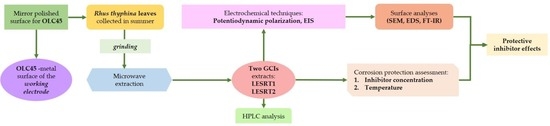
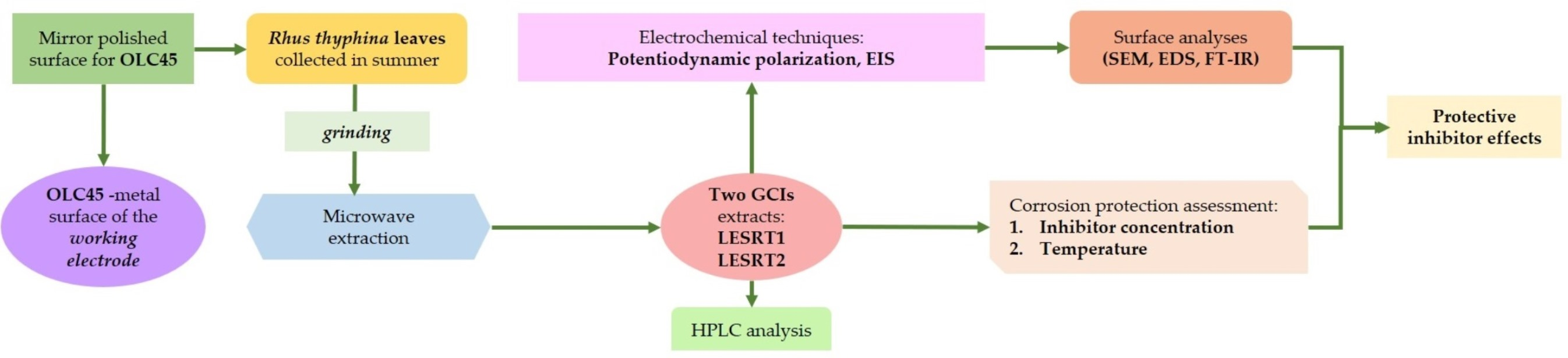
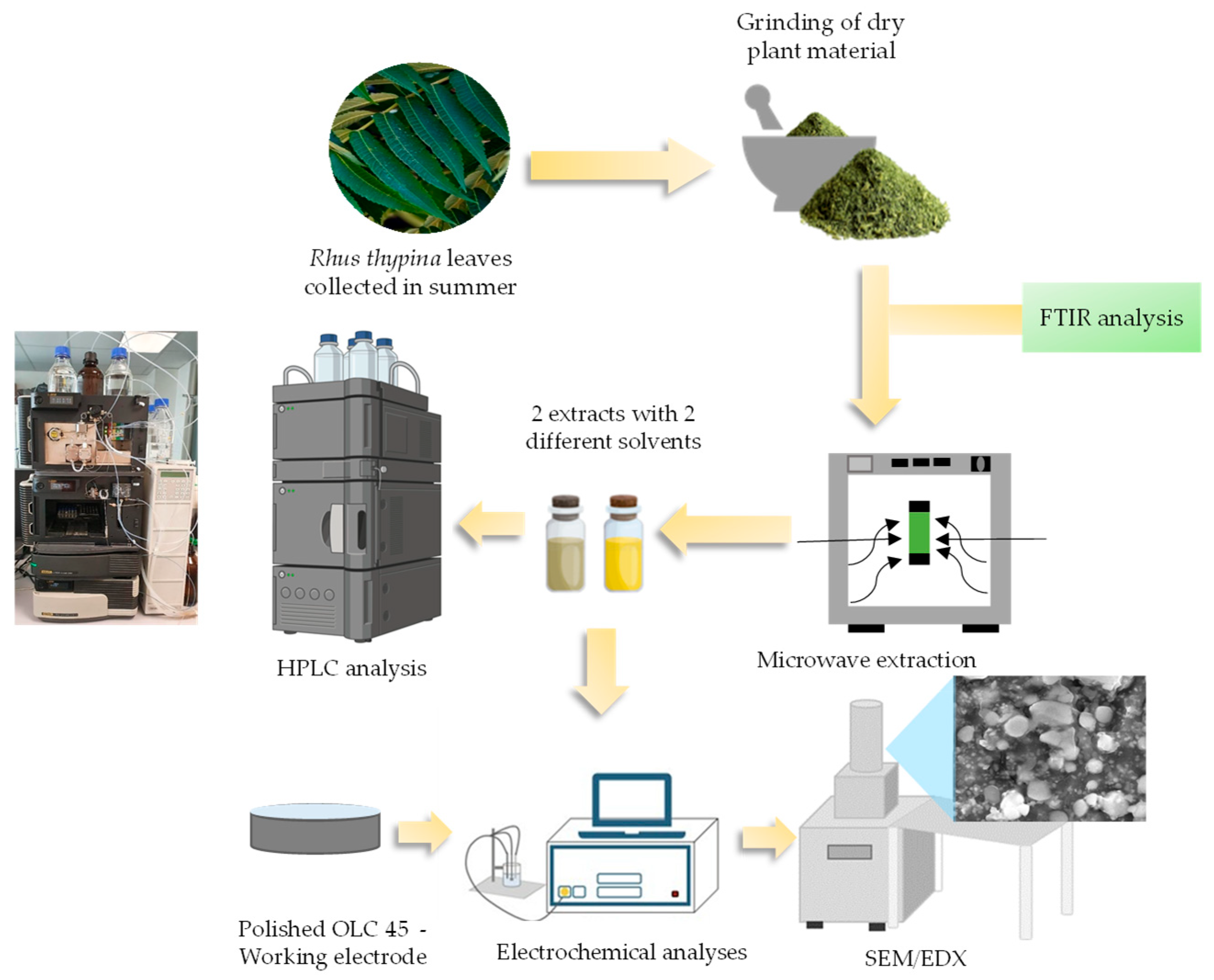
This study examines the ability of hydroalcoholic (methanol and ethanol) leaf extracts collected in summer from Rhus typhina L. (LESRT) to reduce corrosion. In particular, we focus on an extensive method that includes surface characterizations and electrochemical techniques to assess its efficacy in protecting OLC45 carbon steel in a 0.5 M sulfuric acid environment (Scheme 1).

2. Materials and Methods

2.1. Materials

In this work, corrosion tests were conducted on an OLC45 substrate with the following composition.: C% 0.48, Si 0.03%, Mn 0.79%, Fe% 98.32, P% 0.02, S% 0.025, Al% 0.027, Ni% 0.05, Cr% 0.06, Cu% 0.18, Sn% 0.012, and As% 0.006. The corrosive environment was 0.5 M H2SO4, obtained by diluting 96% H2SO4 (analytical grade, Merck, Darmstadt, Germany) with bi-distilled water.
Leaves taken from local residential areas over the summer were dried, ground and sieved to a particle size below 2 mm prior to extraction. A microwave-assisted extraction method was used in which the plant material and solvent were heated using an Ethos Easy Advanced microwave digestion system (Milestone Srl, Sorisole, Italy) for 1 h at 100 °C, with a microwave power of 800 W. The resulting extracts were coded as LESRT1 (methanol/double-distilled water (50%:50%, v/v)) and LESRT2 (ethanol/double-distilled water (50%:50%, v/v)).
For both extraction procedures, a hydroalcoholic solvent mixture (methanol andethanol/water, 1:1 v/v) was used, and the ratio between plant material and solvent was maintained at 1:10 (w/v).
Reagent-grade methanol (Sigma Aldrich, St. Louis, MO, USA), reagent-grade ethanol (Chimreactiv, Bucharest, Romania) and double-distilled water produced in the laboratory using a GFL 2102 water distiller (GFL, Burgwedel, Germany) were used throughout the experiment. The initial extracts were diluted as follows to obtain solutions from 1000 to 20 ppm: aliquots were taken from each extract (1000 to 20 mg), which were diluted to 0.5 L with 0.5 M H2SO4 solution.
The OLC 45 carbon steel specimens were prepared in a cylindrical geometry with an active surface area of 0.5 cm2. This configuration was selected to ensure a uniform, well-defined exposure area. To achieve a mirror-like finish, the samples were mechanically polished using a sequence of silicon carbide sandpapers with increasing grit sizes, ranging from 600 to 4000. Subsequently, the OLC45 specimens were degreased in benzene to ensure the complete removal of organic residues. The working electrodes were then rinsed with double-distilled water, dried at ambient temperature, and finally positioned in the electrochemical cell.

2.2. Methods

High-precision liquid chromatography (HPLC, for the measurement of multiple target components) was used to assess the natural extracts’ composition. For the HPLC analysis, the mobile phase consisted of trifluoroacetic acid (0.1%, Sigma-Aldrich), acetonitrile (Sigma-Aldrich), and distilled water. Quantitative determination of the compounds present in the extracts was performed using an L-3000 HPLC system (Rigol Technologies Inc., Beijing, China) equipped with a diode-array detector (HPLC-DAD) and a Kinetex EVO C18 column (150 × 4.6 mm, 5 µm particle size; Phenomenex, Torrance, CA, USA). Separation was achieved using a binary solvent system under gradient elution conditions. The solvents used were (A) 0.1% trifluoroacetic acid (TFA) in water and (B) 0.1% TFA in acetonitrile. The elution gradient was as follows: 100% solvent (B) at 30 °C for 50 min at an elution flow rate of 1 mL/min. Detection was carried out at 4 different wavelengths (255, 280, 325, and 355 nm), selected according to data reported in the specialized literature.
Stock solutions of reference standards belonging to various classes of phenolic compounds were prepared at a concentration of 1000 µg/mL. These included phenolic acids (gallic acid, protocatechuic acid), flavonoids (isoquercitrin, myricetin, catechin, epicatechin, hyperoside, naringin, naringenin, luteolin), benzoic acid derivatives (vanillic acid), hydroxycinnamic acids and related compounds (caffeic acid, sinapic acid, o-coumaric acid, p-coumaric acid), tannins and their derivatives (tannic acid, ellagic acid), chlorogenic acids (chlorogenic acid), and phytoalexins (resveratrol), all purchased from Merck KGaA (Darmstadt, Germany). Calibration curves were constructed using standard solutions in the concentration range of 10–400 µg/mL. Compound identification and quantification were carried out by comparing retention times and spectral data with those of the corresponding reference standards.
A VoltaLab-PGZ 402 potentiostat/galvanostat system, operated by Voltamaster 4 software, was utilized in this study to examine the corrosion inhibition behavior of carbon steel using all electrochemical techniques: potentiostatic polarization, potentiodynamic polarization, and electrochemical impedance spectroscopy. Electrochemical measurements were performed using a conventional three-electrode configuration. OLC 45 discs served as the working electrodes (WEs), while a saturated calomel electrode (SCE) and a platinum plate were employed as the reference and counter electrodes, respectively. All experiments were carried out at 25 °C under naturally aerated conditions, in quiescent solution with no stirring or mechanical agitation. Measurements were performed in triplicate (n = 3), and the results are expressed as mean values ± standard deviation (SD).
Corrosion determinations were performed with and without certain doses of the LESRT. The electrochemical behavior of OLC45 in 0.5 M H2SO4, both in the absence and presence of the two plant-derived inhibitors, was investigated through potentiodynamic polarization and electrochemical impedance spectroscopy (EIS). The inhibition efficiency was assessed using potentiodynamic polarization curves, which allowed for the determination of the electrochemical parameters for OLC45 specimens in both the absence and presence of varying concentrations of green inhibitors.
Tafel polarization curves were recorded by scanning the potential from the cathodic to the anodic region (±250 mV) vs. OCP at a scan rate of 2 mV/s. The anodic and cathodic Tafel branches were extrapolated to the corrosion potential (Ecorr) to determine the corrosion current density (icorr) and the respective Tafel slopes ba and bc. After stabilization of the open-circuit potential (OCP), electrochemical impedance spectroscopy (EIS) measurements were performed at the OCP potential within the frequency range of 100 kHz to 40 mHz. Impedance tests were performed at a rate of 10 points per decade with changing frequency. Measurements were repeated for each electrode to ensure adequate consistency of the results.
All electrochemical experiments were performed using a potentiostat/galvanostat VoltaLab PGZ 402 (Radiometer Analytical, Lyon, France) system. The powder from Rhus typhina L. leaves gathered in summer was evaluated using a Bruker FTIR spectrometer (Bruker, Ettlingen, Germany) with an ATR attachment (Pike, Madison, WI, USA) in the spectral region 4000–650 cm−1 at a resolution of 4 cm−1. An SEM was used to determine the morphology of the green-synthesized corrosion inhibitors on the OLC45 surface. Images were taken using a Quanta Inspect F50 (ThermoFisher Scientific, Hillsboro, OR, USA) scanning electron microscope, which is equipped with a field emission gun (FEG) offering 1.2 nm resolution.
For FTIR analysis, a Bruker Optics Tensor 37 FTIR spectrometer (with ATR) was used (Ettlingen, Germany) in the spectral range 4000–650 cm−1 at a resolution of 4 cm−1.
A highly effective method for examining corrosion-induced changes on the electrode surface is surface analysis. Surface characterization of the OLC 45 samples was performed using Scanning Electron Microscopy (SEM) coupled with Energy-Dispersive X-ray Spectroscopy (EDX). Micrographs were acquired using a Quanta Inspect F50 (FEI Company, Eindhoven, The Netherlands) system, which features a field emission gun (FEG) providing a resolution of 1.2 nm and an integrated EDX spectrometer with a MnK resolution of 133 eV Kα.

3. Results and Discussion

3.1. FTIR Powder Analysis

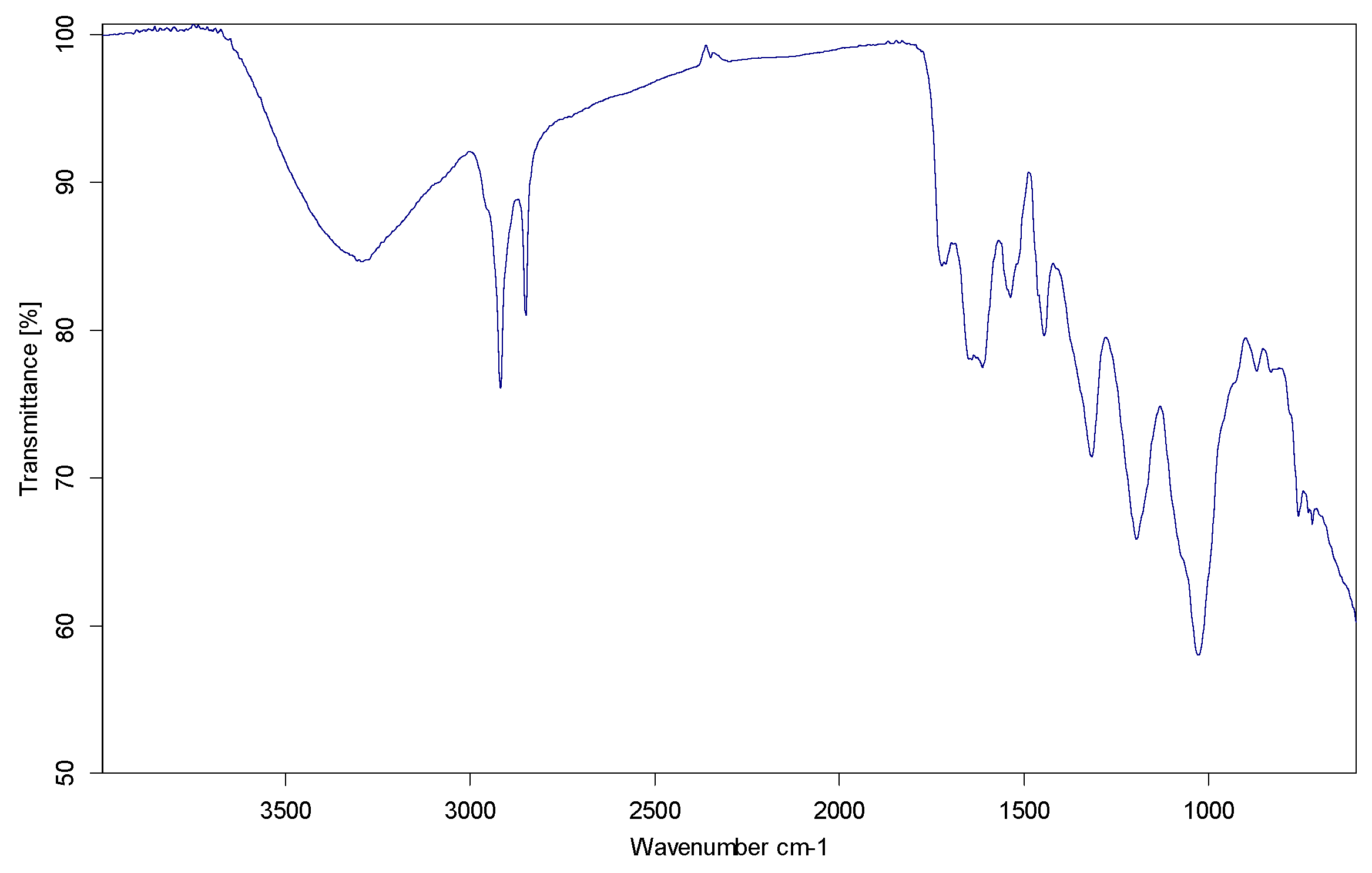
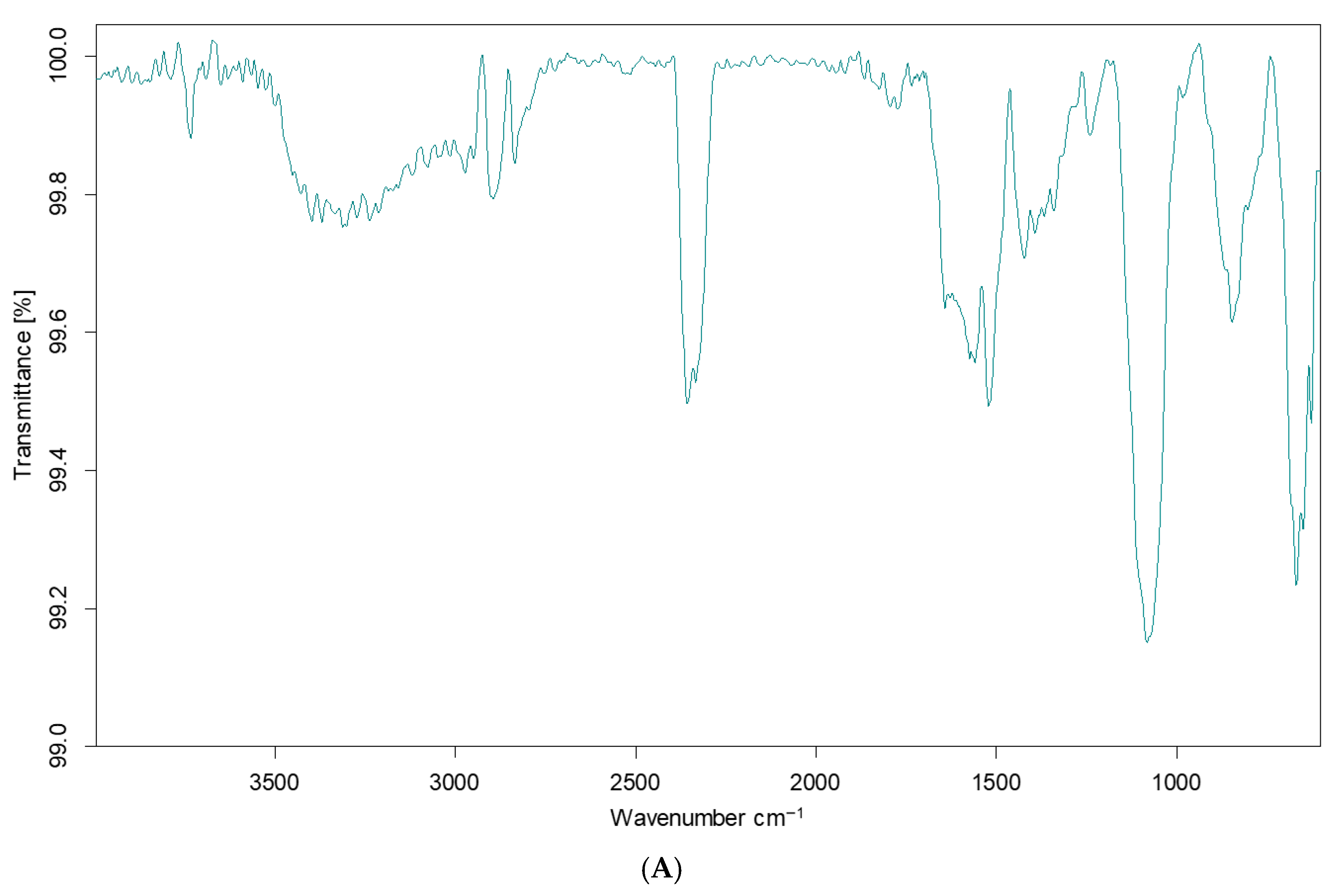
The functional groups present in the raw material (in powder form) used in the preparation of the eco-inhibitors obtained were identified using a Fourier transform IR spectrometer (FTIR) (Bruker, Tensor 27) with the following characteristics: 5 scans/sample, resolution 4 cm−1, and frequency range 4000–600 cm−1. The resulting spectrum is shown in Figure 1 for powder from Rhus typhina L. leaves collected in summer.
The FTIR spectrum of leaf powder collected in summer from Rhus typhina L. was recorded in the range 4000–600 cm−1 and shows the presence of several functional groups characteristic of bioactive compounds in plants. The weak and relatively broad band in the 3200–3600 cm−1 region corresponds to the O-H bond, which is specific to hydroxyl groups in the structure of phenols, polyphenols, carboxylic acids, and tannins.
The absorption bands recorded at 2917 and 2849 cm−1 are assigned to the stretching vibrations of C-H groups, suggesting the presence of aliphatic fragments in the extracted compounds. An intense band at 1721 cm−1 indicates the stretching vibrations of the C=O bond, specific to carboxylic or ester groups, highlighting the possible presence of gallic acid and its derivatives.
In the 1641–1536 cm−1 region, significant bands appear, associated with C=C stretching vibrations in the aromatic nucleus and conjugated C=O vibrations. These bands confirm the presence of phenolic nuclei and polyhydroxylic aromatic compounds, such as flavonoids and gallic acid. The band at 1444 cm−1 is specific to the deformation vibrations of the aliphatic CH2/CH3 groups.
Below 1400 cm−1, the band at 1316 cm−1 can be attributed to C-O vibrations in phenolic or carboxylic groups, while the band at 1194 cm−1 reflects C-O-C vibrations of ether bonds in glycosidic structures or esterified tannins.
The presence of saccharide compounds or glycosides is supported by the intense band at 1026 cm−1, characteristic of the C-O vibrations of alcohols and polysaccharides. Therefore, the FTIR spectrum indicates the presence of major classes of bioactive compounds in the plant extract, such as polyphenols (especially gallic acid and derivatives), hydrolysable tannins, flavonoids, and phenolic glycosides.

3.2. Quantitative and Qualitative Evaluation of LESRT

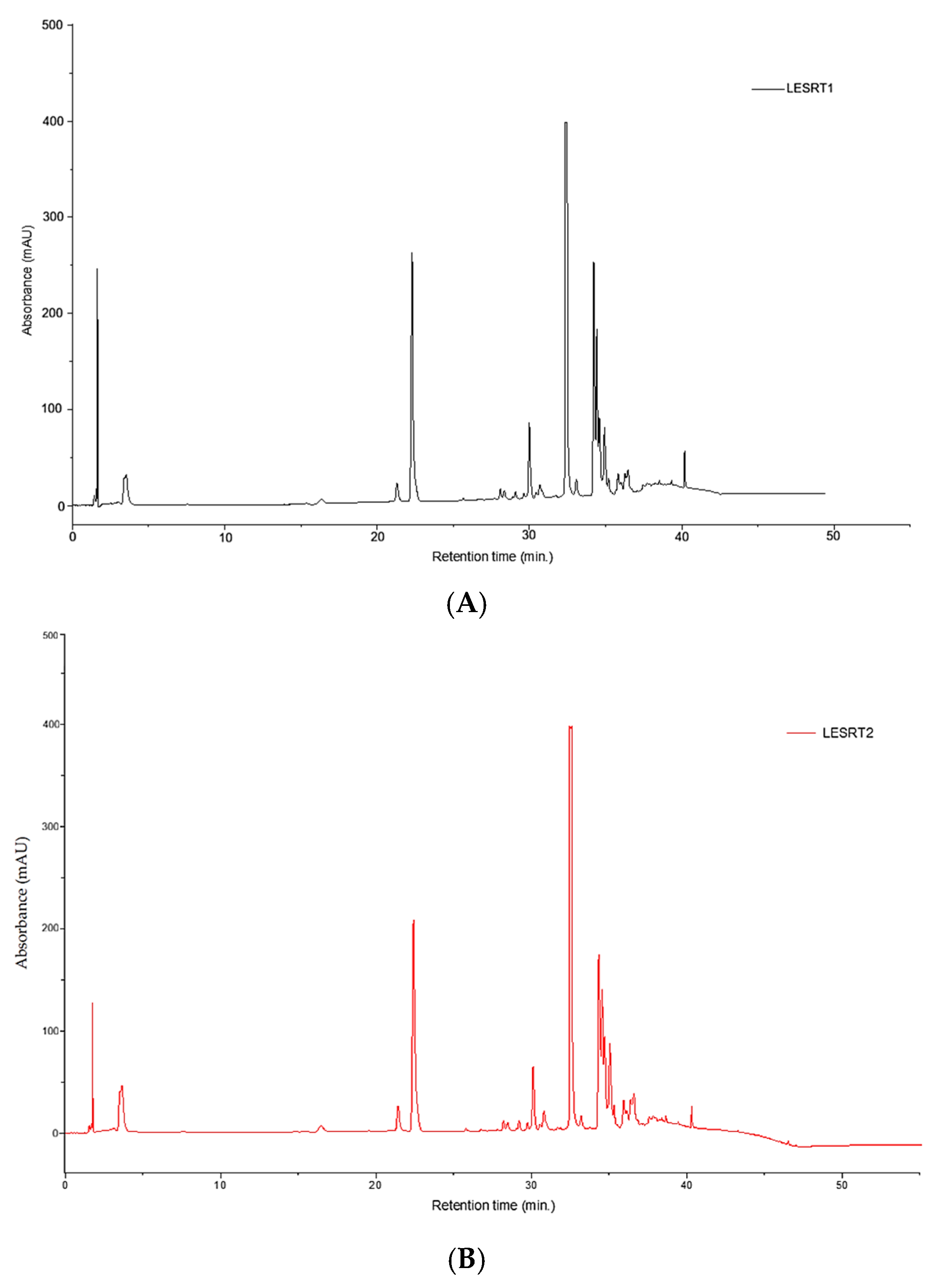
An analytical test (HPLC) was conducted after the extraction to provide a picture of their composition. The results are presented in Table 1 and Figure 2.
Compared to LESRT1, LESRT2 is characterized by a higher total content of phenolic acids and flavonoids, particularly ferulic acid, ellagic acid, naringin, malvidin, and genistein. The HPLC results are consistent with the FTIR spectra, confirming the presence of characteristic functional groups (-OH, C=O, and aromatic C=C) associated with the identified phenolic acids and flavonoids. This phytochemical enrichment suggests a slightly improved performance of LESRT2, due to the presence of compounds with multiple functional groups capable of interacting effectively with the metal surface through physicochemical adsorption mechanisms. At the same time, the phyto-components determined support the formation of a more stable protective film, favorable for inhibiting corrosion processes.

3.3. Electrochemical Studies

3.3.1. Potentiodynamic Polarization Procedures

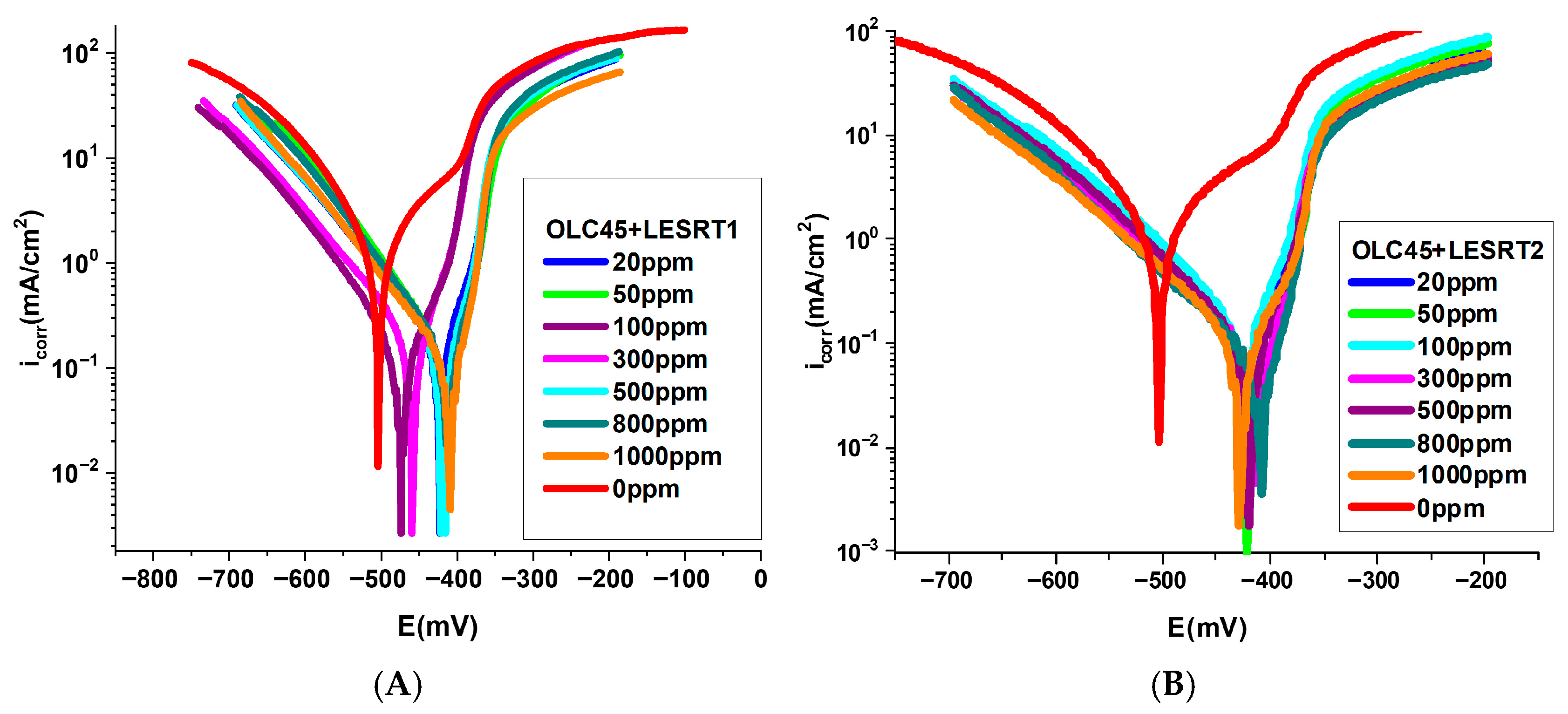
This study investigated the use of green corrosion inhibitors as an effective strategy to protect OLC45 substrates under harsh conditions, targeting anodic, cathodic, or mixed corrosion processes. The inhibitory effects of LESRT1 and LESRT2 were evaluated in 0.5 M H2SO4 using potentiodynamic polarization and electrochemical impedance spectroscopy (EIS). The surfaces inhibited by LESRT exhibited a marked reduction in both anodic and cathodic current densities, indicating effective suppression of the corresponding electrochemical reactions. The polarization curves revealed that the current densities recorded in the presence of LESRT extracts from Rhus typhina L. leaves were significantly lower than those obtained for the uninhibited system. This behavior suggests that LESRT acts as a mixed-type inhibitor, affecting both anodic metal dissolution and cathodic hydrogen evolution reactions. As shown in Figure 1, the addition of these compounds to the aggressive medium effectively retards both electrochemical processes. The presence of LESRT extracts from Rhus typhina L. leaves as green corrosion inhibitors shifts the corrosion potential (Ecorr) toward more positive values relative to the uninhibited sample, suggesting a predominant influence on the anodic reaction over the cathodic one.
The polarization curves for the OLC45 samples in a 0.5 M H2SO4 solution, both in the absence and presence of the inhibitor, are displayed in Figure 3.
Table 2 and Table 3 present the electrochemical parameters, including corrosion current density (icorr), anodic and cathodic Tafel slopes, corrosion potential (Ecorr), and protection efficiency (E%). As shown in Figure 3 and Table 2 and Table 3, the addition of LESRT1 and LESRT2 shifted the corrosion potential (Ecorr) in the positive direction and significantly decreased the anodic Tafel slopes (ba), indicating that these green corrosion inhibitors primarily affect the anodic dissolution of the metal. This behavior can be attributed to the adsorption of SO42− ions and/or inhibitor molecules onto the anodic active sites of OLC45, thereby suppressing the anodic corrosion process.
The experimental results showed that the concentration of green corrosion inhibitors, LESRT1 and LESRT2, greatly reduced corrosion current while increasing inhibition efficiency. The investigations demonstrated that a protective layer was adsorbed onto the OLC45 surface, inhibiting potential active sites (centers).
When comparing inhibition efficiency and corrosion rate (Rmpy, in mil/year; P, in mm/year; and Kg, in g × m−2h−1) for all eco-friendly inhibitors, the results indicate thatLESRT1 and LESRT2 provide effective corrosion defense for the OLC45 substrate in 0.5 M H2SO4. The protective efficacy was determined by the adsorption of inhibitor molecules onto active sites, coupled with the development of a stable interfacial film composed of corrosion products on the OLC 45 surface. Furthermore, Figure 3 and Table 2 and Table 3 reveal that better protection efficiency was obtained for LESRT2/OLC 45 at concentrations of 1000 ppm and 800 ppm, and for LESRT1/OLC45 at concentrations of 800 ppm, 1000 ppm; however, LESRT2/OLC45 showed slightly higher efficiency values.
Both LESRT1 and LESRT2 exhibited high corrosion inhibition efficiency for OLC45 steel in 0.5 M H2SO4, as evidenced by the decrease in corrosion current density and the increase in protection efficiency with increasing inhibitor concentration.
Although LESRT2 showed slightly higher inhibition efficiency (92%) compared to LESRT1 (91%) at 1000 ppm, this difference is minimal and within the expected experimental variability. Therefore, both extracts can be considered similarly effective corrosion inhibitors under the studied conditions. Nevertheless, this minor difference may be tentatively associated with its higher content of phenolic and flavonoid compounds, as indicated by HPLC analysis (Tabel 1). These phyto-constituents contain multiple functional groups (e.g., -OH, -COOH, aromatic rings); they also contain donor atoms such as O, N, and S. Systems with π electrons associated with these functional groups have electron-rich centers (e.g., -COOH, -OH, -NH2, aromatic rings) that can interact with metal surfaces via physical or chemical adsorption [39]. Moreover, the synergy between the main phyto-components may promote efficient adsorption on the metal surface and the formation of a stable protective layer, responsible for the effective inhibition of the corrosion process [20,26,31], resulting in enhanced protection.
Competition for adsorption on the OLC45 substrate obstructs the active centers and, as a result, SO42− (corrosive element) is prevented from affecting the OLC45 substrate, ensuring protection.
At lower concentrations, adsorption processes dominate and lead to significant inhibition efficiency, while at higher concentrations, surface saturation occurs, resulting in a plateau in performance.

3.3.2. Electrochemical Impedance Spectroscopy (EIS)

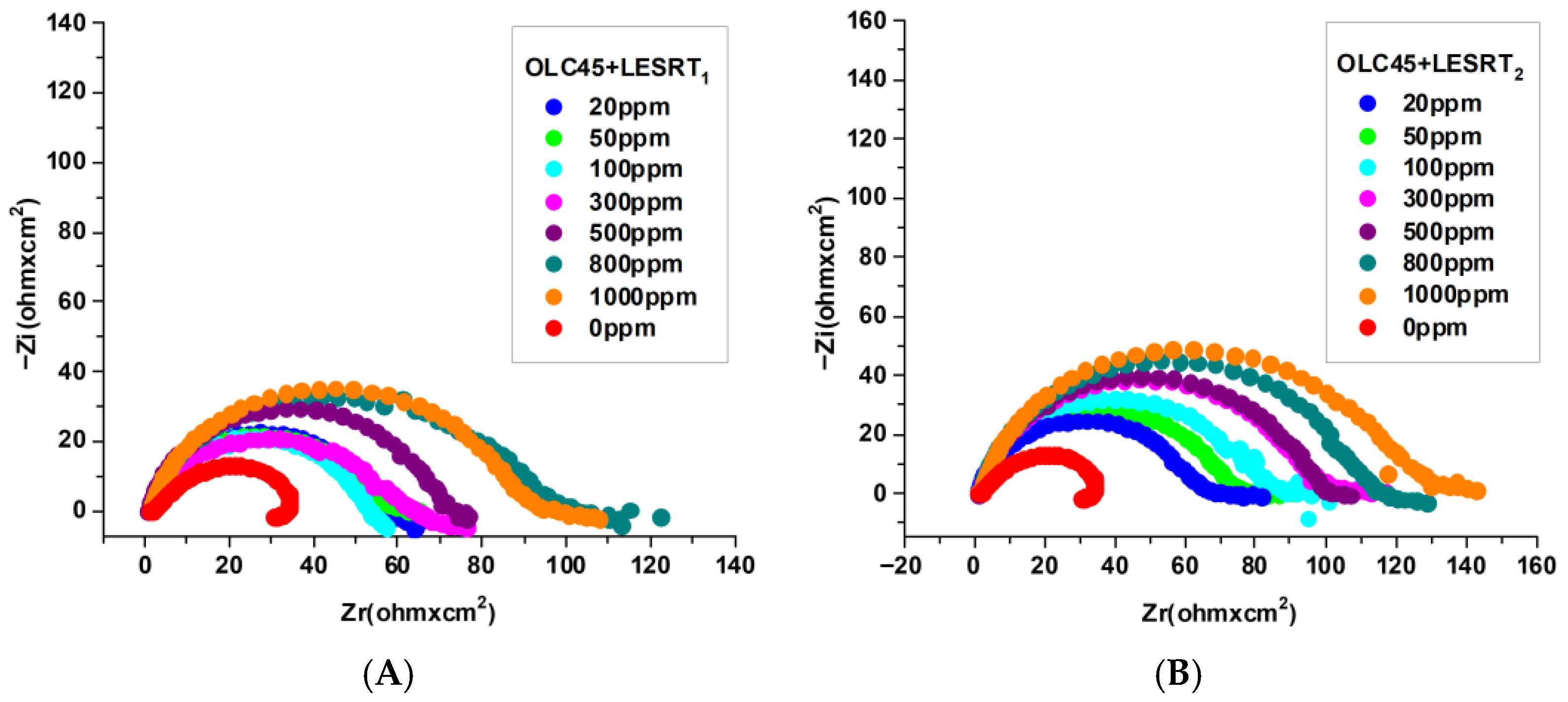
The protective performance of two plant-based inhibitors on OLC45 in an H2SO4 medium was evaluated using electrochemical impedance spectroscopy (EIS). The EIS results confirmed the anticorrosive effect of Rhus typhina leaf extract, collected during the summer, on the OLC45 substrate in aggressive environments. The impedance data provide insight into the inhibitory behavior of these eco-friendly corrosion inhibitors through the formation of a protective layer on the metal surface. Figure 4 presents the Nyquist plots of OLC45 at the metal/solution interface in the absence and presence of different inhibitor concentrations.
Figure 4 shows a small capacitive loop in the Nyquist plots for the OLC45 sample in the absence of inhibitors, indicating that the corrosion process is mainly controlled by charge transfer. In the presence of green corrosion inhibitors (GCIs), the Nyquist plots exhibit enlarged capacitive loops, characteristic of charge transfer-controlled processes. These loops generally reflect a single time constant, associated with the charge transfer reaction at the metal/solution interface influenced by the adsorbed bioactive components.
Moreover, the diameter of the capacitive loops for the inhibited samples is significantly larger than that of the uninhibited OLC45 electrode, and it increases with increasing GCI concentration. This behavior indicates an enhancement in charge transfer resistance, confirming that the GCIs provide improved corrosion protection for the OLC45 substrate in H2SO4 solution.
The Nyquist plots reveal that the addition of GCIs significantly changed the impedance response of the OLC45 sample, confirming the formation of a protective film in the presence of LESRT1 and LESRT2. As shown in Figure 4, the impedance diagrams deviate from ideal semicircles, which can be attributed to frequency dispersion arising from surface roughness and inhomogeneities of the OLC45 substrate [39]. Furthermore, Figure 4 indicates that the diameters of the capacitive loops at 800 and 1000 ppm for both LESRT1 and LESRT2 are considerably larger than those observed in the absence of inhibitors. This increase reflects higher charge transfer resistance, suggesting that Rhus typhina leaf extracts provide enhanced corrosion protection for the OLC45 sample in H2SO4 solution.
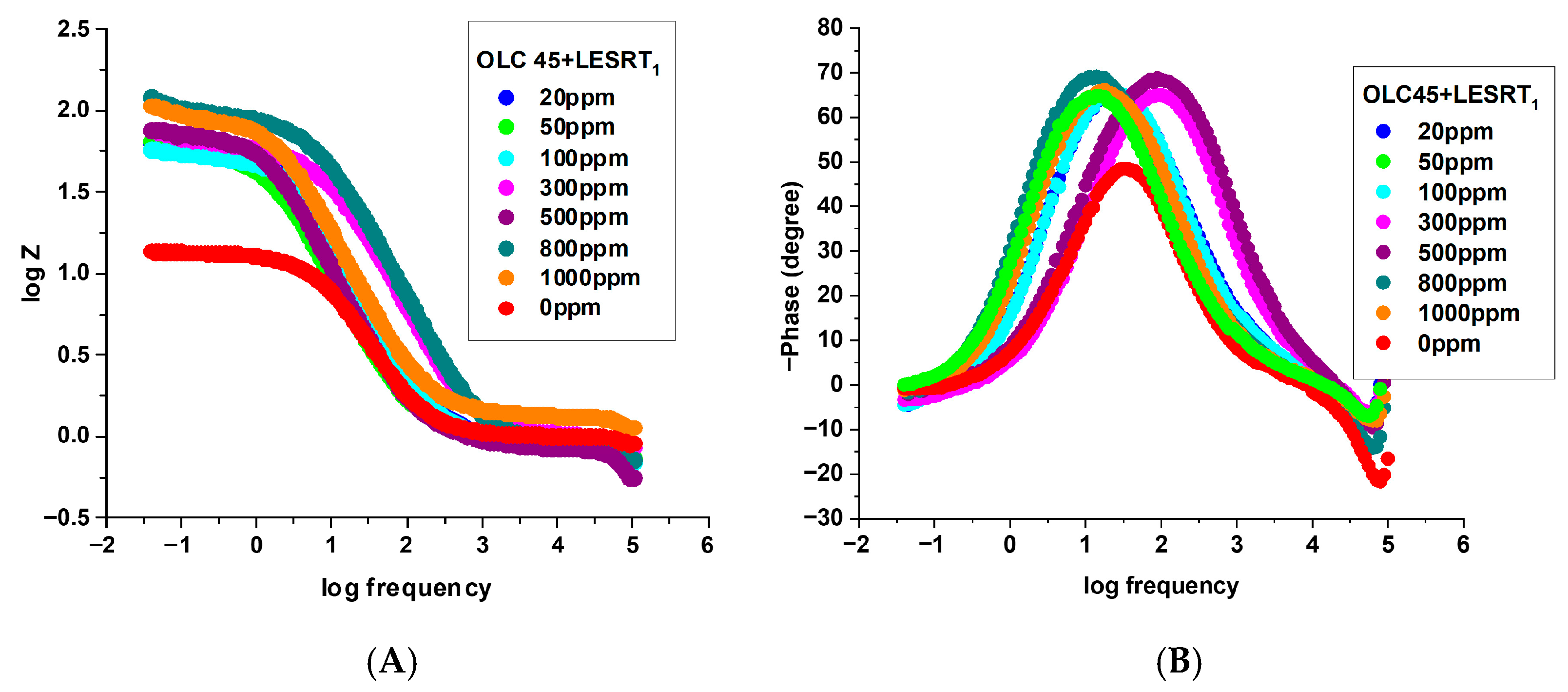
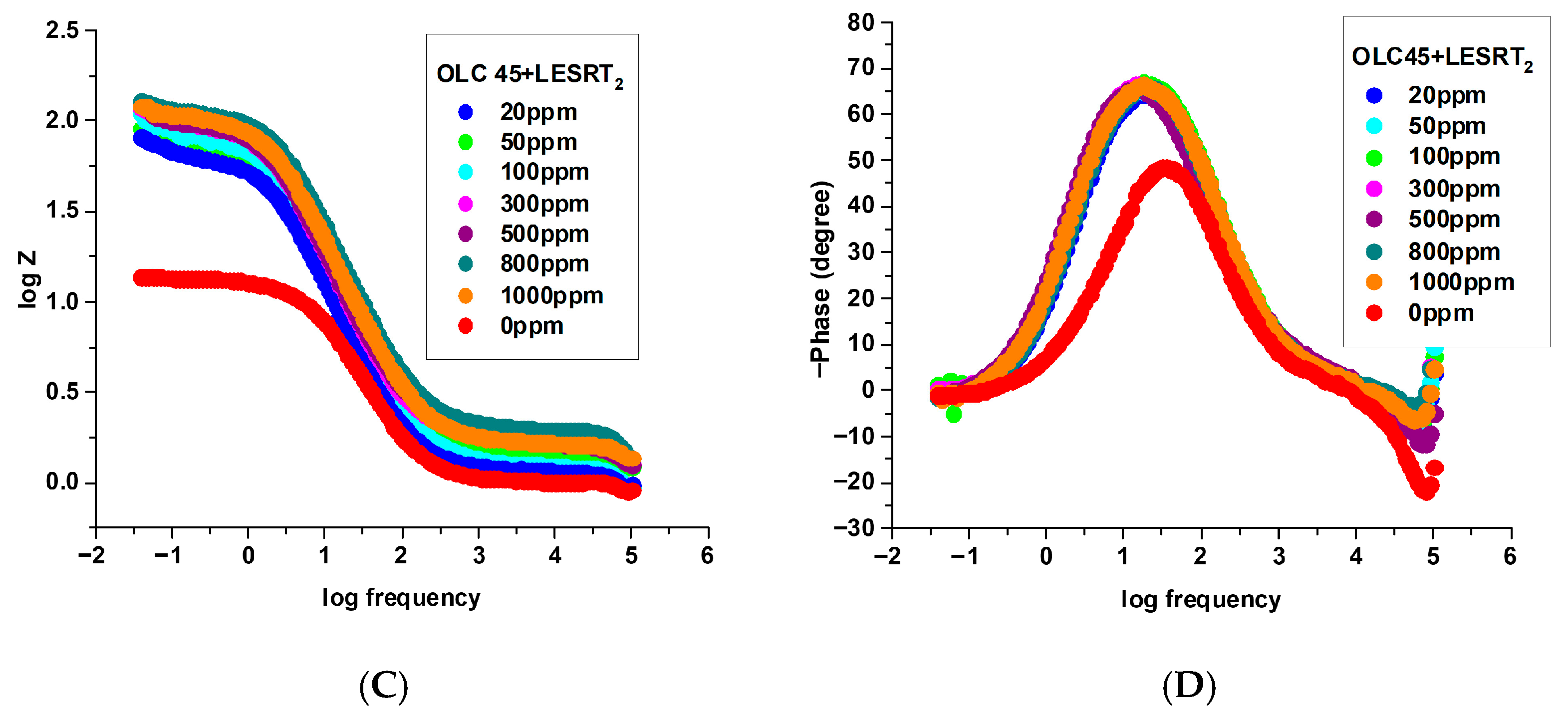
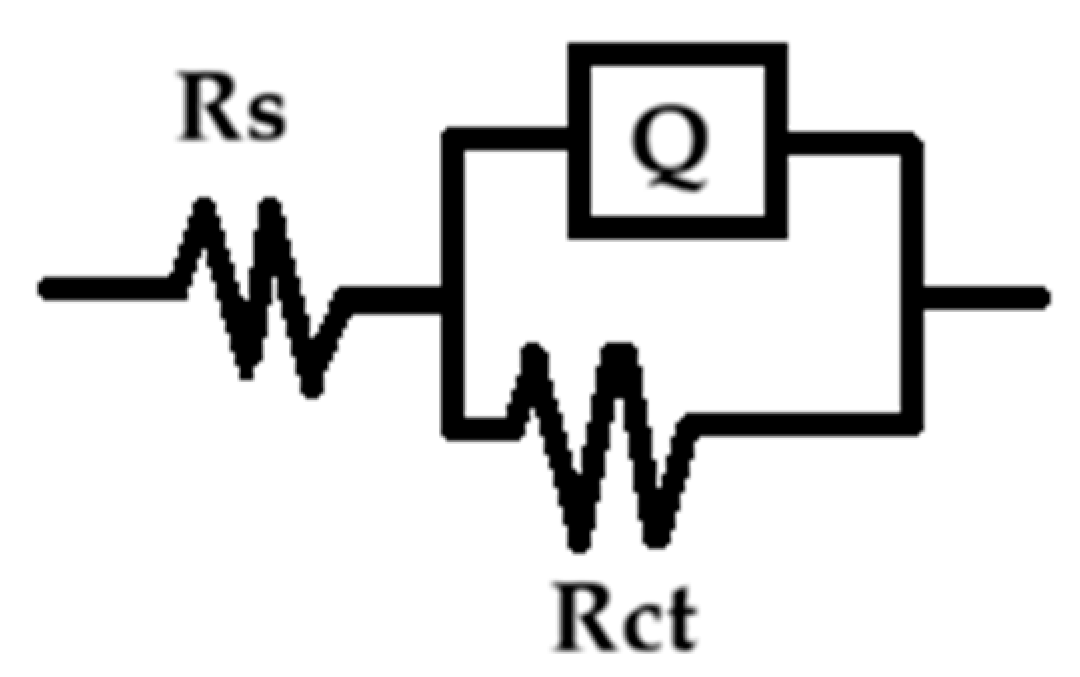
The Bode plots of the OLC45 sample, in the absence and presence of LESRT (Figure 5), show that the impedance modulus at low frequencies increases with increasing inhibitor concentration, indicating that the adsorption of phytochemical components enhances the corrosion protection of the OLC45 substrate in the acidic electrolyte. The plots display a single time constant, suggesting that the electrolyte does not effectively penetrate the substrate surface and that corrosion is significantly suppressed. As shown in Figure 5, the OLC45 sample exhibits a single time constant with a phase angle of approximately 49° at medium to low frequencies, indicative of inductive behavior associated with weak diffusion processes. The Bode plots presented in Figure 5 show that, in the presence of LESRT, the phase angle versus the logarithm of frequency exhibits a well-defined maximum of approximately 70°, corresponding to a relaxation time constant indicative of pronounced capacitive behavior. The phase angle increases significantly upon the addition of LESRT, reflecting the formation of a protective film on the OLC45 substrate. Consequently, the inhibited samples exhibit enhanced capacitive behavior, in agreement with the results obtained from Nyquist measurements and potentiodynamic polarization studies. An increase in the impedance modulus (Zmod) reflects enhanced inhibition efficiency, and it is evident that Zmod increases with increasing concentrations of all GCIs, indicating improved protective performance. The EIS spectra were fitted using the equivalent electrical circuit R(QR) (Figure 6), consistent with the single time constant observed in the Bode plots. The impedance data were analyzed based on this circuit model, yielding key parameters such as the solution resistance (Rs), charge transfer resistance (Rct), and double-layer capacitance (Cdl), as summarized in Table 4 and Table 5. This equivalent circuit (see Figure 6) provides an appropriate representation for fitting and interpreting the experimental EIS data.
In this case, the constant phase element Q (CPE) was used to account for the non-ideal capacitive behavior. The incorporation of the CPE reflects the deformation of the capacitive loop, which is attributed to surface heterogeneity arising from substrate roughness and imperfections. CPE impedance can be expressed as ZCPE = Y0−1 (jω)n, where ZCPE is the CPE impedance, ω is the angular frequency, j is an imaginary number (j2 = −1), Y0 is the amplitude associated with a capacitance, and n is the phase shift. The value of n characterizes the state of inhomogeneity of the substrate area. A higher value of n is associated with a lower degree of substrate roughness i.n., and the inhomogeneity of the substrate is reduced. The CPE is the resistance when n = 0, (Y0 = R), the capacitance when n = 1 (Y0 = C), and the inductance when n = −1 (Y0 = 1/L) [2].
The inhibition efficiency values calculated from EIS (Table 4 and Table 5) are slightly lower than those obtained from potentiodynamic polarization (Table 2 and Table 3). This difference might be due to the fact that EIS is a steady-state technique performed at the open-circuit potential (Ecorr), providing a more conservative evaluation of the interface. In contrast, potentiodynamic polarization involves a broader potential sweep that may influence the adsorption dynamics of the inhibitor molecules. Despite these minor numerical variations, both methods show a consistent trend, confirming the effective protective performance of the LESRT extracts.
EIS measurements revealed that the inhibition of OLC45 substrates with GCI–LESRT1 and LESRT2 leads to an increase in the charge transfer resistance (Rct) and a decrease in the double-layer capacitance (Cdl). The increase in Rct with increasing LESRT concentration indicates a significant enhancement of the protective effect, confirming the strong anticorrosive performance of these green inhibitors on OLC45. This behavior can be attributed to the adsorption of inhibitor molecules at the metal/electrolyte interface, which reduces the local dielectric constant and/or increases the thickness of the electrical double layer, resulting in lower Cdl values. The phytochemical constituents of LESRT adsorb onto the OLC45 surface, forming a protective inhibitory film. The observed increase in Rct further supports the improved inhibition efficiency. Moreover, the Nyquist and Bode plots demonstrate that the tested green corrosion inhibitors suppress corrosion processes by acting as a diffusion barrier and by hindering charge transfer reactions.

3.4. The Effect of Temperature

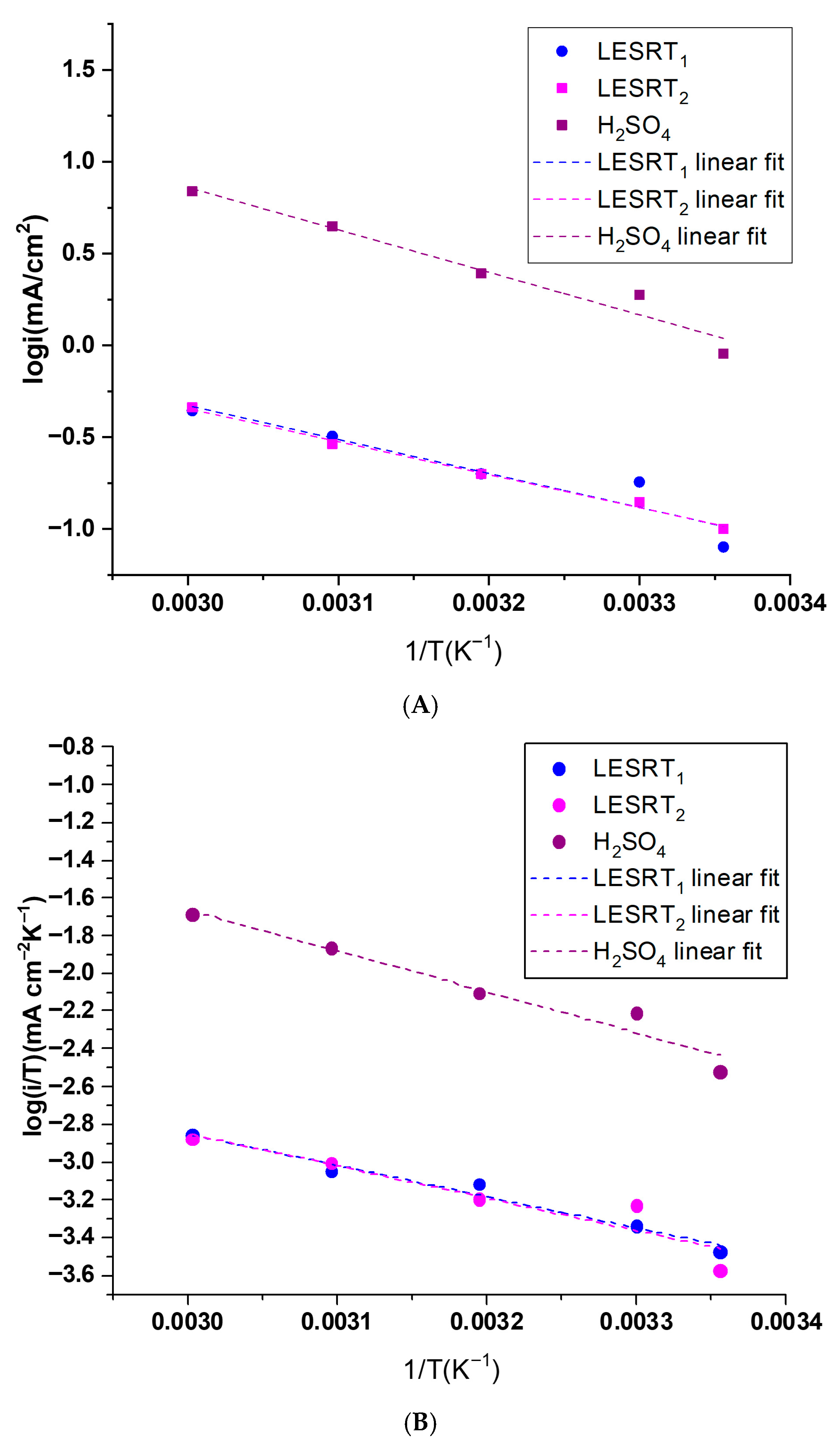
The influence of temperature on the corrosion protection efficiency of LESRT1 and LESRT2, two extracts derived from Rhus typhina leaves, was evaluated at a concentration of 1000 ppm for OLC45 steel in 0.5 M H2SO4 using potentiodynamic polarization measurements at 298 K, 303 K, 313 K, 323 K, and 333 K. The results indicate that the corrosion rate increases with temperature in both inhibited and uninhibited media. Simultaneously, the inhibition efficiency of LESRT1 and LESRT2 decreases as temperature rises, suggesting that the protective mechanism is predominantly controlled by adsorption of the inhibitor molecules on the steel surface. At elevated temperatures, desorption of the adsorbed species becomes more significant, leading to a decline in protective performance. The temperature dependence of the corrosion rate can be described using the Arrhenius equation and the transition state equation.
i c o r r = A exp E a R T
i c o r r = R T N h exp Δ S a R exp Δ H a R T
where icorr represents the corrosion rate, A is the pre-exponential factor, Ea is the apparent activation energy of the OLC45 dissolution process, T is the absolute temperature, and R is the universal gas constant and denote the apparent enthalpy and apparent entropy of activation, respectively, while h is Planck’s constant and N is Avogadro’s number.
Figure 7A presents the Arrhenius plot of the corrosion rate versus 1/T for OLC45 steel in 0.5 M H2SO4, both in the absence and presence of the two extracts derived from Rhus typhina leaves. The activation energy (Ea) values, with and without the plant extracts, were determined from the slopes of the linear plots of log (corrosion rate) versus 1/T (Figure 7A) and are summarized in Table 6.
Figure 7B shows the transition state plot of log (corrosion rate/T) versus 1/T. The straight lines obtained have slopes equal to (− H a /R) and intercepts equal to ln(R/Nh) + ( H a /R), from which the apparent enthalpy of activation ( H a ) and apparent entropy of activation ( S a ) were calculated (Table 6).
Examination of Table 6 and Figure 7 indicates that the Ea values in the presence of the two leaf extracts are lower than those obtained in the uninhibited solution, suggesting that the activation energy reflects the influence of temperature on the inhibition efficiency of the extracts.
Figure 7A shows the Arrhenius plots of log (corrosion rate) versus 1/T for OLC45 steel in 0.5 M H2SO4, both in the absence and presence of the two extracts obtained from Rhus typhina leaves. The apparent activation energy (Ea) values were determined from the slopes of the corresponding linear fits (−Ea/R) and are listed in Table 6.
Figure 7B presents the transition state plots of log (corrosion rate/T) versus 1/T. The obtained straight lines exhibit slopes equal to − H a /R and intercepts equal to ln(R/Nh) + S a /R, allowing for the calculation of the apparent enthalpy ( H a ) and apparent entropy ( S a ) of activation, as summarized in Table 6.
Analysis of the data in Table 6 and Figure 7 reveals that the Ea values decrease in the presence of the leaf extracts compared to the uninhibited solution. This behavior suggests that the extracts modify the corrosion mechanism and that the activation energy can be used to assess the influence of temperature on the inhibition performance.
The calculated activation parameters reveal that the uninhibited acidic solution exhibits higher Ea and ΔH0 values compared to the systems containing leaf extracts, while the activation entropy (ΔS0) is negative in all cases. In the uninhibited solution, the corrosion reaction proceeds mainly via a charge transfer mechanism, requiring a relatively high energetic barrier for metal dissolution. The negative ΔS0 reflects the formation of an ordered activated complex during metal ion formation and solvation.
In the presence of leaf extracts, the decrease in Ea and ΔH0, combined with negative ΔS0 values, indicates that adsorption of phytochemical constituents modifies the interfacial structure. Phyto-constituents (polyphenols, flavonoids, and tannins) present in the extracts interact with the metal surface through electrostatic attraction and donor–acceptor interactions, forming an adsorbed layer. This adsorption reduces the number of active sites available for corrosion and promotes a more organized interfacial environment. The very close activation energy values for LESRT1 and LESRT2 further confirm that both extracts interact with the steel surface through a similar adsorption mechanism and exhibit comparable thermal stability within the investigated temperature range. The positive values of ΔH0 in all cases indicate that the carbon steel dissolution process is endothermic, meaning that corrosion requires energy input. The negative ΔS0 in inhibited systems suggests that the activated complex formed during the corrosion process is more ordered due to the structured organic layer at the interface. The inhibition mechanism is therefore primarily governed by adsorption-mediated surface protection rather than by increasing the intrinsic electrochemical energy barrier.

3.5. Adsorption Isotherm

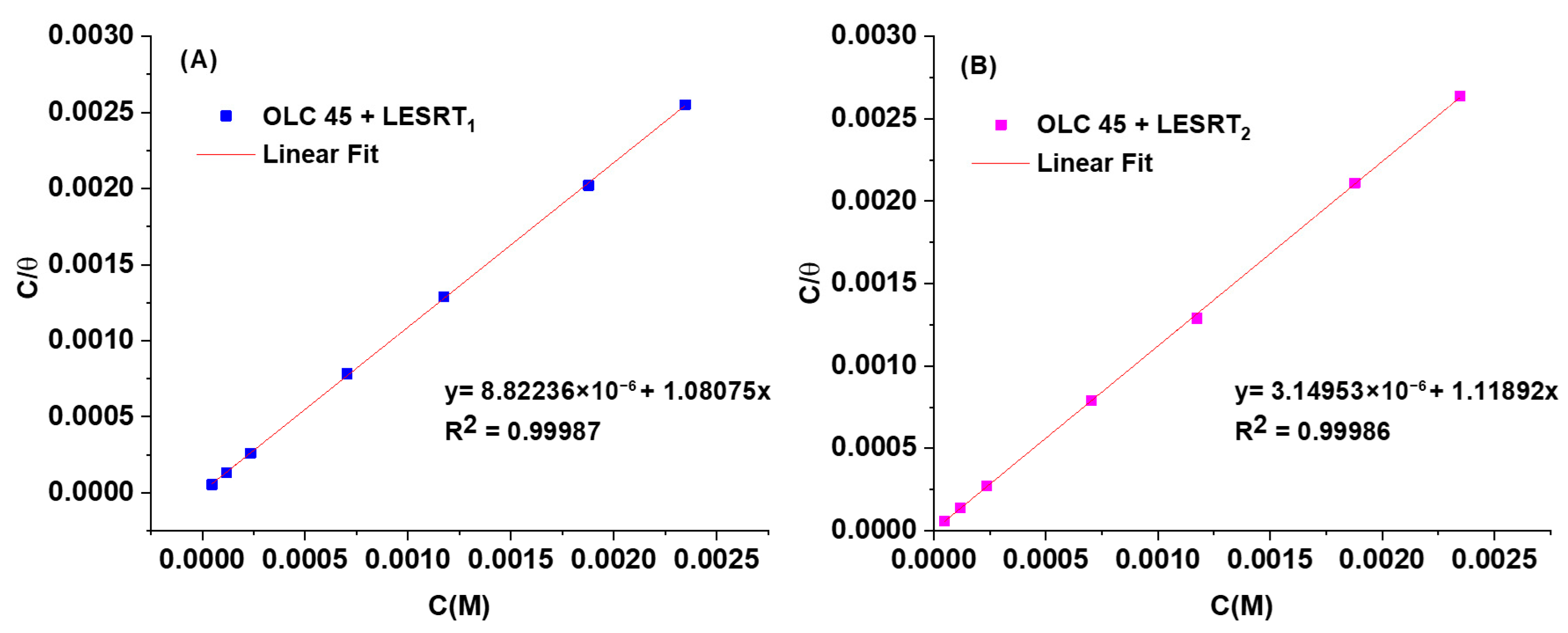
The adsorption isotherm provides essential information about the interaction between the organic substance and the sample area [40]. Also, LESRT’s increased effectiveness resulted from the adsorption process. It is widely thought that the adsorption of LESRT onto the OLC45 substrate is the most critical action in the defensive response. To evaluate the influence of LESRT concentration on corrosion protection, the rate findings have to be fitted to an adsorption equilibrium relationship, such as a Langmuir isotherm. Applying the Langmuir adsorption isotherm resulted in a strong correlation between the covered substrate and isotherm expression. The Langmuir isotherm is significant for analyzing the adsorption process considering the relationship θ/(1 − θ) = KC, where K is the adsorption equilibrium constant, θ is the degree of LESRT coverage on the sample substrate, and C is the LESRT concentration. θ is calculated using the formula θ = (icorr − iinh)/icorr, where icorr and iinh are the corrosion current in 0.5 M H2SO4 with and without the GCI.
The protection was attributed to the adsorption of LESRT1 and LESRT2 onto the substrate, supported by correlation coefficients (R2) exceeding 0.99 (LESRT1 R2 = 0.9998; LESRT2 R2 = 0.9998). This high degree of linearity demonstrates the applicability of the Langmuir isotherm, confirming that the inhibitory effect is fundamentally driven by the adsorption of phytochemical constituents onto the metal surface.
The first stage of corrosion of the metal substrate in 0.5 M H2SO4 by GCI-LESRT is as follows:
M e + I N H M e I N H a d s M e n + + n e + I N H   M e = F e ,   I N H = LESRT 1 ,   LESRT 2
When a significant amount of LESRT is adsorbed, a stable film forms on the OLC45 surface, shielding the metal from corrosive attack. In this research, straight lines were obtained, where the concentration Cinh/θ was plotted versus Cinh with a slope of unity. The slope of the Langmuir adsorption plot is an important parameter for assessing how well the experimental data fit the ideal Langmuir model. Ideally, the slope should be equal to unity, as observed in our study (see Table 7), reflecting the assumption of monolayer adsorption on a homogeneous surface with no interactions between the adsorbed species. If the slope deviates from 1, this may indicate that the adsorption process does not strictly follow Langmuir behavior. Such deviations can arise from factors such as surface heterogeneity, interactions between adsorbed molecules, or the presence of multilayer adsorption. Therefore, the slope provides valuable insight into the validity of the Langmuir model and the nature of the adsorption mechanism involved. The linear relationship indicates that the adsorption of the GCI follows the Langmuir isotherm (Figure 8). The Kads equilibrium constant with the adsorption process of these GCIs might be calculated from the reciprocal of the intercept and its evaluation is presented in Table 7. It is obvious that the big values of Kads indicate effective adsorption, the superior defensive performance of the GCIs on the OLC45 substrate in 0.5 M H2SO4, and an intense electrical contact with the existing double layer and the adsorbed chemicals. Specifically, the adsorption of LESRT enhanced the corrosion resistance of the metal. The adsorption equilibrium constant, Kads, and the standard free energy of adsorption (ΔG°ads) are related by the following equation:
ln K a d s =   G a d s ° R T
The adsorption of the plant-based inhibitors in this investigation is confirmed to follow the Langmuir isotherm by linear plots of Cinh/θ vs. Cinh with a slope approaching 1 (the slope for the LESRT1 extract is 1.081, and for the LESRT2 extract it is 1.118).
The calculated value of G a d s ° is negative, indicating that the adsorption of LESRT is a spontaneous process. Additionally, the values of G a d s ° indicate the strong interaction of the bio-components from LESRT on the metal substrate.
The magnitude of ΔG provides insight into the interaction mechanism between the inhibitor molecules and the substrate. Values close to −20 kJ·mol−1 or lower indicate that adsorption is predominantly governed by electrostatic interactions (physisorption), whereas values around −40 kJ·mol−1 or higher suggest the involvement of charge sharing or transfer between the OLC 45 surface and the LESRT molecules, indicative of chemisorption (see Table 7). These results indicate that both adsorption mechanism types (chemisorption and physical adsorption) occur simultaneously, with a tendency towards chemisorption.

Mechanism of Inhibition

The inhibition mechanism can be explained by determinations and it has been confirmed for both eco-friendly inhibitors studied (LESRT1 and LESRT2) that they prevented OLC45 corrosion in 0.5 M H2SO4 by adsorbing the main phyto-constituents at the substrate/electrolyte interface Their adsorption was facilitated through a combined physical and chemical adsorption mechanism. This process was governed by several key factors, including the surface characteristics and charge of the substrate, the chemical structure and ionic charge of the organic molecules, and the specific nature of the electrolyte environment. The protection provided by these environmentally friendly corrosion inhibitors for the metal substrate against corrosion in 0.5 M H2SO4 was achieved through a series of adsorption areas, molecular sizes, and the mode of interaction used with the metal substrate. In the case of these organic molecules, polyphenols and tannins, the existence of functional groups, -OH, -COOH, and heteroatom O, may be active centers for the adsorption processes of these substances.
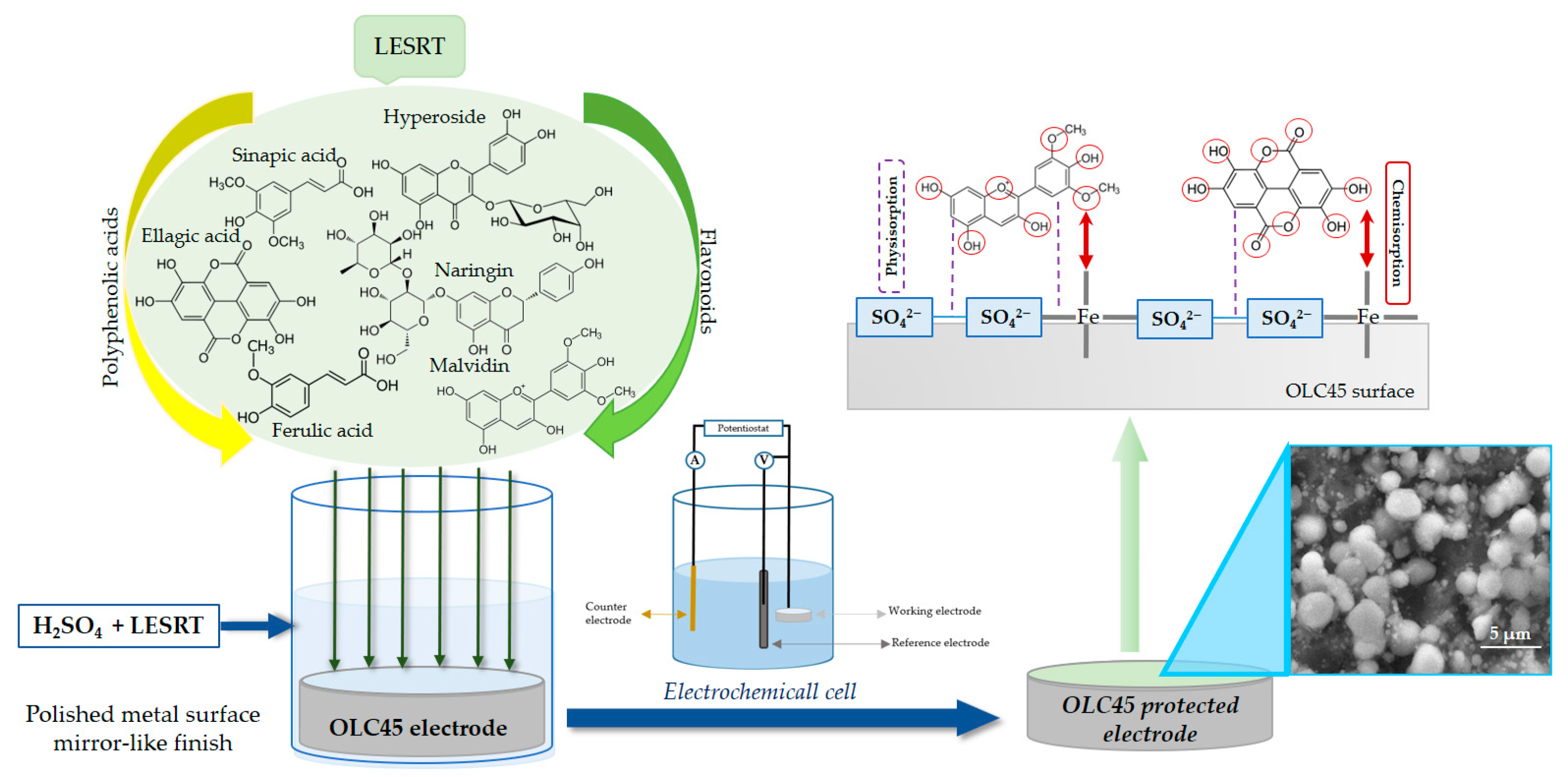
The O atom (oxygen) has the highest negative charge and possesses the greatest capacity to attach itself to the metal surface, being adsorbed directly onto the metal substrate. The protection of these phyto-constituents, in synergy, can be achieved through several modes of adsorption: through physical adsorption from the negative charge of the LESRT and/or (SO42−) and the positively charged metal substrate; through chemical interaction on the π donor–acceptor electrons of the O donor atoms of the bio-components and the available d orbital of the Fe substrate atoms. All categories of adsorption will diminish the area exposed to the corrosive environment, so that deterioration can be stopped. For the LESRT protection procedure for OLC45 in an H2SO4 environment, a form of adsorption and inhibition is proposed, as shown in Scheme 2.

3.6. Surface Investigation Using FT-IR Spectroscopy

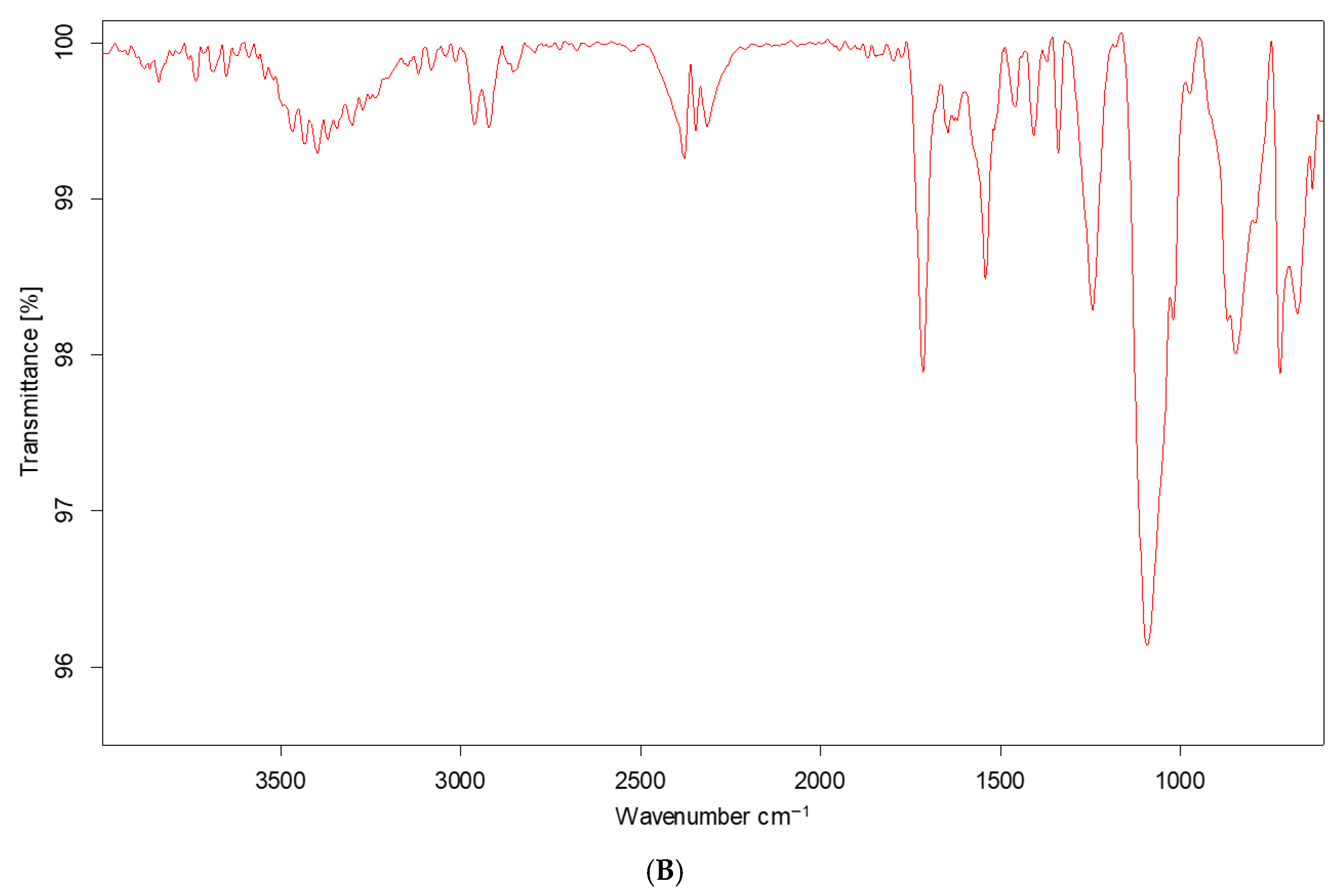
Following their adsorption onto the OLC45 substrate after immersion in the corrosive medium, the distinctive absorption bands of the LESRT1 and LESRT2 green inhibitors were identified in this study using FT-IR analysis. FT-IR spectra were analyzed to evaluate the protective layer that developed on the OLC45 surface and to learn more about the interaction and binding processes at the metal interface, as shown in Figure 9.
The FT-IR spectra recorded for the OLC45 steel samples after exposure to LESRT1 and LESRT2 are characteristic of an organic film adsorbed on the metal surface. As shown in Figure 9A,B, several absorption bands are observed, indicating the presence of organic constituents originating from the Rhus typhina L. extract.
It should be emphasized that most of these absorption bands are also present in the FT-IR spectrum of the Rhus typhina L. extract, indicating that they originate from the phytochemical constituents of the inhibitor and are primarily associated with their adsorption onto the steel surface.
A broad band in the 3400–3300 cm−1 region is attributed to O-H stretching vibrations, associated with hydroxyl groups from phenolic compounds and/or adsorbed water molecules. The bands located at approximately 2920 and 2850 cm−1 correspond to C-H stretching vibrations of -CH2 and -CH3 groups, indicating the presence of aliphatic fragments derived from the organic components of the extract.
In the 1650–1600 cm−1 region, the observed band can be attributed mainly to the bending vibration of adsorbed water (H-O-H), although possible contributions from surface oxide species cannot be excluded. Additional bands in the 1460–1380 cm−1 range are assigned to deformation vibrations of aliphatic groups, further supporting the presence of organic material on the steel surface. A strong band in the 1250–1100 cm−1 region is characteristic of C–O stretching vibrations from phenolic, alcoholic, and ether groups, while the signals between 1050 and 1000 cm−1 are also associated with C-O vibrations typical of plant-derived compounds.
Possible interactions between oxygen-containing functional groups and the metal surface are suggested by slight shifts in band position, changes in intensity, and band broadening compared to the pure extract (Figure 1). However, the presence of specific absorption bands of phytochemical constituents found in the Rhus typhina L. leaf extract on the surface of inhibited OL45 samples should serve as clear evidence of inhibitor adsorption onto the metal surface.
Therefore, the FTIR data should not be interpreted alone as evidence for the formation of new chemical bonds, but rather as confirmation of the adsorption of phytochemical constituents onto the steel surface.
Overall, the FTIR results support the formation of a protective organic film composed of adsorbed plant-derived compounds which acts as a barrier limiting the interaction between the aggressive environment and the metal substrate, thereby contributing to corrosion inhibition.

3.7. Surface Morphological Investigation by Scanning Electron Microscopy (SEM)

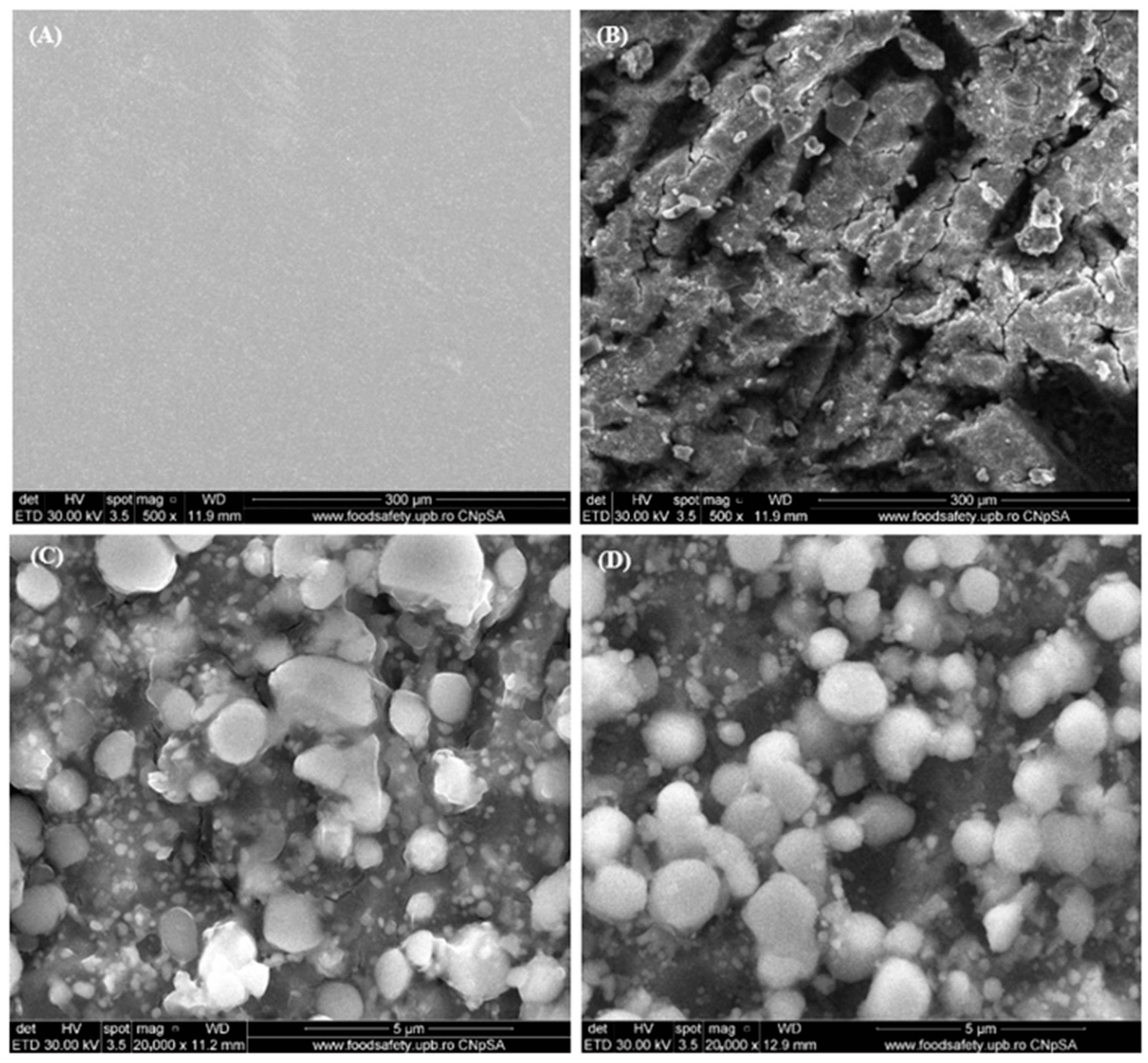
SEM micrographs obtained after immersing the OLC45 surface sample in a 0.5 M H2SO4 environment for 2 h, uninhibited and inhibited by eco-friendly inhibitors extracted from Rhus typhina L. at 1000 ppm, are shown in Figure 10. Figure 10B shows SEM micrographs of the OLC45 substrate immersed in a 0.5 M H2SO4 environment, indicating that the OLC45 sample was severely damaged in the absence of LESRT. It can be seen in Figure 10C,D that, with LESRT (LESRT1 and 2, at 1000 ppm), the OLC45 substrate area showed a superior and improved morphological substrate compared to that of the uninhibited OLC45 substrate, demonstrating the appreciable ability of eco-friendly inhibitors to protect against corrosion. An adsorbed film forms on the OLC45 substrate, reducing contact between the OLC45 sample and the aggressive environment, which contributes to corrosion inhibition.
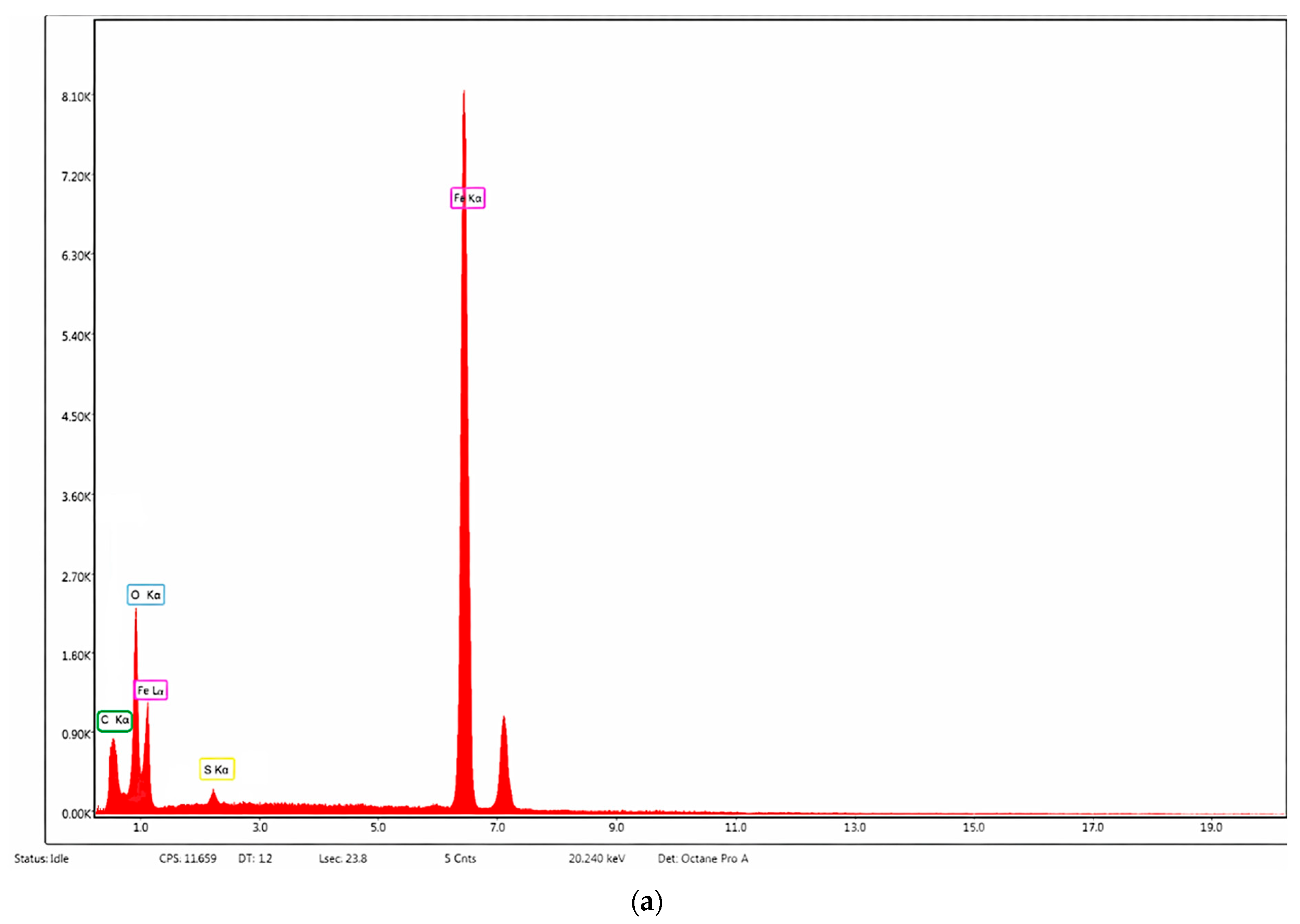
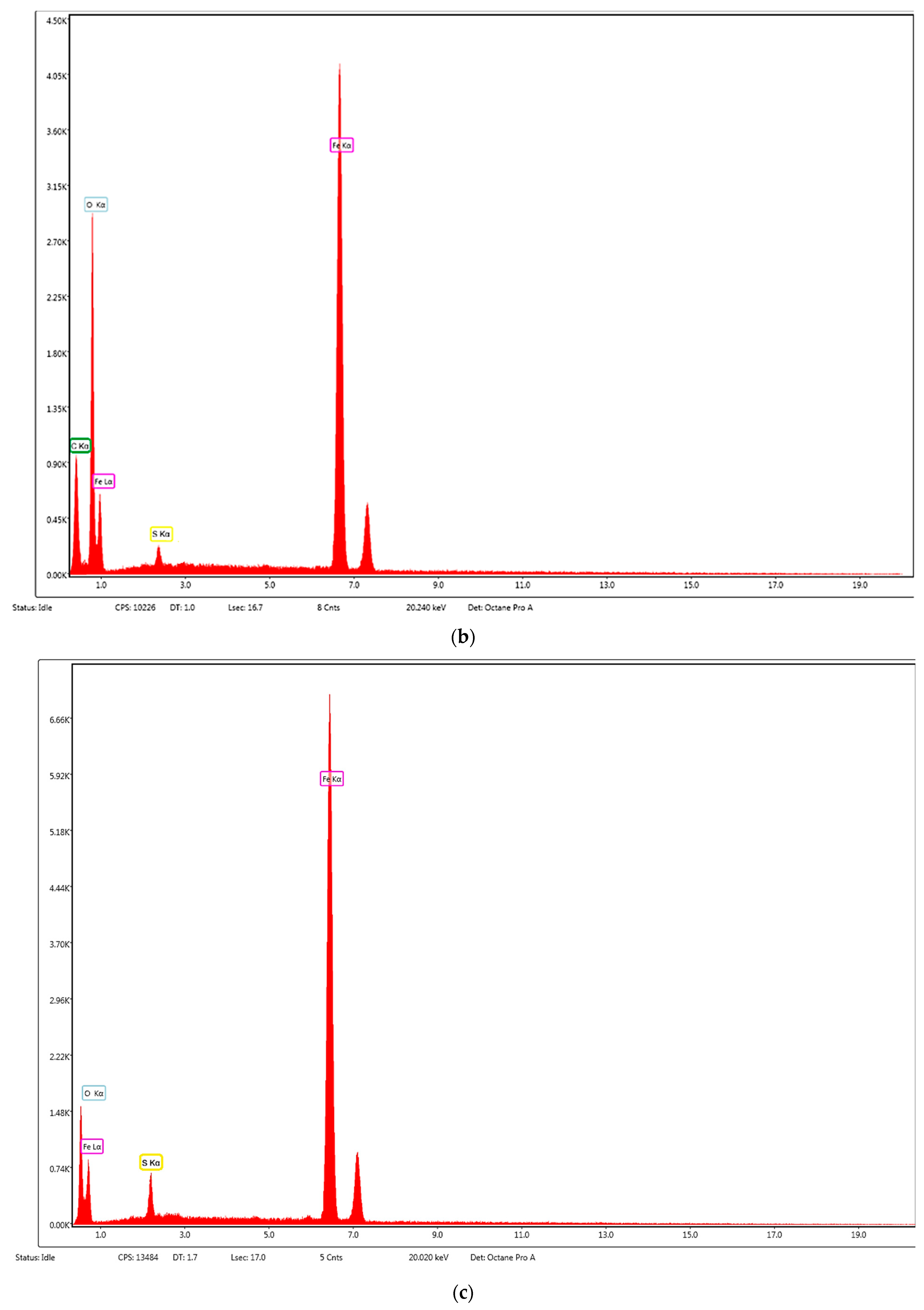
EDS analysis was performed on uninhibited and LESRT1 and LESRT2-inhibited carbon steel samples, and the corresponding spectra are presented in Figure 11. The uninhibited OLC45 steel immersed in H2SO4 (Figure 11a) exhibits intense sulfur (S) and oxygen (O) peaks, confirming the formation of corrosion products on the metal surface. For the inhibited OLC45 samples (Figure 11b,c), the EDS spectra display peaks corresponding to C, O, Fe, and S, indicating the presence of an adsorbed protective layer on the substrate. Compared to the uninhibited sample, the intensities of aggressive elements are noticeably reduced, demonstrating effective surface protection.
In sulfuric acid medium, elevated S and O contents are associated with accelerated corrosion. However, in the presence of LESRT1 and LESRT2 (extracted from RTLE), a significant decrease in these elemental signals is observed, suggesting adsorption of inhibitor molecules at the metal/solution interface and subsequent formation of a protective film.
The reduction in elemental intensities confirms the suppression of iron dissolution and aggressive ion interaction with the surface. These findings are in good agreement with the FTIR results, further supporting the formation of a stable protective layer on the steel substrate.

4. Conclusions

This work highlights the effectiveness of hydroalcoholic extracts derived from Rhus typhina L. leaves (LESRT1—methanol/water and LESRT2—ethanol/water) as eco-friendly corrosion inhibitors for OLC45 carbon steel in 0.5 M H2SO4 solution. Electrochemical evaluations, including potentiodynamic polarization and electrochemical impedance spectroscopy, demonstrated a substantial decrease in corrosion rate in the presence of both extracts, with inhibition efficiencies approaching 91% for LESRT1 and 92% for LESRT2 at 1000 ppm. Protective film formation was also confirmed by surface analyses, providing clear evidence of the inhibitors’ effectiveness in shielding the metal and reducing corrosive attack.
Electrochemical results confirmed that the extracts act as mixed-type inhibitors, reducing both anodic metal dissolution and cathodic hydrogen evolution. The inhibition mechanism is governed by the adsorption of phytochemical constituents on the metal surface, leading to the formation of a protective film. Adsorption behavior followed the Langmuir isotherm, with negative ΔG°ads values indicating a spontaneous process involving both physisorption and chemisorption.
Phytochemical characterization by HPLC revealed a complex composition mostly consisting of phenolic acids and flavonoids, such as gallic, caffeic, ferulic, and sinapic acids. These compounds, characterized by the presence of electron-donating functional groups, are likely involved in adsorption processes at the metal/solution interface, contributing to the formation of a protective barrier through combined physical and chemical interactions.
This study demonstrates that Rhus typhina L. leaf extracts represent promising sustainable alternatives to conventional corrosion inhibitors for use in acidic environments. Further studies will focus on theoretical approaches to better understand the molecular-level interactions, as well as on evaluating performance under more demanding conditions and in different corrosive media.

Author Contributions

Conceptualization, F.B. and D.-I.R.; methodology, F.B. and D.-I.R.; software, F.B., R.-D.T. and S.M.A.; validation, F.B. and E.M.; formal analysis, F.B. and D.-I.R.; investigation, D.-I.R., F.B., R.-D.T. and S.M.A.; data curation, F.B. and D.-I.R.; writing—original draft preparation, F.B. and D.-I.R.; writing—review and editing, D.-I.R., F.B., R.-D.T., S.M.A. and E.M.; visualization, F.B.; supervision, F.B. and E.M. All authors have read and agreed to the published version of the manuscript.

Funding

This research received no external funding.

Institutional Review Board Statement

Not applicable.

Informed Consent Statement

Not applicable.

Data Availability Statement

Data are contained within the article.

Acknowledgments

This work was supported by a grant of the Ministry of Research, Innovation and Digitalization, CNCS—UEFISCDI, project number 83PCE/2025 under PNCDI IV.

Conflicts of Interest

The authors declare no conflicts of interest.

References

  1. Shalabi, K.; Abd El-Lateef, H.M.; Hammouda, M.M.; Osman, A.M.; Tantawy, A.H.; Abo-Riya, M.A. Perspectives on corrosion inhibition features of novel synthesized gemini-fluorinated cationic surfactants bearing varied spacers for acid pickling of X60-steel: Practical, and in silico calculations. Materials 2023, 16, 5192. [Google Scholar] [CrossRef]
  2. Branzoi, F.; Băran, A.; Mihai, M.A.; Zaki, M.Y. The Inhibition Action of Some Brij-Type Nonionic Surfactants on the Corrosion of OLC 45 in Various Aggressive Environments. Materials 2024, 17, 1378. [Google Scholar] [CrossRef]
  3. Iravani, D.; Farhadian, A.; Sharifi, R.; Berisha, A.; Rahimi, A.; Shaabani, A.; Qiang, Y.; Javidparvar, A.A.; Martyushev, D.A.; Akbarinezhad, E. Fabrication of novel Arabic gum-grafted-polyurethanes as eco-friendly corrosion inhibitors for carbon steel in sour environments: Surface analysis and inhibition mechanism. Corros. Sci. 2025, 246, 112712. [Google Scholar] [CrossRef]
  4. Răuță, D.-I.; Matei, E.; Avramescu, S.-M. Recent Development of Corrosion Inhibitors: Types, Mechanisms, Electrochemical Behavior, Efficiency, and Environmental Impact. Technologies 2025, 13, 103. [Google Scholar] [CrossRef]
  5. Zhu, F.L.; Wang, G.D.; Wang, Y.; Cui, W.; Shi, C. Corrosion behavior of different materials in corrosive media of chemical equipment. UPB Sci. Bull. Ser. B Chem. Mater. Sci. 2025, 87, 309–322. [Google Scholar]
  6. Branzoi, F.; Neacsu, E.I.; Mihai, M.A.; Paraschiv, A. Enhanced Corrosion Resistance of OL 37 Steel in Hydrochloric Acid Using a Novel Composite Polymer Film. Materials 2025, 18, 5351. [Google Scholar] [CrossRef] [PubMed]
  7. Qiang, Y.; Guo, L.; Li, H.; Lan, X. Fabrication of environmentally friendly Losartan potassium film for corrosion inhibition of mild steel in HCl medium. Chem. Eng. J. 2021, 406, 126863. [Google Scholar] [CrossRef]
  8. Liao, B.; Luo, Z.; Wan, S.; Chen, L. Insight into the anti-corrosion performance of Acanthopanax senticosus leaf extract as eco-friendly corrosion inhibitor for carbon steel in acidic medium. J. Ind. Eng. Chem. 2023, 117, 238–246. [Google Scholar] [CrossRef]
  9. Grădinaru, C.-Ş.; Coman, G.; Ciucă, S.; Sohaciu, M.-G.; Berbecaru, A.C.; Grecu, A.; Dumitrescu, R.-E.; Gherghescu, I.-A.; Predescu, C. Research on corrosion degradation process of some thermal power plants steam boiler pipes. UPB Sci. Bull. Ser. B Chem. Mater. Sci. 2021, 83, 231–244. [Google Scholar]
  10. Hamza, S.F.; Shahen, S.; Abdel-karim, A.M.; El-Rashedy, A.A.; Hyba, A.M. Eco-friendly corrosion inhibitor chitosan methionine for carbon steel in 1 M hydrochloric acid solution: Experimental and theoretical approach. Sci. Rep. 2025, 15, 15924. [Google Scholar] [CrossRef]
  11. Al-Senani, G.M.; Al-Saeedi, S.I. The use of synthesized CoO/Co3O4 nanoparticles as a corrosion inhibitor of low-carbon steel in 1 M HCl. Materials 2022, 15, 3129. [Google Scholar] [CrossRef]
  12. Modwi, M.M.Y.; Feng, H.; Hadi, M.K.; Chen, N.; Hou, J.; Kamal, E.; Yang, K. Eco-friendly corrosion inhibitor of Q235 carbon steel in 1.0 M HCl by Isatin/Chitosan Schiff base. J. Mol. Struct. 2025, 1321, 139592. [Google Scholar] [CrossRef]
  13. Răuță, D.-I.; Brânzoi, F.; Truşcă, R.-D.; Avramescu, S.-M.; Matei, E. Electrochemical Assessment of Rhus typhina L. Leaf Extract as a Novel Green Corrosion Inhibitor for OL37 in 1 M HCl Medium. Molecules 2025, 30, 2660. [Google Scholar] [CrossRef]
  14. Iranpour, M.; Babaei, A.; Bagherzadeh, M. Microwave and heat-assisted extracted Melilotus officinalis as a potential eco-friendly corrosion inhibitor for carbon steel in 0.5 M HCl solution. Clean. Chem. Eng. 2025, 11, 100149. [Google Scholar] [CrossRef]
  15. Arslanhan, S.; Sığırcık, G.; Yıldız, R.; Baran, M.F. Protection of mild steel from corrosion in HCl solution via green Rumex acetosella extract: Experimental and theoretical studies. Mater. Today Commun. 2024, 40, 109528. [Google Scholar] [CrossRef]
  16. Al Otaibi, N.; Hammud, H.H. Corrosion Inhibition Using Harmal Leaf Extract as an Eco-Friendly Corrosion Inhibitor. Molecules 2021, 26, 7024. [Google Scholar] [CrossRef]
  17. Zeng, J.; Xie, B.; He, Y.; Lai, C.; Li, X.; Wei, Y.; Wang, W.; Yao, B.; Wen, X.; Deng, C. Experimental and theoretical insights into Ramie (Boehmeria nivea (L.) Gaudich) leaves extract as an eco-friendly corrosion inhibitor for mild steel in 1.0 M HCl. Surf. Interfaces 2025, 62, 106155. [Google Scholar] [CrossRef]
  18. Kobzar, Y.L.; Fatyeyeva, K. Ionic liquids as green and sustainable steel corrosion inhibitors: Recent developments. Chem. Eng. J. 2021, 425, 131480. [Google Scholar] [CrossRef]
  19. Vashishth, P.; Bairagi, H.; Narang, R.; Shukla, S.K.; Mangla, B. Thermodynamic and electrochemical investigation of inhibition efficiency of green corrosion inhibitor and its comparison with synthetic dyes on MS in acidic medium. J. Mol. Liq. 2022, 365, 120042. [Google Scholar] [CrossRef]
  20. Vashi, R.T. Green Corrosion Inhibitors for Mild Steel in H2SO4 Solutions (Period 2019–2022)-A Review. Port. Electrochim. Acta 2026, 44, 169–184. [Google Scholar] [CrossRef]
  21. Hau, N.N.; Huong, D.Q. Effect of aromatic rings on mild steel corrosion inhibition ability of nitrogen heteroatom-containing compounds: Experimental and theoretical investigation. J. Mol. Struct. 2023, 1277, 134884. [Google Scholar] [CrossRef]
  22. Galai, M.; El Gouri, M.; Dagdag, O.; El Kacimi, Y.; Elharfi, A.; Touhami, M. New hexa propylene glycol cyclotiphosphazene as efficient organic inhibitor of carbon steel corrosion in hydrochloric acid medium. J. Mater. Environ. Sci 2016, 7, 1562–1575. [Google Scholar]
  23. El Basiony, N.; Badr, E.E.; Baker, S.A.; El-Tabei, A.S. Experimental and theoretical (DFT&MC) studies for the adsorption of the synthesized Gemini cationic surfactant based on hydrazide moiety as X-65 steel acid corrosion inhibitor. Appl. Surf. Sci. 2021, 539, 148246. [Google Scholar] [CrossRef]
  24. Kurshed, N.H.; Khadom, A.A.; Ismail, R.K.; Mohuee, S.K.; Ahmed, N.K.; Alamiery, A. Green biosynthesis of silver nanoparticles from Citrus aurantium leaves plant as corrosion inhibitor for carbon steel in sulfuric acid. Next Nanotechnol. 2026, 9, 100331. [Google Scholar] [CrossRef]
  25. Wang, Q.; Zheng, H.; Liu, L.; Zhang, Q.; Wu, X.; Yan, Z.; Sun, Y.; Li, X. Insight into the anti–corrosion behavior of Reineckia Carnea leaves extract as an eco–friendly and high–efficiency corrosion inhibitor. Ind. Crops Prod. 2022, 188, 115640. [Google Scholar] [CrossRef]
  26. Lin, B.-L.; Zhou, X.-X.; Duan, T.-H.; Zhao, C.; Zhu, J.-H.; Xu, Y.-Y. Experimental and theoretical study on corrosion inhibition and adsorption performance of Ipomoea batatas L. leaf extract for mild steel. Arab. J. Chem. 2024, 17, 105410. [Google Scholar] [CrossRef]
  27. Chen, J.; Wu, Y.; Guo, L.; Li, W.; Tan, B.; Brahmia, A. Insight into the anti-corrosion mechanism of Pisum sativum L. leaves extract as the degradable inhibitor for Q235 steel in sulfuric acid medium. J. Taiwan Inst. Chem. Eng. 2023, 143, 104664. [Google Scholar] [CrossRef]
  28. Oghenerukevwe, P.O.; Onyiriuka, F.; Adepoju, T.F.; Enomah, S.; Mundu, M.M.; Muhammed, N.; Aisha, N.; Usen, I.U.; Oghenejabor, O.D. Regression analysis of corrosion inhibition of 42CrMo4 steel: A case study of acidified large Maradol leaf extract, kinetic, thermodynamics, adsorptions, and process parameter optimization. S. Afr. J. Chem. Eng. 2026, 55, 518–530. [Google Scholar] [CrossRef]
  29. Banumathi, R.; Syed Abuthahir, S.S.; Mohamed Kasim Sheit, H.; Mohan, K.S.; Berbeth Mary, S. Investigation of Baccaurea Ramiflora Leaf Extract as Sustainable Corrosion Inhibitor for Carbon Steel in Acidic Medium. J. Bio Tribo-Corros. 2025, 12, 13. [Google Scholar] [CrossRef]
  30. Wardhana, H.R.; Dewi, N.K.E.S.; Shaleh, M.A.; Setyani, A.; Sari, M.A.; Mafruhah, A.J.; Alfaro, A.C. The influence of gliricidia sepium leaf as corrosion inhibitor on corrosion rate of ST-37 steel in artificial seawater. AIP Conf. Proc. 2026, 3337, 040046. [Google Scholar]
  31. Yadav, O.; Kumar, S.; Yadav, K.; Sharma, R.; Kumar, R. Investigations Properties on the Corrosion Inhibition of Kala Bansa Leaf Extract on Mild Steel in an Acidic Environment. Port. Electrochim. Acta 2026, 44, 27–45. [Google Scholar] [CrossRef]
  32. Tan, B.; Ren, H.; Yin, C.; Li, X.; Li, X.; Wang, R.; Guo, L.; Zhang, Y.; Al-Sadoon, M.K. Nepeta cataria L. leaf extracts as eco-conscious corrosion inhibitor for copper in H2SO4 medium. Colloids Surf. A Physicochem. Eng. Asp. 2025, 711, 136399. [Google Scholar] [CrossRef]
  33. Döner, A.; Yıldız, R.; Arslanhan, S.; Baran, M.F. A comprehensive analysis of Arum dioscoridis plant leaf extract as a corrosion inhibitor for mild steel in 1 M HCl: Synthesis, characterization, surface analysis observations, experimental and DFT studies. J. Taiwan Inst. Chem. Eng. 2025, 169, 105955. [Google Scholar] [CrossRef]
  34. Carmona-Hernandez, A.; Barreda-Serrano, M.C.; Saldarriaga-Noreña, H.A.; López-Sesenes, R.; González-Rodríguez, J.G.; Mejía-Sánchez, E.; Ramírez-Cano, J.A.; Orozco-Cruz, R.; Galván-Martínez, R. Insight into the Corrosion Inhibition Performance of Pistia stratiotes Leaf Extract as a Novel Eco-Friendly Corrosion Inhibitor for Mild Steel in 1 M HCl Solution. Molecules 2024, 29, 5243. [Google Scholar] [CrossRef] [PubMed]
  35. Liu, T.; Li, Z.; Li, R.; Cui, Y.; Zhao, Y.; Yu, Z. Composition analysis and antioxidant activities of the Rhus typhina L. stem. J. Pharm. Anal. 2019, 9, 332–338. [Google Scholar] [CrossRef]
  36. Van Wyk, B.-E.; Wink, M. Medicinal Plants of the World; Briza Publications: Pretoria, South Africa, 2004. [Google Scholar]
  37. Olchowik, E.; Sciepuk, A.; Mavlyanov, S.; Abdullajanova, N.; Zamaraeva, M. Antioxidant capacities of polyphenols from Sumac (Rhus typhina L.) leaves in protection of erythrocytes against oxidative damage. Biomed. Prev. Nutr. 2012, 2, 99–105. [Google Scholar] [CrossRef]
  38. Răuță, D.I.G.; Matei, E.; Avramescu, S. Corrosion inhibition of mild steel by rhus typhina leaf extract in HCl solutions. UPB Sci. Bull. Ser. B Chem. Mater. Sci. 2024, 86, 251–262. [Google Scholar]
  39. Branzoi, F.; Băran, A.; Ludmila, A.; Alexandrescu, E.J.C.P. The inhibition action of some organic polymers on the corrosion carbon steel in acidic media. Chem. Pap. 2020, 74, 4315–4433. [Google Scholar] [CrossRef]
  40. Okafor, P.C.; Osabor, V.I.; Ebenso, E.E. Eco-friendly corrosion inhibitors: Inhibitive action of ethanol extracts of Garcinia kola for the corrosion of mild steel in H2SO4 solutions. Pigment Resin Technol. 2007, 36, 299–305. [Google Scholar] [CrossRef]
Scheme 1. Examination and characterization of hydroalcoholic extracts from leaves collected in summer from Rhus thypina L. on an OLC45 substrate in a corrosive environment.
Technologies 14 00256 sch001
Figure 1. FTIR spectrum for Rhus typhina L. leaf powder in summer.
Technologies 14 00256 g001
Figure 2. HPLC chromatogram of extracts from Rhus typhina L. summer leaves: (A) LESRT1 and (B) LESRT2.
Technologies 14 00256 g002
Figure 3. Polarization curves for OLC45 sample in 0.5 M H2SO4 at different concentrations of LESRT1 (A) and LESRT2 (B) at 25 °C.
Technologies 14 00256 g003
Figure 4. Nyquist diagrams for OLC45 in 0.5 M H2SO4 medium with different concentrations of LESRT1 (A) and LESRT2 (B) at 25 °C.
Technologies 14 00256 g004
Figure 5. Bode graphics of OLC45 in 0.5 M H2SO4 at different concentrations of LESRT1 (A,B) and LESRT2 (C,D) at 25 °C.
Technologies 14 00256 g005aTechnologies 14 00256 g005b
Figure 6. Equivalent circuit.
Technologies 14 00256 g006
Figure 7. Arrhenius plots for OLC45 steel in 0.5 M H2SO4 in the absence and presence of LESRT1 and LESRT2 at different temperatures (A) presents the Arrhenius plot of the corrosion rate versus 1/T for OLC45 steel in 0.5 M H2SO4 and (B) shows the transition state plot of log (corrosion rate/T) versus 1/T).
Technologies 14 00256 g007
Figure 8. Langmuir plot for LESRT1 (A) and LESRT2 (B) on OLC45 in 0.5 M H2SO4.
Technologies 14 00256 g008
Scheme 2. Inhibition mechanisms of corrosion process on OLC45 for LESRT in aggressive acidic environment.
Technologies 14 00256 sch002
Figure 9. FT-IR transmittance plots of LESRT1 1000 ppm (A) and LESRT2 1000 ppm (B).
Technologies 14 00256 g009aTechnologies 14 00256 g009b
Figure 10. SEM images of OLC45 electrode (A) polished, (B) in 0.5 M H2SO4, (C) with 1000 ppm LESRT1, and (D) with 1000 ppm LESRT2.
Technologies 14 00256 g010
Figure 11. EDS plots of the LESRT1 and 2/on OLC45 (a,b) and EDS plots of OLC45 in H2SO4 (c).
Technologies 14 00256 g011aTechnologies 14 00256 g011b
Table 1. Evaluation of extract composition by HPLC method.
Extract/ParameterLESRT1LESRT2
Gallic acid (mg/mL)71.0973.01
Protocatechuic acid (mg/mL)2.092.27
Caffeic acid (mg/mL)27.3028.84
Chlorogenic acid (mg/mL)16.6417.16
Syringic acid (mg/mL)9.3210.45
Ferulic acid (mg/mL)193.99201.89
Sinapic acid (mg/mL)397.98399.99
Ellagic acid (mg/mL)179.20194.44
Rosmarinic acid (mg/mL)29.2231.56
p–Cumaric acid (mg/mL)4.085.59
Daidzein (mg/mL)10.9214.18
Hyperoside (mg/mL)126.36129.52
Rutin (mg/mL)41.2160.81
Naringin (mg/mL)110.45161.13
Malvidin (mg/mL)107.95208.02
Naringenin (mg/mL)18.7820.17
Genistein (mg/mL)21.0957.72
Table 2. Electrochemical kinetic parameters for OLC45 steel in 0.5 M H2SO4 in the presence of various concentrations of LESRT1 at 25 °C.
Conc.
(ppm)
icorr
(mA × cm−2)
Rp
Ω × cm−2
RmpyPmm/yearKg
g/m2 × h
E (%)−Ecorr
(mV)
ba
(mV × dec−1)
−bc
(mV × dec−1)
θ
00.897 ± 0.0101741810.629.43-496 ± 19695-
200.166 ± 0.0038277.741.971.7781426 ± 3421120.81
500.132 ± 0.00310061.61.561.485420 ± 3351140.85
1000.127 ± 0.00210459.261.5041.3586457 ± 133890.86
3000.096 ± 0.0039645.731.161.0489452 ± 236900.89
5000.091 ± 0.00211643.41.100.98690419 ± 344690.90
8000.078 ± 0.00313136.40.920.8392417 ± 259790.92
10000.084 ± 0.00212439.21.060.8991414 ± 3381070.91
Table 3. Electrochemical kinetic parameters for OLC45 steel in 0.5 M H2SO4 in the presence of various concentrations of LESRT2 at 25 °C.
Conc
(ppm)
icorr
(mA × cm−2)
Rp
Ω × cm−2
RmpyPmm/yearKg
g/m2 × h
E (%)−Ecorr
(mV)
ba
(mV × dec−1)
−bc
(mV × dec−1)
θ
00.897 ± 0.0101741810.629.43-496 ± 19695-
200.110 ± 0.0028951.331.301.1688424 ± 245810.88
500.096 ± 0.00310841.61.0550.9489421 ± 232880.89
1000.083 ± 0.00311438.870.9860.8890425 ± 138850.90
3000.081 ± 0.00211937.80.950.8690417 ± 3331020.90
5000.078 ± 0.00113437.30.950.8691418 ± 236890.91
8000.066 ± 0.00319829.860.760.6893412 ± 334970.93
10000.069 ± 0.00218632.20.820.7392430 ± 151650.92
Table 4. EIS parameters for OLC45, with LESRT1, in 0.5 M H2SO4, at 25 °C.
Concentration
(ppm)
RS
(ohm × cm2)
Q − Yo
S × sn × cm−2
Q − nRct
(ohm × cm2)
χ2E%
00.970.00630.76214.664 × 10−3-
200.9180.0004870.8933665.212 × 10−369
500.89850.00055880.8733683.522 × 10−370
1000.87880.0008820.8926718.526 × 10−371
3001.0160.00070770.8795738.032 × 10−372
5000.90080.00074020.75111038.219 × 10−380
8000.86050.00061350.9411183.225 × 10−382
10000.93050.00055350.8711252.735 × 10−384
Table 5. EIS parameters for OLC45, with LESRT2, in 0.5 M H2SO4, at 25 °C.
Concentration
(ppm)
RS
(ohm × cm2)
Q − Yo
S × sn × cm−2
Q − nRct
(ohm × cm2)
χ2E%
00.970.00630.76214.664 × 10−3-
201.4510.00045910.87765.085 × 10−373
501.2340.00042720.9317793.025 × 10−374
1001.1690.00056420.862815.720 × 10−374
3001.8330.00046160.85521123.620 × 10−382
5001.6780.00058240.92561081.732 × 10−381
8002.0120.00085260.92491263.261 × 10−384
10001.6440.00034460.89261322.871 × 10−385
Table 6. The values of Ea, ΔH0 and ΔS0 for LESRT1 and LESRT2 on OLC45 in 0.5 M H2SO4.
InhibitorEa (KJ/mol)ΔH0 (KJ/mol)ΔS0 (J/mol K)
LESRT134.3931.73−157.32
LESRT235.4232.80−154.04
H2SO443.3040.68−104.61
Table 7. The values of Kads and G a d s ° for the LESRT GCIs on OLC45 in 0.5 M H2SO4.
SystemKads
M−1
G a d s °
KJ × mol−1
SlopeAdsorption Type
OLC45 + LESRT11.13 × 105−38.121.081Chemisorption and physical adsorption
OLC45 + LESRT23.12 x 105−40.621.118Chemisorption and physical adsorption
Disclaimer/Publisher’s Note: The statements, opinions and data contained in all publications are solely those of the individual author(s) and contributor(s) and not of MDPI and/or the editor(s). MDPI and/or the editor(s) disclaim responsibility for any injury to people or property resulting from any ideas, methods, instructions or products referred to in the content.