
EMG-Driven Robotic Therapy for Neurological Rehabilitation: A Systematic Review and Meta-Analysis

 ,
,  ,
,  , , and
Abstract
1. Introduction
2. Materials and Methods
2.1. Design and Protocol Registration
2.2. Search Strategy and Study Selection
2.3. Eligibility Criteria
2.4. Risk of Bias Assessment
2.5. Data Analysis
3. Results
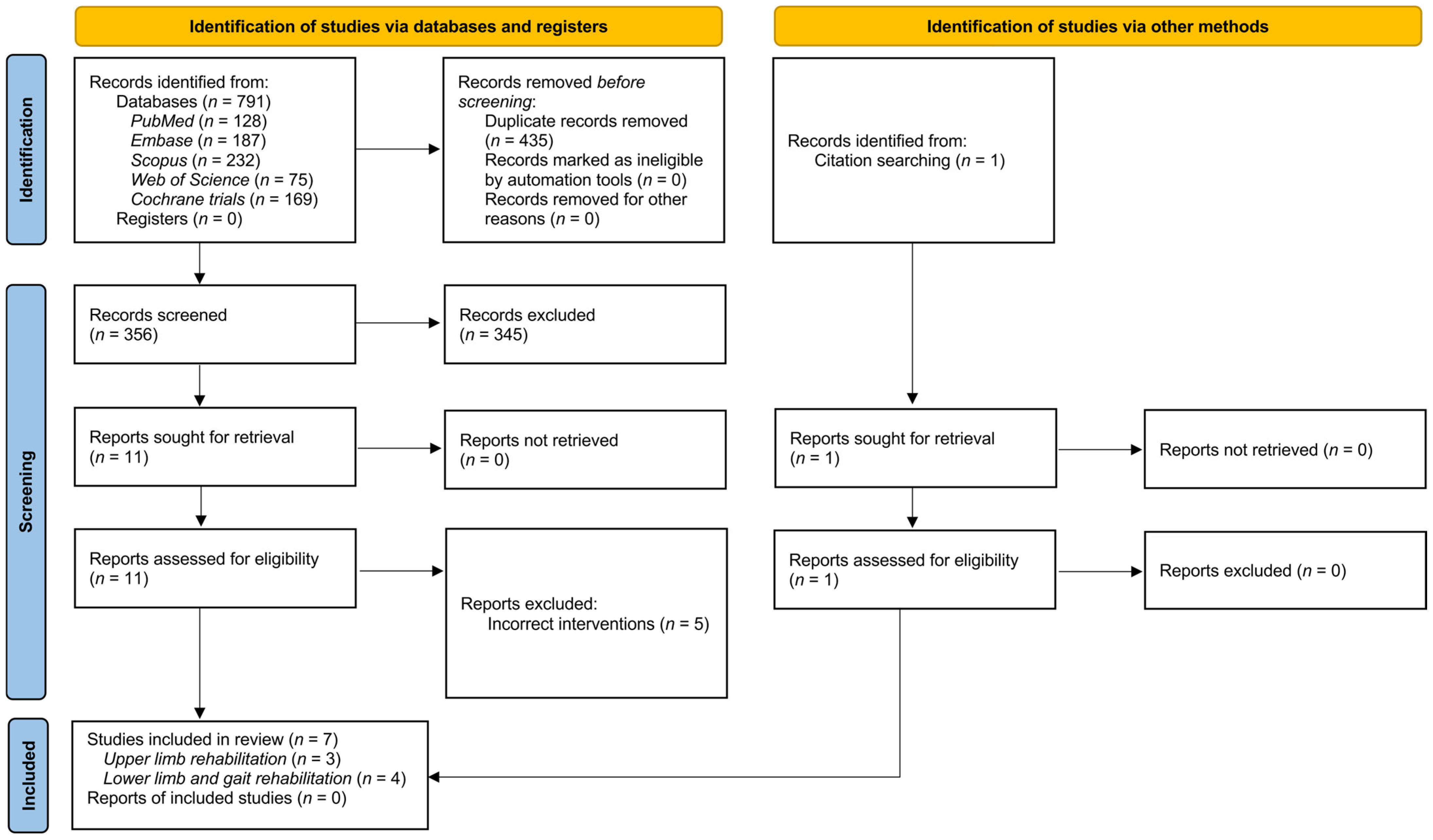
3.1. Search Results and Study Characteristics
3.2. Upper Limb Rehabilitation
3.2.1. Narrative Synthesis of the Included Studies
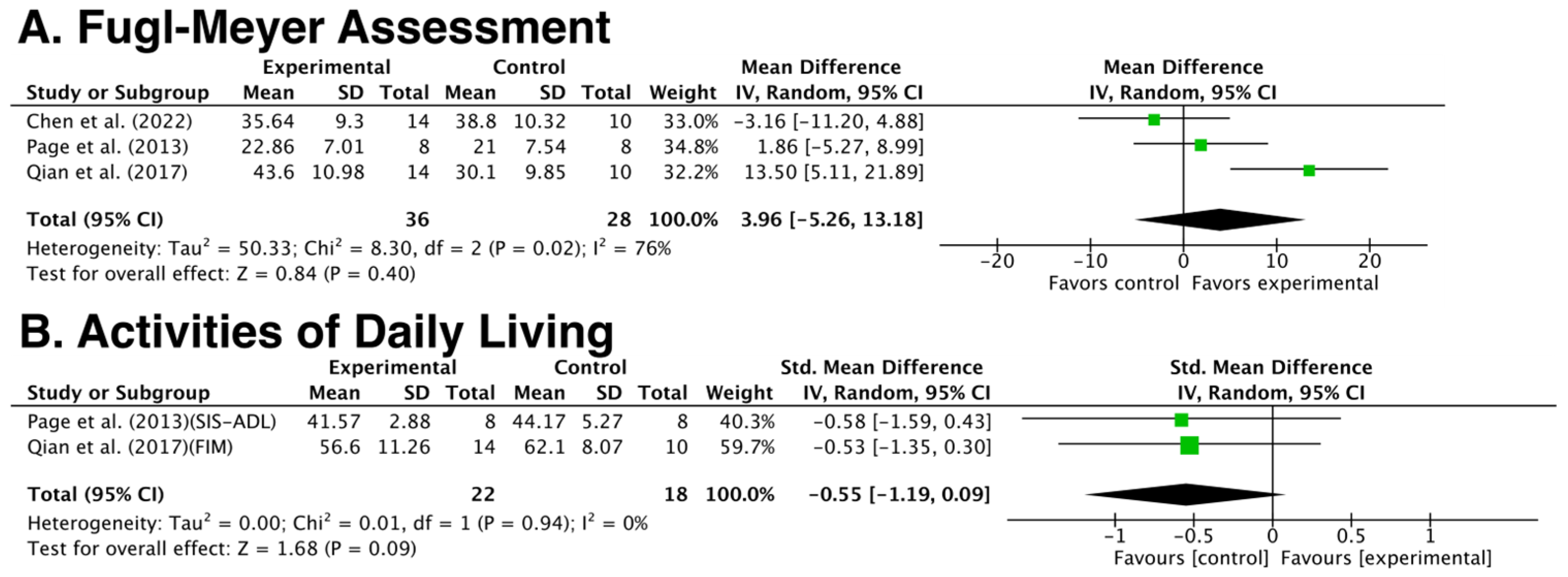
3.2.2. Quantitative Synthesis
3.3. Lower Limb and Gait Rehabilitation
3.3.1. Narrative Synthesis of the Included Studies
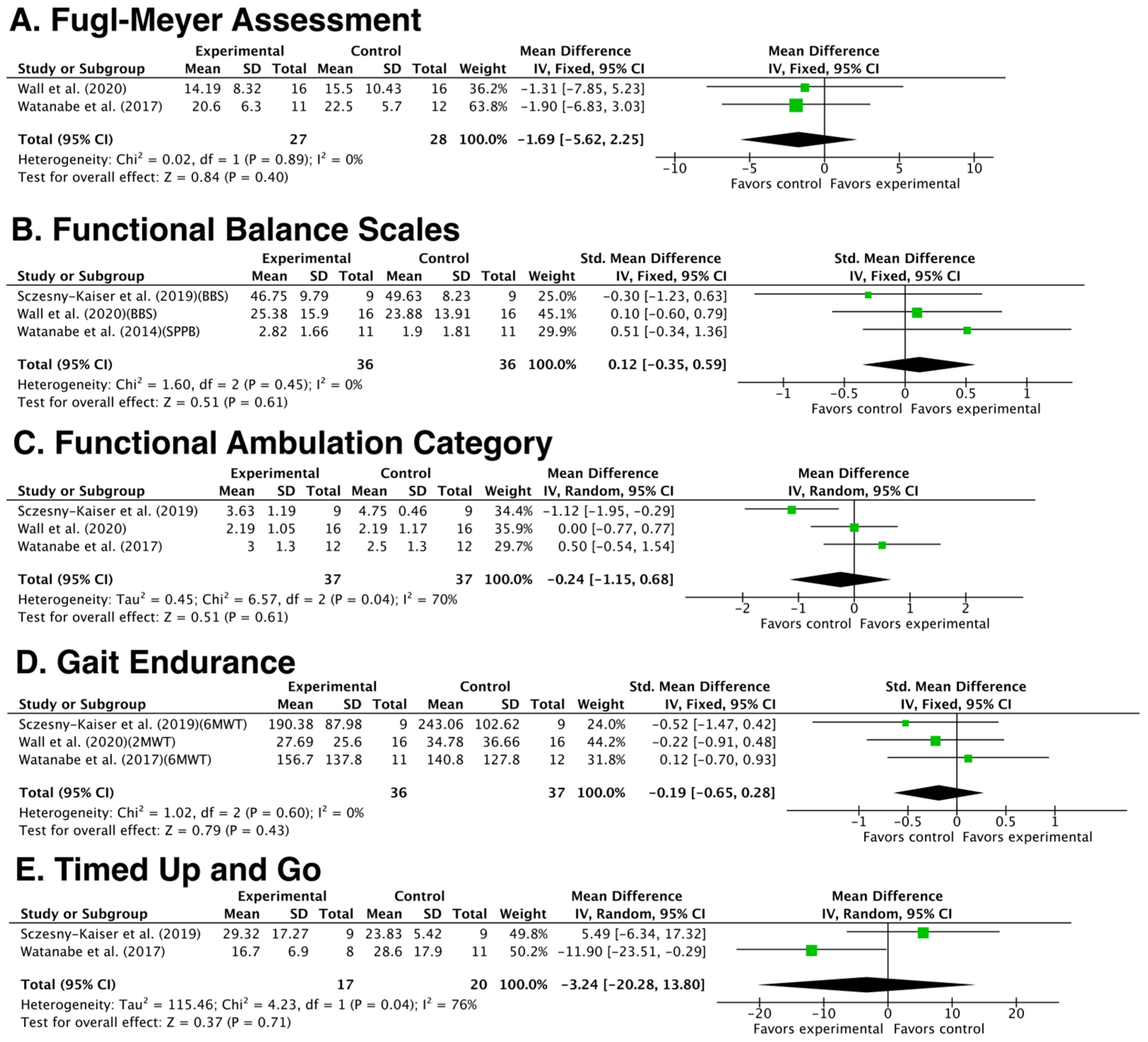
3.3.2. Quantitative Synthesis
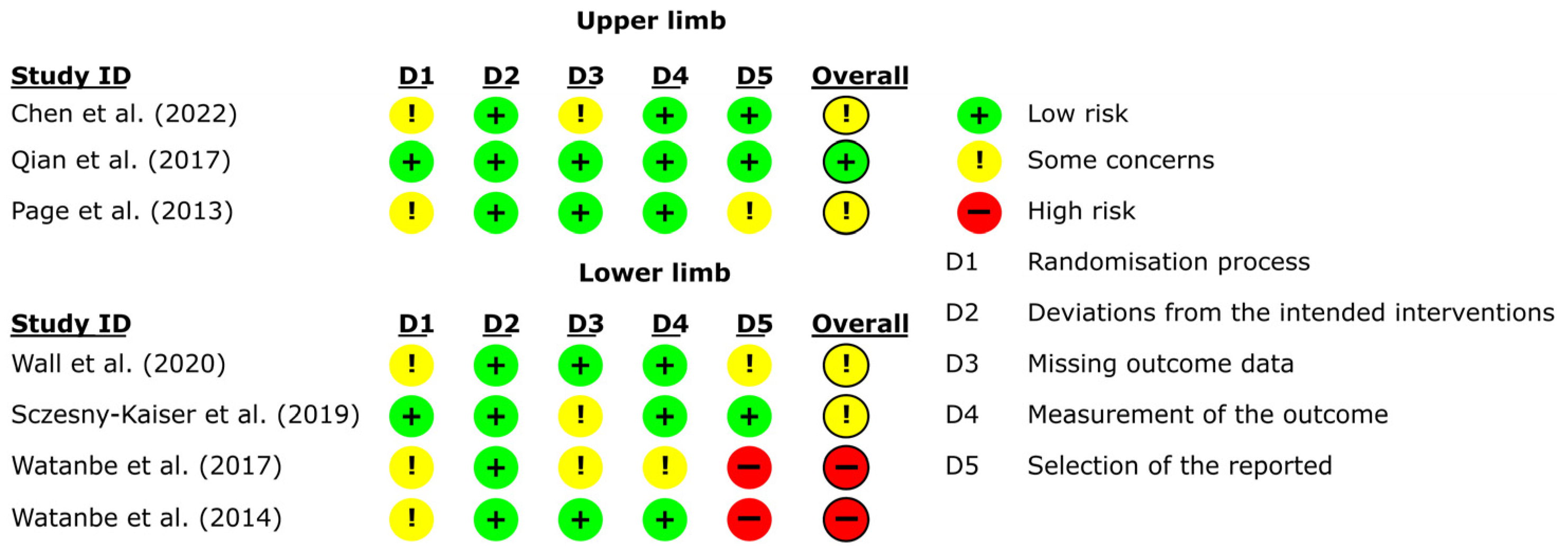
3.4. Risk of Bias Assessment
4. Discussion
4.1. Clinical Implications
4.2. Limitations
4.3. Additional Considerations: Cost, Feasibility, and Accessibility
4.4. Future Research Directions
5. Conclusions
Supplementary Materials
Author Contributions
Funding
Institutional Review Board Statement
Informed Consent Statement
Data Availability Statement
Acknowledgments
Conflicts of Interest
Abbreviations
| 2 MWT | 2 min Walk Test |
| 6 MWD | 6 min Walk Distance |
| 6 MWT | 6 min Walk Test |
| 10 MWT | 10 m Walk Test |
| ADL | Activities of Daily Living |
| ARAT | Action Research Arm Test |
| BBS | Berg Balance Scale |
| BI | Barthel Index |
| BWS | Body Weight Support |
| BWSTT | Body-Weight-Supported Treadmill Training |
| CG | Control Group |
| CGT | Conventional Gait Training |
| COPM | Canadian Occupational Performance Measure |
| CPT | Conventional Physiotherapy |
| CPM | Continuous Passive Motion |
| CT | Conventional Therapy |
| d | Days |
| EMG | Electromyography |
| FAC | Functional Ambulation Category |
| FIM | Functional Independence Measure |
| FMA | Fugl-Meyer Assessment |
| FMA-LE | Fugl-Meyer Lower Extremity |
| HOH | Hand of Hope |
| HAL | Hybrid Assistive Limb |
| LL | Lower Limb |
| MAL | Motor Activity Log |
| MAS | Modified Ashworth Scale |
| MCID | Minimal Clinically Important Difference |
| MD | Mean Differences |
| mo | Months |
| MS | Multiple Sclerosis |
| NMES | Neuromuscular Electrical Stimulation |
| PD | Parkinson Disease |
| QoL | Quality of Life |
| RCT | Randomized Controlled Trial |
| RoB2 | Risk of Bias 2 |
| SCI | Spinal Cord Injury |
| sEMG | Surface Electromyography |
| SIS | Stroke Impact Scale |
| SMD | Standardized Mean Differences |
| SPPB | Short Physical Performance Battery |
| TBI | Traumatic Brain Injury |
| TUG | Timed Up and Go |
| UL | Upper Limb |
| wk | Weeks |
| WMFT | Wolf Motor Function Test |
| y | Years |
References
- Feigin, V.L.; Nichols, E.; Alam, T.; Bannick, M.S.; Beghi, E.; Blake, N.; Culpepper, W.J.; Dorsey, E.R.; Elbaz, A.; Ellenbogen, R.G.; et al. Global, Regional, and National Burden of Neurological Disorders, 1990–2016: A Systematic Analysis for the Global Burden of Disease Study 2016. Lancet Neurol. 2019, 18, 459–480. [Google Scholar] [CrossRef] [Scilit]
- Engel-Yeger, B. The Involvement of Altered Sensory Modulation in Neurological Conditions and Its Relevance to Neuro-Rehabilitation: A Narrative Literature Review. Disabil. Rehabil. 2021, 43, 2511–2520. [Google Scholar] [CrossRef] [Scilit] [PubMed]
- Platz, T.; Sandrini, G. Specialty Grand Challenge for NeuroRehabilitation Research. Front. Neurol. 2020, 11, 349. [Google Scholar] [CrossRef] [Scilit] [PubMed]
- Fujiwara, T.; Paik, N.-J.; Platz, T. Neurorehabilitation: Neural Plasticity and Functional Recovery. Neural Plast. 2017, 2017, 1. [Google Scholar] [CrossRef] [Scilit]
- Winstein, C.J.; Stein, J.; Arena, R.; Bates, B.; Cherney, L.R.; Cramer, S.C.; Deruyter, F.; Eng, J.J.; Fisher, B.; Harvey, R.L.; et al. Guidelines for Adult Stroke Rehabilitation and Recovery: A Guideline for Healthcare Professionals From the American Heart Association/American Stroke Association. Stroke 2016, 47, e98–e169. [Google Scholar] [CrossRef] [Scilit]
- Chen, Y.-W.; Chiang, W.-C.; Chang, C.-L.; Lo, S.-M.; Wu, C.-Y. Comparative Effects of EMG-Driven Robot-Assisted Therapy versus Task-Oriented Training on Motor and Daily Function in Patients with Stroke: A Randomized Cross-over Trial. J. Neuroeng. Rehabil. 2022, 19, 6. [Google Scholar] [CrossRef] [Scilit]
- Sarhan, S.M.; Al-Faiz, M.Z.; Takhakh, A.M. A Review on EMG/EEG Based Control Scheme of Upper Limb Rehabilitation Robots for Stroke Patients. Heliyon 2023, 9, e18308. [Google Scholar] [CrossRef] [Scilit]
- Pradon, D.; Tong, L.; Chalitsios, C.; Roche, N. Development of Surface EMG for Gait Analysis and Rehabilitation of Hemiparetic Patients. Sensors 2024, 24, 5954. [Google Scholar] [CrossRef] [Scilit] [PubMed]
- Fan, T.; Zheng, P.; Zhang, X.; Gong, Z.; Shi, Y.; Wei, M.; Zhou, J.; He, L.; Li, S.; Zeng, Q.; et al. Effects of Exoskeleton Rehabilitation Robot Training on Neuroplasticity and Lower Limb Motor Function in Patients with Stroke. BMC Neurol. 2025, 25, 193. [Google Scholar] [CrossRef] [Scilit]
- Zhang, Y.; Zhao, W.; Wan, C.; Wu, X.; Huang, J.; Wang, X.; Huang, G.; Ding, W.; Chen, Y.; Yang, J.; et al. Exoskeleton Rehabilitation Robot Training for Balance and Lower Limb Function in Sub-Acute Stroke Patients: A Pilot, Randomized Controlled Trial. J. Neuroeng. Rehabil. 2024, 21, 98. [Google Scholar] [CrossRef] [Scilit]
- Fu, J.; Choudhury, R.; Hosseini, S.M.; Simpson, R.; Park, J.-H. Myoelectric Control Systems for Upper Limb Wearable Robotic Exoskeletons and Exosuits—A Systematic Review. Sensors 2022, 22, 8134. [Google Scholar] [CrossRef] [Scilit]
- Blank, A.A.; French, J.A.; Pehlivan, A.U.; O’Malley, M.K. Current Trends in Robot-Assisted Upper-Limb Stroke Rehabilitation: Promoting Patient Engagement in Therapy. Curr. Phys. Med. Rehabil. Rep. 2014, 2, 184–195. [Google Scholar] [CrossRef] [Scilit]
- Frentz, L.; Gallou, W.; Gran, A.; Jerome, I.; Leclercq, C.; Kiper, A. Systematic Review of EMG-Driven Robots in Lower Extremity Post-Stroke Rehabilitation. Sport Tour. Cent. Eur. J. 2023, 6, 119–131. [Google Scholar] [CrossRef] [Scilit]
- Cheung, E.Y.Y.; Yu, K.K.K.; Kwan, R.L.C.; Ng, C.K.M.; Chau, R.M.W.; Cheing, G.L.Y. Effect of EMG-Biofeedback Robotic-Assisted Body Weight Supported Treadmill Training on Walking Ability and Cardiopulmonary Function on People with Subacute Spinal Cord Injuries―A Randomized Controlled Trial. BMC Neurol. 2019, 19, 140. [Google Scholar] [CrossRef] [Scilit] [PubMed]
- Liberati, A.; Altman, D.G.; Tetzlaff, J.; Mulrow, C.; Gøtzsche, P.C.; Ioannidis, J.P.A.; Clarke, M.; Devereaux, P.J.; Kleijnen, J.; Moher, D. The PRISMA Statement for Reporting Systematic Reviews and Meta-Analyses of Studies That Evaluate Health Care Interventions: Explanation and Elaboration. PLoS Med. 2009, 6, e1000100. [Google Scholar] [CrossRef] [Scilit] [PubMed]
- Page, M.J.; McKenzie, J.E.; Bossuyt, P.M.; Boutron, I.; Hoffmann, T.C.; Mulrow, C.D.; Shamseer, L.; Tetzlaff, J.M.; Akl, E.A.; Brennan, S.E.; et al. The PRISMA 2020 Statement: An Updated Guideline for Reporting Systematic Reviews. BMJ 2021, 372, n71. [Google Scholar] [CrossRef] [Scilit] [PubMed]
- Ouzzani, M.; Hammady, H.; Fedorowicz, Z.; Elmagarmid, A. Rayyan-a Web and Mobile App for Systematic Reviews. Syst. Rev. 2016, 5, 210. [Google Scholar] [CrossRef] [Scilit]
- Sterne, J.A.C.; Savović, J.; Page, M.J.; Elbers, R.G.; Blencowe, N.S.; Boutron, I.; Cates, C.J.; Cheng, H.-Y.; Corbett, M.S.; Eldridge, S.M.; et al. RoB 2: A Revised Tool for Assessing Risk of Bias in Randomised Trials. BMJ 2019, 366, l4898. [Google Scholar] [CrossRef] [Scilit]
- Sczesny-Kaiser, M.; Trost, R.; Aach, M.; Schildhauer, T.A.; Schwenkreis, P.; Tegenthoff, M. A Randomized and Controlled Crossover Study Investigating the Improvement of Walking and Posture Functions in Chronic Stroke Patients Using HAL Exoskeleton―The HALESTRO Study (HAL-Exoskeleton STROke Study). Front. Neurosci. 2019, 13, 259. [Google Scholar] [CrossRef] [Scilit]
- Wall, A.; Borg, J.; Vreede, K.; Palmcrantz, S. A Randomized Controlled Study Incorporating an Electromechanical Gait Machine, the Hybrid Assistive Limb, in Gait Training of Patients with Severe Limitations in Walking in the Subacute Phase after Stroke. PLoS ONE 2020, 15, e0229707. [Google Scholar] [CrossRef] [Scilit]
- Watanabe, H.; Tanaka, N.; Inuta, T.; Saitou, H.; Yanagi, H. Locomotion Improvement Using a Hybrid Assistive Limb in Recovery Phase Stroke Patients: A Randomized Controlled Pilot Study. Arch. Phys. Med. Rehabil. 2014, 95, 2006–2012. [Google Scholar] [CrossRef] [Scilit] [PubMed]
- Watanabe, H.; Goto, R.; Tanaka, N.; Matsumura, A.; Yanagi, H. Effects of Gait Training Using the Hybrid Assistive Limb® in Recovery-Phase Stroke Patients: A 2-Month Follow-up, Randomized, Controlled Study. Neurorehabilit. Int. Interdiscip. J. 2017, 40, 363–367. [Google Scholar] [CrossRef] [Scilit]
- Qian, Q.; Hu, X.; Lai, Q.; Ng, S.C.; Zheng, Y.; Poon, W. Early Stroke Rehabilitation of the Upper Limb Assisted with an Electromyography-Driven Neuromuscular Electrical Stimulation-Robotic Arm. Front. Neurol. 2017, 8, 447. [Google Scholar] [CrossRef] [Scilit]
- Page, S.J.; Hill, V.; White, S. Portable Upper Extremity Robotics Is as Efficacious as Upper Extremity Rehabilitative Therapy: A Randomized Controlled Pilot Trial. Clin. Rehabil. 2013, 27, 494–503. [Google Scholar] [CrossRef] [Scilit] [PubMed]
- Page, S.J.; Fulk, G.D.; Boyne, P. Clinically Important Differences for the Upper-Extremity Fugl-Meyer Scale in People With Minimal to Moderate Impairment Due to Chronic Stroke. Phys. Ther. 2012, 92, 791–798. [Google Scholar] [CrossRef] [Scilit]
- Hiragami, S.; Inoue, Y.; Harada, K. Minimal Clinically Important Difference for the Fugl-Meyer Assessment of the Upper Extremity in Convalescent Stroke Patients with Moderate to Severe Hemiparesis. J. Phys. Ther. Sci. 2019, 31, 917–921. [Google Scholar] [CrossRef] [Scilit]
- Pandian, S.; Arya, K.N.; Kumar, D. Minimal Clinically Important Difference of the Lower-Extremity Fugl-Meyer Assessment in Chronic-Stroke. Top. Stroke Rehabil. 2016, 23, 233–239. [Google Scholar] [CrossRef] [Scilit]
- Nakazono, T.; Amano, S.; Saita, K.; Takahashi, K. A Scoping Review of Minimal Important Change and Minimal Detectable Change of the Fugl-Meyer Assessment Lower Extremity Scale in Patients with Stroke. Phys. Ther. Res. 2025, 28, 137–144. [Google Scholar] [CrossRef] [Scilit] [PubMed]
- Turner, R.M.; Bird, S.M.; Higgins, J.P.T. The Impact of Study Size on Meta-Analyses: Examination of Underpowered Studies in Cochrane Reviews. PLoS ONE 2013, 8, e59202. [Google Scholar] [CrossRef] [Scilit]
- Park, J.M.; Park, H.J.; Yoon, S.Y.; Kim, Y.W.; Shin, J.I.; Lee, S.C. Effects of Robot-Assisted Therapy for Upper Limb Rehabilitation After Stroke: An Umbrella Review of Systematic Reviews. Stroke 2025, 56, 1243–1252. [Google Scholar] [CrossRef] [Scilit]
- Jansen, O.; Schildhauer, T.A.; Meindl, R.C.; Tegenthoff, M.; Schwenkreis, P.; Sczesny-Kaiser, M.; Grasmücke, D.; Fisahn, C.; Aach, M. Functional Outcome of Neurologic-Controlled HAL-Exoskeletal Neurorehabilitation in Chronic Spinal Cord Injury: A Pilot With One Year Treatment and Variable Treatment Frequency. Glob. Spine J. 2017, 7, 735–743. [Google Scholar] [CrossRef] [Scilit]
- Yu, Y.; Huang, W.; Tuerxun, H.; Zheng, Y.; Su, L.; Li, X.; Dou, Z. Enhanced Neuroplasticity and Gait Recovery in Stroke Patients: A Comparative Analysis of Active and Passive Robotic Training Modes. BMC Neurol. 2025, 25, 239. [Google Scholar] [CrossRef] [Scilit]
- Goikoetxea-Sotelo, G.; Van Hedel, H.J.A. Defining, Quantifying, and Reporting Intensity, Dose, and Dosage of Neurorehabilitative Interventions Focusing on Motor Outcomes. Front. Rehabil. Sci. 2023, 4, 1139251. [Google Scholar] [CrossRef] [Scilit] [PubMed]
- Wu, X.; Guarino, P.; Lo, A.C.; Peduzzi, P.; Wininger, M. Long-Term Effectiveness of Intensive Therapy in Chronic Stroke. Neurorehabil. Neural. Repair 2016, 30, 583–590. [Google Scholar] [CrossRef] [Scilit] [PubMed]
- Maggioni, S.; Melendez-Calderon, A.; Van Asseldonk, E.; Klamroth-Marganska, V.; Lünenburger, L.; Riener, R.; Van Der Kooij, H. Robot-Aided Assessment of Lower Extremity Functions: A Review. J. Neuroeng. Rehabil. 2016, 13, 72. [Google Scholar] [CrossRef] [Scilit]
- Laparidou, D.; Curtis, F.; Akanuwe, J.; Goher, K.; Niroshan Siriwardena, A.; Kucukyilmaz, A. Patient, Carer, and Staff Perceptions of Robotics in Motor Rehabilitation: A Systematic Review and Qualitative Meta-Synthesis. J. Neuroeng. Rehabil. 2021, 18, 181. [Google Scholar] [CrossRef] [Scilit] [PubMed]
- Takebayashi, T.; Uchiyama, Y.; Okita, Y.; Domen, K. Development of a Program to Determine Optimal Settings for Robot-Assisted Rehabilitation of the Post-Stroke Paretic Upper Extremity: A Simulation Study. Sci. Rep. 2023, 13, 9217. [Google Scholar] [CrossRef] [Scilit]
- Mehrholz, J.; Kugler, J.; Pohl, M.; Elsner, B. Electromechanical-assisted Training for Walking after Stroke. Cochrane Database Syst. Rev. 2025, 5, CD006185. [Google Scholar] [CrossRef] [Scilit]
- Coleman, E.R.; Moudgal, R.; Lang, K.; Hyacinth, H.I.; Awosika, O.O.; Kissela, B.M.; Feng, W. Early Rehabilitation After Stroke: A Narrative Review. Curr. Atheroscler. Rep. 2017, 19, 59. [Google Scholar] [CrossRef] [Scilit]
- Maciejasz, P.; Eschweiler, J.; Gerlach-Hahn, K.; Jansen-Troy, A.; Leonhardt, S. A Survey on Robotic Devices for Upper Limb Rehabilitation. J. Neuroeng. Rehabil. 2014, 11, 3. [Google Scholar] [CrossRef] [Scilit]
- Lo, K.; Stephenson, M.; Lockwood, C. The Economic Cost of Robotic Rehabilitation for Adult Stroke Patients: A Systematic Review. JBI Database Syst. Rev. Implement. Rep. 2019, 17, 520–547. [Google Scholar] [CrossRef] [Scilit] [PubMed]
- Cano-de-la-Cuerda, R.; Blázquez-Fernández, A.; Marcos-Antón, S.; Sánchez-Herrera-Baeza, P.; Fernández-González, P.; Collado-Vázquez, S.; Jiménez-Antona, C.; Laguarta-Val, S. Economic Cost of Rehabilitation with Robotic and Virtual Reality Systems in People with Neurological Disorders: A Systematic Review. J. Clin. Med. 2024, 13, 1531. [Google Scholar] [CrossRef] [Scilit] [PubMed]
- Banyai, A.D.; Brișan, C. Robotics in Physical Rehabilitation: Systematic Review. Healthcare 2024, 12, 1720. [Google Scholar] [CrossRef] [Scilit] [PubMed]



| Author(s), Year | Population Characteristics | Robotic Intervention | EMG Control Muscles | Comparator Intervention | Dose | Outcome Measures | Key Findings |
|---|---|---|---|---|---|---|---|
| Upper limb (n = 3) | |||||||
| Chen et al. (2022) [6] | n = 24; age 58.9 (11.1) y; time since stroke 46.6 (39.2) mo | Hand of Hope hand exoskeleton; sEMG-triggered assistance with biofeedback and interactive games | Extensor digitorum; flexor digitorum superficialis | Task-oriented ADL training | 12 sessions/4 weeks (3×/wk) per period; 20 min CPM + 20 min active + 30 min gaming; washout 1 month | Primary: FMA-UE Secondary: WMFT, ARAT, MAL | Both conditions improved; WMFT-Time improved more after HOH (p = 0.004), whereas task-oriented training improved MAL (p = 0.014) |
| Qian et al. (2017) [23] | n = 24; age 58.8 (10.1) y; time since stroke 14–148 d (range) | EMG-driven NMES-robotic arm; robotic assistance synchronized with NMES | Biceps brachii; triceps brachii; flexor carpi radialis; extensor carpi ulnaris; extensor digitorum | Conventional rehabilitation | 20 sessions/4 weeks (5×/wk); 40 min training (2 × 20 min with 10 min break); routine rehabilitation in both groups | Primary: FMA, MAS Secondary: ARAT, FIM, EMG | Group × time effects favored NMES-robot for FMA total and wrist/hand and for MAS (wrist, fingers); ARAT and FIM showed no between-group differences; effects maintained at 3 months |
| Page et al. (2013) [24] | n = 16; age 57.0 (11.0) y; time since stroke 75.0 (87.6) mo | Myomo e100 wearable powered orthosis; EMG-triggered assistance during task-specific practice | Biceps brachii; triceps brachii | Therapist-supervised task-specific practice (no device) | 24 sessions/8 weeks (3×/wk); 60 min/session; outpatient | Primary: FMA-UE Secondary: COPM, ADL, mobility, hand | No significant between-group differences; both groups improved similarly (FMA change +2.13 vs. +2.25; p = 0.93) |
| Lower limb (n = 4) | |||||||
| Wall et al. (2020) [20] | n = 32; age 56.4 (8.2) y; time since stroke 34.0 (15.4) d | HAL-assisted treadmill gait training with body-weight support (CVC/CAC), embedded in inpatient rehabilitation | Biceps femoris; vastus lateralis; rectus femoris; gluteus maximus | Conventional gait training | 16 sessions/4 weeks (4×/wk); ≤60 min gait training (≤90 min total incl. donning/doffing); standard rehabilitation in both groups | Primary: FAC Secondary: FMA-LE, 2 MWT, BBS, BI | No significant between-group differences post-intervention or at 6 months; no adverse events reported |
| Sczesny-Kaiser et al. (2019) [19] | n = 18; age 64.8 (7.1) y; time since stroke 82.3 (83.9) mo | HAL-assisted BWSTT (double-leg exoskeleton; EMG-based support) | Hip and knee flexors/extensors (not specified by muscle) | Conventional physiotherapy | Crossover: 2 × 6-week periods (30 sessions/period; 5×/wk; 30 min/session) with 1-week break; analysis based on first period | Primary: 10 MWT, 6 MWT, TUG Secondary: FAC, BBS | No significant HAL vs. CT differences; improvements over time for multiple gait outcomes; no carryover effects reported |
| Watanabe et al. (2017) [22] | n = 24; age 71.9 (15.5) y; time since stroke 52.6 (38.6) d | Single-leg HAL gait training (paretic side; CVC/CAC) | Not reported | Conventional gait training | 12 sessions/4 weeks (3×/wk; 20 min/session); follow-up at 8 and 12 weeks | Primary: FAC Secondary: walking speed, stride, cadence, 6MWD, TUG, FMA-LE | Group × time interaction for FAC favored HAL (p = 0.026); secondary outcomes did not differ between groups |
| Watanabe et al. (2014) [21] | n = 22; age 71.3 (15.7) y; time since stroke 54.8 (39.9) d | Single-leg HAL gait training (paretic side; mainly CVC, CAC if needed); suspension as required | Not reported | Conventional gait training | 12 sessions/4 weeks (3×/wk; 20 min/session); inpatient rehabilitation continued, similar total therapy hours | Primary: FAC Secondary: 10 m walking speed, stride, cadence, TUG, 6MWD, SPPB, FMA-LE, strength | FAC improved in both groups; between-group difference favored HAL (MD 0.45; 95% CI 0.02–0.88; p = 0.04); no significant differences for secondary outcomes |
Disclaimer/Publisher’s Note: The statements, opinions and data contained in all publications are solely those of the individual author(s) and contributor(s) and not of MDPI and/or the editor(s). MDPI and/or the editor(s) disclaim responsibility for any injury to people or property resulting from any ideas, methods, instructions or products referred to in the content. |
© 2026 by the authors. Licensee MDPI, Basel, Switzerland. This article is an open access article distributed under the terms and conditions of the Creative Commons Attribution (CC BY) license.
Share and Cite
Kiper, P.; Kopp, C.; Nicolas, Z.; Taupin, S.; Meroni, R.; Calabrò, R.S.; Kiper, A.; Federico, S.; Cieślik, B. EMG-Driven Robotic Therapy for Neurological Rehabilitation: A Systematic Review and Meta-Analysis. Technologies 2026, 14, 119. https://doi.org/10.3390/technologies14020119
Kiper P, Kopp C, Nicolas Z, Taupin S, Meroni R, Calabrò RS, Kiper A, Federico S, Cieślik B. EMG-Driven Robotic Therapy for Neurological Rehabilitation: A Systematic Review and Meta-Analysis. Technologies. 2026; 14(2):119. https://doi.org/10.3390/technologies14020119
Chicago/Turabian StyleKiper, Pawel, Clément Kopp, Zoé Nicolas, Sarah Taupin, Roberto Meroni, Rocco Salvatore Calabrò, Aleksandra Kiper, Sara Federico, and Błażej Cieślik. 2026. "EMG-Driven Robotic Therapy for Neurological Rehabilitation: A Systematic Review and Meta-Analysis" Technologies 14, no. 2: 119. https://doi.org/10.3390/technologies14020119
APA StyleKiper, P., Kopp, C., Nicolas, Z., Taupin, S., Meroni, R., Calabrò, R. S., Kiper, A., Federico, S., & Cieślik, B. (2026). EMG-Driven Robotic Therapy for Neurological Rehabilitation: A Systematic Review and Meta-Analysis. Technologies, 14(2), 119. https://doi.org/10.3390/technologies14020119