Article

Heterogeneous Financial Market Responses to Geopolitical Attacks on Energy Infrastructure: When Pipelines and Maritime Networks Matter More


by
Salem Al Mustanyir
Department of Accounting and Finance, Cork University Business School, University College Cork, T12 K8AF Cork, Ireland
Int. J. Financ. Stud. 2026, 14(9), 251; https://doi.org/10.3390/ijfs14090251 (registering DOI)
Submission received: 13 July 2026 / Revised: 2 September 2026 / Accepted: 15 September 2026 / Published: 18 September 2026
(This article belongs to the Special Issue Financial Risk Management in Times of Geopolitical Uncertainty)

Highlights

What are the main findings?
  • Pipeline and maritime disruptions generate the most consistent negative effects across U.S. financial indices.
  • In contrast, attacks on production infrastructure show limited or negligible market reactions.
  • Notably, despite initial negative responses, rapid information dissemination through media and trading systems helps investors reassess risks and contain broader financial spillovers.
What are the implications of the main findings?
  • Policymakers and investors should exercise caution in decision making by distinguishing between attack types, recognizing that transportation disruptions pose greater risks than production-related incidents.
  • Timely and verified information can serve as a tool for more measured decisions, reducing the likelihood of overreaction and limiting unnecessary financial contagion.

Abstract

Despite extensive research on geopolitical risk and financial markets, limited evidence exists on whether and how different types of attacks on energy facilities and related infrastructure are reflected in the immediate responses of financial markets, and whether the continued diversification of these attacks influences the pattern and behavior of financial market responses. This study addresses this gap by examining the differential impact of five categories of attacks—infrastructure, ports and vessels, cyberattacks, pipelines, and security-related incidents—on U.S. financial markets. A systematic review identified attacks between 2015 and 2025, comprising 56 events and 168 observations across the three-day event window, and OLS and panel regressions with the daily closing prices of four major U.S. stock indices (S&P 500, NASDAQ, NYSE, and Dow Jones) were employed to examine abnormal returns. Methodologically, the study contributes by disaggregating attacks into distinct categories, revealing that treating them as homogeneous shocks obscures meaningful differences in market sensitivity. Pipeline and maritime disruptions generate the most consistent negative effects, while production infrastructure attacks yield limited reactions, as spare capacity and reserves can offset localized damage. Transportation disruptions are harder to compensate due to restoration time and insurer reluctance to operate in high risk zones. While attacks trigger negative responses, rapid information dissemination helps investors reassess risks and contain spillovers. These insights can assist policymakers and investors in adopting more measured decisions that limit unnecessary contagion while emphasizing transportation security in risk management.
JEL Classification:
Q41; Q43; Q48; G33; G14

1. Introduction

1.1. Background

In recent years, geopolitical tensions have increasingly emerged as a recurring source of global instability, affecting various regions through armed confrontations, attacks on critical energy infrastructure, disruptions to maritime transportation routes, and threats to international supply chains (Caldara & Iacoviello, 2022; Chalissery & Naushad, 2026). The diversity of these events in terms of their frequency, duration, and severity has generated mounting pressures on the global economy, influencing fiscal policies, reshaping economic priorities, and complicating long-term development planning (Hodula et al., 2024; Lu et al., 2020). Notably, many of these episodes have occurred in major oil-producing areas and strategic energy corridors that are essential to the stability of global petroleum supplies (Polemis & Bentsos, 2025).
Meanwhile, the range of targets has expanded considerably, extending beyond conventional physical assets to include maritime routes, pipeline networks, and cyber systems (Dinler, 2026; Pietrek, 2022). This expanding range of targets reflects a structural shift in how geopolitical conflicts are waged, with energy infrastructure increasingly serving as both a strategic asset and a vulnerability. This structural shift has intensified the exposure of global energy systems to disruptions that are not only more frequent, but also more varied in their nature and consequences. The diversification of attack vectors complicates the assessment of supply risks and introduces new layers of uncertainty into energy markets.
Yet, this growing complexity in the nature and scope of attacks has not been accompanied by a parallel evolution in the understanding of markets, analysts, and policymakers of this evolution and diversity. The prevailing understanding remains largely confined to broad indicators or isolated event analyses, which offer limited insight into the diverse threat landscape and often fail to differentiate between distinct categories of attacks or their specific channels of impact. This limited understanding is not merely an academic shortcoming; it has practical consequences for how investors and decision-makers interpret events and translate them into strategic responses. The challenge lies not only in the diversity of attacks, but also in the absence of a coherent framework that integrates these multiple forms of threats into a unified assessment. As a result, markets and analysts still tend to treat such events separately or selectively, rather than capturing their full scope and interconnected implications.

1.2. Research Problem

Although geopolitical tensions have continued to exert a significant influence on energy markets, with geopolitical risks increasingly amplifying oil price fluctuations (Y. Qin et al., 2020), and despite ongoing efforts to accelerate the transition toward alternative energy sources (Debnath et al., 2025; Khan, 2025), oil remains a fundamental pillar of the global energy system, accounting for nearly one-third of worldwide energy consumption and retaining its position as the dominant energy source (S. Al Mustanyir, 2025; Xue et al., 2025).
At the same time, recurrent geopolitical disruptions affecting major oil-producing regions and strategic transportation corridors continue to expose the world economy to episodes of energy market instability and sudden increases in oil prices, generating economic pressures that affect governments, businesses, and households alike (Chakraborty, 2024; Darwiche et al., 2025; Luo & Sun, 2024). These pressures extend well beyond commodity markets, transmitting across economic and financial systems and increasingly turning geopolitical disturbances into a recurrent source of macroeconomic and financial instability worldwide (Asadollah et al., 2024; Ji et al., 2026; Luo & Sun, 2024).
The challenge, however, lies in the fact that these disruptions are no longer limited to a single type of threat, making it difficult to anticipate how each category of attack translates into financial market pressure. Conceptually, the market impact of an attack may depend on several factors, including the speed with which the damaged infrastructure can be restored, the availability of alternative supply routes, and the degree of uncertainty surrounding the operational consequences of the incident. These factors are likely to vary across attack types, which may lead investors to form different risk assessments depending on the nature of the disruption.

1.3. Significance of the Study

The recurring nature of these attacks, coupled with their increasing diversity, underscores the growing relevance of understanding how financial markets respond to different types of energy infrastructure disruptions. Despite the frequency and variety of such incidents, prior research has not systematically examined whether investors distinguish between attack categories when forming expectations about supply disruptions and their broader economic consequences. This issue is particularly significant given that different types of attacks—whether on production sites, transportation networks, or cyber systems—carry different implications for supply continuity, restoration timelines, and the associated uncertainty in financial markets. Without a clear understanding of these differential effects, policymakers and market participants may lack the necessary evidence to calibrate their responses to specific types of threats, potentially leading to either overreaction or insufficient attention to critical vulnerabilities. A review of the existing literature provides the foundation for identifying the gap more precisely.

1.4. Literature Review

1.4.1. Cross-Domain Effects of Geopolitical Developments on Economic and Financial Outcomes

Geopolitical developments have been examined in the literature through their implications across a wide range of economic and financial domains. Prior studies have considered their effects on commodity markets (Özdemir et al., 2025), investment behavior and investor sentiment (He, 2023; Wang et al., 2024), fiscal policy and financial stability (Chakraborty, 2024; Martin, 2025), energy security (Zhang et al., 2023), international trade (Atacan & Açık, 2023), and technological innovation (Góes & Bekkers, 2022). This body of work reflects the breadth of economic areas that are commonly associated with geopolitical developments, without isolating their effects within a single dimension of analysis.
Within this context, crude oil markets have received considerable attention due to their strategic importance in global energy systems. Existing research has examined how geopolitical developments are reflected in oil market behavior, including oil price volatility (Monge et al., 2023; Zhang et al., 2023), supply disruptions (Bjørnland, 2022; Kim, 2022), strategic inventory adjustments (Galkin et al., 2025), demand shocks (Olaniran, 2026), pressures on energy firms (Agbede et al., 2024), OPEC policy responses, and investment dynamics within the oil sector (Islam et al., 2025).

1.4.2. Financial Market Evidence on Geopolitical Shocks

When considering financial markets, prior research has provided a rich body of evidence on the effects of geopolitical developments across a wide range of events and geographical settings. Existing studies have examined these effects in different economic environments, including advanced and emerging markets as well as specific groups of countries (Elsayed & Helmi, 2021; Nasouri, 2025). Attention has also been directed toward a broad spectrum of asset classes and financial segments, encompassing equity and bond markets, investment activity, banking systems, cryptocurrencies, foreign exchange markets, and gold (Banerjee et al., 2024; Chiang, 2021; Ji, 2025; Khan, 2025; Korsah et al., 2024; Qadri, 2025; Singh & Roca, 2022).
Previous research has further investigated market responses over different time horizons, covering both short- and long-term effects (Chen, 2025). In addition, existing evidence has extended to a variety of sectoral settings, including technology, manufacturing, agriculture, and other industries (Ghavidel Doostkouei et al., 2024; Shawon et al., 2024). The breadth of this literature underscores the widespread relevance of geopolitical developments and highlights the sensitivity of diverse financial market segments and economic structures to geopolitical shocks.

1.4.3. Geopolitical Risk and Energy Market Interaction

A growing segment of the literature has shifted toward formal representations of geopolitical uncertainty using constructed indicators such as geopolitical risk indices, war-related measures, and broader uncertainty proxies (Jin et al., 2023; Zhang et al., 2022). This development has enabled empirical research to move away from purely narrative interpretations toward more comparable and systematically measurable forms of geopolitical exposure in energy markets.
At the same time, attention has also been directed toward how energy markets adjust under conditions of stress and disruption, particularly through the behavior of energy-linked commodities during turbulent periods (Degl’Innocenti et al., 2025; Maghyereh & Al-Zoubi, 2026). In addition, a complementary line of research has highlighted reverse effects, where movements in energy commodities themselves reshape broader pricing behavior and market dynamics (S. Al Mustanyir, 2026). These studies therefore reflect two main lines of evidence on the interaction between geopolitical uncertainty and energy markets and energy commodity dynamics.

1.4.4. Information Diffusion and Market Sensitivity to Energy Infrastructure Attacks

In markets exposed to geopolitical disruptions affecting oil infrastructure and key production regions, the implications for price behavior are often shaped by the immediate nature of the event and the extent of perceived operational disruption (Morão, 2025; Nelson, 2025). While the full assessment of physical damage, supply interruption duration, and broader economic consequences typically unfolds over time (Reuters, 2026a, 2026b), market pricing processes tend to adjust at a much faster pace in response to incoming signals. Formal institutional disclosures are often delayed and tend to vary in the level of detail provided, which increases the relevance of alternative information sources in shaping immediate market interpretation (Reuters, 2024).
Market reactions are therefore largely driven by rapidly circulating information originating from international news agencies (Armstrong et al., 2021), digitally mediated communication flows such as social media platforms (Ma et al., 2025), and direct exchanges within oil trading networks (N. Lane et al., 2022). Alongside these channels, price formation is influenced by benchmark movements in crude oil markets (Imsirovic, 2022), behavioral patterns such as herding among traders, and short-term liquidity pressures within financial systems (S. H. Al Mustanyir, 2026).
Beyond human-driven channels, information processing is increasingly shaped by automated mechanisms embedded in modern trading and monitoring systems. These include algorithmic risk-alert frameworks operating in exposed operational environments (Yang et al., 2021) and high-frequency trading systems that react instantaneously to abrupt market movements (Min & Borch, 2022). The interaction between these channels alters the speed at which information is absorbed into prices, which may lead to variation in market reactions depending on the nature of the underlying disruption.

1.4.5. Critical Synthesis of Previous Findings

A number of studies have examined the effects of geopolitical developments on financial markets using aggregate risk indicators, such as the geopolitical risk index (GPR) or war-related measures (Jin et al., 2023; Zhang et al., 2022). These studies generally found that higher geopolitical risk is associated with negative market returns and heightened volatility. However, the use of broad indices might not allow for a distinction between different types of geopolitical events, such as attacks on energy infrastructure versus diplomatic tensions or military conflicts. Other studies have focused on specific conflict events, such as the Russia–Ukraine conflicts or the Israel–Hamas conflict, and reported mixed findings: some found significant negative effects on equity markets (Alsagr et al., 2026; Hoffmann et al., 2025), while others found weak or insignificant responses (Bhattacharjee et al., 2025; Yudaruddin et al., 2025). This inconsistency suggests that the market impact of geopolitical events may depend on the nature and context of the event, rather than on the mere occurrence of geopolitical risk. Consequently, the use of aggregate indicators may obscure important differences in how various types of geopolitical events are perceived and priced by financial markets.
Studies also differ considerably in their methodological approaches, which might explain some of the variation in the reported findings. While some researchers employed event-study frameworks with short windows (e.g., 3 to 5 days) to capture immediate market reactions (Hoffmann et al., 2025; Yudaruddin et al., 2025), others used longer horizons or panel regressions that allowed for the isolation of event-specific effects (Abedin et al., 2024; Alsagr et al., 2026). The use of different expected-return models—ranging from simple market-adjusted returns to more complex CAPM-based specifications—might contribute to the inconsistency of results across studies (Chen, 2025; Singh & Roca, 2022). Methodological choices regarding the handling of clustered events might also contribute to variation in findings, as few studies have addressed the potential dependence between events occurring in close proximity, which could bias standard errors and overstate statistical significance (Petersen, 2008). These methodological limitations suggest that caution is warranted when interpreting the cumulative evidence on geopolitical risk and financial market reactions.
Despite the valuable contributions of the studies discussed above, a common limitation across much of this literature is the treatment of geopolitical attacks on energy infrastructure as relatively homogeneous events. Most empirical work either focused on aggregate geopolitical risk indicators or examined specific conflicts without distinguishing between attacks on production facilities, transportation networks, or cyber systems (Jin et al., 2023; Zhang et al., 2022; Alsagr et al., 2026; Hoffmann et al., 2025). This aggregation might mask important differences in how financial markets respond to each type of disruption. For instance, an attack on a pipeline might have different implications for supply continuity than a cyberattack on a refinery’s control system, yet these distinctions have not been systematically explored empirically. Moreover, the mechanisms through which different attack types affect investor sentiment and market liquidity remain largely unexplored in the existing literature (Bhattacharjee et al., 2025; Yudaruddin et al., 2025). Consequently, the theoretical and empirical understanding of how attack heterogeneity translates into heterogeneous financial market responses remains incomplete, highlighting the need for a more disaggregated approach.

1.5. Research Gap

Despite the extensive body of research devoted to geopolitical developments and their economic and financial consequences, an important gap remains in the literature. Previous studies have primarily examined aggregate geopolitical risk indicators, oil price shocks, or broad conflict events. However, while the literature has acknowledged that geopolitical conflicts increasingly involve attacks on different components of energy supply chains, it has not systematically investigated whether these different attack types generate distinct patterns of financial market reactions. The implicit assumption in existing research has been that geopolitical disruptions affecting energy infrastructure can be treated as homogeneous events, yet the growing diversity of attack vectors suggests that investors may perceive and respond to each category differently. Consequently, empirical evidence remains scarce on whether and how the heterogeneity of attacks targeting energy facilities translates into differentiated financial market responses and investor behavior.

1.6. Research Objectives

Given the increasing relevance of ongoing geopolitical developments and their implications for financial markets, along with the contributions of prior literature, this study extends existing work by investigating how different types of attacks on energy facilities and related infrastructure are reflected in the immediate responses of financial markets, and whether the continued diversification of these attacks influences the pattern and behavior of financial market responses. Specifically, the study aims to examine whether financial markets react differently to distinct categories of energy infrastructure attacks, and to identify which attack types generate the most pronounced responses. In doing so, this study contributes to the literature by disaggregating geopolitical attacks into meaningful categories rather than treating them as homogeneous shocks, thereby offering a more granular understanding of investor sensitivity to energy infrastructure disruptions.

1.7. Research Motivation

The motivation for this study stems from the observation that despite the increasing frequency and diversity of attacks on energy infrastructure, there is limited empirical evidence on whether and how financial markets differentiate between these attack types in their pricing and risk assessment processes. This study may offer important implications for policymakers, investors, and financial institutions by providing evidence on whether financial markets respond differently to different types of geopolitical attacks on energy infrastructure. Such insights can contribute to improving risk assessment frameworks and market monitoring practices in environments characterized by heightened geopolitical uncertainty. The findings may also assist financial market participants in identifying which types of attacks are more strongly reflected in market reactions, thereby supporting more informed pricing, allocation, and risk management decisions under conditions of elevated uncertainty.
The timeliness of this study is underscored by the intensifying geopolitical tensions in the Middle East, particularly the ongoing disruptions in the Strait of Hormuz (Bahgat, 2026; López-Niño & Montero-González, 2026). These developments have prompted a reassessment of long-standing assumptions regarding the reliability of energy supply chains and the adequacy of existing contingency measures. As policymakers and investors confront these challenges, the need for systematic evidence on the underlying patterns, potential solutions, and less visible vulnerabilities becomes increasingly pressing, particularly to inform practical applications and strategic decision-making (Chukwu et al., 2025; Ghosh & Ghosh, 2025). Empirical evidence from this study can help bridge the gap between observed patterns and actionable insights for decision-makers.

1.8. Structure of the Paper

The subsequent sections of the paper are organized as follows. Section 2 presents the methodology, including the systematic review process, sample construction, and empirical approach. Section 3 reports the descriptive and quantitative results. Section 4 discusses the findings and their implications. Section 5 concludes the paper by summarizing the main contributions, acknowledging limitations, and offering directions for future research.

2. Methodology

A systematic review methodology was employed to build a dataset capable of addressing the research aim, focusing on how attacks on oil facilities translate into movements in financial markets (Garcia & Berton, 2026; Leroux & McCullogh, 2023). The chosen approach emphasizes structure, transparency, and replicability, consistent with the core purpose of examining the effects of physical disruptions to energy infrastructure on investor behavior.
Given the absence of a single, unified database that systematically records geopolitical attacks on energy infrastructure, relying on a single news source or data repository would be insufficient for capturing the full range of relevant incidents. To ensure comprehensive coverage, this study draws on multiple information sources, including international news agencies, academic databases, trade publications, and official reports. Constructing a dedicated dataset through a systematic review process, while resource-intensive and demanding, offers the greatest assurance of data quality and transparency. This approach enables the study to trace each incident across multiple sources, verify its accuracy, and maintain a clear audit trail of the selection process, thereby enhancing the credibility and replicability of the empirical analysis.
The review process was structured through five consecutive phases, each aimed at securing thorough coverage and pertinence of the gathered materials. These phases followed a transparent and replicable protocol, comprising identification, screening, eligibility, verification, and final selection, with each phase applying specific inclusion and exclusion criteria to ensure that only direct attacks on oil facilities were retained. These phases were deliberately shaped to identify incidents bearing directly on oil facilities and the accompanying reactions in financial markets, all while preserving a disciplined and replicable framework (Qasba et al., 2023). This structured approach is consistent with established guidelines for systematic reviews in financial event studies (Garcia & Berton, 2026; Leroux & McCullogh, 2023).
The initial phase involved selecting core databases that would form the foundation of the search. LexisNexis and Factiva served as primary sources, chosen for their access to verified international news from reputable outlets including Reuters, Bloomberg, The Times, and The Wall Street Journal. To supplement these, Google Scholar, ProQuest News & Newspapers, and EBSCO were incorporated to capture academic articles, trade journals, dissertations, theses, and official reports. This multi-source strategy was intended to secure a broad range of material formats, supporting the identification of a diverse set of relevant incidents.
A set of search terms was applied across the selected databases to retrieve materials aligned with the research focus. The terms comprised attack on oil facilities, disruption of oil supply, attack energy infrastructure, oil facility sabotage, oil market response to attacks, and financial market reaction to oil attacks. These were chosen to capture incidents where attacks on oil facilities could influence financial markets. Following the retrieval process, titles, abstracts, and full texts were examined to determine relevance. This phase resulted in 30,519 materials.
In this phase, materials were examined according to their format and the time frame of the incidents they covered. The collected items spanned news articles, reports, books, trade journals, dissertations, theses, and scholarly journals. This variety was sought to incorporate multiple perspectives: news items offered immediate accounts, academic works contributed analytical depth, and trade publications along with official documents provided specialized context. The study confined attention to events occurring between 2015 and 2025. This interval was selected since it represents a period marked by frequent and varied attacks on oil facilities, covering a wide range of attack types across different energy assets. Restricting the scope to these years helped maintain consistency across incidents while reflecting contemporary dynamics in both attacks and financial market conditions. This phase resulted in 706 materials.
Moving forward, materials were assessed to confirm the accuracy of each reported incident. Verification involved ensuring that the documented date matched the actual occurrence rather than the publication date. Only events with a direct impact on oil facilities were kept; indirect incidents—such as labor protests or unexecuted threats—were set aside. This process helped ensure that the remaining materials provided reliable information aligned with the study’s focus on measurable financial market effects. At the same time, duplicate records describing the same incident were identified and consolidated, retaining a single entry per event. Additionally, in the event that an attack involved more than one type of energy facility or related infrastructure, it would have been excluded; however, no such cases were identified during the review process. This phase resulted in 94 records.
In the last phase, incidents taking place within a five-day span of one another were not carried forward, as overlapping time frames could blur the distinct market response tied to each attack. Financial markets often digest new information swiftly, and keeping closely timed events might distort the observed effects. This exclusion criterion aims to mitigate the potential bias arising from clustered events, as the dependence between observations can affect the reliability of standard errors and statistical inference, a concern addressed in the econometric literature on clustered data (Colin Cameron & Miller, 2015). This step resulted in 56 events, which constituted the final sample derived from the systematic review in this study.
After completing the systematic review phases, the remaining 56 events were examined more closely. Each event corresponded to a distinct attack on oil facilities during the study period. Based on the nature and target of each incident, the events were grouped into five categories. Infrastructure attacks covered attacks directly targeting oil facilities, including refineries, storage tanks, and wells, with 10 attacks. Ports and vessels attacks involved strikes on oil tankers, shipping vessels, and port facilities used for loading or storage, totaling 12 attacks. Cyberattacks consisted of technological disruptions affecting control systems, servers, or digital networks linked to oil operations, accounting for 14 attacks. Pipeline attacks included strikes on oil and gas transportation lines, with 12 attacks. Security-related attacks comprised armed assaults, hostage situations, or threats that endangered personnel working at oil facilities, representing 8 attacks. These five groupings outline the range of attacks included in the final dataset.
To examine how financial markets respond to attacks on oil facilities this study relied on four major U.S. stock market indices as reference points: The Standard & Poor’s 500 (S&P 500), the Nasdaq Composite (NASDAQ), the New York Stock Exchange (NYSE), and the Dow Jones Industrial Average (Dow Jones). These indices were selected to capture broad market performance across different sectors; the S&P 500 provides a comprehensive measure of the overall U.S. equity market, NASDAQ captures technology-heavy and growth-oriented segments, the NYSE reflects large-cap and diversified firms across multiple sectors, and the Dow Jones represents established industrial and blue-chip companies. Together, they ensure a well-rounded representation of investor sentiment and market dynamics. Daily closing price data for these indices were obtained from Yahoo Finance (Yahoo, 2026), covering the period from January 2015 to December 2025 to align with the temporal scope of the dataset.
Abnormal returns (AR) were calculated as the difference between the closing price of each index on the event day and its price on the preceding trading day. A daily frequency was adopted since financial markets tend to incorporate new information quickly, with price adjustments often taking place within hours of an event; using daily data captures such immediate shifts more effectively than weekly or monthly observations (Demirer et al., 2015; Joo & Park, 2021; P. Qin & Bai, 2022). Abnormal returns are estimated using the following formula:
AR i , t   = P i . t o b s P i , t 1 p r e v
where:
  • ARi,t = Abnormal return of index i on day t;
  • P i . t o b s = Observed closing price of index i on day t;
  • P i , t 1 p r e v = Closing price of index i on the trading day immediately preceding day t.
Thus, for each attack, three abnormal returns are computed: on the event day (day 0, relative to day −1), on the first day after the event (day 1, relative to day 0), and on the second day after the event (day 2, relative to day 1).
The event window was set to three days for each attack: the day of the incident (0), the following day (1), and the second day after (2). A narrow window was chosen since financial markets tend to absorb new information quickly; extending the period beyond three days could introduce price movements stemming from unrelated developments rather than the attack itself (Hamilton, 2009). This three-day window is therefore consistent with the study’s focus on capturing immediate, event-driven price adjustments, rather than longer-term valuation effects that may be influenced by other factors. For each of the 56 events, abnormal returns were computed for day 0, day 1, and day 2 across all four indices, resulting in a total of 168 observations across the examined windows. This design supports a focused analysis of market reactions to attacks on oil facilities while preserving a direct temporal connection between each event and the corresponding price movement (Miller, 2023; Sasikumar & Sundaram, 2024).
The 56 events were grouped into the five previously defined categories—infrastructure attacks, ports and vessels attacks, cyberattacks, pipeline attacks, and security-related attacks—to examine how each type influences financial markets. Abnormal returns were analyzed separately for every category alongside the full sample. This treatment allows the study to move beyond treating all attacks as uniform, capturing instead the distinct market responses tied to each category and identifying which categories exert stronger effects on financial markets.
To examine whether abnormal returns on event days differed from those on other trading days, an ordinary least squares (OLS) regression was applied. For each of the four indices, a dummy variable specification was used across the full time series from January 2015 to December 2025. Three separate dummy variables were created, corresponding to the three days within the event window (day 0, day 1, and day 2); each dummy took a value of one on the relevant event day for any of the 56 attacks and zero otherwise. This approach isolates the average difference in abnormal returns between event and non-event periods, which aligns with the objective of comparing event-day returns against the broader time series (Colin Cameron & Miller, 2015; Wooldridge, 2010). The p-value was reported to indicate the probability of observing a difference under the null hypothesis, which states that the coefficients on all three event dummies are jointly zero. The regressions were run separately for each index and repeated across the five attack categories as well as the full set of 56 events. Significance levels of 1%, 5%, and 10% were applied. All estimations were carried out using STATA.
A panel regression model was used to further explore how financial markets responded to attacks on oil facilities over the three-day event window. The data were organized as a panel where each attack represented a cross-sectional unit, and the three days following the attack (day 0, day 1, and day 2) formed the time dimension. The trading day immediately before each attack (day −1) served as the baseline, capturing abnormal returns prior to the incident, against which abnormal returns on the event days were measured. A random effects specification was chosen under the assumption that event-specific characteristics were uncorrelated with the explanatory variables, providing efficient estimates while accounting for unobserved differences across events (Baltagi & Baltagi, 2021; Hsiao, 2022).
To confirm the appropriateness of this choice, the Hausman test was conducted, and the results did not reject the null hypothesis (p > 0.05), indicating that random effects was a suitable specification for the panel data in this study. Furthermore, all standard errors were computed using robust estimators to account for heteroscedasticity, and the potential dependence across events was addressed by clustering standard errors at the event level, as multiple observations from the same attack may not be independent (Petersen, 2008; Colin Cameron & Miller, 2015).
The explanatory variables were dummy indicators for each event day (day 0, day 1, and day 2), with the baseline day (day −1) as the reference. The p-value for the difference between each event day and the baseline was reported to reflect the probability of observing such a difference under the null hypothesis, which states that the market response on each event day relative to the baseline is zero. The regressions were estimated using STATA, with significance assessed at the 1%, 5%, and 10% levels. The same analysis was carried out separately for each of the five attack categories and for the full sample, allowing for a detailed examination of how different types of attacks influence financial markets.
Financial markets are known for their frequent ups and downs, yet this study did not seek to explain the underlying sources of that volatility. The focus remained on detecting abnormal returns in the days immediately following attacks on oil facilities. Two different empirical strategies were applied to capture patterns from distinct perspectives, offering a broader view of any observed effects. Even with this combined approach, short-term price shifts may still arise during the event window; such movements are viewed as part of the normal market backdrop rather than the direct cause of the measured abnormal returns. This stance enables the study to detect observable market responses to attacks while recognizing the naturally fluid character of financial markets, and it accounts for standard methodological considerations in event-study frameworks—especially when assessing the size and statistical reliability of abnormal return estimates.

3. Results

3.1. Descriptive Results of Financial Markets’ Responses

During the period from May 2016 to December 2025, the financial markets experienced several attacks on oil facilities, which had a noticeable impact on major stock market indices. Financial markets reacted rapidly to each event, with differences in the magnitude of responses across indices reflecting the sensitivity of financial markets to geopolitical shocks related to the energy sector.
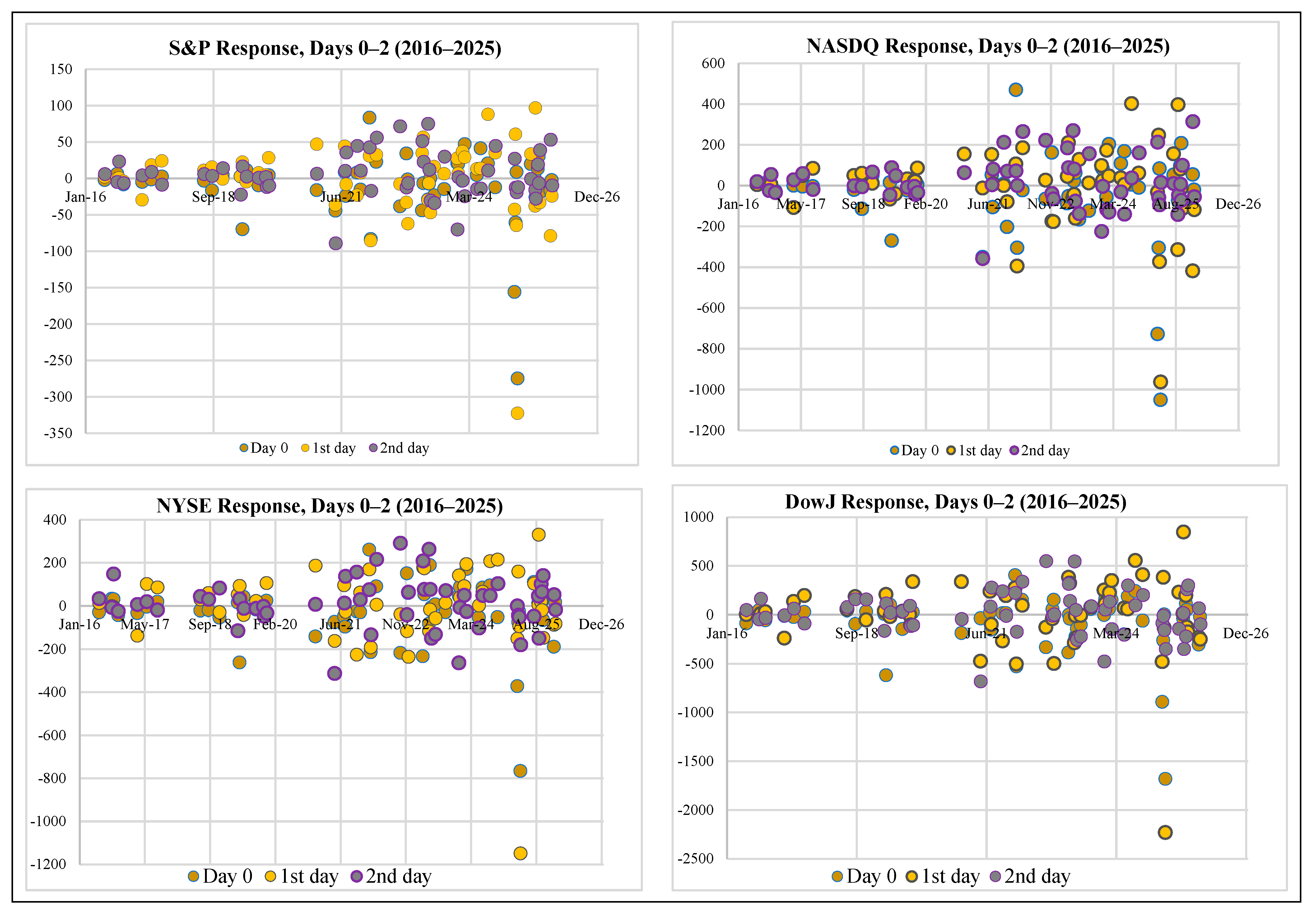
With regard to the temporal distribution of events, the longest periods of calm—defined as the absence of sabotage attacks on oil facilities—were observed between mid-2017 and mid-2018, as well as throughout 2020, during which no incidents were recorded. The highest concentration of attacks occurred during several distinct periods: from mid-2016 to mid-2017, from mid-2018 to the end of 2019, from the beginning of 2021 to the end of the first quarter of 2022, and from the beginning of the fourth quarter of 2022 until the end of the study period in December 2025, as illustrated in Figure 1.
Turning to the S&P 500, over the period 2016–2025, the index recorded a maximum change of 83.7 points on the first day, 96.74 points on the second day, and 75.03 points on the third day, while the minimum changes were −274.45 points, −322.44 points, and −89.1 points, respectively. In terms of the averages, the changes amounted to −10.90 points on the first day, −2.10 points on the second day, and 4.93 points on the third day.
For the NASDAQ index, the maximum changes reached 469.31 points on the first day, 401.9 points on the second day, and 313.04 points on the third day, while the minimum changes were −727.9 points, −418.14 points, and −225.28 points, respectively. The average changes amounted to −39.73 points on the first day, −7.48 points on the second day, and 17.18 points on the third day (see Figure 1).
With respect to the NYSE index, the maximum change reached 261.9 points on the first day, 331.5 points on the second day, and 291.4 points on the third day, while the minimum changes were −370.7 points, −235.3 points, and −263.7 points, respectively. The average changes were −28.41 points on the first day, −4.79 points on the second day, and 14.24 points on the third day.
Similarly, the Dow Jones index recorded maximum changes of 406.39 points on the first day, 846.24 points on the second day, and 548.75 points on the third day, while the minimum changes were −890.01 points, −503.53 points, and −475.92 points, respectively. In terms of the averages, the changes amounted to −84.79 points on the first day, 4.74 points on the second day, and 18.74 points on the third day.

3.2. Quantitative Results

3.2.1. OLS Regression Results

Overall, the OLS regression results indicate that the aggregate impact of sabotage attacks on oil facilities is most pronounced on the first day following the events, with negative abnormal returns observed across all major U.S. stock indices. Pipeline-targeted attacks emerged as the primary driver of statistically significant market reactions, while attacks targeting infrastructure, ports and vessels, cyberattacks, or security-related incidents did not show significant effects.
For the total number of attacks, the S&P 500 exhibited a statistically significant negative return on the first day (p = 0.02, coefficient = −13.1). Similarly, NASDAQ showed a significant decline (p = 0.03, coefficient = −48.2). The NYSE also demonstrated a negative response, reaching significance at p = 0.08 (coefficient = −33.9), while the Dow Jones Industrial Average recorded a significant drop (p = 0.02, coefficient = −99.4) (see Table 1).
Pipeline-targeted attacks produced notable negative responses across all indices. The S&P 500 showed significant declines on the first day (p = 0.02, coefficient = −28.4) and second day (p = 0.00, coefficient = −32.5). NASDAQ recorded declines on the first day (p = 0.03, coefficient = −102.2) and second day (p = 0.00, coefficient = −134.2). NYSE displayed significant decreases on day one (p = 0.02, coefficient = −81.6) and day two (p = 0.05, coefficient = −96.1). The Dow Jones index also reacted strongly, with significant negative coefficients on the first day (p = 0.02, coefficient = −207.4) and the second day at marginal significance (p = 0.07, coefficient = −163.5) (see Table 1).

3.2.2. Panel Regression Results

The panel regression results lend support to the negative market responses observed on the first day following attacks. Across the indices, aggregate attacks showed negative coefficients, which are consistent with the OLS findings. Attacks on ports and vessels and cyberattacks resulted in significant or marginally significant negative effects on some indices, whereas attacks on infrastructure, pipelines, and security-related incidents showed no statistically significant effects(see Table 2).
The panel regression results are broadly in line with the OLS findings in terms of the immediate negative market responses, particularly on the first day following sabotage attacks. Across the indices, aggregate attacks consistently showed negative coefficients. For the total number of attacks, the S&P 500 showed a significant negative coefficient of −19 (p = 0.02; mean = −10.9), NASDAQ −73.9 (p = 0.04; mean = −39.7), NYSE −42.6 (p = 0.10; mean = −28.4), and Dow Jones −123.6 (p = 0.02; mean = −84.7) (see Table 2).
For attacks on ports and vessels, significant negative effects were observed on the first day for several indices: the S&P 500 showed a negative coefficient of −17.3 (p = 0.08; mean = −2.9), NYSE −60.5 (p = 0.10; mean = −12.2), and Dow Jones −176.9 (p = 0.04; mean = −52.1). Cyberattacks affected the S&P 500 with a coefficient of −22.8 (p = 0.10; mean = −6.5) and NASDAQ −104.7 (p = 0.09; mean = −20.4) on the first day.

4. Discussion

The descriptive patterns observed across the four major U.S. indices reveal that financial markets exhibit significant sensitivity to geopolitical attacks on energy facilities, yet this sensitivity is characterized by considerable volatility and asymmetry. The maximum positive changes across the indices—reaching 83.7 points for the S&P 500, 469.31 points for NASDAQ, 261.9 points for the NYSE, and 406.39 points for the Dow Jones on the first day—demonstrate that markets can react with pronounced upward swings. However, the occurrence of substantially larger negative movements, with minimum values reaching −274.45 points for the S&P 500, −727.9 points for NASDAQ, −370.7 points for the NYSE, and −890.01 points for the Dow Jones, indicates that financial markets exhibit a stronger downside sensitivity to geopolitical shocks affecting energy infrastructure. This asymmetric reaction pattern aligns with evidence that geopolitical conflicts generate immediate negative pressures on equity markets, particularly when they threaten energy supply chains (Alsagr et al., 2026; Hoffmann et al., 2025; Pandey et al., 2023).
Consistent with this pattern, the average changes across all four indices revealed a consistent negative market response on the first day following attacks, followed by gradual recovery over the subsequent days. The S&P 500 recorded average declines of −10.90 points on the first day, moderating to −2.10 points on the second day before turning positive at 4.93 points on the third day. Similarly, NASDAQ showed average decreases of −39.73 points on day one, −7.48 points on day two, and a recovery to 17.18 points on day three. This pattern suggests that while financial markets react negatively to geopolitical attacks on energy facilities, the impact is often short-lived, consistent with historical evidence that geopolitical shocks typically cause losses that fade over time (Bhattacharjee et al., 2025; Hoffmann et al., 2025; Yudaruddin et al., 2025). This rapid adjustment reflects the efficiency with which financial markets process new information and reassess risk perceptions, though the initial negative response indicates that investors price in immediate uncertainty regarding potential supply disruptions (M. Al-Awadhi et al., 2025; Pandey et al., 2023).
The dataset constructed for this study captured the full spectrum of attacks across the study period, encompassing five distinct categories—infrastructure, ports and vessels, cyberattacks, pipelines, and security-related incidents. This broad classification ensured that the analysis reflected the diverse range of threats facing energy supply chains, rather than being confined to a single type of disruption. The temporal distribution revealed that the sample was not uniformly spread across the decade; instead, it exhibited pronounced concentration during certain periods, interspersed with extended intervals of relative calm. These patterns are consistent with the episodic nature of geopolitical tensions, which tend to flare up during specific geopolitical cycles and subside during others, as documented in prior research on geopolitical risk and energy market stability (Hkiri et al., 2026; Hodula et al., 2024; Jin et al., 2023).
The longest periods without recorded attacks occurred between mid-2017 and mid-2018, a phase characterized by relative geopolitical stability in major oil-producing regions (Abdel-Latif et al., 2020; Hodula et al., 2024). Similarly, the year 2020 witnessed no attacks on oil facilities, which likely reflects the global redirection of attention and resources toward managing the COVID-19 pandemic, as governments and markets prioritized public health and economic stabilization over geopolitical confrontations (Amoutzias et al., 2022; Karamti & Belhassine, 2022). In contrast, a notable escalation in attacks began in 2022 and continued through to the end of the study period, coinciding with the Russia–Ukraine conflict and the subsequent restructuring of global energy markets (Pan & Sun, 2023; Yudaruddin & Lesmana, 2024). This temporal pattern underscores that the sample captured not only a diverse array of attack types, but also varying intensities of geopolitical activity across the study period, providing a robust foundation for analyzing financial market responses under different geopolitical conditions.
Turning to the OLS estimates, the results provide robust evidence that financial markets respond negatively to geopolitical attacks on energy facilities, consistent with the descriptive patterns observed earlier. When considering the aggregate effect of all attacks, the OLS estimates revealed a consistent negative response across all four indices on the first day following events, indicating that financial markets react swiftly and negatively to geopolitical shocks affecting energy infrastructure, regardless of the specific type of attack (Hoffmann et al., 2025; Yudaruddin & Lesmana, 2024). The S&P 500, NASDAQ, NYSE, and Dow Jones all recorded statistically significant declines, with coefficients ranging from −13.1 to −99.4 points. This broad-based negative reaction aligns with the descriptive findings that financial markets exhibit immediate sensitivity to geopolitical uncertainty. The absence of significant effects beyond the first day for the full sample suggests that the initial negative response does not persist, consistent with the efficient market hypothesis and the notion that markets quickly assimilate information and adjust expectations within a short period (Bhattacharjee et al., 2025).
Beyond the aggregate effect, the OLS estimates revealed that not all attacks are equal in their impact on financial markets, supporting the study’s central premise that attack heterogeneity matters. This finding is consistent with prior research documenting varying effects of geopolitical developments across commodity markets, investment behavior, and financial stability (Özdemir et al., 2025; He, 2023; Chakraborty, 2024; Martin, 2025). Pipeline-targeted attacks emerged as the primary driver of statistically significant reactions, generating negative abnormal returns across all four major U.S. indices on the first and second days following the events. This finding aligns with previous evidence that disruptions to energy transportation networks trigger immediate concerns over supply continuity and economic stability (Alsagr et al., 2026; Yudaruddin & Lesmana, 2024). Notably, the persistence of negative effects over two days suggests that damage to pipeline infrastructure may have a more prolonged impact on financial markets, as the disruption to crude oil and refined product flows extends beyond the initial shock before markets begin to recover. This prolonged reaction is consistent with studies on geopolitical risk and energy market interaction, which highlight how supply disruptions translate into sustained price pressures and investor uncertainty (Monge et al., 2023; Zhang et al., 2023; Jin et al., 2023).
In contrast, attacks on infrastructure, ports and vessels, cyber systems, and security-related incidents did not yield significant coefficients in the OLS framework, suggesting that financial markets perceive these forms of disruptions as less immediately consequential for broader economic activity and corporate profitability (Bhattacharjee et al., 2025). This differentiated pattern confirms that markets distinguish between attack types based on their perceived capacity to disrupt energy supply chains, and by extension, financial market stability, reinforcing the importance of disaggregating geopolitical events rather than treating them as homogenous shocks.
Beyond the aggregate confirmation, the panel estimates revealed that the relative importance of attack types differed from the OLS findings. While pipeline-targeted attacks were the primary driver of negative returns in the OLS framework, they did not yield significant coefficients in the panel specification, suggesting that their effect may be less robust when accounting for event-specific heterogeneity. Conversely, cyberattacks, which were insignificant in the OLS estimates, produced negative effects on the S&P 500 and NASDAQ on the first day, indicating that financial markets may react to technological disruptions when isolated from broader time-series noise. This difference likely reflects the panel model’s ability to filter out unrelated market movements by benchmarking each attack against its own pre-event baseline, thereby capturing effects that OLS, which compares against the full time series, may obscure (Hoffmann et al., 2025). The emergence of cyberattacks as a significant factor in the panel framework may also reflect the difficulty markets face in assessing the operational impact of such incidents, where uncertainty about technological damage can drive initial negative reactions that are later revised as more information becomes available (Alsagr et al., 2026).
The significance of ports and vessels attacks in the panel framework, despite their insignificance in OLS, suggests that maritime disruptions—while not always triggering broad market reactions—can generate immediate negative responses when evaluated against the pre-incident baseline. This pattern may reflect the role of shipping routes in global energy logistics, where disruptions to tanker movements and port operations introduce uncertainty about supply delivery timelines, even if such disruptions do not always materialize into sustained price effects (Abedin et al., 2024; Alsagr et al., 2026). Infrastructure attacks and security-related incidents remained insignificant across both methodologies, suggesting that financial markets may perceive these forms of disruptions as less directly threatening to corporate profitability and broader economic activity, either because they do not immediately impair energy supply chains or because their effects are perceived as localized and containable (Bhattacharjee et al., 2025; Goyal & Soni, 2024).
A notable pattern emerged regarding how financial markets perceive threats to energy logistics. Pipeline and maritime disruptions consistently generated the strongest financial market responses, while infrastructure attacks remained largely insignificant across most specifications. This divergence likely reflects an ingrained market perception that production infrastructure often operates with sufficient spare capacity, making localized damage more readily compensable through excess supply buffers, alternative sources, or inventory drawdowns. This interpretation is supported by the literature on geopolitical risk and energy market interaction, which emphasizes the role of strategic inventories and spare capacity in mitigating supply shocks (Monge et al., 2023; Zhang et al., 2023).
In contrast, disruptions to transportation networks—whether through pipelines or shipping routes—are perceived as more difficult to offset quickly, particularly given the reluctance of insurers and vessel operators to navigate high-risk areas, which can prolong logistical bottlenecks, and the extended time typically required to restore pipeline operations following damage. Unlike production facilities, where output can often be rerouted or replaced from other fields, transportation networks are more constrained in their substitutability, as pipelines have fixed routes and maritime chokepoints lack immediate alternatives. This structural vulnerability makes transportation disruptions more likely to translate into sustained supply shortfalls, a pattern consistent with evidence that energy supply chains are particularly sensitive to logistical bottlenecks (Atacan & Açık, 2023; Zhang et al., 2023). The persistence of this pattern suggests that investors have gradually internalized the idea that transportation vulnerabilities pose a greater and more lasting threat to energy supply chains than damage to production facilities themselves, underscoring the primacy of logistics-related risks in financial market assessments of geopolitical attacks affecting energy supply chains.
Turning to the comparative behavior of the four indices, the results show that while the aggregate negative response was consistent across all indices, notable differences emerged in their sensitivity to specific attack types. The NASDAQ exhibited a unique reaction to cyberattacks, likely reflecting its pronounced concentration of technology and growth-oriented firms, where cyber incidents targeting energy systems highlight broader digital security weaknesses that could affect technology companies (Abedin et al., 2024). The S&P 500 also showed a response to cyberattacks, consistent with its broader sectoral composition that includes a significant technology weighting, while the NYSE and Dow Jones did not exhibit significant reactions, reflecting their lower exposure to technology sectors. Across the remaining attack categories, the four indices exhibited largely similar patterns of response, with no significant differences in their reactions to infrastructure, ports and vessels, pipeline, or security-related incidents. This overall similarity likely reflects the high degree of integration and correlation among major U.S. equity indices, where shocks to energy infrastructure transmit broadly across the financial system (Hoffmann et al., 2025; Marangoz et al., 2025).
The differential responses observed across attack categories can be interpreted through the lens of perceived risk versus actual disruption. This distinction is well-documented in the literature on financial market evidence on geopolitical shocks, which shows that investors react not only to the materialization of disruptions but also to the uncertainty surrounding their persistence and economic consequences (Elsayed & Helmi, 2021; Nasouri, 2025). Pipeline attacks generated the most consistent negative reactions across financial markets, reflecting their direct and tangible threat to energy transportation networks, which markets perceive as critical to supply stability (Yudaruddin et al., 2025). Ports and vessels attacks produced significant effects in the panel framework, suggesting that maritime disruptions introduce uncertainty about logistics and delivery timelines, even if their impact is not always sustained (Ferrari Minesso et al., 2026).
Cyberattacks, while significant for technology-heavy indices, showed more limited effects, consistent with the difficulty markets face in assessing operational damage and their tendency to react to uncertainty rather than confirmed disruptions (Gheorghe & Panazan, 2025). In contrast, infrastructure and security-related incidents remained insignificant, suggesting that markets perceive these as either localized, containable, or lacking direct implications for broader economic activity (Yudaruddin et al., 2025). This pattern indicates that financial markets differentiate between attack types based on the perceived persistence and economic materiality of their effects, rather than reacting uniformly to all geopolitical events. This differentiated response aligns with prior evidence that geopolitical shocks transmit across financial systems in heterogeneous ways, depending on the perceived materiality and duration of the disruption (Chiang, 2021; Singh & Roca, 2022).
The rapid negative responses observed across all indices on the event day, coupled with the subsequent fading of these effects for most indices by the first and second days following, provide evidence consistent with the semi-strong form of market efficiency, where asset prices swiftly incorporate new publicly available information (Hoffmann et al., 2025). The immediate repricing on the event day and the first day following indicates that financial markets assimilate geopolitical shocks affecting energy supply chains with considerable speed, with the initial negative reaction being gradually adjusted as markets reassess the materiality of each event (Yudaruddin et al., 2025).
This pattern aligns with the broader literature on geopolitical risk transmission, which emphasizes that equity markets tend to absorb geopolitical shocks rapidly, with losses typically dissipating over time as the market reassesses the materiality of the disruption (Hoffmann et al., 2025; Marangoz et al., 2025). The speed of adjustment observed here, rather than reflecting overreaction, appears to represent an efficient information assimilation process, where prices oscillate briefly as initial risk assessments are refined against incoming evidence (Marangoz et al., 2025).
The speed with which financial markets registered negative returns on the event day—often before any official confirmation of the attacks—underscores the growing influence of instantaneous information dissemination channels on equity price formation. News wires and social media platforms circulate breaking developments within minutes, while algorithmic trading systems and institutional dealing networks convert such signals into price actions almost immediately (Abedin et al., 2024; Alsagr et al., 2026). Such dynamics are well-recognized in the literature on information diffusion, where the interaction between news flows and trading algorithms has been shown to amplify short-term market sensitivity to geopolitical developments (Armstrong et al., 2021; Min & Borch, 2022; Yang et al., 2021).
This pattern is consistent with the view that geopolitical events can trigger sharp market movements through information-driven trading, even before their economic consequences are fully understood (Bhattacharjee et al., 2025; Marangoz et al., 2025). This rapid adjustment process reflects the efficiency of financial markets in assimilating new information, consistent with the form of market efficiency documented in prior research (Section 1.4.2; Chen, 2025).
The rapidity of these responses, observed across all four indices on the event day, indicates that financial markets do not wait for verified assessments from official entities; instead, they operate on intelligence flowing through digital platforms and proprietary trading feeds. This velocity of information fosters short-term volatility while facilitating swift price discovery, although it can also inject noise that may be corrected once authoritative reports become available (Hoffmann et al., 2025; Marangoz et al., 2025). These findings are in line with the notion that contemporary equity markets are increasingly shaped by high-frequency and algorithmic trading, where speed advantages and automated sentiment extraction from unstructured news shape price trajectories well before the full implications of energy-related disruptions are confirmed (Abedin et al., 2024; Alsagr et al., 2026).
This study contributes to the existing literature by providing empirical evidence that financial markets do not respond uniformly to geopolitical attacks on energy infrastructure, but rather differentiate based on the type of incident. By disaggregating attacks into distinct categories—infrastructure, maritime, pipeline, cyber, and security—the analysis demonstrates that the heterogeneity of these events carries significant implications for market behavior, challenging the conventional approach of treating geopolitical shocks as homogenous. For policymakers, the findings highlight the need for differentiated monitoring frameworks that account for the varying financial market impacts of different attack types, particularly prioritizing pipeline and maritime disruptions due to their more consistent negative effects. For investors, the results underscore the importance of incorporating attack-specific risk assessments into portfolio decisions, especially given the rapid information transmission and short-lived nature of most market reactions, which suggests that overreacting to unconfirmed reports may be costly. For financial risk management, the study reinforces the value of distinguishing between transient uncertainty and confirmed supply disruptions, enabling more targeted hedging strategies that align with the specific characteristics of each attack type rather than broad geopolitical indices alone.
A further implication of these findings relates to the strategic vulnerability of oil-dependent economies, as underscored by current disruptions in the Strait of Hormuz (Bahgat, 2026; Ferrari Minesso et al., 2026). The current study confirms that transportation networks are the most sensitive nodes in energy supply chains, and that their exposure to geopolitical shocks transmits directly to investor sentiment, market stability, and government fiscal positions. While the dataset covers the past decade, the fact that transportation networks emerge as the primary channel of disruption even during a period of relative stability—compared with the current turmoil in the Strait of Hormuz—adds weight to the policy relevance of these findings. The observed patterns are not contingent on extreme conditions, but rather reflect structural vulnerabilities that are likely to be magnified under the heightened tensions observed today.
Oil-exporting countries should therefore move beyond contingency planning and accelerate the implementation of alternative transport routes, including new pipelines, railway linkages, and diversified shipping corridors (Chukwu et al., 2025; López-Niño & Montero-González, 2026). This transition should not be delayed by domestic constraints such as local content requirements, cost–benefit considerations, or maintenance concerns, which, while legitimate, should not overshadow the strategic imperative of ensuring supply security. The recurring nature of geopolitical tensions in key maritime zones underscores that these are not isolated shocks but persistent risks that, if left unaddressed, will continue to impose significant costs on global economic stability. Policymakers must therefore treat transportation security as a foundational element of long-term fiscal and economic planning, and prioritize the removal of regulatory and operational barriers that slow down the development of resilient energy infrastructure.
Despite the contributions of this study, several limitations should be acknowledged. The analysis relied on daily closing prices, which do not capture intraday price dynamics or the precise timing of market reactions that may occur within trading sessions. In addition, volatility dynamics were not modeled, limiting the ability to assess the persistence of uncertainty triggered by different attack types. Also, the classification of incidents into five categories, while systematic, may have oversimplified the multifaceted nature of real-world events that often combine multiple characteristics. Furthermore, the three-day event window, though appropriate for capturing immediate market responses, does not extend to longer-term adjustments or delayed effects. Finally, concurrent macroeconomic developments or policy announcements may have coincided with the attacks, and the analysis does not isolate their influence. Addressing these limitations in future research would enhance the understanding of financial market responses to geopolitical attacks on energy infrastructure.

5. Conclusions

This study provides novel empirical evidence that different categories of geopolitical attacks on energy facilities generate divergent responses across U.S. financial markets. The findings reveal that financial markets have increasingly internalized the critical role of energy transportation networks, where disruptions to pipelines and maritime routes are perceived as more difficult to compensate than damage to production infrastructure, given the extended restoration timelines and the reluctance of insurers and vessel operators to operate in high-risk zones. The key results confirm that pipeline and maritime attacks produce the most significant negative reactions, while production infrastructure and security-related incidents show limited or negligible effects. Theoretically, this study contributes by disaggregating attacks into distinct categories, demonstrating that treating them as homogeneous shocks obscures meaningful differences in market sensitivity.
While markets react negatively to attacks overall, the rapid information dissemination through media and trading systems enables swift price adjustments, mitigating prolonged uncertainty. These insights offer policymakers and investors a framework for integrating transportation security into risk assessments, while demonstrating how timely information can support more measured and forward-looking decisions that limit unnecessary financial contagion. From a policy perspective, the findings highlight the need to safeguard energy transportation networks, enhance financial risk monitoring systems, and develop attack-specific measures for investors. Moving from assessment to implementation, the findings should be translated into concrete measures, particularly in light of ongoing geopolitical tensions in the Middle East. This includes accelerating the development of alternative transport routes and removing regulatory barriers. For investors, the results support the use of differentiated hedging strategies and caution against overreacting to unconfirmed reports.
Future research could extend these findings by incorporating intraday data and volatility modeling to capture more granular market dynamics. Among the limitations are the use of daily closing prices, the three-day event window, and the classification of attacks into five categories. Future work could build on this foundation to provide a more comprehensive understanding of financial market responses to geopolitical attacks on energy infrastructure.

Funding

This research received no external funding.

Institutional Review Board Statement

Not applicable.

Informed Consent Statement

Not applicable.

Data Availability Statement

The data utilized in this study were sourced from Yahoo Finance, a publicly accessible financial database. All data supporting the findings are presented within the article, further inquiries can be directed to the corresponding author.

Conflicts of Interest

The author declares no conflicts of interest.

References

  1. Abdel-Latif, H., El-Gamal, M., & Jaffe, A. M. (2020). The ephemeral Brent geopolitical risk premium. Economics of Energy & Environmental Policy, 9(2), 31–50. [Google Scholar] [CrossRef] [Scilit]
  2. Abedin, M. Z., Goldstein, M. A., Malhotra, N., & Yadav, M. P. (2024). Middle East conflict and energy companies: The effect of air and drone strikes on global energy stocks. Finance Research Letters, 69, 106009. [Google Scholar] [CrossRef] [Scilit]
  3. Agbede, O. O., Akhigbe, E. E., Ajayi, A. J., & Egbuhuzor, N. (2024). Financial modeling for global energy market impacts of geopolitical events and economic regulations. Magna Scientia Advanced Research and Reviews, 10(2), 272–296. [Google Scholar] [CrossRef] [Scilit]
  4. Al Mustanyir, S. (2025). The impact of bankruptcy announcements on oil markets: Bankrupt but not broken. Cogent Business & Management, 12(1), 2585541. [Google Scholar] [CrossRef] [Scilit]
  5. Al Mustanyir, S. (2026). Dynamics of oil markets amid financial distress among small firms in the energy industry. Risks, 14(4), 80. [Google Scholar] [CrossRef] [Scilit]
  6. Al Mustanyir, S. H. (2026). Corporate financial distress and equity market contagion: Evidence from energy sector collapses in the US stock market. International Journal of Financial Studies, 14(5), 129. [Google Scholar] [CrossRef] [Scilit]
  7. Alsagr, N., Yudaruddïn, R., Ekşï, İ. H., & Hacıevliyagil, N. (2026). Geopolitical conflict, military capability, and energy market stability: Evidence from the Israel–Hamas conflict. Energy Policy, 215, 115333. [Google Scholar] [CrossRef] [Scilit]
  8. Amoutzias, G. D., Nikolaidis, M., Tryfonopoulou, E., Chlichlia, K., Markoulatos, P., & Oliver, S. G. (2022). The remarkable evolutionary plasticity of coronaviruses by mutation and recombination: Insights for the COVID-19 pandemic and the future evolutionary paths of SARS-CoV-2. Viruses, 14(1), 78. [Google Scholar] [CrossRef] [Scilit] [PubMed]
  9. Armstrong, W. J., Cardella, L., & Sabah, N. (2021). Information shocks, disagreement, and drift. Journal of Financial Economics, 140(3), 916–940. [Google Scholar] [CrossRef] [Scilit]
  10. Asadollah, O., Carmy, L. S., Hoque, M. R., & Yilmazkuday, H. (2024). Geopolitical risk, supply chains, and global inflation. The World Economy, 47(8), 3450–3486. [Google Scholar] [CrossRef] [Scilit]
  11. Atacan, C., & Açık, A. (2023). Impact of geopolitical risk on international trade: Evidence from container throughputs. Transactions on Maritime Science, 12(02), 1–11. [Google Scholar] [CrossRef] [Scilit]
  12. Bahgat, G. (2026). Crisis in the Strait of Hormuz: What lies ahead? Middle East Policy, 33(2), 72–84. [Google Scholar] [CrossRef] [Scilit]
  13. Baltagi, B. H., & Baltagi, B. H. (2021). Unbalanced panel data models. In Econometric analysis of panel data (pp. 229–257). Springer. [Google Scholar]
  14. Banerjee, A. K., Sensoy, A., & Goodell, J. W. (2024). Volatility connectedness between geopolitical risk and financial markets: Insights from pandemic and military crisis periods. International Review of Economics & Finance, 96, 103740. [Google Scholar] [CrossRef] [Scilit]
  15. Bhattacharjee, A., Sidana, N., Goel, R., Shukre, A., & Singh, T. (2025). Cross-border ripples: Investigating stock market responses to Israel-Hamas conflict in trading partner nations using event study method. Journal of Economic Studies, 52(4), 803–823. [Google Scholar] [CrossRef] [Scilit]
  16. Bjørnland, H. C. (2022). The effect of rising energy prices amid geopolitical developments and supply disruptions. Challenges for Monetary Policy in a Rapidly Changing World, 84. [Google Scholar]
  17. Caldara, D., & Iacoviello, M. (2022). Measuring geopolitical risk. American Economic Review, 112(4), 1194–1225. [Google Scholar] [CrossRef] [Scilit]
  18. Chakraborty, L. (2024). Fiscal policy responses to geopolitical uncertainties. Innovatus: An Ivanian Journal of Economics and Business Studies, 2(01), 1–9. [Google Scholar]
  19. Chalissery, N., & Naushad, J. (2026). Geopolitical risk and market sentiment: Evidence from wavelet coherence and power spectrum analysis. Journal of Economic Studies, 1–19. [Google Scholar] [CrossRef] [Scilit]
  20. Chen, S. (2025). Geopolitics. In Decoding the market: Cycles, valuations, and strategies (pp. 79–87). Springer. [Google Scholar]
  21. Chiang, T. C. (2021). Geopolitical risk, economic policy uncertainty and asset returns in Chinese financial markets. China Finance Review International, 11(4), 474–501. [Google Scholar] [CrossRef] [Scilit]
  22. Chukwu, C., Vasilev, A., & Saha, S. (2025). A panel analysis of brent oil price dynamics on macroeconomic effects: The case of some selected oil-producing countries. Journal of Economics, Business, and Commerce, 2(2), 29–47. [Google Scholar] [CrossRef] [Scilit]
  23. Colin Cameron, A., & Miller, D. L. (2015). A practitioner’s guide to cluster-robust inference. Journal of Human Resources, 50(2), 317–372. [Google Scholar] [CrossRef] [Scilit]
  24. Darwiche, J., Badran, M., Awada, M., & Boungou, W. (2025). Geopolitical risks and inflation: Insights across time horizons. Policy Studies, 47(3), 397–411. [Google Scholar] [CrossRef] [Scilit]
  25. Debnath, P., Deshmukh, S. M., Laroia, M., Selvakumar, P., Manjunath, T., & Bhattacharya, S. (2025). Challenges faced by countries in renewable energy adoption. In Geopolitical landscapes of renewable energy and urban growth (pp. 295–320). IGI Global Scientific Publishing. [Google Scholar]
  26. Degl’Innocenti, M., Santilli, G., Sclip, A., & Zhou, S. (2025). Commodity price risk, supply chain, and lending. Energy Economics, 150, 108808. [Google Scholar] [CrossRef] [Scilit]
  27. Demirer, R., Jategaonkar, S. P., & Khalifa, A. A. (2015). Oil price risk exposure and the cross-section of stock returns: The case of net exporting countries. Energy Economics, 49, 132–140. [Google Scholar] [CrossRef] [Scilit]
  28. Dinler, Ö. B. (2026). Cybersecurity threats and intrusion detection approaches for petroleum refinery industrial control systems. System, 12, 13. [Google Scholar]
  29. Elsayed, A. H., & Helmi, M. H. (2021). Volatility transmission and spillover dynamics across financial markets: The role of geopolitical risk. Annals of Operations Research, 305(1), 1–22. [Google Scholar] [CrossRef] [Scilit]
  30. Ferrari Minesso, M., Mendes, B. L., Stalla-Bourdillon, A., & Vidaházy, V. (2026). How US financial markets react to geopolitical shocks hitting oil supply. Economic Bulletin Boxes, 4(4), 47–55. [Google Scholar]
  31. Galkin, P., Considine, J., Al Dayel, A., & Hatipoglu, E. (2025). The response of global oil inventories to supply shocks. Commodities, 4(2), 10. [Google Scholar] [CrossRef] [Scilit]
  32. Garcia, K., & Berton, L. (2026). Unlocking the potential of news: A systematic review of advantages and challenges for event detection and analysis. Computer Science Review, 59, 100838. [Google Scholar] [CrossRef] [Scilit]
  33. Ghavidel Doostkouei, S., Naysary, B., Karimi, M. S., & Iesvand Heidari, A. (2024). Geopolitical risk and volatility dynamics in fintech market. In Geopolitical risk and volatility dynamics in fintech market. SSRN. [Google Scholar]
  34. Gheorghe, C., & Panazan, O. (2025). Quantifying cybersecurity impacts on clean energy market volatility: A time-frequency approach. Mathematics, 13(8), 1320. [Google Scholar] [CrossRef] [Scilit]
  35. Ghosh, B., & Ghosh, A. (2025). Impact of geopolitical risk & economic policy uncertainty among energy transition metals in extreme market conditions. Mineral Economics, 38(3), 551–567. [Google Scholar] [CrossRef] [Scilit]
  36. Goyal, P., & Soni, P. (2024). Beyond borders: Investigating the impact of the 2023 Israeli–Palestinian conflict on global equity markets. Journal of Economic Studies, 51(8), 1714–1731. [Google Scholar] [CrossRef] [Scilit]
  37. Góes, C., & Bekkers, E. (2022). The impact of geopolitical conflicts on trade, growth, and innovation. arXiv, arXiv:2203.12173. [Google Scholar]
  38. Hamilton, J. D. (2009). Understanding crude oil prices. The Energy Journal, 30(2), 179–206. [Google Scholar] [CrossRef] [Scilit]
  39. He, Z. (2023). Geopolitical risks and investor sentiment: Causality and TVP-VAR analysis. The North American Journal of Economics and Finance, 67, 101947. [Google Scholar] [CrossRef] [Scilit]
  40. Hkiri, B., Roubaud, D., Khan, N., & Aytaç, B. (2026). Dynamics interconnectedness between energy markets and global commodities: Evidence from global crisis and geopolitical tensions. Review of Financial Economics, 44(2), e70042. [Google Scholar] [CrossRef] [Scilit]
  41. Hodula, M., Janků, J., Malovaná, S., & Ngo, N. A. (2024). Geopolitical risks and their impact on global macro-financial stability: Literature and measurements. SSRN. [Google Scholar]
  42. Hoffmann, V., Huynh, L. D. T., & Wang, M. (2025). What drives abnormal returns of stock markets in wartime? Evidence from 17 invasions. European Journal of Political Economy, 86, 102643. [Google Scholar] [CrossRef] [Scilit]
  43. Hsiao, C. (2022). Analysis of panel data. Cambridge University Press. [Google Scholar]
  44. Imsirovic, A. (2022). The trading and price discovery for crude oils. In The Palgrave Handbook of International Energy Economics (pp. 327–358). Springer. [Google Scholar]
  45. Islam, M. S., Ahmed, F., Islam, M. M., Rehman, A. U., & Alam, M. F. (2025). The impact of oil price shocks on oil and gas production amidst geopolitical risk in OPEC: Insights from method of moments quantile regression. Journal of the Knowledge Economy, 16(2), 9776–9805. [Google Scholar] [CrossRef] [Scilit]
  46. Ji, J. (2025). Geopolitical risk and its impact on capital allocation and stock market performance. Applied Economics Letters, 33, 1677–1682. [Google Scholar] [CrossRef] [Scilit]
  47. Ji, J., Cao, Z., Zhang, C. Y., & Zheng, X. (2026). Dissecting the influence of geopolitical risks on employment decisions: The role of employment protection across countries. Journal of Corporate Finance, 99, 102988. [Google Scholar] [CrossRef] [Scilit]
  48. Jin, Y., Zhao, H., Bu, L., & Zhang, D. (2023). Geopolitical risk, climate risk and energy markets: A dynamic spillover analysis. International Review of Financial Analysis, 87, 102597. [Google Scholar] [CrossRef] [Scilit]
  49. Joo, Y. C., & Park, S. Y. (2021). The impact of oil price volatility on stock markets: Evidences from oil-importing countries. Energy Economics, 101, 105413. [Google Scholar] [CrossRef] [Scilit]
  50. Karamti, C., & Belhassine, O. (2022). COVID-19 pandemic waves and global financial markets: Evidence from wavelet coherence analysis. Finance Research Letters, 45, 102136. [Google Scholar] [CrossRef] [Scilit] [PubMed]
  51. Khan, M. N. (2025). Assessing the impact of geopolitical crises on global financial markets. Journal of Economic Integration, 40(1), 29–52. [Google Scholar]
  52. Kim, I. (2022). Shale oil and the future of geopolitics. In Handbook on oil and international relations (pp. 409–426). Edward Elgar Publishing. [Google Scholar]
  53. Korsah, D., Amewu, G., & Osei Achampong, K. (2024). The impact of geopolitical risks, financial stress, economic policy uncertainty on African stock markets returns and volatilities: Wavelet coherence analysis. Journal of Humanities and Applied Social Sciences, 6(5), 450–470. [Google Scholar] [CrossRef] [Scilit]
  54. Leroux, J., & McCullogh, E. (2023). Systematic news media scanning and synthesis: Creating a dataset of emergent initiatives and localized responses to public washroom provision in Canada during the COVID-19 pandemic. Health Promotion and Chronic Disease Prevention in Canada: Research, Policy and Practice, 43(8), 385. [Google Scholar] [CrossRef] [Scilit] [PubMed]
  55. López-Niño, D., & Montero-González, P.-M. (2026). Strait of Hormuz: An institutionalist study of the strategic governance of a global energy chokepoint. URVIO Revista Latinoamericana de Estudios de Seguridad, (45), 24–41. [Google Scholar]
  56. Lu, Z., Gozgor, G., Huang, M., & Lau, C. K. (2020). The impact of geopolitical risks on financial development: Evidence from emerging markets. Journal of Competitiveness, 1, 93. [Google Scholar] [CrossRef] [Scilit]
  57. Luo, H., & Sun, Y. (2024). Effects of geopolitical risk on environmental sustainability and the moderating role of environmental policy stringency. Scientific Reports, 14(1), 10747. [Google Scholar] [CrossRef] [Scilit] [PubMed]
  58. Ma, G., Tourani-Rad, A., Xu, Y., & Zhou, Z. (2025). Is social media information noise or fundamentals? Evidence from the crude oil market. SSRN. [Google Scholar]
  59. Maghyereh, A., & Al-Zoubi, H. (2026). The effect of oil price uncertainty on the joint default risk of oil and natural gas companies. Energy Research Letters, 7(3). [Google Scholar] [CrossRef] [Scilit]
  60. M. Al-Awadhi, A., Bash, A., Algharabali, B., & Al-Failakawi, A. Y. (2025). From chaos to consensus: An event study on the Korean stock market. Cogent Economics & Finance, 13(1), 2502437. [Google Scholar] [CrossRef] [Scilit]
  61. Marangoz, C., Gerekan, B., Yılmaz, E., & Bulut, E. (2025). Disentangling geopolitical risks: A quantile approach to geopolitical risk indices’ impacts on stock markets. Finance Research Letters, 77, 107113. [Google Scholar] [CrossRef] [Scilit]
  62. Martin, V. (2025). Geopolitical risk and its effects on financial stability: Case study of the Republic of Serbia. Ekonomske Ideje i Praksa, 2025(59), 19–36. [Google Scholar] [CrossRef] [Scilit]
  63. Miller, D. L. (2023). An introductory guide to event study models. Journal of Economic Perspectives, 37(2), 203–230. [Google Scholar] [CrossRef] [Scilit]
  64. Min, B. H., & Borch, C. (2022). Systemic failures and organizational risk management in algorithmic trading: Normal accidents and high reliability in financial markets. Social Studies of Science, 52(2), 277–302. [Google Scholar] [CrossRef] [Scilit] [PubMed]
  65. Monge, M., Rojo, M. F. R., & Gil-Alana, L. A. (2023). The impact of geopolitical risk on the behavior of oil prices and freight rates. Energy, 269, 126779. [Google Scholar] [CrossRef] [Scilit]
  66. Morão, H. (2025). The economic effects of tensions in energy transportation. Research in Transportation Economics, 112, 101598. [Google Scholar] [CrossRef] [Scilit]
  67. Nasouri, A. (2025). The impact of geopolitical risks on equity markets and financial stress: A comparative analysis of emerging and advanced economies. International Journal of Economics and Business Administration, 13(1), 30–41. [Google Scholar] [CrossRef] [Scilit] [PubMed]
  68. Nelson, W. (2025). Critical Infrastructure and tanker chokes impacting brent premiums and prices: A structural map of physical risk across the brent pricing chain. Available online: https://ssrn.com/abstract=5264769 (accessed on 13 June 2026).
  69. N. Lane, J., Lim, S. S., & Uzzi, B. (2022). Biased information transmission in investor social networks: Evidence from professional traders. In Biased information transmission in investor social networks: Evidence from professional traders. SSRN. [Google Scholar]
  70. Olaniran, A. O. (2026). Geopolitical risk versus supply-and demand-induced oil shocks. Energy Research Letters, 7(2). [Google Scholar] [CrossRef] [Scilit]
  71. Özdemir, L., Vurur, N. S., Ozen, E., Świecka, B., & Grima, S. (2025). Volatility modeling of the impact of geopolitical risk on commodity markets. Economies, 13(4), 88. [Google Scholar] [CrossRef] [Scilit]
  72. Pan, Q., & Sun, Y. (2023). Changes in volatility leverage and spillover effects of crude oil futures markets affected by the 2022 Russia-Ukraine conflict. Finance Research Letters, 58, 104442. [Google Scholar] [CrossRef] [Scilit]
  73. Pandey, D. K., Hassan, M. K., Kumari, V., & Hasan, R. (2023). Repercussions of the Silicon Valley Bank collapse on global stock markets. Finance Research Letters, 55, 104013. [Google Scholar] [CrossRef] [Scilit]
  74. Petersen, M. A. (2008). Estimating standard errors in finance panel data sets: Comparing approaches. The Review of Financial Studies, 22(1), 435–480. [Google Scholar] [CrossRef] [Scilit]
  75. Pietrek, G. (2022). Threats to critical infrastructure. The case of unmanned aerial vehicles. Journal of Modern Science, 49(2), 120–133. [Google Scholar] [CrossRef] [Scilit]
  76. Polemis, D., & Bentsos, C. (2025). LNG vessels transits through Suez Canal under the changing geopolitical context. Journal of Shipping and Trade, 10(1), 17. [Google Scholar] [CrossRef] [Scilit]
  77. Qadri, S. M. (2025). Indian financial markets functioning and the impact of geopolitics in present scenario. Dutch Journal of Finance and Management, 8(2), 38895. [Google Scholar] [CrossRef] [Scilit]
  78. Qasba, R. K., Bucharles, A. C. F., Piccoli, M. V. F., Sharma, P., Banga, A., Kamaraj, B., Nawaz, F. A., Kumar, H. J., Happy, M. A., & Qasba, R. K. (2023). Bartter syndrome: A systematic review of case reports and case series. Medicina, 59(9), 1638. [Google Scholar] [CrossRef] [Scilit] [PubMed]
  79. Qin, P., & Bai, M. (2022). Does oil price uncertainty matter in stock market volatility forecasting? PLoS ONE, 17(12), e0277319. [Google Scholar] [CrossRef] [Scilit] [PubMed]
  80. Qin, Y., Hong, K., Chen, J., & Zhang, Z. (2020). Asymmetric effects of geopolitical risks on energy returns and volatility under different market conditions. Energy Economics, 90, 104851. [Google Scholar] [CrossRef] [Scilit]
  81. Reuters. (2024). Russia’s Tuapse oil refinery damaged in Ukraine drone attack, Russian officials say. Reuters. Available online: https://www.reuters.com/world/europe/russia-says-downs-75-ukraine-launched-drones-some-near-tuapse-oil-refinery-2024-07-22/ (accessed on 6 March 2026).
  82. Reuters. (2026a). Oil refining at a standstill in central Russia after Ukrainian drone strikes, sources say. Reuters. Available online: https://www.reuters.com/business/energy/oil-refining-standstill-central-russia-after-ukrainian-drone-strikes-sources-say-2026-05-20/ (accessed on 21 May 2026).
  83. Reuters. (2026b). Russia’s Kirishi halts refining after Ukrainian drone attack, sources say. Reuters. Available online: https://www.reuters.com/business/energy/russias-vast-kirishi-oil-refinery-halts-processing-after-drone-attack-sources-2026-05-05/ (accessed on 5 May 2026).
  84. Sasikumar, S., & Sundaram, N. (2024). Event study methodology trends in the stock market: A systematic review based on bibliometric analysis. Multidisciplinary Reviews, 7(10), 2024234. [Google Scholar] [CrossRef] [Scilit]
  85. Shawon, R. E. R., Dalim, H. M., Shil, S. K., Gurung, N., Hasanuzzaman, M., Hossain, S., & Rahman, T. (2024). Assessing geopolitical risks and their economic impact on the USA using data analytics. Journal of Economics, Finance and Accounting Studies, 6(6), 5–16. [Google Scholar] [CrossRef] [Scilit]
  86. Singh, V., & Roca, E. D. (2022). China’s geopolitical risk and international financial markets: Evidence from Canada. Applied Economics, 54(34), 3953–3971. [Google Scholar] [CrossRef] [Scilit]
  87. Wang, Z., Li, R., & Kong, Q. (2024). Shanghai oil futures prices and firms’ investment decisions: Evidence from Chinese manufacturing firms. Energy Economics, 134, 107560. [Google Scholar] [CrossRef] [Scilit]
  88. Wooldridge, J. M. (2010). Econometric analysis of cross section and panel data. MIT Press. [Google Scholar]
  89. Xue, S., Liu, B.-Y., Fan, Y., & Wang, H. (2025). Compositional regression analysis of the energy mix and its determinants. Energy, 324, 136015. [Google Scholar] [CrossRef] [Scilit]
  90. Yahoo, F. (2026). S&P/TSX composite index. Yahoo Finance. Available online: https://ca.finance.yahoo.com/quote/%5EGSPTSE/history/ (accessed on 8 March 2025).
  91. Yang, Y., Li, Y., Zhang, T., Zhou, Y., & Zhang, H. (2021). Early safety warnings for long-distance pipelines: A distributed optical fiber sensor machine learning approach. Proceedings of the AAAI Conference on Artificial Intelligence, 35(17), 14991–14999. [Google Scholar] [CrossRef] [Scilit]
  92. Yudaruddin, R., & Lesmana, D. (2024). Banking sector’s reaction during the Russian invasion of Ukraine: Who reacted the most? Journal of Economic Studies, 51(5), 1011–1035. [Google Scholar] [CrossRef] [Scilit]
  93. Yudaruddin, R., Lesmana, D., Halil Ekşi, İ., Ginn, W., & Tabash, M. I. (2025). The Red Sea conflict and market reactions: Examining the role of military strength in financial markets. Peace Economics, Peace Science and Public Policy, 31(2), 193–227. [Google Scholar] [CrossRef] [Scilit]
  94. Zhang, Z., He, M., Zhang, Y., & Wang, Y. (2022). Geopolitical risk trends and crude oil price predictability. Energy, 258, 124824. [Google Scholar] [CrossRef] [Scilit]
  95. Zhang, Z., Wang, Y., & Li, B. (2023). Asymmetric spillover of geopolitical risk and oil price volatility: A global perspective. Resources Policy, 83, 103701. [Google Scholar] [CrossRef] [Scilit]
Figure 1. The S&P, NASDAQ, NYSE, and Dow Jones responses in the first three days of attacks on oil facilities (2016–2025). Source: Yahoo Finance (Yahoo, 2026).
Ijfs 14 00251 g001
Table 1. OLS results for the S&P, NASDAQ, NYSE, and Dow Jones responses to attacks on oil facilities (2016–2025).
EvtAllS&PNASDAQNYSEDowJ
pCoefpCoefpCoefpCoef
00.02 **−13.10.03 **−48.20.08 *−33.90.02 **−99.4
10.44−4.30.48−160.60−10.30.81−9.9
20.642.60.708.60.668.60.924.09
cons0.012.20.018.50.065.50.0214.6
EvtInfrastructurepCoefpCoefpCoefpCoef
00.23−15.80.16−74.40.53−290.29−105.9
10.646.20.4936.20.6818.50.4969.4
20.567.60.6424.20.46340.8519.1
cons0.021.90.027.30.114.60.0512.3
EvtPorts, VesselspCoefpCoefpCoefpCoef
00.69−4.80.88−70.69−16.70.69−4.8
10.2314.60.3248.20.2251.70.2314.6
20.645.50.7216.90.7513.30.645.5
cons0.031.80.0370.124.50.031.8
EvtCyberattackspCoefpCoefpCoefpCoef
00.45−8.50.53−280.66−17.20.39−72.4
10.81−2.70.92−40.70−14.90.79−21.9
20.66−4.90.81−10.70.46−28.70.48−59.2
cons0.0120.027.50.085.10.0413.1
EvtPipelinespCoefpCoefpCoefpCoef
00.02 **−28.40.03 **−102.20.02 **−96.10.02 **−207.4
10.00 ***−32.50.00 ***−134.20.05 **−81.60.07 *−163.5
20.783.290.877.40.7513.40.8912.1
cons0.012.10.018.30.055.50.0214
EvtSecuritypCoefpCoefpCoefpCoef
00.70−5.640.67−250.962.300.88−16.5
10.75−4.740.80−14.40.69−20.30.67−47.2
20.676.210.7419.20.5332.40.6943.8
cons0.021.930.027.30.104.70.0512.3
***, **, and * indicate significance at the 1, 5, and 10% levels, respectively.
Table 2. Panel regression with random effects results for S&P, NASDAQ, NYSE, and Dow Jones responses to attacks on oil facilities (2016–2025).
EvtALLS&PNASDAQNYSEDowJ
µ ARpCoefµ ARpCoefµ ARpCoefµ ARpCoef
−1Base EvtBase EvtBase EvtBase Evt
0−10.90.02 **−19−39.70.04 **−73.9−28.40.10 *−42.6−84.70.02 **−123.6
1−2.10.26−10.2−7.40.22−41.6−4.70.56−18.94.70.59−34
24.90.61−3.217.10.51−1714.20.990.0418.740.67−20
cons0.098.1cons0.0834.2cons0.4314.2cons0.2538.8
EvtInfrastructureµ ARpCoefµ ARpCoefµ ARpCoefµ ARpCoef
−1Base EvtBase EvtBase EvtBase Evt
0−13.80.6−11.3−670.46−72.8−24.30.83−13.4−93.50.70−58.5
18.10.5210.743.50.5937.723.20.5534.181.80.42116.9
29.60.1712.131.60.5325.838.70.2149.631.50.4766.5
cons0.79−2.5cons0.95.7cons0.74−10.9cons0.64−35
EvtPorts, Vesselsµ ARpCoefµ ARpCoefµ ARpCoefµ ARpCoef
−1Base EvtBase EvtBase EvtBase Evt
0−2.90.08 *−17.3−0.060.5−36.9−12.20.10 *−60.5−52.10.04 **−176.9
116.50.76255.20.518.356.30.808136.90.8512.2
27.40.41−6.9240.75−12.817.90.20−30.451.30.22−73.4
cons0.1114.4cons0.3336.8cons0.0648.3cons0.03124.7
EvtCyberattacksµ ARpCoefµ ARpCoefµ ARpCoefµ ARpCoef
−1Base EvtBase EvtBase EvtBase Evt
0−6.50.10 *−22.8−20.40.09 *−104.7−120.70−24.5−59.30.29−106.8
1−0.710.28−173.50.21−80.7−9.80.68−22.3−8.70.58−56.3
2−2.80.19−19.1−3.20.14−87.4−23.60.55−36−460.39−93.6
cons0.1716.2cons0.0784.2cons0.7812.4cons0.5547.5
EvtPipelinesµ ARpCoefµ ARpCoefµ ARpCoefµ ARpCoef
−1Base EvtBase EvtBase EvtBase Evt
0−26.20.32−30.9−93.80.37−111.5−90.60.4−83.9−193.40.30−198.8
1−30.30.33−35−125.80.24−143.5−76.10.59−69.4−149.50.53−154.8
25.40.960.8215.80.98−1.8190.7525.726.10.8820.8
cons0.724.6cons0.7317.7cons0.90−6.6cons0.955.3
EvtSecurityµ ARpCoefµ ARpCoefµ ARpCoefµ ARpCoef
−1Base EvtBase EvtBase EvtBase Evt
0−3.70.16−6.7−17.60.42−20.470.40−21.7−4.20.28−41.5
1−2.80.69−5.8−70.86−9.8−15.60.34−44.4−34.90.43−72.2
28.150.785.126.50.7223.737.20.918.3856.10.8918.8
cons0.713cons0.912.8cons0.4828.8cons0.5637.3
**, and * indicate significance at the 1, 5, and 10% levels, respectively.
Disclaimer/Publisher’s Note: The statements, opinions and data contained in all publications are solely those of the individual author(s) and contributor(s) and not of MDPI and/or the editor(s). MDPI and/or the editor(s) disclaim responsibility for any injury to people or property resulting from any ideas, methods, instructions or products referred to in the content.