1. Introduction
Recently, the digital transformation has played a key role in creating innovative opportunities and driving efficiencies through advances in digital technology within our economy (
World Bank, 2023). Additionally, digital technologies such as artificial intelligence, blockchain, fintech, cloud computing, robotics, and other forms of digital commerce are converging as part of a comprehensive ecosystem that integrates all aspects of finance and investment, driven by the advent of the 4IR (
Schwab, 2017). The rapid pace of technological advancement is driving growing interest among private investors seeking financial innovations (e.g., AI stocks, cryptocurrency, fintech, green finance, and clean energy stocks) to invest globally (
Chung, 2021). Historically, conventional approaches to finance have been built on strong macroeconomic foundations and institutional structures; therefore, the macroeconomic frameworks used by traditional financial institutions to conduct their business have remained generally unchanged throughout time (
George, 2024). The integration of technological innovations into the traditional investment landscape will likely create new opportunities for changing the ways in which innovations are perceived by society he connectedness dynamics were found to be influenced by political signal quality.
Furthermore, the financial uncertainty and market connectivity associated with innovation-focused financial assets have been redefined as these asset classes have evolved. Traditional financial assets are generally linked through past performance, observable cash flows, and relatively stable institutional conditions. Alternative, or innovation-based, financial markets are very dependent on expectations regarding future technical advances, innovation-related regulations, the credibility of institutions, digital governance, and ultimately, the adoption of new technologies (
Schintler, 2022). As a result, financial assets associated with the 4IR are more susceptible to informational uncertainty, speculative behavior, and rapidly changing technological assets. Current literature exemplifies how uncertainty among innovation-sensitive financial systems can lead to increased spillover transmission of and interconnectedness among financial markets, especially during crisis and economic instability (
Chatziantoniou & Gabauer, 2021;
Alhashim et al., 2025). Such dynamics are especially pronounced within financial systems, where the values of financial assets are primarily based on forward-looking expectations and collective investor confidence.
The existing literature has increasingly focused on volatility spillovers, systemic interconnectedness, and uncertainty transmission across multiple financial markets. The vast body of literature has developed new techniques for measuring directional spillovers and systemic interconnectedness in financial markets using connectedness frameworks developed by
Diebold and Yilmaz (
2009,
2012,
2014). In addition, as researchers have implemented Time-Varying Parameter Vector Autoregression (TVP-VAR) modeling methods to capture changing market conditions, they have also been able to assess how spillover dynamics across markets evolve (
Chatziantoniou & Gabauer, 2021). Furthermore,
Baruník and Křehlík (
2018) extended the analysis of connectedness from the time to the frequency domain, enabling researchers to measure spillovers across short- and long-term investment horizons. Recent studies have more broadly applied connectedness frameworks to include green finance instruments, clean energy systems, sovereign credit risk markets, and climate-sensitive assets during times of heightened uncertainty and crisis (
Aljarba et al., 2024;
Alhashim et al., 2025;
Naifar, 2024). Thus, these studies indicate the dynamic nature of connectedness structures and the strong influence of uncertainty shocks and changing market conditions.
Despite growing literature on connectedness and volatility spillovers, several important limitations remain unresolved. For instance, most previous research has focused exclusively on isolated categories of financial assets generated by innovation, including cryptocurrencies, clean energy, AI technology, and green finance. Consequently, limited generalizable findings exist regarding how uncertainty spreads within integrated financial ecosystems founded on innovation in the 4IR. Furthermore, fragmentation limits scholars’ ability to ascertain how spillover transmits through interlinked financial systems related through the same technological narrative and/or institutional context. Another shortcoming of the majority of existing research is its reliance on traditional indicators for measuring uncertainty, such as Economic Policy Uncertainty (EPU), Geopolitical Risk (GPR), and Climate Policy Uncertainty, as well as on implied volatility measures (
Baker et al., 2016;
Caldara & Iacoviello, 2022). Traditional indicators facilitate understanding of economic and political instability but offer limited information about how credible an individual or organization is in producing political communication.
This aspect is especially relevant for innovation-based financial systems, as technological financial assets rely heavily on future expectations of institutional support, technological governance, digital regulation, and innovation policies. Under such circumstances, political communication can serve as a vital informational channel that affects investor sentiment, expectation formation, and market coordination. Thus, ambiguous and poor political communication can worsen informational uncertainty and increase spillover effects in integrated technological-financial systems. In this regard, the Quality of Political Signals Index (Qindex) designed by
Białkowski et al. (
2022) serves as a special measure of informational ambiguity and political communication quality. It is based on the frequency of newspaper articles involving such keywords as political signals, quasi-truths, fake political news, and alternative political narratives. Hence, higher Qindex values correspond to lower-quality political signals and greater informational distortion in political communication. While traditional measures of uncertainty focus primarily on policy disagreements or macroeconomic instability, Qindex captures the informational credibility aspect of political communication, which may be important for spillovers across innovation-based financial systems. In this regard,
Caylor et al. (
2023) contend that disruptive technology companies have an inherently ambiguous value structure, which is highly reliant on the belief of the investing public, thus leaving innovation-driven financial systems susceptible to informational uncertainty and political signaling effects.
Against this backdrop, the current research makes several contributions to the literature as follows: First, the current study constructs an integrated framework to investigate connectedness and spillover transmission among a range of innovation-based financial markets related to 4IR, including AI-based financial markets, cryptocurrency markets, fintech platforms, and green financial assets. Second, the concept of political information quality is used as another dimension of uncertainty transmission, leveraging the Qindex to analyze connectedness dynamics. This constitutes a departure from traditional uncertainty proxies that have been extensively used in previous studies. Third, by applying the TVP-VAR framework of connectedness, the Extended Joint Connectedness and frequency-connectedness approach, and the QNET system, the study identifies dynamic, frequency-specific uncertainty transmissions among interconnected 4IR financial ecosystems. Lastly, the study contributes to the wider literature on systemic risk, uncertainty transmission, and innovation-based financial markets.
The rest of the paper is structured as follows:
Section 2 discusses the relevant literature and theory.
Section 3 provides the methodology.
Section 4 presents the data and empirical results, along with an analysis of spillover effects across innovation-based financial systems. Robustness and structural stability tests are provided in
Section 5, while
Section 6 provides the conclusions to this paper.
2. Literature Review
In the last decade, the literature on volatility and connectivity spillovers has grown significantly due to the increased integration of global financial markets and an increased awareness of the transmission of systemic risk. Historically, most work on this topic has focused on measuring return and volatility spillovers in traditional financial markets to understand how a shock originating in one market affects other, interconnected markets.
Diebold and Yilmaz’s (
2009,
2012,
2014) work has made a notable contribution to the literature on connectivity by developing variance-decomposition-based frameworks to measure directional spillovers and systemic interconnectedness across financial systems. The results of their work demonstrate that financial markets are connected in a network of interdependence, and therefore uncertainty shocks can spread quickly to other markets, especially during times of macroeconomic instability or financial crisis. As a result, connectedness analysis has become a critical framework for examining contagion effects, market synchronization, and systemic vulnerability in modern financial markets.
Recent studies show that the new literature on financial connectedness has emphasized the dynamic and alterable nature of spillover transmission. Traditional rolling windows have been criticized for their reliance on arbitrarily defined windows and their inability to credibly capture the evolution of interrelated financial markets amid changing economic conditions. As a result of these criticisms, researchers have increasingly turned to TVP-VAR models that allow for continuous evolution of the data over time without the need for fixed rolling windows (
Chatziantoniou & Gabauer, 2021;
Balcilar et al., 2021). In the same way,
Lastrapes and Wiesen (
2021) applied a joint spillover index to better measure connectedness and the systemic nature of spillover effects across the entire financial system. Moreover, studies using both methods have consistently shown that interconnectedness among financial markets is greater during periods of high uncertainty, geopolitical instability, financial crises, and macroeconomic shocks (
Chatziantoniou & Gabauer, 2021;
Aljarba et al., 2024;
Tiwari et al., 2019). These findings indicate that the process of transmitting spillovers is dynamic, shaped by market conditions and levels of uncertainty.
The literature on connectedness has also expanded into the frequency domain to better distinguish between short- and long-term spillover dynamics. The frequency-connectedness framework developed by
Baruník and Křehlík (
2018) significantly advanced this literature by providing a methodology for decomposing spillovers into components across different investment horizons.
Baruník and Křehlík (
2018) established that spillovers in the short run are typically associated with information processing, quick, temporary market responses, and speculative behavior, while long-run spillovers reflect uncertainty, structural connections between assets, and anticipated adjustments to long-horizon expectations. Thus, frequency-domain connectedness analysis has gained importance for understanding how financial shocks affect the transmission of information across different investment horizons and market environments. Other literature has continued to apply the frequency connectedness framework to investigate spillover effects in climate-sensitive assets, energy systems, and innovation-driven financial markets (
Alhashim et al., 2025;
Usman et al., 2025).
Researchers are examining whether there are connections between different asset classes within financial systems focused on innovation. The literature suggests that technology-oriented assets, as well as green finance, clean energy, and technology-focused financial assets, are closely connected, particularly during times of stress and uncertainty (see
Alhashim et al., 2025;
Naifar, 2024). There has also been evidence of significant spillover effects of volatility between sovereign credit default swap markets during periods of uncertainty, as reported by
Aljarba et al. (
2024). Thus, it appears that the connectedness structure(s) within innovation-driven financial markets is extremely dynamic and affected by events that create uncertainty (shocks), macroeconomic instability, and changing investor expectations.
Furthermore, many studies have begun to note that there is considerably different behavior among innovation-based financial products, as compared to traditional financial products, due to the high degree of reliance on expected future technological developments, institutional credibility, regulatory support, and adoption of innovations when measuring the value of the innovation-based financial products (
Schintler, 2022). Moreover, the existing literature on 4IR assets continues to demonstrate that technological advances are rapidly transforming the way economic, financial, and investment systems across industries are structured and operate (
Chung, 2021;
George, 2024;
Adekunle et al., 2026). Therefore, other researchers, including
Kim and Kim (
2022),
Nwosu et al. (
2023), and
Wan Ismail et al. (
2024), have likewise pointed out that technological developments associated with the 4IR continue to impact the manner in which corporations, including their internal and external systems, their reporting environments, and the digital transformation processes, occur. Accordingly, uncertainty will continue to be increasingly complicated by the growing number of interconnected and interdependent financial markets, as technological advances and investor expectations can be communicated instantaneously across multiple networks. This finding is consistent with previous literature indicating that innovation-driven financial systems are especially susceptible to spillover effects during periods of extreme volatility and uncertainty (
Alhashim et al., 2025;
Chatziantoniou & Gabauer, 2021).
Developments in the connection literature include an increase in empirical research examining uncertainty indicators as significant contributors to spillover transmission and financial instability. Many studies use standard uncertainty indicators such as Economic Policy Uncertainty (EPU), Geopolitical Risk (GPR), Climate Policy Uncertainty, Trade Policy Uncertainty, and signs of implied volatility to characterize how financial connectedness and spillover dynamics fluctuate (
Baker et al., 2016;
Białkowski et al., 2022), though the literature shows that shocks caused by uncertainty increase the synchronization of markets, decrease the ability for diversification, and elevate the amount of volatility that spills over into all levels of interdependent financial systems (
Naifar, 2024;
Aljarba et al., 2024). While research on uncertainty transmission continues to grow, comparatively little research examines the information quality and credibility of political communication (see
Table 1).
The literature on financial connectedness and uncertainty transmission suggests that a deterioration in political signal quality will lead to a rise in informational uncertainty for investors. The quality of political communication can influence the spillover transmission between the 4IR markets, since 4IR assets rely on the expectations of technological adoption, regulation, and institutional credibility in the future. Additionally, in times of crisis and uncertainty, interconnectedness is likely to be further reinforced, as investors will respond at the same time to similar information shocks.
3. Methodology
This study uses the connectedness framework of Time-Varying Parameter Vector Autoregression (TVP-VAR) to analyze spillover effects between 4IR financial assets and political signal quality. This framework combines the connectedness concept introduced by
Diebold and Yilmaz (
2012) with frequency-connectedness by
Baruník and Křehlík (
2018) to capture spillover effects that depend on time variation and frequency.
The connectedness framework of
Diebold and Yilmaz (
2012) has been used extensively to measure systemic risk, volatility spillovers, and uncertainty spillovers across financial markets. Recent literature has extended the connectedness framework to measure spillover effects for climate uncertainty, sovereign risk, commodity markets, and financial assets in the 4IR space because financial connectedness is continually changing due to different market conditions (
Chatziantoniou & Gabauer, 2021;
Balcilar et al., 2021;
Alhashim et al., 2025;
Naifar, 2024).
The TVP-VAR model allows for the distribution of arbitrary windows, typically associated with traditional rolling-window VAR models, minimizing information loss and effectively monitoring gradual changes in spillover dynamics during periods of increased market uncertainty and stress (
Antonakakis & Gabauer, 2017). Given that the current study includes critical events such as the COVID-19 pandemic, rising geopolitical tensions, heightened inflationary pressures, and continued monetary tightening post-pandemic, the empirical examination of the interconnectedness of assets and financial markets acknowledges the effect of changing regimes on the behavior of connectedness.
3.1. Joint Connectedness Approach
The joint connectedness approach is used to estimate spillover transmission in the connected network. The approach incorporates sum normalisation and expands the conventional connectedness approach by estimating the cumulative effect of shocks transmitted through the variables in the connected system (
Balcilar et al., 2021). Consequently, the net pairwise directional spillovers
from the joint connectedness approach is equal to
This equation represents the fraction of the forecast error variance of variable
i, specifically the
H-step forecast error variance, which can be attributed to the joint conditioning on future shocks of all variables except for variable
ith. In this context,
Mi represents a rectangular matrix of dimensions K × K − 1 equivalent to the identity matrix with the
ith column removed. Additionally,
refers to the vector of shocks at time t + 1 for all variables except the
ith variable. The joint total connectedness index is presented as follows:
This equation implies that the value should be constrained within the range of zero to one; however, discrepancies arise with the methodologies suggested by
Chatziantoniou and Gabauer (
2021).
The connectedness approach measures the extent to which forecast error variance in one variable is explained jointly by shocks transmitted from other variables in the connected network. Although the joint connectedness approach measures cumulative spillover transmission, it assumes relative stability of parameters during the entire estimation period. Therefore, the extended TVP-VAR connectedness approach is adopted to estimate evolving spillover dynamics during changes in the market environment.
3.2. Extended Joint Connectedness Approach
In order to capture time-varying spillover effects, the extended TVP-VAR connectedness model is applied. The TVP-VAR model is advantageous compared to static connectedness models in that it allows for capturing structural shifts in the interrelationships between financial variables without using rolling window estimates. This is especially the case considering that spillover effects from uncertainty in 4IR financial systems are not expected to remain stable in the face of financial stress, geopolitical instability, and technological disruption.
The primary objective is to determine the equivalence of the scaled generalized forecast error variance decomposition g
TClji,t in the context of the joint connectedness method (
jTCIji,t), which satisfies the following conditions:
3.3. Frequency Connectedness Approach
In addition to the previously mentioned techniques, the study also employs the frequency-connectedness framework (BK18) developed by
Baruník and Křehlík (
2018) to examine spillover behavior across different investment horizons. The benefit of the BK18 method is its ability to account for connections in the time, frequency, and time-frequency domains (
Opoku et al., 2023). This contrasts with typical aggregated time-domain connectedness models by decomposing spillovers into different frequency bands, thereby capturing heterogeneous transmission behaviors across short- and long-horizon timeframes. This is particularly important, as investors interpret uncertainty/information differently depending on their individual investment horizon, trading strategy, and appetite for risk (
Baruník & Křehlík, 2018).
Consistent with the literature on frequency connectedness, short-run connectedness is driven by immediate market responses, speculation, and temporary information shocks, while long-run connectedness measures persistent spillover propagation due to structural uncertainty and changing macroeconomic expectations (
Baruník & Křehlík, 2018;
Balcilar et al., 2021). Such frequency-based classification has been applied in recent literature dealing with renewables, crude oil, carbon, and spillover effects in financial markets (
Nie et al., 2022;
Opoku et al., 2023). Thus, the chosen frequency ranges can be considered appropriate for measuring both temporary and persistent connectedness of innovation-based financial systems.
The variance decomposition illustrates the share of the forecast-error variance of a variable that can be explained by shocks to other variables in the VAR system. Consider the spectral behavior of the series X
t at frequency ω:
In Equation (4),
, and ∞ shows the long-term relation between all variations in the modelled parameters. An alternative approach is to calculate generalized error variance decomposition at some single frequency: ω.
Equation (5) can be standardized as follows:
This method as described by
Baruník and Křehlík (
2018) aggregates the data and creates a total connectedness table based on frequency band d = (a, b). The completed table divides the original data into two segments: short-run (periods up to two months periodicity) and long-run (periods greater than two months in length). The aggregate connectedness table will therefore express the connectedness of all parameters in the model of frequencies d = (a, b) as follows:
Consequently, the overall connectedness in the frequency band d can be defined as
The pairwise connectedness can be expressed as follows:
The weight of a specific frequency band d must be considered when it contributes to the overall measure, as follows:
The spectral weight , it illustrates the relative proportion of the total frequency band d of the overall VAR system, whilst Cd is the overall connectedness of the different frequencies represented in the connectedness table ( d) associated with their respective frequency band d.
3.4. Impact of Quality of Political Signals on Return Spillovers
To examine the effect of political information quality on uncertainty transmission, the study estimates the following regression model:
where the joint total connectedness index represents the dependent variable, while the Quality of Political Signals Index (Qindex) serves as the primary explanatory variable alongside the relevant control variables.
3.5. Lag Selection Criteria
The optimal lag specification of the VAR model was determined using traditional information criteria, such as the Akaike Information Criterion (AIC), the Schwarz Criterion (SC), the Hannan-Quinn Criterion (HQ), and the Final Prediction Error (FPE) (
Ivanov & Kilian, 2005).
3.6. Structural Stability and Robustness Analysis
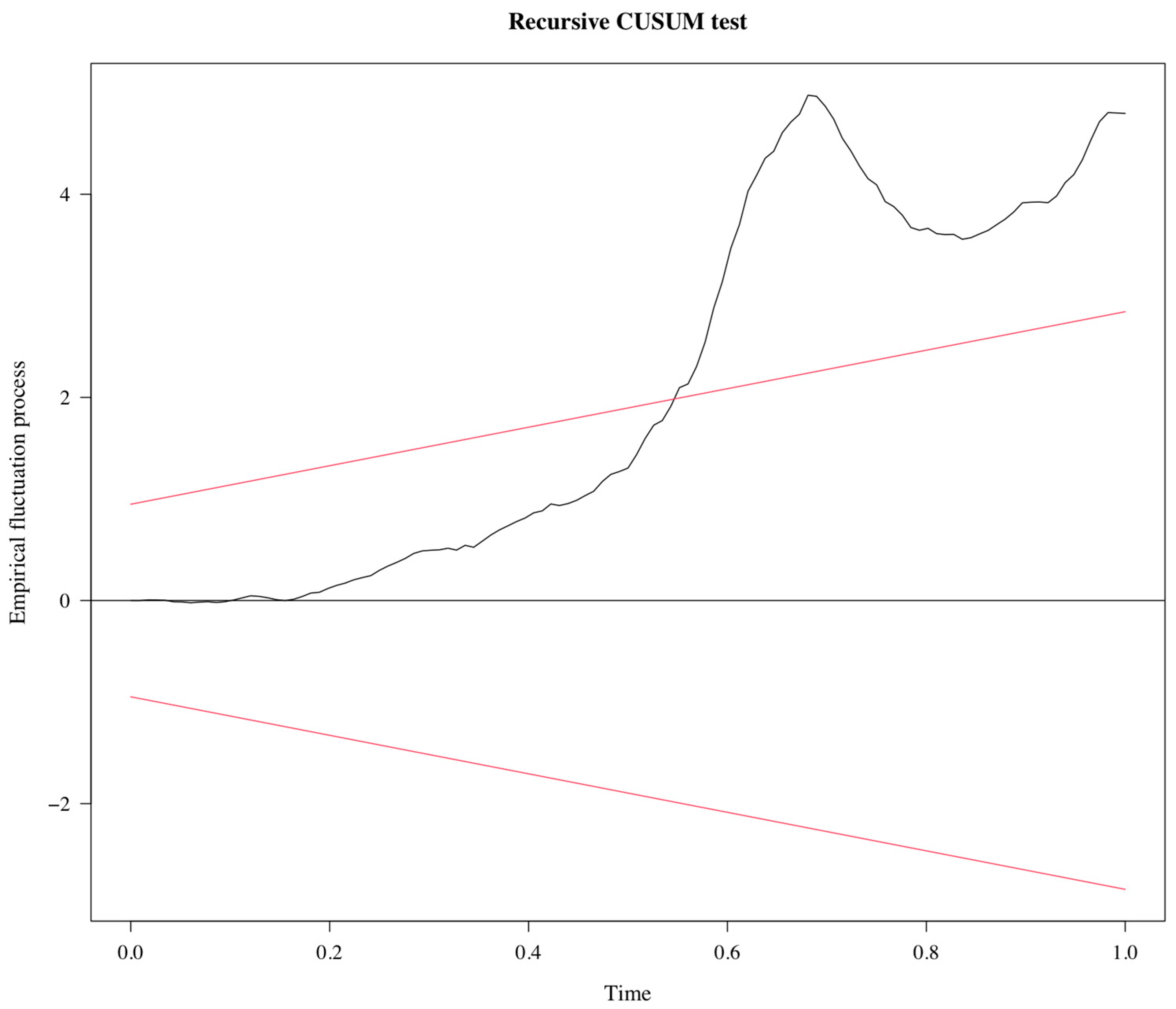
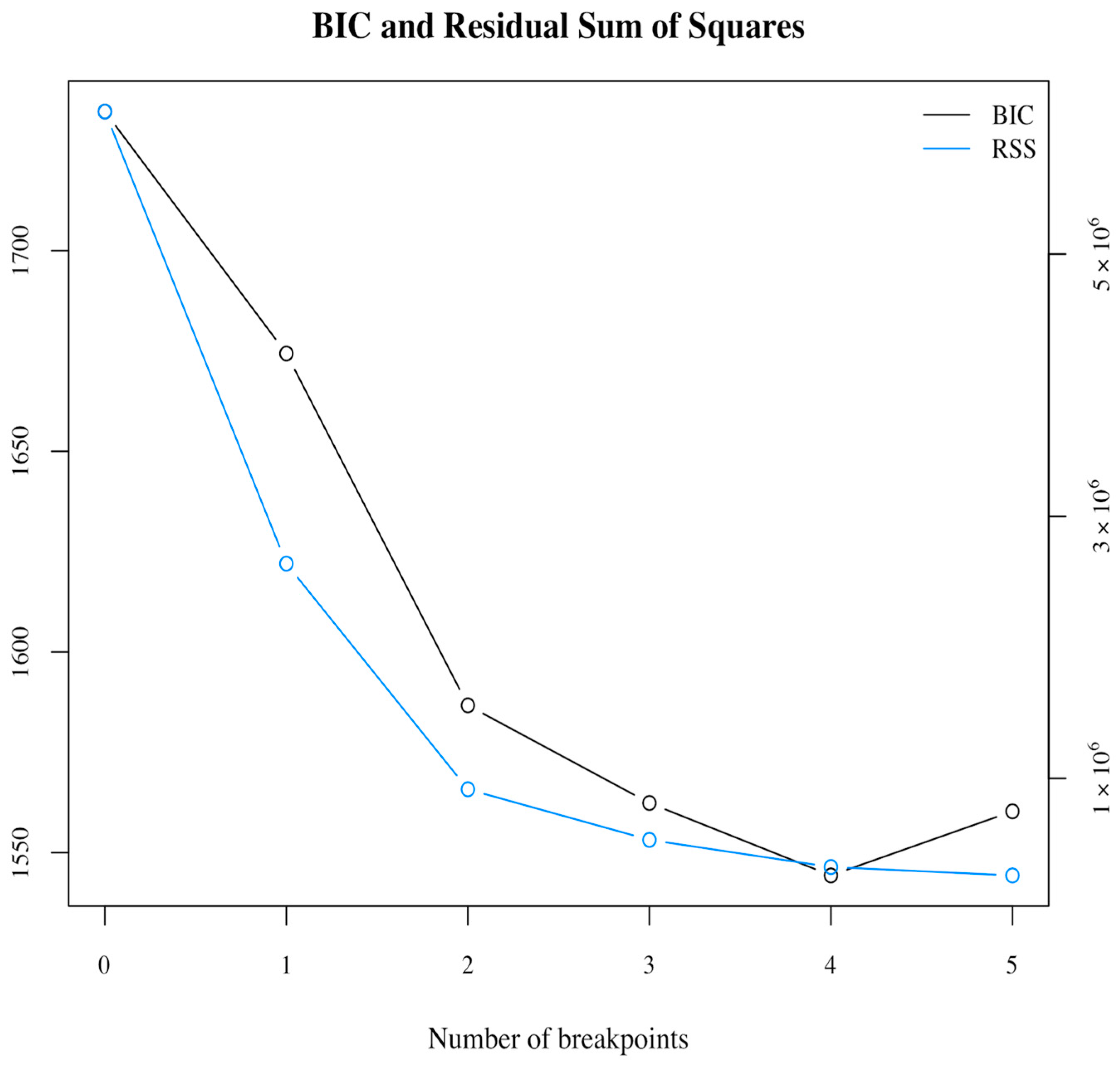
To address the possibility of structural breaks in the sample period under consideration, an extra robustness test based on recursive CUSUM tests and Bai–Perron structural break tests (
Perron, 2006) was conducted. These tests were conducted to determine whether there was stability in connectedness dynamics during periods of uncertainty and crisis. The results show evidence of structural change in the connectedness dynamics, thereby justifying the use of the TVP-VAR-BK18 model to capture the dynamic nature of the connectedness process under uncertainty. The results of the structural stability test are presented in
Appendix A.
4. Data and Preliminary Statistics
To investigate the determinants of total connectedness spillover among the 4IR assets including fintech, blockchain, cybersecurity, internet, and disruptive technology indices, we incorporated the following pivotal indices: Quality of Political Signals Index (Qindex), climate policy uncertainty index (CPU), geopolitical risk index (GPR), a recession dummy (NBER), the CBOE crude oil volatility index (OVX), the trade policy uncertainty index (TPU), CBOE volatility index (VIX), and world uncertainty index (WUI). The dataset was obtained from Bloomberg, investing.com, and policyuncertainty.com and consists of monthly observations spanning from January 2015 to April 2025. The sample period is determined based on data availability and spans major global economic and financial events, including the COVID-19 pandemic and the Russia–Ukraine conflict.
The chosen indices include the significant dimensions of financial ecosystems in the 4IR, focusing on future expectations for technology and information. They are, therefore, very sensitive to uncertainty transmission and spillovers (
Kim & Kim, 2022;
Nwosu et al., 2023;
Wan Ismail et al., 2024). Additionally, studies show that innovation-focused financial assets are part of interconnected and uncertainty-sensitive financial systems marked by dynamic spillover behaviour and increased crisis sensitivity (
Balcilar et al., 2021;
Usman et al., 2025). Thus, the chosen indices offer an appropriate context for studying connectedness and spillover transmission in technologically connected financial systems.
To ensure stationarity, continuously compounded returns are calculated by taking the logarithmic differences in consecutive index prices, expressed as
, where (r
t) denotes the return at time (t), and (4IR
t) and (4IR
t−1) represent the index prices at time (t) and (t − 1), respectively. To analyze the impact of global crises on financial connectedness, the sample period was segmented into three separate sub-periods based on the methodology used by
Imran et al. (
2025):
- (i)
The overall sample period;
- (ii)
The COVID-19 crisis period;
- (iii)
The Russia–Ukraine conflict period.
More precisely, the COVID-19 crisis period refers to the period from December 2019 to January 2022, while the Russia–Ukraine conflict period began in February 2022.
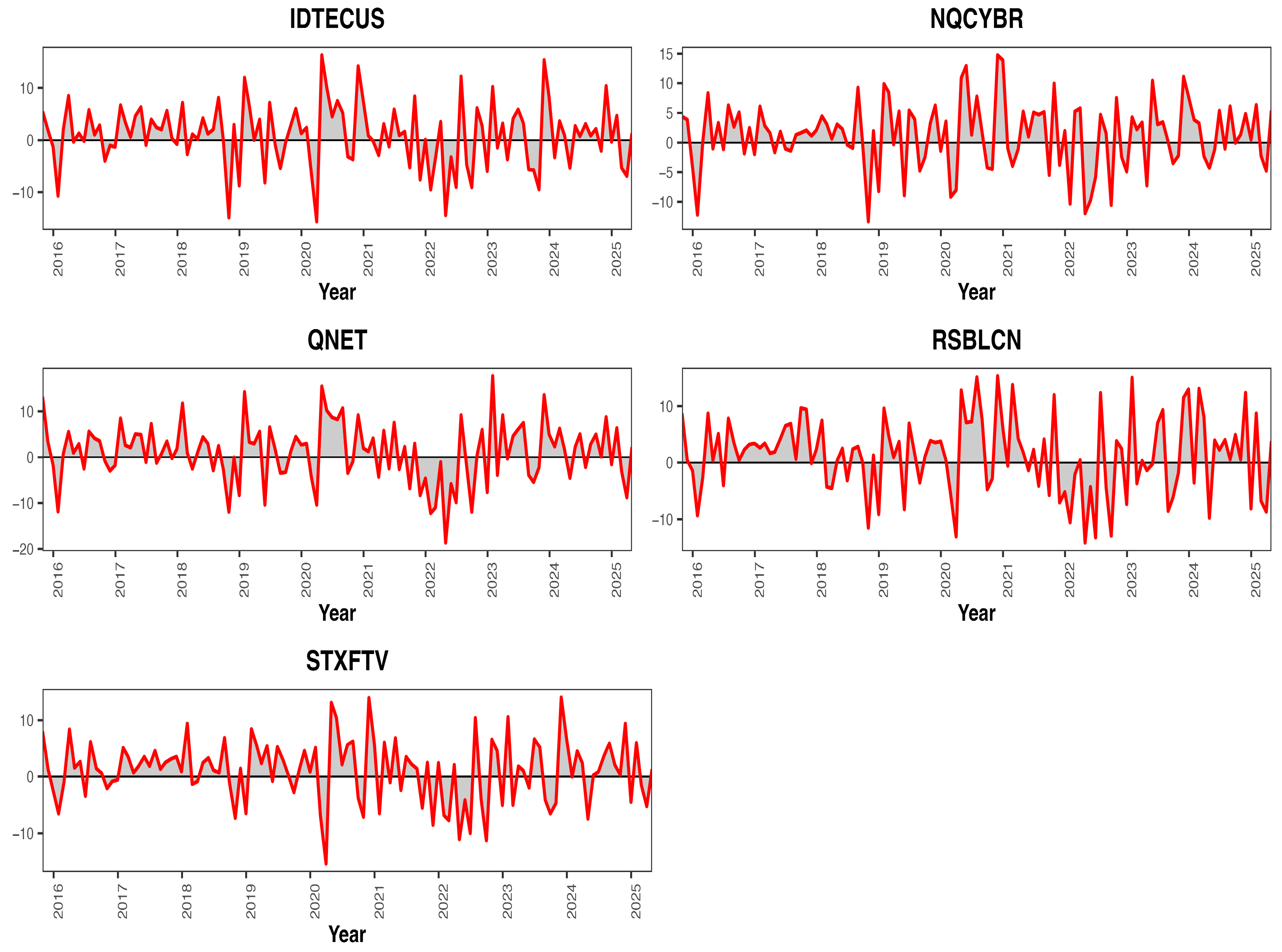
The return dynamics of 4IR assets in
Figure 1 exhibit substantial time variation and volatility concentration during the sample period. The mention of periods of increased global uncertainty is linked to acute movements across all asset classes, especially during the COVID-19 pandemic and the conflict between Russia and Ukraine. Although volatile in the short term, the series of returns exhibits a mean-reverting trend, suggesting it does not exhibit long-term trends.
Table 2 shows that they also align with the properties of financial time series, including conditional heteroskedasticity, and explain the need to implement sophisticated econometric models. Further, the results of the correlation matrix in
Table 3 show moderately high correlations among some of the uncertainty variables, but none exceeds the critical level. To further test whether multicollinearity is an issue, variance inflation factor (VIF) diagnostics were performed.
According to
Table 4, the reported VIF values remain below the commonly accepted threshold levels, suggesting that multicollinearity is unlikely to materially affect the regression estimates (
Kyriazos & Poga, 2023).
5. Empirical Results and Discussion
5.1. Dynamic Total Connectedness
The results for dynamic connectedness are presented in
Table 5 and
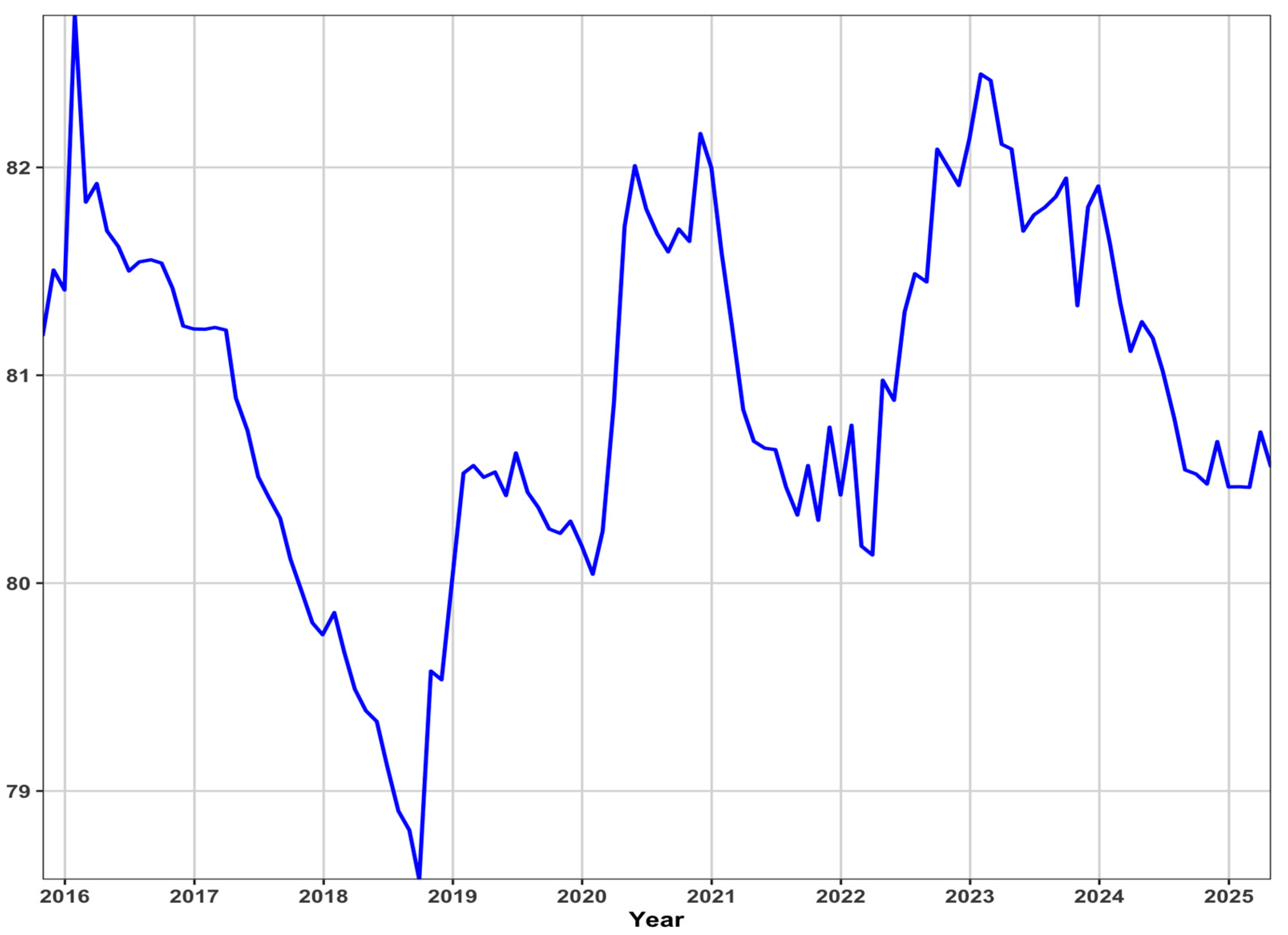
Figure 2 for the overall sample period and the crisis sub-periods. As evidenced by the results, the selected technology-oriented assets exhibit persistently high levels of interconnectedness, suggesting spillover effects within innovation-based financial systems.
Across the overall sample period, the TCI stood at 80.91%, suggesting that the majority of forecast error variance was driven by cross-market rather than idiosyncratic shocks. IDTECUS turned out to be the main source of the spillover effect due to its higher FROM value (90.05%), whereas NQCYBR was identified as the biggest net receiver with a NET of −3.14. The assets QNET and STXFTV were also found to be net transmitters during most of the sample period.
As shown in
Figure 2, spillover effects varied over time and became significantly more intense during periods of global uncertainty. In particular, connectedness rose during the coronavirus pandemic and remained high during the conflict between Russia and Ukraine.
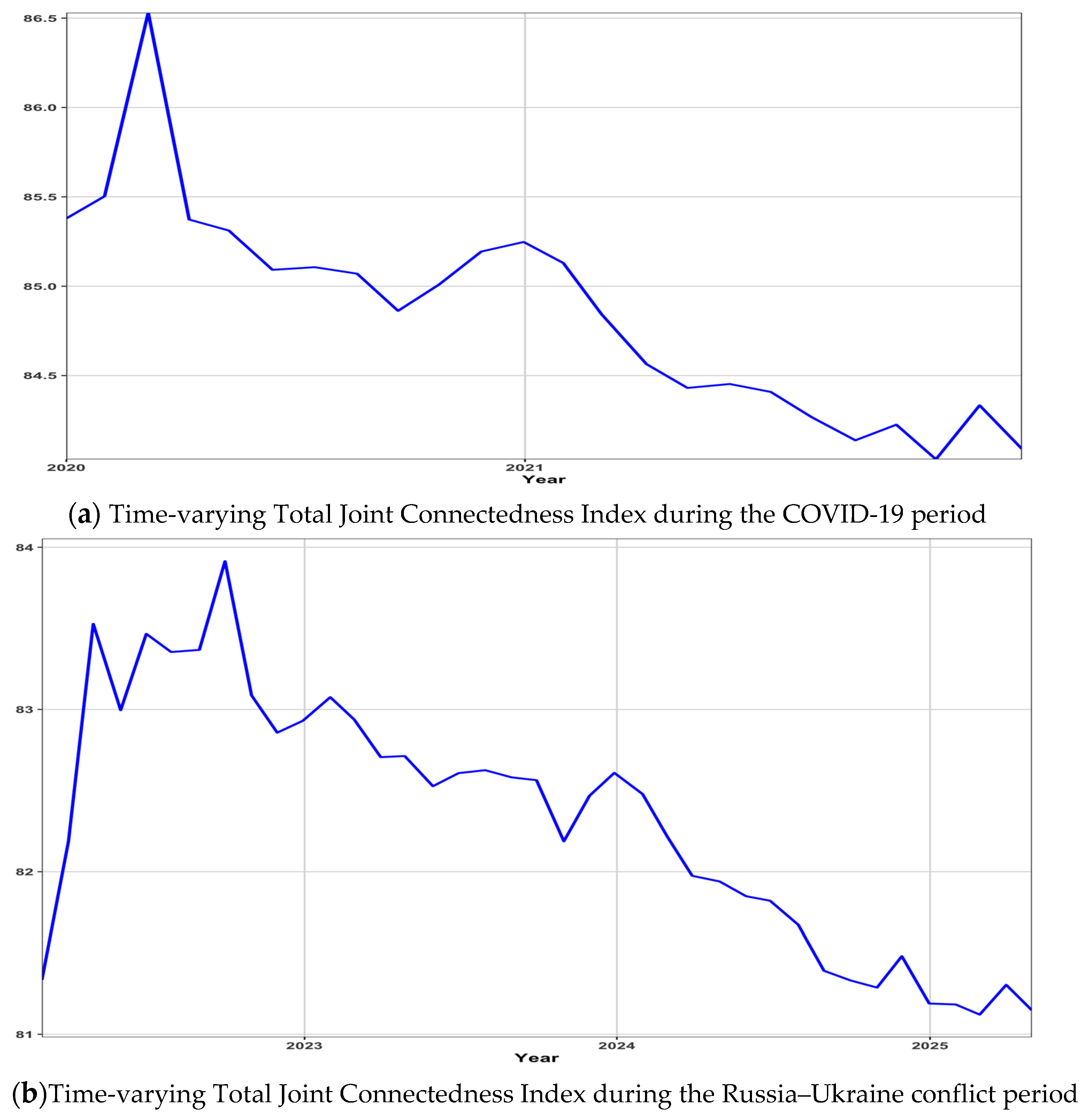
This trend is further evident from
Figure 3, whereby the TCI was significantly higher during the COVID-19 period at 85.29%. During this period, the highest NET connectedness for positive spillovers was observed in STXFTV, amounting to 7.90, whereas QNET and NQCYBR emerged as significant net receivers, recording −4.76 and −12.97, respectively. The results imply that the uncertainty associated with the pandemic period has exacerbated the synchronization of investor behavior and volatility transmission.
In addition, the connectedness level was similarly high during the Russia–Ukraine conflict period at 82.31%. The political information quality gained prominence during this period because QNET emerged as a net transmitter with a NET value of 2.83. Similarly, IDTECUS and STXFTV were observed to play a dominant role in influencing the connectedness network. On the other hand, NQCYBR remained relatively fragile to external disturbances.
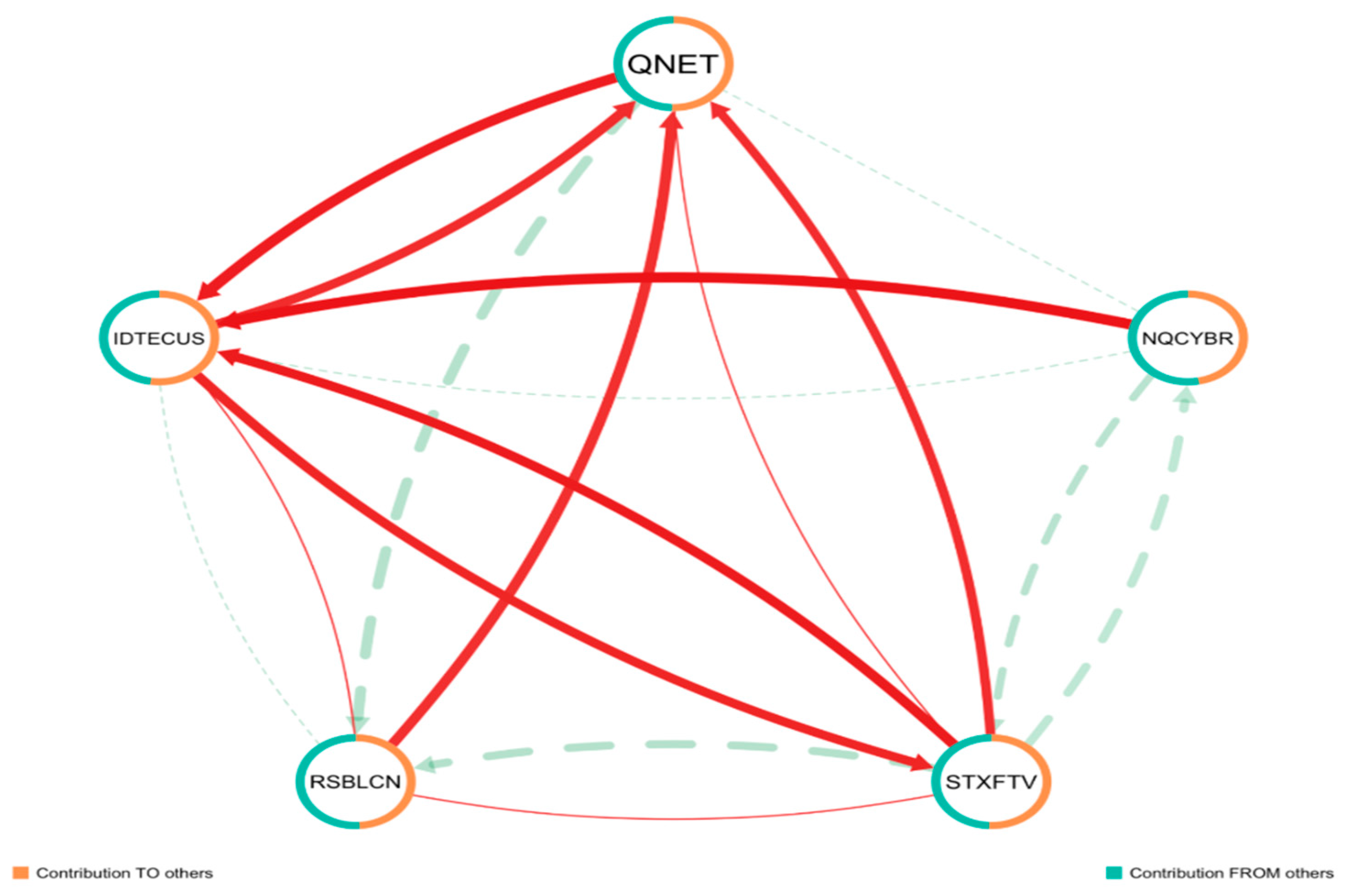
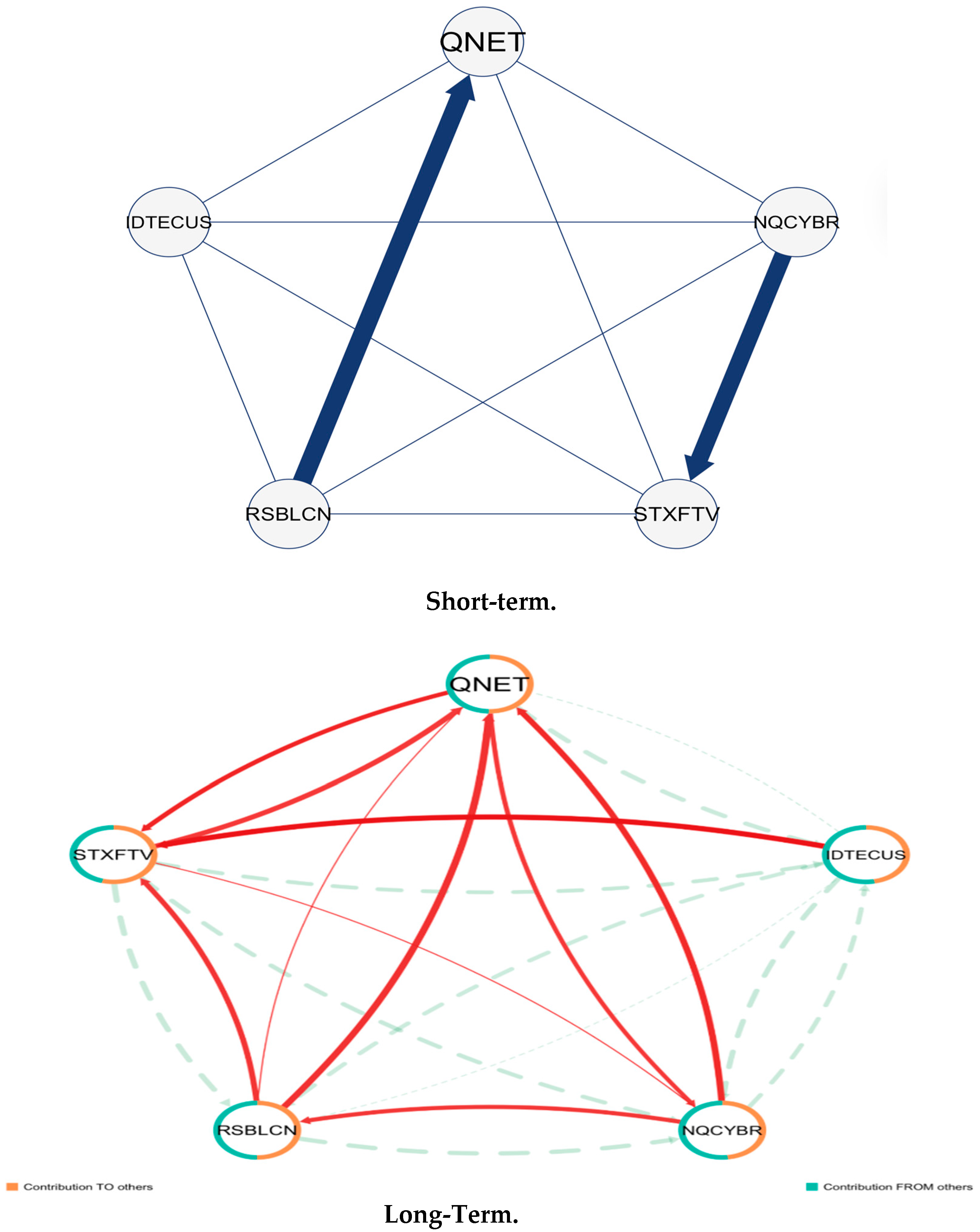
The spillover network shown in
Figure 4 again emphasizes the asymmetric transmission of volatility within the system. In terms of network structure, IDTECUS, STXFTV, and QNET play an important role in the transmission of shocks across markets, while NQCYBR mainly acts as a shock absorber. Generally, the results show that 4IR financial systems are interrelated, crisis sensitive, and vulnerable to spillover effects.
As evident from the results, the degree of connectedness in financial systems associated with 4IR is significantly increased during times of increased uncertainty and market stress. Most importantly, the significant rise in the Total Connectedness Index amid the COVID-19 pandemic and Russia–Ukraine conflict indicates that crisis situations not only lead to increased volatility spillovers but also decrease segmentation, which is typically seen between innovation-based financial assets. Technological financial systems may thus be seen as less distinct investment portfolios and rather as interconnected parts of a more comprehensive financial ecosystem sensitive to uncertainty at crisis times. This result supports the arguments presented by
Chatziantoniou and Gabauer (
2021) and
Balcilar et al. (
2021) regarding increased dynamics and persistence in connectedness structures in high uncertainty situations. The predominant spillover effect of IDTECUS and STXFTV also emphasizes the increasing significance of technology and innovation-based sectors in financial ecosystems from a systemic perspective.
Although past literature mainly treated technology-based assets as high-growth or alternative investments, the current results suggest that these markets have increasingly become important transmission channels for uncertainty across connected financial networks. To some extent, this finding can be seen as an extension of the results reported by
Alhashim et al. (
2025), who found that innovation-based financial assets exhibit greater spillover sensitivity during periods of uncertainty. However, the current study shows that such assets not only receive uncertainty shocks but also actively contribute to systemic uncertainty transmission across digital financial ecosystems. In addition, the emergence of QNET as a net transmitter during the Russia–Ukraine conflict period indicates that political information quality and uncertainty information may increasingly influence connectedness behavior in technological financial systems.
The role of QNET as a transmitter of net flow during the Russia–Ukraine conflict period also indicates that political signal quality and information about uncertainty can be important determinants of connectedness behavior in technologically integrated financial systems. This point is especially crucial, as it implies that geopolitical risks and political information quality can change investors’ expectations and lead to greater synchronization in innovation-based financial markets than in traditional markets. The results of this study are partially consistent with those reported by
Białkowski et al. (
2022). Specifically, it is argued that lower political signal quality increases uncertainty and makes it harder for investors to interpret the economic situation. However, this paper shows that geopolitical risks can act not only as background factors but also as active drivers of systemic spillovers in technologically integrated markets.
The relatively high values of connectedness across the entire sample period indicate that the financial systems within the 4IR are gradually becoming more integrated and more susceptible to contagion effects driven by uncertainties. While this integration could enhance information diffusion and increase efficiency during non-crisis periods, it would increase systemic risk during crises, as it intensifies contagion and reduces diversification benefits. In this regard, the results refute the idea that innovative financial assets are inherently immune to systemic risks, as they may eventually become a source of systemic risk themselves.
5.2. Frequency Connectedness
The findings of the frequency connectedness are provided in
Table 6 and
Figure 5 and
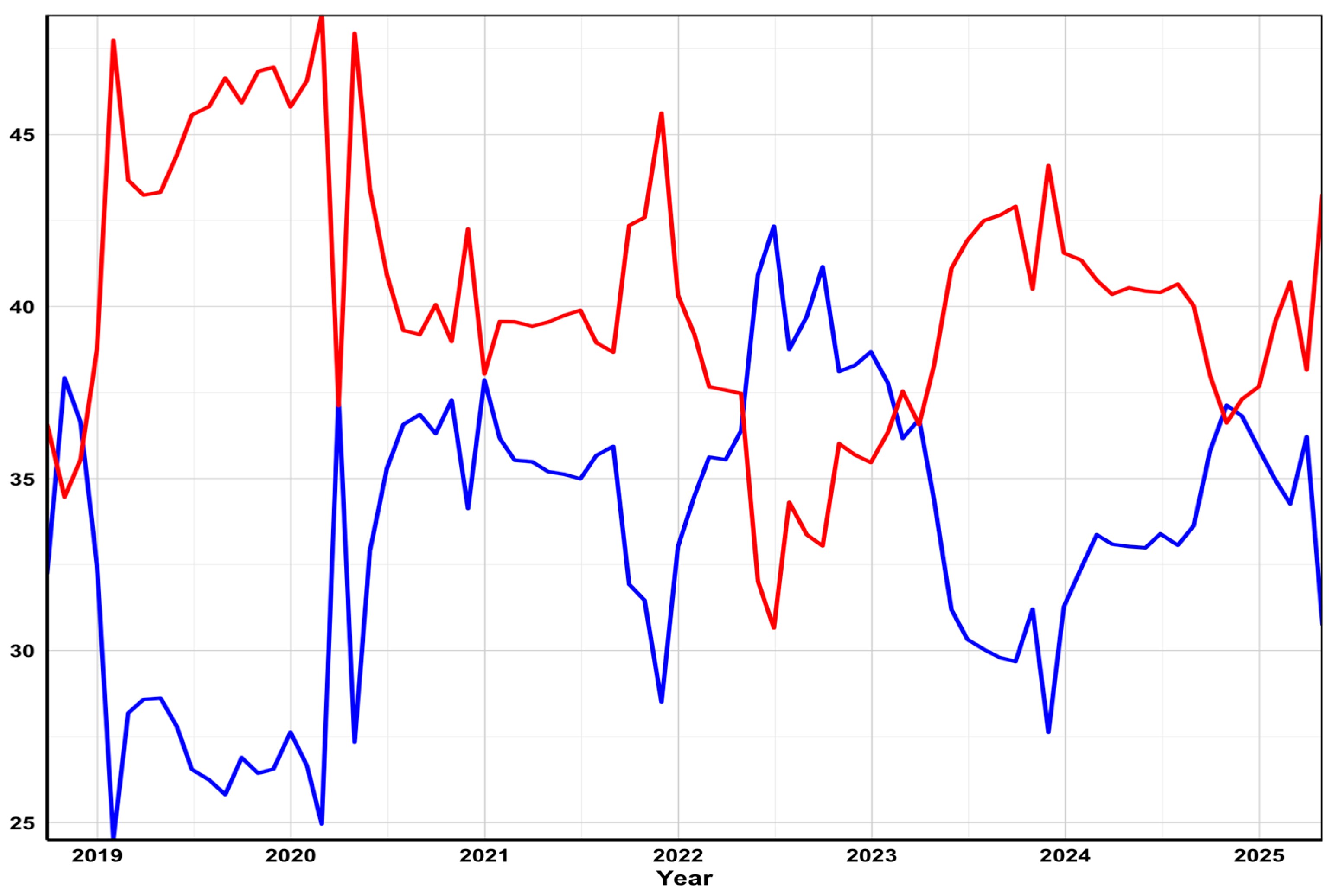
Figure 6 below. The results show that spillover effects in 4IR financial markets are mainly observed in the short run. This is because the short-term connectedness index (TCI = 39.24) is greater than the long-term connectedness index (TCI = 33.97). Hence, the greatest uncertainty about transmission occurs in the short run.
In the short run, STXFTV and IDTECUS stand out as primary net transmitters with NET = 4.85 and NET = 1.60, respectively. They play an important role in spreading short-run volatility in interconnected technological markets. On the other hand, NQCYBR and RSBLCN are net receivers with NET = −4.01 and NET = −3.13.
Figure 5 further demonstrates the relatively dense interconnection of the short-run spillover network.
In the context of long-term connectedness, spillover transmission is relatively lower, but more stable over time. As such, IDTECUS emerges as the principal long-term net transmitter, with a NET score of 6.30, demonstrating the sustained influence of disruptive technological innovation on interconnected financial markets. In contrast, NQCYBR and STXFTV appear to exhibit comparatively weaker long-term spillover, as some of their spillovers are short-lived reactions to uncertainty.
From
Figure 6 below, it is clear that short-term connectedness exceeds long-term connectedness in most periods of the sample. In essence, 4IR financial markets are more sensitive to temporary uncertainty shocks, rapid information adjustments, and changes in investor sentiment than to structural factors.
The prevalence of short-term connectedness suggests that spillover behavior in 4IR financial systems is likely to be predominantly influenced by rapid information processing, uncertainty-sensitive investor behavior, and short-term expectation adjustment rather than by slowly evolving structural fundamentals. Overall, these results are consistent with the arguments put forward by
Baruník and Křehlík (
2018), who claimed that the connectedness structure varies significantly depending on the investment horizon, especially when an uncertainty-sensitive market regime is involved. In a similar manner,
Balcilar et al. (
2021) found that both financial and commodity markets tend to experience higher levels of short-term spillovers during periods of high uncertainty and speculative investor behaviour. On the other hand, the current research findings partially contradict the traditional understanding of innovation-based financial systems which are supposed to be primarily based on long-term technological fundamentals. Even though long-term spillovers cannot be ignored, the observed level of short-term connectedness suggests that 4IR financial systems may be more sensitive to temporary uncertainty shocks, sentiment shifts, and investor reactions than initially presumed.
The significance of IDTECUS as the prevailing long-term spillover effect further underscores the ongoing structural relevance of disruptive technological innovations in integrated financial networks. Compared with the declining influence of other 4IR assets over longer time frames, IDTECUS retains robust long-term transmission capabilities, suggesting that disruptive technological innovations could continue to drive systemic financial interconnectedness beyond short-term crisis responses. The results provide some support for
George (
2024) and
Schintler (
2022), who argued that the structural relevance of 4IR technologies in modern economies is on the rise.
Overall, the results of the frequency decomposition analysis show that spillover transmission in innovation-based financial systems occurs largely in the short term, while long-term connectedness reflects structural integration. Although technological integration enhances long-term interdependence, the prevalence of short-term spillovers suggests that innovation-driven financial networks remain crisis-induced and information-driven.
5.3. Impact of Quality of Political Signals on 4IR Return Spillovers
The determinants of total connectedness in 4IR financial markets are presented in
Table 7. The coefficients from the baseline regressions suggest that the effect of Qindex on connectedness is quite weak even under normal market conditions. Despite the positive coefficient of Qindex in Model 9 (0.0006), its effect on connectedness is not statistically significant.
Nevertheless, the crisis interaction models show that the picture changes significantly. For example, in Model 10, the interaction coefficients Qindex × COVID (0.0353 ***) and Qindex × WAR (0.0144 ***) are both statistically significant (at the 1% significance level). Hence, the worsening of political signal quality increases connectedness when markets undergo crisis conditions. Moreover, although the coefficient of Qindex alone in Model 10 is negative (−0.0151 ***), its effect on connectedness remains statistically significant, indicating that credible political communication can reduce volatility transmission under high levels of uncertainty.
In addition, among the control variables, OVX is positive and significant for connectedness across specifications, with a coefficient of 0.0123 *** in Model 9. This indicates that oil market volatility is an important source of uncertainty, driving a higher degree of uncertainty transmission in interconnected technological-financial systems. On the other hand, GPR is negative and significant in all models, while TPU is also negative and significantly associated with connectedness. Thus, not all sources of uncertainty contribute equally to the spillover behavior in innovation-based financial markets.
The quantile regression results in
Table 8 below provide additional support for the robustness of the results obtained in the baseline analysis above in different regimes of connectedness. The coefficient of Qindex is negative and significant in all quantiles, falling from −0.0228 *** in Q5 to −0.0098 * in Q95. The implication is that political signal quality has a stronger stabilizing association with connectedness during relatively low connectedness regimes than during high connectedness regimes.
The interaction effect of Qindex × COVID remains positive and significant throughout all quantiles, starting from 0.0448 *** for Q5 up to 0.0309 *** for Q95. Similarly, the interaction effect of Qindex × WAR is found to be positive and significant at the lower and mid-quantiles, but the significance fades at higher quantiles. This suggests that the quality of political signals becomes more relevant in crisis-sensitive markets with coordinated investor responses.
This implies that the economic significance of political signal quality is mainly observed during periods of uncertainty, rather than in normal market settings. The insignificance of the baseline Qindex regression coefficient suggests that political signal quality alone cannot be the constant source driving connectedness in the financial system across 4IR. On the other hand, the significant and positive interaction effects during the pandemic and Russia–Ukraine conflict suggest that reduced political signal quality reinforces spillover transmission under uncertainty-sensitivity and market synchronization.
An important channel through which political signal quality affects uncertainty transmission in the financial system is the information channel. When political communication deteriorates, there will be greater uncertainty about the future paths of policies, regulations, and the macroeconomic environment, making it difficult for investors to determine whether the information is credible. In such situations, investors may respond to both economic and political news simultaneously, leading to synchronized trading and faster spillover transmission among technological assets. This observation is consistent with the work by
Białkowski et al. (
2022).
These findings also underline the significance of the investor’s expectation mechanism in innovative financial systems. Given that many 4IR assets depend heavily on expected technological progress and growth potential, changes in the quality of political communication may have significant implications for market sentiment and expectation formation. Hence, uncertainties regarding political communication can quickly spill over into related technological markets due to expectation-driven portfolio allocation and uncertainty-averse trading strategies. These findings partially follow the arguments presented by
Nguyen et al. (
2026) regarding the influence of political signal quality on financial expectations.
In addition, the findings from the quantile regression analysis show that the effect of political signal quality depends on market states and varies in different situations. In particular, the association of Qindex with lower quantiles suggests that effective political communication may help mitigate spillovers during periods of relative stability. At the same time, the weaker association of Qindex in higher quantiles indicates that in extremely connected crisis settings, systemic uncertainty and collective investor reactions prevail over market behavior.
The persistent importance of the COVID interaction term across quantiles further suggests that information contagion was likely exacerbated by pandemic-related uncertainty across interconnected 4IR financial markets. In contrast to traditional uncertainty shocks, pandemic uncertainty affected not only economic expectations but also technological expectations and digital investment activities, leading to information spill-over through several interconnected channels. This result supports
Caylor et al. (
2023) in their assertion that innovation-sensitive assets continue to rely heavily on informational cues from the general public and expectation-based valuation.
The results indicate that political communication quality acts as a potential conditional risk factor in interconnected 4IR financial markets. Although high-quality political communication can mitigate information spillovers during non-crisis times, crisis periods seem to intensify the transmission of uncertainty through coordinated investor behavior and information contagion.
The findings contribute to the growing body of research on the propagation of uncertainty and the interconnectedness of financial markets by showing that these markets are a network of interconnected markets in which shocks are not received in isolation (
Diebold & Yilmaz, 2009,
2014). The greater financial market operations connectedness during times of uncertainty is in line with various studies confirming that uncertainty leads to an increase in market connectedness and contagion (
Baker et al., 2016;
Caldara & Iacoviello, 2022). The results indicate that, as regards the information transfer perspective, the quality of political communication offers an important information channel for the development and change of expectations. When the quality of the political signal drops, informational frictions will be exacerbated, policy outlook will be even less obvious, and spillovers through financial markets affected by innovations will be even larger. By doing so, the study goes beyond the conventional literature on uncertainty and explores uncertainty’s informational credibility rather than just uncertainty as it relates to political disagreement and geopolitical shocks.
To evaluate the robustness of the relationship between political signal quality and connectedness, the regression analysis is estimated using a sequential model-building approach. The baseline specification includes only Qindex, while subsequent models progressively incorporate additional uncertainty and market controls. This approach allows us to assess whether the effect of political signal quality remains stable after controlling for alternative sources of uncertainty and financial market conditions.
5.4. Robustness and Structural Stability Analysis
Further diagnostic tests on the stability of the empirical findings were conducted to validate the empirical model specification. First, recursive CUSUM tests were conducted to assess parameter stability during the sample period. The results shown in
Appendix A Figure A1 indicate time-varying behavior and parameter instability during periods of major uncertainty, confirming the applicability of the TVP-VAR model for modeling time-varying spillovers.
Secondly, the Bai–Perron structural break test in
Appendix A Figure A2 further confirms the presence of multiple structural breaks in the sample period, especially during major crisis periods related to the COVID-19 pandemic, geopolitical tensions, and post-COVID-19 uncertainty. These results show that connectedness behavior of 4IR financial systems varies across different uncertainty periods, indicating that the financial systems are not structurally constant. Overall, robustness results provide further justification for the suitability of the TVP-VAR-BK18 model in capturing dynamic and crisis-connectedness behavior in financial systems.
6. Conclusions and Policy Implications
This research explores dynamic and frequency-connectedness among 4IR financial assets, with a particular focus on the effect of political signal quality uncertainty on spillover transmission among interconnected financial systems. Based on the TVP-VAR and BK18 frequency-connectedness approaches, the results confirm persistently high levels of interconnectedness among 4IR markets, especially during the COVID-19 pandemic and the Russia–Ukraine conflict.
Furthermore, the frequency-connectedness results suggest that spillover transmission is predominantly characterized by short-term connectedness, implying that 4IR financial systems respond strongly to information changes, uncertainties, and coordinated investor actions. Finally, regression results show that political signal quality plays an increasingly significant role during crisis episodes, since a reduction in information credibility can significantly increase uncertainty transmission and systemic interconnectedness in the technological financial market.
There are several implications of these findings for investors, policymakers, and regulators. Firstly, persistent high levels of interconnectedness between financial systems mean that diversification benefits in innovation-driven financial systems are limited in the case of increased uncertainties. Secondly, credible political signaling becomes increasingly relevant to reduce uncertainty-driven spillovers in technologically integrated financial ecosystems.
Nevertheless, this research has some limitations, despite its significant contribution. First, this study is based solely on 4IR financial indices, which may not reflect the full picture of the technological landscape. Second, while structural stability analyses were performed in the paper, future studies can consider applying other regime-switching techniques and even machine learning approaches to investigate nonlinear spillovers. Third, changes in the geopolitical and macroeconomic environments can influence the mechanisms through which uncertainty is transmitted within such innovation-oriented financial systems. In future, research may consider alternative causal identification approaches to examine the potentially endogenous relationship between political information quality and financial connectedness.
Finally, it is evident that 4IR financial systems have become more integrated, more sensitive to uncertainty, and more prone to crisis-driven contagion effects, making dynamic risk monitoring and uncertainty-sensitive policy frameworks crucial for technological financial ecosystems.