


Perception of Hidden Confidence in Neutral Expressions: Interactions of Facial Attractiveness, Self-Esteem, and Names to Be Addressed by

Abstract
1. Introduction
2. Experiment 1
2.1. Method
2.1.1. Participants
2.1.2. Materials
2.1.3. Procedure
2.1.4. Ethical Considerations
2.2. Results
2.3. Discussion
3. Experiment 2
3.1. Method
3.1.1. Participants
3.1.2. Materials and Procedure
3.2. Results
3.3. Discussion
4. General Discussion
Author Contributions
Funding
Institutional Review Board Statement
Informed Consent Statement
Data Availability Statement
Acknowledgments
Conflicts of Interest
References
- Allport, Gordon Willard. 1937. Personality: A Psychological Interpretation. New York: Holt. [Google Scholar]
- Arias, Pablo, Pascal Belin, and Jean-Julien Aucouturier. 2018. Auditory smiles trigger unconscious facial imitation. Current Biology 28: R782–R783. [Google Scholar] [CrossRef] [Scilit] [PubMed]
- Bora, Emre, Simavi Vahip, Ali Saffet Gonul, Fisun Akdeniz, Müge Alkan, Melise Ogut, and Ayse Eryavuz. 2005. Evidence for theory of mind deficits in euthymic patients with bipolar disorder. Acta Psychiatrica Scandinavica 112: 110–16. [Google Scholar] [CrossRef] [Scilit] [PubMed]
- Brand, Rebecca J., Abigail Bonatsos, Rebecca DOrazio ’, and Hilary DeShong. 2012. What is beautiful is good, even online: Correlations between photo attractiveness and text attractiveness in men’s online dating profiles. Computers in Human Behavior 28: 166–70. [Google Scholar] [CrossRef] [Scilit]
- Brothers, Leslie. 1990. The social brain: A project for integrating primate behavior and neurophysiology in a new domain. Concepts in Neuroscience 1: 27–51. [Google Scholar]
- Brüne, Martin. 2005. Emotion recognition,‘theory of mind,’and social behavior in schizophrenia. Psychiatry Research 133: 135–47. [Google Scholar] [CrossRef] [Scilit] [PubMed]
- Bugental, James F. T., and Seymour L. Zelen. 1950. Investigations into the’self-concept’. I. The WAY technique. Journal of Personality 18: 483–98. [Google Scholar] [CrossRef] [Scilit]
- Carrera-Levillain, Pilar, and Jose-Miguel Fernandez-Dols. 1994. Neutral faces in context: Their emotional meaning and their function. Journal of Nonverbal Behavior 18: 281–99. [Google Scholar] [CrossRef] [Scilit]
- Carvajal, Fernando, Sandra Rubio, Juan M. Serrano, Marcos Ríos-Lago, Juan Alvarez-Linera, Lara Pacheco, and Pilar Martín. 2013. Is a neutral expression also a neutral stimulus? A study with functional magnetic resonance. Experimental Brain Research 228: 467–79. [Google Scholar] [CrossRef] [Scilit]
- Cordaro, Daniel T., Rui Sun, Dacher Keltner, Shanmukh Kamble, Niranjan Huddar, and Galen McNeil. 2018. Universals and cultural variations in 22 emotional expressions across five cultures. Emotion 18: 75. [Google Scholar] [CrossRef] [Scilit]
- Crozier, W. Ray, and Patricia S. Dimmock. 1999. Name-calling and nicknames in a sample of primary school children. British Journal of Educational Psychology 69: 505–16. [Google Scholar] [CrossRef] [Scilit]
- Crozier, W. Ray, and Evanthia Skliopidou. 2002. Adult recollections of name-calling at school. Educational Psychology 22: 113–24. [Google Scholar] [CrossRef] [Scilit]
- Dimberg, Ulf, Monika Thunberg, and Kurt Elmehed. 2000. Unconscious facial reactions to emotional facial expressions. Psychological Science 11: 86–89. [Google Scholar] [CrossRef] [Scilit] [PubMed]
- Du, Xiaopeng, Mengchen Dong, Dian Gu, Zhiyong Xin, Jiang Jiang, and Yan Sun. 2021. Difficult name, cold man: Chinese names, gender stereotypicality and trustworthiness. International Journal of Psychology 56: 349–60. [Google Scholar] [CrossRef] [Scilit] [PubMed]
- Ekman, Paul. 1984. Expression and the nature of emotion. In Approaches to Emotion. Edited by Paul Ekman and Klaus R. Sherer. Hillsdale: Lawrence Erlbaum Association, Inc, pp. 319–44. [Google Scholar]
- Ekman, Paul, and Wallace V. Friesen. 1975. Unmasking the Face: A Guide to Recognizing Emotions from Facial Clues. Hoboken: Prentice-Hall. [Google Scholar]
- Elfenbein, Hillary Anger, and Nalini Ambady. 2002. On the universality and cultural specificity of emotion recognition: A meta-analysis. Psychological Bulletin 128: 203–35. [Google Scholar] [CrossRef] [Scilit]
- Fernández-Dols, José-Miguel, Pilar Carrera, Kimberly A. Barchard, and Marta Gacitua. 2008. False recognition of facial expressions of emotion: Causes and implications. Emotion 8: 530. [Google Scholar] [CrossRef] [Scilit]
- Gao, Wen, Bo Cao, Shiguang Shan, Xilin Chen, Delong Zhou, Xiaohua Zhang, and Debin Zhao. 2008. The CAS-PEAL large-scale Chinese face database and baseline evaluations. IEEE Transactions on Systems, Man, and Cybernetics—Part A: Systems and Humans 38: 149–61. [Google Scholar] [CrossRef] [Scilit]
- Gebauer, Jochen E., Michael Riketta, Philip Broemer, and Gregory R Maio. 2008. “How much do you like your name?” An implicit measure of global self-esteem. Journal of Experimental Social Psychology 44: 1346–54. [Google Scholar] [CrossRef] [Scilit]
- Guéguen, Nicolas, and Alexandre Pascual. 2011. Mr “Py” is Probably a Good Mathematician: An Experimental Study of the Subjective Attractiveness of Family Names. Names 59: 52–56. [Google Scholar] [CrossRef] [Scilit]
- Hawker, David S. J., and Michael J. Boulton. 2000. Twenty years’ research on peer victimization and psychosocial maladjustment: A meta-analytic review of cross-sectional studies. The Journal of Child Psychology and Psychiatry and Allied Disciplines 41: 441–55. [Google Scholar] [CrossRef]
- Haxby, James V., Elizabeth A. Hoffman, and M Ida Gobbini. 2000. The distributed human neural system for face perception. Trends in Cognitive Sciences 4: 223–33. [Google Scholar] [CrossRef] [Scilit]
- Keltner, Dacher, and Jonathan Haidt. 1999. Social functions of emotions at four levels of analysis. Cognition and Emotion 13: 505–21. [Google Scholar] [CrossRef] [Scilit]
- Kiyomi, Setsuko. 2010. A study on names and naming: Nicknames, company names and pet names. Surugadai University Studies 41: 81–103. (In Japanese) [Google Scholar]
- Laham, Simon M., Peter Koval, and Adam L. Alter. 2012. The name-pronunciation effect: Why people like Mr. Smith more than Mr. Colquhoun. Journal of Experimental Social Psychology 48: 752–56. [Google Scholar] [CrossRef] [Scilit]
- Leary, Mark R., Ellen S. Tambor, Sonja K. Terdal, and Deborah L. Downs. 1995. Self-esteem as an interpersonal monitor: The sociometer hypothesis. Journal of Personality and Social Psychology 68: 518. [Google Scholar] [CrossRef]
- Lewinski, Peter. 2015. Automated facial coding software outperforms people in recognizing neutral faces as neutral from standardized datasets. Frontiers in Psychology 6: 1386. [Google Scholar] [CrossRef] [Scilit]
- Lõhmus, Mare, L. Fredrik Sundström, and Mats Björklund. 2009. Dress for success: Human facial expressions are important signals of emotions. Annales Zoologici Fennici 46: 75–80. [Google Scholar] [CrossRef] [Scilit]
- Malatesta, Carol Z., Michael J. Fiore, and James J. Messina. 1987. Affect, personality, and facial expressive characteristics of older people. Psychology and Aging 2: 64. [Google Scholar] [CrossRef]
- Markus, Hazel Rose, and Shinobu Kitayama. 1991. Culture and the self: Implications for cognition, emotion, and motivation. Psychological Review 98: 224–53. [Google Scholar] [CrossRef]
- Matsumoto, David, and Paul Ekman. 1988. Japanese and Caucasian Facial Expressions of Emotion (JACFEE) and Neutral Faces (JACNeuF). San Francisco: University of California. [Google Scholar]
- Matsumoto, David, and Paul Ekman. 1989. American-Japanese cultural differences in intensity ratings of facial expressions of emotion. Motivation and Emotion 13: 143–57. [Google Scholar] [CrossRef] [Scilit]
- Matsumoto, David, and Hyisung C. Hwang. 2014. Judgments of subtle facial expressions of emotion. Emotion 14: 349. [Google Scholar] [CrossRef] [Scilit]
- Mehrabian, Albert. 1997. Impressions created by given names. Names 45: 19–33. [Google Scholar] [CrossRef] [Scilit]
- Mehrabian, Albert. 2001. Characteristics attributed to individuals on the basis of their first names. Genetic, Social, and General Psychology Monographs 127: 59. [Google Scholar]
- Mogi, Norie. 2002. Japanese ways of addressing people. Investigationes Linguisticae 8: 14–22. [Google Scholar] [CrossRef] [Scilit]
- Ogawa, Tokuko, Masaomi Oda, Sakiko Yoshikawa, and Shigeru Akamatsu. 1997. Evaluation of facial expressions differing in face angles—Constructing a database of facial expressions. Technical Report of Institute of Electronics, Information and Communication Engineers (IEICE), HIP 97: 47–52. [Google Scholar]
- Roberts, S. Craig, Anthony C. Little, Anna Lyndon, J. Roberts, Jan Havlicek, and Robert L. Wright. 2009. Manipulation of body odour alters men’s self-confidence and judgements of their visual attractiveness by women. International Journal of Cosmetic Science 31: 47–54. [Google Scholar] [CrossRef] [Scilit] [PubMed]
- Saegusa, Chihiro, and Katsumi Watanabe. 2016. Judgments of facial attractiveness as a combination of facial parts information over time: Social and aesthetic factors. Journal of Experimental Psychology: Human Perception and Performance 42: 173–79. [Google Scholar] [CrossRef] [Scilit] [PubMed]
- Sato, Wataru, and Sakiko Yoshikawa. 2010. Detection of emotional facial expressions and anti-expressions. Visual Cognition 18: 369–88. [Google Scholar] [CrossRef] [Scilit]
- Shimizu, Hiroshi. 2016. An introduction to the statistical free software HAD: Suggestions to improve teaching, learning and practice data analysis. Journal of Media, Information and Communication 1: 59–73. [Google Scholar]
- Van Kleef, Gerben A. 2009. How emotions regulate social life: The emotions as social information (EASI) model. Current Directions in Psychological Science 18: 184–88. [Google Scholar] [CrossRef] [Scilit]
- Willis, Janine, and Alexander Todorov. 2006. First impressions: Making up your mind after a 100-ms exposure to a face. Psychological Science 17: 592–98. [Google Scholar] [CrossRef] [Scilit]
- Zwebner, Yonat, Anne-Laure Sellier, Nir Rosenfeld, Jacob Goldenberg, and Ruth Mayo. 2017. We look like our names: The manifestation of name stereotypes in facial appearance. Journal of Personality and Social Psychology 112: 527. [Google Scholar] [CrossRef] [Scilit] [PubMed]
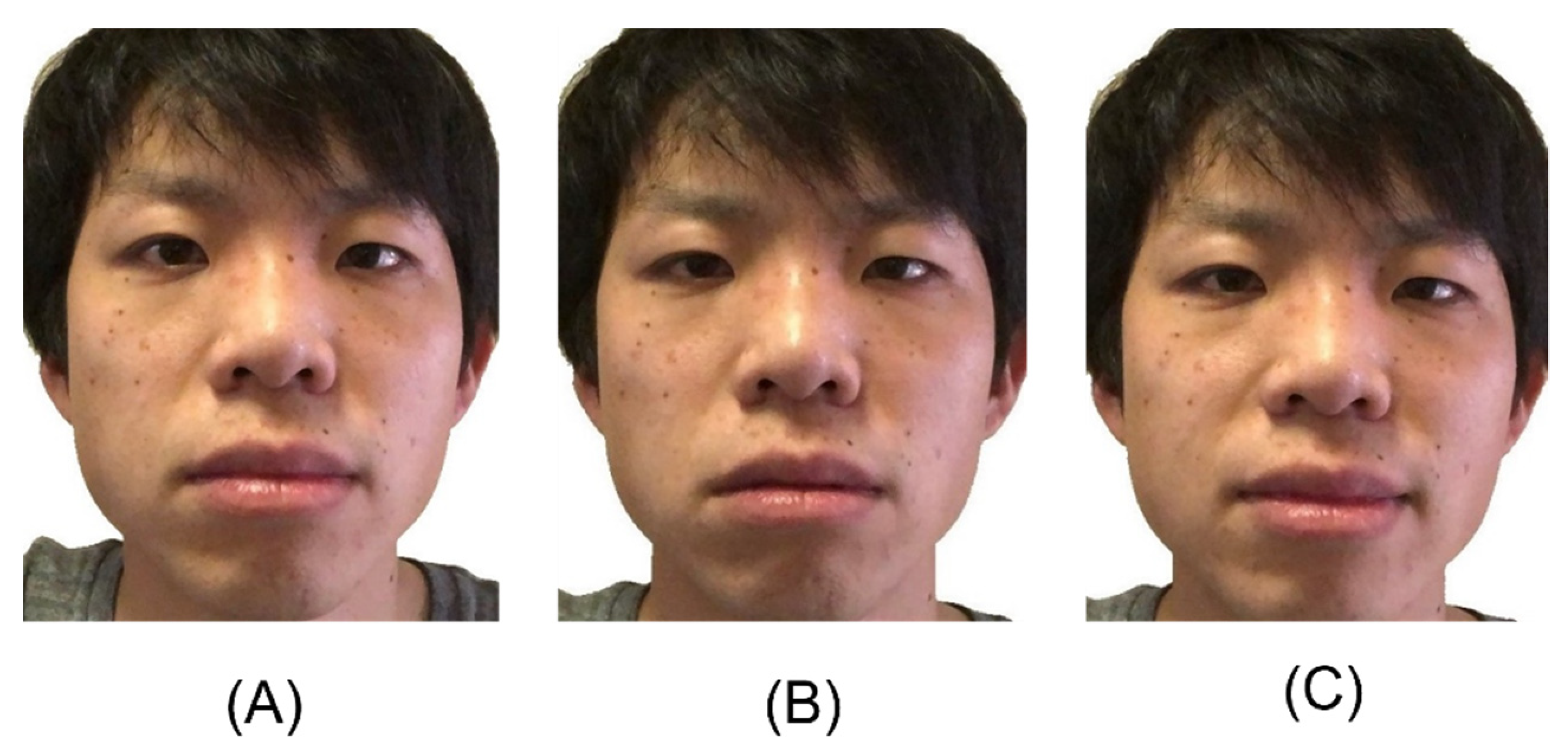
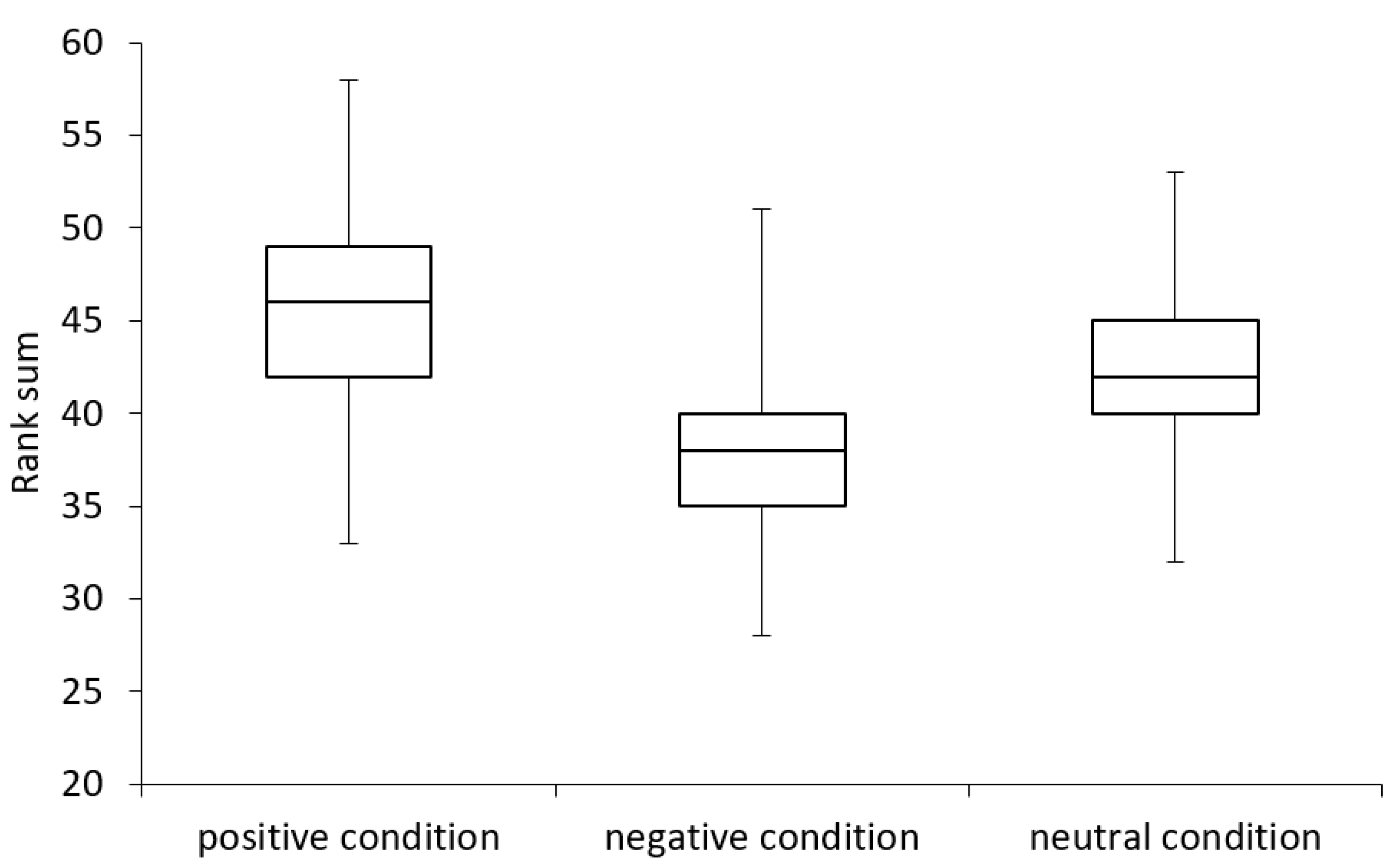
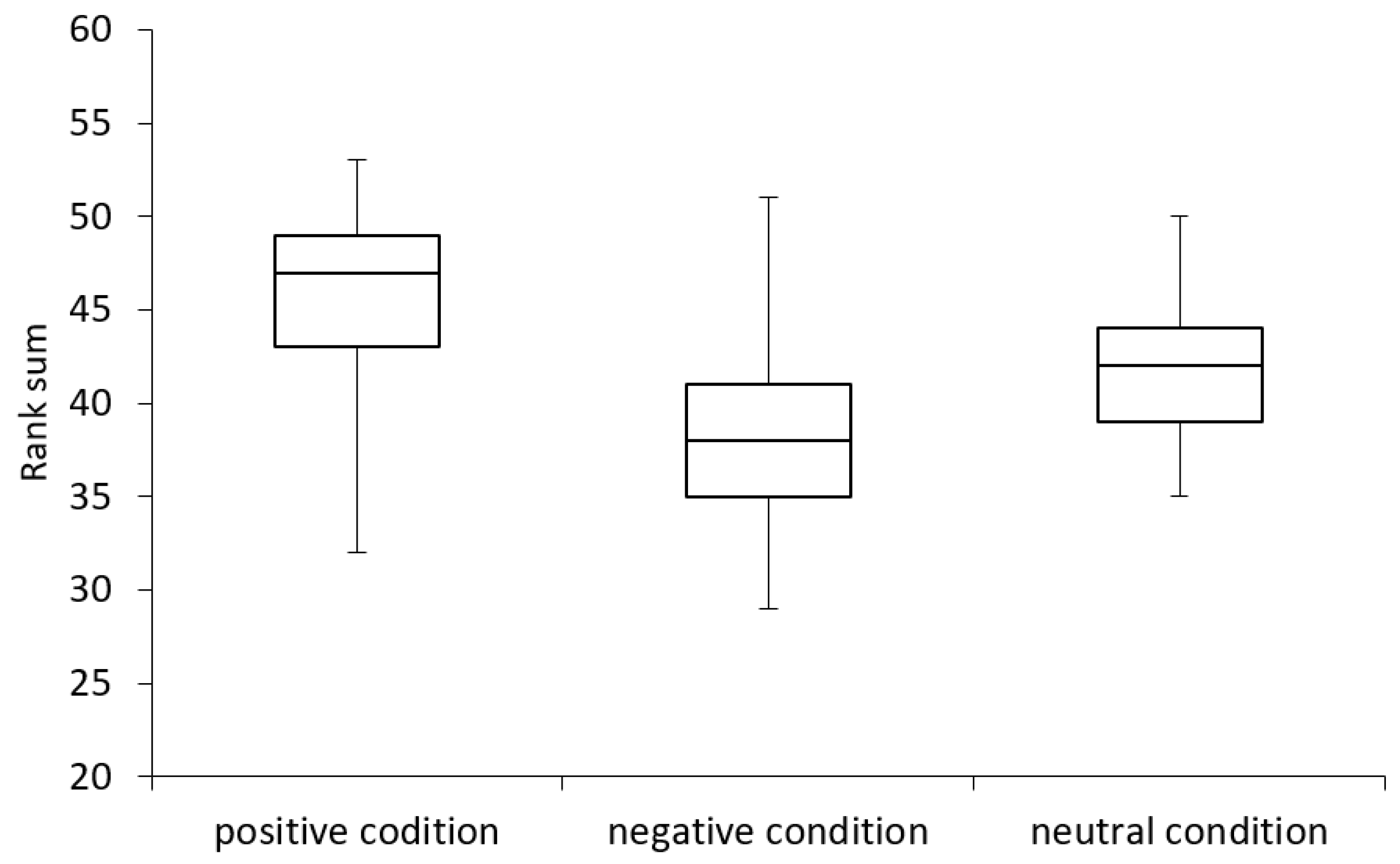

| Positive Names | Negative Names | Neutral Names | ||||
|---|---|---|---|---|---|---|
| Time | N | % | N | % | N | % |
| Early childhood | 9 | 42.86 | 2 | 9.52 | 1 | 4.76 |
| Elementary school years | 1 | 4.76 | 1 | 4.76 | 4 | 19.05 |
| Junior high school years | 3 | 14.29 | 4 | 19.05 | 4 | 19.05 |
| High school years | 1 | 4.76 | 1 | 4.76 | 3 | 14.29 |
| After high school years | 7 | 33.33 | 6 | 28.57 | 8 | 38.10 |
| Never been called | 0 | 0.00 | 7 | 33.33 | 1 | 4.76 |
Publisher’s Note: MDPI stays neutral with regard to jurisdictional claims in published maps and institutional affiliations. |
© 2022 by the authors. Licensee MDPI, Basel, Switzerland. This article is an open access article distributed under the terms and conditions of the Creative Commons Attribution (CC BY) license (https://creativecommons.org/licenses/by/4.0/).
Share and Cite
Azami, R.; Kikutani, M.; Kitamura, H. Perception of Hidden Confidence in Neutral Expressions: Interactions of Facial Attractiveness, Self-Esteem, and Names to Be Addressed by. Languages 2022, 7, 88. https://doi.org/10.3390/languages7020088
Azami R, Kikutani M, Kitamura H. Perception of Hidden Confidence in Neutral Expressions: Interactions of Facial Attractiveness, Self-Esteem, and Names to Be Addressed by. Languages. 2022; 7(2):88. https://doi.org/10.3390/languages7020088
Chicago/Turabian StyleAzami, Ritsuko, Mariko Kikutani, and Hideya Kitamura. 2022. "Perception of Hidden Confidence in Neutral Expressions: Interactions of Facial Attractiveness, Self-Esteem, and Names to Be Addressed by" Languages 7, no. 2: 88. https://doi.org/10.3390/languages7020088
APA StyleAzami, R., Kikutani, M., & Kitamura, H. (2022). Perception of Hidden Confidence in Neutral Expressions: Interactions of Facial Attractiveness, Self-Esteem, and Names to Be Addressed by. Languages, 7(2), 88. https://doi.org/10.3390/languages7020088

