5.1. Variation Patterns in Heritage Russian Across Corpora
In this section, we summarize the most prominent patterns of variation in heritage Russian across our corpora. In doing so, we apply qualitative analysis to all three corpora and quantitative analysis to the third corpus, which includes interviews with speakers from both generations (see
Table 1). The most prominent structural patterns are those attested in all three corpora, albeit to varying quantitative extents and in diverse concrete manifestations. Even if individual speakers demonstrate use of contact-affected or further non-canonical patterns to a different extent, both in qualitative and quantitative dimensions, certain main avenues of variation can be identified (
Ždanova, 2012).
The most prominent variation patterns in our corpora include fluctuations in noun number and case, shifts in nominal and verbal government, and calquing of syntactic constructions (see
Table 2).
Notwithstanding differences in the speaker composition of the collected corpora, this comparison primarily enables the identification of recurrent morphosyntactic variation patterns across datasets, indicating their robustness.
At the next stage, these most prominent patterns were statistically tested across the third corpus, building on work carried out by
Warditz (
forthcoming). As shown in
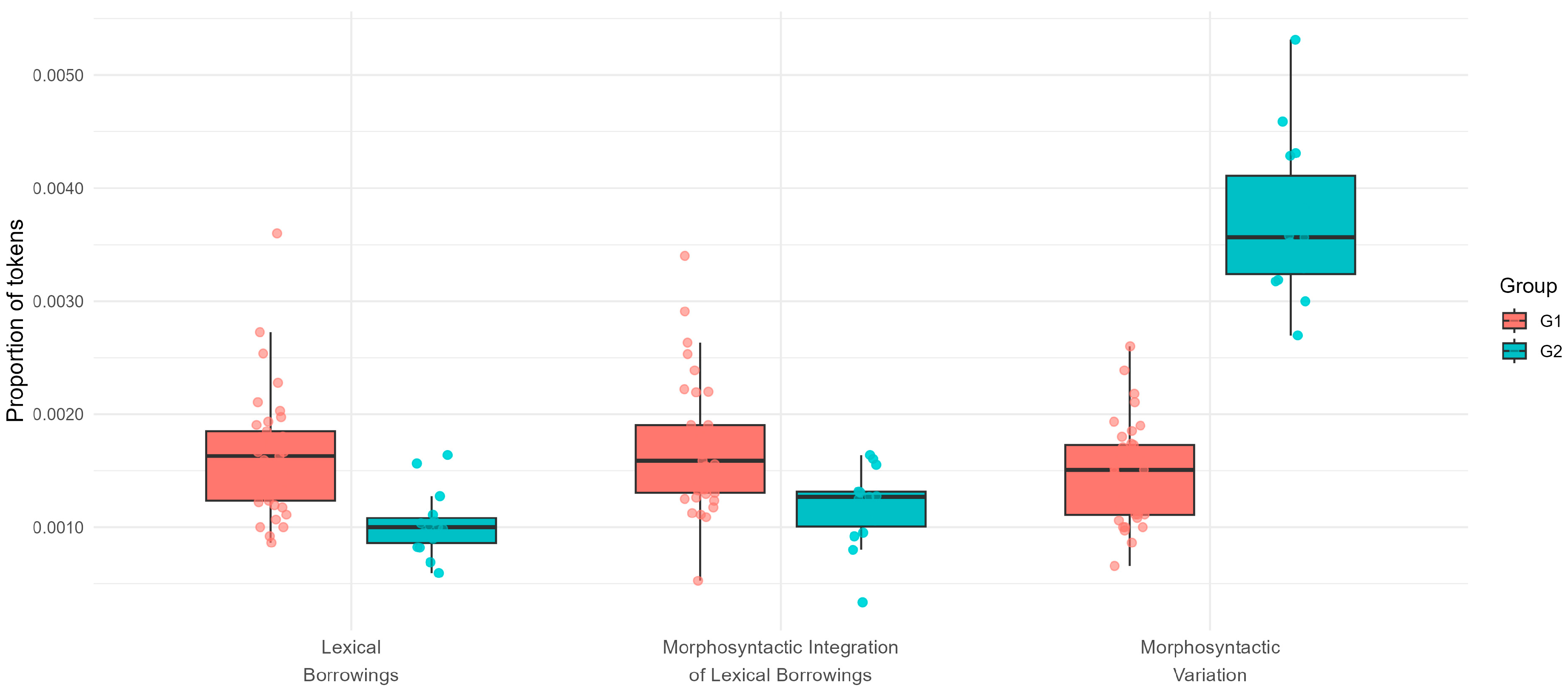
Figure 1 and
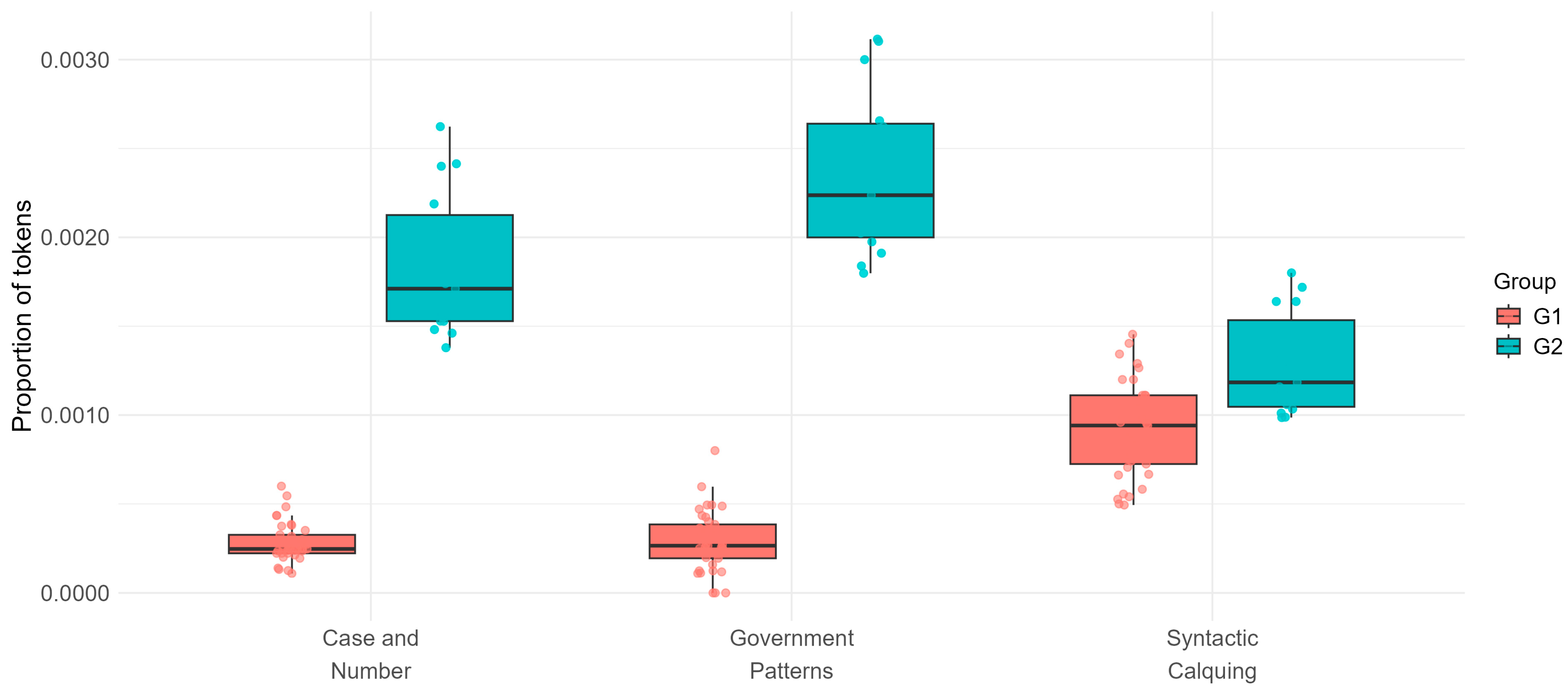
Figure 2, the analysis focuses on the proportional distribution of variation patterns within both generations, with tokens counted as each attested instance of a contact-induced linguistic feature in the corpus. This presentation serves two purposes: first, to demonstrate the intergenerational distribution of variation patterns within a methodologically homogeneous corpus; second, to show that the proportional profiles within speakers and within generations point to the sustainability—and thus the non-random character—of these patterns.
Figure 1 visualizes the proportional distribution of contact-induced variation types within each generation. The
y-axis represents the proportion of tokens per interview/participant; median values indicate central tendencies, while interquartile ranges and whiskers capture dispersion across interviews.
In the first generation, lexical borrowings display the highest proportional values. Median proportions for both integrated and non-integrated lexical borrowings fall within a comparable range (0.0015–0.0017), with integrated borrowings showing a slightly higher central tendency. Morphosyntactic variation, by contrast, exhibits a somewhat lower median proportion (0.0014–0.0015). The interquartile ranges for all variation types remain relatively narrow, indicating limited dispersion and a stable proportional profile across interviews. The second generation shows a clearly different proportional configuration. Morphosyntactic variation now clearly dominates, with median proportions clustering substantially higher (0.0035 or above), well exceeding the corresponding values for lexical borrowing.
Figure 1 also reveals greater dispersion for morphosyntactic variation within this group, reflected in higher values and a wider interquartile range, indicating both increased frequency and greater variability across interviews. In contrast, non-integrated lexical borrowings show low median proportions (around or below 0.001), while integrated borrowings remain slightly higher but still far below the levels observed for morphosyntactic variation.
More specifically,
Figure 2 illustrates the proportional distribution of morphosyntactic variation types within each generation.
In the first generation, all three morphosyntactic patterns occur at relatively low proportional levels. Case and number variation and variation in government patterns show similarly low median proportions (0.0002–0.0003), together with narrow interquartile ranges, indicating limited dispersion and low overall frequency across interviews. Syntactic calquing exhibits slightly higher median proportions (0.0009–0.0010) but remains comparatively constrained, with only moderate variability. The second generation displays substantially higher proportional values across all types of morphosyntactic variation. Variation in government patterns shows the highest median proportions (0.0022–0.0024), accompanied by a relatively wide interquartile range and higher upper values, indicating both increased frequency and greater variability across interviews. Case and number variation also increases markedly, with median proportions clustering around 0.0016–0.0018. Syntactic calquing, while exhibiting lower median values than the other two categories in this generation (0.0011–0.0013), nevertheless occurs at clearly higher proportional levels than in the first generation.
Taken together, in the first generation, all morphosyntactic patterns occur at low and relatively compressed proportional levels, with limited dispersion across interviews. In contrast, the second generation shows a substantial upward shift in median proportions across all morphosyntactic categories, accompanied by increased variability. Variation in government patterns and case and number variation emerge as the most prominent contributors, while syntactic calquing, though less frequent, also increases markedly. At the same time, the proportional consistency of these tendencies across speakers and interviews further indicates that the observed restructuring reflects sustainable and internally structured patterns rather than isolated distributional effects. Both figures provide converging distributional evidence for an intergenerational shift from primarily lexical contact-induced variation toward increasingly structural outcomes, driven not only by higher overall frequencies but also by a differentiated internal reweighting of morphosyntactic patterns within each generation.
These findings confirm that contact with the societal German increasingly targets structurally sensitive domains of Russian, particularly the syntactic interface, agreement, and government. The proportional distributions of the identified variation patterns across speakers and generations additionally support their interpretation as systematic rather than random tendencies.
5.2. Variation Domains in Baseline Russian
In this section, we address the question of whether the identified variation patterns are likewise characterized as especially dynamic in baseline Russian and, if so, to what extent their concrete manifestations in mono- and multilingual settings are analogous or different. For this purpose, we draw on two corpus-based studies reflecting ongoing morphosyntactic dynamics in baseline Russian:
Graudina et al. (
2001) and
Glovinskaja (
1996, updated
2008). Notably, most studies on the ongoing dynamics of baseline Russian after 1985 emerged 20–30 years ago, cf. milestone collective projects such as
Zemskaja (
1996) and
Krysin (
2008). Although several subsequent studies documented exemplary variation within baseline Russian, no larger-scale projects followed, and research on the ongoing dynamics of Russian remained largely peripheral (
Warditz, 2019).
The updated handbook of Russian morphosyntactic variants (
Graudina et al., 2001) is based on a statistically evaluated corpus and qualitative analysis of oral and written data. Compared to the previous edition of the handbook (
Itzkovič et al., 1976), the documented changes are classified according to their degree of dynamism, ranging from low (e.g., variants of infinitive forms of several verbs), through medium (e.g., the emergence of feminine variants of professional nominations and the gradual loss of the genitive partitive), to high dynamism (e.g., zero genitive plural forms for technical units of measurement such as
aмпep instead of
aмпepoв or
вoльт instead of
вoльтoв). Furthermore, the handbook discusses fine-nuanced semantic differences expressed in corresponding vs. concurring variants, for instance, of verbal government with GEN.SG vs. ACC.SG (example 1):
| (1) | ждaть пoeздa | vs. | ждaть пoeзд |
| | wait.INF train-GEN.SG | vs. | wait.INF train-ACC.SG |
| | ‘to wait for a train’ | vs. | ‘to wait for the train’ |
The handbook also addresses, for instance, parallel forms of imperfective verbs (2) or fluctuations of GEN/ACC after negation (3):
| (2) | cтaндapтизиpoвaть vs. cтaндapтизoвaть |
| | ‘to standardize’ |
| (3) | нe дaвaть paзpeшeниe | vs. | нe дaвaть paзpeшeния |
| | NEG give-INF permission-ACC.SG | vs. | NEG give-INF permission-GEN.SG |
| | ‘not to give permission’ |
Notably, this primarily prescriptive handbook documents variation largely within the standard variety of Russian, while also capturing ongoing shifts in agreement norms, for instance the increasing preference for в Укpaинe ‘in Ukraine’ over earlier нa Укpaинe ‘on Ukraine’, interpreted as reflecting emerging norm change and the gradual re-evaluation of the earlier variant as substandard.
By contrast,
Glovinskaja (
2008) describes language dynamics in baseline Russian through the notion of “mass mistakes,” drawing primarily on oral data and thus providing a corpus that is methodologically closer to ours. Focusing on the morphosyntactic evolution of Russian after 1985, she identifies tendencies toward the weakening of case functions (e.g., the replacement of case government by prepositional constructions, example 4) as well as the destabilization of semantically unmotivated syntactic agreement, reflecting a shift toward semantic rather than formal agreement (example 5):
| (4) | пиcьмo дpyгa | vs. | пиcьмo oт дpyгa
letter from friend-GEN.SG |
| | letter friend-GEN.SG | vs. |
| | ‘letter from a (specific) friend’ | vs. | ‘letter from a friend’ |
| (5) | yвидeв этo жилищe, | y мeня cлoжилocь | caмoe плoxoe впeчaтлeниe |
| | see.PFV.PTCP this dwelling | at me.DAT form.PFV.3SG worst impression [syntactic disagreement] |
| | ‘Having seen this dwelling, I got the worst impression’ |
Glovinskaja distinguishes between innovations that have already acquired a systemic character in everyday and mass-media communication and frequent “mass mistakes,” interpreted as indicators of language dynamics (cf. examples 6 and 7, respectively), classifying the use of
no ‘by/according to’ instead of
в ‘in’ as an established innovation (6) and the replacement of case government by a prepositional construction with
o ‘about’ (7) as a mistake, respectively:
| (6) | зaдoлжeннocть в зapплaтe | vs. | зaдoлжeннocть пo зapплaтe |
| | debt in salary-LOC.SG | vs. | debt on salary-DAT.SG |
| | ‘arrears in the salary’ | vs. | ‘salary arrears’ |
| (7) | oпиcывaть митинг | vs. | oпиcывaть o митингe |
| | describe-INF meeting-ACC.SG | vs. | describe-INF about meeting-PREP.SG |
| | ‘to describe a meeting’ | | |
Example (5) also represents a frequent “mass mistake,” as the participial clause yвидeв этo жилищe ‘having seen this dwelling’ syntactically disagrees with the subject of the main clause (y мeня ‘at me’), constituting a classic Russian dangling participle construction.
Against this background,
Table 3 compares the domains of variation identified in our corpora of heritage Russian with those reported in both studies on baseline Russian. While it shows analogous developments in heritage and baseline Russian,
Table 3 also demonstrates that contact-induced and hybrid morphosyntactic forms remain largely absent from baseline sources, thereby marking a clear boundary between the two domains of Russian.
Despite their different empirical bases—standard written usage in
Graudina et al. (
2001) and primarily everyday spoken usage in
Glovinskaja (
1996,
2008)—the baseline studies identify largely comparable areas of variation, which also overlap with those attested in our corpora of heritage Russian, even though they comprise partly different sets of variants. Therefore, the following discussion focuses on variation patterns shared between baseline and heritage Russian to demonstrate how they are nevertheless realized differently in the two settings.
5.3. Variation Patterns in Heritage and Baseline Russian
In this section, we examine the extent to which attested variation patterns in baseline and heritage Russian are analogous or divergent. In doing so, we focus on the unstable parts of Russian, highlighting their increasing sensitivity to contact with a pragmatically stronger German in a migratory setting. As these variation patterns are produced in a multilingual context where they may never fully consolidate into permanent changes, we verified their sustainability using three diachronically spaced corpora.
In
Table 4,
Table 5 and
Table 6, the most prominent morphosyntactic variation patterns of migrant heritage Russian already identified—fluctuations in noun number and case, shifts in prepositional and verbal government, and calquing of syntactic constructions—are presented in their concrete linguistic manifestations.
The documented variation in nominal number and case points to a weakening of oppositions within the case paradigm and, consequently, to increasing diffusivity in the expression of differential object marking, including the grammaticalized distinction between animate and inanimate referents in baseline Russian (e.g.,
Corbett, 1982;
Timberlake, 2004;
Sinnemäki & Dickey, 2025). Such grammatical interference may result in the erosion and eventual loss of grammatical categories in migrant heritage languages (
Weinreich, 1953), for instance, of the grammaticalized category of animacy in Russian, not supported in contact with societal German. Contact-induced variation is also evident in number, particularly in the pluralization of baseline
singularia tantum, a development traceable to transfer from societal German. Accordingly, the documented examples can be regarded as relatively diffuse, insofar as case competition may alternatively be interpreted as an extension of differential object marking to inanimate referents (
Corbett, 1980).
Fluctuations in nominal number and case are likewise attested in baseline Russian (
Glovinskaja, 2001,
2008). However, while GEN/ACC competition and the extension of animate object marking occur in baseline Russian as well, the overgeneralization of inanimate object marking as an indicator of the loss of animacy as a grammatical category has not been documented to date. Interestingly, the pluralization of
singularia tantum nouns, or more generally the expansion of plural paradigms—previously treated as a deviation in heritage Russian (
Glovinskaja, 2001)—is now widely accepted as an ongoing evolutionary trend in baseline Russian.
Gorbov (
2014), for instance, documents the replenishment of formerly
singularia tantum paradigms (e.g.,
pиcки ‘risks’,
пpoдaжи ‘sales’). As these trends are also attested in baseline Russian (
Glovinskaja, 2001;
Graudina et al., 2001;
Krysin, 2008), especially in informal spoken registers, they confirm that language contact does not function as an autonomous cause of morphological restructuring but rather amplifies internal tendencies, particularly in domains characterized by instability or competing forms (
Vanhove et al., 2012).
Shifts in prepositional, nominal, and verbal government likewise reflect areas of instability in baseline Russian, on the one hand, and intergenerational attrition and transfer from societal German, on the other hand. Unlike verbal or nominal government, the predicative instrumental in Russian is construction-licensed; its loss in migrant heritage Russian therefore reflects case neutralization rather than a restructuring of argument selection. The loss of predicative instrumental in favor of the nominative points to a simplification of the case paradigm and the ongoing expansion of the nominative (for an analogous trend in baseline Russian, see
Glovinskaja, 2001;
Graudina et al., 2001), while also reflecting transfer from German, which requires the nominative, cf.
Ich war ein Einzelkind ‘I was the only child.’ Further shifts similarly reflect the interaction of individual variation and the calquing of German government patterns, thereby simplifying baseline structures in favor of the dominant language, cf. examples (9)–(11):
eздить c aвтoбycoм and
mit dem Bus fahren ‘to go by bus’ (
mit + DAT);
ϕиpмa, кoтopaя c этим зaнимaeтcя and
die Firma, die sich damit beschäftigt ‘the company that deals with this’ (
mit + DAT governed by the verb);
cocpeдoтoчитьcя нa paбoтy and
sich auf die Arbeit konzentrieren ‘to concentrate on work’ (ACC with the preposition
auf vs.
нa). However, morphosyntactic simplification of the baseline structures is attested only for nominal predication, cf. examples (1)–(2).
The emergence of the preposition
c ‘with’ in instrumental government patterns, instead of the prepositionless Russian instrumental, can be interpreted as an analogous leveling of a Russian typological feature (also attested within the Slavic language continuum) in contact with German as the societal language. Moreover, this trend corresponds to the increasing use of prepositional government in baseline Russian, particularly under the influence of English after 1990 (
Glovinskaja, 2008). As an indicator of a shift from synthetic to analytic government (ibid.), this trend has historical precedent in Slavic languages (cf. the history of the archaic Slavic locative in
Toporov, 1961;
Warditz, 2022).
When comparing fluctuations in government in heritage and baseline Russian, it should be noted that both display well-known areas of variation—or rather, instability—in the baseline system (cf.
Itzkovič et al., 1976;
Graudina et al., 2001), especially in the concurrence of prepositions
в/нa ‘in/on’, as in the politically loaded contrast
нa Укpaинe ‘on Ukraine’ vs.
в Укpaинe ‘in Ukraine’. However, to date, these phenomena in baseline Russian have largely been interpreted as “mass mistakes” rather than as systematic trends functioning as a competitive source for the emergence of new variants (
Glovinskaja, 2008).
Calquing of syntactic constructions is not attested in the baseline corpora used, representing a specific area of contact-induced variation in multilingual settings. Syntactic transfer affects various types of constructions in different ways. More precisely, interrogatives are characterized by the borrowing or calquing of German lexical markers, as well as by shifts in word order and the loss of baseline intonation patterns. The use of
или ‘or’ as a complementizer in embedded polar interrogatives represents a syntactic calque from German
ob ‘whether’, extending the distribution of the Russian coordinating conjunction
или under contact-induced influence. Furthermore, German patterns replace baseline Russian double negation and are frequently employed in possessive and impersonal constructions. In the latter, contact-induced pro-drop or contamination occurs. In (6), the required explicit subject is omitted, while in (7), the Russian 3PL impersonal pattern is blended with the German
man + 3SG construction. Notably, the East Slavic typological pattern of possession
y + GEN + быть ‘at + GEN + be’ is not entirely resistant to contact with societal German, which expresses possession through
DAT + haben, alongside Western and South Slavic languages that also employ
have-type constructions (
Isačenko, 1974). This deeply entrenched pattern can be reshaped under the prolonged influence of societal German, demonstrating its inherent instability in the baseline and, in turn, confirming that language contact primarily affects less stable parts of a weaker language.
Taken together, across all three corpora collected at different points in time and across different settings by heritage speakers with comparable sociolinguistic profiles, the same patterns of contact-induced variation in heritage Russian emerge. This suggests their stable emergence, even if they are not transmitted in a classical intergenerational sense. Crucially, these patterns largely overlap with those attested in baseline Russian, thereby confirming their systemic character.