1. Compounding and Its History in Greek: A Brief Overview
A compound is an item involving the combination of at least two lexemes (
Bauer, 2017). Depending on the language, these lexemes can be morphologically realized as roots, stems or words. Stems and words are included in Modern Greek compounds, while in Ancient Greek, roots had also been among the possible compound constituents (
Ralli, 2026).
1Modern Greek compounds have one-word form, one stress, a linking element -
o-, right-hand inflection, and a head at the right side of headed constructions. Syntactic rules and operations do not have access to the internal structure of compounds, which are anaphoric islands, in that their lexeme constituents cannot be modified independently of the compound as a whole, and the internal structure cannot be disrupted by the insertion of a new element of either lexical or functional status (see
Ralli, 2013 for details).
Compounding as a word-formation process has been particularly fertile throughout the history of the Greek language. Compound formations in Homeric Greek (around the 8th c. BC) are numerous, as shown by the extensive list of examples given in
Tserepis (
1902), while the works by
Meissner and Tribulato (
2002) and
Tribulato (
2015) leave no doubt that many compounds were already in use in the Mycenaean period (ca. 15th–12th c. BC). During the Classical period (5th–4th c. BC), compounds are abundant, particularly nouns (
Chantraine, 1945). As
Debrunner (
1917) has shown, a great variety of compound categories is subsequently found in Hellenistic Greek (ca. 3rd c. BC–3rd c. AD), where an increase of verbal constructions is observed, as opposed to the few instances detected in Classical Greek (see, for example, the Hellenistic verbs
νυμφαγωγέω /nympʰagōgéō/ ‘lead the bride to the groom’s house’, Polyb. 26.7.10, 2nd c. BC, and
γλωσσαλγέω /glōssalgéō/ ‘chatter’, Greg. Naz. 2.313b, 4th c. AD).
2In Early and especially Late Medieval Greek (4th c. AD–15th c. AD), as well as in Early Modern Greek (16th c. AD–18th c. AD), the variety of compounds has been enriched, mainly with respect to verbal categories (
Browning, 1969;
Tribulato & Ralli, 2024). Beginning with the 14th c., compounds displaying the coordination of two verbs (V V) are of particular interest (see
Aerts & Hokwerda, 2002;
Nicholas & Joseph, 2009;
Kiparsky, 2009;
Manolessou & Tsolakidis, 2009;
Ralli, 2009).
ἱστοριζογράφω /istorizoɣráfo/ ‘to illustrate historically’ <
ἱστορίζ(ω) /istorízo/ ‘to depict’ +
γράφω /ɣráfo/ ‘to write’,
Diig. tetr. 399 14th c.) illustrates this case. In the preceding centuries, only one example of a possible coordination of verbs is attested, dated from the 12th c., for which it is not clear whether the constituents are two verbs or a noun and a verb:
βομβοκτυπίζω /vomvoktipízo/ ‘strike with a noise’ or ‘make noise and strike’ <
βόμβος /vómvos/ ‘noise’ or
βομβῶ /vomvó/ ‘make noise’ +
κτυπίζω /ktipízo/ ‘strike’,
Ptoch. III 332, 12th c.
According to
Ralli (
2009, p. 60), the emergence of verbal coordinative structures in Late Medieval Greek is attributable to the increased productivity of compounding in general, and of verbal compounds in particular (1a,b).
3| (1) | a. | ἀδικοκρίνω | <ἄδικ(α) | + κρίνω |
| | | /aðikokríno/ | /áðika/ | /kríno/ |
| | | ‘judge someone unjustly’ | ‘unjustly’ | ‘judge’ |
| (DELLAP., Erot. apokr. 1133, 15th c.) |
| | b. | καρδιοφλογίζω | <καρδι(ά) | + φλογίζω |
| | | /karðiofloɣízo/ | /karðjá/ | /floʝízo/ |
| | | ‘arouse erotic desire’ | ‘heart’ | ‘inflame’ |
| (Katal. 120, 15th c.) |
As a consequence of this development, the Greek morphological system came to accommodate the only pattern that had hitherto been absent from coordinative compound structures, namely the coordination of two verbs (2a), since coordination of nouns and adjectives in compounds was already attested in the language since Ancient Greek, and several creations of this type appear in Medieval Greek (2b,c).
| (2) | a. | V + V ἀνεβοκατεβαίνω | <ἀνεβ(αίνω) | + κατεβαίνω |
| | | /anevokatevéno/ | /anevéno/ | /katevéno/ |
| | | ‘go up and down’ | ‘go up’ | ‘go down’ |
| (Diig. tetr. 1047, 14th c.) |
| | b. | N + N εἰσοδοέξοδος | <εἴσοδ(ος) | + ἔξοδος |
| | | /isoðoéksoðos/ | /ísoðos/ | /katevéno/ |
| | | ‘go up and down’ | ‘go up’ | ‘exit’ |
| (Diig. tetr. 1047, 14th c.) |
| | c. | Adj. + Adj. γλυκοπαχύς | <γλυκ(ός) | + παχύς |
| | | /ɣlikopaçís/ | /ɣlikós/ | /paçís/ |
| | | ‘sweet-thick’ | ‘sweet’ | ‘thick’ |
| (Demetrios Pepagomenos, Hierakosophion 404, 13th c.) |
The productive formation of compounds persisted in Modern Greek, while the abundance of structural patterns and their diversity in Modern Greek dialects are remarkable. For instance, it is worth noting that more than 4200 compounds of the Cretan dialect have been recorded and morphologically analyzed (
Chairetakis, 2024). The only exception to productive dialectal Greek compounding is found in Cappadocian and the two varieties of South Italian Greek, Griko and Greko, where constructions displaying a Greek structure are either rare or absent in both linguistic systems, due to a heavy influence from other languages. More specifically, Cappadocian has been influenced by Turkish (
Dawkins, 1916), whereas South Italian Greek has been affected by Italo-Romance (
Rohlfs, 1977).
2. Topic, Data and Methodology
In this article, we present and analyze compounding in Modern Lesbian, a dialectal variety of Modern Greek, in comparison with the compounding system of Standard Modern Greek, as described by
Papageorgiou (
1975) and the traditional grammars (e.g.,
Triantaphylidis, 1941) and analyzed in detail by
Ralli (
2013).
4Our work is the first to deal with compounding in Modern Lesbian, which belongs to the so-called “Group of Northern Greek dialects”. This dialectal group differs from that of the southern part of Greece in that it displays two phonological phenomena, the deletion of high vowels /i/ and u/ in unstressed position, and the raising of unstressed mid-vowels /e/ and /o/ into [i] and [u], respectively. For instance, words like the Standard Modern Greek
spíti ‘house’,
puló ‘sell’,
neró ‘water’ and
kózmos ‘world’ are pronounced in Modern Lesbian as
spit,
plo,
niró and
kózmus. Like the other Modern Greek dialects (Tsakonian is an exception, as suggested by
Deffner (
1923)), Modern Lesbian descends from Hellenistic Koine, the lingua franca of Hellenistic times. However, there are no testimonies as to when Modern Lesbian was separated from the other dialects, and the oldest existing sources date from the 15th c. AD. (see
St. Anagnostou, 2026). During its long history, Modern Lesbian has come into contact with other languages, mainly with the Italo-Romance Genovese and Venetian, the languages of the Genovese (1355–1462) governors and the Venetian traders, respectively, and Turkish, the language of the Ottoman (1462–1912) rulers. The Ottoman occupation of Lesbos ended in 1912, and since then, the population has been entirely Greek-speaking.
Nowadays, the dialect is still spoken by approximately 100,000 inhabitants of the island, and the speakers are of all ages. Interestingly, several written works are found for, or in, the dialect, sketchy grammars, dictionaries, glossaries, collections of stories, pieces of folk literature, and local journals. Recently, a dialectal atlas mapping the variation of 113 dialectal phenomena and words has been developed (
Ralli, 2019;
Alexelli, 2021), and a limited number of theoretical works have been published on specific grammatical phenomena, such as the article on possessive pronouns by
Gafos and Ralli (
2002). Efforts to document Modern Lesbian are of crucial importance, because the dialect started being declined, especially among young people, under the pressure of Standard Modern Greek, the official language of the Greek State.
For the purposes of this work, we have built a corpus containing 2500 dialectal compounds, drawn from various written sources (dictionaries/glossaries and dialectal texts), and oral narratives collected in the field by A. Ralli herself, during the period 2005–2024.
5 The compounds are examined according to the type of structural patterns they display, the constituents involved, the compound internal relations, and the notion of headedness. We also investigate some lexical and structural borrowing examples (matter- and pattern-borrowing in terms of
Sakel (
2007)) in the dialect, due to contact with Turkish and Italo-Romance. Pattern-borrowing cases show that contact has an impact on the morphology of the dialect in that it has introduced innovative structures.
In support of our analysis, we use the quantitative evidence provided by the digital Dialectal Compounds (DComp) database, which has been developed at the Laboratory of Modern Greek Dialects of the University of Patras. This database contains approximately 17,000 entries, which are drawn from written sources of many Modern Greek dialects, and oral material/narratives collected through field work within the framework of several research projects directed by A. Ralli.
6Since the compound structures are not accessible to syntactic rules, for their analysis, we follow
Ralli’s (
2013) approach, who considers Greek compounding to occur in a morpheme-based autonomous morphological domain and Greek compounds to be morphological objects, involving stems and words as basic constituents.
The article is structured as follows.
Section 1 contains a brief introduction to Greek compounding throughout the centuries, showing the productive character of the process as a fertile source for the enrichment of the vocabulary. Special emphasis is given to the innovative appearance of V V structures. The topic and the data of the work are presented in
Section 2, that is, the compounds of Modern Lesbian, and some useful information is added about this dialectal variety.
Section 3 introduces the basic properties of Modern Greek compounds, all of which characterize Modern Lesbian compounds too, as shown in
Section 4, where these properties are examined one by one and are illustrated with specific examples. The article ends with the conclusions (
Section 5), a list of abbreviations, and the relevant references.
3. Basic Properties of Standard Modern Greek Compounds
According to
Ralli (
2013), Greek compounding exhibits a set of properties that distinguish this process from other word-formation mechanisms, including inflection and derivation. Greek compounds are one-word formations, built from stems and words, and belong to all major grammatical categories, namely nouns (e.g.,
λαχαναγορά /laxanaɣorá/ ‘vegetable market’ <λ
άχαν(ο) /láxano/ ‘cabbage’ +
αγορά /aɣorá/ ‘market’), adjectives (e.g.,
λαομίσητος /laomísitos/ ‘hated by the people’ <
λα(ός) /laós/ ‘people’ +
μισητ(ός) /misitós/ ‘hated’), and verbs (e.g.,
χαρτοπαίζω /xartopézo/ ‘to play cards’ <
χαρτ(ιά) /xartiá/ ‘cards’ +
παίζω /pézo/ ‘to play’). Most adverbs, by contrast, constitute secondary formations, typically derived from compound adjectives through the addition of the suffix -
α /a/ (e.g.,
νοτιοδυτικάAdv /notioðitiká/ ‘southwest’ <
νοτιοδυτικ(ός)Adj /notioðitikós/ + -
αDSuf /a/).
Among compounds, nominal formations are by far the most frequent, as attested by
Papageorgiou (
1975). Most of them involve two nouns (e.g.,
πυργόσπιτο /pirɣóspito/ ‘tower house’ <
πύργ(ος) /pírɣos/ ‘tower’ +
σπίτ(ι) /spíti/ ‘house’) or an adjective and a noun (e.g.,
ομορφοκόριτσο /omorfokóritso/ ‘beautiful girl’ <
όμορφ(ο) /ómorfo/ ‘beautiful’ +
κορίτσ(ι) /korítsi/ ‘girl’).
Adjectival compounds either result from the combination of two adjectives (e.g., κοκκινόμαυρος /kokinómavros/ ‘red-black’ <κόκκιν(ος) /kókinos/ ‘red’ + μαύρ(ος) /mávros/ ‘black’) or of a noun and an adjective (e.g., κοσμοξάκουστος /kozmoksákustos/ ‘world-renowned’ <κόσμ(ος) /kózmos/ ‘world’ + ξακουστ(ός) /ksakustós/ ‘renowned’).
Verbal compounds are created through the combination of two verbs (e.g., ανοιγοκλείνω /aniɣoklíno/ ‘open-close’ <ανοίγ(ω) /aníɣo/ ‘open’ + κλείνω / klíno/ ‘close’), a noun and a verb (e.g., νυχτοπερπατώ /nixtoperpató/ ‘walk at night’ <νύχτ(α) /níxta/ ‘night’ + περπατώ /perpató/ ‘walk’), or an adverb and a verb (e.g., αργοπεθαίνω /arɣopeθéno/ ‘die slowly’ <αργ(ά) /arɣá/ ‘slowly’ + πεθαίνω /peθéno/ ‘die’). Of these patterns, the AdvV combination constitutes the most productive source of verbal compounds, as shown by the examples found in dictionaries, traditional grammars, texts and everyday conversation.
Compounds behave as single phonological words, bearing one main stress, which falls on one of the final three syllables, depending on the case form. The stress position serves as a crucial diagnostic for identifying the internal morphological structure of compounds. In [Stem Stem] formations (e.g.,
χιονόβροχο /çonóvroxo/ ‘snow-rain’ <
χιόν(ι) /çóni/ ‘snow’ +
βροχ(ή) /vroçí/ ‘rain’) and [Word Stem] ones (e.g.,
δεκαήμερο /ðekaímero/ ‘ten-days’ <
δέκα /ðéka/ ‘ten’ +
ημέρ(α) /iméra/ ‘day’), stress regularly appears on the antepenultimate syllable, regardless of the stress position of the constituents when used independently. By contrast, in [Stem Word] (e.g.,
ντοματοσαλάτα /domatosaláta/ ‘tomato salad’ <
ντομάτ(α) /domáta/ ‘tomato’ +
σαλάτα /saláta/ ‘salad’) and [Word Word] compounds (e.g.,
ξανακοιμάμαι /ksanacimáme/ ‘sleep again’ <
ξανά /ksaná/ ‘again’ +
κοιμάμαι /cimáme/ ‘sleep’), the stress coincides with that of the rightmost constituent (
Nespor & Ralli, 1996, p. 357).
Unlike prefixes and suffixes, stems are not subject to strict positional constraints within a compound structure, since they can be attested both on the right-hand and on the left-hand sides of the compounds (e.g.,
ποντικοπαγίδα /pondikopaʝíða/ ‘mousetrap’ <
ποντικ(ός) /pondikós/ ‘mouse’ +
παγίδα /paʝíða/ ‘trap’ vs.
τυφλοπόντικας /tiflopóndikas/ ‘mole’ <
τυφλ(ός) /tiflós/ ‘blind’ +
ποντικ(ός) /pondikós/ ‘mouse’). However, as noted by
Ralli (
2013, p. 16), the ordering of constituents is not entirely free, as certain factors—such as the structural relationship between the constituents and the notion of headedness—play a crucial role in determining the position (right or left) of the compound elements.
Moreover, there are constituents, the so-called ‘bound stems’, which are placed at the right side of nominal compounds. Contrary to common stems which belong to various grammatical categories and become free words with the appropriate inflectional endings, bound stems are generally bound deverbal nouns. They are derived from Ancient Greek verbal bases, either through a vowel alternation (e.g.,
λέγ-ω /léɣo/ ‘I talk’ > -
λoγ- /loɣ/) or, more rarely, through the conversion of the perfective verbal stem into a nominal one (e.g.,
έ-φαγ-α /éfaɣa/ ‘I ate’ > -
φαγ- /faɣ/). However, their meaning is more abstract than the meaning of nouns deriving from verbs. For illustration, consider the compound
γλωσσολόγος /γlosolóγos/ lit. who deals with/tells about language, ‘linguist’, the second constituent of which -
λογ- /loγ/ is always bound and has a different meaning ‘tells about/deals with’ from the free noun
lóγος /loγos/ ‘word’ (for details, see
Ralli, 2008).
Inflection is always realized at the right side of compounds. [Stem Stem] compounds and [Word Stem] ones may display inflectional suffixes that differ from those of their second constituent when taken in isolation. For instance, the compounds
αγριόφωνοςIC1 /aɣriófonos/ ‘(of) rough voice’ <
άγρι(α) /áɣria/ ‘rough, wild’ +
φων(ή)IC3 /foní/ ‘voice’ and
κατωσέντον(ο)IC5 /katoséndono/ ‘lower bedsheet’ <
κάτω /káto/ ‘down, low’ +
σεντόν(ι)IC6 /sendóni/ ‘bedsheet’ end in -
os /os/ (inflection class 1 (IC1)) and -
o /o/ (IC5), respectively, while the right constituents
φων(ή)IC3 /foní/ ‘voice’ and
σεντόν(ι)IC6 /sendóni/ ‘bedsheet’ end in -
η /i/ (IC3) and -
ι /i/ (ΙC6).
7 In contrast, [Stem Word] and [Word Word] compounds preserve the inflectional properties of the rightmost member, as shown by the examples
χιονάνθρωποςIC1 /çonánθropos/ ‘snowman’ <
χιόν(ι) /çóni/ ‘snow’ +
άνθρωποςIC1 /ánθropos/ ‘human’ and
πισωβελονιάIC3 /pisoveloniá/ ‘backstitch’ <
πίσω /píso/ ‘back, behind’ +
βελονιάIC3 /veloniá/ ‘stitch’.
The constituents of compounds are linked together by the vowel -
ο- /o/, which functions as a compound marker (
Ralli, 2013). Historically derived from an Ancient Greek thematic vowel, this element became generalized as a linking vowel from the Early Hellenistic period onwards (
Anastasiadi-Symeonidi, 1996;
Ralli & Raftopoulou, 1999). It surfaces when the first constituent is a stem and does not appear when the second constituent begins with a vowel that is stronger than /o/ on the vowel hierarchy proposed by
Chatzidakis (
1905–1907, p. 211). For example, consider the absence of -
o- in the compound
ξαναβλέπω /ksanavlépo/ ’see again’, where the first member is the adverbial word
ξανά /ksaná/ ‘again’. Consider also the compound
ομορφάνθρωπος /omorfánθropos/ ‘handsome man’, consisting of the stem
ομορφ- /omorf/ of the adjective
όμορφ(ος) /ómorfos/ ‘beautiful’ and the word
άνθρωπος /ánθropos/ ‘human’. The compound marker -
ο- /o/ is absent as the initial vowel /a/ of
άνθρωπος /ánθropos/ is stronger than /o/ according to the vowel hierarchy.
With respect to headedness, compounds are classified as either endocentric or exocentric. Endocentric compounds contain a head—typically the rightmost constituent—that determines both the grammatical category and the core meaning of the compound. For instance, in a compound like
πισωγυρίζω /pisoʝirízo/ ‘go back to’ (<
πίσω /píso/ ‘behind, back’ +
γυρίζω /ʝirízo/ ‘return, turn back’), the head is the right member
γυρίζω /ʝirízo/ ‘return, turn back’. Exocentric compounds, by contrast, lack a lexical head; neither of the lexeme constituents is responsible for the grammatical category of the entire compound and its category. According to
Ralli and Andreou (
2012), in exocentric compounds, the category and basic meaning are assigned by an overtly realized or a zero derivational suffix, which is added at the right side of the compound combination. For illustration, consider the word
χασομέρης /xasoméris/ ‘idler’, consisting of the perfective stem
χασ- /xas/ of the verb
χάνω /xáno/ ‘lose’, the stem
μερ- /mer/ of the noun
μέρα /méra/ ‘day’ and the suffix -
ης /is/). Another example is the combination of two nouns
φαρμακόγλωσσος /farmakóɣlosos/ ‘poison-tongued’, built from
φαρμάκ(ι) /farmáki/ ‘poison’,
γλώσσ(α) /ɣlósa/ ‘tongue’ and a zero derivational suffix -
ØDSuf.
On the basis of the relation between the constituents, Modern Greek compounds are classified into two categories: (a) compounds with a dependency relation (e.g.,
αγριάνθρωπος /aɣriánθropos/ ‘wild man’ <
άγρι(ος) /áɣrios/ ‘wild’ +
άνθρωπος /ánθropos/ ‘man’), and (b) coordinative constructions (e.g.,
μαχαιροπίρουνα /maçeropíruna/ ‘cutlery’ <
μαχαίρ(ια) /maçérja/ ‘knives’ +
πιρούν(ια) /pirúɲa/ ‘forks’) (
Manolessou & Tsolakidis, 2009). The members of the former group are further divided into attributive (e.g.,
ομορφοπαίδι /omorfopéði/ ‘beautiful child’ <
όμορφ(ο) /ómorfo/ ‘beautiful’ +
παιδ(ί) /peðí/ ‘child’) and subordinative compounds (e.g.,
ηλιόσπορος /iljósporos/ ‘sunflower seed’ <
ήλι(ος) /íljos/ ‘sun’ +
σπόρος /spóros/ ‘seed’). Coordinative compounds are by far fewer than the constructions displaying a dependency relation between their members.
4. Modern Lesbian Compounds
Modern Lesbian exhibits a rich compounding process producing formations in everyday talk. To date, a large number of Modern Lesbian compounds can be found in various written sources, glossaries and dictionaries (see, among others,
Demiris, 2003;
Papanis & Papanis, 2000;
Ralli, 2017;
Stergellis, 2017;
Paraskevaidis, 2020;
Kakaronis, 2021), sketchy grammatical descriptions (e.g.,
Aravanopoulos, 1975), various local journals (e.g.,
ʝi adziða, 2015), and folk tales and literature (e.g.,
Karna, 2020;
Psarianos, 2023), all in dialectal form. As already said, the corpus of our investigation contains 2500 Modern Lesbian compounds drawn from these sources and the oral corpora of A. Ralli’s personal archives. They come from all villages of the island, but mainly from those of Agiasos, Agra, Antissa, Vasilika, Eressos, Mesotopos, Plomari, Polichnitos, Thermi, Pamphila, and Mantamados. Among these compounds, 1438 items have been listed and morphologically analyzed in the digital DComp database.
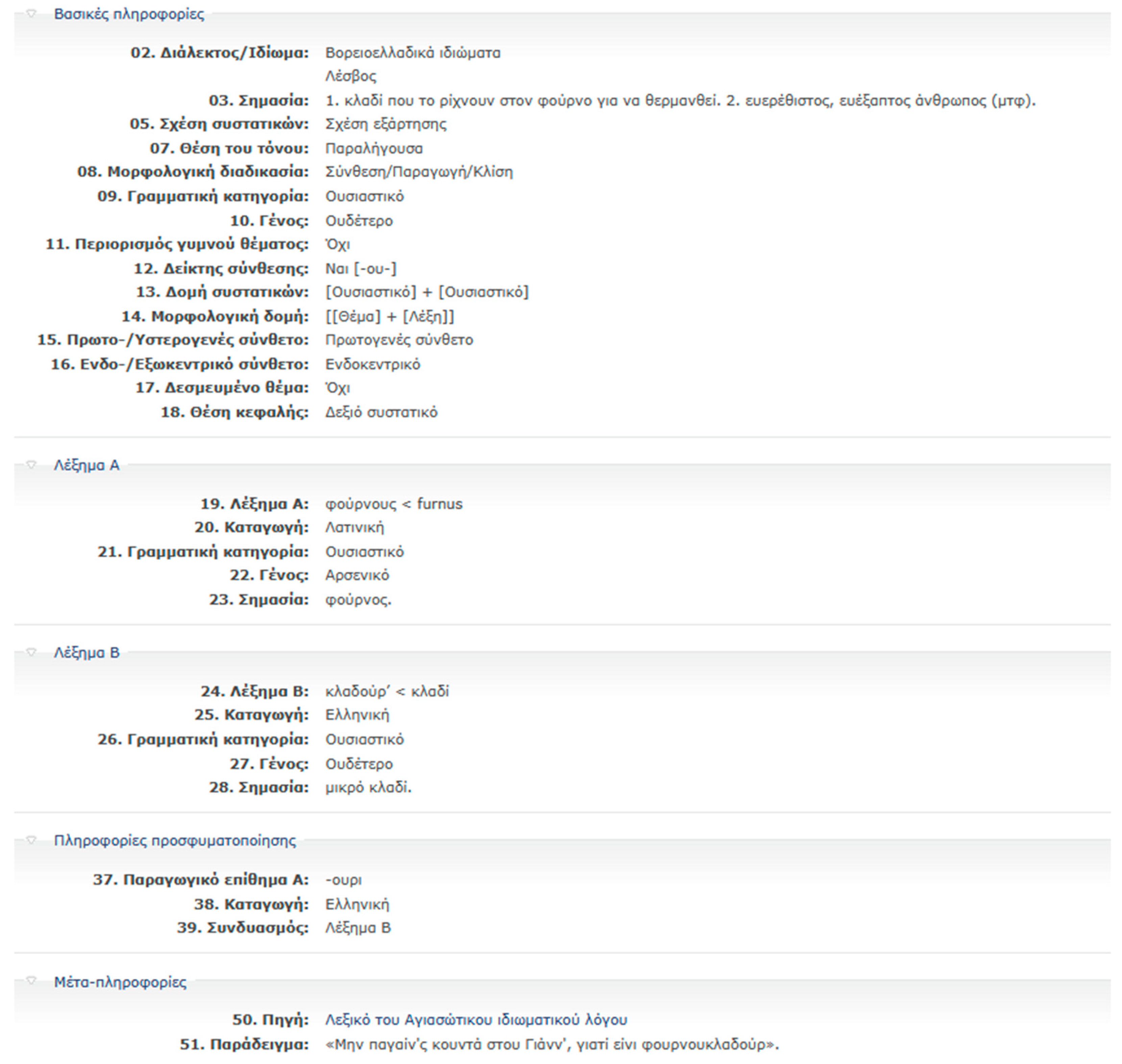
For illustration, in
Figure 1 below, we list a screenshot of the DComp entry
φουρνουκλαδούρ /furnuklaðúr/ ‘small piece of wood for the fire of the local oven’, metaphorically used for somebody ‘excitable/touchy’ <
φούρν(ους) /fúrn(us)/ ‘oven’
+ κλαδούρ /klaðúr/ ‘small piece of wood’. The data and information are in Greek, since there is no English version available for DComp.
It is important to note that all grammatical categories of compounds that are attested in Standard Modern Greek and its dialectal varieties are represented in our corpus. More specifically, nominal (see (3a,b)), adjectival (see (4a,b)), and verbal (see (5a,b)) compounds are documented, along with some examples belonging to the adverbial category (see (6a,b)). From a quantitative perspective, the compounds recorded in DComp are predominantly nouns (974 items), followed by adjectives (255) and verbs (191), while adverbial compounds constitute a much smaller category (18 items). This distribution confirms the predominance of nominal compounding in Modern Lesbian, in line with Standard Modern Greek and other dialectal varieties.
| (3) | a. | ασφαλαγκ-ό-τρυπα | <ασφάλαγκ(ας) | + τρύπα |
| | | /asfalagótripa/ | /asfálagas/ | /trípa/ |
| | | ‘a hole dug by the mole’ | ‘mole’ | ‘hole’ |
| (oral source) |
| | b. | ταβαν-ό-κατα | <ταβάν | + κάτα |
| | | /tavanókata/ | /taváɲ/ | /káta/ |
| | | ‘cat that climbs on rooftops’ | ‘roof, ceiling’ | ‘cat’ |
| (Papanis & Papanis, 2000) |
| (4) | a. | ουλ-ό-μαυρους | <ούλ(ου) | + μαύρους |
| | | /ulómavrus/ | /úlu/ | /mávrus/ |
| | | ‘completely black’ | ‘all’ | ‘black’ |
| (Stergellis, 2017) |
| | b. | χουντρ-ό-ξουμπλους | <χουντρ(ό) | + ξόμπλ |
| | | /xudróksublus/ | /xudró/ | /ksóbʎ/ |
| | | ‘coarsely made decorative elements’ | ‘thick’ | ‘decorative element’ |
| (Papanis & Papanis, 2000) |
| (5) | a. | σκαλ-ου-γυρεύγου | <σκαλ(ίζου) | + γυρεύγου |
| | | /skaluʝirévɣu/ | /skalízu/ | /ʝirévɣu/ |
| | | ‘search by prying’ | ‘pry’ | ‘search’ |
| (oral source) |
| | b. | κουκλ-ου-στσιπάζου | <κουκλ(ώνου) | + στσιπάζου |
| | | /kuklustsipázu/ | /kuklónu/ | /stsipázu/ |
| | | ‘hide (with a hood)-cover’ | ‘hide with a hood’ | ‘cover’ |
| (Ralli, 2017) |
| (6) | a. | ουλ-ου-γυρίς | <ούλ(ους) | + γύρ(ους) | + -ις |
| | | /uluʝirís/ | /úlus/ | /ʝírus/ | Dsuf |
| | | ‘all year round’ | ‘all’ | | |
| (Stergellis, 2017) |
| | b. | πισώκουλα | <πίσου | + κώλ(ους) | + -α |
| | | /pisókula/ | /písu/ | /kólus/ | Dsuf |
| | | ‘backwards’ | ‘back’ | ‘buttocks’ | |
| (Papanis & Papanis, 2000) |
The formations display the -
o- /o/ linking element (compound marker for
Ralli, 2013), which ensures the transition between the two members and is noted between hyphens in the examples of (3)–(6). Due to the so-called “northern vocalism”, which raises the unstressed /e/ and /o/ vowels to [i] and [u], respectively (see
Section 2), the linking element appears as -
ου- /u/ in unstressed position. Only (6b) does not contain any linking element because the first constituent is a word, and, as already noted, -
o- appears after a stem.
With respect to morphological structure, the two most frequent compound patterns of Modern Greek, [Stem Stem] (7a) and [Stem Word] (7b), are also attested in Modern Lesbian. The dominance of these patterns is also shown in DComp, which contains 974 [Stem Stem] compounds and 385 [Stem Word] formations.
| (7) | a. | καρδουζούμ | <καρύδ | + ζ(ου)μ(ί) |
| | | /karðuzúm/ | /karíð/ | /zumí/ |
| | | ‘walnut porridge’ | ‘walnut’ | ‘juice |
| (Kakaronis, 2021) |
| | b. | ρουδουπαππούδα | <ρόδ | + παππούδα |
| | | /ruðupapúða/ | /róð/ | /papúða/ |
| | | ‘pomegranate seed; handsome person’ | ‘pomegranate’ | ‘seed’ |
| (Sp. Anagnostou, 1903; Stergellis, 2017) |
Compounds involving the combination of a word and a stem [Word Stem] (8a) or of two words [Word Word] (8b) are also attested in our corpus. These patterns are considerably less frequent than those displayed in (7).
| (8) | a. | κατουπάτ | <κάτου | + πάτ(ους) |
| | | /katupát/ | /kátu/ | /pátus/ |
| | | ‘sediment’ | ‘down’ | ‘bottom’ |
| (Papanis & Papanis, 2000) |
| | b. | ξαναντουζντίζου | <ξανά | + ντουζντίζου (<Tr düzmek) |
| | | /ksanaduzdízu/ | /ksaná/ | /duzdízu/ |
| | | ‘start again’ | ‘again’ | ‘start’ |
| (Paraskevaidis, 2020) |
In DComp, only 55 [Word Stem] and 24 [Word Word] formations are identified, similarly to Standard Modern Greek and other Modern Greek dialects, such as Cretan (
Ralli & Chairetakis, 2025) and the dialectal variety of Phthiotis in Central Greece (
Tsouknidas & Chairetakis, 2023).
Modern Lesbian, like Standard Modern Greek and its dialectal varieties, primarily forms endocentric compounds, the head of which—namely, the element responsible for the grammatical category and the core meaning of the compound—is located on the right side of the structure (9). Exocentric compounds are also attested. As already noted in
Section 3, the head in these compounds is usually a derivational suffix, either lexically overt (10a) or zero (10b), which is added after the combination of the two lexemes.
| (9) | κατσκαδουκουριμένους | <κατσκάδ | + κουριμένους |
| | /katskaðukuriménus/ | /katskáð/ | /kuriménus/ |
| | ‘shorn like a goat’ | ‘goat’ | ‘shorn’ |
| (oral source) |
| (10) | a. | σκουρπαλιβράς | <σκουρπ(ώ) | + αλεύρ | + -ας |
| | | /skurpalivrás/ | /skurpó/ | /alévr/ | Dsuf |
| | | ‘spendthrift’ | ‘scatter’ | ‘flour’ | |
| (oral source) |
| | b. | μαυρόθουρους | <μαύρ(ους) | + θουρ(ιά) | + -Ø |
| | | /mavrόθurus/ | /mávrus/ | /θurjá/ | Dsuf |
| | | ‘dark skinned’ | ‘black’ | ‘appearance’ | |
| (Sp. Anagnostou, 1903) |
The same tendency is also quantitatively reflected in the DComp database, where endocentric compounds clearly predominate (1145 entries), while exocentric formations are considerably fewer (293 entries).
With respect to the relation between the lexeme constituents, Modern Lesbian predominantly exhibits compounds with a dependency relation (11a,b), while coordinative constructions are considerably fewer (12a,b). Verbal coordinative compounds, which, as already mentioned in
Section 1, appeared in Late Medieval Greek, are numerically limited (12c). See the representative examples exhibited in (11) and (12):
| (11) | a. | αγριγιάγκαθους | <άγριγι(ου) | + αγκάθ |
| | | /aɣriʝágaθus/ | /áɣriʝu/ | /agáθ/ |
| | | ‘wild thorn’ | ‘wild’ | ‘thorn’ |
| (Demiris, 2003) |
| | b. | σταυρουλούλουδου | <σταυρ(ός) | + λουλούδ |
| | | /stavrulúluðu/ | /stavrós/ | /lulúð/ |
| | | ‘flower distributed by the priest in church’ | ‘cross’ | ‘flower’ |
| (Ralli, 2017) |
| (12) | a. | αλουγουμούλαρα | <άλουγ(α) | + μουλάρ(ι)α |
| | | /aluɣumúlara/ | /áluɣa/ | /mulárja/ |
| | | ‘horses-mules’ | ‘horses’ | ‘mules’ |
| (οral source) |
| | b. | μπρουστουπίσνους | <μπρουστ(νός) | + πισνός |
| | | /brustupísnus/ | /brustnós/ | /pisnós/ |
| | | ‘two-faced’ | ‘front’ | ‘back’ |
| (Ralli, 2017; Stergellis, 2017) |
| | c. | ασπρουγανιάζου | <ασπρ(ίζου) | + γανιάζου |
| | | /aspruɣaɲázu/ | /asprízu/ | /ɣaɲázu/ |
| | | ‘fade’ | ‘whiten’ | ‘undergo alteration’ |
| (Ralli, 2017; Stergellis, 2017) |
This distribution is also confirmed by the data in DComp, where 1401 compounds display dependency relations, whereas only 37 are coordinative.
Interestingly, compounds involving constituents of foreign origin are also attested in the dialect, given that Modern Lesbian came into close contact with Italo-Romance and Turkish (see
Section 2). In DComp, compounds with constituents of Turkish origin are more numerous (114 cases) than those containing Italo-Romance elements (77 cases). This conforms to the type of loan words in the Modern Lesbian vocabulary, where those of Turkish origin are more numerous than the Italo-Romance ones, due to the long Ottoman dominance of the island of Lesbos (see
Section 2).
It is important to note that compound members of loan origin are fully integrated into the system: (a) They conform to the stress properties of native compounds in that, as noted in
Section 3, they bear a stress falling on one of the last three syllables (e.g.,
λαγηνόμπρικου /laʝinóbriku/ ‘pair of copper or brass vessels’ <
λαγήν /laʝíɲ/ ‘washbasin’ (<Tr
leğen <Ancient Greek
λεκάνη /lekánē/) +
μπρίκ /bric/ ‘coffee pot’ (<Tr
ibrik). (b) The first members of the nominal or verbal category are stems, in line with the Greek native property to create inflected nouns, adjectives and verbs by combining stems and inflectional endings. Since the transferred loan items are wordforms, they undergo a reanalysis in order to become stems and accept an appropriate inflectional ending, in accordance with the requirements of Greek morphology to build inflected words on the basis of stems and inflectional endings (see
Ralli, 2022 for details). For instance, the Italo-Romance borrowed
limone ‘lemon’ appears as the stem
λιμόν /limóɲ/ in the compound
λιμουνάπδου /limunápðu/ ‘type of pear’ <
λιμόν /limóɲ/ +
απ(ί)δ /apíð/ ‘pear’). (c) When occurring as second constituents, loan items are always followed by inflectional suffixes of Greek origin (e.g.,
αρχουντόσουγου /arxudósuɣu/ ‘family of aristocratic behavior and appearance’ <
άρχουντ(
ας) /árxudas/ +
σόγ /sóʝ/ ‘family’ (<Tr
soy).
Although compounds with only one constituent of foreign origin are numerous (13), examples are also attested in which both constituents of a compound are loan elements, either originating from the same source language (14a) or from two different languages (14b). Compare the data in (13) and (14) below:
| (13) | a. | μπακλαβουκόμματου | <μπακλαβ(άς) (<Tr baklava) | + κουμμάτ |
| | | /baklavukómatu/ | /baklavás/ | /kumát/ |
| | | ‘piece of baklava’ | ‘baklava’ | ‘piece’ |
| (Ralli, 2017) |
| | b. | καρουτσόδρομους | <καρότσ(α) (<It carrozza) | + δρόμους |
| | | /karutsóðromus/ | /karótsa/ | /ðrómus/ |
| | | ‘road for carts’ | ‘cart’ | ‘road’ |
| (Stergellis, 2017) |
| (14) | a. | ζιρντουπίλαφου | <ζιρντ(ές) (<Tr zerde) | +πιλάφ (<Turkish pilav) |
| | | /zirdupílafu/ | /zirdés/ | /piláf/ |
| | | ‘sweet pilaf’ | ‘sweet rice dessert’ | ‘pilaf’ |
| (Paraskevaidis, 2020) |
| | b. | τσκαλουμπάρδακα | <τσκάλ(ια) (<Sl čukal) | + μπαρδάκ(ι)α |
| | | /tskalubárðaka/ | /tskáʎa/ | /barðáca/ (<Tr bardak) |
| | | ‘set of earthenware vessels’ | ‘earthen pots’ | ‘glasses’ |
| (Ralli, 2017) |
Crucially, compounds containing constituents of foreign origin, other than Turkish or Italo-Romance, such as the example in (14b), are rare in the dialectal material, since the languages that have principally affected Modern Lesbian are Turkish and Italo-Romance. Other languages, for instance, Arabic or Slavic, have occasionally provided loan material. In DComp, 18 compound constituents of Arabic origin are found, and only one of Slavic origin.
In Modern Lesbian, there are also compounds containing bound stems, that is, constituents that cannot function as independent words even with an appropriate inflectional affix (see also
Section 3). Among the bound stems, -
λoγ- /loɣ/ (see (15c)) and -
φaγ /faɣ/ (see (15a,b)) are frequently found at the right-hand side of compounds. -
λoγ- /loɣ/ is the most frequent (14 instances in DComp) and combines with lexemes of Greek origin (15a,b) as well as with foreign ones (15c).
| (15) | a. | ξλουφάγους | <ξύλ(ου) | + -φαγ | + -ους |
| | | /kslufáɣus/ | /ksílu/ | /faɣ/ | us |
| | | ‘wood-eating insect; wood-smoothing file’ | ‘wood’ | ‘eater’ | |
| (Papanis & Papanis, 2000) |
| | b. | μαθρακουφάγους | <μαθρακ(ός) | + -φαγ- | + -ους |
| | | /maθrakufáɣus/ | /maθrakós/ | /faɣ/ | /us/ |
| | | ‘grey heron’ | ‘frog’ | ‘eater’ | |
| (Demiris, 2003) |
| | c. | χαμπαρουλόγους | <χαμπάρ
(Tr haber) | + -λoγ- | + -ους |
| | | /xabarulóɣus/ | /xabar/ | /loɣ/ | /us/ |
| | | ‘bee-type insect’ | ‘news’ | ‘who tells/brings’ | |
| (Paraskevaidis, 2020) |
Interestingly, -λoγ- /loɣ/ also occurs in some toponyms, such as the toponym Πρασουλόγους /prasulóɣus/ resulting from the combination of the noun πράσ(ου) /prásu/ ‘leek’ and the bound stem -λoγ- /loɣ/. The literal meaning of this compound is ‘one who carries leeks’ or ‘one who is expert on leeks’. As a toponym, Prasulóɣus is the name of a tiny island situated in front of the village of Mantamados, on the eastern coast of Lesbos.
It is worth focusing on two phenomena of language contact in Modern Lesbian compounding that are of particular interest, since they both denote pattern-borrowing: one of them originates from Turkish and the other from Italo-Romance. The construction
αγέρα-παρα-σί /aʝéra para-sí/, literally ‘wind–money’ and metaphorically ‘something of no value’, is formed from the Greek word
αγέρας /aʝéras/ ‘wind’, the Turkish word
παρά (<
para) ‘money’, and the Turkish compound marker -
sI (
Ralli, 2020). It is generally accepted that the combination of two free nouns with the compounding marker -
sI constitutes a typical pattern of native Turkish compounds (
Göksel, 2009;
Bağriaçik & Ralli, 2014). Therefore,
αγέρα-παρα-σί /aʝéra para-sí/ may be analyzed as a pattern-borrowing case, since it displays a Turkish structure, that is, a pattern displaying two free nouns and the Turkish compound marker -
sI. In the literature, it is well known that structural borrowing is more difficult to occur than lexical borrowing and appears in situations of intense contact between two linguistic systems (
Thomason, 2001). In fact, Modern Lesbian and Turkish have been in such a situation for almost four centuries, when Turkish was the official language of administration. Given that
aʝéra para-sí is the only example identified so far in our corpus, and considering the fact that the two linguistic systems are no longer in contact, an alternative analysis treating
aʝéra para-sí as a simple lexicalized phrase is equally plausible.
Another case of structural borrowing, this time from Italo-Romance, is attested in a very limited number of left-headed compounds: they display a structure of Italo-Romance compounding, where the head is primarily at the left side, as shown by
Scalise (
1992):
| (16) | a. | αβγουκαλάμαρα | <αβγ(ά) | + καλαμάρια |
| | | /avɣukalámara/ | /avɣá/ | /kalamárja/ |
| | | ‘squids − eggs’ | ‘eggs’ | ‘squids’ |
| (Sp. Anagnostou, 1903) |
| | b. | στσλουπόταμους | <στσύλ(ους) | + πουταμός |
| | | /stslupótamus/ | /stsílus/ | /putamós/ |
| | | ‘dog-like otter’ | ‘dog’ | ‘river’ |
| (Demiris, 2003) |
| | c. | λαγηνόμπρικου | <λαγήν | + μπρίκ |
| | | /laʝinóbriku/ | /laʝíɲ/ | /bríc/ |
| | | ‘earthen vessel with two spouts for oil use’ | ‘earthen vessel’ | ‘coffee pot’ |
| (Demiris, 2003) |
According to
Andreou (
2013,
2014), certain left-headed compounds are already attested in Ancient Greek (e.g.,
θέοινος /t
héoinos/ ‘God of wine’ <
θεός /t
heόs/ ‘God’ +
οἶνος /oînos/ ‘wine’, (
TLG, 1972–2026), Aeschylus 44A, 736b, 4, 6th–5th c. BC). However, as argued by
Ralli (
2023),
Chairetakis (
2024) and
Ralli and Chairetakis (
2025), a number of new left-headed formations have emerged in the Hellenistic period (e.g.,
ἱπποπόταμος /hippopόtamos/ ‘type of mammal’ <
ἵππος /híppos/ ‘horse’ +
ποταμός /potamόs/ ‘river’, (
TLG, 1972–2026), Porphyry, De Statuis 10.62–63, 3rd c. AD) as well as in Late Medieval Greek (e.g.,
παλαμόχειρον /palamόçiron/ ‘palm of the hand’ <
παλάμ(η) /palámi/ ‘palm’ +
χείρ /çír/ ‘hand’,
Diig. tetr. 893, 14th c.), Early Modern Greek (e.g.,
φυλλοκάλαμο /filokálamo/ ‘leaf of the reed’ <
φύλλ(ο) /fílo/ ‘leaf’ +
καλάμ(ι) /kalámi/ ‘reed’, CHORTATSIS,
Erof. V 270, 16th c.) and Modern Greek (e.g.,
πλακολίθι /plakolíθi/ ‘block from stone’ <
πλάκ(α) /pláka/ ‘block’ +
λίθ(ος) /líθos/ ‘stone’,
Maniateas, 2002). The latter has appeared in areas that were strongly influenced by Italo-Romance, a linguistic system which builds many compounds with the head positioned at the left side of the structure. As suggested by
Ralli & Chairetakis (
2025) and
Ralli (
2023), contact with Italo-Romance must have played a significant role in the strengthening or revival of this structural pattern in several Modern Greek dialects, which have experienced an Italo-Romance dominance, that is, in the dialects of South Italy, Cyprus, Crete and those of the Heptanesian Dodekanesian and Cycladic islands. By contrast, it cannot be accidental that in many central and northern Greek varieties, which did not come into close contact with Italo-Romance linguistic systems, such structures are absent (see indicatively
Tsouknidas & Chairetakis, 2023 for the varieties of Phthiotis). Therefore, with respect to Modern Lesbian, we could propose that the few instances of left-headed compounds found in the dialect are due to contact with Italo-Romance. Since this contact was not as heavy and long-lasting as contact with Turkish, the limited number of left-headed compounds attested in the dialect can be accounted for.