1. Introduction
The Interface Hypothesis (IH) was originally proposed to explain the difficulties that bilinguals face in acquiring the structures of a second language (
Sorace & Filiaci, 2006). Examining these difficulties from within a generative grammar framework, the first version of the IH posits that while bilinguals can easily acquire narrow syntactic properties despite exhibiting significant developmental delays, interface properties that involve syntax and other cognitive domains may not be completely acquired. The revised version of the IH (
Sorace & Serratrice, 2009) makes a linguistically principled distinction between interfaces by grouping them as internal and external. According to this distinction, internal interfaces integrate linguistic modules that pertain to the properties of formal grammar, such as syntax, semantics, phonology, morphology, or their combinations. Conversely, external interfaces involve the combination of linguistic modules with elements of language that are not related to formal grammar but are more related to general cognition and/or world knowledge, such as discourse/pragmatics. To be more precise, internal interfaces involve interactions between linguistic modules (e.g., morphosyntax), whereas external interfaces involve interactions between linguistic and non-linguistic systems. As a result, phenomena involving external interfaces are predicted to be more difficult to acquire because they integrate information from different language-internal domains as well as language-external ones.
Tsimpli and Sorace (
2006) state that the distinction between internal and external interfaces is based on the assumption that an external interface is a higher level of language use that integrates properties of language and domains outside of language. The revised version of the IH also predicts that phenomena located at external interfaces will result in optional and unstable use in bilingual populations because bilinguals have less detailed knowledge of or less automatic access to computational constraints within the language module (
Sorace, 2011). An additional difficulty in acquiring these structures is due to the impact that a varying context has on their use. To elaborate, such variable context-dependent use gives rise to a variable interpretation of the same linguistic surface form, adding to the complexity of its use and interpretation. It is reasonable to assume, thus, that learners need consistent and extensive exposure to varied language use to attain native-like grammar and develop automatic processing skills. A lack of use, though, does not always correlate with a lack of competence, suggesting that learners possibly have an abstract mental representation but need experience to arrive at the adult state.
Heritage speakers (HSs) are considered a specific type of bilingual, and by definition they have more than one mental grammar mediated within a single mind. HSs are speakers who combine heritage and majority languages in their repertoire as they grew up in a bi- or multilingual home with a minority/heritage language that is not the dominant majority language in the larger society (
Wiese et al., 2025). The vulnerability of various grammatical features in HSs and the questions related to their grammatical competence play a crucial role in investigating the development and representation of the minority/heritage language (
Montrul, 2009;
Polinsky, 2018). According to
Sorace (
2011), the IH makes explicit claims regarding the HSs’ ultimate attainment of their minority/heritage language. Recent studies on HSs have suggested that they usually have control over the rules of particular modules (e.g., syntax) but face difficulties at the interfaces between modules, namely modules with external interfaces (
Benmamoun et al., 2013;
Montrul, 2004,
2009;
Montrul et al., 2015). Therefore, the claims of the IH can be applied to HSs as well (
Benmamoun et al., 2013;
Montrul & Polinsky, 2011).
HSs are further divided into two subgroups based on the age at which they immigrated to the second language (L2) environment, which constitutes a clear distinction between the subgroups. The first group is labeled as attrition and/or late/sequential bilinguals.
Montrul (
2002,
2008,
2009) and
Polinsky (
2006) describe first language (L1) attrition as performance differences in a fully acquired and mature L1 grammar as a result of increased exposure to an L2. According to
Silva-Corvalán (
1994), L1 attrition is the loss of L1 features after the L1 has been acquired completely and has remained stable for a while. This group involves adult L1 speakers who have received schooling in their L1 in an L1 setting and then after a while started to acquire an L2 as a result of emigrating to an L2-speaking country (
Kim et al., 2010); therefore, this group is also known as first-generation immigrants. The participants in our first-generation HS group fit this description. The second group is called the incomplete acquisition and/or early/simultaneous bilinguals and refers to the children of first-generation immigrants. They are exposed to their L1 from early on, but they begin to acquire the L2 (i.e., the majority language) before their L1 (i.e., the minority/heritage language) is fully acquired; this mostly occurs when they start schooling in the majority language (
Aalberse & Hulk, 2018). As a result, their L1 knowledge is regarded as incomplete in adulthood, and they are referred to as incomplete L1 learners (
Domínguez et al., 2019;
Montrul, 2008;
Polinsky, 1997;
Silva-Corvalán, 2018)
1. One proposed reason for this outcome is that these children are exposed “to less-than-optimal input conditions during the age of primary linguistic development (birth–4 years) and/or the period of later language development that takes place during the preschool and school years (4–13 years)” when “many aspects of grammar may not reach full development and remain incompletely acquired” (
Montrul, 2009, p. 241). Therefore, incomplete acquisition is described as “the non-target-like ultimate attainment, which may be the result of many different situations leading to input reduction in childhood” (
Montrul, 2009, p. 241). Our second-generation HS group aligns with these descriptions as they are early/simultaneous bilinguals with a minority language in their home setting and a majority language in school and society. The different L1 acquisition trajectories of these two subgroups provide an ideal testing ground for investigating potential transgenerational language change and differences in HSs regarding a linguistic structure that involves the integration of knowledge located at external interfaces.
A classic example of a linguistic structure that requires the integration of different (non)linguistic modules is definiteness since its computation lies at the interface of semantics, morphology, syntax, and discourse/pragmatics (
Polinsky, 2018). While some languages mark the noun phrase (NP) for definiteness via case morphology (e.g., Turkish), others use different markers (e.g., the preposition ‘
et’ in Hebrew, the postposition ‘
ko’ in Hindi, the preposition ‘
a’ in Spanish, and the particle ‘
pe’ in Romanian). Despite the different surface manifestations of definiteness cross-linguistically, the contextually appropriate use of definiteness is considered a source of difficulty for language users in general (
Felser & Arslan, 2019). According to one account, the correct use of a definite NP depends on the notion of
uniqueness (
Hawkins, 1984), while according to another, it depends on
familiarity (
Heim, 1982). The uniqueness requirement posits that for the appropriate use of a definite NP, the entity denoted by the NP must be unique, that is, there must be only one such entity in the world, and this entity must perfectly match the description provided by the NP. The familiarity requirement, on the other hand, claims that for the correct use of a definite NP, the entity decribed by the NP must be introduced either explicitly or implicitly in the current discourse to ensure that it is known by both the speaker and the hearer. Definiteness plays a crucial role in communication because speakers have a responsibility to formulate their sentences via judgments based on whether or not the referent of the NP can be identified, by employing the contextual assumptions that the hearer can access. According to
Chafe (
1976), a speaker can employ definite language structures only when they assume that the hearer already knows the particular referent that the speaker has in mind and can identify it correctly. If this is not the case, the speaker needs to use indefinite expressions to introduce the new referent both to the hearer and to the discourse (also see
Fodor & Sag, 1982;
Heim, 1982; for Turkish see
Dede, 1986;
Enç, 1991;
Erguvanlı, 1984;
Johanson, 1977;
Kornfilt, 1997;
von Heusinger & Kornfilt, 2005; for a semantic account see
von Heusinger, 2002)
2. The identification process of the referent is crucial for both the speaker and the hearer because felicitous discourse requires that the speaker can structure the discourse in an optimal manner and the hearer can effortlessly understand what the speaker has in mind (e.g.,
Küntay, 2002, a.o.). Therefore, the correct choice of (in)definite NPs depends not only on morphosyntax but also on discourse/pragmatic considerations, which makes their acquisition and target-like use quite difficult.
There are studies that explore the possible difficulties that HSs face in using the appropriate definite forms. For instance,
Montrul (
2004) compared 24 intermediate and advanced-level HSs to 20 Spanish monolinguals in an oral production experiment and found that all HSs omitted the definiteness marker ‘
a’ in Spanish between 20% and 40% of the time. Similar results were obtained in a follow-up study that employed an elicited production task and a written acceptability judgment task (
Montrul & Bowles, 2009). Another study conducted by
Fenyvesi (
2005) investigated the use of definite markers in Hungarian HSs living in the USA and reported the inappropriate use of definite and indefinite markers. The researcher reported that Hungarian HSs were mixing the conjugation of definiteness; that is, they were using definite conjugation for indefinites and indefinite conjugation for definites. Finally,
Aalberse and Moro (
2014) explored the use of the Malay definite marker ‘
-nya’ by Malay HSs living in the Netherlands. They reported overuse of the marker and attributed this finding to the influence of Dutch, a language that requires the obligatory use of definite articles. The findings of these studies clearly demonstrate that HSs, in general, face difficulties in the contextually appropriate use of definiteness, and that they cannot successfully integrate linguistic and non-linguistic information from various modules. This indicates that external interfaces cause serious challenges for HSs.
As far as transgenerational differences between first- and second-generation HSs in their correct usage of definiteness are concerned, some variation has been observed. For example,
Montrul and Sánchez-Walker (
2013) used oral production tasks to compare first- and second-generation Spanish HSs to Spanish monolinguals, and the results showed high rates of definiteness marker omission in both HS groups, indicating no transgenerational differences. In another study,
Montrul et al. (
2015) explored the same phenomenon in first- and second-generation HSs of Spanish, Romanian, and Hindi in the USA and compared them to Spanish, Romanian, and Hindi native speakers by using a bimodal acceptability judgment task. The authors observed no differences between first-generation Romanian and Hindi HSs when compared to Romanian and Hindi native speakers; however, they differed from second-generation Romanian and Hindi HSs, indicating transgenerational differences. Conversely, no transgenerational differences were observed for Spanish HSs, and both HS groups differed from Spanish native speakers, replicating the results of
Montrul and Sánchez-Walker (
2013).
Montrul et al. (
2015) concluded that the combination of transfer from the majority language (i.e., English) and the quality of input from parents, together with a reduced quantity of input in the heritage language, resulted in different degrees of vulnerability in the correct use of definiteness across different heritage languages. More research is needed regarding the transgenerational differences in HSs for the correct use of definiteness since the number of studies is limited and the results are inconclusive.
1.1. Turkish Definiteness
Turkish is a pro-drop language with a canonical S(ubject)–O(bject)–V(erb) word order and an agglutinative morphology with rich suffixation both in the nominal and verbal domains. It is also a free-word-order language with abundant scrambling. Of relevance to the current study is the morphological marking on nouns, particularly case morphology, and most specifically accusative (ACC) case morphology on NPs in the direct object position. Historically, this area of study in Turkish linguistics has generated abundant research. Although ACC case morphology is optional, with optionality being a characteristic feature of differential object marking languages, it is far from being merely a formal marking devoid of discourse/pragmatics-linked consequences (see
Enç, 1991;
Erguvanlı, 1984;
Göksel & Kerslake, 2005;
Kornfilt, 1997)
3. The presence of ACC case morphology involves the interaction of morphology and syntax, the latter of which allows an ACC-marked nominal a relatively free word order compared to a nominal without overt ACC case morphology. In addition to this core grammar of internal interfaces, ACC case morphology also reveals sensitivity to discourse/pragmatic theoretic considerations. In other words, in addition to the interfaces of linguistic components internal to core grammar, there are also properties involving the interaction of modules outside core grammar, such as discourse/pragmatics. Hence, knowledge and command of target-like use of ACC case morphology require the integration of information from different linguistic domains, as well as world knowledge, cognitive domains, and discourse/pragmatic configurations.
In Turkish, the grammatical and discourse/pragmatic aspects of ACC case morphology can be best investigated through definiteness
4. Turkish does not have a definite article, yet
bir ‘one’ is used as an indefinite article (see
Göksel & Kerslake, 2005;
Kornfilt, 1997;
Underhill, 1976;
Zidani-Eroğlu, 2020, for the diachronic trajectory). Before diving into accounts of definiteness and specificity in Turkish, the following examples illustrate the morphosyntactic forms and their corresponding interpretations of ACC-marked direct objects, that is, their associated readings regarding definiteness and specificity. Descriptively, the interaction between surface form and interpretation, which suggests a strong correlation, is as follows: a bare (i.e., one not preceded by a determiner) NP marked with ACC, as in (2), is definite and specific; a non-bare NP with ACC case morphology, as in (4), is indefinite and specific; a non-bare NP without ACC case morphology, as in (3), is both indefinite and non-specific; and the bare non-ACC-marked nominal in (1) is neither definite nor specific.
| (1) | No ACC case marking and no article: non-definite and non-specific |
| | Ali | kitap | oku-du. |
| | Ali | book | read-PST.3SG |
| | Ali read books/Ali did some book reading. |
| (2) | ACC case marking but no article: definite and specific |
| | Ali | kitab-ı | oku-du. |
| | Ali | book-ACC | read-PST.3SG |
| | Ali read the book. |
| (3) | No ACC case marking but with the article bir: indefinite and non-specific |
| | Ali | bir kitap | oku-du. |
| | Ali | one book | read-PST.3SG |
| | Ali read a/one book. |
| (4) | ACC case marking and the article bir: indefinite and specific |
| | Ali | bir kitab-ı | oku-du. |
| | Ali | a book-ACC | read-PST.3SG |
| | Ali read a (particular/specific/certain) book. |
As described above, definiteness and specificity are often linked: a definite NP is also specific, while an indefinite NP can be either specific or non-specific. These are clearly distinct semantic and discourse/pragmatic features, though they are intricately intertwined. Therefore, theoretical accounts of definiteness and specificity often face the challenge of discerning and reconciling the interaction between definiteness and specificity. Accounts of these semantic-discourse/pragmatic features involve capturing the referential use of the nominal expression in a given discourse context. For example, consider sentence (1). The sentence in (1) refers to
books in general because it lacks both ACC case morphology and the indefinite article. However, in sentence (2), the NP
the book is ACC-marked with no indefinite article, which indicates that it can be identified by both the speaker and the hearer. On the other hand, the NP in (3) without ACC case morphology but with an indefinite article refers to any member of the
book category that cannot be identified by the hearer. Finally, the NP in (4) has ACC case morphology together with the indefinite article, indicating that the NP is identifiable to the speaker but not to the hearer. When sentences (2) and (4) are compared, we can say that both nominals refer to a particular referent (
Krause & von Heusinger, 2019); however, they differ in terms of definiteness: a hearer can identify the NP in (2) but not in (4). When we consider sentences (3) and (4), the hearer cannot identify the NP in either sentence, yet the NP is identifiable to the speaker only in sentence (4).
In the context of ACC case morphology in Turkish,
Enç (
1991) claims that this case marker signals specificity, which is derived from partitivity. To illustrate this in detail, consider the following examples from
Enç (
1991, p. 6):
| (5) | Odam-a | birkaç çocuk | gir-di. |
| | my room-DAT | several child | enter-PST.3SG |
| | Several children entered my room. |
| (6) | İki | kız-ı | tanıyor-du-m. |
| | two | girl-ACC | know-PST-1SG |
| | I knew two girls (from the set of girls who entered the room). |
| (7) | İki | kız | tanıyor-du-m. |
| | two | girl | know-PST-1SG |
| | I knew two girls. |
| (8) | Kız-lar-dan | iki-sin-i | tanıyor-du-m. |
| | girl-PL-ABL | two-AGR-ACC | know-PST-1SG |
| | I knew two of the girls. |
The indefinite and plural NP in (5) introduces a group of children in the domain of discourse. The indefinite NP with ACC case morphology in (6) can only refer back to two children as part of the group of children previously introduced into the domain of discourse by the preceding sentence; the presumed subset–superset, i.e., partitive, relation is highlighted via the paraphrase given in (8). This ACC-marked NP cannot introduce new referents into the domain of discourse. In contrast, the NP in (7), lacking overt ACC case morphology, cannot refer back to a subset of two children from within the superset of children previously established in the discourse; it can only introduce novel referents into the discourse that fit the description of the noun. In short, (6) is discourse-linked, whereas (7) is non-discourse-linked.
One final factor influencing definiteness while keeping specificity constant is related to the grammatical number of the NP in the context sentence. If the NP in the context sentence is singular as in (9), the NP referring back to this previously introduced entity in the context sentence must be definite and specific as in the continuation sentence (10), since the definite-specific NP
the child will directly refer to the NP
a child introduced in the preceding context. The examples are taken from
Uygun (
2023, p. 3).
| (9) | Odam-a | bir çocuk | gir-di. |
| | my room-DAT | a child | enter-PST.3SG |
| | A child entered my room. |
| (10) | Çocuğ-u | hemen | tanı-dı-m. |
| | child-ACC | immediately | recognize-PST-1SG |
| | I immediately recognized the child. |
Conversely, a plural NP in the context sentence (11) can only be followed by an indefinite-specific NP in the continuation sentence (12), because
one of the children refers to a child that is included in the group of
children introduced in the preceding discourse (
Uygun, 2023, p. 3).
| (11) | Odam-a | çocuk-lar | gir-di. |
| | my room-DAT | children | enter-PST.3SG |
| | Children entered my room. |
| (12) | Bir çocuğ-u | hemen | tanı-dı-m. |
| | a child-ACC | immediately | recognize-PST-1SG |
| | I immediately recognized one of the children. |
Examples (5) from
Enç (
1991) and (11) from
Uygun (
2023) illustrate that plural NPs in Turkish can only be felicitously followed by indefinite-specific NPs marked with overt ACC morphology and preceded by a numeric determiner, as shown in (6) and (12), respectively, even though their surface forms may differ: a numeric determiner gives rise to a plural reading without overt plural morphology in (5), while (11) lacks a numeric determiner but is marked with plural morphology. Example (9), with a context sentence including an indefinite, non-specific NP lacking ACC morphology, can be referred back to with a definite-specific NP with ACC case shown in (10). Our study employs these different morphosyntactic forms, relevant for subsequent discourse, in constructing the context sentences.
1.2. Previous Studies on the Use of Definiteness in Turkish
Several studies have been conducted to investigate the correct use of definiteness in Turkish. One group of these studies mainly focuses on the acquisition of Turkish definiteness in monolingual children. In one of the earliest studies,
Küntay (
2002) explored the expression of indefinite referents in 70 preschool children, 30 elementary school children, and 15 adults by using a wordless picture story to elicit narratives from the participants. The results showed that Turkish preschool children used the indefinite article
bir much less frequently than older speakers, and a gradual emergence of indefiniteness expressions was observed at later stages. According to the researcher, these results are in line with the general developmental trend observed in other languages. Based on the results,
Küntay (
2002) concluded that the correct usage of
bir for introducing indefinite referents is observed by age seven in Turkish-speaking children. In another study,
Ketrez (
2015) used a truth-value judgment task to test the correct usage of ACC-marked indefinite objects in children between the ages of 3;5 and 6;6. Previous research has shown that the ACC case is one of the earliest acquired cases in Turkish (i.e., by the age of 2;0, e.g., see
Ekmekçi, 1986), and children correctly use it to distinguish grammatical relations, such as subject vs. object (
Aksu-Koç & Slobin, 1985;
Ketrez, 1999;
Ketrez & Aksu-Koç, 2009;
Özge et al., 2019;
Slobin & Bever, 1982). The results of
Ketrez (
2015) suggested that the youngest age group could not differentiate between case-marked and unmarked objects correctly, but they started to recognize the case marker around the age of 5;0. However, the researcher concluded that even at the age of 6;0, children were not able to interpret the ACC-marked indefinites in the same way as adult Turkish speakers (80% vs. 99%). These results indicate the incomplete acquisition of the ACC-marked indefinites despite the early emergence and correct use of the ACC case marker in monolingual Turkish children.
There are also studies that investigate definiteness in Turkish HSs. For example, by using the analysis of a Turkish spoken corpus collected in the Netherlands by
Doğruöz (
2007) and
Doğruöz and Backus (
2007,
2009),
Backus et al. (
2011) found that Turkish HSs had difficulties with the usage of the indefinite article
bir. While
bir is associated with non-specific referents in native Turkish, it was sometimes used with specific referents by Turkish HSs living in the Netherlands.
Felser and Arslan (
2019) investigated the correct use of definite forms in Turkish HSs living in Germany via an untimed multiple-choice discourse completion task. The researchers found that the HS group made more mistakes than the native controls in using the correct definite forms. To be more precise, HSs provided more than 20% inappropriate responses; that is, they used indefinite responses in the definite condition and definite responses in the indefinite condition. The authors concluded that the HS group’s sensitivity to using appropriate definite and indefinite forms is dramatically reduced. In another study,
Krause and Roberts (
2020) used an acceptability judgment task to explore the effect of animacy on definiteness. The results showed that Turkish HSs with high Turkish proficiency patterned with monolinguals, whereas HSs with low Turkish proficiency performed differently, indicating the crucial role of Turkish proficiency in the performance of HSs.
Yılmaz and Sauermann (
2023) compared HSs living in Germany to native Turkish speakers in an untimed elicitation task, where the participants had to choose the correct direct object, namely, a case-marked indefinite, an unmarked indefinite, or a definite form, after reading a dialog. The researchers did not observe any differences between the groups and concluded that the HS group, like the native Turkish speakers, was able to successfully encode/decode relationships and construct pragmatically appropriate utterances. Finally,
Uygun (
2023) investigated the processing of definiteness in Turkish HSs by focusing on their reading times and end-of-sentence responses in a self-paced reading experiment. The results showed no differences from native Turkish speakers in terms of reading times, but significant differences were observed in the end-of-sentence responses. Uygun observed that HSs experienced more difficulty with indefinite-specific sentences but not with definite-specific sentences. These results suggest that HSs exhibit vulnerability/difficulty in integrating information at the external interfaces for plural NPs that require an indefinite-specific continuation.
To our knowledge, only one study has investigated Turkish definiteness in HSs by focusing on transgenerational differences.
Coşkun Kunduz and Montrul (
2022) used a story retelling task and a picture selection task to compare first- and second-generation Turkish immigrants in the USA to native Turkish speakers. The results showed clear transgenerational differences. The first-generation group did not differ from the native speakers in either task, indicating native-like performance and no signs of L1 attrition. The second-generation group was the least accurate group and showed more variability and divergent attainment in both tasks, suggesting a representational problem with abstract grammatical knowledge. These results are in line with the findings for Hindi and Romanian HSs (
Montrul et al., 2015) but contradict those for Spanish HSs (
Montrul & Sánchez-Walker, 2013;
Montrul et al., 2015). In an attempt to explain the observed differences,
Coşkun Kunduz and Montrul (
2022) claim that the Turkish ACC marker is used more frequently to mark specificity than the Spanish ‘
a’ marker.
To summarize, the number of studies investigating definiteness in Turkish HSs is limited. While
Backus et al. (
2011) and
Felser and Arslan (
2019) found contextually inappropriate uses of both definite and indefinite forms,
Yılmaz and Sauermann (
2023) noticed no difference between HSs and native speakers, and
Uygun (
2023) observed group differences only for indefinites. Crucially,
Krause and Roberts (
2020) identified Turkish proficiency as a decisive factor in HSs’ performance. Regarding transgenerational differences,
Coşkun Kunduz and Montrul (
2022) observed significant differences between first- and second-generation Turkish immigrants. According to
Martynova et al. (
2025, p. 1242), these results indicate the dynamic nature of definiteness-marking strategies in Turkish HSs. As can be seen, a vulnerability/difficulty in integrating external interfaces (i.e., morphosyntax and discourse/pragmatics) has frequently been noted, but the results are inconclusive due to methodological differences. Further research is needed not only on the appropriate use of definiteness by HSs in general but also on its use between generations of HSs, i.e., transgenerational differences across various heritage languages, as studies on transgenerational differences are scarce. This study contributes to this line of research by studying a comparatively understudied subgroup of Turkish HSs, namely those living in the USA, and presents novel data on their transgenerational behavior with respect to definiteness, an aspect of language that requires the integration of information at external interfaces.
1.3. The Present Study
The aim of the present study is to investigate whether a language phenomenon involving external interfaces, such as morphosyntax and discourse/pragmatics poses vulnerability/difficulty to Turkish HSs in comparison to native speakers when judging grammatical correctness of the sentences presented to them. More specifically, this study aims to explore whether the manipulation of the bareness (bare vs. non-bare) and grammatical number (plural vs. singular) of the NP in the context sentence affects the way they judge the definiteness (definite specific vs. indefinite non-specific vs. indefinite specific) in the experimental sentence. We also want to investigate how first- and second-generation HSs are affected by the interaction of morphosyntax and discourse/pragmatics interfaces and whether any transgenerational differences exist between the groups regarding the correct use of Turkish definiteness. Therefore, we investigate the following research questions:
Is there a difference between Turkish native speakers and first- and second-generation HSs in their grammaticality judgment ratings?
If this is the case, then how do the bareness and grammatical number properties of the NP in the context sentence influence their grammaticality judgment ratings regarding different definiteness structures in the immediately subsequent sentence?
In line with the findings of earlier studies on Turkish HSs, we expect to observe an overall vulnerability/difficulty for HSs in integrating external interfaces, but this vulnerability/difficulty is expected to be more pronounced in the second-generation HSs due to the acquisition of Turkish under heritage language conditions. Such an expectation, if confirmed by the findings, would support to the results reported by
Coşkun Kunduz and Montrul (
2022); that is, transgenerational differences between first- and second-generation HSs, with the first-generation HSs exhibiting native-like performance and the second-generation HSs exhibiting more variable and divergent performance. The effect of bareness will be investigated for the first time, and higher ratings for the bare condition are expected. Regarding grammatical number, if the NP in the context sentence is plural, higher acceptance of indefinite-specific responses is expected. Conversely, with singular NPs, higher ratings for definite-specific responses are expected.
To recap, this study will contribute to testing the claims of the IH by mainly focusing on a structure that lies at the external interfaces involving morphosyntax and discourse/pragmatics and will explore whether the claims of IH made for bilinguals in general also apply to HSs in particular. The results of the study will show whether HSs in general exhibit more vulnerability/difficulty in structures with external interfaces and whether generational differences affect the acceptability ratings of the two HS groups that have different L1 acquisition trajectories.
2. Materials and Methods
2.1. Participants
We tested 49 monolingually raised Turkish speakers (MONO). All of them were born and raised in Türkiye, and they had never lived abroad. Thirty-five of them were females, and 14 of them were males. The mean age of the group was 30.41 (SD = 9.22). Seventeen of them were high school graduates, 18 of them were university graduates, and 14 of them had completed their MA. In addition, 35 Turkish HSs living in the USA were tested. All HSs were exposed to Turkish from birth. One participant was removed because of low Turkish proficiency (11 out of 20), and 2 participants were removed due to their low accuracy (less than 70%) on the control items. The language structure part of The European Language Certificates (TELC Turkish) test was applied to the HS group. The test consists of two cloze tests with 20 questions in total, and participants who scored below 12 out of 20 were excluded because 12 was the cut-off point for the B2 level based on the Common European Framework of Reference (CEFR). As a result, the data of the remaining 32 HSs were further analyzed. All HSs completed a detailed background questionnaire adopted from the Language Experience and Proficiency Questionnaire (LEAP-Q), which was originally developed by
Marian et al. (
2007). The HS data were divided into two groups to investigate the transgenerational differences. The groups were formed based on the participant’s age of arrival to the USA
5. Participants who arrived in the USA after age 15 were grouped as first-generation HSs (GEN1) and the rest as second-generation HSs (GEN2). As a result, there were 23 HSs in the GEN1 group and nine in the GEN2 group.
There were 15 females and 8 males in the GEN1 group, and they had a mean age of 61.65 (SD = 7.78). Their age range was between 44 and 82. All received their education in Türkiye. One of them was a high school graduate, 12 were university graduates, 4 completed their MA degrees, and 6 completed their PhD degrees. Their age of arrival in the USA was quite late (mean = 28.70; SD = 7.07), and they had been living in the USA for a long time (mean = 32.43; SD = 0.71). The group also had a high TELC score (mean = 19.17; SD = 0.38, with 12 participants scoring at ceiling), and the results of their self-ratings of their Turkish skills out of 10 indicate a high proficiency (Reading: mean = 9.91; SD = 0.71; Writing: mean = 9.77; SD = 1.41; Speaking: mean = 9.73; SD = 0.71; Listening: mean = 9.82; SD = 0.21). Their daily use of Turkish was also high (mean = 52.94%; SD = 35.36), with three skills exceeding 50% (Reading: mean = 51.50%; SD = 49.50; Writing: mean = 42.00%; SD = 28.28; Speaking: mean = 52.86%; SD = 35.36; Listening: mean = 56.67%; SD = 35.40). These figures indicate active use of Turkish on a daily basis in terms of percentage.
Regarding the GEN2 group, there were 7 females and 2 males. The group had a mean age of 38.22 (SD = 26.16). Their age range was between 18 and 69. Two participants were high school graduates, 6 were university graduates, and 1 had completed her MA degree. Five participants were born in the USA, and the rest were born in Türkiye and arrived in the USA at ages 1, 5, 9, and 12. Their age of arrival in the USA was very early (mean = 3.00; SD = 6.36); however, they had been living in the USA for quite a long time (mean = 33.67; SD = 17.68). Only 4 participants had attended Turkish language courses in the USA. The GEN2 group had not only a lower TELC score (mean = 15.78; SD = 1.41; with no participant scoring at ceiling) but also lower self-ratings related to their Turkish skills (Reading: mean = 6.89; SD = 0.71; Writing: mean = 6.33; SD = 2.12; Speaking: mean = 7.56; SD = 2.12; Listening: mean = 8.44; SD = 1.41). In addition, their daily use of Turkish was also lower than the GEN1 group (mean = 37.14%; SD = 21.21), with only two skills exceeding 50% (Reading: mean = 17.78%; SD = 35.36; Writing: mean = 27.78%; SD = 14.14; Speaking: mean = 53.33%; SD = 7.07; Listening: mean = 58.89%; SD = 14.10), indicating a preference for oral communication in their daily lives. Seven out of 9 participants in the GEN2 group were the children of participants in the GEN1 group who had high TELC (mean = 19.00; SD = 0.13) and self-rating scores for their Turkish skills out of 10 (Reading: mean = 9.86; SD = 0.71; Writing: mean = 9.86; SD = 0.71; Speaking: mean = 9.86; SD = 0.71; Listening: mean = 9.86; SD = 0.71) with active daily use Turkish (mean = 52.50%; SD = 34.84).
We also compared both HS groups’ scores via Wilcoxon tests. The GEN2 group had a significantly earlier age of arrival to the USA than the GEN1 group (W = 207; p < 0.015), but the groups did not differ in terms of length of stay in the USA (p = 0.834). The TELC score of the GEN1 group was significantly higher than that of the GEN2 group (W = 198.5; p < 0.043), indicating significantly better Turkish proficiency. In addition, significant differences were observed for the self-ratings of all Turkish skills (all ps < 0.020), with the GEN2 group having significantly lower scores. However, regarding the daily use of Turkish, the only significant difference was found in reading (W = 149.5; p < 0.049), with the GEN1 group spending significantly more time reading in Turkish on a daily basis.
2.2. Materials
By manipulating bareness (bare vs. non-bare), grammatical number (plural vs. singular), and definiteness (definite specific vs. indefinite non-specific vs. indefinite specific), 24 experimental sentence sets across 12 different conditions were created.
All sentences adhere to the canonical structure of Turkish to avoid any discourse-theoretic/information structure effects such as focus and topicalization, which affect the interpretation of a sentence (e.g.,
Erguvanlı, 1984;
Göksel & Özsoy, 2000;
İşsever, 2000,
2003). All experimental sentences had a context sentence with the structure of an existential construction, which is known to exhibit a definiteness effect where the nominal associate is limited to an indefinite nominal only. A total of four morphosyntactic types of indefinite nominals were created in the existential context sentences: one with a bare plural NP (13), one with a non-bare plural NP (14), one with a bare singular NP (15), and one with a non-bare singular NP (16). NPs not preceded by a numeric determiner or modifying expressions, regardless of affixation, were treated as bare. All NPs in the context sentences were inanimate to avoid any potential interference of animacy in the context of specificity and definiteness (
Krause & von Heusinger, 2019;
Kızılkaya, 2022). The continuation sentence immediately following the context sentence (17) contained either (a) a definite-specific (DS), (b) an indefinite-non-specific (INS), or (c) an indefinite-specific (IS) NP. All participants had to use the discourse/pragmatic cue presented to them in the context sentence to choose the correct continuation sentence, which included the definiteness manipulation.
| (13) | Context | Masa-nın | üzer-in-de | kitap-lar | var-dı. |
| | sentence | table-GEN | on-POSS-LOC | book-PL | to be-PST.3SG |
| | There were books on the table. |
| (14) | Context | Masa-nın | üzer-in-de | beş kitap | var-dı. |
| | sentence | table-GEN | on-POSS-LOC | five book | to be-PST.3SG |
| | There were five books on the table. |
| (15) | Context | Masa-nın | üzer-in-de | kitap | var-dı. |
| | sentence | table-GEN | on-POSS-LOC | a book | to be-PST.3SG |
| | There was a book on the table. |
| (16) | Context | Masa-nın | üzer-in-de | bir kitap | var-dı. |
| | sentence | table-GEN | on-POSS-LOC | one book | to be-PST.3SG |
| | There was a/one book on the table. |
| (17) Continuation sentence immediately following the context sentence |
| (a) DS | Can-ı | sıkıl-an | Ayşe | kitab-ı | oku-du. |
| | Ø-ACC | bored-REL | Ayşe | book-ACC | read-PST.3SG |
| | Ayşe, who was bored, read the book. |
| (b) INS | Can-ı | sıkıl-an | Ayşe | bir kitap | oku-du. |
| | Ø-ACC | bored-REL | Ayşe | a book | read-PST.3SG |
| | Ayşe, who was bored, read a book. |
| (c) IS | Can-ı | sıkıl-an | Ayşe | bir kitab-ı | oku-du. |
| | Ø-ACC | bored-REL | Ayşe | one book-ACC | read-PST.3SG |
| | Ayşe, who was bored, read one of the books. |
Consistent with how discourse-pragmatic considerations are reflected in Turkish morphosyntax/grammar, our expectations with respect to felicitous responses pursuant to the contextual clues in (13–16) are as follows; we also provide an evaluation of accounts regarding uniqueness, familiarity, and partitivity (previously outlined).
In the context of (13), given that the contextual NP is plural, the only felicitous continuation option is the IS bir kitab-ı in (17), which is consistent with the partitive approach. If the bare plural NP in the context sentence were to be understood as a unique set of entities, then the felicitous follow-up would have to be a plural NP marked for ACC, which is not an option here. Similar considerations would apply to the familiarity condition. An NP with such morphosyntactic properties is not an option in the set of possible continuations. Considering the context in (14), given that the NP is semantically plural, though with zero plural morphology but a syntactically preceding numeric determiner denoting more than one, the appropriate follow-up is again IS for the exact same reasoning as in the preceding context sentence and regarding the relevant accounts. The context sentence in (15) is perhaps the most interesting, as it provides more felicitous options based on which accounts of definiteness one considers. If kitap is taken as a singular count noun, then uniqueness predicts a DS follow-up, as does the familiarity approach to definiteness. Only if the context sentence NP in (15) is interpreted as plural rather than singular does the partitivity approach become relevant and predict the IS follow-up in (17). The NP in the context sentence in (16) elicits the DS as an appropriate response under both the uniqueness and the familiarity approaches. Given that felicitous uses follow from the indefinite NP varying in morphosyntactic features but cut across accounts in terms of what these predict, we are noncommittal as to which of these accounts conceptually motivates our participants’ response behavior.
By using a Latin-square design, twelve different presentation lists were created, and the experimental sentences in each list were pseudo-randomized. A full list of the experimental items can be found on the Center for Open Science Framework website at
https://osf.io/k3527/ (accessed on 2 May 2026). Forty-eight filler sentences were mixed with the experimental sentences, and each list had a total of 72 sentences. All filler sentences also had a context sentence followed by a continuation sentence that measured subject-verb agreement and tense marking. Half of the filler sentences were grammatically correct.
2.3. Procedure
The acceptability judgment experiment was prepared using Google® Forms, which functioned as a web-based survey administrator. The experiment was set up on a five-point scale, where 1 refers to “absolutely unacceptable” and 5 referred to “absolutely acceptable”. Participants were instructed to rate each sentence they saw on the computer screen intuitively. Each pair of sentences, consisting of one context sentence and one continuation sentence, was presented one by one, and there was no time limit. Each sentence pair was presented separately, and the five-point rating scale, with labels for 1 and 5, was placed below each sentence. Participants made their ratings via mouse click, and when they pressed the next button, the next sentence was presented to them. A bar on the page allowed the participants to keep track of their progress.
All participants were sent a web link to the experiment, and they completed the experiment remotely on their personal computers. Before starting the experiment, all participants were asked to sign a consent form. The HSs also had to complete a detailed background questionnaire and provide self-ratings for their four skills in Turkish. The experiment started with an instruction page followed by a short biographical form for the participants. After reading and completing these two pages, participants completed the experiment, which took approximately 20 min. After the experiment, the HS group completed the Turkish proficiency test TELC.
2.4. Data Analysis
Statistical analyses on the rating data were conducted with R (version 4.2.2), which is an open-source programming language and environment for statistical computing (
R Core Team, 2023). Linear mixed-effects regression models with crossed random effects for items and participants were used to analyze the rating data (
Baayen et al., 2008). The models included the participant-level variable
group (MONO vs. GEN1 vs. GEN2) and item-level variables
bareness (bare vs. non-bare),
grammatical number (plural vs. singular), and
definiteness (definite specific vs. indefinite non-specific vs. indefinite specific) as fixed effects together with random slopes for item and participant. The models were fitted using the package
lme4 (
Bates et al., 2015). A model with maximum random effects and interactions was constructed as a starting point, and when the model did not converge, it was gradually simplified until convergence was reached (
Barr et al., 2013). During the simplification process, random slopes by item and participant for each fixed effect in the model were retained only if they improved the model fit significantly. This improvement was measured by using the Akaike Information Criterion (AIC), which provides a measure that penalizes complexity and leads to predictors being kept only when they substantially contribute to explaining variance in the data (
Venables & Ripley, 2002). During the simplification process, the model with the lower AIC was selected each time until no model with a lower AIC was produced. The final version of the model included random slopes for the interaction of definiteness and grammatical number by item and by participant. The effect sizes are reported by using model coefficients in log odds (
ß), standard errors (
SE),
t-statistics, and
p values.
p-values were computed by using the
lmerTest package and Satterthwaite’s approximation for denominator degrees of freedom (
Kuznetsova et al., 2014).
3. Results
Table 1 provides the means and standard deviations (in parentheses) of each group’s ratings across the conditions.
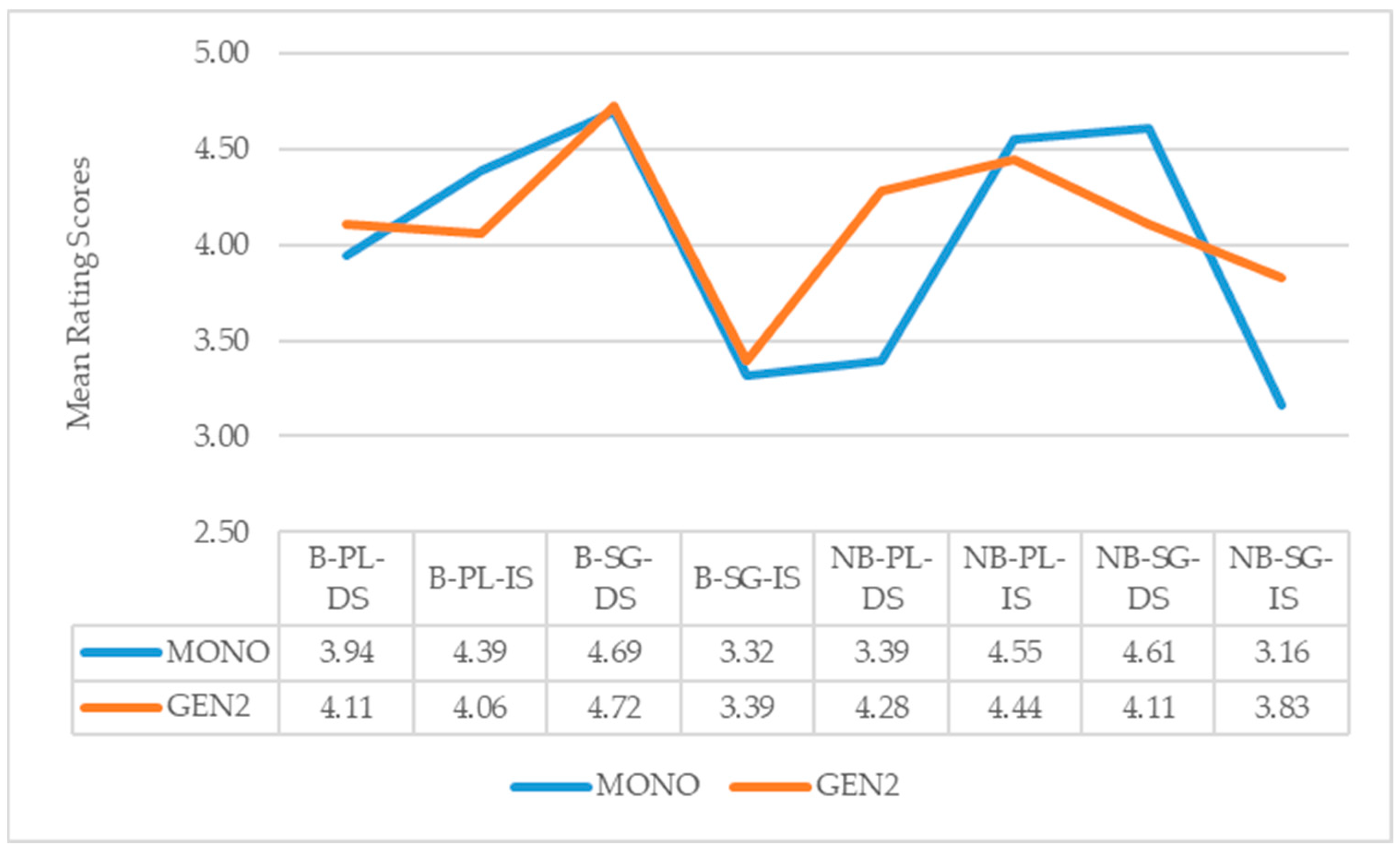
The results of the omnibus analysis revealed several significant main effects. The main effect of bareness (ß = −0.034; SE = 0.033; t = −2.094; p < 0.036) indicates that sentences with bare NPs received significantly higher ratings than those of non-bare NPs (3.95 vs. 3.85). In addition, the main effect of grammatical number (ß = −0.112; SE = 0.029; t = −3.869; p < 0.001) reflects the fact that sentences with plural NPs were rated more favorably than those with singular NPs (4.10 vs. 3.71). The main effect of definiteness was found to be significant when definite-specific sentences were compared with the other two conditions. Definite-specific sentences received significantly higher ratings than indefinite-non-specific sentences (4.15 vs. 3.70; ß = −0.128; SE = 0.029; t = −4.422; p < 0.001). A similar pattern was also observed between definite-specific and indefinite-specific sentences (4.15 vs. 3.86; ß = −0.083; SE = 0.026; t = −3.146; p < 0.003). Interestingly, the main effect of the group did not turn out to be significant (all ps > 0.124). We also obtained several interactions not involving the factor group, but since these effects and interactions are not related to our research questions, they will not be discussed further.
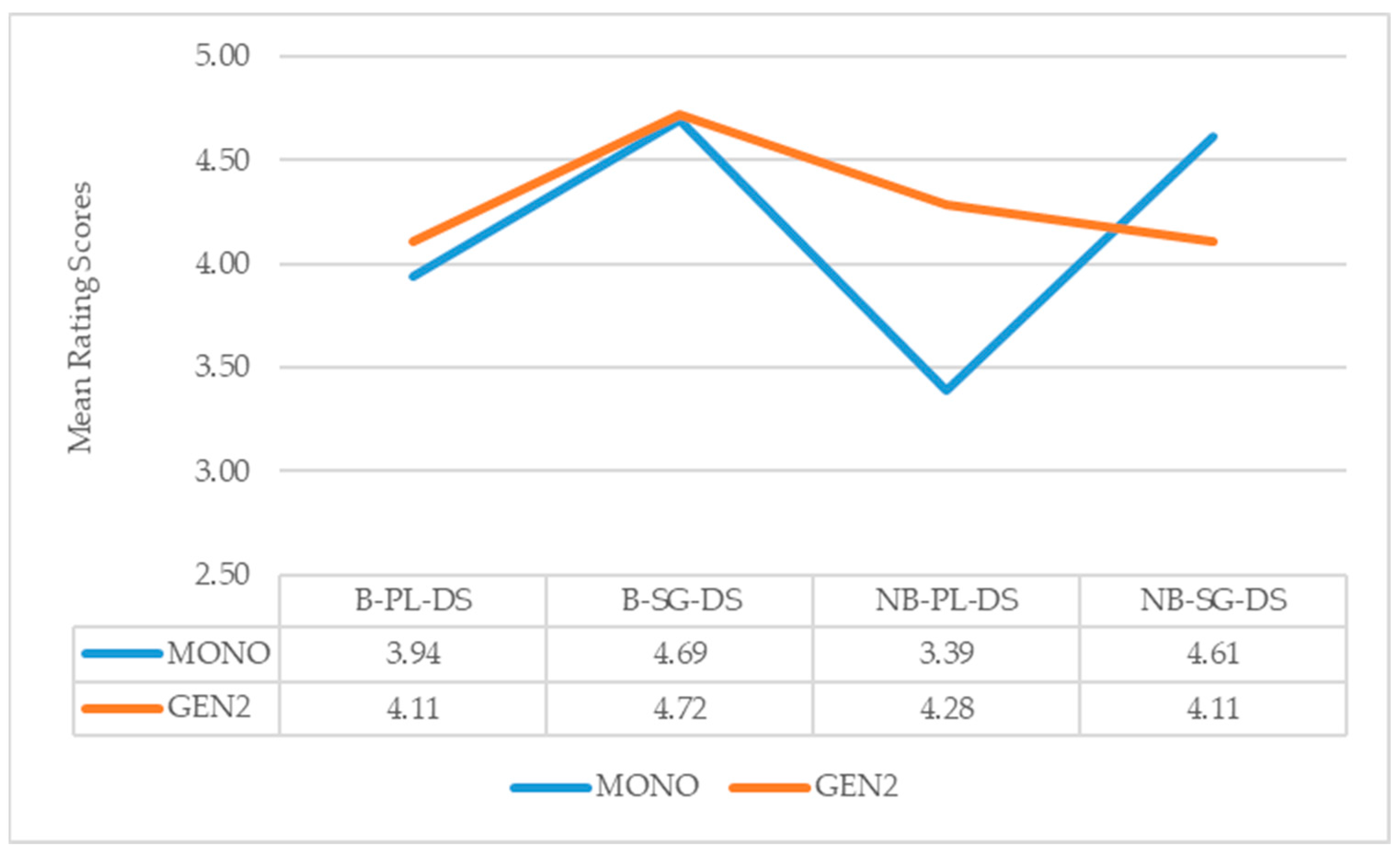
When the data was releveled for definite-specific, we obtained several interactions with the factor group. First of all, a significant three-way interaction of bareness, grammatical number, and group between the MONO and GEN 2 was found (
ß = 0.336;
SE = 0.148;
t = 2.274;
p < 0.025). To resolve this interaction, we ran analyses separately on the groups (see
Figure 1). The results for the MONO group indicate a significant main effect of bareness (
ß = −0.103;
SE = 0.029;
t = −3.561;
p < 0.001) and grammatical number (
ß = 0.292;
SE = 0.054;
t = 5.363;
p < 0.001). These figures indicate that the MONO group rated sentences with bare NPs significantly higher than those with non-bare NPs (4.32 vs. 4.00), and they also favored singular NPs more than plural NPs (4.09 vs. 3.67). In addition, we observed a significant interaction of bareness and grammatical number in the MONO group (
ß = −0.161;
SE = 0.060;
t = −2.775;
p < 0.007). Conversely, neither the main effects nor the interaction seemed to influence the ratings of the GEN2 group (all
ps > 0.198).
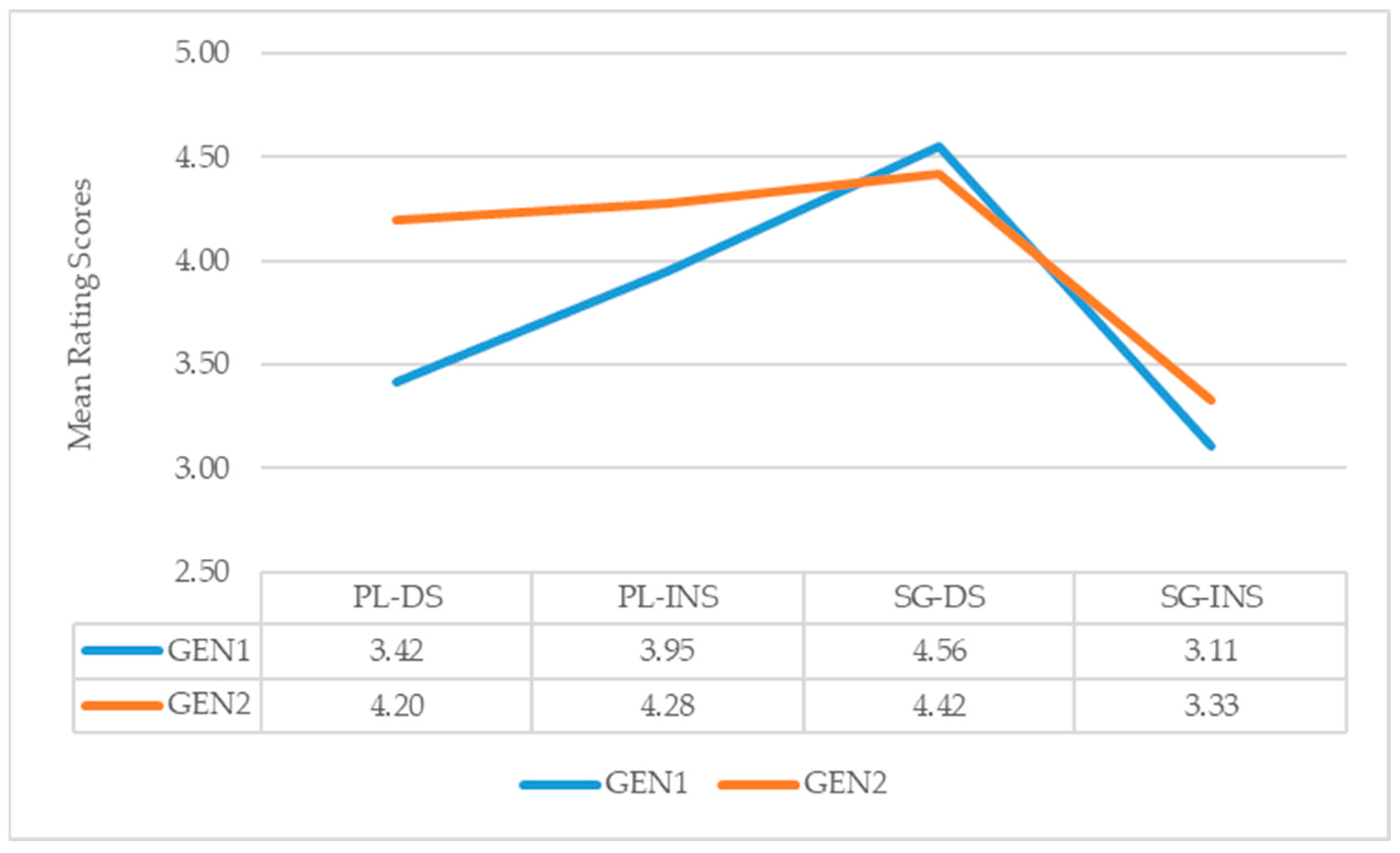
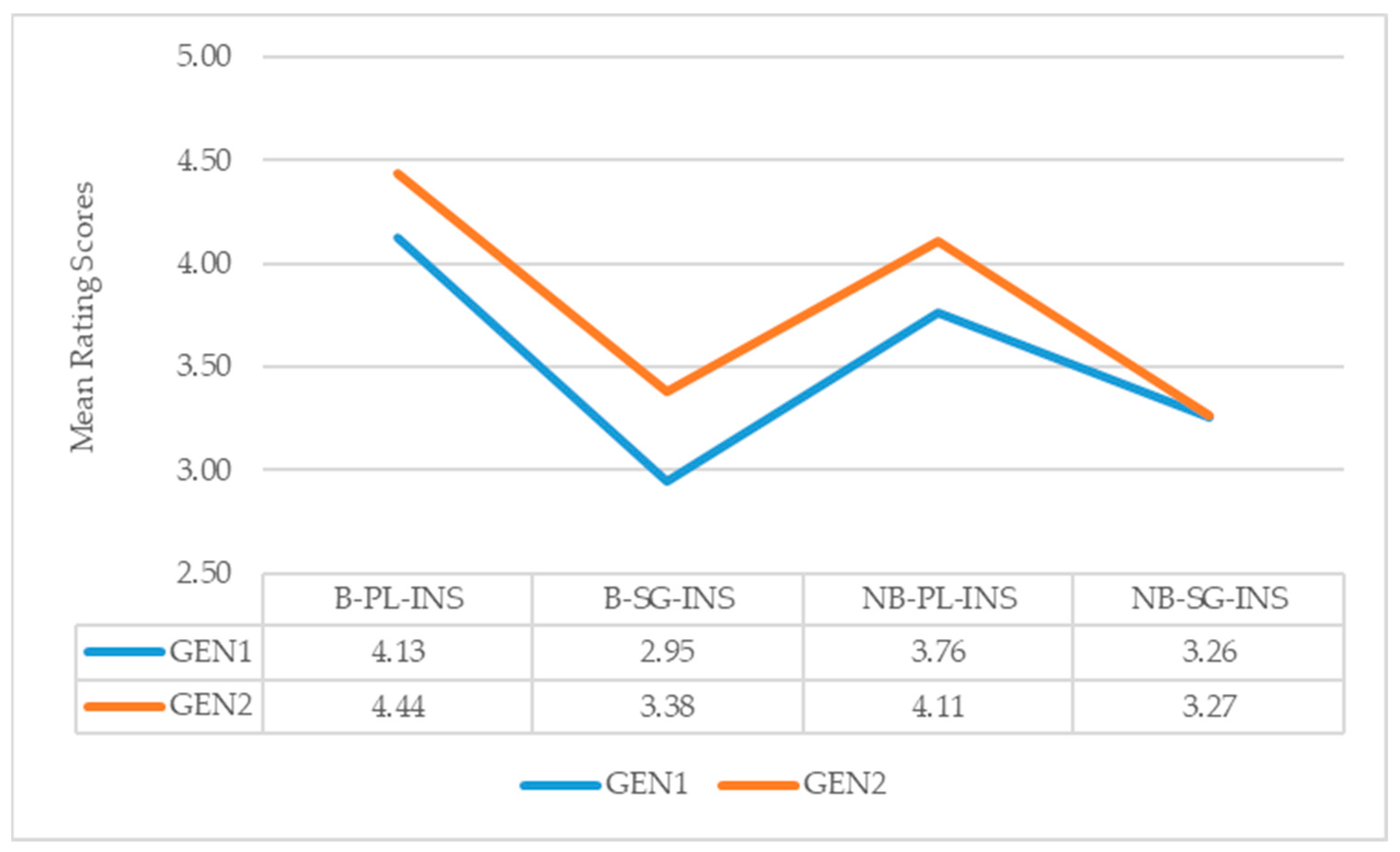
We also obtained a significant three-way interaction of grammatical number, definiteness between DS and INS, and group between GEN1 and GEN2 (
ß = 0.476;
SE = 0.220;
t = 2.162;
p < 0.031). The results of the further interaction resolution analyses (see
Figure 2) reflect significant main effects of grammatical number (
ß = 0.372;
SE = 0.079;
t = 4.713;
p < 0.001) and definiteness (
ß = −0.150;
SE = 0.045;
t = −3.294;
p < 0.003) only for the GEN1 group. These results demonstrate significantly higher ratings for sentences with singular NPs (3.83 vs. 3.68) and the DS condition (3.99 vs. 3.53). We also observed a significant grammatical number and definiteness interaction (
ß = 0.703;
SE = 0.120;
t = 5.845;
p < 0.001) again only for the GEN1 group. However, these factors did not tend to affect the ratings of the GEN2 group (all
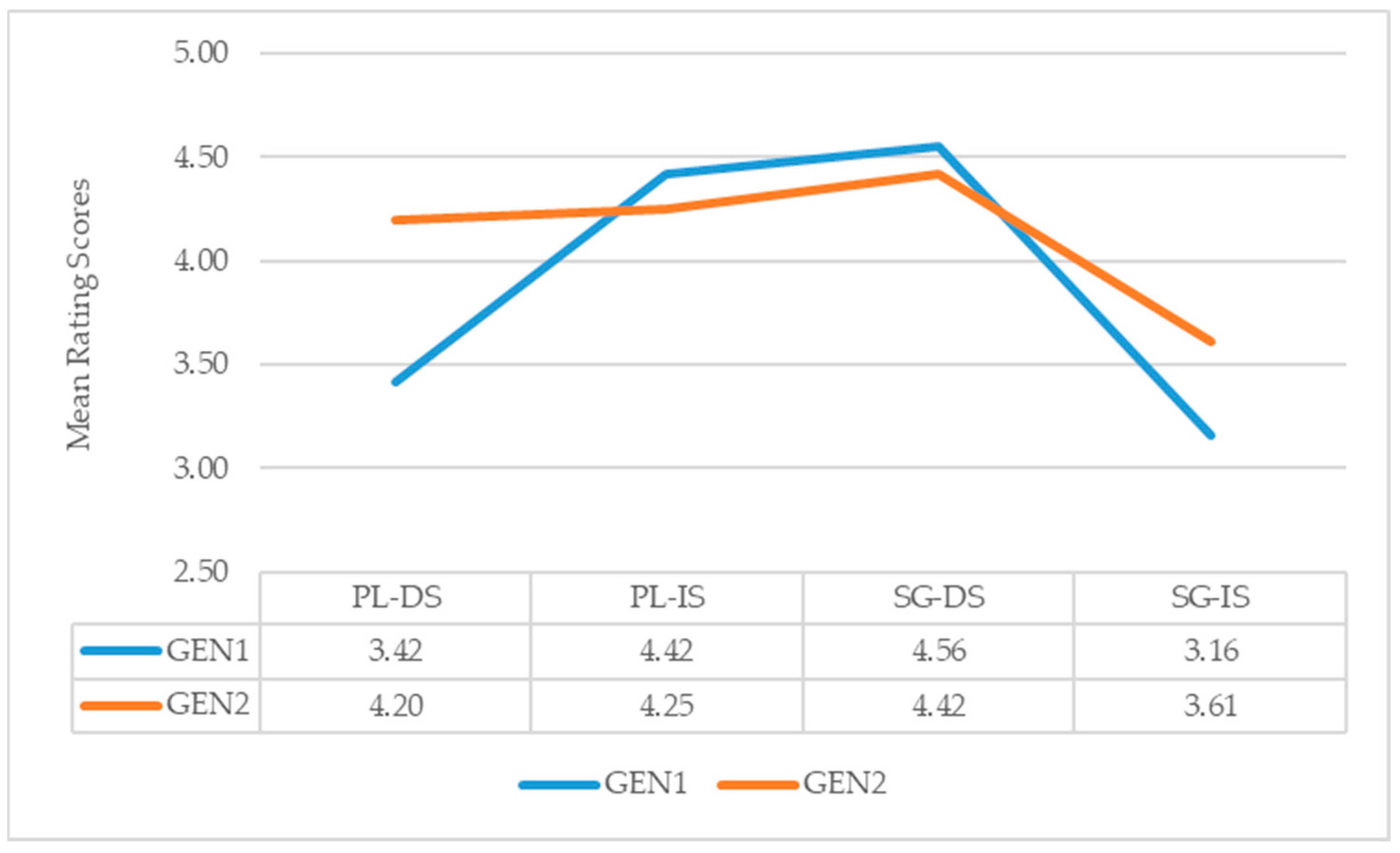
ps > 0.170). A similar three-way interaction between GEN1 and GEN2 was observed for the grammatical number and definiteness between DS and IS (
ß = 0.541;
SE = 0.257;
t = 2.106;
p < 0.037). While the main effect of grammatical number and the interaction of grammatical number and definiteness (
ß = 0.785;
SE = 0.140;
t = 5.621;
p < 0.001) were significant for the GEN1 group, none of them turned out to be decisive factors in the ratings of the GEN2 group (all
ps > 0.092, see
Figure 3).
Finally, there was a significant four-way interaction of bareness, grammatical number, definiteness between DS and IS, and group between MONO and GEN2 (
ß = 0.481;
SE = 0.210;
t = 2.295;
p < 0.023). The results indicate a main effect of bareness (
ß = −0.103;
SE = 0.029;
t = −3.561;
p < 0.001), grammatical number (
ß = 0.292;
SE = 0.054;
t = 5.363;
p < 0.001), and definiteness (
ß = −0.095;
SE = 0.031;
t = −3.050;
p < 0.003) only for the MONO group. As indicated above, the MONO group favored sentences with bare and singular NPs significantly more. They also provided significantly higher ratings for DS sentences (4.16 vs. 3.86). We also observed a significant bareness, grammatical number, and definiteness interaction (
ß = 0.270;
SE = 0.082;
t = 3.289;
p < 0.003) only in the MONO group. On the contrary, none of these main effects nor the interaction seemed to influence the ratings of the GEN2 group (see
Figure 4).
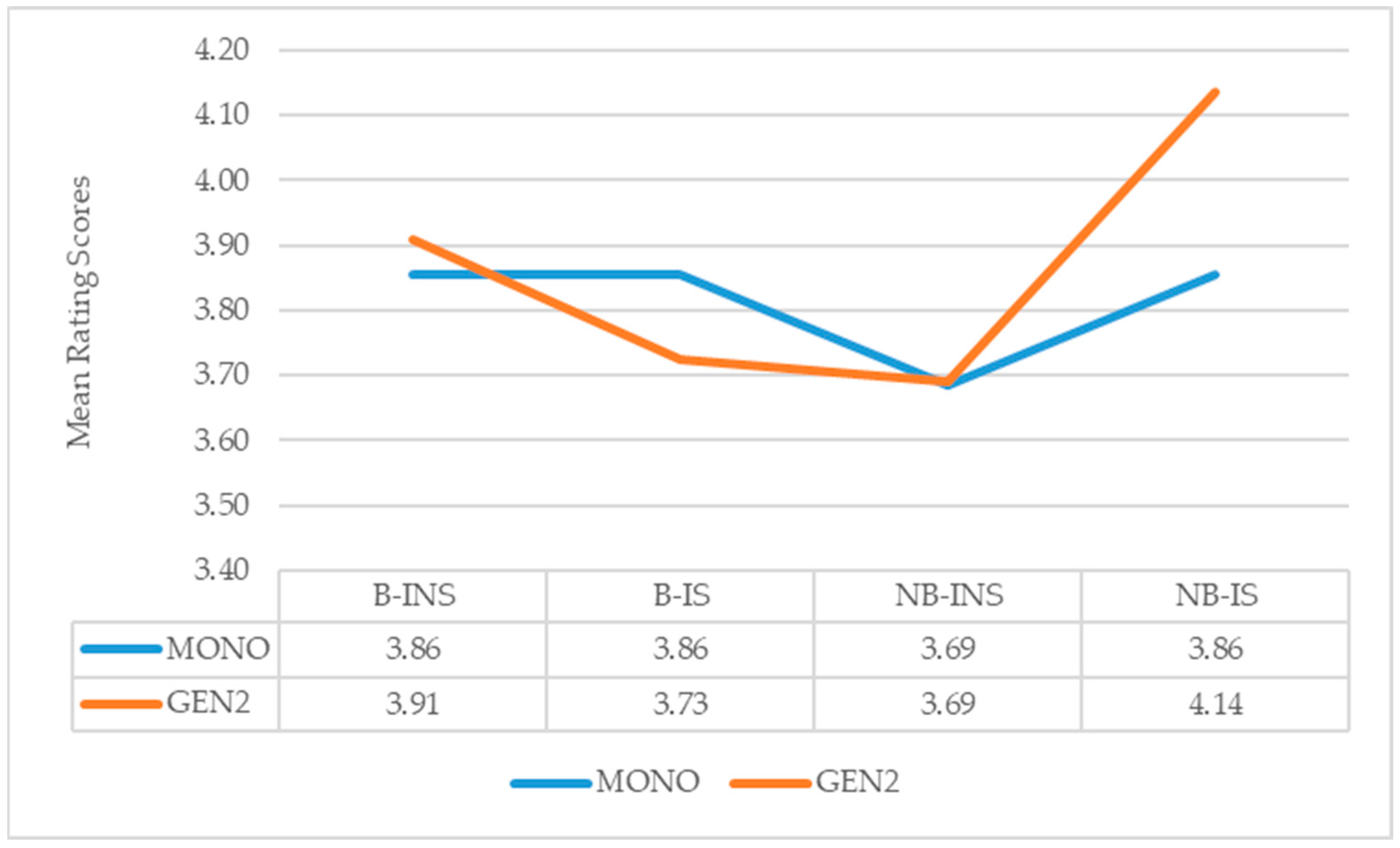
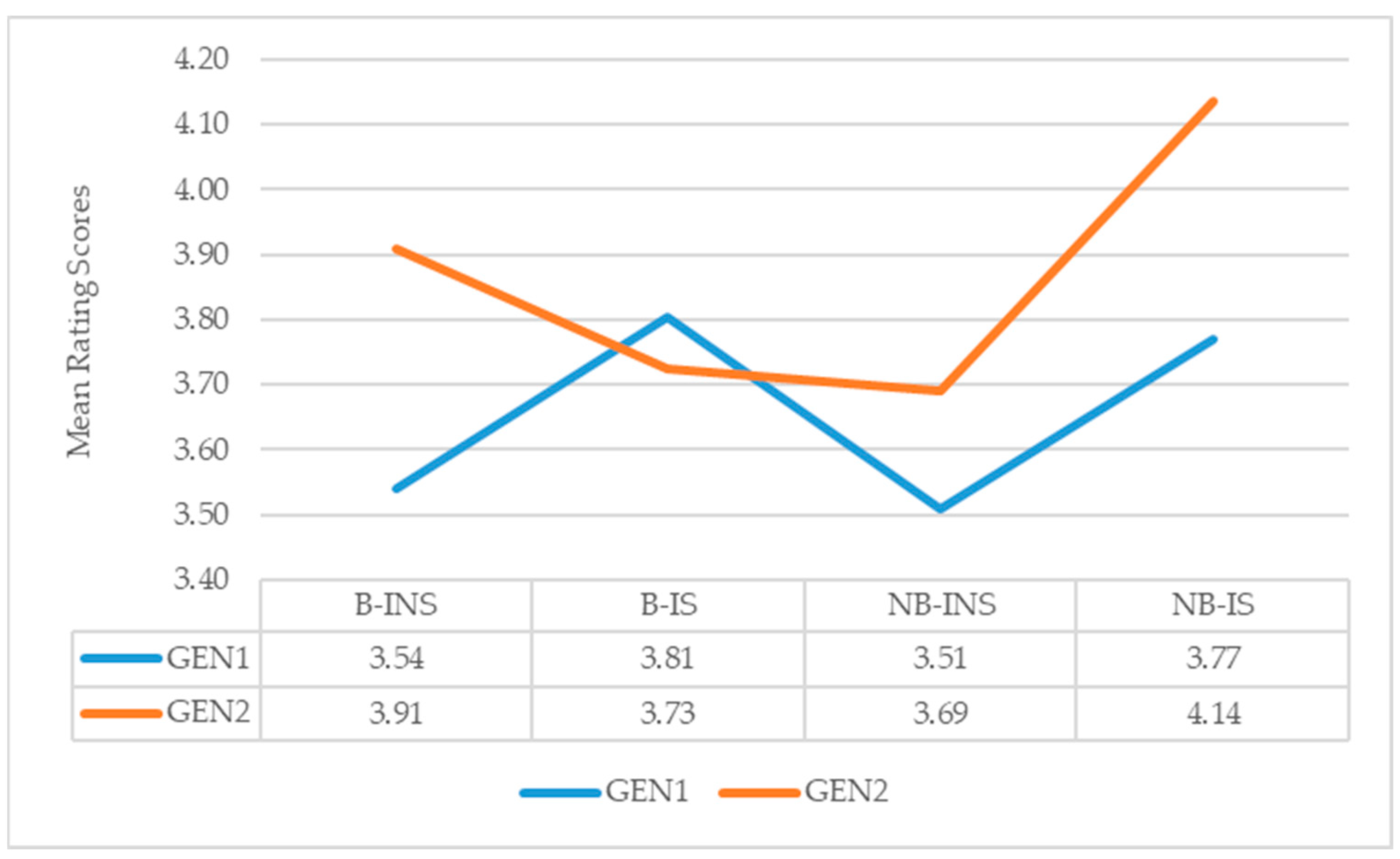
We also observed several interactions with the factor group when the data was releveled for indefinite-non-specific. We initially found a significant two-way interaction of bareness and group between GEN1 and GEN2 (ß = 0.180; SE = 0.081; t = 2.234; p < 0.027). The main effect of bareness was only significant for the GEN2 group (ß = −0.155; SE = 0.069; t = −2.262; p < 0.025), indicating a tendency for higher ratings for sentences with bare NPs (3.91 vs. 3.69). This effect was not significant for the GEN1 group (3.54 vs. 3.51, p = 0.556).
For the GEN1 and GEN2 groups, we also found a significant bareness, grammatical number, and group interaction (see
Figure 5).
While the main effect of bareness was significant for the GEN2 group, grammatical number played a crucial role in the ratings of the GEN1 group (ß = −0.332; SE = 0.068; t = −4.843; p < 0.001) with significantly higher ratings for sentences with plural NPs (3.95 vs. 3.11). Furthermore, we observed a significant bareness and grammatical number interaction (ß = 0.248; SE = 0.085; t = 2.914; p < 0.005) only in the GEN1 group, but this interaction did not seem to contribute to the ratings of the GEN2 group (p = 0.378).
We also obtained a significant three-way interaction of bareness, definiteness between INS and IS, and group between GEN1 and GEN2 (
ß = 0.317;
SE = 0.114;
t = 2.784;
p < 0.007). The main effect of bareness and the interaction of bareness and definiteness (
ß = 0.301;
SE = 0.097;
t = 3.105;
p < 0.003) turned out to influence the ratings of the GEN2 group but not the GEN1 group (all
ps > 0.556, see
Figure 6).
The same significant three-way interaction was also observed between MONO and GEN2 (
ß = 0.229;
SE = 0.105;
t = 2.179;
p < 0.031). While the main effect of bareness and the interaction of bareness and definiteness appeared to be crucial factors for the GEN2 group, they did not affect the ratings of the MONO group (all
ps > 0.072, see
Figure 7).
4. Discussion
By carrying out an acceptability judgment experiment, the aim of the present study was to investigate whether the integration of information at the external interfaces is vulnerable/difficult for a) first- and second-generation Turkish HSs compared to monolinguals and b) first-generation HSs compared to the second-generation.
When the item-level variable definiteness was releveled for DS, several interactions with the factor group were obtained. These interactions showed that the ratings of the GEN2 group contrasted significantly with both the MONO and the GEN1 groups, while these latter two groups provided similar ratings that did not differ from each other significantly. The ratings of the MONO group were influenced by the manipulations of bareness, grammatical number, definiteness (DS vs. IS), and their interactions, whereas none of these factors or interactions tended to be crucial in the ratings of the GEN2. Similarly, grammatical number, definiteness (DS vs. INS and DS vs. IS), and their interactions affected the ratings of the GEN1 group, yet none of these effects or interactions turned out to influence the ratings of the GEN2 group. These differences suggest a tendency towards significant transgenerational differences between the HS groups.
By releveling the variable definiteness to INS, similar results were obtained; specifically, the MONO and GEN1 groups exhibited similar rating patterns that differed significantly from the GEN2 group. However, in this condition, the manipulation, especially of the factor of bareness exhibited a tendency to significantly influence the GEN2 group only. For example, while bareness and the interaction of bareness and definiteness (INS vs. IS) influenced the ratings of the GEN2 group, they had no role in the ratings of the MONO and GEN1 groups. Furthermore, while the interaction of bareness and grammatical number turned out to be significant for the GEN1 group, the effect of the interaction was not significant for the GEN2 group. These differences also suggest a tendency towards transgenerational differences within the HS group.
What do these results show us? As stated previously, the contextually appropriate choice of definiteness relies on the integration of linguistic and non-linguistic information (morphosyntax and discourse/pragmatics), i.e., external interface phenomena. As stated by the revised version of IH, structures at the external interfaces are more difficult and problematic to acquire and master not only for L2 speakers but also for HSs. The results of the present study suggest a trend whereby the integration of information at external interfaces is vulnerable/difficult for the GEN2 group, while the GEN1 group mostly exhibits a native-like rating performance. This means that when morphosyntactic information needs to be integrated with the discourse/pragmatics information that was presented in the context sentence, the GEN1 group rates the sentences in parallel with the MONO group, indicating no problems with the integration of information at external interfaces. Conversely, the GEN2 group seems to experience much more vulnerability/difficulty in doing so and demonstrates a rating pattern that tends to differ significantly from both the MONO and the GEN1 groups; this suggests a possible non-end-state status of their knowledge in Turkish definiteness. These results appear to be in line with the previous studies that compared different generations of HSs not only in Hindi and Romanian (
Montrul et al., 2015) but also in Turkish (
Coşkun Kunduz & Montrul, 2022). However, the results also indicate some differences from Spanish HSs with different generational groups (
Montrul & Sánchez-Walker, 2013;
Montrul et al., 2015). This observed discrepancy might be related to the structure of definiteness in these languages. Hindi does not have articles to mark definiteness and specificity, while Spanish does; therefore, the postposition marker ‘
ko’ in Hindi is more needed to mark definiteness and specificity than the Spanish article ‘
a’ (
Montrul et al., 2015). Similar to Hindi, Turkish has no articles to mark definiteness and specificity, and while
bir is used as for indefinite NPs, the ACC marker is employed for specificity (
Coşkun Kunduz & Montrul, 2022). In general, it can be concluded that definiteness, which involves the integration of information at the external interfaces such as morphosyntax and discourse/pragmatics, is problematic for HSs in general when compared to native speakers, regardless of the heritage language being investigated.
These results also give rise to another important question: what might be the reasons for the observed transgenerational differences? The first reason might be related to the conditions under which the GEN2 group acquired Turkish. Recall that the HSs in the GEN2 group had a very early age of arrival in the USA (mean = 3.00; SD = 6.36), whereas HSs in the GEN1 group arrived in the USA after age 15 (mean = 28.70; SD = 7.07), and this difference was statistically significant (
p < 0.015). These figures show that the GEN1 group had fully mastered the correct usage of
bir and the ACC marker in definiteness before they moved to the USA; however, the GEN2 group seemed to have lacked the opportunity to fully master
bir and the ACC marker because of their early contact with the majority language, English. According to
Montrul (
2008, p. 265), “bilingual children can lose linguistic competence in the L1 quickly and easily, particularly during the age of early language development.” This statement means that when a child comes into contact with the dominant language, in this case English, and uses the dominant language more than the heritage language (i.e., Turkish), the knowledge of the heritage language will become more compromised.
Montrul (
2008) also emphasizes the crucial importance of early and middle childhood in learning a language effortlessly, while noting that the same periods are the most vulnerable ones for language loss when appropriate input and language use are missing. The GEN2 group did not seem to have the opportunity to master Turkish definiteness, and this property might have remained absent in their resources related to Turkish because they did not fully acquire Turkish as a result of being exposed to the dominant language from early on. Conversely, the GEN1 group fully mastered Turkish and the definiteness structure, and this knowledge remains robust despite their living in the USA for many years. This interpretation is also supported by the TELC and Turkish self-rating scores. The GEN1 group exhibited significantly higher TELC (
p < 0.043) and Turkish self-rating (all
ps < 0.020) scores than the GEN2 group, which indicates significantly better Turkish proficiency among the GEN1 group.
The second reason for the observed transgenerational differences might be related to the quantity and quality of input (
Polinsky & Scontras, 2020, pp. 13–14). The quantity of input refers to the amount of exposure to the heritage language, which in turn leads to more balanced bilingualism and better knowledge of the heritage language. If a grammatical structure is rare and not reinforced via schooling or high frequency, that structure cannot be fully acquired by HSs because they will never have the input that is necessary to learn that structure successfully. The quality of input mainly describes the fact that the input in the heritage language is circumscribed to a small set of speakers, such as family members and relatives/neighbors, with specific topics common to this group. It is a known fact that HSs receive input that differs in quantity and quality when compared to their monolingual peers (
Fernald, 2006;
Sorace, 2005;
Sorace & Serratrice, 2009;
Tsimpli & Sorace, 2006). Recent research has also shown that the quantity and quality of input play an important role in acquiring structures that involve interfaces (
Chondrogianni & Marinis, 2011;
Kupisch et al., 2013;
Kupisch et al., 2014;
Unsworth, 2016;
Unsworth et al., 2014). In addition,
Leal Méndez et al. (
2015) also claim that any changes to the quantity and quality of input for discourse-related properties would lead HSs to display less sensitivity to appropriate grammatical choices in various discourse contexts. The quantity and quality of input seem to be a primary cause for the observed transgenerational differences in the present study. While the GEN1 group received a high quantity and quality of Turkish input not only from their families but also from the schools they attended in Türkiye, the GEN2 group did not seem to have the opportunity to receive the same type of input, resulting in a tendency to exhibit divergences in the integration of external interfaces. Recall that the HSs in the GEN2 group had an early age of arrival to the USA (mean = 3.00; SD = 6.36), indicating that they did not receive the same amount of formal education in Turkish; specifically, seven out of nine GEN2 participants started schooling in the USA. Interestingly, only four participants in the GEN2 group had attended Turkish courses, and their daily use of Turkish was also lower than that of the GEN1 group. All of these situations related to their Turkish acquisition trajectory led the GEN2 group to receive less Turkish input in terms of quantity and quality, which, together with a lack of formal education in Turkish, resulted in significantly lower TELC and self-ratings scores related to their Turkish skills when compared to the GEN1 group. Furthermore,
Krause and Roberts (
2020) highlighted the importance of heritage language proficiency in exhibiting native-like performance in definiteness, with high L1 proficiency HSs patterning with native speakers, whereas low L1 proficiency HSs perform differently. Our results are consistent with such findings, as the higher Turkish language performance of the GEN1 mirrored that of the MONO, while the lower language performance of the GEN2 resulted in language behavior distinct from that of GEN1 and MONO.
The reason why the GEN2 group seems to face vulnerability/difficulty when integrating external interfaces can be explained by the proposal of
Polinsky and Scontras (
2020). Because the GEN2 group seems not to have completely acquired Turkish and is assumed not to have received a high quantity and quality of input, they tend to face difficulties with phenomena that impose relatively high cognitive demands, such as integrating morphosyntax and discourse/pragmatics. When they are confronted with this difficulty, they may face pressure to restructure the grammar of their heritage language, and this restructuring possibly turns their heritage language into a less ambiguous, more regular, and less structured system. Regarding definiteness, this restructuring pattern observed in the GEN2 group appears to exhibit some restructuring of the Turkish definiteness system by emphasizing bareness over number (i.e., the singularity vs. plurality of the NP in the context sentence). The idea of restructuring HS grammar is not novel and supports the claims of the IH since the vulnerability/difficulty of integrating the external interfaces most likely causes a change in the grammar of the GEN2 group (
Polinsky & Scontras, 2020).