Article

How Heritage Russian Mirrors Unstable Parts of the Baseline: A Corpus-Based Study on Intergenerational Language Dynamics

by
Vladislava Warditz
Institute of Slavic Studies, University of Cologne, 50931 Cologne, Germany
Languages 2026, 11(7), 138; https://doi.org/10.3390/languages11070138
Submission received: 30 December 2025 / Revised: 7 May 2026 / Accepted: 21 May 2026 / Published: 1 July 2026

Abstract

This paper examines how heritage Russian reflects morphosyntactic dynamics in baseline Russian, drawing on three diachronically spaced corpora collected in 2001, 2010, and 2022 in Germany. It identifies recurrent patterns of variation in heritage Russian and assesses how they correspond to domains of instability already attested in the baseline system. The study assumes that transfer, variation, and convergence in heritage Russian are shaped not only by its reduced use in favor of the societal language but also by internal trigger mechanisms analogous to those operating in baseline Russian, while at the same time exhibiting specific variation patterns arising from multilingual variation typical of communication among heritage speakers. The analysis shows that the most prominent domains that consistently emerge as unstable across the corpora are nominal number and case, shifts in nominal and verbal government, and calquing of syntactic constructions. In this respect, heritage Russian mirrors baseline tendencies while also exhibiting contact-enhanced effects. For instance, GEN/ACC competition and the extension of animate object marking occur in both baseline and heritage Russian, whereas the overgeneralization of inanimate object marking appears predominantly in heritage Russian. Similarly, the loss of an instrumental predicative in favor of the nominative and fluctuations in prepositional government reflect baseline instability amplified by German influence. Syntactic variation—including borrowing of connectors, loss of baseline intonation patterns, and pro-drop in impersonal constructions—further illustrates the interaction of internal instability and contact effects, whereby contact-affected syntactic patterns are not attested in baseline Russian. The calquing of German possessive constructions and the shift from prepositionless to prepositional government patterns can be interpreted as instances of contact-induced leveling of Russian typological features, accompanied by simplification where baseline structures diverge from dominant-language patterns. Interpreted as part of a broader shift from synthetic to analytic government, these developments align with both contact-induced tendencies and historically attested changes in Slavic languages. The identified patterns of variation in heritage Russian correspond to domains of instability in baseline Russian, showing that the loci of variation are largely analogous, while their concrete manifestations are partly different. In comparison with baseline Russian, heritage Russian exhibits both analogous and specific—non-canonical—variants, reflecting unstable areas of the baseline in a multilingual setting and becoming particularly visible in subsequent generations of the migrant community. Within a broader typological context, the documented variation trends align with sensitive language domains observed in other contact situations, confirming their systematic character across diverse minoritized contexts.

1. Introduction

Notwithstanding its internal dynamics, baseline Russian is typically treated as a stable benchmark for comparing language use in mono- and multilingual settings. The specific features of Russian in the diaspora have hardly been examined against the background of ongoing variation within baseline Russian itself (Glovinskaja, 2001, 2008). This paper addresses language dynamics in mono- and multilingual contexts by examining morphosyntactic variation in migrant heritage Russian in relation to vulnerable domains of baseline Russian.
Understood as minoritized languages in multilingual settings, acquired primarily in a family framework (Fishman, 2001), migrant heritage languages1 are often described in terms of reduced input, incomplete acquisition, or attrition (for an overview, see Montrul & Polinsky, 2021). This paper adopts a comparative perspective to language change in mono- and multilingual settings (Heine & Kuteva, 2005, 2008; Haspelmath, 2008), examining how variation in migrant heritage Russian reflects vulnerable domains within baseline Russian under conditions of contact with a dominant societal language. Accordingly, migrant heritage Russian is understood as a part of a native-speaker continuum (Wiese et al., 2022). In comparison with the baseline, migrant heritage Russian demonstrates a distinct evolutionary dynamic through ongoing attrition among subsequent generations of speakers, on the one hand, and through intensive contact with a dominant societal language, on the other. Moreover, against the background of baseline evolution, the creativity of heritage speakers is concentrated on borrowing rather than internal innovation, and linguistic processes often occur without regular reference to standard languages (Stoffel, 1988), resulting in the emergence of non-canonical patterns and forms. As Russian in the diaspora functions as a highly dynamic contact-affected variety, its (non-canonical) innovations may never become complete changes (Mesthrie, 2008). Therefore, a comparison of variation across three diachronically spaced interview corpora collected over more than two decades should allow us to identify and verify the most prominent patterns of variation in their relation to documented instability in baseline Russian.
Given high heterogeneity in language proficiency in both societal and heritage languages across the speaker continuum, migrant heritage Russian is conceptualized in this paper as a highly variable system, albeit one in which certain vectors of change are discernible through individual variation. In other words, although the specific manifestations of variation among heritage speakers depend on a range of socio- and psycholinguistic factors, their qualitative and quantitative dynamics follow a recognizable trajectory (Warditz, 2016). Additionally, as structural instability and internal language dynamics, together with contact-induced transfer, jointly shape linguistic outcomes in multilingual environments (Aalberse et al., 2019; Dediu & Cysouw, 2013; Sakel & Matras, 2008), heritage Russian is situated as a case where both external contact factors and internal language processes interact.
As dynamic contact varieties lacking conventional intergenerational transmission, heritage languages display a wide spectrum of contact-induced variation, ranging from pragmatic and prosodic interfaces and the lexicon to semantic, grammatical, and syntactic core structures (for an overview and further bibliography, see Warditz, 2020). This paper focuses on structural variation patterns, considering lexical transfer as a frequent introduction of morphological adaptation and/or syntactic calquing. When examining unstable parts of language as more sensitive to language change, morphosyntactic variation is seen as emerging from competing options within language systems, whose distribution is shaped by frequency, functional pressure, and structural asymmetries (Thomason, 2017). From this perspective, language contact does not introduce fundamentally new mechanisms of change or create change ex nihilo, but rather modulates the probabilities of existing variants, preferentially affecting areas that are already weakly entrenched or structurally unstable (Backus et al., 2011). Applying this logic to heritage Russian, variation is argued to target the same morphosyntactic domains that display instability in baseline Russian, making heritage data a privileged window into system-internal tendencies (Clyne, 2003). At the same time, due to reduced conventional language transmission and sustained multilingual exposure in the diaspora, internal pressures toward variation in heritage Russian may lead to specific innovations or non-canonical variants that deviate from corresponding manifestations in the baseline.
Within this framework, we aim to understand how migrant heritage Russian reflects ongoing morphosyntactic dynamics in baseline Russian.

2. Theoretical Context

When examining the variation dynamics of heritage Russian in comparison with the baseline, we adopt the view that questions concerning the mechanisms, causes, and adaptive functions of change are best addressed through the study of languages newly brought into contact (Weinreich, 1953; Labov, 1965). Our central concepts are thereby defined as follows: Variation refers to the synchronic coexistence of functionally equivalent variants within a speech community (Labov, 1972), whereas language change denotes a diachronic process involving directional shifts in the frequency or distribution of these variants over time (Weinreich et al., 1968). However, since change must be inferred through structured patterns identified during diachronic comparison or systematically stratified synchronic data (Bailey et al., 1991), rather than focusing on variation in parole, we analyze unstable domains within the language system (langue), treating attested individual usages (usus) as evidence for underlying systematic processes. Accordingly, instability is understood as a property of certain domains of the language system that exhibit heightened susceptibility to variation and change, in line with proposals that different components of language differ in their degree of stability (Jakobson, 1996; Parkvall, 2008).
To the best of our knowledge, only a limited number of studies have directly compared language dynamics in heritage and baseline Russian (Glovinskaja, 2001; Ždanova, 2012; Warditz, 2025), focusing on potentially analogous mechanisms that trigger variation in both contexts. Conversely, internally driven language processes—well documented for monolingual settings—have rarely been systematically applied to multilingual contexts, even though they are likely to play a role there as well (cf. Jakobson, 1996, p. 42; Glovinskaja, 2001, p. 482; Parkvall, 2008, p. 234; Ždanova, 2012, pp. 690–692). Glovinskaja (2001) compares contemporary innovations and so-called “mass mistakes” in baseline Russian—such as deviations in case and number agreement, the misuse of government patterns, and irregularities in syntactic coordination—with parallel phenomena observed in migratory settings. Her analysis identifies predominantly shared rather than context-specific processes (Mečkovskaja, 2004), including the simplification of case and number paradigms (notably the expansion of the nominative), as well as the emergence of prepositional government, interpreted as part of a broader shift from synthetism to analytism. Based on qualitative evidence, Glovinskaja concludes that such variations may stabilize only over a long time; however, these processes tend to accelerate under the pressure of dominant societal languages, that is, under the conditions of bilingualism. At the same time, evidence from bilingual and multilingual contexts shows that bilingualism and code-switching can, in some cases, contribute to the stabilization of emerging variants (Mesthrie, 2008, p. 274). These observations confirm the crucial role of system-internal processes in language variation across both monolingual and multilingual settings.
When addressing these issues in a broader typological context, previous research has repeatedly shown that structural effects of contact are not evenly distributed across the grammar but concentrate in domains already characterized by internal variability, weak semantic transparency, or functional overlap (Heine & Kuteva, 2005, 2008). These domains are therefore especially prone to variation and restructuring under facilitating conditions. Cross-linguistic studies, in turn, identify several domains as particularly susceptible to contact-induced variation and change. Nominal morphology—especially case marking and adpositional government—is often destabilized, showing increased optionality, the spread of prepositional constructions, or partial re-functionalization of case distinctions (Heine & Kuteva, 2005). Verbal domains, particularly argument structure and valency patterns, display heightened instability, with competing constructions subject to leveling, reanalysis, or redistribution in frequency (Harris & Campbell, 1995). Agreement and indexation systems can undergo simplification, optionality, or restructuring in prolonged contact, particularly when functional load is low or overlapping strategies exist (Corbett, 2006). These findings refine the classic borrowability hierarchy (Thomason & Kaufman, 1988), which ranks lexical items as most easily borrowed, followed by function words, derivational morphology, and finally inflectional morphology and syntactic structure. At the same time, these findings corroborate qualitatively based observations regarding heritage Russian made by Glovinskaja (2001). In line with previous studies, we assume that the core linguistic features of heritage Russian—transfer, variation, and convergence—have been shaped not only by its reduced use in favor of a societal language, but also by internal trigger mechanisms analogous to baseline Russian (Aalberse et al., 2019; specifically for Russian, Warditz, 2025). Nevertheless, minoritized Russian also exhibits consistent variation patterns distinct from baseline Russian. In contrast to monolingual speakers, bilingual speakers in a migratory context often use two language systems as one communicative repertoire (García & Wei, 2014; Léglise & Moreano, 2017), whereby the concrete manifestations of multilingual variation can represent not only occasional code-switching phenomena, but also systemic structural and lexical patterns that have either been borrowed or have emerged independently (Clyne, 2003). Against this background, heritage Russian is conceptualized here as an empirical testing ground for hypotheses about mechanisms of language variation and change. Due to its heightened susceptibility to variation, latent tendencies of the baseline system may surface more clearly, while the overall trajectories of change are expected to remain structurally analogous in both systems (Glovinskaja, 2001, 2008). This assumption is supported by previous research identifying similar and unique trends, for example, in the use of bi-aspectual verbs in heritage and baseline Russian (Warditz, 2025), or in nominal government in heritage Russian and Polish in comparison with their respective baselines (Warditz, 2016), both vulnerable domains within the baseline systems. Within this theoretical and empirical framework, we investigate language dynamics in heritage Russian in comparison with baseline Russian, addressing both external (contact-induced) and internal mechanisms of language variation.

3. Research Design: Methods, Research Questions, and Hypotheses

When examining how variation in heritage Russian reflects instability in the system of baseline Russian, this study addresses the following research questions: (i) Which variation patterns in heritage Russian overlap with baseline instability? (RQ1); (ii) To what extent are these patterns reproduced or restructured? (RQ2); and (iii) How are they realized in concrete linguistic forms? (RQ3).
The central hypothesis is that the same vulnerable domains of the grammatical system are targeted in both settings, while their surface manifestations differ due to the interplay of attrition and contact. More specifically, this study advances the following hypotheses:
H1. 
(Shared Instability Hypothesis): Variation in heritage Russian will concentrate in the same structurally vulnerable domains that exhibit instability in baseline Russian.
H2. 
(Divergent Realization Hypothesis): Although the loci of variation will overlap, the surface realizations of this variation will differ. Heritage speakers are expected to produce both (i) variants attested in baseline Russian and (ii) non-canonical forms arising from the interaction of incomplete acquisition, attrition, and cross-linguistic influence.
Methodologically, the study follows a corpus-based, quantitative-comparative approach combining diachronic and cross-corpus analysis (McEnery & Hardie, 2011; Gries, 2009; Biber et al., 1998). First, the most prominent patterns of variation are identified across three corpora of heritage Russian, collected in 2001, 2010, and 2022 in Germany. These are then compared with corresponding patterns in two baseline Russian corpora to detect overlap in structurally unstable domains. Linguistic variables are selected based on prior evidence of variability in contact settings, and competing variants are operationalized and coded across both datasets. Quantitative frequency analysis is combined with qualitative examination of contexts to trace shifts in distribution and conditioning factors. Finally, the analysis focuses on concrete linguistic manifestations, distinguishing between baseline-like variants and non-canonical forms. This approach assumes that heritage language systems are shaped by the interaction of internal restructuring processes and external contact-induced pressures. When comparing variation across corpora, our study disentangles inherited instability from contact-induced change, showing that heritage Russian remains anchored in the baseline system while developing distinct patterns under multilingual conditions.

4. Corpora: Specifics, Advantages, and Limitations

The study is based on three diachronically spaced corpora comprising speakers with comparable sociolinguistic profiles (see Table 1). In evaluating the data, however, several specific factors were considered, especially regarding intergenerational language dynamics and the potential establishment of innovations.
Language transmission in this multilingual migratory setting does not follow a straightforward intergenerational model. Unlike situations of long-term isolation, such as those found in historical dialects (Breu et al., 2016), migrant heritage Russian is shaped by ongoing, multidirectional contact not only with the societal language but also with baseline Russian. Transmission takes place not only within the family, but also through external domains such as kindergarten, heritage-language schools, and digital environments, including internet-mediated literacy practices. As a result, heritage Russian emerges as a dynamic communicative code whose structural profile may shift over time and across speakers, without necessarily giving rise to a stabilized community norm. This implies that heritage Russian may undergo contact-induced change to varying degrees, while also allowing for “upgrading” toward near-native or native-like competence comparable to that of monolingual baseline speakers (Ždanova, 2012; Warditz, 2025). Consequently, we interpret the documented variation patterns not as categorical innovations or fully established variants, as such an interpretation would presuppose stabilization, conventionalization, and consistent cross-speaker transmission. Instead, these patterns are viewed as indicators of reduced stability in specific areas of the baseline system rather than as fully conventionalized innovations. Although these variation patterns do not necessarily develop into consistently transmitted variants that shape the long-term grammar of migrant heritage Russian, they may provide insight into areas of grammatical sensitivity in the baseline system.
The corpora were collected at different points in time and in different locations in Germany (Baden-Württemberg, North Rhine-Westphalia, and Berlin), allowing for the identification and verification of the most prominent variation patterns across speaker continua (hereafter referred to as C1, C2, and C3, respectively) (cf. Table 1). Methodically, C1 (2000–2001) was collected using exclusively participatory monitoring, C2 (2010) is based on semi-structured interviews and participatory monitoring, and C3 (2022) comprises only semi-structured interviews.
Each interview (C2 and C3) comprises approximately 7500 words, resulting in an estimated total of 225,000 and 390,000 words, respectively. All respondent groups are assumed to have high proficiency in societal German due to their professions, as well as in heritage Russian, since most members of the second generation are students of Slavic Studies (as a major or minor subject) at various universities in Germany. Their self-reported proficiency was further confirmed during participatory monitoring as well as during interviewing.
The interviews addressed domains such as schooling, employment, institutional interaction, family communication, and everyday life in Germany. These topics were selected to promote spontaneous storytelling about locally embedded experiences and thus provide contexts in which multilingual variation is likely to emerge. Recordings were automatically transcribed using speech-recognition software and subsequently manually corrected to ensure morphosyntactic accuracy. Non-canonical forms—defined as morphosyntactic realizations diverging from baseline Russian but occurring in heritage Russian, including both contact-induced variants and internally motivated analogical extensions—were identified and annotated manually through comparison with baseline Russian usage described in reference grammars and corpus-based studies. Coding targeted variation in nominal case and number, government patterns, predicate marking, and syntactic constructions, all identified in previous research as typologically sensitive domains in Russian (see Results). Annotation consistency was ensured through repeated verification across the corpus. Although the analysis is primarily qualitative, recurring variation patterns were attested across multiple speakers and all three recording periods, while approximate frequency distributions confirmed their systematic character.
Despite their quantitative limitations, particularly in comparison to large-scale national corpora of baseline Russian, the corpora used in the study offer clear advantages for identifying diverse patterns of variation and represent some of the largest datasets available from fieldwork-based research on heritage Russian.

5. Results: Variation Dynamics in Heritage and Baseline Russian

5.1. Variation Patterns in Heritage Russian Across Corpora

In this section, we summarize the most prominent patterns of variation in heritage Russian across our corpora. In doing so, we apply qualitative analysis to all three corpora and quantitative analysis to the third corpus, which includes interviews with speakers from both generations (see Table 1). The most prominent structural patterns are those attested in all three corpora, albeit to varying quantitative extents and in diverse concrete manifestations. Even if individual speakers demonstrate use of contact-affected or further non-canonical patterns to a different extent, both in qualitative and quantitative dimensions, certain main avenues of variation can be identified (Ždanova, 2012).
The most prominent variation patterns in our corpora include fluctuations in noun number and case, shifts in nominal and verbal government, and calquing of syntactic constructions (see Table 2).
Notwithstanding differences in the speaker composition of the collected corpora, this comparison primarily enables the identification of recurrent morphosyntactic variation patterns across datasets, indicating their robustness.
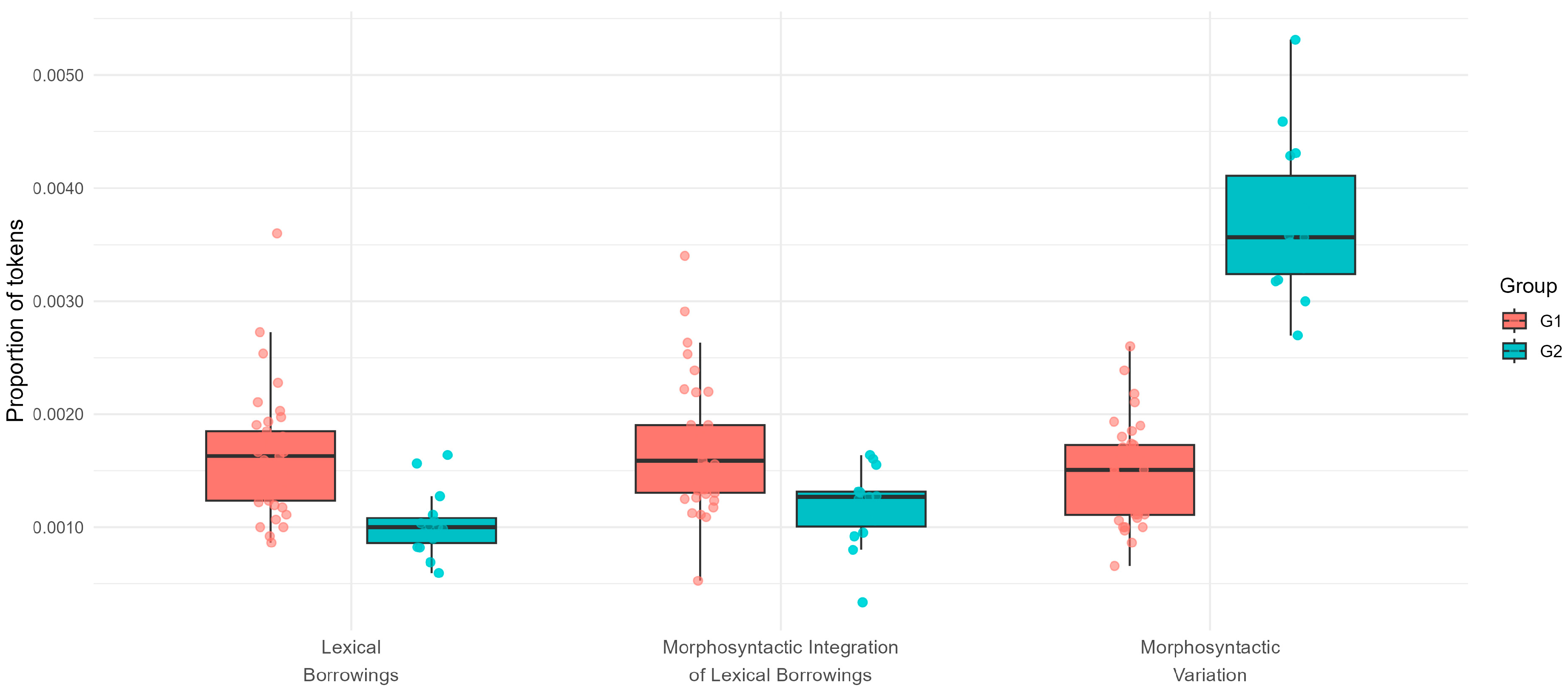
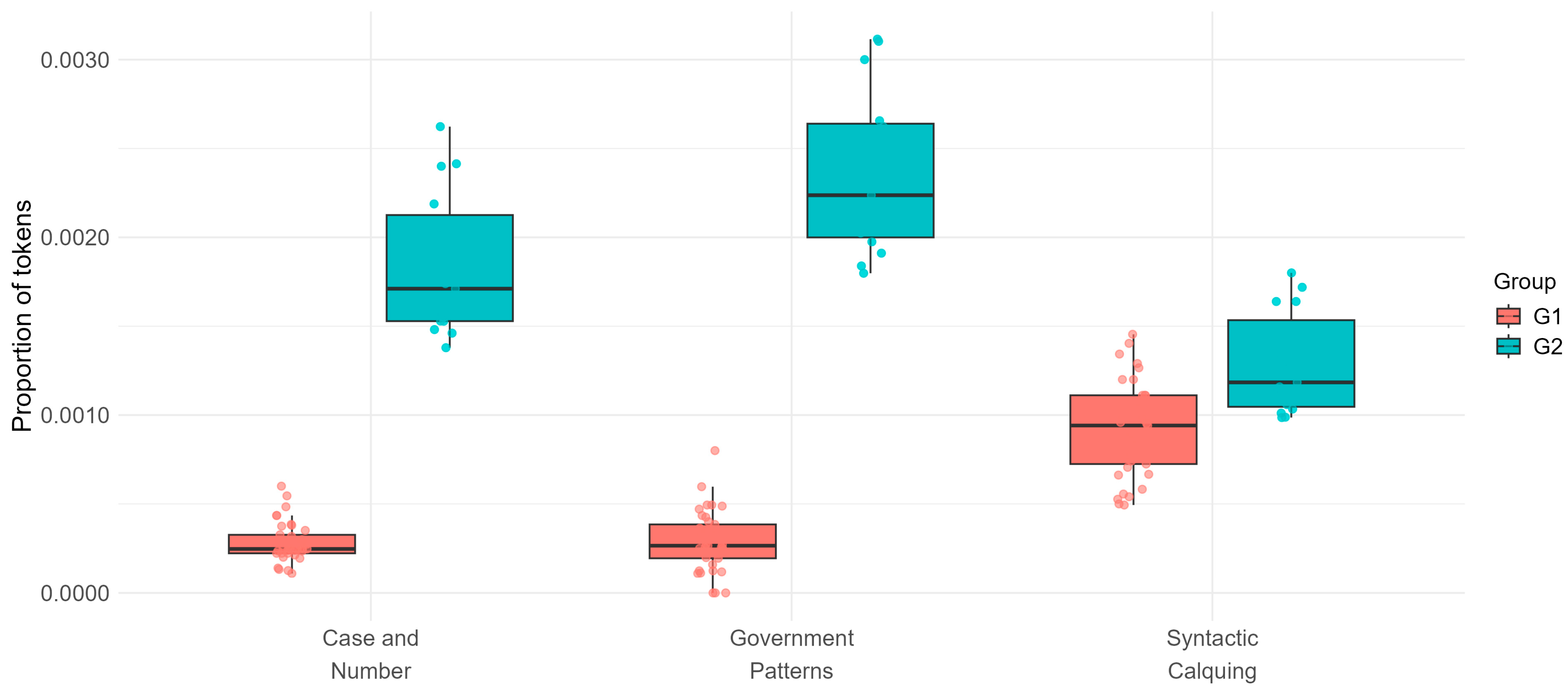
At the next stage, these most prominent patterns were statistically tested across the third corpus, building on work carried out by Warditz (forthcoming). As shown in Figure 1 and Figure 2, the analysis focuses on the proportional distribution of variation patterns within both generations, with tokens counted as each attested instance of a contact-induced linguistic feature in the corpus. This presentation serves two purposes: first, to demonstrate the intergenerational distribution of variation patterns within a methodologically homogeneous corpus; second, to show that the proportional profiles within speakers and within generations point to the sustainability—and thus the non-random character—of these patterns.
Figure 1 visualizes the proportional distribution of contact-induced variation types within each generation. The y-axis represents the proportion of tokens per interview/participant; median values indicate central tendencies, while interquartile ranges and whiskers capture dispersion across interviews.
In the first generation, lexical borrowings display the highest proportional values. Median proportions for both integrated and non-integrated lexical borrowings fall within a comparable range (0.0015–0.0017), with integrated borrowings showing a slightly higher central tendency. Morphosyntactic variation, by contrast, exhibits a somewhat lower median proportion (0.0014–0.0015). The interquartile ranges for all variation types remain relatively narrow, indicating limited dispersion and a stable proportional profile across interviews. The second generation shows a clearly different proportional configuration. Morphosyntactic variation now clearly dominates, with median proportions clustering substantially higher (0.0035 or above), well exceeding the corresponding values for lexical borrowing. Figure 1 also reveals greater dispersion for morphosyntactic variation within this group, reflected in higher values and a wider interquartile range, indicating both increased frequency and greater variability across interviews. In contrast, non-integrated lexical borrowings show low median proportions (around or below 0.001), while integrated borrowings remain slightly higher but still far below the levels observed for morphosyntactic variation.
More specifically, Figure 2 illustrates the proportional distribution of morphosyntactic variation types within each generation.
In the first generation, all three morphosyntactic patterns occur at relatively low proportional levels. Case and number variation and variation in government patterns show similarly low median proportions (0.0002–0.0003), together with narrow interquartile ranges, indicating limited dispersion and low overall frequency across interviews. Syntactic calquing exhibits slightly higher median proportions (0.0009–0.0010) but remains comparatively constrained, with only moderate variability. The second generation displays substantially higher proportional values across all types of morphosyntactic variation. Variation in government patterns shows the highest median proportions (0.0022–0.0024), accompanied by a relatively wide interquartile range and higher upper values, indicating both increased frequency and greater variability across interviews. Case and number variation also increases markedly, with median proportions clustering around 0.0016–0.0018. Syntactic calquing, while exhibiting lower median values than the other two categories in this generation (0.0011–0.0013), nevertheless occurs at clearly higher proportional levels than in the first generation.
Taken together, in the first generation, all morphosyntactic patterns occur at low and relatively compressed proportional levels, with limited dispersion across interviews. In contrast, the second generation shows a substantial upward shift in median proportions across all morphosyntactic categories, accompanied by increased variability. Variation in government patterns and case and number variation emerge as the most prominent contributors, while syntactic calquing, though less frequent, also increases markedly. At the same time, the proportional consistency of these tendencies across speakers and interviews further indicates that the observed restructuring reflects sustainable and internally structured patterns rather than isolated distributional effects. Both figures provide converging distributional evidence for an intergenerational shift from primarily lexical contact-induced variation toward increasingly structural outcomes, driven not only by higher overall frequencies but also by a differentiated internal reweighting of morphosyntactic patterns within each generation.
These findings confirm that contact with the societal German increasingly targets structurally sensitive domains of Russian, particularly the syntactic interface, agreement, and government. The proportional distributions of the identified variation patterns across speakers and generations additionally support their interpretation as systematic rather than random tendencies.

5.2. Variation Domains in Baseline Russian

In this section, we address the question of whether the identified variation patterns are likewise characterized as especially dynamic in baseline Russian and, if so, to what extent their concrete manifestations in mono- and multilingual settings are analogous or different. For this purpose, we draw on two corpus-based studies reflecting ongoing morphosyntactic dynamics in baseline Russian: Graudina et al. (2001) and Glovinskaja (1996, updated 2008). Notably, most studies on the ongoing dynamics of baseline Russian after 1985 emerged 20–30 years ago, cf. milestone collective projects such as Zemskaja (1996) and Krysin (2008). Although several subsequent studies documented exemplary variation within baseline Russian, no larger-scale projects followed, and research on the ongoing dynamics of Russian remained largely peripheral (Warditz, 2019).
The updated handbook of Russian morphosyntactic variants (Graudina et al., 2001) is based on a statistically evaluated corpus and qualitative analysis of oral and written data. Compared to the previous edition of the handbook (Itzkovič et al., 1976), the documented changes are classified according to their degree of dynamism, ranging from low (e.g., variants of infinitive forms of several verbs), through medium (e.g., the emergence of feminine variants of professional nominations and the gradual loss of the genitive partitive), to high dynamism (e.g., zero genitive plural forms for technical units of measurement such as aмпep instead of aмпepoв or вoльт instead of вoльтoв). Furthermore, the handbook discusses fine-nuanced semantic differences expressed in corresponding vs. concurring variants, for instance, of verbal government with GEN.SG vs. ACC.SG (example 1):
(1)ждaть пoeздa vs.ждaть пoeзд
wait.INF train-GEN.SG vs. wait.INF train-ACC.SG
‘to wait for a train’vs.‘to wait for the train’
The handbook also addresses, for instance, parallel forms of imperfective verbs (2) or fluctuations of GEN/ACC after negation (3):
(2)cтaндapтизиpoвaть vs. cтaндapтизoвaть
‘to standardize’
(3)нe дaвaть paзpeшeниe vs. нe дaвaть paзpeшeния
NEG give-INF permission-ACC.SG vs. NEG give-INF permission-GEN.SG
‘not to give permission’
Notably, this primarily prescriptive handbook documents variation largely within the standard variety of Russian, while also capturing ongoing shifts in agreement norms, for instance the increasing preference for в Укpaинe ‘in Ukraine’ over earlier нa Укpaинe ‘on Ukraine’, interpreted as reflecting emerging norm change and the gradual re-evaluation of the earlier variant as substandard.
By contrast, Glovinskaja (2008) describes language dynamics in baseline Russian through the notion of “mass mistakes,” drawing primarily on oral data and thus providing a corpus that is methodologically closer to ours. Focusing on the morphosyntactic evolution of Russian after 1985, she identifies tendencies toward the weakening of case functions (e.g., the replacement of case government by prepositional constructions, example 4) as well as the destabilization of semantically unmotivated syntactic agreement, reflecting a shift toward semantic rather than formal agreement (example 5):
(4)пиcьмo дpyгa vs. пиcьмo oт дpyгa
letter from friend-GEN.SG
letter friend-GEN.SG vs.
‘letter from a (specific) friend’vs.‘letter from a friend’
(5)yвидeв этo жилищe, y мeня cлoжилocь caмoe плoxoe впeчaтлeниe
see.PFV.PTCP this dwellingat me.DAT form.PFV.3SG worst impression [syntactic disagreement]
‘Having seen this dwelling, I got the worst impression’
Glovinskaja distinguishes between innovations that have already acquired a systemic character in everyday and mass-media communication and frequent “mass mistakes,” interpreted as indicators of language dynamics (cf. examples 6 and 7, respectively), classifying the use of no ‘by/according to’ instead of в ‘in’ as an established innovation (6) and the replacement of case government by a prepositional construction with o ‘about’ (7) as a mistake, respectively:
(6)зaдoлжeннocть в зapплaтe vs.зaдoлжeннocть пo зapплaтe
debt in salary-LOC.SG vs.debt on salary-DAT.SG
‘arrears in the salary’vs.‘salary arrears’
(7)oпиcывaть митингvs.oпиcывaть o митингe
describe-INF meeting-ACC.SGvs.describe-INF about meeting-PREP.SG
‘to describe a meeting’
Example (5) also represents a frequent “mass mistake,” as the participial clause yвидeв этo жилищe ‘having seen this dwelling’ syntactically disagrees with the subject of the main clause (y мeня ‘at me’), constituting a classic Russian dangling participle construction.
Against this background, Table 3 compares the domains of variation identified in our corpora of heritage Russian with those reported in both studies on baseline Russian. While it shows analogous developments in heritage and baseline Russian, Table 3 also demonstrates that contact-induced and hybrid morphosyntactic forms remain largely absent from baseline sources, thereby marking a clear boundary between the two domains of Russian.
Despite their different empirical bases—standard written usage in Graudina et al. (2001) and primarily everyday spoken usage in Glovinskaja (1996, 2008)—the baseline studies identify largely comparable areas of variation, which also overlap with those attested in our corpora of heritage Russian, even though they comprise partly different sets of variants. Therefore, the following discussion focuses on variation patterns shared between baseline and heritage Russian to demonstrate how they are nevertheless realized differently in the two settings.

5.3. Variation Patterns in Heritage and Baseline Russian

In this section, we examine the extent to which attested variation patterns in baseline and heritage Russian are analogous or divergent. In doing so, we focus on the unstable parts of Russian, highlighting their increasing sensitivity to contact with a pragmatically stronger German in a migratory setting. As these variation patterns are produced in a multilingual context where they may never fully consolidate into permanent changes, we verified their sustainability using three diachronically spaced corpora.
In Table 4, Table 5 and Table 6, the most prominent morphosyntactic variation patterns of migrant heritage Russian already identified—fluctuations in noun number and case, shifts in prepositional and verbal government, and calquing of syntactic constructions—are presented in their concrete linguistic manifestations.
The documented variation in nominal number and case points to a weakening of oppositions within the case paradigm and, consequently, to increasing diffusivity in the expression of differential object marking, including the grammaticalized distinction between animate and inanimate referents in baseline Russian (e.g., Corbett, 1982; Timberlake, 2004; Sinnemäki & Dickey, 2025). Such grammatical interference may result in the erosion and eventual loss of grammatical categories in migrant heritage languages (Weinreich, 1953), for instance, of the grammaticalized category of animacy in Russian, not supported in contact with societal German. Contact-induced variation is also evident in number, particularly in the pluralization of baseline singularia tantum, a development traceable to transfer from societal German. Accordingly, the documented examples can be regarded as relatively diffuse, insofar as case competition may alternatively be interpreted as an extension of differential object marking to inanimate referents (Corbett, 1980).
Fluctuations in nominal number and case are likewise attested in baseline Russian (Glovinskaja, 2001, 2008). However, while GEN/ACC competition and the extension of animate object marking occur in baseline Russian as well, the overgeneralization of inanimate object marking as an indicator of the loss of animacy as a grammatical category has not been documented to date. Interestingly, the pluralization of singularia tantum nouns, or more generally the expansion of plural paradigms—previously treated as a deviation in heritage Russian (Glovinskaja, 2001)—is now widely accepted as an ongoing evolutionary trend in baseline Russian. Gorbov (2014), for instance, documents the replenishment of formerly singularia tantum paradigms (e.g., pиcки ‘risks’, пpoдaжи ‘sales’). As these trends are also attested in baseline Russian (Glovinskaja, 2001; Graudina et al., 2001; Krysin, 2008), especially in informal spoken registers, they confirm that language contact does not function as an autonomous cause of morphological restructuring but rather amplifies internal tendencies, particularly in domains characterized by instability or competing forms (Vanhove et al., 2012).
Shifts in prepositional, nominal, and verbal government likewise reflect areas of instability in baseline Russian, on the one hand, and intergenerational attrition and transfer from societal German, on the other hand. Unlike verbal or nominal government, the predicative instrumental in Russian is construction-licensed; its loss in migrant heritage Russian therefore reflects case neutralization rather than a restructuring of argument selection. The loss of predicative instrumental in favor of the nominative points to a simplification of the case paradigm and the ongoing expansion of the nominative (for an analogous trend in baseline Russian, see Glovinskaja, 2001; Graudina et al., 2001), while also reflecting transfer from German, which requires the nominative, cf. Ich war ein Einzelkind ‘I was the only child.’ Further shifts similarly reflect the interaction of individual variation and the calquing of German government patterns, thereby simplifying baseline structures in favor of the dominant language, cf. examples (9)–(11): eздить c aвтoбycoм and mit dem Bus fahren ‘to go by bus’ (mit + DAT); ϕиpмa, кoтopaя c этим зaнимaeтcя and die Firma, die sich damit beschäftigt ‘the company that deals with this’ (mit + DAT governed by the verb); cocpeдoтoчитьcя нa paбoтy and sich auf die Arbeit konzentrieren ‘to concentrate on work’ (ACC with the preposition auf vs. нa). However, morphosyntactic simplification of the baseline structures is attested only for nominal predication, cf. examples (1)–(2).
The emergence of the preposition c ‘with’ in instrumental government patterns, instead of the prepositionless Russian instrumental, can be interpreted as an analogous leveling of a Russian typological feature (also attested within the Slavic language continuum) in contact with German as the societal language. Moreover, this trend corresponds to the increasing use of prepositional government in baseline Russian, particularly under the influence of English after 1990 (Glovinskaja, 2008). As an indicator of a shift from synthetic to analytic government (ibid.), this trend has historical precedent in Slavic languages (cf. the history of the archaic Slavic locative in Toporov, 1961; Warditz, 2022).
When comparing fluctuations in government in heritage and baseline Russian, it should be noted that both display well-known areas of variation—or rather, instability—in the baseline system (cf. Itzkovič et al., 1976; Graudina et al., 2001), especially in the concurrence of prepositions в/нa ‘in/on’, as in the politically loaded contrast нa Укpaинe ‘on Ukraine’ vs. в Укpaинe ‘in Ukraine’. However, to date, these phenomena in baseline Russian have largely been interpreted as “mass mistakes” rather than as systematic trends functioning as a competitive source for the emergence of new variants (Glovinskaja, 2008).
Calquing of syntactic constructions is not attested in the baseline corpora used, representing a specific area of contact-induced variation in multilingual settings. Syntactic transfer affects various types of constructions in different ways. More precisely, interrogatives are characterized by the borrowing or calquing of German lexical markers, as well as by shifts in word order and the loss of baseline intonation patterns. The use of или ‘or’ as a complementizer in embedded polar interrogatives represents a syntactic calque from German ob ‘whether’, extending the distribution of the Russian coordinating conjunction или under contact-induced influence. Furthermore, German patterns replace baseline Russian double negation and are frequently employed in possessive and impersonal constructions. In the latter, contact-induced pro-drop or contamination occurs. In (6), the required explicit subject is omitted, while in (7), the Russian 3PL impersonal pattern is blended with the German man + 3SG construction. Notably, the East Slavic typological pattern of possession y + GEN + быть ‘at + GEN + be’ is not entirely resistant to contact with societal German, which expresses possession through DAT + haben, alongside Western and South Slavic languages that also employ have-type constructions (Isačenko, 1974). This deeply entrenched pattern can be reshaped under the prolonged influence of societal German, demonstrating its inherent instability in the baseline and, in turn, confirming that language contact primarily affects less stable parts of a weaker language.
Taken together, across all three corpora collected at different points in time and across different settings by heritage speakers with comparable sociolinguistic profiles, the same patterns of contact-induced variation in heritage Russian emerge. This suggests their stable emergence, even if they are not transmitted in a classical intergenerational sense. Crucially, these patterns largely overlap with those attested in baseline Russian, thereby confirming their systemic character.


6. Conclusions

The present study set out to investigate how variation in heritage Russian reflects instability in the baseline by addressing three related questions: (i) which variation patterns in heritage Russian overlap with areas of baseline instability (RQ1), (ii) to what extent these patterns are reproduced or restructured in the heritage grammar (RQ2), and (iii) how they are realized in concrete language use (RQ3). The results support the central assumption that variation in heritage Russian is not distributed randomly across the grammatical system but concentrates in domains that are independently known to be structurally unstable in baseline Russian. In this respect, the findings are consistent with the Shared Instability Hypothesis (H1): the loci of variation observed in the heritage Russian data largely coincide with areas previously described as unstable or highly variable within the baseline. However, calquing of syntactic constructions is not attested in the baseline corpora used, representing rather a specific area of variation in multilingual settings, i.e., in heritage Russian in our case. This finding further supports evidence that structures at the syntax–pragmatics interface are particularly vulnerable to attrition and cross-linguistic influence in multilingual contexts (Chamorro & Sorace, 2019).
The data also confirm the Divergent Realization Hypothesis (H2). Although variation among heritage speakers targets the same domains as in the baseline, the surface realization of variation differs. Alongside variants that are attested in baseline Russian, heritage speakers produce forms that reflect restructuring processes of grammar, including effects of attrition and cross-linguistic influence. These findings suggest that heritage variation should not be interpreted simply as a reduction or erosion of baseline structure, but rather as the outcome of interaction between pre-existing zones of variability and specific developmental trajectories in a migratory setting, demonstrating analogous and distinct avenues of language evolution in mono- and multilingual settings.
Given the absence of conventional intergenerational transmission in heritage languages—unlike other contact varieties such as historical dialects or confessional diaspora varieties—it is particularly noteworthy that comparable patterns recur across diachronically and geographically dispersed corpora. This recurrence points to the systematic character of their emergence. At the same time, the dynamic nature of heritage Russian must be considered: while attrition may affect individual speakers, others may attain near-native competence. Consequently, variation patterns documented as typical of heritage Russian to date do not necessarily lead to categorical change. Against this background, the stable emergence of the identified patterns across three speaker groups constitutes a central empirical result.
Furthermore, the findings show that morphosyntactic variation in heritage Russian (i) comprises primarily fluctuations in noun number and case, shifts in prepositional, nominal and verbal government, and calquing of syntactic constructions, and thereby (ii) mirrors the most prominent areas of instability in baseline Russian, while differing in degree, distribution, and concrete manifestations.
(1) Fluctuations in nominal number and case are well attested in baseline Russian (Glovinskaja, 2001, 2008), including GEN/ACC competition and the extension of animate object marking. Heritage Russian aligns with these patterns but also exhibits overgeneralization effects not documented in the baseline, such as the extension of inanimate object marking as a potential indicator of animacy weakening. At the same time, developments previously treated as deviations in heritage Russian—most notably the pluralization of singularia tantum—have since been recognized as ongoing trends in baseline Russian.
(2) Shifts in prepositional, nominal and verbal government similarly affect domains recognized as unstable in baseline Russian. The loss of the instrumental predicative in favor of the nominative reflects both baseline tendencies toward paradigm simplification (Glovinskaja, 1996) and contact-induced reinforcement from German, which requires nominative marking. The same holds for fluctuating prepositional government, including the well-known concurrence of в/нa ‘in/on’ (Graudina et al., 2001), where heritage Russian reproduces baseline domains of variation while often amplifying their frequency and scope.
(3) Contact-affected syntactic variation in heritage Russian represents a specific avenue of variation in multilingual settings, further reflecting a special sensitivity of the syntactic interface of weaker languages (Thomason & Kaufman, 1988; Thomason, 2017). Interrogatives display borrowed or calqued German connectors, shifts in word order, and loss of baseline intonation patterns. Borrowed structures also replace baseline double negation and are frequently employed in possessive and impersonal constructions. In the latter, contact-induced pro-drop occurs through the omission of an explicit subject otherwise required in baseline Russian.
(4) The calquing of German possessive constructions and the shift from prepositionless to prepositional government patterns are typologically significant. They can be interpreted as instances of leveling of Russian typological features in a contact situation, accompanied by simplification where baseline structures diverge from dominant-language patterns (for more on simplification in language shift, see Kantarovich et al., 2021). Interpreted as part of a broader shift from synthetic to analytic government, these changes align both with contact-induced tendencies and with historically attested developments in Slavic languages. In this sense, the restructuring of Russian syntax in a migratory setting further reflects the historical evolution of Russian to a significant extent.
When examining the extent to which variation in heritage Russian reflects variation attested in baseline Russian, the paper demonstrated that the same vulnerable domains are targeted in both settings, while their surface manifestations differ due to the interplay of attrition and contact in a multilingual one. By explicitly situating heritage Russian within the native-speaker continuum, the analysis connected research on variation in baseline Russian with its contact variety in a migratory setting. Additionally, the patterns identified in heritage Russian correspond not only with baseline Russian but also with grammatical domains repeatedly identified in typological and contact-linguistic research as especially sensitive to contact-induced change, including the syntax–pragmatics interface, case and agreement, and other morphosyntactic domains known for their instability in multilingual settings (Chamorro & Sorace, 2019; Matras, 2009; Muysken, 2013), thereby supporting their systemic nature.

Funding

This research received no external funding. The APC was funded by MDPI/Languages as part of the Outstanding Reviewer Award 2024.

Data Availability Statement

The corpora analyzed in this study are not publicly available. Publication at the Data Center for the Humanities, University of Cologne, is planned as part of ongoing work.

Conflicts of Interest

The author declares no conflicts of interest.

Abbreviations

1PL first-person plural
1SG first-person singular
2SG second-person singular
3SG third-person singular
3PL third-person plural
ACC accusative
ADJ adjectival form
DAT dative
EMPH emphatic particle
F feminine
FUT future tense
GEN genitive
INF infinitive
INSTR instrumental
L1 first language
L2 second language
LOC locative
M masculine
NEG negation marker
NOM nominative
PFV perfective
PL plural
PST past tense
PRS present tense
PREP prepositional case
REL relative marker/pronoun
SG singular
PTCP participle

Note

1
As the term heritage languages typically refers to second-generation speakers with a migration background, and migrant languages to first-generation speakers, we adopt Fishman’s original term migrant heritage languages (2001) to encompass all generations of the diaspora.

References

  1. Aalberse, S., Backus, A., & Muysken, P. (2019). Heritage languages: A language contact approach. John Benjamins. [Google Scholar]
  2. Backus, A., Doğruöz, A. S., & Heine, B. (2011). Salient stages in contact-induced grammatical change: Evidence from synchronic vs. diachronic contact situations. Language Sciences, 33(5), 738–752. [Google Scholar] [CrossRef]
  3. Bailey, G., Wikle, T., Tillery, J., & Sand, L. (1991). The apparent time construct. Language Variation and Change, 3(3), 241–264. [Google Scholar] [CrossRef]
  4. Biber, D., Conrad, S., & Reppen, R. (1998). Corpus linguistics: Investigating language structure and use. Cambridge University Press. [Google Scholar]
  5. Breu, W., Berghaus, J., & Scholze, L. (2016). Der Verbalaspekt im totalen Sprachkontakt. Moliseslavisch, Obersorbisch und Burgenlandkroatisch im Vergleich. In W. Breu, & T. Reuther (Eds.), Slavistische Linguistik 2014. Referate des XL. Konstanzer Slavistischen Arbeitstreffens in Konstanz/Hegne, 1.–5. September 2013 (pp. 55–116). Peter Lang (Wiener Slawistischer Almanach, 77). [Google Scholar]
  6. Chamorro, G., & Sorace, A. (2019). The interface hypothesis as a framework for studying L1 attrition. In M. S. Schmid, & B. Köpke (Eds.), The Oxford handbook of language attrition. Oxford University Press. [Google Scholar] [CrossRef]
  7. Clyne, M. G. (2003). Dynamics of language contact: English and immigrant languages. Cambridge University Press. [Google Scholar]
  8. Corbett, G. G. (1980). Animacy in Russian and other Slavonic languages: Where syntax and semantics fail to match. In C. V. Chvany, & R. D. Brecht (Eds.), Morphosyntax in Slavic (pp. 43–61). [Google Scholar]
  9. Corbett, G. G. (1982). Gender in Russian: An account of gender specification and its relationship to declension. Russian Linguistics, 6, 197–232. [Google Scholar] [CrossRef]
  10. Corbett, G. G. (2006). Canonical agreement. In Agreement (pp. 1–34). Cambridge University Press. [Google Scholar]
  11. Dediu, D., & Cysouw, M. (2013). Some structural aspects of language are more stable than others: A comparison of seven methods. PLoS ONE, 8(1), e55009. [Google Scholar] [CrossRef] [PubMed]
  12. Fishman, J. (2001). 300-plus years of heritage language education in the United States. In J. K. Peyton, S. McGinnis, & D. A. Ranard (Eds.), Heritage languages in America: Preserving a national resource (pp. 81–89). Center for Applied Linguistics. [Google Scholar]
  13. García, O., & Wei, L. (2014). Translanguaging: Language, bilingualism, and education. Palgrave MacMillan. [Google Scholar]
  14. Glovinskaja, M. J. (1996). Aktivnye processy v grammatike (na materiale innovacij i massovych jazykovych ošibok) [Active processes in grammar (based on innovations and widespread language errors)]. In E. A. Zemskaja (Ed.), Russkij jazyk konca XX stoletija (1985–1995) (pp. 237–304). Jazyki russkoj kul’tury. [Google Scholar]
  15. Glovinskaja, M. J. (2001). Obščie i specifičeskie processy v jazyke metropolii i ėmigracii [General and specific processes in the language of the metropolis and “migration”]. In E. Zemskaja (Ed.), Jazyk russkogo zarubež’ja: Obščie processy i rečevye portrety [The language of the Russian diaspora: General processes and speech portraits] (pp. 341–492). Jazyki slavjanskoj kul’tury. [Google Scholar]
  16. Glovinskaja, M. J. (2008). Aktivnyje processy v grammatike [Active processes in grammar]. In L. P. Krysin (Ed.), Sovremennyj russkij jazyk. Aktivnye processy na rubeže XX-XXI vekov [Contemporary Russian language: Active processes at the turn of the 20th–21st centuries] (pp. 187–270). Jazyki slavjanskich kul’tur. [Google Scholar]
  17. Gorbov, A. (2014). Čislovye paradigmy abstraktnych suščestvitel’nych v russkom yazyke XX veka: Tendencii razvitija i vlijanie anglijskogo jazyka [Number paradigms of abstract nouns in twentieth-century Russian: Development trends and the influence of English]. Russian Linguistics, 38(1), 23–46. [Google Scholar] [CrossRef]
  18. Graudina, L. K., Itzkovič, V. A., & Katlinskaja, L. P. (2001). Grammatičeskaja pravil’nost’ russkoj reči: Stilističeskij slovar’ variantov [Grammatical correctness of Russian speech: A stylistic dictionary of variants]. Nauka. [Google Scholar]
  19. Gries, S. T. (2009). Quantitative corpus linguistics with R: A practical introduction. Routledge. [Google Scholar]
  20. Harris, A. C., & Campbell, L. (1995). Historical syntax in cross-linguistic perspective (Vol. 74). Cambridge University Press. [Google Scholar]
  21. Haspelmath, M. (2008). Creating economical morphosyntactic patterns in language change. In Language universals and language change (pp. 185–214). Oxford University Press. [Google Scholar]
  22. Heine, B., & Kuteva, T. (2005). Language contact and grammatical change (pp. 123–170). Cambridge University Press. [Google Scholar]
  23. Heine, B., & Kuteva, T. (2008). Constraints on contact-induced linguistic change. Journal of Language Contact, 2(1), 57–90. [Google Scholar] [CrossRef]
  24. Isačenko, A. V. (1974). On Have and Be languages (A typological sketch). In M. S. Flier (Ed.), Slavic forum: Essays in linguistics and literature (pp. 43–77). Mouton. [Google Scholar]
  25. Itzkovič, V. A., Katlinskaja, L. P., & Graudina, L. K. (1976). Grammatičeskaja pravil’nost’ russkoj reči: Opyt častotno-stilističeskogo slovarja variantov [Grammatical correctness of Russian speech: A frequency-stylistic dictionary of variants]. Nauka. [Google Scholar]
  26. Jakobson, R. (1996). Jazyk i bessoznatel’noe [Language and the unconscious]. Gnozis. [Google Scholar]
  27. Kantarovich, J., Grenoble, L. A., Vinokurova, A., & Nesterova, E. (2021). Complexity and simplification in language shift. Frontiers in Communication, 6, 638118. [Google Scholar] [CrossRef]
  28. Krysin, L. P. (Ed.). (2008). Sovremennyj russkij jazyk. Aktivnyje processy na rubeže XX-XXI vekov [Contemporary Russian language: Active processes at the turn of the 20th–21st centuries]. Jazyki slavjanskikh kul’tur. [Google Scholar]
  29. Labov, W. (1965). On the mechanism of linguistic change. In C. W. Kreidler (Ed.), Languages and Linguistics (Vol. 18, pp. 91–114). Georgetown University, Institute of Languages and Linguistics. [Google Scholar]
  30. Labov, W. (1972). Sociolinguistic patterns. University of Pennsylvania Press. [Google Scholar]
  31. Léglise, I., & Moreano, S. (2017). From varieties in contact to the selection of linguistic resources in multilingual settings. In R. Bassiouney (Ed.), Identity and dialect performance: A study of communities and dialects (pp. 143–159). Routledge. [Google Scholar]
  32. Matras, Y. (2009). Language contact. Cambridge University Press. [Google Scholar]
  33. McEnery, T., & Hardie, A. (2011). Corpus linguistics: Method, theory and practice. Cambridge University Press. [Google Scholar]
  34. Mečkovskaja, N. B. (2004). Čem interesen russkij jazyk v rassejan’e? [Why the Russian language is interesting in the diaspora] (Review: E. Zemskaja (Ed.), Jazyk russkogo zarubež’ja: Obščie processy i rečevye portrety [The language of the Russian diaspora: General processes and speech portraits]). Russian Linguistics, 28(2), 237–259. [Google Scholar]
  35. Mesthrie, R. (2008). Pidgins/creoles and contact languages: An overview. In The handbook of pidgin and creole studies (pp. 263–286). Blackwell Publishing Ltd. [Google Scholar]
  36. Montrul, S., & Polinsky, M. (Eds.). (2021). The Cambridge handbook of heritage languages and linguistics. Cambridge University Press. [Google Scholar]
  37. Muysken, P. (2013). Language contact: Constraints and common paths. Cambridge University Press. [Google Scholar]
  38. Parkvall, M. (2008). Which parts of language are the most stable? Language Typology and Universals, 61(3), 234–250. [Google Scholar] [CrossRef]
  39. Sakel, J., & Matras, Y. (2008). Modelling contact-induced change in grammar. In T. Stolz, D. Bakker, & R. S. Palomo (Eds.), Aspects of language contact: New theoretical, methodological and empirical findings with special focus on romancisation processes (pp. 63–87). De Gruyter. [Google Scholar]
  40. Sinnemäki, K., & Dickey, S. M. (2025). Differential object marking (DOM). In M. L. Greenberg, L. A. Grenoble, & V. Chidambaram (Eds.), Encyclopedia of Slavic Languages and Linguistics Online. Brill. [Google Scholar] [CrossRef]
  41. Stoffel, H.-P. (1988). Bi-aspectual loan verbs in Migrant Serbo-Croatian. New Zealand Slavonic Journal, 22(1), 1–7. [Google Scholar]
  42. Thomason, S. G. (2017). Contact as a source of language change. In B. D. Joseph, & R. D. Janda (Eds.), The handbook of historical linguistics (pp. 687–712). Wiley. [Google Scholar]
  43. Thomason, S. G., & Kaufman, T. (1988). Language contact, creolization, and genetic linguistics. University of California Press. [Google Scholar]
  44. Timberlake, A. (2004). A reference grammar of Russian. Cambridge University Press. [Google Scholar]
  45. Toporov, V. N. (1961). Lokativ v slavjanskich jazykach [The locative in Slavic languages]. Izdatel’stvo Akademii nauk SSSR. [Google Scholar]
  46. Vanhove, M., Stolz, T., Urdze, A., & Otsuka, H. (2012). Morphologies in contact. Akademie Verlag. [Google Scholar]
  47. Warditz, V. (2016). Slavische Migrationssprachen in Deutschland: Zur Erklärungskraft von Sprachwandelfaktoren in Kontaktsituationen. In S. Ptashnyk, R. Beckert, & M. Wolny (Eds.), Gegenwärtige Sprachkontakte im Kontext der Migration (pp. 99–118). Winter Verlag. [Google Scholar]
  48. Warditz, V. (2019). Varianz im Russischen: Von funktionalstilistischer zur soziolinguistischen Perspektive. (= Variolingua. Nonstandard – Standard – Substandard, Bd. 50). Peter Lang. [Google Scholar] [CrossRef]
  49. Warditz, V. (2020). Diaspora, Slavic languages in. In M. L. Greenberg (Ed.), Encyclopedia of Slavic Languages and Linguistics Online. Brill. [Google Scholar] [CrossRef]
  50. Warditz, V. (2022). Sprachkontakt in der Geschichte des archaischen Lokativs in der Slavia (anhand der Nowgoroder Birkenrindentexte). Zeitschrift für Slawistik, 67(3), 405–434. [Google Scholar] [CrossRef]
  51. Warditz, V. (2025). Bi-aspectual verbs in heritage Russian against the background of baseline language dynamics. Russian Linguistics, 49(1), 1. [Google Scholar] [CrossRef]
  52. Warditz, V. (forthcoming). Russian in Germany: Variation trends across generations. In V. Baranova, & K. Fedorova (Eds.), Decentralized variants of Russian and their speakers: World Russians. Routledge. [Google Scholar]
  53. Weinreich, U. (1953). Languages in contact: Findings and problems. Mouton. [Google Scholar]
  54. Weinreich, U., Labov, W., & Herzog, M. I. (1968). Empirical foundations for a theory of language change. In W. P. Lehmann, & Y. Malkiel (Eds.), Directions for historical linguistics (pp. 95–188). University of Texas Press. [Google Scholar]
  55. Wiese, H., Alexiadou, A., Allen, S., Bunk, O., Gagarina, N., Iefremenko, K., Martynova, M., Pashkova, T., Rizou, V., Schroeder, C., Shadrova, A., Szucsich, L., Tracy, R., Tsehaye, W., Zerbian, S., & Zuban, Y. (2022). Heritage speakers as part of the native language continuum. Frontiers in Psychology, 12, 717973. [Google Scholar] [CrossRef] [PubMed]
  56. Zemskaja, E. A. (Ed.). (1996). Russkij jazyk konca XX stoletija (1985–1995). Jazyki russkoj kul’tury. [Google Scholar]
  57. Ždanova, V. (2012). Jazyk russkoj diaspory: K probleme tipologii morfologičeskich i sintaksičeskich charakteristik. [The language of the Russian diaspora: On the typology of morphological and syntactic characteristics]. In J. Apresjan, I. Boguslavsky, M.-C. L’Homme, L. Iomdin, J. Milicevic, A. Polguère, & L. Wanner (Eds.), Meaning, texts and other exciting things. A festschrift to commemorate the 80th anniversary of professor Igor A. Mel’čuk (pp. 682–695). Jazyki slavjanskoj kul’tury. [Google Scholar]
Figure 1. Proportional distribution of variation types within each generation.
Languages 11 00138 g001
Figure 2. Proportional distribution of morphosyntactic variation patterns within each generation.
Languages 11 00138 g002
Table 1. Corpora: respondent background characteristics.
CorpusC1C2C3
Number of participants4130 52
Generation1st vs. 1.5th 2nd1st (n = 37) and 2nd (n = 15)
Mean age24 years25 years37.5 vs. 26 years
Mean age at emigration13 years5 years 25.5–29.5 vs. 0–3 years
Duration of residence in Germany (at time of data collection)9–12 years 19–22 years 8–12 years vs. 23–26 years
Proficiency in Russianhighhighhigh
Proficiency in Germanhighhighhigh
Table 2. Distribution of the most prominent variation patterns across the corpora.
Corpus/PatternC1C2C3
1. Fluctuations in the categories of number and case
1a. GEN/ACC competition vs. mixing
1b. Weakening of animacy distinction
1c. Number variation/pluralization of Singularia Tantum
2. Shifts in nominal and verbal government
2a. Loss of INSTR in predicative function
2b. Nominal government
2c. Verbal government
3. Calquing of syntactic constructions
3a. Interrogative
3b. Negative
3c. Possessive
3d. Impersonal
Table 3. Variation domains in heritage and baseline Russian.
Heritage Russian (C1, C2, C3)Baseline Russian
(Graudina et al., 2001)
Baseline Russian (Glovinskaja, 1996, 2008)
1. Variations in number and case
1a. GEN/ACC competition
1b. Weakening of animacy distinction
1c. Number variation/pluralization of Singularia Tantum
2. Shifts in nominal and verbal government
2a. INSTR vs. NOM in predicative function
2b. Nominal government
2c. Verbal government
3. Calquing of syntactic constructions
Table 4. Fluctuations in the categories of number and case.
TypeExampleGlossTranslationExpected
GEN/ACC competition vs. mixing(1) Oн нe гoвopил плoxoe o дpyгиx.3SG.M NEG say-PST.M bad-ACC.SG about other-GEN.PL‘He didn’t say bad things about others.’GEN after negation: плoxoгo
(2) Mы кyпили вceгo нyжнoгo.1PL buy-PST.PL all-GEN.SG necessary-GEN.SG‘We bought everything necessary.’ACC in affirmative sentence: вcë нyжнoe.
(3) Cecтpa yзнaлa нyжныx aдpecoв.sister.NOM find.out-PST.F necessary-GEN.PL address-GEN.PL‘My sister found out the necessary addresses.’ACC in affirmative sentence: нyжныe aдpeca.
Weakening of animacy distinction(4) Oн видeл pyccкиe cтyдeнты.3SG.M see-PST.M Russian-NOM.PL student-NOM.PL‘He saw Russian students.’GEN.PL: pyccкиx cтyдeнтoв.
(5) Te дpyзья, кoтopыe мы имeли…those friends-NOM.PL that-REL.NOM.PL we have-PST.PL‘Those friends that we had…’GEN.PL: кoтopыx
Number variation/pluralization of Singularia Tantum(6) Ceйчac ecть нoвыe инϕopмaции o нaшиx poдcтвeнникax в Kaзaxcтaнe.now there-is new-PL information-PL about our relatives-LOC in Kazakhstan-LOC‘Now there is new information about our relatives in Kazakhstan.’Singularia tantum: нoвaя инφopмaция
(7) Bмecтo пepeвoдa мы зaнимaлиcь aнaлизaми тeкcтoв.instead-of translation-GEN.SG we-NOM were-engaged-PST.PL analyses-INST.PL texts-GEN.PL‘Instead of translation, we were engaged in analyses of texts.’Singularia tantum: aнaлизoм
Table 5. Shifts in prepositional, nominal and verbal government.
TypeExampleGlossTranslationExpected
Loss of INSTR in predicative function(1) Я былa eдинcтвeнный peбeнoк в ceмьe.I.F.SG be-PST.F only-M.SG child-NOM.SG in family-LOC.SG‘I was the only child in the family.’INSTR for predicate noun: eдинcтвeнным peбeнкoм
(2) Пaпa был элeктpocлecapь.father.NOM be-PST.M electric-plumber-NOM.SG‘Father was an electric plumber.’INSTR for predicate noun: элeктpocлecapeм
Nominal government(3) cтpax oт вoдыfear from water-GEN‘fear of water’GEN without preposition: cтpax вoды
(4) интepec в пoлитикeinterest in politics-PREP + ACC‘interest in politics’к + DAT: интepec к пoлитикe
Prepositional government(5) пиcaть c кapaндaшoмwrite-INF with pencil-INSTR.SG‘To write with a pencil.’without a preposition
(6) Я этo знaю нeмeцкoгoI.NOM this.ACC know-1SG from German-GEN.SG‘I know this from German.’another preposition—из
(7) читaть в языкe opигинaлaread-INF in language.LOC original-GEN.SG‘To read in the original language.’another preposition e—нa
(8) yчитьcя нa yнивepcитeтestudy-INF on university-LOC.SG‘To study at the university.’Another preposition—в
Verbal government(9) eздить c aвтoбycoмgo-INF with bus-INSTR.SG‘To go by bus.’without a preposition
(10) ϕиpмa, кoтopaя c этим зaнимaeтcяcompany.NOM that-REL with this.INSTR occupy-3SG‘The company that deals with this.’without a preposition
(11) cocpeдoтoчитьcя нa paбoтyconcentrate-INF on work.ACC‘To concentrate on work.’LOC: нa paбoтe
Table 6. Calquing of syntactic constructions.
TypeExampleGlossTranslationExpected
Interrogative(1) Я нe знaю, ob тeбe нe мeшaeт…I.NOM NEG know-1SG if you.DAT NEG disturb-3SG‘I don’t know whether it bothers you…’clitic interrogative particle ли instead of ob; another word order: Я нe знaю, нe мeшaeт ли тeбe…
(2) Я cпpocил, или y мeня ecть шaнcы.I.NOM ask-PST.M.SG or at me.NOM be-PRS chance.PL‘I asked whether I have chances.’clitic interrogative particle ли instead of calqued или used as a complementiser; another word order: ecть ли y мeня шaнcы
(3) Tы жe пoйдeшь c нaми, или?you.PRS EMPH go-FUT.2SG with us or?‘You’ll go with us, won’t you?’another intonation pattern Tы жe пoйдeшь3/c нaми; no calqued или?
Negative(4) Дo этoгo я никoгдa cлышaл o peпpeccияx.before this I.NOM never hear-PST.M about repression.PL‘I had never heard about the repressions before.’double negation никoгдa нe cлышaл
Possessive(5) Я имeлa языкoвoй кypc.I.NOM have-PST.F language-ADJ course.ACC‘I took a language course.’possessive construction y + GEN: У мeня был кypc ‘I had a course.’
Impersonal(6) Здecь идeт o тoм, чтo…here goes about that-ACC that‘This is about…’explicit subject: Здecь peчь идeт o тoм, чтo…
(7) B Poccии пишeт в гaзeтax…in Russia write-3SG in newspaper-LOC.PL‘In Russia, it is written in newspapers…’3PL: в Poccии пишyт в гaзeтax
Disclaimer/Publisher’s Note: The statements, opinions and data contained in all publications are solely those of the individual author(s) and contributor(s) and not of MDPI and/or the editor(s). MDPI and/or the editor(s) disclaim responsibility for any injury to people or property resulting from any ideas, methods, instructions or products referred to in the content.