
Article

L1 Attrition in Instructed Settings: Evidence from L1 Spanish–L2 English Bilinguals
by
Elena García-Guerrero
1,* and
Cristóbal Lozano
2
1
Departamento de Filologías Inglesa y Alemana, Universidad de Córdoba, 14003 Córdoba, Spain
2
Departamento de Filologías Inglesa y Alemana, Universidad de Granada, 18011 Granada, Spain
*
Author to whom correspondence should be addressed.
Languages 2026, 11(5), 101; https://doi.org/10.3390/languages11050101

Submission received: 28 February 2025 / Revised: 7 April 2026 / Accepted: 10 April 2026 / Published: 13 May 2026

Abstract

This study investigates first language attrition in the interpretation and processing of relative clause attachment ambiguities among instructed late sequential L1 Spanish–L2 English bilinguals. Traditionally, L1 attrition has been associated with limited L1 use and exposure, along with extensive naturalistic immersion. This study questions these conditions as prerequisites of attrition, examining bilinguals who live in an L1 environment but are extensively exposed to their second language in an instructed, classroom-based university setting. Bilinguals were compared with two native control groups of Spanish and English monolinguals. Results from a picture selection task reveal L1 attrition effects in instructed bilinguals, as they rely less frequently on their L1-preferred disambiguation strategy, i.e., high attachment, when resolving ambiguous relative clauses, particularly in comparison to Spanish monolinguals. Instructed bilinguals also exhibit higher processing when processing ambiguous sentences. Additionally, the study explores whether language dominance modulates attrition effects. We consider the implications of these findings for our understanding of grammatical attrition across different input contexts.

1. Introduction

First language (L1) grammatical attrition in adult sequential bilinguals has been widely examined in the literature (see Baker, 2024; Domínguez, 2013; and contributions in Schmid & Köpke, 2019 for overviews of grammatical attrition). Earlier research primarily conceptualised L1 grammatical attrition as changes affecting underlying linguistic representations. However, more recent studies have expanded this view to also include changes that affect the processing of, and access to, the L1 grammar.
The present study adopts this broader view of L1 attrition. It builds on Schmid and Köpke’s (2017, p. 637) definition of attrition as “any of the phenomena that arise in the native language of a sequential bilingual as the consequence of the co-activation of languages, crosslinguistic transfer or disuse, at any stage of second language development and use”. A central aspect of their proposal is the fact that attrition effects occur along a continuum, and attrition is understood as a gradual process ranging from processing changes and those underlying linguistic representations. In the early stages of L2 development, such effects may manifest as processing difficulties due to language coactivation, including increased processing costs or difficulties in lexical retrieval. Over time, and depending on factors such as proficiency and patterns of L1–L2 use and exposure, attrition effects may manifest as changes in linguistic representations.
An implication of this view is that attrition effects may emerge at any stage of L2 development and under a wide range of L2-exposure conditions. Since both languages are active in the bilingual mind, some degree of interaction is expected regardless of whether L2 use and exposure occur through naturalistic immersion or in instructed settings. Thus, Schmid and Köpke (2017, p. 641) propose that “every bilingual is an attriter”. While this claim remains controversial, it highlights the idea that attrition should not be treated as an outcome affecting only a subset of bilinguals, but rather as a natural consequence of the bilingual experience. From this perspective, the present study conceptualises grammatical attrition as any change in L1 grammatical representations, manifested not only at a representational but also at a processing level, which can emerge under different conditions of L2 exposure.
L1 attrition appears to be influenced to varying degrees by extralinguistic factors such as proficiency, dominance, length of L2 residence, and types of L2 exposure contexts (see contributions in Schmid & Köpke, 2019). Research has typically associated attrition with advanced bilinguals who have lived and have been immersed in L2-dominant contexts for extended periods and, consequently, with reduced L1 use and input. Thus, attrition effects have been consistently attested in immersed bilingual populations (Chamorro et al., 2016; Dussias & Sagarra, 2007; Gargiulo, 2020; Gürel, 2004; Kaltsa et al., 2015; Kasparian & Steinhauer, 2016; Tsimpli et al., 2004). In a typical case, when bilinguals settle in an L2-speaking country and their L2 exposure increases, this inevitably leads to a reduction in L1 exposure, resulting in an unbalanced scenario where bilinguals’ L2 use and exposure overcome those of the L1. Such an imbalance, although to a lesser degree, is also found in bilinguals who remain in an L1-dominant environment but receive extensive L2 exposure in an instructed, classroom-based context. The implication is that attrition may be found in both immersed and instructed bilinguals, as evidenced by a few studies in instructed settings (Długosz, 2021; Martín-Villena, 2023; Martín-Villena et al., 2025; Requena & Berry, 2021). However, different L2 exposure types (immersed vs. instructed) may modulate the extent of L1 attrition, likely due to differences in input quality and quantity, proficiency, and dominance (these factors will be discussed in more detail in Section 2.1).
This investigation contributes to broadening the traditional scope of L1 attrition research by focusing on instructed bilinguals, i.e., individuals exposed to their L2 in a classroom context while living in an L1 environment.1 Additionally, we explore whether attrition manifests as processing effects only or whether it also involves representational changes by combining both online and offline measures. Finally, we investigate a phenomenon that has not been addressed in studies of L1 attrition in instructed contexts: bilinguals’ L1 preferences to resolve relative clause attachment (RCA) ambiguities.
The structure under investigation is composed of a complex noun phrase (NP) of the form NP1 of NP2, followed by an RC, which allows two potential syntactic configurations, resulting in two different interpretations. This is illustrated in (1) and (2), taken from Cuetos and Mitchell (1988), where the relative pronoun who/que may refer to either the first NP (NP1), the servant/el criado, or to the second NP (NP2), the actress/la actriz. The listener or reader must resolve the ambiguity by attaching the RC to either NP1 or NP2. The preference to attach the relative clause to NP1 corresponds to a high-attachment (HA) strategy, while the preference to attach it to NP2 reflects a low-attachment (LA) strategy.
(1)Someone shot the servanti of the actressj whoi/j was on the balcony.
(2)Alguien disparó contra el criadoi de la actrizj quei/j estaba en el balcón.
RCA ambiguities have received considerable attention because they challenge the universality of processing strategies (Frazier, 1978). Locality principles such as Late Closure predict attachment of the RC to the element currently being processed, i.e., low attachment (Frazier, 1978). However, RCA preferences differ across native speakers of different languages (Cuetos & Mitchell, 1988; Hemforth et al., 2015; Papadopoulou & Clahsen, 2003; Zagar et al., 1997). Crucially for this study, while native Spanish favours an HA interpretation, native English shows an LA preference (Cheng et al., 2021; Cuetos & Mitchell, 1988; Dussias, 2003; Dussias & Sagarra, 2007). Such cross-linguistic variation provides an ideal context to investigate L1 attrition in L1 Spanish–L2 English bilinguals. Crucially, previous RCA studies have examined immersed bilinguals but not instructed ones.
As Hicks et al. (2024, p. 145) point out, “further empirical investigation is required to reveal the fundamental characteristics of the phenomenon: what grammatical properties can undergo attrition; to what extent; under what linguistic and extralinguistic conditions?” Such conditions, among others, involve the bilingual populations that are susceptible to experiencing attrition and the contexts where it may emerge. By examining the L1 interpretation and processing of RCA ambiguities in instructed bilinguals using a picture selection task (PST) and comparing their patterns with findings from immersed bilinguals, this study sheds light on the extent of L1 grammatical attrition. It offers relevant insights into how different types of L2 exposure influence bilinguals’ L1 grammars.

2. Attrition in Instructed vs. Immersed Settings

2.1. Instructed vs. Immersed Input

L1 attrition research has been traditionally associated with bilinguals who (i) are long immersed in the L2 target country and therefore (ii) receive abundant L2 naturalistic input (with a decrease in L1 use and exposure). However, L1 attrition may also emerge in bilinguals exposed to the L2 in an instructed, classroom setting (see Section 2.3 for a discussion of some empirical studies). This section reviews key aspects of the type of input that instructed and immersed bilinguals receive.
The role of instructed vs immersed input has been extensively investigated in SLA (Housen & Pierrard, 2005, and references therein). There is evidence that L2 acquisition is context independent since learners with instructed exposure follow similar stages in their L2 developmental route of grammatical competence as bilinguals immersed in an L2 environment (Housen & Pierrard, 2005). If the input context does not lead to different developmental patterns in L2 acquisition, it is reasonable to assume the same for L1 attrition. Immersed and instructed contexts would result in similar outcomes in terms of the type of attrition, i.e., similar underlying mechanisms will govern L1 attrition across L2-exposure contexts. However, this does not imply that attrition outcomes will be identical across settings. Instead, the same linguistic structure will be susceptible to attrition in both contexts, but the extent of the changes may differ, with attrition effects likely to be attenuated in instructed settings due to differences in input quantity and quality, language dominance, and L2 proficiency. In this line, for instance, corpus-based results from Martín-Villena et al. (2025) reveal attrition effects for both naturalistic bilinguals (i.e., Spanish natives residing in the UK) and instructed bilinguals (i.e., Spanish natives doing an English degree in Spain). They conclude, however, that the input context (immersed vs. instructed) modulates the extent of attrition, with attrition rates being higher in immersed than instructed bilinguals. Thus, L2 contexts may modulate the extent of attrition, but they do not necessarily lead to qualitatively different types of attrition.
Differences in the extent of attrition effects between immersed and instructed bilinguals may be accounted for by differences in their language experience across multiple factors (see Schmid & Cherciov, 2019, for an overview). It is worth noting, among others, the role of quantity/quality of L2 input (see differences between immersed and instructed settings in Zingaretti et al., 2025), as well as language dominance and L2 proficiency.
Regarding the quantity of input, naturalistically immersed bilinguals typically receive a higher amount of exposure to L2 input in the target country (which in turn reduces L1 exposure). In contrast, instructed bilinguals receive L2 input during their instructed activities (both in class and outside class), which is arguably less in terms of quantity than for naturalistic bilinguals. In terms of input quality, naturalistic bilinguals are exposed to native varieties, which are richer in terms of contexts and interaction, whereas the variety of input instructed bilinguals receive is of an academic nature and not always produced by natives of the target language. Focusing on the university-level instructed bilinguals tested in the present study, the L2 input they are exposed to can be classified as English as a Medium of Instruction (EMI) since English is used to teach and learn academic subjects (Lasagabaster, 2022). Such classroom input has been shown to approximate naturalistic input (Dahl & Vulchanova, 2014).
Language dominance refers to how dominant a bilingual is in each of the languages in their linguistic repertoire. It can be defined as a multi-faceted construct that covers a wide range of factors within the bilingual experience, such as proficiency and language use (Montrul, 2015; Silva-Corvalán & Treffers-Daller, 2015; Treffers-Daller, 2019). These factors may vary over time, which means that dominance is also a dynamic construct. Bilinguals may exhibit greater proficiency and more frequent use in one language, i.e., their dominant language, compared to the other non-dominant language at different points in time. Attrition research has mostly focused on L2-immersed bilinguals, as they have a higher chance of being L2-dominant (Cairncross et al., 2023; Dussias, 2003; Tsimpli et al., 2004). However, there are few research studies on attrition effects on bilinguals whose dominant language remains their L1, as is the case with instructed bilinguals in EMI contexts (Martín-Villena et al., 2025). Given the influence of language dominance on attrition effects and the limited evidence available for instructed settings, dominance was included as a factor in our research questions.
Finally, regarding proficiency, previous attrition studies have primarily tested L2-immersed, highly proficient speakers (Dussias, 2003; Dussias & Sagarra, 2007), which was assumed to be necessary for attrition effects to manifest (see Yilmaz, 2019 for an overview). In a typical scenario, naturalistically immersed bilinguals may generally achieve higher L2 proficiency than instructed bilinguals due to the need to get involved in the functional language of the community. However, it is possible for instructed bilinguals to become proficient speakers in their L2, reaching comparable levels. In fact, Martín-Villena et al. (2025) report attrition effects in advanced instructed bilinguals, evidencing that they also constitute a suitable population for investigating attrition effects. All these factors will be discussed in more detail in the context of our instructed bilinguals in Section 5.1.

2.2. The Activation Threshold Hypothesis (ATH)

Differences in L2 exposure and use between instructed bilinguals and Spanish monolinguals allow us to examine L1 attrition effects from the perspective of the Activation Threshold Hypothesis (Paradis, 1993, 2004, 2007). According to this account, each linguistic representation has an activation threshold, defined as the amount of neural activation required for that representation to become accessible. Therefore, activation thresholds are modulated by patterns of language use. Particularly, more frequent and recent use or exposure to a given form will lower its activation threshold, which will in turn increase its accessibility and facilitate its retrieval. In contrast, reduced language use or exposure raises these activation thresholds, making the linguistic representation less accessible, and retrieval becomes more effortful.
Consequently, the ATH assumes that corresponding representations in bilinguals’ L1 and L2 are in competition. This implies an inverse relation between activation thresholds. For example, when the threshold of a given L2 form decreases, the threshold for the L1 increases, and vice versa. This is so because frequent use and exposure to a structure in the L2 lowers its activation threshold and makes it more accessible, but at the same time, its competing L1 representation becomes more inhibited, resulting in a higher activation threshold and reduced accessibility.
As a result, L1 attrition emerges as a function of language experience and, more precisely, when L2 representations become more accessible than their L1 counterparts. In particular, attrition arises when both L1 and L2 share equivalent forms. Greater recency and frequency of L2 exposure and use lead to stronger activation of the L2 and, consequently, to the emergence of attrition effects. This also accounts for the selective nature of attrition, since L1 structures with direct L2 counterparts are especially vulnerable to change. Therefore, we expect evidence of L1 attrition in instructed bilinguals, given the increased activation of the L2 in this population compared to monolinguals. Additionally, because these effects are predicted to vary based on patterns of L1-L2 use and exposure, bilinguals who are more dominant in English are predicted to exhibit stronger attrition effects.
Importantly, the ATH (Gürel, 2004, 2007) has been investigated in naturalistic contexts, which typically involve substantial L1 disuse and extensive L2 exposure, as outlined in the previous section. However, to our knowledge, the ATH has not been explored in instructed settings, where L2 input is quantitatively more limited and differs in quality. Additionally, L1 use, although reduced, is substantially maintained in instructed contexts. This raises the question of whether, and to what extent, instructed settings are sufficient to modulate bilinguals’ activation thresholds. The present study addresses this by examining whether the conditions of instructed settings (see Section 2.1 above) are sufficient to observe attrition effects. Within the framework of the ATH (Gürel, 2004, 2007), we predict that differences in L2 exposure and use between instructed bilinguals and monolinguals will be enough to trigger attrition effects in our bilingual population.

2.3. Previous Studies of Instructed Settings

L1 attrition has traditionally been examined in immersed settings, as these environments most clearly meet the conditions under which attrition is expected to emerge: reduced L1 input/use, extensive L2 exposure in an L2-dominant context, and advanced proficiency in the L2. Research in immersed settings provides robust evidence of L1 grammatical attrition among late sequential bilinguals (e.g., Cairncross et al., 2023; Chamorro et al., 2016; Cuza, 2010; Domínguez, 2013; Gargiulo, 2020; Gürel, 2004; Iverson, 2012; Kaltsa et al., 2015; Tsimpli et al., 2004), especially after prolonged immersion.
However, compared with the abundant literature on immersed contexts, attrition in instructed settings has received considerably less attention. This is likely because these environments are less conducive to traditional conditions associated with the emergence of attrition. However, even in classroom contexts, regular exposure to L2 input and opportunities for L2 use can trigger language coactivation (Schmid & Köpke, 2017), creating conditions conducive to attrition, as shown by the limited literature in instructed bilinguals (e.g., Cook, 2003; Długosz, 2021; Martín-Villena, 2023; Requena & Berry, 2021).
We discuss here some relevant studies on grammatical attrition in instructed settings.2 Długosz (2021) examined the interpretation of wh-questions and referential object pronouns in instructed L1 Polish–L2 English/German bilinguals (n = 25). These were university students in linguistics who had completed around 800 h of L2 courses. Results from a grammaticality judgement task showed that instructed bilinguals were significantly more likely than monolinguals to accept overt object pronouns, following the L2 tendency, while no differences emerged for wh-questions. These findings suggest that instructed bilinguals can experience attrition, although effects may vary across linguistic domains. Similarly, Requena and Berry (2021) examined L1 processing of pre- and post-verbal clitic pronouns in advanced L1 Spanish–L2 English bilinguals (n = 22) living in an L1 environment. Results from an SPRT revealed L1 attrition effects in the processing of instructed bilinguals, reflected as a reading advantage in the L1 dispreferred condition (i.e., postverbal clitics) compared to monolinguals. This increased acceptance of the L2-preferred position aligns with the optionality observed by Długosz (2021).
Further insights are offered by Martín-Villena (2023) and Martín-Villena et al. (2025), who investigated grammatical attrition in L1 Spanish–L2 English bilinguals, comparing instructed and immersed contexts. Instructed bilinguals (n = 80) lived in an L1 environment (Spain) but were exposed daily to their L2 in a classroom setting as they were completing a degree in English Studies, taught in English. In contrast, immersed bilinguals (n = 94) lived in an L2-speaking country. Findings from corpus-based production (Martín-Villena et al., 2025), as well as the interpretation and processing of subject referring expressions (Martín-Villena, 2023) revealed attrition effects. Both bilingual groups differed from Spanish monolinguals, overproducing redundant overt pronouns in topic continuity contexts, consistent with findings in L1 attrition (Lozano, 2009; Martín-Villena & Lozano, 2020). Bilinguals also showed increased acceptance of a subject-biased interpretation of overt pronouns following the L2 English tendency. Although both bilingual groups exhibited L1 attrition, the effect was significantly more pronounced for immersed than instructed bilinguals. Findings suggest that L1 attrition effects are milder in instructed than immersed bilinguals. Importantly, also for the present study, bilinguals’ interpretation patterns were modulated by language dominance. Those who were more L2 English-dominant, as measured by the BLP, displayed stronger attrition effects (i.e., a greater tendency to select subject antecedents for overt pronouns, typical of the L2 English). Such within-group variability reflects that, even within the same bilingual population (instructed or immersed), additional factors like dominance play a role in the extent of attrition effects.
More recently, Zingaretti et al. (2025) examined the impact of instructed vs. immersed settings on late L1 English–L2 Italian bilinguals across L1 domains (lexicon, syntax-pragmatics interface, and prosody). Instructed bilinguals (n = 27) were completing a degree in Italian Studies in the UK, where they had lived from birth, whereas immersed bilinguals (n = 27) were born in the UK but had lived in Italy for an extended period. As predicted, and in line with Martín-Villena (2023) and Martín-Villena et al. (2025), both groups evidenced L1 attrition, although to varying degrees. Instructed bilinguals exhibited attrition only in lexical access, while immersed bilinguals showed attrition across all domains examined. Focusing on the syntax–pragmatics interface, Zingaretti et al. (2025) found differences in RTs only (processing delays in ambiguous sentences), but not in interpretation preferences. Thus, the authors suggest that L1 attrition with interface phenomena emerges as greater processing difficulty for bilinguals rather than shifts in preference, supporting the view that attrition mainly affects real-time access to linguistic knowledge rather than knowledge itself (Sorace, 2011).
Although research in instructed settings remains limited, available evidence points to the presence of attrition effects. However, it is necessary to discuss such findings in relation to those from immersed settings to have a wide picture of the extent of attrition across different L2-input contexts. Particularly, given that factors like quantity and quality of L2 input, proficiency or dominance, which are inherently different in instructed and immersed settings, appear to play a key role, with immersed bilinguals exhibiting stronger attrition effects than those in instructed settings.
Further research is needed to examine attrition effects in instructed settings using both online and offline measures to determine the extent of such effects in these bilinguals compared to those in immersed settings. Focusing on the structure under investigation, relative clause attachment (RCA), there is extensive evidence, both online and offline, of L1 preferences in immersed bilinguals (see next section). However, to our knowledge, no study has yet explored L1 RCA biases in instructed bilinguals. By studying RCA preferences, both online and offline, in instructed bilinguals and comparing our findings with the existing research in immersed contexts, this study will shed light on (i) whether changes in instructed bilinguals parallel those of immersed bilinguals, and (ii) whether processing and representational changes can be observed in instructed contexts.

3. Relative Clause Attachment Preferences

3.1. RCA in Native Spanish and Native English

Studies on RCA have extensively evidenced an HA tendency in native Spanish, as opposed to the LA preference of native English, across both offline and online measures (Carreiras & Clifton, 1993; Cheng et al., 2021; Cuetos & Mitchell, 1988; Dussias, 2003; Dussias & Sagarra, 2007; Jegerski et al., 2016a; Rodríguez, 2004; Solaimani & Marefat, 2024). The following studies examined the same linguistic structure as the present study. Cuetos and Mitchell (1988), for instance, compared offline RCA preferences in the L1 of Spanish and English natives. The Spanish group consisted of undergraduate students (N = 20) living in Spain, while participants in the English group were undergraduates (N = 26) in the UK. Each group was tested in their L1 via an offline questionnaire. Target items included a globally ambiguous RC, as (3) below, where the RC could be attached to either NP1 (la hija/the daughter) or NP2 (el coronel/the colonel). The items were followed by a comprehension question:
(3)El periodista entrevistó a la hijai del coronelj quei/j tuvo el accidente
The journalist interviewed the daughteri of the colonelj whoi/j had had the accident3
¿Quién tuvo el accidente?
Who had the accident?
Spanish natives selected an HA interpretation 62.3% of the time, while an LA interpretation was preferred 36.8% of the time.4 The opposite pattern was observed for English natives, whose mean HA responses were 37.1%, while the average for LA responses was 58.0%. The authors conclude that Spanish natives show a preference for HA, whereas English natives exhibit an LA interpretative bias.
Similarly, Dussias (2003) tested RCA preferences in native Spanish and English, with participants completing an offline questionnaire in their L1.5 The Spanish group was composed of native Spanish speakers (n = 14), who reported less than 1 year of study in an L2 and were tested in a Spanish-speaking country. The English group was composed of native English speakers (n = 19) who reported less than 1 year of study in an L2. Target items were similar to those in Cuetos and Mitchell (1988), i.e., globally ambiguous RCs followed by a comprehension question.
While Spanish natives were expected to select more HA choices in their L1 Spanish, English monolinguals were predicted to favour LA responses in English. Due to the dependent nature of the responses, only HA responses were reported. Spanish natives provided a HA response approximately 74% of the time, whereas the mean HA response for English monolinguals was 14%. These findings reveal a straightforward HA preference in native Spanish and an LA preference in native English, which is in line with the offline findings by Cuetos and Mitchell (1988).

3.2. RCA in Spanish-English Bilinguals

Attachment preferences have also been examined in bilingual speakers (Cairncross et al., 2023; Dussias, 2003; Papadopoulou & Clahsen, 2003; Valenzuela et al., 2020). We will review only Spanish–English bilinguals, as it is the focus of this study. Dussias (2003), for instance, tested RCA biases in L1 Spanish–L2 English (n = 31) and L1 English–L2 Spanish (n = 32) speakers. Both groups were immersed in an L2 environment, although the length of immersion was not balanced across groups. L1 Spanish–L2 English bilinguals lived in the US for an average of 7.5 years, while L1 English–L2 Spanish bilinguals lived in a Spanish-speaking country for an average of 2 years before returning to the US, where they were tested. This is relevant because not only did the two groups differ in length of residency by approximately 5 years, but also the L1 English–L2 Spanish group was re-exposed to their L1, which seems to attenuate attrition effects (Chamorro et al., 2016). Language dominance was measured via self-reports. All bilinguals were English-dominant based on L2 exposure but identified as L1-dominant based on proficiency.
A questionnaire was administered, containing ambiguous sentences followed by a question, similar to (3) above. Results on bilinguals’ L1 preferences were reported in terms of mean HA responses. L1 Spanish–L2 English bilinguals tested in L1 Spanish favour HA 44% of the time, significantly differing from their native Spanish counterparts, discussed in the previous section, who favoured HA 74% of the time. Conversely, L1 English–L2 Spanish bilinguals tested in L1 English prefer HA 28% of the time, showing a bias towards LA and pattering with their native English counterparts, whose mean HA responses was 14%. Thus, attrition is only found in the L1 Spanish–L2 English group, who depart from native behaviour, favouring their L2-preferred strategy. Results are relevant because L1 attrition is observed in the bilingual group with a longer length of L2 immersion (mean = 7.5 years). The mean length of residency of L1 English–L2 Spanish bilinguals was considerably shorter (mean = 2 years), and they were tested back in an L1 environment, with a subsequent reduction in L2 exposure.
Similarly, Jegerski et al. (2016b) investigated RCA biases in late L1 Spanish–L2 English bilinguals (n = 21) who acquired their L2 English after the age of 12 and migrated to the US in adulthood, with a mean residency of 4.8 years (SD = 4.3). Based on self-reported proficiency, bilinguals were Spanish-dominant. Notably, although again relying on self-reports, the study explored L1-dominant bilinguals. Their language exposure was distributed as 51.5% English, 43.9% Spanish, and 3.7% other. An offline sentence-interpretation task was administered in their two languages. As in the studies above, target items contained a globally ambiguous RC followed by a comprehension question.
Results show similar attachment preferences in their L1 and L2. The mean HA responses was 57.1% in L1 Spanish and 50.5% in L2 English, with no significant differences between languages. Bilinguals seem to show neutral preferences, implementing a single strategy in both Spanish and English. Relevant for this study is the percentage of HA choices in bilinguals’ L1 (57.1%), which suggests an attenuated HA preference, departing from the strong HA tendency attested in Spanish natives and evidencing attrition effects. This attenuated tendency towards their L2-preferred strategy aligns with the results of the present study. Findings by Jegerski et al. (2016b) indicate that L1 attrition of RCA biases can occur even in short periods of immersion.
RCA has also been explored in online processing (Dussias, 2003; Dussias & Sagarra, 2007). Dussias and Sagarra (2007) conducted an eye-tracking whilst reading experiment to address the effect of length of L2 exposure on L1 RCA strategies. They tested a similar bilingual population to ours, the only difference being the type of L2 exposure received (naturalistic vs. instructed). Two L1 Spanish–L2 English bilingual groups were recruited: an extensive-exposure group (n = 20) and a limited-exposure group (n = 28). Both bilingual groups lived in the US but differed in duration: the extensive-exposure group for an average of 7.1 years, while the limited-exposure group averaged 8.5 months. Importantly, at the time of testing, while the extensive-exposure group was still residing in the US, the limited-exposure group had already returned to an L1 environment (Spain), which may influence results (Chamorro et al., 2016). Participants were tested in Spanish, and target items contained RCA ambiguities resolved using morphological gender, creating the two conditions illustrated in (4) below. (4a) forces HA since the adjective enferma/ill can only refer to a female antecedent in Spanish (NP1 hermana/sister). Conversely, (4b) forces LA as the female character appears in NP2 (niñera/babysitter):
(4)Target items
(4a)High attachment
El policía arrestó a la hermanai del criadoj quei/j estaba enfermai desde hacía tiempo
The police arrested the sisteri of the servantj[masc] whoi/j had been illi[fem] for a while.
(4b)Low attachment
El policía arrestó al hermanoi de la niñeraj quei/j estaba enfermaj desde hacía tiempo
The police arrested the brotheri of the babysitterj[fem] whoi/j had been illj[fem] for a while.
The critical disambiguating region was defined as the adjective within the RC (enferma/ill). Findings revealed an effect of length of immersion on RCA processing. For bilinguals with limited exposure, total RTs at the critical region were shorter in sentences forcing HA (mean RTs = 406 ms) than LA (mean RTs = 660 ms), which indicates a HA preference and Spanish native-like processing. Conversely, bilinguals with extensive exposure exhibited shorter RTs when LA was forced (mean RTs = 454 ms), compared to forcing-HA (mean RTs = 537 ms). The processing cost in the L1-preferred forcing-HA condition is considered evidence of attrition, showing that length of L2 naturalistic immersion influences bilinguals’ L1 strategies.
Findings from Dussias and Sagarra (2007) align with Dussias (2003), who observed attrition in bilinguals immersed for an average of 7 years, but not in those immersed for around 2 years. However, it is worth acknowledging that in both studies, there is a confound between length of L2 immersion/exposure and L1 re-exposure, making it unclear which factor can better account for the differences observed. Similarly, Jegerski et al. (2016b) demonstrated that even short immersion may lead to attrition effects. Findings from Jegerski et al. (2016b) contrast with those from the limited-exposure group in Dussias and Sagarra (2007), who did not evidence attrition effects. This discrepancy likely reflects the fact that the two studies define short immersion differently: it is operationalised as a mean of 8.5 months in Dussias and Sagarra (2007), compared to 4.8 years in Jegerski et al. (2016b). Overall, findings from L1 RCA preferences evidence attrition effects in immersed bilinguals, even after relatively short periods. However, it remains unknown whether similar effects can be found for RCA ambiguities in other L2-exposure contexts, like instructed settings. This will be addressed in this study.

4. Research Questions

The following research questions (RQs) and hypotheses (Hs) were formulated:
RQ1. 
Are L1 attrition effects observed in the L1 interpretation of ambiguous relative clauses among instructed Spanish–English bilinguals?
H1. 
Regarding L1 Spanish–L2 English instructed bilinguals, it is predicted that attrition effects will manifest as an attenuation of their L1-preferred strategy (HA), showing a higher tendency towards the L2-preferred disambiguation mechanism (LA).
RQ2. 
Are L1 attrition effects observed in the L1 processing of ambiguous relative clauses among instructed bilinguals?
H2. 
Instructed bilinguals are expected to exhibit higher RTs (i.e., slower responses) in ambiguous sentences compared to Spanish and English monolinguals, evidencing processing cost due to the greater optionality expected in their offline responses.
RQ3. 
Does dominance modulate potential attrition effects in the L1 interpretation/processing of ambiguous RCs among instructed bilinguals?6
H3. 
It is predicted that, if L1 attrition effects emerge in the interpretation/processing of ambiguous RCs, these will be modulated by language dominance. Stronger attrition effects, i.e., increased selection of LA interpretations and higher RTs, will be found in bilinguals who are more English-dominant.

5. Methodology

5.1. Participants

Three participant groups were recruited: late sequential L1 Spanish–L2 English instructed bilinguals, along with Spanish monolinguals and English monolinguals as control groups.
The experimental group consisted of 47 L1 Spanish–L2 English adult bilinguals, undergraduate students at the University of Granada, Spain, completing a degree in English Studies. Thus, they lived in an L1 environment and were extensively exposed to their L2 English in an EMI setting. Bilinguals were on average 20.27 years of age (SD = 1.82) and were raised monolingually in Spain. No participant had lived in an English-speaking country, minimising the possibility of interference from naturalistic exposure.
To get an idea of the amount of L2 input they receive, this will be further commented on. English Studies is a four-year degree delivered in English, so students attend lectures, complete assignments, and take exams in L2 English. The degree covers a wide range of courses (literature, linguistics, culture and history of English-speaking countries, etc.), which require students to read extensively in English. The Spanish university system requires an average of 20 weekly hours of attendance to lectures and additional hours of autonomous work. Participants in this group reported attending lectures regularly, ensuring extensive and daily L2 exposure. Completing a degree in their L2, with both classroom activities and home assignments conducted predominantly in English, ensures considerable L2 use and exposure, even while living in an L1 environment. However, despite bilinguals’ regular L1 exposure, this inevitably results in fewer L1 opportunities than university students in the Spanish monolingual control group, whose degree is taught entirely in their L1.
In terms of input quality, our instructed bilinguals received mostly non-native oral English input (from highly proficient speakers), as well as written native input through academic readings. Regarding L2 proficiency, instructed bilinguals were advanced L2 English speakers, with a mean score of 53.28 out of 60 (SD = 3.51) according to the Oxford Quick Placement Test (OQPT) (Oxford University Press, 2003), which corresponds to a C1–C2 level. Finally, language dominance was measured via the Bilingual Language Profile (BLP) questionnaire (Birdsong et al., 2012), which provides a score ranging from −218 to +218, where positive values indicate stronger L1 dominance, and negative values indicate stronger L2 dominance. Our instructed bilinguals obtained a mean score of 67.65 (SD = 13.54, range = 30.15–90.44), indicating they remained dominant in their L1 Spanish, but to a lower extent than their Spanish monolingual counterparts.
The Spanish monolingual group consisted of 50 native speakers of Peninsular Spanish with an average age of 22.3 years (SD = 2.53), who were raised monolingually and lived in an L1 environment (Granada, Spain) from birth. They were not attending English classes at the time of testing and had never lived abroad to avoid potential L2 exposure in an instructed and naturalistic setting, respectively. Participants can be described as functional monolinguals, as they did not use an additional language on a regular basis despite having some basic knowledge of English. They scored a mean of 20.53 points out of 60 (SD = 3.03) in the OQPT (A2 level) and reported not using English in their daily life. Additionally, the BLP questionnaire assessed language dominance, revealing that Spanish monolinguals were dominant in their L1, with a mean score of 163.23 (SD = 11.28, range = 141–190). Therefore, whilst both Spanish monolinguals and bilinguals were L1 dominant, the monolingual controls were more so.
Finally, the present study also includes a second control group of English natives. A total of 49 native speakers of British English were tested, with an average age of 20.71 years (SD = 2.80). Participants were living in Cambridge, UK, at the time of testing and reported having studied either Spanish or French as an L2. Initially, participation was limited to L2 Spanish learners, but due to difficulties in recruiting participants, it was extended to French learners, given that native French exhibits a preference for HA, in line with native Spanish (Frenck-Mestre & Pynte, 2000; Zagar et al., 1997).7 L2 proficiency was assessed using either the University of Wisconsin Placement test (University of Wisconsin, 1998) or the ESL French placement test (ESL Free French Level Test, 2023) depending on participants’ L2, revealing an overall mean L2 proficiency of 17.34 (SD = 2.71), which corresponds to an A2 level. Finally, English monolinguals were strongly L1-dominant as measured by the BLP, with a mean score of 175.89 (SD = 15.91).
Table 1 summarises participants’ profiles, reporting the means and standard deviations of different variables. Independent-samples t-tests revealed differences in L2 English proficiency between instructed bilinguals and Spanish monolinguals, with the former being significantly more proficient (M = 53.28 vs. 20.53; t(89.25) = 47.70, p < 0.001). Similarly, significant group differences were reported for dominance. Bilinguals were dominant in their L1 Spanish, but significantly less than Spanish monolinguals (M = −67.65 vs. −163.24; t(89.21) = 36.15, p < 0.001). Bilinguals also differed from English monolinguals (M = −67.65 vs. 175.89; t(89.25) = −79.14, p < 0.001), who were strongly English dominant. Differences were also reported between English and Spanish monolinguals (M = −163.24 vs. 175.89; t(84.14) = 115.27, p < 0.001), with each group being strongly dominant in their respective L1.

5.2. Picture Selection Task

RCA preferences were tested using a bimodal picture selection task, with auditory (recorded sentences) and visual input (images). Example (5) below illustrates a PST trial. Target sentences contain a complex object-modifying NP of the form NP1 of NP2, which precedes an embedded RC. Two versions of the task were administered based on participants’ L1: Spanish monolinguals and bilinguals completed it in Spanish, while English monolinguals did so in English.
A total of 18 different target sentences were created. The English version included only ambiguous sentences, whereas in the Spanish PST, these sentences were distributed across three conditions, forcing-HA, forcing-LA, and ambiguous, resulting in 6 items per condition. The two forcing conditions included unambiguous sentences, which served as control conditions where no attrition was expected.
In the Spanish PST, the forcing conditions disambiguated the sentence using a grammatically gender-marked pronoun (el cual/la cual) as NP1 and NP2 always had different genders. In (5a), el cual must refer to a masculine noun, forcing attachment with NP1 el alumno (the student). Similarly, la cual in (5b) must refer to a feminine entity, forcing attachment with the female noun la científica (the scientist). However, English lacks gender-marked relative pronouns, so the English version of the task included only the ambiguous condition. This condition used the pronouns que and who in the Spanish and English tasks, respectively, which can refer to either a masculine or a feminine entity.
(5)Condition examples
(5a)Forcing-HA
Observa aquí al alumnoi[masc] de la científicaj[fem] el cuali[masc] lee un libro atentamente
(5b)Forcing-LA
Observa aquí al alumnoi[masc] de la científicaj[fem] la cualj[fem] lee un libro atentamente
(5c)Ambiguous
Observa aquí al alumnoi[masc] de la científicaj[masc] quei/j[masc/fem] lee un libro atentamente
Observe here the studenti[masc] of the scientistj[fem] whoi/j[masc/fem] reads a book carefully
Languages 11 00101 i001
The design was counterbalanced to avoid each forcing condition being always marked by the same relative pronoun (el cual or la cual) and to prevent any potential pronoun effect. Therefore, in the forcing-HA condition, half of the sentences forced an HA interpretation via el cual and the other half via la cual. The same was done for the forcing-LA condition. This was achieved by interchanging the grammatical gender of the two NPs preceding the RC.
All target items contain main clauses with the preposition de/of between NP1 and NP2 to avoid a potential preposition type effect (Crocker, 1996; Pritchett, 1992).8 Additionally, the two NPs preceding the RC are always realised by a definite article and an animate human entity, as animacy effects have been reported on attachment preferences (Acuña-Fariña et al., 2009). Together with target sentences, the task also included practice (n = 4) and filler items (n = 36). Some fillers contained ambiguous structures different from RCA sentences, while others were non-ambiguous items.
For each experimental sentence, two images were created depicting the same scene. Each image included two human characters, with only the agent of the RC differing. In target trials, one image depicts an HA interpretation, while the other depicts an LA interpretation (see example (5) above). Images present a plain white background to maintain low visual complexity. Characters were drawn with equal height and wear prototypical clothing to quickly associate them with their profession or role (a doctor, a policeman, a grandparent, etc.). The design was undertaken by a professional graphic designer.
Finally, regarding recorded sentences, Spanish sentences were recorded by a female native speaker of Spanish (age = 25) with a southern peninsular variety of the language, like that of Spanish monolinguals and bilinguals. Similarly, a female native English speaker (age = 21) recorded the English sentences. Her variety, British English, corresponded with the variety English monolinguals were exposed to in Cambridge, UK. Sentences were recorded in a quiet lab to ensure no background noise affected the quality of the recordings.9 Each sentence was recorded multiple times using Audacity®, which allowed the selection of the best exemplar. Selection criteria were based on normal speaking rate and naturalistic prosody in terms of intonation, stress, and rhythm. For instance, pauses after NP1 seem to foster an LA interpretation, while pauses after NP2 tend to promote an HA interpretation (Bergmann et al., 2008; Fromont et al., 2017). Such pauses were avoided. All recordings were normalised to a consistent sound level.

5.3. Procedure

Regarding the sequence of tasks, participants first completed the background tasks, i.e., the proficiency test, followed by the language questionnaire (BLP). Then, they completed the PST, which was administered in person in the lab. During the PST, participants sat in front of a computer screen and were required to place their hands on the keyboard. In each trial, two images appeared on screen simultaneously, with each image displayed on one side of the screen. The position of the images was counterbalanced so that the HA and LA images appeared on the left in half of the trials and on the right in the other half.
Then, a sentence in the corresponding L1 was played. Participants were instructed to listen carefully to the sentence while looking at the images. Each sentence was played only once, and a beep sound marked the conclusion of each recorded sentence. The sound was included because it was necessary to mark the end of the sentence, as there were no comprehension questions. The task was designed so that participants could not select any image until the sentence had finished, i.e., key presses were ignored during the sentence playback and were only registered after the recording finished. This was to ensure that participants had listened to the whole sentence before providing a response. The sound signalled the moment from which they were allowed to respond. After the beep sound, participants pressed a key to select the image that best represented the sentence they just heard. Once a key was pressed, both images disappeared, and the next trial began.
Response times (RTs) were also recorded, reflecting the time taken by participants to provide a response. These do not include the duration of the recordings themselves but rather begin at the end of the recorded sentence (i.e., from the beep sound) and continue until participants pressed a key. Longer RTs suggest an increased cognitive effort in processing the sentence and selecting the appropriate response. Therefore, the PST allowed us to collect both offline responses (i.e., interpretative biases) and RTs. Both measures will be analysed and discussed in the following sections.

5.4. Data Cleaning and Pre-Processing

Comprehension accuracy was checked in the unambiguous filler items as a measure of participants’ attention. Following standard practices (Marsden et al., 2018), the threshold was set at 80% per participant. A percentage above this threshold would indicate that the participant accurately completed the task and was engaged in it. A total of 7 participants were excluded because they did not reach the 80% threshold. These participants belonged to the Spanish monolingual group (n = 5) and the English monolingual group (n = 2). No participants from the bilingual group were excluded. For the remaining participants (n = 139), mean comprehension accuracy to fillers was 98%, 99%, and 98% for Spanish monolinguals, instructed bilinguals, and English monolinguals, respectively.
RTs were also considered in the data cleaning process. To identify and remove potential outliers in the response time data, the first step was to create a plot to visualise the RTs’ distribution for each group. RTs less than 100 ms or greater than 5000 ms were removed, as these likely indicate lapses in attention, leading to the removal of 6.59% of the data. The specific percentage of RT exclusion for each group was as follows: Spanish monolinguals = 6.30%, bilinguals = 4.85%, and English monolinguals = 8.63%.

6. Results

6.1. RCA Preferences: Descriptive Results

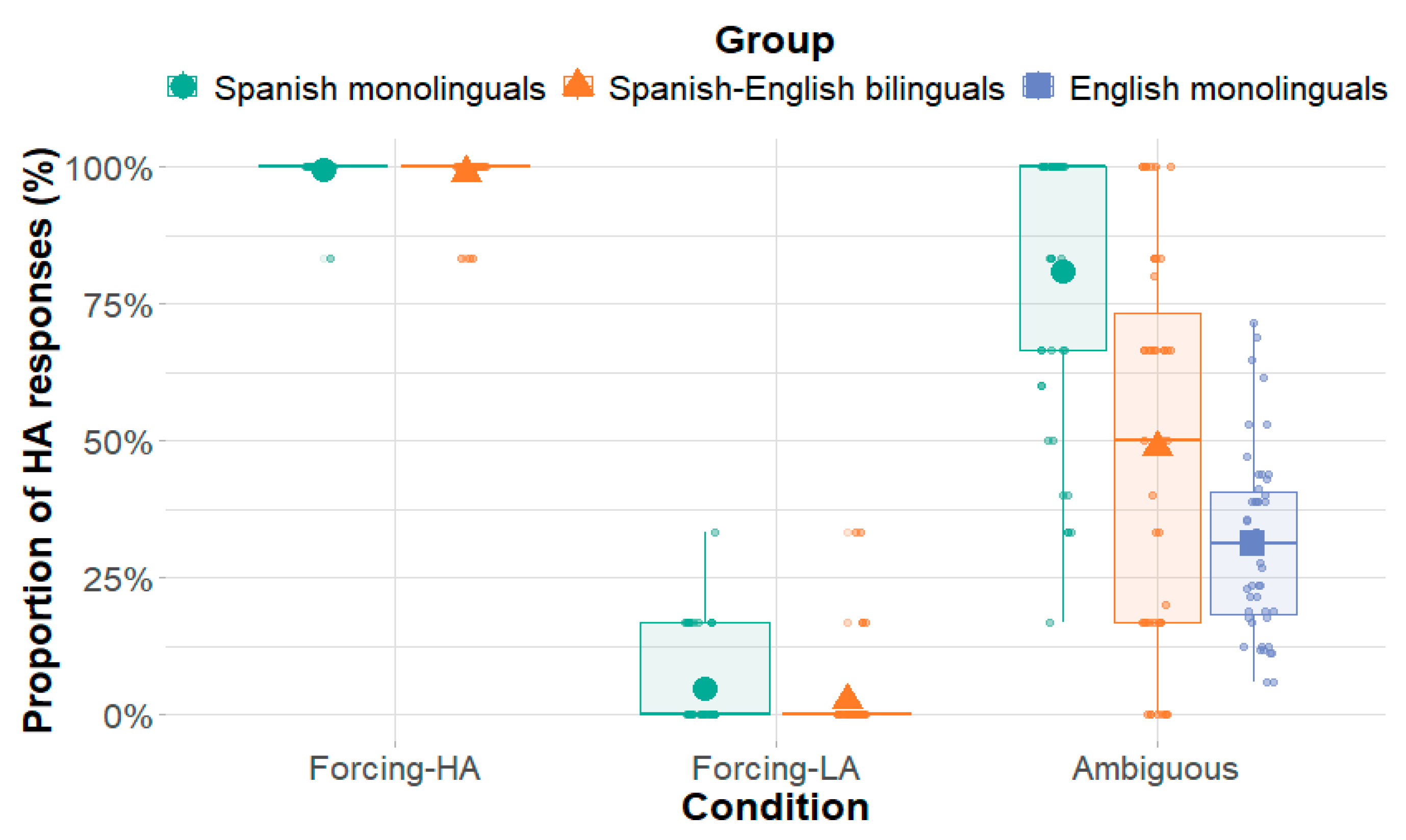
Figure 1 presents the percentage (%) of HA responses by group and condition. Data for the English group is only available for the ambiguous condition, as this was the only experimental condition tested in the English version of the PST. Forcing-HA and forcing-LA conditions serve as control conditions to verify that Spanish monolinguals and bilinguals correctly understand non-ambiguous sentences.
In the forcing-HA condition, as expected, both Spanish monolinguals and bilinguals consistently selected an HA interpretation (Spanish: mean = 100%, SD = 0; bilinguals: mean = 99.3%, SD = 3.47). Regarding the forcing-LA condition, also as predicted, the low percentage of HA responses in both groups (Spanish: mean = 4.26%, SD = 8.21; bilinguals: mean = 2.22%, SD = 7.62) indicates an LA preference since the RC can only be interpreted as modifying NP2.
Focusing on ambiguous sentences, at a group level, the Spanish group clearly preferred an HA interpretation (mean = 82.9%, SD = 24.3), while the native English group preferred an LA interpretation, as evidenced by the considerably lower percentage of HA choices (mean HA-choices: 31.2%, SD = 16.5), suggesting a tendency towards LA. Instructed bilinguals performed at chance levels (mean = 51.3%, SD = 34.9), indicating a reduction in the typical Spanish preference for HA. This pattern suggests that bilinguals showed no clear preference for either attachment strategy and were, therefore, less categorical in their responses compared to both monolingual groups.
Figure 1 also shows the individual mean HA responses per participant to better illustrate the degree of variation at the individual level. To facilitate interpretation, these were then grouped into five intervals (0%, 25%, 50%, 75%, and 100%), which represent ranges: 0% corresponds to 0–12.5%, 25% to 12.5–37.5%, 50% to 37.5–62.5%, 75% to 62.5–87.5%, and 100% to 87.5–100%. Regarding bilinguals, the majority (31/47) fell within the intermediate 50% category, with smaller proportions in the 75% (9/47) and 25% (7/47) categories. This indicates that bilinguals predominantly exhibited L1–L2 optionality in attachment strategies, alternating between HA and LA responses. However, a minority still showed a preference for HA, while another minority seemed to shift towards the L2 strategy. As for monolinguals, it is worth noting that some degree of variability was observed, which shows that attachment strategies are preferences rather than categorical distinctions.

6.2. RCA Preferences: Inferential Statistics

Before analysing the condition of interest (i.e., the ambiguous condition), we conducted a preliminary analysis comparing the two L1 Spanish groups in the two unambiguous conditions, where no differences between groups were expected. To ensure this, a subset was created in R (R Core Team, 2024). The dependent variable was participants’ attachment responses (0 = LA, 1 = HA). Fixed effects included group and condition, as well as their interaction. Predictors were sum-coded as follows: group (Spanish monolinguals = +1, bilinguals = −1), condition (forcing-HA = +1, forcing-LA = −1). A mixed-effects logistic regression model was fitted with random intercepts for participant and item. As expected, results from the group*condition interaction revealed non-significant differences (p = 0.868), confirming that bilinguals and Spanish monolinguals exhibited the same behaviour in unambiguous sentences, showing no signs of L1 attrition.
To address attrition effects on RCA preferences, two analyses were conducted. First, attachment responses were analysed considering group differences only. A second analysis included language dominance as a continuous predictor to test whether differences in dominance modulated attachment preferences across groups. In both analyses, only data from the ambiguous condition across all groups were considered.
For the first analysis, pre-processed data were exported to R (R Core Team, 2024). Data from the ambiguous condition were analysed with a binomial logistic regression model using the lme4 package (Bates et al., 2015). The dependent variable was participants’ attachment choices (coded as 0 = LA, 1 = HA). To address attachment preferences across groups in ambiguous sentences, the final model included group (Spanish monolinguals, bilinguals, and English monolinguals) as independent variable (i.e., as a predictor), which was sum-coded as follows: English monolinguals [1, 0], Spanish monolinguals [0, 1], and bilinguals [−1, −1]. The bilingual group was coded as −1 to allow it to be directly compared to both monolingual groups. Random intercepts for participant and item were included to account for by-participant and by-item variability. Regarding random slopes, an initial model included group by item but resulted in a singularity issue, so it was removed to reduce complexity in the random-effects structure.
The intercept represents the grand mean of HA responses across all groups in the ambiguous condition. Significant group differences were found in the ambiguous condition (χ2(2) = 72.41, p < 0.001). As expected, English monolinguals were predicted to select significantly fewer HA responses (β = −1.27, p < 0.001), indicating a preference for LA. In contrast, Spanish monolinguals showed significantly higher probability of providing an HA response (β = 1.57, p < 0.001), revealing a clear preference for HA. These patterns indicate that instructed bilinguals significantly differed from both monolingual groups, exhibiting less straightforward attachment preferences.
A second analysis addressed whether language dominance may modulate L1 interpretation of ambiguous RCs in L1 Spanish–L2 English bilinguals. It was predicted that higher English dominance correlated with stronger L1 attrition effects, i.e., higher selection of an LA interpretation in more English-dominant bilinguals. Dominance was assessed using the BLP questionnaire, which provides a final dominance score for each participant. The dominance variable was pre-processed to place all participants’ scores within the same language continuum. For all groups: values closer to the negative end of the continuum (−218) indicate higher Spanish dominance, while values closer to the positive end (+218) indicate higher English dominance. Before adding this variable as a continuous predictor in the statistical model, BLP scores were standardised by dividing each value by the standard deviation of the variable, without mean-centring. This was so because in the original scale (±218), the value 0 has a specific interpretation: balanced bilingualism.
A generalised linear mixed-effects model was fitted to data from the ambiguous condition across groups. The dependent variable was attachment choices, and the model structure of maximum fit included fixed effects of group (sum-coded as above), language dominance, and their interaction. The intercept reflected the grand mean across groups. Random intercepts for participant and item were also included.
Overall, a significant interaction between group and dominance was observed (χ2(2) = 6.00, p = 0.050), indicating that the effect of dominance on attachment preferences differed across groups. However, fixed effects showed that this interaction was significant for the contrast between English monolinguals and bilinguals only (β = −3.737, p = 0.025), but not for the contrast between Spanish monolinguals and bilinguals (β = 0.672, p = 0.766). To further examine the role of dominance within bilinguals, a separate linear mixed-effects model was fitted, including only bilingual data, with dominance as a continuous predictor and random intercepts for participant and item. Results did not reveal a significant effect of dominance (χ2(1) = 2.25, p = 0.134). Consistently, the fixed effect of dominance was not significant (β = 2.30, p = 0.125). Taken together, findings suggest that the apparent modulating effect of dominance should be interpreted with caution, as it does not reflect a robust effect of dominance in bilinguals.

6.3. Response Times: Descriptive Results

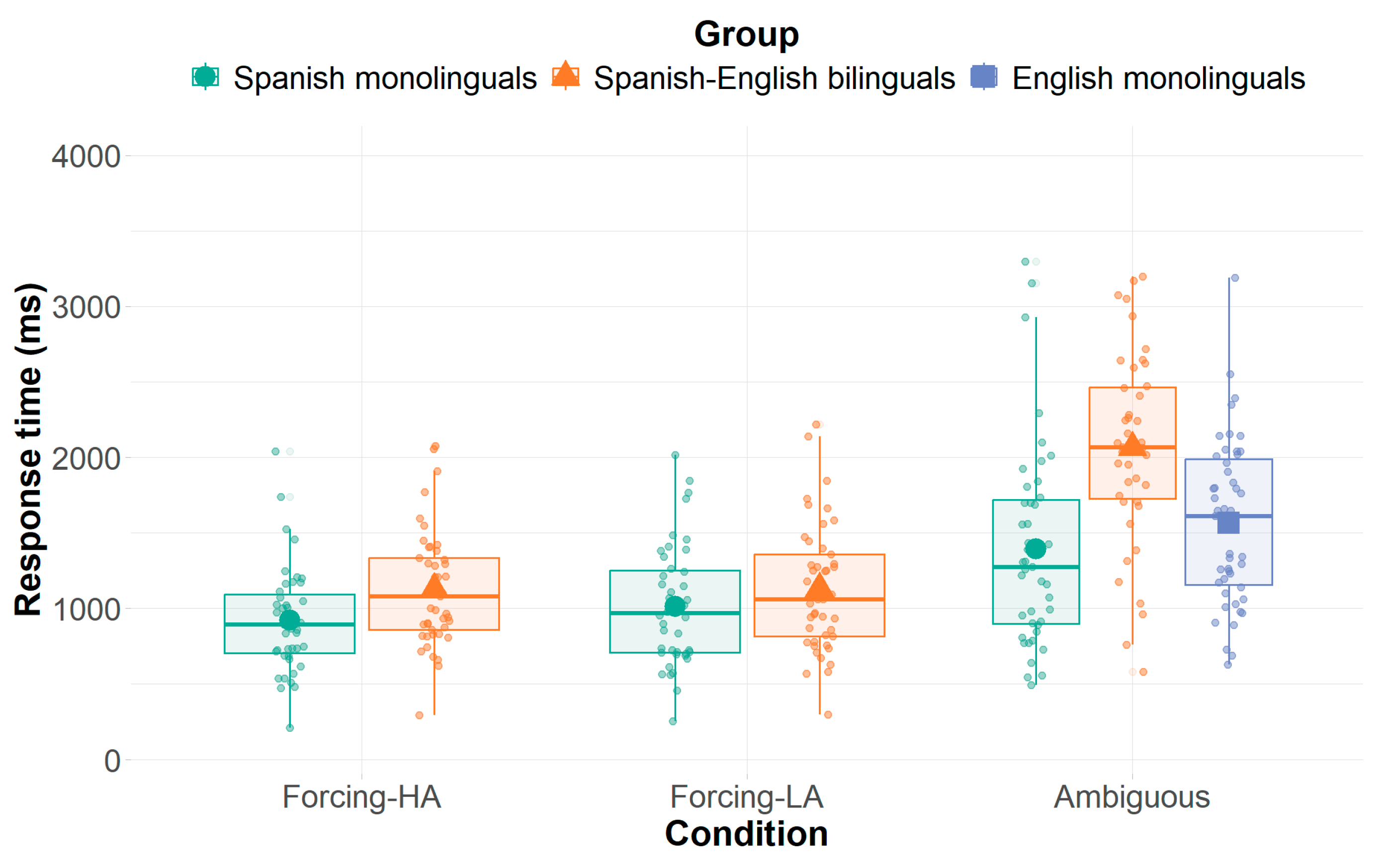
Figure 2 presents participants’ RTs in milliseconds (ms) by condition (forcing-HA, forcing-LA, and ambiguous) across groups (Spanish monolinguals, instructed bilinguals, and English monolinguals).
First, in the two control conditions, Spanish monolinguals and L1 Spanish–L2 English bilinguals showed similar patterns, as expected, providing fast responses in non-ambiguous sentences. In the forcing-HA condition, Spanish monolinguals recorded a mean RT of 922 ms (SD = 486), while instructed bilinguals had a mean of 1128 ms (SD = 514). Similarly, in the forcing-LA condition, Spanish monolinguals showed a mean response time of 1013 ms (SD = 575), compared to 1128 ms (SD = 589) for bilinguals.
Regarding the ambiguous condition, group differences were observed, with Spanish monolinguals being the fastest in providing a response (mean = 1345 ms, SD = 865), followed first by English monolinguals (mean = 1558 ms, SD = 1007) and then by instructed bilinguals (mean = 2066, SD = 1051). Overall, ambiguous sentences elicited longer response times in all groups. However, the increase was not balanced across groups, with the most pronounced increase observed in bilinguals.

6.4. Response Times: Inferential Statistics

To explore attrition effects in L1 processing, two analyses were conducted, following the same approach used for offline responses. First, RT data were examined considering only cross-group variation in processing patterns. Second, an additional analysis included language dominance as a continuous predictor to assess whether differences observed may be further modulated by dominance. Both analyses were restricted to data from the ambiguous condition.
For the first analysis, RT data were analysed using generalised linear mixed-effects models using the lme4 package (Bates et al., 2015). The dependent variable, response times, was log-transformed to normalise model residuals (Vasishth & Nicenboim, 2016). The final model included fixed effects of group and random intercepts for participant and item. The contrast coding was the same as outlined for attachment preferences in 6.2.
A significant main effect of group was found (F(2, 141.13) = 6.05, p < 0.003). The model revealed significant differences between instructed bilinguals and both Spanish monolinguals (β = −0.179, p = 0.001) and English monolinguals (β = −0.105, p = 0.039). In ambiguous sentences, instructed bilinguals showed higher RTs, i.e., they took longer to provide a response, than both control groups, who made their final decision faster.
A second analysis included language dominance as a continuous predictor. It was expected that greater English dominance would be associated with stronger L1 attrition effects, i.e., longer RTs reflecting additional time to provide a response. Following the approach used for offline responses, language dominance was added to the generalised linear mixed-effects model previously described, which predicted RTs based on group. Thus, the final model included fixed effects of group (sum-coded as indicated above), language dominance, and their interaction, along with random intercepts for participant and item.
Model results show that the main effect of language dominance did not reach statistical significance (β = 0.513, p = 0.218). Similarly, the interaction between group and dominance was not significant either (χ2(2) = 0.78, p = 0.379), indicating that dominance does not modulate response patterns across groups. To further examine the effect of dominance within the bilingual group, a separate model was fitted for bilinguals only. No significant effect of dominance was observed in this group (χ2(1) = 0.012, p = 0.813), confirming the absence of a dominance effect on RTs among bilinguals.

7. Discussion and Conclusions

This study addressed L1 grammatical attrition in late sequential L1 Spanish–L2 English bilinguals exposed to their L2 in an instructed setting, focusing on their L1 interpretation and processing of RCA ambiguities. Instructed bilinguals were examined in comparison with two L1 control groups, i.e., Spanish monolinguals and English monolinguals. Results from a PST revealed significant group effects both in the interpretation and processing of ambiguous RCs, providing evidence of L1 attrition among instructed bilinguals. This was manifested as optionality in bilinguals’ attachment preferences and increased processing cost when resolving ambiguous sentences in their L1.

7.1. RCA Preferences

Results confirmed the predictions for RQ1. Focusing on bilinguals’ L1 interpretation, evidence of L1 attrition was observed in instructed bilinguals, reflected in a weakening of the typical HA preference in native Spanish and an increased tendency towards the L2-preferred LA strategy. As illustrated in Figure 1, individual attachment responses reveal that the majority of bilinguals (31/47) alternate between HA and LA strategies in their L1, resulting in a pattern of optionality (Baker, 2024; Gürel & Yilmaz, 2011). This pattern is consistent with accounts that conceptualise grammatical attrition not only as complete replacement of L1 forms, but also as involving alternation between L1 and L2 grammatical options (see Baker, 2024; Hicks & Domínguez, 2020 for a discussion). In such cases, L2 options (i.e., LA) are incorporated into the existing L1 grammar without fully replacing it, resulting in co-existing strategies within the same speaker. Thus, most of our instructed bilinguals show no clear attachment preference: they neither consistently favour their L1-preferred strategy (HA) nor the L2 mechanism (LA), appearing to be equally likely to resolve ambiguous RCs through an HA or an LA interpretation.
Although a minority, Figure 1 also shows that some bilinguals (9/47) predominantly select LA, suggesting that the L2 strategy replaced the L1 mechanism. However, overall, optionality appears to be the predominant outcome of L1 attrition in our data. This pattern of optionality has been reported in prior attrition studies in immersed bilinguals (Baker, 2024; Gürel & Yilmaz, 2011). In this same line, and more specifically within the domain of RCA ambiguities, our findings are consistent with previous research on immersed bilinguals, who exhibit attenuated L1 interpretative biases and increased use of the L2 strategy (Dussias, 2003; Jegerski et al., 2016a). The present study extends this pattern to instructed L2-exposure settings, showing that optionality can emerge not only when bilinguals are immersed in naturalistic L2 environments, but also in L2 classroom-based contexts. Additionally, while studies tend to only report group-level preferences, the present study has further illustrated individual variability, with most bilinguals exhibiting optionality.
Bilinguals’ behaviour contrasts with that of control monolingual groups, who exhibit more consistent interpretative biases. Spanish monolinguals reveal a HA preference, while English monolinguals tend to prefer LA, aligning with previous studies on RCA interpretation preferences in native Spanish and English (Cheng et al., 2021; Cuetos & Mitchell, 1988; Dussias, 2003; Jegerski et al., 2016a). Importantly, at a group level, our instructed bilinguals not only differ from Spanish monolinguals but also from English monolinguals. Results show that, overall, bilinguals exhibit significantly higher HA bias (and therefore, lower LA bias) than English speakers.

7.2. RCA Response Times

Predictions for RQ2, which addressed attrition effects in bilinguals’ L1 processing, were also confirmed. Results showed higher RTs (i.e., slower responses) in bilinguals compared to monolinguals, indicating that bilinguals needed more time to process ambiguous sentences and consciously select a final interpretation. In contrast, both monolingual groups were faster in selecting a final interpretation. These findings align with previous research on online RCA biases in immersed bilinguals (Dussias & Sagarra, 2007), and RT findings align with those we obtained for offline responses. Bilinguals, unlike monolinguals, have two active linguistic systems with opposing attachment strategies (HA vs. LA). Such language coactivation seems to result in an increased likelihood that both attachment strategies remain active and accessible during processing. This is indeed reflected in bilinguals’ optionality in attachment responses, as most bilingual participants alternate between the L1 and L2 strategies rather than consistently selecting one. Such availability of competing alternatives is, in turn, likely to result in greater hesitation. In this sense, longer RTs can be interpreted as reflecting the additional processing time required to resolve this competition and select between the available alternatives (HA and LA).
These findings are consistent with predictions of the Activation Threshold Hypothesis (Paradis, 1993, 2004, 2007), which highlights the role of language experience and proposes that L1 changes emerge as a function of frequency and recency of language use/exposure. The groups analysed differ in their attachment preferences and RTs. Monolinguals, who are more frequently exposed to and use the L1, exhibit a strong bias towards the typical L1 strategy. In contrast, instructed bilinguals, who use the L2 more frequently, show less categorical L1 preferences and greater tolerance of the L2 strategy. Results at a group level indicate that increased L2 exposure/use (even in non-naturalistic settings) is associated with greater L1 optionality and processing cost, revealing increased activation of L2 patterns, which results in alternation between L1 and L2 strategies.
Within the framework of the ATH, our results suggest that L1 activation thresholds can be lowered in instructed bilinguals. At the group level, the attenuation of the typical L1 HA preference indicates a shift in activation patterns, but the individual-level data (see Figure 1) reveal some degree of variability. Most bilinguals alternate between HA and LA, which suggests that the activation thresholds of L1 and L2 representations are relatively similar, resulting in optionality due to comparable activation levels. In these cases, neither parsing strategy clearly dominates, and both remain available. At the same time, a small subset of bilinguals shows a preference for LA, following the L2 pattern. Such cases suggest a stronger reconfiguration of activation thresholds, since L2 representations become more accessible than L1 ones. Conversely, another small subset maintains an HA preference, indicating that L1 thresholds remain lower and relatively unaffected by L2 exposure. Overall, our findings indicate that while instructed L2 exposure can lower L1 thresholds and increase competition between L1 and L2 representations, this process is subject to individual variability. Our data contribute to the ATH, showing that changes in activation thresholds are possible in non-naturalistic contexts, and that these changes do not equally affect all bilinguals.

7.3. Role of Dominance

Finally, RQ3 addressed whether language dominance modulates potential attrition effects in bilinguals. Predictions for RQ3 were disconfirmed. It was expected that greater English dominance would correlate with stronger attrition effects, reflected as increased selection of LA interpretations and higher processing cost. However, the effect of dominance was not significant on both offline and online measures, indicating that it cannot account for variability in attachment preferences or response patterns. One possible explanation is related to the language dominance variable itself. As measured by the BLP questionnaire (Birdsong et al., 2012), dominance is a gradient, multi-faceted concept encompassing several components: language use, language history, proficiency, and language attitudes. It is therefore possible that specific sub-components of dominance, such as language use, may be more sensitive modulating predictors of attrition signs. Additionally, the amount of data may have been insufficient for the statistical models to uncover subtle effects. Future research could address this issue by increasing the number of items tested and recruiting participants with a wider range of dominance profiles. Doing so would ensure a broader representation of language dominance along the BLP continuum and, in turn, provide more conclusive results.

7.4. Final Conclusions

This study revealed L1 attrition effects in the interpretation and processing of RCA ambiguities in instructed bilinguals, comparable to those reported in immersed settings. Although instructed bilinguals do not meet traditional conditions for attrition, they fall within the broader definition of L1 attrition proposed by Schmid and Köpke (2017). What makes our findings particularly revealing is that instructed bilinguals differ from immersed bilinguals in the key factors typically associated with attrition. Considering input quantity, bilinguals received a substantial amount of L2 input as they were completing a degree entirely taught in L2 English. However, they may not reach the same amount of input as immersed bilinguals, who tend to report a predominant use of their L2 (Jegerski et al., 2016b; Kasparian & Steinhauer, 2016), given that the L2 is their functional language and is present in a wider range of communicative contexts. Input quantity is also related to the L1. Instructed bilinguals lived in an environment where the L1 remained the societal language and was used extensively with family and friends outside the university. Consequently, they did not experience substantial L1 disuse or lack of exposure. Although studying in English reduces their L1 exposure and opportunities for L1 use compared to other Spanish monolinguals in Spain, L1 use and input remain considerably higher than that of naturalistically immersed bilinguals.
Additionally, most of the oral input instructed bilinguals received came from non-native speakers, typically Spanish native speakers who taught their courses in English. Consequently, bilinguals were not exposed to a native variety of their L2, which again contrasts with the typical situation of immersed contexts. Together with these differences, instructed bilinguals in our study remained L1-dominant. Previous attrition studies have focused on bilinguals in L2-dominant contexts (Cuza, 2010; Dussias, 2003; Gürel, 2004; Tsimpli et al., 2004), reporting attrition in this population. Instructed bilinguals, however, show only a reduced degree of L1 dominance compared to monolinguals.
We expected that these differences in input quantity and quality, L1–L2 patterns of use and exposure, and dominance might modulate the extent of attrition effects in instructed vs. immersed bilinguals, rather than the specific patterns of attrition themselves. Compared to the prior literature on RCA ambiguities, our findings seem to indicate that attrition effects in our instructed bilinguals are comparable to those reported for immersed bilinguals (see Section 3.2). The emergence of attrition effects in instructed bilinguals with these characteristics suggests that attrition can be triggered by lower amounts of L2 input than traditionally assumed and by non-naturalistic (i.e., classroom-based) L2 exposure. These findings contribute to our understanding of the extent of L1 attrition, particularly regarding the input contexts in which it may arise.
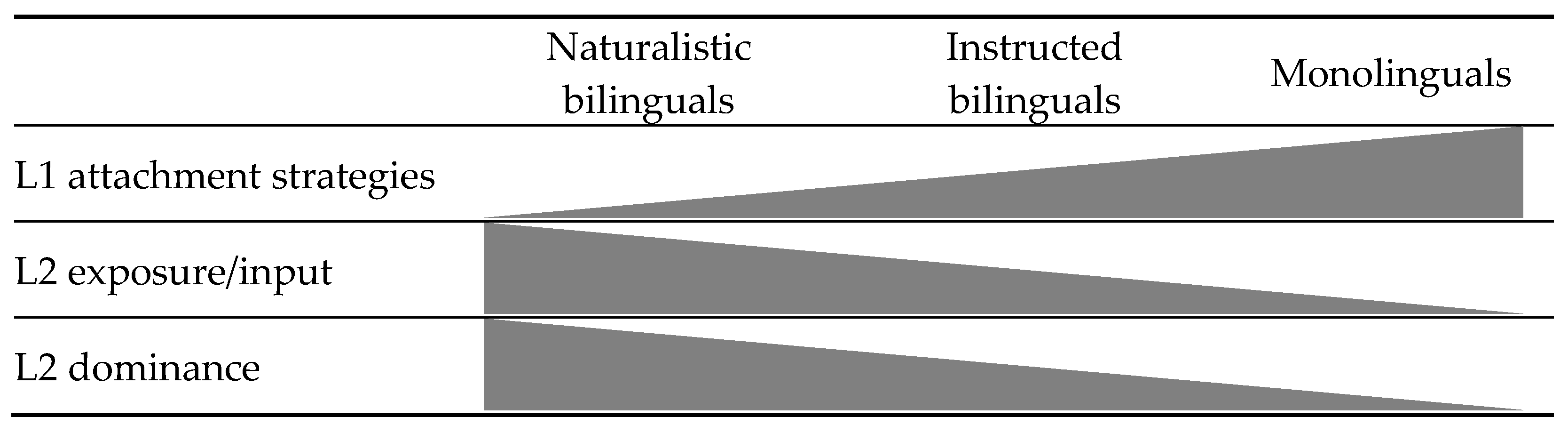
However, further research is required to determine the extent to which instructed L2 exposure influences bilinguals’ L1. Our study did not include a group of immersed bilinguals in an L2-speaking environment, so we limited our comparison to previous findings on RCA in such populations. To the best of our knowledge, no study has jointly examined instructed and immersed bilinguals for RCA. This approach becomes particularly relevant considering the results obtained by Martín-Villena et al. (2025), who directly compared instructed and immersed bilinguals in anaphora resolution. Such direct comparison would allow us to determine whether instructed bilinguals exhibit attrition effects comparable to those of immersed bilinguals, or whether, as Martín-Villena et al. (2025) suggest, a gradient pattern emerges, with stronger effects in immersed bilinguals and more attenuated effects in instructed learners. This latter possibility is captured in Figure 3, which paves the way for future research. Naturalistic bilinguals, typically characterised by a higher degree of L2 exposure/input and dominance, would show the weakest reliance on the L1-preferred strategy and a substantial adoption of the L2 mechanism. Instructed bilinguals would display an intermediate or mitigated degree of L1 attachment preferences, whereas Spanish monolinguals would show the strongest L1 bias due to their minimal L2 exposure/input and dominance. In order to advance this idea further, it is necessary to conduct more studies that compare monolinguals with instructed and immersed bilinguals across multiple linguistic properties, including RCA, and implement rigorous analyses of factors such as L1–L2 exposure, dominance, and proficiency. This would shed new light on the extent of attrition effects in naturalistically immersed bilinguals vs clasroom-based instructed bilinguals.

Author Contributions

Conceptualization, C.L. and E.G.-G.; methodology, E.G.-G. and C.L.; software, E.G.-G.; formal analysis, E.G.-G.; investigation, E.G.-G. and C.L.; resources, E.G.-G. and C.L.; writing—original draft preparation, E.G.-G.; writing—review and editing, E.G.-G. and C.L.; supervision, C.L.; project administration, C.L.; funding acquisition, C.L. and E.G.-G.; Hardware acquisition: C.L. All authors have read and agreed to the published version of the manuscript.

Funding

This research was funded by Ministerio de Ciencia e Innovación, grant number PID2020-113818GB-I00.

Institutional Review Board Statement

The study was approved by the Ethics Committee of the University of Granada (protocol code 1794/CEIH/2020 and date of approval 9 December 2020) for studies involving humans.

Informed Consent Statement

Informed consent was obtained from all subjects involved in the study.

Data Availability Statement

Data and analyses will be made publicly available via OSF upon potential acceptance.

Acknowledgments

This study was funded by grant number PID2020-113818GB-I00 from MCIN (Ministerio de Ciencia e Innovación), AEI (Agencia Estatal de Investigación) (DOI: https://doi.org/10.13039/501100011033) to the second author, and supported by a predoctoral FPU contract funded by Ministerio de Ciencia, Innovación y Universidades and a research grant from the British Spanish Society awarded to the first author.

Conflicts of Interest

The authors declare no conflicts of interest.

Abbreviations

The following abbreviations are used in this manuscript:
BLPBilingual language profile
HAHigh attachment
LALow attachment
L1First language
L2Second language
NPNoun phrase
OQPTOxford Quick Placement Test
PSTPicture selection task
RCRelative clause
RCARelative clause attachment
SLASecond language acquisition
UKUnited Kingdom
USUnited States

Notes

1
The term “instructed bilinguals” does not imply that bilingual participants received explicit instruction on the linguistic structure under investigation (i.e., RCA ambiguities), which we confirm they did not receive.
2
There are no previous RCA studies examining L1 grammatical attrition in instructed settings, so we will draw on research from other structures to provide the necessary background.
3
The English translation is the original one used by Cuetos and Mitchell (1988).
4
Percentages do not add up to 100% because the original task also included a “neither” option participants could select.
5
The scope of the study was broader as it also investigated L2 learners of Spanish and English. Results for bilinguals will be discussed in the following section.
6
L2 proficiency is not included as a separate variable in the analysis, and therefore, it is not addressed independently in the RQs. This is because proficiency is considered a component of language dominance and is incorporated into standard measures of dominance (e.g., the BLP questionnaire), so it is not examined separately.
7
A regression model was applied to the data from English participants, predicting attachment preferences based on their L2, and no significant differences were found. English natives who studied L2 Spanish do not significantly differ from those who studied L2 French (β = −0.23, p = 0.091). Thus, we are confident that the L2 of the English monolingual group does not act as a confounding variable in the results.
8
Thematic prepositions like with seem to favour LA interpretations of ambiguous RCs in English, while the preposition of fosters more neutral attachment preferences.
9
The lab for data collection from Spanish monolinguals and bilinguals was BilinguaLab at the University of Granada, while the lab for English monolinguals was the Cambridge Processing and Acquisition of Language Lab (CAMPAL) at the University of Cambridge.

References

  1. Acuña-Fariña, C., Fraga, I., García-Orza, J., & Piñeiro, A. (2009). Animacy in the adjunction of Spanish RCs to complex NPs. European Journal of Cognitive Psychology, 21(8), 1137–1165. [Google Scholar] [CrossRef]
  2. Baker, L. (2024). The role of linguistic input in adult grammars: Modelling L1 morphosyntactic attrition [Ph.D. thesis, University of Southampton]. Available online: https://eprints.soton.ac.uk/487888/ (accessed on 10 February 2025).
  3. Bates, D., Mächler, M., Bolker, B., & Walker, S. (2015). Fitting linear mixed-effects models using LME4. Journal of Statistical Software, 67(1), 1–48. [Google Scholar] [CrossRef]
  4. Bergmann, A., Armstrong, M., & Maday, K. (2008, May 6–9). Relative clause attachment in English and Spanish: A production study. Speech Prosody 2008, Campinas, Brazil. [Google Scholar]
  5. Birdsong, D., Gertken, L. M., & Amengual, M. (2012). Bilingual language profile: An easy-to-use instrument to assess bilingualism. COERLL. [Google Scholar]
  6. Cairncross, A., Vogelzang, M., & Tsimpli, I. (2023). Pseudorelatives, relatives, and L1 attrition: Resilience and vulnerability in parser biases. International Journal of Bilingualism, 28(5), 1016–1032. [Google Scholar] [CrossRef]
  7. Carreiras, M., & Clifton, C. (1993). Relative clause interpretation preferences in Spanish and English. Language and Speech, 36(4), 353–372. [Google Scholar] [CrossRef]
  8. Chamorro, G., Sorace, A., & Sturt, P. (2016). What is the source of L1 attrition? The effect of recent L1 re-exposure on Spanish speakers under L1 attrition. Bilingualism: Language and Cognition, 19(3), 520–532. [Google Scholar] [CrossRef]
  9. Cheng, Y., Rothman, J., & Cunnings, I. (2021). Parsing preferences and individual differences in nonnative sentence processing: Evidence from eye movements. Applied Psycholinguistics, 42(1), 129–151. [Google Scholar] [CrossRef]
  10. Cook, V. (Ed.). (2003). The effects of the second language on the first. Multilingual Matters. [Google Scholar]
  11. Crocker, M. W. (1996). Computational psycholinguistics: An interdisciplinary approach to the study of language. Kluwer. [Google Scholar]
  12. Cuetos, F., & Mitchell, D. C. (1988). Cross-linguistic differences in parsing: Restrictions on the use of the late closure strategy in Spanish. Cognition, 30(1), 73–105. [Google Scholar] [CrossRef]
  13. Cuza, A. (2010). On the L1 attrition of the Spanish present tense. Hispania, 93(2), 256–272. [Google Scholar] [CrossRef]
  14. Dahl, A., & Vulchanova, M. D. (2014). Naturalistic acquisition in an early language classroom. Frontiers in Psychology, 5, 329. [Google Scholar] [CrossRef] [PubMed]
  15. Długosz, K. (2021). L2 effects on L1 in foreign language learners: An exploratory study on object pronouns and verb placement in wh-questions in Polish. Papers in Linguistics, 23(4), 153–172. [Google Scholar] [CrossRef]
  16. Domínguez, L. (2013). Understanding interfaces: Second language acquisition and first language attrition of Spanish subject realization and word order variation (Vol. 55). John Benjamins Publishing Company. [Google Scholar] [CrossRef]
  17. Dussias, P. E. (2003). Syntactic ambiguity resolution in L2 learners: Some effects of bilinguality on L1 and L2 processing strategies. Studies in Second Language Acquisition, 25(4), 529–557. [Google Scholar] [CrossRef]
  18. Dussias, P. E., & Sagarra, N. (2007). The effect of exposure on syntactic parsing in Spanish–English bilinguals. Bilingualism: Language and Cognition, 10(01), 101. [Google Scholar] [CrossRef]
  19. ESL Free French Level Test. (2023). Available online: https://www.esl-languages.com/en/online-language-tests/french-test (accessed on 10 February 2025).
  20. Frazier, L. (1978). On comprehending sentences: Syntactic parsing strategies [Doctoral dissertations, University of Connecticut]. [Google Scholar]
  21. Frenck-Mestre, C., & Pynte, J. (2000). Resolving syntactic ambiguities: Cross-Linguistic differences? In M. De Vincenzi, & V. Lombardo (Eds.), Cross-linguistic perspectives on language processing (Vol. 25, pp. 119–148). Springer Netherlands. [Google Scholar] [CrossRef]
  22. Fromont, L. A., Soto-Faraco, S., & Biau, E. (2017). Searching high and low: Prosodic breaks disambiguate relative clauses. Frontiers in Psychology, 8(96), 96. [Google Scholar] [CrossRef]
  23. Gargiulo, C. (2020). On L1 attrition and prosody in pronominal anaphora resolution. Lund University. Available online: https://www.ht.lu.se/en/series/9855440/ (accessed on 10 February 2025).
  24. Gürel, A. (2004). Selectivity in L2-induced L1 attrition: A psycholinguistic account. Journal of Neurolinguistics, 17(1), 53–78. [Google Scholar] [CrossRef]
  25. Gürel, A. (2007). (Psycho)linguistic determinants of L1 attrition. In B. Köpke, M. S. Schmid, M. Keijzer, & S. Dostert (Eds.), Language attrition: Theoretical perspectives (pp. 99–119). John Benjamins. [Google Scholar]
  26. Gürel, A., & Yilmaz, G. (2011). Restructuring in the L1 Turkish grammar: Effects of L2 English and L2 Dutch. Language, Interaction and Acquisition, 2(2), 221–250. [Google Scholar] [CrossRef]
  27. Hemforth, B., Fernandez, S., Clifton, C., Frazier, L., Konieczny, L., & Walter, M. (2015). Relative clause attachment in German, English, Spanish and French: Effects of position and length. Lingua, 166, 43–64. [Google Scholar] [CrossRef]
  28. Hicks, G., & Domínguez, L. (2020). A model for L1 grammatical attrition. Second Language Research, 36(2), 143–165. [Google Scholar] [CrossRef]
  29. Hicks, G., Domínguez, L., Jamieson, E., & Schmid, M. S. (2024). L1 grammatical attrition in late Spanish-English bilinguals in the UK: Aspectual interpretations of present tense in Spanish. The Language Learning Journal, 52(2), 145–158. [Google Scholar] [CrossRef]
  30. Housen, A., & Pierrard, M. (2005). Investigating instructed second language acquisition. In A. Housen, & M. Pierrard (Eds.), Investigations in instructed second language acquisition (pp. 1–30). Mouton de Gruyter. [Google Scholar] [CrossRef]
  31. Iverson, M. (2012). Advanced language attrition of Spanish in contact with Brazilian Portuguese [Ph.D. thesis, University of Iowa]. [Google Scholar] [CrossRef]
  32. Jegerski, J., Keating, G. D., & VanPatten, B. (2016a). On-line relative clause attachment strategy in heritage speakers of Spanish. International Journal of Bilingualism, 20(3), 254–268. [Google Scholar] [CrossRef]
  33. Jegerski, J., VanPatten, B., & Keating, G. D. (2016b). Relative clause attachment preferences in early and late Spanish-English bilinguals. In D. Pascual y Cabo (Ed.), Advances in Spanish as a heritage language (Vol. 49, pp. 81–98). John Benjamins Publishing Company. [Google Scholar] [CrossRef]
  34. Kaltsa, M., Tsimpli, I. M., & Rothman, J. (2015). Exploring the source of differences and similarities in L1 attrition and heritage speaker competence: Evidence from pronominal resolution. Lingua, 164, 266–288. [Google Scholar] [CrossRef]
  35. Kasparian, K., & Steinhauer, K. (2016). Confusing similar words: ERP correlates of lexical-semantic processing in first language attrition and late second language acquisition. Neuropsychologia, 93, 200–217. [Google Scholar] [CrossRef] [PubMed]
  36. Lasagabaster, D. (2022). English-medium instruction in higher education (1st ed.). Cambridge University Press. [Google Scholar] [CrossRef]
  37. Lozano, C. (2009). Selective deficits at the syntax-discourse interface: Evidence from the CEDEL2 corpus. In N. Snape, Y. I. Leung, & M. Sharwood Smith (Eds.), Representational deficits in SLA: Studies in honor of roger Hawkins (Vol. 47, pp. 127–166). John Benjamins Publishing Company. [Google Scholar] [CrossRef]
  38. Marsden, E., Thompson, S., & Plonsky, L. (2018). A methodological synthesis of self-paced reading in second language research. Applied Psycholinguistics, 39(5), 861–904. [Google Scholar] [CrossRef]
  39. Martín-Villena, F. (2023). L1 morphosyntactic attrition at the early stages: Evidence from production, interpretation, and processing of subject referring expressions in L1 Spanish-L2 English instructed and immersed bilinguals. Universidad de Granada. [Google Scholar]
  40. Martín-Villena, F., & Lozano, C. (2020). Anaphora resolution in topic continuity: Evidence from L1 English–L2 Spanish data in the CEDEL2 corpus. In J. Ryan, & P. Crosthwaite (Eds.), Referring in a second language: Studies on reference to person in a multilingual world (1st ed., pp. 119–141). Routledge. [Google Scholar] [CrossRef]
  41. Martín-Villena, F., Lozano, C., & Sorace, A. (2025). L1 morphosyntactic attrition in instructed and immersed bilinguals: Modulators of redundancy in oral production. Bilingualism: Language and Cognition, 1–14. [Google Scholar] [CrossRef]
  42. Montrul, S. (2015). Dominance and proficiency in early and late bilingualism. In C. Silva-Corvalán, & J. Treffers-Daller (Eds.), Language dominance in bilinguals (1st ed., pp. 15–35). Cambridge University Press. [Google Scholar] [CrossRef]
  43. Oxford University Press. (2003). Quick placement test. Oxford University Press. [Google Scholar]
  44. Papadopoulou, D., & Clahsen, H. (2003). Parsing strategies in L1 and L2 sentence processing: A study of relative clause attachment in Greek. Studies in Second Language Acquisition, 25(4), 501–528. [Google Scholar] [CrossRef]
  45. Paradis, M. (1993). Linguistic, psycholinguistic, and neurolinguistic aspects of ‘interference’ in bilingual speakers: The activation threshold hypothesis. International Journal of Psycholinguistics, 9, 133–145. [Google Scholar]
  46. Paradis, M. (Ed.). (2004). A neurolinguistic theory of bilingualism. John Benjamins. [Google Scholar]
  47. Paradis, M. (2007). L1 attrition features predicted by a neurolinguistic theory of bilingualism. In B. Köpke, M. S. Schmid, M. Keijzer, & S. Dostert (Eds.), Studies in bilingualism (Vol. 33, pp. 121–133). John Benjamins Publishing Company. [Google Scholar] [CrossRef]
  48. Pritchett. (1992). Grammatical competence and parsing performance. University of Chicago Press. [Google Scholar]
  49. R Core Team. (2024). R: A language and environment for statistical computing [Computer software]. R Foundation for Statistical Computing. Available online: https://www.R-project.org/ (accessed on 15 September 2024).
  50. Requena, P. E., & Berry, G. M. (2021). Cross-linguistic influence in L1 processing of morphosyntactic variation: Evidence from L2 learners. Applied Psycholinguistics, 42(1), 153–180. [Google Scholar] [CrossRef]
  51. Rodríguez, G. (2004). Relative clause attachment preferences in second language learners’ parsing performance. University of Pennsylvania Working Papers in Linguistics, 10(1), 157–169. [Google Scholar]
  52. Schmid, M. S., & Cherciov, M. (2019). Introduction to extralinguistic factors in language attrition. In M. S. Schmid, & B. Köpke (Eds.), The Oxford handbook of language attrition (pp. 265–276). Oxford University Press. [Google Scholar] [CrossRef]
  53. Schmid, M. S., & Köpke, B. (2017). The relevance of first language attrition to theories of bilingual development. Linguistic Approaches to Bilingualism, 7(6), 637–667. [Google Scholar] [CrossRef]
  54. Schmid, M. S., & Köpke, B. (2019). The Oxford handbook of language attrition (First published in paperback). Oxford University Press. [Google Scholar]
  55. Silva-Corvalán, C., & Treffers-Daller, J. (2015). Digging into dominance: A closer look at language dominance in bilinguals. In C. Silva-Corvalán, & J. Treffers-Daller (Eds.), Language dominance in bilinguals (1st ed., pp. 1–14). Cambridge University Press. [Google Scholar] [CrossRef]
  56. Solaimani, E., & Marefat, H. (2024). Definiteness matters as a discourse cue in L1 and L2 processing of relative clauses. Pragmatics & Cognition, 31(1), 185–204. [Google Scholar] [CrossRef]
  57. Sorace, A. (2011). Pinning down the concept of “interface” in bilingualism. Linguistic Approaches to Bilingualism, 1(1), 1–33. [Google Scholar] [CrossRef]
  58. Treffers-Daller, J. (2019). What defines language dominance in bilinguals? Annual Review of Linguistics, 5(1), 375–393. [Google Scholar] [CrossRef]
  59. Tsimpli, I., Sorace, A., Heycock, C., & Filiaci, F. (2004). First language attrition and syntactic subjects: A study of Greek and Italian near-native speakers of English. International Journal of Bilingualism, 8(3), 257–277. [Google Scholar] [CrossRef]
  60. University of Wisconsin. (1998). The university of Wisconsin college-level placement test: Spanish (Grammar) form 96M. University of Wisconsin Press. [Google Scholar]
  61. Valenzuela, E., Klassen, R., Zamuner, T., & Borg, K. (2020). Ambiguous relative clause modifier attachment in code-switched constructions: Evidence from eye tracking. In Perspectivas actuales en la enseñanza y el aprendizaje de lenguas en contextos multiculturales [Current perspectives in language teaching and learning in multicultural contexts] (pp. 133–161). Aranzadi. [Google Scholar]
  62. Vasishth, S., & Nicenboim, B. (2016). Statistical methods for linguistic research: Foundational ideas—Part I. Language and Linguistics Compass, 10(8), 349–369. [Google Scholar] [CrossRef]
  63. Yilmaz, G. (2019). L1 attrition, L2 development, and integration. In M. Schmid, & B. Köpke (Eds.), Oxford handbook of language attrition (pp. 304–313). Oxford University Press. [Google Scholar]
  64. Zagar, D., Pynte, J., & Rativeau, S. (1997). Evidence for early closure attachment on first pass reading times in French. The Quarterly Journal of Experimental Psychology, 50(2), 421–438. [Google Scholar] [CrossRef]
  65. Zingaretti, M., Chondrogianni, V., Ladd, D. R., & Sorace, A. (2025). L1 attrition vis-à-vis L2 acquisition: Lexicon, syntax–pragmatics interface, and prosody in L1-English L2-Italian late bilinguals. Languages, 10(9), 224. [Google Scholar] [CrossRef]
Figure 1. Proportion of HA responses by condition and group.
Languages 11 00101 g001
Figure 2. Mean response times (ms) by condition and group.
Languages 11 00101 g002
Figure 3. Attrition gradience: Hypotheses for future research on RCA strategies across input contexts.
Languages 11 00101 g003
Table 1. Summary of participants’ profiles.
BilingualsSpanish MonolingualsEnglish Monolinguals
MSDMSDMSD
Age20.271.8222.32.5320.712.80
L2 proficiency53.283.5120.533.0317.342.71
Language dominance67.6513.54163.2411.28175.8915.91
Disclaimer/Publisher’s Note: The statements, opinions and data contained in all publications are solely those of the individual author(s) and contributor(s) and not of MDPI and/or the editor(s). MDPI and/or the editor(s) disclaim responsibility for any injury to people or property resulting from any ideas, methods, instructions or products referred to in the content.