Article

The Link Between Perception and Production in the Laryngeal Processes of Multilingual Speakers

by
Zsuzsanna Bárkányi
1,2,* and
Zoltán G. Kiss
3
1
School of Languages & Applied Linguistics, Faculty of Wellbeing, Education & Language Studies, The Open University, Milton Keynes MK7 6AA, UK
2
Hungarian Research Centre for Linguistics, 1068 Budapest, Hungary
3
Faculty of Humanities, ELTE Eötvös Loránd University, 1088 Budapest, Hungary
*
Author to whom correspondence should be addressed.
Languages 2025, 10(2), 29; https://doi.org/10.3390/languages10020029

Submission received: 12 August 2024 / Revised: 30 January 2025 / Accepted: 31 January 2025 / Published: 5 February 2025
(This article belongs to the Special Issue Advances in the Investigation of L3 Speech Perception)

Abstract

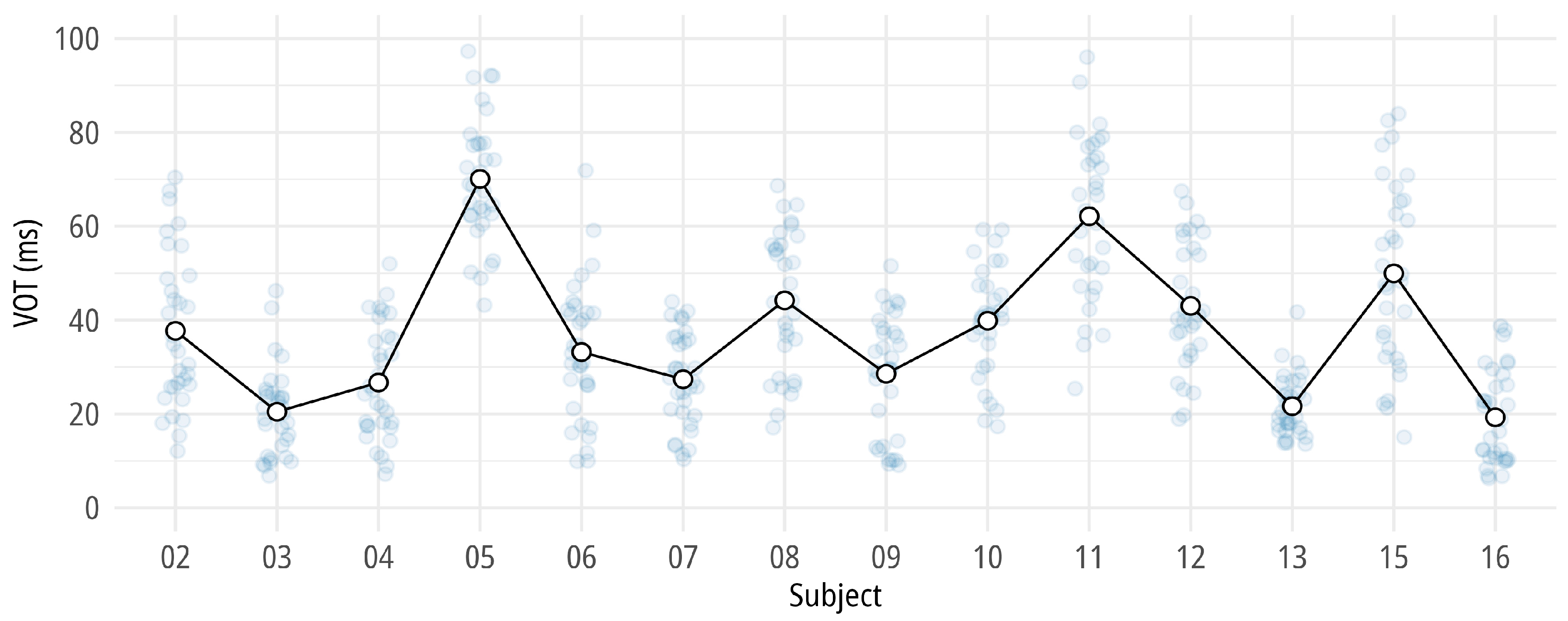
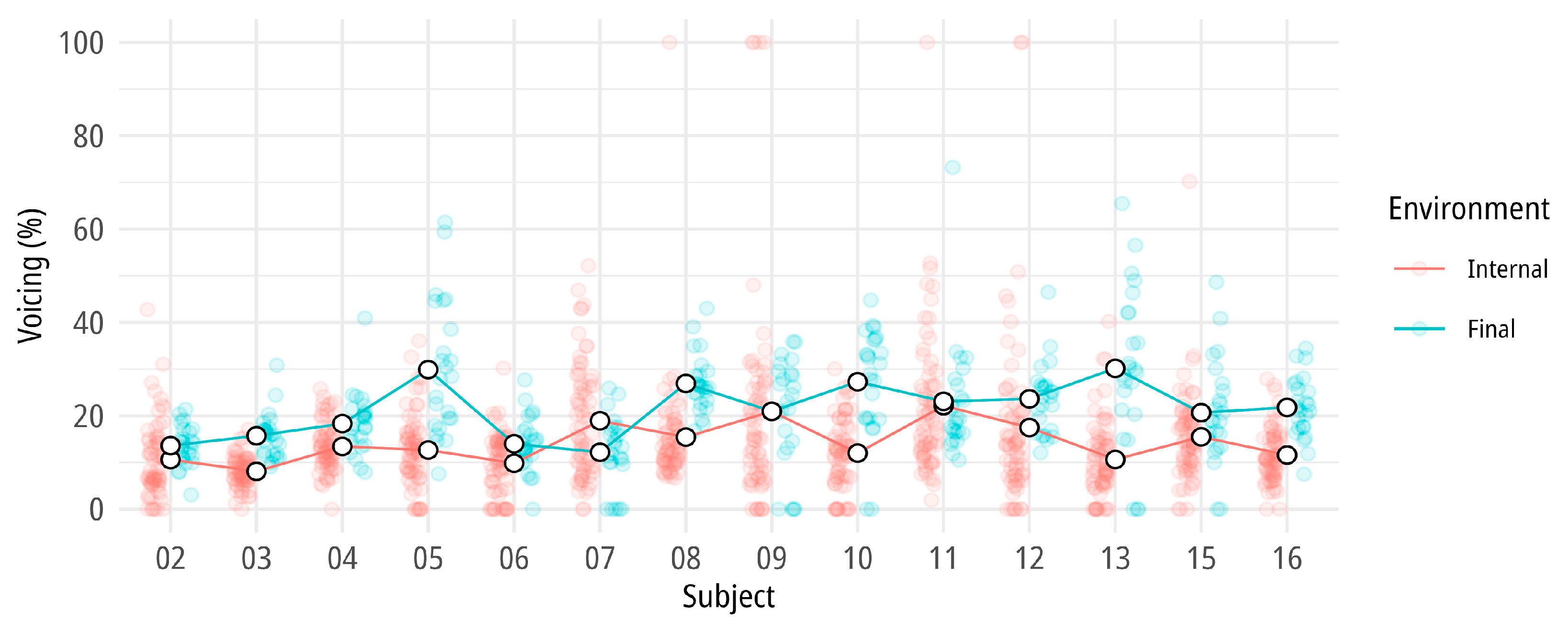
The present paper investigates the link between perception and production in the laryngeal phonology of multilingual speakers, focusing on non-contrastive segments and the dynamic aspect of these processes. Fourteen L1 Hungarian, L2 English, and L3 Spanish advanced learners took part in the experiments. The production experiments examined the aspiration of voiceless stops in word-initial position, regressive voicing assimilation, and pre-sonorant voicing; the latter two processes were analyzed both word-internally and across word boundaries. The perception experiments aimed to find out whether learners notice the phonetic outputs of these processes and regard them as linguistically relevant. Our results showed that perception and production are not aligned. Accurate production is dependent on accurate perception, but accurate perception is not necessarily transferred into production. In laryngeal postlexical processes, the native language seems to play the primary role even for highly competent learners, but markedness might be relevant too. The novel findings of this study are that phonetic category formation seems to be easier than the acquisition of dynamic allophonic alternations and that metaphonological awareness is correlated with perception but not with production.
Keywords: L3 phonology; multilingual phonology; speech perception; postlexical processes; regressive voicing assimilation; pre-sonorant voicing; VOT; Spanish; Hungarian; English L3 phonology; multilingual phonology; speech perception; postlexical processes; regressive voicing assimilation; pre-sonorant voicing; VOT; Spanish; Hungarian; English