1. Introduction
Nonlinear state estimation is a fundamental problem in sensor fusion, navigation, and bearings-only tracking, with important applications in aerospace systems [
1,
2,
3,
4,
5]. In such problems, the process and measurement models are often strongly nonlinear, while practical implementations are constrained by real-time computation and onboard processing capability. The extended Kalman filter (EKF) has long been one of the most widely used approaches because of its simple structure and modest computational cost. However, its first-order linearization may introduce non-negligible errors in strongly nonlinear regimes commonly encountered in practice. On the other hand, the sequential Monte-Carlo-based approaches, such as the particle filter (PF), can provide better accuracy, but their computational burden is often too high for real-time applications.
For this reason, deterministic sampling filters (DSFs), which approximate Gaussian-weighted integrals by carefully selected deterministic points and weights, have attracted considerable attention. Representative methods include the unscented Kalman filter (UKF) [
6], the cubature Kalman filter (CKF) [
7], and the Gauss–Hermite quadrature Kalman filter (GHQKF) [
8]. These methods typically provide more accurate Gaussian integral approximations than the EKF in strongly nonlinear settings, while remaining much more computationally efficient than sequential Monte-Carlo approaches [
9,
10].
Among these filters, the GHQKF is generally more accurate and stable than the UKF and CKF because it relies on Gauss–Hermite quadrature to compute Gaussian-weighted integrals. However, its tensor-product construction causes the number of quadrature points to grow exponentially with the state dimension, which makes it computationally expensive in higher-dimensional estimation problems. Sparse-grid rules have therefore been introduced to mitigate this limitation, leading to sparse-grid Gaussian filters with improved computational scalability [
11]. However, classical GHQ, Sparse-grid quadrature filter and sparse-GHQ-based filters still employ polynomial-based quadrature weights determined by moment-matching conditions, which limits their flexibility in adapting the quadrature rule to the structure of the underlying integrand.
A different line of research has emerged from the kernel quadrature and probabilistic numerical integration literature, where quadrature weights are derived by minimizing the worst-case integration error in a reproducing kernel Hilbert space (RKHS) [
12,
13,
14]. For the Gaussian kernel, Karvonen and Särkkä [
12] showed that Gaussian kernel quadrature (GKQ) can be constructed on scaled Gauss–Hermite nodes through the Mercer eigendecomposition, yielding kernel-adapted weights with attractive theoretical properties. Briol et al. [
14] further established the role of probabilistic integration in statistical computation, providing a broader theoretical foundation for kernel-based quadrature. In nonlinear filtering, Wang et al. [
15] and Naik et al. [
16] developed a Gaussian kernel quadrature Kalman filter (GKQKF) in the standard tensor-product setting, and Wu et al. [
17] further extended the GKQKF to the continuous–discrete system for GNSS interference source tracking.
However, the existing literature applies the GKQ rule mainly in the univariate or tensor-product setting, and its sparse-grid extension for higher-dimensional nonlinear estimation has not been fully developed. In contrast, existing sparse-grid filters, such as the sparse-grid Gauss–Hermite quadrature filter (SGHQKF), alleviate the dimensional growth of tensor-product quadrature, but they still rely on quadrature weights inherited from polynomial-exactness-based univariate rules rather than kernel-adapted RKHS weighting. Therefore, although RKHS optimality is available for fixed nodes and tensor-product GKQ constructions, the behavior of GKQ-type weighting within a Smolyak sparse-grid construction has not been systematically examined in the context of nonlinear Kalman filtering.
To address this gap, this paper proposes a sparse-grid Gaussian kernel quadrature Kalman filter (SGKQKF) for nonlinear state estimation. Starting from a univariate GKQ rule constructed on scaled Gauss–Hermite nodes, the proposed method introduces a Smolyak sparse-grid extension to obtain a multivariate quadrature rule with substantially reduced computational complexity relative to tensor-product GKQ filtering. In this way, the method combines kernel-adapted quadrature weighting with the computational advantage of sparse-grid sampling. In addition, the relationship between the proposed SGKQKF and existing filters, including the GHQKF, the sparse-grid GHQKF, and the UKF under specific parameter settings, is discussed to clarify the scope of the proposed formulation.
The main contributions of this paper are summarized as follows:
(1) A sparse-grid Gaussian kernel quadrature filtering scheme is developed for discrete-time nonlinear state estimation. By combining GKQ-type kernel-adapted weighting with a Smolyak sparse-grid construction, the proposed SGKQKF extends existing GKQ-based filtering beyond the univariate and full tensor-product settings, while retaining the computational advantage of sparse-grid sampling in higher-dimensional problems.
(2) The RKHS interpretation and the connections with existing deterministic Gaussian filters are clarified. Exact fixed-node kernel-quadrature optimality is distinguished from the closed-form GKQ implementation, while numerical maximum mean discrepancy (MMD) comparisons are used to assess the sparse-grid RKHS discrepancy in the tested configurations. The relationships with GHQKF, SGHQKF, and UKF are discussed under specific parameter settings.
The remainder of this paper is organized as follows.
Section 2 reviews the deterministic Gaussian filtering framework and the associated Gaussian-weighted integral approximation problem.
Section 3 presents the Gaussian kernel quadrature rule, the sparse-grid extension, and the resulting SGKQKF, followed by the analysis of its relationships with existing filters and its RKHS interpretation.
Section 4 reports numerical experiments, including a bearings-only tracking problem with angle-only measurements.
Section 5 concludes the paper and discusses future research directions.
3. Gaussian Kalman Filter with Sparse Gaussian Kernel Quadrature Rule
As discussed in
Section 1, the GHQKF achieves high accuracy but at an exponential computational cost. In this section, we construct the GKQ rule to improve the quadrature weights and then introduce the sparse-grid technique to reduce computational complexity.
3.1. Gaussian Kernel Quadrature Rule
Defining the Gaussian kernel [
12]:
where the scaled factor
. For a univariate generic integrand
, the Gaussian integral approximated by the GKQ rule is expressed as
where
and
are the
univariate Gaussian kernel points and corresponding weights, respectively.
The weights vector
can be described as the linear system [
12]:
where
,
, and
is the Gaussian measure.
According to Mercer’s theorem [
22], the Gaussian kernel can be rewritten as
where
are the positive and non-increasing eigenvalues and
are the
-orthonormal eigenfunctions. Assume that
is the Gaussian probability measure, such that
with variance
, where
is related to the global scale. Considering the convergence property and performance of the nodes,
is chosen here [
12].
Defining the constants
,
, and
, the eigenvalues
is
where
is related to the local scale of the problem and gives the scale of the kernel, which in turn defines the underlying reproducing kernel Hilbert space along with a length scale reflected in its norm. The auxiliary parameter
reflects the length scale of the eigenfunctions. Thus, the corresponding eigenfunctions
can be obtained by
where
, and
is the standard Hermite polynomials defined by their Rodrigues formula:
Using the eigendecomposition of the kernel function
, it can be rewritten as
The infinite matrix cannot be directly computed. So a truncation
is chosen to approximate it. Then we have [
23]
To avoid the ill-conditioning associated with radial basis interpolation as
,
is required. Here, we assume that
,
is turned into a square matrix. According to (23),
is obtained, where
is a diagonal matrix
, and
is the Vandermonde matrix:
In order to normalize the Hermite polynomials of
, the univariate GKQ points can be defined as
where
are the GHQ points. Now
can be rewritten as
, which means univariate GKQ points can be obtained from scaled univariate GHQ points.
is diagonal and the inverse of the diagonal elements are the corresponding weights of the unique GHQ points such that
, where
. Then,
. According to (20), (26), and the above discussions, the corresponding weights of the GKQ can be obtained:
Therefore,
where the eigenfunctions of the Gaussian kernel satisfy [
12]:
Assume that
is the value of a number rounded downwards to the nearest integer, and substitute (31) into (30), the weights of the GKQ points are
Equations (28) and (32) define the univariate GKQ nodes and the associated closed-form approximate weights derived from the truncated Mercer decomposition on scaled Gauss–Hermite nodes. It should be emphasized that these closed-form weights are not obtained by directly solving
for the full Gaussian kernel. Rather, they are derived from the scaled Gauss–Hermite/Mercer construction and are used here as a computationally convenient approximation to the exact fixed-node kernel-quadrature weights. Now consider the
dimensional multivariate integral in (3), and the GKQ integral can be shown as
The tensor product rule can be utilized to obtain and . Substitute the multivariate GKQ points and weights into the Gaussian filter framework, and the Gaussian kernel quadrature filter (GKQKF) can be obtained. The GKQKF can be regarded as a kind of scaled multivariate GHQ rule. It means that the computational cost of GKQKF is similar to that of GHQKF, but the accuracy can be potentially improved based on the parameters , , and for a certain .
The exact fixed-node KQ weights are determined by minimizing the worst-case integration error over the RKHS of the Gaussian kernel. The closed-form GKQ weights used in Equations (28) and (32) are Mercer-based practical approximations to these exact weights. This shift from polynomial-exactness-based weighting to kernel-adapted weighting is the main distinction between the GHQ and GKQ paradigms.
3.2. Sparse-Grid Gaussian Kernel Quadrature Kalman Filter
The GKQKF with
points becomes computationally expensive as the state dimension or quadrature accuracy increases. This is unfavorable for the practical applications of sensor information fusion, especially in high-dimensional cases. The reason lies in the fact that the tensor product rule is not exact in a class of polynomials of a bounded total, but for a tensor product of univariate polynomials [
24]. As a result, the sparse-grid rule is used to extend the univariate GKQ to the multivariate system here. Thus, its computational cost grows much more slowly than that of the full tensor-product rule.
According to Smolyak’s rule, the multivariate Gaussian integral with the GKQ rule is given by
where
is the accuracy level means that
is exact for all polynomials of the form
with
. The
is a binomial coefficient.
stands for tensor product.
is the univariate GKQ rule with the accuracy level
. It is exactly to at least the
order of all polynomials, where
is an accuracy level sequence.
is a set of accuracy level sequences defined by
where
is the empty set and
is ranging from
to
.
The integral approximation, which uses the sparse-grid rule, can be expressed explicitly as
where
is the univariate GKQ point set with the accuracy level
, which contains
or more points.
is an SGKQ point and
.
The set of sparse Gaussian kernel points is given by
where
stands for union set. To obtain
, pick all the values of
successively such that
, and select all the univariable GKQ points combination for each
. During the process, if the point is new, it is added to the set
, and then the weight is
If the point has been in
, the number of the set is not changed, but the corresponding weight will be recalculated according to the previous weight of the point, such that:
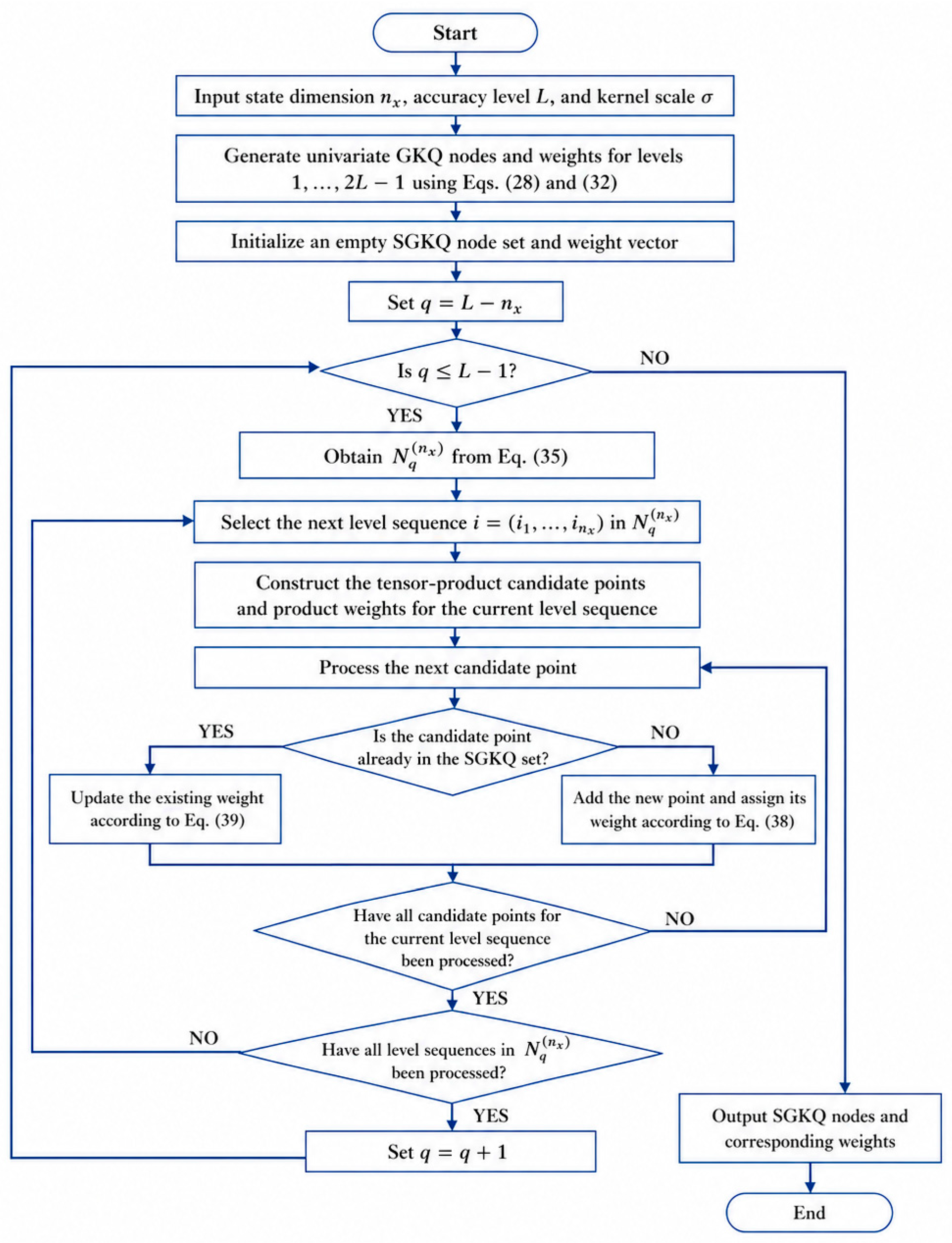
Therefore, the SGKQ points and weights can be generated using the following Algorithm 1. The corresponding flowchart is shown in
Figure 1.
| Algorithm 1: Generate SGKQ points and weights |
and accuracy level .
Output: The SGKQ points and corresponding weights.
Step 1: Generate univariate GKQ points and weights with level 1, …, 2L − 1 based on univariate GHQ rules with (28) and (32).
Step 2: For each specific are determined.
Step 3: For each point , and calculate the corresponding weight according to (38). If the point already exists, recalculate the weight based on (39).
Repeat Steps 2 to 3 until all the points for each specific is checked. |
Substitute the SGKQ points and weights into the Gaussian filter framework, and the new filter named SGKQKF, can be obtained.
In a certain accuracy level, the number of points for the SGKQ increases polynomially with dimension
, but the number of points for the GKQ and GHQ increases exponentially with dimension
.
Table 1 shows the number of points comparison between SKGQKF and GKQKF/GHQKF when the accuracy level is 2 and 3.
As shown in
Table 1, when
L = 2, if
, the number of points for SGKQKF is less than that of the GKQKF. When
L = 3, if
, the number of points for SGKQKF is less than that of the GKQKF or GHQKF. This shows that the SGKQKF can substantially reduce the number of quadrature points, and hence the computational cost, in higher-dimensional problems relative to the GHQKF and GKQKF.
3.3. Relationships Among SGKQKF, GKQKF, and the Other Filters
As discussed, GKQKF uses the GKQ rule, which can be regarded as a scaled GHQ rule with
. If
, then
,
, and
. Substituting them into (28) and (32), we have
That is, when , the GKQ rule is degraded into the GHQ rule, so that the GHQKF is a subset of GKQKF. In this sense, the GKQKF is more flexible than the GHQKF, because a suitable value of can be chosen to further improve the filtering accuracy with the same number of points.
The proposed SGKQKF uses the sparse-grid rule instead of the tensor product rule to alleviate the curse of dimensionality problem. Compared with the sparse-grid GHQKF (SGHQKF), the SGKQKF uses the GKQ rule instead of the GHQ rule, which may improve accuracy without increasing the number of quadrature points. Additionally, the SGKQKF will be degraded into the SGHQKF when . That is, the SGHQKF is a subset of the proposed SGKQKF.
It has been shown that the UKF with the parameters
and
are subsets of the SGHQKF at the level-2 accuracy [
24]. Also, the UKF with those specific parameters can be regarded as a subset of the proposed SGKQKF. It is because the SGKQ rule will become the SGHQ rule when
. Compared with the UKF, the SGKQKF is generally more accurate when the accuracy level is greater than 2. Consequently, the SGKQKF has potential superiority in the nonlinear filtering problems.
It is noted that Smolyak-type sparse-grid constructions may involve negative weights. In the present work, no loss of positive semi-definiteness was observed in the reported experiments, although a general theoretical guarantee remains an open question.
3.4. Worst-Case Integration Error Analysis of the GKQ and SGKQ Rules
In this subsection, we analyze the approximation quality of the GKQ and SGKQ rules from the perspective of the reproducing kernel Hilbert space (RKHS), which provides a principled way to compare quadrature rules beyond polynomial exactness.
Let
denote the RKHS associated with the Gaussian kernel
in (20). Consider a quadrature rule
approximating the Gaussian integral
. The worst-case integration error (WCE) is defined as
where
with
, and
with
. For the Gaussian kernel and distinct nodes,
is strictly positive definite, and hence (42) is a strictly convex quadratic function of
.
Proposition 1. Optimality of the exact fixed-node kernel-quadrature weights [12].
For a fixed node set
, the exact fixed-node kernel-quadrature weight vector
uniquely minimizes the RKHS worst-case integration error
among all quadrature rules supported on
. Consequently, for any alternative weights
on the same nodes,
with equality if and only if
. The above optimality result applies to the exact fixed-node kernel-quadrature weights
. In contrast, the weights used in the implemented SGKQKF, given in Equations (28) and (32), are closed-form weights obtained from the scaled Gauss–Hermite/Mercer construction. Therefore, these closed-form weights are interpreted in this paper as a practical approximation to the exact fixed-node KQ weights, rather than as the exact minimizer of the full RKHS worst-case error. The limiting relation between the implemented closed-form GKQ rule and the GHQ rule is discussed separately in
Section 3.3.
Proposition 2. Tensor-grid case for exact fixed-node kernel quadrature.
Assume a product measure
, a tensor-product kernel
, and a tensor-grid node set
. Then, the kernel matrix and kernel-mean vector satisfy
and the unique WCE-minimizing weight vector is
Therefore, the tensor product of the univariate exact fixed-node KQ weight vectors is the unique WCE minimizer among all quadrature rules supported on the same tensor-grid nodes.
Proof. For a tensor-product kernel and tensor-grid nodes, the (
i,
j)-th entry of the multivariate kernel matrix satisfies
which yields the Kronecker factorization
. Similarly, by the product structure of the measure,
, giving
. By the standard Kronecker inverse property
, we obtain
This shows that the tensor product of the univariate exact fixed-node KQ weight vectors is the unique minimizer of the strictly convex quadratic (42) on the full tensor grid. Since the GHQ tensor-product weights correspond to a different weight vector on the same node set, Proposition 1 guarantees that their WCE is no smaller.
Since each is strictly positive definite for the Gaussian kernel with distinct nodes, the Kronecker product is also strictly positive definite. Hence, the quadratic form remains strictly convex in the multivariate case, and the minimizer is unique. This proposition characterizes the exact fixed-node KQ rule on tensor-grid nodes. The tensor-product GKQKF implemented in this paper uses the closed-form scaled Gauss–Hermite/Mercer weights as a practical approximation to these exact tensor-grid KQ weights. □
Remark 1. On the Sparse-Grid Case.
Proposition 2 applies to the tensor-product construction. For the Smolyak sparse-grid construction, the quadrature rule is a signed linear combination of tensor-product components, and, therefore, a simple closed-form factorization of the RKHS worst-case error is generally unavailable. Nevertheless, for any given
, the squared MMD can be computed directly from Equation (42) using the SGKQ or SGHQ nodes and weights. Therefore,
Table 2 reports numerical MMD
2 comparisons between SGKQ and SGHQ as empirical diagnostics of the RKHS discrepancy in the tested configurations, rather than as a formal sparse-grid RKHS optimality theorem. The pseudo-inverse fixed-node KQ diagnostic is included only to assess the numerical difference between the implemented closed-form Mercer-based weights and the corresponding fixed-node KQ weights on the same SGKQ node sets.
As shown in
Table 2, the MMD
2 values obtained with the implemented closed-form SGKQ weights are very close to those obtained with the pseudo-inverse fixed-node KQ diagnostic on the same node sets in all tested configurations. In addition, SGKQ reduces the MMD
2 by approximately 71.35–98.88% relative to SGHQ, indicating a substantial empirical reduction in RKHS discrepancy. These results support the practical effectiveness of the proposed SGKQ rule without implying exact sparse-grid RKHS optimality.
Remark 2. Role of the Scaled Factor .
The WCE depends on σ through the kernel and the resulting GKQ weights. As
, the GKQ rule reduces to the GHQ rule in our formulation (Equation (40)), while finite
yields kernel-adapted weights that often improve the accuracy–efficiency trade-off, consistent with the experiments in
Section 4.
Remark 3. Quantitative Bound in the Univariate Case.
For the univariate case, the squared WCE admits the Mercer–eigenpair representation:
In particular, for the GKQ design in [
12], the above expression yields a truncation-type bound dominated by the spectral tail
. Since
decays geometrically for the Gaussian kernel, the WCE decreases rapidly with
, which helps explain the improved accuracy–efficiency trade-off observed in
Section 4.
4. Numerical Experiments
In this section, one and high-dimensional nonlinear problems are used to test the proposed algorithms. The CKF is adopted as the representative third-degree deterministic Gaussian filtering baseline. Then a typical target tracking problem is built [
25], and the algorithms, such as the CKF, GHQKF, GKQKF and SGKQKF, are compared. All numerical experiments were implemented in MATLAB R2025b and run on a computer equipped with an Intel(R) Core(TM) Ultra 7 258V processor, 32 GB RAM, and Windows 11. No parallel acceleration was used.
4.1. Performance Test of the Algorithms in One and High-Dimensional Nonlinear Problems
Experiment 1. A 1-D Example. This one-dimensional experiment serves as a basic validation of the proposed GKQ-based filtering framework in a simple nonlinear setting. It should be noted that, in the univariate case, the Smolyak sparse-grid construction reduces to the corresponding underlying one-dimensional quadrature rule rather than producing a genuinely sparse multidimensional grid. Therefore, this experiment is not intended to demonstrate a sparse-grid advantage over the tensor-product construction. Instead, it is used to examine the behavior of the GKQ-based weights and the influence of the kernel scale parameter in a low-dimensional setting. Considering the 1-D nonlinear problem: where
denotes the state at time index
k,
is the Gaussian process noise with
, and
is the Gaussian measurement noise with
.
The root mean square error (RMSE) at time index
(
) is defined as
where
is Monte-Carlo times and
.
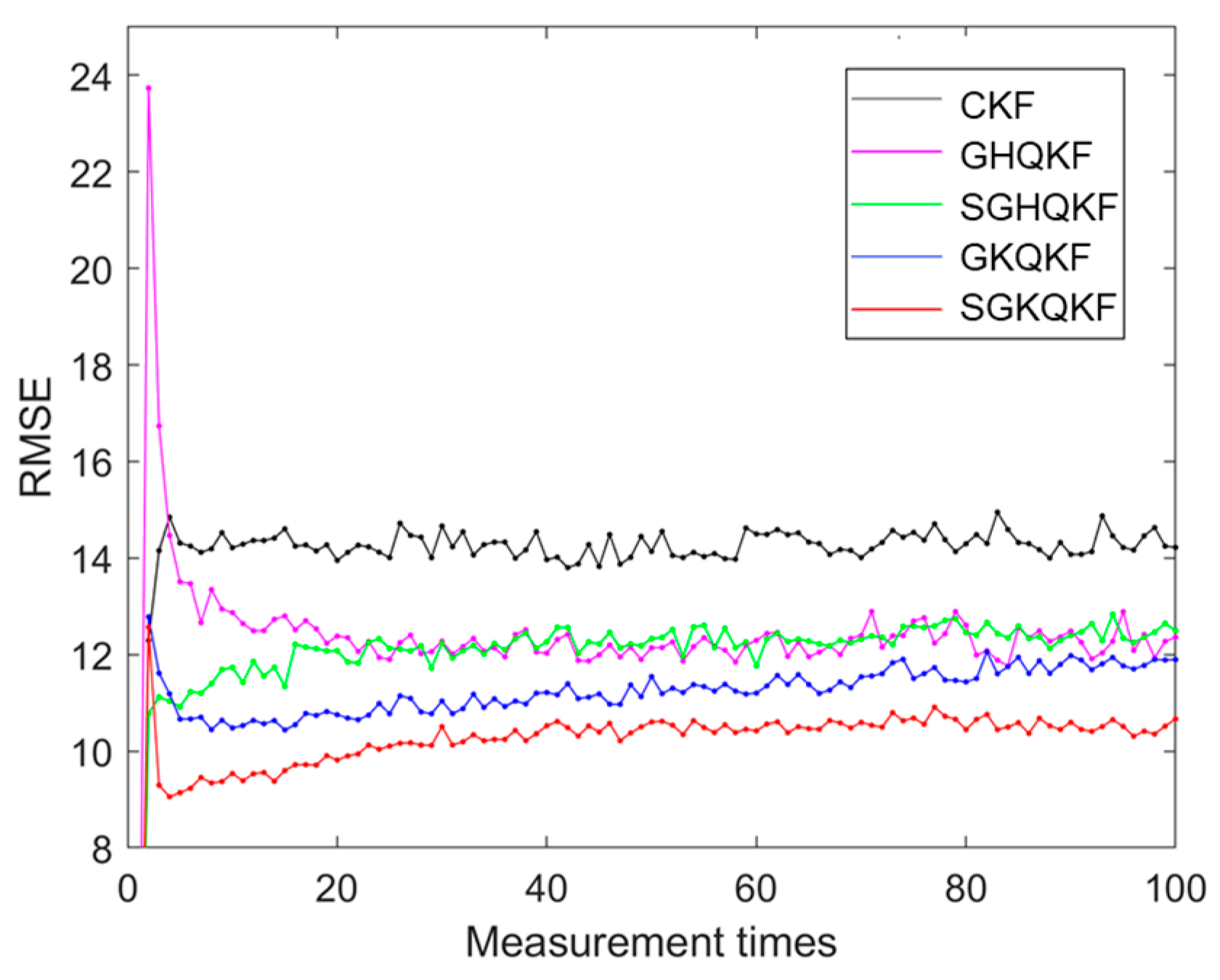
The CKF, GHQKF, SGHQKF, GKQKF, and SGKQKF are compared. The GHQKF and GKQKF use three univariate points with the tensor product rule. The SGHQKF and SGKQKF use the accuracy level . The GKQKF and the SGKQKF use the same scaled factor in this case.
As shown in
Figure 2, the CKF provides the lowest accuracy for this nonlinear problem. Compared with the GHQKF, the GKQKF achieves better accuracy in this tested setting. The SGKQKF also performs better than the SGHQKF, indicating that the kernel-adapted weights can improve the corresponding quadrature rule under the present parameter setting. Additionally, the SGKQKF performs better under some values of the scaled factor
. This indicates that the scaled factor
can be utilized to obtain better accuracy.
Experiment 2. A high-dimensional nonlinear filtering problem. The state-space model is:
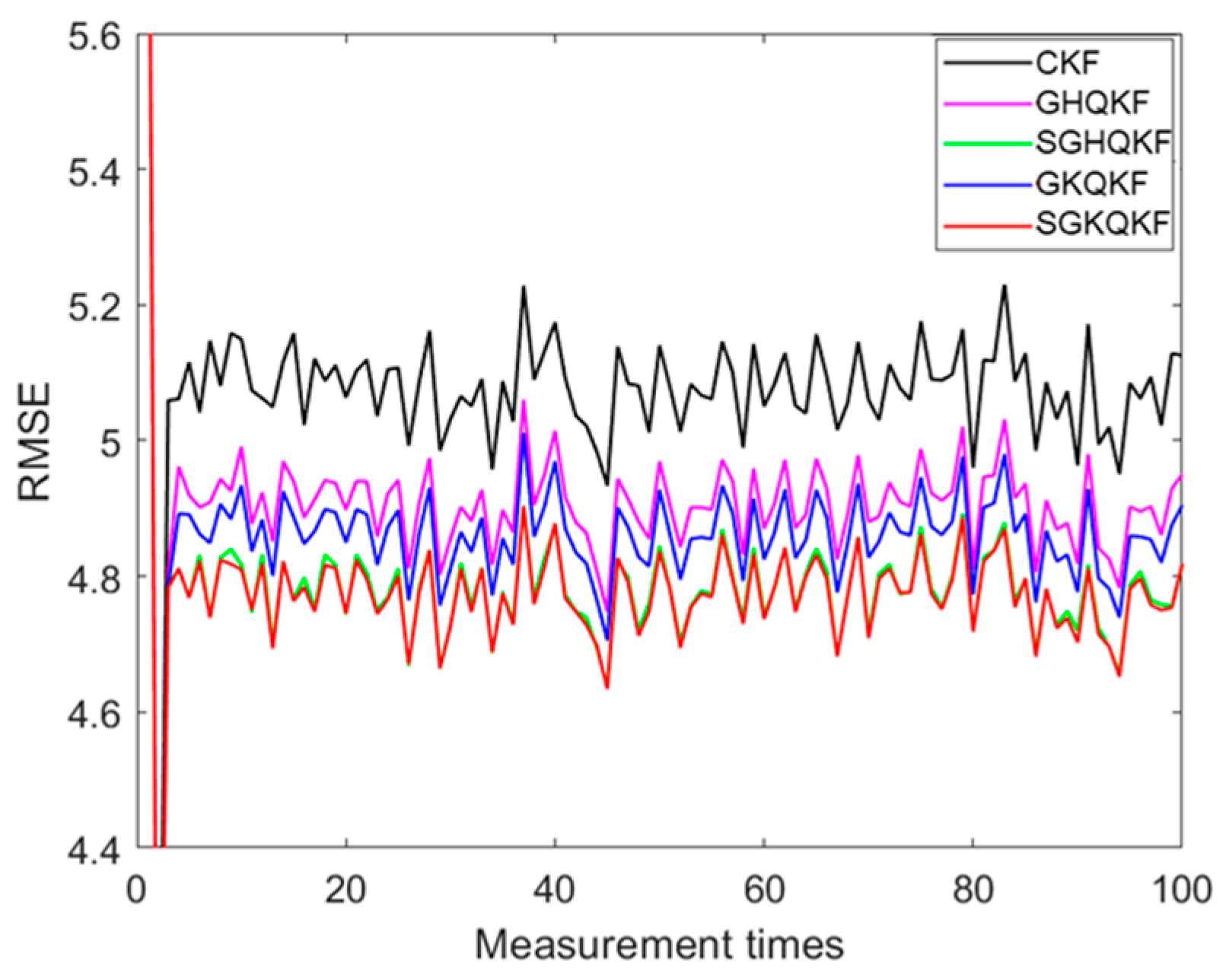
Experiment 2 considers a five-dimensional nonlinear system with a scalar measurement. The state vector is denoted by , and the measurement is . Thus, and , and the measurement function maps the state space to a scalar observation. The process-noise covariance is set to , and the measurement-noise variance is . The initial state and covariance are and . The CKF, GHQKF, and SGHQKF are set to the same as Experiment 1. The GKQKF and the SGKQKF use the scaled factor , and the other parameters are the same as Experiment 1. Also, the Monte-Carlo times are 200.
The RMSEs of different algorithms are shown in
Figure 3.
Table 3 shows the computational time investigated relative to that of the CKF.
As shown in
Figure 3, it is not surprising that the SGKQKF performs better than SGHQKF and GHQKF, which means the GKQ rule is more accurate than the GHQ rule. Additionally, as shown in
Table 3, the SGKQKF runs much faster than the GHQKF and the GKQKF because it uses 71 points by means of the sparse-grid rule, which is more computationally efficient than the GKQKF and the GHQKF with 243 points.
To further illustrate the effect of the scaled factor on the GKQKF and the SGKQKF, comparisons of the GKQKF and the SGKQKF with different values are considered. The initial parameters of the system and filters are set to the same as Experiment 2.
The mean squared error (MSE) for each Monte-Carlo run is defined as
where
is Monte-Carlo times and
.
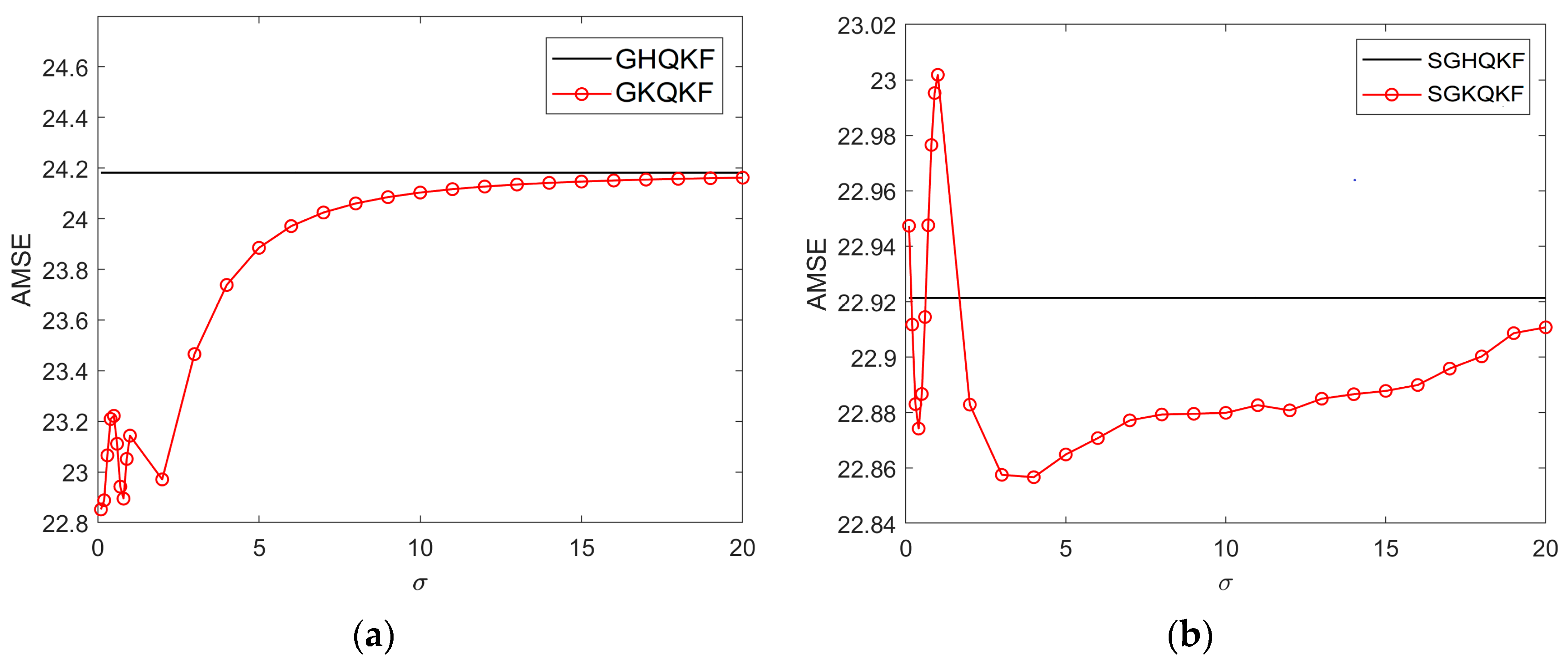
The average MSEs (AMSEs) of the GKQKF and the SGKQKF with different
parameters are compared. In this experiment,
. When
, the test step is chosen as 0.1. When
, the test step is 1. The results are shown in
Figure 4a,b.
As shown in
Figure 4, when
, the performance of the GKQKF and SGKQKF is relatively unstable. This behavior is consistent with the fact that a small kernel scale may compress the effective GKQ node locations, so that the quadrature points may not sufficiently cover the posterior density. For moderate and larger values of
, the GKQ-based filters become more stable and achieve accuracy comparable to, and in some tested cases better than, their GHQ-based counterparts. As
further increases, the implemented GKQ rule gradually approaches the corresponding GHQ rule, which is consistent with the limiting behavior of the implemented closed-form scaled Gauss–Hermite construction. Therefore, the performance gap between GKQKF and GHQKF becomes smaller for large
. Compared with the SGHQKF, the SGKQKF uses the same sparse-grid structure and the same number of points, while introducing the kernel scale parameter
, which provides additional flexibility in the quadrature weights. These observations are empirical and depend on the tested nonlinear model and parameter range. In the present experiments,
is selected empirically within the tested range; developing an adaptive or theoretically guided selection rule for
is left for future work.
4.2. Bearings-Only Tracking with Angle Measurements
Bearings-only tracking (BOT) using passive angle sensors is a representative nonlinear estimation problem that arises in surveillance and aerospace sensing applications [
25]. The highly nonlinear arctangent measurement model makes BOT a challenging benchmark for nonlinear filters.
The target is assumed to be in linear motion with nearly constant velocity for convenience. The state vector of the target at time index
(
) can be given by
, where
is the position vector and
is the velocity vector. The single observer measures the angle information of the target. It is assumed to be maneuvering where the start coordinate is
, and the state vector is expressed by
, where
. Thus, the system model can be written as
where
is the transition matrix,
is the
component of
at time index
such that
,
and
are generally assumed independent and identically distributed zero mean Gaussian noise with the covariance matrix of
and
, respectively. Defining
as the measurement interval,
= 10
−11 km
2/s
3 is the process noise intensity, and
and
can be given by
Equation (57) is written using the arctangent relation as a compact mathematical expression of the bearing angle, but the numerical implementation evaluates the bearing using the two-argument atan2 function to preserve the correct quadrant information. In all BOT simulations, the bearing innovation is wrapped into before the Kalman update.
The root mean square error in position (
) at time index
k is defined as
where
is Monte-Carlo times and
.
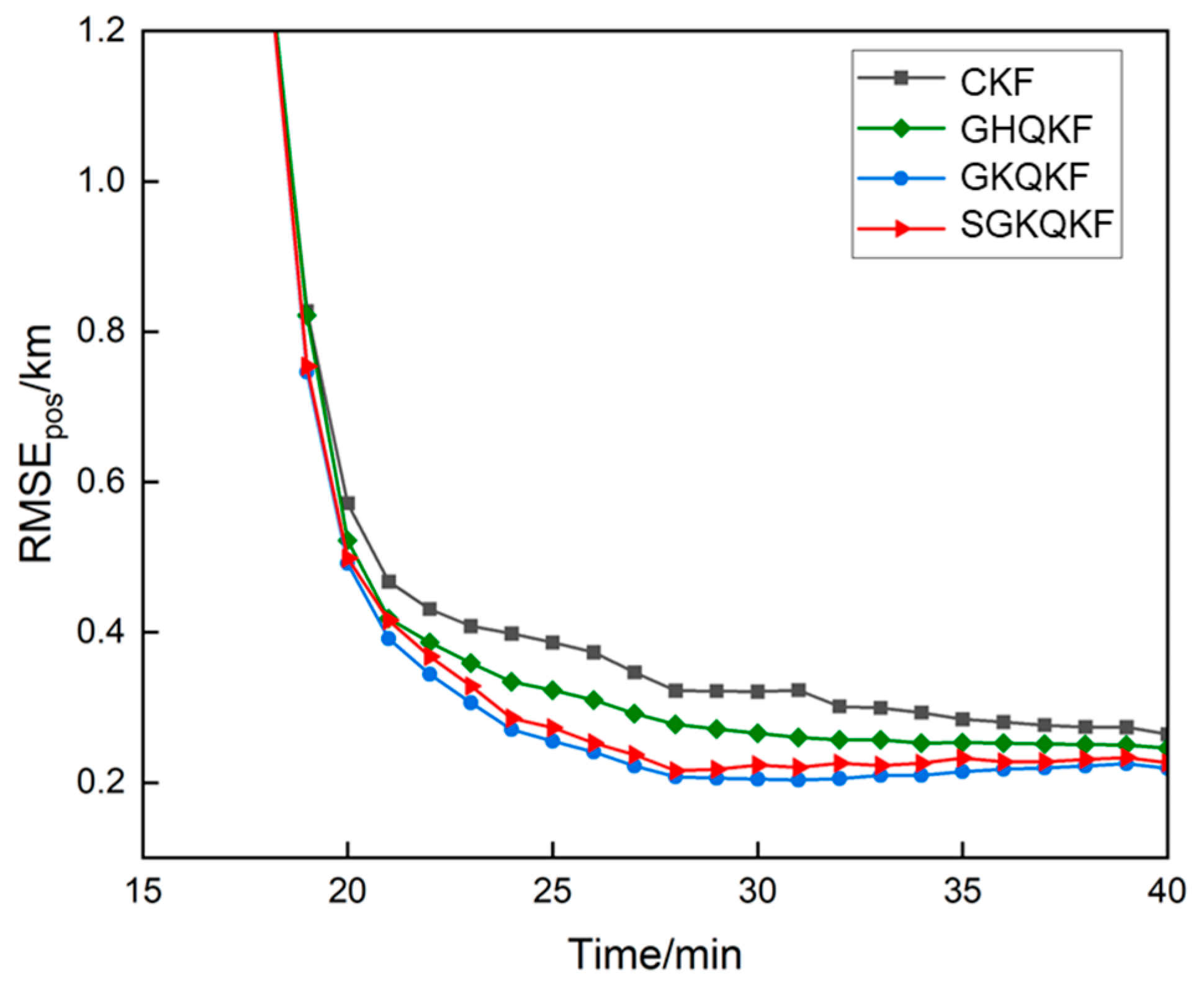
For fair comparison, the same initializations are set to different algorithms. The
of the CKF, GHQKF, GKQKF with
, and SGKQKF with
are shown in
Figure 5.
Table 4 shows the computational time investigated relative to that of the CKF.
Figure 5 shows the tracking results from 15 to 40 min. This interval excludes the initial transient stage and focuses on the period in which the filters exhibit distinguishable convergence and tracking behavior. After approximately 40 min, all filters have reached stable tracking behavior and their relative trends remain almost unchanged. As shown in
Figure 5 and
Table 4, the performance of the proposed GKQKF and SGKQKF is better than that of the traditional CKF and GHQKF. The GKQKF and the SGKQKF perform similarly, but the SGKQKF requires approximately 54.4% of the runtime of the GKQKF, which means the SGKQKF strikes an appropriate balance between accuracy and computational efficiency.
Although the numerical results demonstrate the favorable accuracy–efficiency trade-off of the proposed SGKQKF in the tested examples, the evaluation remains mainly empirical. In particular, the kernel scale parameter is selected by scanning a finite set of candidate values, and confidence intervals are not reported for all Monte-Carlo performance metrics. Therefore, the reported results should be interpreted as empirical evidence in the tested configurations rather than as a formal finite-sample performance guarantee.
5. Conclusions
In this paper, we proposed the SGKQKF for nonlinear state estimation. By combining Gaussian kernel-based quadrature weighting with a Smolyak sparse-grid construction, the proposed method extends GKQ-type filtering from tensor-product grids to sparse-grid structures. We also clarified the distinction between the exact fixed-node KQ rule and the closed-form Mercer-based implementation: the former has an RKHS worst-case-error optimality property, while the latter is used as a practical approximation. Numerical results indicate that the proposed SGKQ rule reduces the MMD relative to the standard SGHQ rule in the tested configurations. The filtering experiments further demonstrate that the SGKQKF achieves a favorable accuracy–efficiency trade-off compared with conventional deterministic Gaussian filters, mainly by reducing the number of quadrature points through the sparse-grid construction.
This study still has several limitations. The sparse-grid MMD analysis should be interpreted as empirical diagnostic evidence rather than as a formal RKHS optimality theorem. Moreover, the kernel scale parameter is selected empirically in the numerical experiments, and confidence intervals are not reported for all Monte-Carlo performance metrics. Future work will focus on rigorous RKHS error analysis for Smolyak sparse-grid rules, adaptive or theoretically guided selection of , uncertainty quantification over Monte-Carlo runs, and validation under higher-dimensional or more challenging non-Gaussian and outlier-contaminated noise conditions.