Article

Digital Transformation in Aircraft Design and Certification: Ontology Design Patterns for Modeling Regulatory Guidance Material Documentation


by
Andréa Cartile
1,*,
Catharine Marsden
2 and
Susan Liscouët-Hanke
1
1
Department of Mechanical, Industrial and Aerospace Engineering, Concordia University, Montréal, QC H3G 1M8, Canada
2
Department of Mechanical and Aerospace Engineering, Royal Military College of Canada, Kingston, ON K7K 7B4, Canada
*
Author to whom correspondence should be addressed.
Aerospace 2026, 13(5), 460; https://doi.org/10.3390/aerospace13050460
Submission received: 4 March 2026 / Revised: 5 May 2026 / Accepted: 11 May 2026 / Published: 13 May 2026
(This article belongs to the Special Issue Airworthiness, Safety and Reliability of Aircraft)

Abstract

Aircraft design is regulated by federal law and must comply with complex regulatory documentation. The complexity of the certification process has resulted in a growing interest in digital transformation, for which models are often used to provide explicit structure. Ontological modeling is one of the most promising approaches for the digital transformation of regulatory documentation. This paper presents a novel approach to ontology development that applies ontology design patterns to construct a knowledge representation of regulatory documentation, with a focus on guidance material. The approach includes five main processes: (i) the selection of a regulatory document; (ii) the use of a natural language processing tool; (iii) a contextual analysis; (iv) the identification of patterns in the natural language; and (v) the development and implementation of ontology design patterns. The modeling approach is demonstrated using the ARP4754B: Guidelines for Development of Civil Aircraft and Systems guidance material document and is validated with a use case AC21.101-1B—Establishing the Certification Basis of Changed Aeronautical Products guidance material document. The modeling approach is then verified against an established set of regulatory documentation modeling requirements. The systematic ontological modeling approach presented in this paper enables digital transformation of regulatory documentation, a necessary step for a more efficient and effective certification process.

1. Introduction

Aircraft are safety-critical systems regulated by federal law [1,2]. Aircraft design regulations have become progressively more stringent since the 1920s [3,4], resulting in an increasingly complex and costly certification process [5,6,7].
The certification process is governed by authorities [8] such as the European Union Aviation Safety Agency (EASA) [9], the Federal Aviation Administration (FAA) in the United States [3], and Transport Canada Civil Aviation (TCCA) [10,11]. Regulatory information is communicated from the authority to aircraft development companies in the form of documentation, which can be divided into two main categories: regulations and guidance material. Regulations contain the requirements to which an aircraft development company must comply, and guidance material documents typically include recommendations for how compliance can be demonstrated. As an example, the FAA oversees over 1800 design regulations for commercial transport-category aircraft [12,13], as well as thousands of pages of associated guidance material and supporting documentation [14,15].
Regulatory documentation is often characterized by ambiguous use of natural language, legal terminology, context-dependent definitions, and complex cross-referencing [16]. For example, the FAA regulation §25.1309 (b) states that “The airplane systems and associated components, evaluated separately and in relation to other systems, must be designed and installed so that they meet all of the following requirements: (1) Each catastrophic failure condition (i) Must be extremely improbable; and (ii) Must not result from a single failure” [17]. This section of the regulations is difficult to parse into individual requirements, as each subsection depends on the context of the introductory sentence. Additionally, none of the definitions for airplane systems, their separate and relational evaluation, design, and installation, extreme improbability or single failure are included in the regulations themselves. The information necessary to understand this section of the regulations must instead be found in thousands of pages of guidance material documentation which contain detailed information on complex compliance processes [18]. The interpretation of the regulatory documentation, the knowledge of implicit relationships between the regulations and guidance material, and the understanding of how an aircraft design is certified in practice is knowledge held tacitly by subject matter experts (SMEs), who acquire that knowledge over many years of experience [2].
The imperative to manage complex processes and information throughout aircraft design and certification programs has created an interest in digital transformation [19,20,21]. While digital modeling tools such as computer-aided design (CAD) [22], finite element analysis (FEA) [23], multidisciplinary design analysis and optimization (MDAO) [24], and digital twins [19,25,26,27] have been demonstrated to contribute to program success, digital transformation of the aircraft certification process remains in the early stages of implementation [28,29]. As regulatory documents are publicly available and common to both the regulator and the applicant, an investigation of approaches for developing a reusable regulatory digital platform based on a shared vocabulary provides value to all stakeholders. The intent of this investigation is not to replace SMEs but rather to leverage software tools to support the SMEs throughout the design and certification process [30].

1.1. Ontological Modeling for Digital Transformation of Regulatory Documentation

Models are routinely used to provide structure for digital transformation [31]. Previous research by Cartile et al. [30] establishes a set of nine requirements and compares the feasibility of process mapping, Unified Modeling Language (UML), and ontological modeling methods for the most effective approach to modeling aircraft regulatory documentation in the context of digital transformation. The previously established requirements are listed in Table 1.
The previous research concludes that the most promising method for further investigation is ontological modeling, as it provides capabilities for formally structuring natural language to meet requirements 1 and 2 in Table 1 [30]. Ontological modeling is therefore selected as the focus for the research that is the subject of this paper.

1.2. Research Question and Paper Overview

This research aims to answer the following question: Can ontological modeling be used to effectively represent aircraft regulatory guidance material documentation in the context of digital transformation?
Section 2 provides the current state of the literature and the gaps addressed in this research. Section 3 presents the research methodology used to produce a novel, systematic, and repeatable approach to developing generic, modular, adaptable, consistent, and explicit ontological models for the effective representation of aircraft regulatory documentation. The methodology is demonstrated using examples from the SAE International Aerospace Recommended Practice ARP4754B: Guidelines for Development of Civil Aircraft and Systems guidance material document [32]. Validation case studies are commonly used to demonstrate that a modeling approach is reproducible and can be repeatably applied to meet its intended purpose [33,34]. Section 4 validates the research methodology using the Advisory Circular AC21.101-1B—Establishing the Certification Basis of Changed Aeronautical Products guidance material document [35]. Conformance tests are conducted in Section 5 to verify and discuss the research results against the nine modeling requirements proposed in [30]. Section 6 concludes the research findings and proposes future applications for this work.

2. Literature Review

The literature review is structured as follows: Section 2.1 discusses regulatory documentation modeling research and the challenges identified in the literature. Section 2.2 introduces ontological modeling, and Section 2.3 provides an overview of ontology design pattern literature. Section 2.4 summarizes the gaps and presents the contributions of this paper.

2.1. Modeling Regulatory Documentation

The imperative to digitally transform regulatory documentation has been recognized in domains such as building and construction, environmental law, pharmaceutical drugs, finance, and nuclear safety [36,37,38,39,40]. Early logic models of the law, termed legal logic [41,42], formed the basis for recent advancements in computational law knowledgebases [43,44,45]. Examples of regulatory modeling applications include modeling compliance information to improve retrievability during audits [36,46]; developing semantic frameworks for regulatory language using Extensible Markup Language (XML) for web-based regulations [37]; and using Bidirectional Encoder Representations from Transformers (BERT), a subset of artificial intelligence (AI), for regulatory language classification [38,39].
Aerospace researchers have also recently taken an interest in modeling regulations and guidance material. Ray et al. [47] develop an aerospace-specific aeroBERT-NER large language model (LLM) using CFR Part 23/Part 25 regulatory text and CubeSat documentation. Several researchers have investigated the use of Systems Modeling Language (SysML), a systems engineering domain-specific language based on Unified Modeling Language (UML), to model regulations for small fixed-wing aircraft [48,49] and large fixed-wing aircraft [50] as elements contributing to a larger initiative of modeling the certification planning process. Harrison et al. [51] further develop this work to include modeled representations for means and methods of compliance. Modeling of compliance documents is also investigated by Paul et al. [52], who use ontological models of tasks listed in the ARP4754A guidance material document and develop a dashboard to track work completion status. Eito-Brun et al. [53] model a guidance material document for data exchange and aggregation in the space sector using a natural language processing tool and ontological modeling.
The researchers investigating regulatory modeling have identified several challenges. Fazal et al. [50] note that the ambiguity and context-dependency in the natural language render the regulations difficult to parse and represent in model entities. The semi-structured semantic capabilities of UML-based modeling languages have been recognized as a limitation and lack the necessary capabilities to address the challenges in regulatory natural language [30,54,55,56,57]. Ray et al. [47] reflect similar context-dependency challenges and note having to modify the original regulatory text into a more machine-readable format. While significant advances have been made in the use of LLMs in model development [58], challenges in modeling complex domains are also identified in LLM literature [59]. The “complex concepts, specialized terminology, and intricate relationships between entities” and the absence of a structured knowledgebase result in LLM output inconsistencies [59]. The labeling and reformatting of ambiguous regulatory language introduces risks of changes to the interpretation and intended meaning of the regulations, affecting model outcomes.
The challenges identified in the literature highlight a gap in the effectiveness of current modeling approaches for representing domain-specific, ambiguous, and context-dependent natural language of aircraft regulatory documentation. Previous research conducted by Cartile et al. [30], supported by recent literature [28,31,60], identifies ontological modeling as the most suitable method to address this gap in the context of digital transformation.

2.2. Ontological Modeling

Ontologies are models of a knowledgebase expressed in a formal ontological language [61,62,63,64]. Modern ontologies are based in description logic, a decidable subset of first-order logic that borrows formalization methods from set theory and Boolean algebra [65,66,67], of which there are several types that differ in levels of expressivity and computational complexity [68,69]. The decidable nature of description logic has facilitated advancements in the area of computational reasoning, which are used in ontological modeling tools to make inferred deductions such as class membership without explicit assertion and check for logical inconsistencies in a model [70,71,72,73]. Ontologies use open-world assumptions and are typically monotonic [74], where new information cannot be used to revise old conclusions within a model [75,76]. One of the criticisms of monotonic logic and the open-world assumption is the susceptibility to axiomatic fallacies, where new information may require manual restructuring of classification restrictions or world-model reorganization [76]. Closed-world non-monotonic frameworks such as rule-based systems are often used in conjunction with ontologies to overcome these limitations [74,77].
Ontologies have been used in many applications such as the organization of the World Wide Web [77,78]; as an interface for software systems such as model-to-model and model-to-code generation [79,80]; for capturing requirements specifications to inform software development [81]; and for knowledge management, including formal knowledge representation, search, and retrieval [60,61]. The successful adoption of ontologies for the semantic web has also led to many initiatives that have supported the use of ontological modeling for knowledge representation [82,83], including the development of standards managed by W3C [84] and open-sourced ontological modeling tools such as Protégé [85,86]. Advances in artificial intelligence, such as natural language processing and large language models, have resulted in resurging interest in ontological modeling [87].
Ontologies can be developed from source documentation or from existing models, and can be constructed manually, automatically, or semi-automatically [16,61,87,88,89,90]. Ontological model development guidelines proposed by Noy and McGuinness [63] note the importance of determining the domain, scope, and purpose of an ontology and recommend using a list of competency questions to validate whether the resulting models fulfill their intended purpose. Several large-scale upper-level ontology initiatives have also been proposed as methods for ontological model development [91,92,93,94], such as the Descriptive Ontology for Linguistic and Cognitive Engineering (DOLCE) foundational ontology library [95].
Debellis and Neches [77] discuss the challenges associated with the development and application of an upper-level ontology, stating, “it was simply too complicated to build an all-encompassing model, in part because practical resolution depends on context.” Bernabé et al. [96] discuss a lack of empirical evidence on the effectiveness of foundational ontologies and observe low adherence to development guidelines. Gangemi and Presutti [97] discuss the lack of consensus on modeling guidelines as one of the primary challenges of ontology implementation, which results in a tendency to develop single-use models [61,98]. One of the ways proposed to improve model development standardization is through the use of ontology design patterns (ODPs) [91,97].

2.3. Ontology Design Patterns

Design patterns are widely used in the field of software engineering to provide systematic, reusable designs for recurrent problems [99,100]. Design patterns can improve model quality by providing consistency within and across models and have been increasingly applied to ontological modeling [91,101].
An EU-funded research project, NeOn Consortium, was launched in the early 2000s to create an inventory of ontological design patterns [73,102,103,104]. The NeOn project organized patterns into several categories including content patterns, which focus on semantics and repeated patterns found in the natural language of the domain being modeled [73,105,106].
Content design patterns are used to address case-specific semantic modeling applications, referred to as “generic use cases” [105,107]. Gangemi [105] proposes selecting a generic use case when developing an ontological modeling framework to determine the scope and structure of a model for domain-specific applications. Content design patterns can be used as flexible, reusable, and self-contained building blocks to model recurring tasks within a use case, and “provide common ground for more complex ontologies” [108]. Examples of content patterns include spatial geometries, human action, and events [100]; time [109,110]; class structure [111]; part-whole composition [112,113,114,115] and group membership [116]; and sequences such as process sequence [117,118], genomic sequence [119,120], and sequence of parts assembly [121].
Combinations of content design patterns are also used to model specific applications. For example, the trajectories design pattern combines segment, geospatial, time-dependent, and sequential patterns in a single ontology [108,122]. The trajectories design pattern has been used in applications such as bird migration models and urban planning [108,123].
While the logical foundation of ontological modeling provides a means to mathematically structure natural language, it also has constraints. The use of content design patterns is one approach to structuring the natural language while still respecting these constraints. For example, one of the limitations of description logic-based ontologies is that relationships can only be asserted between individuals. Noy [124] presents several solutions to this design problem that make use of design patterns while still conforming to the rules of description logic. Other examples of ontology design challenges include the representation of part-whole relationships [114,115,125] and assigning non-measurable attributes to individuals [126]. Noy [124] explains that each design pattern has trade-offs, where the selection of the most appropriate pattern depends on the purpose of the ontology.
While many authors have proposed approaches to ontological modeling and have explored the use of ontological design patterns to develop models, a gap remains in the literature for a systematic approach to identifying areas of application, techniques for development, and guidelines for implementation of ontology design patterns for aircraft regulatory documentation in the context of digital transformation [90].

2.4. Summary, Gaps, and Contributions

The literature has identified several challenges in developing effective models of aircraft regulatory documentation, which current modeling method capabilities have been unable to address. Ontological modeling and ontology design patterns show promise for effectively representing aircraft regulatory documentation and addressing the regulatory natural language challenges identified in the literature. However, there remains a gap for a systematic and repeatable approach to model development that can be used to identify patterns in the natural language, develop generic ontology design patterns, and implement the ontology design patterns to represent recurring patterns throughout the regulatory documentation.
This paper presents a novel approach to ontology development that includes the systematic identification of recurring patterns and the development and implementation of ontology design patterns to several case studies, demonstrating a repeatable knowledge representation approach for regulatory documentation to address the gap in the literature. The approach leverages the use of natural language processing and contextual analysis to identify recurring patterns in the regulatory text and establishes a structured, generic, modular, and adaptable approach to the development and implementation of ontology design patterns to effectively represent the natural language. The approach is developed and validated using two guidance material document case studies selected from different domains within the aircraft design and certification process to support confidence in repeatability of the modeling approach: the SAE International Aerospace Recommended Practice ARP4754B: Guidelines for Development of Civil Aircraft and Systems [32]; and the Federal Aviation Administration (FAA) Advisory Circular AC21.101-1B—Establishing the Certification Basis of Changed Aeronautical Products [35]. The selection of these case studies is intended to demonstrate reusability and support the standardization of this approach across different disciplines within this domain to provide a modeling framework for the digital transformation of the aircraft certification process. The modeling approach developed in this research enables traceable, repeatable, and purpose-specific modeling of regulatory guidance material, which has not been previously demonstrated in the aerospace certification domain.
This paper makes the following scientific contributions to advance the state of the art of modeling aircraft regulatory documentation in the context of digital transformation:
(a) Methodological contributions to ontological modeling development: this approach contributes a systematic modeling methodology using natural language pattern identification and generic ontology design pattern development for repeatable implementation.
(b) Contributions to the representation of aircraft regulatory documentation: this approach addresses the ambiguity challenges of regulatory natural language and supports the complex relationships between regulatory documentation through the NLP-assisted concept identification and contextual analysis to formalize recurring regulatory natural language patterns that are characteristic of regulatory documentation (classification, process, and reference patterns) and their mapping to corresponding ontology design patterns.
(c) Empirical research contributions: the validation and verification of the proposed methodology through two non-trivial aerospace guidance material case studies, demonstrating generalizability and repeatability across regulatory contexts and value as a tool for knowledge capture by including subject matter experts and database interaction with the model.

3. Research Methodology

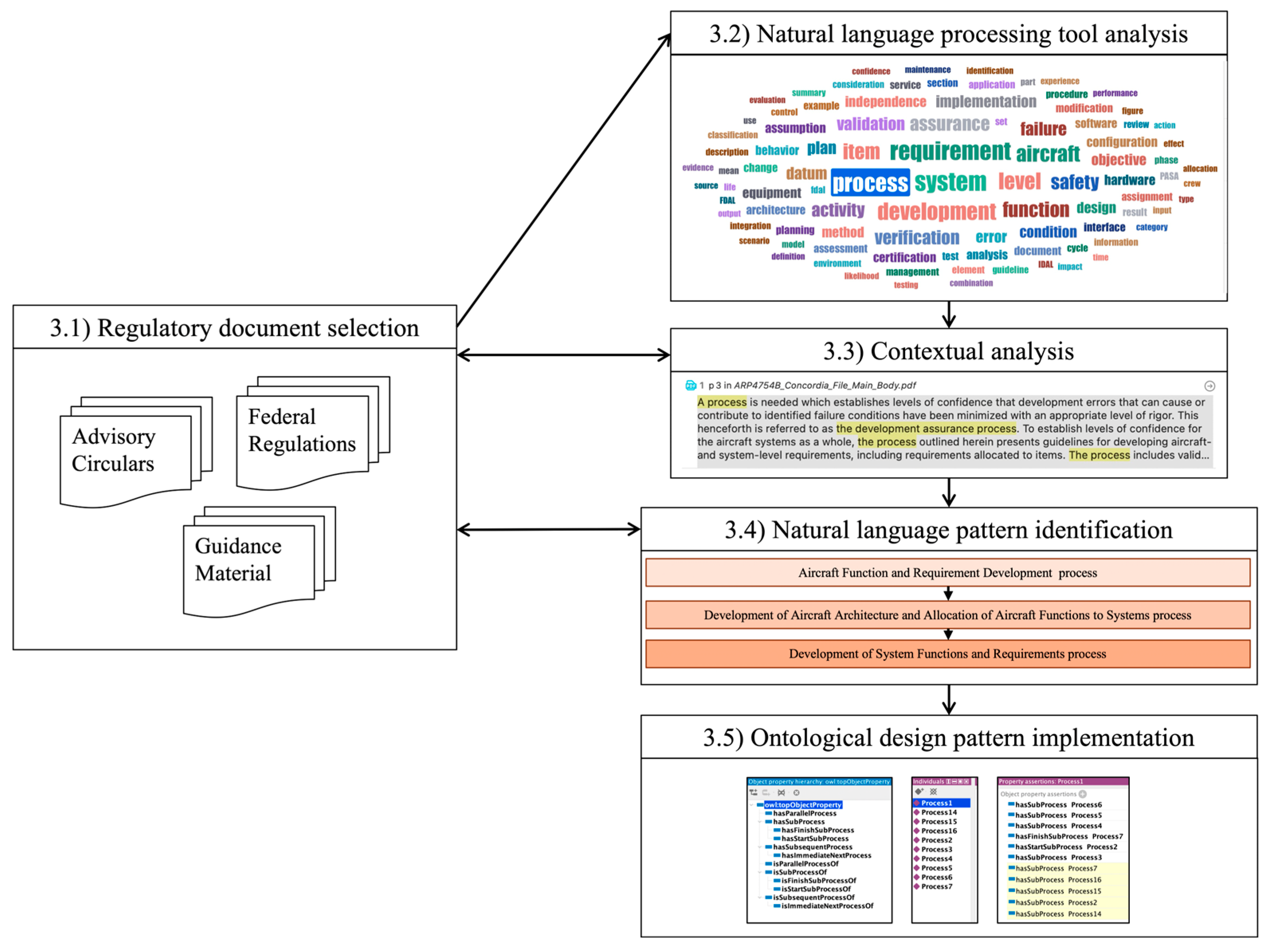
The research methodology presented in this section describes the process of developing ontological models from the natural language found in regulatory guidance material documentation. The research methodology is developed using examples from the ARP4754B; is validated using examples from the AC21.101-1B; and is verified against previously established modeling requirements. The model development process is illustrated in Figure 1 and described in the following sections: Section 3.1 includes the selection of regulatory documentation; a natural language processing tool used to identify candidate concepts directly from regulatory text in Section 3.2; a contextual analysis to investigate the definitions and intended meaning of concepts is conducted in Section 3.3; recurring patterns within the natural language are identified in Section 3.4; and Section 3.5 describes the selection and implementation of design patterns for ontological model development.

3.1. Regulatory Document Selection

One of the key guidance material documents used to certify civil aircraft design is the SAE International Aerospace Recommended Practice ARP4754B: Guidelines for Development of Civil Aircraft and Systems [32]. The use of this document is recognized internationally as a method for demonstrating compliance with safety regulations such as CFR §25.1309, which requires catastrophic failure conditions to be extremely improbable and hazardous failure conditions to be extremely remote [17,18,127]. The ARP4754B [32] frequently references a second guidance document, the ARP4761A: Guidelines for Conducting the Safety Assessment Process on Civil Aircraft, Systems, and Equipment [128], which further specifies processes for assessing design safety. The development of the research methodology is demonstrated using examples from both the ARP4754B and ARP4761A.

3.2. Natural Language Processing Tool Analysis

3.2.1. NLP-Identified Keywords and Noun-Phrases

The selected regulatory documentation is analyzed using the natural language processing (NLP) software tool Atlas.ti version 25.0.1 [129] “concept search” function to identify the most frequently occurring keywords and their associated noun-phrases throughout the document. The Atlas “concept search” function is distinct from a “word frequency” function. While a word frequency function identifies parts-of-speech frequencies and provides lists of word categories, such as nouns, verbs, and adjectives, the concept search provides a list of keywords in any part-of-speech and ranks their frequencies depending on the number of noun-phrases associated with that keyword [130]. The advantage of using the concept search function is that it provides an overview of the main concepts used across a document and the contextual excerpts where the noun-phrases occur to provide a comprehensive initial starting point for ontology development.
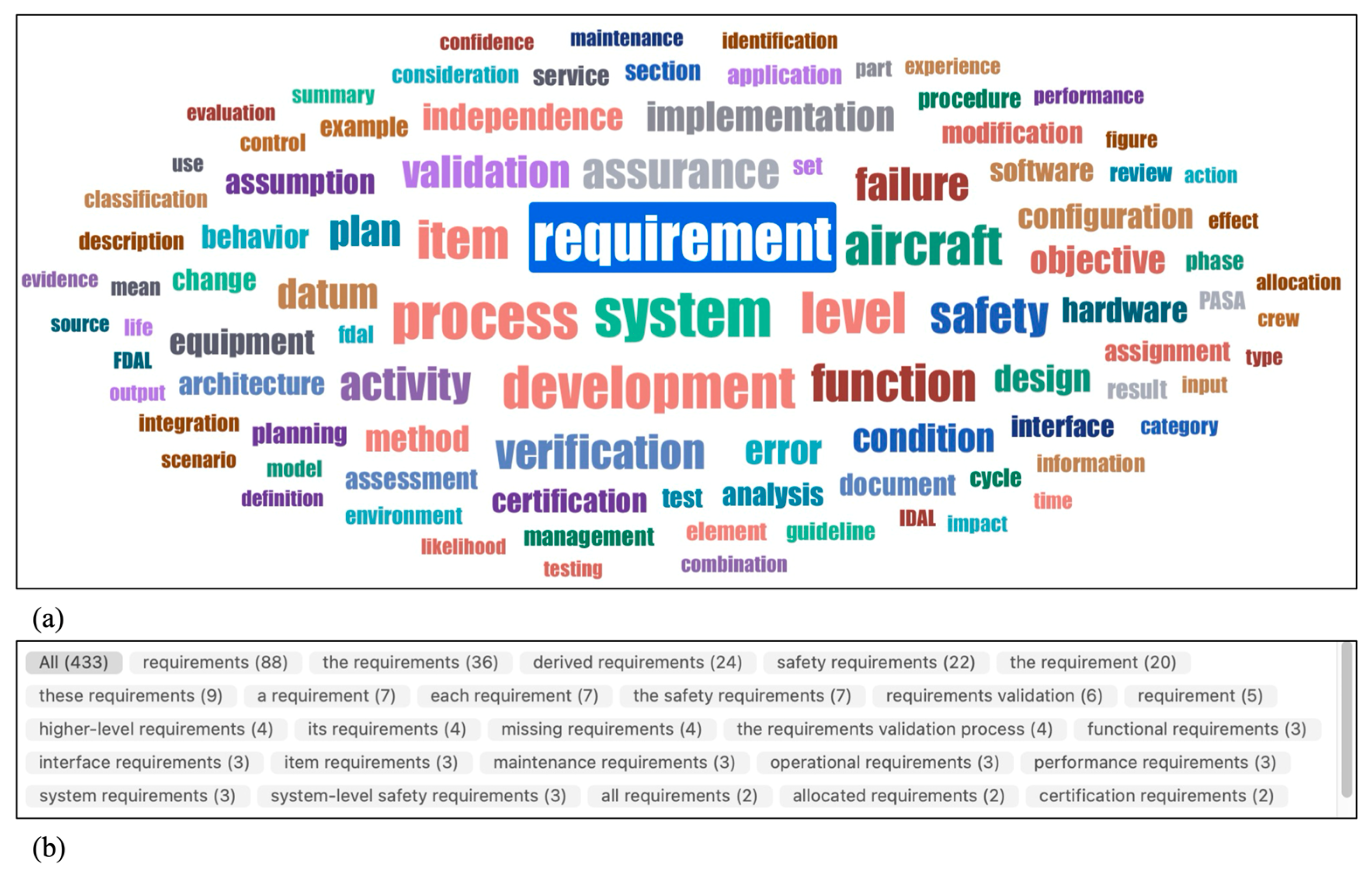
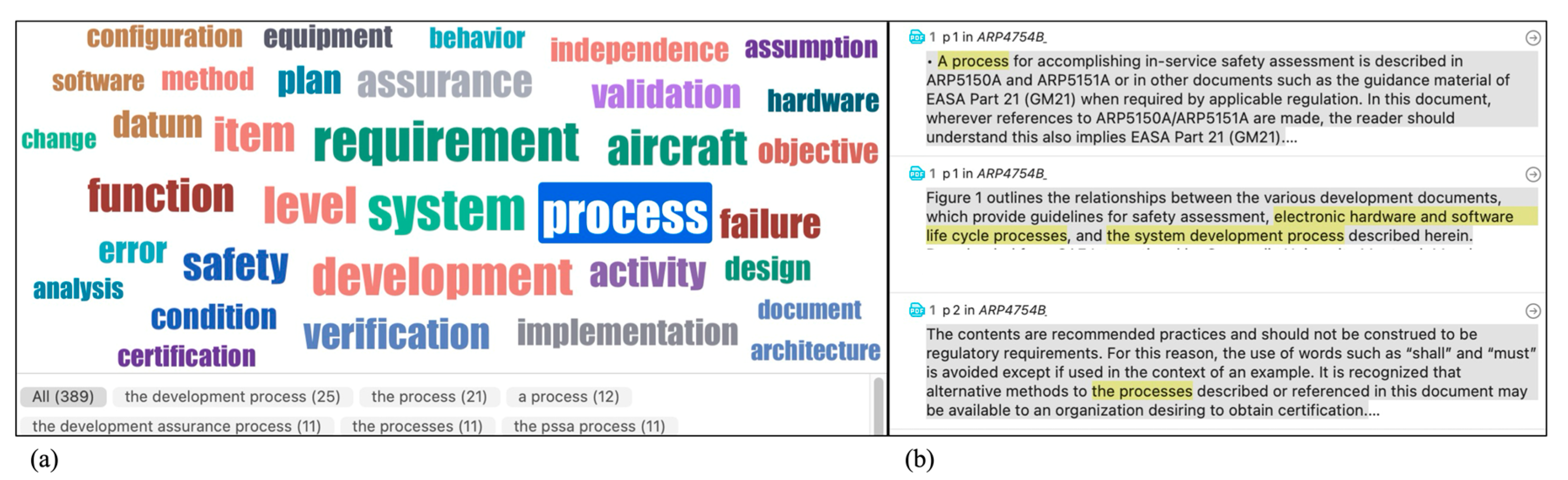
The keywords for the ARP4754B [32] are shown in Figure 2a, and the noun-phrases associated with the keyword requirement are shown in Figure 2b.
The top five keywords and corresponding number of associated noun-phrases in the main body of the ARP4754B document are system (462 noun-phrases), requirement (433 noun-phrases), process (389 noun-phrases), development (378 noun-phrases), and level (260 noun-phrases).
The listed noun-phrases require cleaning activities, such as combining singular and plural noun-phrases; combining noun-phrases that differ due to articles such as “the” and “a”; and removing duplicates of noun-phrases appearing under multiple keywords, such as the noun-phrase system development appearing under both system and development. Although this cleaning process is amenable to automation, it was performed manually for the purpose of this research. Examples of the NLP-identified keywords system, requirement, and process are shown in column 1 of Table 2, and examples of associated noun-phrases are listed in column 2 of Table 2.

3.2.2. Identification of Concepts to Be Modeled

The cleaned noun-phrases are then further analyzed to identify an initial list of ontological concepts to be modeled. Column 3 of Table 2 provides examples of concepts identified from the ARP4754B document.
Table 2. Examples of keywords and associated noun-phrases from the ARP4754B identified by NLP software and organized into ontological concepts.
Keywords Identified by NLP SoftwareNoun-Phrases Identified by
NLP Software
Ontological Concepts to be Modeled
systemsystem architecturearchitecture, function, development, and system
system functions
system development
requirementrequirement(s)derived requirement, safety requirement, validation process
derived requirement
safety requirement
requirement validation
processdevelopment processdevelopment, development assurance, process
development assurance process
As an example of this assessment, the keyword system in Table 2 column 1 has associated noun-phrases system architecture, system functions, and system development, listed in Table 2 column 2. The analysis results in the identification of the four different ontological concepts shown in Table 2, column 3: architecture, function, development, and system.

3.3. Contextual Analysis

A contextual analysis is conducted for each of the ontological concepts to identify explicit definitions, ambiguous use of concepts, and potential ontological modeling structures for classes, individuals, and properties. The contextual analysis is conducted using the ontological concept identification questions listed below. The use of questions to define the scope of an ontology is based on recommendations made by Noy and McGuinness [63].
  • Contextual analysis questions used to identify ontological concepts
Q1.
Is this noun-phrase a technical term?
Q2.
Is the noun-phrase defined?
Q3.
What kind of “thing” is the noun-phrase? Ex: an artifact, a process, a status, a verb, a concept, etc.
Q4.
Does the noun-phrase maintain the same definition and categorization in each of its contextual instances?
Q5.
Are there any classification criteria or constraints associated with the noun-phrase?
Q6.
Are there recurring patterns within the contexts of the noun-phrases?
As an example of explicit definitions, concepts such as function and requirement are often further specified as being aircraft-level, system-level, or item-level. The ARP4754B includes definitions for both system and item; however, aircraft remains undefined. Aircraft-level activities occur throughout the document, and a lack of an associated definition is identified as a challenge for explicit modeling.
The contextual analysis process also enables the identification of additional associated concepts and the relationships between them. Examples of additional concepts related to those listed in Table 2 above are shown in Table 3 below.

3.4. Natural Language Pattern Identification

The contextual analysis process enables the identification of recurring patterns throughout the text that can be modeled as repeatable structures in ontologies. This assessment is also used to define how the concepts will be represented in an ontology, either as individuals, classes, or properties. Three examples of natural language patterns were identified in the ARP4754B: classification patterns, process patterns, and reference patterns, and are described below.

3.4.1. Classification Patterns

Classification is an important theme across aircraft regulatory documentation and is often used to determine which regulations and compliance activities are required for certification. As class membership inference is one of the main functions of ontological modeling, identifying classification patterns in natural language is one of the primary areas of investigation for this research.
3.4.1.1. Class Pattern
Class membership requires an initial class structure. The NLP-identified keywords shown in Figure 2a for the ARP4754B provide a starting point for the ontological class structure, which is further refined with recurring concepts identified through contextual analysis. The concepts are assessed for shared characteristics or constraints that may group them together into a class. The Process and Requirement keywords shown in Figure 2a are examples of initial classes for the ARP4754B. For example, the keyword requirement is assessed using the contextual analysis questions listed in Section 3.3. The ARP4754B ([32], pp. 43–44) identifies several types of requirements, including safety, functional, customer, operational, performance, physical and installation, maintainability, interface, certification, and derived, and provides guidance for the derivation of each type of requirement. The many types of requirements identified in the ARP4754B result in the identification of the keyword Requirement as an ontological class.
3.4.1.2. Classification Criteria Pattern
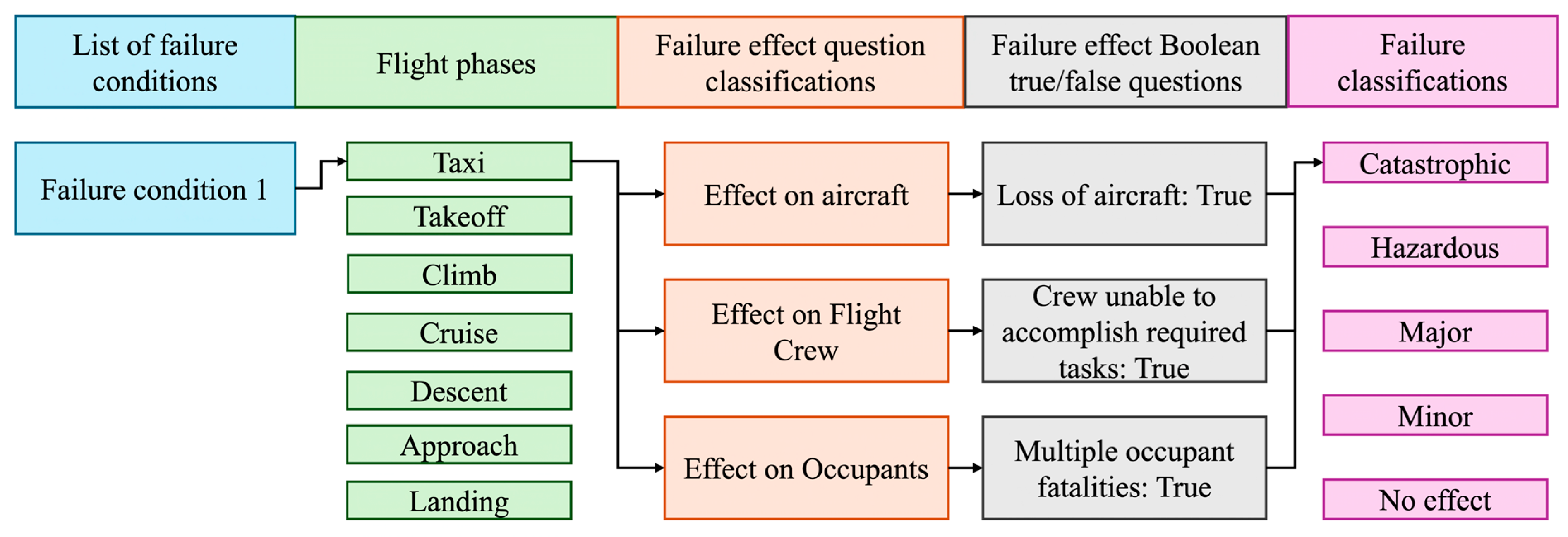
Following the identification of classes, the criteria for class membership are extracted from the document as part of the contextual analysis and pattern identification process. Continuing the same example of the keyword Requirement, safety requirements are further defined through a series of processes and methods, which begin with the Aircraft Functional Hazard Assessment (AFHA). The objective of the AFHA is to identify aircraft-level functional failure conditions and classify them according to their severity, which includes Catastrophic, Hazardous, Major, Minor, and No Effect. Each failure condition must be assessed by an SME for its effect on the aircraft, on the flight crew, and on the occupants. All three assessments must be made for each failure condition at each phase of flight, which includes taxi, takeoff, climb, cruise, descent, approach, and landing. The classification criteria are detailed in the accompanying implementation guidance material document ARP4671A ([128], p. 40). The failure classification process for a catastrophic failure is illustrated in Figure 3.
The failure classification process shown in Figure 3 depicts a single failure condition 1 (blue) being assessed in the taxi phase of flight (green) for its effect on the aircraft, effect on the flight crew, and effect on the occupants of the aircraft (orange). A Boolean true/false question is posed for each of these failure effect questions, shown in gray. An answer of true for any of the questions results in a Catastrophic classification for failure condition 1, shown in purple. This process must be conducted for all failure conditions associated with all aircraft-level functions, at each phase of flight.
Safety requirements as described in the ARP4754B and ARP4671A are developed using recurring Boolean true/false questions that result in a series of classifications, which are identified as a frequently occurring pattern across the guidance material documents and can be modeled in an ontology. The failure condition is the entity needing classification and is represented as an ontological individual. The Boolean true/false questions are represented in an ontology as data properties, where the range of each property is defined as Boolean. The failure classifications of catastrophic, hazardous, major, minor, and no effect are each represented in an ontology as a class.

3.4.2. Process Patterns

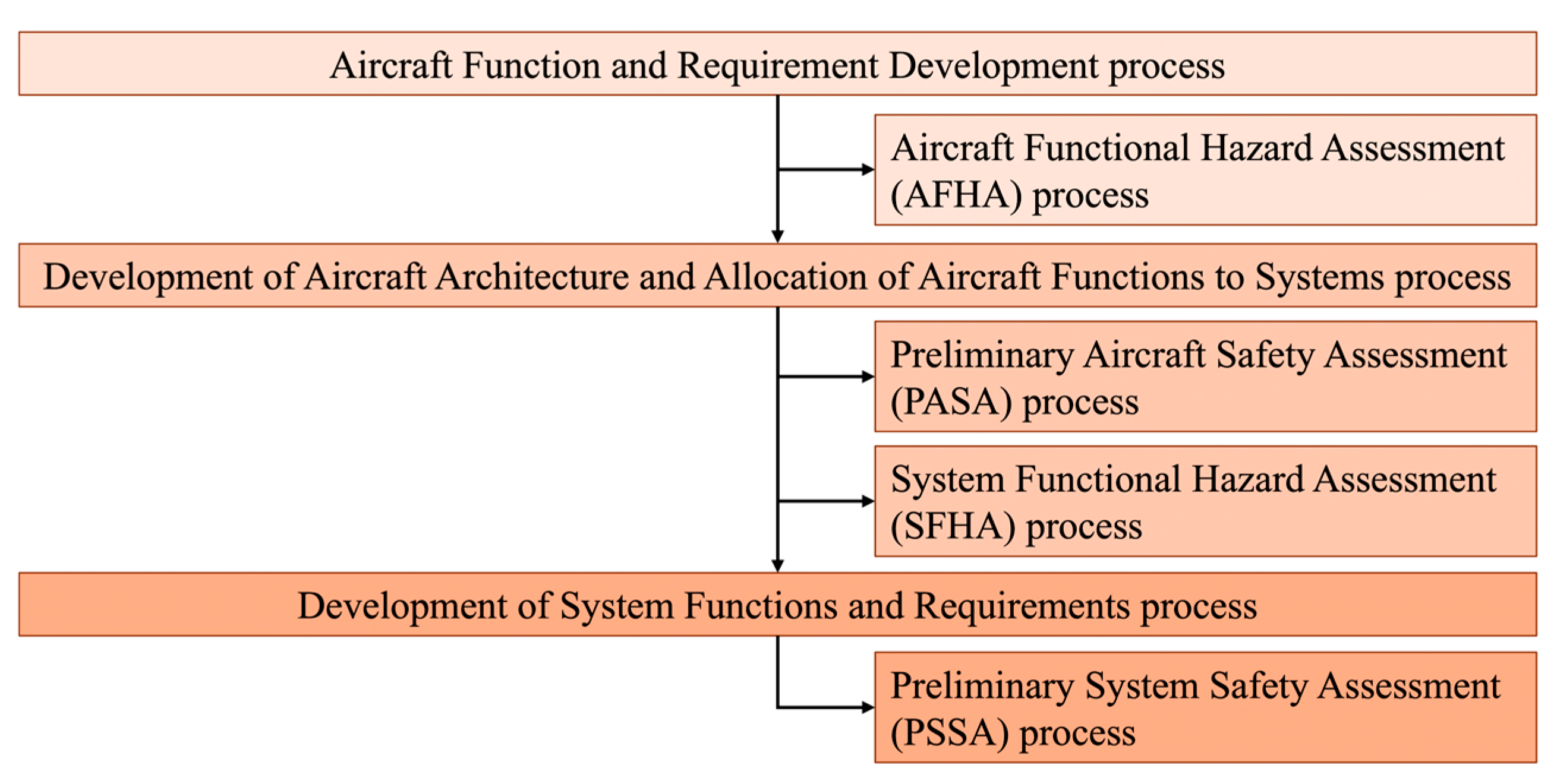
One of the main focuses of guidance material is to describe supporting compliance processes and the order in which they must be performed. Continuing with the same example, the series of processes described in the ARP4754B ([32], p. 24) that are used to define safety requirements begin with the Aircraft Functional Hazard Assessment (AFHA) and include several subsequent processes shown in Figure 4.
The ARP4754B describes the processes shown in Figure 4 as having both a hierarchy and a sequential order of operation.
3.4.2.1. Process/Subprocesses Hierarchy Patterns
The main processes shown in Figure 4 include the Aircraft Function and Requirement Development process; the Development of Aircraft Architecture and Allocation of Aircraft Functions to Systems process; and the Development of System Functions and Requirements process. Each process has several subprocesses, including the Aircraft Functional Hazard Assessment (AFHA), Preliminary Aircraft Safety Assessment (PASA), System Functional Hazard Assessment (SFHA), and Preliminary System Safety Assessment (PSSA) subprocesses.
3.4.2.2. Ordered Process Patterns
The ARP4754B also describes the order in which the processes/subprocesses should be performed. For example, the AFHA subprocess is required as input to the Development of Aircraft Architecture and Allocation of Aircraft Functions to Systems process, and therefore the AFHA must be completed first. The arrows in Figure 4 indicate the order in which the processes should occur.
The example of safety requirements is used to illustrate that recurring patterns such as Boolean true/false classification questions and process sequence patterns are used throughout the ARP4754B and ARP4671A guidance material documents and can be modeled using ontological design patterns. Each of these processes is represented in an ontology as an individual of type Process. The hierarchy and sequence between the individuals are modeled using object properties and further specified using object property characteristics to infer an order of operation for these processes.

3.4.3. Reference Patterns

Aircraft certification requires stringent documentation traceability to track changes, engineering justification, and compliance. The explicit cross-referencing within the regulations and implicit cross-referencing between regulations and guidance material require a mechanism for representation within a model for forward and backward traceability between the model and its source documentation to ensure the model is a source of truth.
3.4.3.1. Source Referencing
Each of the ontological concepts identified in the contextual analysis corresponds to one or several sections of text in which the concept is mentioned. The NLP software tool Atlas.ti [129] concept mining capability demonstrates the utility of in-text source referencing, shown in Figure 5. The example of the keyword Process selected in Figure 5a shows the in-text location and contexts in which the Process noun-phrases appear in Figure 5b.
A defined relationship between each ontological entity and its source documentation is also necessary to differentiate the type of source documentation that is being modeled to distinguish between entities sourced from law-bound regulations and entities linked to guidance material recommendations and means of compliance.
3.4.3.2. Cross-Referencing
The interdependent nature of aircraft systems is reflected in complex cross-referencing between regulatory documents. While regulations only explicitly reference other regulations, guidance material cross-references both the regulations and other guidance material documents. Examples of external document sections referenced throughout the ARP4754B include the FAA’s Code of Federal Regulations (CFRs) [131] and EASA’s Certification Specifications (CS) [132], such as the §25.1309 [17,133], as well as other guidance material documents such as the ARP4671A [128]. The relationship between the regulations and guidance material is only explicitly defined in one direction; regulations do not explicitly reference which guidance material documents are accepted as recommendations for establishing means of compliance. A modeling pattern reflecting a forward and backward relationship between regulations and guidance material would contribute to clarifying the interactions between the documents.
The source and cross-reference patterns are modeled in an ontology using the annotation property relationship. The annotation property is selected as the mechanism for this relationship as it can be linked to any modeled entity in an ontology and can therefore be used as forward and backward traceability for all ontological classes, properties, and individuals.
The classification, process, and referencing patterns identified in the natural language pattern identification assessment form the foundation for logical, repeatable modeling structures and are used to inform the design and implementation of ontology design patterns to develop an ontological representation of the guidance material documentation.

3.5. Ontological Design Pattern Implementation

Ontology design patterns are implemented using the ontological modeling tool Protégé [85,86] based in S R O I Q ( D ) description logic [68] as a modeling solution to represent the patterns found in the natural language of the text. This paper uses guidelines presented by Noy and McGuinness [63], DeBellis [90], and Insaurralde and Blasch [88] to develop ontological models.
The proposed ontology design patterns and modeling implementation are discussed in the following section and include class, Boolean true/false classification, process, and reference ontology design patterns.

3.5.1. Class Ontology Design Pattern

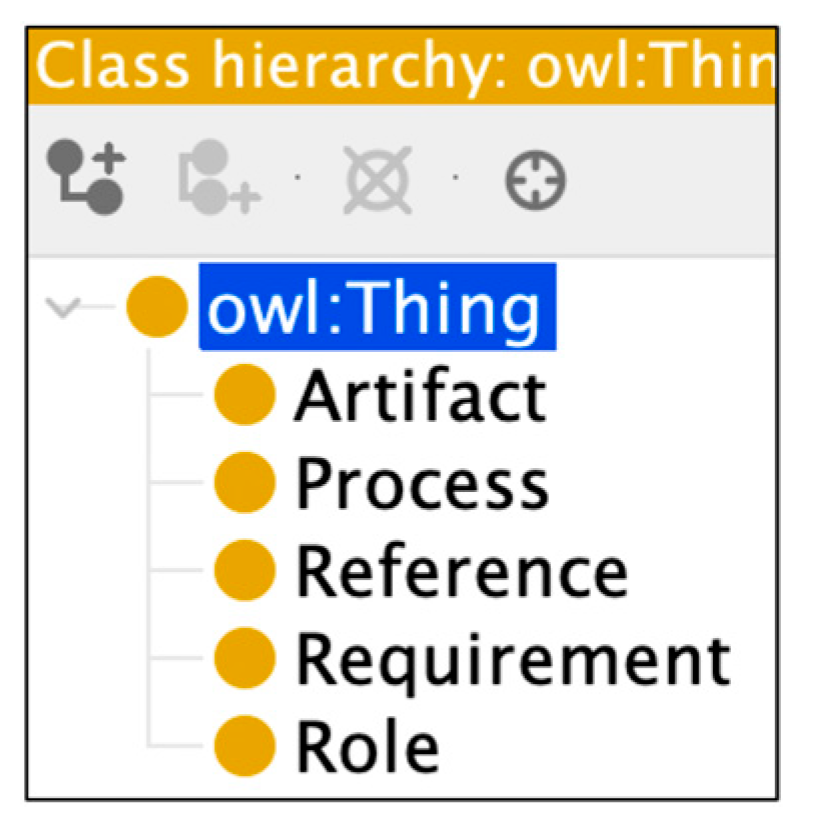
The proposed Class ontology design pattern for the class pattern identified in the ARP4754B is presented in Figure 6.
The class structure in Figure 6 includes Artifact, Process, Reference, Requirement, and Role classes. The identification of a class structure is supported by the literature. Humberg et al. [111] discuss the Artifact, Process, and Role classes as being widely accepted across software modeling literature as a solution to formalizing concept hierarchies for model interoperability. Humberg et al. [111] also propose the use of a Reference class to store an explicitly defined set of source documentation references. References are related to entities in the ontology to provide forward and backward traceability between the ontological entities and their location within source documentation. In this research, the Reference class is adapted to include relationships to both source and cross-referenced documents, as described in Section 3.4.3 and modeled in Section 3.5.4. The Process and Requirement classes shown in Figure 6 model the natural language patterns identified in Section 3.4.1.1 and are specific to the ARP4754B.

3.5.2. Boolean True/False Classification Ontology Design Pattern
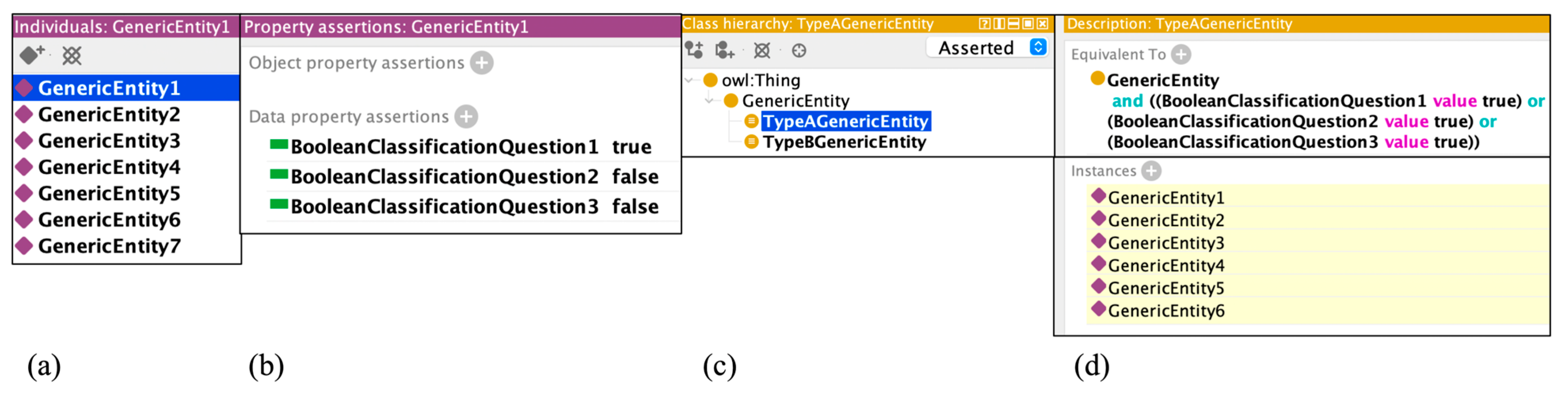
A Boolean true/false classification ontology design pattern is developed to represent the classification criteria pattern presented in Section 3.4.1.2, where a series of Boolean true/false questions are used to classify individuals. A generic ontological model is shown in Figure 7 to illustrate the design pattern, and an implementation example for the ARP4754B is shown in Figure 8.
The Boolean true/false pattern illustrated in Figure 7 is structured as follows. The individuals to be classified are shown in Figure 7a and are labeled GenericEntity 1–7. Three data properties are shown in Figure 7b as BooleanClassificationQuestion 1–3. The aircraft certification subject matter expert (SME) must interact with the model to answer true or false for each question in Figure 7b with respect to each individual in Figure 7a. Membership of the class TypeAGenericEntity shown in Figure 7c is constrained by requiring the value true for any one of the BooleanClassificationQuestions shown in Figure 7d, and the individuals meeting this criterion are inferred as members of class TypeAGenericEntity, shown in Figure 7d. The individuals, data properties, and classes are intentionally represented as generic entities in this design pattern, as they are intended to be replaced with specific entities when applied to an aircraft design and development program. The pattern is also designed to be scalable, where any number of entities can be added or removed depending on the program type or size.
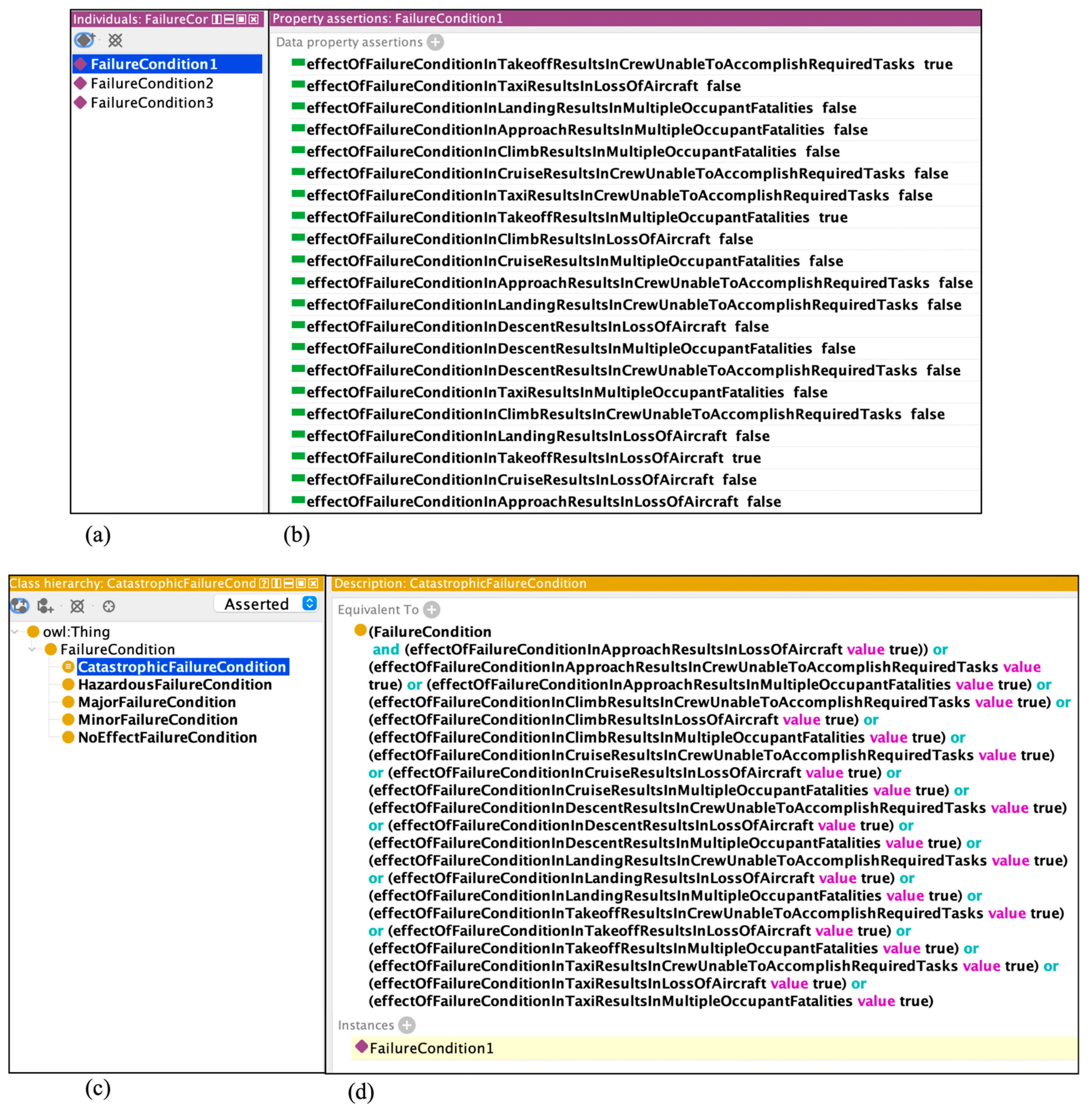
The Boolean true/false ontology classification pattern is used to model the safety requirement failure condition severity classification criteria example from the ARP4761 described in Section 3.4.1.2 and illustrated in Figure 3. The resulting ontological model is shown in Figure 8.
Figure 8. Boolean true/false classification design pattern applied to failure condition classification criteria described in the ARP4671A, including (a) generic failure condition individuals, (b) data property assertions, (c) failure condition severity classifications, and (d) constraints.
Aerospace 13 00460 g008
Generic failure condition individuals such as FailureCondition1 are shown in Figure 8a, where in an aircraft design program, the generic individuals would be renamed with program-specific failure conditions. Figure 8b shows the Boolean true/false questions for catastrophic failure presented in Figure 3, modeled as data property assertions for each phase of flight, where an SME enters a Boolean true or false value for each assertion. The severity levels are shown in Figure 8c, and the constraints that determine the class membership criteria for each classification are shown in Figure 8d. The design pattern, when applied to this example, is demonstrated as being scalable to a larger number of data property assertions without having to modify the pattern structure.

3.5.3. Process Ontology Design Patterns

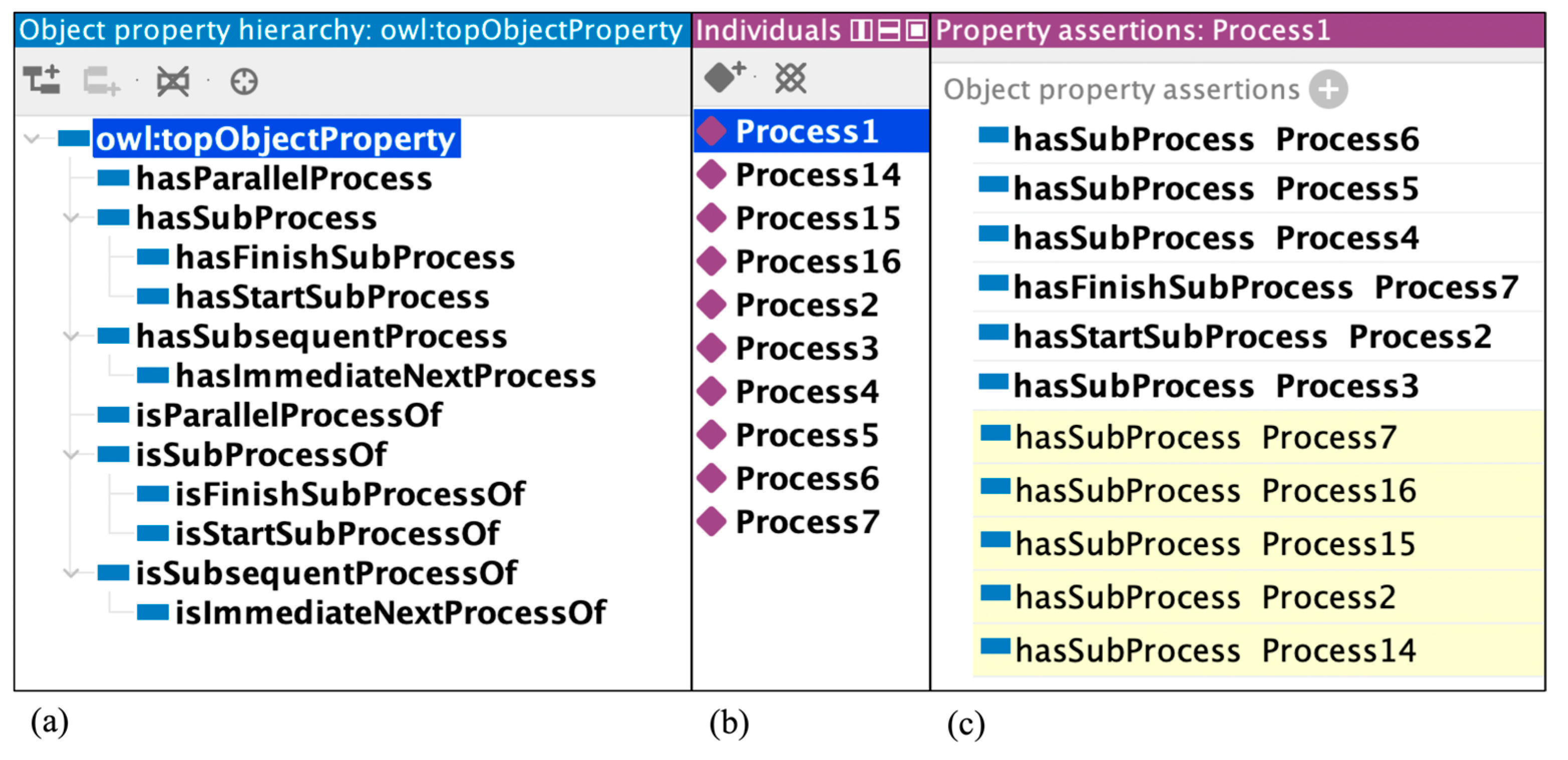
The process natural language patterns presented in Section 3.4.2 are structured using two ontology design patterns: a part-whole relationship design pattern is used to model process/subprocess hierarchy described in Section 3.4.2.1, and a sequence design pattern is used to model process order described in Section 3.4.2.2. A generic ontological model is shown in Figure 9 to illustrate the process design pattern, and its application to an example from the ARP4754B is shown in Figure 10.
The process ontology design pattern shown in Figure 9 includes (a) object properties, (b) generic process individuals, and (c) object property assertions. The individuals labeled Process 1–7 and 14–16 are randomly numbered to demonstrate the use of object property assertions in defining the process/subprocess hierarchy and order of process sequence. Object property characteristics such as inverse and transitive are used to further define relationships between processes. The object properties and associated characteristics shown in Figure 9a are further detailed in Table 4.
3.5.3.1. Process/Subprocesses Modeled Using Part-Whole Relationship Ontology Design Pattern
The process/subprocess hierarchical relationship is represented by the transitive hasSubProcess object property shown in the first row of Table 4, which implements a part-whole relationship design pattern based on the Rector and Welty [114] “Representation Pattern 1: Representing a part-whole hierarchy.” This pattern allows the representation of a hierarchy while respecting the subsumption rule described in Section 2.1 and is scalable so that any number of subprocesses can be added without changing the design pattern.
3.5.3.2. Ordered Process Sequence Modeled Using a Sequence Ontology Design Pattern
The sequence ontology design pattern is represented by the remaining five object properties shown in Table 4, and is adapted from patterns presented by Hu et al. [108], DeBellis [117], and Gangemi [118]. The first and last subprocesses within a process are identified by hasFirstSubProcess and hasLastSubProcess, respectively. These relationships are both functional. The sequence following the first process is indicated as one of the following: a subsequent process with unspecified order using the transitive object property hasSubsequentProcess; a process that is immediately subsequent using the object property hasImmediateNextProcess; or a process that occurs in parallel using the transitive object property hasParallelProcess. The reasoner is used to infer additional sequential information from the object property characteristics, shown in yellow in Figure 9c.
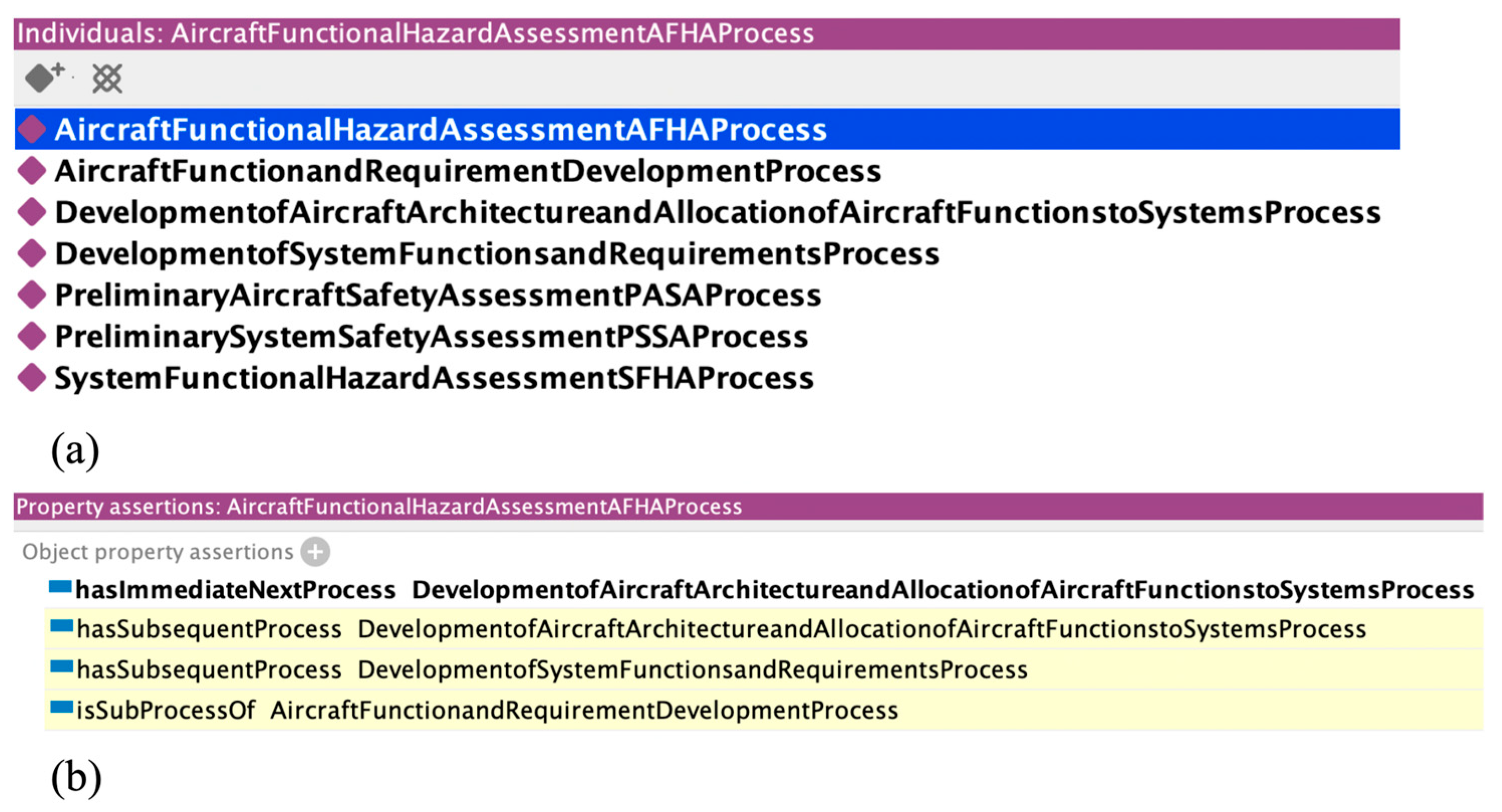
Figure 10 illustrates the generic Figure 9 ontology design pattern applied to an example from the ARP4754B processes described in Section 3.4.2.
Figure 10. Process ontology design pattern applied to selected processes from the ARP4754B, including (a) individuals and (b) object property assertions.
Aerospace 13 00460 g010
The individuals in Figure 10a are the selected processes described in Section 3.4.2 and Figure 4. The object property assertions in Figure 10b demonstrate how object properties are used to identify immediate next processes, subsequent processes, and subprocess relationships.

3.5.4. Reference Ontology Design Pattern

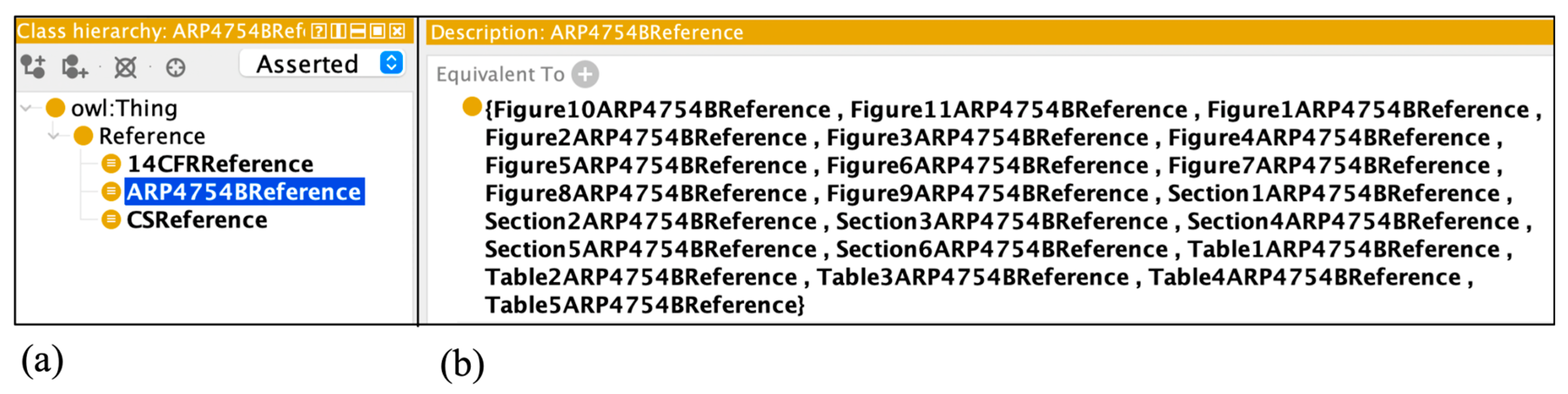
The referencing patterns presented in Section 3.4.3 are structured using a Reference ontology design pattern. The source reference pattern is shown in Figure 11, and the cross-reference pattern is shown in Figure 12 for the ARP4754B.
A Reference class and ARP4754B Reference, 14CFR Reference, and CS Reference subclasses are shown in Figure 11a and Figure 12a. The source referencing pattern is structured as an enumerated list, demonstrated in Figure 11b for the ARP4754B document sections. The cross-referencing pattern discussed in Section 3.4.3.2 is also structured as an enumerated list, demonstrated in Figure 12b using examples from Title 14 of the Code of Federal Regulations (CFR) that are referenced throughout the ARP4754B. Each concept modeled in the ontology can be related to one or more sections of corresponding reference documentation using the annotation properties hasSourceReference and hasCrossReference, respectively. This relationship between classes, object properties, data properties, and individuals and their location within source documentation provides traceability that can support model revisions to ensure models remain a current source of truth.
The classification, process, and reference design patterns identified in the ARP4754B recur many times throughout the document and represent patterns that are typical of aircraft regulatory documentation. The ontology design patterns are developed using scalable, generic entities to form a template that can be applied to other instances of the pattern throughout the same document and other regulatory documents. The modeling approach developed in this research is intended to function as a methodology for identifying those patterns as they recur throughout regulatory text and provides a mechanism for identifying and modeling new patterns using the same methodology.

4. Validation and Results

In this section, the research question, “Can ontological modeling be used to effectively represent aircraft regulatory documentation in the context of digital transformation?” is answered by validating the modeling approach proposed in Section 3 with a guidance material document use case. A guidance material document from another discipline in the aircraft certification domain is selected to validate this modeling approach and is used to demonstrate the repeatability of the research methodology to different applications.

4.1. Regulatory Document Selection

The document selected to validate the modeling approach is the Advisory Circular AC21.101-1B—Establishing the Certification Basis of Changed Aeronautical Products [35] guidance material document, which provides guidance for complying with the Code of Federal Regulations (CFRs) §21.101 [134]. The AC21.101-1B provides guidance for establishing a new certification basis for changes made to an existing aircraft, a certification challenge that is arguably more complex than for a clean-sheet design. The equivalent documents to the AC21.101-1B and CFR §21.101 for the European (EASA) and Canadian (TCCA) regulatory bodies are as follows: the EASA equivalent guidance material document is the GM 21.A.101 Establishing the certification basis of changed aeronautical products [135] and the regulation CS 21.A.101 [136]. The Canadian Advisory Circular equivalent, AC 500-016 Issue No. 1 [137], currently points to the FAA’s AC21.101-1B to provide interim guidance for complying with the equivalent Canadian Aviation Regulation, CAR 521.158 [138], in establishing the certification basis for a changed aeronautical product.
This research was conducted in collaboration with two industrial partners: a Canadian aerospace research and development company specializing in aircraft certification and a Canadian aircraft modification company. Interactions with industrial partners included author on-site internships, presentations, discussions, and research reviews with aircraft certification SMEs. The AC21.101-1B is selected for its relevance to the aircraft modification sector and for the subject matter expertise in the areas of aircraft modification and certification, contributing to this research.

4.2. Natural Language Processing Tool Analysis

4.2.1. NLP-Identified Keywords and Noun-Phrases

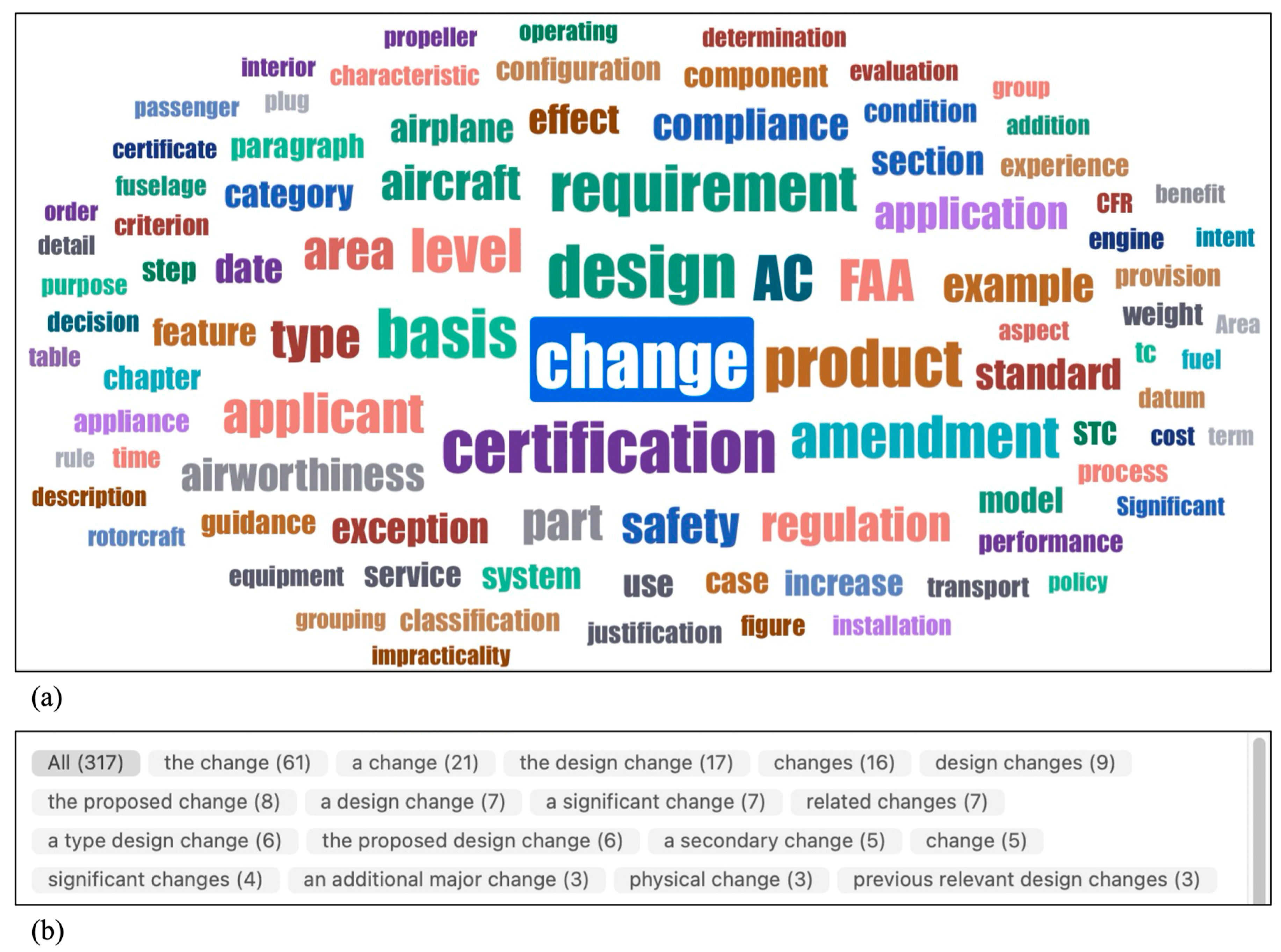
The selected regulatory documentation is analyzed using a natural language processing tool, Atlas.ti version 25.0.1 [129]. The most frequently occurring keywords and associated noun-phrases in the main body of the AC 21.101-1B document are shown in Figure 13.
The top five keywords and associated noun-phrases in the AC 21.101-1B are change (317 noun-phrases), design (140 noun-phrases), certification (113 noun-phrases), basis (110 noun-phrases), and product (106 noun-phrases). Table 5 provides examples of the NLP-identified keywords basis, change, and product. Noun-phrase cleaning activities described in Section 3.2.1 are conducted and examples of cleaned associated noun-phrases are presented in column 2 of Table 5.

4.2.2. Identification of Concepts to Be Modeled

The cleaned noun-phrases are then further analyzed to identify an initial list of ontological concepts to be modeled, examples of which are shown in column 3 of Table 5.
Table 5. Examples of keywords and associated noun-phrases from the AC21.101-1B identified by the NLP tool and organized into ontological concepts.
Examples of Keywords Identified by NLP SoftwareNoun-Phrases Identified by
NLP Software
Ontological Concepts to be Modeled
basiscertification basiscertification basis/type certification basis (synonymous)
type certification basis
the basis
changechange(s)change/design change/type design change (synonymous)
design change(s)
type design change
substantial changesubstantial change
related and unrelated changesrelated change
unrelated change
productproduct(s)aeronautical product/product (synonymous)
aeronautical product
As a specific example, the keyword basis in Table 5 is associated with the noun-phrases certification basis, type certification basis, and the basis. Most of the noun-phrases containing the word basis are paired with the word certification, and as a result the noun-phrase certification basis is selected as the concept most relevant to the aircraft modification domain.

4.3. Contextual Analysis

The series of questions presented in Section 3.3 is used to conduct a contextual analysis for each of the ontological concepts to identify definitions, ambiguity, and additional associated concepts to form an initial modeling structure. Examples of additional ontological concepts identified through the contextual analysis of the AC 21.101-1B are shown in Table 6.
As an example of additional concepts identified in this process, one of the instances of the concept certification from paragraph 3.1.1 of the AC21.101-1B ([35], p. 11) has the following context: “As an applicant for the certification of a type design change, you must show […].”
While certification and type design change are already included in the initial NLP-identified concepts shown in Table 5, applicant is not. Relationships between certification, type design change, and applicant are also absent from the NLP software output. A further contextual analysis of applicant shows that the applicant takes many different actions throughout the text, including identifying, showing, considering, accounting for, assessing, electing, evaluating, designating, documenting, proposing, choosing, using, changing, justifying, substantiating, demonstrating, complying, filing, applying, and submitting. The contextual analysis facilitates the identification of synonyms and selection of the most relevant relationships to be modeled in the ontology.

4.4. Natural Language Pattern Identification

The contextual analysis process enables the identification of recurring patterns throughout the natural language of the text. Similarly to the pattern identification process presented in Section 3.4 for the ARP4754B, the patterns identified in the natural language of the AC21.101-1B are classification patterns, process patterns, and reference patterns, described below.

4.4.1. Classification Patterns

Classification remains an important theme in the AC21.101-1B in determining which regulations will be required to form the basis of certification for a changed aircraft. The investigation of classes and class membership criteria in the natural language of the document is necessary to identify recurring patterns and develop an ontology.
4.4.1.1. Class Pattern
The NLP-identified keywords shown in Figure 13a provide a starting point for class structure investigation for the AC21.101-1B. The keyword Change is an example of an initial class, as changes to an aircraft require severa.
l classification activities throughout the AC21.101-1B. Additional classes of Artifact, Process, Reference, and Role that are common to software modeling literature as described in Section 3.5.1 are also relevant to the AC21.101-1B. For example, the AC21.101-1B further classifies the keyword Change as substantial changes, significant changes, and related or unrelated changes. The types of Change defined in the AC21.101-1B result in the identification of the keyword Change as an ontological class.
4.4.1.2. Classification Criteria Patterns
  • Boolean true/false classification
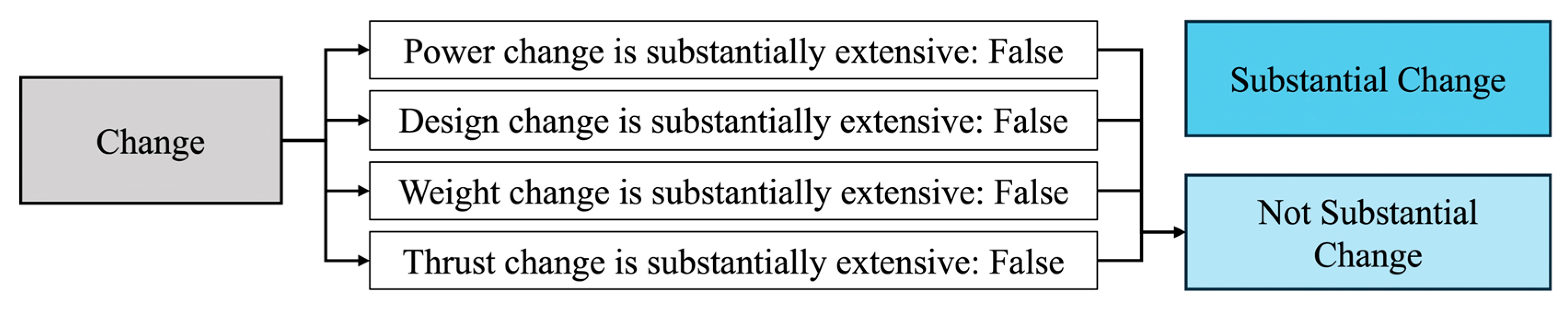
Following the identification of classes, the criteria for class membership are extracted from the document as part of the contextual analysis and pattern identification process. Continuing in the example of the keyword Change, the AC21.101-1B provides a series of classification steps, including “Step 2. Verify the Proposed Type Design Change is Not Substantial” ([35], p. 14). The AC21.101-1B states that “… you [must] apply for a new [type certificate] for a changed product if the change in design, power, thrust, or weight is so extensive that a substantially complete investigation of compliance with the applicable regulations is required” ([35], p. 14). The statement provides criteria for classifying a change as substantial or not substantial and can be organized into a series of Boolean true/false questions illustrated in Figure 14 for a not substantial change classification.
The change classification process shown in Figure 14 depicts a change (gray) being assessed for the extent of its effect on power, design, weight, and thrust. A Boolean true/false question is posed for each of these substantiality questions, shown in white. An answer of False must be given for all questions in order for the change to be considered as not substantial (light blue). If any of the answers were to be True, the change would be classified as substantial (dark blue).
The criteria for a substantial or not substantial change as described in the AC21.101-1B illustrate another example of recurring Boolean true/false questions that result in a series of classifications, which are identified as a frequently occurring pattern across the guidance material documents and can be modeled in an ontology. The change is the entity needing classification and is represented as an ontological individual. The Boolean true/false questions are represented in an ontology as data properties, where the range of each property is defined as Boolean. The classifications of substantial change or not substantial change are each represented in an ontology as a class.
  • Pairwise comparison classification
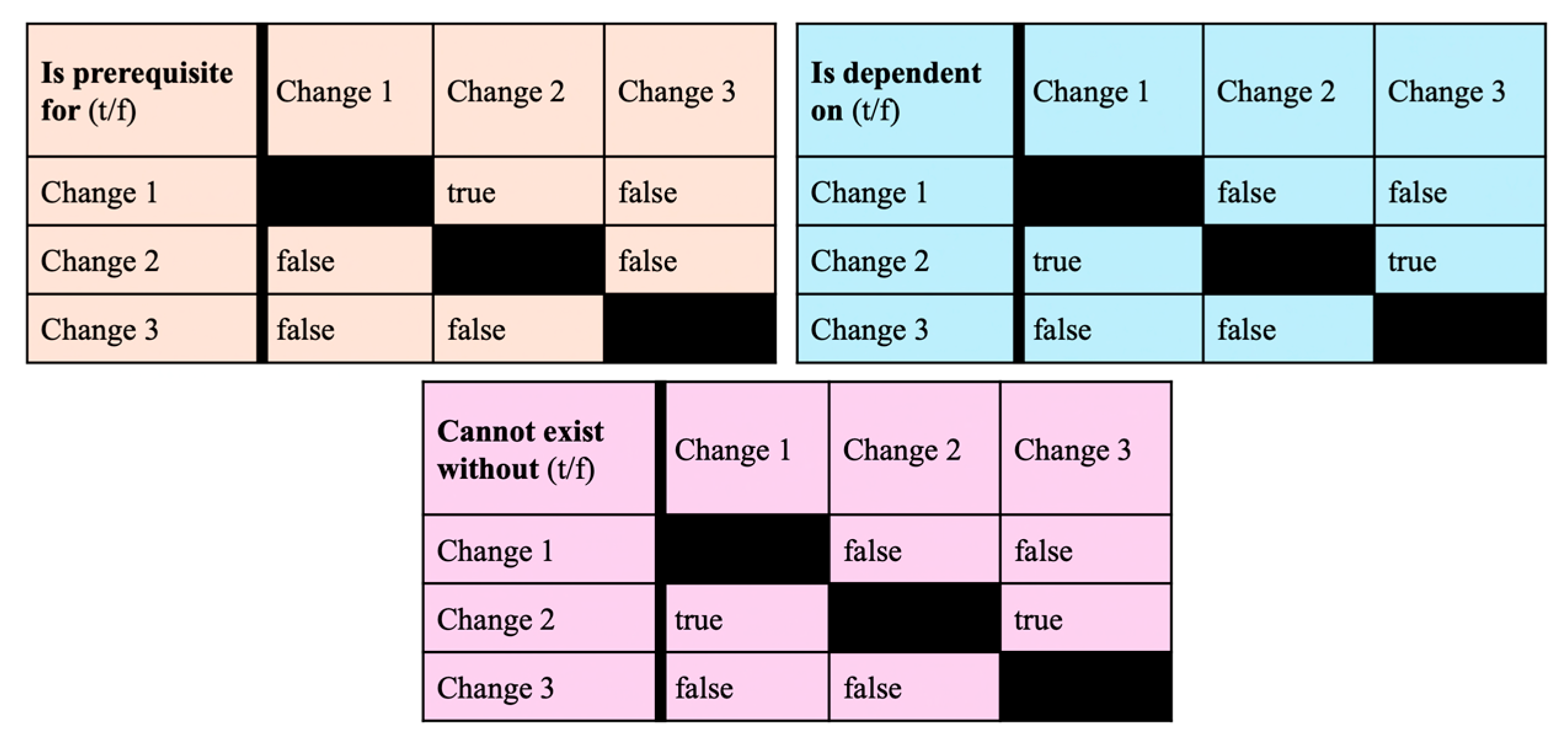
Another example of keyword Change classification criteria is found in “Step 4. Arrange Changes into Related and Unrelated Groups” of the AC21.101-1B ([35], p. 15), which states that “Related changes are those that cannot exist without another, are co-dependent, or a pre-requisite of another.” This statement addresses cases where several changes are being made within the same aircraft modification program and states the criteria against which changes are assessed for their relationship to one another. This classification process has additional complexity of relational criteria, which the Boolean true/false classification design pattern alone is unable to address. The three criteria of cannot exist without, are co-dependent, or pre-requisite of another form the basis for a pairwise comparison between each of the changes to assess whether they are related to one another. A diagram of a related/unrelated pairwise comparison matrix between three generic changes is shown in Figure 15.
Figure 15 shows one pairwise comparison conducted using three criteria to assess if changes are related to one another. Each table represents a question about the nature of the relationship between generic changes 1, 2, and 3. The changes are related if one or more of the comparisons in Figure 15 have a value of true and are unrelated if all the comparisons have values of false. A pairwise comparison is a mathematical method often used for multidimensional decision-making in complex systems design and can be modeled in an ontology. The generic changes, change 1, change 2, and change 3, are to be classified and are represented as ontological individuals. The Boolean true/false questions are represented in an ontology as data properties and specified as relational, with the range of each property defined as Boolean. The classifications of related and unrelated changes must be further specified as related to change 1, related to change 2, related to change 3, or unrelated change, and are modeled in an ontology as classes.

4.4.2. Process Patterns

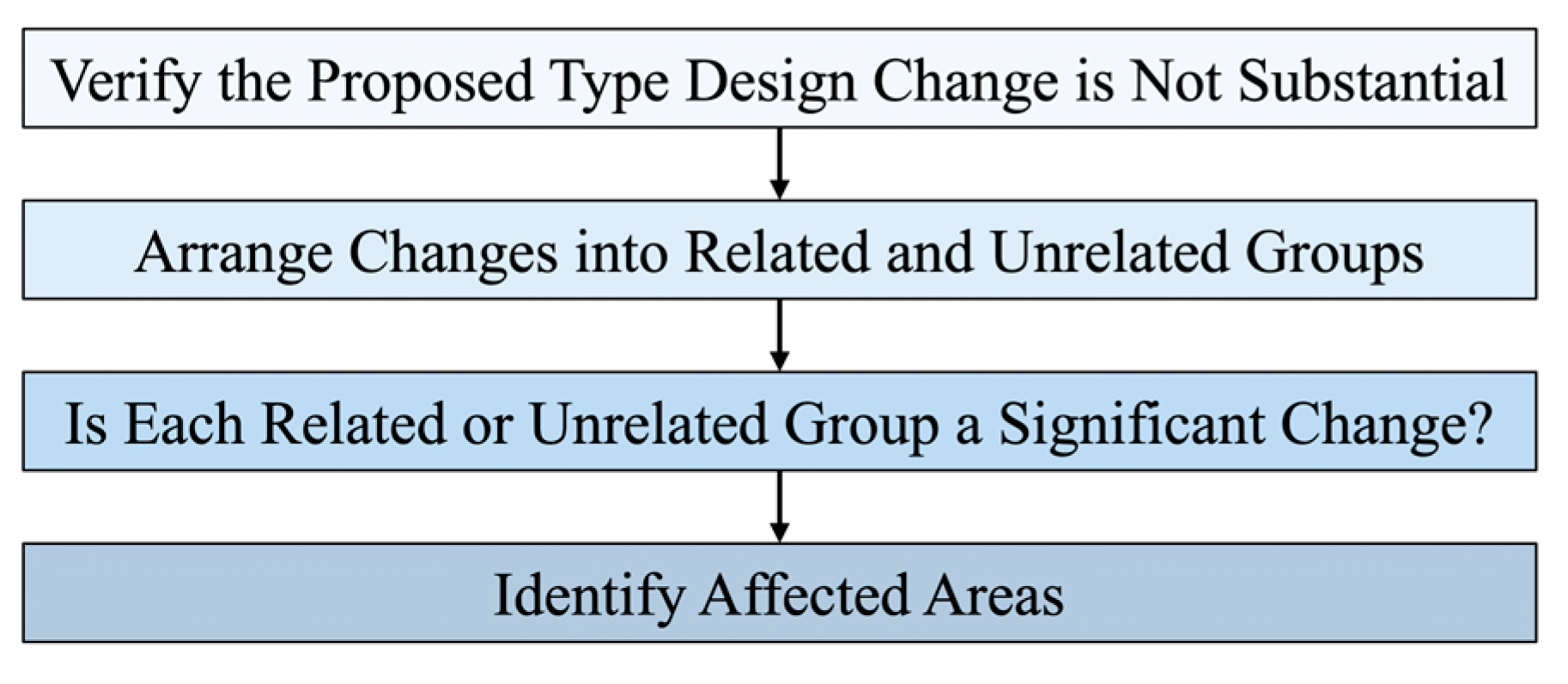
The AC21.101-1B contains guidance on compliance processes and their order of occurrence. For example, assessing types of Changes involves a series of several processes which are described in the AC21.101-1B [35] and shown in Figure 16.
The processes described in Figure 16 include Verify Proposed Change is Not Substantial, Arrange Changes into Related and Unrelated Groups, Is Each Related or Unrelated Group a Significant Change, and Identify Affected Areas. The order of these processes is presented sequentially in the AC21.101-1B, where each process must be completed prior to conducting the subsequent process. Order is indicated by the arrows in Figure 16.

4.4.3. Reference Patterns

Similarly to the source referencing and cross-referencing patterns described in Section 3.4.3, the ontological modeling concepts can be sourced to sections of the AC21.101-1B, and the external document most cross-referenced is the Code of Federal Regulations (CFRs) §21.101 [134].
The classification, process, and referencing patterns identified in the natural language pattern identification assessment of the AC21.101-1B form the foundation for logical, repeatable modeling structures and are used to validate the research methodology for the design and implementation of ontology design patterns and the applicability of the systematic ontological representation of a broader scope of guidance material documentation.

4.5. Ontological Design Pattern Implementation

Ontological design patterns for the classification, process, and reference natural language patterns identified in the AC21.101-1B are proposed in the following sections and include class; Boolean true/false classification; pairwise comparison; process; and reference ontology design patterns.

4.5.1. Class Ontology Design Pattern

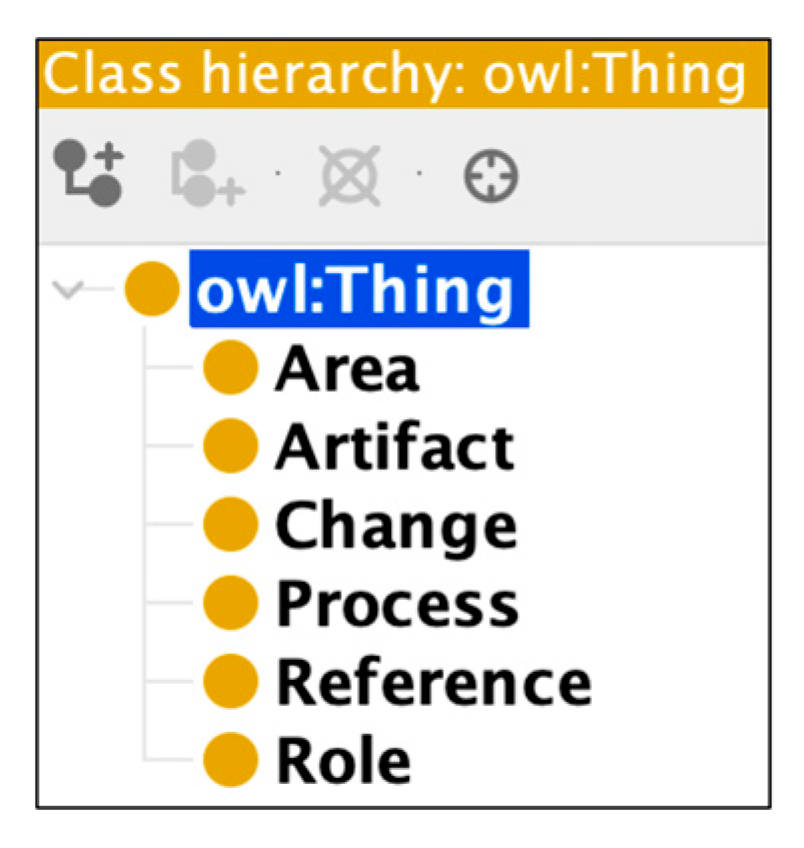
The proposed Class ontology design pattern for the class pattern identified in the AC21.101-1B is presented in Figure 17.
The class structure in Figure 17 makes use of both classes used in software development and classes specific to the AC 21.101-1B. Two classes in Figure 17 differ from those identified in the ARP4754B example presented in Section 3.5.1. The Requirement class has been removed because the AC21.101-1B does not contain requirements classification activities. The classes Change and Area have been added, as these contain classification activities and criteria.

4.5.2. Boolean True/False Classification Ontology Design Pattern

The Boolean true/false classification design pattern previously shown in Figure 7 is implemented in the context of the AC21.101-1B process Verify Proposed Change is Not Substantial and is presented in Figure 18.
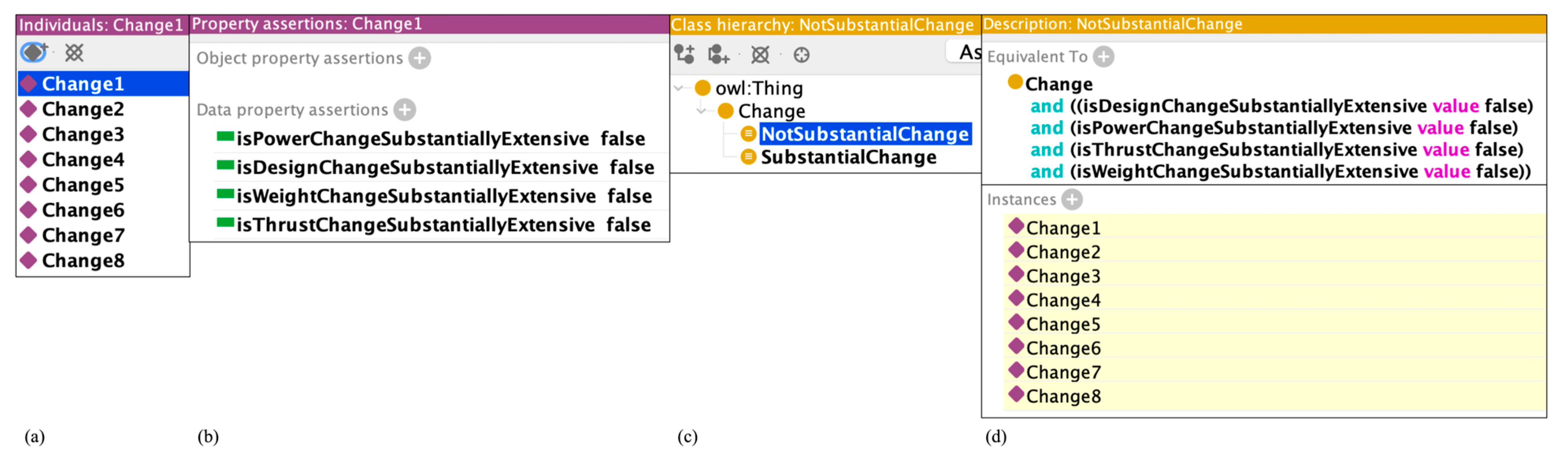
The individuals of class Change shown in Figure 18a represent the proposed changes to the aeronautical product. The ontological representation shown in Figure 18b involves an assessment of each change against the AC21.101-1B criteria for substantiality using the following data property assertions: is power change substantially extensive; is design change substantially extensive; is weight change substantially extensive; and is thrust change substantially extensive.
The structure permits the SME to interact with the model and answer each of these questions with true or false values. As a result of the SME input, an ontological reasoner classifies changes as either NotSubstantialChange or SubstantialChange as shown in Figure 18c according to the constraints shown in Figure 18d. A non-substantial change is one in which all of the criteria for substantiality listed above are reported as false. Examples of generic changes inferred as members of the NotSubstantialChange class are shown in the bottom half of Figure 18d. The individuals classified under NotSubstantialChange therefore qualify as changes to an aeronautical product, rather than a new product design.
The classifications were tested using different combinations of data property values for each of the individuals to ensure the reasoner did not detect any logical errors.

4.5.3. Pairwise Comparison Classification Ontology Design Pattern

Pairwise comparison and part-whole relationship ontology design patterns are used to structure the related and unrelated group pairwise comparison classification criteria pattern identified in Section 4.4.1.2.
A generic ontological model is shown in Figure 19 to illustrate the design pattern, and the implementation of the design pattern to the AC21.101-1B is shown in the ontology in Figure 20.
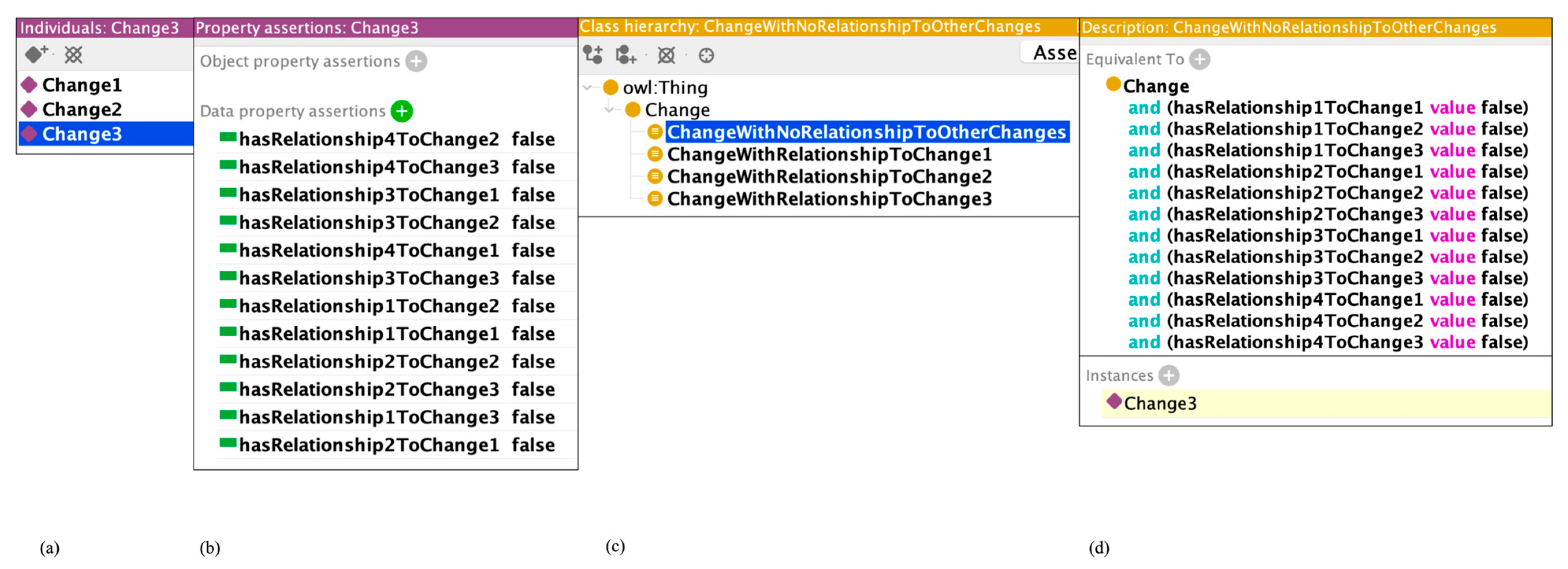
The individuals of class Change are shown in Figure 19a, and examples of generic pairwise comparison questions are shown as data properties in Figure 19b. The SME answers true or false for each of the four questions comparing the respective changes. The class diagram in Figure 19c shows the classes named in a way that allows for group membership while respecting a subsumptive relationship between a class and its members, such as Change with no relationship to other changes. This is a part-whole group-membership design pattern based on “Representation Pattern 2: Defining classes for Parts” presented by Rector and Welty [114]. Changes are inferred to class membership by the reasoner if they meet the constraint criteria, an example of which is shown in Figure 19d. The member of this class, Change3, has data property assertion values of false for all pairwise comparison questions. This design pattern is scalable, in that any number of pairwise comparisons can be conducted by adding data properties and including them as constraints for class membership criteria.
The pairwise comparison classification ontology design pattern is applied to the AC21.101-1B Arrange Changes into Related and Unrelated Groups process and is shown in Figure 20.
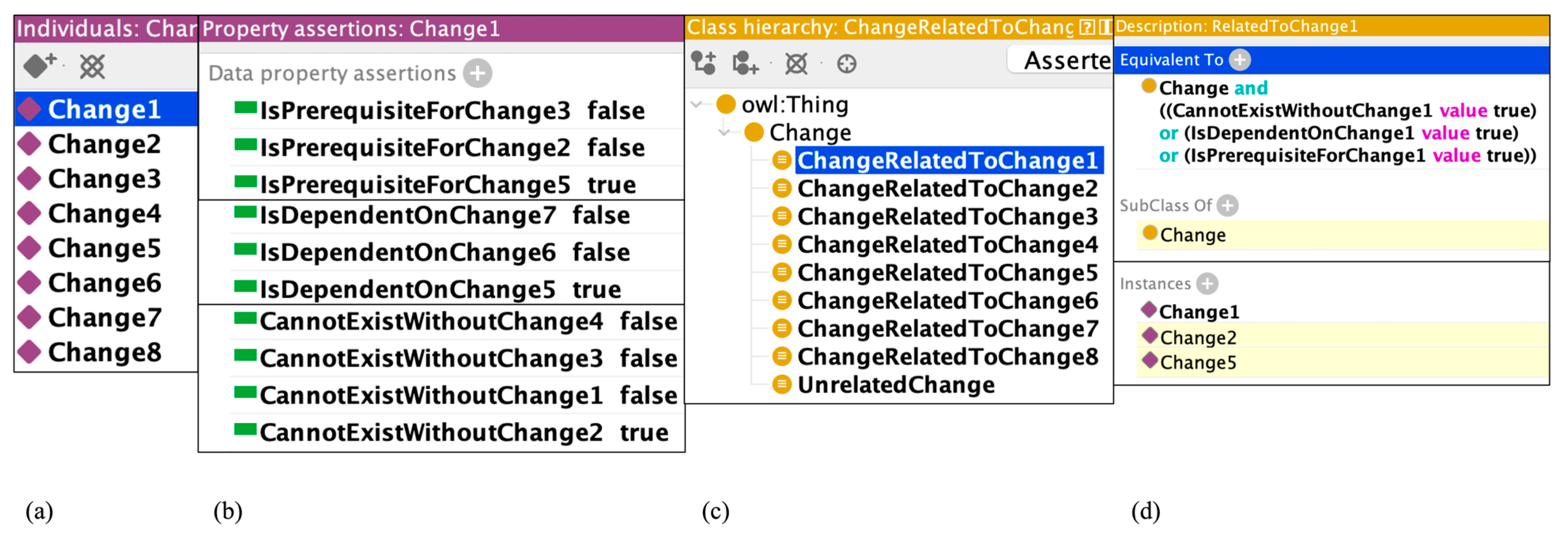
Figure 20. Pairwise comparison classification ontology design pattern as applied to the Related/Unrelated groups process described in the AC21.101-1B including (a) individuals, (b) data property assertions, (c) class, and (d) constraints.
Aerospace 13 00460 g020
Generic individuals Change 1–8 are shown in Figure 20a. The three related/unrelated change assessment criteria of cannot exist without, are co-dependent, or pre-requisite of another are modeled using data property assertions. Each criterion question is asked for each of the change pairs, examples of which are shown in Figure 20b and listed in Table 7.
The SME answers each question for each of the change individuals with true or false values in the ordered pairwise comparison. As a result of the SME input, an ontological reasoner then classifies changes into either ChangeRelatedtoChange 1-8 or UnrelatedChange classes shown in Figure 20c. These classifications are determined by the constraints shown in Figure 20d. The changes are inferred as members of a related group if any one of the data property assertion values is true and are classified as unrelated if all values are false. An example for ChangeRelatedtoChange1 is shown in Figure 20d, where Change2 and Change5 are inferred as related to Change1, and Change1 is explicitly defined as a class member.

4.5.4. Process Ontology Design Patterns

The ordered processes identified in the AC21.101-1B are structured using a process ontology design pattern. The generic process design pattern previously shown in Figure 9 is applied to selected processes from the AC21.101-1B and the results are presented in Figure 21.
The individual Arrange Changes into Related and Unrelated Groups Process is selected as an example in Figure 21a to illustrate object property assertions for the order of processes in Figure 21b.

4.5.5. Reference Ontology Design Pattern

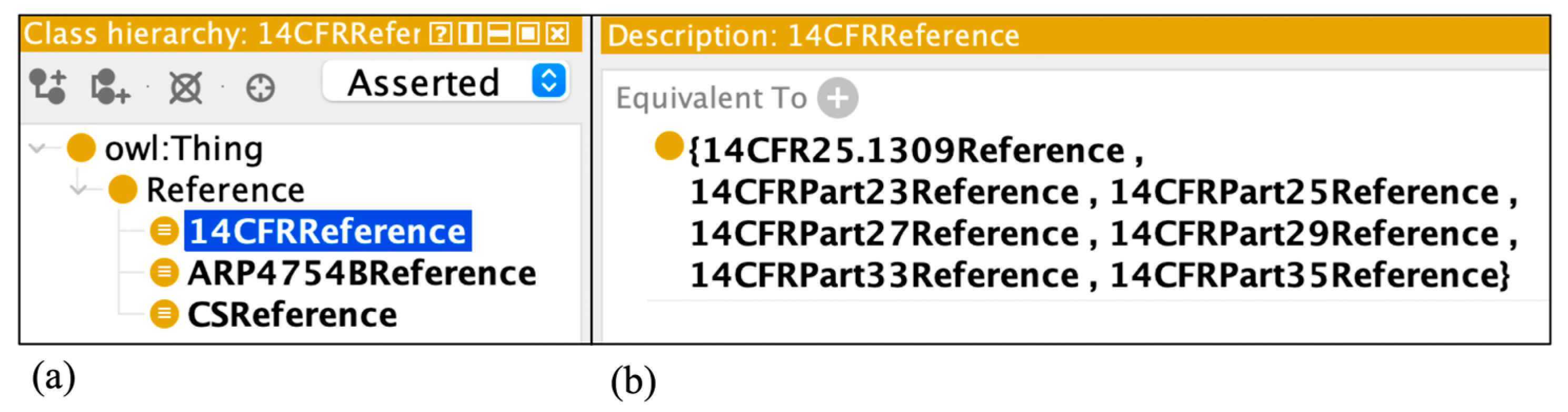
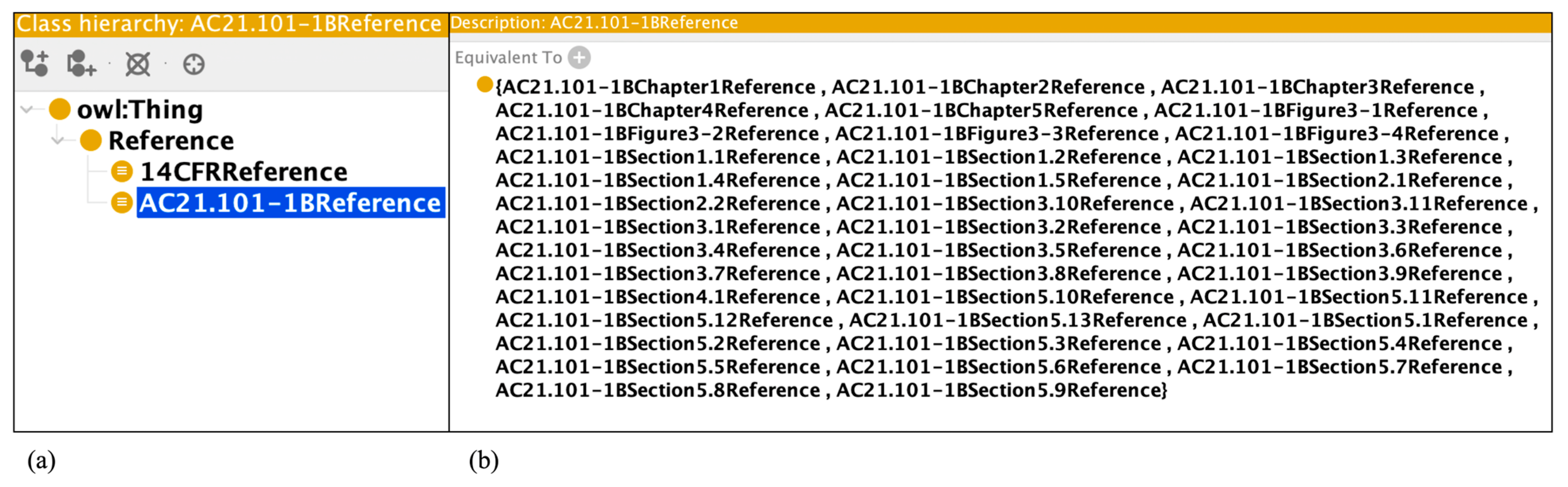
The Reference ontological design pattern presented in Figure 11 is applied to the AC21.101-1B and shown in Figure 22.
Two subclasses are listed in Figure 22a under the class Reference. The first subclass is AC21.101-1B Reference, referring to the source referenced within the document, and the second subclass is 14CFR Reference, referring to Title 14 Aeronautics and Space of the Code of Federal Regulations (CFR) cross-reference. Each section of the respective documents is modeled as an individual in the ontology, and subclass membership is declared explicitly using an enumerated list, shown in Figure 22b. Each concept modeled in the ontology can be related to one or more sections of corresponding source documentation through the use of the annotation property hasSourceReference and related to cross-referenced documentation using the annotation property hasCrossReference.

4.6. Results

The ontological modeling approach presented in this paper aims to provide a logical, repeatable, interoperable modeling structure. The class, Boolean true/false, pairwise comparison, process, and reference design patterns, when applied to the AC21.101-1B guidance material, develop individual ontologies that are treated as a collection of modules. These modules can interact with one another, with external databases, and with subject matter experts; and provide an explicit, formal representation of the natural language within the guidance material documentation and can be used for digital transformation.
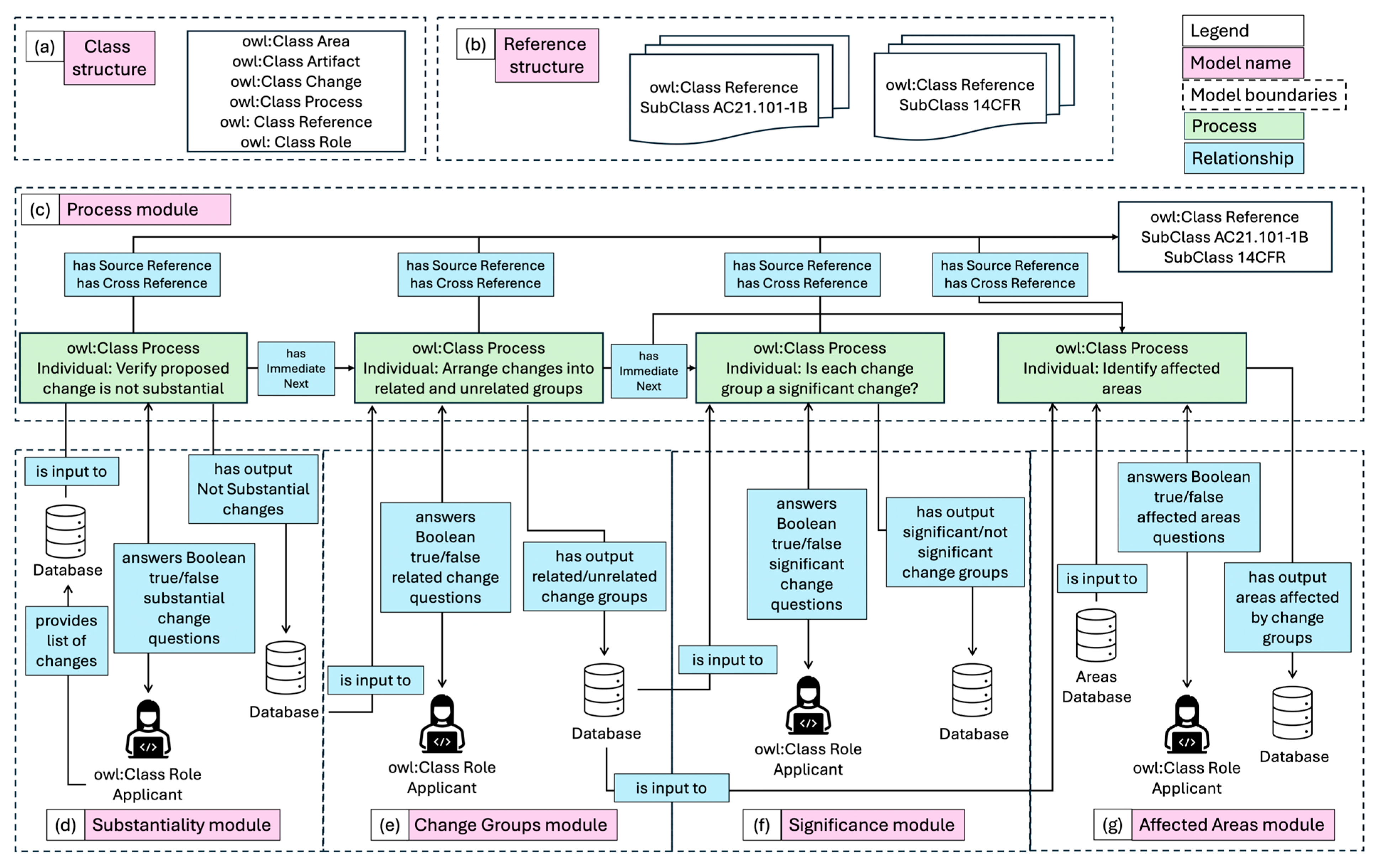
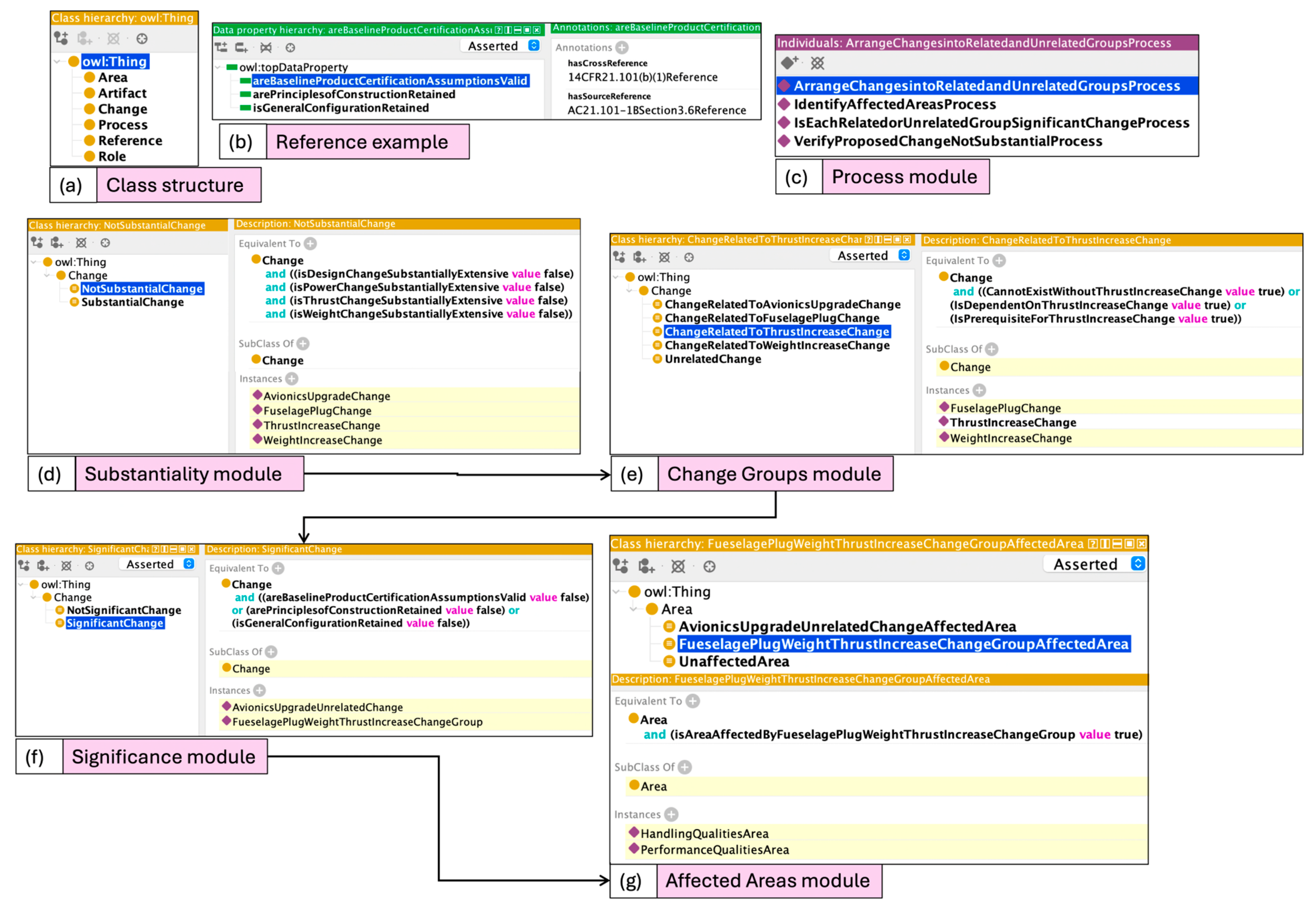
A metamodel illustrating the organization and interaction of the ontological models developed for the AC21.101-1B is shown in Figure 23. The AC21.101-1B provides an example of an aircraft design program with two modifications: a fuselage extension modification to increase the number of passengers and an avionics upgrade modification to modernize the flight deck. The metamodel presented in Figure 23 is applied to the modification program examples described in the AC21.101-1B and the results of this implementation are shown in Figure 24.
The Class pattern in Figure 23 and Figure 24a shows the Area, Artifact, Change, Process, Reference, and Role classes described in Section 4.5.1. A reference example is shown in Figure 24b, which relates the Boolean true/false questions from the (f) Significance module to the CFR §21.101(b)(1) and AC21.101-1B using the annotation property hasCrossReference and hasSourceReference, respectively.
The Process module shown in Figure 23 and Figure 24c depicts the four AC21.101-1B processes of Verify proposed change is not substantial, Arrange changes into related and unrelated groups, Is each related or unrelated group a significant change, and Identify affected areas described in Section 4.5.4. Each of these processes is represented as an individual in the owl:Class Process. Processes are related to one another by sequential object properties, examples of which are shown in blue boxes labeled has immediate next.
Each process is realized by an individual module. As shown in Figure 23 and Figure 24, the Substantiality module (d) and the Significance module (f) use a Boolean true/false classification design pattern, while the Change Groups module (e) and the Affected Areas module (g) apply the pairwise comparison ontology design pattern.
The modification example described in the AC21.101-1B states that the fuselage plug results in an increase in aircraft weight and requires an increase in engine thrust. Four Change individuals are therefore modeled in Figure 24d as Fuselage Plug Change, Weight Increase Change, Thrust Increase Change, and Avionics Upgrade Change. The Boolean true/false data properties are specified in each module according to the example. All four change individuals are classified as Not Substantial Change in Figure 24d, which are then input to Figure 24e to assess related and unrelated change groups. The resulting classifications of Fuselage Plug Change, Weight Increase Change, and Thrust Increase Change as one related Fuselage Plug Weight Thrust Increase Change Group, and the Avionics Upgrade Unrelated Change are then input to Figure 24f, which classifies both the change group and the unrelated change as Significant Change. The significant changes are then input to Figure 24g and assessed for their effect on other areas of the aircraft, such as Handling Qualities Area and Performance Qualities Area, as per the AC21.101-1B [35].
The models shown in Figure 23 and Figure 24 represent a machine-readable format of the AC21.101-1B guidance material document that explicitly captures the intended meaning of its natural language and reflects the complex interactions of its processes. The models in Figure 23 and Figure 24d–g show additional information pertaining to the implementation of a software solution based on this framework, which includes the interaction between the ontological model, the applicant, and an external database. The applicant provides proprietary inputs, such as lists of changes, and provides decisions captured as Boolean true/false questions. The applicant role is represented generically but would be assigned to an SME according to the expertise required for each project.
Preliminary database feasibility assessments have been conducted using the Cellfie spreadsheet import plugin for Protégé [139] to capture the inferred classification result output from each module to act as input to the next module. In a developed and implemented software solution based on this framework, a database would also function as a knowledge capture tool, not only to provide information for the basis of certification but also to retain compliance information that can be used in future aircraft modification programs.
The ontological modeling approach has also been successfully applied to effectively model sections of the Federal Aviation Administration (FAA) Code of Federal Regulations (CFRs). This additional validation further demonstrates the reusability of the research methodology on a broader range of authorship and document intent, and confirms that the patterns identified through this method are representative of both regulatory and guidance material documentation.

5. Verification and Discussion

This section presents the conformance verification assessment of the models presented in Section 3.5 and Section 4.5 against requirements and provides a discussion on the methodology developed in this research.

5.1. Verification of Results Against Modeling Requirements

The resulting models are evaluated for effectiveness by verifying the models against requirements established by Cartile et al. [30]. The requirements, conformance, and conformance justification are presented in Table 8.
The ontological modeling approach presented in this paper meets seven out of the nine modeling requirements shown in Table 8 and contingently meets the remaining two requirements. This approach supports the domain-specific semantics of regulatory documentation, is modular, interoperable, traceable, and reusable. The limitations of computational feasibility and scalability remain to be tested by extending this methodology to a larger scope of regulatory documents.
The resulting ontological modeling approach is well-suited for knowledge capture. The interaction with both the SME and an external database allows the generic model, when applied to a specific use case, to capture project-specific data such as technical specifications and means-of-compliance justification for reuse in other projects. The logical flow of information and systematic structuring of the model lend themselves well to knowledge storage and retrieval, making the model usable for future programs.

5.2. Discussion

The application of the proposed modeling approach to a use case successfully validates its viability, and the assessment of the approach against modeling requirements verifies its effectiveness for modeling regulatory guidance material documentation. The advantage of the open-world assumption inherent to ontologies is that the resulting regulatory document models can scale to any program size with any number of entities, without having to restructure the design patterns. The advantage of combining open-world with closed-world assumptions is that a closed-world assumption database tool can be used to capture and store program information. The modular structure of ontological models and interface with the database allows for the ontology to behave non-monotonically, where inferences from one module are used to inform classifications in the next.
The resources required to develop models of regulatory documentation are extensive, both in terms of the required development effort and the number of subject matter experts needed for model validation. The methodology requires subject matter expertise in both ontological modeling and the domain that is being modeled and is best conducted collaboratively between subject matter experts (SMEs) in each field.
Once a model has been developed and validated for a document, it can be used for the digital transformation of that document, and the ontological modeling SME will only be required to update models to reflect changes in regulatory documentation, which occur relatively infrequently. All versions of models will remain relevant, as the continued operation of aircraft over many years requires legacy documentation to be maintained.
Subject matter expertise acquired through experience working on aircraft certification programs is necessary to be able to interpret and understand regulatory terminology and remains indispensable to the certification process and the development of models reflecting that process. A software tool resulting from the modeling framework presented in this paper is intended to support the SMEs and leverage their expertise and tacit knowledge by facilitating the navigation of regulatory documents, allowing the SMEs to focus on design justification and decision-making.
Consistency in structure and nomenclature across models is important for model interoperability. Concept identification and interpretation bias is reduced in this research through consultation with aircraft certification SMEs. However, as subject matter expert opinion and interpretation of the natural language in the regulations can vary across the aerospace industry, any bias in the development of an ontology design pattern is therefore carried throughout model implementation. Ontology synonym mechanisms such as rdfs:label are used to mitigate bias by defining nomenclature equivalencies. Once a design pattern is established, a modeling protocol ensures the design pattern is applied consistently and facilitates the identification of equivalent terms across uniformly structured models.

6. Conclusions

The research study presented in this paper proposes a novel ontological modeling approach in support of the digital transformation of aircraft regulatory guidance material documentation to address the regulatory documentation modeling gaps identified in the literature. This paper presents a modeling methodology that includes five main processes: i) regulatory documentation selection; ii) the use of a natural language processing tool; iii) a contextual analysis; iv) a natural language pattern identification process; and v) the development and implementation of ontology design patterns. The modeling approach is demonstrated using examples from the ARP4754B: Guidelines for Development of Civil Aircraft and Systems [32] guidance material document and validated using the AC21.101-1B—Establishing the Certification Basis of Changed Aeronautical Products [35] guidance material document. The resulting modeling approach is verified against an established set of modeling requirements and answers the research question that yes, ontological modeling can be used to effectively represent aircraft regulatory guidance material documentation in the context of digital transformation.
The modeling approach presented in this paper is developed to address the ambiguity and context-dependency challenges found in the natural language of aircraft regulatory documentation by providing logic-based, modular, interoperable, traceable, and reusable models. This systematic modeling approach is a necessary step towards digital transformation and enabling a more efficient and effective aircraft certification process. A digital tool developed from this modeling framework will provide a regulatory and guidance material platform that is common to both the regulator and the applicant throughout the certification process.
This modeling approach shows promise for future applications such as modeling equivalence between other regulatory bodies such as the European Union Aviation Safety Agency (EASA) and Transport Canada Civil Aviation (TCCA) and as a method for developing regulations for new technologies.

Author Contributions

A.C.: Conceptualization, Data curation, Formal analysis, Investigation, Methodology, Visualization, Writing—original draft, Writing—review and editing; C.M.: Conceptualization, Formal analysis, Funding acquisition, Investigation, Methodology, Resources, Supervision, Validation, Writing—review and editing; S.L.-H.: Conceptualization, Funding acquisition, Methodology, Supervision, Validation, Writing—review and editing. All authors have read and agreed to the published version of the manuscript.

Funding

This research is supported by the Natural Sciences and Engineering Research Council of Canada (NSERC), Cascade Aerospace Inc., and Marinvent Corporation through the Collaborative Research and Development Grant—Project (CRDPJ) Grant Number CRDPJ 543654-19.

Data Availability Statement

The data that support the findings of this study are available from Cascade Aerospace Inc. and Marinvent Corporation, but restrictions apply to the availability of these data, which were used under agreement for the current study, and so are not publicly available. Data are, however, available from the authors upon reasonable request and with permission of Cascade Aerospace Inc. and Marinvent Corporation [Contact: Andréa Cartile, andreacartile@gmail.com].

Acknowledgments

The authors thank the National Science and Engineering Research Council of Canada, Cascade Aerospace and Marinvent Corporation for funding this research. A very special thanks to the subject matter experts at Cascade Aerospace Inc. and Marinvent Corporation for providing this research opportunity, as well as for their ongoing feedback and expertise.

Conflicts of Interest

The authors declare that they have no known competing financial interests or personal relationships that could have appeared to influence the work reported in this paper.

Abbreviations

The following abbreviations are used in this manuscript:
ACAdvisory Circular
AIArtificial intelligence
ARPAerospace Recommended Practice
CFRCode of Federal Regulations
EASAEuropean Union Aviation Safety Agency
FAAFederal Aviation Administration
LLMLarge language model
NLPNatural language processing
ODPOntology design pattern
SMESubject matter expert
TCCATransport Canada Civil Aviation
UMLUnified Modeling Language

Glossary

The following terms and associated definitions are used in this manuscript:
TermDefinition
AC21.101-1BAdvisory Circular AC21.101-1B—Establishing the Certification Basis of Changed Aeronautical Products [35]
ARP4754BSAE International Aerospace Recommended Practice ARP4754B: Guidelines for Development of Civil Aircraft and Systems [32]
ARP4761ASAE International Aerospace Recommended Practice ARP4761A: Guidelines for Conducting the Safety Assessment Process on Civil Aircraft, Systems, and Equipment [128]
Concept searchFrequently occurring noun-phrases are first identified, such as “certification basis”, and used to identify the most frequently occurring concepts, such as “certification”. Concepts can be any part-of-speech. Atlas.ti [129]
Explicit“[…] coded in written form” ([61], p. 7)
Formal“[…] ‘formal’ means that the ontology specification is given in a language that comes with a formal syntax and semantics, thus resulting in machine executable and machine interpretable ontology descriptions.” ([62], p. 8)
Noun-phrase“A phrase formed by a noun and all its modifiers and determiners.” Merriam-Webster [140]
Ontological classes/subclassesOntological representation of sets (description logic) [90]
Ontological individualsOntological representations of elements of a set (description logic) [90]
Ontological propertiesOntological representations of relationships between individuals and restrictions for class membership (description logic) [90]
Semantic“Semantics in the “formal semantics” tradition is rooted in logic and model theory, and borrows many of its tools from those developed by logicians for the study of the formal languages of logic. […] Outside of logic the term semantics is often used in a much broader sense, roughly as anything relating to meaning.” ([66], p. 95)
ValidationValidation is the process of confirming that the modeling approach can meet its intended purpose [34]
VerificationVerification is the process of assessing whether the modeling approach can meet a set of requirements [34]

References

  1. Knight, J.C. Safety critical systems: Challenges and directions. In Proceedings of the 24th International Conference on Software Engineering, Orlando, FL, USA, 19–25 May 2002. [Google Scholar]
  2. Downer, J. Trust and technology: The social foundations of aviation regulation. Br. J. Sociol. 2010, 61, 83–106. [Google Scholar] [CrossRef] [Scilit]
  3. Federal Aviation Administration. A Brief History of the FAA. 2017. Available online: https://www.faa.gov/about/history/brief_history/ (accessed on 14 February 2026).
  4. Tye, W. Civil Airworthiness. J. R. Aeronaut. Soc. 1966, 70, 253–257. [Google Scholar] [CrossRef] [Scilit]
  5. Schmollgruber, P.; Bedouet, J.; Sgueglia, A.; Defoort, S.; Lafage, R.; Bartoli, N.; Gourinat, Y.; Benard, E. Use of a Certification Constraints Module for Aircraft Design Activities. In Proceedings of the 17th AIAA Aviation Technology, Integration, and Operations Conference, Denver, CO, USA, 5–9 June 2017. [Google Scholar]
  6. Xie, J.; Briceno, S.; Mavris, D.N.; Chakraborty, I. Development of a Certification Module for Early Aircraft Design. In Proceedings of the AIAA Aviation 2019 Forum, Dallas, TX, USA, 17–21 June 2019. [Google Scholar]
  7. McComas, A. Aerospace Engineering Services Company Uses Simcenter STAR-CCM+ to Reduce Aircraft Certification Cost. Siemens. 2020. Available online: https://www.plm.automation.siemens.com/global/pl/our-story/customers/tlg-aerospace/51461/ (accessed on 26 May 2025).
  8. International Civil Aviation Organization (ICAO). Convention on International Civil Aviation Done at Chicago on the 7th Day of December 1944; International Civil Aviation Organization (ICAO): Chicago, IL, USA, 1944. [Google Scholar]
  9. European Union Aviation Safety Agency (EASA). EASA—Making Aviation Safer and Greener for over 20 Years. European Union. 2025. Available online: https://www.easa.europa.eu/en/20th-anniversary (accessed on 14 June 2025).
  10. Canada, T. Over 100 Years of Canadian Aviation; Government of Canada: Ottawa, ON, Canada, 2023; Available online: https://tc.canada.ca/en/campaigns/national-aviation-day-february-23/over-100-years-canadian-aviation (accessed on 15 June 2025).
  11. Oliveto, A.M. FAA vs. EASA: A Comparative Analysis of the Disciplinary Systems Applied in Aviation Law. Issues Aviat. Law Policy 2015, 15, 113–148. [Google Scholar]
  12. AerSale. What It Means to Comply with Airworthiness Under 14 CFR Part 25; AerSale: Doral, FL, USA, 2019; Available online: https://www.aersale.com/media-center/what-it-means-to-comply-with-airworthiness-under-14-cfr-part-25 (accessed on 7 November 2025).
  13. Federal Aviation Administration. Code of Federal Regulations—Part 25 Airworthiness Standards: Transport Category Airplanes; National Archives: Washington, DC, USA, 2026. Available online: https://www.ecfr.gov/current/title-14/chapter-I/subchapter-C/part-25?toc=1 (accessed on 12 January 2026).
  14. Federal Aviation Administration. Advisory Circulars; United States Department of Transportation: Washington, DC, USA, 2026. Available online: https://www.faa.gov/regulations_policies/advisory_circulars/ (accessed on 23 January 2026).
  15. Federal Aviation Administration. Regulations & Policies; United States Department of Transportation: Washington, DC, USA, 2023. Available online: https://www.faa.gov/regulations_policies (accessed on 20 April 2024).
  16. Cartile, A.; Marsden, C.; Liscouët-Hanke, S. Clarifying Ambiguity in Aircraft Regulatory Documentation: A Review of Modeling Approaches. J. Aerosp. Inf. Syst. 2025, 22, 4–16. [Google Scholar] [CrossRef] [Scilit]
  17. Federal Aviation Administration. Code of Federal Regulations—§25.1309 Equipment, Systems, and Installations; National Archives: Washington, DC, USA, 2024. Available online: https://www.ecfr.gov/current/title-14/chapter-I/subchapter-C/part-25/subpart-F/subject-group-ECFR9f24bf451b0d2b1/section-25.1309 (accessed on 16 February 2025).
  18. Federal Aviation Administration. AC 20-174 Development of Civil Aircraft and Systems; U.S. Department of Transportation: Washington, DC, USA, 2011.
  19. AIAA Digital Engineering Integration Committee. Digital Twin: Definition & Value—An AIAA and AIA Position Paper; American Institute of Aeronautics and Astronautics, Inc.: Reston, VA, USA, 2020. [Google Scholar]
  20. Federal Aviation Administration. AC 120-78A—Electronic Signatures, Electronic Recordkeeping, and Electronic Manuals; Federal Aviation Administration: Washington, DC, USA, 2016.
  21. Perno, M.; Hvam, L.; Haug, A. Implementation of digital twins in the process industry: A systematic literature review of enablers and barriers. Comput. Ind. 2022, 134, 103579. [Google Scholar] [CrossRef] [Scilit]
  22. Ameri, F.; Dutta, D. Product Lifecycle Management: Closing the Knowledge Loops. Comput.-Aided Des. Appl. 2005, 2, 577–590. [Google Scholar] [CrossRef] [Scilit]
  23. National Aeronautics and Space Administration. Design and Integration Tools NASA STRuctrual ANalysis (NASTRAN); NASA Technology Transfer Program: Washington, DC, USA, 2022. Available online: https://software.nasa.gov/software/LAR-16804-GS (accessed on 28 April 2022).
  24. Ciampa, P.D.; Nagel, B.; La Rocca, G. A MBSE Approach to MDAO Systems for the Development of Complex Products. In Proceedings of the AIAA Aviation 2020 Forum, Virtual, 15–19 June 2020. [Google Scholar]
  25. Oroz, J.; Roohi, Z.A.; Abelezele, S.; Fronk, G.; Al Fawares, R.; Pinon-Fischer, O.J.; Gharbi, A.; Mavris, D.N.; Petersen, M.; Karl, A.; et al. Implementing the Digital Thread—A Proof-of-Concept. In Proceedings of the AIAA SCITECH 2023 Forum, National Harbor, MD, USA, 23–27 January 2023. [Google Scholar]
  26. Deon, B.; Cotta, K.; Silva, R.; Batista, C.; Justino, G.; Freitas, G.; Cordeiro, A.; Barbosa, A.; Loução, F., Jr.; Simioni, T.; et al. Digital twin and machine learning for decision support in thermal power plant with combustion engines. Knowl.-Based Syst. 2022, 253, 109578. [Google Scholar] [CrossRef] [Scilit]
  27. Su, C.; Tang, X.; Jiang, Q.; Han, Y.; Wang, T.; Jiang, D. Digital twin system for manufacturing processes based on a multi-layer knowledge graph model. Sci. Rep. 2025, 15, 12835. [Google Scholar] [CrossRef] [Scilit]
  28. Clean Aviation Joint Undertaking. Concerto Newsletter 1st Issue; European Union: Brussels, Belgium, 2024. [Google Scholar]
  29. ICAO Innovation Fair. Digitalizing Certification Processes: For More Robustness and Efficiency. 2024. Available online: https://www2023.icao.int/Meetings/InnovationFair2024/Documents/Presentations/Session-6-Digitalizing-certification-processes.pdf (accessed on 16 November 2025).
  30. Cartile, A.; Marsden, C.; Liscouët-Hanke, S. Digital Transformation in Aircraft Design and Certification: Developing Requirements for Modeling Regulatory Documentation. Aerospace 2025, 12, 724. [Google Scholar] [CrossRef] [Scilit]
  31. de Bem Machado, A.; Secinaro, S.; Calandra, D.; Lanzalonga, F. Knowledge management and digital transformation for Industry 4.0: A structured literature review. Knowl. Manag. Res. Pract. 2022, 20, 320–338. [Google Scholar] [CrossRef] [Scilit]
  32. SAE International. Aerospace Recommended Practice ARP4754B: Guidelines for Development of Civil Aircraft and Systems; SAE International: Warrendale, PA, USA, 2023. [Google Scholar]
  33. Hlomani, H.; Stacey, D. Approaches, methods, metrics, measures, and subjectivity in ontology evaluation: A survey. Semant. Web J. 2014, 1, 1–11. [Google Scholar]
  34. Wheatcraft, L.S.; Ryan, M.J.; Katz, T.E. INCOSE Needs and Requirements Manual; John Wiley & Sons, Inc.: Hoboken, NJ, USA, 2025. [Google Scholar]
  35. Federal Aviation Administration. AC 21.101-1B—Establishing the Certification Basis of Changed Aeronautical Products; Federal Aviation Administration: Washington, DC, USA, 2016.
  36. Dimyadi, J.; Pauwels, P.; Amor, R. Modelling and Accessing Regulatory Knowledge for Computer-Assisted Compliance Audit. J. Inf. Technol. Constr. 2016, 21, 317–336. [Google Scholar]
  37. Kerrigan, S.; Law, K.H. Logic-Based Regulatory Compliance-Assistance. In Proceedings of the 9th International Conference on Artificial Intelligence and Law (ICAIL ‘03), Edinburgh, Scotland, UK, 24–28 June 2003. [Google Scholar]
  38. Gray, M.; Xu, J.; Tong, W.; Wu, L. Classifying Free Texts Into Predefined Sections Using AI in Regulatory Documents: A Case Study with Drug Labeling Documents. Chem. Res. Toxicol. 2023, 36, 1290–1299. [Google Scholar] [CrossRef] [Scilit] [PubMed]
  39. Correa, N.; Correa, A. Neural Text Classification for Digital Transformation in the Financial Regulatory Domain. In Proceedings of the 2022 IEEE ANDESCON, Barranquilla, Colombia, 16–19 November 2022. [Google Scholar]
  40. Korger, A.; Baumeister, J. Rule-based Semantic Relation Extraction in Regulatory Documents. In Proceedings of the LWDA 2021 (FGWM Knowledge Management Workshop), Munich, Germany, 1–3 September 2021; Volume 2993, pp. 26–37. [Google Scholar]
  41. Lovevinger, L. An Introduction to Legal Logic An Introduction to Legal Logic. Indiana Law J. 1952, 27, 429–447. [Google Scholar]
  42. Allen, L.E. Symbolic Logic: A Razor-Edged Tool for Drafting and Interpreting Legal Documents. Yale Law J. 1957, 66, 833–879. [Google Scholar] [CrossRef] [Scilit]
  43. Gangemi, A.; Sagri, M.-T.; Tiscornia, D. A Constructive Framework for Legal Ontologies. In Law and the Semantic Web; Lecture Notes in Computer Science; Springer: Berlin/Heidelberg, Germany, 2005; Volume 3369, pp. 97–124. [Google Scholar]
  44. de Oliveira Rodrigues, C.M.; de Freitas, F.L.G.; Barreiros, E.F.S.; de Azevedo, R.R.; de Almeida Filho, A.T. Legal ontologies over time: A systematic mapping study. Expert Syst. Appl. 2019, 130, 12–30. [Google Scholar] [CrossRef] [Scilit]
  45. Küçük, D.; Can, F. Computational Law: Datasets, Benchmarks, and Ontologies. arXiv 2025, arXiv:2503.04305v1. [Google Scholar] [CrossRef] [Scilit]
  46. Zhang, J.; El-Gohary, N.M. Semantic NLP-Based Information Extraction from Construction Regulatory Documents for Automated Compliance Checking. J. Comput. Civ. Eng. 2016, 30, 04015014. [Google Scholar] [CrossRef] [Scilit]
  47. Ray, A.T.; Fischer, O.J.; Mavris, D.N.; White, R.T.; Cole, B.F. aeroBERT-NER: Named-Entity Recognition for Aerospace Requirements Engineering using BERT. In Proceedings of the AIAA SciTech 2023 Forum, National Harbor, MD, USA, 23–27 January 2023. [Google Scholar]
  48. Bleu-Laine, M.-H.; Bendarkar, M.V.; Xie, J.; Briceno, S.I.; Mavris, D.N. A Model-Based System Engineering Approach to Normal Category Airplane Airworthiness Certification. In Proceedings of the AIAA Aviation 2019 Forum, Dallas, TX, USA, 17–21 June 2019. [Google Scholar]
  49. Bendarkar, M.V.; Xie, J.; Briceno, S.; Harrison, E.; Mavris, D.N. A Model-Based Aircraft Certification Framework for Normal Category Airplanes. In Proceedings of the AIAA Aviation 2020 Forum, Virtual, 15–19 June 2020. [Google Scholar]
  50. Fazal, B.; Glinski, S.; Harrison, E.D.; Fields, T.; Bendarkar, M.V.; Garcia, E.; Mavris, D.N. An MBSE Framework for Regulatory Modeling of Transport Category Airplanes. In Proceedings of the AIAA Aviation 2022 Forum, Chicago, IL, USA, 27 June–1 July 2022. [Google Scholar]
  51. Harrison, E.D.; Baker, A.; Sundaram, T.; Aydin, K.E.; Paulson, L.; Bendarkar, M.V.; Garcia, E.; Mavris, D.N. Development ofa Means of Compliance Model to Support Model-Based Regulatory Analysis. In AIAA Aviation Forum and ASCEND; American Institute of Aeronautics and Astronautics: Reston, VA, USA, 2025. [Google Scholar]
  52. Paul, S.; Siu, K.; Meng, B.; Durling, M.; Prince, D.; McMillan, C.; Shackleton, J. A Semantic Triplestore-Based ARP4754A Compliance Summary Dashboard. In Proceedings of the 2024 AIAA DATC/IEEE 43rd Digital Avionics Systems Conference (DASC), San Diego, CA, USA, 29 September–3 October 2024. [Google Scholar]
  53. Eito-Brun, R.; Gómez-Berbís, J.M.; de Amescua Seco, A. Knowledge tools to organise software engineering Data: Development and validation of an ontology based on ECSS standard. Adv. Space Res. 2022, 70, 485–495. [Google Scholar] [CrossRef] [Scilit]
  54. Chaudron, M.R.V.; Heijstek, W.; Nugroho, A. How effective is UML modeling? Softw. Syst. Model. 2012, 11, 571–580. [Google Scholar] [CrossRef] [Scilit]
  55. Petre, M. UML in Practice. In Proceedings of the 35th International Conference on Software Engineering (ICSE 2013), San Francisco, CA, USA, 18–26 May 2013. [Google Scholar]
  56. Kiko, K.; Atkinson, C. A Detailed Comparison of UML and OWL; University of Mannheim: Mannheim, Germany, 2008. [Google Scholar]
  57. Cibrián, E.; Olivert-Iserte, J.; Díez-Fenoy, C.; Mendieta, R.; Llorens, J.; Álvarez-Rodríguez, J.M. Ensuring Semantic Consistency in SysML v2 Models Through Metamodel-Driven Validation. IEEE Access 2025, 13, 121444–121457. [Google Scholar] [CrossRef] [Scilit]
  58. Li, J.; Garijo, D.; Poveda-Villalón, M. Large Language Models for Ontology Engineering: A Systematic Literature Review. Semant. Web J. 2025, preprint. [Google Scholar]
  59. Ling, C.; Zhao, X.; Lu, J.; Deng, C.; Zheng, C.; Wang, J.; Chowdhury, T.; Li, Y.; Cui, H.; Zhang, X.; et al. Domain Specialization as the Key to Make Large Language Models Disruptive: A Comprehensive Survey. ACM Comput. Surv. 2025, 58, 1–39. [Google Scholar] [CrossRef] [Scilit]
  60. Theocharis, S.; Tsihrintzis, G.A. Semantic Knowledge Modelling via Open Linked Ontologies: Ontologies in E-Governance, Vols. In Artificial Intelligence-Enhanced Software and Systems Engineering; Virvou, M., Tsihrintzis, G.A., Bourbakis, N.G., Jain, L.C., Eds.; Springer: Cham, Switzerland, 2023; Volume 4. [Google Scholar]
  61. Lim, S.C.J.; Liu, Y.; Chen, Y. Ontology in Design Engineering: Status and Challenges. In Proceedings of the International Conference on Engineering Design (ICED15), Milan, Italy, 27–30 July 2015. [Google Scholar]
  62. Guarino, N.; Oberle, D.; Staab, S. What Is an Ontology? In Handbook on Ontologies; Springer: Berlin/Heidelberg, Germany, 2009; pp. 1–17. [Google Scholar]
  63. Noy, N.F.; McGuinness, D.L. Ontology Development 101: A Guide to Creating Your First Ontology. 2001. Available online: https://protege.stanford.edu/publications/ontology_development/ontology101-noy-mcguinness.html (accessed on 14 February 2023).
  64. Baader, F.; Calvanese, D.; McGuinness, D.L.; Nardi, D.; Patel-Schneider, P.F. The Description Logic Handbook: Theory, Implementation, and Applications; Cambridge University Press: New York, NY, USA, 2007. [Google Scholar]
  65. Ewald, W. The Emergence of First-Order Logic. In The Stanford Encyclopedia of Philosophy; Spring 2019 Edition; Metaphysics Research Lab, Stanford University: Stanford, CA, USA, 2018; Available online: https://plato.stanford.edu/archives/spr2019/entries/logic-firstorder-emergence/ (accessed on 30 March 2024).
  66. Partee, B.H.; Ter Meulen, A.; Wall, R.E. Mathematical Methods in Linguistics; Kluwer Academic Publishers: Dordrecht, The Netherlands; Boston, MA, USA, 1990. [Google Scholar]
  67. Baader, F.; Nutt, W. Chapter 2: Basic description logics. In The Description Logic Handbook; Cambridge University Press: Cambridge, UK, 2007; pp. 47–104. [Google Scholar]
  68. Sikos, L.F. Chapter 4 Description Logics: Formal Foundation for Web Ontology Engineering. In Description Logics in Multimedia Reasoning; Springer: Cham, Switzerland, 2017; pp. 67–120. [Google Scholar]
  69. Knorr, M.; Hitzler, P. Description logics. In Handbook of the History of Logic, Volume 9: Computational Logic; Elsevier: Amsterdam, The Netherlands, 2014; pp. 659–678. [Google Scholar]
  70. Hitzler, P.; Krötzsch, M.; Rudolph, S. Foundations of Semantic Web Technologies; CRC Press Taylor & Francis Group: Boca Raton, FL, USA, 2010. [Google Scholar]
  71. Krötzsch, M.; Simančík, F.; Horrocks, I. A Description Logic Primer. arXiv 2013, arXiv:1201.4089. [Google Scholar] [CrossRef] [Scilit]
  72. Nardi, D.; Brachman, R.J. Chapter 1: An Introduction to Description Logics. In The Description Logics Handbook: Theory, Implementation, and Applications; Cambridge University Press: New York, NY, USA, 2007; pp. 1–42. [Google Scholar]
  73. Suárez-Figueroa, M.C.; Brockmans, S.; Gangemi, A.; Gómez-Pérez, A.; Lehmann, J.; Lewen, H.; Presutti, V.; Sabou, M. NeOn: Deliverable 5.1.1: NeOn Modelling Components. NeOn Integrated Project EU-IST-027595. Electronic 2007. Available online: https://research-archive.stem.open.ac.uk/stemra-data/uploads/sites/136/2025/03/NeOn_2007_D5.1.1v3.pdf (accessed on 10 May 2026).
  74. Knorr, M.; Alferes, J.J.; Hitzler, P. Local Closed-World Reasoning with Description Logics under the Well-Founded Semantics. Artif. Intell. 2011, 175, 1528–1554. [Google Scholar] [CrossRef] [Scilit]
  75. Minsky, M. A Framework for Representing Knowledge. In The Psychology of Computer Vision; McGraw-Hill, Inc.: New York, NY, USA, 1975; pp. 211–267. [Google Scholar]
  76. McDermott, D.; Doyle, J. Non-monotonic Logic I. Artif. Intell. 1980, 13, 41–72. [Google Scholar] [CrossRef] [Scilit]
  77. DeBellis, M.; Neches, R. Knowledge Representation and The Semantic Web: An Historical Overview of Influences on Emerging Tools. Recent Adv. Comput. Sci. Commun. 2023, 16, 22–36. [Google Scholar] [CrossRef] [Scilit]
  78. Cardoso, J. Chapter 1: The Syntactic and the Semantic Web. In Semantic Web Services: Theory, Tools, and Applications; IGI Global: Hershey, PA, USA, 2007; pp. 1–23. [Google Scholar]
  79. Fraga, A.L.; Vegetti, M.; Leone, H.P. Ontology-based solutions for interoperability among product lifecycle management systems: A systematic literature review. J. Ind. Inf. Integr. 2020, 20, 100176. [Google Scholar] [CrossRef] [Scilit]
  80. Strmečki, D.; Magdalenić, I.; Radosević, D. A Systematic Literature Review on the Application of Ontologies in Automatic Programming. Int. J. Softw. Eng. Knowl. Eng. 2018, 28, 559–591. [Google Scholar] [CrossRef] [Scilit]
  81. Uschold, M.; Jasper, R. A Framework for Understanding and Classifying Ontology Applications. In Proceedings of the IJCAI-99 Workshop on Ontologies and Problem-Solving Methods (KRR5), Stockholm, Sweden, 31 July 1999. [Google Scholar]
  82. Horrocks, I.; Patel-Schneider, P.F.; McGuinness, D.L.; Welty, C.A. OWL: A Description-Logic-Based Ontology Language for the Semantic Web. In The Description Logic Handbook: Theory, Implementation, and Applications; Cambridge University Press: Cambridge, UK, 2007; pp. 458–486. [Google Scholar]
  83. McGuinness, D.L.; van Harmelen, F. OWL Web Ontology Language Overview. W3C. 2004. Available online: https://www.w3.org/TR/owl-features/ (accessed on 25 September 2024).
  84. W3C. OWL 2 Web Ontology Language Primer, 2nd ed.; W3C: Wakefield, MA, USA, 2012; Available online: https://www.w3.org/TR/2012/REC-owl2-primer-20121211/ (accessed on 27 February 2020).
  85. The Board of Trustees of the Leland Stanford Junior University. Protégé. 2019. Available online: https://protege.stanford.edu/ (accessed on 5 February 2020).
  86. Musen, M.A. The Protégé Team. The Protégé Project: A Look Back and a Look Forward. AI Matters Assoc. Comput. Mach. Specif. Interest Group Artif. Intell. 2015, 1, 4–12. [Google Scholar]
  87. Yun, W.; Zhang, X.; Li, Z.; Liu, H.; Han, M. Knowledge modeling: A survey of processes and techniques. Int. J. Intell. Syst. 2021, 36, 1686–1720. [Google Scholar] [CrossRef] [Scilit]
  88. Insaurralde, C.C.; Blasch, E. Chapter 6: Ontologies in aeronautics. In Advances in Aeronautical Informatics; Springer: Cham, Switzerland, 2018; pp. 67–86. [Google Scholar]
  89. Khadir, A.C.; Aliane, H.; Guessoum, A. Ontology learning: Grand tour and challenges. Comput. Sci. Rev. 2021, 39, 100339. [Google Scholar] [CrossRef] [Scilit]
  90. DeBellis, M. A Practical Guide to Building OWL Ontologies Using Protégé 5.5 and Plugins Edition 3.2. 2021. Available online: https://www.michaeldebellis.com/post/new-protege-pizza-tutorial (accessed on 6 January 2024).
  91. Janowicz, K.; Gangemi, A.; Hitzler, P.; Krisnadhi, A.; Presutti, V. Introduction: Ontology Design Patterns in a Nutshell. In Ontology Engineering with Ontology Design Patterns: Foundations and Applications; Akademische Verlagsgesellschaft: Berlin, Germany, 2016; Volume 25. [Google Scholar]
  92. Falbo, R.A.; Guizzardi, G.; Gangemi, A.; Presutti, V. Ontology patterns: Clarifying concepts and terminology. In WOP’13: Proceedings of the 4th International Conference on Ontology and Semantic Web Patterns, Sydney, Australia, 21 October 2013; CEUR-WS: Aachen, Germany, 2013. [Google Scholar]
  93. Borgo, S.; Galton, A.; Kutz, O. Foundational ontologies in action. Appl. Ontol. 2022, 17, 1–16. [Google Scholar] [CrossRef] [Scilit]
  94. Presutti, V.; Gangemi, A. Chapter 5: Dolce+D&S Ultralite and its main ontology design patterns. In Ontology Engineering with Ontology Design Patterns: Foundations and Applications; Akademische Verlagsgesellschaft AKA GmbH: Berlin, Germany, 2016; pp. 81–104. [Google Scholar]
  95. Masolo, C.; Borgo, S.; Gangemi, A.; Guarino, N.; Oltramari, A. WonderWeb Deliverable D18 Ontology Library (final). In IST Project 2001-33052 WonderWeb: Ontology Infrastructure for the Semantic Web; CNR-ISTC Laboratory for Applied Ontology: Trento, Italy, 2003. [Google Scholar]
  96. Bernabé, C.H.; Rosinach, N.Q.; Souza, V.E.S.; da Silva Santos, L.O.B.; Mons, B.; Jacobsen, A.; Roos, M. The use of foundational ontologies in biomedical research. J. Biomed. Semant. 2023, 14, 21. [Google Scholar] [CrossRef] [Scilit]
  97. Gangemi, A.; Presutti, V. Ontology Design Patterns. In Handbook on Ontologies; Springer: Berlin/Heidelberg, Germany, 2009; pp. 221–244. [Google Scholar]
  98. Asim, M.N.; Wasim, M.; Khan, M.U.G.; Mahmood, W.; Abbasi, H.M. A survey of ontology learning techniques and applications. Database 2018, 2018, bay101. [Google Scholar] [CrossRef] [Scilit] [PubMed]
  99. Wedyan, F.; Abufakher, S. Impact of design patterns on software quality: A systematic literature review. IET Softw. 2020, 14, 1–17. [Google Scholar] [CrossRef] [Scilit]
  100. Alexander, C. The Timeless Way of Building; Oxford University Press: New York, NY, USA, 1979. [Google Scholar]
  101. Blomqvist, E.; Gangemi, A.; Presutti, V. Experiments on pattern-based ontology design. In Proceedings of the Fifth International Conference on Knowledge Capture (K-CAP ‘09), Redondo Beach, CA, USA, 1 September 2009. [Google Scholar]
  102. Gangemi, A.; Gómez-Pérez, A.; Presutti, V.; Suárez-Figueroa, M.C. Towards a Catalog of OWL-based Ontology Design Patterns. In Proceedings of theXII Conferencia de la Asociación Española para la Inteligencia Artificial (CAEPIA-TTIA 2007), Salamanca, Spain, 12 November 2007. [Google Scholar]
  103. Association for Ontology Design & Patterns (ODPA). Ontology Design Pattern Types; Association for Ontology Design & Patterns (ODPA): Washington, DC, USA, 2010; Available online: http://ontologydesignpatterns.org/wiki/OPTypes (accessed on 30 March 2024).
  104. Association for Ontology Design & Patterns (ODPA). 2025. Available online: https://github.com/odpa (accessed on 22 July 2025).
  105. Gangemi, A. Ontology Design Patterns for Semantic Web Content. In Proceedings of the 4th International Semantic Web Conference (ISWC 2005), Galway, Ireland, 6–10 November 2005. [Google Scholar]
  106. de Cea, G.A.; Gómez-Pérez, A.; Montiel-Ponsoda, E.; Suárez-Figueroa, M.C. Using Linguistic Patterns to Enhance Ontology Development. In Proceedings of the International Conference on Knowledge Engineering and Ontology Development (KEOD 2009), Madeira, Portugal, 6–8 October 2009. [Google Scholar]
  107. Blomqvist, E.; Hammar, K.; Presutti, V. Chapter 2: Engineering Ontologies with Patterns—The eXtreme Design Methodology. In Ontology Engineering with Ontology Design Patterns: Foundations and Applications; Akademische Verlagsgesellschaft AKA GmbH: Berlin, Germany, 2016; pp. 23–50. [Google Scholar]
  108. Hu, Y.; Janowicz, K.; Carral, D.; Scheider, S.; Kuhn, W.; Berg-Cross, G.; Hitzler, P.; Dean, M.; Kolas, D. A Geo-ontology Design Pattern for Semantic Trajectories. In Proceedings of the International Conference on Spatial Information Theory 2013 (COSIT 2013), Scarborough, UK, 2–6 September 2013. [Google Scholar]
  109. Allen, J.F. Towards a General Theory of Action and Time. Artif. Intell. 1984, 23, 123–154. [Google Scholar] [CrossRef] [Scilit]
  110. Ermolayev, V.; Batsakis, S.; Keberle, N.; Tataryntseva, O.; Antoniou, G. Ontologies of Time: Review and Trends. Int. J. Comput. Sci. Appl. 2014, 11, 57–115. [Google Scholar]
  111. Humberg, T.; Wessel, C.; Poggenpohl, D.; Wenzel, S.; Ruhroth, T.; Jürjens, J. Ontology-Based Analysis of Compliance and Regulatory Requirements of Business Processes. In Proceedings of the 3rd International Conference on Cloud Computing and Services Science (CloudSecGov-2013), Aachen, Germany, 8–10 May 2013. [Google Scholar]
  112. Winston, M.E.; Chaffin, R.; Herrmann, D. A Taxonomy of Part-Whole Relations. J. Cogn. Sci. 1987, 11, 417–444. [Google Scholar]
  113. Shimizu, C.; Hitzler, P.; Paul, C. Ontology Design Patterns for Winston’s Taxonomy of Part-Whole Relations. In Studies on the Semantic Web Volume 36: Emerging Topics in Semantic Technologies; IOS Press: Amsterdam, The Netherlands, 2018; pp. 119–129. [Google Scholar]
  114. Rector, A.; Welty, C. Simple Part-Whole Relations in OWL Ontologies. W3C. 2005. Available online: https://www.w3.org/2001/sw/BestPractices/OEP/SimplePartWhole/simple-part-whole-relations-v1.3.html (accessed on 10 October 2024).
  115. Altowayan, A.A.; Tao, L. Simplified Approach for Representing Part-Whole Relations in OWL-DL Ontologies. In Proceedings of the 2015 IEEE 17th International Conference on High Performance Computing and Communications, 2015 IEEE 7th International Symposium on Cyberspace Safety and Security, and 2015 IEEE 12th International Conference on Embedded Software and Systems, New York, NY, USA, 24–26 August 2015. [Google Scholar]
  116. Cregan, A.; Mochol, M.; Vrandečić, D.; Bechhofer, S. Pushing the limits of OWL, Rules and Protégé—A simple example. In Proceedings of the OWLED*05 Workshop on OWL: Experiences and Directions, Galway, Ireland, 11–12 November 2005. [Google Scholar]
  117. DeBellis, M. Semantic Web Rule Language (SWRL) Process Modeling Tutorial. 2023. Available online: https://www.michaeldebellis.com/post/swrl_tutorial (accessed on 19 October 2024).
  118. Gangemi, A. Sequence. Association for Ontology Design & Patterns (ODPA). 2023. Available online: https://github.com/odpa/patterns-repository/blob/master/Sequence/Sequence.md (accessed on 12 March 2025).
  119. Drummond, N.; Rector, A.; Stevens, R.; Moulton, G.; Horridge, M.; Wang, H.H.; Seidenberg, J. Putting OWL in Order: Patterns for Sequences in OWL. In Proceedings of the OWLED*06 Workshop on OWL: Experiences and Directions, Athens, GA, USA, 10–11 November 2006. [Google Scholar]
  120. Mungall, C.J.; Batchelor, C.; Eilbeck, K. Evolution of the Sequence Ontology terms and relationships. J. Biomed. Inform. 2011, 44, 87–93. [Google Scholar] [CrossRef] [Scilit] [PubMed]
  121. Qiao, L.; Qie, Y.; Zhu, Z.; Zhu, Y.; uz Zaman, U.K.; Anwer, N. An ontology-based modeling and reasoning framework for assembly sequence planning. Int. J. Adv. Manuf. Technol. 2018, 94, 4187–4197. [Google Scholar] [CrossRef] [Scilit]
  122. Krisnadhi, A. Trajectory; Association for Ontology Design & Patterns (ODPA). 2023. Available online: https://github.com/odpa/patterns-repository/blob/master/Trajectory/Trajectory.md (accessed on 18 June 2025).
  123. Noël, D.; Villanova-Oliver, M.; Gensel, J.; Le Quéau, P. Design Patterns for Modelling Life Trajectories in the Semantic Web. In Proceedings of the International Symposium on Web and Wireless Geographical Information Systems (W2GIS 2017), Shanghai, China, 11–12 May 2017. [Google Scholar]
  124. Noy, N. Using Classes as Property Values; W3C: Cambridge, MA, USA, 2004; Available online: https://lists.w3.org/Archives/Public/www-archive/2004May/att-0019/ClassesAsValues-v3.html (accessed on 10 November 2024).
  125. Herrmann, D.J.; Chaffin, R.; Winston, M.E. Robins are a part of birds”: The confusion of semantic relations. Bull. Psychon. Soc. 1986, 24, 413–415. [Google Scholar] [CrossRef] [Scilit]
  126. Rector, A. Representing Specified Values in OWL: “Value Partitions” and “Value Sets”; W3C: Cambridge, MA, USA, 2005; Available online: https://www.w3.org/TR/swbp-specified-values/ (accessed on 9 August 2024).
  127. European Union Aviation Safety Agency. Easy Access Rules for Acceptable Means of Compliance for Airworthiness of Products, Parts and Appliances (AMC-20); European Union Aviation Safety Agency: Cologne, Germany, 2023; Available online: https://www.easa.europa.eu/en/document-library/easy-access-rules/easy-access-rules-acceptable-means-compliance-airworthiness (accessed on 27 August 2025).
  128. SAE International. Aerospace Recommended Practice ARP4761A: Guidelines for Conducting the Safety Assessment Process on Civil Aircraft, Systems, and Equipment; SAE International: Warrendale, PA, USA, 2023. [Google Scholar]
  129. ATLAS.ti Scientific Software Development GmbH. 2024. Available online: https://atlasti.com/ (accessed on 22 January 2024).
  130. Atlas.ti. What Makes a Concept? Lumivero: Denver, CO, USA, 2025; Available online: https://manuals.atlasti.com/Mac/en/manual/SearchAndCode/SearchAndCodeFindConcepts.html (accessed on 30 March 2025).
  131. Federal Aviation Administration. Code of Federal Regulations—Title 14, Chapter 1, Subchapter C: Aircraft; National Archives: Washington, DC, USA, 2024. Available online: https://www.ecfr.gov/current/title-14/chapter-I/subchapter-C (accessed on 17 February 2024).
  132. European Union Aviation Safety Agency. Certification Specifications (CSs); European Union Aviation Safety Agency: Cologne, Germany, 2025; Available online: https://www.easa.europa.eu/en/document-library/certification-specifications (accessed on 21 August 2025).
  133. European Union Aviation Safety Agency. Certification Specification CS-25 Amendment 28; European Union Aviation Safety Agency: Washington, DC, USA, 2023; Available online: https://www.easa.europa.eu/en/document-library/certification-specifications/cs-25-amendment-28 (accessed on 21 August 2025).
  134. Federal Aviation Administration. Code of Federal Regulations—§ 21.101 Designation of Applicable Regulations; National Archives: Washington, DC, USA, 2024. Available online: https://www.ecfr.gov/current/title-14/chapter-I/subchapter-C/part-21/subpart-D/section-21.101 (accessed on 3 March 2024).
  135. European Union Aviation Safety Agency. Easy Access Rules for Initial Airworthiness and Environmental Protection (Regulation (EU) No 748/2012); European Union: Washington, DC, USA, 2024; Available online: https://www.easa.europa.eu/en/document-library/easy-access-rules/easy-access-rules-initial-airworthiness-and-environmental (accessed on 12 May 2025).
  136. European Union Aviation Safety Agency. CS 21.A.101 Type-Certification Basis, Operational Suitability Data Certification Basis and Environmental Protection Requirements for a Major Change to a Type-Certificate; European Union: Washington, DC, USA, 2023; Available online: https://eur-lex.europa.eu/legal-content/EN/TXT/?uri=CELEX%3A02012R0748-20230825 (accessed on 21 November 2025).
  137. Transport Canada Civil Aviation. Notice: Interim Guidance—Use of Federal Aviation Administration (FAA) Advisory Circular (AC) 21.101-1B in Lieu of Transport Canada AC 500-016 Issue No. 1. Government of Canada. 2018. Available online: https://tc.canada.ca/en/aviation/reference-centre/aircraft-certification-guidance-advisory-materials-pre-2007/notice-interim-guidance-use-federal-aviation-administration-faa-advisory-circular-ac-21101-1b-lieu-transport-canada-ac-500-016-issue-no-1 (accessed on 29 August 2025).
  138. Transport Canada Civil Aviation. Canadian Aviation Regulations CAR 521.158—Standards of Airworthiness; Government of Canada: Ottawa, ON, Canada, 2019; Available online: https://lois-laws.justice.gc.ca/eng/regulations/SOR-96-433/FullText.html#s-521.01:~:text=Standards%20of%20Airworthiness-,521.158%C2%A0(1),-Subject%20to%20subsections (accessed on 23 November 2025).
  139. Hardi, J.; O’Connor, M. Cellfie Plugin. GitHub. 2023. Available online: https://github.com/protegeproject/cellfie-plugin (accessed on 5 June 2024).
  140. Merriam-Webster. Definition: Noun Phrase; Merriam-Webster Inc.: Springfield, MA, USA, 2025; Available online: https://www.merriam-webster.com/dictionary/noun%20phrase (accessed on 18 September 2025).
Figure 1. Diagram depicting the research methodology, including Section 3.1: regulatory document selection; Section 3.2: analysis using a natural language processing tool; Section 3.3: contextual analysis; Section 3.4: natural language pattern identification; and Section 3.5: ontological design pattern implementation.
Aerospace 13 00460 g001
Figure 2. ARP4754B noun-phrase identification using natural language processing software tool Atlas.ti [129], showing (a) keywords associated with most frequently occurring noun-phrases and (b) examples of noun-phrases associated with the keyword “requirement”.
Aerospace 13 00460 g002
Figure 3. Failure condition classification process for Catastrophic classification described in the ARP4671A.
Aerospace 13 00460 g003
Figure 4. Examples of ordered processes described in the ARP4754B.
Aerospace 13 00460 g004
Figure 5. ARP4754B noun-phrase identification using natural language processing software tool Atlas.ti [129], showing (a) most frequently occurring keyword “process” selected, and (b) examples of in-text locations of associated noun-phrases.
Aerospace 13 00460 g005
Figure 6. Class ontology design pattern for the ARP4754B.
Aerospace 13 00460 g006
Figure 7. Generic Boolean true/false classification design pattern including (a) individuals, (b) data property assertions, (c) classes, and (d) constraints.
Aerospace 13 00460 g007
Figure 9. Generic process ontology design pattern including (a) object properties, (b) generic process individuals, and (c) individual object property assertions.
Aerospace 13 00460 g009
Figure 11. Source reference ontology design pattern applied to the ARP4754B including (a) classes and (b) enumerated list of individuals.
Aerospace 13 00460 g011
Figure 12. Cross-reference ontology design pattern applied to the ARP4754B including (a) classes and (b) enumerated list of individuals.
Aerospace 13 00460 g012
Figure 13. AC 21.101-1B noun-phrase identification using the natural language processing software tool Atlas.ti [129], showing (a) keywords associated with most frequently occurring noun-phrases and (b) examples of noun-phrases associated with the keyword “change”.
Aerospace 13 00460 g013
Figure 14. Change classification criteria for a “not substantial change” described in the AC21.101-1B.
Aerospace 13 00460 g014
Figure 15. Pairwise comparison matrix with three generic changes and three related/unrelated change classification criteria questions described in the AC21.101-1B.
Aerospace 13 00460 g015
Figure 16. Examples of ordered processes described in the AC21.101-1B.
Aerospace 13 00460 g016
Figure 17. Class ontology design pattern for the AC21.101-1B.
Aerospace 13 00460 g017
Figure 18. Boolean true/false classification ontology design patterns applied to the substantiality classification criteria described in the AC21.101-1B, including (a) individuals, (b) data property assertions, (c) classes, and (d) constraints.
Aerospace 13 00460 g018
Figure 19. Generic pairwise comparison classification ontology design pattern including (a) individuals, (b) data property assertions, (c) classes, and (d) constraints.
Aerospace 13 00460 g019
Figure 21. Process ontology design pattern applied to selected processes from the AC21.101-1B including (a) individuals and (b) object property assertions.
Aerospace 13 00460 g021
Figure 22. Reference ontology design pattern applied to the AC21.101-1B including (a) classes and (b) enumerated list of individuals.
Aerospace 13 00460 g022
Figure 23. Metamodel representing the logical structure and information flow of the AC21.101-1B using ontology design patterns, including the (a) Class, (b) Reference, (c) Process, (d) Substantiality, (e) Change groups, (f) Significance, and (g) Affected areas modules.
Aerospace 13 00460 g023
Figure 24. Ontology modules applied to a fuselage extension and avionics upgrade modification example from the AC21.101-1B, including the (a) Class, (b) Reference, (c) Process, (d) Substantiality, (e) Change groups, (f) Significance, and (g) Affected areas modules.
Aerospace 13 00460 g024
Table 1. Requirements for modeling aircraft regulatory documentation, established in previous work by Cartile et al. [30].
Requirement 1Models must accurately reflect the natural language and intended meaning found in the regulatory documentation.
Requirement 2Models must include explicit definitions.
Requirement 3Models must be modular.
Requirement 4Each model must be purpose specific.
Requirement 5Each model must have a constrained scope.
Requirement 6Models must have consistent architectures.
Requirement 7All modeled entities must be traceable to their source document and location within that source document.
Requirement 8Models must be generic and reusable on different programs.
Requirement 9Models must be scalable.
Table 3. Examples of ontological concepts identified through contextual analysis of the ARP4754B.
AFHAProcessDevelopmentAssurancePlanningProcessInterfaceRequirementProcessAssurance
AircraftLevelDevelopmentAssuranceProcessItemDevelopmentIndependenceProcessIndependence
AircraftSafetyDevelopmentErrorItemLevelPSSAProcess
AircraftSystemDevelopmentProcessMaintenanceRequirementRequirement
ArchitectureFailureConditionOperationalRequirementSafetyAssessmentProcess
CertificationRequirementFunctionPASAProcessSafetyRequirement
CustomerRequirementFunctionalIndependencePerformanceRequirementSFHAProcess
DerivedRequirementFunctionalRequirementPhysical RequirementSystemLevel
DevelopmentAssuranceLevelIndependencePhysicalIndependenceValidationProcess
DevelopmentAssurancePlanInstallationRequirementProcessVerificationProcess
Table 4. Object properties and associated characteristics for process ontology design patterns.
Object PropertyObject Property Characteristic
hasSubProcesstransitive, inverse of isSubProcessOf
              hasFirstSubProcessfunctional, inverse of isFirstSubProcessOf
              hasLastSubProcessfunctional, inverse of isLastSubProcessOf
hasSubsequentProcesstransitive, inverse of isSubsequentProcessOf
              hasImmediateNextProcessinverse of isImmediateNextProcessOf
hasParallelProcesstransitive, inverse of isParallelProcessOf
Table 6. Examples of ontological concepts identified through contextual analysis of the AC21.101-1B.
AffectedAreaExistingCertificationBasisProductLevelChange
AgreedCertificationBasisExtensiveChangePropellerProduct
AircraftProductFinalCertificationBasisProposedCertificationBasis
AirplaneProductFunctionalChangeProposedChange
AmendedSupplementalTypeCertificateMajorChangeRelatedChangeGroup
AmendedTypeCertificateMinorChangeResultingCertificationBasis
ApplicantNewCertificationBasisRotorcraftProduct
AssumptionNewTypeCertificateSecondaryChange
BaselineCertificationBasisNotSignificantChangeSignificantChange
BaselineProductOriginalCertificationBasisSmallAirplaneProduct
CertificationBasisPerformanceChangeSubstantialChange
ChangedProductPhysicalChangeSupplementalTypeCertificate
CumulativeEffectChangesPowerChangeTransportAirplaneProduct
CurrentCertificationBasisPreviouslyTypeCertificatedProductTypeCertificate
EngineProductPreviousRelevantDesignChangesTypeDesign
EquivalentCertificationBasisProductChangeTypeDesignConfiguration
ExceptedProductProductConfigurationUnrelatedChangeGroup
Table 7. Pairwise comparison data property assertions for related/unrelated change assessment, as described in the AC21.101-1B.
Related/Unrelated Change Assessment Criteria CategoryPairwise Comparison Data Property Assertions
Cannot exist withoutCannot exist without Change 1; cannot exist without Change 2; […] cannot exist without Change 8
Are co-dependentIs dependent on Change 1; is dependent on Change 2; […] is dependent on Change 8
Pre-requisite of anotherIs prerequisite for Change 1; is prerequisite for Change 2; […] is prerequisite for Change 8
Table 8. Ontological modeling approach verification summary table.
RequirementDo the Models Conform?Conformance Justification
Requirement 1 Models must accurately reflect the natural language and intended meaning found in the regulatory documentation.YesThe use of a natural language processing tool reflects the natural language found in the regulatory documentation, and the contextual analysis process reflects its intended meaning, Section 3.2 and Section 4.2.
Requirement 2 Models must include explicit definitions.YesClass membership is constrained by the necessary and sufficient conditions defining each class, seen in the classification ontology design patterns in Section 3.5.2, Section 4.5.2, and Section 4.5.3. Explicit definitions can also be related to concepts using the annotation property.
Requirement 3 Models must be modular.YesModularity is demonstrated in Section 4, specifically in the logical diagram presented in Figure 23.
Requirement 4 Each model must be purpose specific.YesThe monotonic nature of ontologies restricts each model to one set of classification inferences, which limits each model to a specific purpose.
Requirement 5 Each model must have a constrained scope.Yes (contingent)While the models developed in this research remained computationally feasible, the models would require larger-scale implementation to test the maximum level of scope constraint required.
Requirement 6 Models must have consistent architectures.YesThe Class ontology design patterns in Section 3.5.1 and Section 4.5.1 ensure consistent architectures across models.
Requirement 7 All modeled entities must be traceable to their source document and location within that source document.YesThe Reference ontology design pattern ensures traceability to source documentation and location within that source documentation, as demonstrated in Section 3.5.4 and Section 4.5.5.
Requirement 8 Models must be generic and reusable on different programs.YesThe generic individuals used to demonstrate model development, such as FailureCondition1 in Section 3.5.2, Process1 in Section 3.5.3, and Change1 in Section 4.5.2, ensure this modeling approach is applicable to and can be reused on any program.
Requirement 9 Models must be scalable.Yes (contingent)The open-world assumption of ontological models lends itself well to scalability. An example of a scalable ontology design pattern is the pairwise comparison design pattern presented in Section 4.5.3, which can be scaled to any number of individuals or comparison questions without changing the design pattern. Similarly to Requirement 5, the full scalability potential would require further testing to assess the computational feasibility limitations.
Disclaimer/Publisher’s Note: The statements, opinions and data contained in all publications are solely those of the individual author(s) and contributor(s) and not of MDPI and/or the editor(s). MDPI and/or the editor(s) disclaim responsibility for any injury to people or property resulting from any ideas, methods, instructions or products referred to in the content.