Article

Coupled Heat Transfer Analysis of Hypersonic Wide-Speed-Range Cruise Aircraft

School of Mechanical Engineering, Nanjing University of Science and Technology, Nanjing 210094, China
*
Author to whom correspondence should be addressed.
Aerospace 2026, 13(5), 459; https://doi.org/10.3390/aerospace13050459
Submission received: 14 April 2026 / Revised: 8 May 2026 / Accepted: 11 May 2026 / Published: 13 May 2026
(This article belongs to the Special Issue Hypersonic Aerodynamics and Propulsion)

Abstract

Hypersonic aircraft represent a cutting-edge technology in aerospace engineering. Coupled heat transfer is a critical physical phenomenon in such aircraft. However, existing studies face challenges in predicting aerothermal behavior. Based on a specific geometric configuration, an axisymmetric model and the ideal gas assumption, this study establishes a numerical simulation model for coupled heat transfer in hypersonic wide-speed-range cruise aircraft. Through numerical simulations, the heat transfer characteristics of the aircraft under Mach numbers of 6, 7, 8 and 9 are analyzed, revealing the evolution of the temperatures at characteristic points and surfaces as the Mach number increases. Additionally, this study analyzes the heat transfer characteristics of metallic materials such as Inconel 718, 17-4PH, 93WNiFe and TA19, revealing differences in thermal protection performance among aircraft made of different materials under hypersonic conditions. Correlation functions relating nose temperature to time and surface temperatures to Mach number are fitted. The results indicate that as the Mach number increases, the aerodynamic heating temperature of the aircraft rises, and the aerodynamic heating effect at the stagnation point becomes more pronounced. Among the materials studied, 17-4PH exhibits the best overall thermal protection performance. This study provides methodological support for thermal prediction of hypersonic aircraft.

1. Introduction

Hypersonic aircraft represents a cutting-edge aerospace technology with significant strategic value in military reconnaissance, long-range strikes, space exploration and high-speed transportation [1,2]. Hypersonic cruise aircraft face extremely harsh aerodynamic heating conditions during flight, and the high-temperature states encountered during long-duration flight pose a severe challenge to the structural safety of the aircraft [3]. Thermal protection performance directly determines the aircraft’s survivability and mission feasibility. Accurate prediction of aerodynamic heating and the rational selection of thermal protection materials have become some of the key technological bottlenecks constraining the development of hypersonic aircraft [4,5].
During high-speed flight, the gas near the surface experiences intense viscous stagnation, converting the kinetic energy of gas parcels into thermal energy, which causes a rapid rise in surface temperature. The high temperature is then transferred to the interior of the structure and downstream via heat conduction, forming a complex coupled process of aerodynamic heating and structural thermal response [6]. The aerodynamic heating problem in hypersonic aircraft is essentially a conjugate heat transfer process between the fluid domain and the solid domain [7]. In recent years, scholars both domestically and internationally have conducted extensive research on the mechanisms of aerodynamic heating in hypersonic flows and related numerical simulation methods.
Regarding the mechanisms of aerodynamic heating, Zhong [8] reviewed advances in the study of hypersonic boundary layer sensitivity, instability and transition using direct numerical simulation (DNS), noting that boundary layer transition has a first-order effect on aerodynamic heating. Knight [9] found that the peak heat flux generated by the interaction between hypersonic shock waves and the transition boundary layer can be more than three times that of fully turbulent interactions. Candler [10] systematically elaborated on the rate effects in hypersonic flows and analyzed the quantitative impact of processes such as vibrational excitation, dissociation and ionization in high-temperature real gas effects on aerodynamic heating. Mo [11] reviewed the progress in numerical studies of the effects of high-temperature chemical non-equilibrium on the aerodynamic and thermal characteristics of hypersonic aircraft, revealing the significant impact of wall catalytic effects on aerodynamic heating. Viviani [12] pointed out that shock/boundary layer interactions and high-temperature real gas effects have a decisive influence on the accuracy of heat flux predictions. Lewis [7] noted that heat transfer in high-speed flows is not simply a matter of convective heat transfer. Rather, it involves various complex physical mechanisms, including viscous dissipation, thermal radiation and shock-induced separation bubbles. Tang [13] employed DNS to investigate aerodynamic heating in a Mach 5 compressible ramp flow, revealing the mechanisms of heat generation and transport in the separation, recirculation, and reattachment regions during shock–turbulent boundary layer interaction (STBLI). Raje [14] highlighted the challenges posed by compressibility effects, STBLI and turbulence–chemistry interactions for predicting wall heat transfer. Liu [15] revealed the global aerodynamic heating effects and their symmetry patterns induced by the interaction between a swept-back shock and the boundary layer in hypersonic transition flow, noting that aerodynamic heating issues are critical to the structural safety of high-speed aircraft.
In the field of coupled heat transfer numerical simulation methods, Zhao [16] developed an integrated flow–thermal–structural method based on the finite volume method, establishing a unified integral equation to describe the physical processes of aerodynamic heating and structural heat transfer. Zhang [17] proposed a time-adaptive, loosely coupled analysis strategy for hypersonic conjugate heat transfer (CHT) problems, leveraging the order-of-magnitude difference between flow behavior and structural heat transfer to achieve efficient simulation of long-duration CHT. Huang [18] developed a tightly coupled flow–thermal–structural numerical method for thermal protection systems and found that decoupled analysis significantly underestimates the structural temperature response. Errera [19] developed a numerical prediction model for CHT that accounts for radiative effects, expanding the scope of application of coupled heat transfer analysis. Zhou [20] developed a loosely coupled gas-dynamic BGK scheme for solving hypersonic CHT problems, improving the accuracy of wall heat flux estimation and numerical stability. Yang [21] summarized advances in heat transfer research considering interface effects in high-enthalpy and high-speed flows, noting that challenges remain in mesoscale experimental validation, cross-scale modeling of interfaces and coupling algorithms. John [22] developed a CHT solver for aerothermal analysis of a cylindrical leading edge in hypersonic airflow and found that functionally graded materials provide effective thermal protection. Appar [23] conducted a conjugate flow–heat analysis of a re-entry aircraft in a rarefied flow field and revealed the critical impact of wall temperature jump effects on aerothermal prediction. Yang [24] conducted a numerical analysis of the aerothermal heating of a tapered leading edge based on the Nonlinear Coupled Constitutive Relations (NCCR) model, verifying the model’s advantages in simulating rarefied non-steady flows. Du [25] proposed a perturbation region update method and a new heat flux estimation method, significantly reducing the number of coupled time steps for long-duration hypersonic CHT problems. Lin [26] proposed a novel fluid–thermal–catalytic–radiative coupling scheme to study multiphysics coupling processes involving hypersonic flow, heat transfer, heterogeneous catalysis and radiation interactions. Cao [27] proposed a non-intrusive DSMC-FEM partitioned coupling framework, utilizing the preCICE library to achieve high-fidelity simulations of sparse hypersonic CHT. Existing research on systematic analyses of the coupled heat transfer characteristics of aircraft made of different metallic materials across a wide speed range remains limited.
This paper develops a numerical simulation model for coupled heat transfer in hypersonic wide-speed-range cruise aircraft and conducts mesh independence validation. Numerical simulations of the heat transfer characteristics under different Mach number conditions are conducted to reveal the evolution of temperatures at characteristic points and surfaces as the Mach number increases. A comparative analysis of the heat transfer characteristics of four typical metallic materials is conducted, revealing differences in the thermal protection performance of aircraft made from different materials under hypersonic conditions. Correlation functions relating nose temperature to time and surface temperatures to Mach number are fitted. This study provides methodological support for thermal prediction of hypersonic aircraft.

2. Model and Methodology for Coupled Heat Transfer

2.1. Aircraft Model

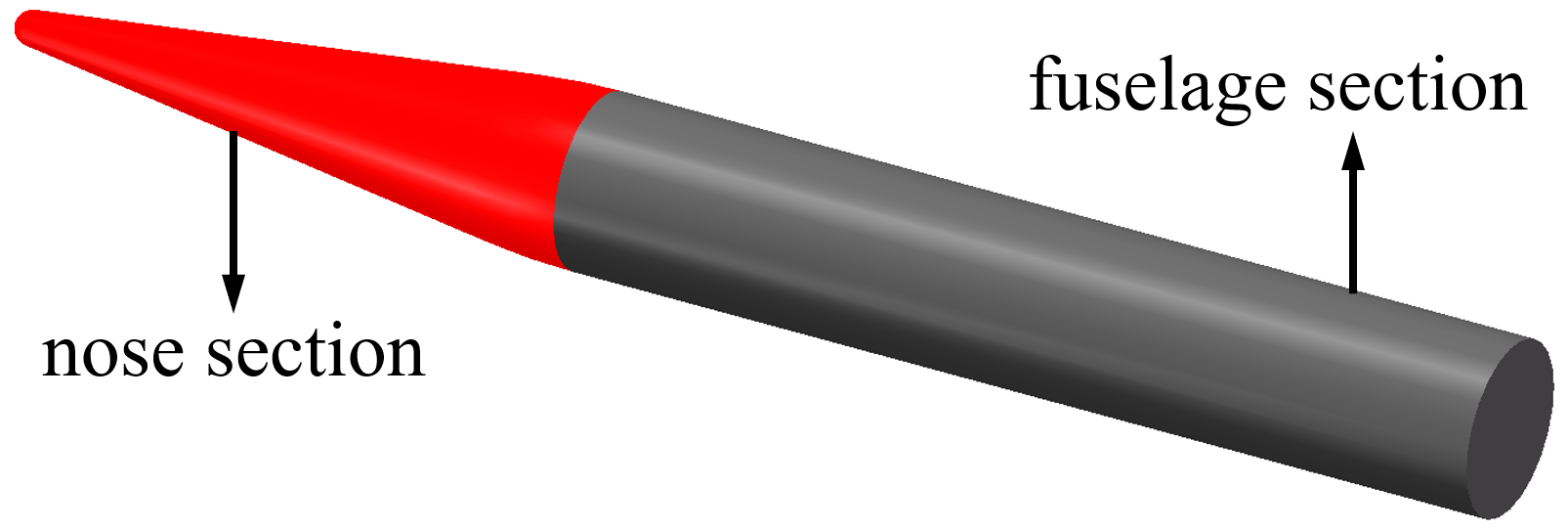
A hypersonic cruise aircraft model was established using a 3D modeling software, as shown in Figure 1. The aircraft primarily consists of a nose section and a fuselage section.
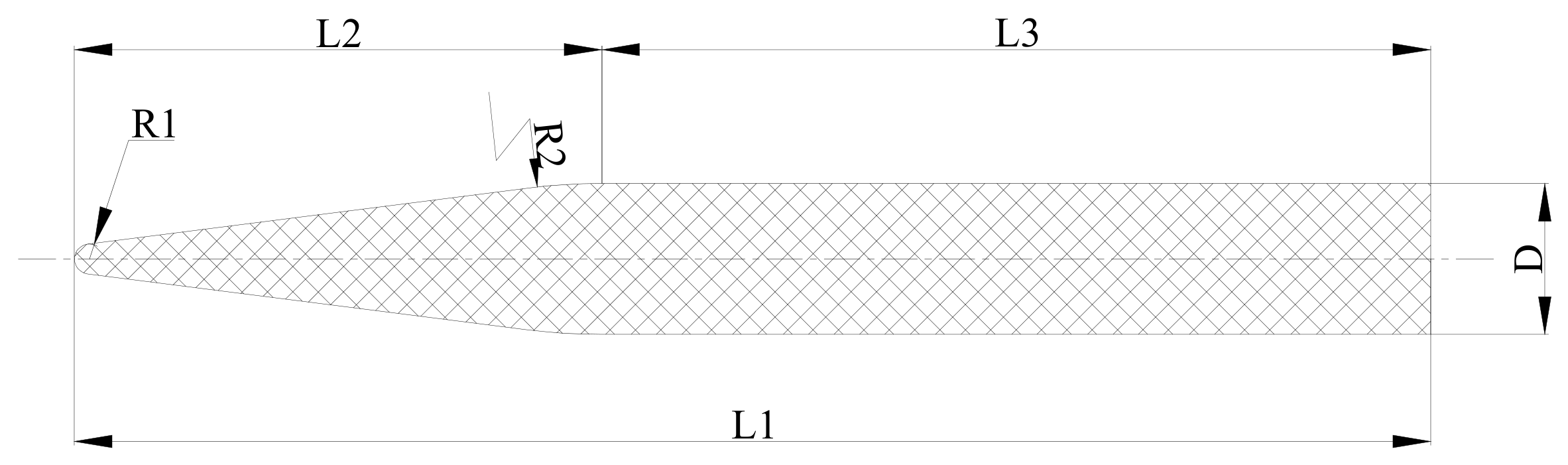
The aerodynamic dimensions of the aircraft are illustrated in Figure 2. The aircraft diameter is D = 80   mm . The total axial length of the aircraft is L 1   =   9   D = 720   mm . The axial length of the nose section is L 2   =   3.5   D = 280   mm . The axial length of the fuselage section is L 3   =   5.5   D = 440   mm . The nose radius is R 1   =   0.1   D =   8   mm . The arc radius between the nose section and the fuselage section is R 2   =   4   D =   320   mm [28].

2.2. Methodology for Coupled Heat Transfer

2.2.1. Numerical Simulation Methods

First, models of the hypersonic cruise aircraft and the fluid domain are created using SolidWorks 2018. Subsequently, meshing of the fluid and solid domains is performed in Pointwise. Then, heat transfer phenomena of the aircraft under different Mach number conditions are simulated using Fluent, resulting in a numerical simulation model for coupled heat transfer of the hypersonic wide-speed-range cruise aircraft. Finally, the coupled heat transfer characteristics of the aircraft at different Mach numbers are analyzed by monitoring the temperatures at characteristic points and surfaces of the aircraft. A schematic diagram illustrating the numerical simulation methods for coupled heat transfer in hypersonic cruise aircraft is shown in Figure 3.

2.2.2. Development of Numerical Simulation Model for Coupled Heat Transfer

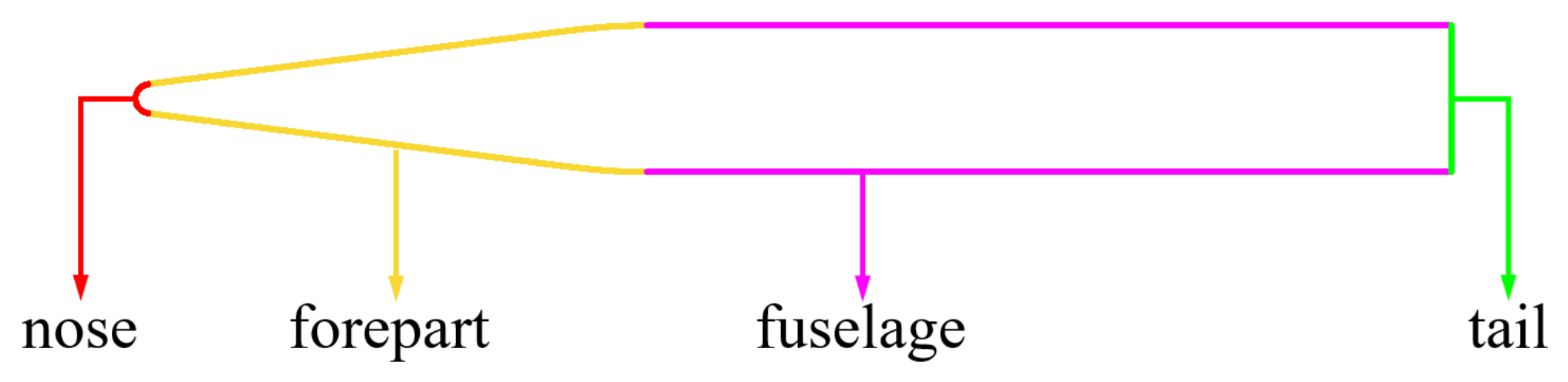
Due to the axisymmetric structure of the aircraft, a two-dimensional axisymmetric model is used instead of the three-dimensional model for numerical simulation to enhance computational efficiency. The boundary naming scheme is illustrated in Figure 4. The aircraft boundary consists of the nose, forepart, fuselage and tail, with all boundary types set as the wall.
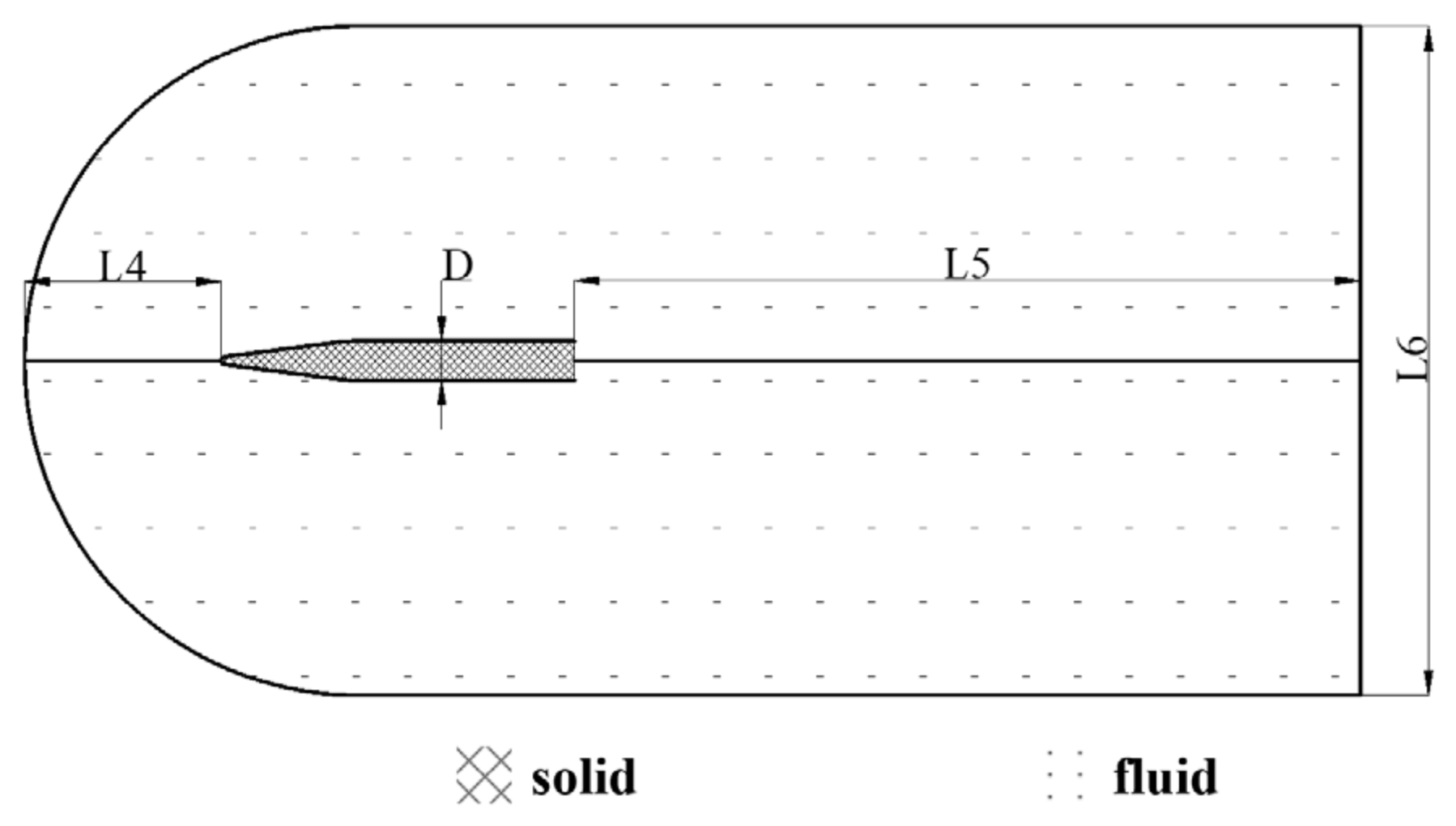
The external flow domain model for the aircraft was established. The schematic diagram of the fluid domain dimensions is shown in Figure 5. The distance between the fluid domain inlet and the aircraft is 5 times the aircraft diameter, i.e., L 4   =   5   D = 400   mm . The distance between the fluid domain outlet and the aircraft is 20 times the aircraft diameter, i.e., L 5   =   20   D = 1600   mm . The radial diameter of the fluid domain is 17 times the aircraft diameter, i.e., L 6   =   17 D = 1360   mm [28].
The fluid domain boundary consists of an inlet (in), an outlet (out) and an axis of symmetry (axis). The inlet boundary is a pressure far field, the outlet boundary is a pressure outlet, and the axis of symmetry boundary is axisymmetric. Due to the significant gradient in aerodynamic characteristics of the boundary layer at hypersonic speeds, it is essential to appropriately set the height of the first mesh layer in the boundary layer on the aircraft surface. This enhances the quality of the fluid domain mesh and improves computational accuracy. The height of the first boundary layer mesh in the numerical simulation is calculated using Equation (1) [29]. Here, ρ is air density, ρ = 0.194   kg / m 3 ; V c is the incoming flow velocity, V c = 1770   m / s ; L is the characteristic length scale, L = 0.72   m ; μ is the dynamic viscosity coefficient, μ = 1.4216 × 10 5   kg / ( m s ) ; R e is the Reynolds number; C f is the friction drag coefficient; τ w is the wall shear stress; u τ is the friction velocity; y + is the dimensionless wall distance, y + = 4 ; h * is the boundary layer height correction factor, h * = 2 ; and h is the first boundary layer height, which is calculated using Equation (1) (i.e., h = 0.0096   mm 0.01   mm ). The distribution of the dimensionless wall distance on the wall surface obtained through numerical simulation is shown in Figure 6. The results indicate that the dimensionless wall distance ranges between 0.01 and 3.05, falling within the viscous sublayer. Therefore, setting the first boundary layer height to 0.01 mm is appropriate.
R e = ρ V c L μ C f = 0.026 R e 1 / 7 τ w = 1 2 C f ρ V c 2 u τ = τ w ρ h = h * y + μ u τ ρ
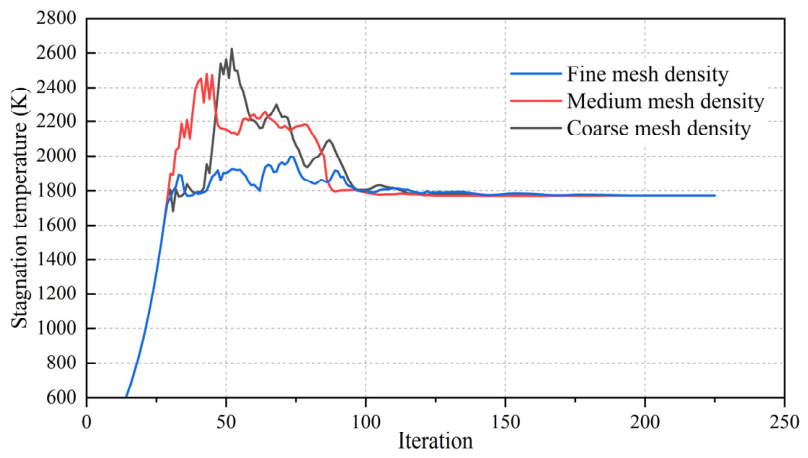
To avoid excessive computational errors caused by overly coarse meshes while preventing increased computational resource consumption due to overly fine meshes, this study conducts mesh-independence verification. Mesh independence verification demonstrates that numerical simulation results are unaffected by mesh density, validating the reliability and stability of computational outcomes. Three meshes with varying densities—coarse, medium and fine—were generated. The influence of these meshes on simulation results was analyzed by monitoring the stagnation temperature. The parameters and results for the different mesh densities are shown in Table 1. The numerical simulation iteration results for the stagnation temperature at the different mesh densities are shown in Figure 7. The results indicate that the calculations for stagnation temperature converge for all three mesh densities, and the computational results for different meshes no longer show significant variation with increasing mesh density. Considering both computational accuracy and computational cost, the medium-density mesh is selected for numerical simulation [28]. The stagnation temperature was calculated to be 1776.5 K using the aerodynamic Equation (2). T 0 is the stagnation temperature, γ is the specific heat ratio, γ = 1.4 , M a = 6 , T = 216.65   K . Compared with the result obtained from Equation (2), the error in the stagnation temperature calculated using the medium mesh is 0.24%, further demonstrating the reliability of the numerical model.
T 0 = ( 1 + γ 1 2 M a 2 ) T
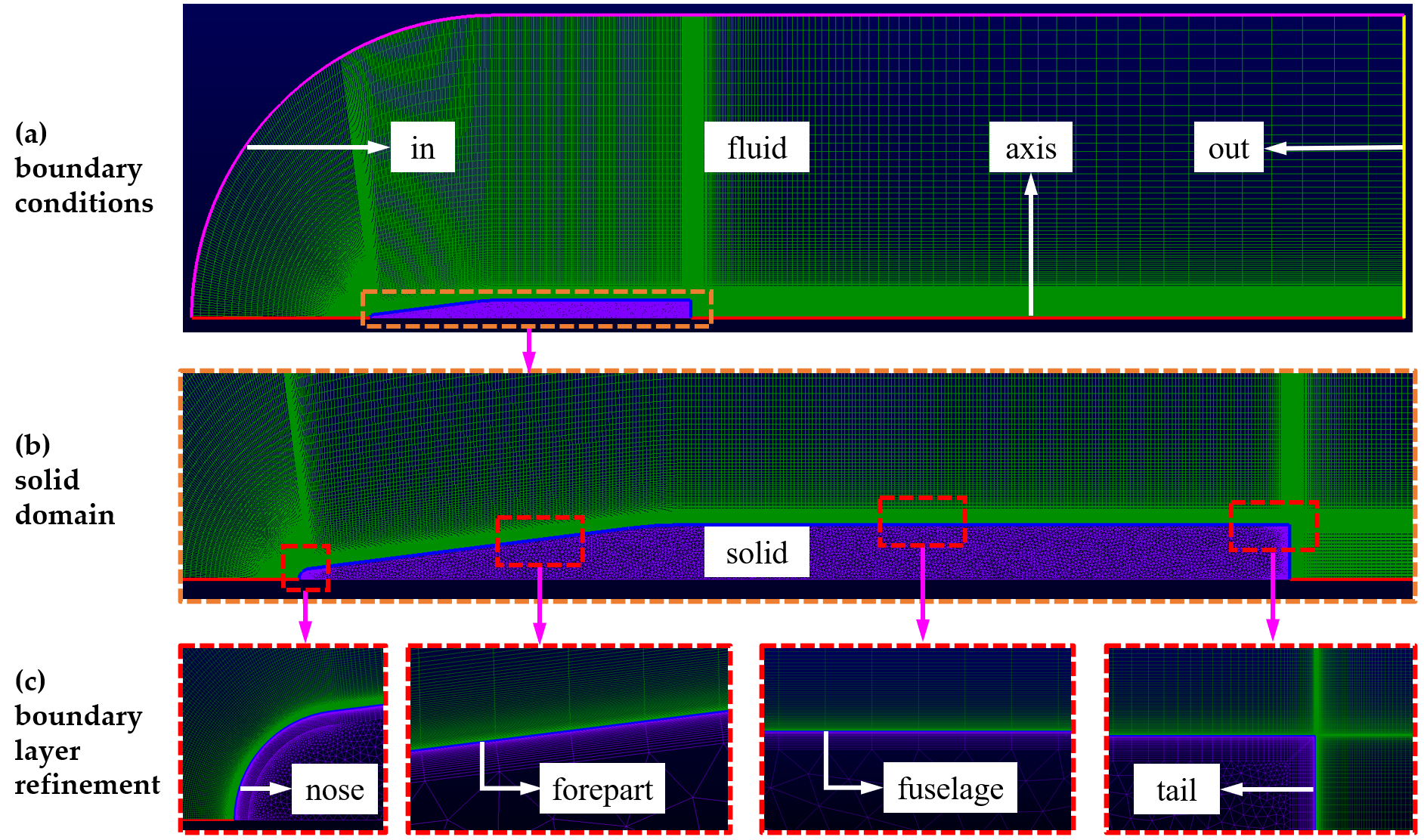
A schematic diagram illustrating the naming of fluid and solid domains and the boundary layer refinement is shown in Figure 8. The fluid and solid domains are meshed using the meshing software Pointwise 18.6, generating 154,619 mesh elements. The minimum orthogonal quality of the fluid domain mesh is 0.91, which is excellent.
The fluid domain medium in this study is air. The ideal gas assumption was employed in numerical simulations, and chemical reactions such as vibration excitation, dissociation and ionization were neglected. Viscosity follows Sutherland’s law. The free-stream pressure is 12,044.5 Pa, and the free-stream temperature is 216.65 K. A numerical simulation model for coupled heat transfer in hypersonic wide-speed-range cruise aircraft was established using the Fluent 2022 software to analyze the coupled heat transfer characteristics of the aircraft at different Mach numbers. The simulation employed an axisymmetric two-dimensional spatial domain. A pressure-based solver was employed, which exhibits good convergence for transient coupled heat transfer problems involving high-speed flow. The selected turbulence model was the SST k-omega model [30,31], which achieves a balance between accuracy and computational efficiency. Viscous heating and compressibility effects were accounted for in the transient state calculation. The convergence tolerance for the continuity, energy, and momentum equations was 0.001, with a maximum of 20 iterations for each time step. The total simulation duration was 100 s. The fluid and solid domains were coupled and simulated simultaneously. The turbulence intensity and turbulence viscosity ratio were set to 1%. The initial temperature of the solid domain was 216.65 K. The pressure–velocity coupling strategy was PISO. The flux type was Rhie–Chow distance-based. The spatial discretization method was Green–Gauss cell-based. The pressure method was second order. The density, momentum and energy methods were second-order upwind. The turbulent kinetic energy and specific dissipation rate methods were first-order upwind [32].

3. Results Analysis

3.1. Analysis of Coupled Heat Transfer Results at Different Mach Numbers

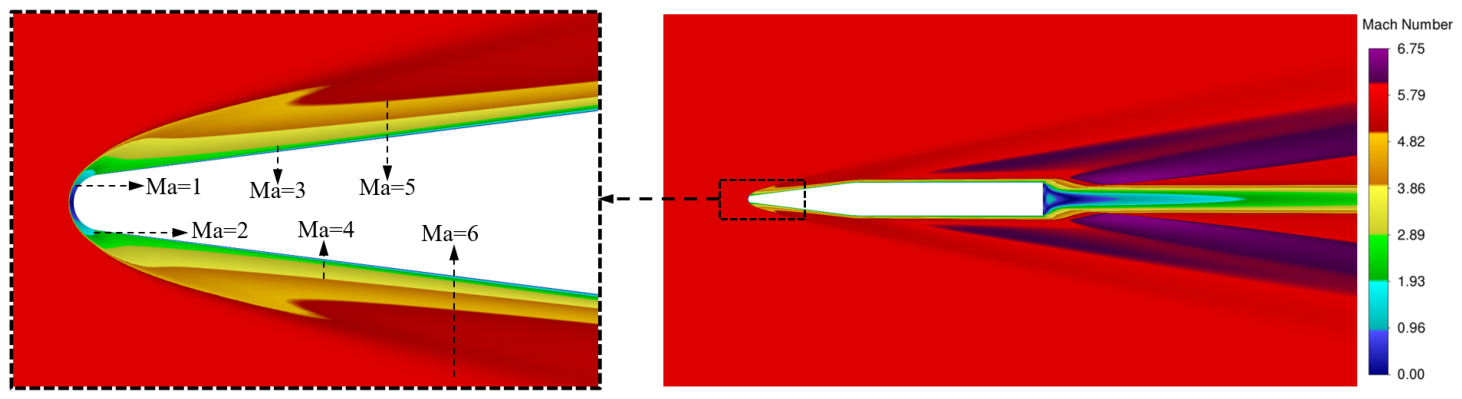
The results for flight conditions at Mach numbers 6, 7, 8 and 9 are obtained using the numerical simulation model for coupled heat transfer in hypersonic wide-speed-range cruise aircraft. The Mach contour plot for the flight condition at Mach 6 is shown in Figure 9. Figure 9 shows that the Mach number decreases progressively toward the stagnation point along the fluid domain from the inlet toward the aircraft’s stagnation point, sequentially experiencing Ma = 6, Ma = 5, Ma = 4, Ma = 3, Ma = 2 and Ma = 1.
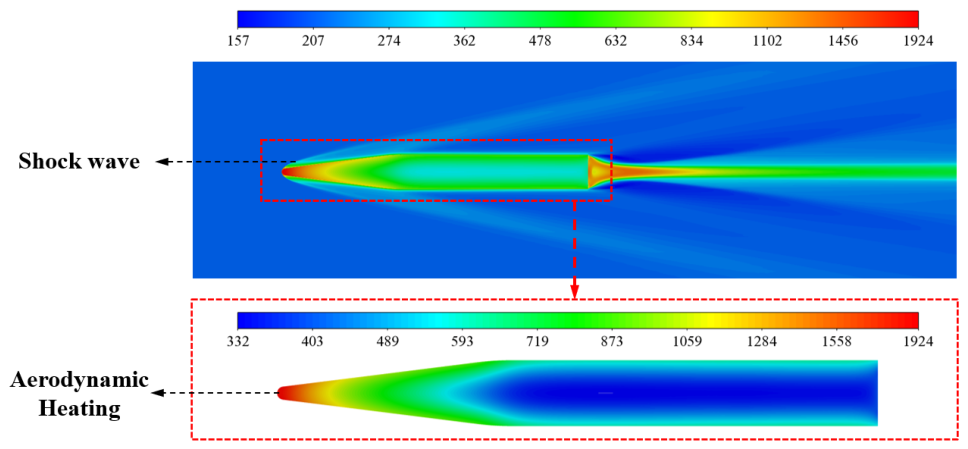
The temperature contour plot for the flight condition at Mach 6 is shown in Figure 10. During hypersonic flight, a bow-shaped shock wave forms along the aircraft wall. Due to viscous stagnation near the aircraft’s surface, the kinetic energy of gas parcels is converted into thermal energy, which causes the surface temperature to rise. This high temperature continuously transfers inward, resulting in aerodynamic heating.
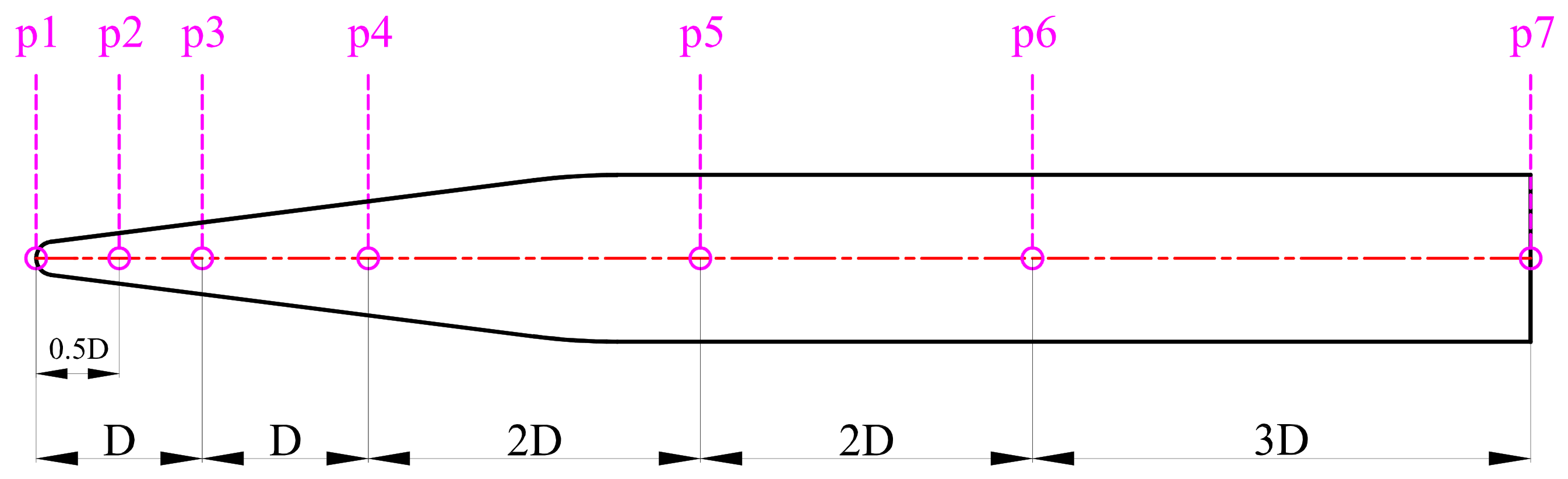
In this paper, seven characteristic points and four feature surfaces are selected for heat transfer analysis based on the aerodynamic configuration of the aircraft. The characteristic points are named p1, p2, p3, p4, p5, p6 and p7. A schematic diagram of the distribution of the characteristic points is shown in Figure 11. The coordinate positions of the characteristic points are listed in Table 2, with p1 as the origin. The four feature surfaces are named nose, forepart, fuselage and tail. A schematic diagram of their distribution is shown in Figure 4.

3.1.1. Coupled Heat Transfer Results for the Aircraft at Mach 6

Temperature contour plots of the aircraft at Mach 6 for different flight times are shown in Table 3. The aircraft material is nickel-based superalloy Inconel 718. The table displays the temperature contour plots for the aircraft at coupled heat transfer times of 1 s, 10 s, 20 s, 30 s, 40 s, 50 s and 100 s. When t = 10 s, the maximum temperature of the aircraft exceeded 1260 K. When t = 50 s, it exceeded 1740 K. When t = 100 s, it exceeded 1920 K. The results indicate that the thermal response of the aircraft underwent a process of thermal shock and heat conduction and gradually approached a quasi-steady state over time. Heat is transferred from the walls towards the interior, while simultaneously transferring from the nose to the tail. The contour plots reveal a layered gradient temperature distribution characteristic. The temperature exhibits strong leading-edge concentration and nonlinear growth over time. Temperatures are highest and rise most rapidly near the stagnation point, indicating significant aerodynamic heating.
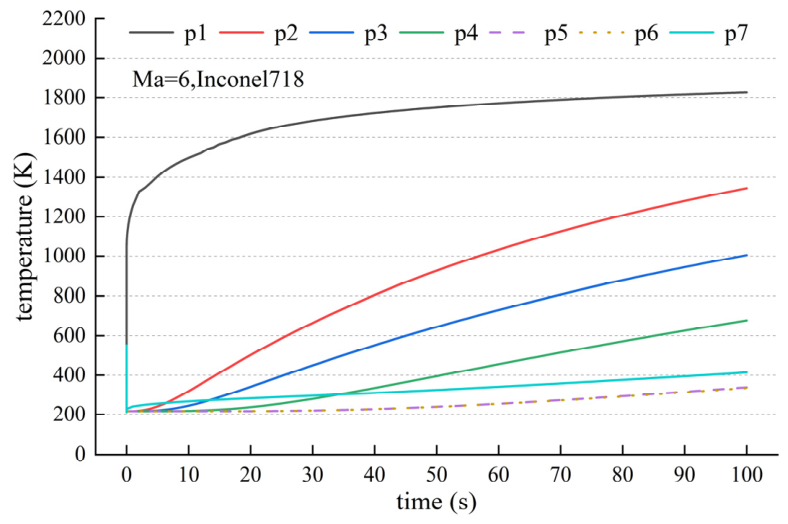
Figure 12 shows the temperature–time curves at different characteristic points of the aircraft flying at Mach 6. At t = 10 s, the temperatures at p1-p7 were 1498 K, 318 K, 245 K, 218 K, 217 K, 217 K and 267 K, respectively. At t = 50 s, they were 1749 K, 926 K, 645 K, 395 K, 239 K, 239 K and 325 K, respectively. At t = 100 s, they were 1826 K, 1344 K, 1004 K, 678 K, 338 K, 335 K and 413 K, respectively, at which point the temperature relationship among the characteristic points was p1 > p2 > p3 > p4 > p7 > p5 ≈ p6. The heat flux values at p1, p2, p3, and p4 were relatively high, resulting in rapid temperature rise and significant heating effects. In contrast, the heat flux values at p5, p6 and p7 were relatively low, leading to slower temperature rise and weaker heating effects. The results indicate that, with the exception of p7, the temperatures of all characteristic points increase monotonically with time, while the temperature of p7 exhibits a rising–declining–rising trend.
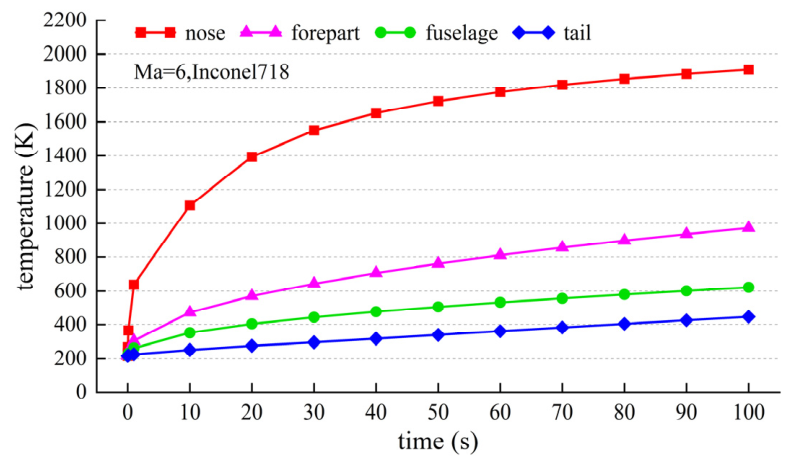
Figure 13 shows the temperature–time curves at different characteristic surfaces of the aircraft flying at Mach 6. At t = 10 s, the average temperatures of the nose, forepart, fuselage and tail characteristic surfaces were 1107 K, 472 K, 351 K and 251 K, respectively. At t = 50 s, they were 1721 K, 761 K, 506 K and 338 K, respectively. At t = 100 s, they were 1910 K, 973 K, 622 K and 446 K, respectively, at which point the temperature relationship among the characteristic surfaces was nose > forepart > fuselage > tail. During the 100 s coupled heat transfer process, the temperature increases for the nose, forepart, fuselage and tail were approximately 1693 K, 756 K, 406 K and 229 K, respectively. The results indicate that the temperatures of all characteristic surfaces increase monotonically with time, but the heating rates gradually slow down, progressively approaching a quasi-steady state. The nose has the highest temperature and the fastest heating rate, while the tail has the lowest temperature and the slowest heating rate. The aerodynamic heat load is primarily concentrated at the nose of the aircraft, and the aerodynamic heating effect significantly attenuates along the flow direction.

3.1.2. Coupled Heat Transfer Results for the Aircraft at Mach 7

Temperature contour plots of the aircraft at Mach 7 for different flight times are shown in Table A1 of Appendix A. The table displays the temperature contour plots for the aircraft at coupled heat transfer times of 1 s, 10 s, 20 s, 30 s, 40 s, 50 s and 100 s. When t = 10 s, the maximum temperature of the aircraft exceeded 1670 K. When t = 50 s, it exceeded 2360 K. When t = 100 s, it exceeded 2640 K.
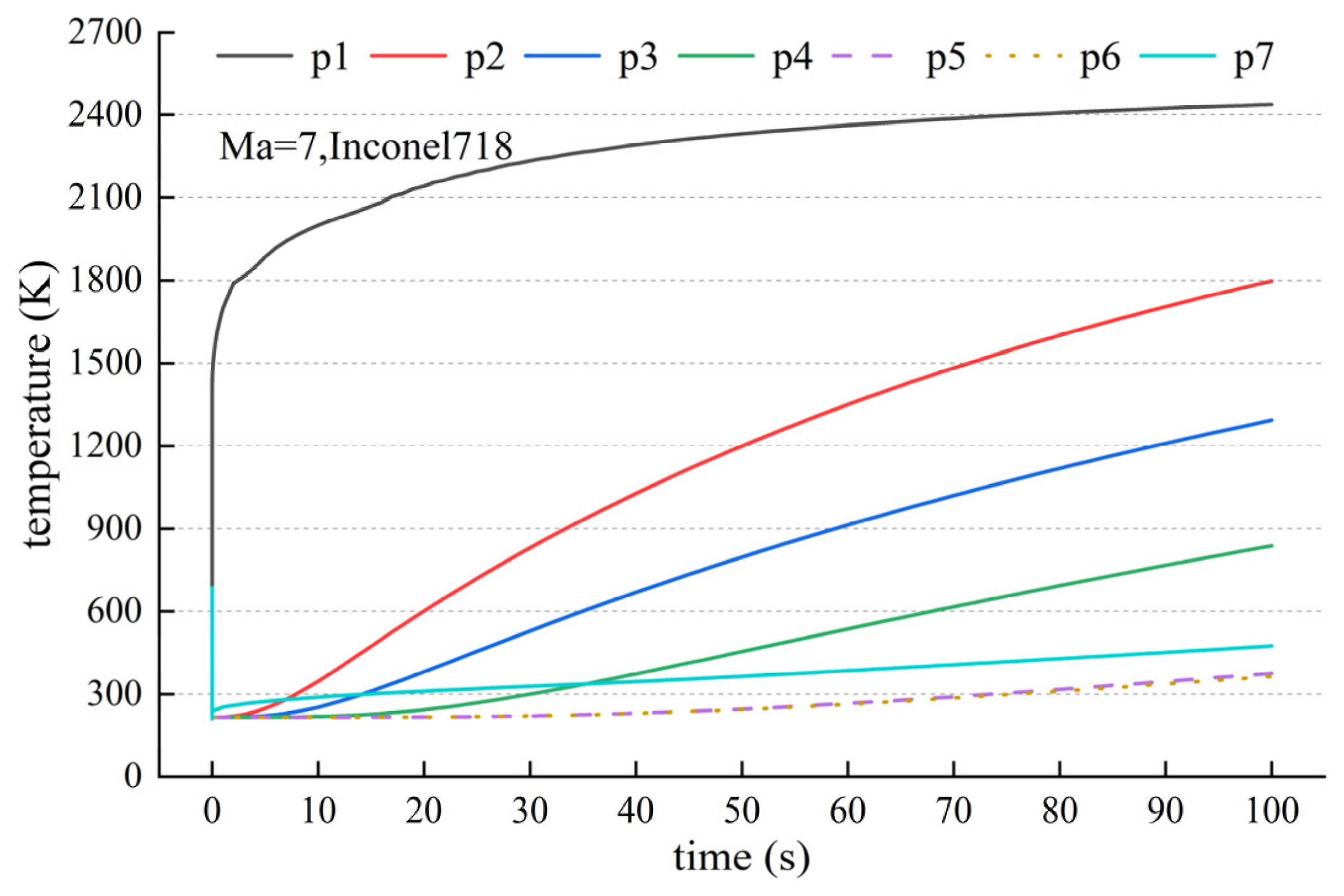
Figure 14 shows the temperature–time curves at different characteristic points of the aircraft flying at Mach 7. At t = 10 s, the temperatures at p1-p7 were 2000 K, 347 K, 253 K, 219 K, 217 K, 217 K and 289 K, respectively. At t = 50 s, they were 2332 K, 1120 K, 797 K, 454 K, 246 K, 244 K and 364 K, respectively. At t = 100 s, they were 2437 K, 1798 K, 1294 K, 838 K, 376 K, 364 K and 475 K, respectively.
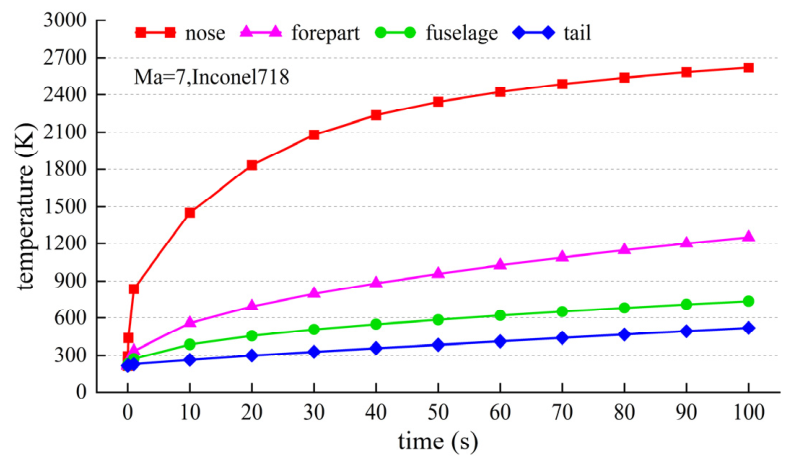
Figure 15 shows the temperature–time curves at different characteristic surfaces of the aircraft flying at Mach 7. At t = 10 s, the average temperatures of the nose, forepart, fuselage and tail characteristic surfaces were 1451 K, 557 K, 386 K and 264 K, respectively. At t = 50 s, they were 2341 K, 957 K, 585 K and 384 K, respectively. At t = 100 s, they were 2620 K, 1250 K, 736 K and 518 K, respectively. During the 100 s coupled heat transfer process, the temperature increases for the nose, forepart, fuselage and tail were approximately 2403 K, 1033 K, 519 K and 301 K, respectively.

3.1.3. Coupled Heat Transfer Results for the Aircraft at Mach 8

Temperature contour plots of the aircraft at Mach 8 for different flight times are shown in Table A2 of Appendix A. The table displays the temperature contour plots for the aircraft at coupled heat transfer times of 1 s, 10 s, 20 s, 30 s, 40 s, 50 s and 100 s. When t = 10 s, the maximum temperature of the aircraft exceeded 2150 K. When t = 50 s, it exceeded 3100 K. When t = 100 s, it exceeded 3520 K.
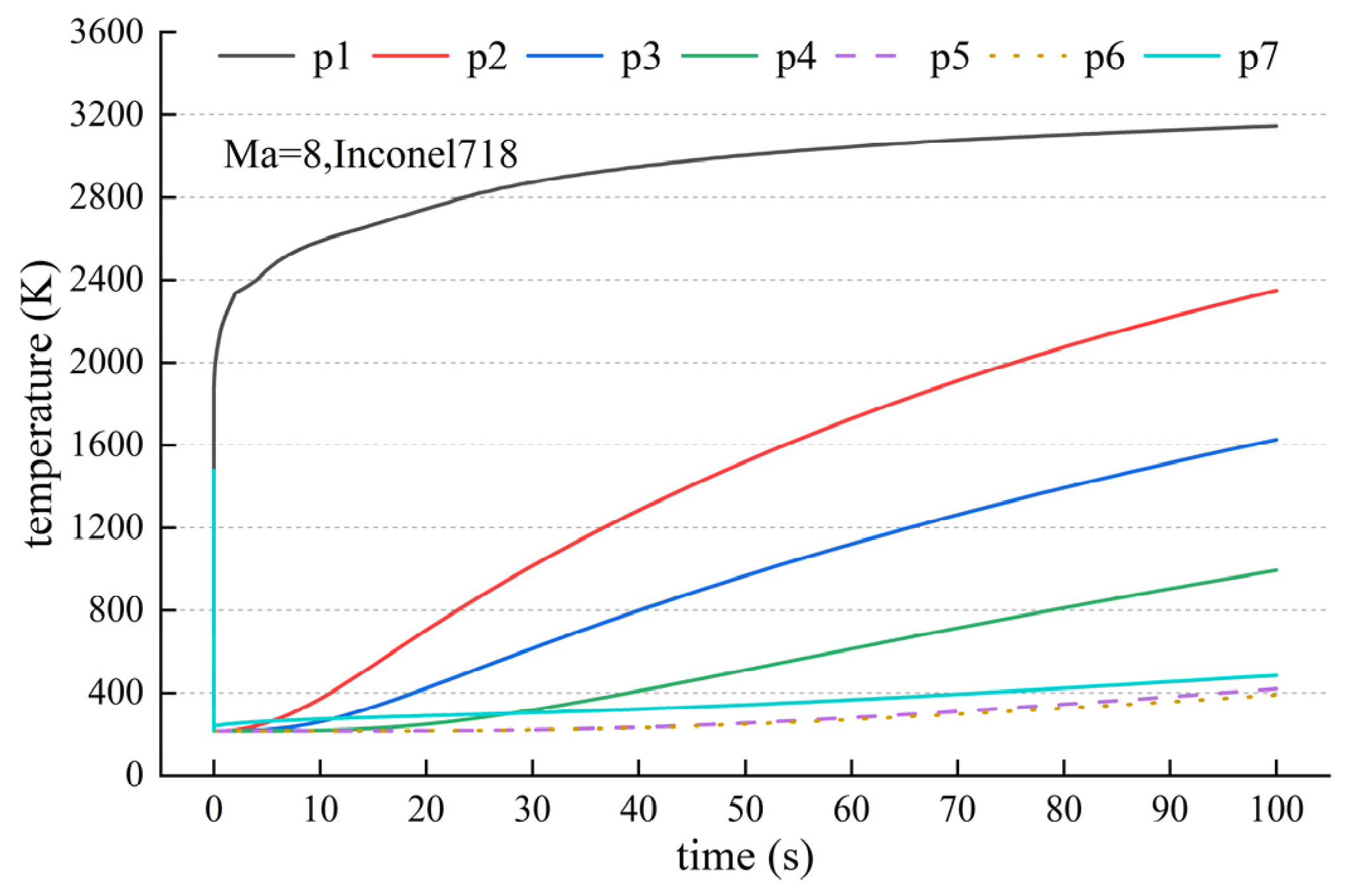
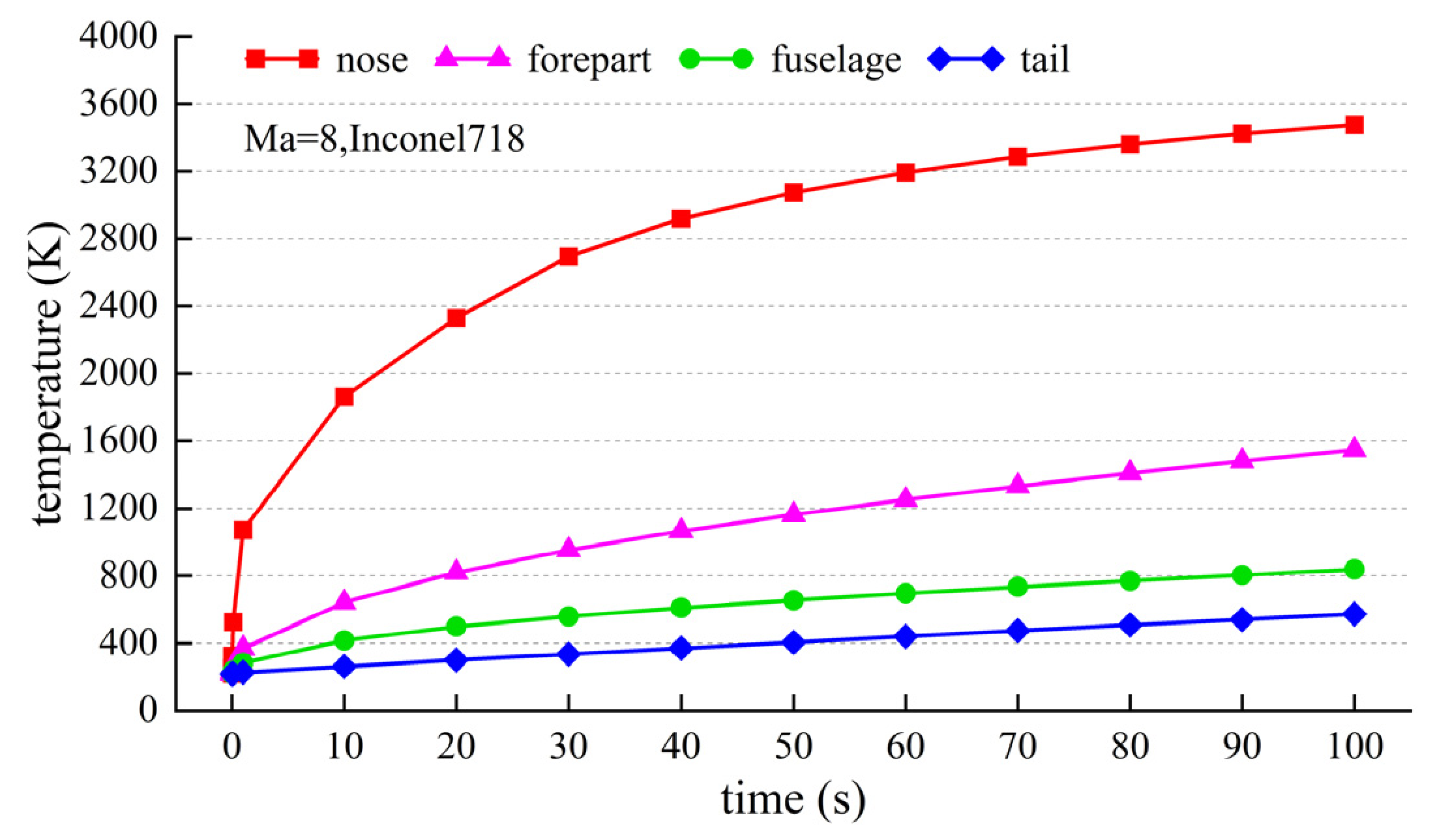
Figure 16 shows the temperature–time curves at different characteristic points of the aircraft flying at Mach 8. At t = 10 s, the temperatures at p1-p7 were 2589 K, 371 K, 260 K, 219 K, 217 K, 217 K and 273 K, respectively. At t = 50 s, they were 3004 K, 1521 K, 968 K, 511 K, 254 K, 249 K and 342 K, respectively. At t = 100 s, they were 3147 K, 2350 K, 1627 K, 993 K, 420 K, 389 K and 485 K, respectively.
Figure 17 shows the temperature–time curves at different characteristic surfaces of the aircraft flying at Mach 8. At t = 10 s, the average temperatures of the nose, forepart, fuselage and tail characteristic surfaces were 1862 K, 642 K, 416 K and 262 K, respectively. At t = 50 s, they were 3073 K, 1163 K, 654 K and 405 K, respectively. At t = 100 s, they were 3475 K, 1545 K, 838 K and 573 K, respectively. During the 100 s coupled heat transfer process, the temperature increases for the nose, forepart, fuselage and tail were approximately 3258 K, 1329 K, 621 K, and 357 K, respectively.

3.1.4. Coupled Heat Transfer Results for the Aircraft at Mach 9

Temperature contour plots of the aircraft at Mach 9 for different flight times are shown in Table A3 of Appendix A. The table displays the temperature contour plots for the aircraft at coupled heat transfer times of 1 s, 10 s, 20 s, 30 s, 40 s, 50 s and 100 s. When t = 10 s, the maximum temperature of the aircraft exceeded 2700 K. When t = 50 s, it exceeded 3980 K. When t = 100 s, it exceeded 4580 K.
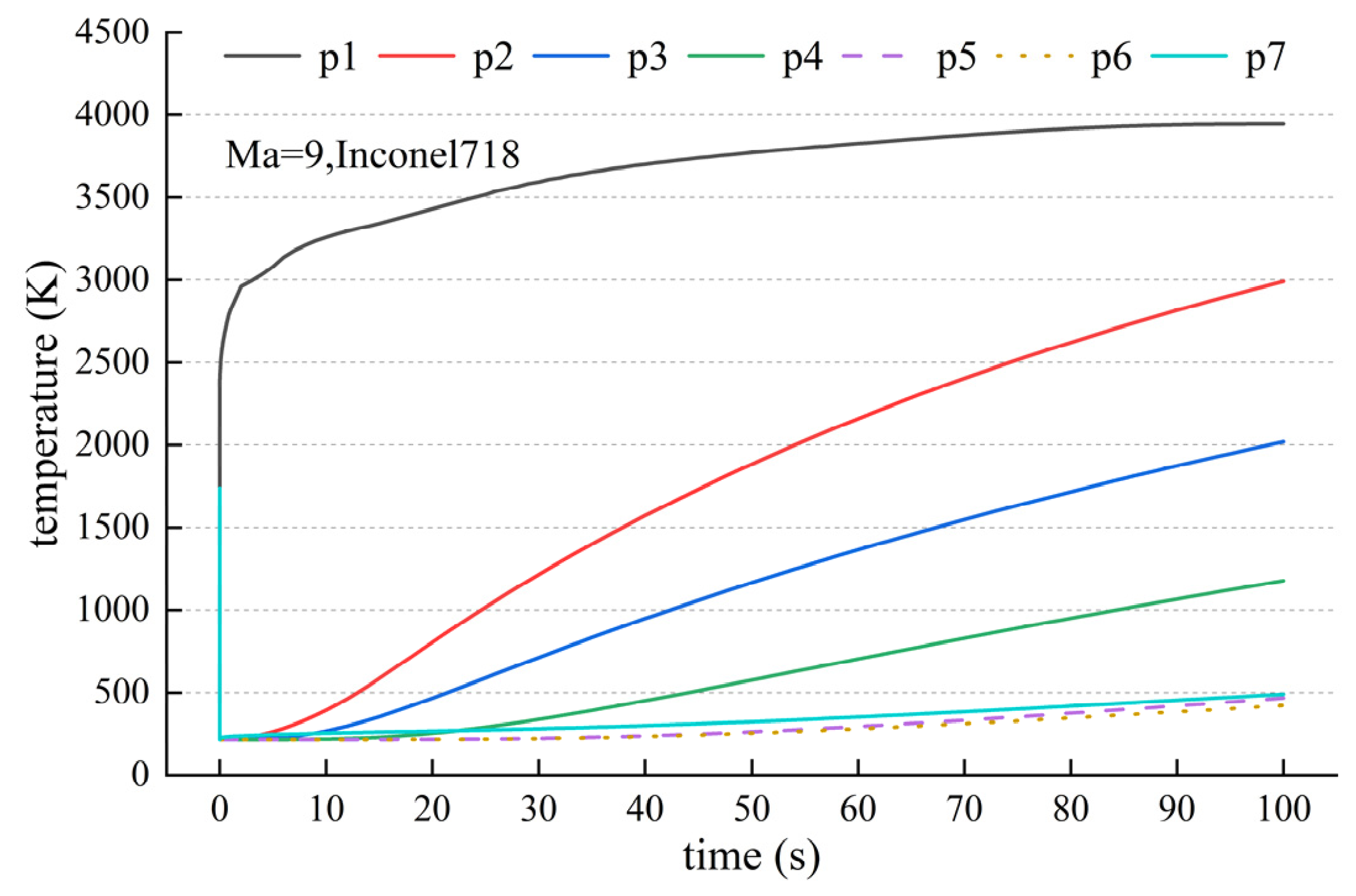
Figure 18 shows the temperature–time curves at different characteristic points of the aircraft flying at Mach 9. At t = 10 s, the temperatures at p1-p7 were 3258 K, 392 K, 267 K, 220 K, 217 K, 217 K and 254 K, respectively. At t = 50 s, they were 3773 K, 884 K, 1166 K, 576 K, 262 K, 254 K and 323 K, respectively. At t = 100 s, they were 3945 K, 2991 K, 2020 K, 1177 K, 466 K, 421 K and 490 K, respectively.
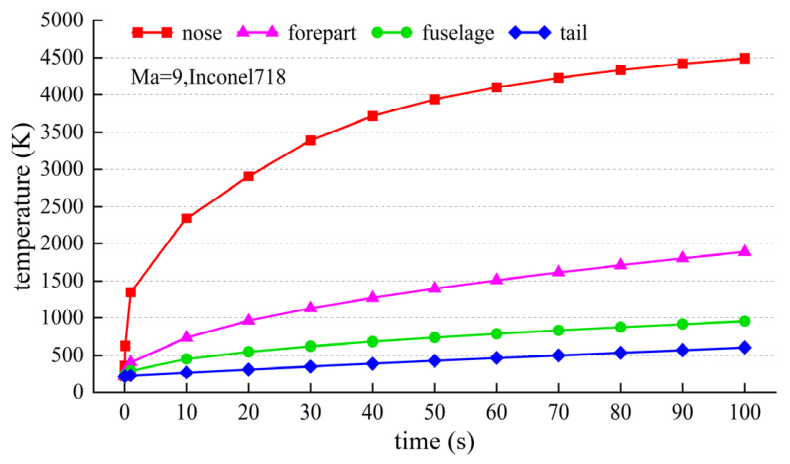
Figure 19 shows the temperature–time curves at different characteristic surfaces of the aircraft flying at Mach 9. At t = 10 s, the average temperatures of the nose, forepart, fuselage and tail characteristic surfaces were 2343 K, 732 K, 451 K and 267 K, respectively. At t = 50 s, they were 3935 K, 1397 K, 734 K and 428 K, respectively. At t = 100 s, they were 4489 K, 1885 K, 952 K and 603 K, respectively. During the 100 s coupled heat transfer process, the temperature increases for the nose, forepart, fuselage and tail were approximately 4272 K, 1669 K, 735 K and 386 K, respectively.

3.1.5. Coupled Heat Transfer Analysis of Aircraft at Different Mach Numbers

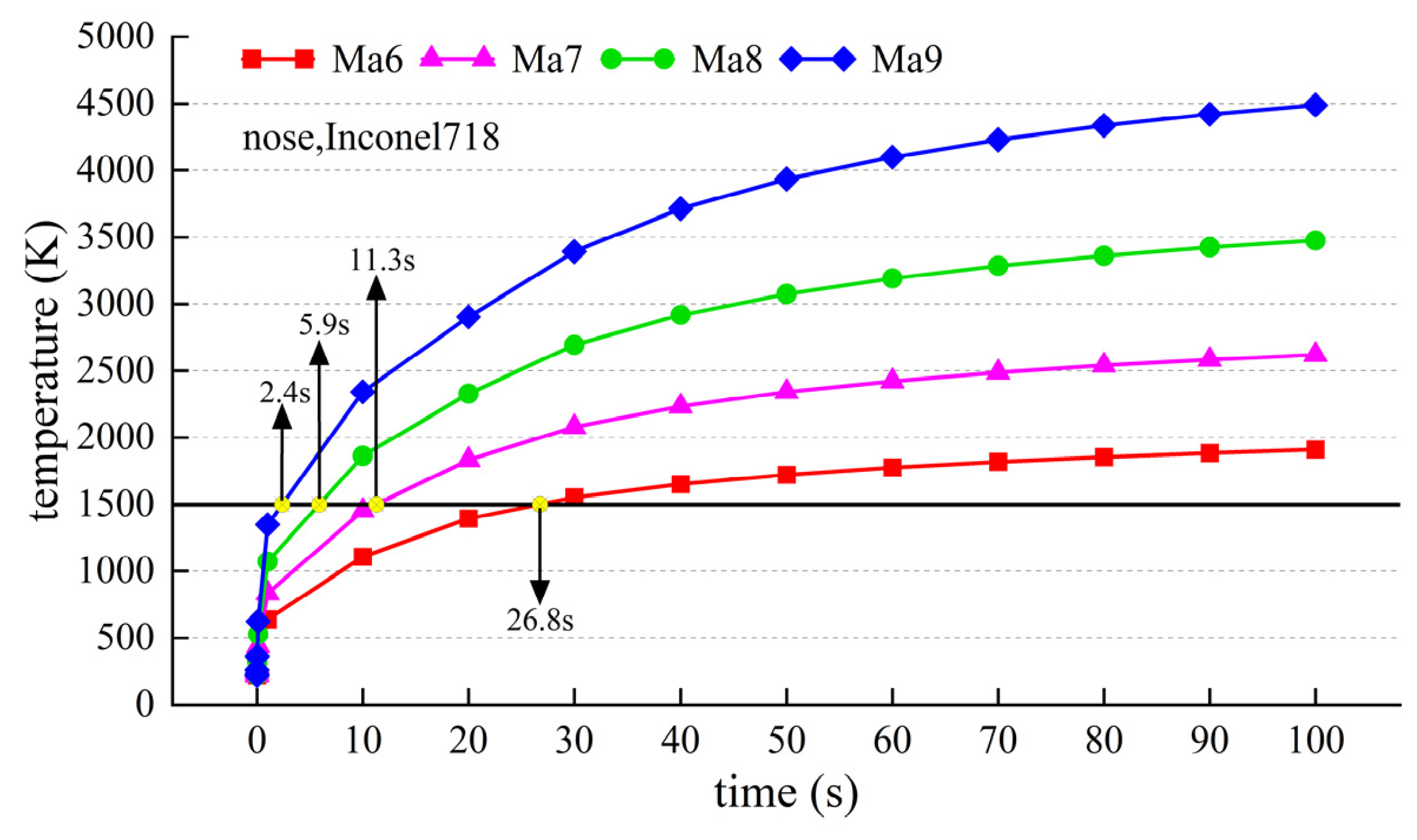
Figure 20 shows the curves of nose temperature of the aircraft as functions of Mach number and time. At Mach 6, the nose temperature reaches 1500 K after 26.8 s of flight. At Mach 7, it reaches 1500 K after 11.3 s, which is 15.5 s earlier than at Mach 6, corresponding to an aerodynamic heating rate increased by 137%. At Mach 8, it reaches 1500 K after 5.9 s, which is 20.9 s earlier than at Mach 6, corresponding to an aerodynamic heating rate increased by 354%. At Mach 9, it reaches 1500 K after 2.4 s, which is 24.4 s earlier than at Mach 6, corresponding to an aerodynamic heating rate increased by 1017%. The study indicates that, at a fixed Mach number, the nose temperature increases with time. Under a fixed total flight time, the nose temperature increases with Mach number. The higher the Mach number, the faster the aerodynamic heating rate. An increase in Mach number significantly exacerbates the aerodynamic heating phenomenon.
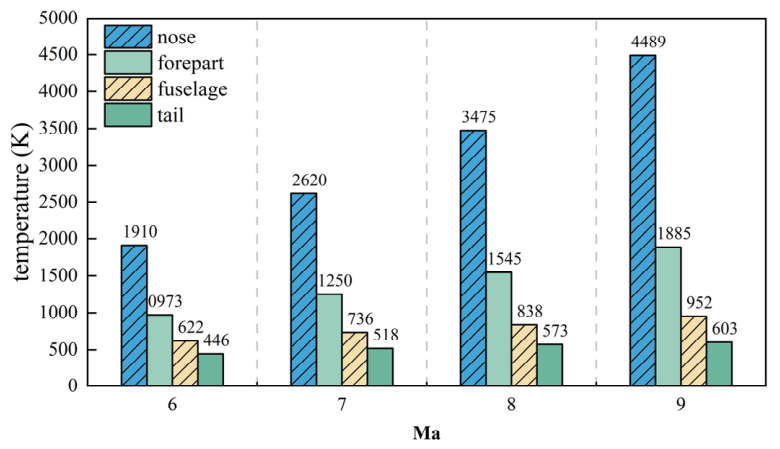
Figure 21 shows a bar chart of temperature at different characteristic surfaces as a function of Mach number for the Inconel 718 aircraft at t = 100 s. During the 100 s coupled heat transfer process, the nose temperature increased from 1910 K to 4489 K, an increase of 135%; the forepart temperature increased from 973 K to 1885 K, an increase of 94%; the fuselage temperature increased from 622 K to 952 K, an increase of 53%; and the tail temperature increased from 446 K to 603 K, an increase of 35%. The temperatures of all four characteristic surfaces increase with increasing Mach number. The nose experiences strong shock compression, resulting in the highest temperature, and is most significantly affected by Mach number variations. The forepart is influenced by both the incoming compression wave and upstream heat conduction, exhibiting the second-highest temperature, and is considerably affected by Mach number variations. The fuselage lies in the boundary layer development region with a relatively uniform thermal load and is less affected by Mach number variations. The tail is located in the bottom recirculation zone, showing the lowest temperature, and is least affected by Mach number variations. The study indicates that the temperatures of the aircraft increase with Mach number. The effect of Mach number variations is most significant at the nose and least significant at the tail.

3.2. Analysis of Coupled Heat Transfer Results for Different Materials

The metallic materials used in hypersonic aircraft are primarily classified into superalloys, stainless steels, high-density alloys and titanium alloys. A representative superalloy is Inconel 718, a nickel-based superalloy capable of operating at high temperatures ranging from 650 °C to 700 °C. A representative stainless steel is 17-4PH, a martensitic precipitation-hardening stainless steel that offers high strength, hardness and excellent corrosion resistance. A representative material for high-density alloys is 93WNiFe. This tungsten-based alloy contains 93% tungsten and has a density far exceeding that of ordinary metals. A representative titanium alloy is TA19, a near-α titanium alloy with a nominal composition of Ti-6Al-2Sn-4Zr-2Mo. TA19 titanium alloy has low density, high strength and excellent high-temperature performance. The density, specific heat capacity and thermal conductivity parameters of various metallic materials are shown in Table 4. This study assumes that the thermophysical properties of the metallic materials do not vary with temperature or time.

3.2.1. Coupled Heat Transfer Results for the 17-4PH Aircraft

Temperature contour plots of the aircraft at Mach 6 for different flight times are shown in Table 5. The aircraft material is 17-4PH stainless steel. The table displays the temperature contour plots for the aircraft at coupled heat transfer times of 1 s, 10 s, 20 s, 30 s, 40 s, 50 s and 100 s. When t = 10 s, the maximum temperature of the aircraft exceeded 1200 K. When t = 50 s, it exceeded 1680 K. When t = 100 s, it exceeded 1860 K.
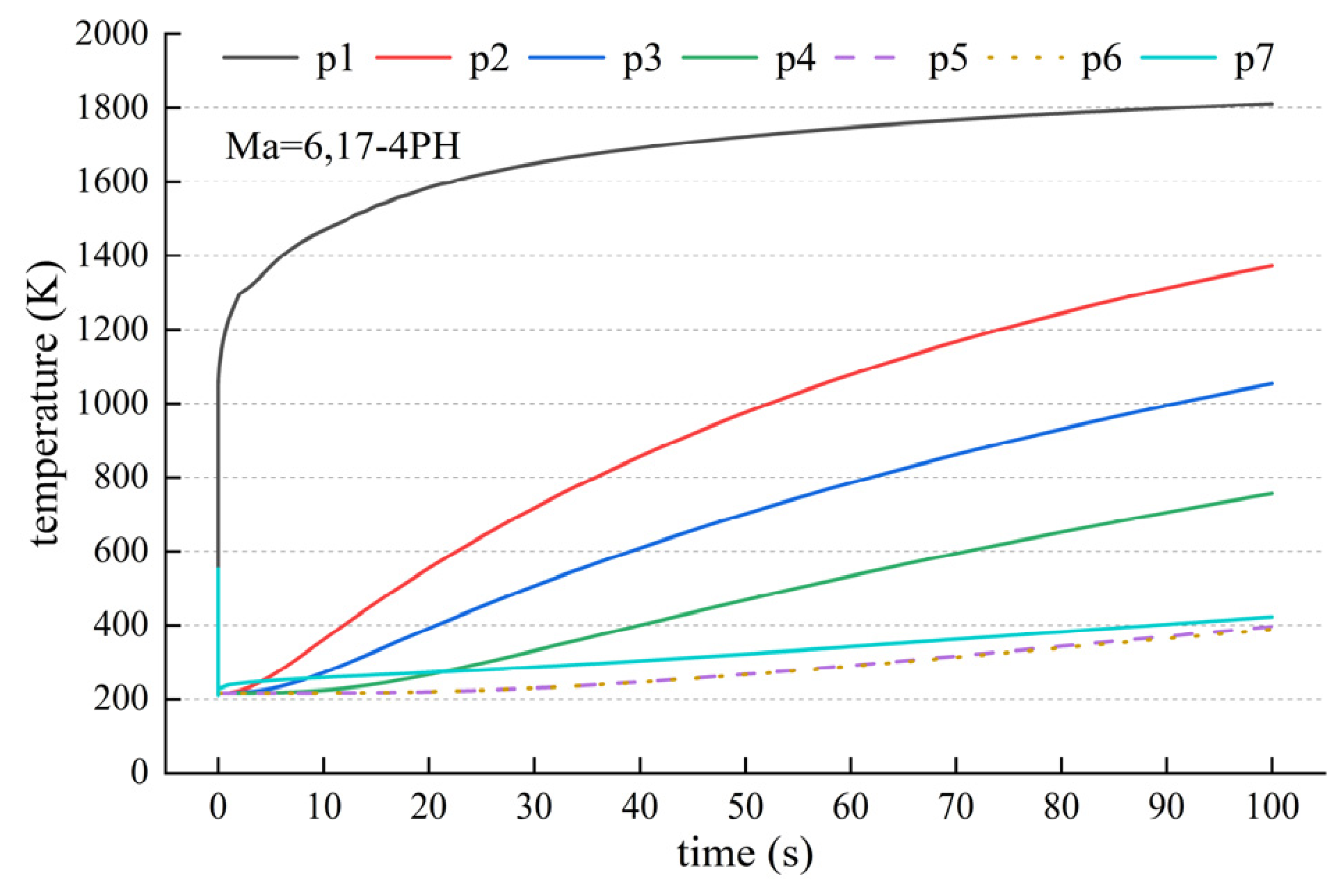
Figure 22 shows the temperature–time curves at different characteristic points of the aircraft flying at Mach 6. At t = 10 s, the temperatures at p1-p7 were 1468 K, 360 K, 272 K, 224 K, 217 K, 217 K and 258 K, respectively. At t = 50 s, they were 1723 K, 975 K, 701 K, 468 K, 267 K, 266 K and 322 K, respectively. At t = 100 s, they were 1811 K, 1372 K, 1053 K, 756 K, 396 K, 388 K and 423 K, respectively.
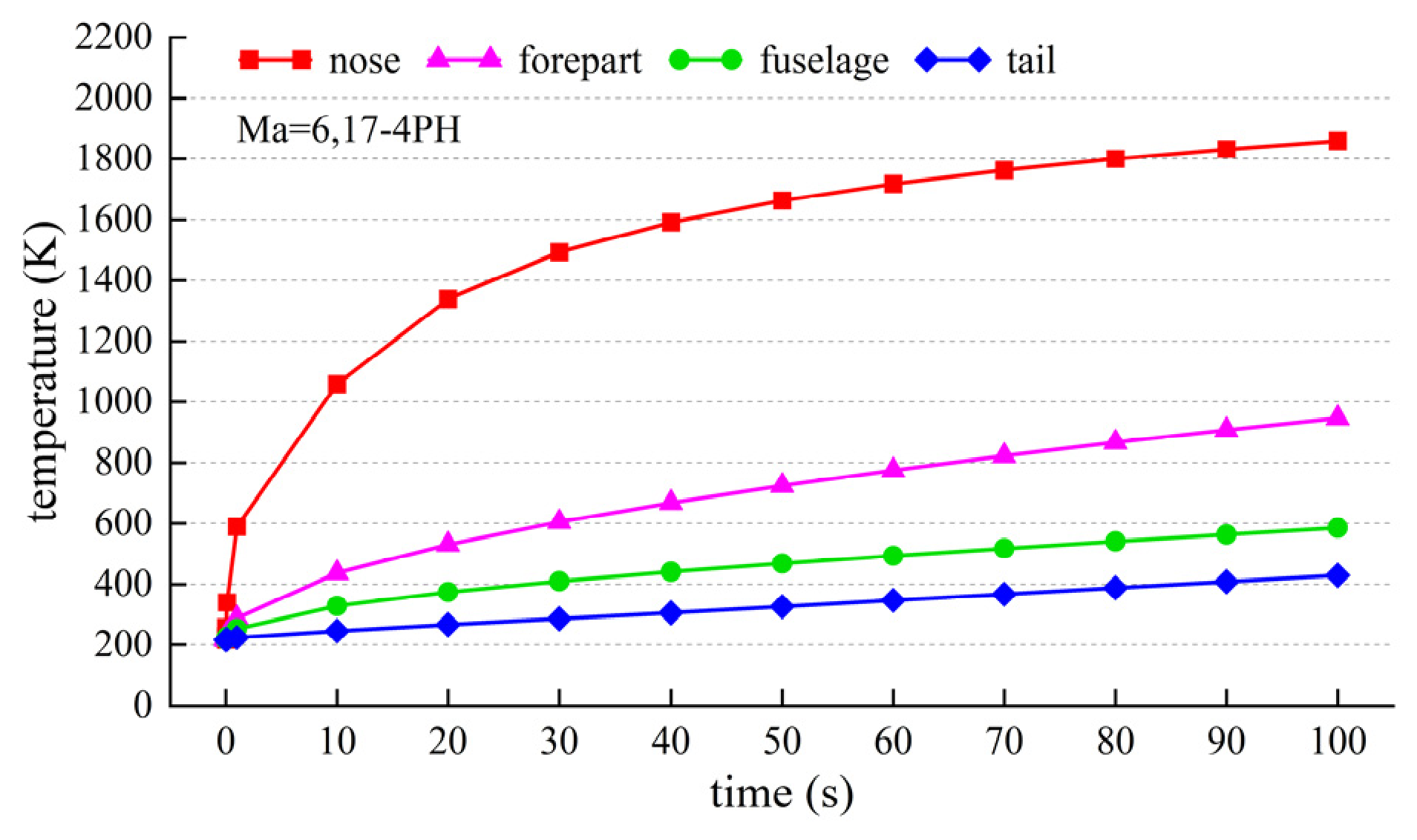
Figure 23 shows the temperature–time curves at different characteristic surfaces of the aircraft flying at Mach 6. At t = 10 s, the average temperatures of the nose, forepart, fuselage and tail characteristic surfaces were 1058 K, 437 K, 328 K and 246 K, respectively. At t = 50 s, they were 1663 K, 724 K, 468 K and 326 K, respectively. At t = 100 s, they were 1859 K, 947 K, 585 K and 429 K, respectively. During the 100 s coupled heat transfer process, the temperature increases for the nose, forepart, fuselage and tail were approximately 1643 K, 730 K, 368 K and 212 K, respectively.

3.2.2. Coupled Heat Transfer Results for the 93WNiFe Aircraft

Temperature contour plots of the aircraft at Mach 6 for different flight times are shown in Table A4 of Appendix A. The aircraft material is 93WNiFe high-density alloy. The table displays the temperature contour plots for the aircraft at coupled heat transfer times of 1 s, 10 s, 20 s, 30 s, 40 s, 50 s and 100 s. When t = 10 s, the maximum temperature of the aircraft exceeded 990 K. When t = 50 s, it exceeded 1520 K. When t = 100 s, it exceeded 1700 K.
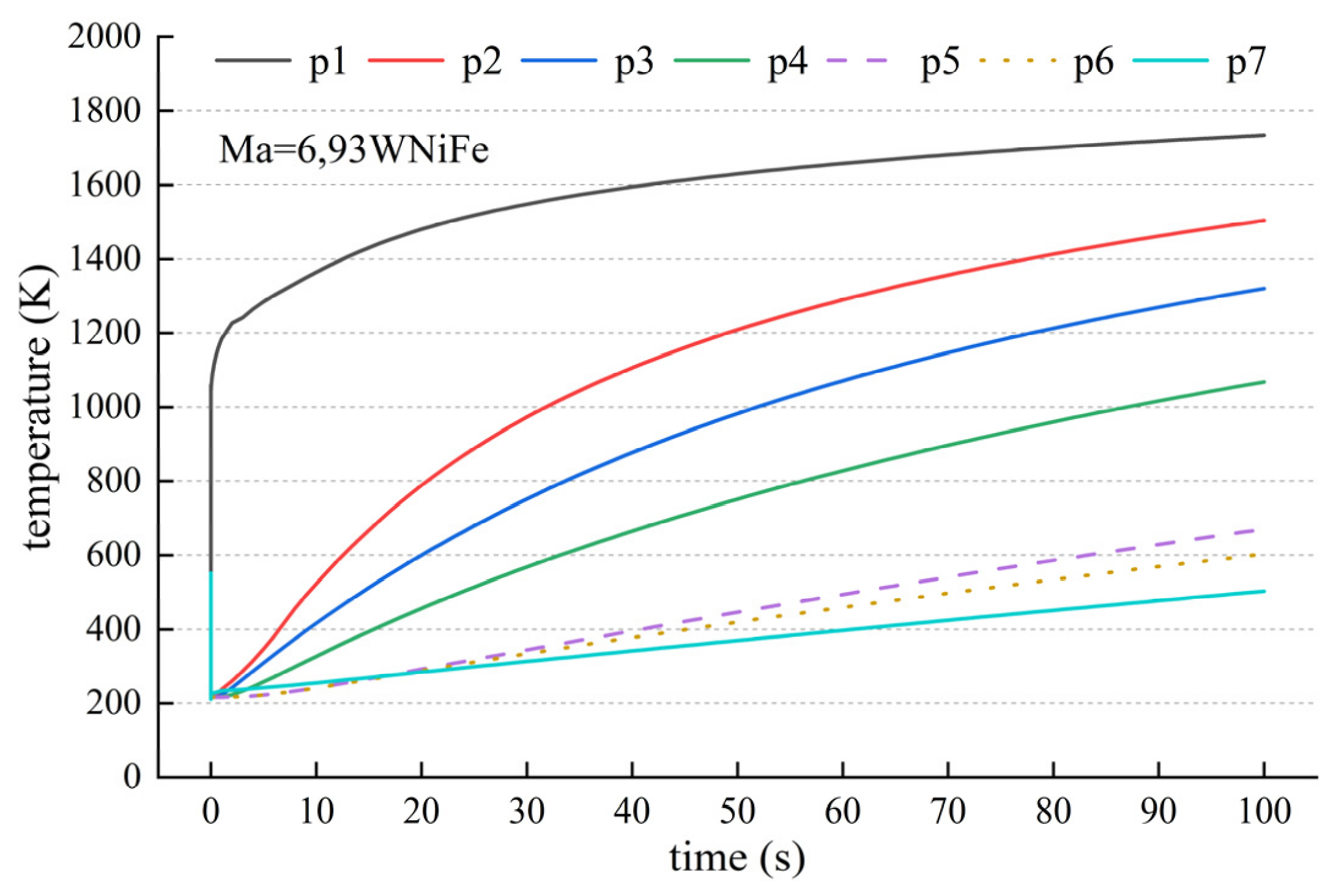
Figure 24 shows the temperature–time curves at different characteristic points of the aircraft flying at Mach 6. At t = 10 s, the temperatures at p1-p7 were 1365 K, 523 K, 416 K, 327 K, 242 K, 242 K and 255 K, respectively. At t = 50 s, they were 1630 K, 1209 K, 982 K, 751 K, 446 K, 420 K and 370 K, respectively. At t = 100 s, they were 1735 K, 1504 K, 1321 K, 1068 K, 671 K, 603 K and 503 K, respectively, at which point the temperature relationship among the characteristic points was p1 > p2 > p3 > p4 > p5 > p6 > p7.
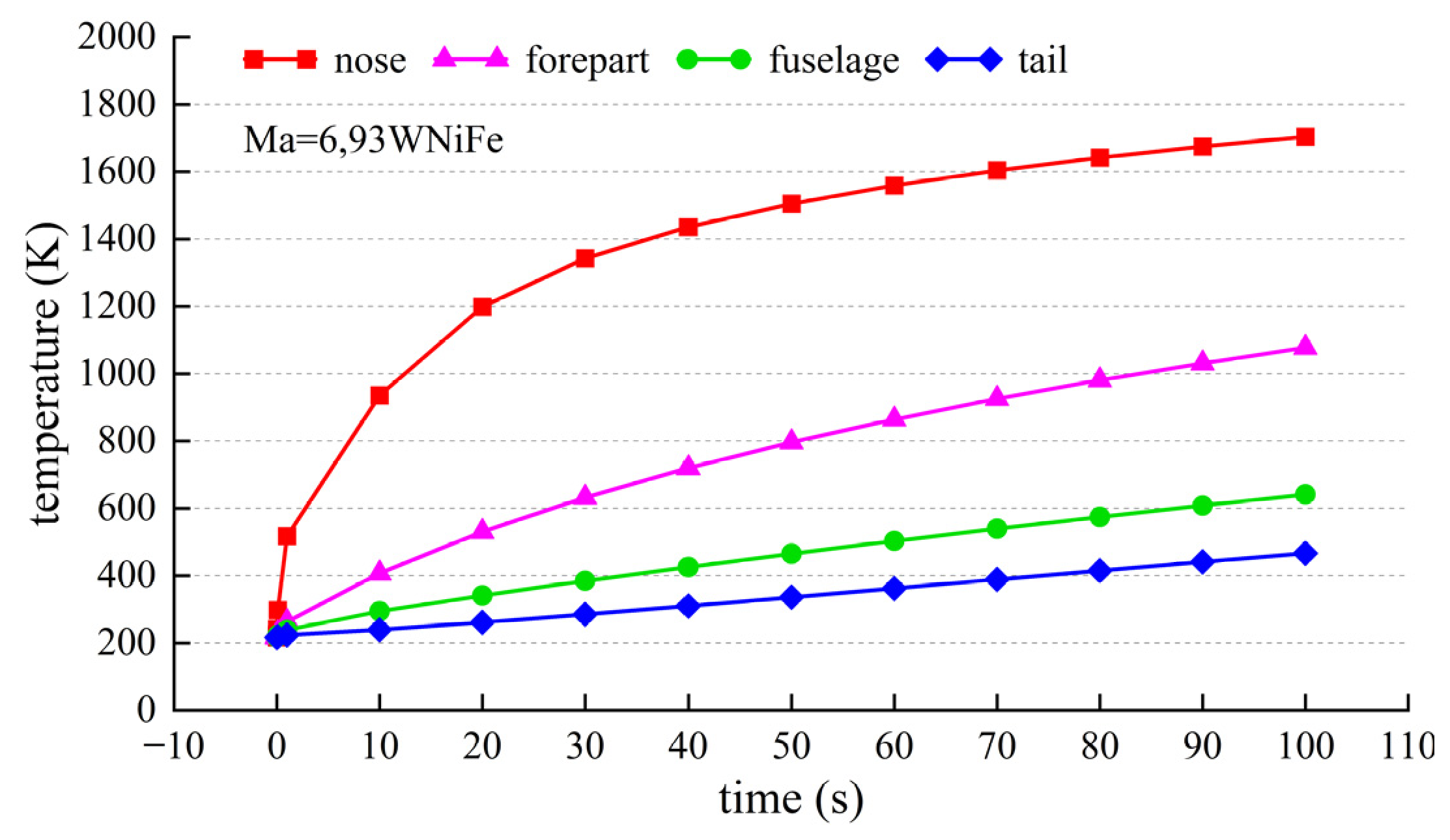
Figure 25 shows the temperature–time curves at different characteristic surfaces of the aircraft flying at Mach 6. At t = 10 s, the average temperatures of the nose, forepart, fuselage and tail characteristic surfaces were 936 K, 407 K, 294 K and 239 K, respectively. At t = 50 s, they were 1505 K, 796 K, 465 K and 336 K, respectively. At t = 100 s, they were 1703 K, 1077 K, 641 K and 467 K, respectively. During the 100 s coupled heat transfer process, the temperature increases for the nose, forepart, fuselage and tail were approximately 1487 K, 860 K, 424 K and 250 K, respectively.

3.2.3. Coupled Heat Transfer Results for the TA19 Aircraft

Temperature contour plots of the aircraft at Mach 6 for different flight times are shown in Table A5 of Appendix A. The aircraft material is TA19 titanium alloy. The table displays the temperature contour plots for the aircraft at coupled heat transfer times of 1 s, 10 s, 20 s, 30 s, 40 s, 50 s and 100 s. When t = 10 s, the maximum temperature of the aircraft exceeded 1420 K. When t = 50 s, it exceeded 1880 K. When t = 100 s, it exceeded 2050 K.
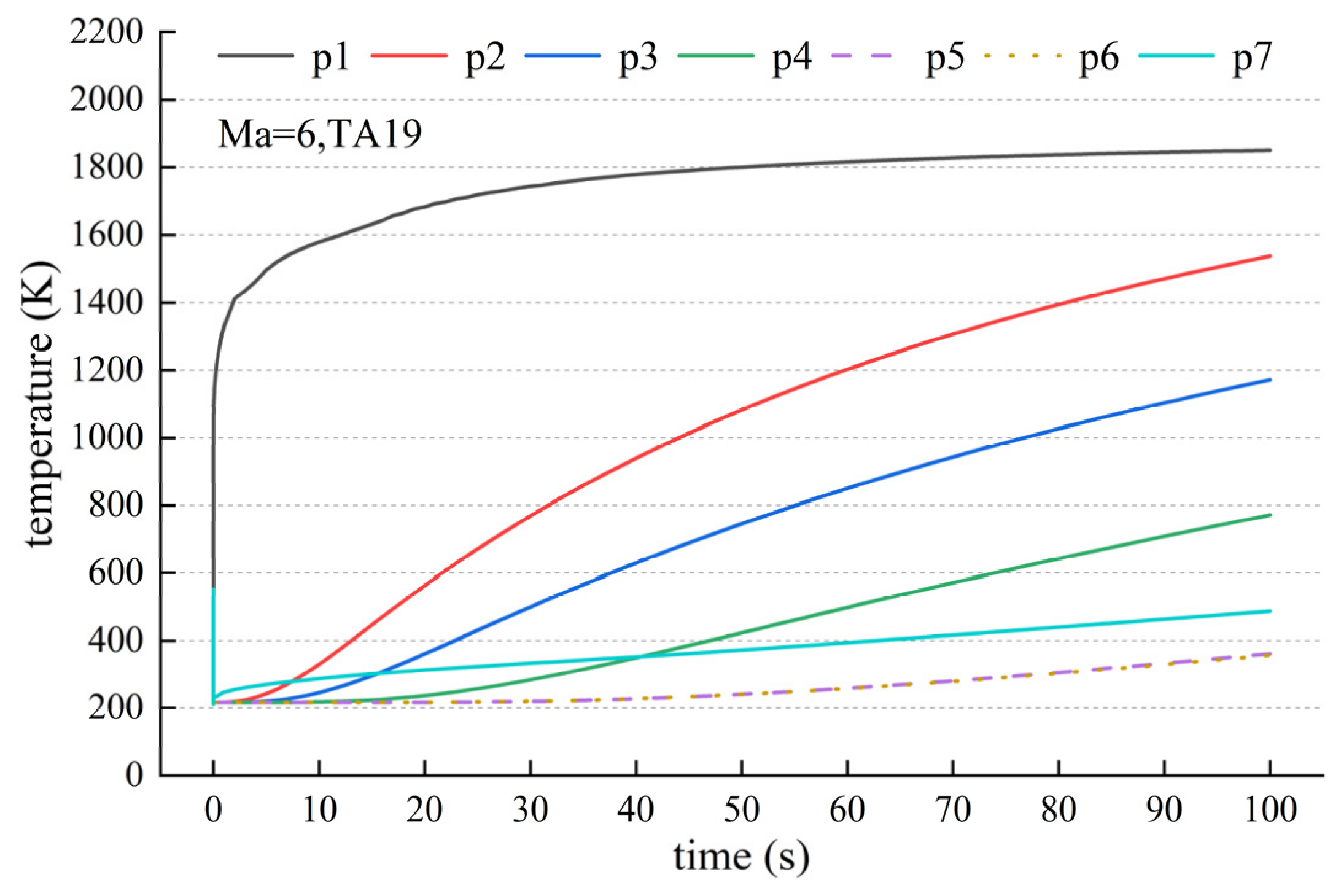
Figure 26 shows the temperature–time curves at different characteristic points of the aircraft flying at Mach 6. At t = 10 s, the temperatures at p1-p7 were 1579 K, 330 K, 245 K, 218 K, 217 K, 217 K, and 288 K, respectively. At t = 50 s, they were 1800 K, 1082 K, 746 K, 423 K, 241 K, 240 K, and 372 K, respectively. At t = 100 s, they were 1851 K, 1538 K, 1172 K, 771 K, 361 K, 357 K, and 487 K, respectively.
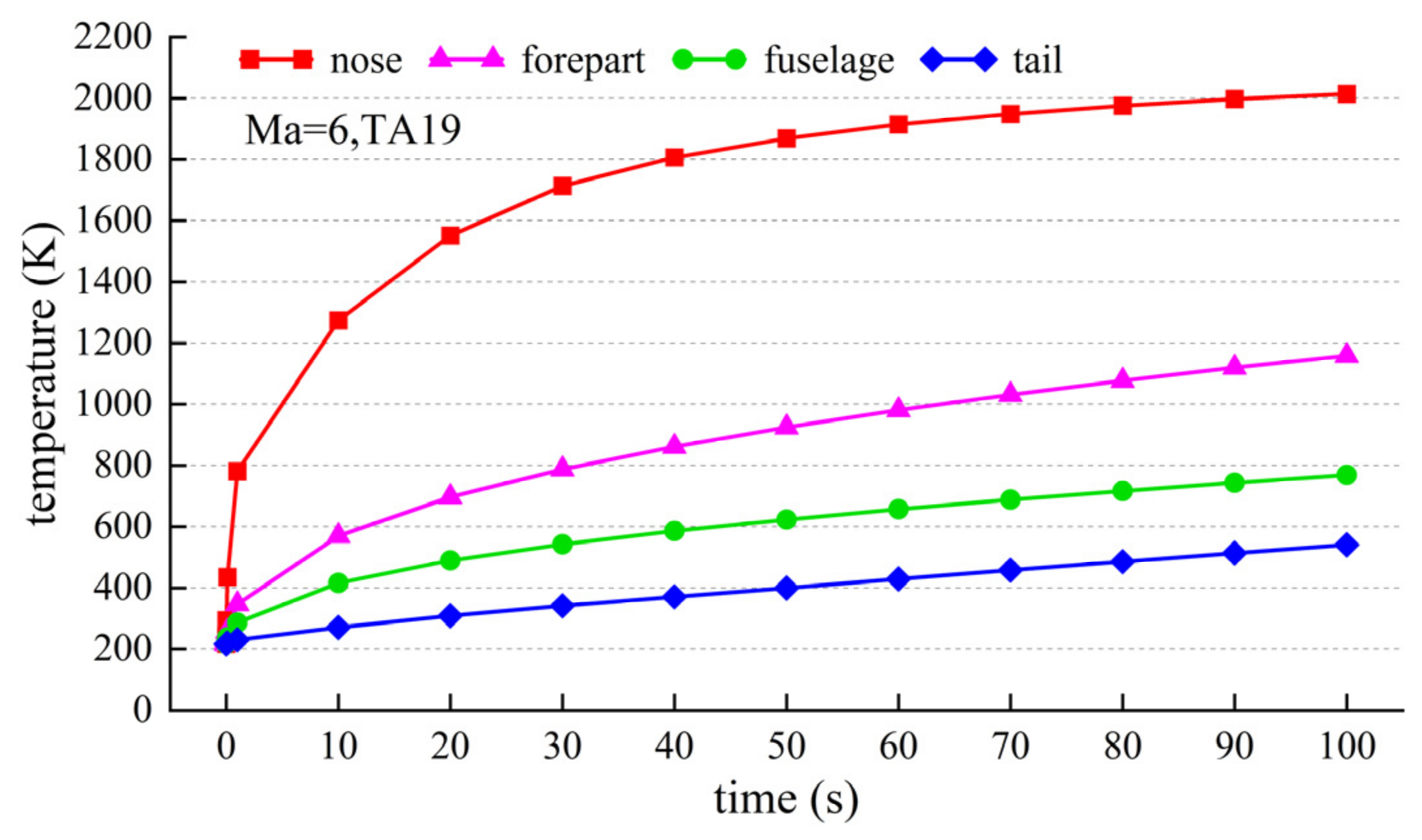
Figure 27 shows the temperature–time curves at different characteristic surfaces of the aircraft flying at Mach 6. At t = 10 s, the average temperatures of the nose, forepart, fuselage and tail characteristic surfaces were 1274 K, 570 K, 416 K and 271 K, respectively. At t = 50 s, they were 1869 K, 925 K, 623 K and 400 K, respectively. At t = 100 s, they were 2014 K, 1159 K, 769 K, and 541 K, respectively. During the 100 s coupled heat transfer process, the temperature increases for the nose, forepart, fuselage and tail were approximately 1797 K, 942 K, 552 K, and 324 K, respectively.

3.2.4. Coupled Heat Transfer Analysis of Aircraft Made of Different Materials

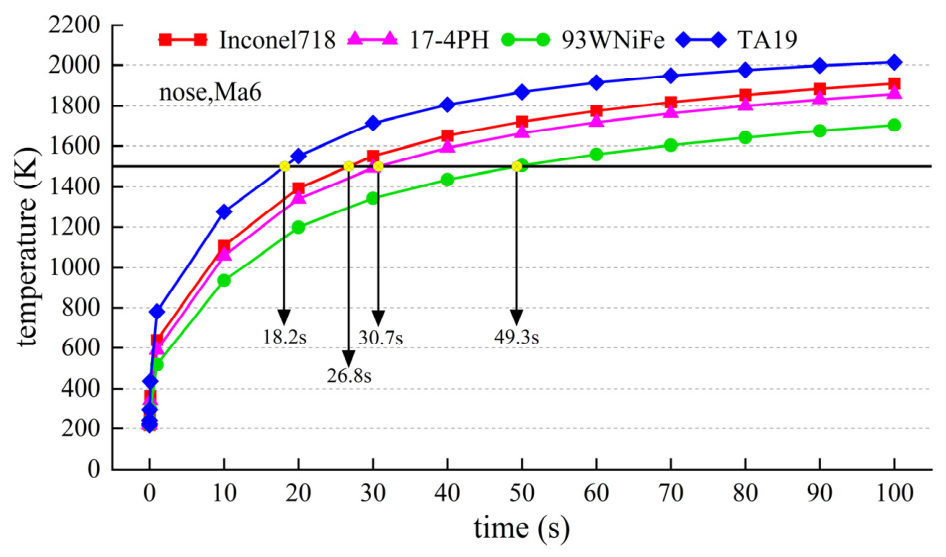
Figure 28 shows the curves of nose temperature of the aircraft as functions of material and time. When the aircraft material is TA19, the thermal conductivity and thermal diffusivity are relatively low, and the nose temperature reaches 1500 K after 18.2 s of flight. For Inconel718, the nose temperature reaches 1500 K after 26.8 s, which is 8.6 s later than that for TA19. For 17-4PH, it reaches 1500 K after 30.7 s, 12.5 s later than TA19. For 93WNiFe, which has higher thermal conductivity and thermal diffusivity, the nose temperature reaches 1500 K after 49.3 s, 31.1 s later than that for TA19. The study indicates that, at a fixed Mach number, the nose temperature increases with time. The physical properties of high thermal conductivity and high thermal diffusivity significantly mitigate the thermal concentration phenomenon caused by aerodynamic heating.
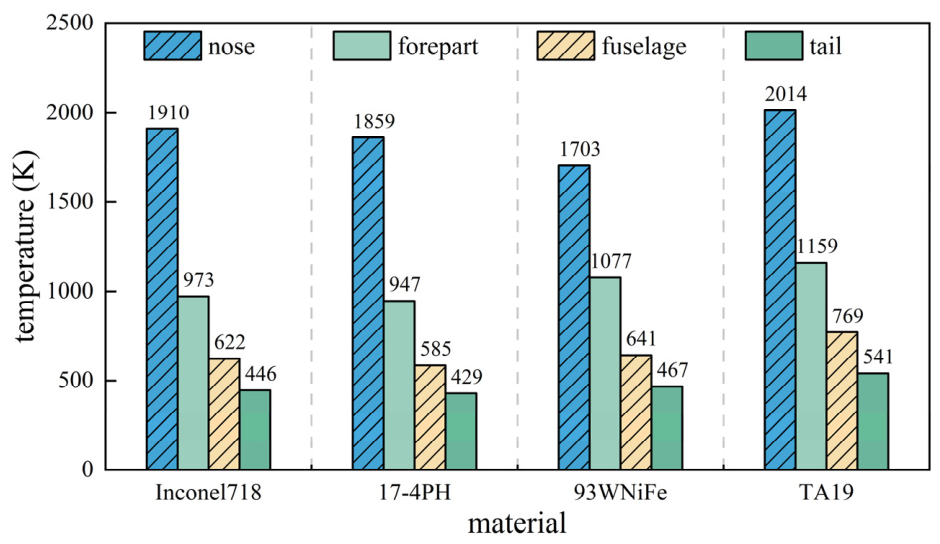
Figure 29 shows a bar chart of temperature at different characteristic surfaces as a function of material for the aircraft at t = 100 s. All materials exhibit the typical distribution where the temperature is highest at the nose and gradually decreases along the flow direction. However, the temperature gradients and temperature differences vary significantly among materials, reflecting the regulatory role of material properties in coupled heat transfer. The temperature relationship at the nose is TA19 > Inconel 718 > 17-4PH > 93WNiFe. The temperature relationships at the forepart, fuselage and tail are TA19 > 93WNiFe > Inconel 718 > 17-4PH. The TA19 aircraft exhibits the highest temperatures at all four surfaces. Due to its low thermal conductivity and low thermal diffusivity, heat primarily accumulates at the nose, reaching a temperature as high as 2014 K, indicating that its thermal protection performance is the poorest. The 93WNiFe aircraft exhibits the lowest nose temperature. Its high thermal conductivity and high thermal diffusivity enable rapid heat redistribution along the axial direction, reducing the nose temperature to 1703 K, which is 311 K lower than that of TA19. This effectively alleviates leading-edge heat concentration, although temperatures at other surfaces remain relatively high. The 17-4PH aircraft exhibits the lowest temperatures at the fuselage and tail (429~585 K), a relatively low temperature at the forepart (947 K), and a relatively low nose temperature (1859 K), demonstrating the best overall thermal protection performance. The lower the average temperature of the four characteristic surfaces, the better the thermal protection performance. The average temperatures of the characteristic surfaces for 17-4PH, 93WNiFe, Inconel 718, and TA19 are 955 K, 972 K, 988 K, and 1121 K, respectively. The 17-4PH shows the best overall thermal protection performance. The study indicates that 93WNiFe exhibits excellent thermal protection performance at the nose. Inconel 718 demonstrates good thermal protection performance. TA19 exhibits the poorest thermal protection performance. The ranking of thermal protection performance is 17-4PH > 93WNiFe > Inconel 718 > TA19. It should be noted that the thermal protection performance is obtained under the flight condition at Mach 6.

3.3. Coupled Heat Transfer Prediction and Analysis

The numerical simulation model developed for coupled heat transfer in hypersonic cruise aircraft is used to analyze temperature variations at the aircraft’s characteristic surfaces over time under different Mach numbers. Building on Section 3.1, the function of nose temperature versus time for the Inconel 718 aircraft flying at Mach 6 is obtained through nonlinear data fitting, as shown in Equation (3). During the initial phase of coupled heat transfer (0–20 s), heat generated by aerodynamic heating is primarily deposited in the thin boundary layer and is conducted into the interior and downstream. At this stage, the structure has not yet reached thermal equilibrium, and the temperature distribution exhibits transient heat conduction characteristics. The nose temperature of the aircraft rises rapidly, exhibiting a power–law relationship with time. In the late stage of coupled heat transfer (after 20 s), the temperature continues to rise, but the internal temperature gradient of the aircraft gradually decreases, and the temperature distribution gradually exhibits quasi-steady-state heat conduction characteristics. The heating rate decreases significantly and tends toward equilibrium, with the nose temperature following an exponential saturation growth relationship with time.
T nose = 216.7 + 379.1 t 0.378 , 0 t < 20 , R 2 = 0.998 1936.8 543.2 e 0.032 ( t 20 ) , 20 t 100 , R 2 = 0.997
In this paper, the functions of temperature versus Mach number for the four characteristic surfaces of the Inconel 718 aircraft are obtained through nonlinear data fitting, as shown in Equation (4). The flight duration is 100 s. These functions reveal the differential growth mechanisms of temperatures at various surfaces of the aircraft with respect to Mach number. The nose experiences intense shock heating, with the temperature exhibiting power–law growth, reflecting the extreme sensitivity of the nose temperature to Mach number. The forepart is located in the compression zone, where heat flux is weaker than at the nose. Due to aerodynamic heating and heat conduction from the nose, the temperature still increases according to a power–law function, but with a decreasing exponent. The fuselage is situated in the turbulent boundary layer development zone, where heat flux primarily originates from wall friction, and the temperature exhibits an approximately linear relationship. The tail is located in the recirculation zone at the underside of the aircraft, where the temperature exhibits a saturated logarithmic growth. This region is characterized by low-pressure, low-velocity recirculating flow, accompanied by separation and reattachment phenomena. As the Mach number increases, the convective heat transfer coefficient gradually approaches saturation as separation in the recirculation zone intensifies and momentum exchange with the high-velocity external flow diminishes. The logarithmic function is precisely the typical mathematical form used to describe slowing growth and convergence to a limit. These functions not only fit the numerical results but also describe, from a physical perspective, the differences in coupled heat transfer mechanisms at different surfaces, providing a reference for the thermal protection design of hypersonic aircraft.
T nose = 42.30 M a 2.12 T forepart = 52.08 M a 1.63 T fuselage = 109.04 M a 30.89 T tail = 392.68 ln ( M a ) 251.75 , 6 M a 9 , R 2 = 0.979
The fitting equations proposed in this study are based on a specific geometric shape, an axisymmetric two-dimensional model and the ideal gas assumption, and are applicable for the prediction of coupled heat transfer under Mach number conditions ranging from 6 to 9. For hypersonic blunt-nosed conical aircraft configurations with similar aspect ratios, the equations can serve as a preliminary design reference.

4. Conclusions

This study employs numerical simulation techniques to investigate the characteristics and evolution of coupled heat transfer with Mach number for hypersonic cruise aircraft as well as differences in coupled heat transfer among different materials. The study is based on a specific geometric shape, an axisymmetric two-dimensional model and the ideal gas assumption. Under conditions of high enthalpy or high Mach number, corrections accounting for thermochemical non-equilibrium effects are required. The main conclusions are as follows:
(1)
A numerical simulation model for coupled heat transfer in hypersonic wide-speed-range cruise aircraft is established. Mesh independence verification is conducted to ensure the accuracy and reliability of the numerical simulation.
(2)
Temperature distributions under Mach numbers of 6, 7, 8 and 9 are analyzed via numerical simulation, revealing the variation pattern of coupled heat transfer in the aircraft with respect to Mach number. The aircraft temperature increases as the Mach number increases. The effect of Mach number variations is most significant at the nose and least significant at the tail.
(3)
The temperature distributions of metallic materials are analyzed through numerical simulation, revealing the heat transfer characteristics of aircraft made of different materials. The ranking of thermal protection performance is 17-4PH > 93WNiFe > Inconel 718 > TA19.
(4)
The functions relating nose temperature to time and surface temperatures to Mach number are fitted, revealing the differential growth mechanism of temperature with Mach number at various surfaces of the aircraft under hypersonic conditions.

Author Contributions

Conceptualization, S.G., S.M. and L.G.; methodology, S.G. and S.M.; software, S.G.; validation, S.G. and Z.A.; investigation, K.J.; data curation, S.G. and Z.A.; writing—original draft preparation, S.G.; writing—review and editing, S.G., Z.A. and K.J. All authors have read and agreed to the published version of the manuscript.

Funding

This research received no external funding.

Data Availability Statement

The datasets used and analyzed during the current study are available from the author on reasonable request.

Conflicts of Interest

The authors declare no conflicts of interest.

Appendix A

Table A1. Temperature contour plots of the aircraft at Mach 7 for different flight times (Inconel 718).
Serial NumberTime (s)Temperature Contour Plots (K)
Inconel 718Ma7011Aerospace 13 00459 i001
Inconel 718Ma70210Aerospace 13 00459 i002
Inconel 718Ma70320Aerospace 13 00459 i003
Inconel 718Ma70430Aerospace 13 00459 i004
Inconel 718Ma70540Aerospace 13 00459 i005
Inconel 718Ma70650Aerospace 13 00459 i006
Inconel 718Ma707100Aerospace 13 00459 i007
Table A2. Temperature contour plots of the aircraft at Mach 8 for different flight times (Inconel 718).
Serial NumberTime (s)Temperature Contour Plots (K)
Inconel 718Ma8011Aerospace 13 00459 i008
Inconel 718Ma80210Aerospace 13 00459 i009
Inconel 718Ma80320Aerospace 13 00459 i010
Inconel 718Ma80430Aerospace 13 00459 i011
Inconel 718Ma80540Aerospace 13 00459 i012
Inconel 718Ma80650Aerospace 13 00459 i013
Inconel 718Ma807100Aerospace 13 00459 i014
Table A3. Temperature contour plots of the aircraft at Mach 9 for different flight times (Inconel 718).
Serial NumberTime (s)Temperature Contour Plots (K)
Inconel 718Ma9011Aerospace 13 00459 i015
Inconel 718Ma90210Aerospace 13 00459 i016
Inconel 718Ma90320Aerospace 13 00459 i017
Inconel 718Ma90430Aerospace 13 00459 i018
Inconel 718Ma90540Aerospace 13 00459 i019
Inconel 718Ma90650Aerospace 13 00459 i020
Inconel 718Ma907100Aerospace 13 00459 i021
Table A4. Temperature contour plots of the aircraft at Mach 6 for different flight times (93WNiFe).
Serial NumberTime (s)Temperature Contour Plots (K)
93WNiFeMa6011Aerospace 13 00459 i022
93WNiFeMa60210Aerospace 13 00459 i023
93WNiFeMa60320Aerospace 13 00459 i024
93WNiFeMa60430Aerospace 13 00459 i025
93WNiFeMa60540Aerospace 13 00459 i026
93WNiFeMa60650Aerospace 13 00459 i027
93WNiFeMa607100Aerospace 13 00459 i028
Table A5. Temperature contour plots of the aircraft at Mach 6 for different flight times (TA19).
Serial NumberTime (s)Temperature Contour Plots (K)
TA19Ma6011Aerospace 13 00459 i029
TA19Ma60210Aerospace 13 00459 i030
TA19Ma60320Aerospace 13 00459 i031
TA19Ma60430Aerospace 13 00459 i032
TA19Ma60540Aerospace 13 00459 i033
TA19Ma60650Aerospace 13 00459 i034
TA19Ma607100Aerospace 13 00459 i035

References

  1. Sziroczak, D.; Smith, H. A review of design issues specific to hypersonic flight vehicles. Prog. Aeosp. Sci. 2016, 84, 044105. [Google Scholar] [CrossRef]
  2. Wan, Z.; Ma, L.; Wang, X.; Sun, Z.; Yang, C. Aerothermoelastic problems of hypersonic vehicles and their recent research progress. Acta Astronaut. 2025, 236, 982–1011. [Google Scholar] [CrossRef]
  3. Peters, A.; Zhang, D.; Chen, S.; Ott, C.; Oses, C.; Curtarolo, S.; McCue, I.; Pollock, T.; Prameela, S. Materials design for hypersonics. Nat. Commun. 2024, 15, 15. [Google Scholar] [CrossRef]
  4. Bano, S.; van Pelt, H.; Wild, G.; AIAA. Evolving Thermal Protection Systems: A Comprehensive Review of Materials, Sensing Technologies, and Smart Solutions. In Proceedings of the 2025 AIAA Aviation Forum and Ascend, Las Vegas, NV, USA, 21–25 July 2025. [Google Scholar]
  5. Hu, F.; Wang, J.; Sui, Z.; Lin, G.; Zhao, W.; Jin, H.; You, Y. A review on research progress of large area thermal protection structures for hypersonic vehicles. Acta Astronaut. 2025, 232, 541–556. [Google Scholar] [CrossRef]
  6. Anderson, J.D., Jr. Hypersonic and High-Temperature Gas Dynamics, 2nd ed.; American Institute of Aeronautics and Astronautics: Reston, VA, USA, 2006. [Google Scholar]
  7. Lewis, M.; Hickey, J. Conjugate Heat Transfer in High-Speed External Flows: A Review. J. Thermophys. Heat Transf. 2023, 37, 697–712. [Google Scholar] [CrossRef]
  8. Zhong, X.; Wang, X. Direct Numerical Simulation on the Receptivity, Instability, and Transition of Hypersonic Boundary Layers. Annu. Rev. Fluid Mech. 2012, 44, 527–561. [Google Scholar] [CrossRef]
  9. Knight, D.; Mortazavi, M. Hypersonic shock wave transitional boundary layer interactions—A review. Acta Astronaut. 2018, 151, 296–317. [Google Scholar] [CrossRef]
  10. Candler, G.V. Rate Effects in Hypersonic Flows. Annu. Rev. Fluid Mech. 2019, 51, 379–402. [Google Scholar] [CrossRef]
  11. Fan, M.; Zhenxun, G.; Chongwen, J.; Chunhian, L. Progress in the numerical study on the aerodynamic and thermal characteristics of hypersonic vehicles: High-temperature chemical non-equilibrium effect. Sci. Sin. Phys. Mech. Astron. 2021, 51, 104703. [Google Scholar]
  12. Viviani, A.; Aprovitola, A.; Pezzella, G.; Rainone, C. CFD design capabilities for next generation high-speed aircraft. Acta Astronaut. 2021, 178, 143–158. [Google Scholar] [CrossRef]
  13. Tang, Z.; Xu, H.; Li, X.; Ren, J. Aerodynamic heating in hypersonic shock wave and turbulent boundary layer interaction. J. Fluid Mech. 2024, 999, A66. [Google Scholar] [CrossRef]
  14. Raje, P.; Parish, E.; Hickey, J.; Cinnella, P.; Duraisamy, K. Recent developments and research needs in turbulence modeling of hypersonic flows. Phys. Fluids 2025, 37, 39. [Google Scholar] [CrossRef]
  15. Liu, X.; Zhuang, Y.; Wang, G.; He, C.; Liu, Y.; Peng, D. Global aerothermal effects and their symmetry in hypersonic transitional swept shock wave/boundary-layer interactions. J. Fluid Mech. 2025, 1023, 28. [Google Scholar] [CrossRef]
  16. Zhao, X.; Sun, Z.; Tang, L.; Zheng, G. Coupled Flow-Thermal-Structural Analysis Of Hypersonic Aerodynamically Heated Cylindrical Leading Edge. Eng. Appl. Comp. Fluid Mech. 2011, 5, 170–179. [Google Scholar] [CrossRef]
  17. Zhang, S.; Chen, F.; Liu, H. Time-Adaptive Loosely Coupled Strategy for Conjugate Heat Transfer Problems in Hypersonic Flows. J. Thermophys. Heat Transf. 2014, 28, 635–646. [Google Scholar] [CrossRef]
  18. Huang, J.; Yao, W.; Shan, X.; Chang, C. Coupled Fluid-Structural Thermal Numerical Methods for Thermal Protection System. AIAA J. 2019, 57, 3630–3638. [Google Scholar] [CrossRef]
  19. Errera, M.; Moretti, R.; Mayeur, J.; Gelain, M.; Tessé, L.; Lamet, J.; Laroche, E. A numerical predictive model for conjugate heat transfer with radiation. Int. J. Heat Mass Transf. 2020, 160, 14. [Google Scholar] [CrossRef]
  20. Zhou, D.; Lu, Z.; Guo, T.; Chen, G. A loosely-coupled gas-kinetic BGK scheme for conjugate heat transfer in hypersonic flows. Int. J. Heat Mass Transf. 2020, 147, 17. [Google Scholar] [CrossRef]
  21. Yang, X.; Xiao, G.; Du, Y.; Liu, L.; Wei, D.; Gui, Y. Heat transfer with interface effects in high-enthalpy and high-speed flow: Modelling review and recent progress. Appl. Therm. Eng. 2021, 195, 21. [Google Scholar] [CrossRef]
  22. John, B.; Chandrashekhara, S.; Panneerselvam, V. Conjugate heat transfer study of hypersonic flow past a cylindrical leading edge composed of functionally graded materials. Proc. Inst. Mech. Eng. Part C J. Eng. Mech. Eng. Sci. 2022, 236, 4394–4411. [Google Scholar] [CrossRef]
  23. Appar, A.; Kumar, R.; Naspoori, S. Conjugate flow-thermal analysis of a hypersonic reentry vehicle in the rarefied flow regime. Phys. Fluids 2022, 34, 20. [Google Scholar] [CrossRef]
  24. Junyuan, Y.; Xudong, L.; Shuhua, Z.; Wenwen, Z.; Fu, Z.; Weifang, C. Research on the Aero-Heating at the Sharpened Leading Edge Based on Nonlinear Coupled Constitutive Relations. Chin. J. Theor. Appl. Mech. 2023, 55, 2321–2330. [Google Scholar]
  25. Du, C.; Chen, Z.; Li, W.; Gao, Z. Studies on acceleration algorithms for numerical simulations of hypersonic conjugate heat transfer problems. Comput. Fluids 2024, 275, 12. [Google Scholar] [CrossRef]
  26. Lin, W.; Hu, F.; Sui, Z.; Wang, Y.; Jin, H.; You, Y. The investigation of fluid-thermal-catalysis-radiation coupling scheme of conjugate heat transfer for heterogeneous recombination reaction process. Int. J. Heat Mass Transf. 2025, 241, 19. [Google Scholar] [CrossRef]
  27. Cao, Z.; Ma, C. A Non-Intrusive DSMC-FEM Coupling Method for Two-Dimensional Conjugate Heat Transfer in Rarefied Hypersonic Conditions. Aerospace 2025, 12, 1021. [Google Scholar] [CrossRef]
  28. Gao, S.; Jia, K.; Ma, S.; Ai, Z. Shock Angle Characteristics and Test Analysis of Hypersonic Wide-Speed-Range Cruise Aircraft. Aerospace 2026, 13, 170. [Google Scholar] [CrossRef]
  29. White, F.M.; Xue, H. Fluid Mechanics; McGraw-Hill Education: Columbus, OH, USA, 2021. [Google Scholar]
  30. Menter, F. 2-Equation Eddy-Viscosity Turbulence Models For Engineering Applications. AIAA J. 1994, 32, 1598–1605. [Google Scholar] [CrossRef]
  31. Yu, Z.; Hongbo, W.; Mingbo, S.; Chao, W.; Xu, L. SST turbulence model improvements: Review. Acta Aeronaut. Astronaut. Sin. 2023, 44, 103–134. [Google Scholar]
  32. Tu, J.; Yeoh, G.H.; Liu, C.; Tao, Y. Computational Fluid Dynamics: A Practical Approach; Elsevier: Amsterdam, The Netherlands, 2023. [Google Scholar]
Figure 1. Hypersonic cruise aircraft.
Aerospace 13 00459 g001
Figure 2. Schematic diagram of the aircraft’s aerodynamic dimensions.
Aerospace 13 00459 g002
Figure 3. Numerical simulation methods for coupled heat transfer.
Aerospace 13 00459 g003
Figure 4. Aircraft boundary naming.
Aerospace 13 00459 g004
Figure 5. Schematic diagram of fluid domain dimensions.
Aerospace 13 00459 g005
Figure 6. The distribution of the dimensionless wall distance on the wall surface.
Aerospace 13 00459 g006
Figure 7. Numerical simulation results of stagnation temperature for different mesh densities.
Aerospace 13 00459 g007
Figure 8. Schematic diagram of fluid and solid domain naming and boundary layer refinement.
Aerospace 13 00459 g008
Figure 9. Mach contour plot at Ma = 6.
Aerospace 13 00459 g009
Figure 10. Temperature contour plot at Ma = 6.
Aerospace 13 00459 g010
Figure 11. Schematic diagram of the distribution of characteristic points.
Aerospace 13 00459 g011
Figure 12. Temperature–time curves at different characteristic points (Ma = 6, Inconel 718).
Aerospace 13 00459 g012
Figure 13. Temperature–time curves at different characteristic surfaces (Ma = 6, Inconel 718).
Aerospace 13 00459 g013
Figure 14. Temperature–time curves at different characteristic points (Ma = 7, Inconel 718).
Aerospace 13 00459 g014
Figure 15. Temperature–time curves at different characteristic surfaces (Ma = 7, Inconel 718).
Aerospace 13 00459 g015
Figure 16. Temperature–time curves at different characteristic points (Ma = 8, Inconel 718).
Aerospace 13 00459 g016
Figure 17. Temperature–time curves at different characteristic surfaces (Ma = 8, Inconel 718).
Aerospace 13 00459 g017
Figure 18. Temperature–time curves at different characteristic points (Ma = 9, Inconel 718).
Aerospace 13 00459 g018
Figure 19. Temperature–time curves at different characteristic surfaces (Ma = 9, Inconel 718).
Aerospace 13 00459 g019
Figure 20. Curves of aircraft nose temperature as functions of Mach number and time.
Aerospace 13 00459 g020
Figure 21. Temperature versus Mach number bar chart for different characteristic surfaces.
Aerospace 13 00459 g021
Figure 22. Temperature–time curves at different characteristic points (Ma = 6, 17-4PH).
Aerospace 13 00459 g022
Figure 23. Temperature–time curves at different characteristic surfaces (Ma = 6, 17-4PH).
Aerospace 13 00459 g023
Figure 24. Temperature–time curves at different characteristic points (Ma = 6, 93WNiFe).
Aerospace 13 00459 g024
Figure 25. Temperature–time curves at different characteristic surfaces (Ma = 6, 93WNiFe).
Aerospace 13 00459 g025
Figure 26. Temperature–time curves at different characteristic points (Ma = 6, TA19).
Aerospace 13 00459 g026
Figure 27. Temperature–time curves at different characteristic surfaces (Ma = 6, TA19).
Aerospace 13 00459 g027
Figure 28. Curves of aircraft nose temperature as functions of material and time.
Aerospace 13 00459 g028
Figure 29. Comparison of temperatures for different materials at characteristic surfaces.
Aerospace 13 00459 g029
Table 1. Parameters and results for different mesh densities.
Mesh DensityFirst-Layer Mesh Height (mm)Number of MeshesIteration Step CountStagnation
Temperature (K)
Coarse0.01108,7391711771.3
Medium0.01154,6192031772.3
Fine0.01206,4992251772.6
Table 2. Positions of characteristic points.
Characteristic Pointsp1p2p3p4p5p6p7
X (mm)04080160320480720
Y (mm)0000000
X/D00.512469
Table 3. Temperature contour plots of the aircraft at Mach 6 for different flight times (Inconel 718).
Serial NumberTime (s)Temperature Contour Plots (K)
Inconel 718Ma6011Aerospace 13 00459 i036
Inconel 718Ma60210Aerospace 13 00459 i037
Inconel 718Ma60320Aerospace 13 00459 i038
Inconel 718Ma60430Aerospace 13 00459 i039
Inconel 718Ma60540Aerospace 13 00459 i040
Inconel 718Ma60650Aerospace 13 00459 i041
Inconel 718Ma607100Aerospace 13 00459 i042
Table 4. Thermophysical properties of different metal materials.
MaterialDensity
[g/cm3]
Specific Heat Capacity
[J/(kg·K)]
Thermal Conductivity
[W/(m·K)]
Type
Inconel 7188.1943511.4superalloy
17-4PH7.7546017.9stainless steel
93WNiFe17.6813484.0high-density alloy
TA194.535286.8titanium alloy
Table 5. Temperature contour plots of the aircraft at Mach 6 for different flight times (17-4PH).
Serial NumberTime (s)Temperature Contour Plots (K)
17-4PHMa6011Aerospace 13 00459 i043
17-4PHMa60210Aerospace 13 00459 i044
17-4PHMa60320Aerospace 13 00459 i045
17-4PHMa60430Aerospace 13 00459 i046
17-4PHMa60540Aerospace 13 00459 i047
17-4PHMa60650Aerospace 13 00459 i048
17-4PHMa607100Aerospace 13 00459 i049
Disclaimer/Publisher’s Note: The statements, opinions and data contained in all publications are solely those of the individual author(s) and contributor(s) and not of MDPI and/or the editor(s). MDPI and/or the editor(s) disclaim responsibility for any injury to people or property resulting from any ideas, methods, instructions or products referred to in the content.